 Скачать презентацию Breakout Forum A C-Level View of the Capital
8a68c82f41f418ec91c24e32afff9250.ppt
- Количество слайдов: 21



Breakout Forum A C-Level View of the Capital Project Portfolio Emerson T. Johns Global Financial Manager Du. Pont 2008 CII Chairman
Capital Expenditures Ø Corporate Executive and Investment Community perspectives Ø Critical issues and expectations Ø What this means to the E&C industry
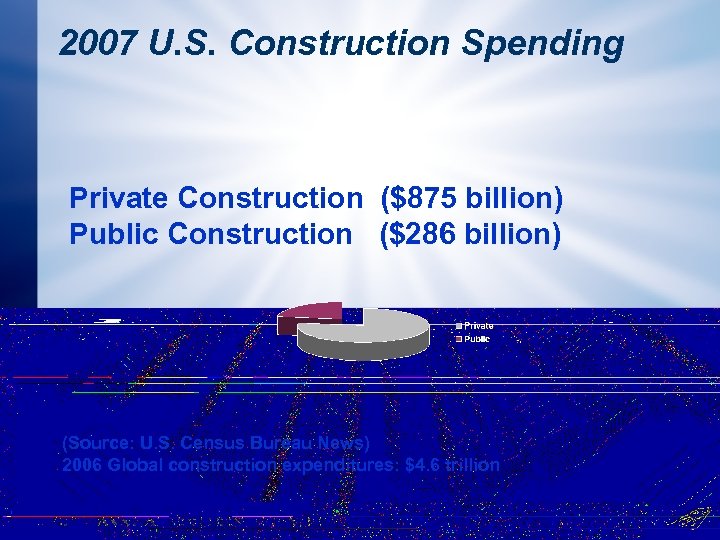
2007 U. S. Construction Spending Private Construction ($875 billion) Public Construction ($286 billion) (Source: U. S. Census Bureau News) 2006 Global construction expenditures: $4. 6 trillion
Capital Expenditures CEO and CFO Perspectives-Examples Ø Maintain a strong balance sheet Ø Drive sustained profitable growth globally Ø Satisfy shareholder expectations (e. g. , Cash Flow Return on Investment, i. e. , CFROI) Ø Capital allocation process Ø Manage risk Ø Sustainability Ø Dependence/reliance on technology Ø Attracting the right talent (and keeping them) to improve business outcomes Ø Adapt to change and respond strategically (speed, flexibility, adaptability) Ø Having an effective capital execution process Ø Ensuring new assets operate efficiently and effectively Ø Containing costs (minimize delays, overruns, etc. )
Capital Expenditures Investment Community Perspective-Examples Ø Key Metric – Cash Flow Return on Investment (CFROI) Ø Grow high return businesses Ø Enhance your ability to increase (or hold on to) high returns - may be new products or new features that allow you to price higher Ø Give you a competitive advantage that you can translate into pricing and/or higher market share Ø Improve fixed asset utilization Ø Allow you to reduce inventory Ø Make an asset more functional – i. e. , improve operating performance and improve returns on that asset
Financial Planning-Capital Investments Cash Flow Measures Ø Net Present Value (NPV) – the value of forecast cash flows if discounted to the present at a given discount rate. Ø Internal Rate of Return (IRR) – financial return realized over the life of an investment. Ø Profitability Index (PI) – present value of future cash inflows generated by project divided by present value of cash outflows. Ø Discounted Payback (DP) – measures the time required for projected cash flows from a proposed investment, discounted at the cost of capital, to equal the initial cash outflow. Ø Cash Flow Return on Investment (CFROI) – measures return on capital on a cash basis; metric useful to assess the quality of a particular investment compared to other “investment” choices (e. g. , R&D)
Financial Planning-Capital Investments Capital Investment Financial/Business Case Learnings Ø Business case analysis (market, pricing, and other key assumptions) Ø Cash flow metrics (original project premise versus actual) Ø Application of learnings to future projects, capital allocation decisions, and risk management process
Financial Management—Capital Key Metrics Business Team § § § Net Present Value (NPV) and Internal Rate of Return (IRR) Discounted Payback Period Profitability Index Project Team § § § Expenditures (capital and non-capital) Schedule Safety Operability/Quality Impact of project on operations Cost of Manufacturing (e. g. , maintenance, reliability, energy, environmental, yields, uptime, etc. ) Corporate § § Capital Allocation Shareholder Value Add (SVA) and Return on Net Assets (RONA) Return on Equity (ROE) Reports on Accomplishment
Capital Expenditures Risk - A Leader’s Concern
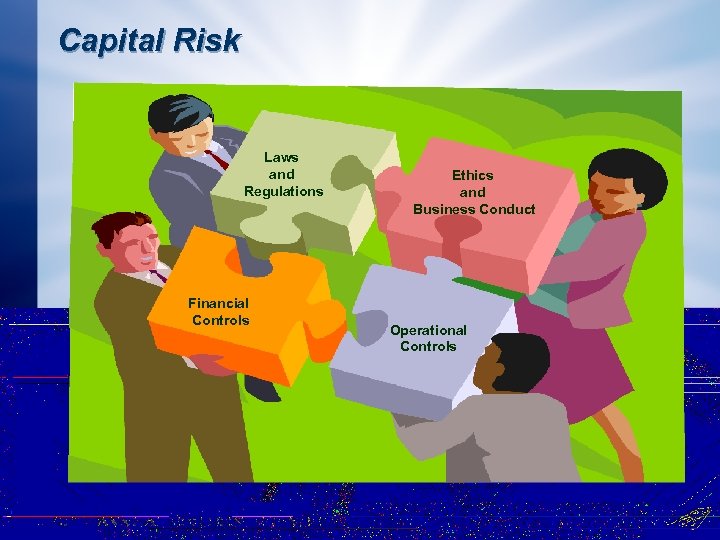
Capital Risk Laws and Regulations Financial Controls Ethics and Business Conduct Operational Controls
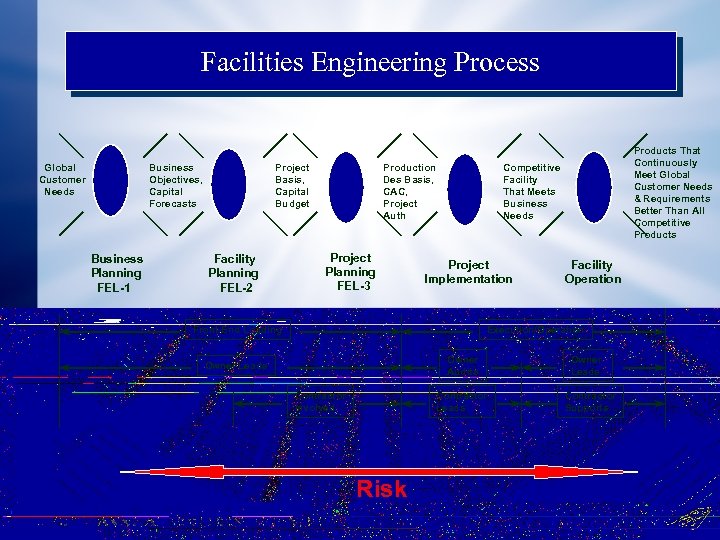
Facilities Engineering Process Global Customer Needs Business Objectives, Capital Forecasts Business Planning FEL-1 Project Basis, Capital Budget Facility Planning FEL-2 Production Des Basis, CAC, Project Auth Project Planning FEL-3 Products That Continuously Meet Global Customer Needs & Requirements Better Than All Competitive Products Competitive Facility That Meets Business Needs Project Implementation Front-End Loading Facility Operation Execution/Operation Owner Audits Owner Leads Contractor Involved Contractor Leads Risk Owner Leads Contractor Supports
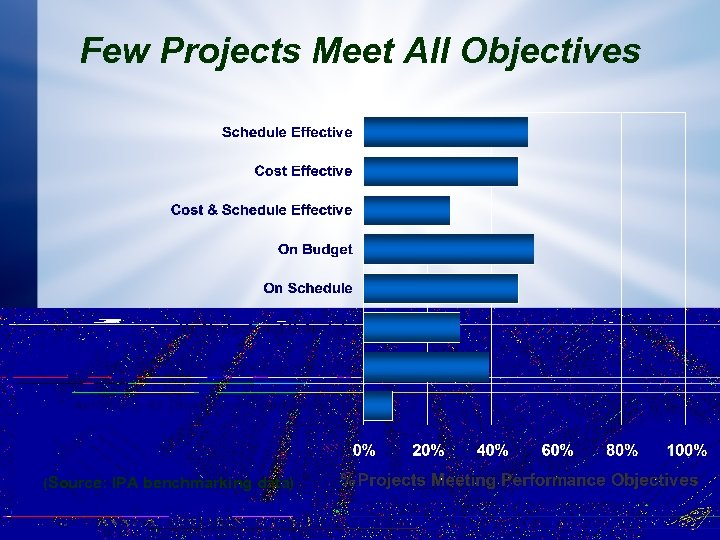
Few Projects Meet All Objectives (Source: IPA benchmarking data)
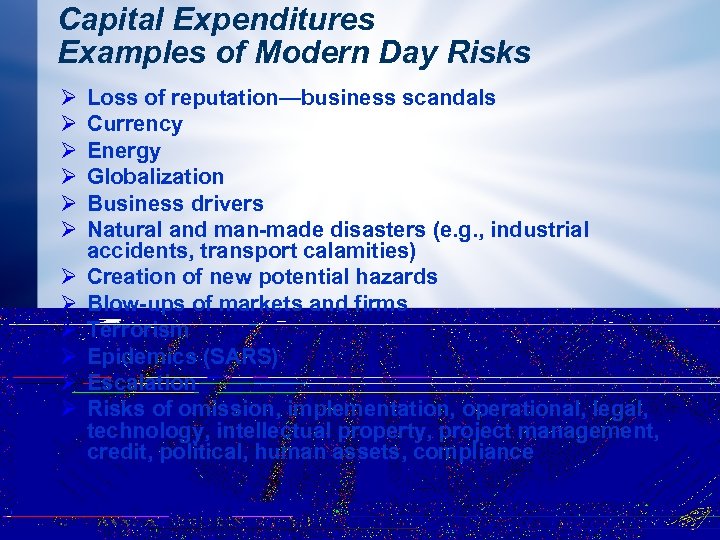
Capital Expenditures Examples of Modern Day Risks Ø Ø Ø Loss of reputation—business scandals Currency Energy Globalization Business drivers Natural and man-made disasters (e. g. , industrial accidents, transport calamities) Creation of new potential hazards Blow-ups of markets and firms Terrorism Epidemics (SARS) Escalation Risks of omission, implementation, operational, legal, technology, intellectual property, project management, credit, political, human assets, compliance
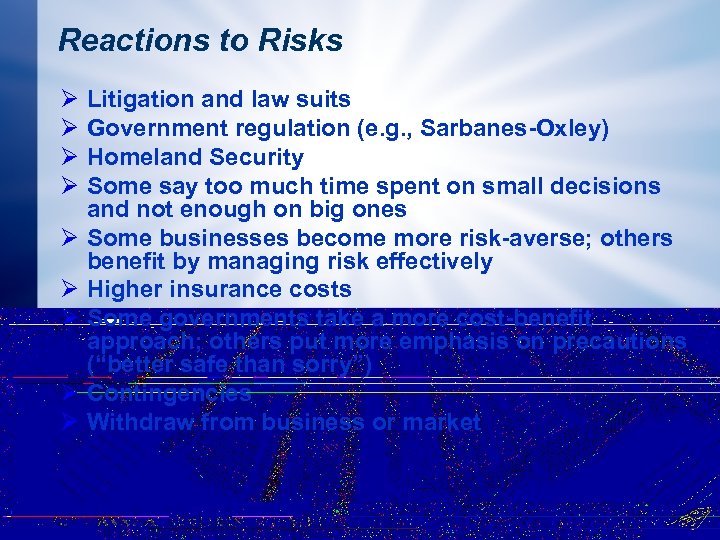
Reactions to Risks Ø Ø Ø Ø Ø Litigation and law suits Government regulation (e. g. , Sarbanes-Oxley) Homeland Security Some say too much time spent on small decisions and not enough on big ones Some businesses become more risk-averse; others benefit by managing risk effectively Higher insurance costs Some governments take a more cost-benefit approach; others put more emphasis on precautions (“better safe than sorry”) Contingencies Withdraw from business or market
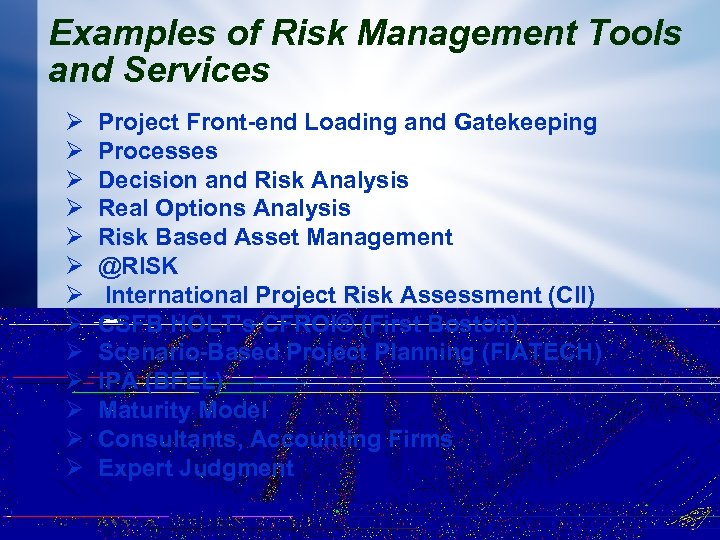
Examples of Risk Management Tools and Services Ø Ø Ø Ø Project Front-end Loading and Gatekeeping Processes Decision and Risk Analysis Real Options Analysis Risk Based Asset Management @RISK International Project Risk Assessment (CII) CSFB HOLT’s CFROI® (First Boston) Scenario-Based Project Planning (FIATECH) IPA (BFEL) Maturity Model Consultants, Accounting Firms Expert Judgment
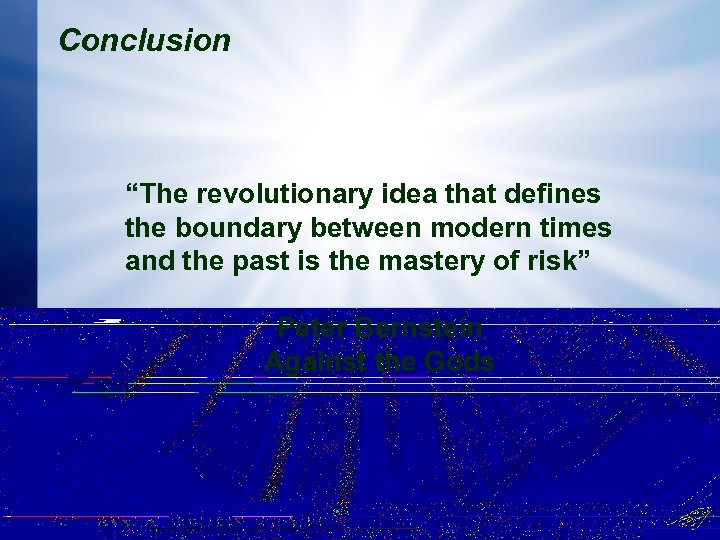
Conclusion “The revolutionary idea that defines the boundary between modern times and the past is the mastery of risk” Peter Bernstein Against the Gods
Capital What Does Capital Management Entail? Ø Ø Ø Ø Strategic Planning Setting Objectives Raising Capital Product Pricing Financial Risk Management Liability Valuation Asset Allocation Risk Management
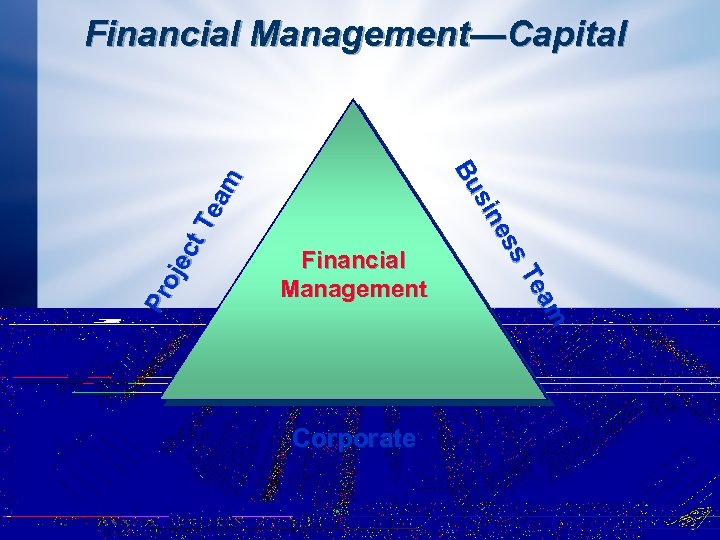
Pr oje ct Financial Management Corporate m m ea ea s. T es es siin sn Bu Bu Te am Financial Management—Capital
Capital Expenditures Trends Ø Work Force and Human Capability Ø Project Delivery Ø Corporate Strategy Ø Technology/Innovation Ø Markets/Demand Drivers Ø Social/Political Drivers
Capital Expenditures Challenges for Owners and the E&C Industry Ø Competitiveness Ø Work force development (Engineering professionals and leaders, crafts) Ø Safety Ø Research Ø Sustainability Ø Productivity (what are the right metrics) Ø Cycle Time Ø Effectiveness & efficiency (competiveness) of assets created Ø Technology (Bio processes, nano technology, carbon emissions, potential water crisis, energy) Ø Project Team Credibility Ø Globalization (including global markets, international competition, materials availability, pricing impact, resource availability, etc. )
A C-Level View of the Capital Project Portfolio Thank You Emerson T. Johns Du. Pont September 5, 2008
Скачать презентацию Breakout Forum A C-Level View of the Capital
8a68c82f41f418ec91c24e32afff9250.ppt