 Скачать презентацию Brazil EC and U S Tripartite Work on
a9411b92d43ae57e70325f479d7e84f5.ppt
- Количество слайдов: 37



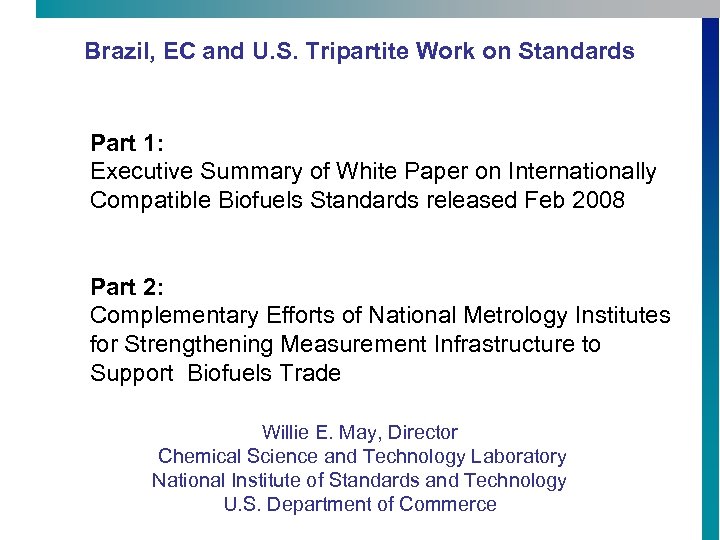
Brazil, EC and U. S. Tripartite Work on Standards Part 1: Executive Summary of White Paper on Internationally Compatible Biofuels Standards released Feb 2008 Part 2: Complementary Efforts of National Metrology Institutes for Strengthening Measurement Infrastructure to Support Biofuels Trade Willie E. May, Director Chemical Science and Technology Laboratory National Institute of Standards and Technology U. S. Department of Commerce
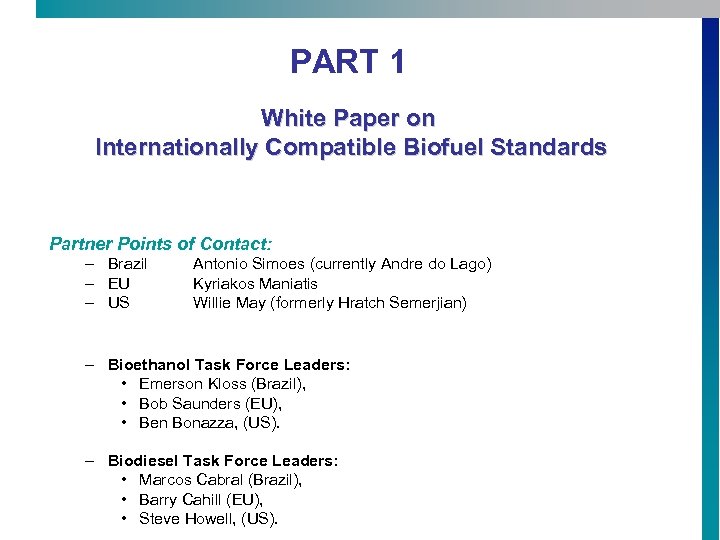
PART 1 White Paper on Internationally Compatible Biofuel Standards Partner Points of Contact: – Brazil – EU – US Antonio Simoes (currently Andre do Lago) Kyriakos Maniatis Willie May (formerly Hratch Semerjian) – Bioethanol Task Force Leaders: • Emerson Kloss (Brazil), • Bob Saunders (EU), • Ben Bonazza, (US). – Biodiesel Task Force Leaders: • Marcos Cabral (Brazil), • Barry Cahill (EU), • Steve Howell, (US).
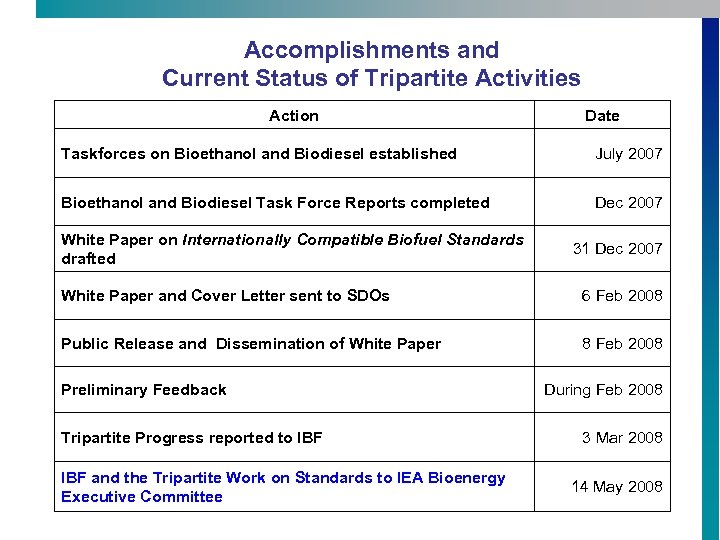
Accomplishments and Current Status of Tripartite Activities Action Date Taskforces on Bioethanol and Biodiesel established July 2007 Bioethanol and Biodiesel Task Force Reports completed Dec 2007 White Paper on Internationally Compatible Biofuel Standards drafted 31 Dec 2007 White Paper and Cover Letter sent to SDOs 6 Feb 2008 Public Release and Dissemination of White Paper 8 Feb 2008 Preliminary Feedback Tripartite Progress reported to IBF and the Tripartite Work on Standards to IEA Bioenergy Executive Committee During Feb 2008 3 Mar 2008 14 May 2008
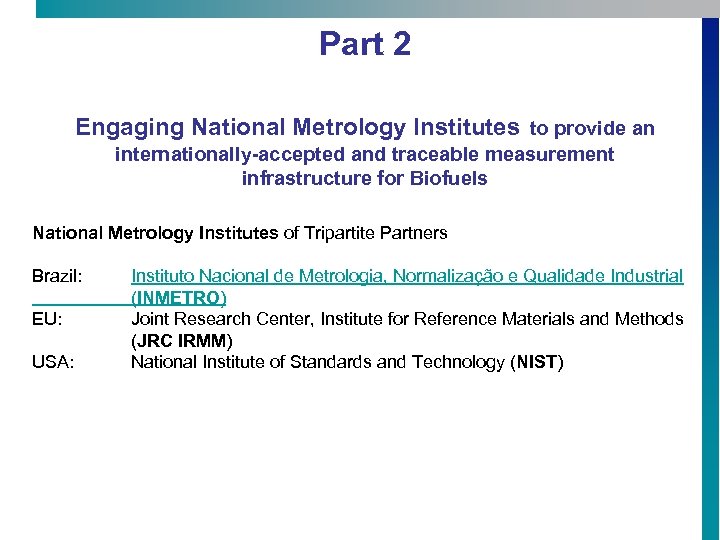
Part 2 Engaging National Metrology Institutes to provide an internationally-accepted and traceable measurement infrastructure for Biofuels National Metrology Institutes of Tripartite Partners Brazil: EU: USA: Instituto Nacional de Metrologia, Normalização e Qualidade Industrial (INMETRO) Joint Research Center, Institute for Reference Materials and Methods (JRC IRMM) National Institute of Standards and Technology (NIST)

PART 1 White Paper on Internationally Compatible Biofuel Standards
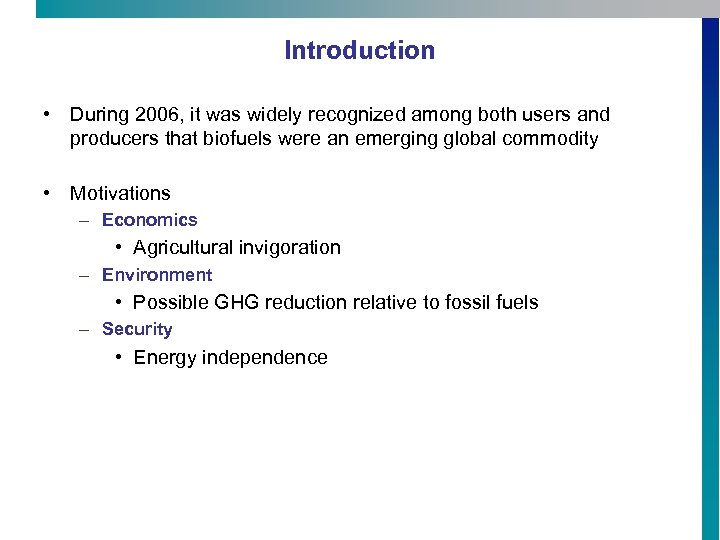
Introduction • During 2006, it was widely recognized among both users and producers that biofuels were an emerging global commodity • Motivations – Economics • Agricultural invigoration – Environment • Possible GHG reduction relative to fossil fuels – Security • Energy independence
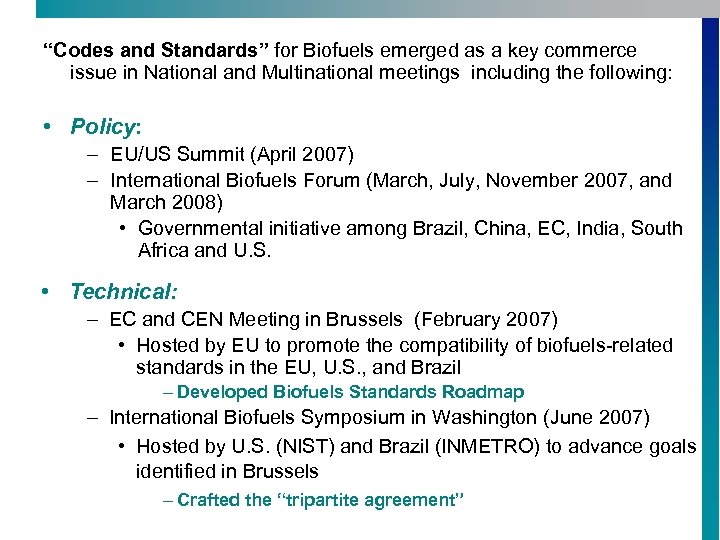
“Codes and Standards” for Biofuels emerged as a key commerce issue in National and Multinational meetings including the following: • Policy: – EU/US Summit (April 2007) – International Biofuels Forum (March, July, November 2007, and March 2008) • Governmental initiative among Brazil, China, EC, India, South Africa and U. S. • Technical: – EC and CEN Meeting in Brussels (February 2007) • Hosted by EU to promote the compatibility of biofuels-related standards in the EU, U. S. , and Brazil – Developed Biofuels Standards Roadmap – International Biofuels Symposium in Washington (June 2007) • Hosted by U. S. (NIST) and Brazil (INMETRO) to advance goals identified in Brussels – Crafted the “tripartite agreement”
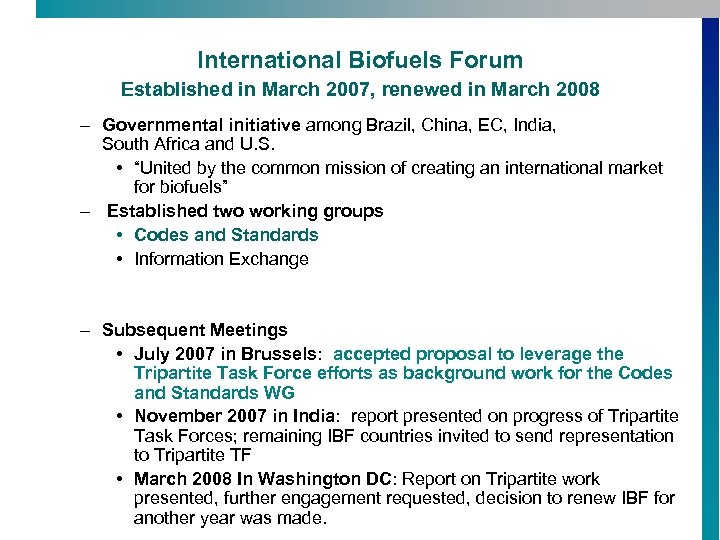
International Biofuels Forum Established in March 2007, renewed in March 2008 – Governmental initiative among Brazil, China, EC, India, South Africa and U. S. • “United by the common mission of creating an international market for biofuels” – Established two working groups • Codes and Standards • Information Exchange – Subsequent Meetings • July 2007 in Brussels: accepted proposal to leverage the Tripartite Task Force efforts as background work for the Codes and Standards WG • November 2007 in India: report presented on progress of Tripartite Task Forces; remaining IBF countries invited to send representation to Tripartite TF • March 2008 In Washington DC: Report on Tripartite work presented, further engagement requested, decision to renew IBF for another year was made.
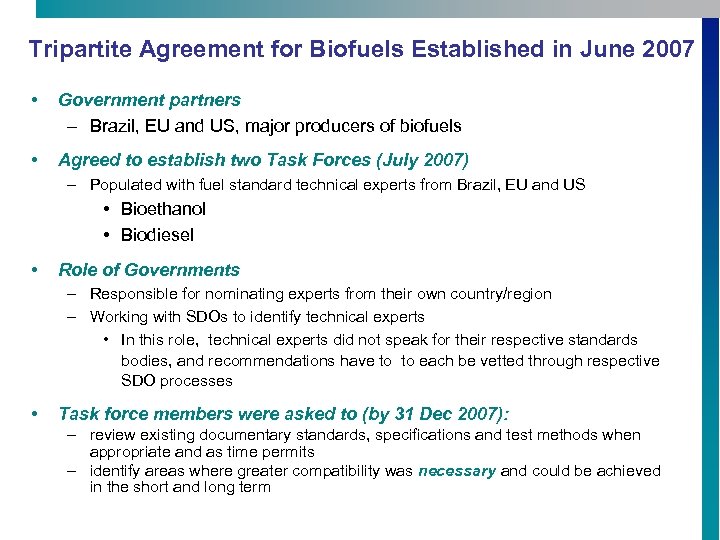
Tripartite Agreement for Biofuels Established in June 2007 • Government partners – Brazil, EU and US, major producers of biofuels • Agreed to establish two Task Forces (July 2007) – Populated with fuel standard technical experts from Brazil, EU and US • Bioethanol • Biodiesel • Role of Governments – Responsible for nominating experts from their own country/region – Working with SDOs to identify technical experts • In this role, technical experts did not speak for their respective standards bodies, and recommendations have to to each be vetted through respective SDO processes • Task force members were asked to (by 31 Dec 2007): – review existing documentary standards, specifications and test methods when appropriate and as time permits – identify areas where greater compatibility was necessary and could be achieved in the short and long term
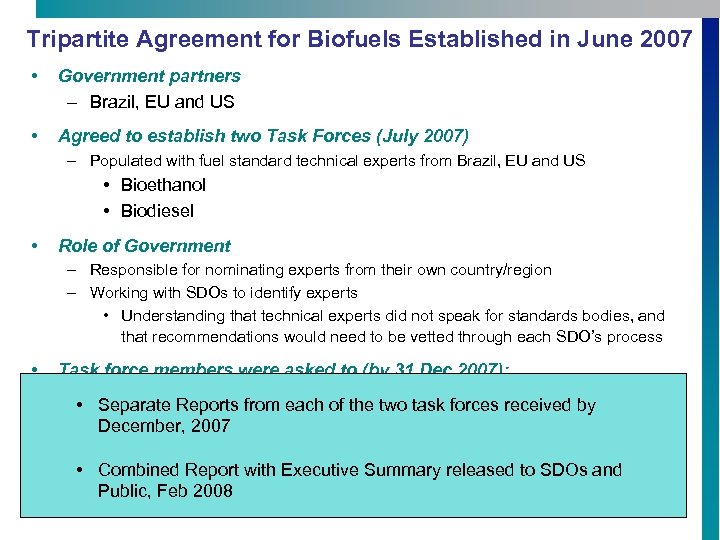
Tripartite Agreement for Biofuels Established in June 2007 • Government partners – Brazil, EU and US • Agreed to establish two Task Forces (July 2007) – Populated with fuel standard technical experts from Brazil, EU and US • Bioethanol • Biodiesel • Role of Government – Responsible for nominating experts from their own country/region – Working with SDOs to identify experts • Understanding that technical experts did not speak for standards bodies, and that recommendations would need to be vetted through each SDO’s process • Task force members were asked to (by 31 Dec 2007): – review existing documentary standards, specifications and test methods when • appropriate and as time permited of the two task forces received by Separate Reports from each – identify areas where greater compatibility was necessary and could be achieved December, 2007 in the short and long term • Combined Report with Executive Summary released to SDOs and Public, Feb 2008
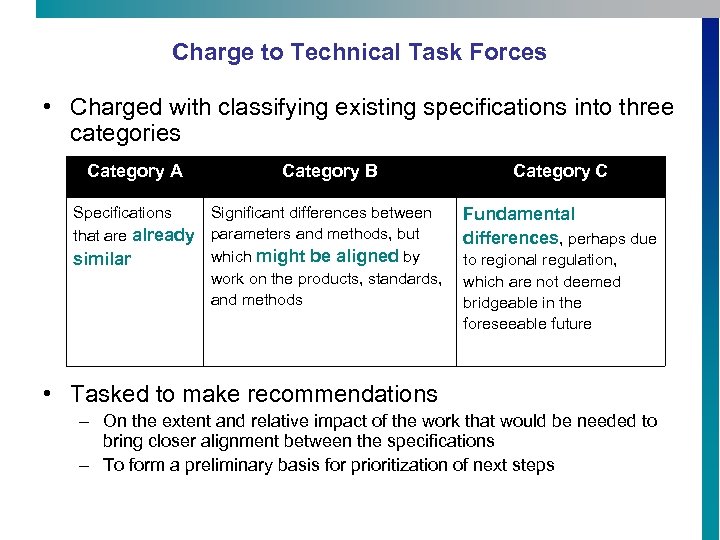
Charge to Technical Task Forces • Charged with classifying existing specifications into three categories Category A Category B Specifications Significant differences between that are already parameters and methods, but which might be aligned by similar work on the products, standards, and methods Category C Fundamental differences, perhaps due to regional regulation, which are not deemed bridgeable in the foreseeable future • Tasked to make recommendations – On the extent and relative impact of the work that would be needed to bring closer alignment between the specifications – To form a preliminary basis for prioritization of next steps
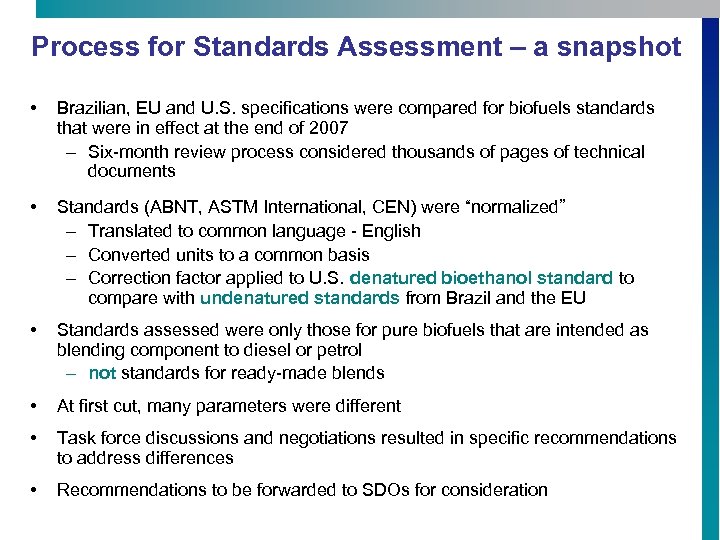
Process for Standards Assessment – a snapshot • Brazilian, EU and U. S. specifications were compared for biofuels standards that were in effect at the end of 2007 – Six-month review process considered thousands of pages of technical documents • Standards (ABNT, ASTM International, CEN) were “normalized” – Translated to common language - English – Converted units to a common basis – Correction factor applied to U. S. denatured bioethanol standard to compare with undenatured standards from Brazil and the EU • Standards assessed were only those for pure biofuels that are intended as blending component to diesel or petrol – not standards for ready-made blends • At first cut, many parameters were different • Task force discussions and negotiations resulted in specific recommendations to address differences • Recommendations to be forwarded to SDOs for consideration
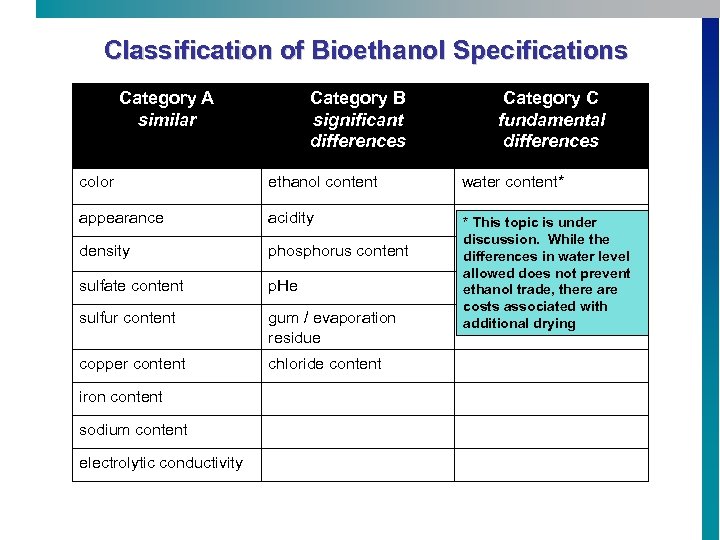
Classification of Bioethanol Specifications Category A similar Category B significant differences Category C fundamental differences color ethanol content water content* appearance acidity density phosphorus content sulfate content p. He sulfur content gum / evaporation residue * This topic is under discussion. While the differences in water level allowed does not prevent ethanol trade, there are costs associated with additional drying copper content chloride content iron content sodium content electrolytic conductivity
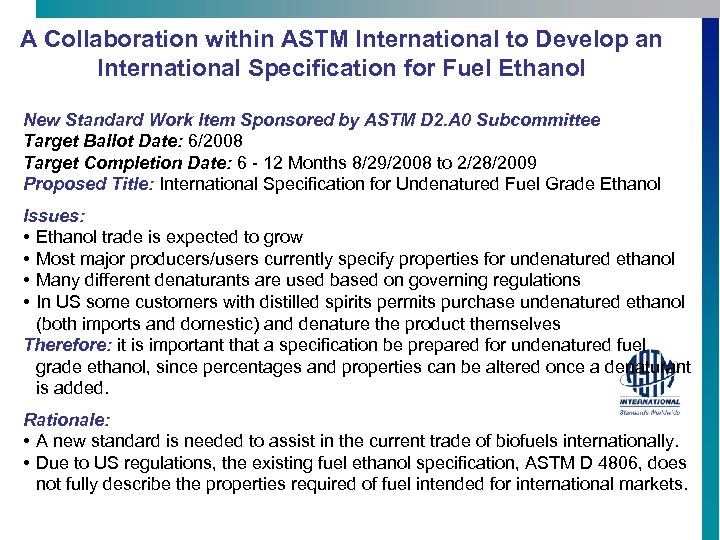
A Collaboration within ASTM International to Develop an International Specification for Fuel Ethanol New Standard Work Item Sponsored by ASTM D 2. A 0 Subcommittee Target Ballot Date: 6/2008 Target Completion Date: 6 - 12 Months 8/29/2008 to 2/28/2009 Proposed Title: International Specification for Undenatured Fuel Grade Ethanol Issues: • Ethanol trade is expected to grow • Most major producers/users currently specify properties for undenatured ethanol • Many different denaturants are used based on governing regulations • In US some customers with distilled spirits permits purchase undenatured ethanol (both imports and domestic) and denature the product themselves Therefore: it is important that a specification be prepared for undenatured fuel grade ethanol, since percentages and properties can be altered once a denaturant is added. Rationale: • A new standard is needed to assist in the current trade of biofuels internationally. • Due to US regulations, the existing fuel ethanol specification, ASTM D 4806, does not fully describe the properties required of fuel intended for international markets.
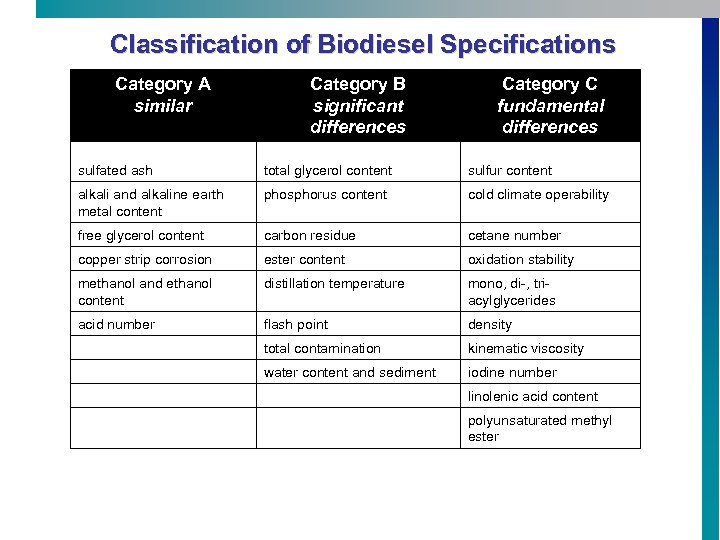
Classification of Biodiesel Specifications Category A similar Category B significant differences Category C fundamental differences sulfated ash total glycerol content sulfur content alkali and alkaline earth metal content phosphorus content cold climate operability free glycerol content carbon residue cetane number copper strip corrosion ester content oxidation stability methanol and ethanol content distillation temperature mono, di-, triacylglycerides acid number flash point density total contamination kinematic viscosity water content and sediment iodine number linolenic acid content polyunsaturated methyl ester
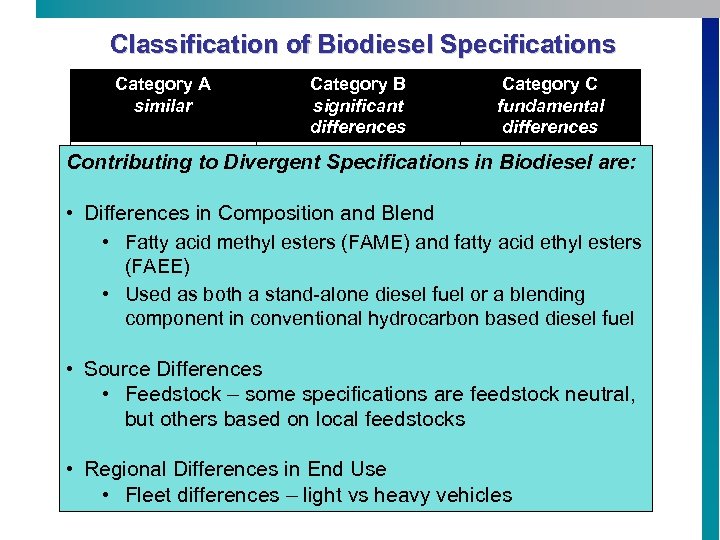
Classification of Biodiesel Specifications Category A similar Category B significant differences Category C fundamental differences Contributing to Divergent Specificationssulfur. Biodiesel are: in content sulfated ash total glycerol content alkali and alkaline earth phosphorus content • metal content Differences in Composition and Blend cold climate operability free glycerol content carbon residue cetane number • Fatty acid methyl esters (FAME) and fatty acid ethyl esters copper strip corrosion ester content oxidation stability (FAEE) methanol and ethanol distillation temperature mono, di-, tri • or a blending content Used as both a stand-alone diesel fuel acylglycerides component in conventional hydrocarbon based diesel fuel acid number flash point density total contamination kinematic viscosity • Source Differences water content and sediment iodine number • Feedstock – some specifications are linolenic acid content feedstock neutral, but others based on local feedstocks polyunsaturated methyl ester • Regional Differences in End Use • Fleet differences – light vs heavy vehicles
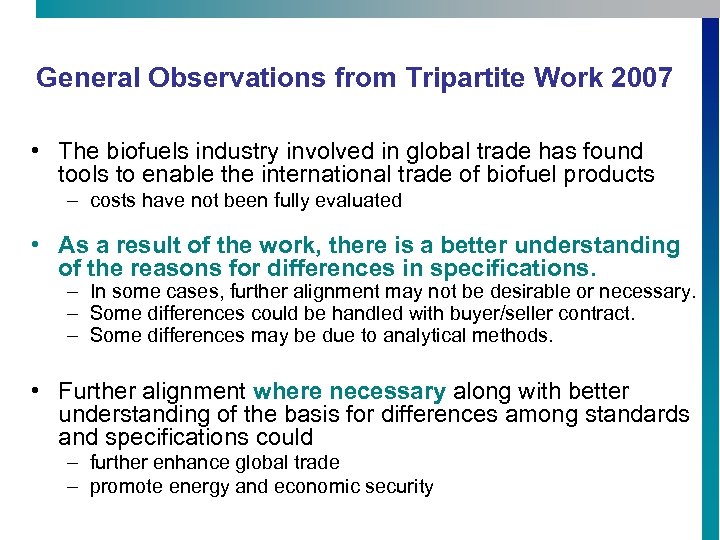
General Observations from Tripartite Work 2007 • The biofuels industry involved in global trade has found tools to enable the international trade of biofuel products – costs have not been fully evaluated • As a result of the work, there is a better understanding of the reasons for differences in specifications. – In some cases, further alignment may not be desirable or necessary. – Some differences could be handled with buyer/seller contract. – Some differences may be due to analytical methods. • Further alignment where necessary along with better understanding of the basis for differences among standards and specifications could – further enhance global trade – promote energy and economic security
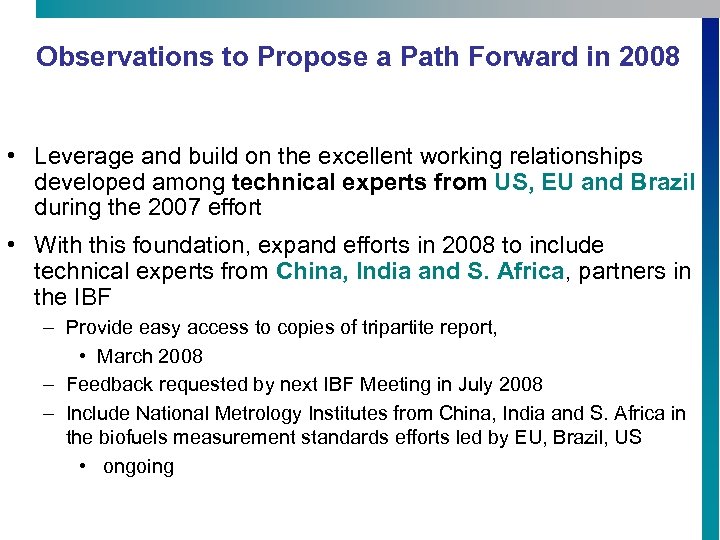
Observations to Propose a Path Forward in 2008 • Leverage and build on the excellent working relationships developed among technical experts from US, EU and Brazil during the 2007 effort • With this foundation, expand efforts in 2008 to include technical experts from China, India and S. Africa, partners in the IBF – Provide easy access to copies of tripartite report, • March 2008 – Feedback requested by next IBF Meeting in July 2008 – Include National Metrology Institutes from China, India and S. Africa in the biofuels measurement standards efforts led by EU, Brazil, US • ongoing
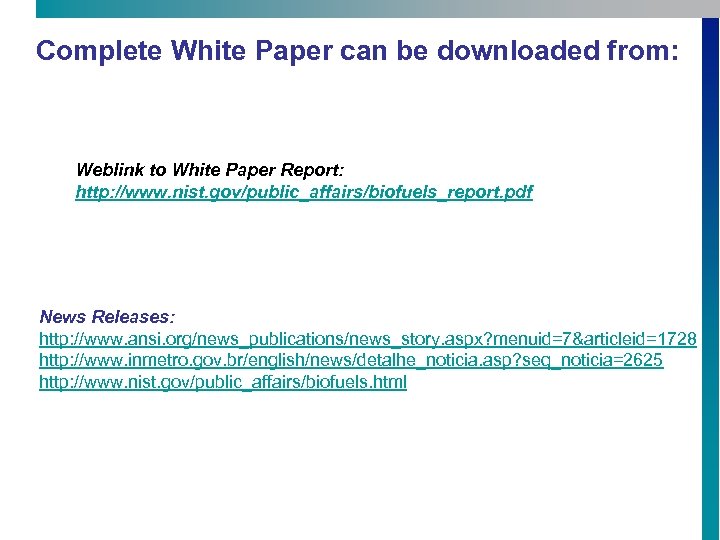
Complete White Paper can be downloaded from: Weblink to White Paper Report: http: //www. nist. gov/public_affairs/biofuels_report. pdf News Releases: http: //www. ansi. org/news_publications/news_story. aspx? menuid=7&articleid=1728 http: //www. inmetro. gov. br/english/news/detalhe_noticia. asp? seq_noticia=2625 http: //www. nist. gov/public_affairs/biofuels. html
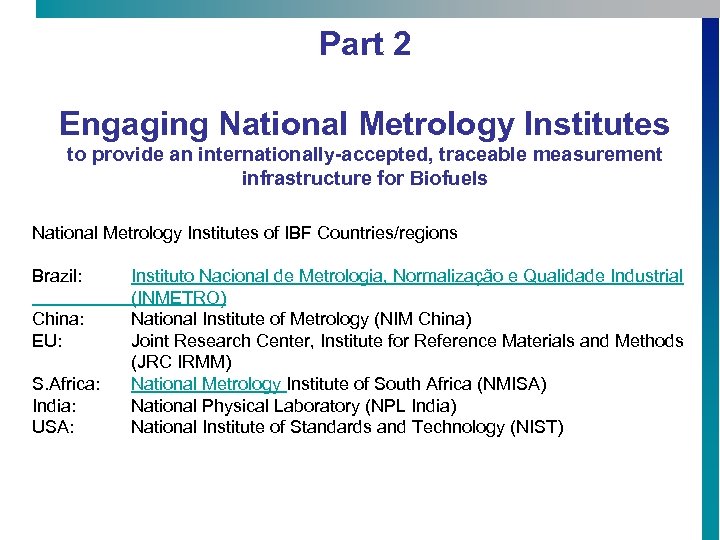
Part 2 Engaging National Metrology Institutes to provide an internationally-accepted, traceable measurement infrastructure for Biofuels National Metrology Institutes of IBF Countries/regions Brazil: China: EU: S. Africa: India: USA: Instituto Nacional de Metrologia, Normalização e Qualidade Industrial (INMETRO) National Institute of Metrology (NIM China) Joint Research Center, Institute for Reference Materials and Methods (JRC IRMM) National Metrology Institute of South Africa (NMISA) National Physical Laboratory (NPL India) National Institute of Standards and Technology (NIST)
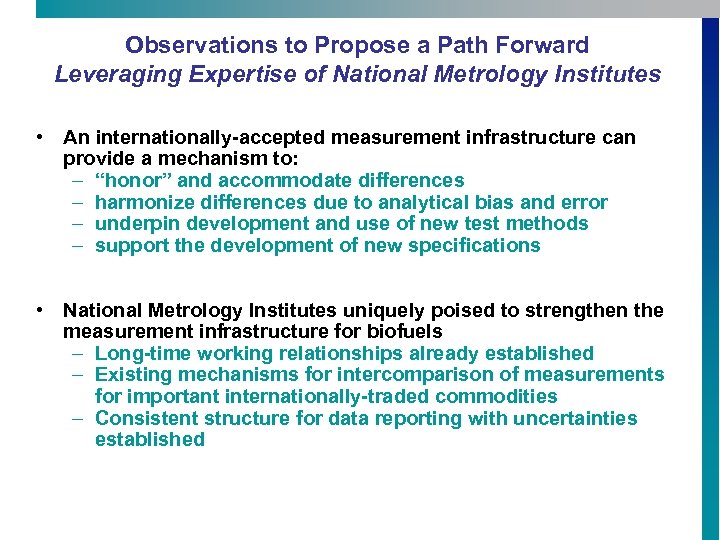
Observations to Propose a Path Forward Leveraging Expertise of National Metrology Institutes • An internationally-accepted measurement infrastructure can provide a mechanism to: – “honor” and accommodate differences – harmonize differences due to analytical bias and error – underpin development and use of new test methods – support the development of new specifications • National Metrology Institutes uniquely poised to strengthen the measurement infrastructure for biofuels – Long-time working relationships already established – Existing mechanisms for intercomparison of measurements for important internationally-traded commodities – Consistent structure for data reporting with uncertainties established
Metrology Community Providing International Measurement Traceability to Support Comparability • Inter-Governmental Treaty of the “Metre Convention” was established in 1875 – Signatories are Nations/Governments – Gave authority to act in world matters of metrology to: • General Conference on Weights and Measures (GCPM - government), • International Committee for Weights and Measures (CIPM – world experts in metrology), • International Bureau of Weights and Measures (BIPM - intergovernmental organization with international staff) • CIPM Mutual Recognition Arrangement “CIPM MRA” was signed in 1999 – Signatories are National Metrology Institutes (NMIs) of Treaty Nations and others
CIPM Mutual Recognition Arrangement … was established in 1999 in response to a growing need for an open, transparent and comprehensive scheme to (1) give users reliable quantitative information on the comparability of measurement services provided by national metrology institutes and (2) provide the technical basis for wider agreements negotiated for international trade, commerce and regulatory affairs. NIST (US), INMETRO (Brazil), JRC IRMM (EC), NPL India (India), NIM (China), NMISA (S. Africa) are among the 67 signatories to the CIPM Mutual Recognition Arrangement among national metrology institutes which requires: – Articulation of measurement capabilities (methods) used to value-assign CRMs and provide other measurement services – Participation in formal international comparison Studies to provide evidence to support such claims – Maintenance of a Quality System for the delivery of CRMs and other measurement services
Example of a Key Comparison under the CIPM MRA Data for more than 100 Studies is publicly available on the BIPM website.
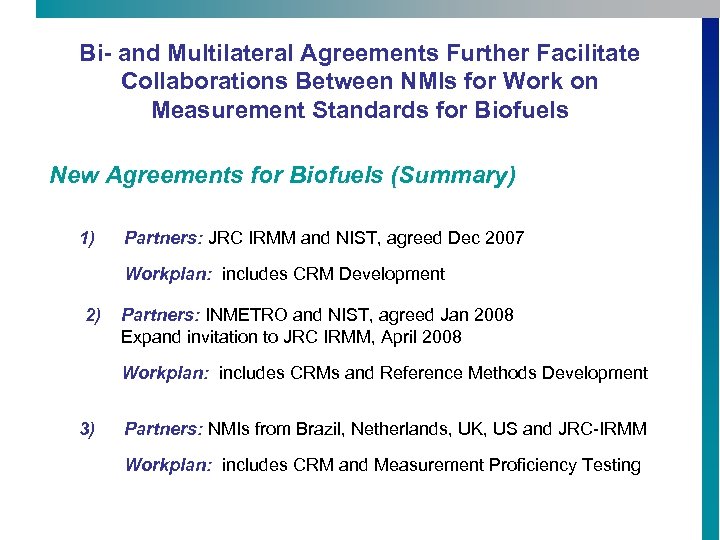
Bi- and Multilateral Agreements Further Facilitate Collaborations Between NMIs for Work on Measurement Standards for Biofuels New Agreements for Biofuels (Summary) 1) Partners: JRC IRMM and NIST, agreed Dec 2007 Workplan: includes CRM Development 2) Partners: INMETRO and NIST, agreed Jan 2008 Expand invitation to JRC IRMM, April 2008 Workplan: includes CRMs and Reference Methods Development 3) Partners: NMIs from Brazil, Netherlands, UK, US and JRC-IRMM Workplan: includes CRM and Measurement Proficiency Testing

NIST, EC Agency Partner for Better Measurements …pact to advance the development and availability of international measurement standards in the fields of chemistry, life sciences and emerging technologies… share resources and responsibilities for projects signed by CSTL director in chemical metrology including Willie May and the measurement methods and standards for: European Commission’s § hazardous substances in electronics § contaminants § biofuels § nanomaterial EHS Joint Research Center Institute for Reference Materials and Measurements director Alejandro Herrero in Belgium, December 17, 2007
Planned Supportive Activities of the Governments through their National Metrology Institutes NIST (U. S. ), and INMETRO (Brazil) have established plans for cooperative development (in 2008) of Certified Reference Materials • Anhydrous and Hydrated bioethanol • Soy and Animal-based biodiesel – for calibrating measurement instruments to a known and internationally accepted reference – for validating the accuracy of measurement results and measurement platforms, space and time. Reference Measurement Methods: – Chemical pattern recognition to identify feedstock source of biodiesel (e. g. soy, rapeseed, animal fat) – Isotope metrology to distinguish between renewable/nonrenewable fuel

An ESI-MS (electrospray ionization mass spectrometry) technique being developed at INMETRO Brazil for providing a fingerprint for categorizing biodiesel by source

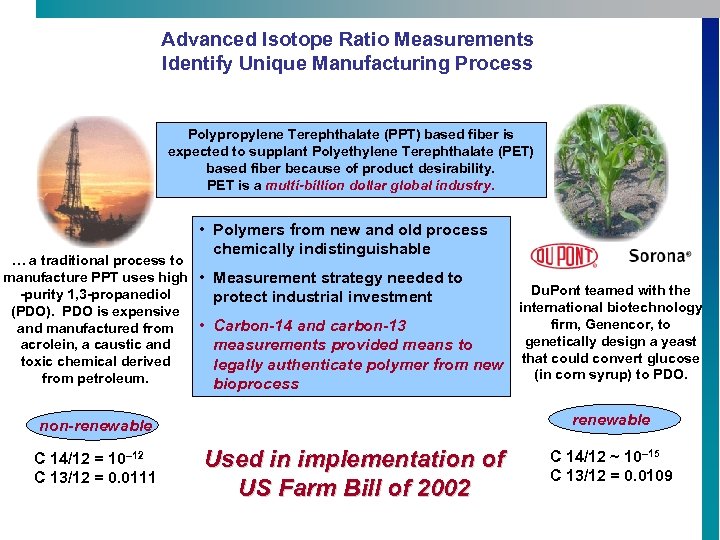
Advanced Isotope Ratio Measurements Identify Unique Manufacturing Process Polypropylene Terephthalate (PPT) based fiber is expected to supplant Polyethylene Terephthalate (PET) based fiber because of product desirability. PET is a multi-billion dollar global industry. • Polymers from new and old process chemically indistinguishable … a traditional process to manufacture PPT uses high • Measurement strategy needed to -purity 1, 3 -propanediol protect industrial investment (PDO). PDO is expensive • Carbon-14 and carbon-13 and manufactured from acrolein, a caustic and measurements provided means to toxic chemical derived legally authenticate polymer from new from petroleum. bioprocess renewable non-renewable C 14/12 = 10– 12 C 13/12 = 0. 0111 Du. Pont teamed with the international biotechnology firm, Genencor, to genetically design a yeast that could convert glucose (in corn syrup) to PDO. Used in implementation of US Farm Bill of 2002 C 14/12 ~ 10– 15 C 13/12 = 0. 0109
Planned Supportive Activities of the Governments through their National Metrology Institutes EC BIOREMA project will focus on development and deployment of test samples for interlaboratory comparisons to “ground truth” biofuels test methods – Several NMIs will value-assign reference samples • INMETRO (Brazil) • NIST (USA) • JRC-IRMM (EC) • NMi VSL (Netherlands) • NPL (UK) – Study participants will be biofuels testing laboratories worldwide – Timeframe: 2008 - 2010
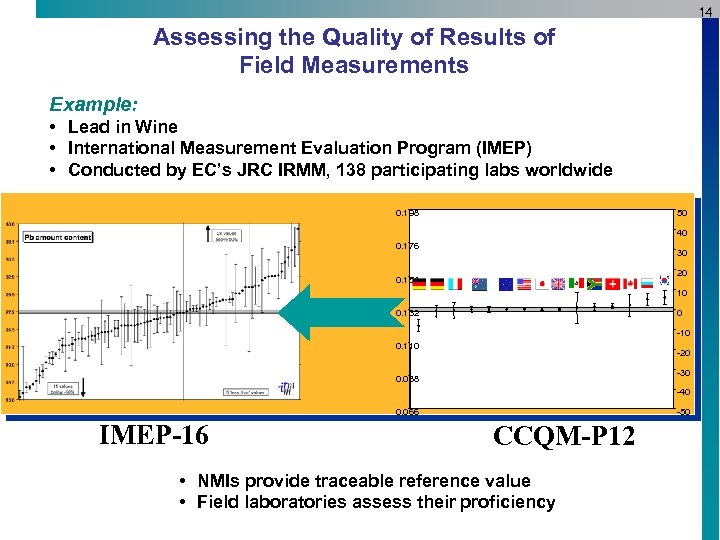
14 Assessing the Quality of Results of Field Measurements Example: • Lead in Wine • International Measurement Evaluation Program (IMEP) • Conducted by EC’s JRC IRMM, 138 participating labs worldwide 0. 198 50 40 0. 176 30 20 0. 154 10 0. 132 0 -10 0. 110 -20 -30 0. 088 -40 0. 066 IMEP-16 -50 CCQM-P 12 • NMIs provide traceable reference value • Field laboratories assess their proficiency
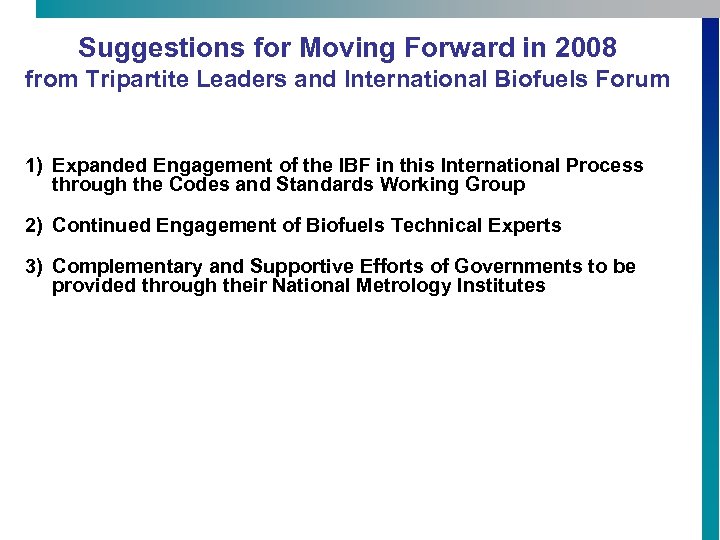
Suggestions for Moving Forward in 2008 from Tripartite Leaders and International Biofuels Forum 1) Expanded Engagement of the IBF in this International Process through the Codes and Standards Working Group 2) Continued Engagement of Biofuels Technical Experts 3) Complementary and Supportive Efforts of Governments to be provided through their National Metrology Institutes
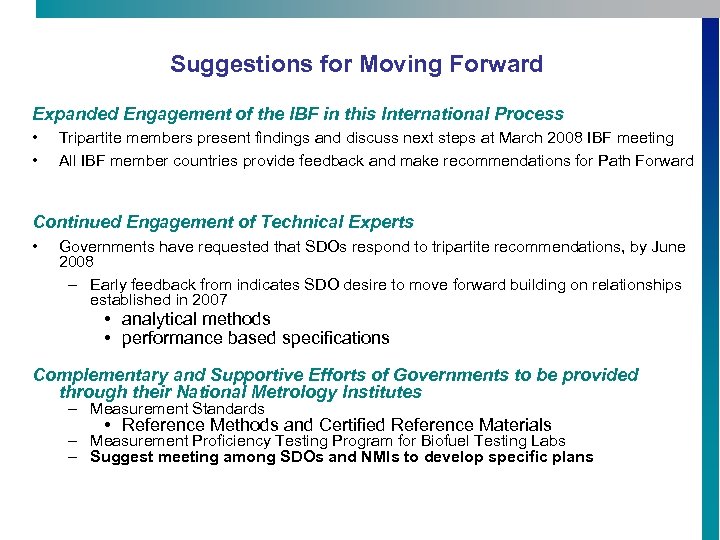
Suggestions for Moving Forward Expanded Engagement of the IBF in this International Process • • Tripartite members present findings and discuss next steps at March 2008 IBF meeting All IBF member countries provide feedback and make recommendations for Path Forward Continued Engagement of Technical Experts • Governments have requested that SDOs respond to tripartite recommendations, by June 2008 – Early feedback from indicates SDO desire to move forward building on relationships established in 2007 • analytical methods • performance based specifications Complementary and Supportive Efforts of Governments to be provided through their National Metrology Institutes – Measurement Standards • Reference Methods and Certified Reference Materials – Measurement Proficiency Testing Program for Biofuel Testing Labs – Suggest meeting among SDOs and NMIs to develop specific plans
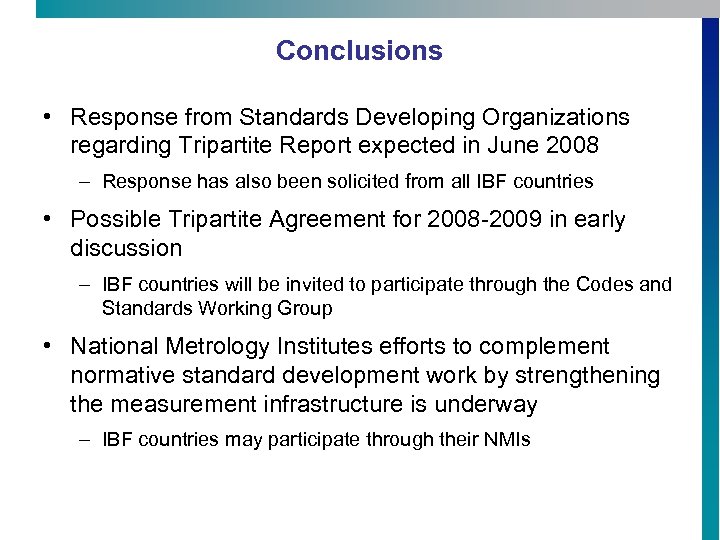
Conclusions • Response from Standards Developing Organizations regarding Tripartite Report expected in June 2008 – Response has also been solicited from all IBF countries • Possible Tripartite Agreement for 2008 -2009 in early discussion – IBF countries will be invited to participate through the Codes and Standards Working Group • National Metrology Institutes efforts to complement normative standard development work by strengthening the measurement infrastructure is underway – IBF countries may participate through their NMIs

END
Скачать презентацию Brazil EC and U S Tripartite Work on
a9411b92d43ae57e70325f479d7e84f5.ppt