 Скачать презентацию Brazil CEBRI Rio de Janeiro Dec 7 2010
348dfaf94510ee2a610e3e918e0e454a.ppt
- Количество слайдов: 95



Brazil, CEBRI, Rio de Janeiro, Dec. 7, 2010 Nuclear Power and Radiation Application for Sustainable Development and Welfare Sueo Machi Senior Advisor to JAEA Former Commissioner, Japan Atomic Energy Commission Former Deputy Director General, IAEA Brazil CEBRI Dec. 7, 2010 S. Machi 1
Talking Points Roles of nuclear power for sustainable development n Trends in Asia increasing nuclear power n Nuclear power policy of Japan n Nuclear applications for improving human welfare - Food and agriculture - Human health - Industrial applications - Environmental protection n Forum for Nuclear Cooperation in Asia (FNCA) n Brazil CEBRI Dec. 7, 2010 S. Machi 2
Nuclear Power for Sustainable Development Energy security n Limited amount of fossil fuel reserve n Rapidly increasing demand of energy for development n Brazil CEBRI Dec. 7, 2010 S. Machi 3
Energy; Essential for Poverty Reduction and Sustainable Development No development without energy n 1. 6 billion people have no access to electricity In Bangladesh 50% of population; no access to electricity n Global energy consumption increase; over 50% by 2030 (70% of increase comes from developing countries) n Brazil CEBRI Dec. 7, 2010 S. Machi 4
Global Challenges of Energy n How to meet rapid increase of demand due to global development n Limited amount of fossil fuel reserve n Climate changes caused by increased CO 2 emission from energy production using fossil fuels Brazil CEBRI Dec. 7, 2010 S. Machi 5
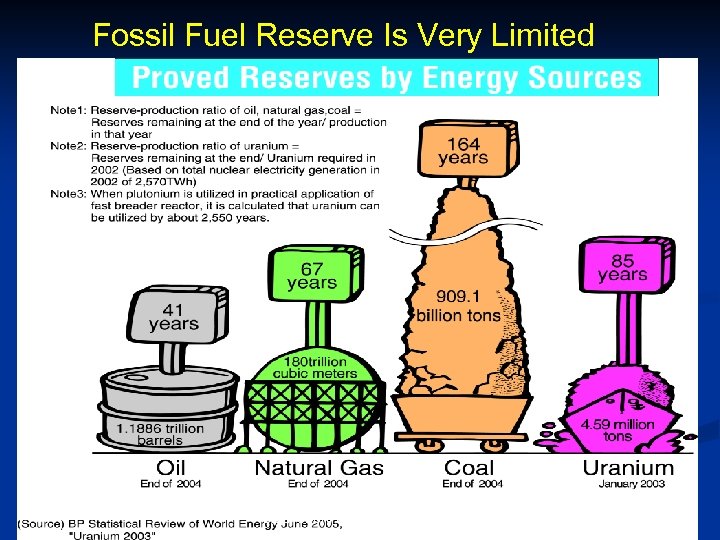
Fossil Fuel Reserve Is Very Limited Univ, Tokyo June 30, 2010 S. Machi Brazil CEBRI Dec. 7, 6
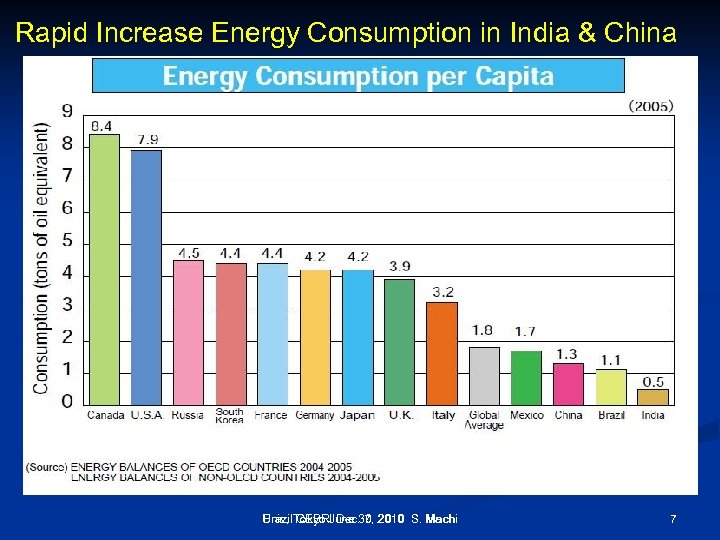
Rapid Increase Energy Consumption in India & China Univ, Tokyo June 30, 2010 S. Machi Brazil CEBRI Dec. 7, 7
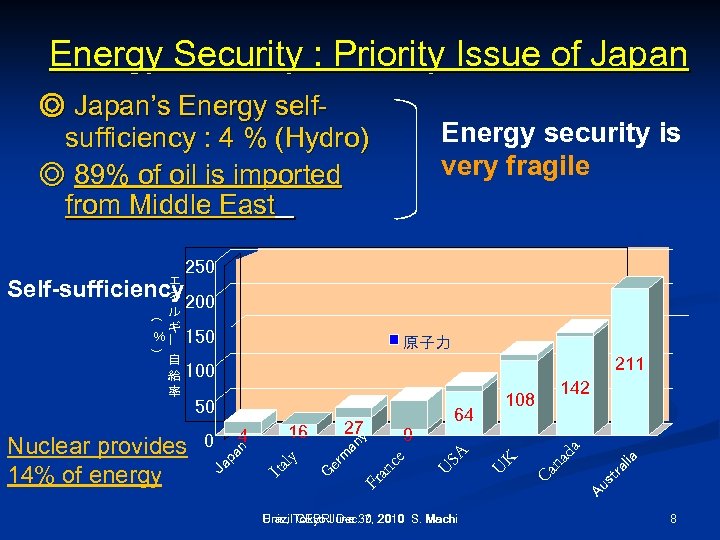
Energy Security : Priority Issue of Japan ◎ Japan’s Energy selfsufficiency : 4 % (Hydro) ◎ 89% of oil is imported from Middle East エ ネ ル ギ Energy security is very fragile 250 Self-sufficiency 200 100 tra lia da na SA U ce an Fr Univ, Tokyo June 30, 2010 S. Machi Brazil CEBRI Dec. 7, K 64 9 y rm an Ge ly 16 Ita 4 pa n 0 27 142 108 Ca 50 Ja ) Nuclear provides 14% of energy 211 U ー 自 給 率 原子力 Au s ( 150 % 8
How to Address Energy Security Expansion of nuclear energy n Saving energy: - Further energy saving in advanced countries - Transfer of advanced energy saving technology to developing countries n Expansion of renewable energy, such as hydro, wind, solar and bio-fuels n Advanced transportation systems n Brazil CEBRI Dec. 7, 2010 S. Machi 9
Nuclear Power for Sustainable Development Mitigation of Climate Change n Approaching Low Carbon Society n Brazil CEBRI Dec. 7, 2010 S. Machi 10
Prof. R. K. Pachauri, IPCC, Nobel Prize ’ 07 Pachuri said: Scientific consensus on the fact that climate system is changing n The climate changes have taken place very likely by the results of human activity n IPCC 4 Report: ①Temperature increase by 2100; 1. 8 -4. 0 C, ②Sea level raise by 2100; 28 -43cm, ③Increase of heat wave, ④Stronger cyclones in tropical zone n Brazil CEBRI Dec. 7, 2010 S. Machi 11
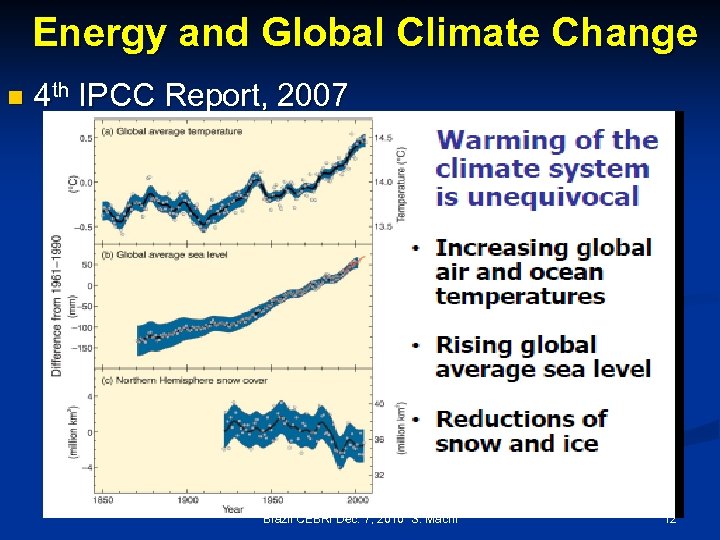
Energy and Global Climate Change n 4 th IPCC Report, 2007 Brazil CEBRI Dec. 7, 2010 S. Machi 12
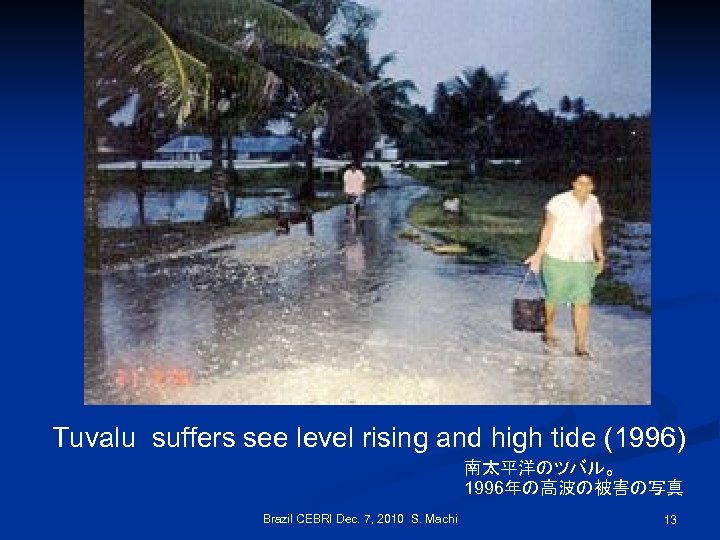
Tuvalu suffers see level rising and high tide (1996) 南太平洋のツバル。 1996年の高波の被害の写真 Brazil CEBRI Dec. 7, 2010 S. Machi 13
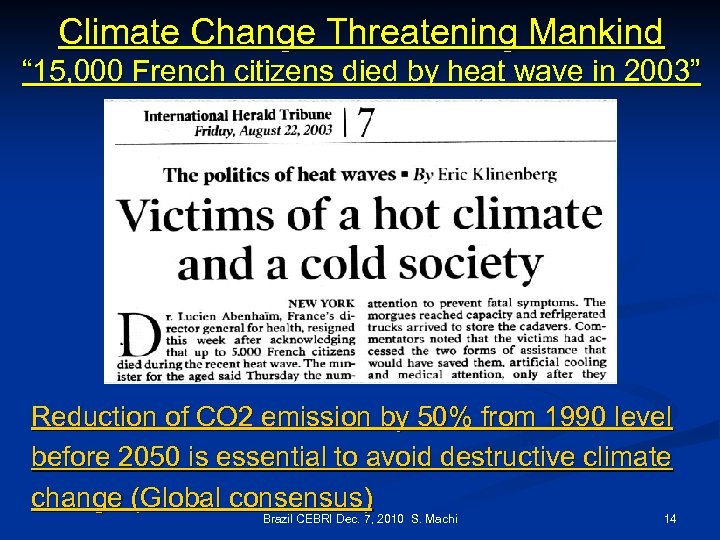
Climate Change Threatening Mankind “ 15, 000 French citizens died by heat wave in 2003” Reduction of CO 2 emission by 50% from 1990 level before 2050 is essential to avoid destructive climate change (Global consensus) Brazil CEBRI Dec. 7, 2010 S. Machi 14
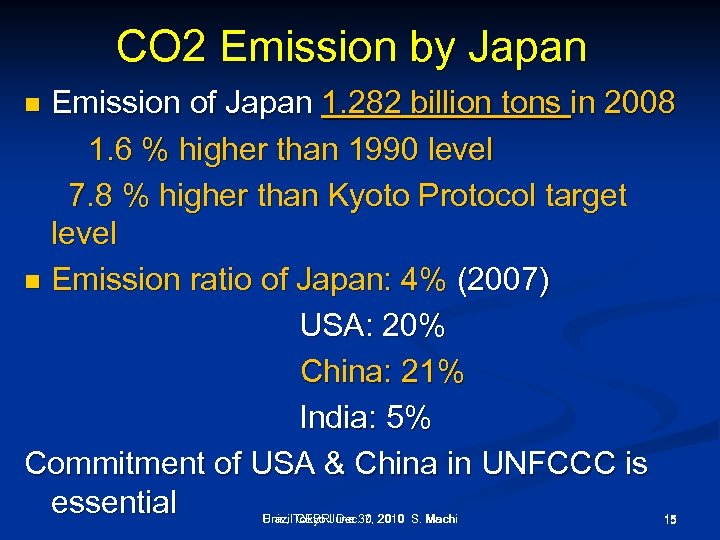
CO 2 Emission by Japan Emission of Japan 1. 282 billion tons in 2008 1. 6 % higher than 1990 level 7. 8 % higher than Kyoto Protocol target level n Emission ratio of Japan: 4% (2007) USA: 20% China: 21% India: 5% Commitment of USA & China in UNFCCC is essential n Univ, Tokyo June 30, 2010 S. Machi Brazil CEBRI Dec. 7, 15
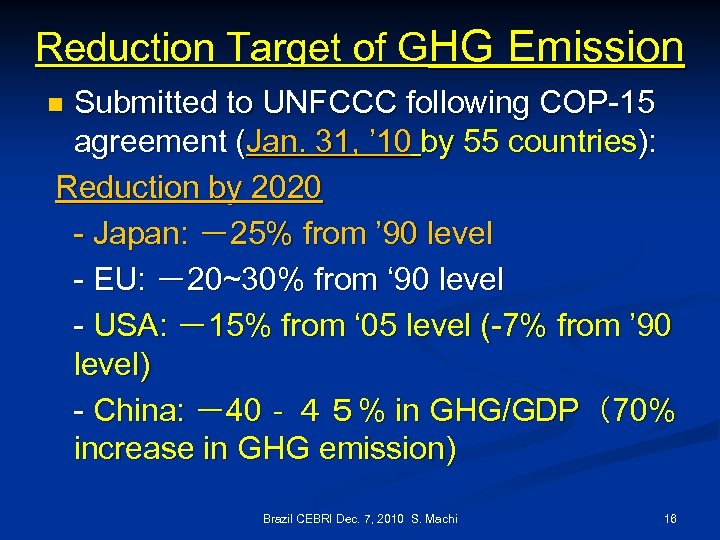
Reduction Target of GHG Emission Submitted to UNFCCC following COP-15 agreement (Jan. 31, ’ 10 by 55 countries): Reduction by 2020 - Japan: -25% from ’ 90 level - EU: -20~30% from ‘ 90 level - USA: -15% from ‘ 05 level (-7% from ’ 90 level) - China: -40‐45% in GHG/GDP(70% increase in GHG emission) n Brazil CEBRI Dec. 7, 2010 S. Machi 16
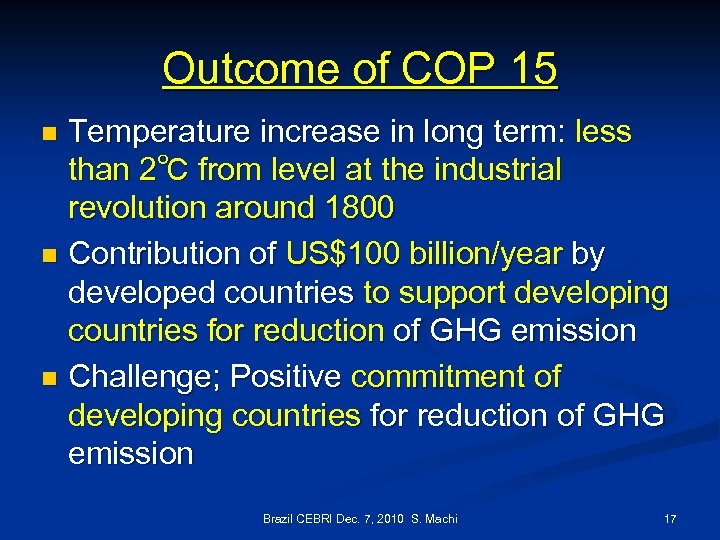
Outcome of COP 15 Temperature increase in long term: less than 2℃ from level at the industrial revolution around 1800 n Contribution of US$100 billion/year by developed countries to support developing countries for reduction of GHG emission n Challenge; Positive commitment of developing countries for reduction of GHG emission n Brazil CEBRI Dec. 7, 2010 S. Machi 17
Nuclear Power to Reduce CO 2 Emission Brazil CEBRI Dec. 7, 2010 S. Machi 18
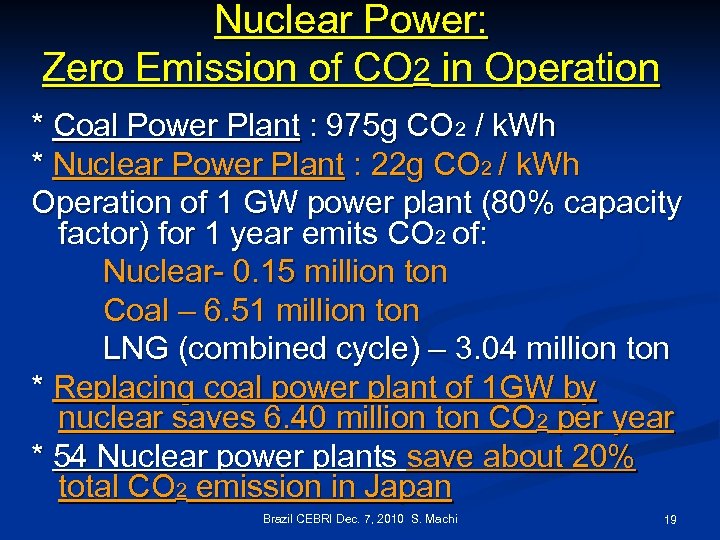
Nuclear Power: Zero Emission of CO 2 in Operation * Coal Power Plant : 975 g CO 2 / k. Wh * Nuclear Power Plant : 22 g CO 2 / k. Wh Operation of 1 GW power plant (80% capacity factor) for 1 year emits CO 2 of: Nuclear- 0. 15 million ton Coal – 6. 51 million ton LNG (combined cycle) – 3. 04 million ton * Replacing coal power plant of 1 GW by nuclear saves 6. 40 million ton CO 2 per year * 54 Nuclear power plants save about 20% total CO 2 emission in Japan Brazil CEBRI Dec. 7, 2010 S. Machi 19
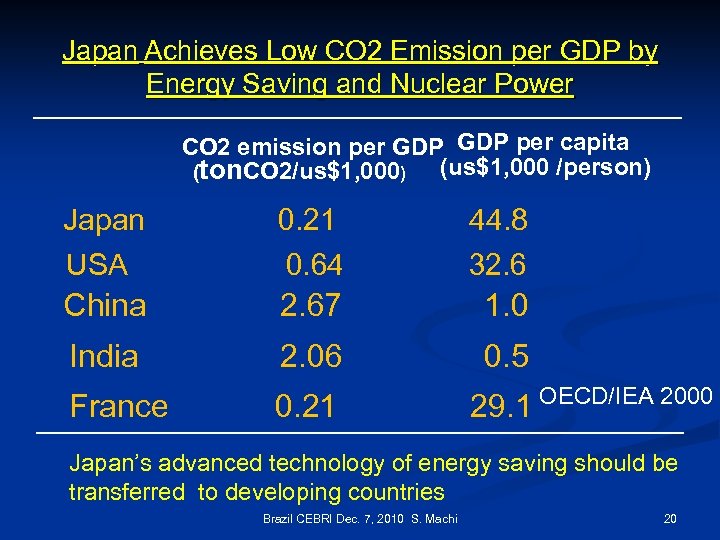
Japan Achieves Low CO 2 Emission per GDP by Energy Saving and Nuclear Power CO 2 emission per GDP per capita (us$1, 000 /person) (ton. CO 2/us$1, 000) Japan USA 0. 21 0. 64 44. 8 32. 6 China 2. 67 1. 0 India 2. 06 0. 5 France 0. 21 29. 1 OECD/IEA 2000 Japan’s advanced technology of energy saving should be transferred to developing countries Brazil CEBRI Dec. 7, 2010 S. Machi 20
Japan’s Energy Policy and Roles of Nuclear Power n n n Mitigation of CO 2 emission Security of energy supply Cost competitiveness Brazil CEBRI Dec. 7, 2010 S. Machi 21
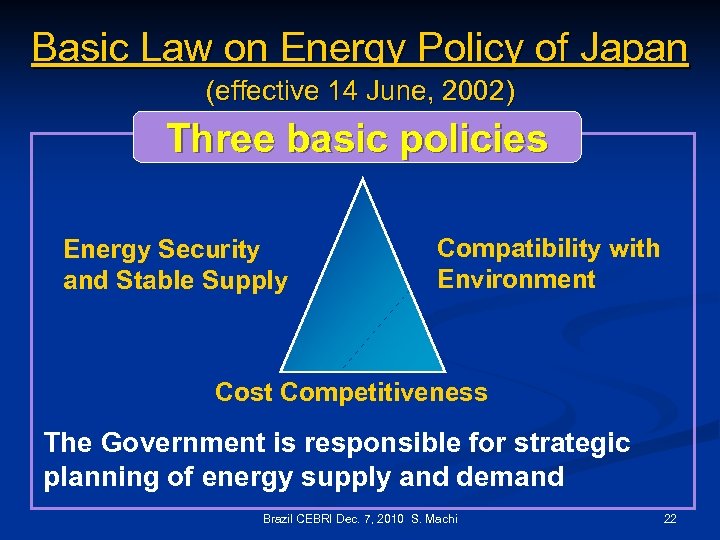
Basic Law on Energy Policy of Japan (effective 14 June, 2002) Three basic policies Energy Security and Stable Supply Compatibility with Environment Cost Competitiveness The Government is responsible for strategic planning of energy supply and demand Brazil CEBRI Dec. 7, 2010 S. Machi 22
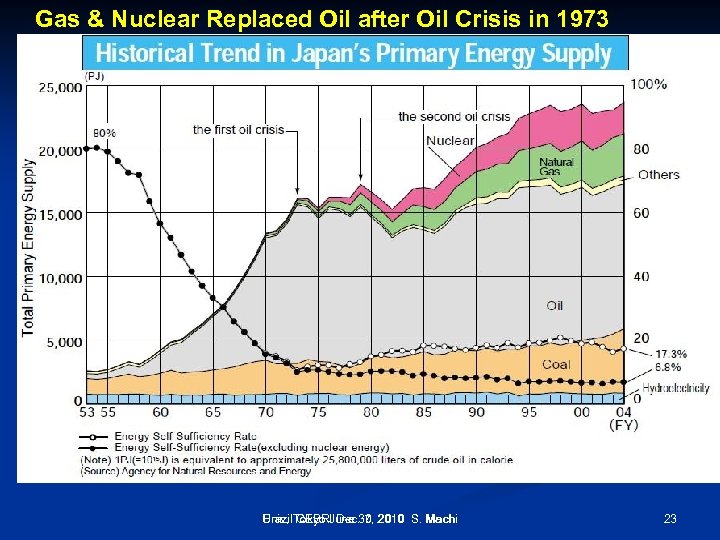
Gas & Nuclear Replaced Oil after Oil Crisis in 1973 Univ, Tokyo June 30, 2010 S. Machi Brazil CEBRI Dec. 7, 23
Japan’s Energy Basic Plan to 2030 ( METI, 2010) Significant increase in nuclear power: 14 additional NPPs by 2030 n Increase in operation factor to 90% n 70% of power is from non-CO 2 emission source n Increase in renewable energy to 10% n 70% of new cars with hybrid and/or electric n 100% light source by LED and/or Organic EL n Fukui Int. Mtg. 3 June, 2010 S. Machi Brazil CEBRI Dec. 7, 2010 S. Machi 24 24
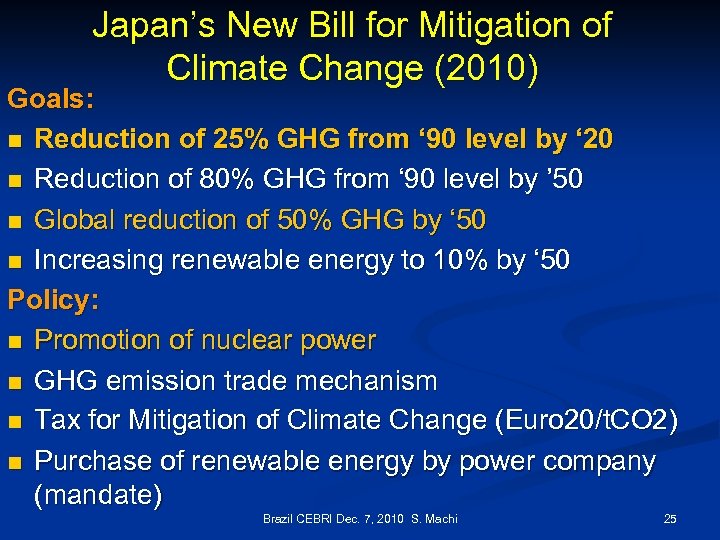
Japan’s New Bill for Mitigation of Climate Change (2010) Goals: n Reduction of 25% GHG from ‘ 90 level by ‘ 20 n Reduction of 80% GHG from ‘ 90 level by ’ 50 n Global reduction of 50% GHG by ‘ 50 n Increasing renewable energy to 10% by ‘ 50 Policy: n Promotion of nuclear power n GHG emission trade mechanism n Tax for Mitigation of Climate Change (Euro 20/t. CO 2) n Purchase of renewable energy by power company (mandate) Brazil CEBRI Dec. 7, 2010 S. Machi 25
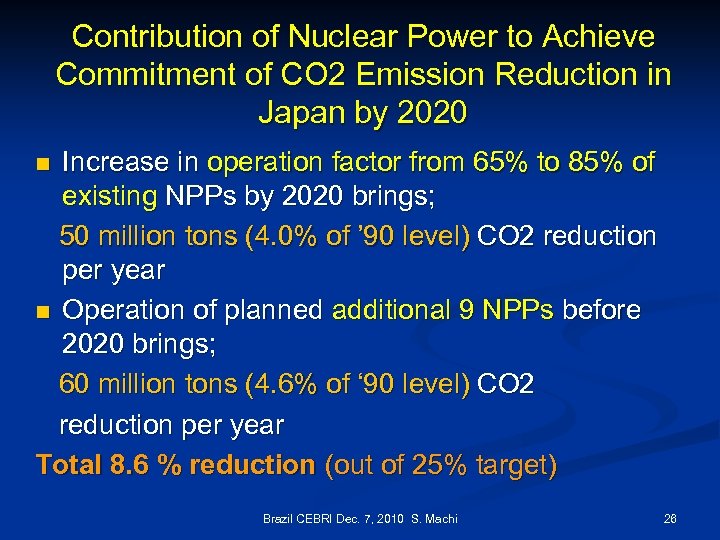
Contribution of Nuclear Power to Achieve Commitment of CO 2 Emission Reduction in Japan by 2020 Increase in operation factor from 65% to 85% of existing NPPs by 2020 brings; 50 million tons (4. 0% of ’ 90 level) CO 2 reduction per year n Operation of planned additional 9 NPPs before 2020 brings; 60 million tons (4. 6% of ‘ 90 level) CO 2 reduction per year Total 8. 6 % reduction (out of 25% target) n Brazil CEBRI Dec. 7, 2010 S. Machi 26
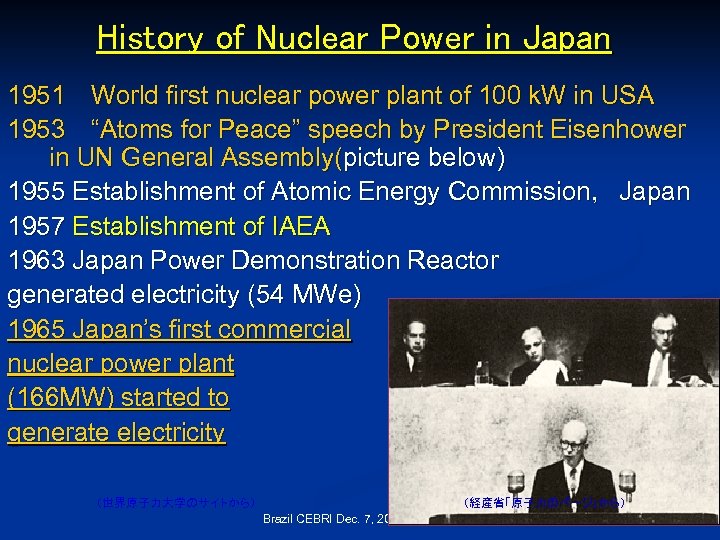
History of Nuclear Power in Japan 1951 World first nuclear power plant of 100 k. W in USA 1953 “Atoms for Peace” speech by President Eisenhower in UN General Assembly(picture below) 1955 Establishment of Atomic Energy Commission, Japan 1957 Establishment of IAEA 1963 Japan Power Demonstration Reactor generated electricity (54 MWe) 1965 Japan’s first commercial nuclear power plant (166 MW) started to generate electricity (世界原子力大学のサイトから) (経産省「原子力のページ」から) Brazil CEBRI Dec. 7, 2010 S. Machi 27
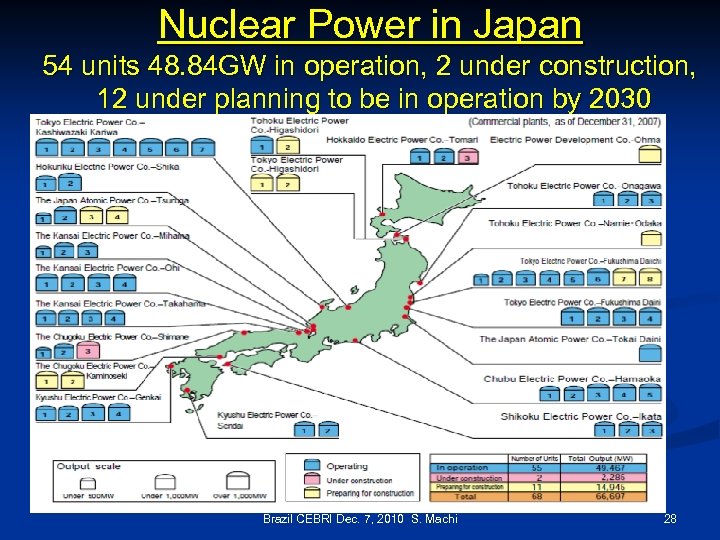
Nuclear Power in Japan 54 units 48. 84 GW in operation, 2 under construction, 12 under planning to be in operation by 2030 Brazil CEBRI Dec. 7, 2010 S. Machi 28
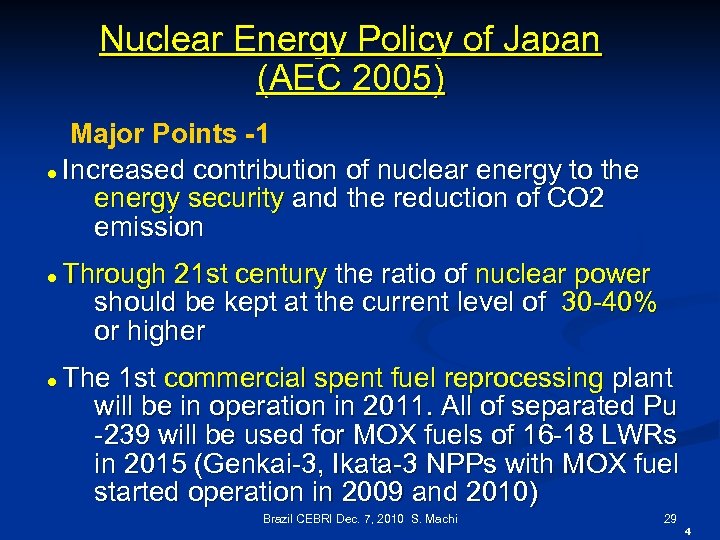
Nuclear Energy Policy of Japan (AEC 2005) Major Points -1 ● Increased contribution of nuclear energy to the energy security and the reduction of CO 2 emission ● Through 21 st century the ratio of nuclear power should be kept at the current level of 30 -40% or higher ● The 1 st commercial spent fuel reprocessing plant will be in operation in 2011. All of separated Pu -239 will be used for MOX fuels of 16 -18 LWRs in 2015 (Genkai-3, Ikata-3 NPPs with MOX fuel started operation in 2009 and 2010) Brazil CEBRI Dec. 7, 2010 S. Machi 29 4
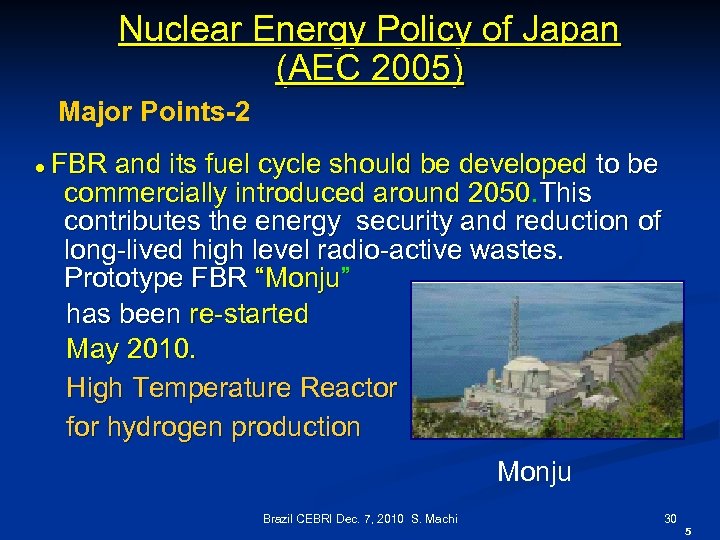
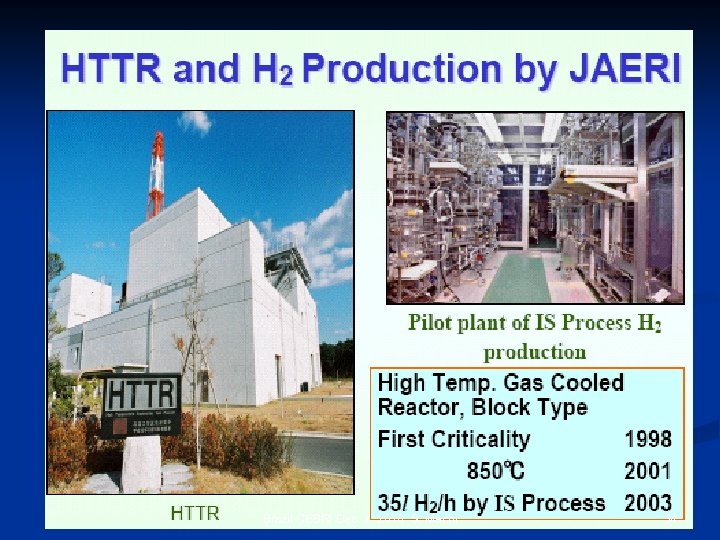
Nuclear Energy Policy of Japan (AEC 2005) Major Points-2 ● FBR and its fuel cycle should be developed to be commercially introduced around 2050. This contributes the energy security and reduction of long-lived high level radio-active wastes. Prototype FBR “Monju” has been re-started May 2010. High Temperature Reactor for hydrogen production Monju Brazil CEBRI Dec. 7, 2010 S. Machi 30 5
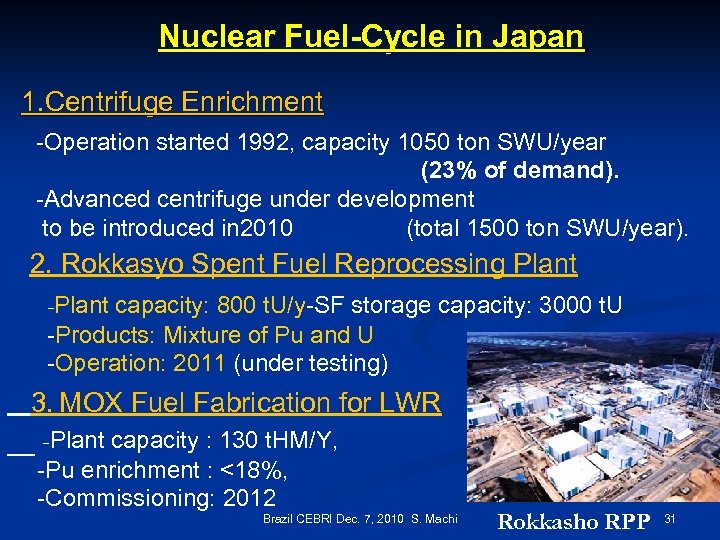
Nuclear Fuel-Cycle in Japan 1. Centrifuge Enrichment -Operation started 1992, capacity 1050 ton SWU/year (23% of demand). -Advanced centrifuge under development to be introduced in 2010 (total 1500 ton SWU/year). 2. Rokkasyo Spent Fuel Reprocessing Plant -Plant capacity: 800 t. U/y-SF storage capacity: 3000 t. U -Products: Mixture of Pu and U -Operation: 2011 (under testing) 3. MOX Fuel Fabrication for LWR -Plant capacity : 130 t. HM/Y, -Pu enrichment : <18%, -Commissioning: 2012 Brazil CEBRI Dec. 7, 2010 S. Machi Rokkasho RPP 31
Nuclear Fuel Cycle Policy Rationality 1. 2. 3. 4. Better energy security in long term by efficient utilization of Pu and U. Better environmental compatibility by reducing high level radioactive wastes. Costs difference between recycling fuels and direct disposal of SF is . 5~0. 7/k. Wh (600~840 per house hold per year) Uranium price has been rapidly increasing from US$7. 1/lb. U 308 in ’ 00 to US $32. 0/lb. U 308 in ’ 05. Brazil CEBRI Dec. 7, 2010 S. Machi 32
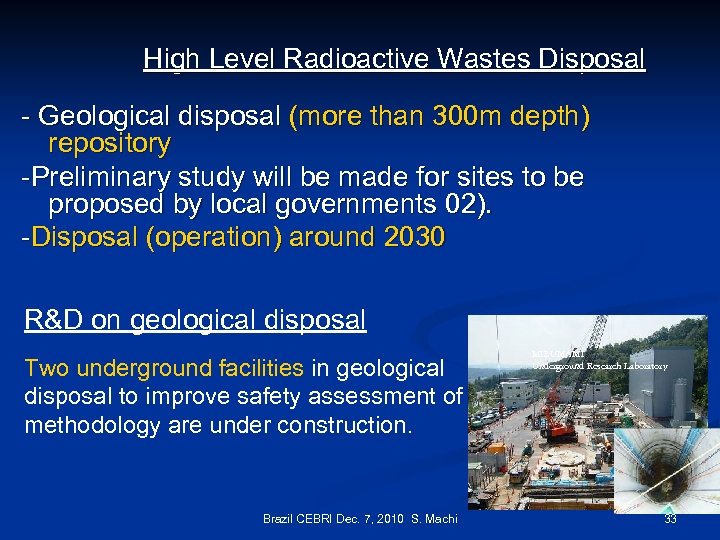
High Level Radioactive Wastes Disposal - Geological disposal (more than 300 m depth) repository -Preliminary study will be made for sites to be proposed by local governments 02). -Disposal (operation) around 2030 R&D on geological disposal Two underground facilities in geological disposal to improve safety assessment of methodology are under construction. Brazil CEBRI Dec. 7, 2010 S. Machi MIZUMAMI Underground Research Laboratory 33
Brazil CEBRI Dec. 7, 2010 S. Machi 34
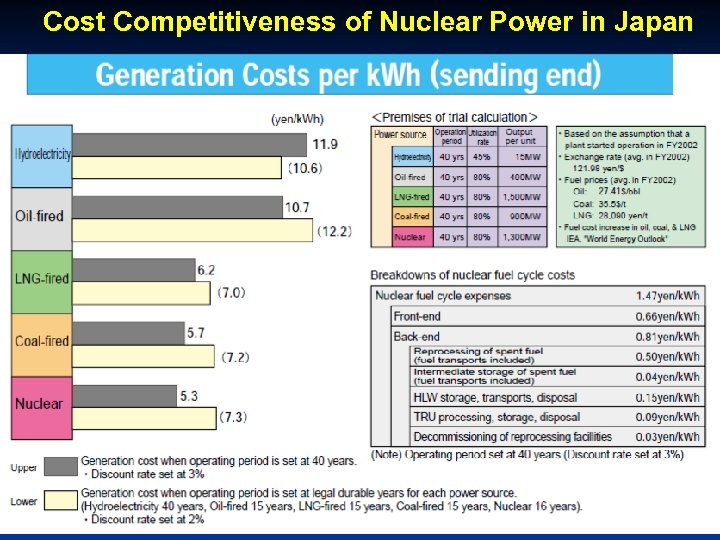
Cost Competitiveness of Nuclear Power in Japan Brazil CEBRI Dec. 7, 2010 S. Machi 35
n Global Trends of Increasing Nuclear Power - IAEA and NEA Projection - Rapid increase of NNPs in Asia Brazil CEBRI Dec. 7, 2010 S. Machi 36
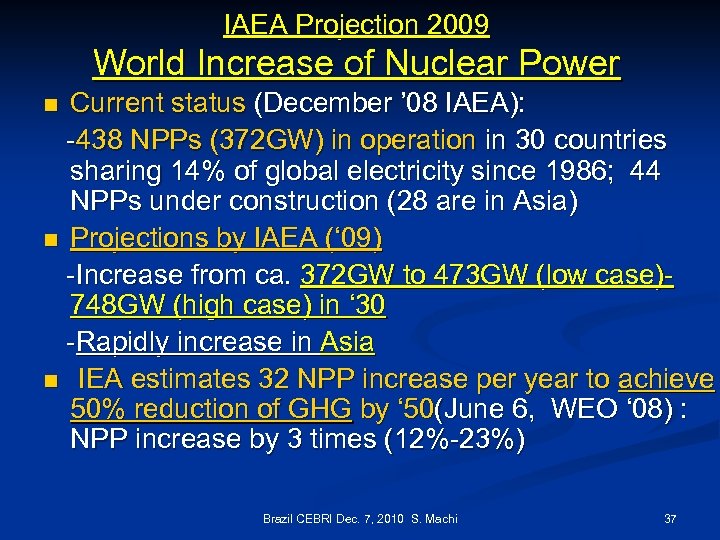
IAEA Projection 2009 World Increase of Nuclear Power Current status (December ’ 08 IAEA): -438 NPPs (372 GW) in operation in 30 countries sharing 14% of global electricity since 1986; 44 NPPs under construction (28 are in Asia) n Projections by IAEA (‘ 09) -Increase from ca. 372 GW to 473 GW (low case)748 GW (high case) in ‘ 30 -Rapidly increase in Asia n IEA estimates 32 NPP increase per year to achieve 50% reduction of GHG by ‘ 50(June 6, WEO ‘ 08) : NPP increase by 3 times (12%-23%) n Brazil CEBRI Dec. 7, 2010 S. Machi 37
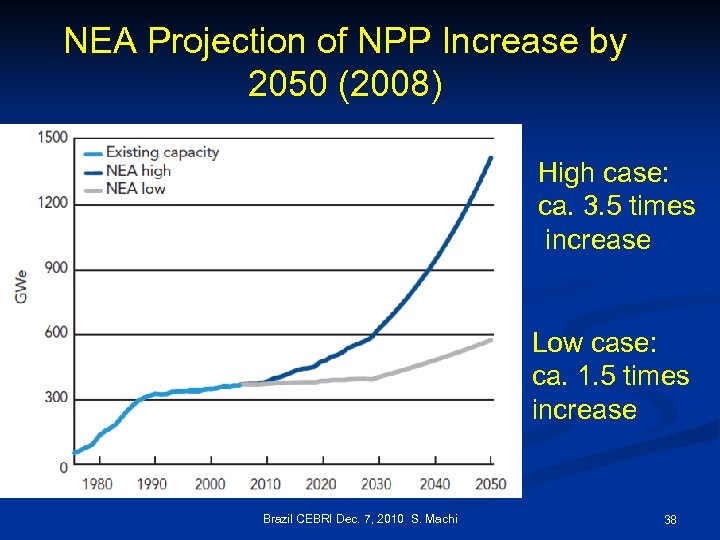
NEA Projection of NPP Increase by 2050 (2008) High case: ca. 3. 5 times increase Low case: ca. 1. 5 times increase Brazil CEBRI Dec. 7, 2010 S. Machi 38
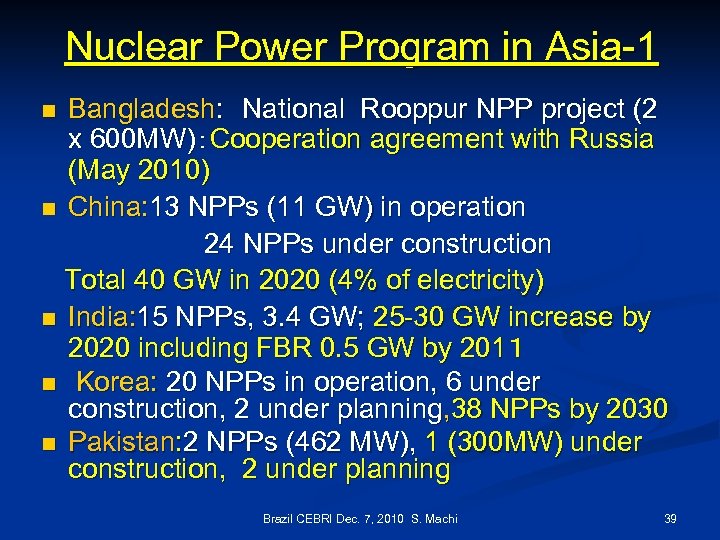
Nuclear Power Program in Asia-1 Bangladesh: National Rooppur NPP project (2 x 600 MW):Cooperation agreement with Russia (May 2010) n China: 13 NPPs (11 GW) in operation 24 NPPs under construction Total 40 GW in 2020 (4% of electricity) n India: 15 NPPs, 3. 4 GW; 25 -30 GW increase by 2020 including FBR 0. 5 GW by 2011 n Korea: 20 NPPs in operation, 6 under construction, 2 under planning, 38 NPPs by 2030 n Pakistan: 2 NPPs (462 MW), 1 (300 MW) under construction, 2 under planning n Brazil CEBRI Dec. 7, 2010 S. Machi 39
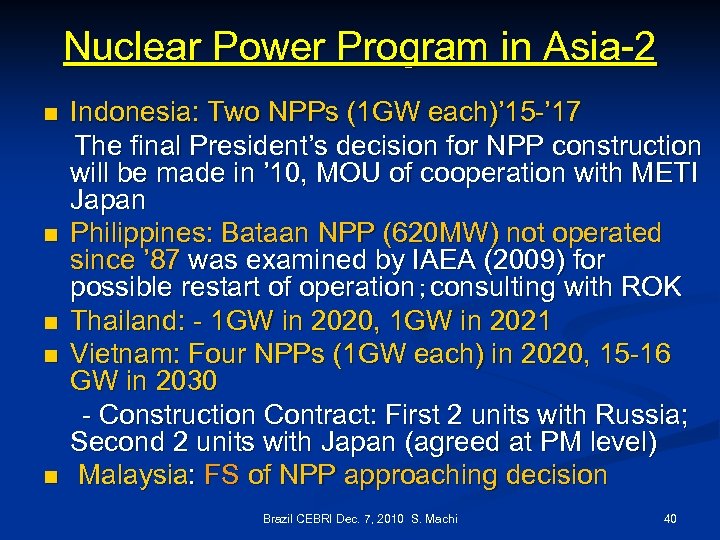
Nuclear Power Program in Asia-2 n n n Indonesia: Two NPPs (1 GW each)’ 15 -’ 17 The final President’s decision for NPP construction will be made in ’ 10, MOU of cooperation with METI Japan Philippines: Bataan NPP (620 MW) not operated since ’ 87 was examined by IAEA (2009) for possible restart of operation;consulting with ROK Thailand: - 1 GW in 2020, 1 GW in 2021 Vietnam: Four NPPs (1 GW each) in 2020, 15 -16 GW in 2030 - Construction Contract: First 2 units with Russia; Second 2 units with Japan (agreed at PM level) Malaysia: FS of NPP approaching decision Brazil CEBRI Dec. 7, 2010 S. Machi 40
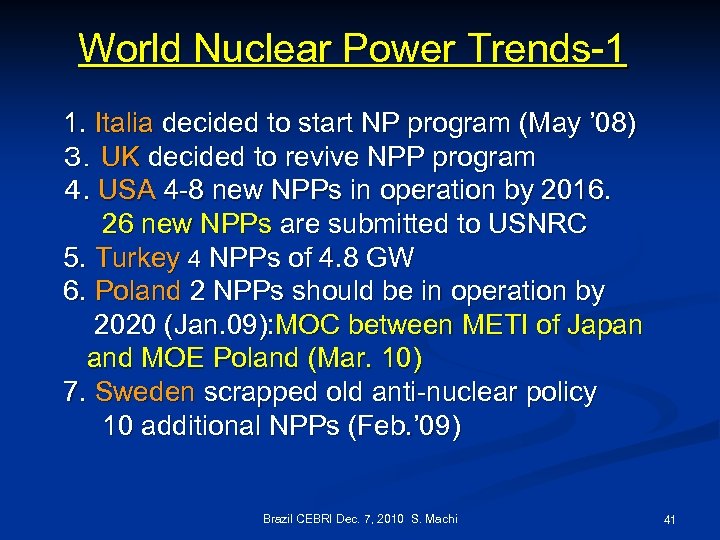
World Nuclear Power Trends-1 1. Italia decided to start NP program (May ’ 08) 3.UK decided to revive NPP program 4. USA 4 -8 new NPPs in operation by 2016. 26 new NPPs are submitted to USNRC 5. Turkey 4 NPPs of 4. 8 GW 6. Poland 2 NPPs should be in operation by 2020 (Jan. 09): MOC between METI of Japan and MOE Poland (Mar. 10) 7. Sweden scrapped old anti-nuclear policy 10 additional NPPs (Feb. ’ 09) Brazil CEBRI Dec. 7, 2010 S. Machi 41
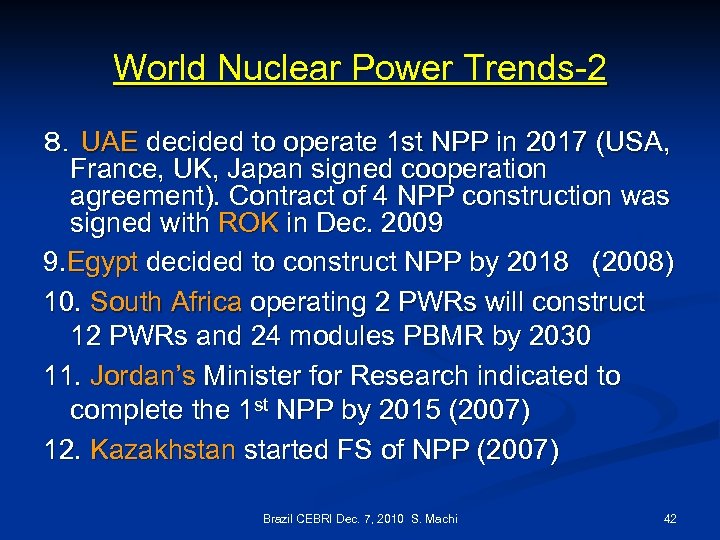
World Nuclear Power Trends-2 8.UAE decided to operate 1 st NPP in 2017 (USA, France, UK, Japan signed cooperation agreement). Contract of 4 NPP construction was signed with ROK in Dec. 2009 9. Egypt decided to construct NPP by 2018 (2008) 10. South Africa operating 2 PWRs will construct 12 PWRs and 24 modules PBMR by 2030 11. Jordan’s Minister for Research indicated to complete the 1 st NPP by 2015 (2007) 12. Kazakhstan started FS of NPP (2007) Brazil CEBRI Dec. 7, 2010 S. Machi 42
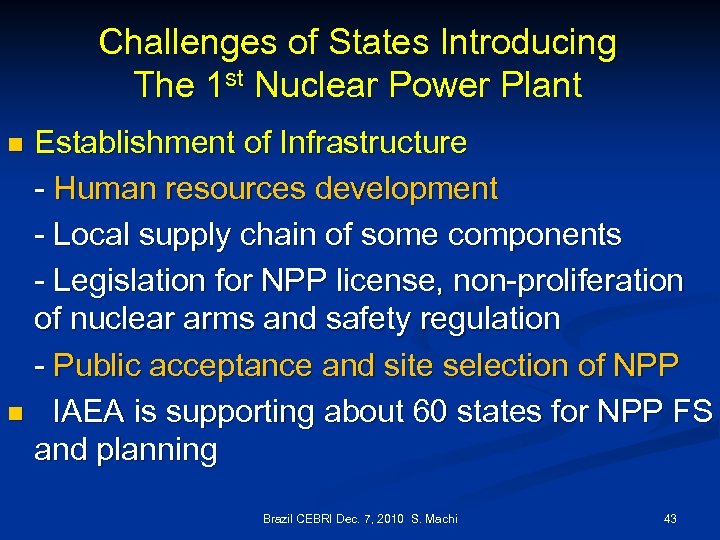
Challenges of States Introducing The 1 st Nuclear Power Plant Establishment of Infrastructure - Human resources development - Local supply chain of some components - Legislation for NPP license, non-proliferation of nuclear arms and safety regulation - Public acceptance and site selection of NPP n IAEA is supporting about 60 states for NPP FS and planning n Brazil CEBRI Dec. 7, 2010 S. Machi 43
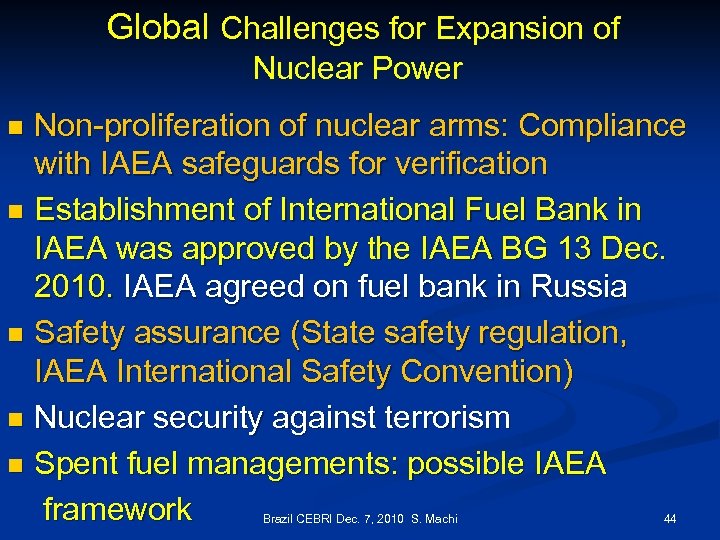
Global Challenges for Expansion of Nuclear Power Non-proliferation of nuclear arms: Compliance with IAEA safeguards for verification n Establishment of International Fuel Bank in IAEA was approved by the IAEA BG 13 Dec. 2010. IAEA agreed on fuel bank in Russia n Safety assurance (State safety regulation, IAEA International Safety Convention) n Nuclear security against terrorism n Spent fuel managements: possible IAEA framework n Brazil CEBRI Dec. 7, 2010 S. Machi 44
Public Acceptance and Trust on Nuclear Power Japan’s Policy for Public Acceptance (1) To make the process of nuclear policy decision be as transparent as possible (2) To communicate as much as possible with the public on benefit, safety assurance and risk assessment of nuclear power by meetings, conference and media (3) Government support for development and welfare of communities where NPPs are located Brazil CEBRI Dec. 7, 2010 S. Machi 45
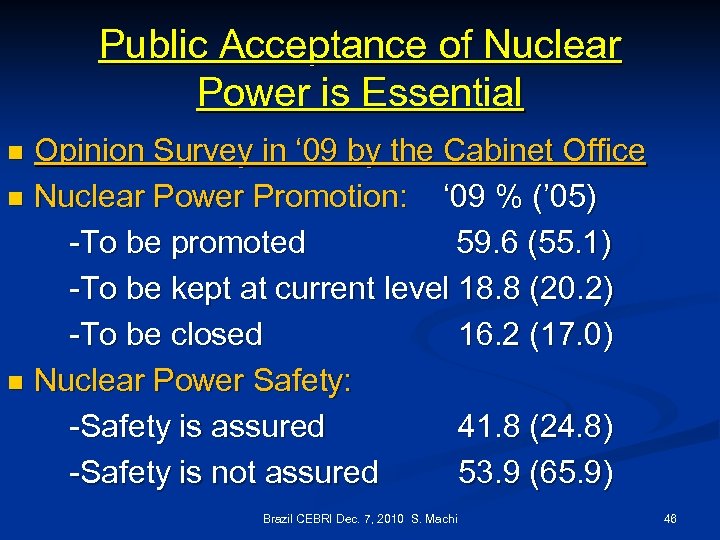
Public Acceptance of Nuclear Power is Essential Opinion Survey in ‘ 09 by the Cabinet Office n Nuclear Power Promotion: ‘ 09 % (’ 05) -To be promoted 59. 6 (55. 1) -To be kept at current level 18. 8 (20. 2) -To be closed 16. 2 (17. 0) n Nuclear Power Safety: -Safety is assured 41. 8 (24. 8) -Safety is not assured 53. 9 (65. 9) n Brazil CEBRI Dec. 7, 2010 S. Machi 46
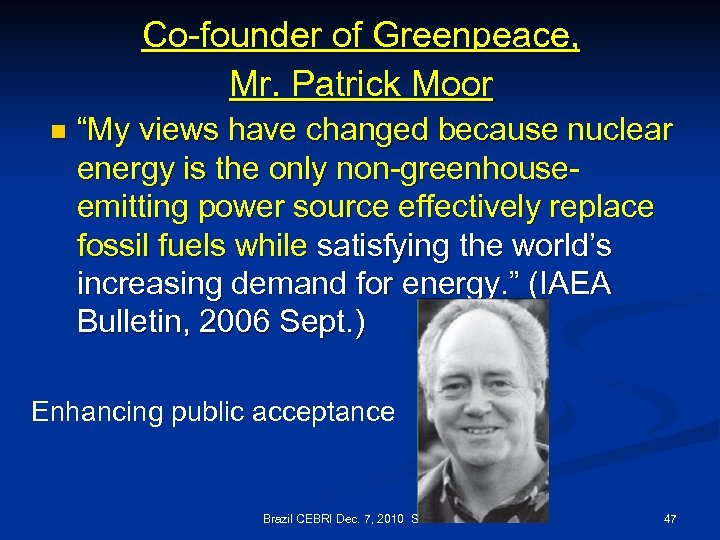
Co-founder of Greenpeace, Mr. Patrick Moor n “My views have changed because nuclear energy is the only non-greenhouseemitting power source effectively replace fossil fuels while satisfying the world’s increasing demand for energy. ” (IAEA Bulletin, 2006 Sept. ) Enhancing public acceptance Brazil CEBRI Dec. 7, 2010 S. Machi 47
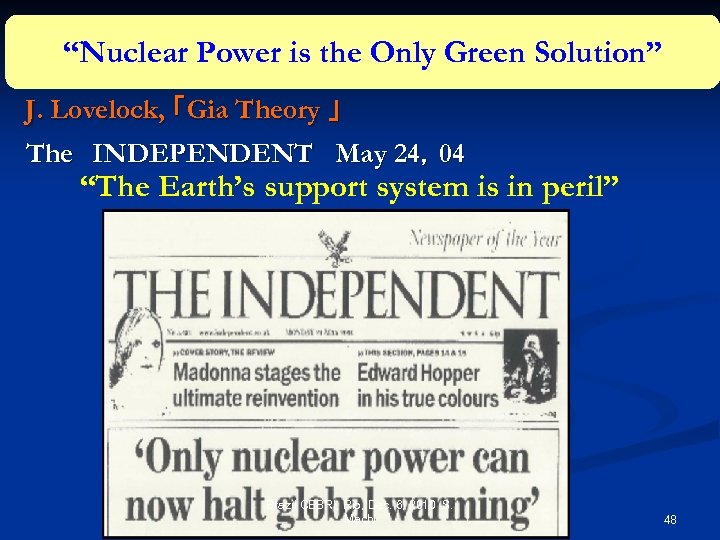
“Nuclear Power is the Only Green Solution” J. Lovelock, 「Gia Theory 」 The INDEPENDENT May 24,04 “The Earth’s support system is in peril” Brazil CEBRI, Rio, Dec. 6, 2010 S. Machi 48
Nuclear Technology for Everyday Life n Nuclear applications for improving human welfare - More productive agriculture - Better human health - Improved industrial process - Environmental protection Brazil CEBRI Dec. 7, 2010 S. Machi 49
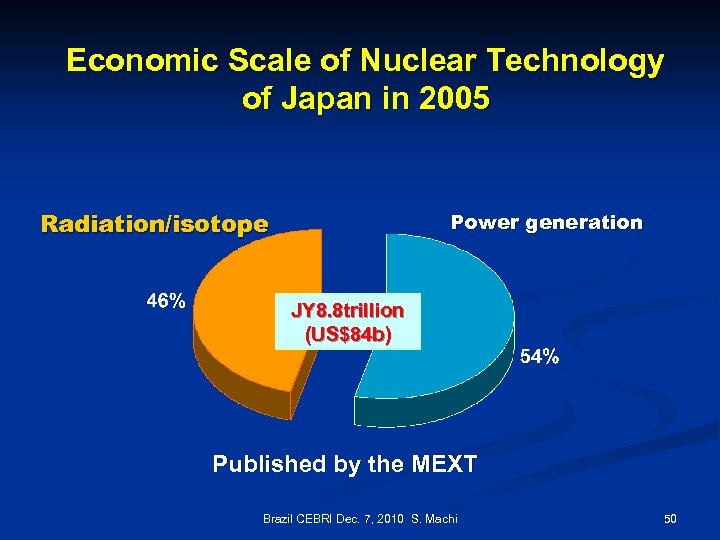
Economic Scale of Nuclear Technology of Japan in 2005 Radiation/isotope Power generation JY 8. 8 trillion (US$84 b) Published by the MEXT Brazil CEBRI Dec. 7, 2010 S. Machi 50
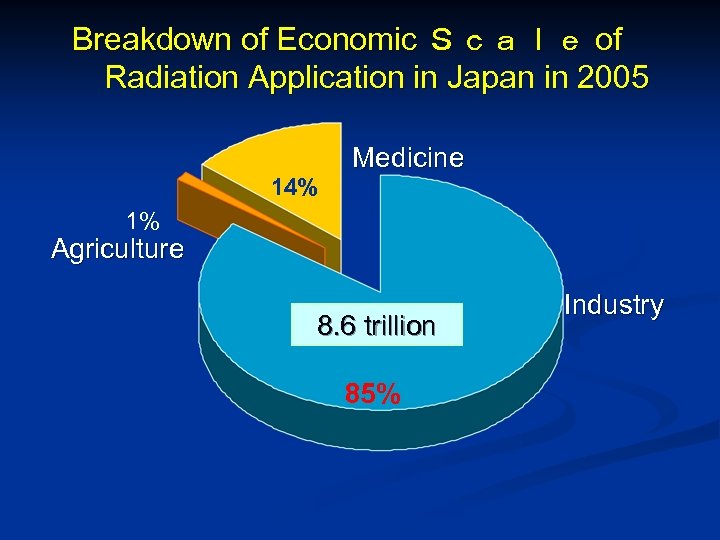
Breakdown of Economic Scale of Radiation Application in Japan in 2005 14% Medicine 1% Agriculture 8. 6 trillion 85% Industry
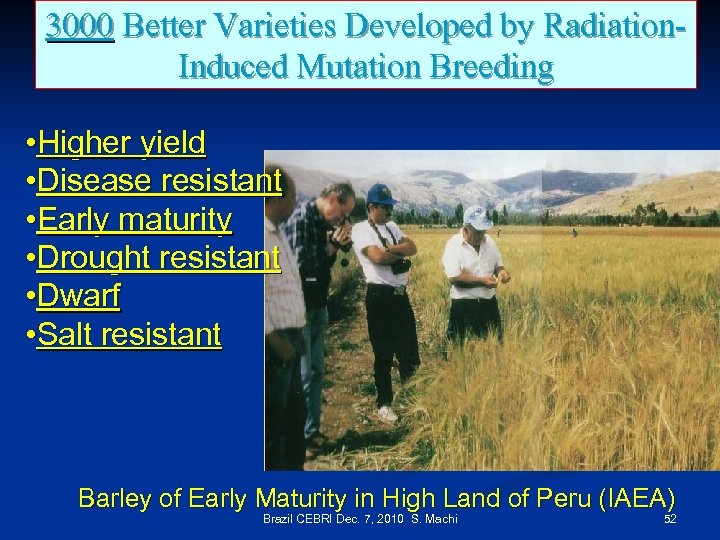
3000 Better Varieties Developed by Radiation. Induced Mutation Breeding • Higher yield • Disease resistant • Early maturity • Drought resistant • Dwarf • Salt resistant Barley of Early Maturity in High Land of Peru (IAEA) Brazil CEBRI Dec. 7, 2010 S. Machi 52
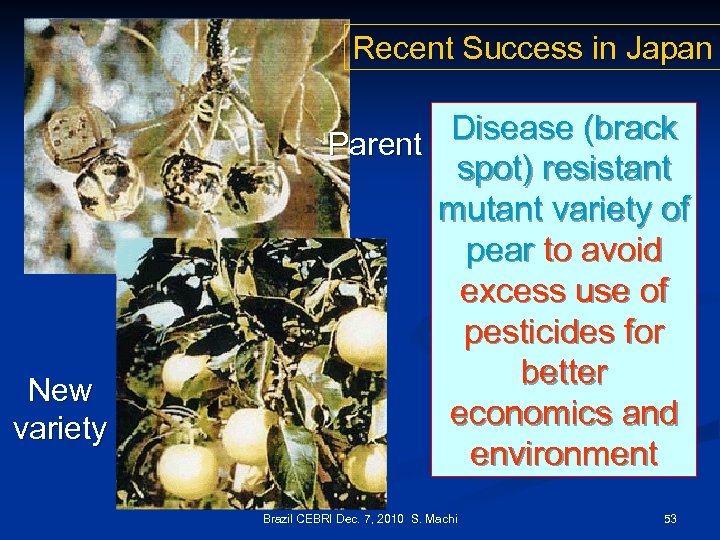
Recent Success in Japan New variety Disease (brack Parent spot) resistant mutant variety of pear to avoid excess use of pesticides for better economics and environment Brazil CEBRI Dec. 7, 2010 S. Machi 53
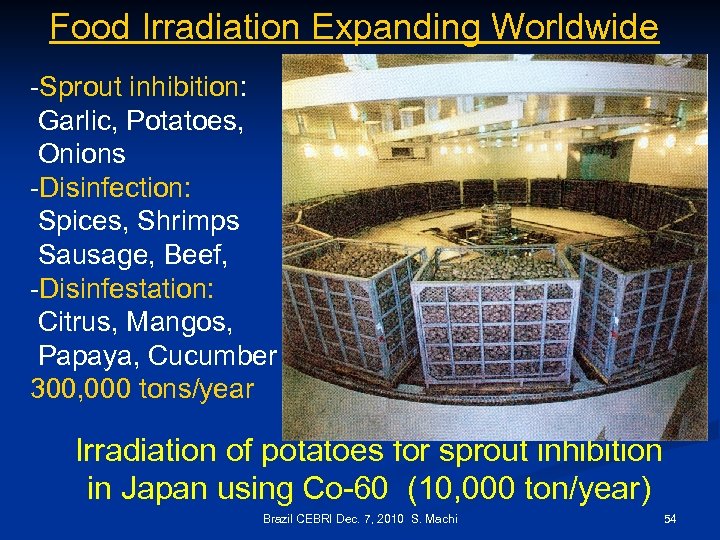
Food Irradiation Expanding Worldwide -Sprout inhibition: Garlic, Potatoes, Onions -Disinfection: Spices, Shrimps Sausage, Beef, -Disinfestation: Citrus, Mangos, Papaya, Cucumber 300, 000 tons/year Irradiation of potatoes for sprout inhibition in Japan using Co-60 (10, 000 ton/year) Brazil CEBRI Dec. 7, 2010 S. Machi 54
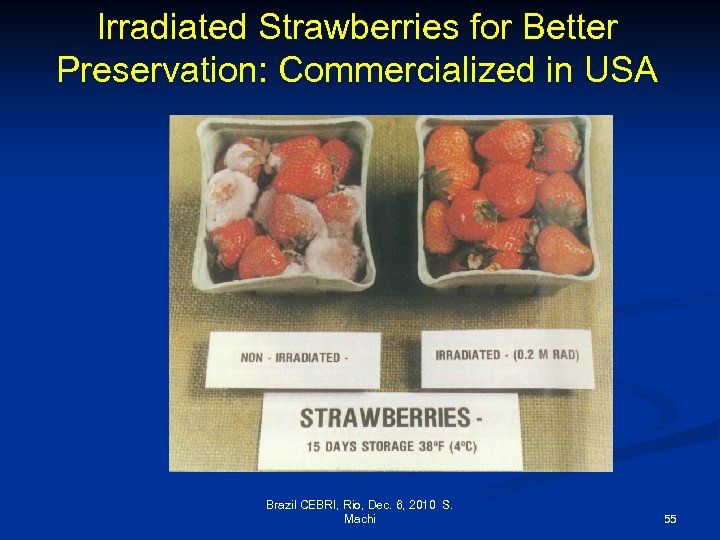
Irradiated Strawberries for Better Preservation: Commercialized in USA Brazil CEBRI, Rio, Dec. 6, 2010 S. Machi 55
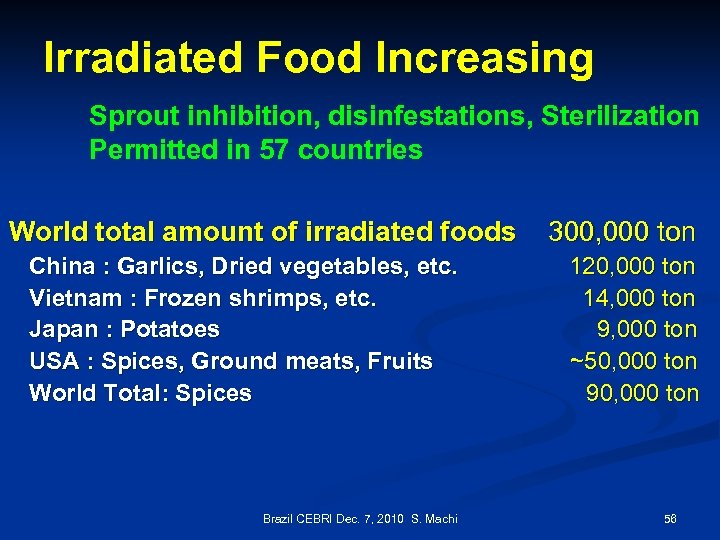
Irradiated Food Increasing Sprout inhibition, disinfestations, Sterilization Permitted in 57 countries World total amount of irradiated foods China : Garlics, Dried vegetables, etc. Vietnam : Frozen shrimps, etc. Japan : Potatoes USA : Spices, Ground meats, Fruits World Total: Spices Brazil CEBRI Dec. 7, 2010 S. Machi 300, 000 ton 120, 000 ton 14, 000 ton 9, 000 ton ~50, 000 ton 90, 000 ton 56
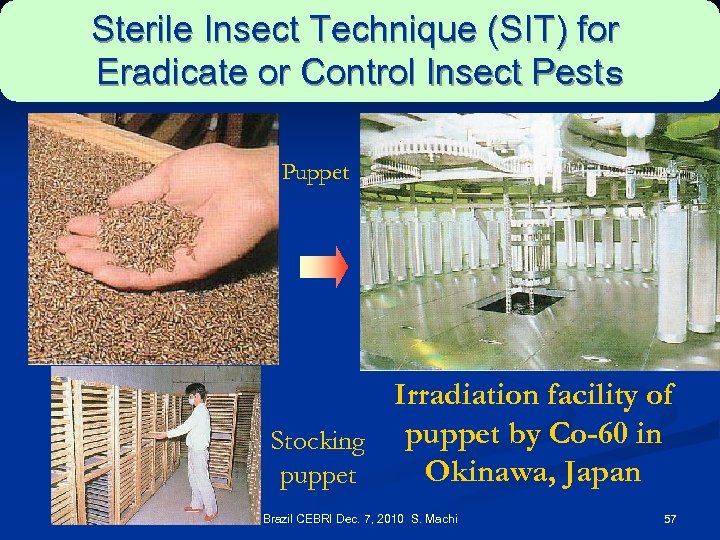
Sterile Insect Technique (SIT) for Eradicate or Control Insect Pests Puppet Irradiation facility of Stocking puppet by Co-60 in Okinawa, Japan puppet Brazil CEBRI Dec. 7, 2010 S. Machi 57
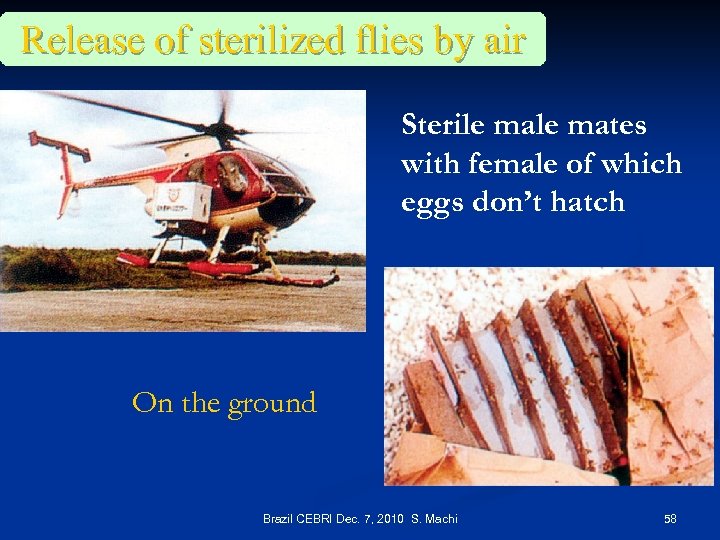
Release of sterilized flies by air Sterile mates with female of which eggs don’t hatch On the ground Brazil CEBRI Dec. 7, 2010 S. Machi 58
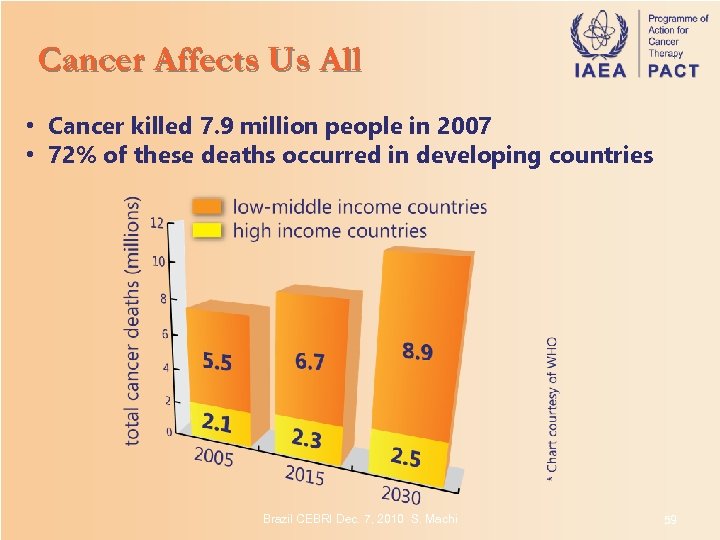
Cancer Affects Us All • Cancer killed 7. 9 million people in 2007 • 72% of these deaths occurred in developing countries Brazil CEBRI Dec. 7, 2010 S. Machi 59
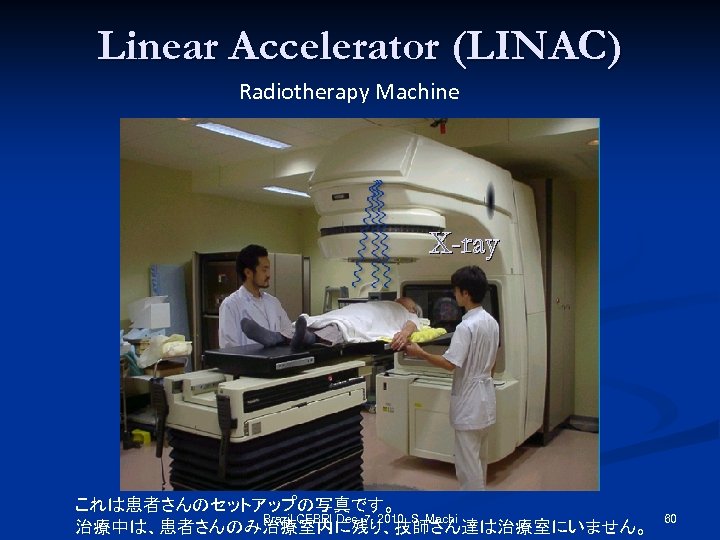
Linear Accelerator (LINAC) Radiotherapy Machine X-ray これは患者さんのセットアップの写真です。 Brazil CEBRI Dec. 7, 2010 S. Machi 治療中は、患者さんのみ治療室内に残り、技師さん達は治療室にいません。 60
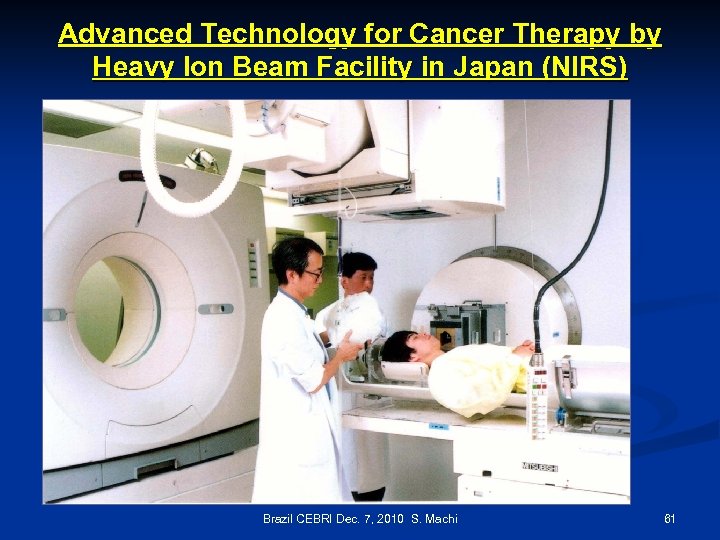
Advanced Technology for Cancer Therapy by Heavy Ion Beam Facility in Japan (NIRS) Brazil CEBRI Dec. 7, 2010 S. Machi 61
Carbon-12 Ion Beam Treatment of Cancer in Japan World first facility of carbon ion treatment at National Institute of Radiological Science, Japan - Effective damage of cancer tumor (high LET) - Selective irradiation on targeted tumor - Much reduced side effect on healthy tissue n Effective cancer: Gullet, Lung, Prostate, Liver, Pancreas, Bone, Head-neck n Number of treated patients by NIRS: 5, 500 n Challenge: reduction of facility cost n n 2 nd facility; Nishiharima, 3 rd ; Gunma Univ. Brazil CEBRI Dec. 7, 2010 S. Machi 62
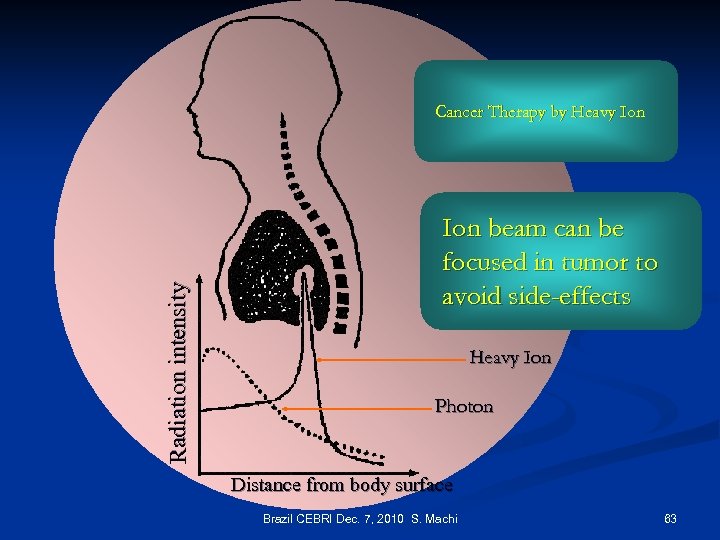
Radiation intensity Cancer Therapy by Heavy Ion beam can be focused in tumor to avoid side-effects Heavy Ion Photon Distance from body surface Brazil CEBRI Dec. 7, 2010 S. Machi 63
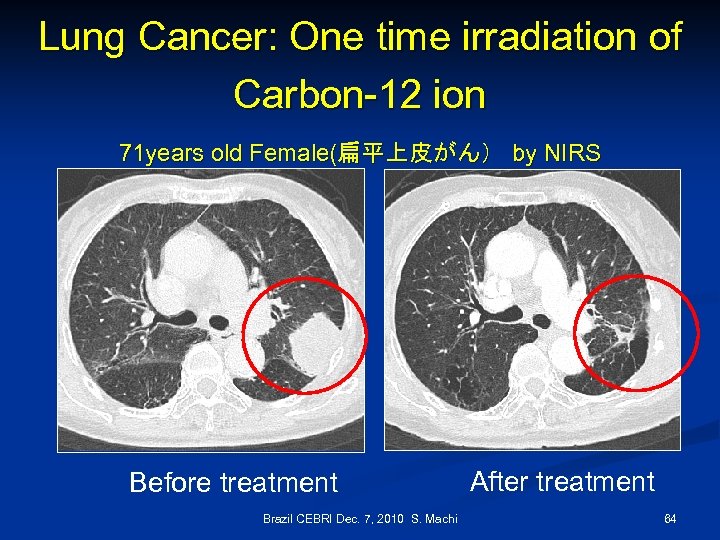
Lung Cancer: One time irradiation of Carbon-12 ion 71 years old Female(扁平上皮がん) by NIRS A B Before treatment Brazil CEBRI Dec. 7, 2010 S. Machi 18 mo after CIRT C After treatment 64
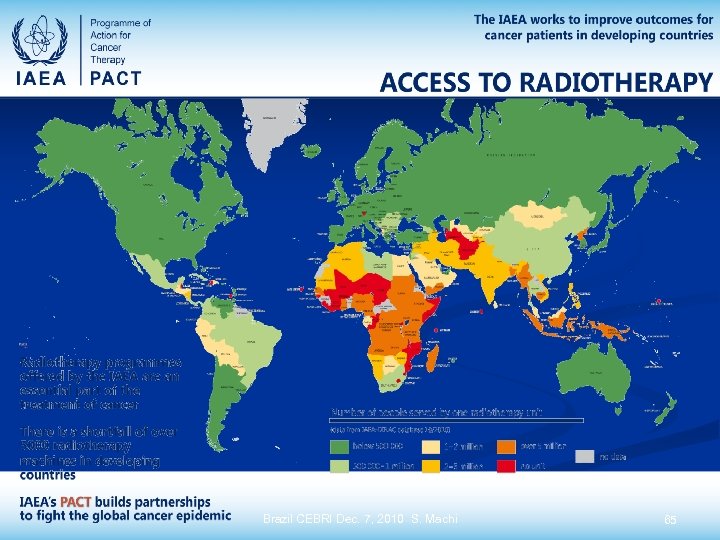
Brazil CEBRI Dec. 7, 2010 S. Machi 65
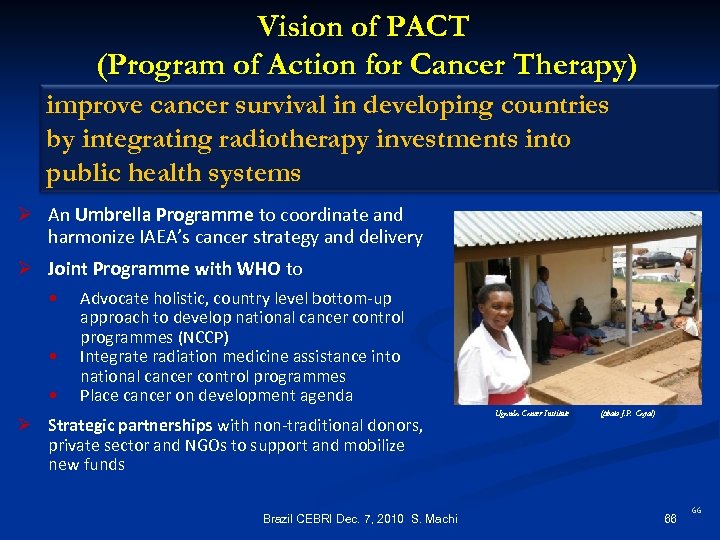
Vision of PACT (Program of Action for Cancer Therapy) improve cancer survival in developing countries by integrating radiotherapy investments into public health systems Ø An Umbrella Programme to coordinate and harmonize IAEA’s cancer strategy and delivery Ø Joint Programme with WHO to • • • Advocate holistic, country level bottom-up approach to develop national cancer control programmes (NCCP) Integrate radiation medicine assistance into national cancer control programmes Place cancer on development agenda Ø Strategic partnerships with non-traditional donors, private sector and NGOs to support and mobilize new funds Brazil CEBRI Dec. 7, 2010 S. Machi Uganda Cancer Institute (photo J. P. Cayol) 66 66
Industrial Applications Radiation processing for better products and environmental protection n Nucleonic control system for efficient process n Radiography for non-destructive testing n Radio-tracer technique for chemical engineering study n Brazil CEBRI Dec. 7, 2010 S. Machi 67
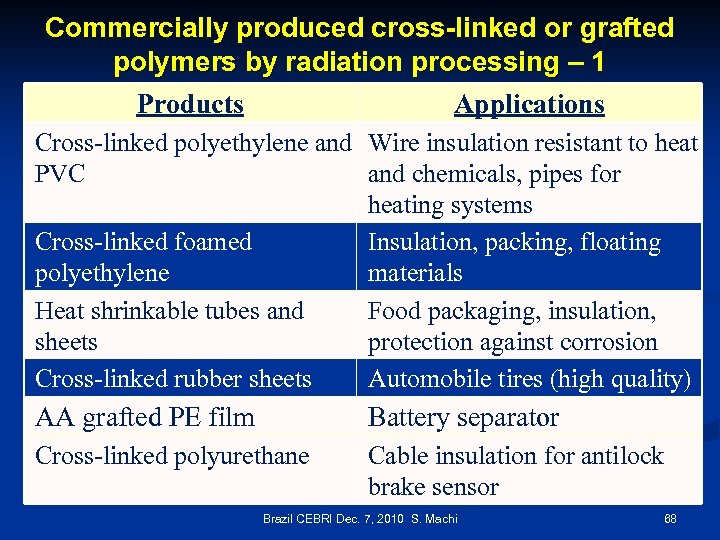
Commercially produced cross-linked or grafted polymers by radiation processing – 1 Products Applications Cross-linked polyethylene and Wire insulation resistant to heat PVC and chemicals, pipes for heating systems Cross-linked foamed Insulation, packing, floating polyethylene materials Heat shrinkable tubes and Food packaging, insulation, sheets protection against corrosion Cross-linked rubber sheets Automobile tires (high quality) AA grafted PE film Battery separator Cross-linked polyurethane Cable insulation for antilock brake sensor Brazil CEBRI Dec. 7, 2010 S. Machi 68
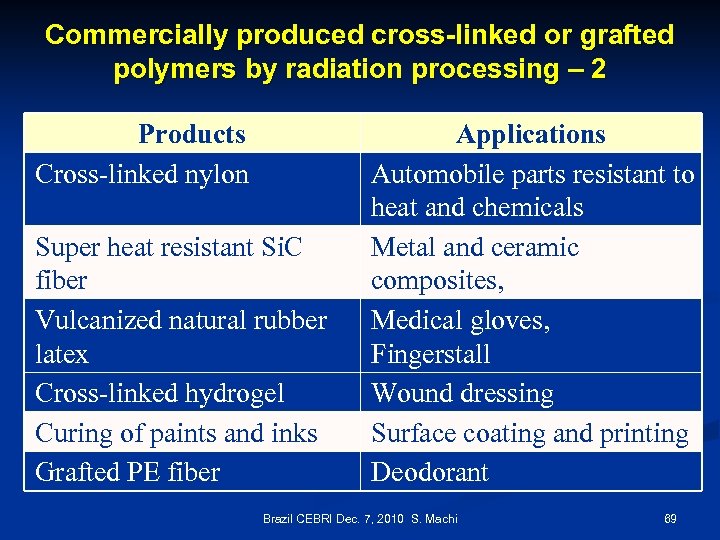
Commercially produced cross-linked or grafted polymers by radiation processing – 2 Products Cross-linked nylon Super heat resistant Si. C fiber Vulcanized natural rubber latex Cross-linked hydrogel Curing of paints and inks Grafted PE fiber Applications Automobile parts resistant to heat and chemicals Metal and ceramic composites, Medical gloves, Fingerstall Wound dressing Surface coating and printing Deodorant Brazil CEBRI Dec. 7, 2010 S. Machi 69
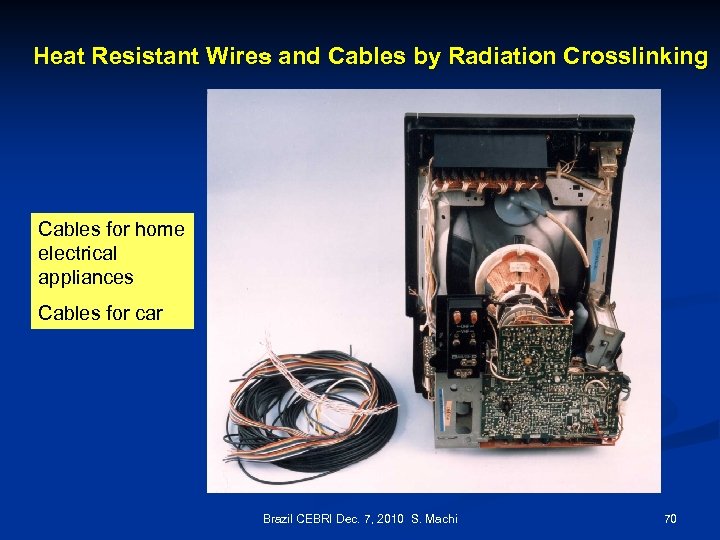
Heat Resistant Wires and Cables by Radiation Crosslinking Cables for home electrical appliances Cables for car Brazil CEBRI Dec. 7, 2010 S. Machi 70
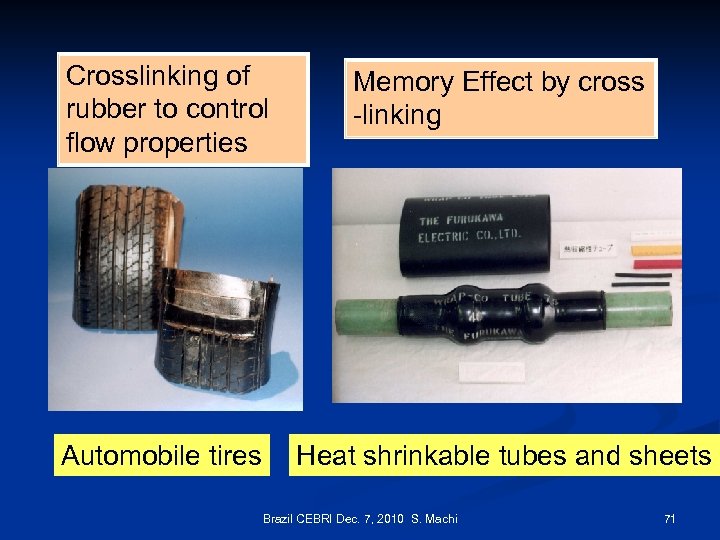
Crosslinking of rubber to control flow properties Memory Effect by cross -linking Automobile tires Heat shrinkable tubes and sheets Brazil CEBRI Dec. 7, 2010 S. Machi 71
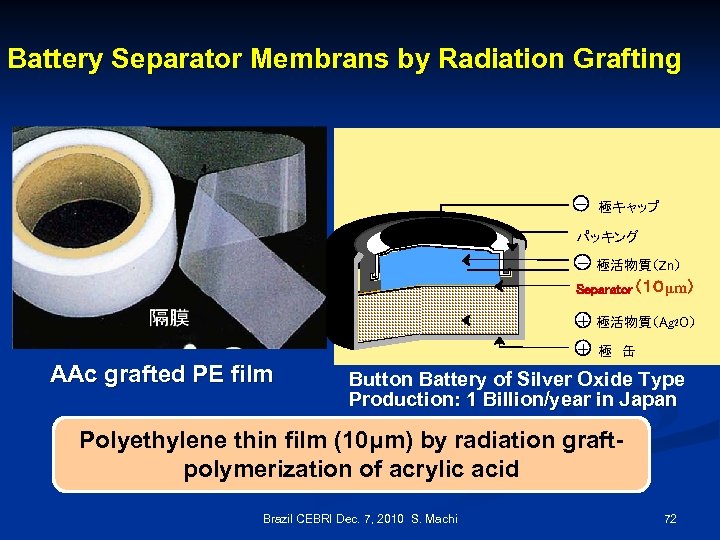
Battery Separator Membrans by Radiation Grafting - 極キャップ パッキング - 極活物質(Zn) Separator (10μm) + 極活物質(Ag 2 O) + 極 缶 AAc grafted PE film Button Battery of Silver Oxide Type Production: 1 Billion/year in Japan Polyethylene thin film (10μm) by radiation graftpolymerization of acrylic acid Brazil CEBRI Dec. 7, 2010 S. Machi 72
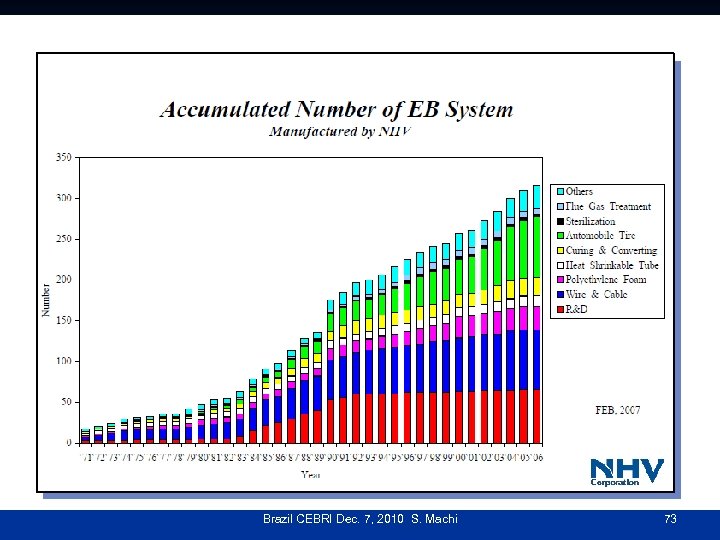
Brazil CEBRI Dec. 7, 2010 S. Machi 73
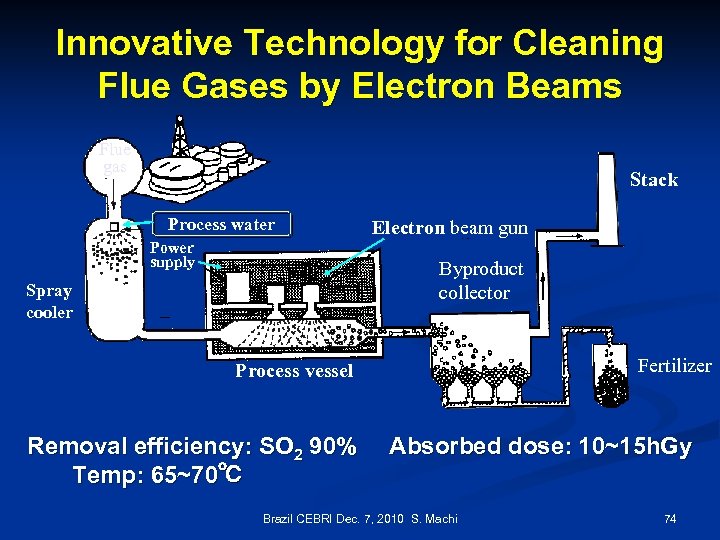
Innovative Technology for Cleaning Flue Gases by Electron Beams Flue gas Stack Process water Power supply Electron beam gun Byproduct collector Spray cooler Process vessel Fertilizer Removal efficiency: SO 2 90% Absorbed dose: 10~15 h. Gy Temp: 65~70℃ Brazil CEBRI Dec. 7, 2010 S. Machi 74
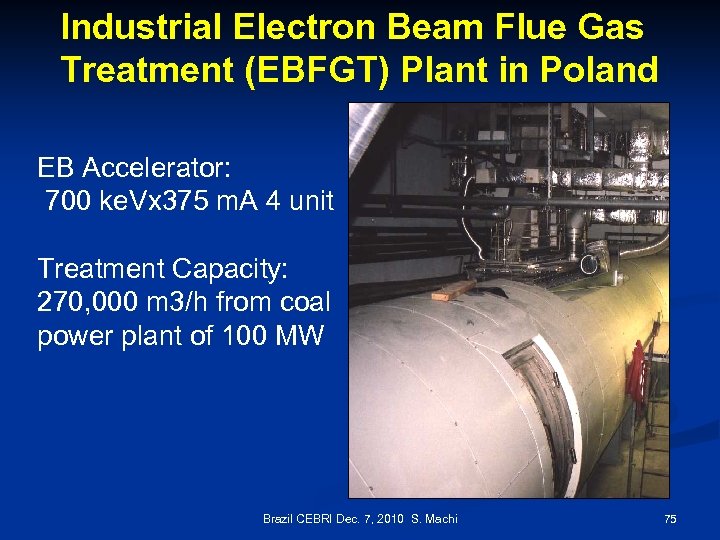
Industrial Electron Beam Flue Gas Treatment (EBFGT) Plant in Poland EB Accelerator: 700 ke. Vx 375 m. A 4 unit Treatment Capacity: 270, 000 m 3/h from coal power plant of 100 MW Brazil CEBRI Dec. 7, 2010 S. Machi 75
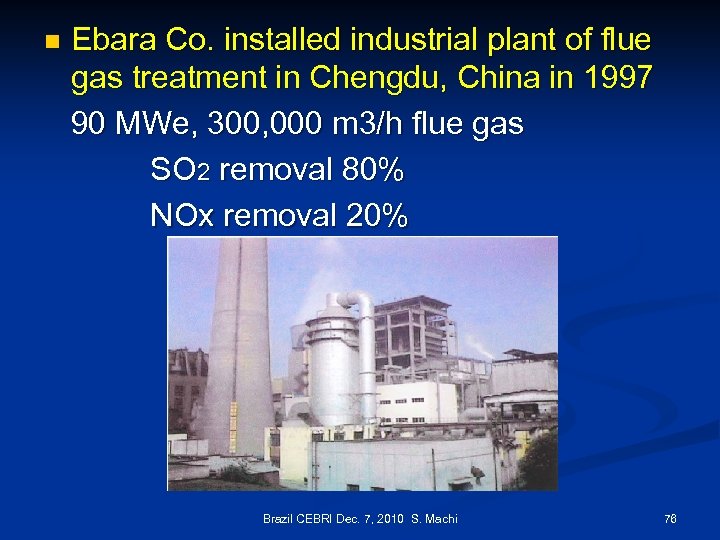
n Ebara Co. installed industrial plant of flue gas treatment in Chengdu, China in 1997 90 MWe, 300, 000 m 3/h flue gas SO 2 removal 80% NOx removal 20% Brazil CEBRI Dec. 7, 2010 S. Machi 76
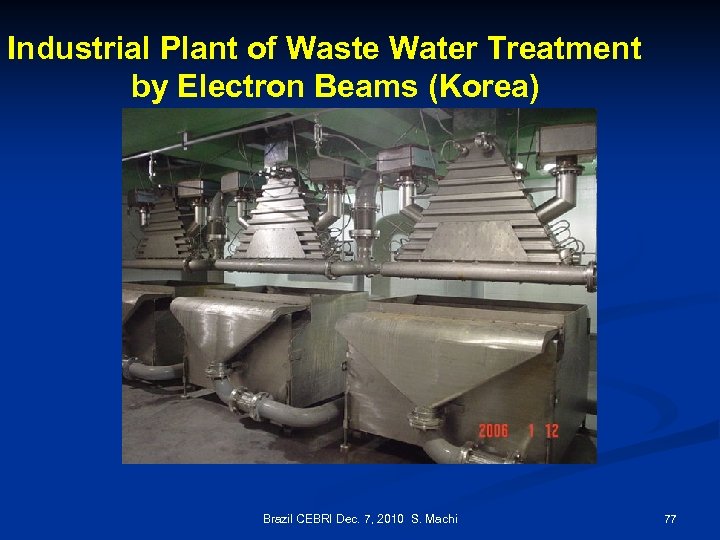
Industrial Plant of Waste Water Treatment by Electron Beams (Korea) Brazil CEBRI Dec. 7, 2010 S. Machi 77
Nuclear Cooperation of Japan with Developing Countries in Asia n Human resources development n Cooperative research & development n Multilateral cooperation (FNCA) n IAEA Brazil CEBRI Dec. 7, 2010 S. Machi 78
Japan’s Cooperation for Nuclear Science and Technology with Asian Countries n n n Nuclear Scientists Exchange Program (MEXT) since 1986: 1500 scientists and engineers have been invited in Japan for a year FNCA(Forum for Nuclear Cooperation in Asia) since 1991: 11 projects & study panel (MEXT, CAO) Training programs for nuclear instructors since 1996, 97 instructors (MEXT) Seminars on nuclear safety (MEXT) Bi-lateral cooperation for nuclear power with Vietnam and Indonesia (METI) Brazil CEBRI Dec. 7, 2010 S. Machi 79
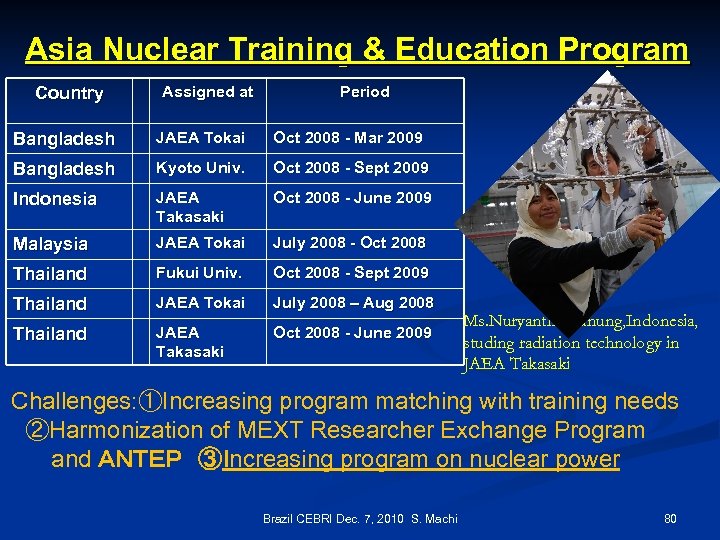
Asia Nuclear Training & Education Program Country Assigned at Period Bangladesh JAEA Tokai Oct 2008 - Mar 2009 Bangladesh Kyoto Univ. Oct 2008 - Sept 2009 Indonesia JAEA Takasaki Oct 2008 - June 2009 Malaysia JAEA Tokai July 2008 - Oct 2008 Thailand Fukui Univ. Oct 2008 - Sept 2009 Thailand JAEA Tokai July 2008 – Aug 2008 Thailand JAEA Takasaki Oct 2008 - June 2009 Ms. Nuryanthi Nunung, Indonesia, studing radiation technology in JAEA Takasaki Challenges: ①Increasing program matching with training needs ②Harmonization of MEXT Researcher Exchange Program and ANTEP ③Increasing program on nuclear power Brazil CEBRI Dec. 7, 2010 S. Machi 80
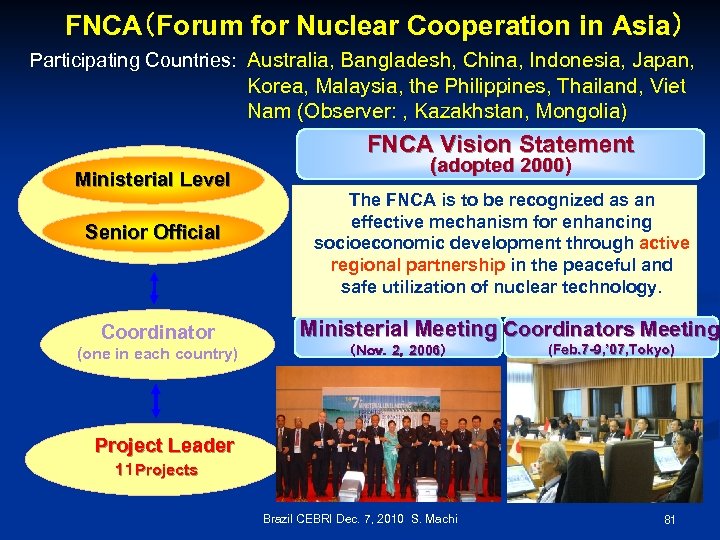
FNCA(Forum for Nuclear Cooperation in Asia) Participating Countries: Australia, Bangladesh, China, Indonesia, Japan, Korea, Malaysia, the Philippines, Thailand, Viet Nam (Observer: , Kazakhstan, Mongolia) FNCA Vision Statement Ministerial Level Senior Official Coordinator (one in each country) (adopted 2000) The FNCA is to be recognized as an effective mechanism for enhancing socioeconomic development through active regional partnership in the peaceful and safe utilization of nuclear technology. Ministerial Meeting Coordinators Meeting (Nov.2,2006) (Feb. 7 -9, ’ 07, Tokyo) Project Leader 11 Projects Brazil CEBRI Dec. 7, 2010 S. Machi 81
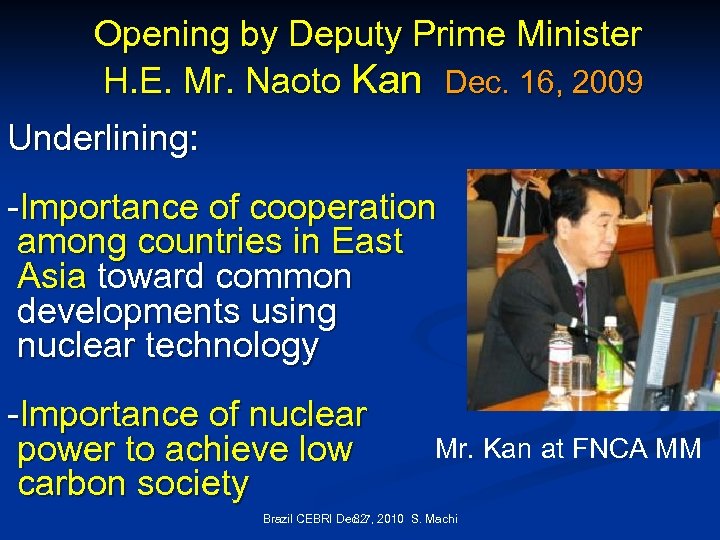
Opening by Deputy Prime Minister H. E. Mr. Naoto Kan Dec. 16, 2009 Underlining: -Importance of cooperation among countries in East Asia toward common developments using nuclear technology -Importance of nuclear power to achieve low carbon society Mr. Kan at FNCA MM Brazil CEBRI Dec. 7, 2010 S. Machi 82
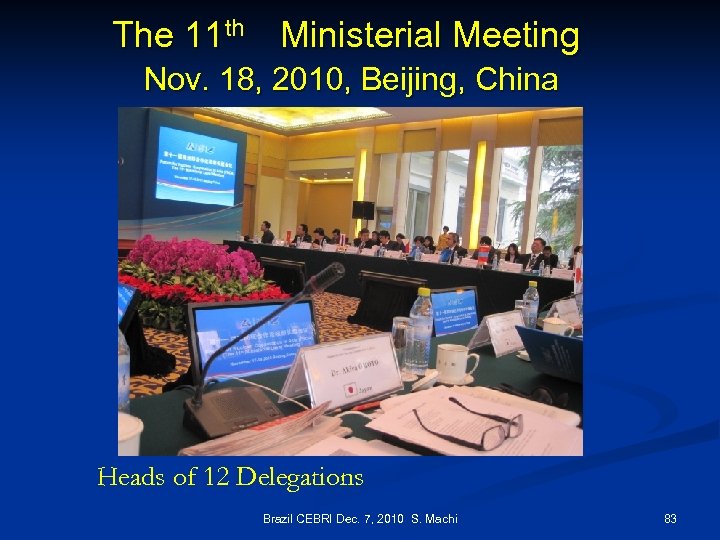
The 11 th Ministerial Meeting Nov. 18, 2010, Beijing, China Heads of 12 Delegations Brazil CEBRI Dec. 7, 2010 S. Machi 83
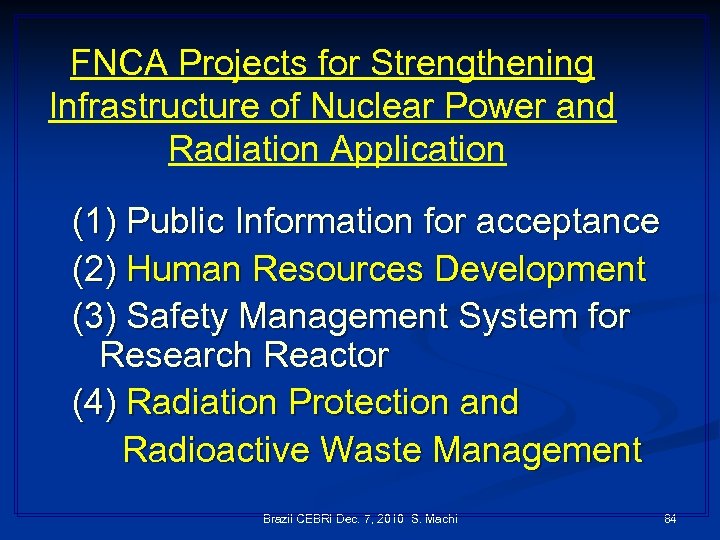
FNCA Projects for Strengthening Infrastructure of Nuclear Power and Radiation Application (1) Public Information for acceptance (2) Human Resources Development (3) Safety Management System for Research Reactor (4) Radiation Protection and Radioactive Waste Management Brazil CEBRI Dec. 7, 2010 S. Machi 84
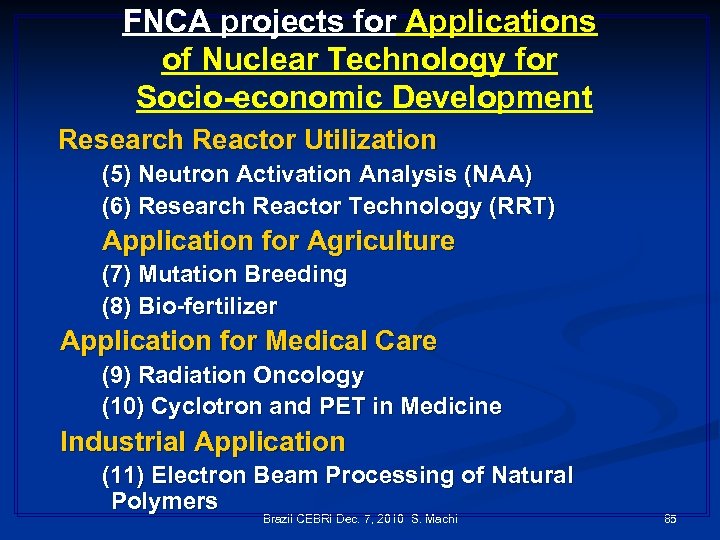
FNCA projects for Applications of Nuclear Technology for Socio-economic Development Research Reactor Utilization (5) Neutron Activation Analysis (NAA) (6) Research Reactor Technology (RRT) Application for Agriculture (7) Mutation Breeding (8) Bio-fertilizer Application for Medical Care (9) Radiation Oncology (10) Cyclotron and PET in Medicine Industrial Application (11) Electron Beam Processing of Natural Polymers Brazil CEBRI Dec. 7, 2010 S. Machi 85
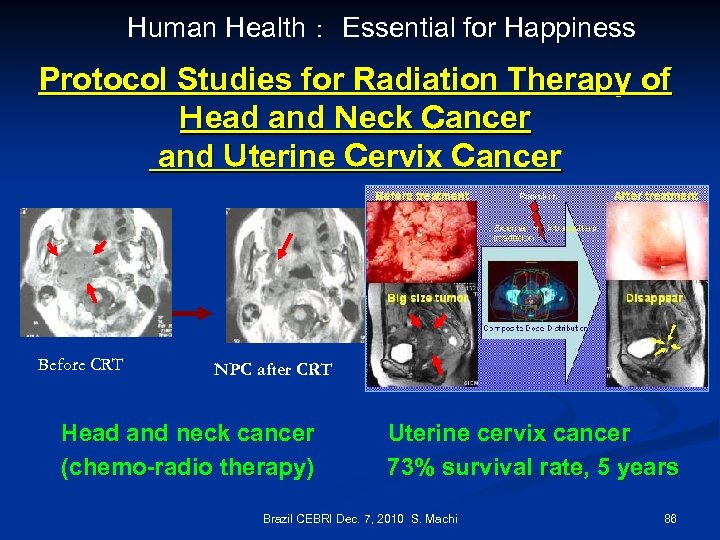
Human Health: Essential for Happiness Protocol Studies for Radiation Therapy of Head and Neck Cancer and Uterine Cervix Cancer Before CRT NPC after CRT Head and neck cancer (chemo-radio therapy) Uterine cervix cancer 73% survival rate, 5 years Brazil CEBRI Dec. 7, 2010 S. Machi 86
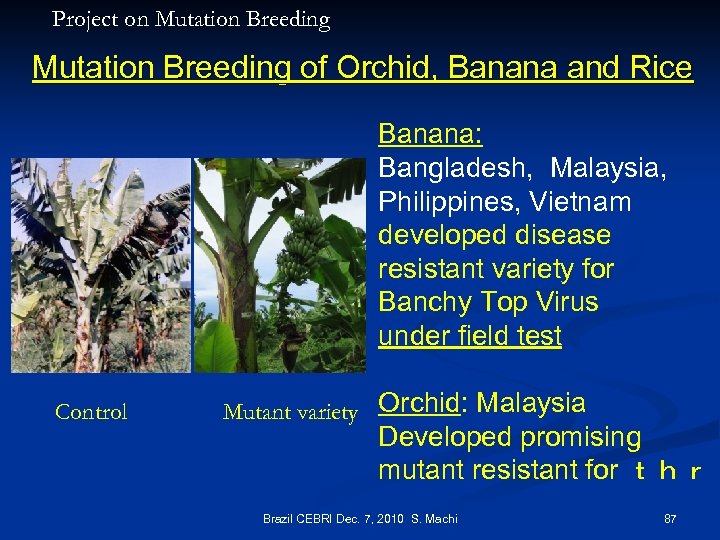
Project on Mutation Breeding of Orchid, Banana and Rice Banana: Bangladesh, Malaysia, n Philippines, Vietnam developed disease resistant variety for Banchy Top Virus under field test Control Mutant variety Orchid: Malaysia Developed promising mutant resistant for thri Brazil CEBRI Dec. 7, 2010 S. Machi 87
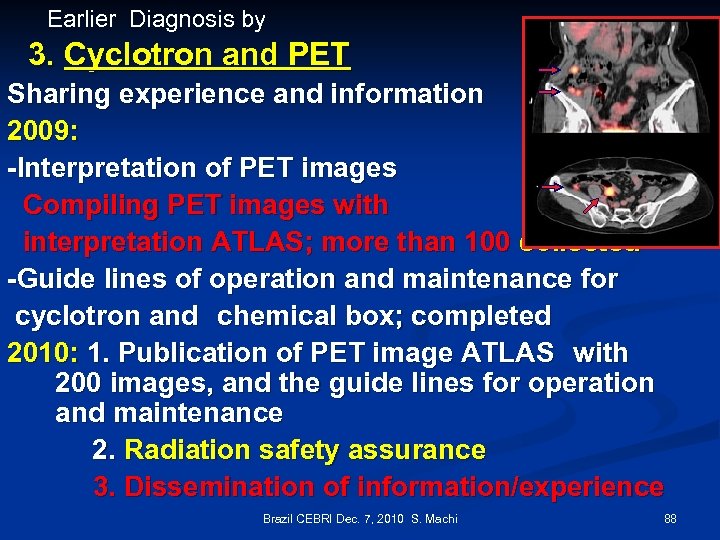
Earlier Diagnosis by 3. Cyclotron and PET Sharing experience and information 2009: -Interpretation of PET images Compiling PET images with interpretation ATLAS; more than 100 collected -Guide lines of operation and maintenance for cyclotron and chemical box; completed 2010: 1. Publication of PET image ATLAS with 200 images, and the guide lines for operation and maintenance 2. Radiation safety assurance 3. Dissemination of information/experience Brazil CEBRI Dec. 7, 2010 S. Machi 88
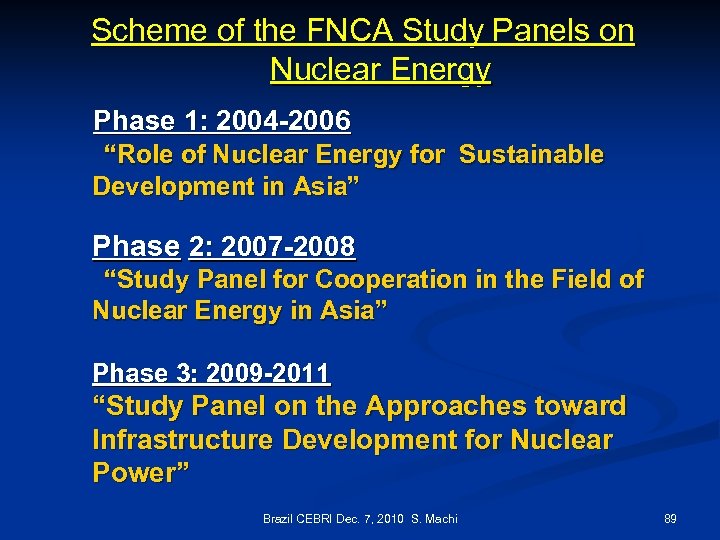
Scheme of the FNCA Study Panels on Nuclear Energy Phase 1: 2004 -2006 “Role of Nuclear Energy for Sustainable Development in Asia” Phase 2: 2007 -2008 “Study Panel for Cooperation in the Field of Nuclear Energy in Asia” Phase 3: 2009 -2011 “Study Panel on the Approaches toward Infrastructure Development for Nuclear Power” Brazil CEBRI Dec. 7, 2010 S. Machi 89
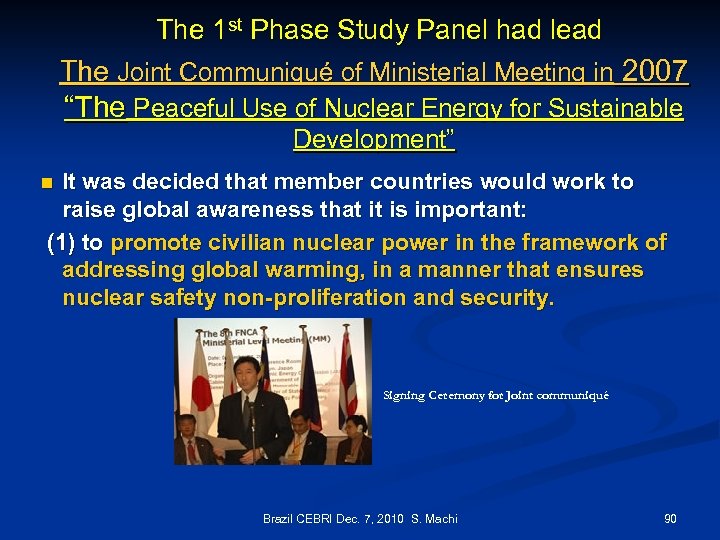
The 1 st Phase Study Panel had lead The Joint Communiqué of Ministerial Meeting in 2007 “The Peaceful Use of Nuclear Energy for Sustainable Development” It was decided that member countries would work to raise global awareness that it is important: (1) to promote civilian nuclear power in the framework of addressing global warming, in a manner that ensures nuclear safety non-proliferation and security. n Signing Ceremony for Joint communiqué Brazil CEBRI Dec. 7, 2010 S. Machi 90
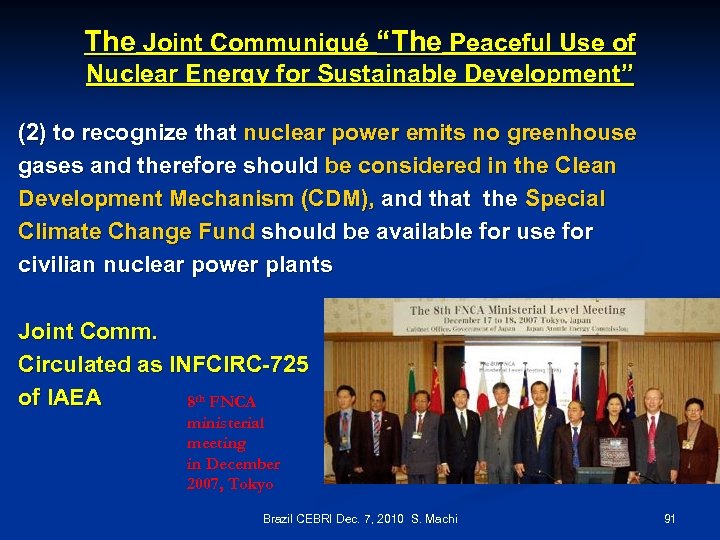
The Joint Communiqué “The Peaceful Use of Nuclear Energy for Sustainable Development” (2) to recognize that nuclear power emits no greenhouse gases and therefore should be considered in the Clean Development Mechanism (CDM), and that the Special Climate Change Fund should be available for use for civilian nuclear power plants Joint Comm. Circulated as INFCIRC-725 of IAEA 8 th FNCA ministerial meeting in December 2007, Tokyo Brazil CEBRI Dec. 7, 2010 S. Machi 91
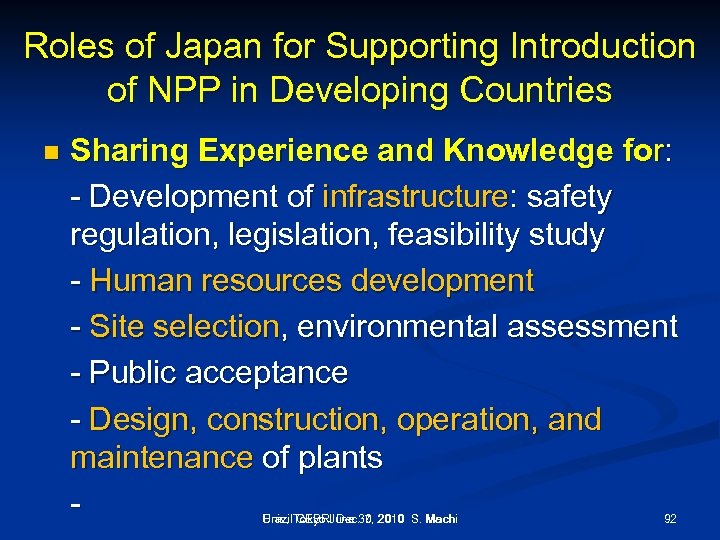
Roles of Japan for Supporting Introduction of NPP in Developing Countries n Sharing Experience and Knowledge for: - Development of infrastructure: safety regulation, legislation, feasibility study - Human resources development - Site selection, environmental assessment - Public acceptance - Design, construction, operation, and maintenance of plants Univ, Tokyo June 30, 2010 S. Machi Brazil CEBRI Dec. 7, 92
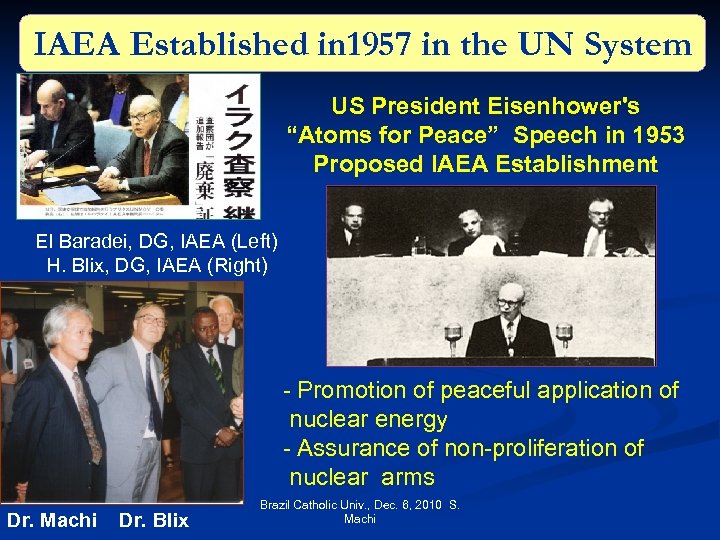
IAEA Established in 1957 in the UN System US President Eisenhower's “Atoms for Peace” Speech in 1953 Proposed IAEA Establishment El Baradei, DG, IAEA (Left) H. Blix, DG, IAEA (Right) - Promotion of peaceful application of nuclear energy - Assurance of non-proliferation of nuclear arms Dr. Machi Dr. Blix Brazil Catholic Univ. , Dec. 6, 2010 S. Machi
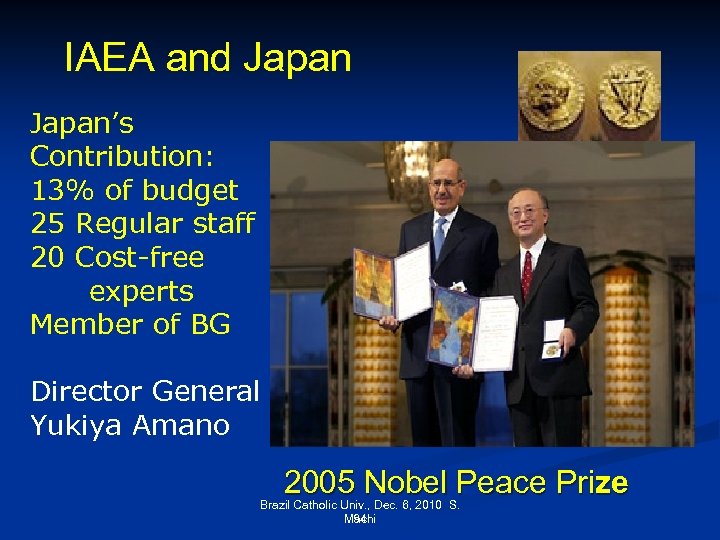
IAEA and Japan’s Contribution: 13% of budget 25 Regular staff 20 Cost-free experts Member of BG Director General Yukiya Amano 2005 Nobel Peace Prize Brazil Catholic Univ. , Dec. 6, 2010 S. Machi 94
Thank you for your attention Brazil CEBRI Dec. 7, 2010 S. Machi 95
Скачать презентацию Brazil CEBRI Rio de Janeiro Dec 7 2010
348dfaf94510ee2a610e3e918e0e454a.ppt