 Скачать презентацию Brain-Based Classrooms Bella Lucia Lauren What did
7b34e17e9fc68fe4206debdce6677d7c.ppt
- Количество слайдов: 10



Brain-Based Classrooms Bella, Lucia, Lauren
What did zero say to eight? 0 8 “I like your belt!”
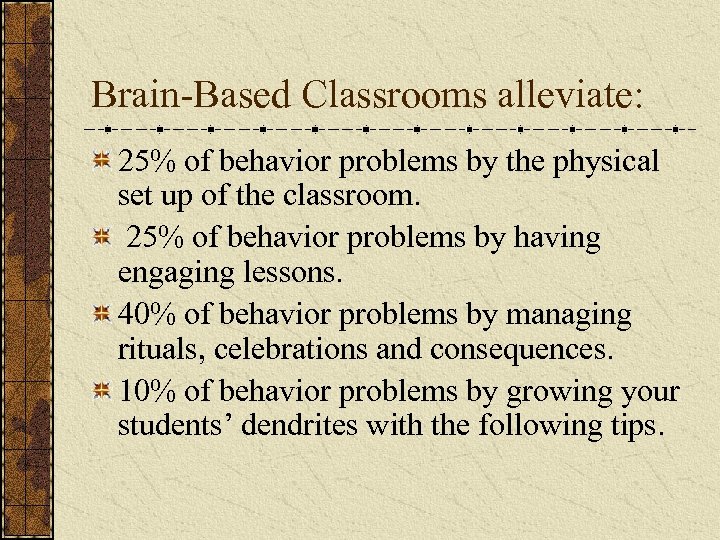
Brain-Based Classrooms alleviate: 25% of behavior problems by the physical set up of the classroom. 25% of behavior problems by having engaging lessons. 40% of behavior problems by managing rituals, celebrations and consequences. 10% of behavior problems by growing your students’ dendrites with the following tips.
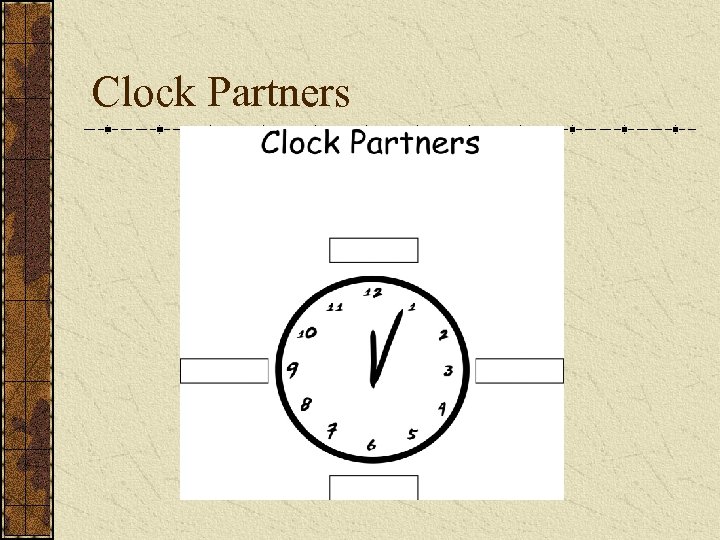
Clock Partners
Grow YOUR Dendrites Participate in each center Be aware of your surroundings/lesson Become a Dendrite Hunter Tools • • • Graphic Organizer Brain Pencil Clock Partners Reflective Practice
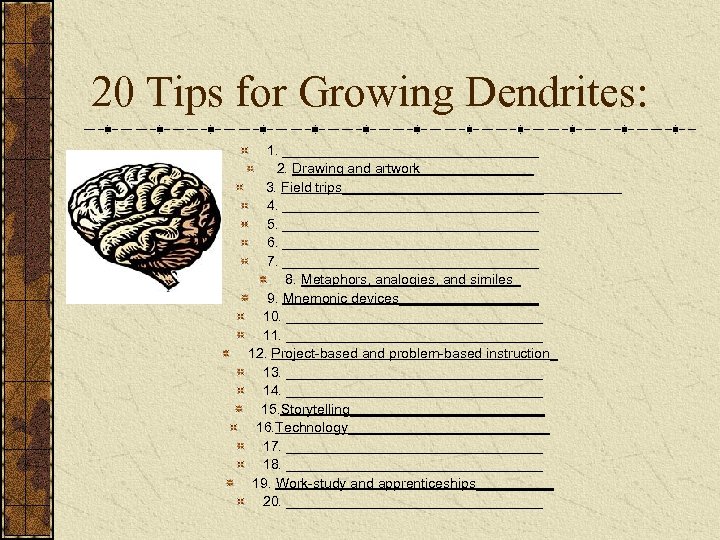
20 Tips for Growing Dendrites: 1. _________________ 2. Drawing and artwork _______ 3. Field trips_____________ 4. _________________ 5. _________________ 6. _________________ 7. _________________ 8. Metaphors, analogies, and similes_ 9. Mnemonic devices_________ 10. _________________ 11. _________________ 12. Project-based and problem-based instruction_ 13. _________________ 14. _________________ 15. Storytelling_____________ 16. Technology_____________ 17. _________________ 18. _________________ 19. Work-study and apprenticeships_____ 20. _________________

Dendrite Group Time Online Stopwatch
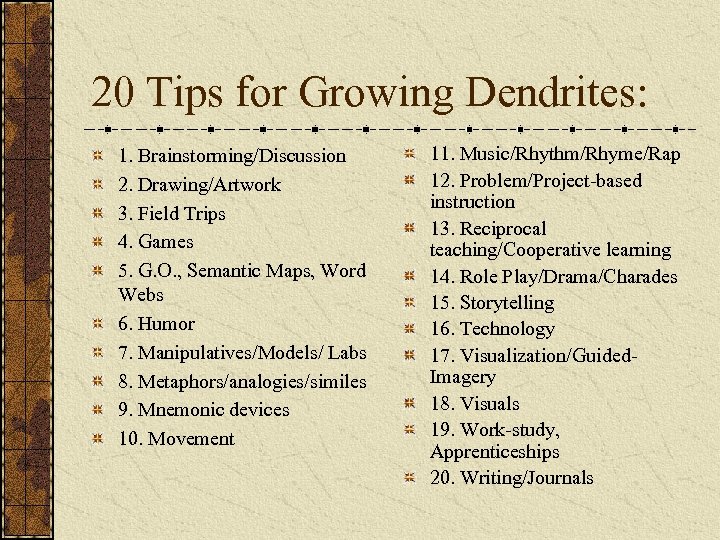
20 Tips for Growing Dendrites: 1. Brainstorming/Discussion 2. Drawing/Artwork 3. Field Trips 4. Games 5. G. O. , Semantic Maps, Word Webs 6. Humor 7. Manipulatives/Models/ Labs 8. Metaphors/analogies/similes 9. Mnemonic devices 10. Movement 11. Music/Rhythm/Rhyme/Rap 12. Problem/Project-based instruction 13. Reciprocal teaching/Cooperative learning 14. Role Play/Drama/Charades 15. Storytelling 16. Technology 17. Visualization/Guided. Imagery 18. Visuals 19. Work-study, Apprenticeships 20. Writing/Journals
Reflection How does this activity apply to your classroom? What is one novel piece of knowledge you have gained from participating? Provide one suggestion for improving this professional development.
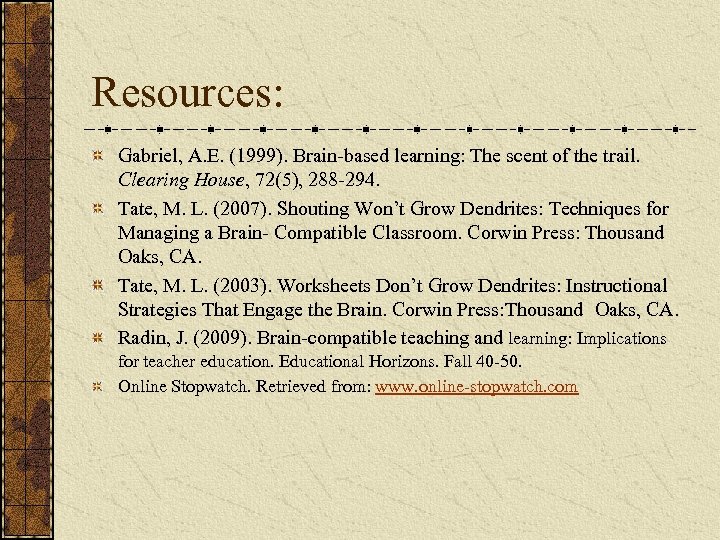
Resources: Gabriel, A. E. (1999). Brain-based learning: The scent of the trail. Clearing House, 72(5), 288 -294. Tate, M. L. (2007). Shouting Won’t Grow Dendrites: Techniques for Managing a Brain- Compatible Classroom. Corwin Press: Thousand Oaks, CA. Tate, M. L. (2003). Worksheets Don’t Grow Dendrites: Instructional Strategies That Engage the Brain. Corwin Press: Thousand Oaks, CA. Radin, J. (2009). Brain-compatible teaching and learning: Implications for teacher education. Educational Horizons. Fall 40 -50. Online Stopwatch. Retrieved from: www. online-stopwatch. com
Скачать презентацию Brain-Based Classrooms Bella Lucia Lauren What did
7b34e17e9fc68fe4206debdce6677d7c.ppt