 Скачать презентацию BRAID Discovering Lag Correlations in Multiple Streams Yasushi
2dfa12e7c30d5af764a2c20686eea5bf.ppt
- Количество слайдов: 59



BRAID: Discovering Lag Correlations in Multiple Streams Yasushi Sakurai (NTT Cyber Space Labs) Spiros Papadimitriou (Carnegie Mellon Univ. ) Christos Faloutsos (Carnegie Mellon Univ. )
Motivation n Data-stream applications q q n Network analysis Sensor monitoring Financial data analysis Moving object tracking Goal q q q Monitor multiple numerical streams Determine which pairs are correlated with lags Report the value of each such lag (if any) SIGMOD 2005 Y. Sakurai et al 2
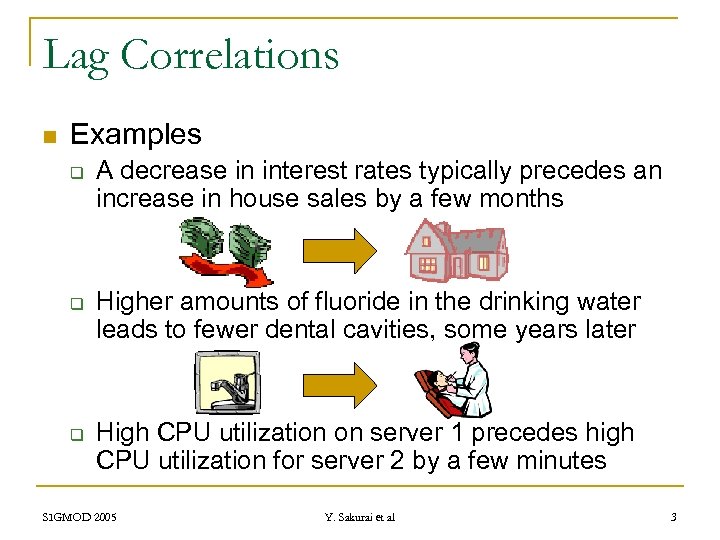
Lag Correlations n Examples q q q A decrease in interest rates typically precedes an increase in house sales by a few months Higher amounts of fluoride in the drinking water leads to fewer dental cavities, some years later High CPU utilization on server 1 precedes high CPU utilization for server 2 by a few minutes SIGMOD 2005 Y. Sakurai et al 3
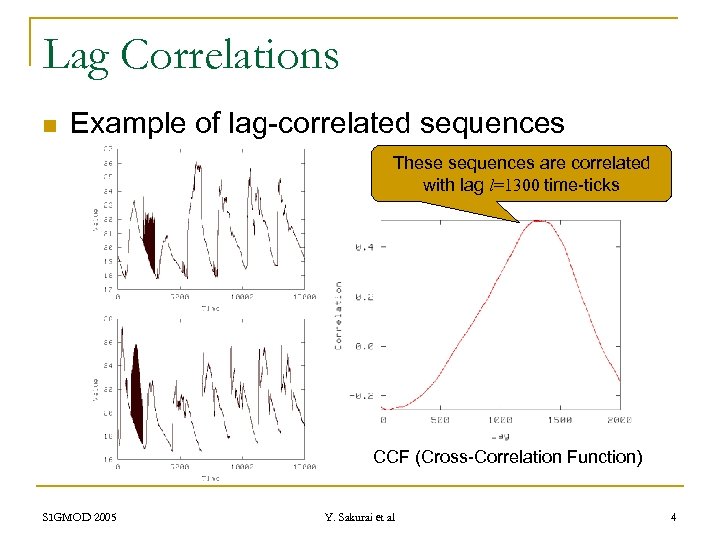
Lag Correlations n Example of lag-correlated sequences These sequences are correlated with lag l=1300 time-ticks CCF (Cross-Correlation Function) SIGMOD 2005 Y. Sakurai et al 4
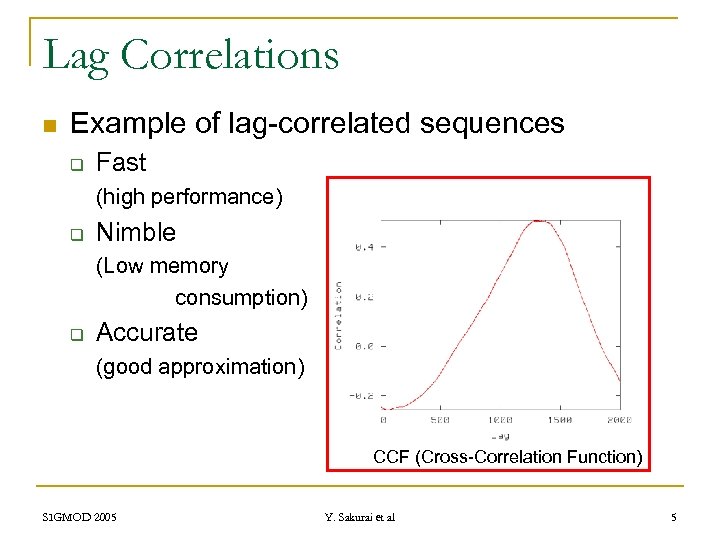
Lag Correlations n Example of lag-correlated sequences q Fast (high performance) q Nimble (Low memory consumption) q Accurate (good approximation) CCF (Cross-Correlation Function) SIGMOD 2005 Y. Sakurai et al 5
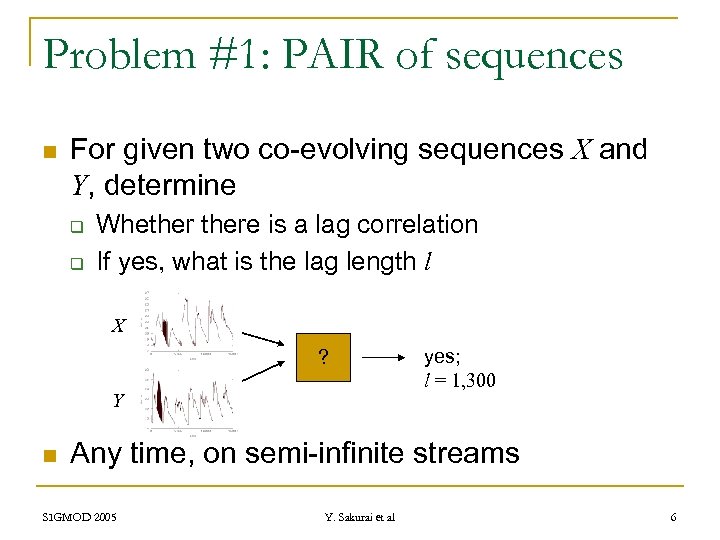
Problem #1: PAIR of sequences n For given two co-evolving sequences X and Y, determine q q Whethere is a lag correlation If yes, what is the lag length l X ? Y n yes; l = 1, 300 Any time, on semi-infinite streams SIGMOD 2005 Y. Sakurai et al 6
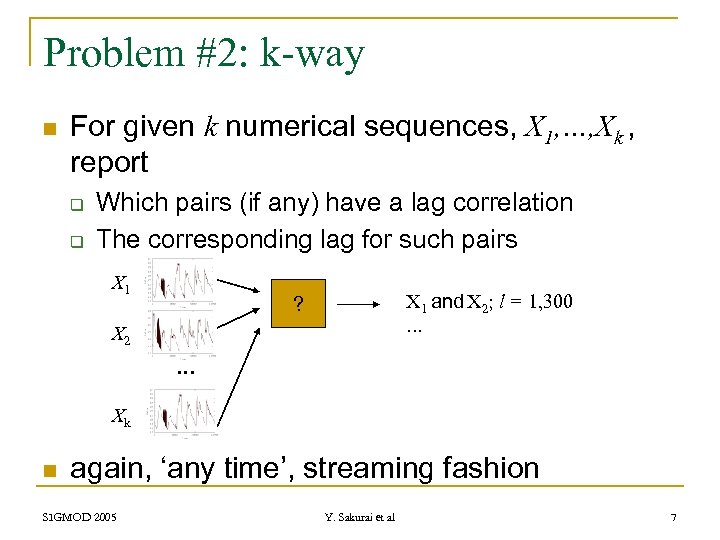
Problem #2: k-way n For given k numerical sequences, X 1, …, Xk , report q q Which pairs (if any) have a lag correlation The corresponding lag for such pairs X 1 and X 2; l = 1, 300. . . ? X 2 . . . Xk n again, ‘any time’, streaming fashion SIGMOD 2005 Y. Sakurai et al 7
Our solution, BRAID n characteristics: q ‘Any-time’ processing, and fast Computation time per time tick is constant q Nimble Memory space requirement is sub-linear of sequence length q Accurate Approximation introduces small error SIGMOD 2005 Y. Sakurai et al 8
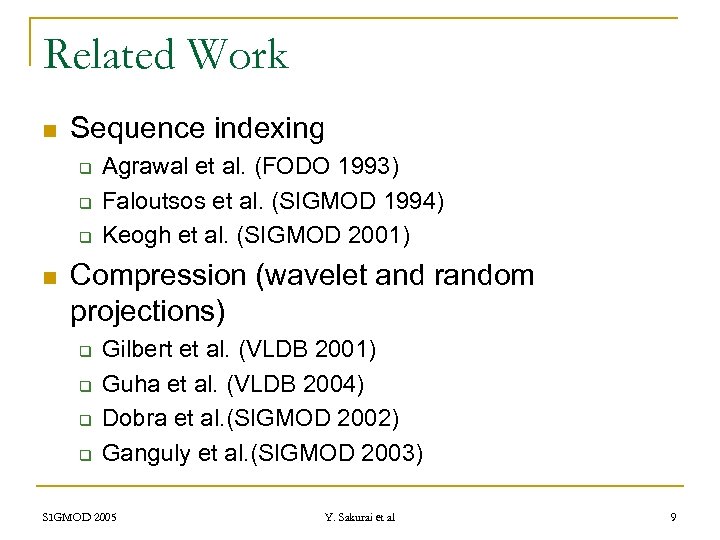
Related Work n Sequence indexing q q q n Agrawal et al. (FODO 1993) Faloutsos et al. (SIGMOD 1994) Keogh et al. (SIGMOD 2001) Compression (wavelet and random projections) q q Gilbert et al. (VLDB 2001) Guha et al. (VLDB 2004) Dobra et al. (SIGMOD 2002) Ganguly et al. (SIGMOD 2003) SIGMOD 2005 Y. Sakurai et al 9
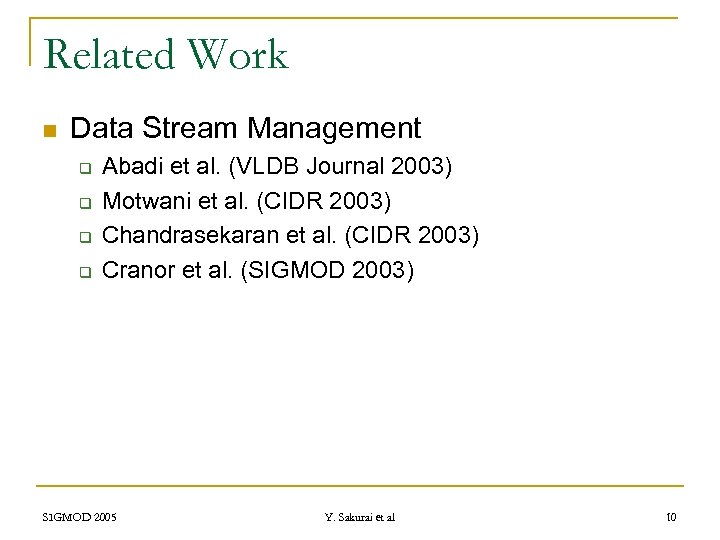
Related Work n Data Stream Management q q Abadi et al. (VLDB Journal 2003) Motwani et al. (CIDR 2003) Chandrasekaran et al. (CIDR 2003) Cranor et al. (SIGMOD 2003) SIGMOD 2005 Y. Sakurai et al 10
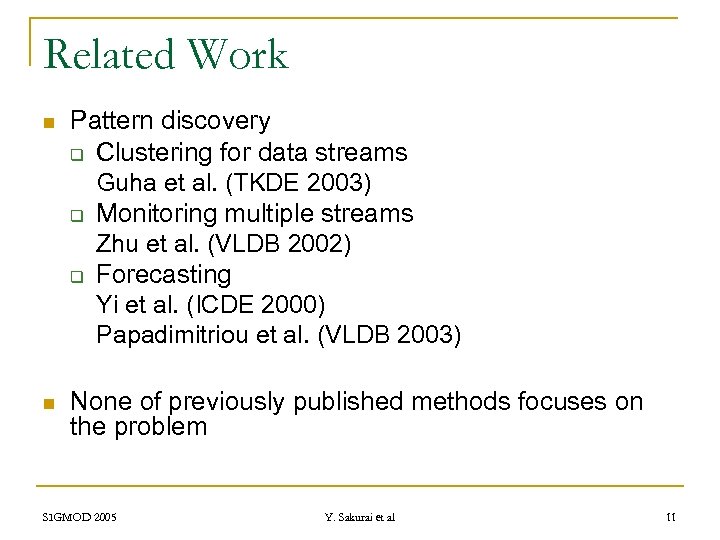
Related Work n Pattern discovery q Clustering for data streams Guha et al. (TKDE 2003) q Monitoring multiple streams Zhu et al. (VLDB 2002) q Forecasting Yi et al. (ICDE 2000) Papadimitriou et al. (VLDB 2003) n None of previously published methods focuses on the problem SIGMOD 2005 Y. Sakurai et al 11
Overview n n n Introduction / Related work Background Main ideas Theoretical analysis Experimental results SIGMOD 2005 Y. Sakurai et al 12
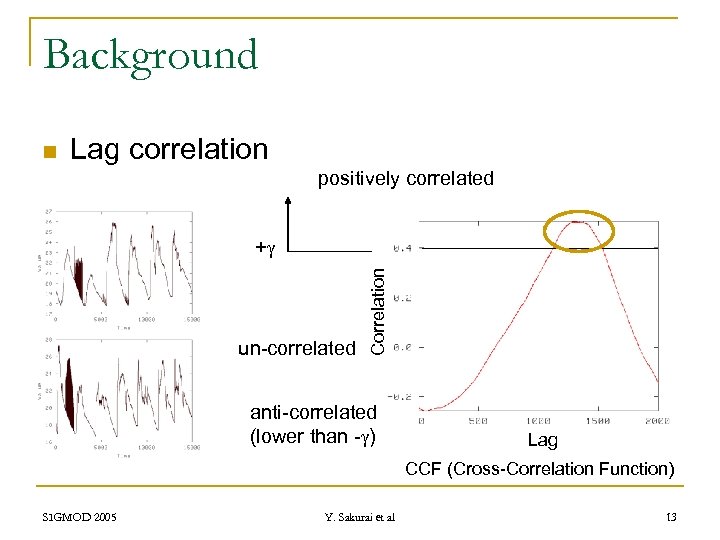
Background n Lag correlation positively correlated un-correlated Correlation +g anti-correlated (lower than -g) Lag CCF (Cross-Correlation Function) SIGMOD 2005 Y. Sakurai et al 13
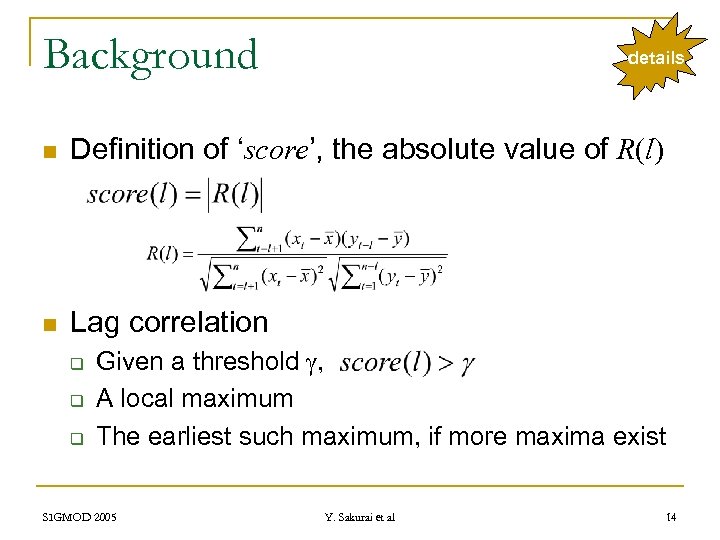
Background details n Definition of ‘score’, the absolute value of R(l) n Lag correlation q q q Given a threshold g, A local maximum The earliest such maximum, if more maxima exist SIGMOD 2005 Y. Sakurai et al 14
Overview n n n Introduction / Related work Background Main ideas Theoretical analysis Experimental results SIGMOD 2005 Y. Sakurai et al 15
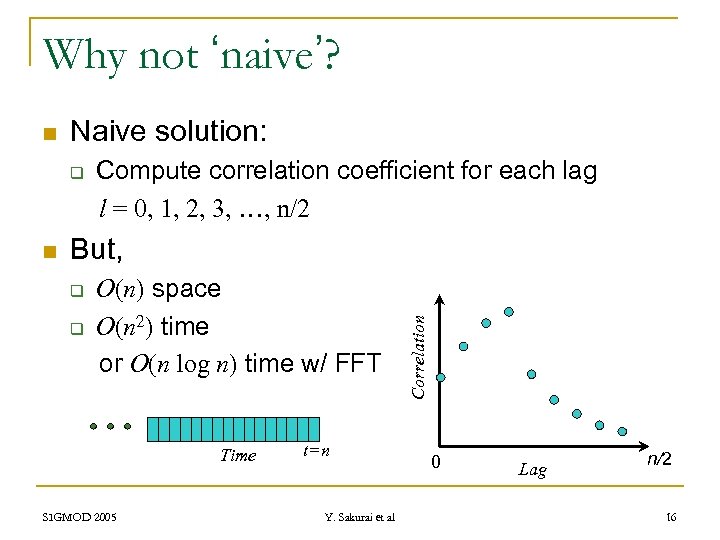
Why not ‘naive’? Naive solution: q n Compute correlation coefficient for each lag l = 0, 1, 2, 3, …, n/2 But, q q O(n) space O(n 2) time or O(n log n) time w/ FFT Time SIGMOD 2005 t=n Y. Sakurai et al Correlation n 0 Lag n/2 16
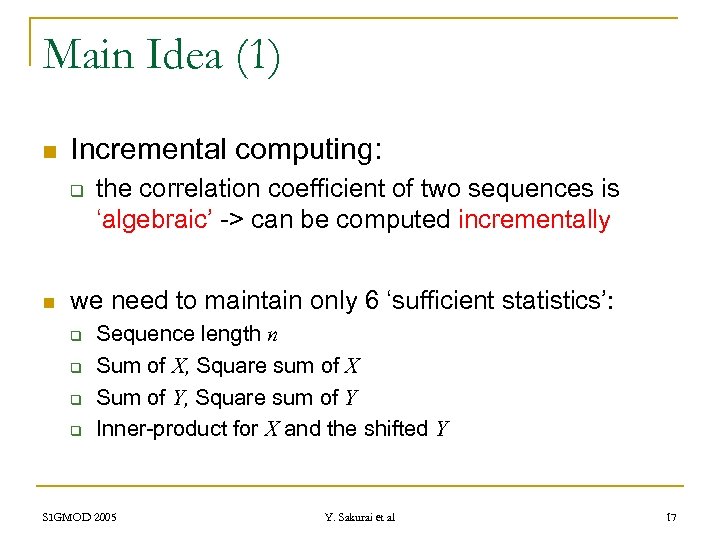
Main Idea (1) n Incremental computing: q n the correlation coefficient of two sequences is ‘algebraic’ -> can be computed incrementally we need to maintain only 6 ‘sufficient statistics’: q q Sequence length n Sum of X, Square sum of X Sum of Y, Square sum of Y Inner-product for X and the shifted Y SIGMOD 2005 Y. Sakurai et al 17
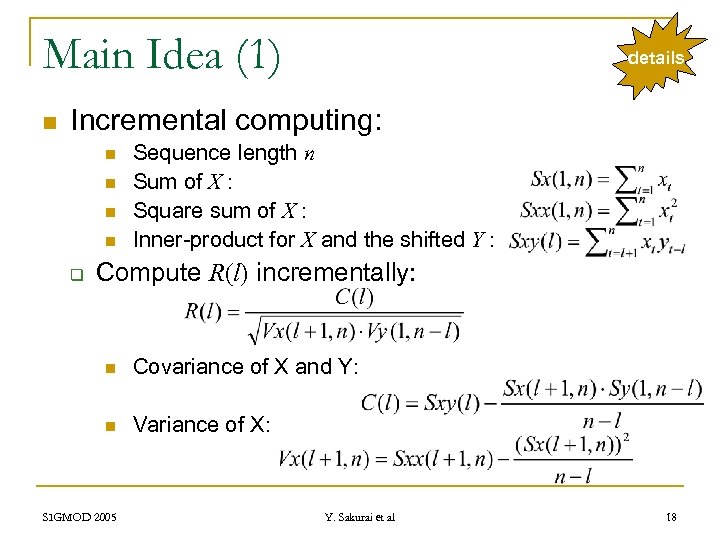
Main Idea (1) n details Incremental computing: n n q Sequence length n Sum of X : Square sum of X : Inner-product for X and the shifted Y : Compute R(l) incrementally: n Covariance of X and Y: n Variance of X: SIGMOD 2005 Y. Sakurai et al 18
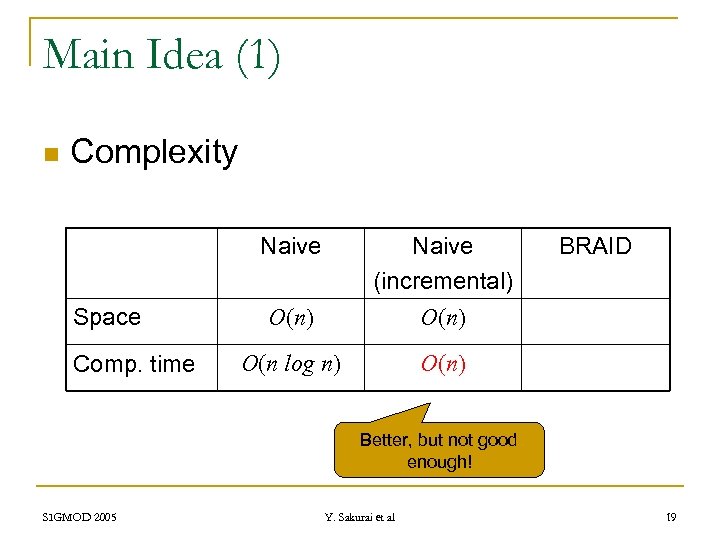
Main Idea (1) n Complexity Naive Space Comp. time Naive (incremental) O(n) O(n log n) BRAID O(n) Better, but not good enough! SIGMOD 2005 Y. Sakurai et al 19
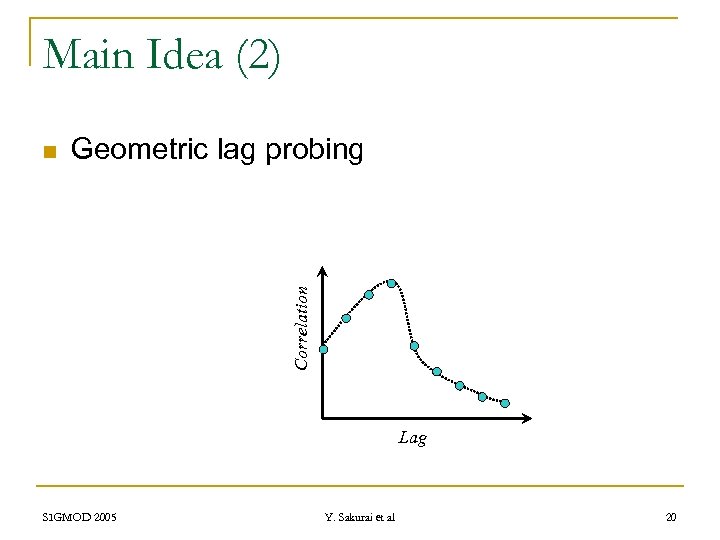
Main Idea (2) Geometric lag probing Correlation n Lag SIGMOD 2005 Y. Sakurai et al 20
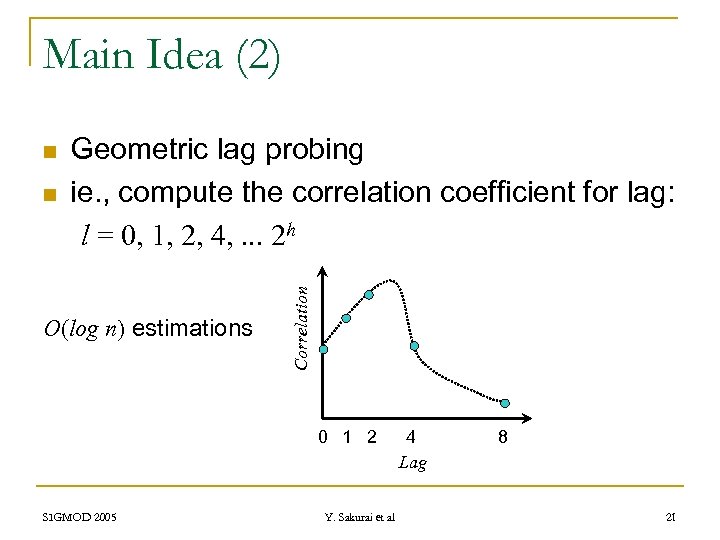
Main Idea (2) n Geometric lag probing ie. , compute the correlation coefficient for lag: l = 0, 1, 2, 4, . . . 2 h O(log n) estimations Correlation n 0 1 2 SIGMOD 2005 Y. Sakurai et al 4 Lag 8 21
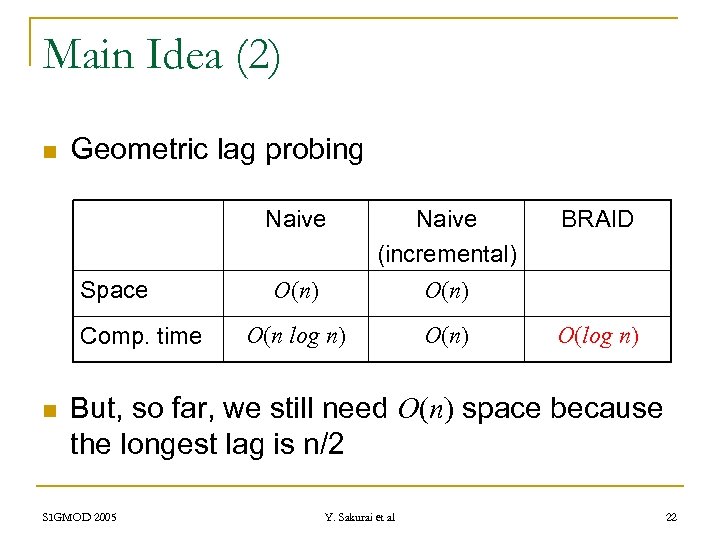
Main Idea (2) n Geometric lag probing Naive Space Comp. time n BRAID O(n) Naive (incremental) O(n log n) O(log n) But, so far, we still need O(n) space because the longest lag is n/2 SIGMOD 2005 Y. Sakurai et al 22
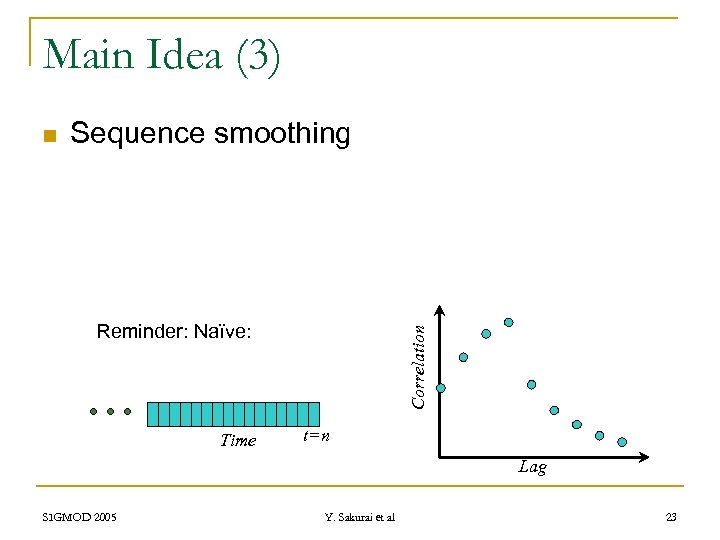
Main Idea (3) n Sequence smoothing Time Correlation Reminder: Naïve: t=n Lag SIGMOD 2005 Y. Sakurai et al 23
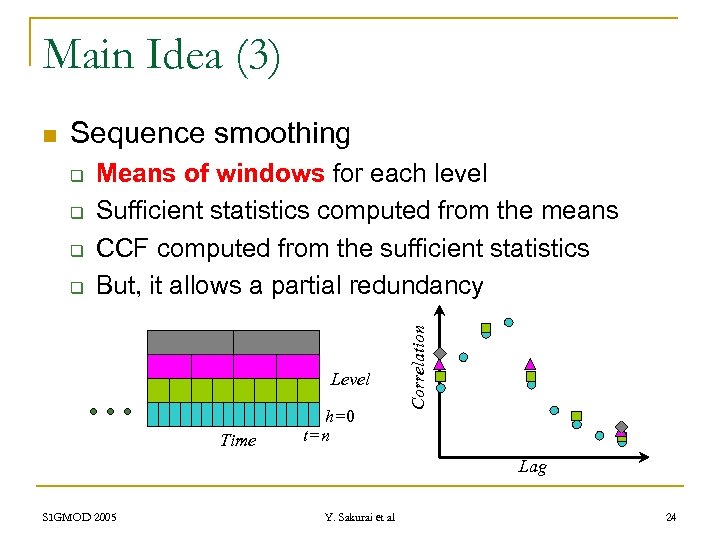
Main Idea (3) Sequence smoothing q q Means of windows for each level Sufficient statistics computed from the means CCF computed from the sufficient statistics But, it allows a partial redundancy Level Time h=0 t=n Correlation n Lag SIGMOD 2005 Y. Sakurai et al 24
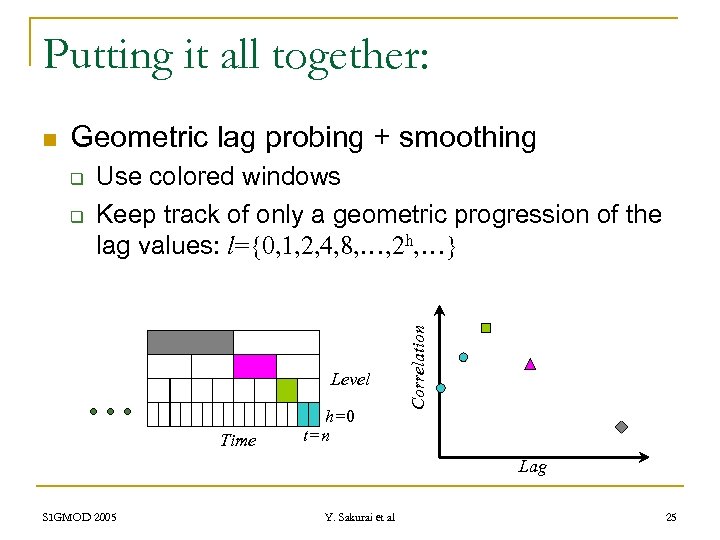
Putting it all together: Geometric lag probing + smoothing q q Use colored windows Keep track of only a geometric progression of the lag values: l={0, 1, 2, 4, 8, …, 2 h, …} Level Time h=0 t=n Correlation n Lag SIGMOD 2005 Y. Sakurai et al 25
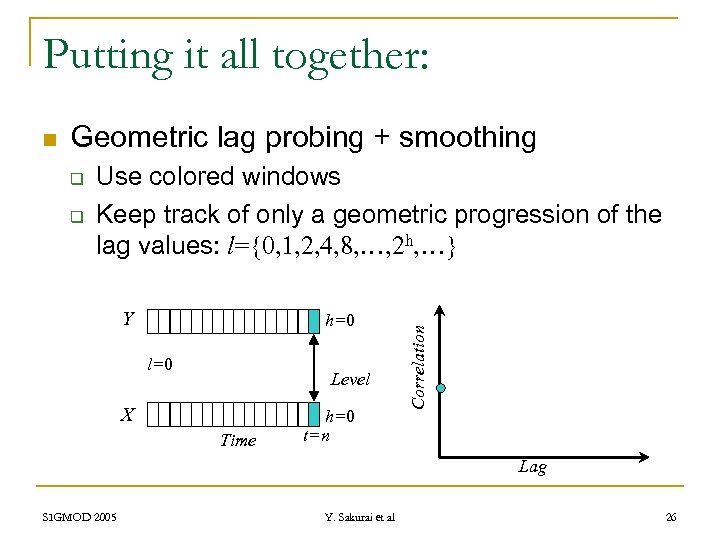
Putting it all together: Geometric lag probing + smoothing q q Use colored windows Keep track of only a geometric progression of the lag values: l={0, 1, 2, 4, 8, …, 2 h, …} Y h=0 l=0 Level X Time h=0 t=n Correlation n Lag SIGMOD 2005 Y. Sakurai et al 26
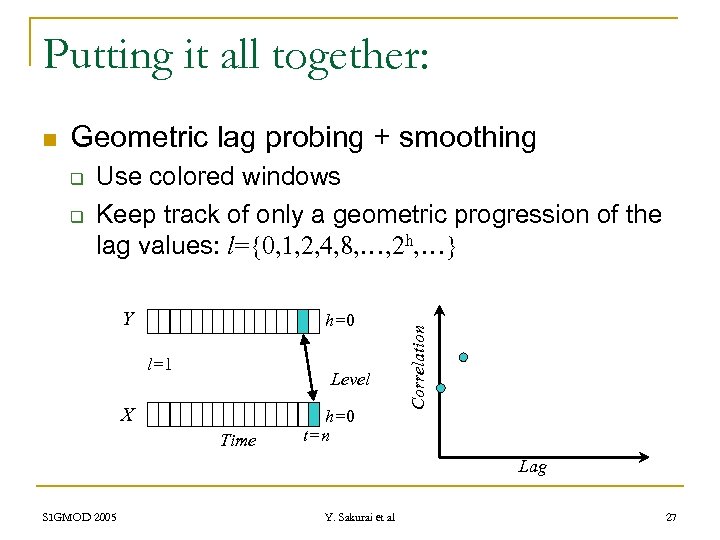
Putting it all together: Geometric lag probing + smoothing q q Use colored windows Keep track of only a geometric progression of the lag values: l={0, 1, 2, 4, 8, …, 2 h, …} Y h=0 l=1 Level X Time h=0 t=n Correlation n Lag SIGMOD 2005 Y. Sakurai et al 27
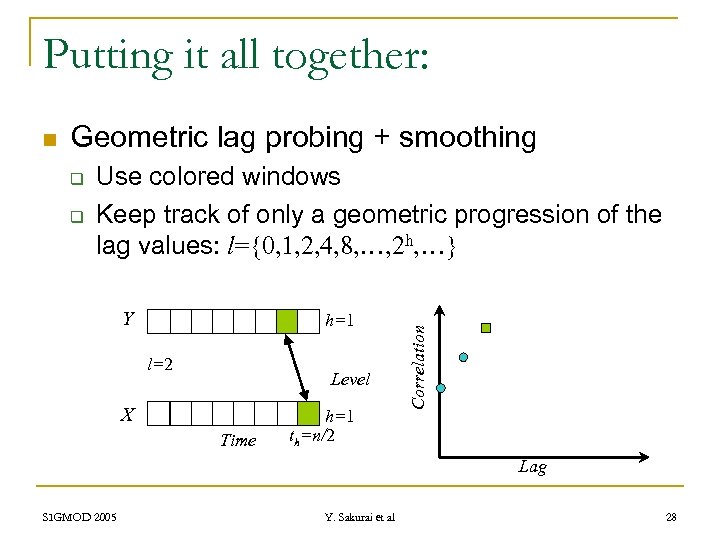
Putting it all together: Geometric lag probing + smoothing q q Use colored windows Keep track of only a geometric progression of the lag values: l={0, 1, 2, 4, 8, …, 2 h, …} Y h=1 l=2 Level X Time h=1 th=n/2 Correlation n Lag SIGMOD 2005 Y. Sakurai et al 28
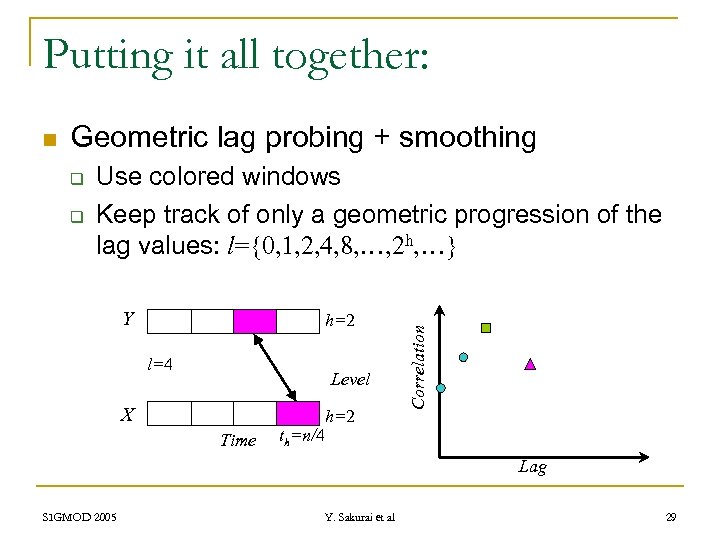
Putting it all together: Geometric lag probing + smoothing q q Use colored windows Keep track of only a geometric progression of the lag values: l={0, 1, 2, 4, 8, …, 2 h, …} Y h=2 l=4 Level X Time h=2 th=n/4 Correlation n Lag SIGMOD 2005 Y. Sakurai et al 29
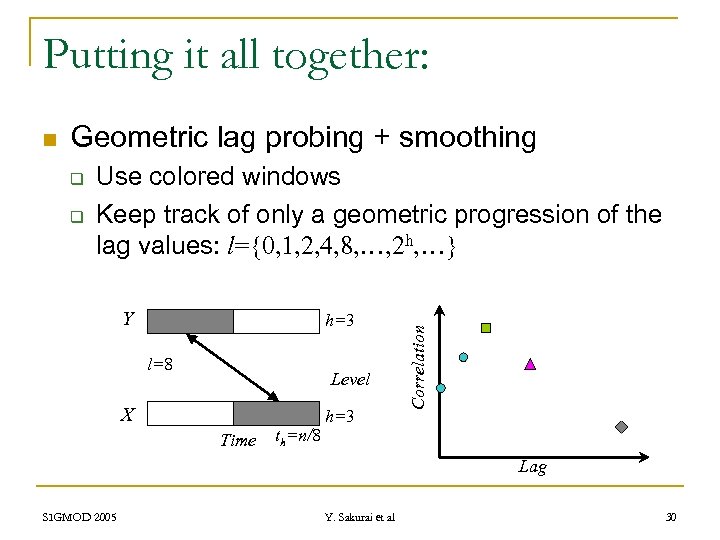
Putting it all together: Geometric lag probing + smoothing q q Use colored windows Keep track of only a geometric progression of the lag values: l={0, 1, 2, 4, 8, …, 2 h, …} Y h=3 l=8 Level X Time th=n/8 h=3 Correlation n Lag SIGMOD 2005 Y. Sakurai et al 30
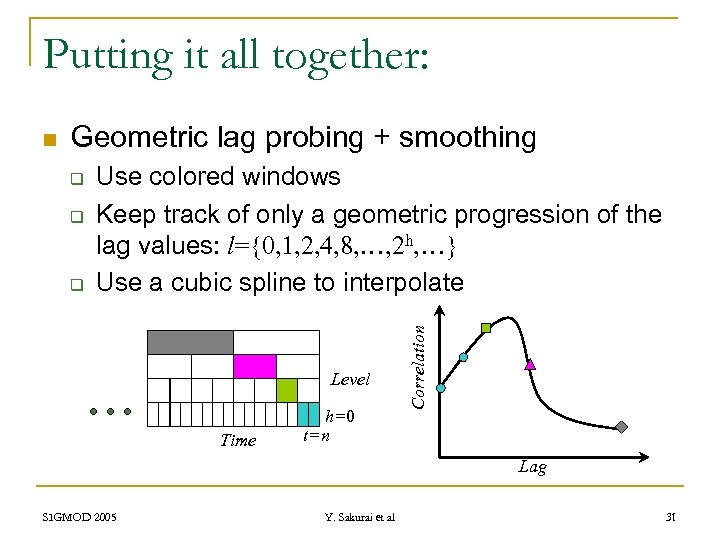
Putting it all together: Geometric lag probing + smoothing q q q Use colored windows Keep track of only a geometric progression of the lag values: l={0, 1, 2, 4, 8, …, 2 h, …} Use a cubic spline to interpolate Level Time h=0 t=n Correlation n Lag SIGMOD 2005 Y. Sakurai et al 31
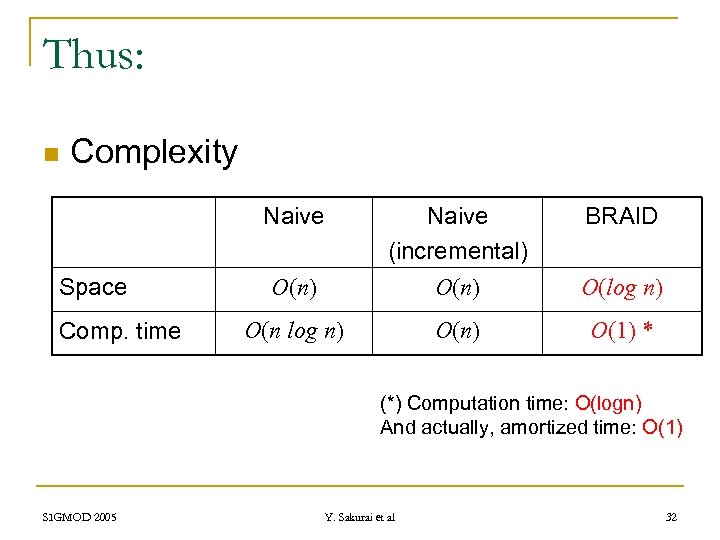
Thus: n Complexity Naive Space Comp. time O(n) Naive (incremental) O(n) BRAID O(log n) O(n log n) O(1) * (*) Computation time: O(logn) And actually, amortized time: O(1) SIGMOD 2005 Y. Sakurai et al 32
Overview n n n Introduction / Related work Background Main ideas q n n details enhancing the accuracy Theoretical analysis Experimental results SIGMOD 2005 Y. Sakurai et al 33
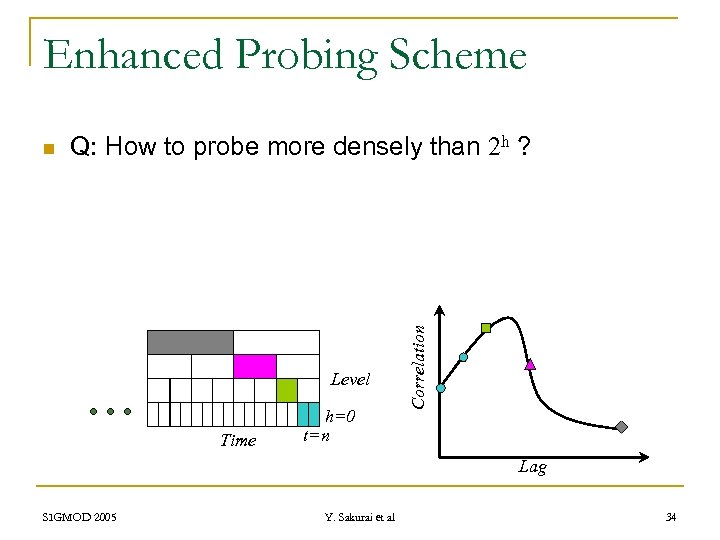
Enhanced Probing Scheme Q: How to probe more densely than 2 h ? Level Time h=0 t=n Correlation n Lag SIGMOD 2005 Y. Sakurai et al 34
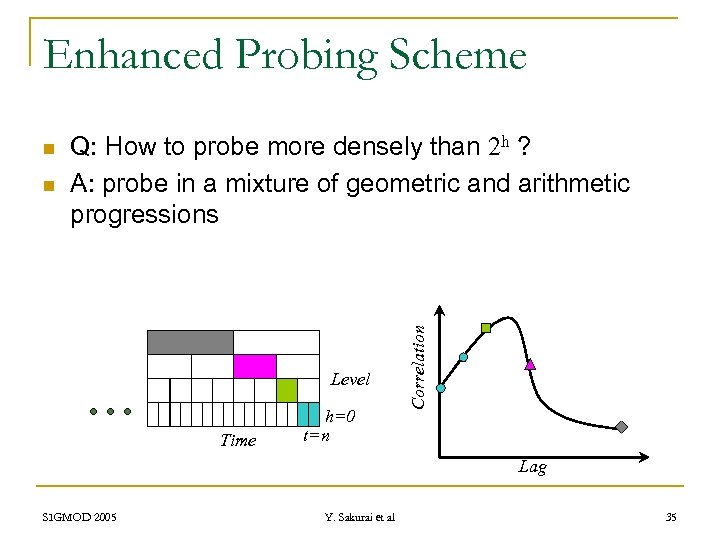
Enhanced Probing Scheme n Q: How to probe more densely than 2 h ? A: probe in a mixture of geometric and arithmetic progressions Level Time h=0 t=n Correlation n Lag SIGMOD 2005 Y. Sakurai et al 35
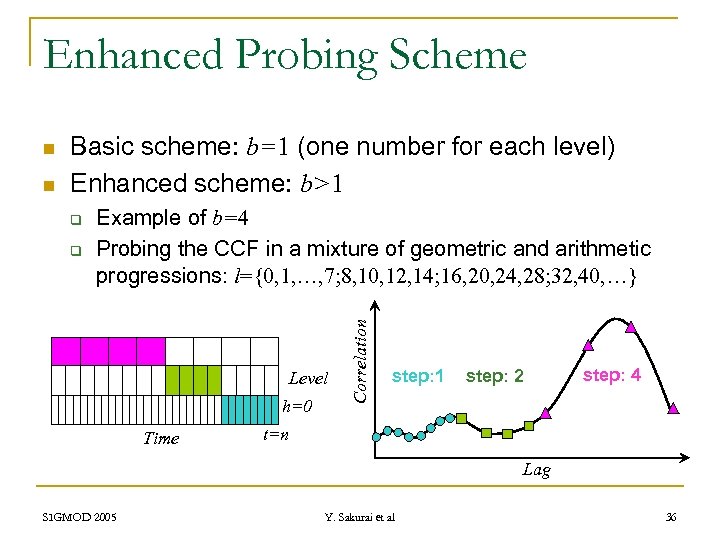
Enhanced Probing Scheme n Basic scheme: b=1 (one number for each level) Enhanced scheme: b>1 q q Example of b=4 Probing the CCF in a mixture of geometric and arithmetic progressions: l={0, 1, …, 7; 8, 10, 12, 14; 16, 20, 24, 28; 32, 40, …} Level h=0 Time Correlation n step: 1 step: 2 step: 4 t=n Lag SIGMOD 2005 Y. Sakurai et al 36
Overview n n n Introduction / Related work Background Main ideas Theoretical analysis Experimental results SIGMOD 2005 Y. Sakurai et al 37
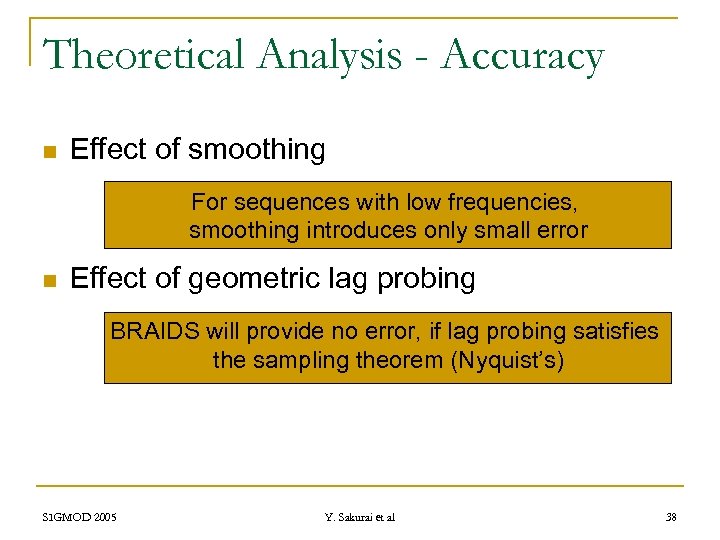
Theoretical Analysis - Accuracy n Effect of smoothing For sequences with low frequencies, smoothing introduces only small error n Effect of geometric lag probing BRAIDS will provide no error, if lag probing satisfies the sampling theorem (Nyquist’s) SIGMOD 2005 Y. Sakurai et al 38
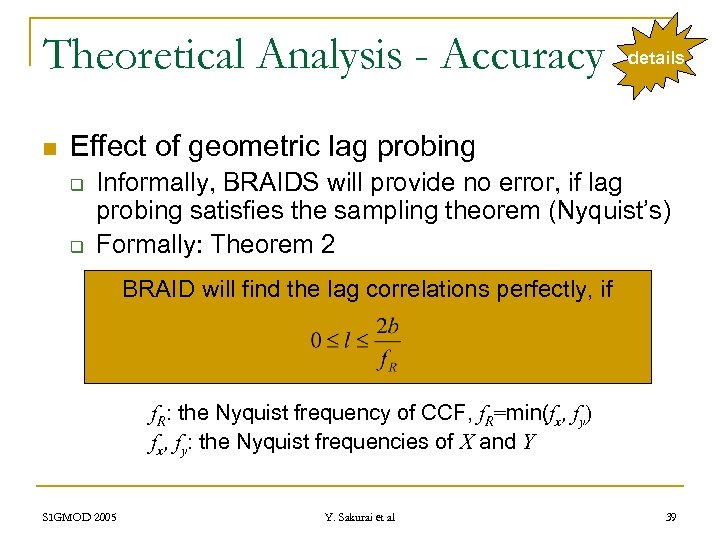
Theoretical Analysis - Accuracy n details Effect of geometric lag probing q q Informally, BRAIDS will provide no error, if lag probing satisfies the sampling theorem (Nyquist’s) Formally: Theorem 2 BRAID will find the lag correlations perfectly, if f. R: the Nyquist frequency of CCF, f. R=min(fx, fy) fx, fy: the Nyquist frequencies of X and Y SIGMOD 2005 Y. Sakurai et al 39
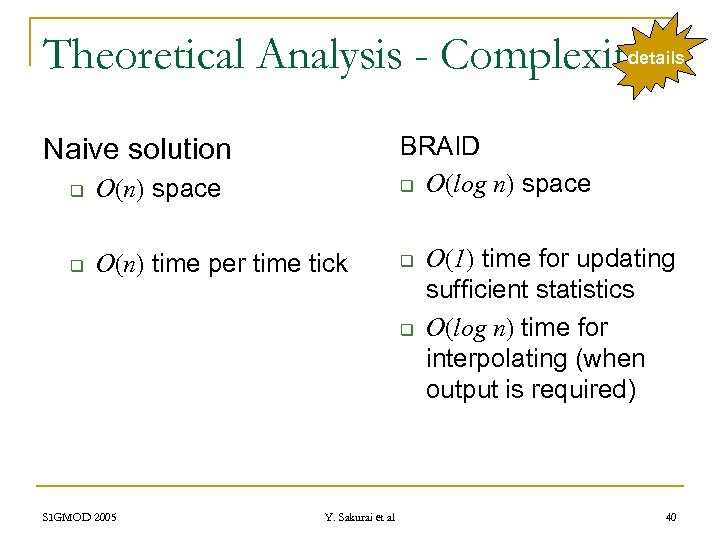
Theoretical Analysis - Complexity details q O(n) space BRAID q O(log n) space q O(n) time per time tick q Naive solution q SIGMOD 2005 Y. Sakurai et al O(1) time for updating sufficient statistics O(log n) time for interpolating (when output is required) 40
Overview n n n Introduction / Related work Background Main ideas Theoretical analysis Experimental results SIGMOD 2005 Y. Sakurai et al 41
Experimental results n Setup q q q Intel Xeon 2. 8 GHz, 1 GB memory, Linux Datasets: Synthetic: Sines, Spike. Trains, Real: Humidity, Light, Temperature, Kursk, Sunspots Enhanced BRAID, b=16 SIGMOD 2005 Y. Sakurai et al 42
Experimental results n Evaluation q q Accuracy for CCF Accuracy for the lag estimation Computation time k-way lag correlations SIGMOD 2005 Y. Sakurai et al 43
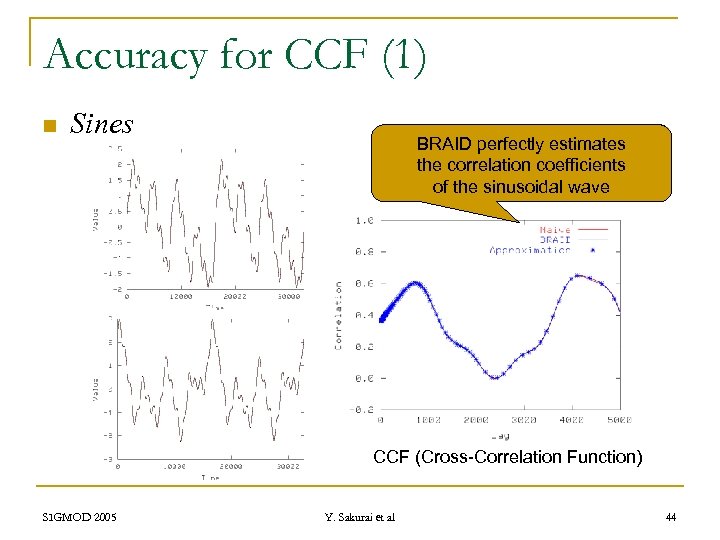
Accuracy for CCF (1) n Sines BRAID perfectly estimates the correlation coefficients of the sinusoidal wave CCF (Cross-Correlation Function) SIGMOD 2005 Y. Sakurai et al 44
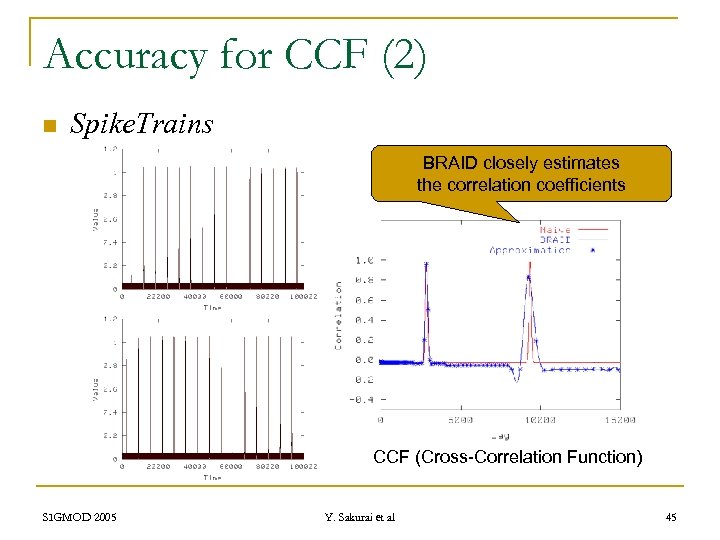
Accuracy for CCF (2) n Spike. Trains BRAID closely estimates the correlation coefficients CCF (Cross-Correlation Function) SIGMOD 2005 Y. Sakurai et al 45
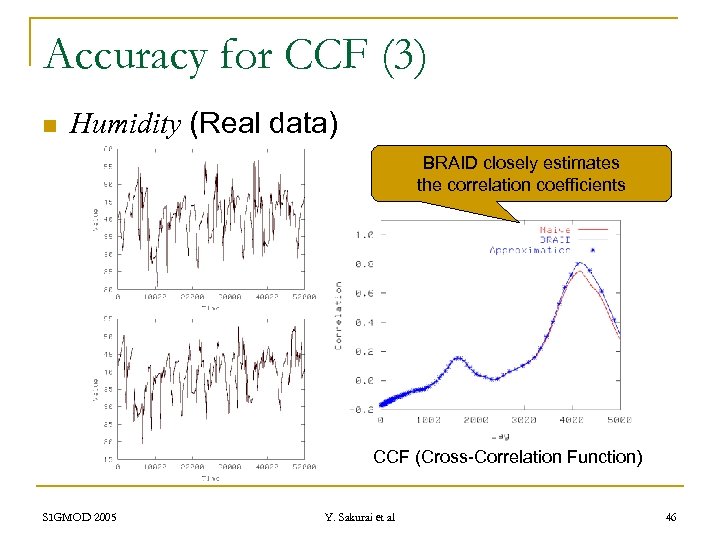
Accuracy for CCF (3) n Humidity (Real data) BRAID closely estimates the correlation coefficients CCF (Cross-Correlation Function) SIGMOD 2005 Y. Sakurai et al 46
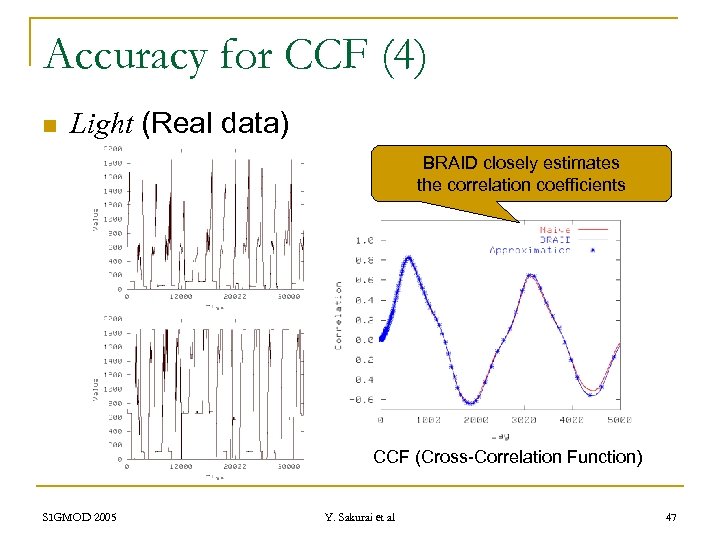
Accuracy for CCF (4) n Light (Real data) BRAID closely estimates the correlation coefficients CCF (Cross-Correlation Function) SIGMOD 2005 Y. Sakurai et al 47
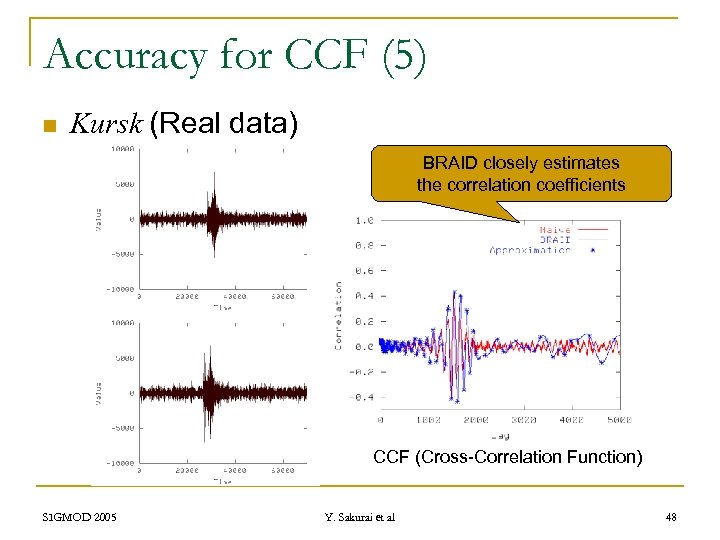
Accuracy for CCF (5) n Kursk (Real data) BRAID closely estimates the correlation coefficients CCF (Cross-Correlation Function) SIGMOD 2005 Y. Sakurai et al 48
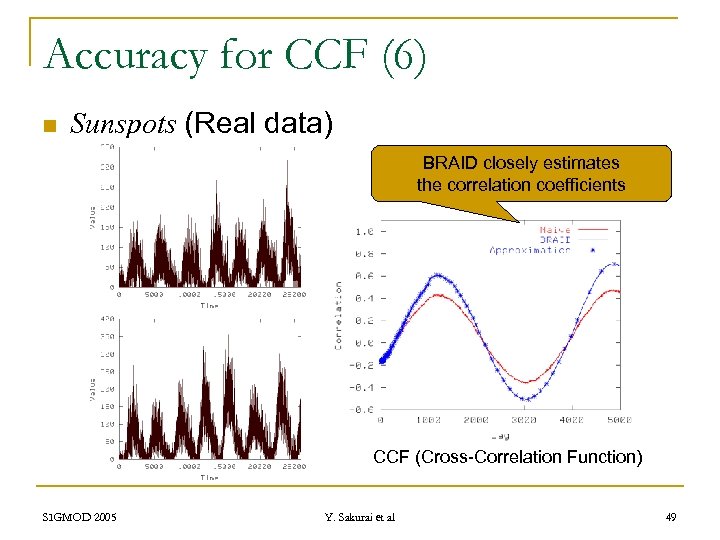
Accuracy for CCF (6) n Sunspots (Real data) BRAID closely estimates the correlation coefficients CCF (Cross-Correlation Function) SIGMOD 2005 Y. Sakurai et al 49
Experimental results n Evaluation q q Accuracy for CCF Accuracy for the lag estimation Computation time k-way lag correlations SIGMOD 2005 Y. Sakurai et al 50
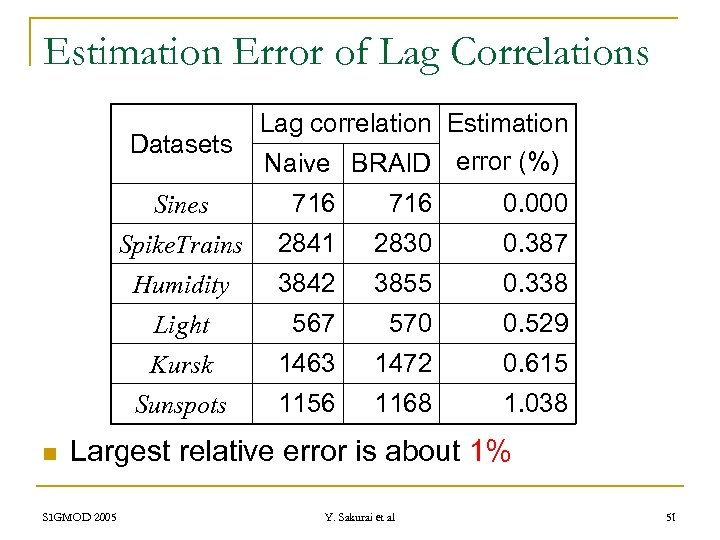
Estimation Error of Lag Correlations Datasets Lag correlation Estimation Naive BRAID error (%) Sines 716 0. 000 Spike. Trains 2841 2830 0. 387 Humidity 3842 3855 0. 338 Light 567 570 0. 529 Kursk 1463 1472 0. 615 Sunspots n 716 1156 1168 1. 038 Largest relative error is about 1% SIGMOD 2005 Y. Sakurai et al 51
Experimental results n Evaluation q q Accuracy for CCF Accuracy for the lag estimation Computation time k-way lag correlations SIGMOD 2005 Y. Sakurai et al 52
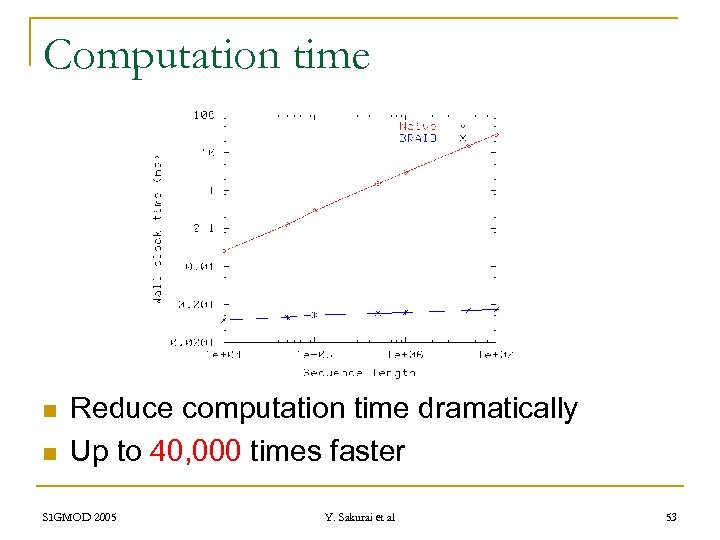
Computation time n n Reduce computation time dramatically Up to 40, 000 times faster SIGMOD 2005 Y. Sakurai et al 53
Experimental results n Evaluation q q Accuracy for CCF Accuracy for the lag estimation Computation time k-way lag correlations SIGMOD 2005 Y. Sakurai et al 54
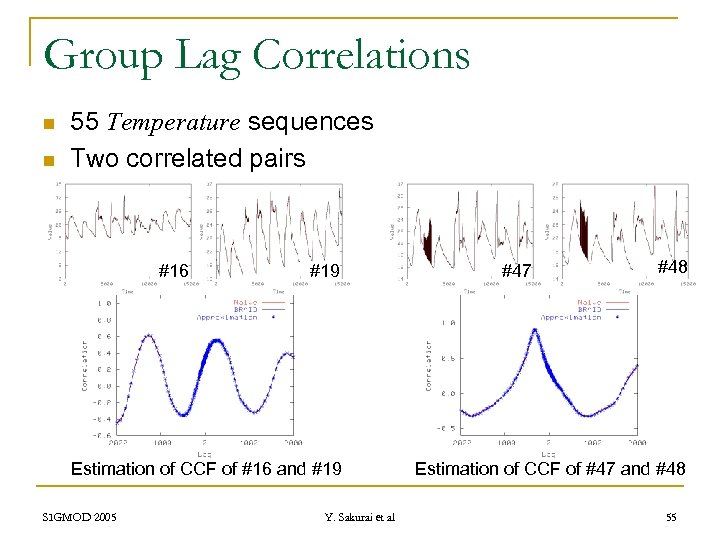
Group Lag Correlations n n 55 Temperature sequences Two correlated pairs #16 #19 Estimation of CCF of #16 and #19 SIGMOD 2005 Y. Sakurai et al #47 #48 Estimation of CCF of #47 and #48 55
Conclusions n Automatic lag correlation detection on data stream 1. ‘Any-time’ 2. Nimble q O(log n) space, O(1) time to update the statistics 3. Fast q Up to 40, 000 times faster than the naive implementation 4. Accurate q within 1% relative error or less SIGMOD 2005 Y. Sakurai et al 56
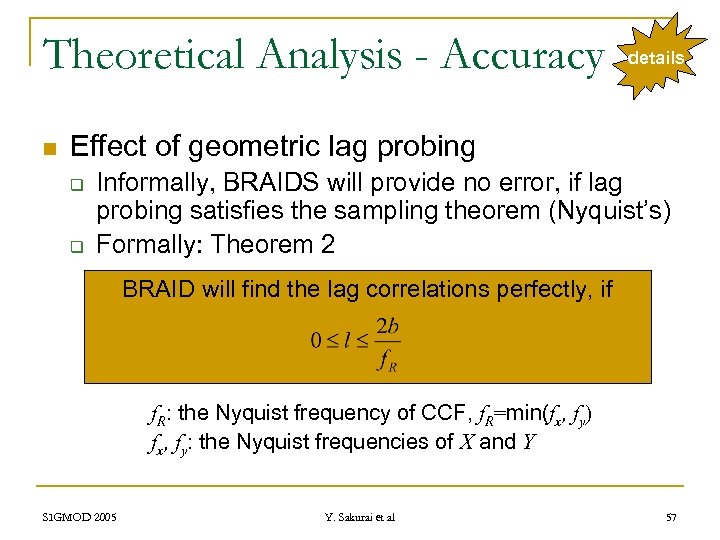
Theoretical Analysis - Accuracy n details Effect of geometric lag probing q q Informally, BRAIDS will provide no error, if lag probing satisfies the sampling theorem (Nyquist’s) Formally: Theorem 2 BRAID will find the lag correlations perfectly, if f. R: the Nyquist frequency of CCF, f. R=min(fx, fy) fx, fy: the Nyquist frequencies of X and Y SIGMOD 2005 Y. Sakurai et al 57
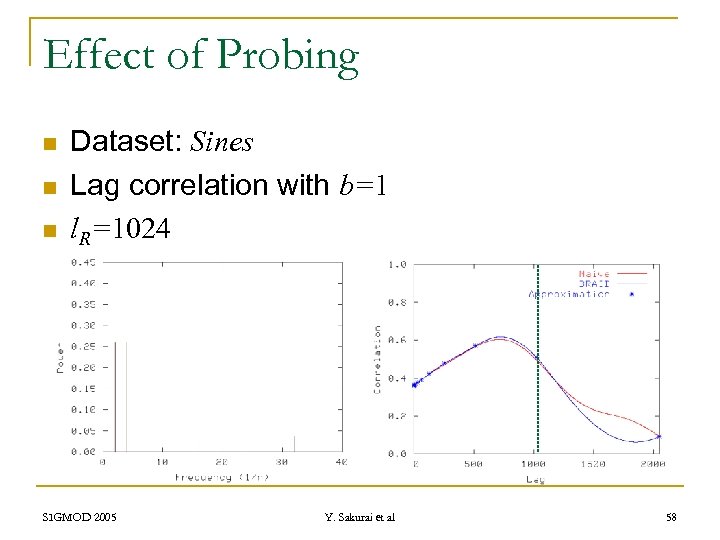
Effect of Probing n n n Dataset: Sines Lag correlation with b=1 l. R=1024 SIGMOD 2005 Y. Sakurai et al 58
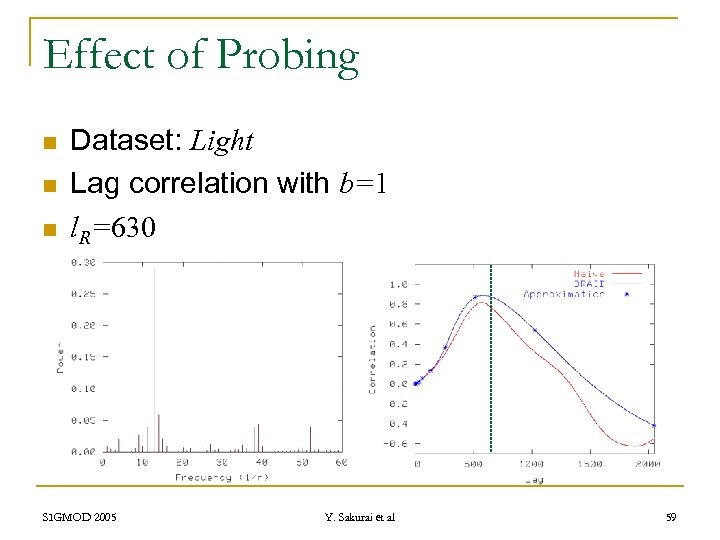
Effect of Probing n n n Dataset: Light Lag correlation with b=1 l. R=630 SIGMOD 2005 Y. Sakurai et al 59
Скачать презентацию BRAID Discovering Lag Correlations in Multiple Streams Yasushi
2dfa12e7c30d5af764a2c20686eea5bf.ppt