 Скачать презентацию Brachytherapy at IST Results from an atypical Comparison
b28abfb821f947dc5a52fe2594291c9f.ppt
- Количество слайдов: 16



Brachytherapy at IST Results from an atypical Comparison Project Stefano Agostinelli 1, 2, Franca Foppiano 1, Stefania Garelli 1, Matteo Tropeano 1 1 National Institute for Cancer Research and 2 Physics Dept. Univ. of Genova Petteri Nieminen & Maria Grazia Pia M. G. Pia et al.
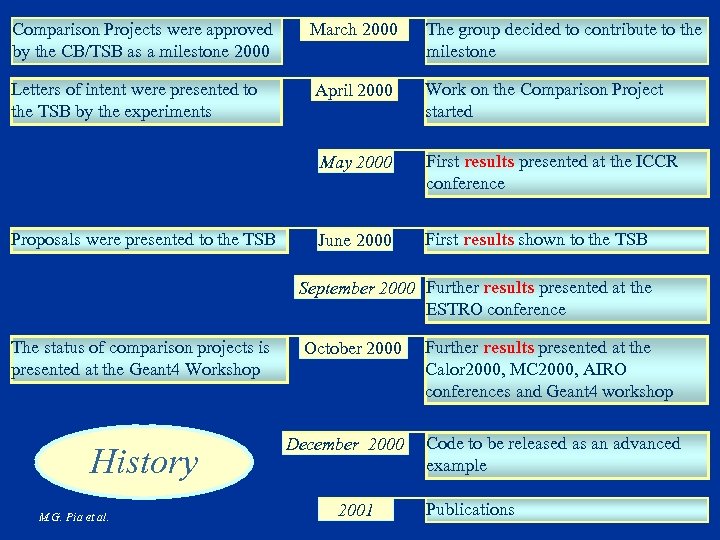
Comparison Projects were approved by the CB/TSB as a milestone 2000 March 2000 The group decided to contribute to the milestone Letters of intent were presented to the TSB by the experiments April 2000 Work on the Comparison Project started May 2000 First results presented at the ICCR conference June 2000 First results shown to the TSB Proposals were presented to the TSB September 2000 Further results presented at the ESTRO conference The status of comparison projects is presented at the Geant 4 Workshop History M. G. Pia et al. October 2000 December 2000 2001 Further results presented at the Calor 2000, MC 2000, AIRO conferences and Geant 4 workshop Code to be released as an advanced example Publications
![What is brachytherapy? ] Brachytherapy is a medical therapy used for cancer treatments ]](https://present5.com/presentation/b28abfb821f947dc5a52fe2594291c9f/image-3.jpg "What is brachytherapy? ] Brachytherapy is a medical therapy used for cancer treatments ]")
What is brachytherapy? ] Brachytherapy is a medical therapy used for cancer treatments ] Radioactive sources are used to deposit therapeutic doses near tumors while preserving surrounding healthy tissues ] In HDR endocavitary brachytherapy: After-loading unit • a radioactive source, for example 192 Ir, is used • the source moves along catheters inserted in natural cavities of the body, e. g. vagina or bronchi; this allows the deposition of therapeutic tumor dose right where it is needed • the source track is programmed by an after-loading unit M. G. Pia et al. Catheter along which source moves
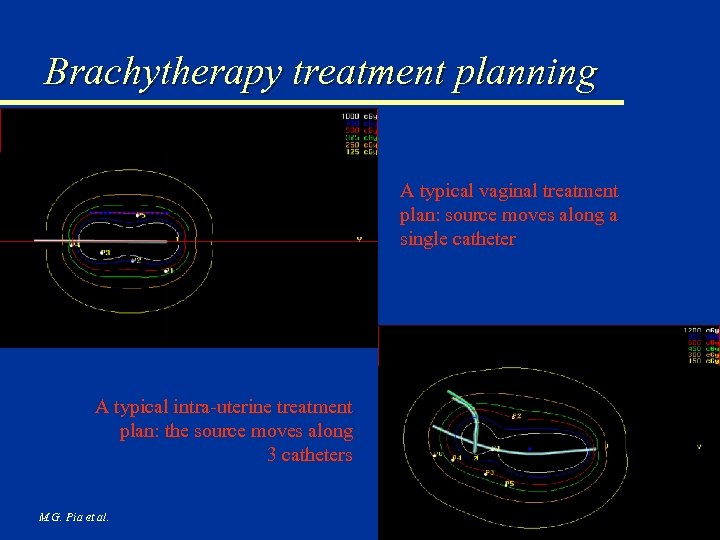
Brachytherapy treatment planning A typical vaginal treatment plan: source moves along a single catheter A typical intra-uterine treatment plan: the source moves along 3 catheters M. G. Pia et al.
Monte Carlo for brachytherapy Monte Carlo simulation topics for brachytherapy: o Dose calculation n Computation of dose deposition kernels for treatment planning dose calculation algorithms based on convolution/superposition methods n Separation of primary, first scatter and multiple scatter components for complex dose deposition models /Computation of other model-dependent parameters, e. g. anisotropy function /Accurate computation of dose deposition in high gradient regions (i. e. near sources) o Verification of experimental calibration procedures M. G. Pia et al.
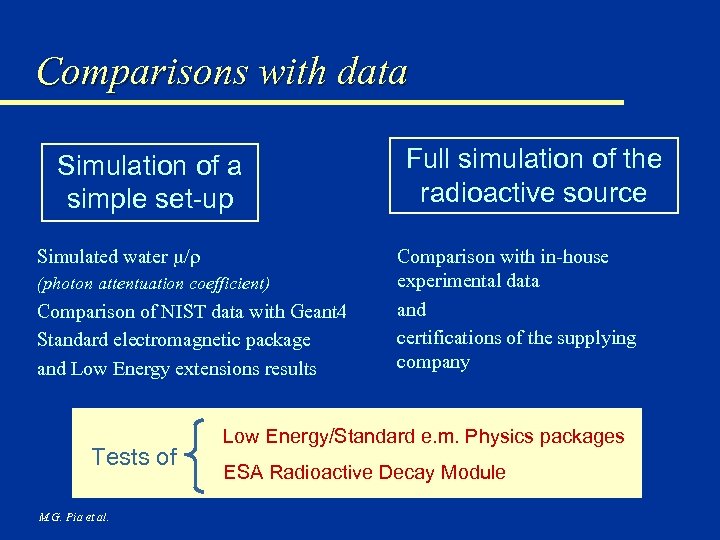
Comparisons with data Simulation of a simple set-up Simulated water (photon attentuation coefficient) Comparison of NIST data with Geant 4 Standard electromagnetic package and Low Energy extensions results Tests of M. G. Pia et al. Full simulation of the radioactive source Comparison with in-house experimental data and certifications of the supplying company Low Energy/Standard e. m. Physics packages ESA Radioactive Decay Module
Comparisons with full source simulation Anisotropy Comparisons with published reference treatment planning data Air kerma rate at various distances Comparisons with measurements of the air kerma rate at IST, following the Protocol for the Basic Dosimetry in Radiotherapy with Brachytherapy Sources of the Italian Association of Biomedical Physics Isodoses Comparisons with tabulated isodoses for superficial brachytherapy applicators M. G. Pia et al.
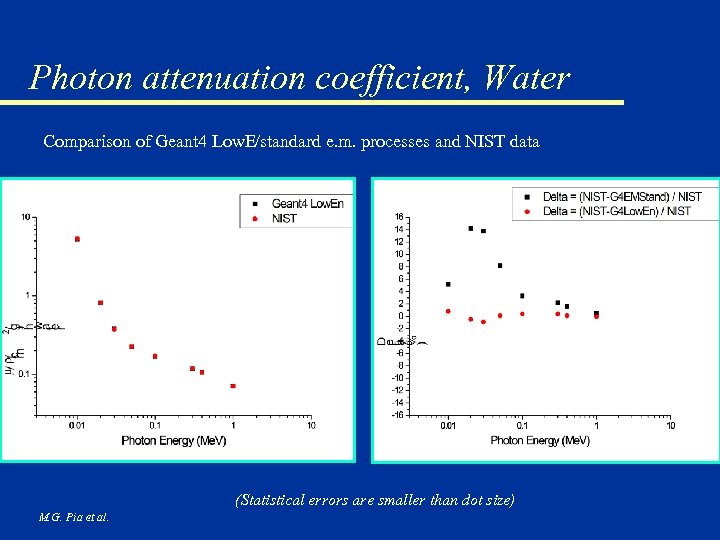
Photon attenuation coefficient, Water Comparison of Geant 4 Low. E/standard e. m. processes and NIST data (Statistical errors are smaller than dot size) M. G. Pia et al.
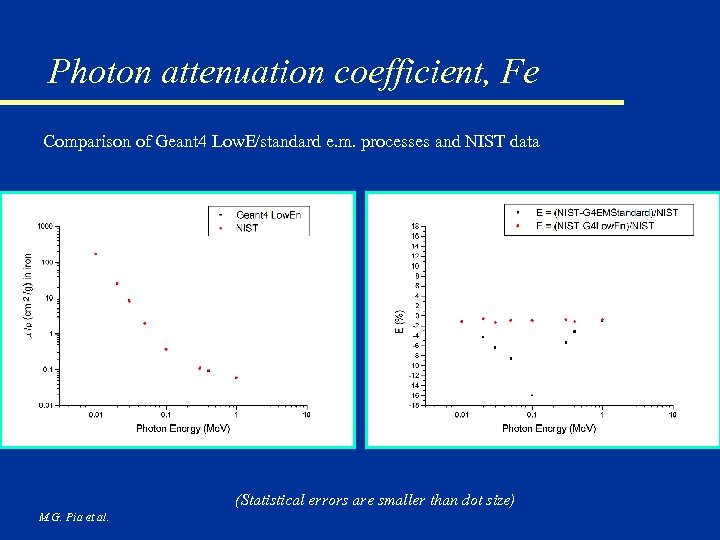
Photon attenuation coefficient, Fe Comparison of Geant 4 Low. E/standard e. m. processes and NIST data (Statistical errors are smaller than dot size) M. G. Pia et al.
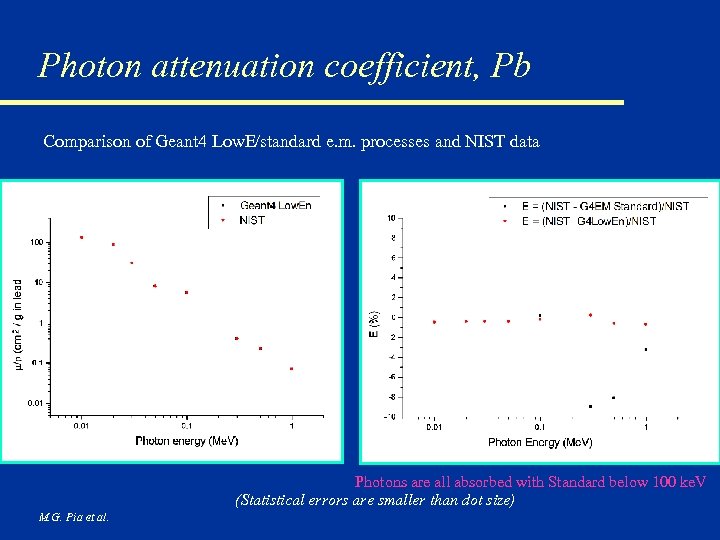
Photon attenuation coefficient, Pb Comparison of Geant 4 Low. E/standard e. m. processes and NIST data Photons are all absorbed with Standard below 100 ke. V (Statistical errors are smaller than dot size) M. G. Pia et al.
![Description of -Selectron 192 Ir source ] ] Geant 4 allows complete flexible description](https://present5.com/presentation/b28abfb821f947dc5a52fe2594291c9f/image-11.jpg "Description of -Selectron 192 Ir source ] ] Geant 4 allows complete flexible description")
Description of -Selectron 192 Ir source ] ] Geant 4 allows complete flexible description of the real geometry 192 Ir l l energy spectrum currently described as monochromatic at 356 ke. V will soon be described by the ESA Geant 4 Radioactive. Decay class M. G. Pia et al.
![Simulation of dose deposition in water ] The simulated source is placed in a](https://present5.com/presentation/b28abfb821f947dc5a52fe2594291c9f/image-12.jpg "Simulation of dose deposition in water ] The simulated source is placed in a")
Simulation of dose deposition in water ] The simulated source is placed in a 30 cm water box ] The dose deposition is investigated in the longitudinal plane ] The plane is partitioned in 1 million 1 mm 3 voxels ] A minimum of 10 millions photons are generated on the 4 solid angle -Selectron 192 Ir source M. G. Pia et al. Longitudinal plane partitioned in cells
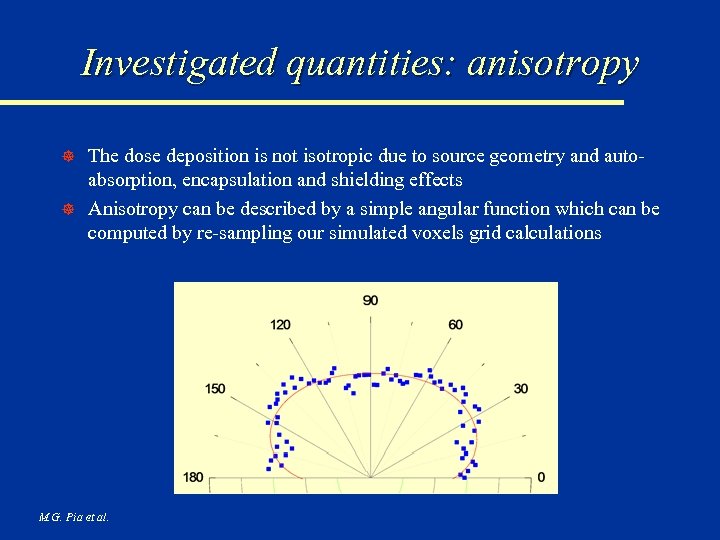
Investigated quantities: anisotropy The dose deposition is not isotropic due to source geometry and autoabsorption, encapsulation and shielding effects ] Anisotropy can be described by a simple angular function which can be computed by re-sampling our simulated voxels grid calculations ] M. G. Pia et al.
![Investigated quantities: isodoses ] The simulated dose deposition data can also be used to](https://present5.com/presentation/b28abfb821f947dc5a52fe2594291c9f/image-14.jpg "Investigated quantities: isodoses ] The simulated dose deposition data can also be used to")
Investigated quantities: isodoses ] The simulated dose deposition data can also be used to derive isodoses M. G. Pia et al.
![Products of this Comparison Project Low. E/standard e. m. processes ] Tests of Geant](https://present5.com/presentation/b28abfb821f947dc5a52fe2594291c9f/image-15.jpg "Products of this Comparison Project Low. E/standard e. m. processes ] Tests of Geant")
Products of this Comparison Project Low. E/standard e. m. processes ] Tests of Geant 4 ] Tests of the Geant 4 Radioactive ] An Advanced ] The ] 4 common presentations at ] 2 common ] A wide ] A contribution to Decay Module physics test ( /r) to become part of regular Low. E testing Example to be released to the user communities porting of Geant 4 2. 0 to Windows/Cygnus M. G. Pia et al. conferences so far publications in preparation (+ IST group’s ones) promotion of Geant 4 in the medical environment technology transfer
![Conclusions and future goals ] This Comparison Project has already generated valuable products ]](https://present5.com/presentation/b28abfb821f947dc5a52fe2594291c9f/image-16.jpg "Conclusions and future goals ] This Comparison Project has already generated valuable products ]")
Conclusions and future goals ] This Comparison Project has already generated valuable products ] The activity of the experimental group and of the Geant 4 collaborators are fully integrated, with mutual benefit ] Further developments and comparisons are planned in the next weeks / More realistic description of 192 Ir source energy spectrum with the new Geant 4 Radioactive. Decay class / Comparison with in-house data / Simulation of shielded brachytherapy applicators Many thanks to Gabriele Cosmo and Alessandro Brunengo for their invaluable help! M. G. Pia et al.
Скачать презентацию Brachytherapy at IST Results from an atypical Comparison
b28abfb821f947dc5a52fe2594291c9f.ppt