 Скачать презентацию Bowls What does Bowls Really Offer
bf9fcadbc3c476171012dac5cdac3cb1.ppt
- Количество слайдов: 28



“ Bowls ” What does Bowls Really Offer People Today ? ? ?

PEOPLE TEAM WORK THE BIG TEAM SUCCESS
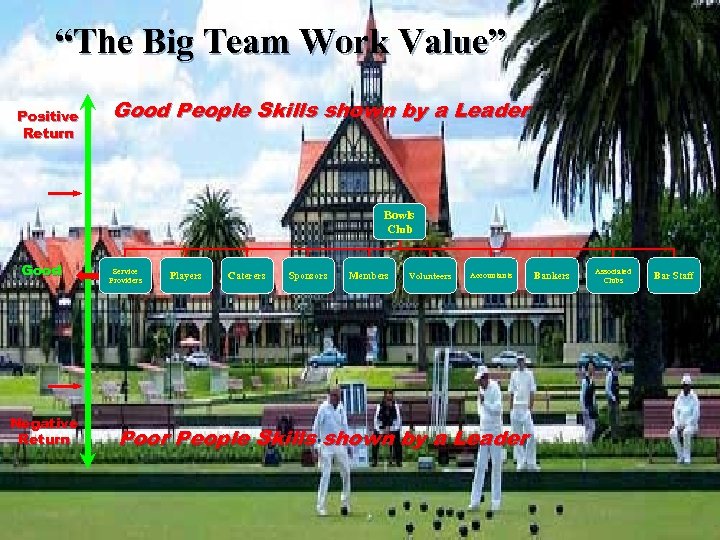
“The Big Team Work Value” Positive Return Good People Skills shown by a Leader Bowls Club Good Negative Return Service Providers Players Caterers Sponsors Members Volunteers Accountants Poor People Skills shown by a Leader Bankers Associated Clubs Bar Staff
Business Plan Example Central Squash Association Club Leadership And Planning Guide
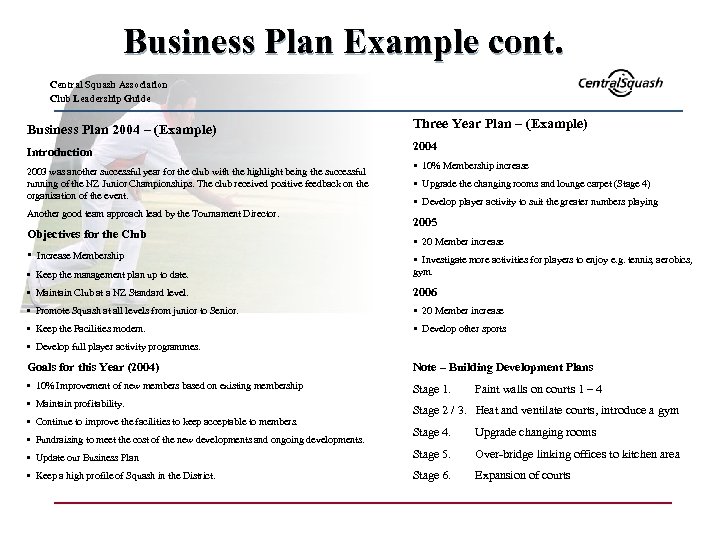
Business Plan Example cont. Central Squash Association Club Leadership Guide Business Plan 2004 – (Example) Three Year Plan – (Example) Introduction 2004 2003 was another successful year for the club with the highlight being the successful running of the NZ Junior Championships. The club received positive feedback on the organisation of the event. Another good team approach lead by the Tournament Director. Objectives for the Club • Increase Membership § 10% Membership increase § Upgrade the changing rooms and lounge carpet (Stage 4) § Develop player activity to suit the greater numbers playing 2005 § 20 Member increase • Keep the management plan up to date. § Investigate more activities for players to enjoy e. g. tennis, aerobics, gym. • Maintain Club at a NZ Standard level. 2006 • Promote Squash at all levels from junior to Senior. § 20 Member increase • Keep the Facilities modern. § Develop other sports • Develop full player activity programmes. Goals for this Year (2004) Note – Building Development Plans • 10% Improvement of new members based on existing membership Stage 1. • Maintain profitability. • Continue to improve the facilities to keep acceptable to members. Paint walls on courts 1 – 4 Stage 2 / 3. Heat and ventilate courts, introduce a gym Stage 4. Upgrade changing rooms • Update our Business Plan Stage 5. Over-bridge linking offices to kitchen area • Keep a high profile of Squash in the District. Stage 6. Expansion of courts • Fundraising to meet the cost of the new developments and ongoing developments.
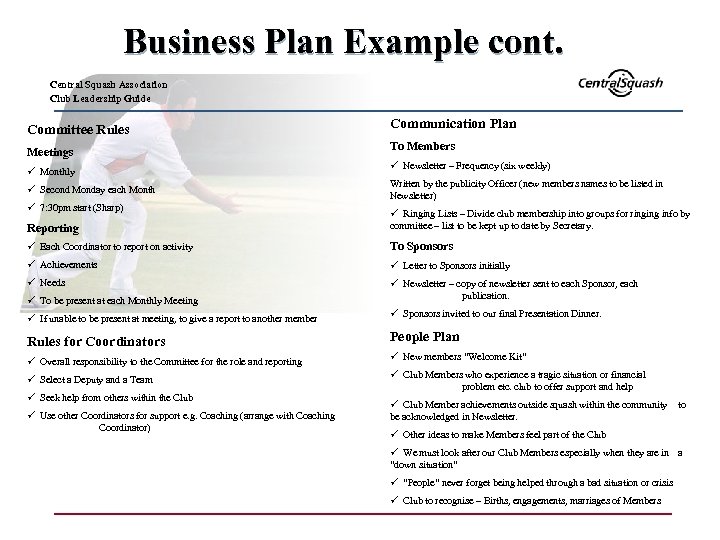
Business Plan Example cont. Central Squash Association Club Leadership Guide Committee Rules Communication Plan Meetings To Members ü Monthly ü Second Monday each Month ü 7: 30 pm start (Sharp) ü Newsletter – Frequency (six weekly) Written by the publicity Officer (new members names to be listed in Newsletter) Reporting ü Ringing Lists – Divide club membership into groups for ringing info by committee – list to be kept up to date by Secretary. ü Each Coordinator to report on activity To Sponsors ü Achievements ü Letter to Sponsors initially ü Needs ü Newsletter – copy of newsletter sent to each Sponsor, each publication. ü To be present at each Monthly Meeting ü If unable to be present at meeting, to give a report to another member Rules for Coordinators ü Overall responsibility to the Committee for the role and reporting ü Select a Deputy and a Team ü Seek help from others within the Club ü Use other Coordinators for support e. g. Coaching (arrange with Coaching Coordinator) ü Sponsors invited to our final Presentation Dinner. People Plan ü New members “Welcome Kit” ü Club Members who experience a tragic situation or financial problem etc. club to offer support and help ü Club Member achievements outside squash within the community to be acknowledged in Newsletter. ü Other ideas to make Members feel part of the Club ü We must look after our Club Members especially when they are in a “down situation” ü “People” never forget being helped through a bad situation or crisis ü Club to recognise – Births, engagements, marriages of Members
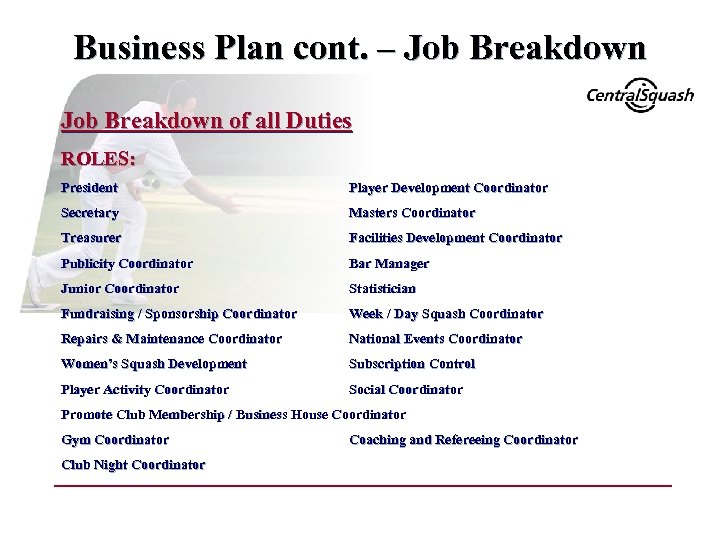
Business Plan cont. – Job Breakdown of all Duties ROLES: President Player Development Coordinator Secretary Masters Coordinator Treasurer Facilities Development Coordinator Publicity Coordinator Bar Manager Junior Coordinator Statistician Fundraising / Sponsorship Coordinator Week / Day Squash Coordinator Repairs & Maintenance Coordinator National Events Coordinator Women’s Squash Development Subscription Control Player Activity Coordinator Social Coordinator Promote Club Membership / Business House Coordinator Gym Coordinator Club Night Coordinator Coaching and Refereeing Coordinator
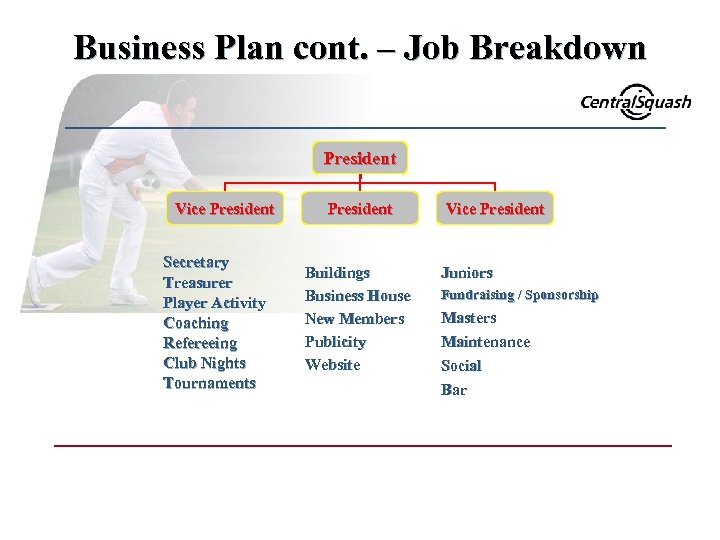
Business Plan cont. – Job Breakdown President Vice President Secretary Treasurer Player Activity Coaching Refereeing Club Nights Tournaments President Buildings Business House New Members Publicity Website Vice President Juniors Fundraising / Sponsorship Masters Maintenance Social Bar
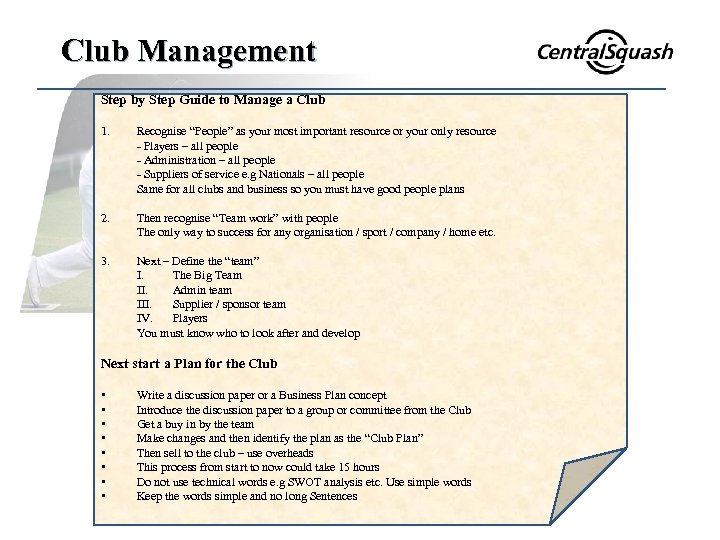
Club Management Step by Step Guide to Manage a Club 1. Recognise “People” as your most important resource or your only resource - Players – all people - Administration – all people - Suppliers of service e. g Nationals – all people Same for all clubs and business so you must have good people plans 2. Then recognise “Team work” with people The only way to success for any organisation / sport / company / home etc. 3. Next – Define the “team” I. The Big Team II. Admin team III. Supplier / sponsor team IV. Players You must know who to look after and develop Next start a Plan for the Club • • Write a discussion paper or a Business Plan concept Introduce the discussion paper to a group or committee from the Club Get a buy in by the team Make changes and then identify the plan as the “Club Plan” Then sell to the club – use overheads This process from start to now could take 15 hours Do not use technical words e. g SWOT analysis etc. Use simple words Keep the words simple and no long Sentences
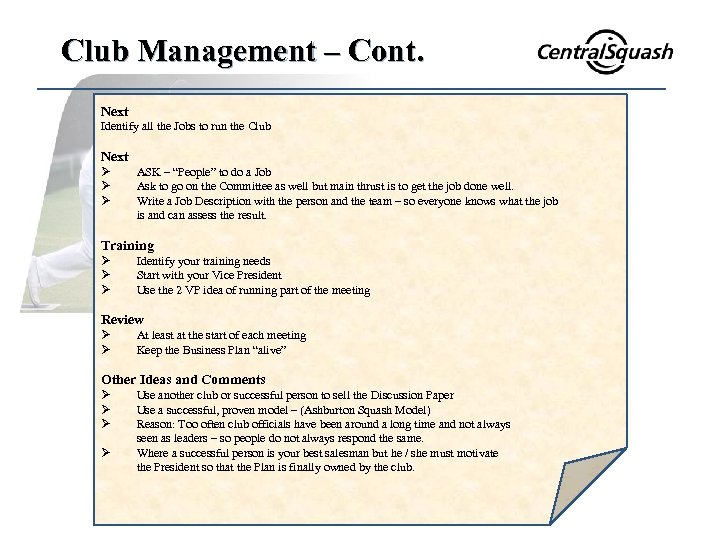
Club Management – Cont. Next Identify all the Jobs to run the Club Next Ø Ø Ø ASK – “People” to do a Job Ask to go on the Committee as well but main thrust is to get the job done well. Write a Job Description with the person and the team – so everyone knows what the job is and can assess the result. Training Ø Ø Ø Identify your training needs Start with your Vice President Use the 2 VP idea of running part of the meeting Review Ø Ø At least at the start of each meeting Keep the Business Plan “alive” Other Ideas and Comments Ø Ø Use another club or successful person to sell the Discussion Paper Use a successful, proven model – (Ashburton Squash Model) Reason: Too often club officials have been around a long time and not always seen as leaders – so people do not always respond the same. Where a successful person is your best salesman but he / she must motivate the President so that the Plan is finally owned by the club.
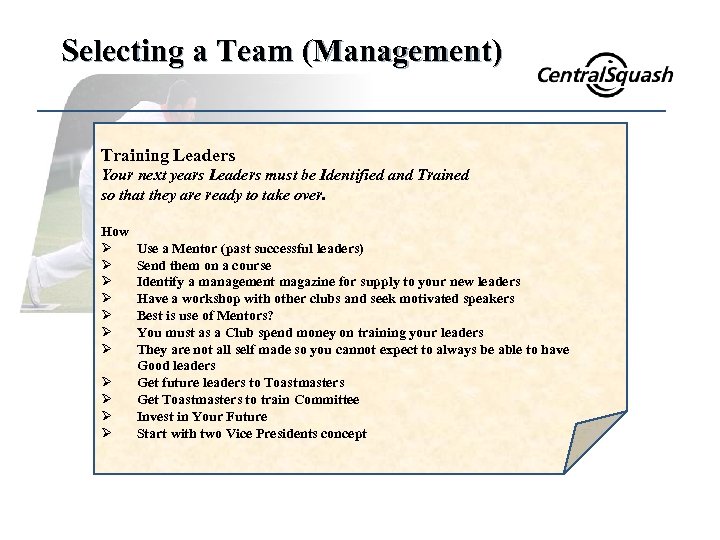
Selecting a Team (Management) Training Leaders Your next years Leaders must be Identified and Trained so that they are ready to take over. How Ø Ø Ø Use a Mentor (past successful leaders) Send them on a course Identify a management magazine for supply to your new leaders Have a workshop with other clubs and seek motivated speakers Best is use of Mentors? You must as a Club spend money on training your leaders They are not all self made so you cannot expect to always be able to have Good leaders Get future leaders to Toastmasters Get Toastmasters to train Committee Invest in Your Future Start with two Vice Presidents concept
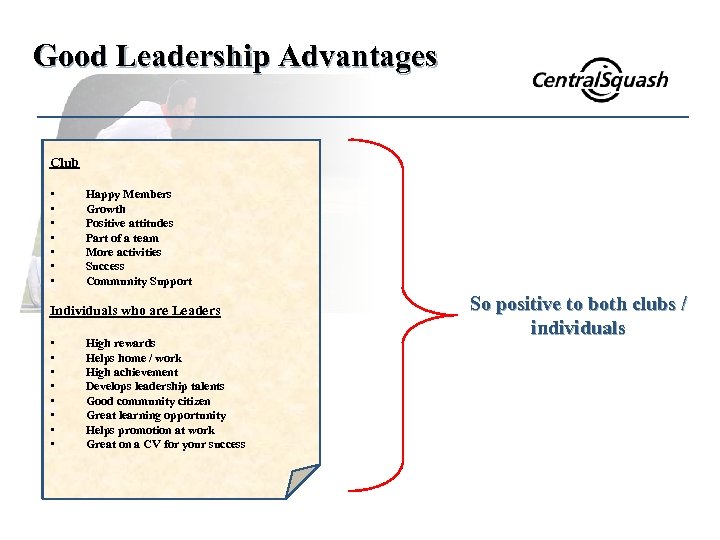
Good Leadership Advantages Club • • Happy Members Growth Positive attitudes Part of a team More activities Success Community Support Individuals who are Leaders • • High rewards Helps home / work High achievement Develops leadership talents Good community citizen Great learning opportunity Helps promotion at work Great on a CV for your success So positive to both clubs / individuals
The Basic Rule of a Club Ø Great flash club facilities, poorly led, FAIL Ø Average club facilities, with good leadership WIN Ø Think about it Ø Don’t throw money at it Ø Develop leadership First Ø It succeeds
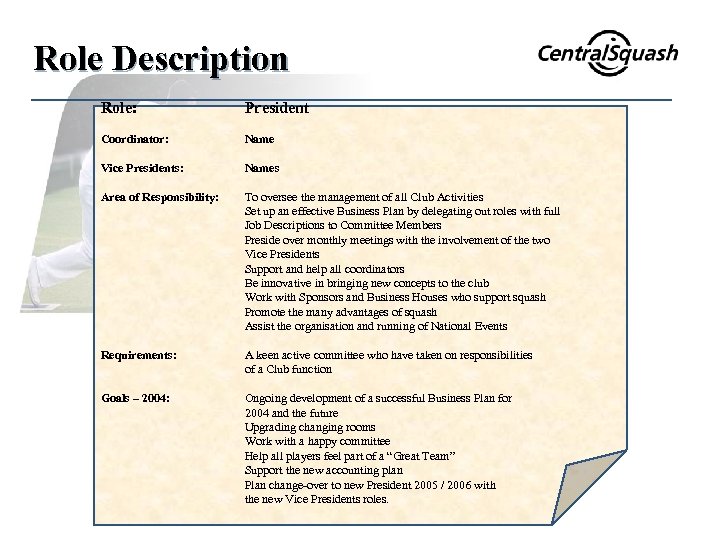
Role Description Role: President Coordinator: Name Vice Presidents: Names Area of Responsibility: To oversee the management of all Club Activities Set up an effective Business Plan by delegating out roles with full Job Descriptions to Committee Members Preside over monthly meetings with the involvement of the two Vice Presidents Support and help all coordinators Be innovative in bringing new concepts to the club Work with Sponsors and Business Houses who support squash Promote the many advantages of squash Assist the organisation and running of National Events Requirements: A keen active committee who have taken on responsibilities of a Club function Goals – 2004: Ongoing development of a successful Business Plan for 2004 and the future Upgrading changing rooms Work with a happy committee Help all players feel part of a “Great Team” Support the new accounting plan Plan change-over to new President 2005 / 2006 with the new Vice Presidents roles.
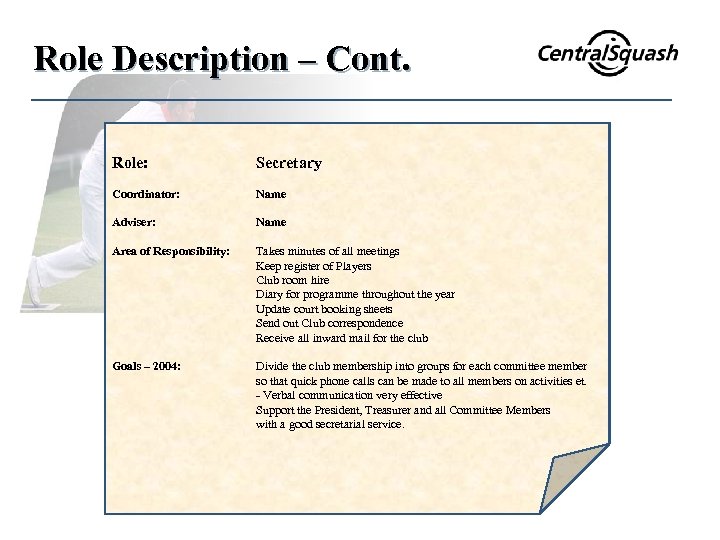
Role Description – Cont. Role: Secretary Coordinator: Name Adviser: Name Area of Responsibility: Takes minutes of all meetings Keep register of Players Club room hire Diary for programme throughout the year Update court booking sheets Send out Club correspondence Receive all inward mail for the club Goals – 2004: Divide the club membership into groups for each committee member so that quick phone calls can be made to all members on activities et. - Verbal communication very effective Support the President, Treasurer and all Committee Members with a good secretarial service.
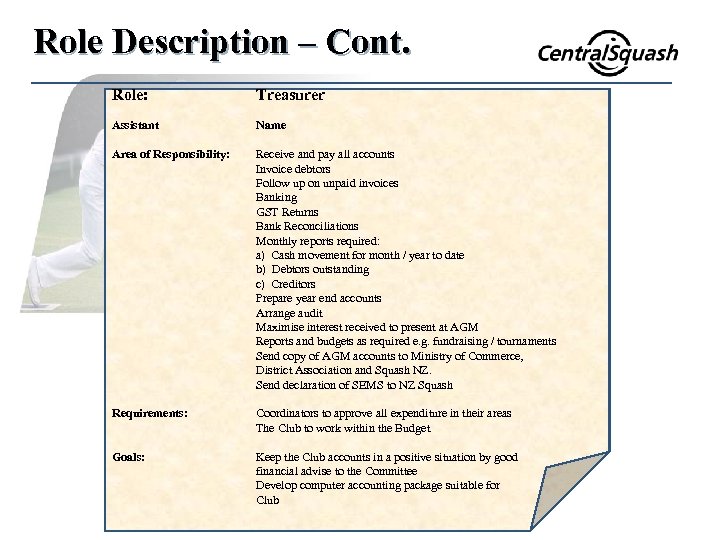
Role Description – Cont. Role: Treasurer Assistant Name Area of Responsibility: Receive and pay all accounts Invoice debtors Follow up on unpaid invoices Banking GST Returns Bank Reconciliations Monthly reports required: a) Cash movement for month / year to date b) Debtors outstanding c) Creditors Prepare year end accounts Arrange audit Maximise interest received to present at AGM Reports and budgets as required e. g. fundraising / tournaments Send copy of AGM accounts to Ministry of Commerce, District Association and Squash NZ. Send declaration of SEMS to NZ Squash Requirements: Coordinators to approve all expenditure in their areas The Club to work within the Budget Goals: Keep the Club accounts in a positive situation by good financial advise to the Committee Develop computer accounting package suitable for Club
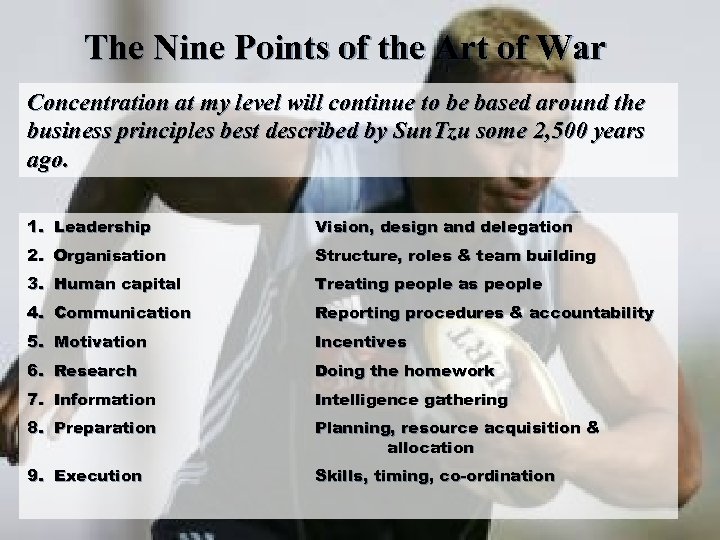
The Nine Points of the Art of War Concentration at my level will continue to be based around the business principles best described by Sun. Tzu some 2, 500 years ago. 1. Leadership Vision, design and delegation 2. Organisation Structure, roles & team building 3. Human capital Treating people as people 4. Communication Reporting procedures & accountability 5. Motivation Incentives 6. Research Doing the homework 7. Information Intelligence gathering 8. Preparation Planning, resource acquisition & allocation 9. Execution Skills, timing, co-ordination
What is a Leader? Definition Leadership is as essential in the workplace today, as it was at the beginning of time. People in early times probably followed leaders who had the skills to help gather food and find shelter from the elements and wild animals. Today people are leaders in different ways. - In their personal lives - In Business - In the community and in government Some leadership rolls are more clearly defined than others, but all have one thing in common. Unless the leader is effective, people will not follow. Today an effective leader needs to be a good communicator, motivator and a persuader. Leadership and learning are indispensable to each other. A leader is the one who gets followed !
The Six “P”s For Success At a recent seminar, Steve Gurney introduced his “six P’s” as the secret to his outstanding results. “Prior Planning Prevents Piss Poor Performance” - Steve Gurney -
The Six “P”s For Success “Prior People Planning Prevents Piss Poor Performance” - Trevor Johnston Again highlights the importance of Planning your Success

LESSONS FROM GEESE
As each bird flaps its wings, it creates an uplift for others behind him. There is 71% more flying range in “V” formation than flying alone. LESSON “People who share a common direction and sense of common purpose can get there more quickly”
Whenever a goose flies out of formation it quickly feels the drag and tries to get back into position. LESSON “It’s harder to do something alone than together. ”
When the lead goose gets tired, it rotates back into the formation and another goose flies at the head. LESSON “Shared leadership and interdependence gives us each a chance to lead as well as opportunities to rest. ”
The geese in formation honk from behind to encourage those up front to keep up their speed. LESSON “We need to make sure our Honking is encouraging and not discouraging. ”
When a goose gets sick or wounded and falls, two geese fall out and stay with it until it revives or dies. Then they catch up or join another flock. LESSON “Stand by your colleagues in difficult times as well as in good. ”
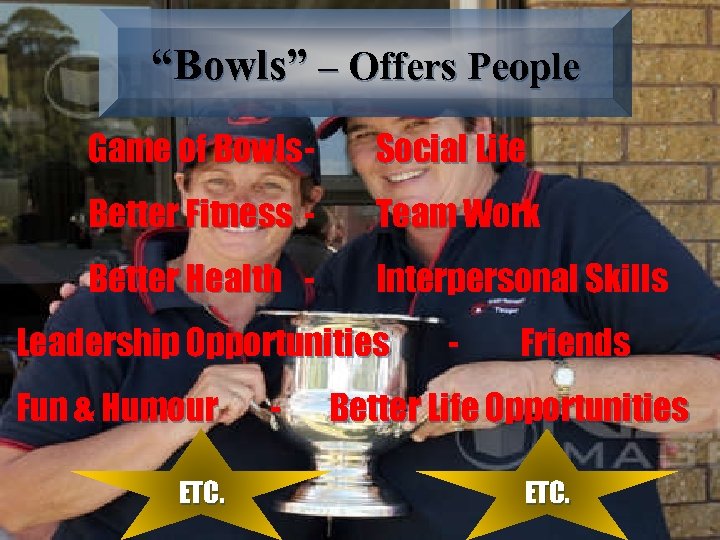
“Bowls” – Offers People Game of Bowls - Social Life Better Fitness - Team Work Better Health - Interpersonal Skills Leadership Opportunities Fun & Humour ETC. - - Friends Better Life Opportunities ETC.
Yes – Sport does add HUGE value to our People & Communities. But - It must be Managed By - Good Leaders With - A Good Plan Then - Success is Guaranteed So - Go for Change & Win
Скачать презентацию Bowls What does Bowls Really Offer
bf9fcadbc3c476171012dac5cdac3cb1.ppt