 Скачать презентацию BOUNDS AND ROBUST HEDGING OF THE AMERICAN OPTION
af229e03fbdca4ad8ad42be90459354f.ppt
- Количество слайдов: 25



BOUNDS, AND ROBUST HEDGING OF THE AMERICAN OPTION Anthony Neuberger (University of Warwick) University of Warwick, 11/12 July 2008
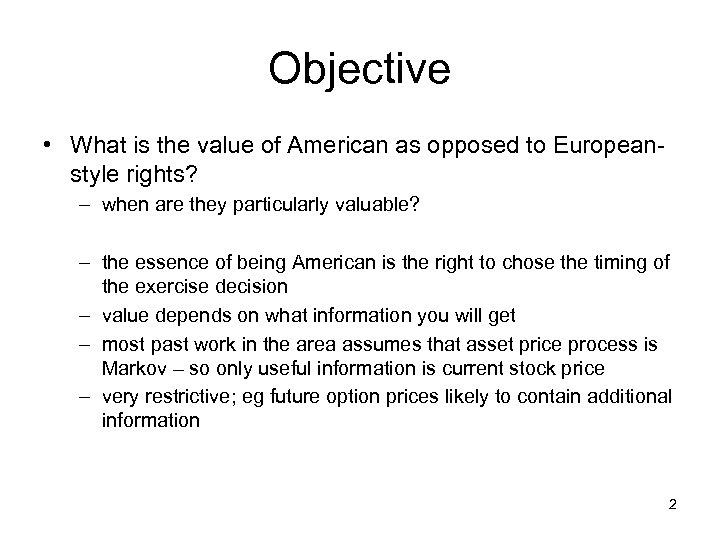
Objective • What is the value of American as opposed to Europeanstyle rights? – when are they particularly valuable? – the essence of being American is the right to chose the timing of the exercise decision – value depends on what information you will get – most past work in the area assumes that asset price process is Markov – so only useful information is current stock price – very restrictive; eg future option prices likely to contain additional information 2
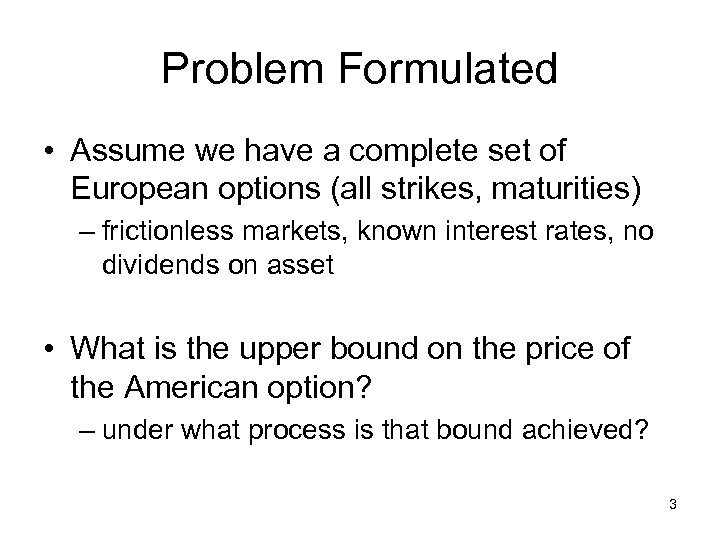
Problem Formulated • Assume we have a complete set of European options (all strikes, maturities) – frictionless markets, known interest rates, no dividends on asset • What is the upper bound on the price of the American option? – under what process is that bound achieved? 3
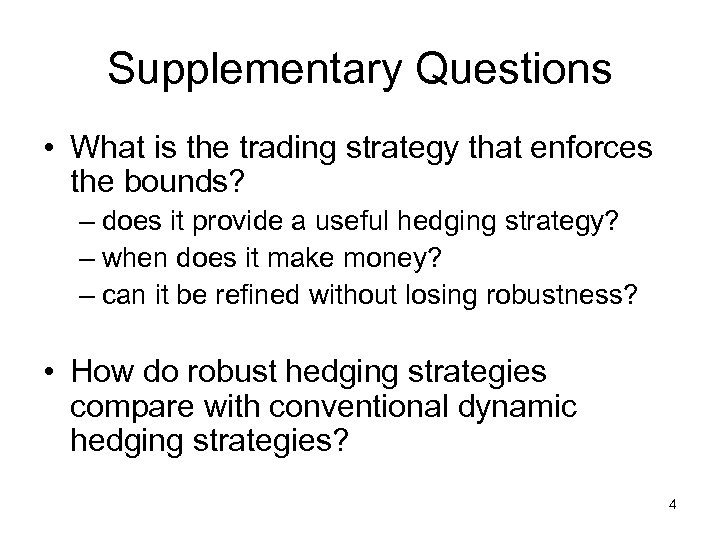
Supplementary Questions • What is the trading strategy that enforces the bounds? – does it provide a useful hedging strategy? – when does it make money? – can it be refined without losing robustness? • How do robust hedging strategies compare with conventional dynamic hedging strategies? 4
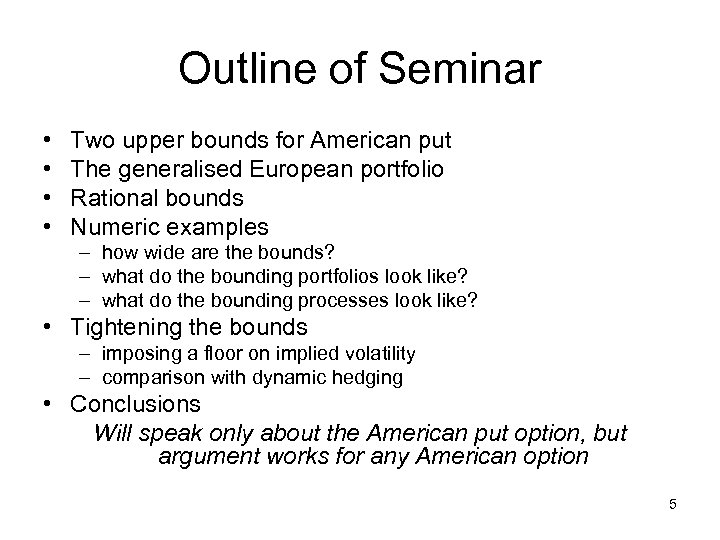
Outline of Seminar • • Two upper bounds for American put The generalised European portfolio Rational bounds Numeric examples – how wide are the bounds? – what do the bounding portfolios look like? – what do the bounding processes look like? • Tightening the bounds – imposing a floor on implied volatility – comparison with dynamic hedging • Conclusions Will speak only about the American put option, but argument works for any American option 5
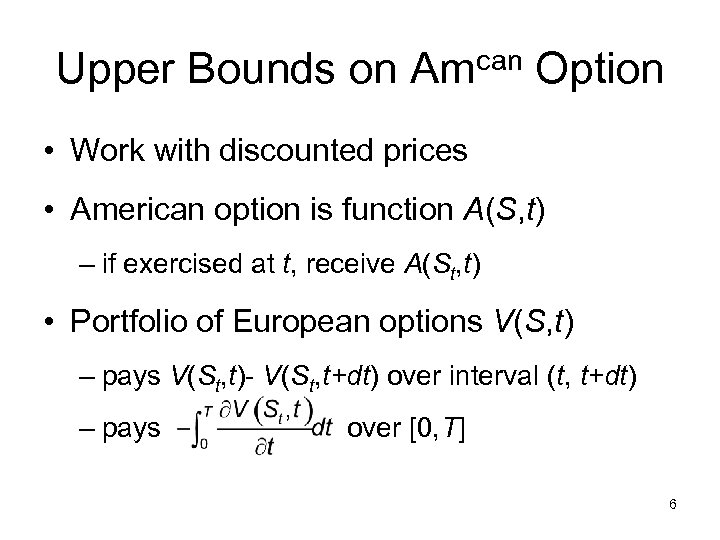
Upper Bounds on Amcan Option • Work with discounted prices • American option is function A(S, t) – if exercised at t, receive A(St, t) • Portfolio of European options V(S, t) – pays V(St, t)- V(St, t+dt) over interval (t, t+dt) – pays over [0, T] 6
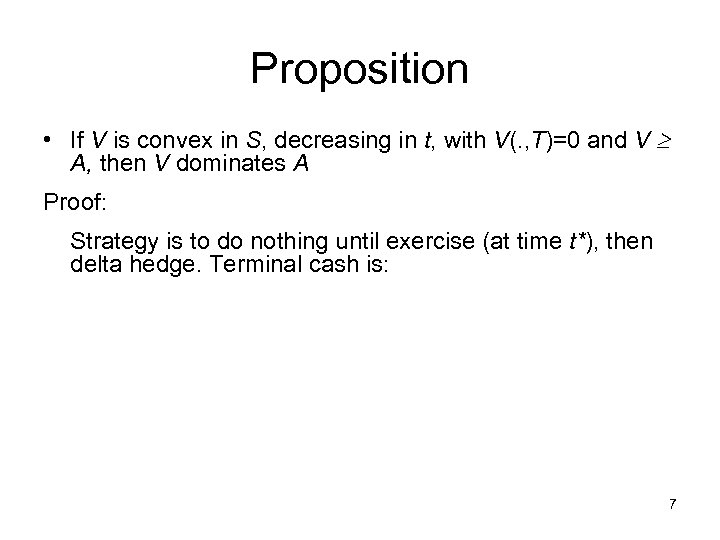
Proposition • If V is convex in S, decreasing in t, with V(. , T)=0 and V A, then V dominates A Proof: Strategy is to do nothing until exercise (at time t*), then delta hedge. Terminal cash is: 7
![Example – European Put • A = [Ke-rt – S]+ ; take V =](https://present5.com/presentation/af229e03fbdca4ad8ad42be90459354f/image-8.jpg "Example – European Put • A = [Ke-rt – S]+ ; take V =")
Example – European Put • A = [Ke-rt – S]+ ; take V = A – satisfies assumptions easiest to work in nominal terms – European portfolio pays at nominal rate r. K so long as put in the money, and [K – S]+ at T – do nothing until exercise • then pay K – S, borrow K and buy share; • cash flow from European portfolio pays interest on loan so long as S < K • if S > K, sell share and repay debt • if S remains below K liquidate at T 8
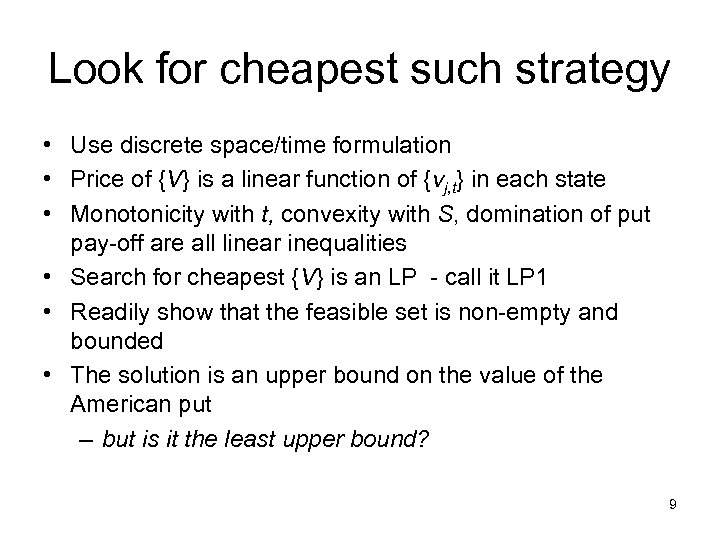
Look for cheapest such strategy • Use discrete space/time formulation • Price of {V} is a linear function of {vj, t} in each state • Monotonicity with t, convexity with S, domination of put pay-off are all linear inequalities • Search for cheapest {V} is an LP - call it LP 1 • Readily show that the feasible set is non-empty and bounded • The solution is an upper bound on the value of the American put – but is it the least upper bound? 9
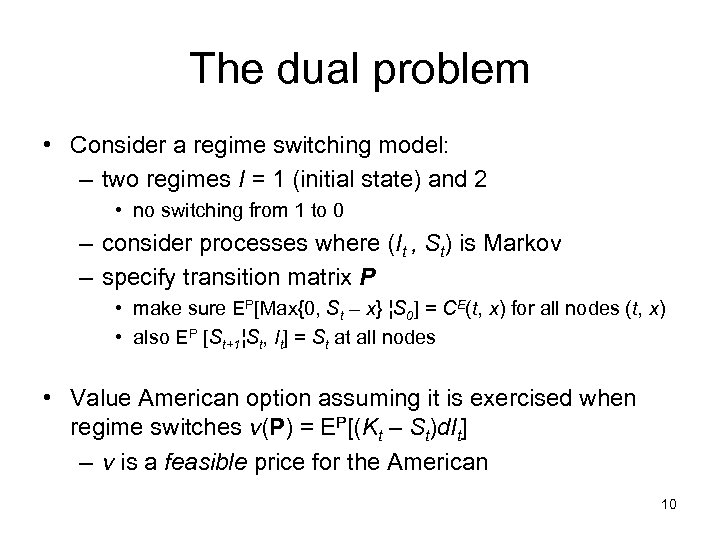
The dual problem • Consider a regime switching model: – two regimes I = 1 (initial state) and 2 • no switching from 1 to 0 – consider processes where (It , St) is Markov – specify transition matrix P • make sure EP[Max{0, St – x} ¦S 0] = CE(t, x) for all nodes (t, x) • also EP [St+1¦St, It] = St at all nodes • Value American option assuming it is exercised when regime switches v(P) = EP[(Kt – St)d. It] – v is a feasible price for the American 10
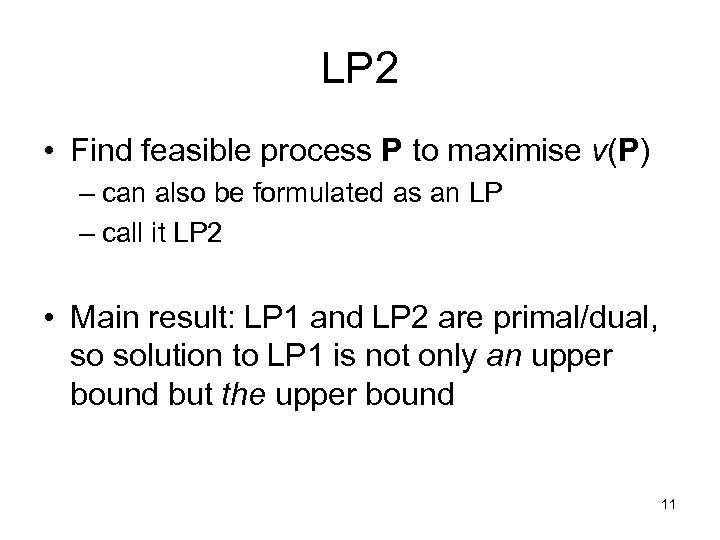
LP 2 • Find feasible process P to maximise v(P) – can also be formulated as an LP – call it LP 2 • Main result: LP 1 and LP 2 are primal/dual, so solution to LP 1 is not only an upper bound but the upper bound 11
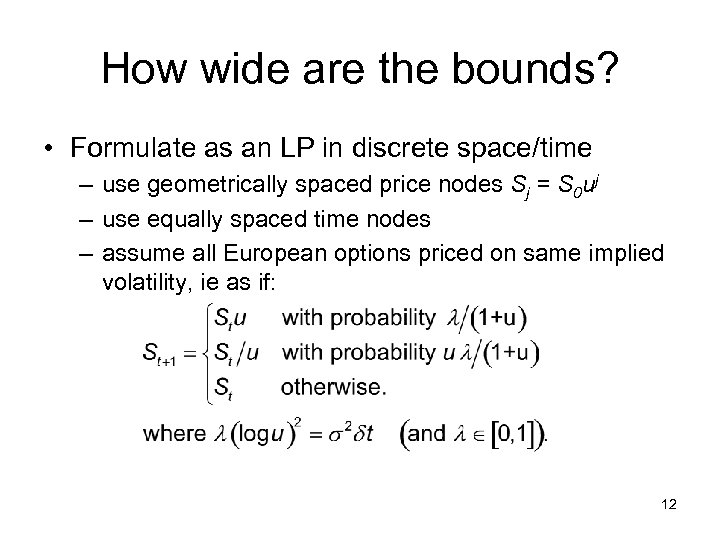
How wide are the bounds? • Formulate as an LP in discrete space/time – use geometrically spaced price nodes Sj = S 0 uj – use equally spaced time nodes – assume all European options priced on same implied volatility, ie as if: 12
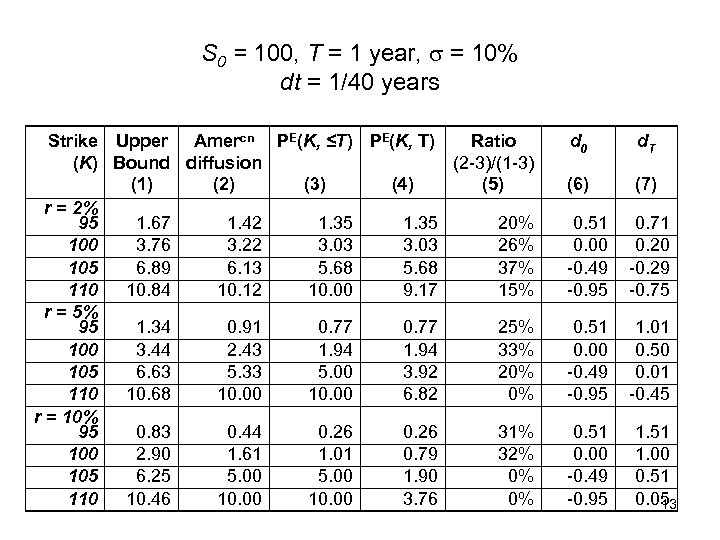
S 0 = 100, T = 1 year, s = 10% dt = 1/40 years Strike Upper Amercn PE(K, ≤T) PE(K, T) Ratio (K) Bound diffusion (2 -3)/(1 -3) (1) (2) (3) (4) (5) r = 2% 95 1. 67 1. 42 1. 35 20% 100 3. 76 3. 22 3. 03 26% 105 6. 89 6. 13 5. 68 37% 110 10. 84 10. 12 10. 00 9. 17 15% r = 5% 95 1. 34 0. 91 0. 77 25% 100 3. 44 2. 43 1. 94 33% 105 6. 63 5. 33 5. 00 3. 92 20% 110 10. 68 10. 00 6. 82 0% r = 10% 95 0. 83 0. 44 0. 26 31% 100 2. 90 1. 61 1. 01 0. 79 32% 105 6. 25 5. 00 1. 90 0% 110 10. 46 10. 00 3. 76 0% d 0 d. T (6) (7) 0. 51 0. 00 -0. 49 -0. 95 0. 71 0. 20 -0. 29 -0. 75 0. 51 0. 00 -0. 49 -0. 95 1. 01 0. 50 0. 01 -0. 45 0. 51 0. 00 -0. 49 -0. 95 1. 51 1. 00 0. 51 0. 05 13
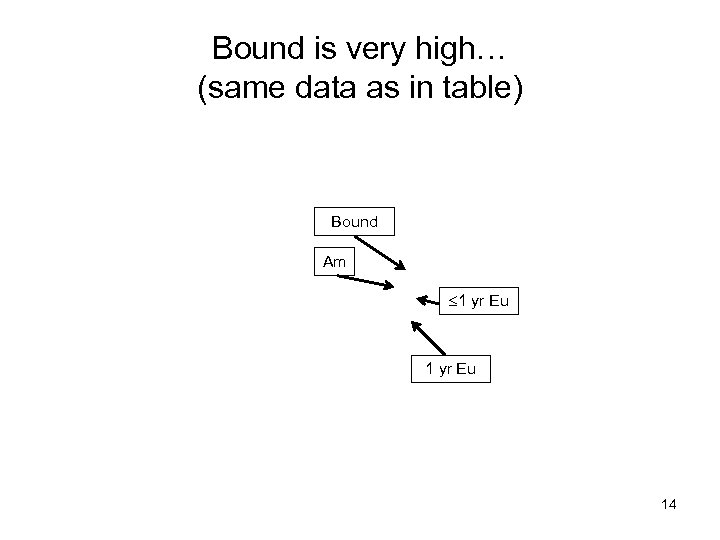
Bound is very high… (same data as in table) Bound Am 1 yr Eu 14
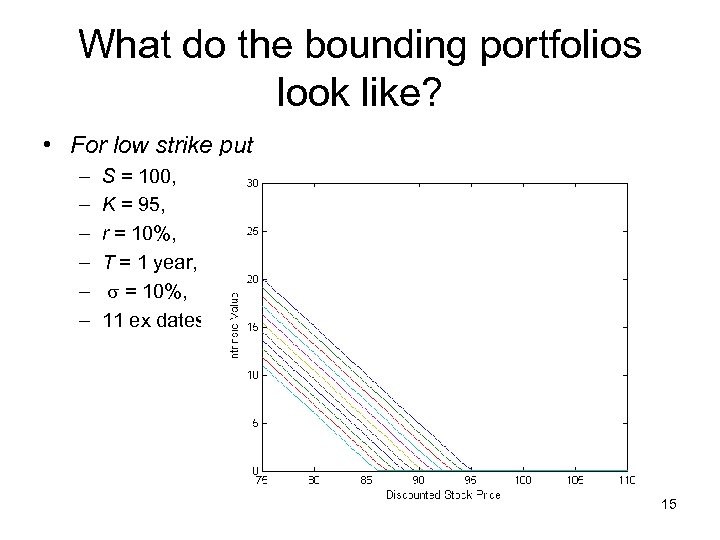
What do the bounding portfolios look like? • For low strike put – – – S = 100, K = 95, r = 10%, T = 1 year, s = 10%, 11 ex dates 15
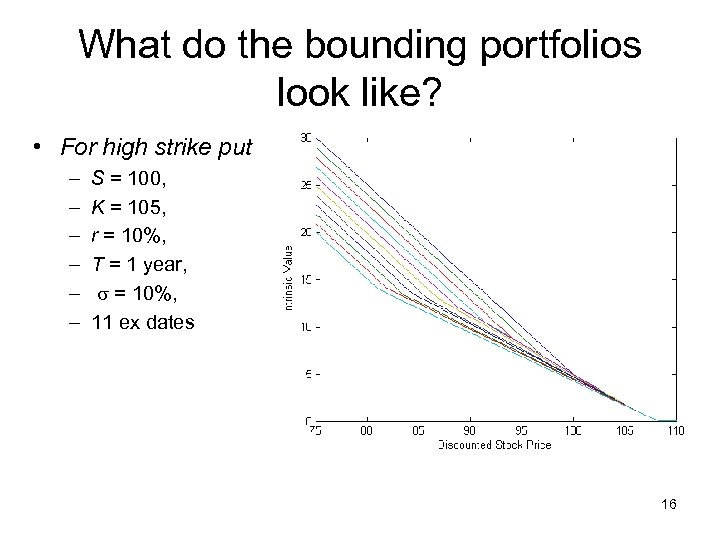
What do the bounding portfolios look like? • For high strike put – – – S = 100, K = 105, r = 10%, T = 1 year, s = 10%, 11 ex dates 16
Nature of the hedging strategy that enforces rational bounds 1. 2. 3. 4. Write the American option at time 0 Buy the dominating European portfolio Do nothing until option is exercised Then delta hedge European portfolio to release intrinsic value but step 4 is not necessary – if European options are traded can liquidate portfolio provided they trade at least at intrinsic value – then you have a static hedging strategy How well does it work? 17
The Horse Race • Take a “true” returns generating model – all options are priced according to the true model – American option is exercised optimally – one bank writes an American option at fair value, buys the European option and liquidates at exercise/expiry – other bank does same but hedges dynamically using incorrect model • Race outcome depends on – how incorrect the model of the dynamic trader – how much weight we put on extreme losses 18
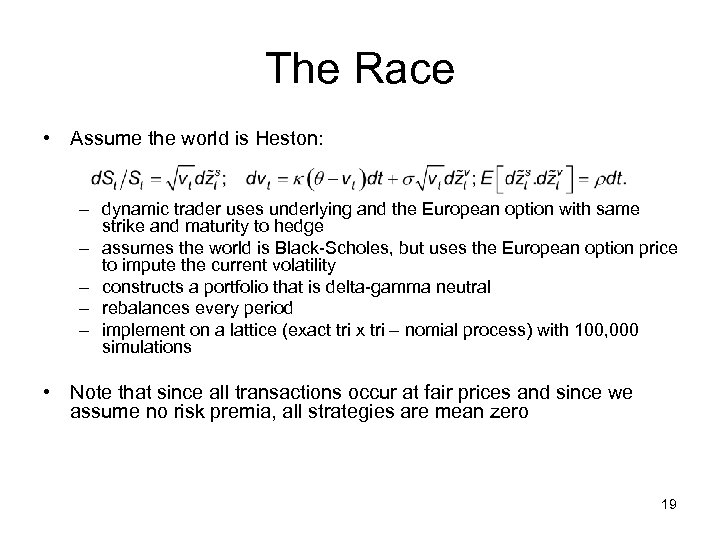
The Race • Assume the world is Heston: – dynamic trader uses underlying and the European option with same strike and maturity to hedge – assumes the world is Black-Scholes, but uses the European option price to impute the current volatility – constructs a portfolio that is delta-gamma neutral – rebalances every period – implement on a lattice (exact tri x tri – nomial process) with 100, 000 simulations • Note that since all transactions occur at fair prices and since we assume no risk premia, all strategies are mean zero 19
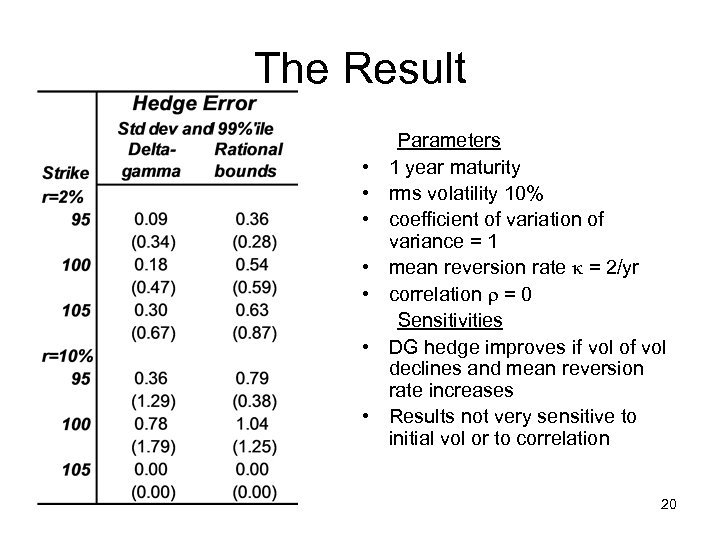
The Result • • Parameters 1 year maturity rms volatility 10% coefficient of variation of variance = 1 mean reversion rate k = 2/yr correlation r = 0 Sensitivities DG hedge improves if vol of vol declines and mean reversion rate increases Results not very sensitive to initial vol or to correlation 20
Tightening the bounds • Allowing for option to trade on intrinsic is pessimistic • Implied volatility is volatile, but does not go to zero • Suppose we put a floor on implied volatility … 21
A volatility floor • Consider an “instantaneous volatility contract” (IVC) – buy it at time t – pays $1 if price next period is different from price today – price of contract is implied jump probability • Assume a permanent floor on the price of IVC – implies a minimum level of implied volatility for all options – means trader can sell IVCs against her portfolio – easy to incorporate this constraint in LP 22
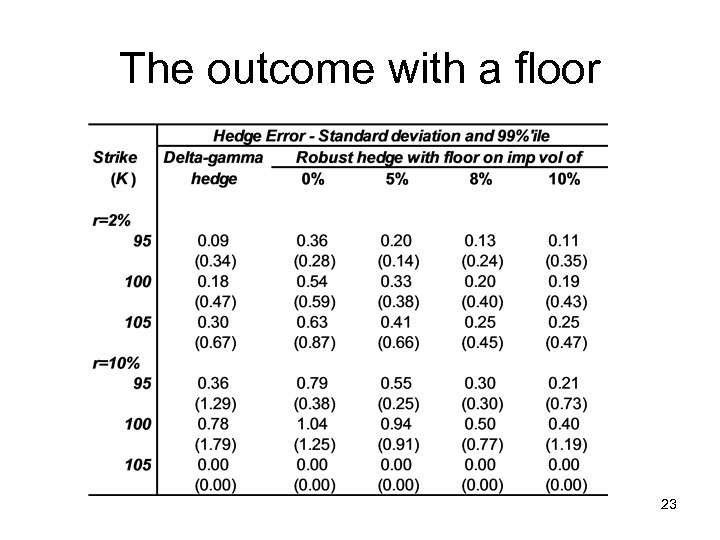
The outcome with a floor 23
Conclusions from Horse race • Rational bounds hedge generally has larger standard error, but lower VAR than delta-gamma hedge • Floor on implied volatility greatly reduces standard error and VAR, and retains substantial robustness • Conclusions depend on how far true process departs from assumed model • Robust hedges are not only robust but involve no intermediate trading 24
Conclusions • Demonstrated how to find rational bounds on the value of an American option, and also robust hedges • For reasonable parameters, possible value of being American several times the value assuming a Markov diffusion • Have characterized the processes that lead to extreme high values – great uncertainty over future volatility • Rational bounds allow for possibility of implausibly low volatilities – can tighten bounds and get better robust hedging strategies through restrictions on implied volatility – appear to have considerable advantages over conventional dynamic strategies when true process unknown • General approach can be applied to other hedging problems 25
Скачать презентацию BOUNDS AND ROBUST HEDGING OF THE AMERICAN OPTION
af229e03fbdca4ad8ad42be90459354f.ppt