 Скачать презентацию Boundary-Value and Eigenvalue Problems Chapter 27 An
9c8bb12894e89d73f3fe1ecc99b967d1.ppt
- Количество слайдов: 12



Boundary-Value and Eigenvalue Problems Chapter 27 • An ODE is accompanied by auxiliary conditions. These conditions are used to evaluate the integral that result during the solution of the equation. An nth order equation requires n conditions. • If all conditions are specified at the same value of the independent variable, then we have an initial-value problem. • If the conditions are specified at different values of the independent variable, usually at extreme points or boundaries of a system, then we have a boundary-value problem. by Lale Yurttas, Texas Chapter 27 A&M University Copyright © 2006 The Mc. Graw-Hill Companies, Inc. Permission required for reproduction or display. 1
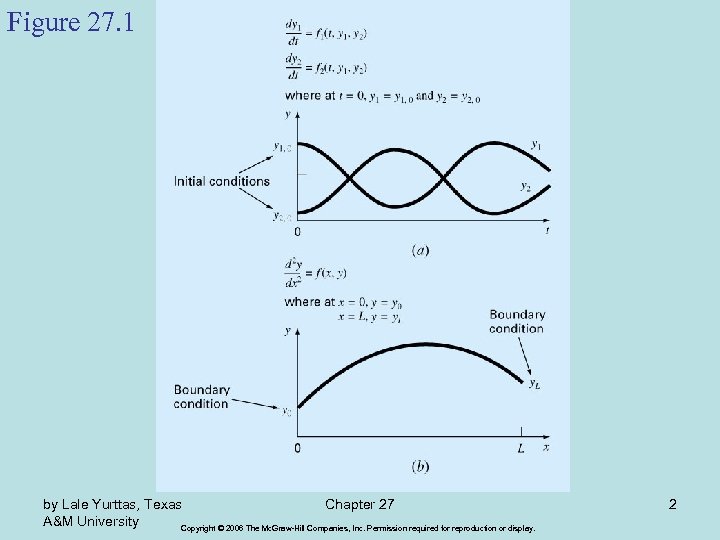
Figure 27. 1 by Lale Yurttas, Texas Chapter 27 A&M University Copyright © 2006 The Mc. Graw-Hill Companies, Inc. Permission required for reproduction or display. 2
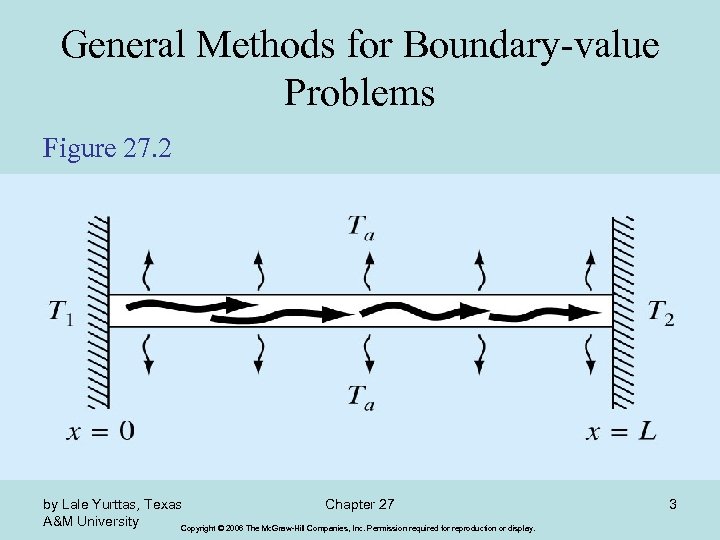
General Methods for Boundary-value Problems Figure 27. 2 by Lale Yurttas, Texas Chapter 27 A&M University Copyright © 2006 The Mc. Graw-Hill Companies, Inc. Permission required for reproduction or display. 3
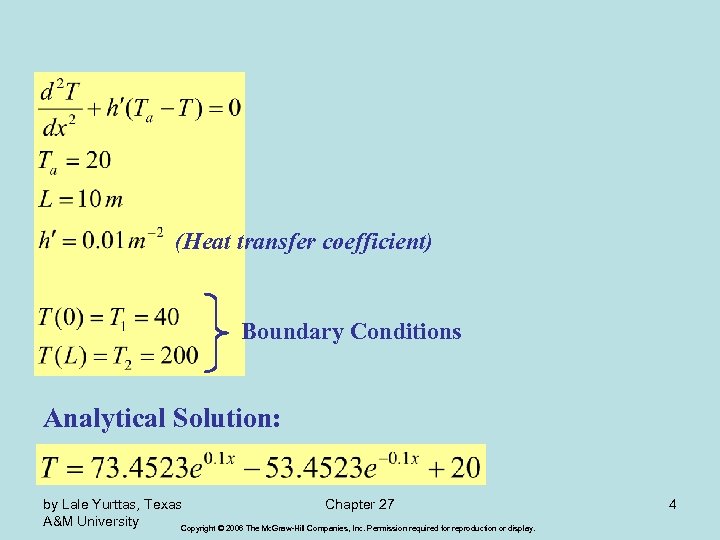
(Heat transfer coefficient) Boundary Conditions Analytical Solution: by Lale Yurttas, Texas Chapter 27 A&M University Copyright © 2006 The Mc. Graw-Hill Companies, Inc. Permission required for reproduction or display. 4
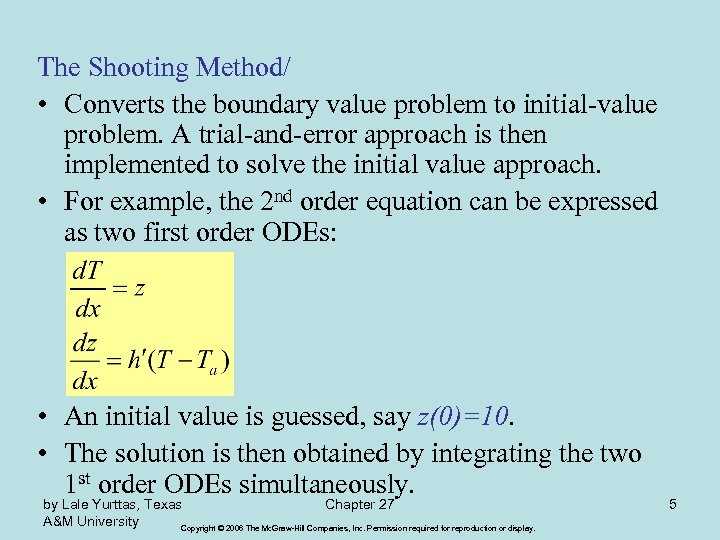
The Shooting Method/ • Converts the boundary value problem to initial-value problem. A trial-and-error approach is then implemented to solve the initial value approach. • For example, the 2 nd order equation can be expressed as two first order ODEs: • An initial value is guessed, say z(0)=10. • The solution is then obtained by integrating the two 1 st order ODEs simultaneously. by Lale Yurttas, Texas Chapter 27 A&M University Copyright © 2006 The Mc. Graw-Hill Companies, Inc. Permission required for reproduction or display. 5
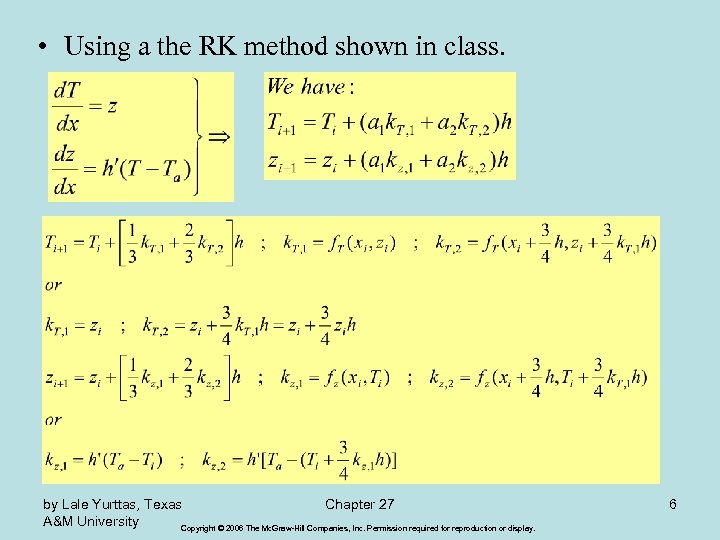
• Using a the RK method shown in class. by Lale Yurttas, Texas Chapter 27 A&M University Copyright © 2006 The Mc. Graw-Hill Companies, Inc. Permission required for reproduction or display. 6
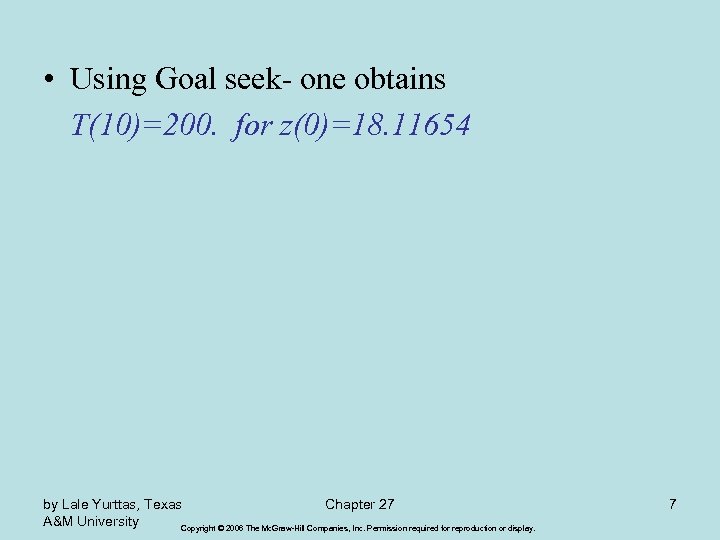
• Using Goal seek- one obtains T(10)=200. for z(0)=18. 11654 by Lale Yurttas, Texas Chapter 27 A&M University Copyright © 2006 The Mc. Graw-Hill Companies, Inc. Permission required for reproduction or display. 7
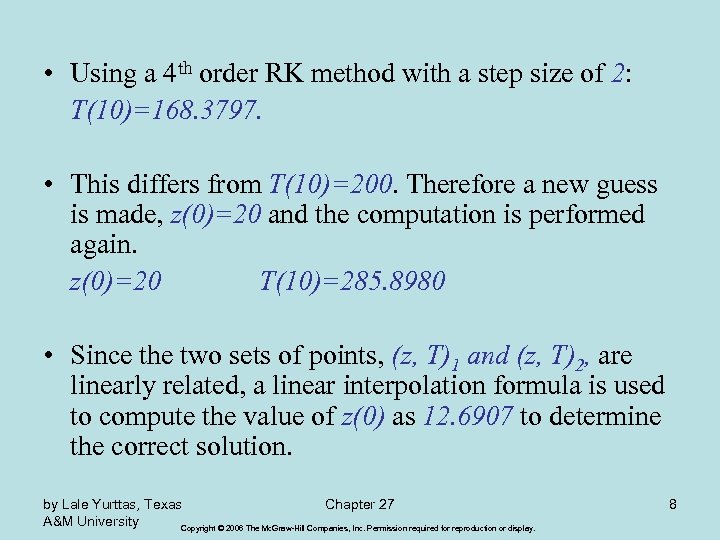
• Using a 4 th order RK method with a step size of 2: T(10)=168. 3797. • This differs from T(10)=200. Therefore a new guess is made, z(0)=20 and the computation is performed again. z(0)=20 T(10)=285. 8980 • Since the two sets of points, (z, T)1 and (z, T)2, are linearly related, a linear interpolation formula is used to compute the value of z(0) as 12. 6907 to determine the correct solution. by Lale Yurttas, Texas Chapter 27 A&M University Copyright © 2006 The Mc. Graw-Hill Companies, Inc. Permission required for reproduction or display. 8
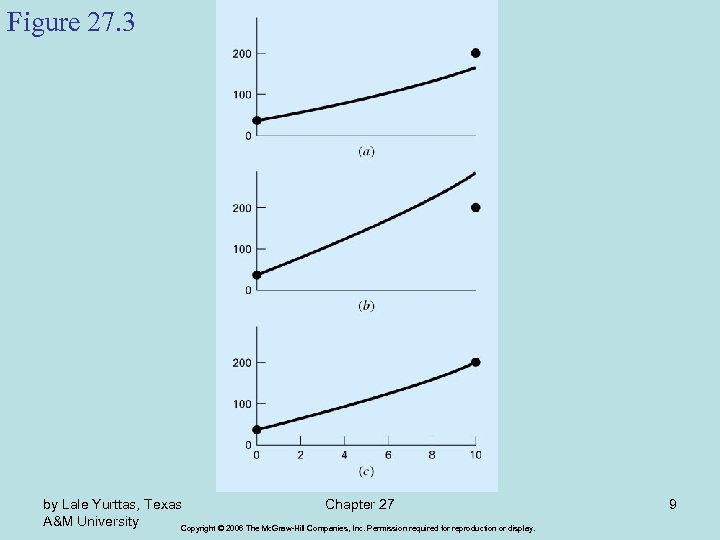
Figure 27. 3 by Lale Yurttas, Texas Chapter 27 A&M University Copyright © 2006 The Mc. Graw-Hill Companies, Inc. Permission required for reproduction or display. 9
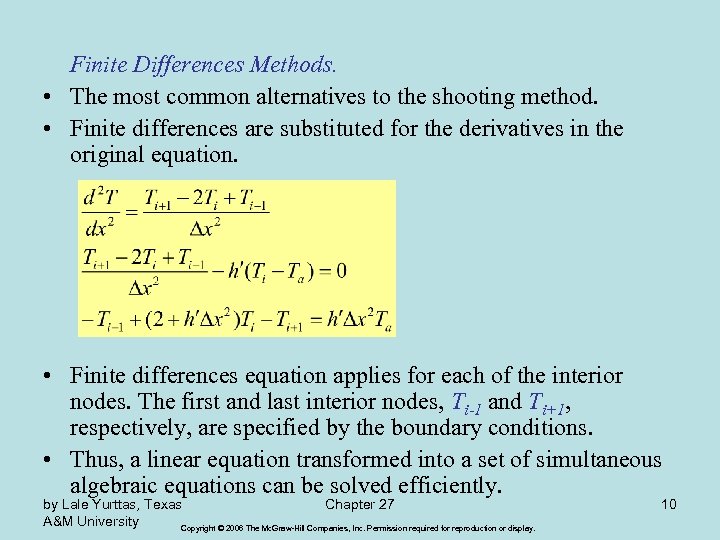
Finite Differences Methods. • The most common alternatives to the shooting method. • Finite differences are substituted for the derivatives in the original equation. • Finite differences equation applies for each of the interior nodes. The first and last interior nodes, Ti-1 and Ti+1, respectively, are specified by the boundary conditions. • Thus, a linear equation transformed into a set of simultaneous algebraic equations can be solved efficiently. by Lale Yurttas, Texas Chapter 27 A&M University Copyright © 2006 The Mc. Graw-Hill Companies, Inc. Permission required for reproduction or display. 10
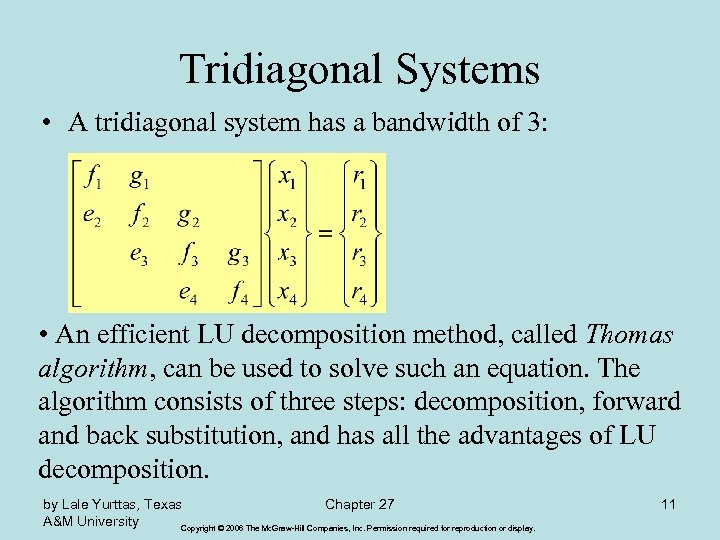
Tridiagonal Systems • A tridiagonal system has a bandwidth of 3: • An efficient LU decomposition method, called Thomas algorithm, can be used to solve such an equation. The algorithm consists of three steps: decomposition, forward and back substitution, and has all the advantages of LU decomposition. by Lale Yurttas, Texas Chapter 27 A&M University Copyright © 2006 The Mc. Graw-Hill Companies, Inc. Permission required for reproduction or display. 11
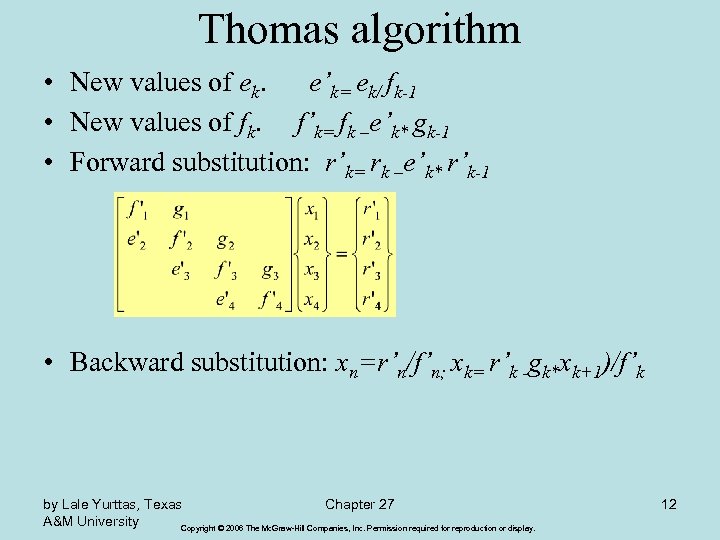
Thomas algorithm • New values of ek. e’k= ek/ fk-1 • New values of fk. f’k= fk –e’k* gk-1 • Forward substitution: r’k= rk –e’k* r’k-1 • Backward substitution: xn=r’n/f’n; xk= r’k -gk*xk+1)/f’k by Lale Yurttas, Texas Chapter 27 A&M University Copyright © 2006 The Mc. Graw-Hill Companies, Inc. Permission required for reproduction or display. 12
Скачать презентацию Boundary-Value and Eigenvalue Problems Chapter 27 An
9c8bb12894e89d73f3fe1ecc99b967d1.ppt