 Скачать презентацию Bottleneck Routing Games in Communication Networks Ron Banner
d027e0e04221efb5a1bd4d4c850ab7e2.ppt
- Количество слайдов: 26




Bottleneck Routing Games in Communication Networks Ron Banner and Ariel Orda Department of Electrical Engineering Technion- Israel Institute of Technology
Selfish Routing u Often (e. g. , large-scale networks, ad hoc networks) users pick their own routes. · No central authority. u Network users are selfish. · Do not care about social welfare. · Want to optimize their own performance. u Major Question: how much does the network performance suffer from the lack of global regulation?
Selfish Routing: Quantifying the Inefficiency u. A flow is at Nash Equilibrium if no user can improve its performance. · May not exist. · May not be unique. u The price of anarchy: The worst-case ratio between the performance of a Nash equilibrium and the optimal performance. u The price of stability: The worst-case ratio between the performance of a best Nash equilibrium and the optimal performance.
Cost structures of flows Additive Metrics (path performance= sum of link performances) · E. g. , Delay, Jitter, Loss Probability. · Considerable amount of work on related routing games: [Orda, Rom & Shimkin, 1992]; [Korilis, Lazar & Orda, 1995]; [Roughgarden & Tardos, 2001]; [Altman, Basar, Jimenez & Shimkin, 2002]; [Kameda, 2002]; [La & Anantharam, 2002]; [Roughgarden, 2005]; [Awerbuch, Azar & Epstein, 2005]; [Even-Dar & Mansour, 2005]; … u Bottleneck Metrics (path performance = worst performance of a link on a path). · No previous studies in the context of networking games!
Bottleneck Routing Games (examples) u Wireless Networks: u Traffic bursts: u Traffic Engineering: · Each user maximizes the smallest battery lifetime along its routing topology. · Each user maximizes the smallest residual capacity of the links they employ. · Each user minimizes the utilization of the most utilized buffer § Avoids deadlocks and packet loss. · Each user minimizes the utilization of the most utilized link. § Avoids hot spots. u Attacks: · usually aimed against the links or nodes that carry the largest amount of traffic. · Each user minimizes the maximum amount of traffic that a link transfers in its routing topology.
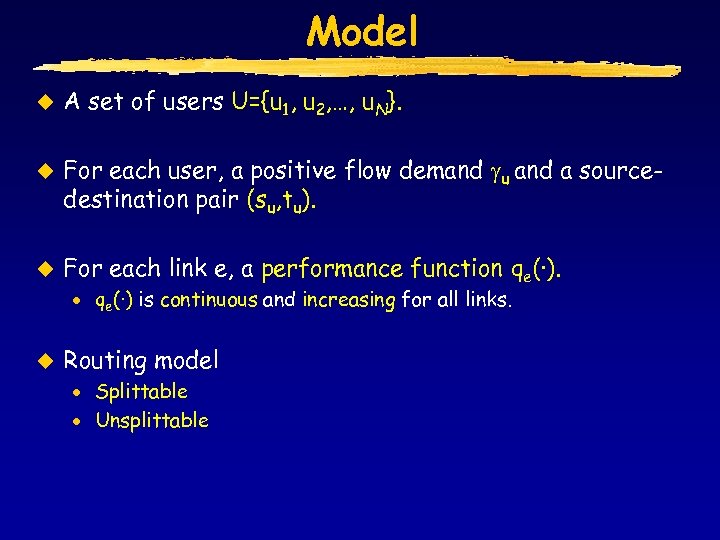
Model u A set of users U={u 1, u 2, …, u. N}. u For each user, a positive flow demand u and a sourcedestination pair (su, tu). u For each link e, a performance function qe(∙). · qe(∙) is continuous and increasing for all links. u Routing model · Splittable · Unsplittable
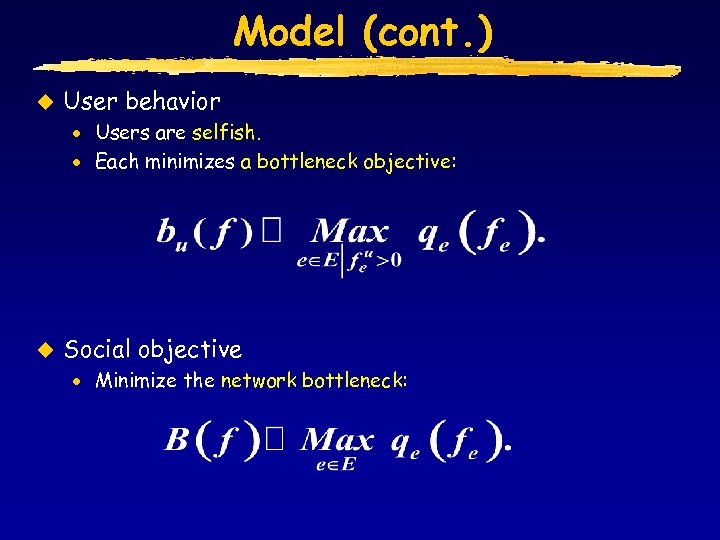
Model (cont. ) u User behavior · Users are selfish. · Each minimizes a bottleneck objective: u Social objective · Minimize the network bottleneck:
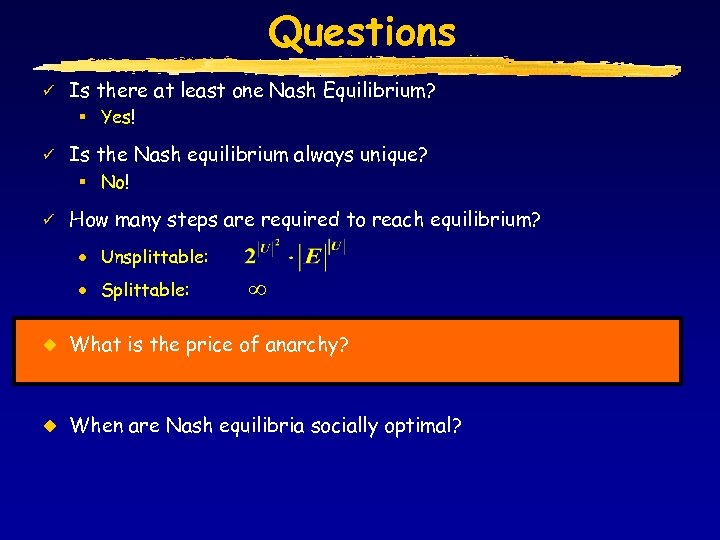
Questions u Is there at least one Nash Equilibrium? u Is the Nash equilibrium always unique? u How many steps are required to reach equilibrium? u What is the price of anarchy? u When are Nash equilibria socially optimal?
Existence of Nash Equilibrium u Theorem: An Unsplittable Bottleneck Game admits a Nash equilibrium · Very simple proof. u Theorem: A Splittable Bottleneck Game admits a Nash Equilibrium. · Complex proof. § Splittable bottleneck games are discontinuous! • why § Hence, standard proof techniques cannot be employed!

Questions ü Is there at least one Nash Equilibrium? § Yes! u Is the Nash equilibrium unique? u How many steps are required to reach equilibrium? u What is the price of anarchy? u When are Nash equilibria socially optimal?
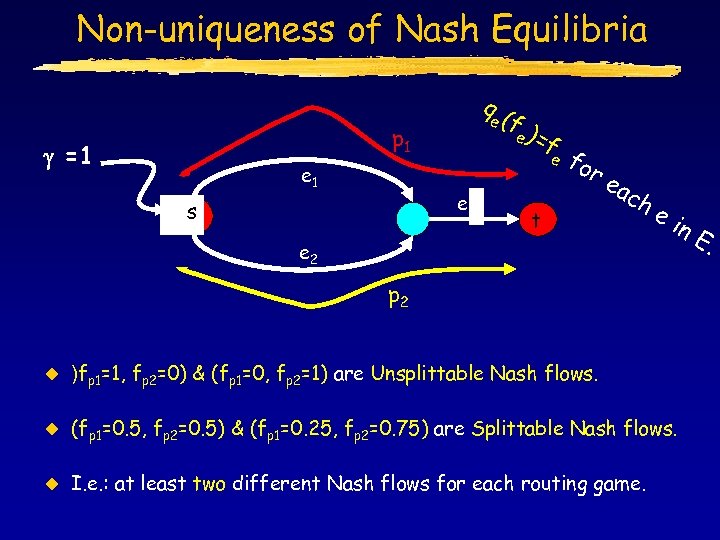
Non-uniqueness of Nash Equilibria qe ( fe ) p 1 g =1 e 3 s =f e fo re t ac he e 2 in p 2 u )fp 1=1, fp 2=0) & (fp 1=0, fp 2=1) are Unsplittable Nash flows. u (fp 1=0. 5, fp 2=0. 5) & (fp 1=0. 25, fp 2=0. 75) are Splittable Nash flows. u I. e. : at least two different Nash flows for each routing game. E.
Questions ü Is there at least one Nash Equilibrium? § Yes! ü Is the Nash equilibrium always unique? § No! u How many steps are required to reach equilibrium? u What is the price of anarchy? u When are Nash equilibria socially optimal?
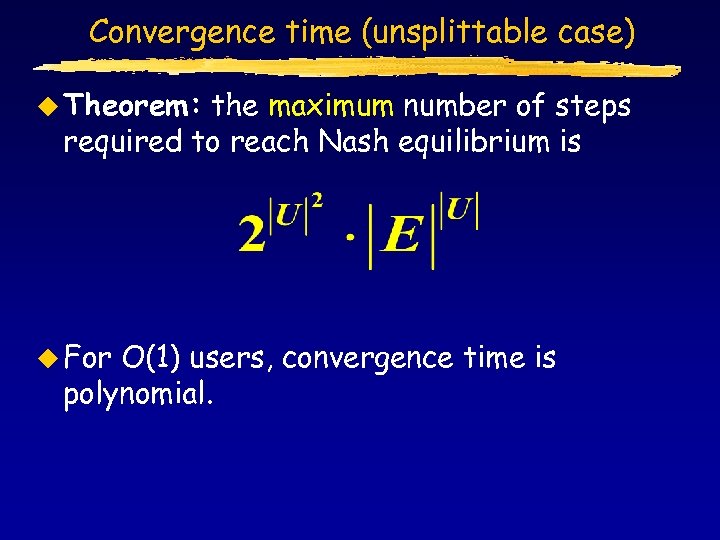
Convergence time (unsplittable case) u Theorem: the maximum number of steps required to reach Nash equilibrium is u For O(1) users, convergence time is polynomial.
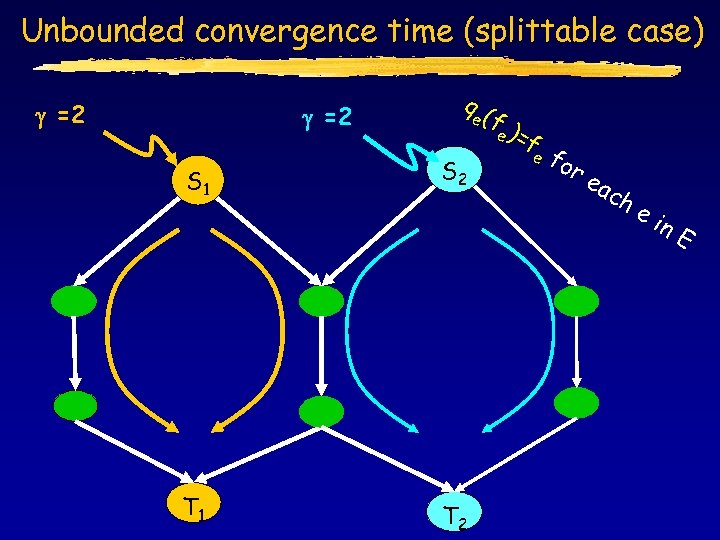
Unbounded convergence time (splittable case) g =2 S 1 T 1 qe ( fe ) S 2 T 2 =f e fo re ac he in E
Questions ü Is there at least one Nash Equilibrium? § Yes! ü Is the Nash equilibrium always unique? § No! ü How many steps are required to reach equilibrium? · Unsplittable: · Splittable: ∞ u What is the price of anarchy? u When are Nash equilibria socially optimal?
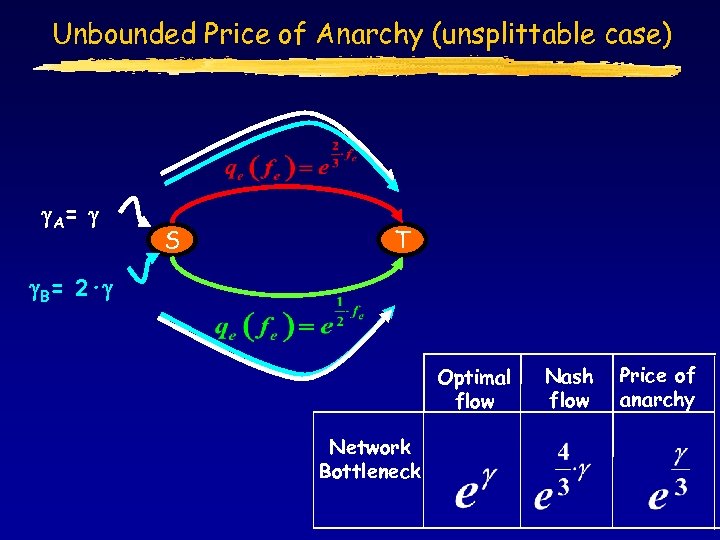
Unbounded Price of Anarchy (unsplittable case) g. A = g S T g. B= 2∙g Optimal flow Network Bottleneck Nash flow Price of anarchy
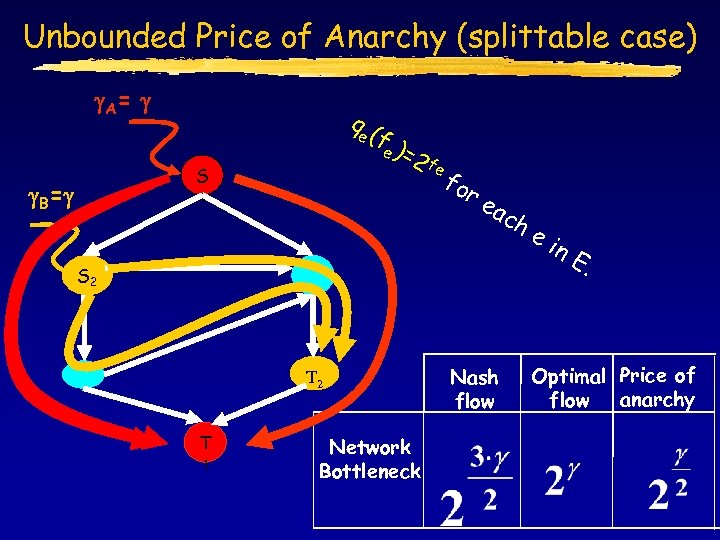
Unbounded Price of Anarchy (splittable case) g. A = g qe ( S g. B=g fe ) =2 f 1 e fo re ac S 2 T 1 Network Bottleneck Nash flow he in E. Optimal Price of anarchy flow
Questions ü Is there at least one Nash Equilibrium? § Yes! ü Is the Nash equilibrium always unique? § No! ü How many steps are required to reach equilibrium? · Unsplittable: · Splittable: ü ∞ What is the price of anarchy? § ∞ u When are Nash equilibria socially optimal?
Optimal Nash Equilibria (unsplittable case) u Theorem: u Good The price of stability is 1. news · Selfish users can agree upon an optimal solution. · Such solutions can be proposed to all users by some centralized protocol. u Bad news · We prove that finding such an optimal Nash equilibrium is NP-hard.
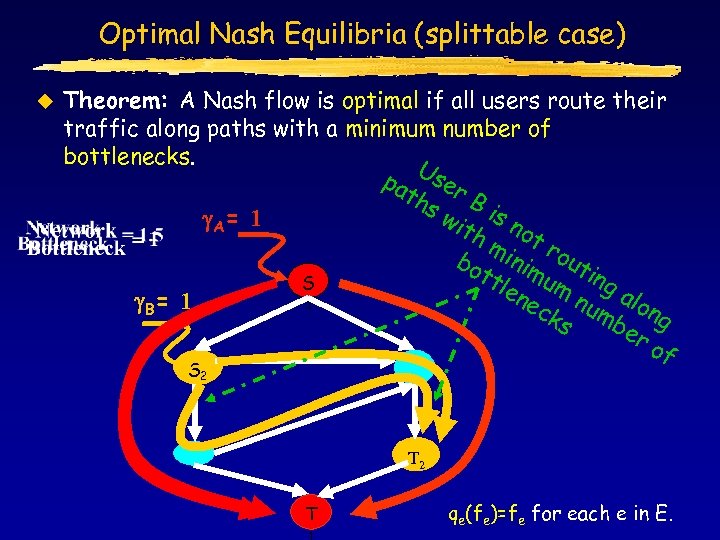
Optimal Nash Equilibria (splittable case) u Theorem: A Nash flow is optimal if all users route their traffic along paths with a minimum number of bottlenecks. U pa ser th s w B is g. A = 1 ith no mi t ro bo nim ut ttl um ing S en g. B = 1 1 ec num alon ks be g ro f S 2 T qe(fe)=fe for each e in E.
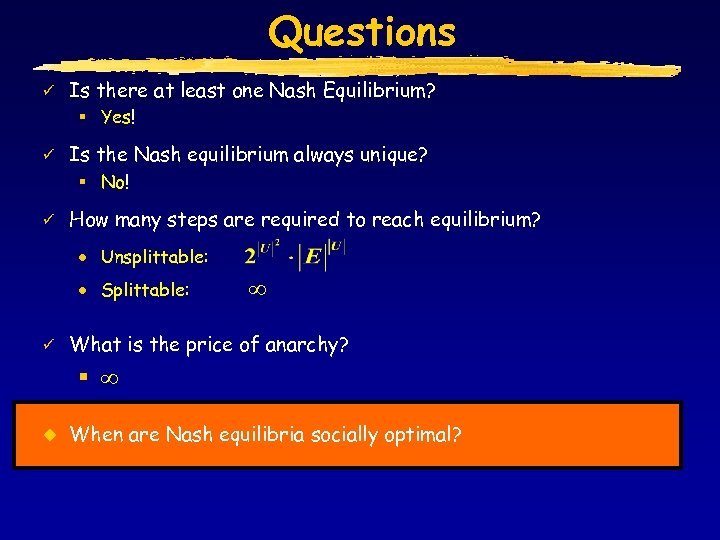
Questions ü Is there at least one Nash Equilibrium? § Yes! ü Is the Nash equilibrium always unique? § No! ü How many steps are required to reach equilibrium? · Unsplittable: · Splittable: ü ∞ What is the price of anarchy? § ∞ ü When Nash equilibriums are socially optimal? § Unsplittable: each best Nash equilibrium (though NP-hard to find). § Splittable: each Nash equilibrium with users that exclusively route over paths with a minimum number of bottlenecks.

Some more results… u Unsplittable: qe(x)=xp link performance functions of · Price of anarchy is O(|E|p). · This result is tight! u Splittable: Nash equilibrium with users that exclusively route over paths with minimum number of bottlenecks. · The average performance (across all links) is |E| times larger than the minimum value. · This result is tight!
Conclusions u Bottleneck scenarios. games emerge in many practical · (yet, they haven't been considered before). u. A Nash equilibrium in a bottleneck game: · Always exists · Can be reached in finite time with unsplittable flows · Might be very inefficient.
Conclusions (cont. ) u BUT, by proper design, Nash equilibria can be optimal! · Unsplittable: any best equilibrium. · Splittable: any equilibrium with users that route over paths with minimum number of bottlenecks. u With these findings, it is possible to optimize overall network performance. · Steer users to choose particular Nash equilibria. § Unsplittable: propose a stable solutions to all users. § Splittable: provide incentives (e. g. , pricing) for minimizing the number of bottlenecks.

Questions?
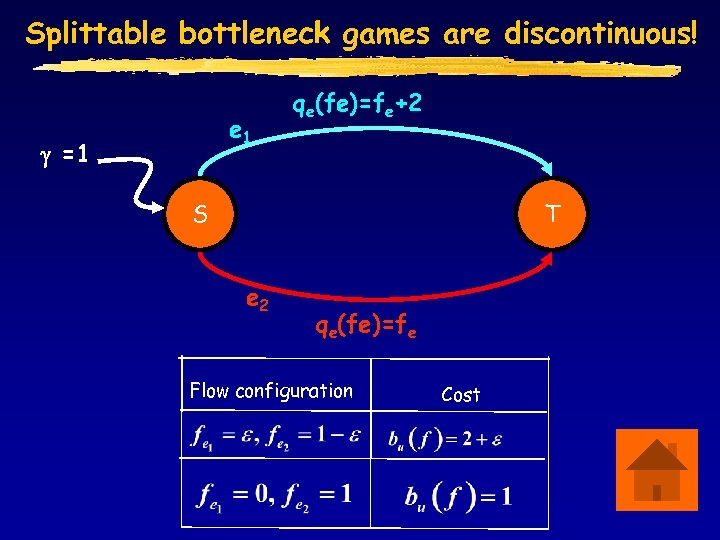
Splittable bottleneck games are discontinuous! e 1 g =1 qe(fe)=fe+2 S T e 2 qe(fe)=fe Flow configuration Cost
Скачать презентацию Bottleneck Routing Games in Communication Networks Ron Banner
d027e0e04221efb5a1bd4d4c850ab7e2.ppt