 Скачать презентацию Boston University Slideshow Title Goes Here Achieving Energy
1ff4238b70bd836b02b68449cdfad7f5.ppt
- Количество слайдов: 40



Boston University Slideshow Title Goes Here Achieving Energy Efficiency in Buildings Michael Gevelber, Associate Professor Mechanical Engineering Co-chair, BU Energy Committee Member, BU Sustainability Committee gevelber@bu. edu • Results of BU Energy Audit Course • Overview of US Building Energy Use • Achieving Energy Efficiencies in Commercial Buildings • Residential: Perform your own energy audit
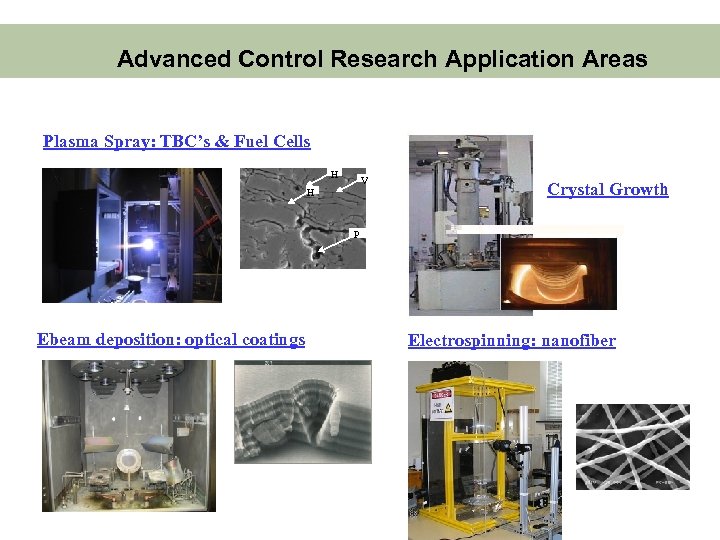
Advanced Control Research Application Areas Boston University Slideshow Title Goes Here Plasma Spray: TBC’s & Fuel Cells H V H Crystal Growth P Ebeam deposition: optical coatings Electrospinning: nanofiber
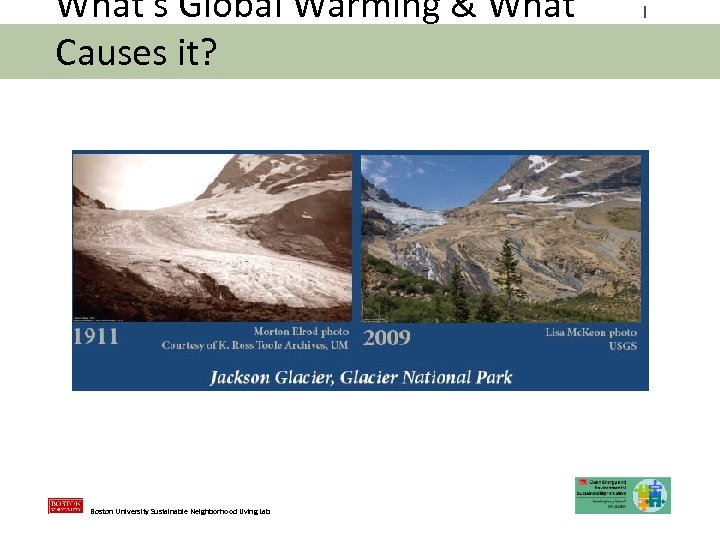
What’s Global Warming & What Causes it? Boston University Slideshow Title Goes Here Boston University Sustainable Neighborhood Living Lab
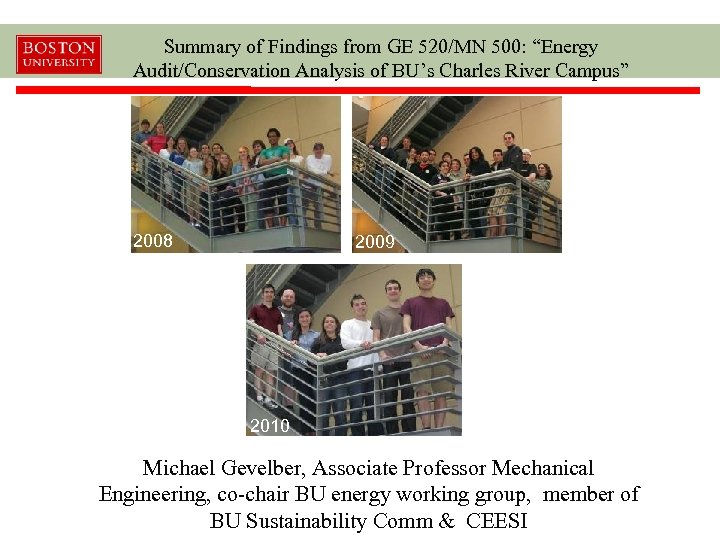
Summary of Findings from GE 520/MN 500: “Energy Audit/Conservation Analysis of BU’s Charles River Campus” Boston University Slideshow Title Goes Here 2008 2009 2010 Michael Gevelber, Associate Professor Mechanical Engineering, co-chair BU energy working group, member of BU Sustainability Comm & CEESI
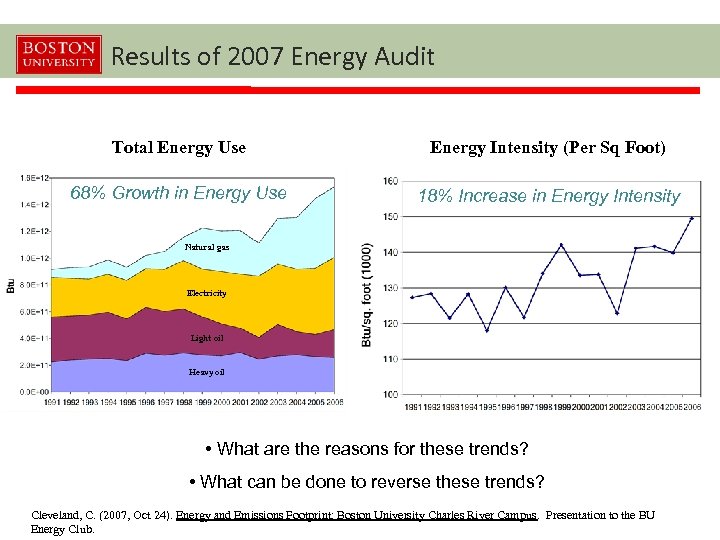
Results of 2007 Energy Audit Boston University Slideshow Title Goes Here Total Energy Use Energy Intensity (Per Sq Foot) 68% Growth in Energy Use 18% Increase in Energy Intensity Natural gas Electricity Light oil Heavy oil • What are the reasons for these trends? • What can be done to reverse these trends? Cleveland, C. (2007, Oct 24). Energy and Emissions Footprint: Boston University Charles River Campus. Presentation to the BU Energy Club.
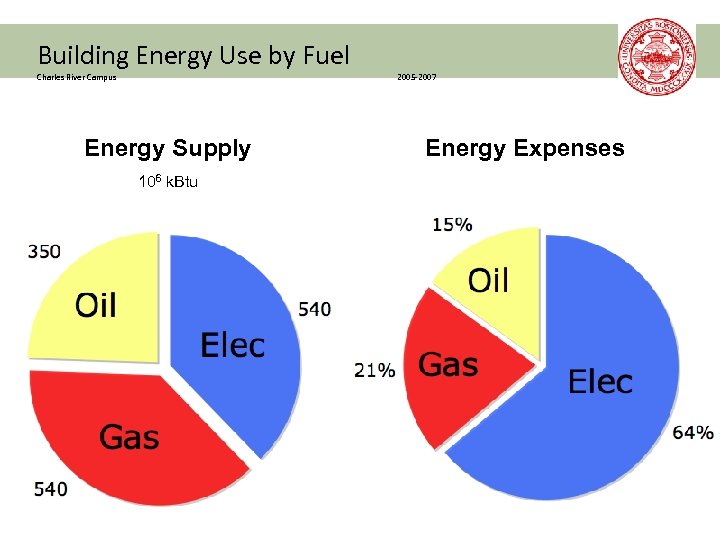
Building Energy Use by Fuel Charles River Campus Boston University Slideshow Title Goes Here Energy Supply 106 k. Btu 2005 -2007 Energy Expenses

Boston University Slideshow Title Goes Here Overview of US Building Energy Use
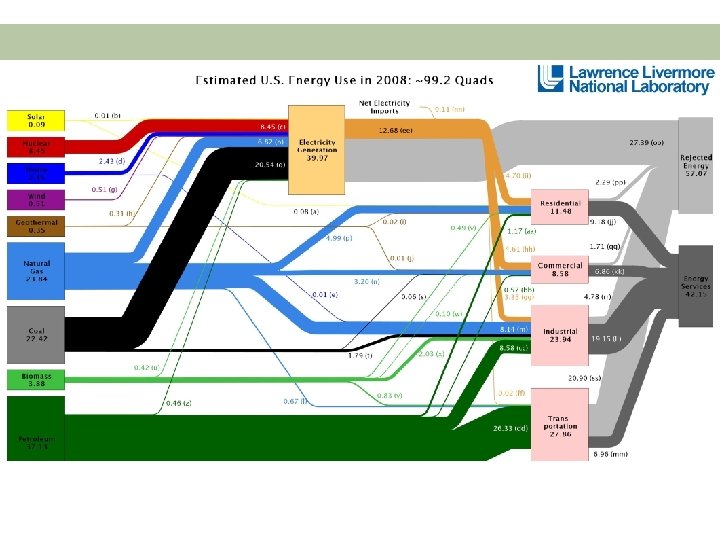
Boston University Slideshow Title Goes Here
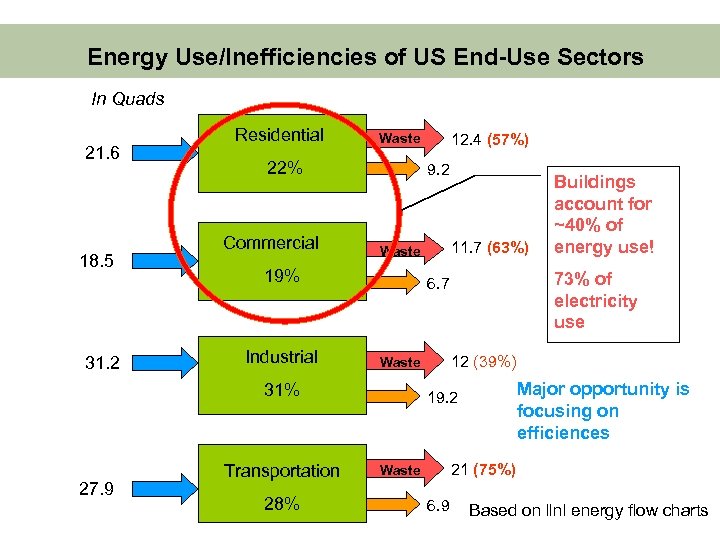
Energy Use/Inefficiencies of US End-Use Sectors In Quads Boston University Slideshow Title Goes Here 21. 6 18. 5 31. 2 Residential Waste 22% Commercial 9. 2 27. 9 28% Buildings account for ~40% of energy use! 73% of electricity use 6. 7 12 (39%) Waste 31% Transportation 11. 7 (63%) Waste 19% Industrial 12. 4 (57%) Major opportunity is focusing on efficiences 19. 2 21 (75%) Waste 6. 9 Based on llnl energy flow charts
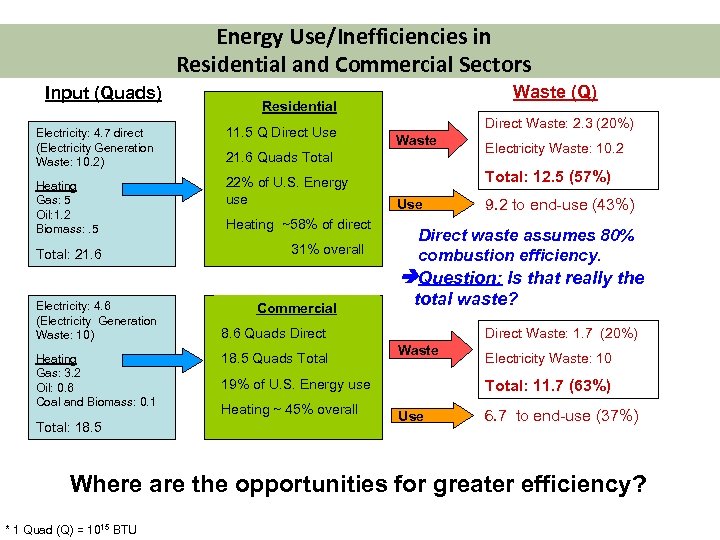
Energy Use/Inefficiencies in Residential and Commercial Sectors Input (Quads) Waste (Q) Residential Boston University 11. 5 Q Direct Use Electricity: 4. 7 direct Slideshow Title Goes Here (Electricity Generation 21. 6 Quads Total Waste: 10. 2) Heating Gas: 5 Oil: 1. 2 Biomass: . 5 22% of U. S. Energy use Total: 21. 6 31% overall Heating ~58% of direct Direct Waste: 2. 3 (20%) Waste Electricity Waste: 10. 2 Total: 12. 5 (57%) Use 9. 2 to end-use (43%) Direct waste assumes 80% combustion efficiency. Question: Is that really the Electricity: 4. 6 (Electricity Generation Waste: 10) Heating Gas: 3. 2 Oil: 0. 6 Coal and Biomass: 0. 1 Total: 18. 5 Commercial total waste? Direct Waste: 1. 7 (20%) 8. 6 Quads Direct 18. 5 Quads Total Waste 19% of U. S. Energy use Heating ~ 45% overall Electricity Waste: 10 Total: 11. 7 (63%) Use 6. 7 to end-use (37%) Where are the opportunities for greater efficiency? * 1 Quad (Q) = 1015 BTU

Energy Savings: Solving for the Hidden Costs of HVAC Achieving Energy Efficiency in Existing Commercial Buildings Boston University Slideshow Title Goes Here Our Focus: HVAC is 50 -70% of ALL energy used in mid/large size buildings Strategy: Reduce high air flow rates which were implemented when energy was cheap. Our Solution • Develop new tool to re-optimize HVAC control • This is not addressed by current tools • Based on real buildings, experience and data Funded by MA Clean Energy Center Professor Gevelber & Professor Wroblenski BU Mechanical Engineering
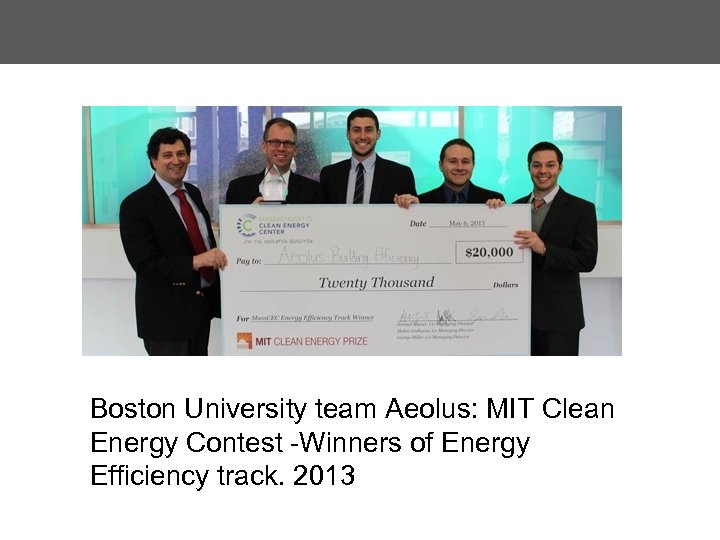
Boston University team Aeolus: MIT Clean Energy Contest -Winners of Energy Efficiency track. 2013 Boston University Sustainable Neighborhood Living Lab
Boston University Slideshow Title Goes Here Residential: Perform Your Own Energy Audit
How to Become an Energy Detective: Help save the world and make some money at the same time Prof. Michael Gevelber Michael Cannamela, Ph. D Candidate, Mechanical Engineering Boston University Sustainable Neighborhood Living Lab
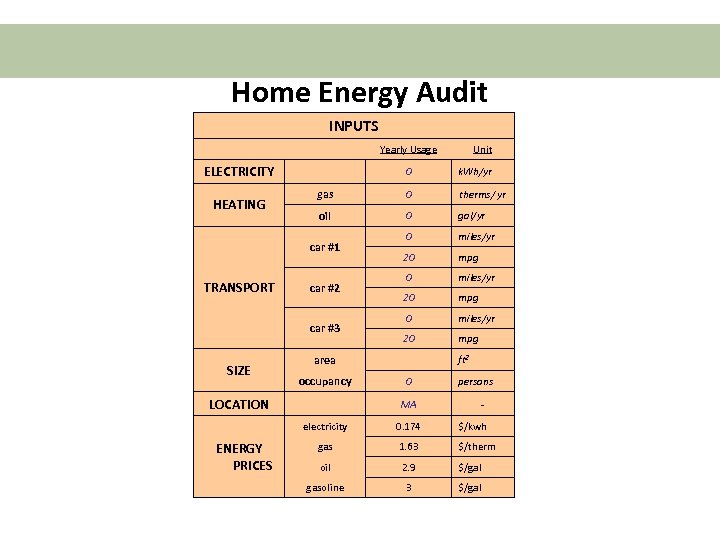
Home Energy Audit INPUTS Boston University Slideshow Title Goes Here k. Wh/yr 0 therms/ yr oil HEATING 0 gas ELECTRICITY Yearly Usage 0 gal/yr 0 miles/yr 20 mpg car #1 TRANSPORT car #2 car #3 area ft 2 occupancy SIZE LOCATION Unit 0 persons MA - electricity ENERGY PRICES 0. 174 $/kwh gas 1. 63 $/therm oil 2. 9 $/gal gasoline 3 $/gal
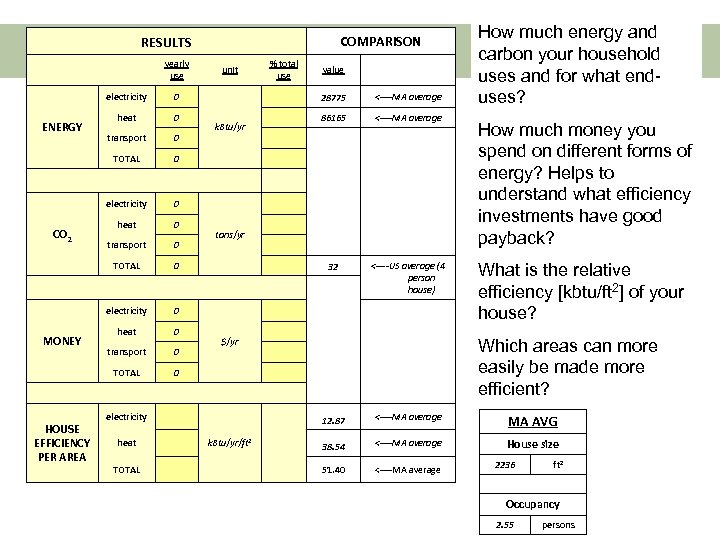
COMPARISON RESULTS yearly use unit % total use value electricity 0 28775 <----MA average heat 0 86165 <----MA average transport 0 TOTAL 0 electricity 0 heat 0 transport 0 TOTAL 0 electricity 0 heat 0 transport 0 TOTAL 0 k. Btu/yr ENERGY University Slideshow Title Goes Here Boston CO 2 MONEY HOUSE EFFICIENCY PER AREA tons/yr TOTAL $/yr electricity heat <----US average (4 person house) 32 How much energy and carbon your household uses and for what enduses? How much money you spend on different forms of energy? Helps to understand what efficiency investments have good payback? What is the relative efficiency [kbtu/ft 2] of your house? Which areas can more easily be made more efficient? 12. 87 k. Btu/yr/ft 2 <----MA average MA AVG 38. 54 <----MA average House size 51. 40 <----MA average 2236 ft 2 Occupancy 2. 55 persons
Boston University Slideshow Title Goes Here
Boston University Slideshow Title Goes Here
Why focus on energy: what problems does the US face? • Limited energy supply & global politics – U. S. is only 5% of world population but consumes 20% of world energy • Pollution and Green House Gas emissions • $ energy is getting more expensive
How do we know where to focus? • What major fuels/energy do we use – Electricity - fuel: combustion - oil -natural gas - gasoline • What are the major end-use applications – House - fuel - transportation - electricity
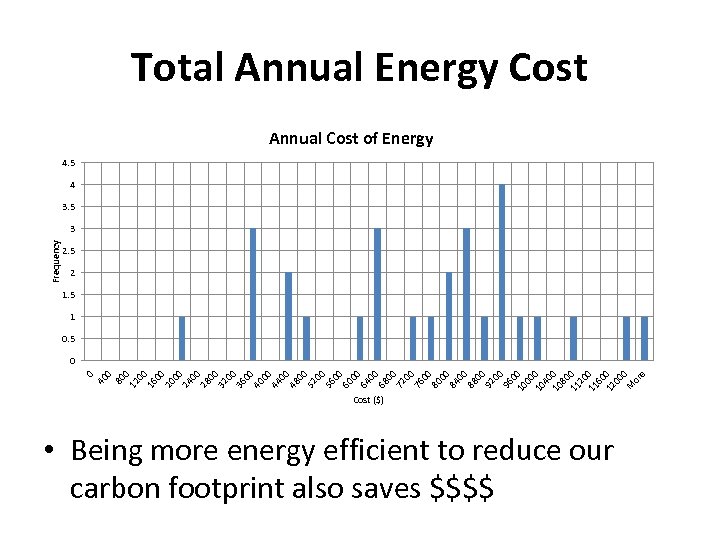
Total Annual Energy Cost Annual Cost of Energy 4. 5 4 3. 5 Frequency 3 2. 5 2 1. 5 1 0. 5 0 80 0 12 00 16 00 20 00 24 00 28 00 32 00 36 00 40 00 44 00 48 00 52 00 56 00 60 00 64 00 68 00 72 00 76 00 80 00 84 00 88 00 92 00 96 0 10 0 00 10 0 40 10 0 80 11 0 20 11 0 60 12 0 00 0 M or e 40 0 0 Cost ($) • Being more energy efficient to reduce our carbon footprint also saves $$$$
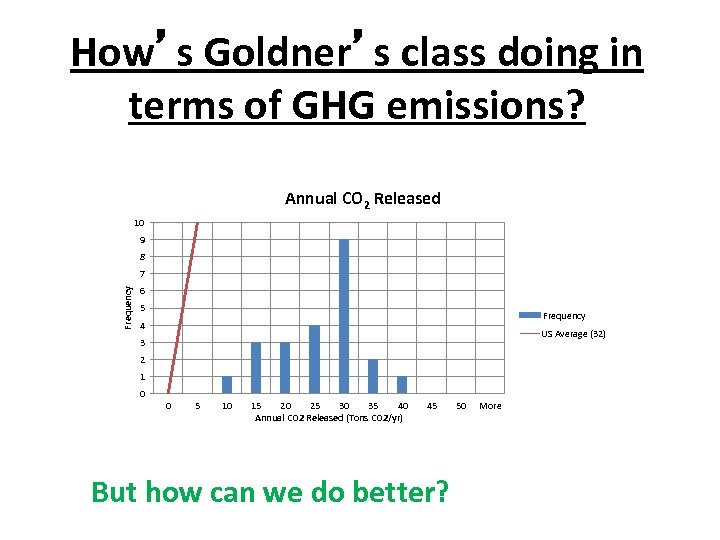
How’s Goldner’s class doing in terms of GHG emissions? Annual CO 2 Released 10 9 8 Frequency 7 6 5 Frequency 4 US Average (32) 3 2 1 0 0 5 10 15 20 25 30 35 40 Annual CO 2 Released (Tons CO 2/yr) 45 But how can we do better? 50 More
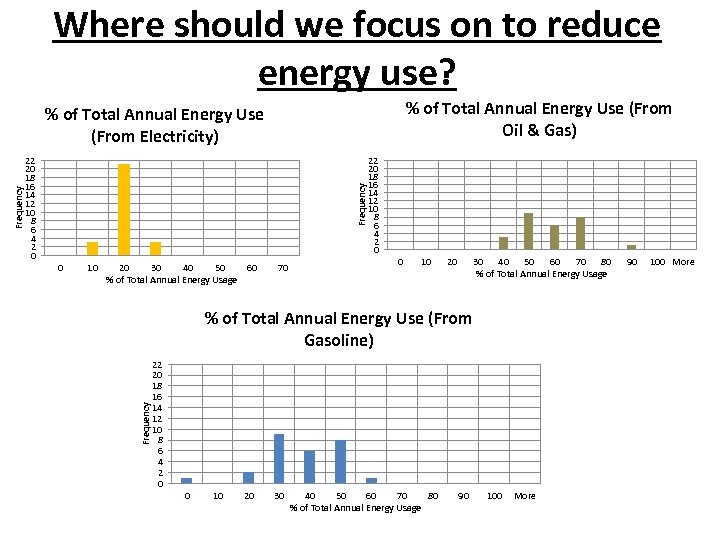
Where should we focus on to reduce energy use? % of Total Annual Energy Use (From Oil & Gas) Frequency 22 20 18 16 14 12 10 8 6 4 2 0 0 10 20 30 40 50 60 % of Total Annual Energy Usage 70 22 20 18 16 14 12 10 8 6 4 2 0 0 10 20 30 40 50 60 70 80 % of Total Annual Energy Usage % of Total Annual Energy Use (From Gasoline) Frequency % of Total Annual Energy Use (From Electricity) 22 20 18 16 14 12 10 8 6 4 2 0 0 10 20 30 40 50 60 70 80 % of Total Annual Energy Usage 90 100 More
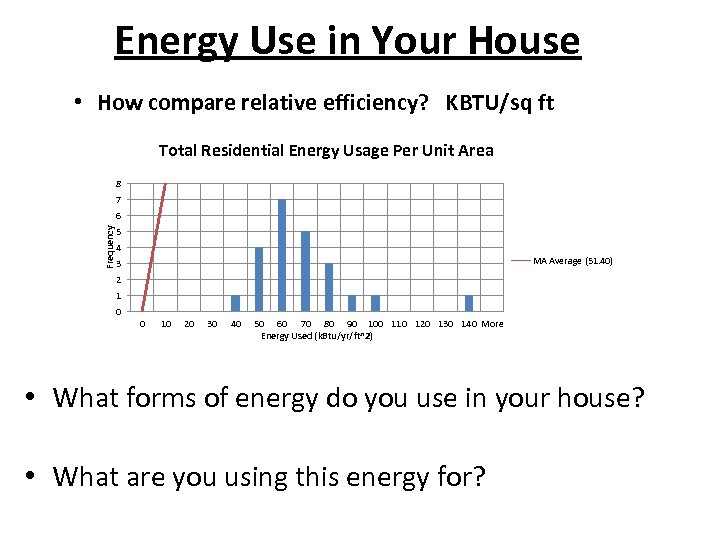
Energy Use in Your House • How compare relative efficiency? KBTU/sq ft Total Residential Energy Usage Per Unit Area 8 7 Frequency 6 5 4 MA Average (51. 40) 3 2 1 0 0 10 20 30 40 50 60 70 80 90 100 110 120 130 140 More Energy Used (k. Btu/yr/ft^2) • What forms of energy do you use in your house? • What are you using this energy for?
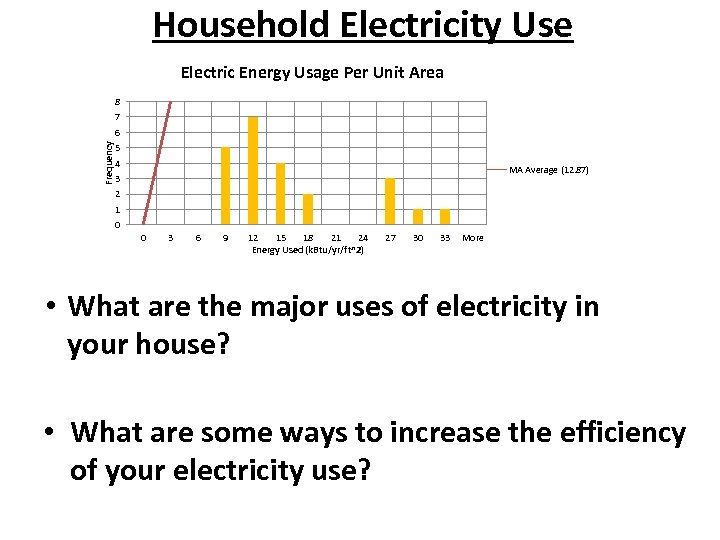
Household Electricity Use Electric Energy Usage Per Unit Area 8 7 Frequency 6 5 4 MA Average (12. 87) 3 2 1 0 0 3 6 9 12 15 18 21 24 Energy Used (k. Btu/yr/ft^2) 27 30 33 More • What are the major uses of electricity in your house? • What are some ways to increase the efficiency of your electricity use?
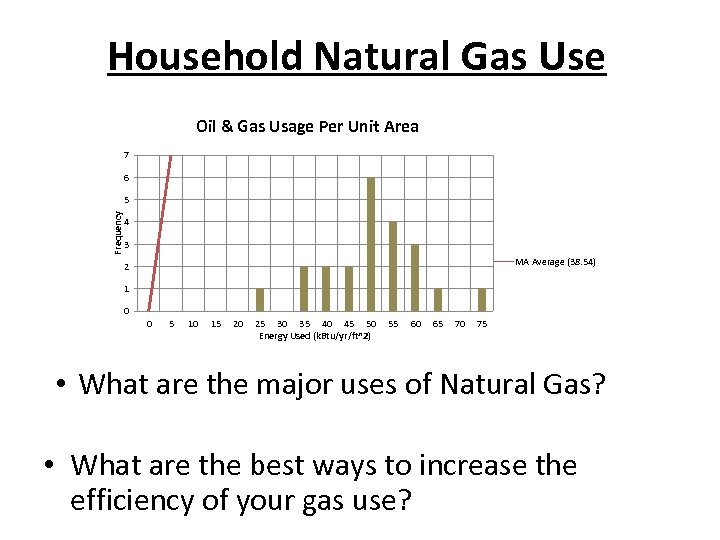
Household Natural Gas Use Oil & Gas Usage Per Unit Area 7 6 Frequency 5 4 3 MA Average (38. 54) 2 1 0 0 5 10 15 20 25 30 35 40 45 50 Energy Used (k. Btu/yr/ft^2) 55 60 65 70 75 • What are the major uses of Natural Gas? • What are the best ways to increase the efficiency of your gas use?
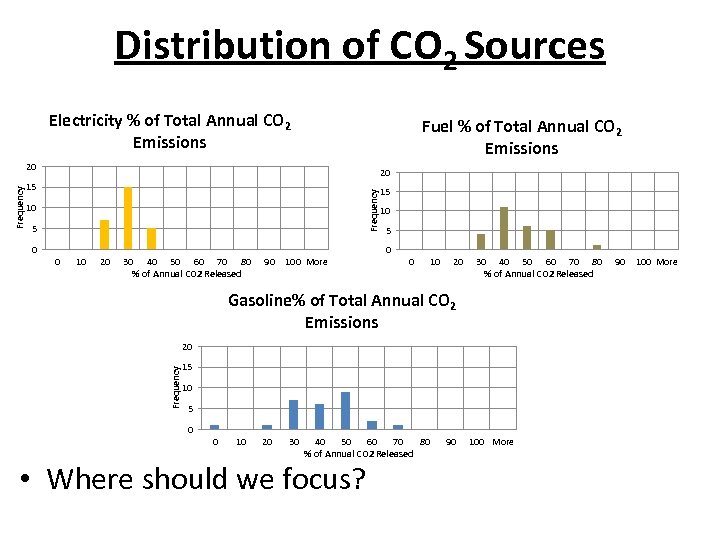
Distribution of CO 2 Sources Electricity % of Total Annual CO 2 Emissions Fuel % of Total Annual CO 2 Emissions 20 15 Frequency 20 10 5 0 15 10 5 0 0 10 20 30 40 50 60 70 80 % of Annual CO 2 Released 90 100 More 0 10 20 30 40 50 60 70 80 % of Annual CO 2 Released Gasoline% of Total Annual CO 2 Emissions Frequency 20 15 10 5 0 0 10 20 30 40 50 60 70 80 % of Annual CO 2 Released • Where should we focus? 90 100 More
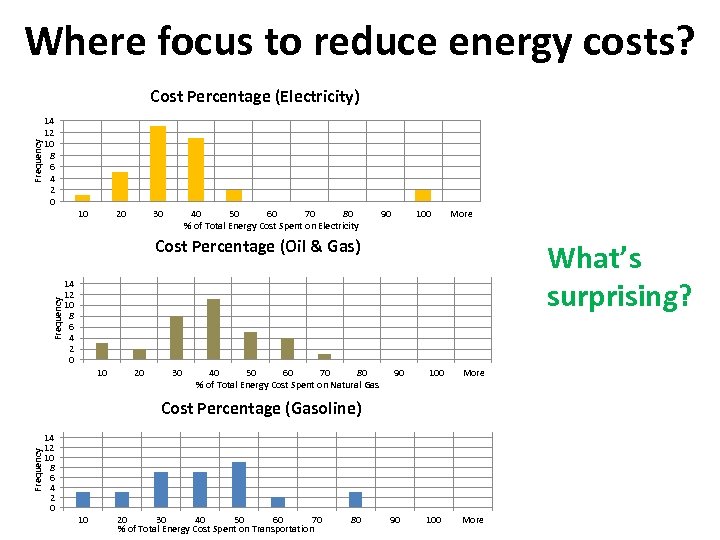
Where focus to reduce energy costs? Frequency Cost Percentage (Electricity) 14 12 10 8 6 4 2 0 10 20 30 40 50 60 70 80 % of Total Energy Cost Spent on Electricity 90 100 More Frequency Cost Percentage (Oil & Gas) What’s surprising? 14 12 10 8 6 4 2 0 10 20 30 40 50 60 70 80 % of Total Energy Cost Spent on Natural Gas 90 100 More Frequency Cost Percentage (Gasoline) 14 12 10 8 6 4 2 0 10 20 30 40 50 60 70 % of Total Energy Cost Spent on Transportation 80 90
The Importance of Screening Data
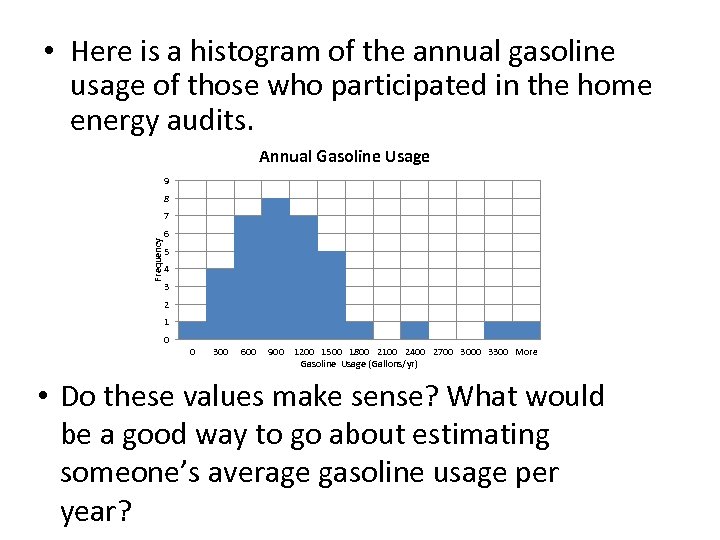
• Here is a histogram of the annual gasoline usage of those who participated in the home energy audits. Annual Gasoline Usage 9 8 Frequency 7 6 5 4 3 2 1 0 0 300 600 900 1200 1500 1800 2100 2400 2700 3000 3300 More Gasoline Usage (Gallons/yr) • Do these values make sense? What would be a good way to go about estimating someone’s average gasoline usage per year?
• In order to estimate someone’s average gasoline usage, you would need to know: how many vehicles they use, how many miles those vehicles can travel with one gallon of gasoline (mpg), and how many miles they travel in a year. • For example: Someone has 1 car, that gets 20 mpg, and they travel 15000 miles/year. They would use: 15000 (miles/year) / 20 (mpg) = 750 (gallons/year). • Or: Someone has 1 car, that gets 12 mpg, and they travel 30000 miles/year. They would use: 30000 (miles/year) / 12 (mpg) = 2500 (gallons / year)
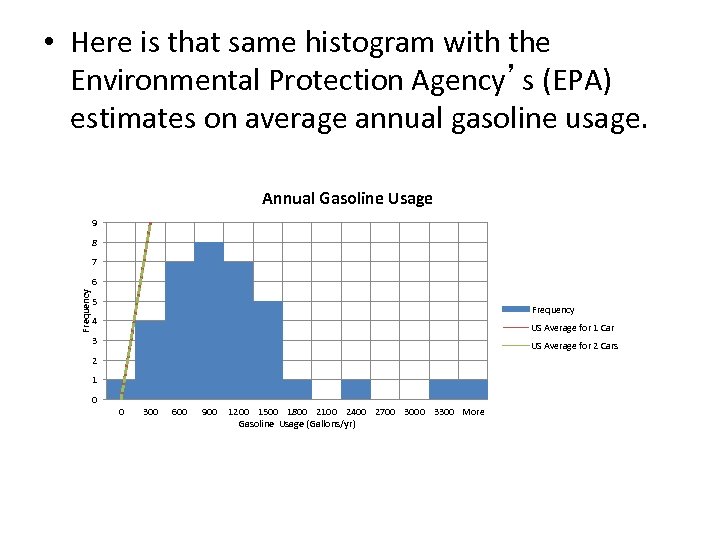
• Here is that same histogram with the Environmental Protection Agency’s (EPA) estimates on average annual gasoline usage. Annual Gasoline Usage 9 8 7 Frequency 6 5 Frequency 4 US Average for 1 Car 3 US Average for 2 Cars 2 1 0 0 300 600 900 1200 1500 1800 2100 2400 2700 3000 3300 More Gasoline Usage (Gallons/yr)
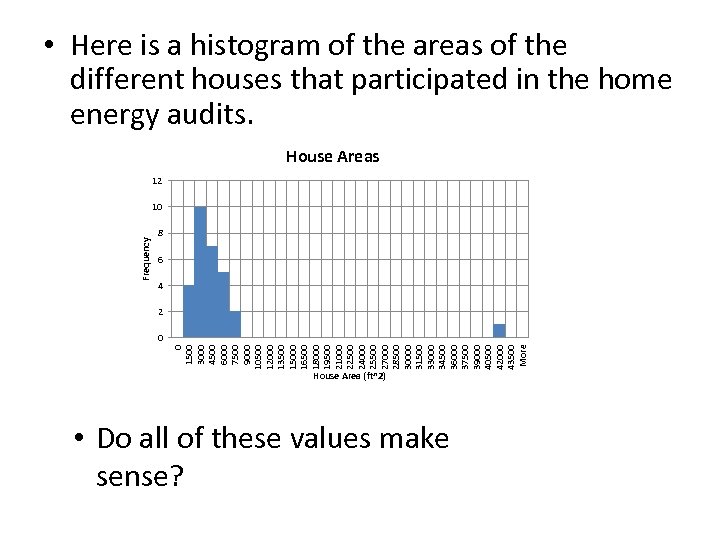
• Here is a histogram of the areas of the different houses that participated in the home energy audits. House Areas 12 Frequency 10 8 6 4 2 0 1500 3000 4500 6000 7500 9000 10500 12000 13500 15000 16500 18000 19500 21000 22500 24000 25500 27000 28500 30000 31500 33000 34500 36000 37500 39000 40500 42000 43500 More 0 House Area (ft^2) • Do all of these values make sense?
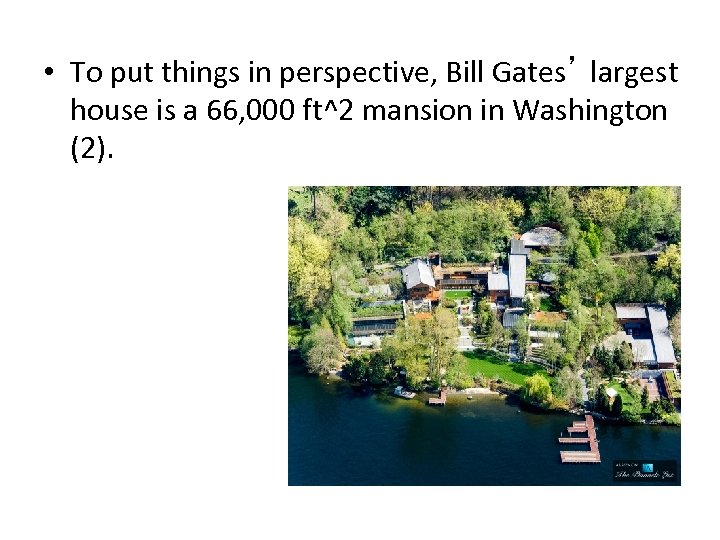
• To put things in perspective, Bill Gates’ largest house is a 66, 000 ft^2 mansion in Washington (2).
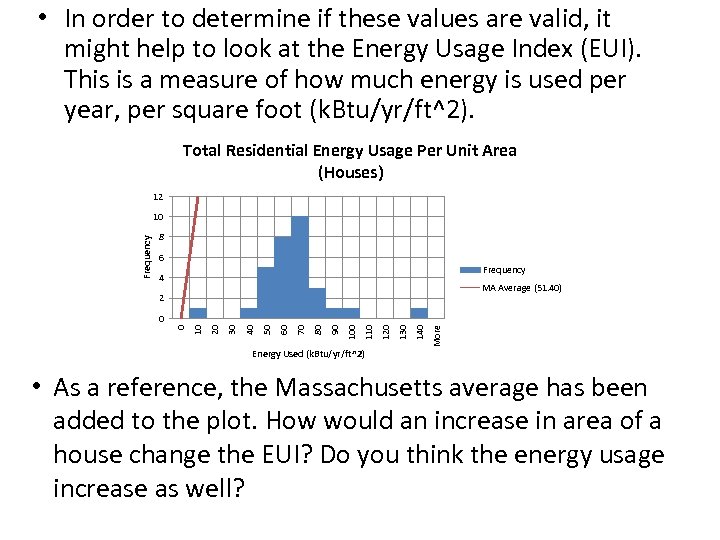
• In order to determine if these values are valid, it might help to look at the Energy Usage Index (EUI). This is a measure of how much energy is used per year, per square foot (k. Btu/yr/ft^2). Total Residential Energy Usage Per Unit Area (Houses) 12 Frequency 10 8 6 Frequency 4 MA Average (51. 40) 2 140 130 More Energy Used (k. Btu/yr/ft^2) 120 110 100 90 80 70 60 50 40 30 20 10 0 0 • As a reference, the Massachusetts average has been added to the plot. How would an increase in area of a house change the EUI? Do you think the energy usage increase as well?
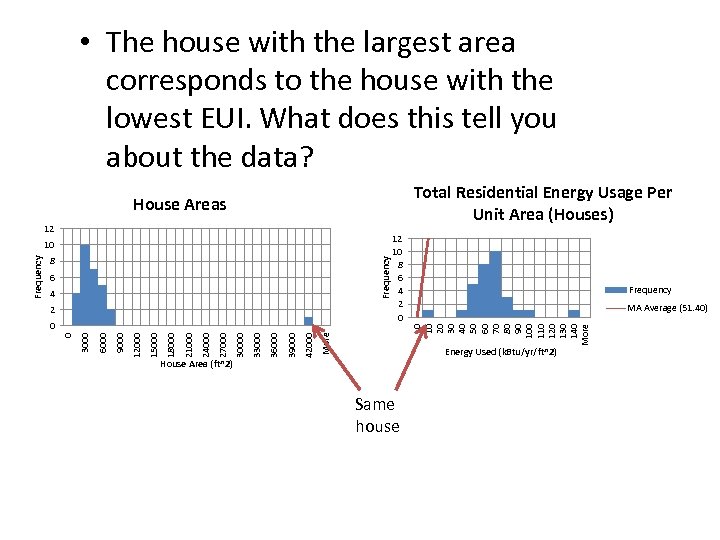
• The house with the largest area corresponds to the house with the lowest EUI. What does this tell you about the data? Total Residential Energy Usage Per Unit Area (Houses) House Areas 12 6 4 2 More 42000 39000 36000 33000 House Area (ft^2) 30000 27000 24000 21000 18000 15000 12000 9000 6000 3000 0 12 10 8 6 4 2 0 Frequency MA Average (51. 40) 0 10 20 30 40 50 60 70 80 90 100 110 120 130 140 More Frequency 8 0 Frequency 10 Energy Used (k. Btu/yr/ft^2) Same house
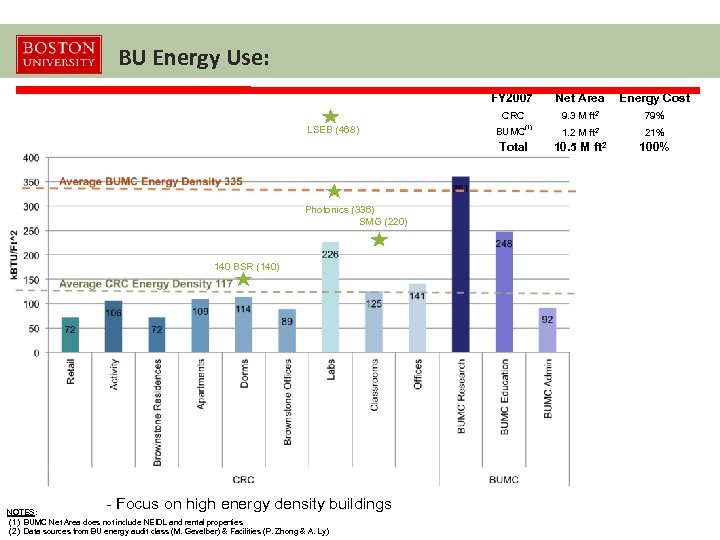
BU Energy Use: FY 2007 LSEB (468) Photonics (336) SMG (220) 140 BSR (140) - Focus on high energy density buildings NOTES: (1) BUMC Net Area does not include NEIDL and rental properties (2) Data sources from BU energy audit class (M. Gevelber) & Facilities (P. Zhong & A. Ly) Energy Cost CRC Boston University Slideshow Title Goes Here Net Area 9. 3 M ft 2 79% 1. 2 M ft 2 21% 10. 5 M ft 2 100% (1) BUMC Total
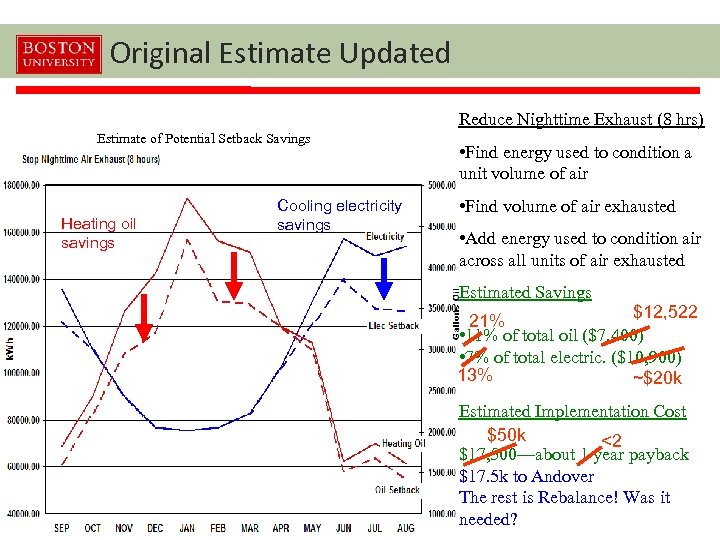
Original Estimate Updated Reduce Nighttime Exhaust (8 hrs) Boston University Slideshow Title Goes Here Estimate of Potential Setback Savings Heating oil savings Cooling electricity savings • Find energy used to condition a unit volume of air • Find volume of air exhausted • Add energy used to condition air across all units of air exhausted Estimated Savings $12, 522 21% • 11% of total oil ($7, 400) • 7% of total electric. ($10, 900) 13% ~$20 k Estimated Implementation Cost $50 k <2 $17, 500—about 1 year payback $17. 5 k to Andover The rest is Rebalance! Was it needed?
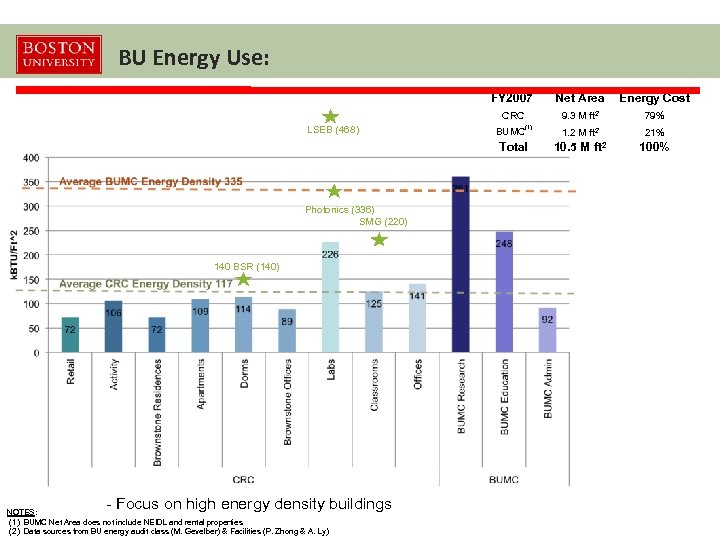
BU Energy Use: FY 2007 LSEB (468) Photonics (336) SMG (220) 140 BSR (140) - Focus on high energy density buildings NOTES: (1) BUMC Net Area does not include NEIDL and rental properties (2) Data sources from BU energy audit class (M. Gevelber) & Facilities (P. Zhong & A. Ly) Energy Cost CRC Boston University Slideshow Title Goes Here Net Area 9. 3 M ft 2 79% 1. 2 M ft 2 21% 10. 5 M ft 2 100% (1) BUMC Total
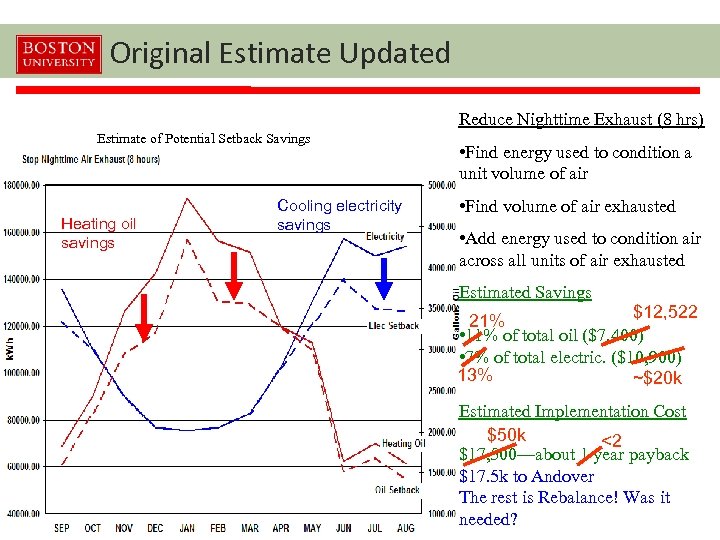
Original Estimate Updated Reduce Nighttime Exhaust (8 hrs) Boston University Slideshow Title Goes Here Estimate of Potential Setback Savings Heating oil savings Cooling electricity savings • Find energy used to condition a unit volume of air • Find volume of air exhausted • Add energy used to condition air across all units of air exhausted Estimated Savings $12, 522 21% • 11% of total oil ($7, 400) • 7% of total electric. ($10, 900) 13% ~$20 k Estimated Implementation Cost $50 k <2 $17, 500—about 1 year payback $17. 5 k to Andover The rest is Rebalance! Was it needed?
Скачать презентацию Boston University Slideshow Title Goes Here Achieving Energy
1ff4238b70bd836b02b68449cdfad7f5.ppt