 Скачать презентацию born 13 Sept 1924 died 25 June 2010
89b70598797879dbb036e8bb25bc67b6.ppt
- Количество слайдов: 41



born 13 Sept. 1924 (died 25 June 2010) the son of a noted Welch preacher, the Rev. Harold Flowers and his wife Marian in Blackburn, Lancashire
Before he was 20 he was recruited by John Cockroft to the Anglo – Canadion atomic bomb project at Chalk River, Ontario
in 1946 Cockroft brought him back to Brittain to work in Otto Frisch’s group of the Atomic Research Establishment at Harward in Fuch’s theoretical section
in 1950 Fuchs was arrested as a Soviet agent and Flowers went to Birmingham University to work under Rudof Peiersls
in 1958 (till 1967) he was appointed professor of theoretical physics in Manchester University at the age of 34 in 1961 elected as a fellow of the Royal Society (FRS) at the age of 36
in 1964 Chairman of the Science Research Council (SRC) in 1973 (till 1985) Rector of Imperial College of London University
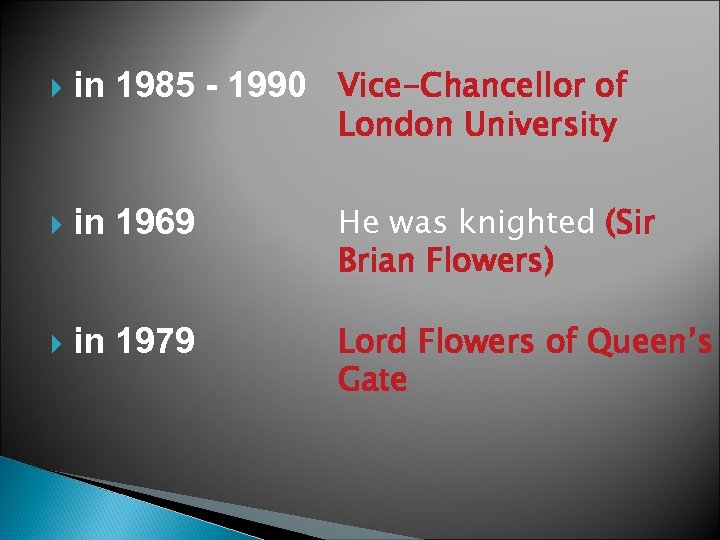
in 1985 - 1990 Vice-Chancellor of in 1969 He was knighted (Sir Brian Flowers) in 1979 Lord Flowers of Queen’s Gate London University
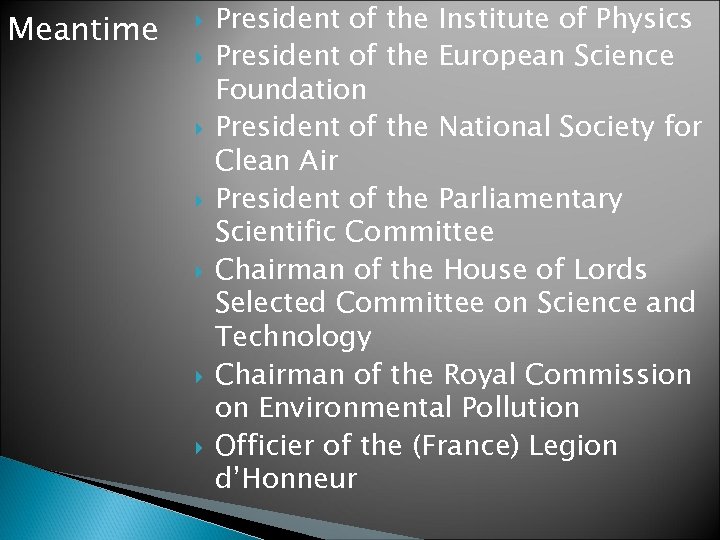
Meantime President of the Institute of Physics President of the European Science Foundation President of the National Society for Clean Air President of the Parliamentary Scientific Committee Chairman of the House of Lords Selected Committee on Science and Technology Chairman of the Royal Commission on Environmental Pollution Officier of the (France) Legion d’Honneur
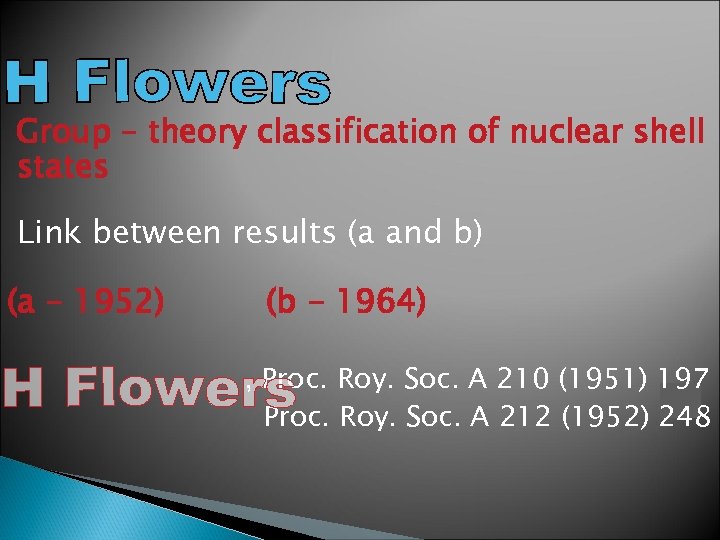
Group – theory classification of nuclear shell states Link between results (a and b) (a - 1952) (b - 1964) , Proc. Roy. Soc. A 210 (1951) 197 Proc. Roy. Soc. A 212 (1952) 248
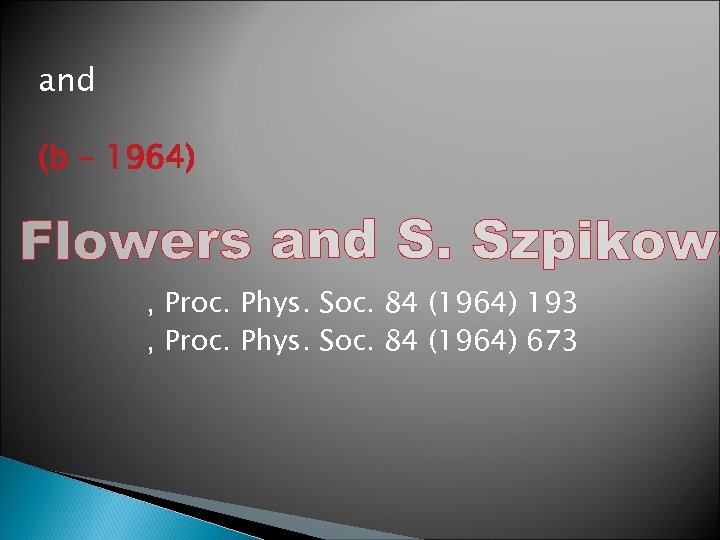
and (b – 1964) , Proc. Phys. Soc. 84 (1964) 193 , Proc. Phys. Soc. 84 (1964) 673
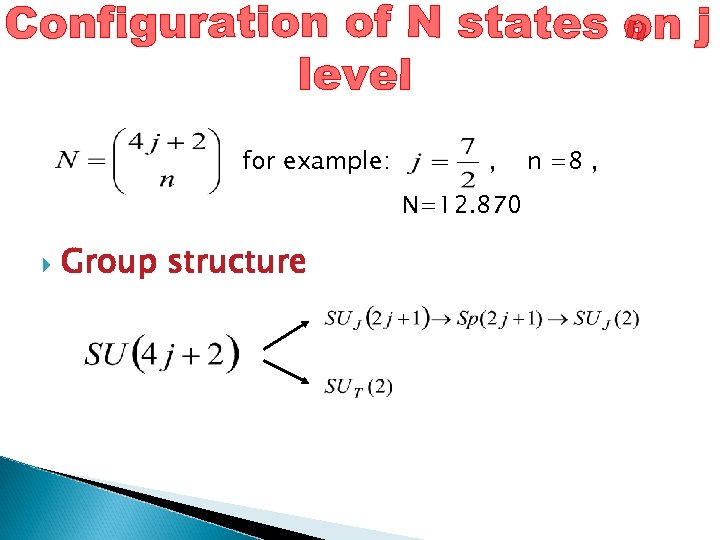
for example: , N=12. 870 Group structure n =8 ,
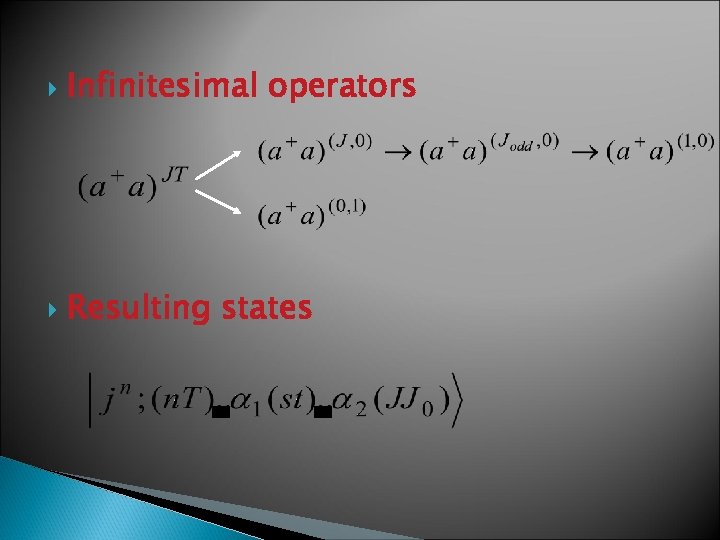
Infinitesimal operators Resulting states
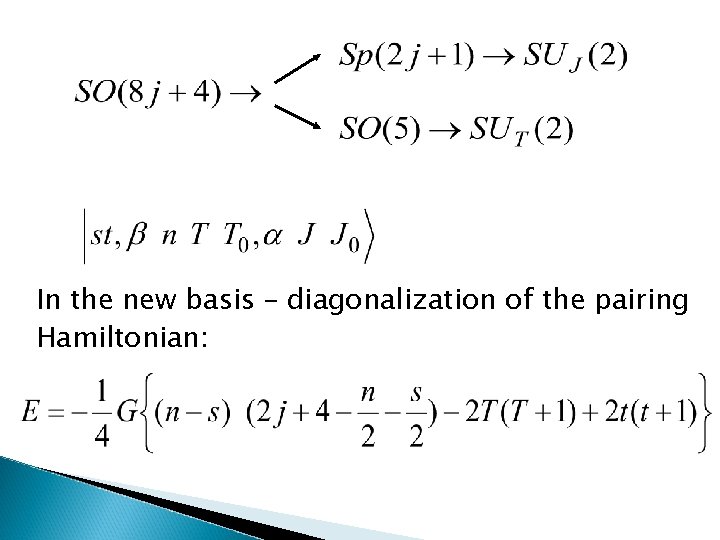
In the new basis – diagonalization of the pairing Hamiltonian:
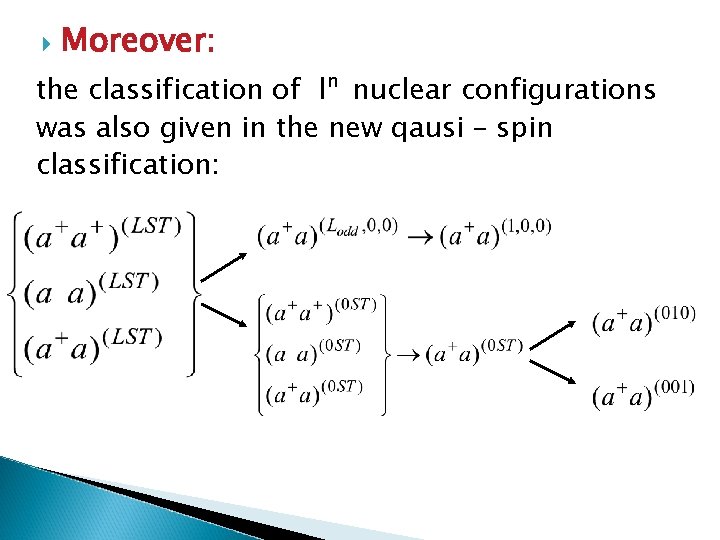
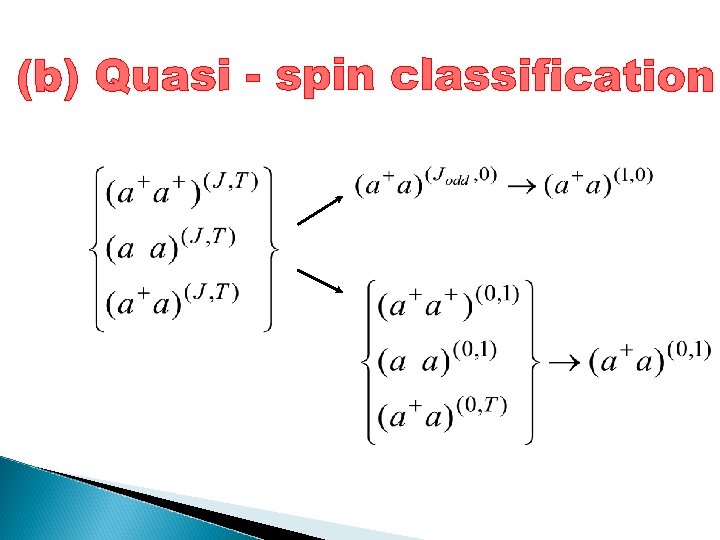
Moreover: the classification of l n nuclear configurations was also given in the new qausi – spin classification:
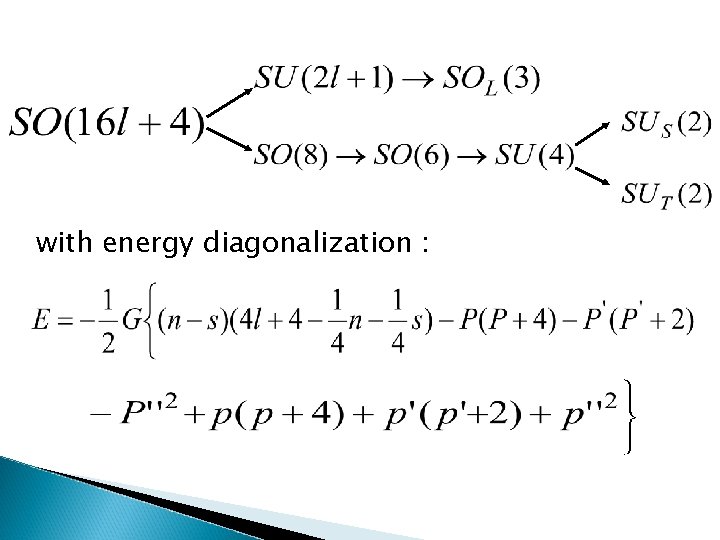
with energy diagonalization :
born 17 July 1929 (died 21 October 2008) in Gospart, Hampshire of an engine driver and schoolteacher
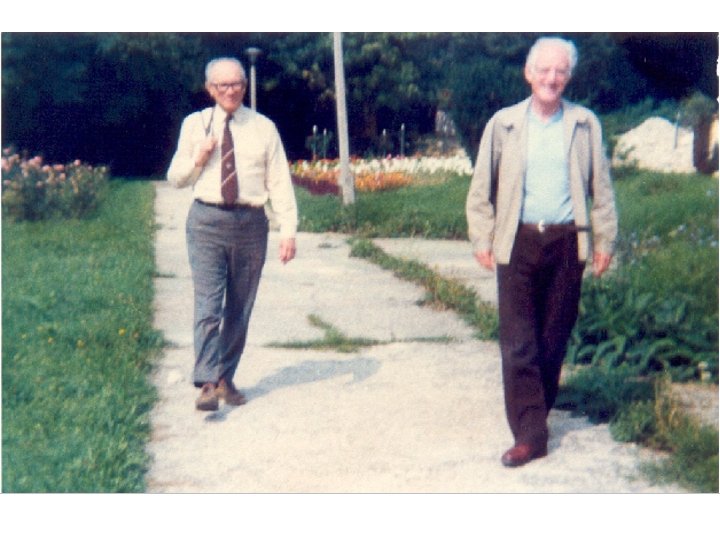
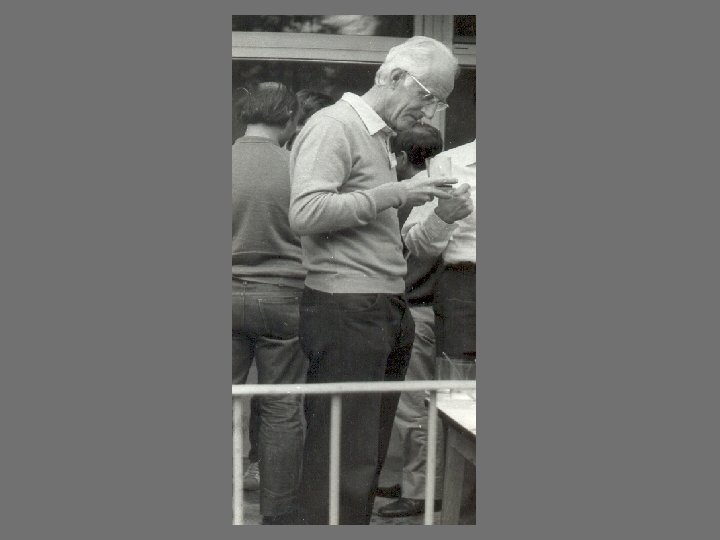
He read mathematics at University College Southampton, graduating in 1949 and remaining to do postgraduate work He obtained his doctorate in theoretical nuclear physics under the supervision of Hermann Jahn. He joined theoretical division of Atomic Energy Research Establishment in Harwell when Dr Brian (later Lord) Flowers was appointed director.
After a year in the USA at the University of Rochester he returned to Southampton. In 1962 he moved to the School of Mathematical and Physical Sciences at the new University of Sussex , Brighton, remaining there until his retirement in 1994.
Phil Elliott achieved global recognition in 1958 with the publication of an application of the symmetry group SU (3) to nuclear structure. This work become one of the most frequently cited references in the field. In 1998 – in the 40 th anniversary of the SU (3) model – a nuclear physics conference held in Brighton with over 100 delegates from over the world.
The conference began with keynote talks by Phil Elliott himself and Akito Arima on the origin and development of the SU(3) model. The advent of the Interacting Boson Model of nuclear structure introduced by Arima and Iachello gave his research new impetus in establishing a firm connection between it and more familiar shell model.
This aim was achieved in series of papers in 1980’s on neutron – proton pairs and isotopic spin in collective nuclear motion. Phil Elliott was elected to the Royal Society (FRS) in 1980. In 1994 he was awarded The Rutherford medal and prize by the Institute of Physics.
In 2002 the European Physical Society awarded its prestigious Lise Meitner prize jointly to Elliott and Iachello „ for their innovative applications of group theoretical methods to the understanding of atomic nuclei”.
(a) The famous SU(3) Elliott model and (b)(b) The Interacting Boson Model: IBM 3 (c) and IBM 4 (d)Link between (a) – 1958 and (b) – 1980: (e)the symmetry consideration with group (f)theory methods
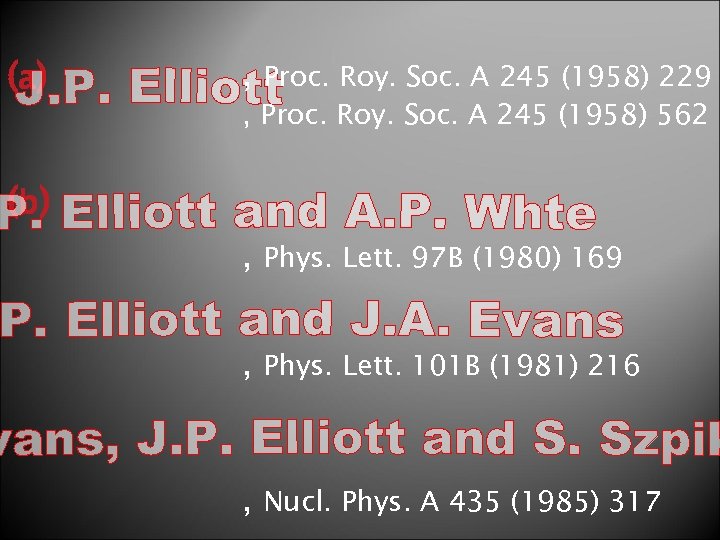
(a) , Proc. Roy. Soc. A 245 (1958) 229 , Proc. Roy. Soc. A 245 (1958) 562 (b ) , Phys. Lett. 97 B (1980) 169 , Phys. Lett. 101 B (1981) 216 , Nucl. Phys. A 435 (1985) 317
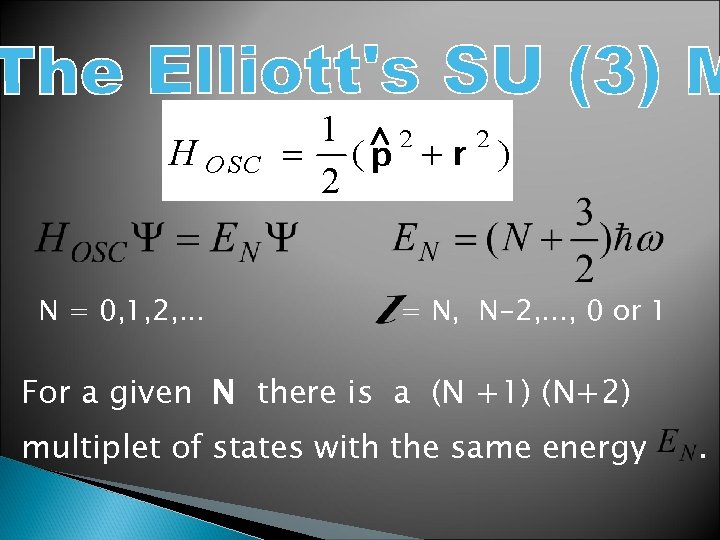
N = 0, 1, 2, . . . = N, N-2, . . . , 0 or 1 For a given N there is a (N +1) (N+2) multiplet of states with the same energy .
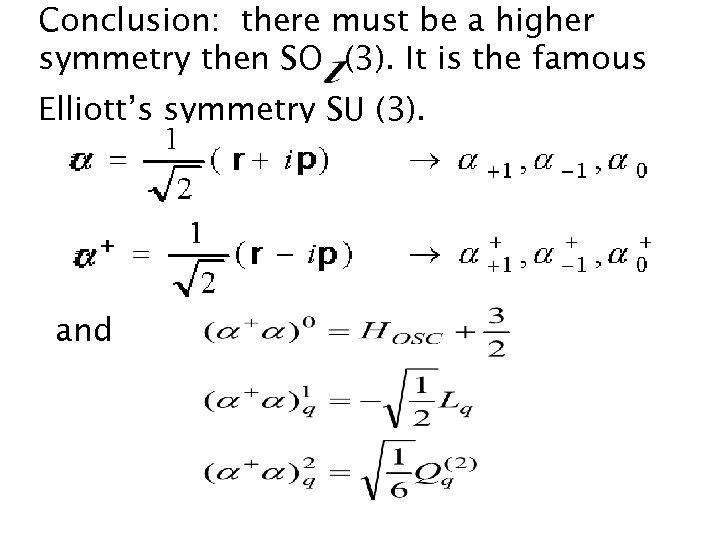
Conclusion: there must be a higher symmetry then SO (3). It is the famous Elliott’s symmetry SU (3). and
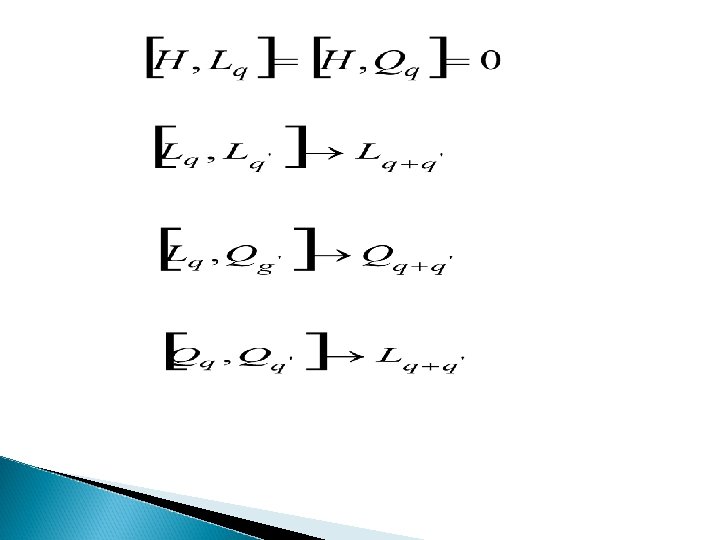
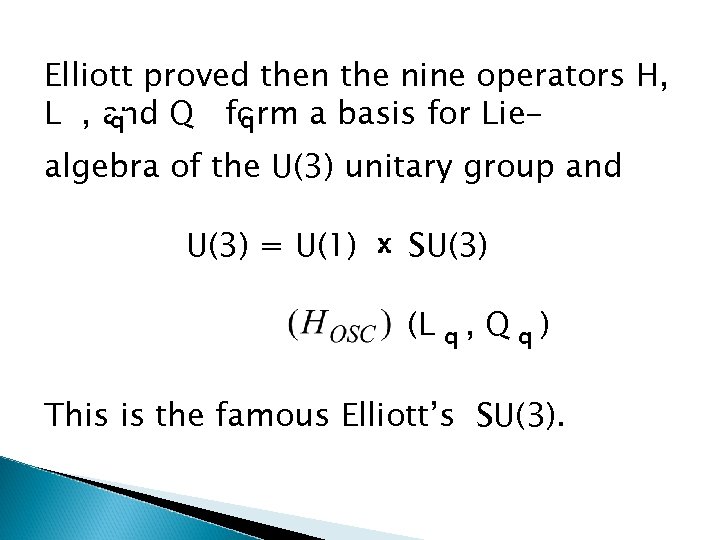
Elliott proved then the nine operators H, L , and Q form a basis for Liealgebra of the U(3) unitary group and U(3) = U(1) SU(3) (L , Q ) This is the famous Elliott’s SU(3).
Under the same symmetry group SU(3) we can consider the mixing configuration of states belonging to the same IR of SU(3) on different l – shells as Elliott in his original paper considered for N=2 and 2 p and 1 f shells.
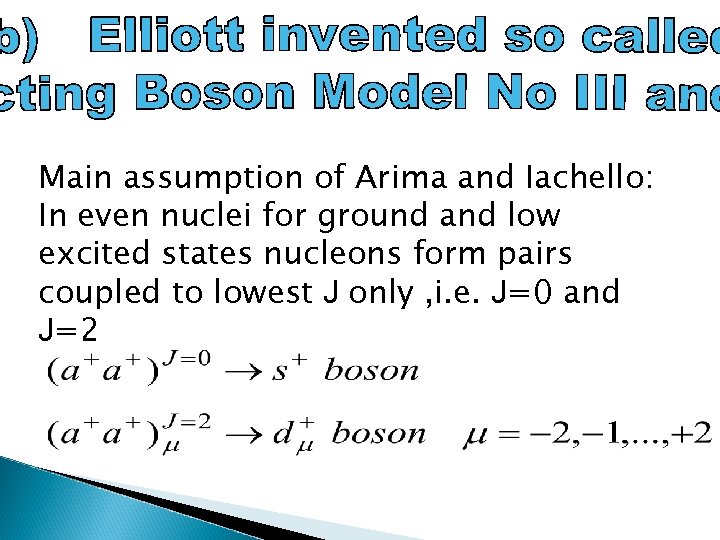
Main assumption of Arima and Iachello: In even nuclei for ground and low excited states nucleons form pairs coupled to lowest J only , i. e. J=0 and J=2
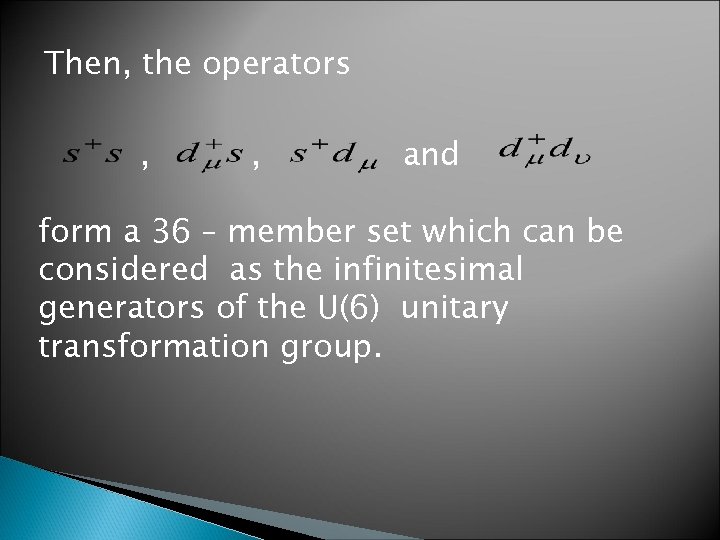
Then, the operators , , and form a 36 – member set which can be considered as the infinitesimal generators of the U(6) unitary transformation group.
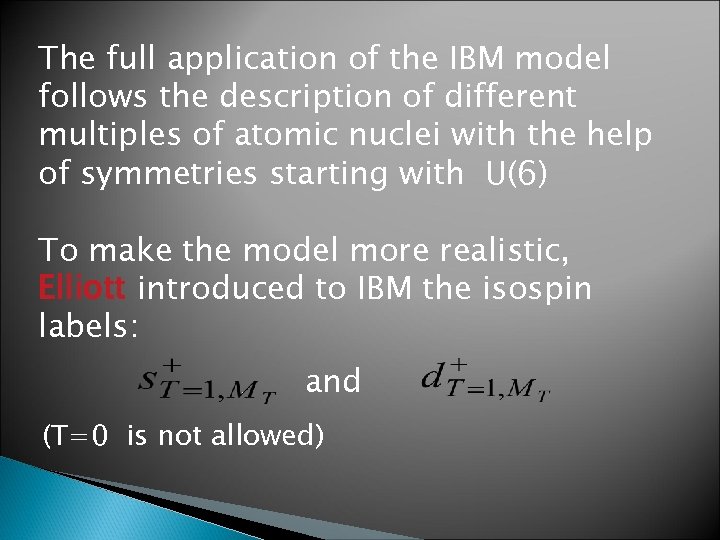
The full application of the IBM model follows the description of different multiples of atomic nuclei with the help of symmetries starting with U(6) To make the model more realistic, Elliott introduced to IBM the isospin labels: and (T=0 is not allowed)
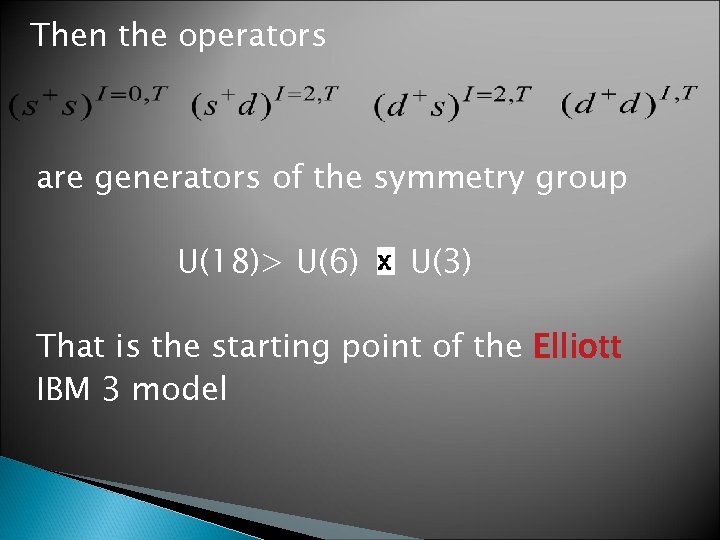
Then the operators are generators of the symmetry group U(18)> U(6) U(3) That is the starting point of the Elliott IBM 3 model
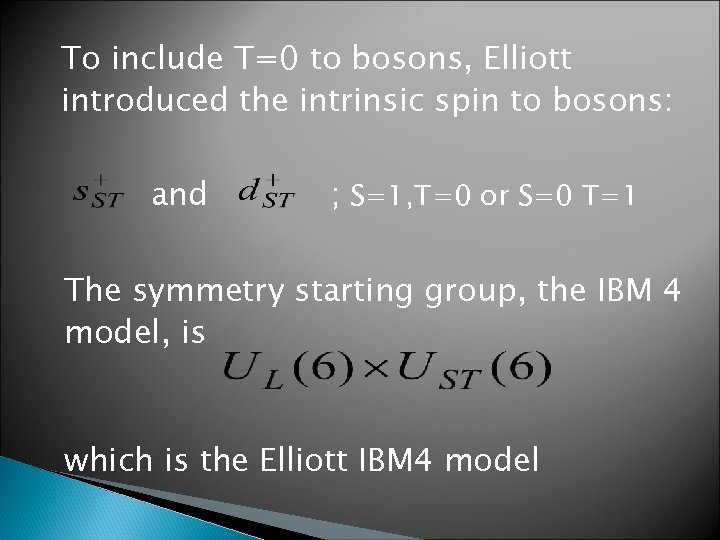
To include T=0 to bosons, Elliott introduced the intrinsic spin to bosons: and ; S=1, T=0 or S=0 T=1 The symmetry starting group, the IBM 4 model, is which is the Elliott IBM 4 model
With these models Elliott was able to analyse the neutron – proton on l or j shell configurations.

Thank you for your attention
Скачать презентацию born 13 Sept 1924 died 25 June 2010
89b70598797879dbb036e8bb25bc67b6.ppt