 Скачать презентацию Borexino Status report and results Rivelatore Purificazione
e70b5e05aa85159ea1e402bc0c41d02b.ppt
- Количество слайдов: 24



Borexino Status report and results Rivelatore: § Purificazione dello scintillatore mediante Water Extraction: • 6 cicli da giugno 2010 ad agosto 2011 § Manutenzione elettronica § Risultati § pep neutrinos § Flusso dei muoni cosmici e loro modulazione annuale § Ricerca di assioni dal sole § Sterile neutrino oscillation: n source Commissione II, Trieste, settembre 2012
Borexino 2012 Ø Lavori Pubblicati: ² First Evidence of pep Solar Neutrinos by Direct Detection in Borexino PRL 108, 051302 (2012); selezionato da APS per essere inserito negli Highlights ² Cosmic-muon flux and annual modulation in Borexino at 3800 m water-equivalent depth, Journal of Cosmology and Astroparticle Physics Volume 2012 May 2012 ² Search for Solar Axions Produced in p(d, 3 He)A Reaction with Borexino Detector, Phys. Rev. D, Volume 85, Issue 9 (2012) ² Measurement of CNGS muon neutrino speed with Borexino Phys. Letters B, 716 (2012), 401 -405 Analisi in progress § Update dell’ analisi dei geo-neutrinos ; § Update della ricerca di processi rari § Studio della produzione di nuclidi cosmogenici
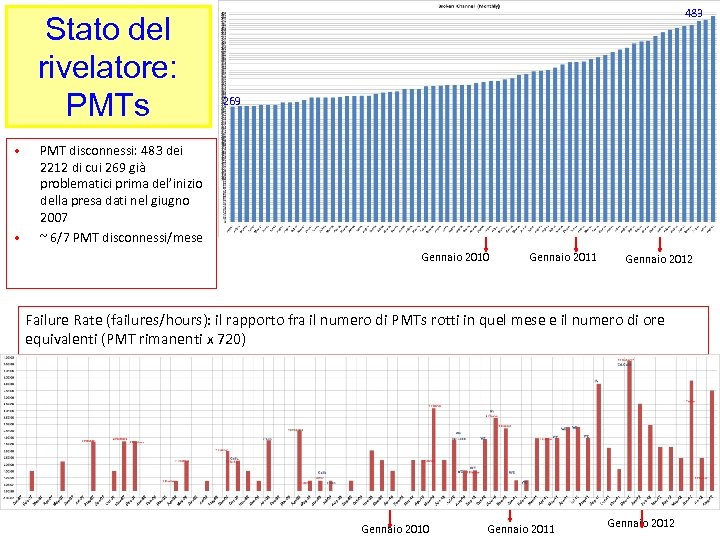
Stato del rivelatore: PMTs • • 483 269 PMT disconnessi: 483 dei 2212 di cui 269 già problematici prima del’inizio della presa dati nel giugno 2007 ~ 6/7 PMT disconnessi/mese Gennaio 2010 Gennaio 2011 Gennaio 2012 Failure Rate (failures/hours): il rapporto fra il numero di PMTs rotti in quel mese e il numero di ore equivalenti (PMT rimanenti x 720) 3 Gennaio 2010 Gennaio 2011 Gennaio 2012
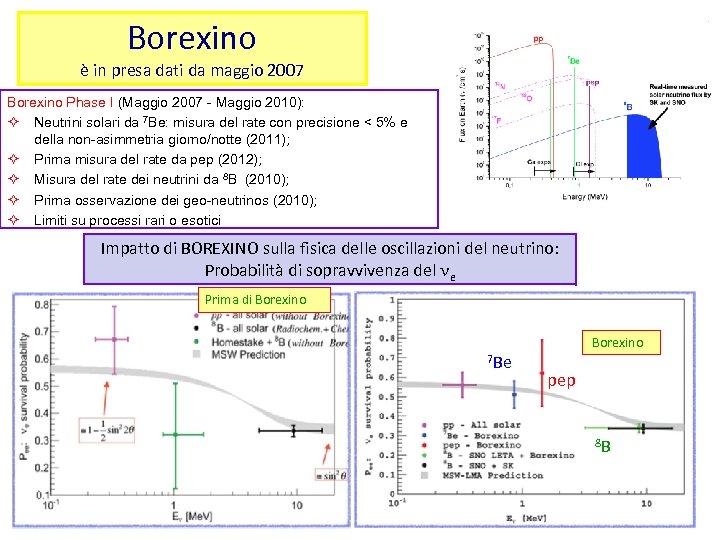
Borexino è in presa dati da maggio 2007 Borexino Phase I (Maggio 2007 - Maggio 2010): ² Neutrini solari da 7 Be: misura del rate con precisione < 5% e della non-asimmetria giorno/notte (2011); ² Prima misura del rate da pep (2012); ² Misura del rate dei neutrini da 8 B (2010); ² Prima osservazione dei geo-neutrinos (2010); ² Limiti su processi rari o esotici Impatto di BOREXINO sulla fisica delle oscillazioni del neutrino: Probabilità di sopravvivenza del ne Prima di Borexino 7 Be pep 8 B 4
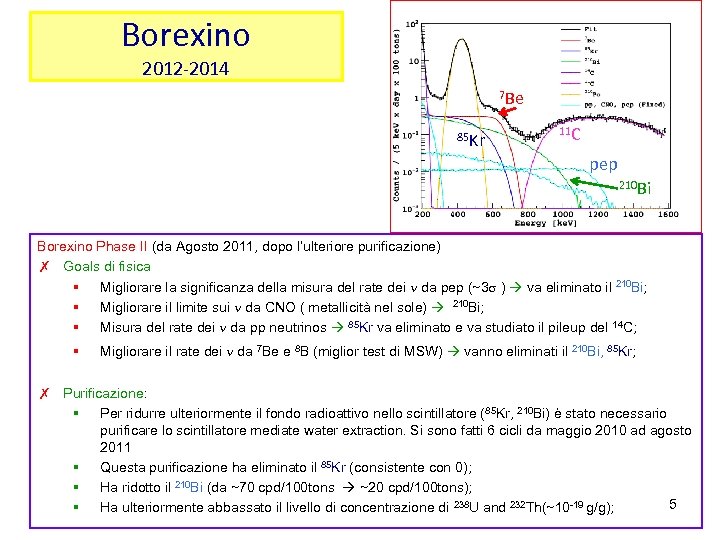
Borexino 2012 -2014 7 Be 85 Kr 11 C pep 210 Bi Borexino Phase II (da Agosto 2011, dopo l’ulteriore purificazione) ✗ Goals di fisica § Migliorare la significanza della misura del rate dei n da pep (~3 s ) va eliminato il 210 Bi; § Migliorare il limite sui n da CNO ( metallicità nel sole) 210 Bi; § Misura del rate dei n da pp neutrinos 85 Kr va eliminato e va studiato il pileup del 14 C; § Migliorare il rate dei n da 7 Be e 8 B (miglior test di MSW) vanno eliminati il 210 Bi, 85 Kr; ✗ Purificazione: § Per ridurre ulteriormente il fondo radioattivo nello scintillatore (85 Kr, 210 Bi) è stato necessario purificare lo scintillatore mediate water extraction. Si sono fatti 6 cicli da maggio 2010 ad agosto 2011 § Questa purificazione ha eliminato il 85 Kr (consistente con 0); § Ha ridotto il 210 Bi (da ~70 cpd/100 tons ~20 cpd/100 tons); 5 § Ha ulteriormente abbassato il livello di concentrazione di 238 U and 232 Th(~10 -19 g/g);
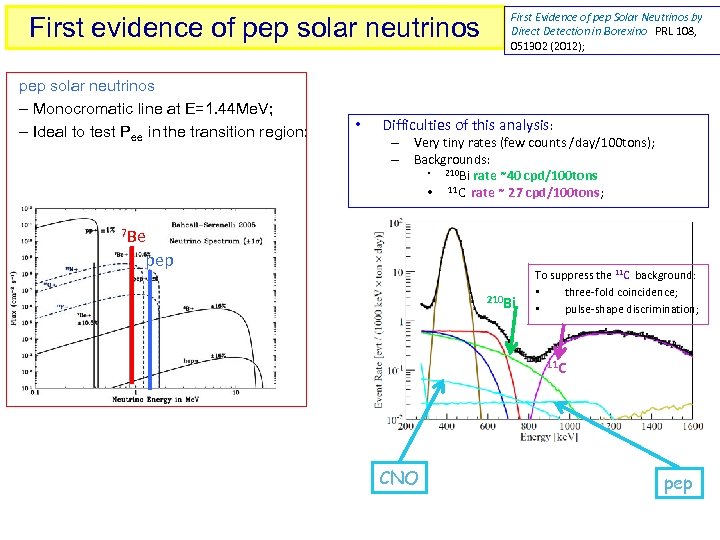
First evidence of pep solar neutrinos – Monocromatic line at E=1. 44 Me. V; – Ideal to test Pee in the transition region; • First Evidence of pep Solar Neutrinos by Direct Detection in Borexino PRL 108, 051302 (2012); Difficulties of this analysis: – Very tiny rates (few counts /day/100 tons); – Backgrounds: • 210 Bi rate ~40 cpd/100 tons • 11 C rate ~ 27 cpd/100 tons; 7 Be pep 210 Bi To suppress the 11 C background: • three-fold coincidence; • pulse-shape discrimination; 11 C CNO pep
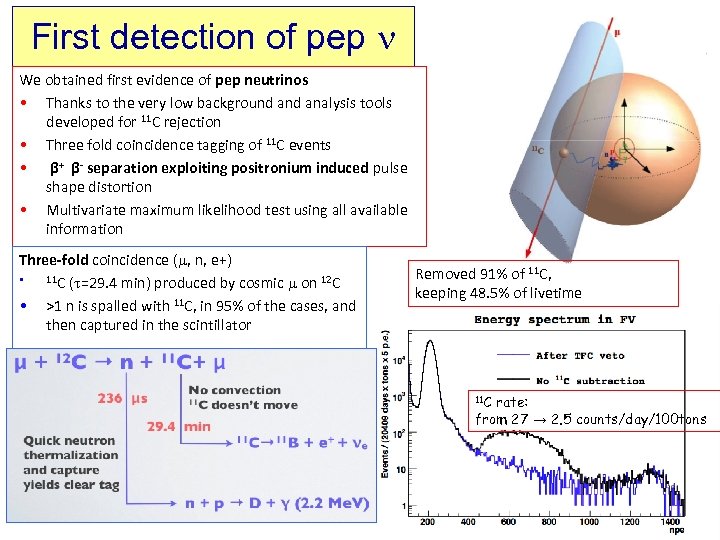
First detection of pep n We obtained first evidence of pep neutrinos • Thanks to the very low background analysis tools developed for 11 C rejection • Three fold coincidence tagging of 11 C events • β+ β- separation exploiting positronium induced pulse shape distortion • Multivariate maximum likelihood test using all available information Three-fold coincidence (m, n, e+) • 11 C ( =29. 4 min) produced by cosmic m on 12 C • >1 n is spalled with 11 C, in 95% of the cases, and then captured in the scintillator Removed 91% of 11 C, keeping 48. 5% of livetime 11 C rate: from 27 → 2. 5 counts/day/100 tons
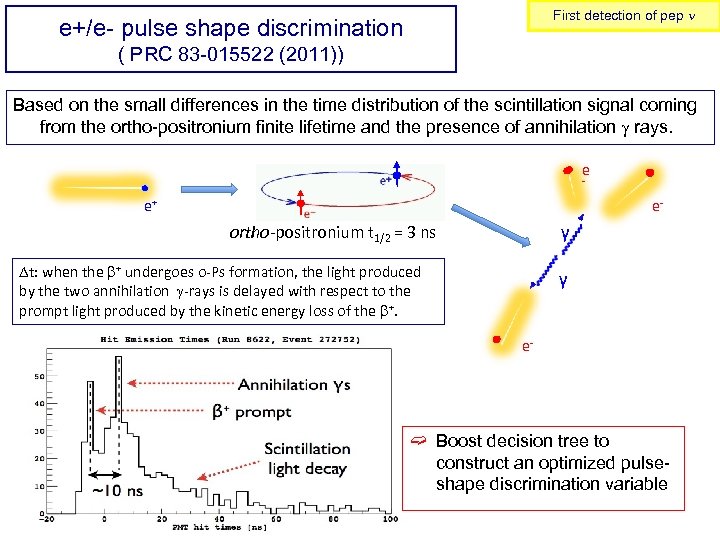
First detection of pep n e+/e- pulse shape discrimination ( PRC 83 -015522 (2011)) Based on the small differences in the time distribution of the scintillation signal coming from the ortho-positronium finite lifetime and the presence of annihilation g rays. e - e+ e- γ ortho-positronium t 1/2 = 3 ns Dt: when the b+ undergoes o-Ps formation, the light produced by the two annihilation g-rays is delayed with respect to the prompt light produced by the kinetic energy loss of the b+. γ e- ➫ Boost decision tree to construct an optimized pulseshape discrimination variable
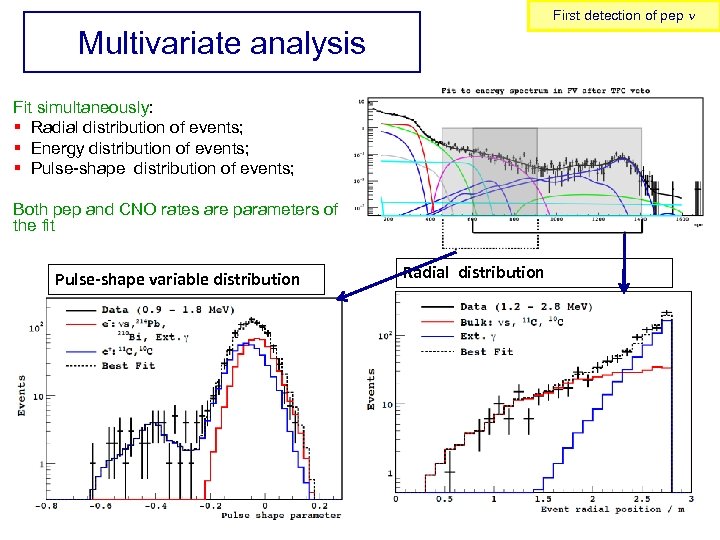
First detection of pep n Multivariate analysis Fit simultaneously: § Radial distribution of events; § Energy distribution of events; § Pulse-shape distribution of events; Both pep and CNO rates are parameters of the fit Pulse-shape variable distribution Radial distribution
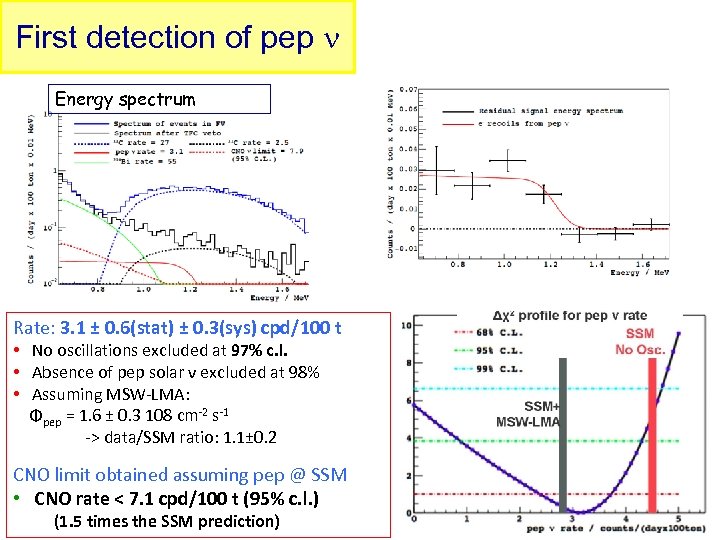
First detection of pep n Energy spectrum Rate: 3. 1 ± 0. 6(stat) ± 0. 3(sys) cpd/100 t • No oscillations excluded at 97% c. l. • Absence of pep solar ν excluded at 98% • Assuming MSW-LMA: Φpep = 1. 6 ± 0. 3 108 cm-2 s-1 -> data/SSM ratio: 1. 1± 0. 2 CNO limit obtained assuming pep @ SSM • CNO rate < 7. 1 cpd/100 t (95% c. l. ) (1. 5 times the SSM prediction)
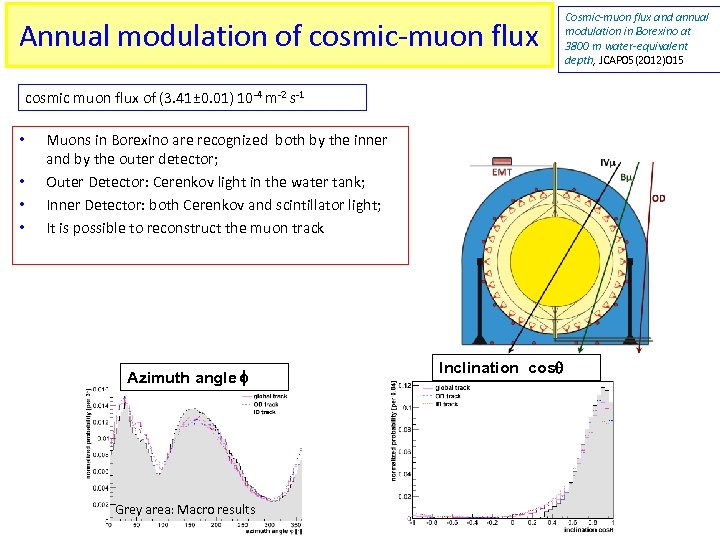
Annual modulation of cosmic-muon flux cosmic muon flux of (3. 41± 0. 01) 10 -4 m-2 s-1 • • Muons in Borexino are recognized both by the inner and by the outer detector; Outer Detector: Cerenkov light in the water tank; Inner Detector: both Cerenkov and scintillator light; It is possible to reconstruct the muon track Azimuth angle f Grey area: Macro results Inclination cosq Cosmic-muon flux and annual modulation in Borexino at 3800 m water-equivalent depth, JCAP 05(2012)015
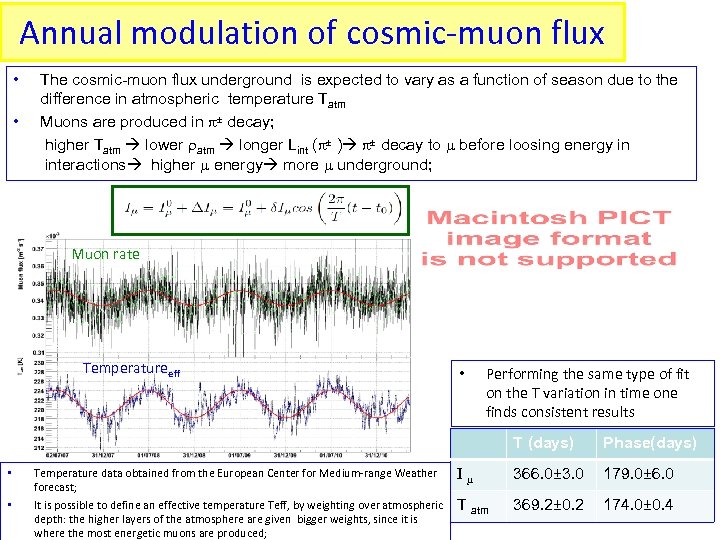
Annual modulation of cosmic-muon flux • • The cosmic-muon flux underground is expected to vary as a function of season due to the difference in atmospheric temperature Tatm Muons are produced in p± decay; higher Tatm lower ratm longer Lint (p± ) p± decay to m before loosing energy in interactions higher m energy more m underground; Muon rate Temperatureeff • Performing the same type of fit on the T variation in time one finds consistent results T (days) • • Temperature data obtained from the European Center for Medium-range Weather forecast; It is possible to define an effective temperature Teff, by weighting over atmospheric depth: the higher layers of the atmosphere are given bigger weights, since it is where the most energetic muons are produced; Phase(days) Im 366. 0± 3. 0 179. 0± 6. 0 T atm 369. 2± 0. 2 174. 0± 0. 4
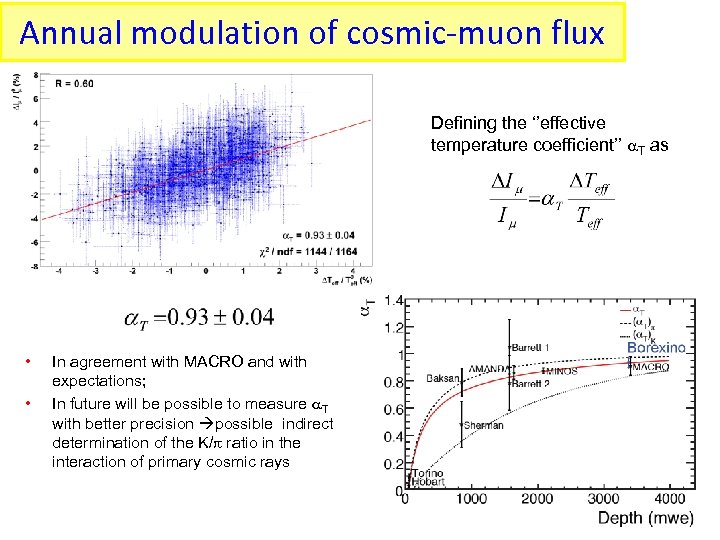
Annual modulation of cosmic-muon flux Defining the ‘’effective temperature coefficient’’ a. T as • • In agreement with MACRO and with expectations; In future will be possible to measure a. T with better precision possible indirect determination of the K/p ratio in the interaction of primary cosmic rays
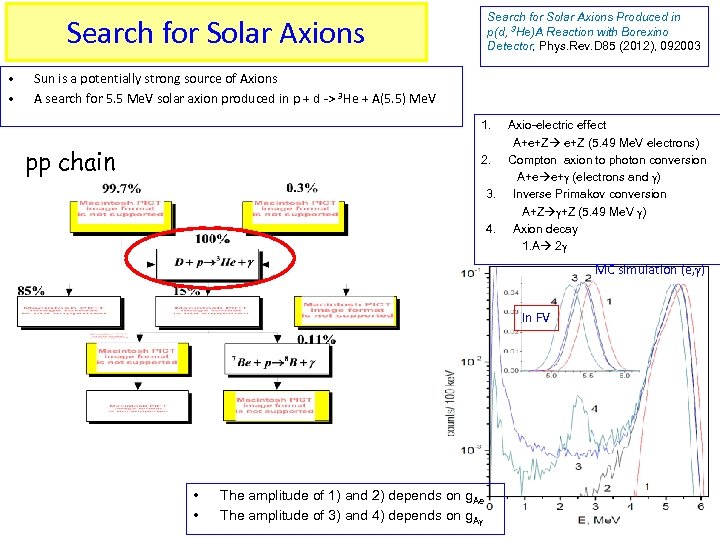
Search for Solar Axions Produced in p(d, 3 He)A Reaction with Borexino Detector, Phys. Rev. D 85 (2012), 092003 Search for Solar Axions • • Sun is a potentially strong source of Axions A search for 5. 5 Me. V solar axion produced in p + d -> 3 He + A(5. 5) Me. V 1. pp chain 2. 3. 4. Axio-electric effect A+e+Z (5. 49 Me. V electrons) Compton axion to photon conversion A+e e+g (electrons and g) Inverse Primakov conversion A+Z g+Z (5. 49 Me. V g) Axion decay 1. A 2 g MC simulation (e, g) In FV • • The amplitude of 1) and 2) depends on g. Ae The amplitude of 3) and 4) depends on g. Ag
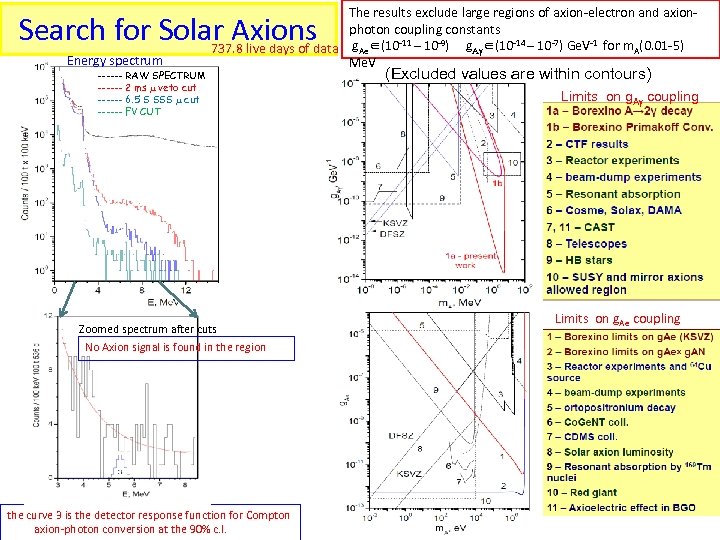
The results exclude large regions of axion-electron and axionphoton coupling constants 737. 8 live days of data g. Ae∈(10 -11 – 10 -9) g. Ag∈(10 -14 – 10 -7) Ge. V-1 for m. A(0. 01 -5) Me. V Search for Solar Axions Energy spectrum ------ RAW SPECTRUM ------ 2 ms m veto cut ------ 6. 5 S SSS m cut ------ FV CUT Zoomed spectrum after cuts No Axion signal is found in the region the curve 3 is the detector response function for Compton axion-photon conversion at the 90% c. l. (Excluded values are within contours) Limits on g. Ag coupling Limits on g. Ae coupling
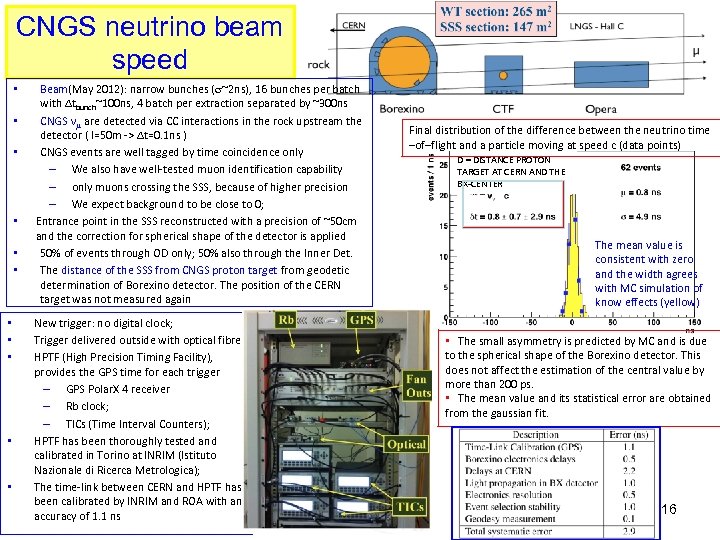
CNGS neutrino beam speed • • • Beam(May 2012): narrow bunches (s~2 ns), 16 bunches per batch with Dtbunch~100 ns, 4 batch per extraction separated by ~300 ns CNGS nm are detected via CC interactions in the rock upstream the detector ( l=50 m -> Dt=0. 1 ns ) CNGS events are well tagged by time coincidence only – We also have well-tested muon identification capability – only muons crossing the SSS, because of higher precision – We expect background to be close to 0; Entrance point in the SSS reconstructed with a precision of ~50 cm and the correction for spherical shape of the detector is applied 50% of events through OD only; 50% also through the Inner Det. The distance of the SSS from CNGS proton target from geodetic determination of Borexino detector. The position of the CERN target was not measured again New trigger: no digital clock; Trigger delivered outside with optical fibre HPTF (High Precision Timing Facility), provides the GPS time for each trigger – GPS Polar. X 4 receiver – Rb clock; – TICs (Time Interval Counters); HPTF has been thoroughly tested and calibrated in Torino at INRIM (Istituto Nazionale di Ricerca Metrologica); The time-link between CERN and HPTF has been calibrated by INRIM and ROA with an accuracy of 1. 1 ns Final distribution of the difference between the neutrino time –of–flight and a particle moving at speed c (data points) D = DISTANCE PROTON TARGET AT CERN AND THE BX-CENTER The mean value is consistent with zero and the width agrees with MC simulation of know effects (yellow) • The small asymmetry is predicted by MC and is due to the spherical shape of the Borexino detector. This does not affect the estimation of the central value by more than 200 ps. • The mean value and its statistical error are obtained from the gaussian fit. 16
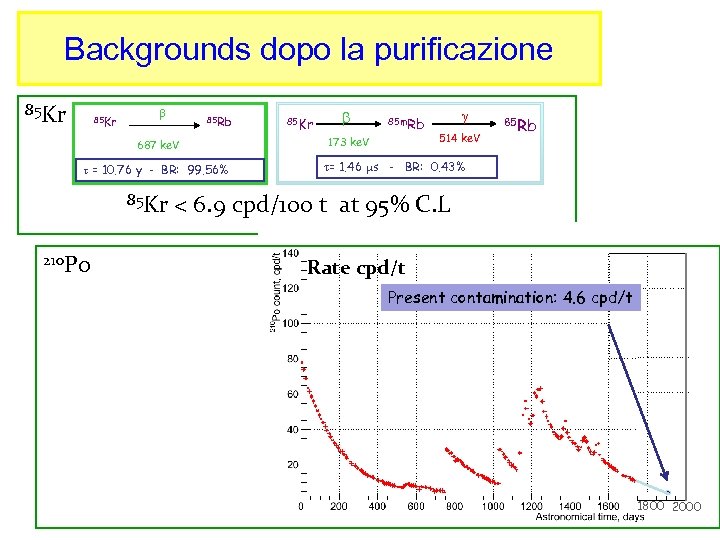
Backgrounds dopo la purificazione 85 Kr b 85 Rb 687 ke. V = 10. 76 y - BR: 99. 56% 85 Kr 210 Po 85 Kr b 85 m. Rb 173 ke. V g 514 ke. V 85 Rb = 1. 46 ms - BR: 0. 43% < 6. 9 cpd/100 t at 95% C. L Rate cpd/t Present contamination: 4. 6 cpd/t 17 1800 2000
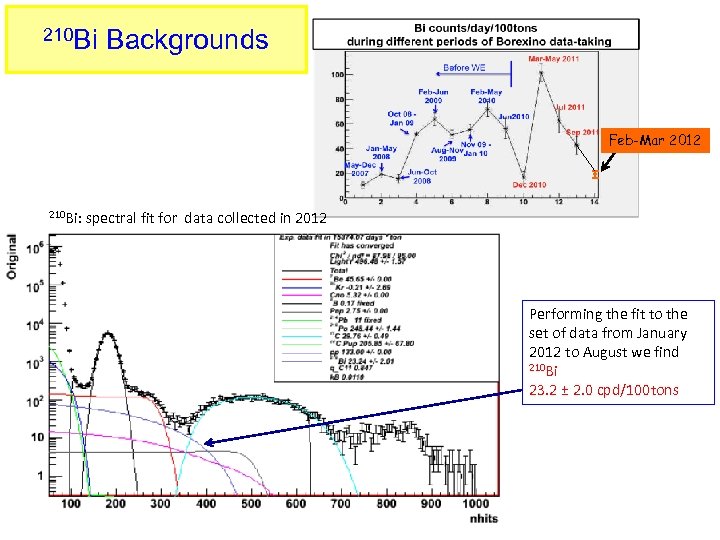
210 Bi Backgrounds Feb-Mar 2012 210 Bi: spectral fit for data collected in 2012 Performing the fit to the set of data from January 2012 to August we find 210 Bi 23. 2 ± 2. 0 cpd/100 tons
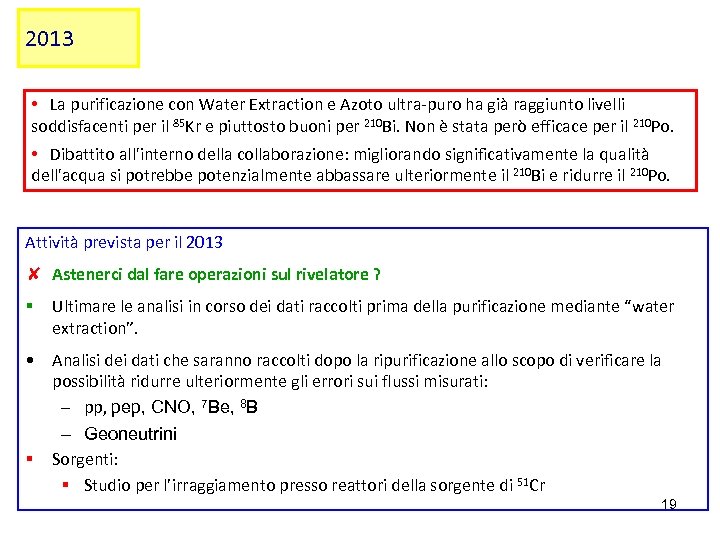
2013 • La purificazione con Water Extraction e Azoto ultra-puro ha già raggiunto livelli soddisfacenti per il 85 Kr e piuttosto buoni per 210 Bi. Non è stata però efficace per il 210 Po. • Dibattito all'interno della collaborazione: migliorando significativamente la qualità dell'acqua si potrebbe potenzialmente abbassare ulteriormente il 210 Bi e ridurre il 210 Po. Attività prevista per il 2013 ✘ Astenerci dal fare operazioni sul rivelatore ? § Ultimare le analisi in corso dei dati raccolti prima della purificazione mediante “water extraction”. • Analisi dei dati che saranno raccolti dopo la ripurificazione allo scopo di verificare la possibilità ridurre ulteriormente gli errori sui flussi misurati: – pp, pep, CNO, 7 Be, 8 B – Geoneutrini § Sorgenti: § Studio per l’irraggiamento presso reattori della sorgente di 51 Cr 19
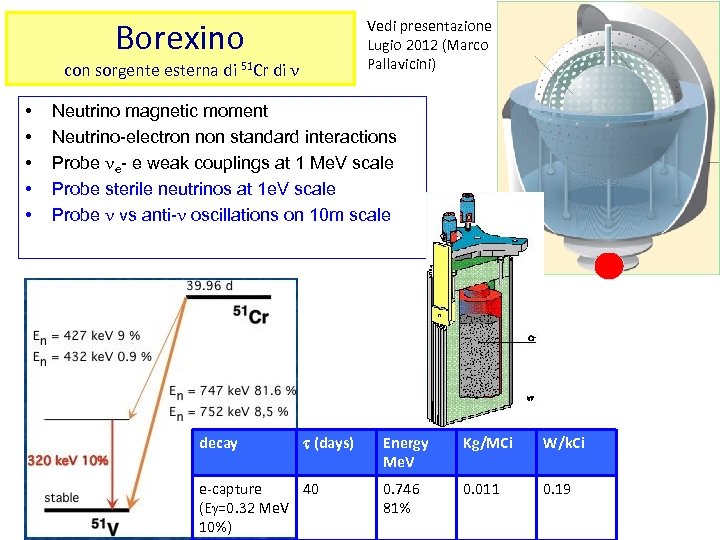
Borexino Vedi presentazione Lugio 2012 (Marco Pallavicini) con sorgente esterna di 51 Cr di n • • • Neutrino magnetic moment Neutrino-electron non standard interactions Probe ne- e weak couplings at 1 Me. V scale Probe sterile neutrinos at 1 e. V scale Probe n vs anti-n oscillations on 10 m scale decay t (days) e-capture 40 (Eg=0. 32 Me. V 10%) Energy Me. V Kg/MCi W/k. Ci 0. 746 81% 0. 011 0. 19
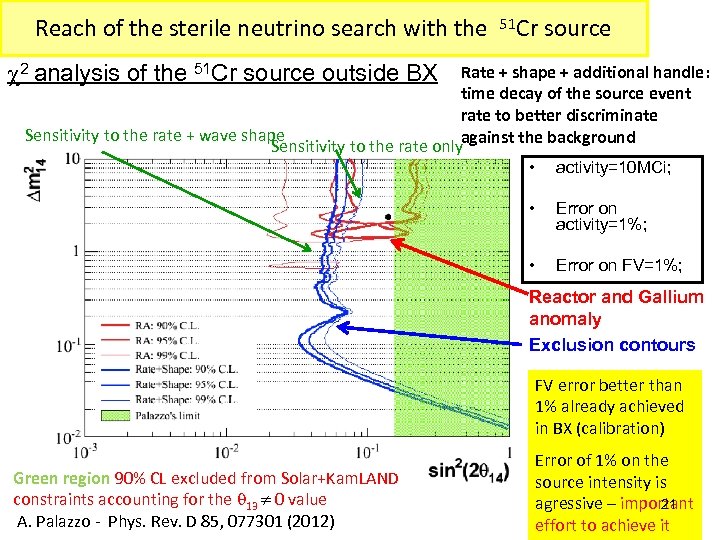
Reach of the sterile neutrino search with the 51 Cr source 2 analysis of the 51 Cr source outside BX Rate + shape + additional handle: time decay of the source event rate to better discriminate Sensitivity to the rate + wave shape against the background Sensitivity to the rate only • activity=10 MCi; • Error on activity=1%; • Error on FV=1%; Reactor and Gallium anomaly Exclusion contours FV error better than 1% already achieved in BX (calibration) Green region 90% CL excluded from Solar+Kam. LAND constraints accounting for the 13 0 value A. Palazzo - Phys. Rev. D 85, 077301 (2012) Error of 1% on the source intensity is 21 agressive – important effort to achieve it
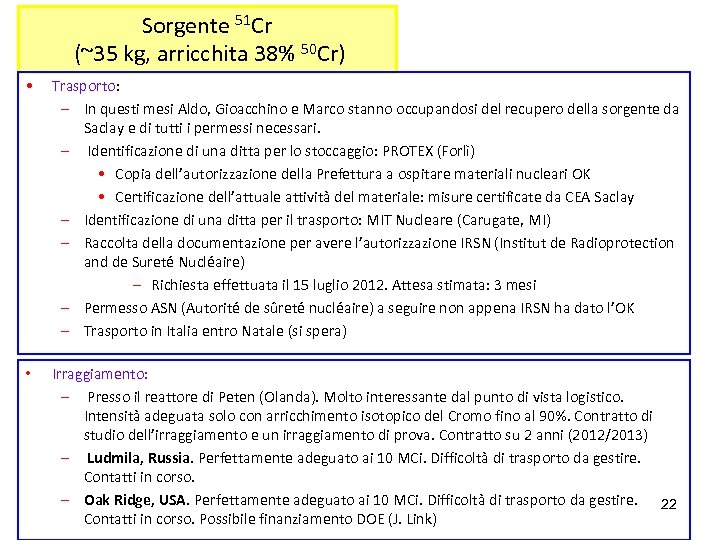
Sorgente 51 Cr (~35 kg, arricchita 38% 50 Cr) • Trasporto: – In questi mesi Aldo, Gioacchino e Marco stanno occupandosi del recupero della sorgente da Saclay e di tutti i permessi necessari. – Identificazione di una ditta per lo stoccaggio: PROTEX (Forlì) • Copia dell’autorizzazione della Prefettura a ospitare materiali nucleari OK • Certificazione dell’attuale attività del materiale: misure certificate da CEA Saclay – Identificazione di una ditta per il trasporto: MIT Nucleare (Carugate, MI) – Raccolta della documentazione per avere l’autorizzazione IRSN (Institut de Radioprotection and de Sureté Nucléaire) – Richiesta effettuata il 15 luglio 2012. Attesa stimata: 3 mesi – Permesso ASN (Autorité de sûreté nucléaire) a seguire non appena IRSN ha dato l’OK – Trasporto in Italia entro Natale (si spera) • Irraggiamento: – Presso il reattore di Peten (Olanda). Molto interessante dal punto di vista logistico. Intensità adeguata solo con arricchimento isotopico del Cromo fino al 90%. Contratto di studio dell’irraggiamento e un irraggiamento di prova. Contratto su 2 anni (2012/2013) – Ludmila, Russia. Perfettamente adeguato ai 10 MCi. Difficoltà di trasporto da gestire. Contatti in corso. – Oak Ridge, USA. Perfettamente adeguato ai 10 MCi. Difficoltà di trasporto da gestire. 22 Contatti in corso. Possibile finanziamento DOE (J. Link)
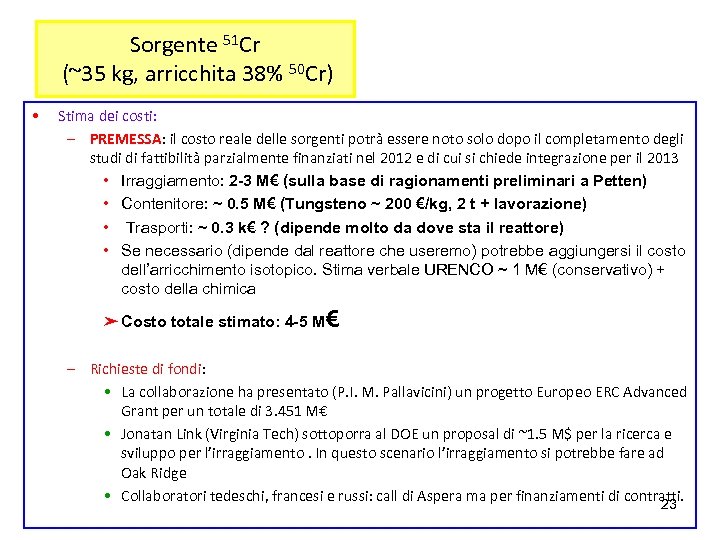
Sorgente 51 Cr (~35 kg, arricchita 38% 50 Cr) • Stima dei costi: – PREMESSA: il costo reale delle sorgenti potrà essere noto solo dopo il completamento degli studi di fattibilità parzialmente finanziati nel 2012 e di cui si chiede integrazione per il 2013 • Irraggiamento: 2 -3 M€ (sulla base di ragionamenti preliminari a Petten) • Contenitore: ~ 0. 5 M€ (Tungsteno ~ 200 €/kg, 2 t + lavorazione) • Trasporti: ~ 0. 3 k€ ? (dipende molto da dove sta il reattore) • Se necessario (dipende dal reattore che useremo) potrebbe aggiungersi il costo dell’arricchimento isotopico. Stima verbale URENCO ~ 1 M€ (conservativo) + costo della chimica ➤ Costo totale stimato: 4 -5 M€ – Richieste di fondi: • La collaborazione ha presentato (P. I. M. Pallavicini) un progetto Europeo ERC Advanced Grant per un totale di 3. 451 M€ • Jonatan Link (Virginia Tech) sottoporra al DOE un proposal di ~1. 5 M$ per la ricerca e sviluppo per l’irraggiamento. In questo scenario l’irraggiamento si potrebbe fare ad Oak Ridge • Collaboratori tedeschi, francesi e russi: call di Aspera ma per finanziamenti di contratti. 23
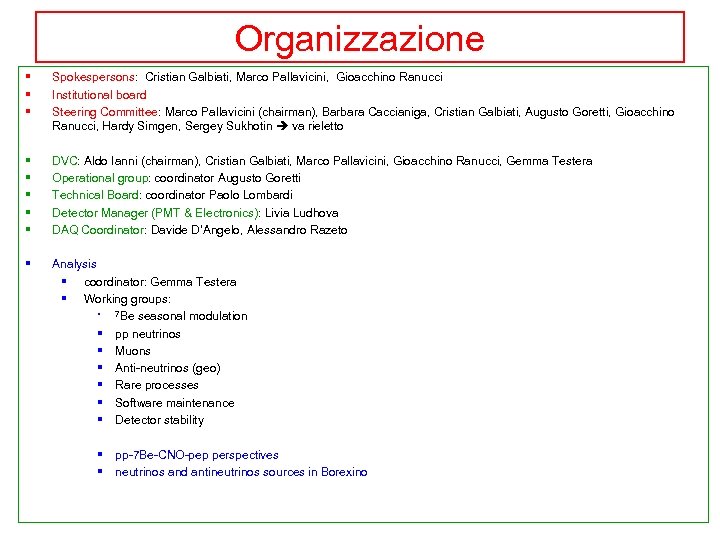
Organizzazione § § § Spokespersons: Cristian Galbiati, Marco Pallavicini, Gioacchino Ranucci Institutional board Steering Committee: Marco Pallavicini (chairman), Barbara Caccianiga, Cristian Galbiati, Augusto Goretti, Gioacchino Ranucci, Hardy Simgen, Sergey Sukhotin va rieletto § § § DVC: Aldo Ianni (chairman), Cristian Galbiati, Marco Pallavicini, Gioacchino Ranucci, Gemma Testera Operational group: coordinator Augusto Goretti Technical Board: coordinator Paolo Lombardi Detector Manager (PMT & Electronics): Livia Ludhova DAQ Coordinator: Davide D’Angelo, Alessandro Razeto § Analysis § coordinator: Gemma Testera § Working groups: § 7 Be seasonal modulation § pp neutrinos § Muons § Anti-neutrinos (geo) § Rare processes § Software maintenance § Detector stability § pp-7 Be-CNO-pep perspectives § neutrinos and antineutrinos sources in Borexino
Скачать презентацию Borexino Status report and results Rivelatore Purificazione
e70b5e05aa85159ea1e402bc0c41d02b.ppt