 Скачать презентацию Border to Border Transportation Conference 2007 April 2007
d6bf1a400de47df6ea2f6fae4d5cd34d.ppt
- Количество слайдов: 21



Border to Border Transportation Conference 2007 April 2007
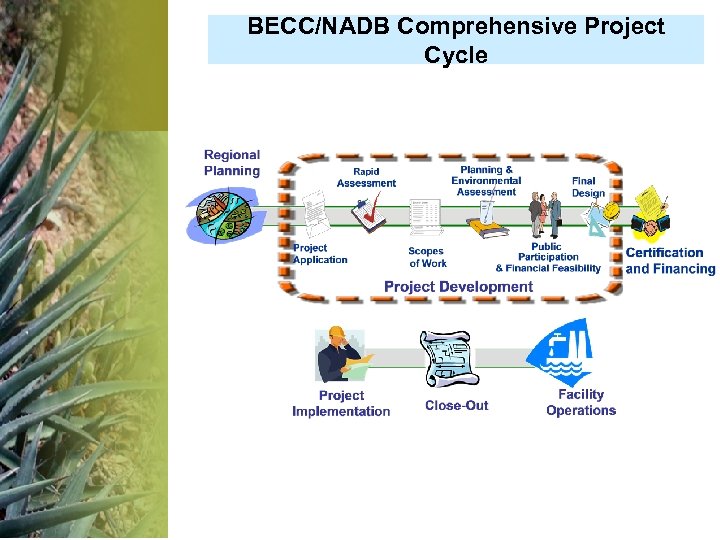
BECC Overview • Our Mission • Mandated Scope • Certification Criteria • Comprehensive Project Cycle • Expertise and Services
Our Mission BECC works to preserve, protect and enhance human health and the environment of the U. S. - Mexico border region, by strengthening cooperation among interested parties and supporting sustainable projects through a transparent binational process in close coordination with the NADB, federal, state and local agencies, the private sector, and civil society.
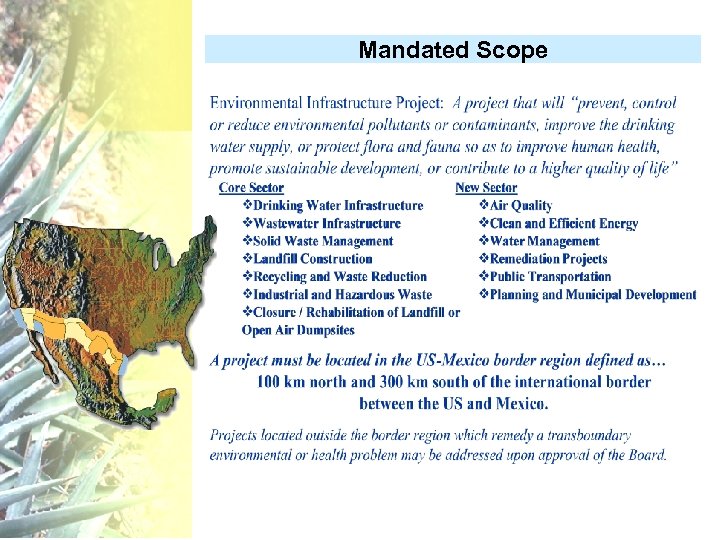
Mandated Scope
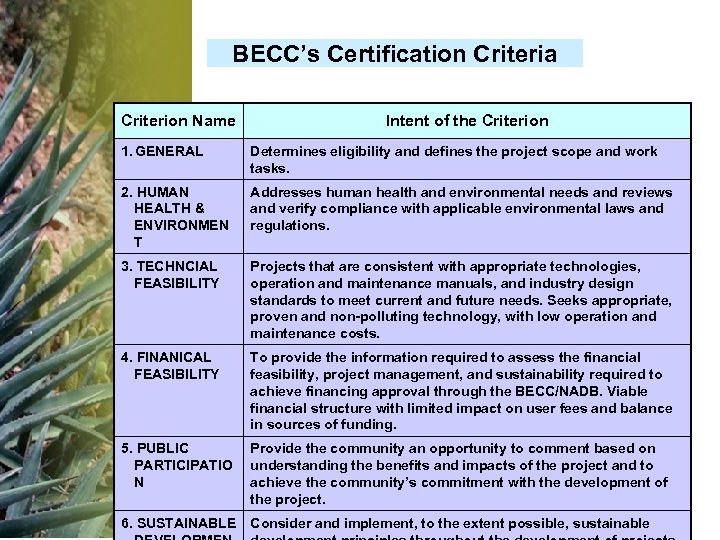
BECC’s Certification Criteria Criterion Name Intent of the Criterion 1. GENERAL Determines eligibility and defines the project scope and work tasks. 2. HUMAN HEALTH & ENVIRONMEN T Addresses human health and environmental needs and reviews and verify compliance with applicable environmental laws and regulations. 3. TECHNCIAL FEASIBILITY Projects that are consistent with appropriate technologies, operation and maintenance manuals, and industry design standards to meet current and future needs. Seeks appropriate, proven and non-polluting technology, with low operation and maintenance costs. 4. FINANICAL FEASIBILITY To provide the information required to assess the financial feasibility, project management, and sustainability required to achieve financing approval through the BECC/NADB. Viable financial structure with limited impact on user fees and balance in sources of funding. 5. PUBLIC PARTICIPATIO N Provide the community an opportunity to comment based on understanding the benefits and impacts of the project and to achieve the community’s commitment with the development of the project. 6. SUSTAINABLE Consider and implement, to the extent possible, sustainable
BECC/NADB Comprehensive Project Cycle
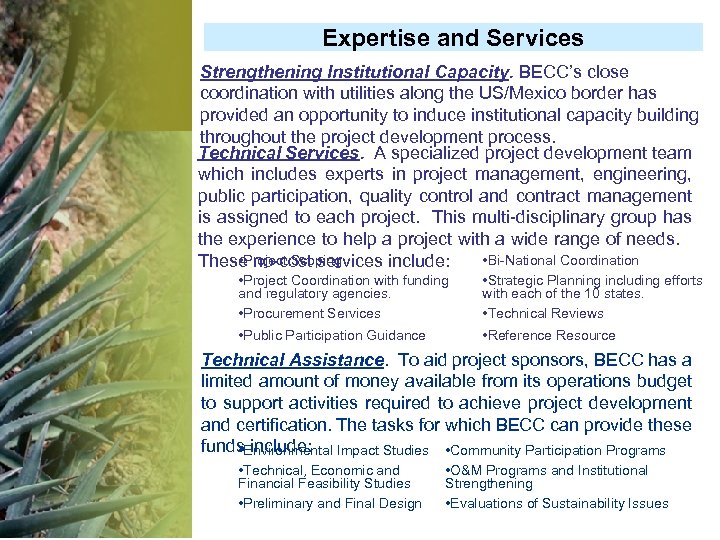
Expertise and Services Strengthening Institutional Capacity. BECC’s close coordination with utilities along the US/Mexico border has provided an opportunity to induce institutional capacity building throughout the project development process. Technical Services. A specialized project development team which includes experts in project management, engineering, public participation, quality control and contract management is assigned to each project. This multi-disciplinary group has the experience to help a project with a wide range of needs. • Project Scoping • Bi-National Coordination These no-cost services include: • Project Coordination with funding and regulatory agencies. • Procurement Services • Public Participation Guidance • Strategic Planning including efforts with each of the 10 states. • Technical Reviews • Reference Resource Technical Assistance. To aid project sponsors, BECC has a limited amount of money available from its operations budget to support activities required to achieve project development and certification. The tasks for which BECC can provide these funds. Environmental Impact Studies • Community Participation Programs • include: • Technical, Economic and Financial Feasibility Studies • Preliminary and Final Design • O&M Programs and Institutional Strengthening • Evaluations of Sustainability Issues
Border Accomplishments • BECC in a Nutshell • Technical Assistance • Certified Projects • Paving Projects • Highway and Bridges Projects • Smartway
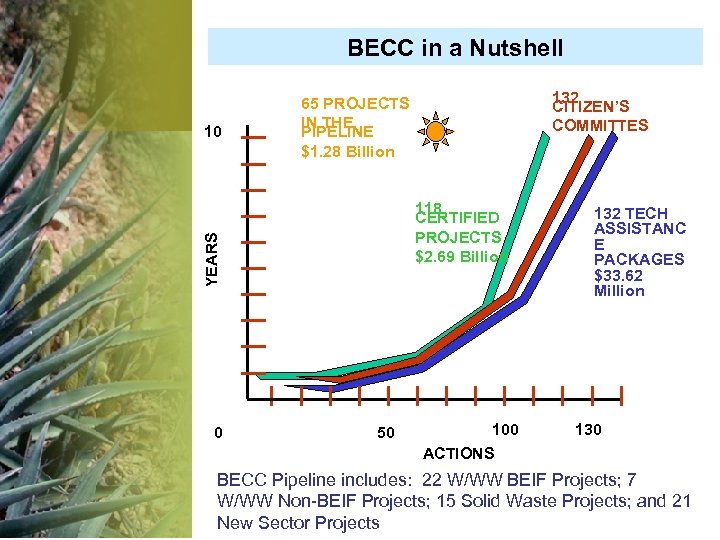
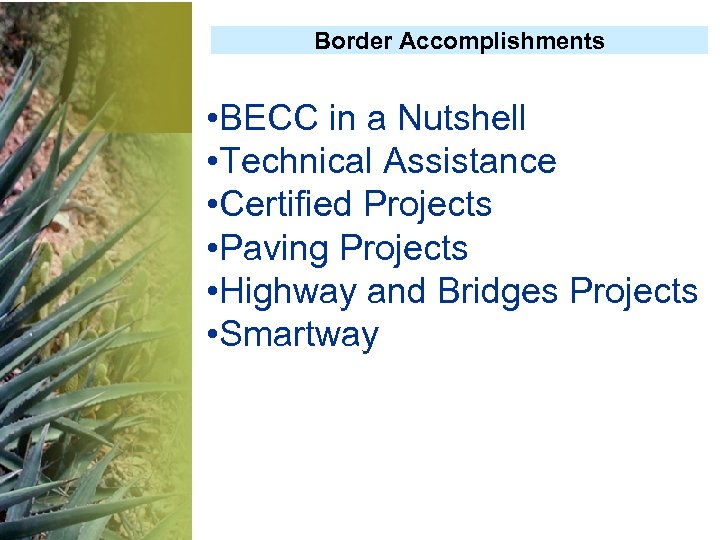
BECC in a Nutshell 118 CERTIFIED PROJECTS $2. 69 Billion YEARS 10 0 132 CITIZEN’S COMMITTES 65 PROJECTS IN THE PIPELINE $1. 28 Billion 50 100 ACTIONS 132 TECH ASSISTANC E PACKAGES $33. 62 Million 130 BECC Pipeline includes: 22 W/WW BEIF Projects; 7 W/WW Non-BEIF Projects; 15 Solid Waste Projects; and 21 New Sector Projects
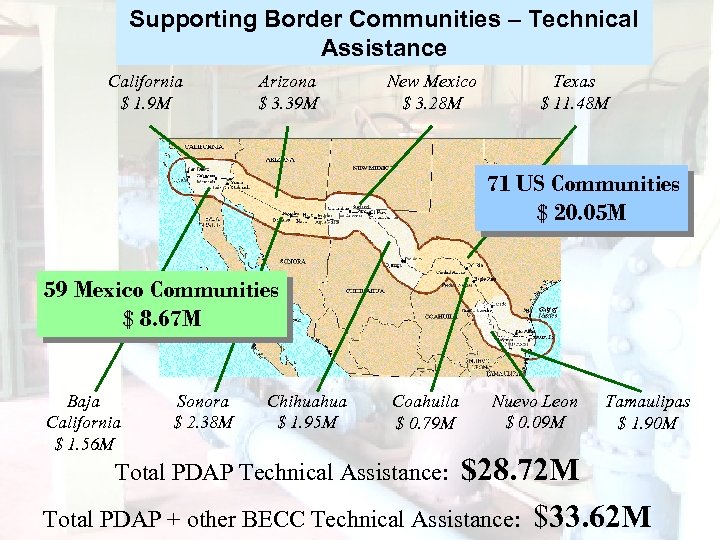
Supporting Border Communities – Technical Assistance California $ 1. 9 M Arizona $ 3. 39 M New Mexico $ 3. 28 M Texas $ 11. 48 M 71 US Communities $ 20. 05 M 59 Mexico Communities $ 8. 67 M Baja California $ 1. 56 M Sonora $ 2. 38 M Chihuahua $ 1. 95 M Coahuila $ 0. 79 M Nuevo Leon $ 0. 09 M Tamaulipas $ 1. 90 M $28. 72 M Total PDAP + other BECC Technical Assistance: $33. 62 M Total PDAP Technical Assistance:
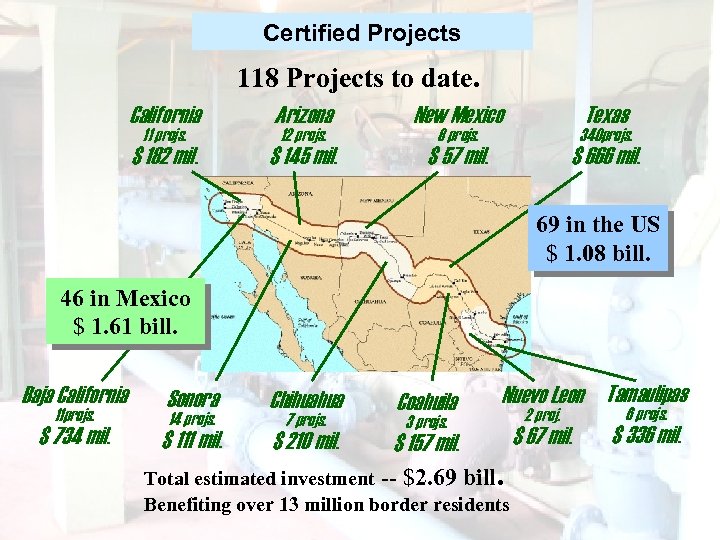
Certified Projects 118 Projects to date. California Arizona New Mexico $ 182 mil. $ 145 mil. $ 57 mil. 11 projs. 12 projs. Texas 8 projs. 340 projs. $ 666 mil. 69 in the US $ 1. 08 bill. 46 in Mexico $ 1. 61 bill. Baja California 11 projs. $ 734 mil. Sonora 14 projs. $ 111 mil. Chihuahua Coahuila $ 210 mil. Nuevo Leon Tamaulipas $ 157 mil. 7 projs. 2 proj. 3 projs. $ 67 mil. . Total estimated investment -- $2. 69 bill Benefiting over 13 million border residents 6 projs. $ 336 mil.
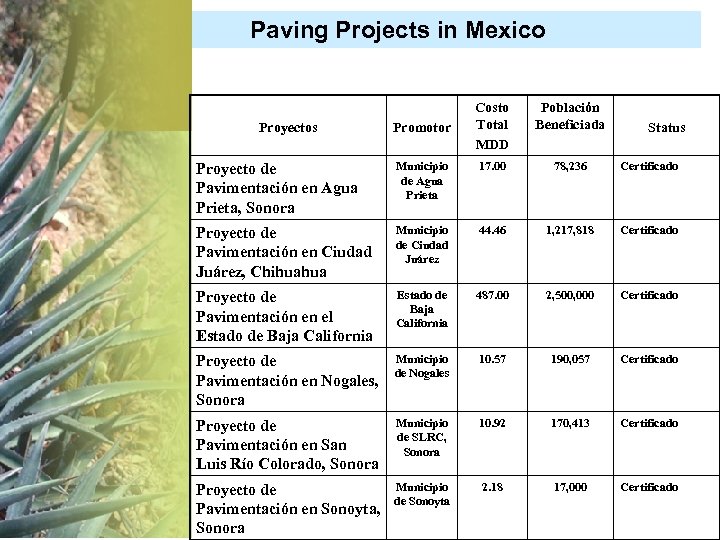
Paving Projects in Mexico Proyectos Promotor Costo Total MDD Población Beneficiada Status Proyecto de Pavimentación en Agua Prieta, Sonora Municipio de Agua Prieta 17. 00 78, 236 Certificado Proyecto de Pavimentación en Ciudad Juárez, Chihuahua Municipio de Ciudad Juárez 44. 46 1, 217, 818 Certificado Proyecto de Pavimentación en el Estado de Baja California 487. 00 2, 500, 000 Certificado Proyecto de Pavimentación en Nogales, Sonora Municipio de Nogales 10. 57 190, 057 Certificado Proyecto de Pavimentación en San Luis Río Colorado, Sonora Municipio de SLRC, Sonora 10. 92 170, 413 Certificado Proyecto de Pavimentación en Sonoyta, Sonora Municipio de Sonoyta 2. 18 17, 000 Certificado
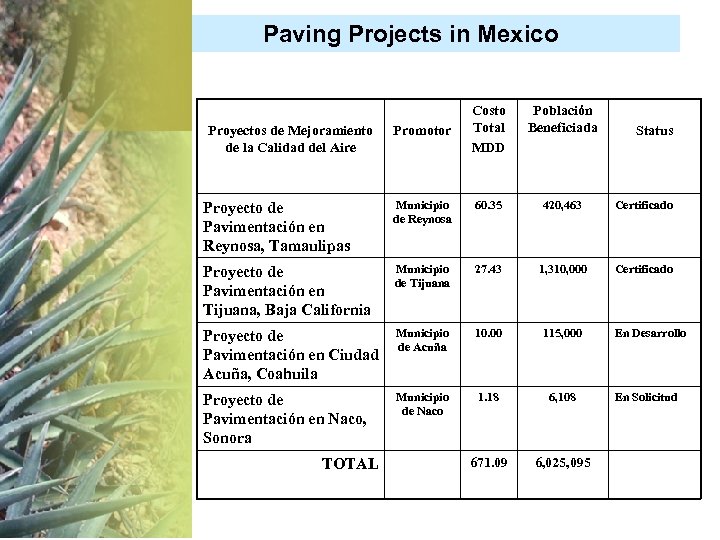
Paving Projects in Mexico Proyectos de Mejoramiento de la Calidad del Aire Promotor Costo Total MDD Población Beneficiada Status Proyecto de Pavimentación en Reynosa, Tamaulipas Municipio de Reynosa 60. 35 420, 463 Certificado Proyecto de Pavimentación en Tijuana, Baja California Municipio de Tijuana 27. 43 1, 310, 000 Certificado Proyecto de Pavimentación en Ciudad Acuña, Coahuila Municipio de Acuña 10. 00 115, 000 Proyecto de Pavimentación en Naco, Sonora Municipio de Naco 1. 18 6, 108 671. 09 6, 025, 095 TOTAL En Desarrollo En Solicitud
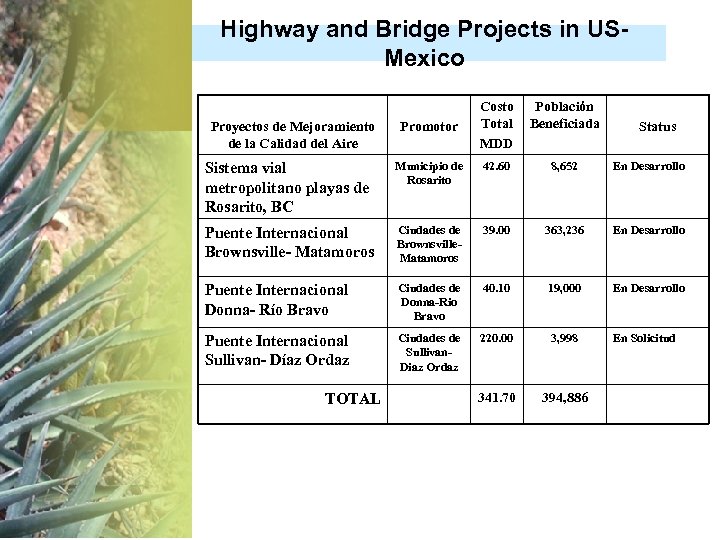
Highway and Bridge Projects in USMexico Proyectos de Mejoramiento de la Calidad del Aire Promotor Costo Total MDD Población Beneficiada Status Sistema vial metropolitano playas de Rosarito, BC Municipio de Rosarito 42. 60 8, 652 En Desarrollo Puente Internacional Brownsville- Matamoros Ciudades de Brownsville. Matamoros 39. 00 363, 236 En Desarrollo Puente Internacional Donna- Río Bravo Ciudades de Donna-Rio Bravo 40. 10 19, 000 En Desarrollo Puente Internacional Sullivan- Díaz Ordaz Ciudades de Sullivan. Diaz Ordaz 220. 00 3, 998 En Solicitud 341. 70 394, 886 TOTAL
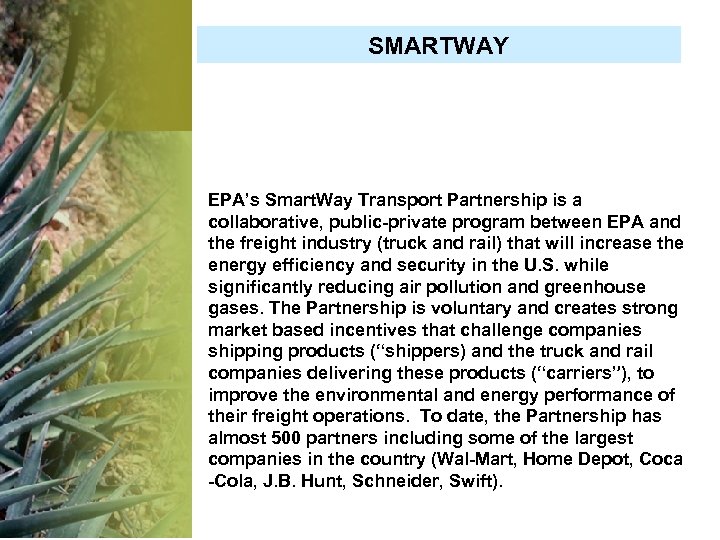
SMARTWAY EPA’s Smart. Way Transport Partnership is a collaborative, public-private program between EPA and the freight industry (truck and rail) that will increase the energy efficiency and security in the U. S. while significantly reducing air pollution and greenhouse gases. The Partnership is voluntary and creates strong market based incentives that challenge companies shipping products (“shippers) and the truck and rail companies delivering these products (“carriers”), to improve the environmental and energy performance of their freight operations. To date, the Partnership has almost 500 partners including some of the largest companies in the country (Wal-Mart, Home Depot, Coca -Cola, J. B. Hunt, Schneider, Swift).
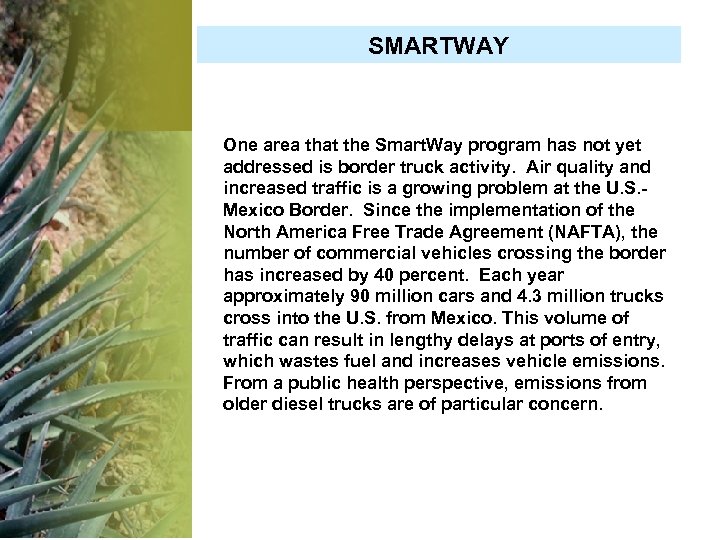
SMARTWAY One area that the Smart. Way program has not yet addressed is border truck activity. Air quality and increased traffic is a growing problem at the U. S. Mexico Border. Since the implementation of the North America Free Trade Agreement (NAFTA), the number of commercial vehicles crossing the border has increased by 40 percent. Each year approximately 90 million cars and 4. 3 million trucks cross into the U. S. from Mexico. This volume of traffic can result in lengthy delays at ports of entry, which wastes fuel and increases vehicle emissions. From a public health perspective, emissions from older diesel trucks are of particular concern.
SMARTWAY EPA’s Smart. Way Transport Partnership has begun exploring ways to reduce emissions and conserve fuel from border trucks. This approach involves identifying shipping companies that arrange to send goods across the border (northbound) and the trucking companies that actually carry the goods across the border. Traditionally, the Smart. Way program recruits shipping companies into the program through a partnership agreement, and shippers agree to ship 50% or more of their goods with trucking companies that meet Smart. Way’s truck goals (trucking companies are also recruited separately). Smart. Way truck goals involve adopting technologies that have been proven to conserve fuel and reduce emissions, such as: idle reduction, trailer aerodynamics, wide-based tires, and exhaust after-treatment devices (e. g. , particulate matter filter). However, these technologies are more effective for long haul trucking operations. Border (or drayage) trucks typically operate on shorter routes and lower speeds, and may not benefit from idle control and trailer
SMARTWAY Due to the complicated nature of border truck crossings, a combination of technologies and strategies is necessary to reduce emissions from border fleet operations. EPA is interested in exploring the feasibility of the following approaches to comprise the Smart. Way Border Truck Upgrade Kit. Technology Solutions • Aluminum Wheels for Single Wide Tires, low-rolling resistance tires, or upgrade to radial tires if using older polyester tires. • Low-viscosity lubricants in rear chassis axle, transmission, and low-viscosity crankcase oil. • Larger Capacity Trailers - Double and Triples. • We believe that the single, most effective strategy for Diesel particulate matter filter and ultra low sulfur diesel • reducing emissions from border trucks is to provide a **Retrofit or replacement of older engines (pre MY 1990) financial incentive for the truck owner to scrap their pre -1990 truck and buy a used truck between 1994 -present. For example, a used model year 2000 truck costs $40 K in the U. S. We believe an appropriate financial incentive would be a loan or grant to cover at least 50% of the purchase price of a newer, used truck.
SMARTWAY Strategy Solutions • Participate in the U. S. Customs and Border Protection’s Free and Secure Trade (FAST) Program. • Use of e. Manifests and transponders to streamline Customs paperwork submissions • Reduce empty truck crossings • Shift to intermodal operations • Engine maintenance program • Operate during off-peak hours, when possible Incentive Opportunities Trucking companies that implement of Smart. Way technologies and strategies identified above will accrue a benefit based on fuel savings. However, the initial cost expenditure for some of the technologies and strategies ranges from $10, 000$20, 000 per truck. As is often the case, many trucking companies committed to border activity lack the capital to purchase and/or participate in the technologies and strategies.
SMARTWAY We are exploring innovative, market-based and sustainable means to allow trucking companies to purchase Smart. Way. In the U. S. , we are working with banks and other financial institutions to offer zerointerest, low-interest, and revolving loan accounts for truck owners interested in purchasing Smart. Way technologies. For Mexican based fleets, we are looking for the certification by BECC in order to have access to the loan program managed by the North American Development Bank as a means to assist Mexican based companies with their participation in the Smart. Way program. We are committed to recruiting Mexican based shipping companies (exporters to U. S. ), and when these Mexican shipping companies join and commit to shipping 50% or more of their goods on Smart. Way qualified carriers, their Mexican trucking companies will need to purchase Smart. Way technologies or participate in programs like the FAST lane program. BECC and the NADBank are developing a program whereby attractive loan packages that can be offered
Thank You
Скачать презентацию Border to Border Transportation Conference 2007 April 2007
d6bf1a400de47df6ea2f6fae4d5cd34d.ppt