 Скачать презентацию Border Gateway Protocol — An Introduction Network Routing
402a5552cd0ffbbfd329f51e3305482a.ppt
- Количество слайдов: 102



Border Gateway Protocol - An Introduction Network Routing class Jim Binkley 1
outline u overview/theory – history/topologies/2 kinds of BGP/basic idea as DV protocol/important ideas u protocol u database, IBGP issues, policy tricks, Cisco config minimal intro u problems including flapping/security Jim Binkley 2
bibliography u rfc 1771, “A Border Gateway Protocol 4”, Yakov Rekhter, and Tony Li, 1995 u rfcs 1772 -1774 related, other BGP rfcs exist u Books: – Moy’s OSPF has a very good overview chapter – “Internet Routing Architectures”, Halabi, Cisco Press, title should be “Fun with BGP” » entire book about BGP basically – IP Routing Protocols - U. Black, has a chapter – Huitema of course and Perlman, 2 nd edition for a little Jim Binkley contrarian thinking 3
more RFCs (which can be state of the art in this case) u 1657 - BGP MIB (SMIv 2) - 1994 u 2385 - Protection of BGP Sessions Via the TCP/MD 5 Signature Option, Heffernan, 1998 u 2595 - Use of BGP-4 Multi-protocol Extensions for IPv 6 Inter-Domain Routing u 2858 - Multi-protocol Extensions for BGP-4, Bates, et. al, June 2000 u route reflection/confederation/communities/ flapping as well + probably something else Jimu rfc 3221 - recent experience (growth of table/s)4 Binkley
history u GGP - gateway to gateway (you knew that? ) - DV IGP used in ARPANET – had 2 out of 4 echo to learn if peer existed – explicit ACK of update u EGP - an EGP!, NSFNET time period – net had to be strictly hierarchical, no loops – metric-less since there could not be 2 paths u IDRP - “i drip, you drip, we all drip”, OSI BGP equivalent, had influence on BGP Jimu and one more. . . (next slide) Binkley 5
history, cont u IDPR - Martha Steenstrup, RFC 1479 – LS EGP, competition for awhile with BGP » again with IPv 6, deja vu all over again – not hop by hop, but source route – initial router determines path to other side – can thus enforce arbitrary policies » go to X, then Y, then turn left, you are at Grandma’s – call this “flow setup” : -> ? – considering MPLS, there may be some irony here Jim Binkley 6
BGP history u some EGP problems drove BGP design – needed to tolerate multiple paths and choose – early policy experiments aided evolution u BGP-4 as BGP-3 did not speak CIDR u multi-protocol BGP recently introduced – can deliver IPv 6 info – can deliver multicast group info and perform RPF function for “uber” PIM/SM Jim Binkley 7
basic idea “use TCP” u we use TCP between BGP peers, call the peers speakers (2 peers), port 179 – BGP is vc oriented, pt. /pt. pair-wise, unicast u TCP handles many of the error problems, hence BGP can be simpler – and stream data – don’t need our own reliable protocol, etc – can be multi-hop if that makes sense Jim Binkley 8
two kinds of BGP u External BGP, EBGP - exterior BGP connection between two separate AS – typically have direct link connection – over a T 1, T 3, OC-xyzzy, Ethernet segment – since two AS/two admins collide, this may take » lawyers, and contracts, and money u Internal BGP, IBGP - internal to AS – may be multi-hop – may need to send BGP updates across the AS Jim Binkley 9
how do we get reachability? u external BGP - usually same link – manually configured on some telco links – if same ethernet segment, ARP will do it for us u internal BGP - may be multi-hop – if so, rely on IGP to get the job done » note: BGP control and routed packets (data) – of course, that could include static routing – IGP/EGP convergence problem - touch on this later Jim Binkley 10
topologies u transit network - packets are routed thru it, may not source/sink – multiple external and internal BGP peers – likely to have full Inet routing table (>=75 k) u multi-homed stub – stub does not have transit packets, src/sink only – > one way out - may be for redundancy – needs AS number u single stub - one way out only – doesn’t need AS or BGP for that matter Jim Binkley 11
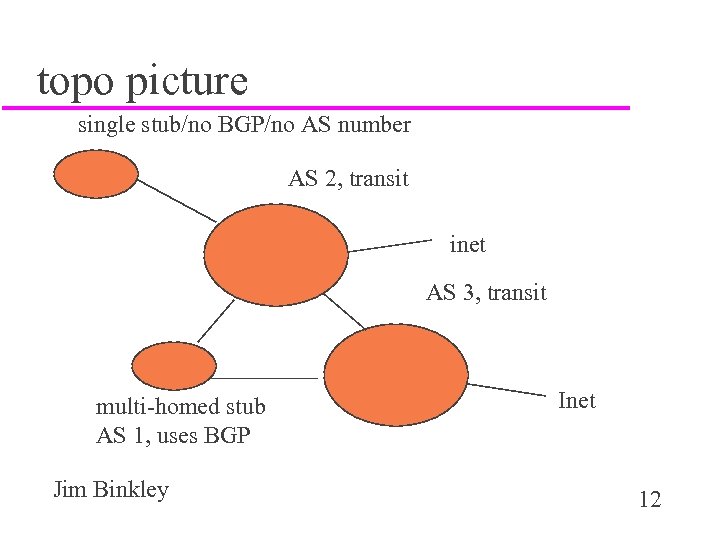
topo picture single stub/no BGP/no AS number AS 2, transit inet AS 3, transit multi-homed stub AS 1, uses BGP Jim Binkley Inet 12
stub routing (no need for BGP) u 1. simply use static route u 2. get default route dynamically using IGP, RIP, OSPF, whatever from ISP/transit u 3. use BGP (training-wheel version) – likely to have fake AS, private AS numbers exist, and ISP/transit system can simply not advertise them, instead make stub appear as part of its AS routing space Jim Binkley 13
BGP as routing protocol u Distance-Vector with a twist u basic BGP logical update consists of: – (ip network(D), subnet mask, “attributes”) – this is oversimplified, deal with this later in protocol u we make routing decisions based on attributes (multiple) + manual configuration, however u one attribute is the Vector; i. e. , the AS path expressed as a complete source route of AS u (to net 111. 0. 0. 0, via AS 1, 2, 3, 4, 5) Jim Binkley 14
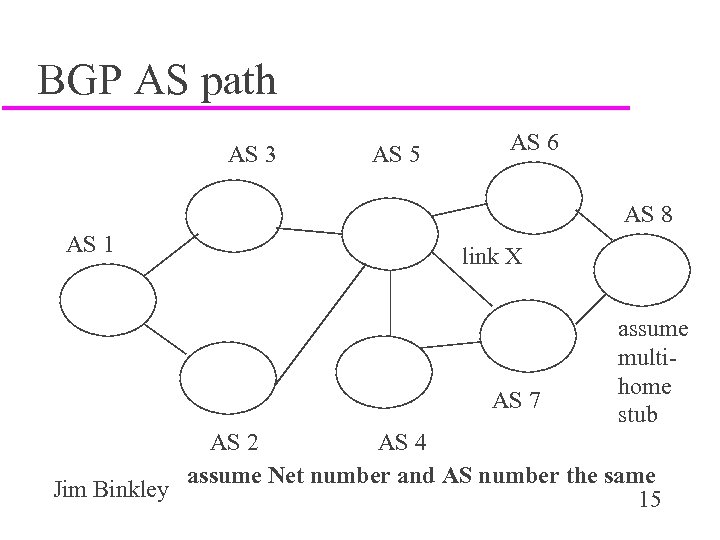
BGP AS path AS 3 AS 5 AS 6 AS 8 AS 1 link X AS 7 assume multihome stub AS 2 AS 4 assume Net number and AS number the same Jim Binkley 15
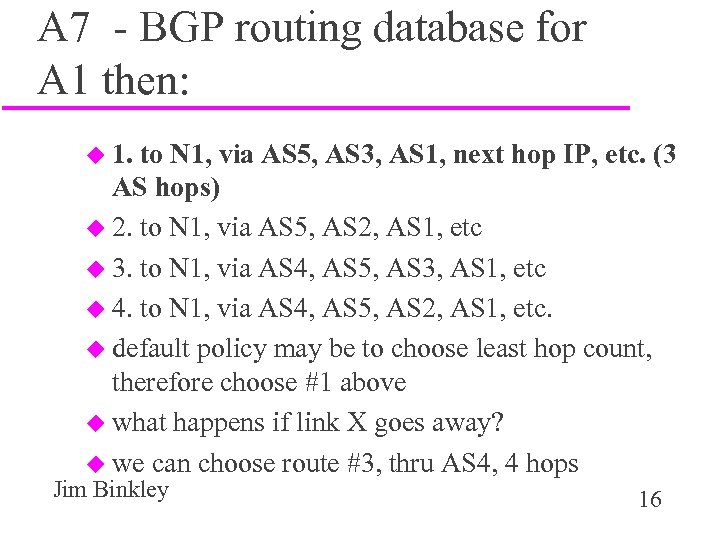
A 7 - BGP routing database for A 1 then: u 1. to N 1, via AS 5, AS 3, AS 1, next hop IP, etc. (3 AS hops) u 2. to N 1, via AS 5, AS 2, AS 1, etc u 3. to N 1, via AS 4, AS 5, AS 3, AS 1, etc u 4. to N 1, via AS 4, AS 5, AS 2, AS 1, etc. u default policy may be to choose least hop count, therefore choose #1 above u what happens if link X goes away? u we can choose route #3, thru AS 4, 4 hops Jim Binkley 16
route UPDATES u note that as route is forwarded, one’s own AS is prepended u e. g. , AS 3 update about AS 1 to AS 5 – input AS 1, output AS 3, AS 1 u this gives us a metric and it helps us remain loopfree at layer 3 – and handle loops at layer 2 u simple rule: if you see yourself in the AS path, that’s a loop, (and an error) Jim Binkley 17
BGP is not RIP u does not send entire routing table every N seconds – sends full routing table at boot (good thing about TCP) – only sends updates upon change (new or withdrawals) u does not do count to infinity – stores multiple paths in database (RIB) and can choose new one if available – and know topology because of AS path (can’t fool me) u routing updates may be chosen on best hop count in terms of # of AS, a default metric therefore Jim Binkley (more on policy in a bit) exists 18
e. g. , back at AS path picture u if using RIP, AS 2 might be told by AS 1, AS 3, is one hop, therefore AS 2 might tell AS 1, AS 3 is two hops – but mean two hops thru A 1 ? ! u with BGP, AS 1 sends route AS 1, AS 3 – AS 1 will not accept AS 2, AS 1, AS 3 from AS 2 Jim Binkley 19
however - regarding policy routing u routing choices may be made on basis of “policy” – policy mechanism not as flexible as arbitrary src routing, as a simplification for now, you can: – ignore routes or some routes from A – send all or some routes to B (or none) – policy based on IP address, AS number/path or Communities (sets of routes), and/or BGP attributes – and manual configuration choices about same Jim Binkley 20
NSFNET u as sole Inet backbone u way back when, got us thinking about this u Acceptable Use Policy: – not ok for business to use govt. funded net – therefore business had to somehow tunnel around it u another Jim Binkley possibility: don’t make silly rules 21
policy routing and BGP u we might distinguish policy-in-the-large and policy-in-the-small u e. g. , IDPR was after end to end policies – not clear how to administer though (more lawyers) u BGP can’t do that, so let’s admit it and move on u your policy affects this router or your set of routers in your AS – you can only hack at other people’s policies. . . u essentially Jim Binkley manual and locally configured 22
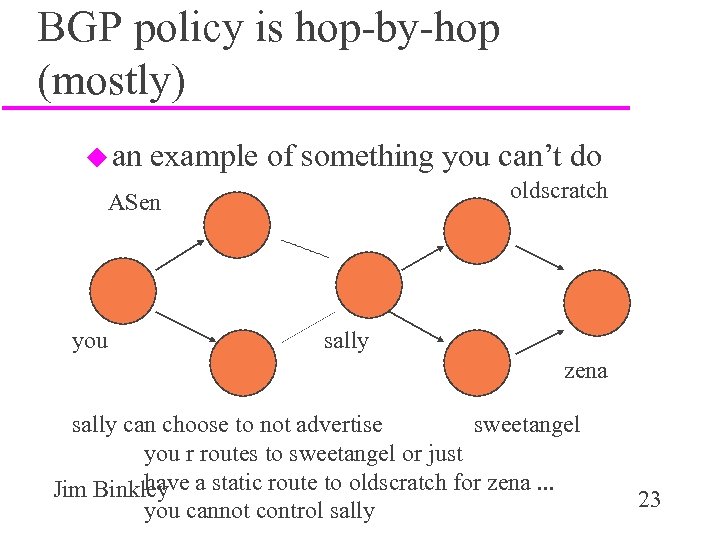
BGP policy is hop-by-hop (mostly) u an example of something you can’t do oldscratch ASen you sally zena sally can choose to not advertise sweetangel you r routes to sweetangel or just have Jim Binkley a static route to oldscratch for zena. . . you cannot control sally 23
one other little item - asymmetric routes u in the preceeding slide we wanted to route thru sweetangel to zena u but got routed thru oldscratch u zena might have a default route thru sweetangel u thus paths could be asymmetric u this is not unusual Jim Binkley 24
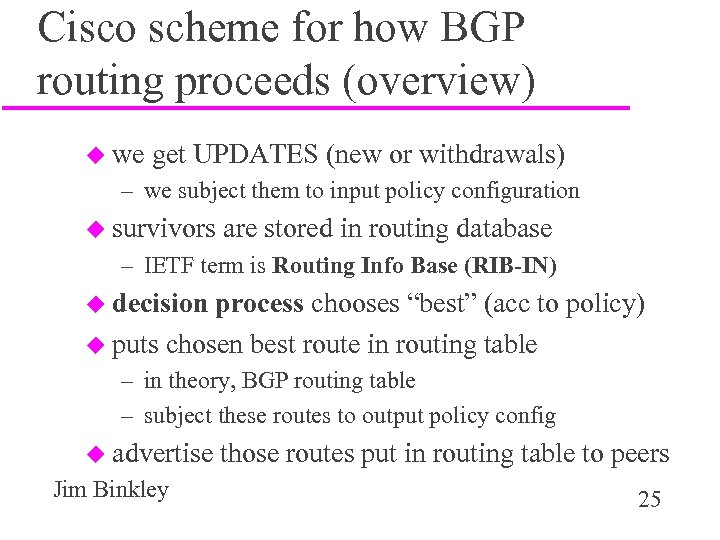
Cisco scheme for how BGP routing proceeds (overview) u we get UPDATES (new or withdrawals) – we subject them to input policy configuration u survivors are stored in routing database – IETF term is Routing Info Base (RIB-IN) u decision process chooses “best” (acc to policy) u puts chosen best route in routing table – in theory, BGP routing table – subject these routes to output policy config u advertise Jim Binkley those routes put in routing table to peers 25
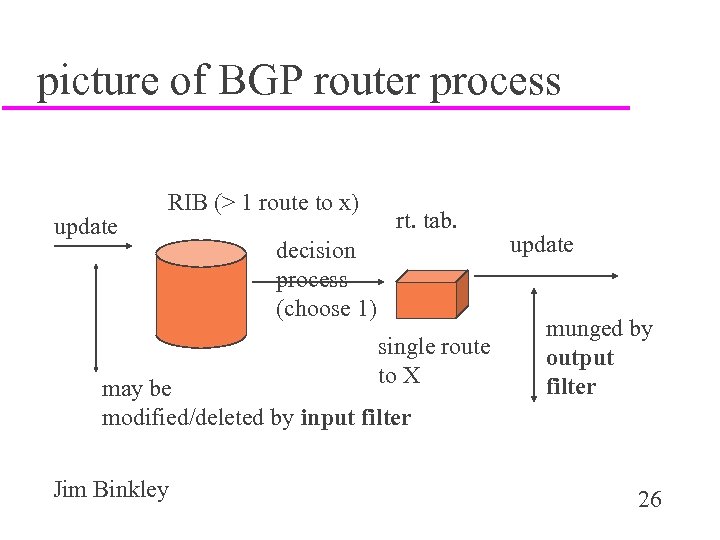
picture of BGP router process update RIB (> 1 route to x) rt. tab. decision process (choose 1) single route to X may be modified/deleted by input filter Jim Binkley update munged by output filter 26
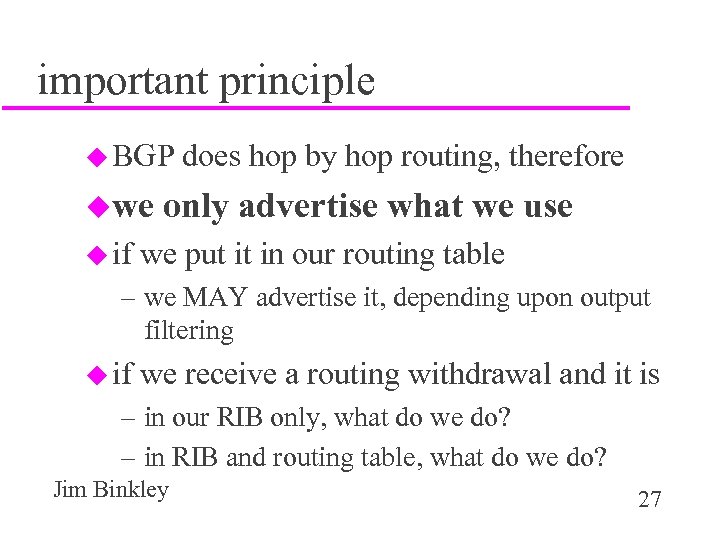
important principle u BGP uwe u if does hop by hop routing, therefore only advertise what we use we put it in our routing table – we MAY advertise it, depending upon output filtering u if we receive a routing withdrawal and it is – in our RIB only, what do we do? – in RIB and routing table, what do we do? Jim Binkley 27
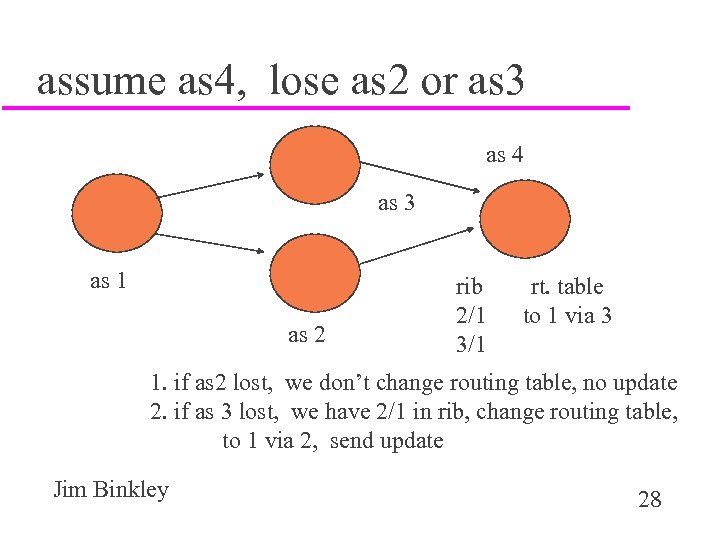
assume as 4, lose as 2 or as 3 as 4 as 3 as 1 as 2 rib 2/1 3/1 rt. table to 1 via 3 1. if as 2 lost, we don’t change routing table, no update 2. if as 3 lost, we have 2/1 in rib, change routing table, to 1 via 2, send update Jim Binkley 28
convergence with BGP means what? u not all RIBs are the same for sure – (different vectors, and other attributes) u same set of IP dsts, with at least one path, and one routing table entry – which may differ from R to R – important assumption: policy does not lead to partition of Internet (has happened) u policy can cause differences of course u flapping - route goes up/down at high frequency, leads to mucho BGP updates Jim Binkley 29
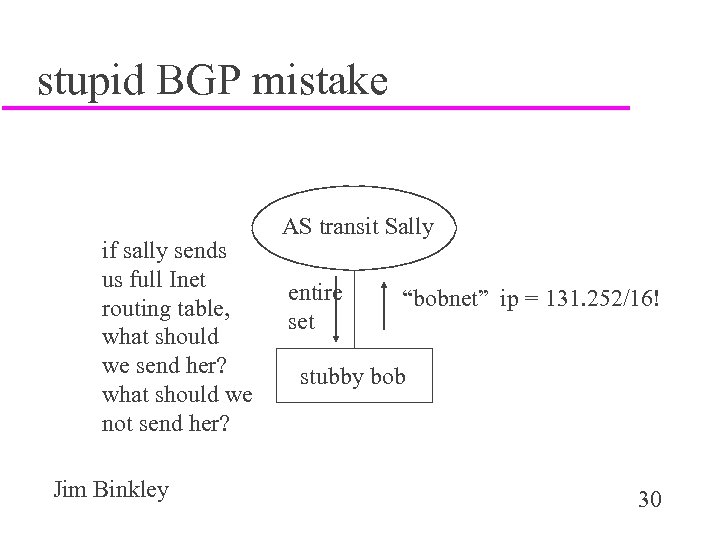
stupid BGP mistake if sally sends us full Inet routing table, what should we send her? what should we not send her? Jim Binkley AS transit Sally entire set “bobnet” ip = 131. 252/16! stubby bob 30
summary: some update rules u we only advertise what we put in our routing table u updates are not refreshed – RIB entries do not time out u BGP only talks when something changes – updates are adds or withdrawals or some other change based on attributes u any RIB change drives the decision process u we exchange routing tables at boot u all of above subject to policy configuration, in/out Jim Binkley 31
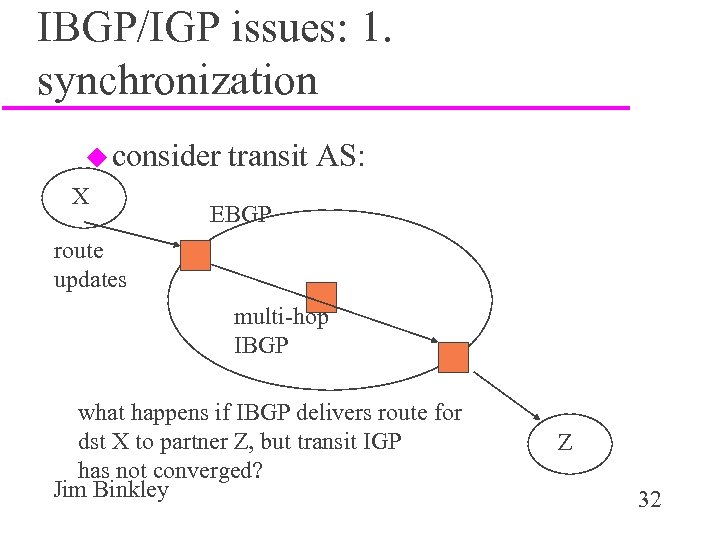
IBGP/IGP issues: 1. synchronization u consider X transit AS: EBGP route updates multi-hop IBGP what happens if IBGP delivers route for dst X to partner Z, but transit IGP has not converged? Jim Binkley Z 32
IGP sync: u answer: we must somehow make sure that the IGP has converged before u EBGP is advertised to Z – remember I send you routes, you send me data u why? because IBGP is multi-hop, and interior router might not know path to X – black hole. . . u in general: Jim Binkley forward. . . don’t send route until you can 33
how do we solve this problem? u 1. we could wait for IGP synchronization – e. g. , EBGP router to Z can’t advertise until IGP “route tag” shows up and – local IGP routing table shows path to X u acc. to Moy, transit AS do not want to dump full Inet routing table into IGP – e. g. , OSPF on all routers does SPF calculation over and over again during route flap – you have >= 150 k routes == ouch Jim Binkley 34
plan B, C, D, etc. u 2. all internal routers use IBGP (aka use BGP. . . ) – – u u u with no synchronization IBGP is IGP (deal with it. . . ) IGP basically gets you to next hop wait: we have a potential N**2 problem … 3. or possibly default route plus a few IGP routes leaked in (if possible) 4. or route recursion … 5. or simply tunnel over internal routers – can use logical circuits courtesy of MPLS or possibly vlans courtesy of Ethernet (or ATM circuits) Jim Binkley 35
common implementation idea u combine next-hop bgp attribute with u recursive routing table lookup – (similar to an IPIP tunnel but not the trick) u control: next-hop for ip X is router Y u routing back: next-hop is NOT directly connected router, therefore must “tunnel” back to Y Jim Binkley 36
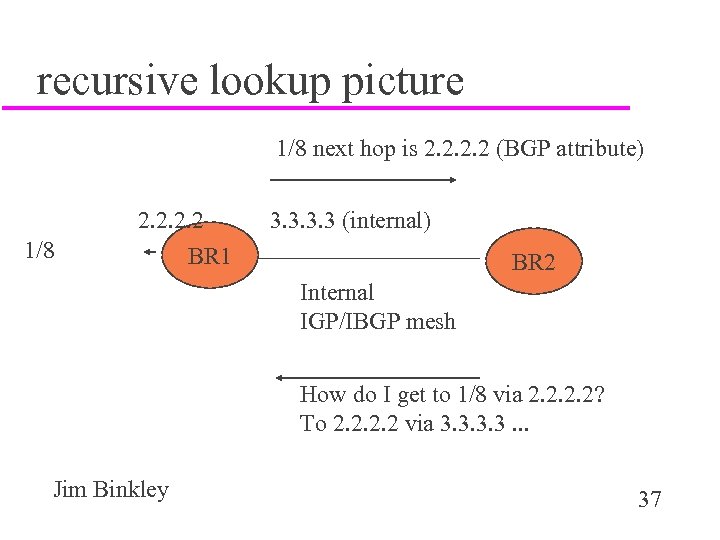
recursive lookup picture 1/8 next hop is 2. 2 (BGP attribute) 1/8 2. 2 BR 1 3. 3 (internal) BR 2 Internal IGP/IBGP mesh How do I get to 1/8 via 2. 2? To 2. 2 via 3. 3. . . Jim Binkley 37
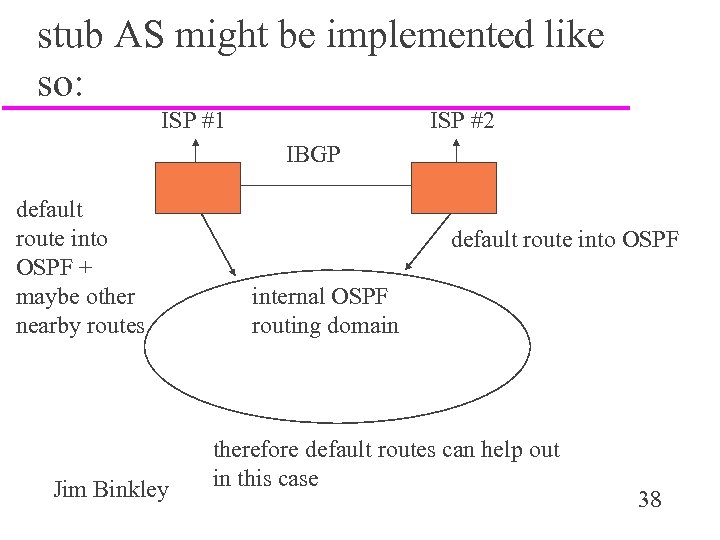
stub AS might be implemented like so: ISP #1 ISP #2 IBGP default route into OSPF + maybe other nearby routes Jim Binkley default route into OSPF internal OSPF routing domain therefore default routes can help out in this case 38
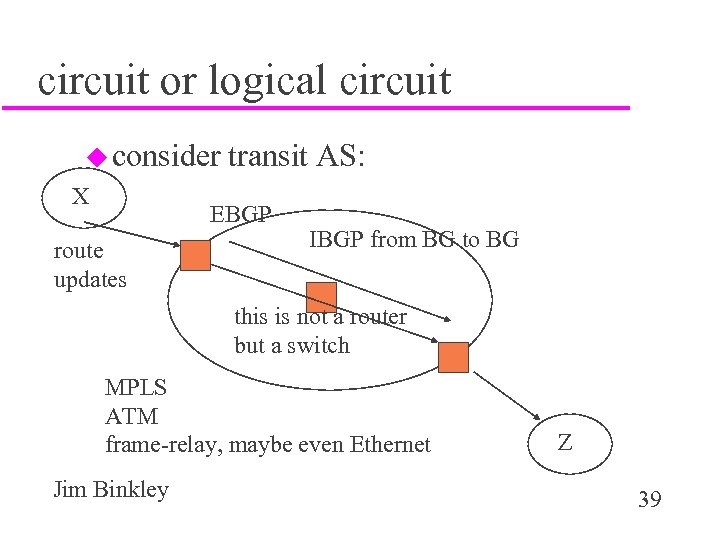
circuit or logical circuit u consider X transit AS: EBGP route updates IBGP from BG to BG this is not a router but a switch MPLS ATM frame-relay, maybe even Ethernet Jim Binkley Z 39
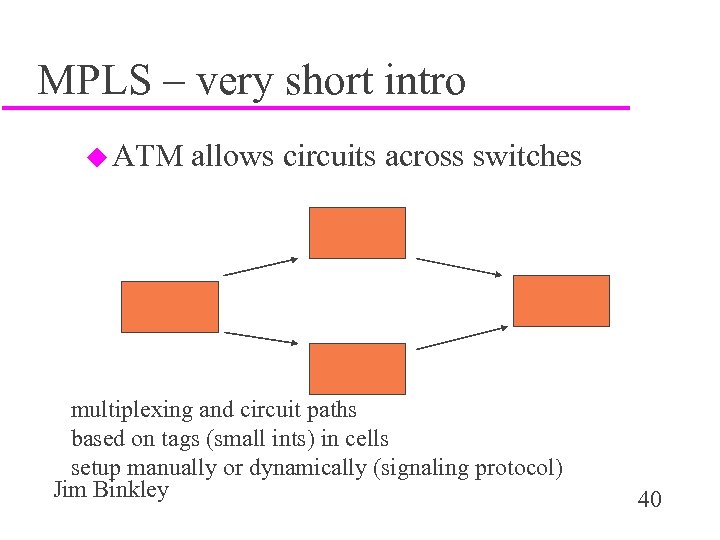
MPLS – very short intro u ATM allows circuits across switches multiplexing and circuit paths based on tags (small ints) in cells setup manually or dynamically (signaling protocol) Jim Binkley 40
Multi-protocol layer switching u logically between L 2 and L 3 u not L 2 specific u can setup signal path u basically “tunnel” across a domain u offers possibilities for traffic shaping, QOS, VPNs, and more or less making L 2 link go further u and has tags like ATM Jim Binkley 41
another IBGP issue u in-order to remain loop free, all AS internal routers must peer – same AS, we can’t add it as a prefix u call this full-mesh IBGP u in large AS, this leads to manual configuration nightmare – all those TCP connections, N**2 more or less u thus notions of route reflectors, route confederations to improve intra-AS scalability Jim Binkley 42
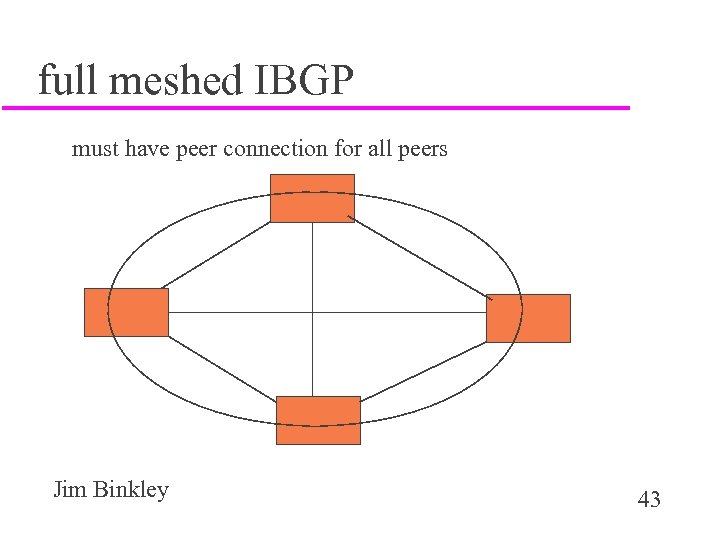
full meshed IBGP must have peer connection for all peers Jim Binkley 43
mechanisms exist for making IBGP mesh more scalable u route confederation notion: – break single AS up into multiple internal AS – tie together with EBGP connection – to outside still appears as one AS – each internal group must have fulled meshed IBGP – next-hop, MED, and local preference attributes important Jim Binkley 44
route reflector u in addition to confederation, we may have route reflector (internal route server) u AS divided into clusters u each cluster has route reflector u route reflector “reflects” updates to internal cluster peers, thus no full mesh in cluster u clusters have IBGP connection between them need complete connections here Jim Binkley 45
note re IBGP and attributes u AS_PATH is NOT incremented, – therefore must manually prevent loops u NEXT_HOP is not touched either. – it’s the way out of the AS with IBGP – need recursive lookup to send pkt in direction of next-hop Jim Binkley 46
the protocol u open/close state machine as virtual circuit u TCP, port 179 u TCP pros – we don’t have to resend or be reliable – don’t care about fragments/resends/loss, TCP job – we can be message-based, variable length » BGP is TLV protocol design more or less – hence updates can be incremental u BGP Jim Binkley is stateful due to TCP and RIB both 47
TCP cons u we need our own keepalive as we cannot rely on TCP keepalive – or assume all link hw has up/down indication u TCP might slow-down due to congestion control – doesn’t make sense to have BGP as control slow-down in the face of “real video” ? ? ? u BGP level security would not prevent TCP level attacks – e. g. , you have authenticated BGP, you face TCP sequence number spoofing Jim Binkley 48
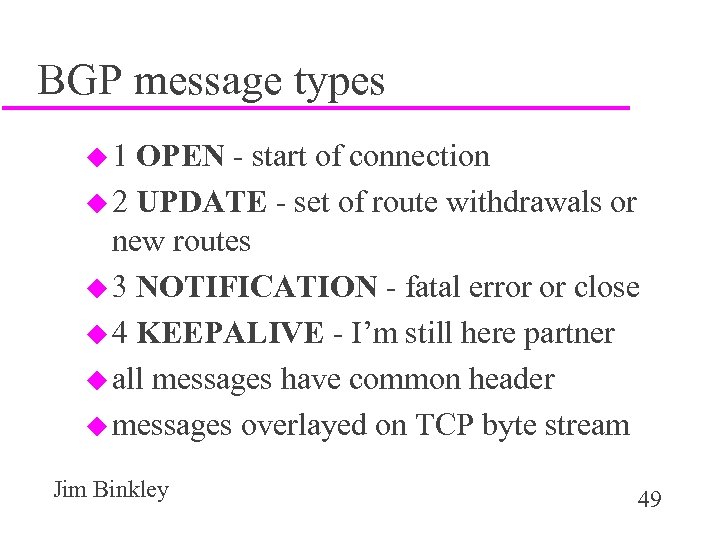
BGP message types u 1 OPEN - start of connection u 2 UPDATE - set of route withdrawals or new routes u 3 NOTIFICATION - fatal error or close u 4 KEEPALIVE - I’m still here partner u all messages have common header u messages overlayed on TCP byte stream Jim Binkley 49
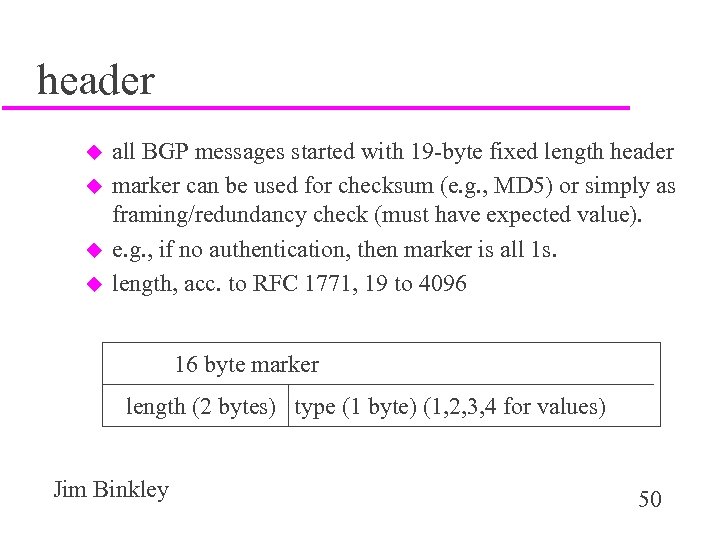
header u u all BGP messages started with 19 -byte fixed length header marker can be used for checksum (e. g. , MD 5) or simply as framing/redundancy check (must have expected value). e. g. , if no authentication, then marker is all 1 s. length, acc. to RFC 1771, 19 to 4096 16 byte marker length (2 bytes) type (1 byte) (1, 2, 3, 4 for values) Jim Binkley 50
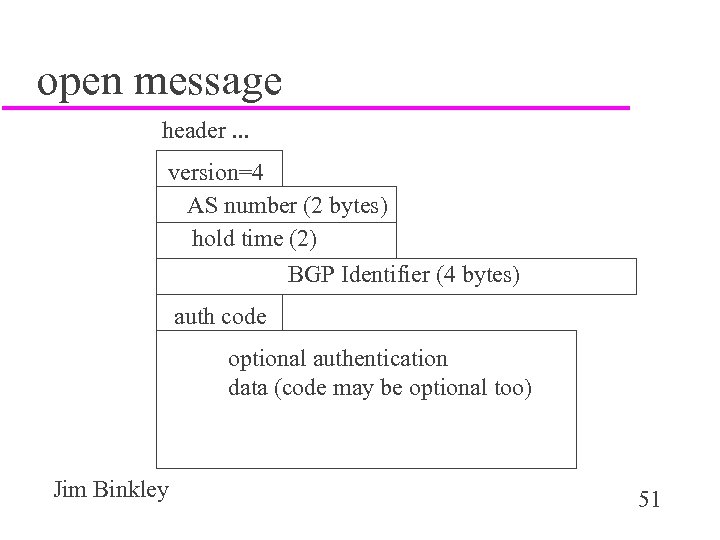
open message header. . . version=4 AS number (2 bytes) hold time (2) BGP Identifier (4 bytes) auth code optional authentication data (code may be optional too) Jim Binkley 51
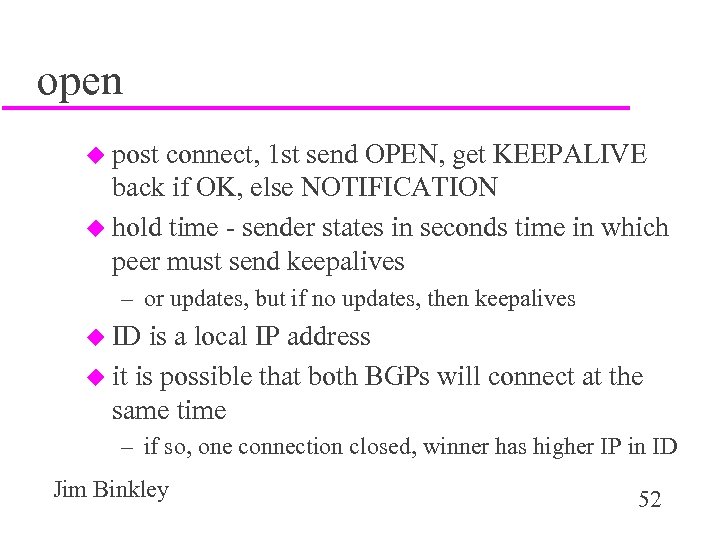
open u post connect, 1 st send OPEN, get KEEPALIVE back if OK, else NOTIFICATION u hold time - sender states in seconds time in which peer must send keepalives – or updates, but if no updates, then keepalives u ID is a local IP address u it is possible that both BGPs will connect at the same time – if so, one connection closed, winner has higher IP in ID Jim Binkley 52
multi-protocol BGP note u note that open takes options u multiprotocol BGP can thus be negotiated with these options: – capabilities negotiated at OPEN – includes MPLS, Multicast, IPv 6 – attributes for multicast NLRI also exist u this allows BGP to do more than IPv 4 Jim Binkley 53
updates u contain two parts (either of which may not exist), more or less: u (withdrawn IP nets (possibly > 1), one path) u however one path consists of u (path attribute length, attributes, NLRI) u the path is in the attributes u NLRI - network layer reachability information – set of possibly > 1 IP addr/masks (lengths really) – therefore these NLRI share the attributes Jim Binkley 54
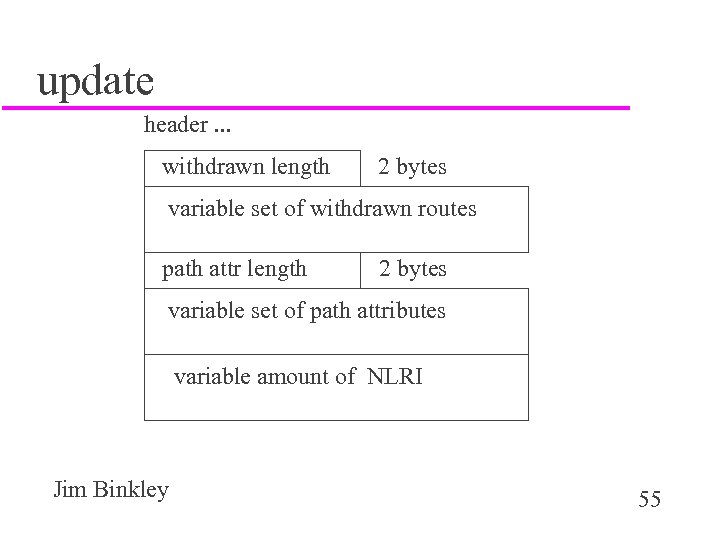
update header. . . withdrawn length 2 bytes variable set of withdrawn routes path attr length 2 bytes variable set of path attributes variable amount of NLRI Jim Binkley 55
update, cont. u withdrawn, aka unfeasible – if len = 0, there are none u routes – – expressed in length/prefix form length is 1 byte long, comes first e. g. , 8/64 would be 64. 0. 0. 0/8 netmask, but actually contiguous prefix both withdrawals, and NLRI like this u withdrawn routes - routes to toss out of RIB – may or may not affect routing table Jim Binkley 56
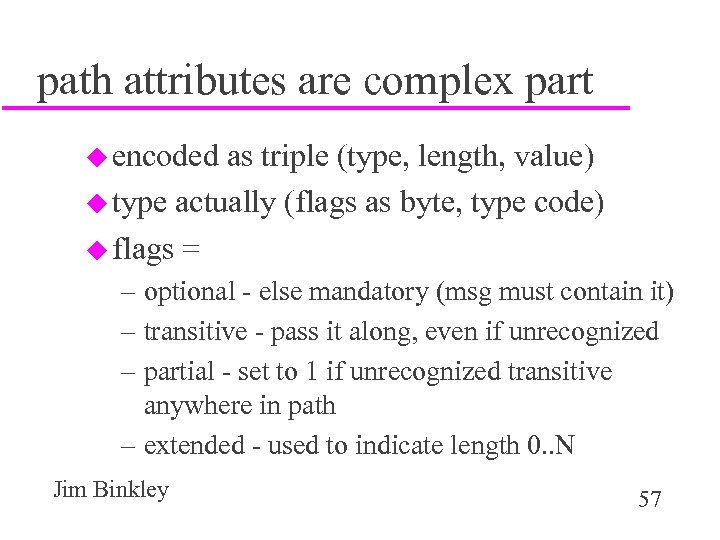
path attributes are complex part u encoded as triple (type, length, value) u type actually (flags as byte, type code) u flags = – optional - else mandatory (msg must contain it) – transitive - pass it along, even if unrecognized – partial - set to 1 if unrecognized transitive anywhere in path – extended - used to indicate length 0. . N Jim Binkley 57
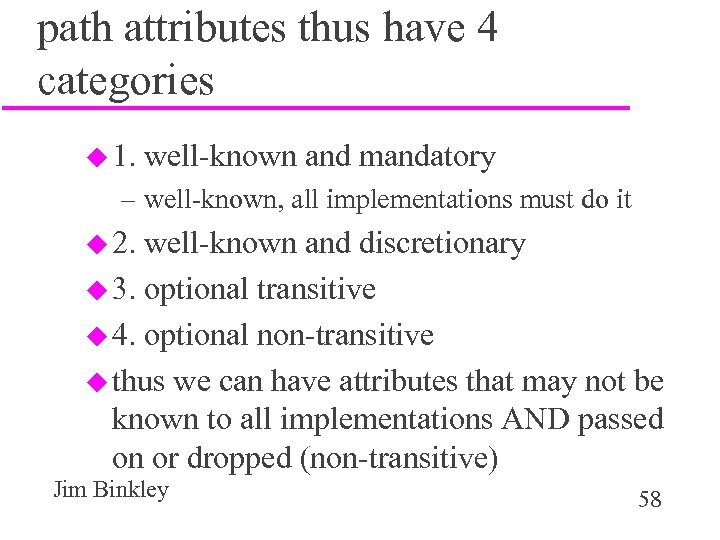
path attributes thus have 4 categories u 1. well-known and mandatory – well-known, all implementations must do it u 2. well-known and discretionary u 3. optional transitive u 4. optional non-transitive u thus we can have attributes that may not be known to all implementations AND passed on or dropped (non-transitive) Jim Binkley 58
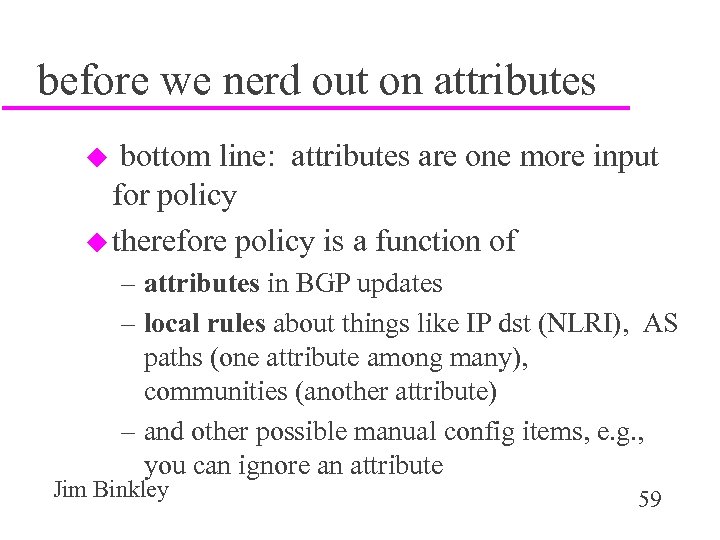
before we nerd out on attributes bottom line: attributes are one more input for policy u therefore policy is a function of u – attributes in BGP updates – local rules about things like IP dst (NLRI), AS paths (one attribute among many), communities (another attribute) – and other possible manual config items, e. g. , you can ignore an attribute Jim Binkley 59
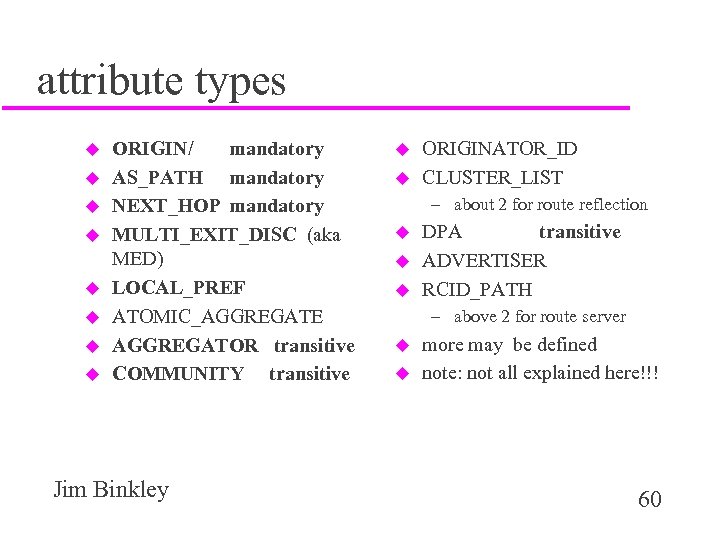
attribute types u u u u ORIGIN/ mandatory AS_PATH mandatory NEXT_HOP mandatory MULTI_EXIT_DISC (aka MED) LOCAL_PREF ATOMIC_AGGREGATE AGGREGATOR transitive COMMUNITY transitive Jim Binkley u u ORIGINATOR_ID CLUSTER_LIST – about 2 for route reflection u u u DPA transitive ADVERTISER RCID_PATH – above 2 for route server u u more may be defined note: not all explained here!!! 60
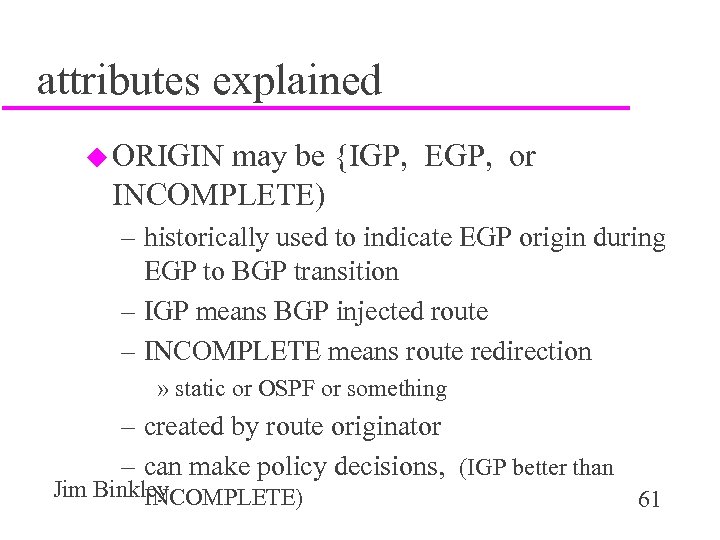
attributes explained u ORIGIN may be {IGP, EGP, or INCOMPLETE) – historically used to indicate EGP origin during EGP to BGP transition – IGP means BGP injected route – INCOMPLETE means route redirection » static or OSPF or something – created by route originator – can make policy decisions, (IGP better than Jim Binkley INCOMPLETE) 61
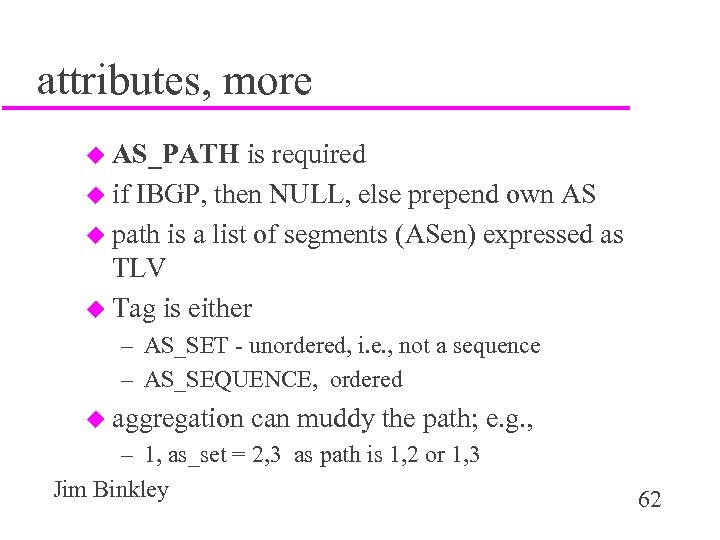
attributes, more u AS_PATH is required u if IBGP, then NULL, else prepend own AS u path is a list of segments (ASen) expressed as TLV u Tag is either – AS_SET - unordered, i. e. , not a sequence – AS_SEQUENCE, ordered u aggregation can muddy the path; e. g. , – 1, as_set = 2, 3 as path is 1, 2 or 1, 3 Jim Binkley 62
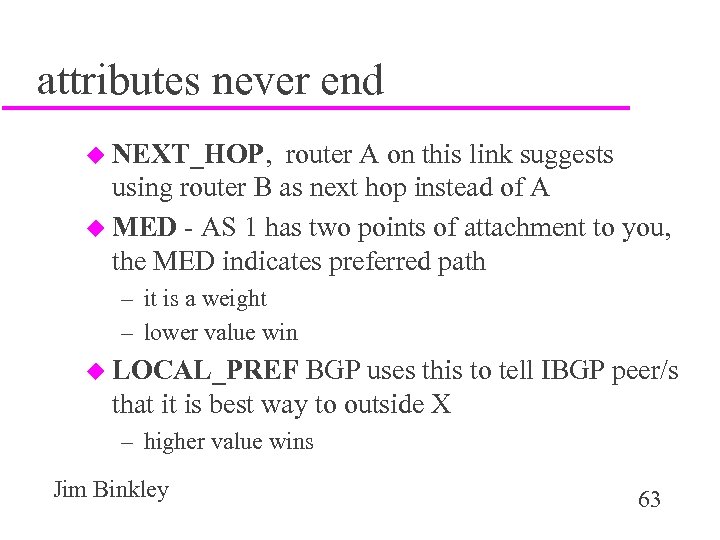
attributes never end u NEXT_HOP, router A on this link suggests using router B as next hop instead of A u MED - AS 1 has two points of attachment to you, the MED indicates preferred path – it is a weight – lower value win u LOCAL_PREF BGP uses this to tell IBGP peer/s that it is best way to outside X – higher value wins Jim Binkley 63
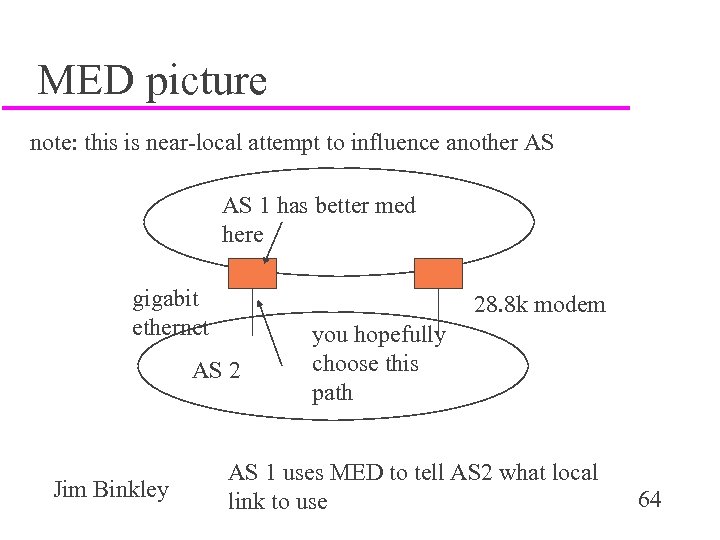
MED picture note: this is near-local attempt to influence another AS AS 1 has better med here gigabit ethernet 28. 8 k modem AS 2 Jim Binkley you hopefully choose this path AS 1 uses MED to tell AS 2 what local link to use 64
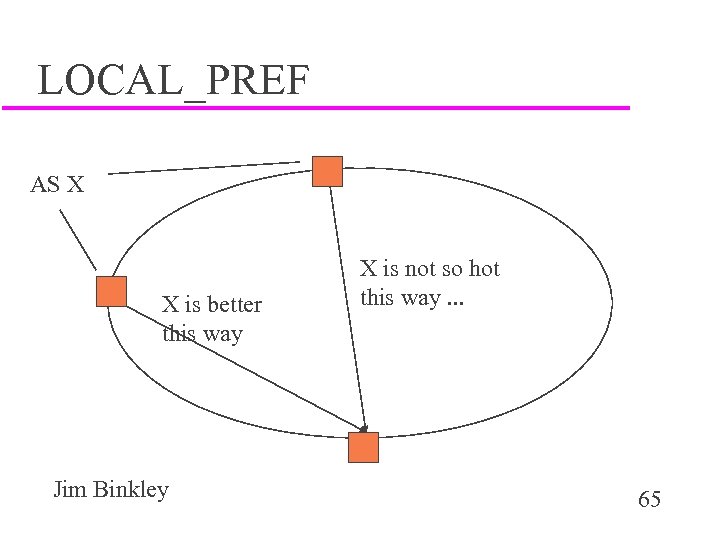
LOCAL_PREF AS X X is better this way Jim Binkley X is not so hot this way. . . 65
more attributes u AGGREGATOR - info only, AS X committed aggregation on this path u COMMUNITY - arbitrary routes grouped together as a set. . . call it a route-bundle – useful for policy (I will forward the state of Kansas, but not the state of Missouri) – often stripped at AS boundaries, even though transitive – allows you to use tags as opposed to addressing info Jim Binkley 66
community u predefined attributes include: no-export - do not send this to EBGP peers no-advertise - do not send this to anyone internet - send this to everyone (the uberbundle) u E. g, an AS might distinguish between routes from UUNET, I 2, and routes internal to itself, and tell its own customers which is which Jim Binkley 67
Cisco weight attribute u cisco-defined and local to a router, not BGP protocol u R 1 recvs route X from R 2 and R 3 u if from R 2, weight is 50 u if from R 3, weight is 100 u bigger weight is put in routing table Jim Binkley 68
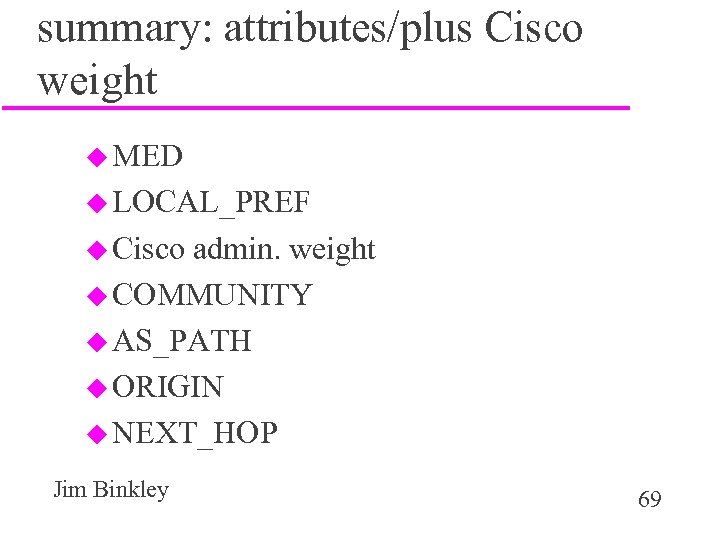
summary: attributes/plus Cisco weight u MED u LOCAL_PREF u Cisco admin. weight u COMMUNITY u AS_PATH u ORIGIN u NEXT_HOP Jim Binkley 69
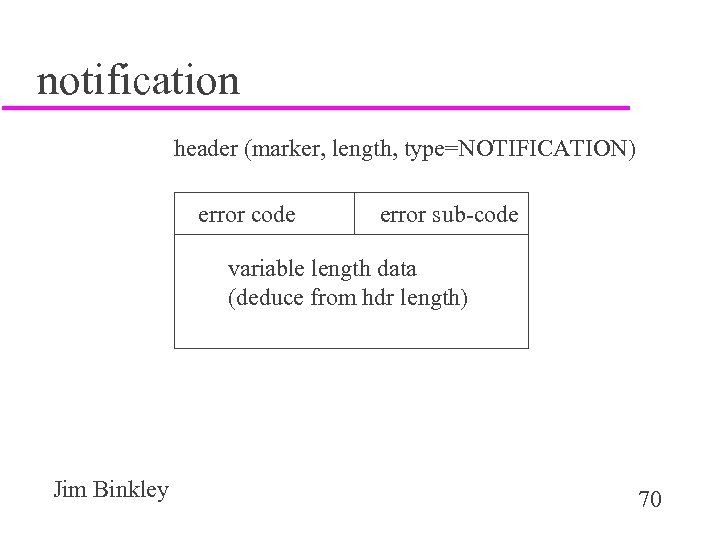
notification header (marker, length, type=NOTIFICATION) error code error sub-code variable length data (deduce from hdr length) Jim Binkley 70
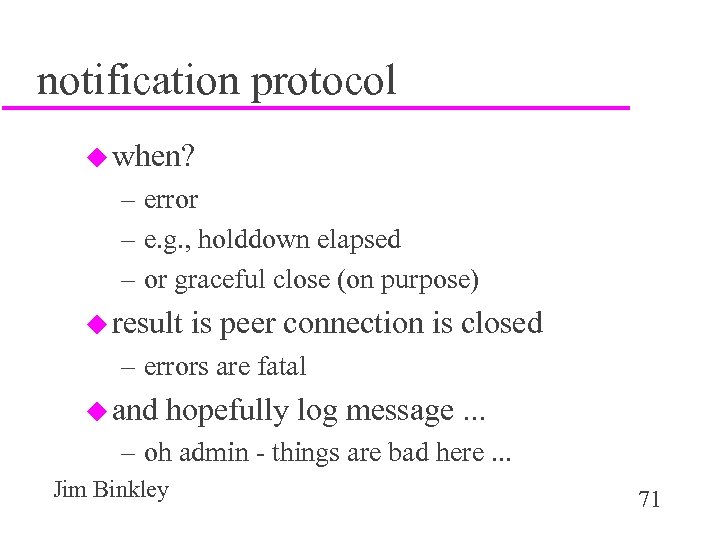
notification protocol u when? – error – e. g. , holddown elapsed – or graceful close (on purpose) u result is peer connection is closed – errors are fatal u and hopefully log message. . . – oh admin - things are bad here. . . Jim Binkley 71
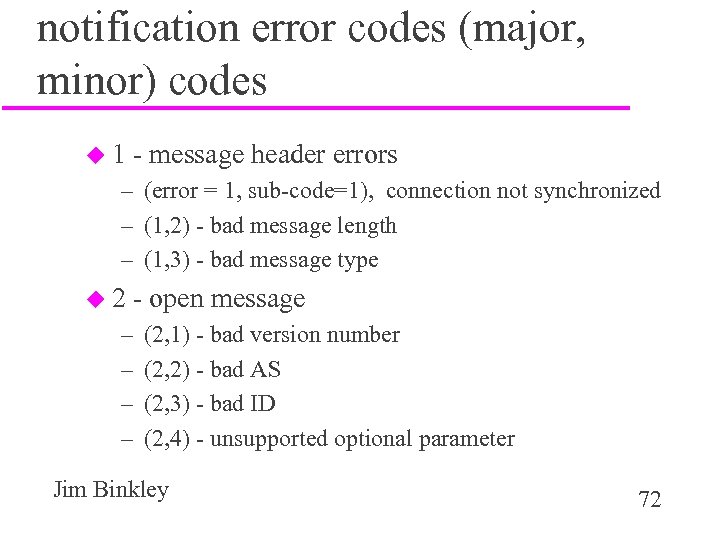
notification error codes (major, minor) codes u 1 - message header errors – (error = 1, sub-code=1), connection not synchronized – (1, 2) - bad message length – (1, 3) - bad message type u 2 - open message – – (2, 1) - bad version number (2, 2) - bad AS (2, 3) - bad ID (2, 4) - unsupported optional parameter Jim Binkley 72
notification errors, cont. u 3 - update message error – quite a few. . . problems with attributes – note (3, 7), AS routing loop u 4 - hold timer expired u 5 - finite state machine error u 6 - cease (close. . . not really an error) Jim Binkley 73
keepalive from 1000 miles up u BGP messages only occur if there are routing topology changes u keepalives on link are how we learn about link failure – and are rather important – we may not be able to trust a specific kind of link to tell us (keepalive is sw fix on flaky hw) – we may not be able to trust TCP keepalive, therefore BGP does not use Jim Binkley 74
keepalive u nothing but (marker, length, type=KEEPALIVE) u in order to avoid connection failure u must send message or KEEPALIVE – within holddown time u zero holddown means no KEEPALIVES needed – perhaps we want to avoid link charges u keep in mind transport is TCP, therefore delay an be unpredictable – keepalive frequency > holddown time is good idea Jim Binkley 75
routing decision process u we have RIB (database) paths and other attributes u we must process them into routing table entries u the decision process is the algorithm here u logically we do the following (acc to 1771) – 1. choose routes to advertise to IBGP peers – 2. choose routes to advertise to EBGP peers – 3. route aggregation and route information reduction u some function is applied to all possible candidate routes for IP dst X, highest preference wins Jim Binkley 76
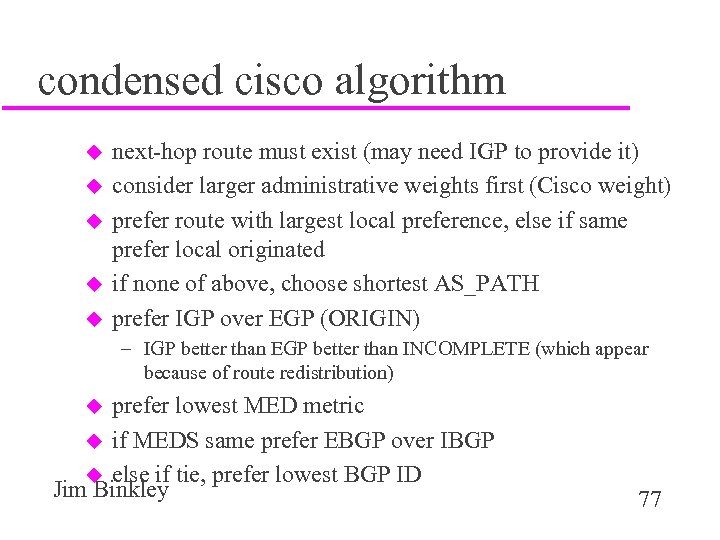
condensed cisco algorithm u u u next-hop route must exist (may need IGP to provide it) consider larger administrative weights first (Cisco weight) prefer route with largest local preference, else if same prefer local originated if none of above, choose shortest AS_PATH prefer IGP over EGP (ORIGIN) – IGP better than EGP better than INCOMPLETE (which appear because of route redistribution) prefer lowest MED metric u if MEDS same prefer EBGP over IBGP u else if tie, prefer lowest BGP ID Jim Binkley u 77
![basic Cisco setup u router bgp <as-number> – network <network-number> mask <mask number> [route-map-name]](https://present5.com/presentation/402a5552cd0ffbbfd329f51e3305482a/image-78.jpg "basic Cisco setup u router bgp <as-number> – network <network-number> mask <mask number> [route-map-name]")
basic Cisco setup u router bgp <as-number> – network <network-number> mask <mask number> [route-map-name] u Note: network injects local network into BGP, but does not specify which IP addr to use for peer connection – neighbor <ip-address> remote-as <number> u Note: Jim Binkley neighbor specifies peer and peer AS 78
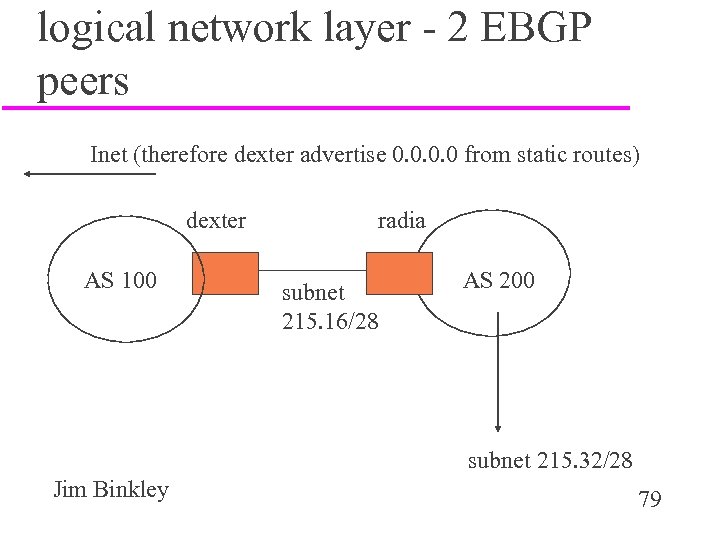
logical network layer - 2 EBGP peers Inet (therefore dexter advertise 0. 0 from static routes) dexter AS 100 radia subnet 215. 16/28 AS 200 subnet 215. 32/28 Jim Binkley 79
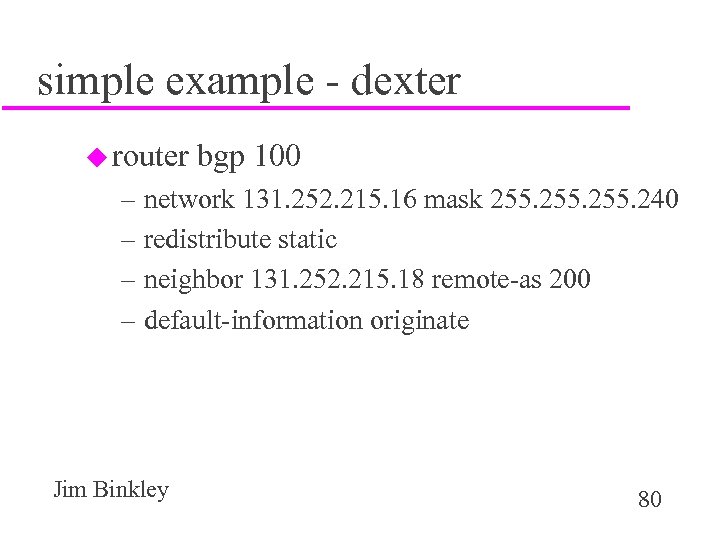
simple example - dexter u router bgp 100 – network 131. 252. 215. 16 mask 255. 240 – redistribute static – neighbor 131. 252. 215. 18 remote-as 200 – default-information originate Jim Binkley 80
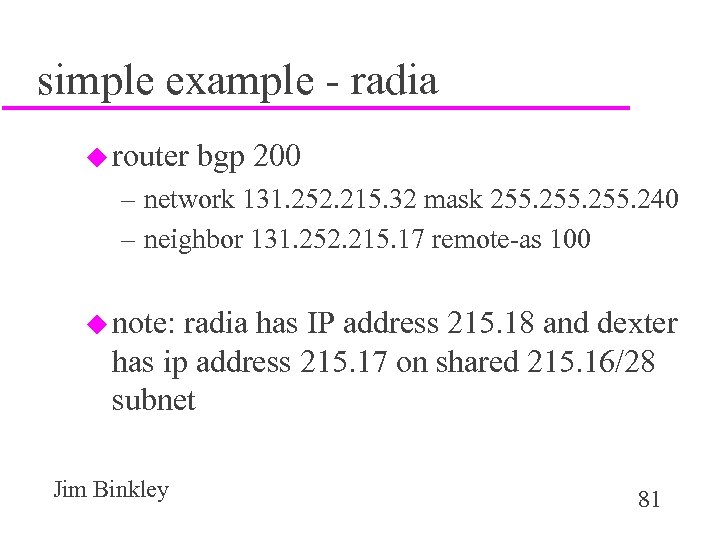
simple example - radia u router bgp 200 – network 131. 252. 215. 32 mask 255. 240 – neighbor 131. 252. 215. 17 remote-as 100 u note: radia has IP address 215. 18 and dexter has ip address 215. 17 on shared 215. 16/28 subnet Jim Binkley 81
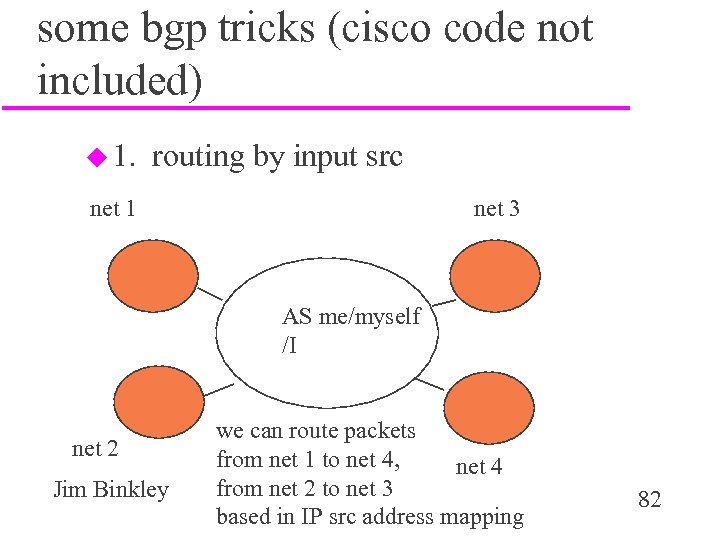
some bgp tricks (cisco code not included) u 1. routing by input src net 1 net 3 AS me/myself /I net 2 Jim Binkley we can route packets from net 1 to net 4, net 4 from net 2 to net 3 based in IP src address mapping 82
ip src addr mapping u questions about previous slide: u why is such a routing policy “not normal”? u can you perform this trick for the AS “outer mongolia”; i. e. , an AS arbitrarily far away? Jim Binkley 83
review 2 1 -way paths u inbound traffic - depends on routes YOU SEND u outbound traffic - depends on routes YOU RECEIVE u it may not be that hard to advertise NET 1 over LINK 1 – and thus cause asymmetric routing as a form of load balancing Jim Binkley 84
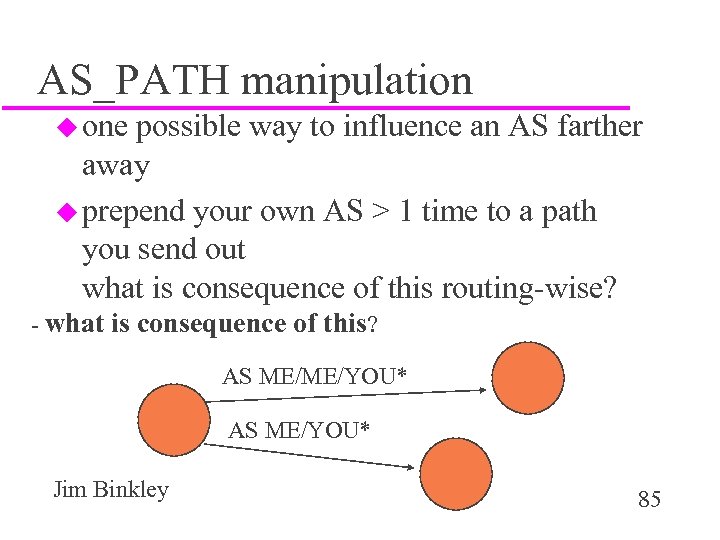
AS_PATH manipulation u one possible way to influence an AS farther away u prepend your own AS > 1 time to a path you send out what is consequence of this routing-wise? - what is consequence of this? AS ME/ME/YOU* AS ME/YOU* Jim Binkley 85
load balancing ? ! u see Halabi for his discussion u define here as multiple paths at layer 3 to dst X u general remarks – possible, but remember two things – BGP is hop by hop - you have less knowledge of net farther from home (ahem. KISS may apply) – routing is two 1 -way problems – Asymmetric routing may/may not be ok - your call u you cannot load balance without redundancy - and asymmetric routing may be part of picture Jim Binkley 86
Cisco routers u automatically load-balance if – same router, two links to same IP prefix – what can you say about the nature of those two links? (similar bandwidth pro) – this info is not extended into IBGP, i. e. , only one route is forwarded – use maximum-paths BGP command Jim Binkley 87
hot-potato routing u in decision process, (after EBGP over IBGP) u we can prefer IGP (OSPF) shortest path u this means data packet goes shortest path internally to get OUTSIDE of us u hot-potato -> in some sense spit packets out of AS the fastest possible way Jim Binkley 88
some BGP problems u scalability of transit system with IBGP – and IGP issues therein – we covered this one already (confed/reflector) u flapping (up/down/up/down. . . ) u misconfigured junior partner – howzabout “routed -g” globally? u congestion u security Jim Binkley leads to TCP backoff 89
flapping u small fraction of routes have been known to cause many updates to “flood” BGP net u call this “route flap” – route UP, then DOWN, then UP, DOWN, etc. u basic idea: if path changes too fast, we will suppress sending updates about – aka holddown technique – a path may have a weight associated with it, penalized over time for more flapping u Cisco calls anti-flapping config route dampening Jim Binkley 90
BGP misconfigurations u small AS could simply announce that it is MIT (BGP equivalent of routed -g. . . ) – and suck local MIT packets towards it u April 1997, small Virginia ISP more or less announced it was Inet Center (it wasn’t) u such incidents have led to desire to sanity check and/or globally list policy u btw: you can always use ACLs and MAPS Jim Binkley to sanity check your (small) neighbors 91
Inet Routing Registry effort (www. irr. net) u global registry in multiple distributed databases u continues earlier RADB (www. radb. net) effort u RIPE-181 policy language evolved now into RPSL - Routing Policy Spec. Language – (see RFC 2650 for examples) u policy language describes routes/AS #s send/received by a given AS number – as well as POC (point of contact) – import from AS 1 accept ANY – import from AS 2 accept only AS 2 Jim Binkley 92
criticisms u garbage-in, garbage-out – admins may not keep up u accept ANY isn’t terribly useful – big ASs can however enforce check on small AS u Bates/Bush/Rekhter/Li have suggested that routing policy be made available in DNS tree – could be administered locally – DNS could be made secure with signatures Jim Binkley 93
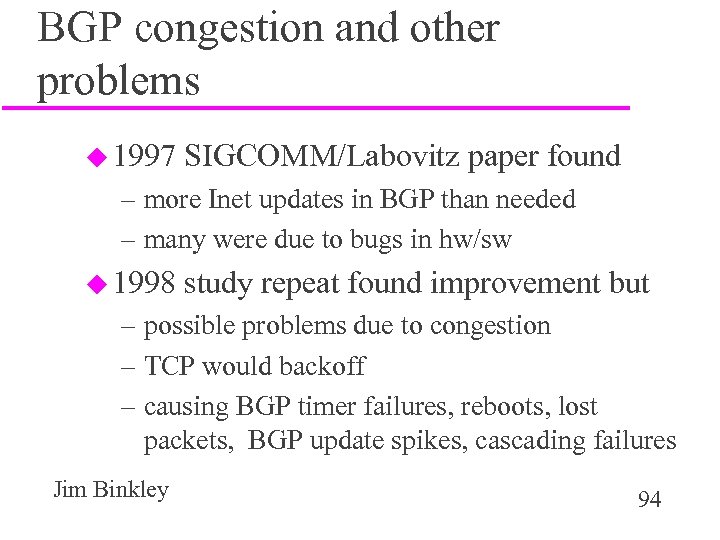
BGP congestion and other problems u 1997 SIGCOMM/Labovitz paper found – more Inet updates in BGP than needed – many were due to bugs in hw/sw u 1998 study repeat found improvement but – possible problems due to congestion – TCP would backoff – causing BGP timer failures, reboots, lost packets, BGP update spikes, cascading failures Jim Binkley 94
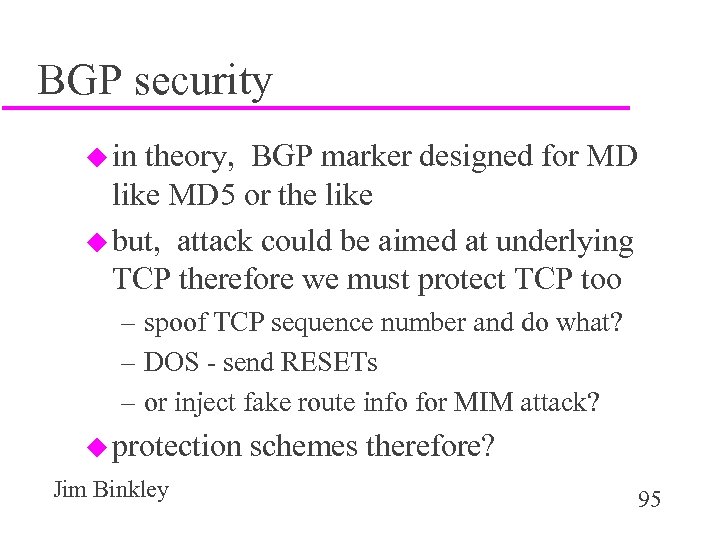
BGP security u in theory, BGP marker designed for MD like MD 5 or the like u but, attack could be aimed at underlying TCP therefore we must protect TCP too – spoof TCP sequence number and do what? – DOS - send RESETs – or inject fake route info for MIM attack? u protection Jim Binkley schemes therefore? 95
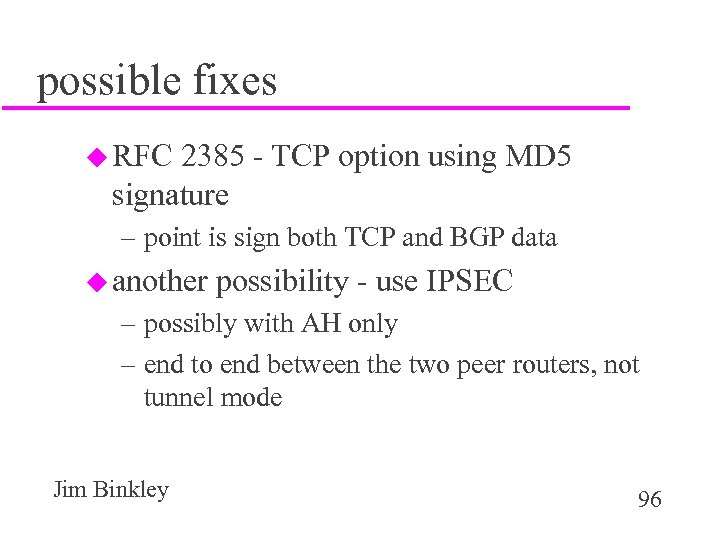
possible fixes u RFC 2385 - TCP option using MD 5 signature – point is sign both TCP and BGP data u another possibility - use IPSEC – possibly with AH only – end to end between the two peer routers, not tunnel mode Jim Binkley 96
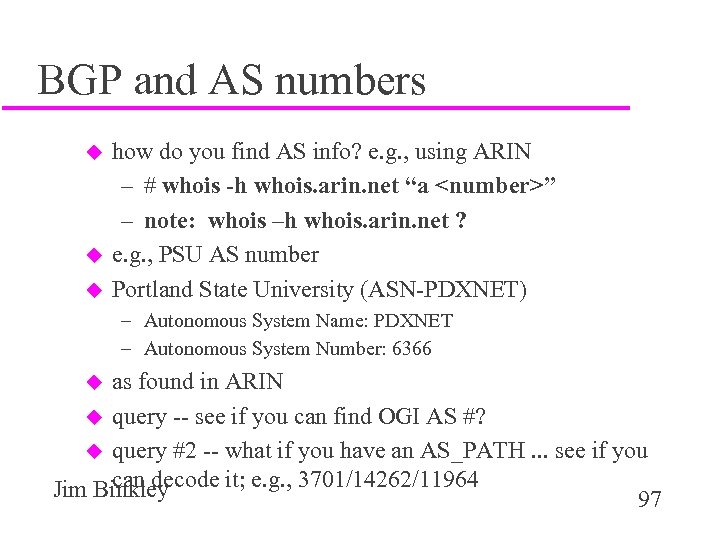
BGP and AS numbers u u u how do you find AS info? e. g. , using ARIN – # whois -h whois. arin. net “a <number>” – note: whois –h whois. arin. net ? e. g. , PSU AS number Portland State University (ASN-PDXNET) – Autonomous System Name: PDXNET – Autonomous System Number: 6366 as found in ARIN u query -- see if you can find OGI AS #? u query #2 -- what if you have an AS_PATH. . . see if you can decode it; e. g. , 3701/14262/11964 Jim Binkley 97 u
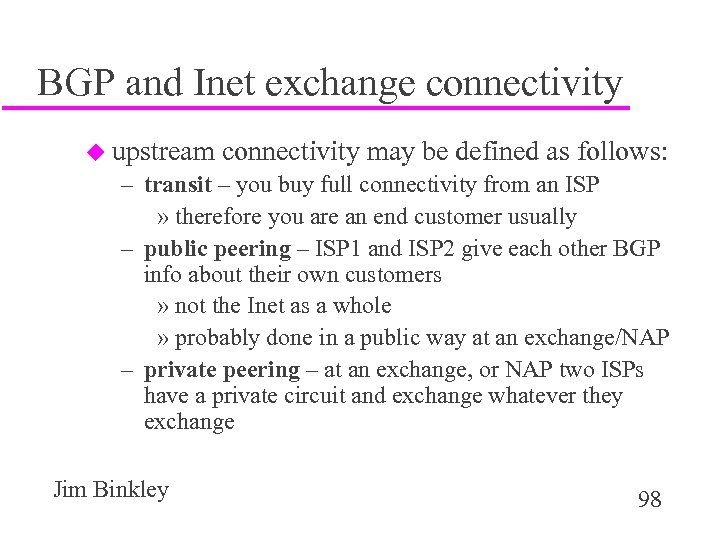
BGP and Inet exchange connectivity u upstream connectivity may be defined as follows: – transit – you buy full connectivity from an ISP » therefore you are an end customer usually – public peering – ISP 1 and ISP 2 give each other BGP info about their own customers » not the Inet as a whole » probably done in a public way at an exchange/NAP – private peering – at an exchange, or NAP two ISPs have a private circuit and exchange whatever they exchange Jim Binkley 98
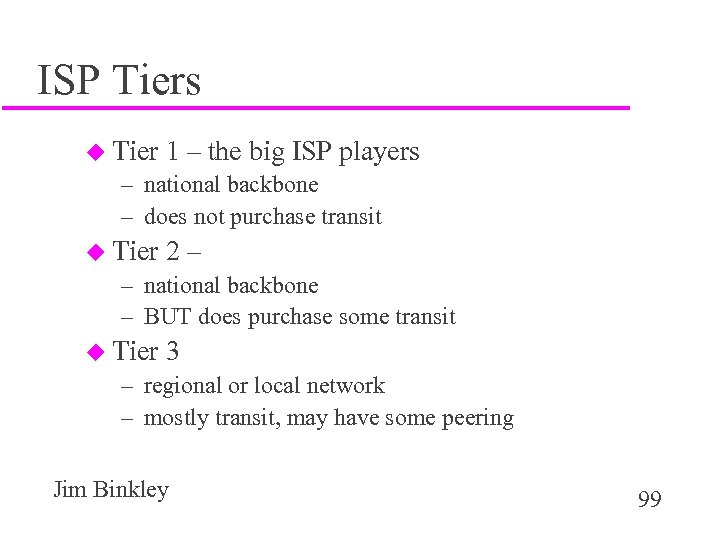
ISP Tiers u Tier 1 – the big ISP players – national backbone – does not purchase transit u Tier 2– – national backbone – BUT does purchase some transit u Tier 3 – regional or local network – mostly transit, may have some peering Jim Binkley 99
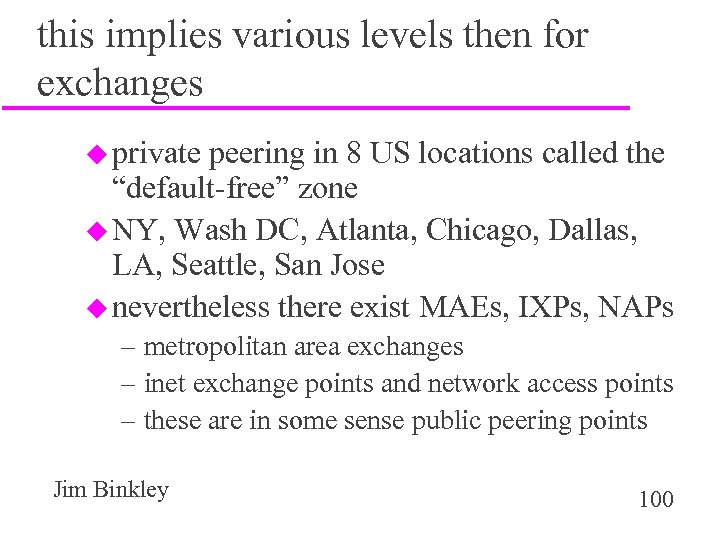
this implies various levels then for exchanges u private peering in 8 US locations called the “default-free” zone u NY, Wash DC, Atlanta, Chicago, Dallas, LA, Seattle, San Jose u nevertheless there exist MAEs, IXPs, NAPs – metropolitan area exchanges – inet exchange points and network access points – these are in some sense public peering points Jim Binkley 100
general study question u BGP peering means exchange of AS information – large want to charge small for this of course – can involve lawyers, contracts, etc. u see what you can find out about peering on the Inet – including structures of NATs/MAEs – how would you design a large peering network? (never mind the lawyers. . . ) Jim Binkley 101
more picky study questions u what kinds of BGP protocol messages exist? u what are the pros/cons of using TCP as a transport? u what security mechanisms can be used with BGP? u explain BGP and policy - how can an AS control route dissemination? u what is the MED attribute? what is it good for? u what does hot-potato routing mean? really? u why does AS_PATH protect BGP against Jim Binkley looping? 102
Скачать презентацию Border Gateway Protocol — An Introduction Network Routing
402a5552cd0ffbbfd329f51e3305482a.ppt