 Скачать презентацию Booz Company Baku November 2008 Building Connectivity
41d281f705410bd3aacb906300955caf.ppt
- Количество слайдов: 98



Booz & Company Baku, November 2008 Building Connectivity to the World Proposal for a Eurasian information super highway This document is confidential and is intended solely for the use and information of the client to whom it is addressed. Booz & Company November 2008 0
The connected world of today The Eurasian disconnect How to close the gap Next Steps Booz & Company November 2008 Azerbaijan Regional Data Highway_081107_GU. ppt Prepared for MCIT 1
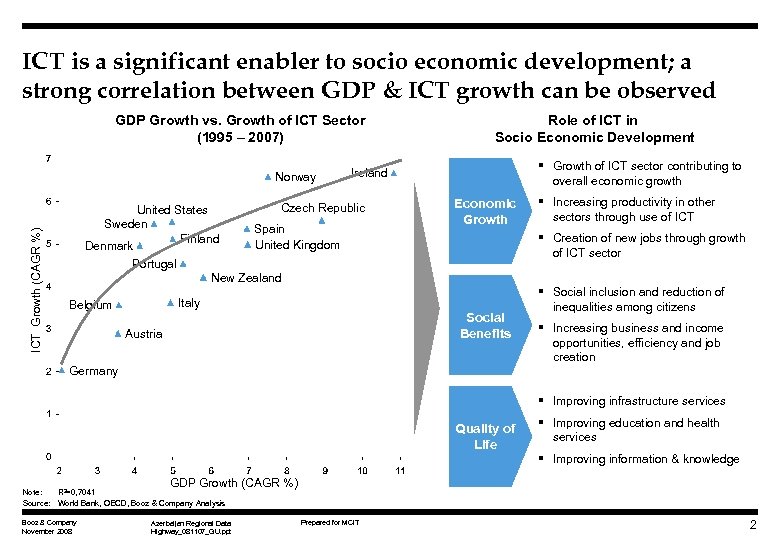
ICT is a significant enabler to socio economic development; a strong correlation between GDP & ICT growth can be observed GDP Growth vs. Growth of ICT Sector (1995 – 2007) ICT Growth (CAGR %) Norway Role of ICT in Socio Economic Development § Growth of ICT sector contributing to overall economic growth Ireland Czech Republic United States Sweden Spain Finland United Kingdom Denmark Portugal New Zealand Economic Growth § Creation of new jobs through growth of ICT sector Italy Belgium Social Benefits Austria § Increasing productivity in other sectors through use of ICT § Social inclusion and reduction of inequalities among citizens § Increasing business and income opportunities, efficiency and job creation Germany § Improving infrastructure services Quality of Life § Improving education and health services § Improving information & knowledge GDP Growth (CAGR %) Note: R²=0, 7041 Source: World Bank, OECD, Booz & Company Analysis Booz & Company November 2008 Azerbaijan Regional Data Highway_081107_GU. ppt Prepared for MCIT 2
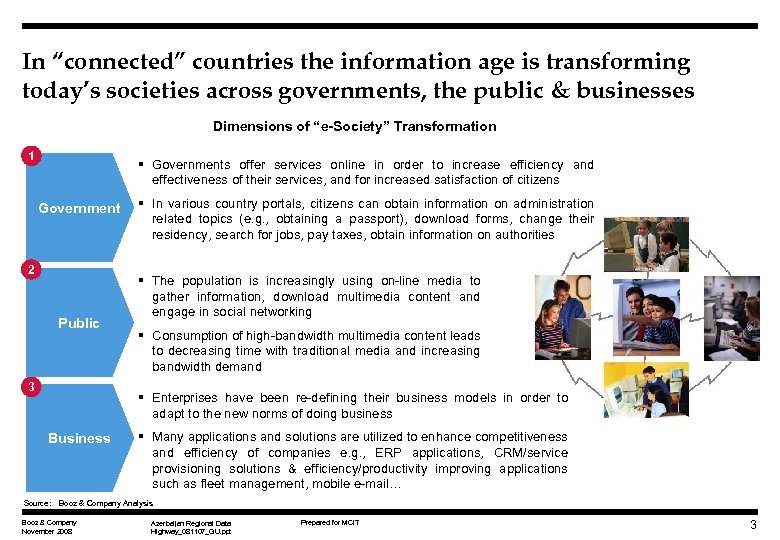
In “connected” countries the information age is transforming today’s societies across governments, the public & businesses Dimensions of “e-Society” Transformation 1 § Governments offer services online in order to increase efficiency and effectiveness of their services, and for increased satisfaction of citizens Government 2 Public 3 § In various country portals, citizens can obtain information on administration related topics (e. g. , obtaining a passport), download forms, change their residency, search for jobs, pay taxes, obtain information on authorities § The population is increasingly using on-line media to gather information, download multimedia content and engage in social networking § Consumption of high-bandwidth multimedia content leads to decreasing time with traditional media and increasing bandwidth demand § Enterprises have been re-defining their business models in order to adapt to the new norms of doing business Business § Many applications and solutions are utilized to enhance competitiveness and efficiency of companies e. g. , ERP applications, CRM/service provisioning solutions & efficiency/productivity improving applications such as fleet management, mobile e-mail… Source: Booz & Company Analysis Booz & Company November 2008 Azerbaijan Regional Data Highway_081107_GU. ppt Prepared for MCIT 3
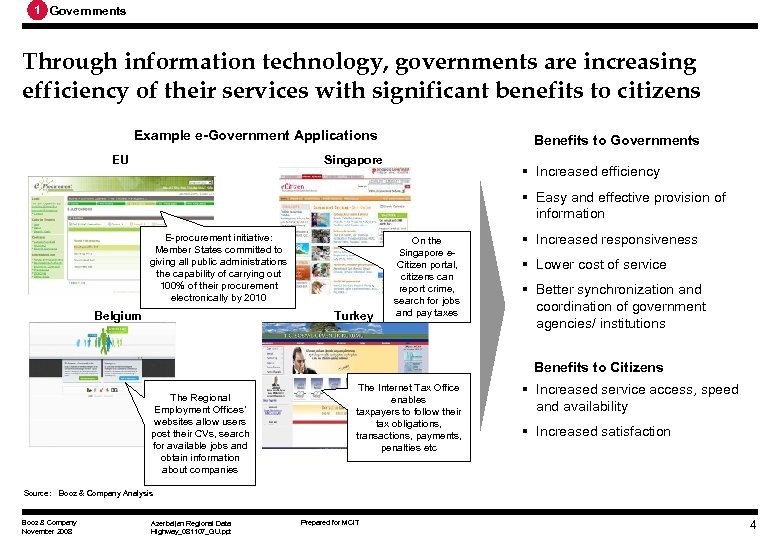
1 Governments Through information technology, governments are increasing efficiency of their services with significant benefits to citizens Example e-Government Applications EU Benefits to Governments Singapore § Increased efficiency § Easy and effective provision of information E-procurement initiative: Member States committed to giving all public administrations the capability of carrying out 100% of their procurement electronically by 2010 Belgium Turkey On the Singapore e. Citizen portal, citizens can report crime, search for jobs and pay taxes § Increased responsiveness § Lower cost of service § Better synchronization and coordination of government agencies/ institutions Benefits to Citizens The Regional Employment Offices’ websites allow users post their CVs, search for available jobs and obtain information about companies The Internet Tax Office enables taxpayers to follow their tax obligations, transactions, payments, penalties etc § Increased service access, speed and availability § Increased satisfaction Source: Booz & Company Analysis Booz & Company November 2008 Azerbaijan Regional Data Highway_081107_GU. ppt Prepared for MCIT 4
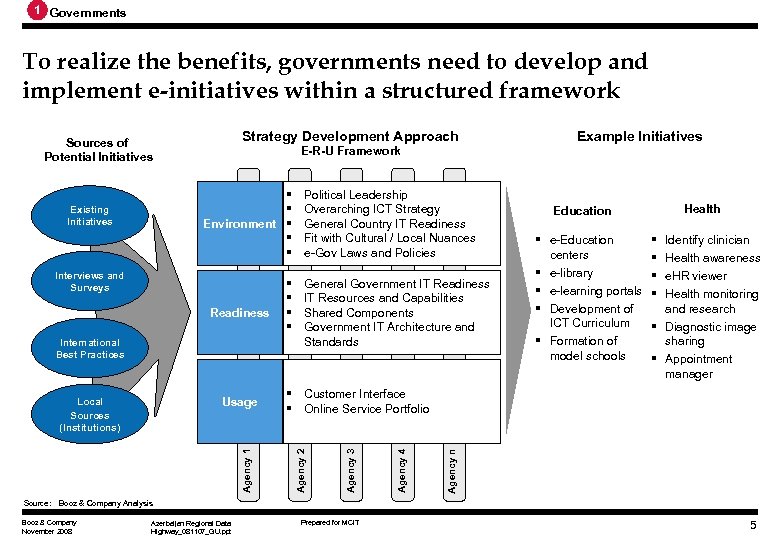
1 Governments To realize the benefits, governments need to develop and implement e-initiatives within a structured framework Strategy Development Approach Sources of Potential Initiatives Usage Agency 1 Local Sources (Institutions) § § Health Education § e-Education centers § e-library § e-learning portals § Development of ICT Curriculum § Formation of model schools § § Identify clinician Health awareness e. HR viewer Health monitoring and research § Diagnostic image sharing § Appointment manager Customer Interface Online Service Portfolio Agency n International Best Practices General Government IT Readiness IT Resources and Capabilities Shared Components Government IT Architecture and Standards Agency 4 Readiness § § Agency 3 Interviews and Surveys Political Leadership Overarching ICT Strategy General Country IT Readiness Fit with Cultural / Local Nuances e-Gov Laws and Policies Agency 2 § § Environment § § § Existing Initiatives Example Initiatives E-R-U Framework Source: Booz & Company Analysis Booz & Company November 2008 Azerbaijan Regional Data Highway_081107_GU. ppt Prepared for MCIT 5
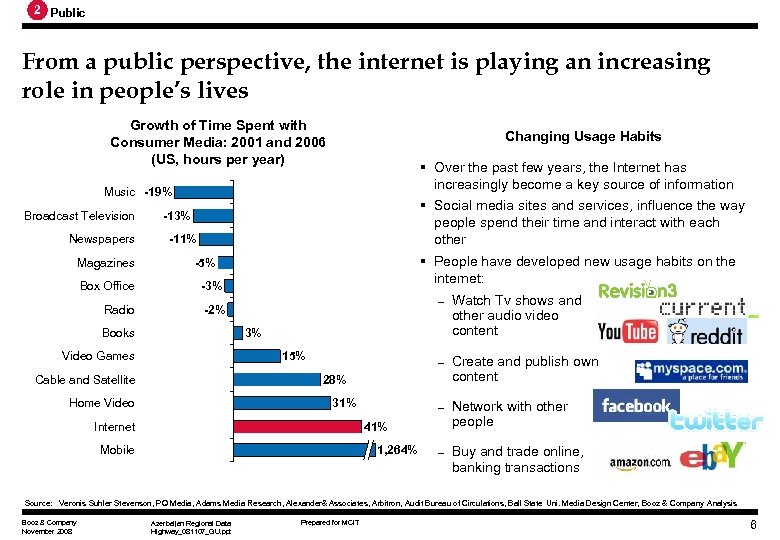
2 Public From a public perspective, the internet is playing an increasing role in people’s lives Growth of Time Spent with Consumer Media: 2001 and 2006 (US, hours per year) Changing Usage Habits § Over the past few years, the Internet has increasingly become a key source of information Music -19% Broadcast Television Newspapers Magazines § Social media sites and services, influence the way people spend their time and interact with each other -13% -11% § People have developed new usage habits on the internet: -5% Box Office -3% Radio -2% Books – Watch Tv shows and other audio video content – Create and publish own content – Network with other people – Buy and trade online, banking transactions 3% Video Games 15% Cable and Satellite 28% Home Video 31% Internet 41% Mobile 1, 264% Source: Veronis Suhler Stevenson, PQ Media, Adams Media Research, Alexander& Associates, Arbitron, Audit Bureau of Circulations, Ball State Uni. Media Design Center, Booz & Company Analysis Booz & Company November 2008 Azerbaijan Regional Data Highway_081107_GU. ppt Prepared for MCIT 6
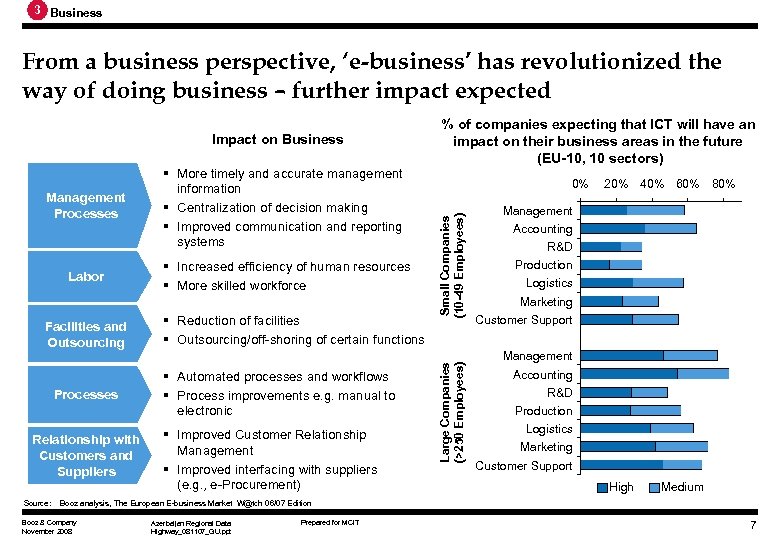
3 Business From a business perspective, ‘e-business’ has revolutionized the way of doing business – further impact expected Labor Facilities and Outsourcing Processes Relationship with Customers and Suppliers § Increased efficiency of human resources § More skilled workforce § Reduction of facilities § Outsourcing/off-shoring of certain functions § Automated processes and workflows § Process improvements e. g. manual to electronic § Improved Customer Relationship Management § Improved interfacing with suppliers (e. g. , e-Procurement) 0% Small Companies (10 -49 Employees) Management Processes § More timely and accurate management information § Centralization of decision making § Improved communication and reporting systems % of companies expecting that ICT will have an impact on their business areas in the future (EU-10, 10 sectors) Large Companies (>250 Employees) Impact on Business 20% 40% 60% 80% Management Accounting R&D Production Logistics Marketing Customer Support High Medium Source: Booz analysis, The European E-business Market W@tch 06/07 Edition Booz & Company November 2008 Azerbaijan Regional Data Highway_081107_GU. ppt Prepared for MCIT 7
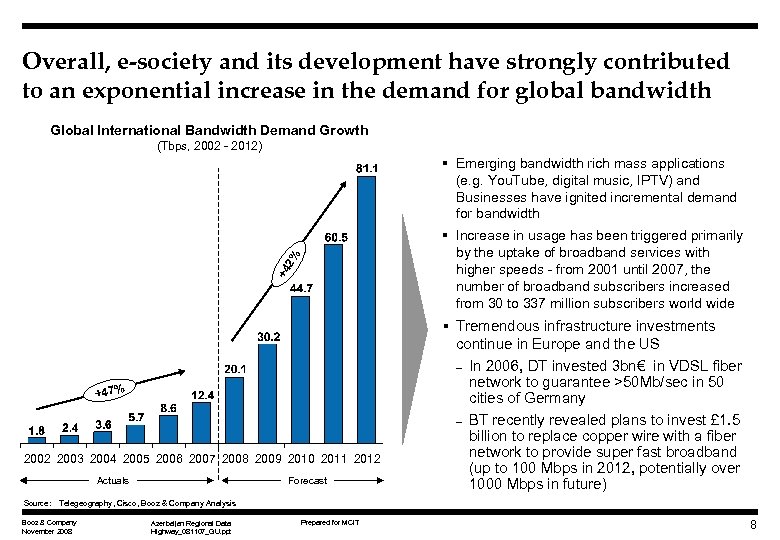
Overall, e-society and its development have strongly contributed to an exponential increase in the demand for global bandwidth Global International Bandwidth Demand Growth (Tbps, 2002 - 2012) § Emerging bandwidth rich mass applications (e. g. You. Tube, digital music, IPTV) and Businesses have ignited incremental demand for bandwidth +4 2% § Increase in usage has been triggered primarily by the uptake of broadband services with higher speeds - from 2001 until 2007, the number of broadband subscribers increased from 30 to 337 million subscribers world wide +47% 2002 2003 2004 2005 2006 2007 2008 2009 2010 2011 2012 Actuals Forecast § Tremendous infrastructure investments continue in Europe and the US – In 2006, DT invested 3 bn€ in VDSL fiber network to guarantee >50 Mb/sec in 50 cities of Germany – BT recently revealed plans to invest £ 1. 5 billion to replace copper wire with a fiber network to provide super fast broadband (up to 100 Mbps in 2012, potentially over 1000 Mbps in future) Source: Telegeography, Cisco, Booz & Company Analysis Booz & Company November 2008 Azerbaijan Regional Data Highway_081107_GU. ppt Prepared for MCIT 8
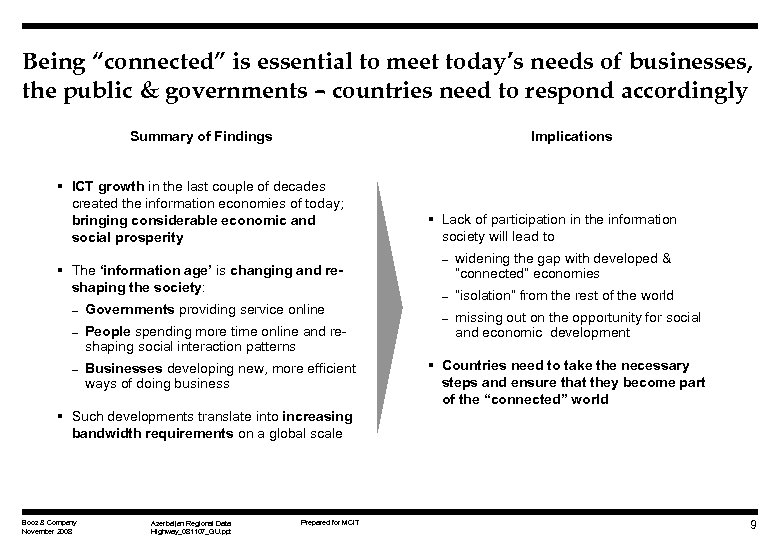
Being “connected” is essential to meet today’s needs of businesses, the public & governments – countries need to respond accordingly Summary of Findings Implications § ICT growth in the last couple of decades created the information economies of today; bringing considerable economic and social prosperity § The ‘information age’ is changing and reshaping the society: – Governments providing service online – People spending more time online and reshaping social interaction patterns – Businesses developing new, more efficient ways of doing business § Lack of participation in the information society will lead to – widening the gap with developed & “connected” economies – “isolation” from the rest of the world – missing out on the opportunity for social and economic development § Countries need to take the necessary steps and ensure that they become part of the “connected” world § Such developments translate into increasing bandwidth requirements on a global scale Booz & Company November 2008 Azerbaijan Regional Data Highway_081107_GU. ppt Prepared for MCIT 9
The connected world of today The Eurasian disconnect How to close the gap Next Steps Booz & Company November 2008 Azerbaijan Regional Data Highway_081107_GU. ppt Prepared for MCIT 10
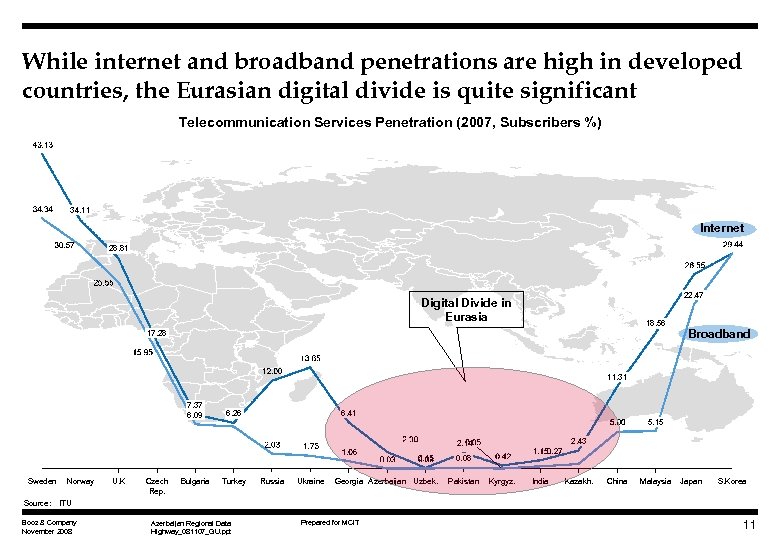
While internet and broadband penetrations are high in developed countries, the Eurasian digital divide is quite significant Telecommunication Services Penetration (2007, Subscribers %) 34. 11 Internet 28. 81 22. 47 Digital Divide in Eurasia 18. 56 17. 28 Broadband 11. 31 7. 37 6. 09 6. 41 6. 26 5. 15 2. 43 0. 08 Sweden Norway U. K Czech Rep. Bulgaria Turkey Russia Ukraine Georgia Azerbaijan Uzbek. Pakistan Kyrgyz. India Kazakh. China Malaysia Japan S. Korea Source: ITU Booz & Company November 2008 Azerbaijan Regional Data Highway_081107_GU. ppt Prepared for MCIT 11
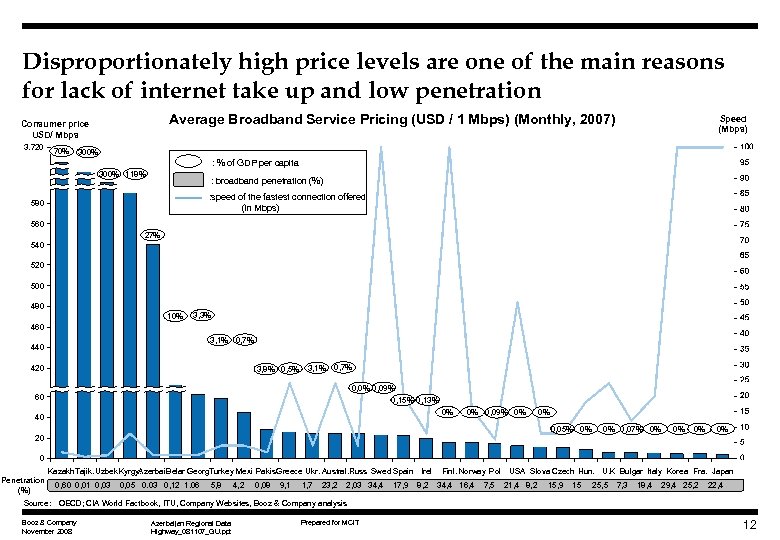
Disproportionately high price levels are one of the main reasons for lack of internet take up and low penetration Average Broadband Service Pricing (USD / 1 Mbps) (Monthly, 2007) Consumer price USD/ Mbps 3. 720 70% Speed (Mbps) 300% : % of GDP per capita 300% 118% : broadband penetration (%) : speed of the fastest connection offered (in Mbps) 580 560 27% 540 520 500 480 10% 3, 3% 460 3, 1% 0, 7% 440 420 3, 8% 0, 5% 3, 1% 0, 7% 0, 09% 60 0, 15% 0, 13% 0% 40 0% 0, 09% 0% 0% 0, 05% 0% 20 0% 0, 07% 0% 0% 0 Kazakh. Tajik. Uzbek. Kyrgy. Azerbai. Belar Georg. Turkey Mexi Pakis. Greece Ukr. Austral. Russ Swed Spain Irel Penetration (%) Finl. Norway Pol USA Slova Czech Hun. U. K Bulgar Italy Korea Fra. Japan 0, 60 0, 01 0, 03 0, 05 0. 03 0, 12 1. 06 5, 8 4, 2 0, 08 9, 1 1, 7 23, 2 2, 03 34, 4 17, 9 8, 2 34, 4 16, 4 7, 5 21, 4 8, 2 15, 9 15 25, 5 7, 3 18, 4 29, 4 25, 2 22, 4 Source: OECD; CIA World Factbook, ITU, Company Websites, Booz & Company analysis Booz & Company November 2008 Azerbaijan Regional Data Highway_081107_GU. ppt Prepared for MCIT 12
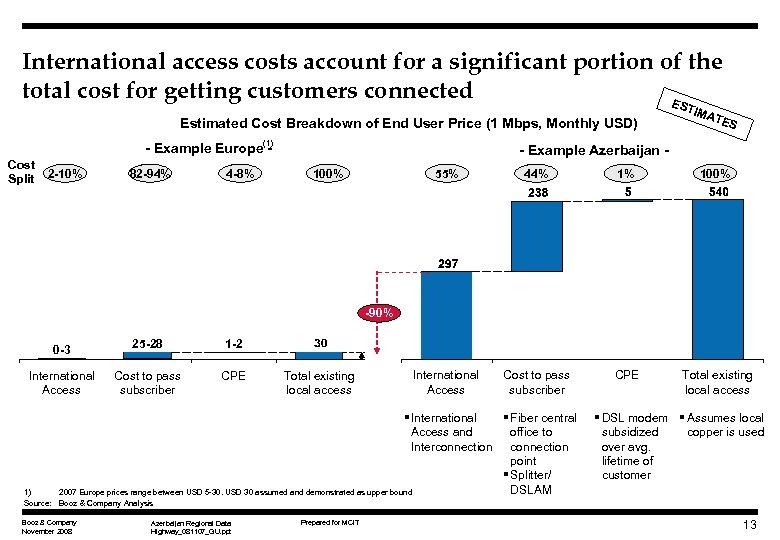
International access costs account for a significant portion of the total cost for getting customers connected ES Estimated Cost Breakdown of End User Price (1 Mbps, Monthly USD) - Example Europe(1) Cost Split 2 -10% 82 -94% 4 -8% TIM ATE S - Example Azerbaijan 100% 55% 44% 1% International Access Cost to pass subscriber CPE 100% -90% 0 -3 International Access 25 -28 1 -2 Cost to pass subscriber CPE Total existing local access § International § Fiber central Access and office to Interconnection point § Splitter/ DSLAM 2007 Europe prices range between USD 5 -30. USD 30 assumed and demonstrated as upper bound Total existing local access § DSL modem § Assumes local subsidized copper is used over avg. lifetime of customer 1) Source: Booz & Company Analysis Booz & Company November 2008 Azerbaijan Regional Data Highway_081107_GU. ppt Prepared for MCIT 13
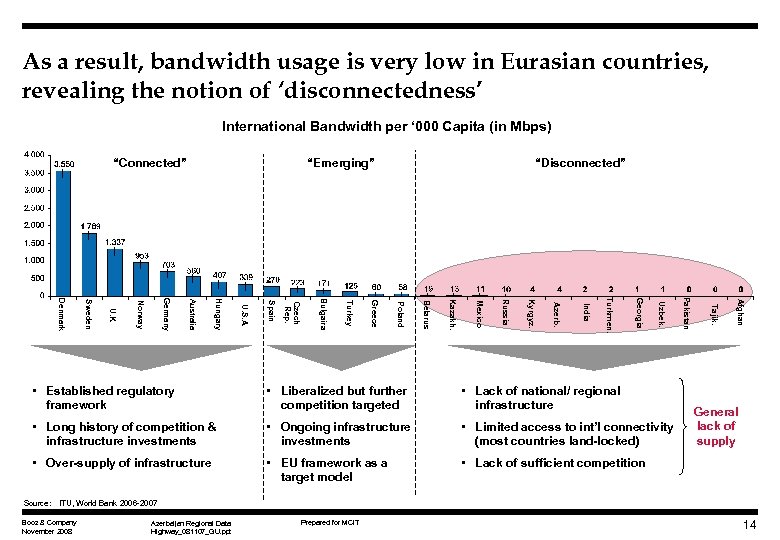
As a result, bandwidth usage is very low in Eurasian countries, revealing the notion of ‘disconnectedness’ International Bandwidth per ‘ 000 Capita (in Mbps) “Connected” “Emerging” “Disconnected” • Long history of competition & infrastructure investments • Ongoing infrastructure investments • Limited access to int’l connectivity (most countries land-locked) • Over-supply of infrastructure • EU framework as a target model Afghan • Lack of national/ regional infrastructure Tajik. • Liberalized but further competition targeted Pakistan Uzbek. Georgia Turkmen. India Azerb. Kyrgyz. Russia Mexico Kazakh. Belarus Poland Greece Turkey Bulgaira Czech Rep. Spain U. S. A Hungary Australia Germany Norway U. K Sweden Denmark • Established regulatory framework • Lack of sufficient competition General lack of supply Source: ITU, World Bank 2006 -2007 Booz & Company November 2008 Azerbaijan Regional Data Highway_081107_GU. ppt Prepared for MCIT 14
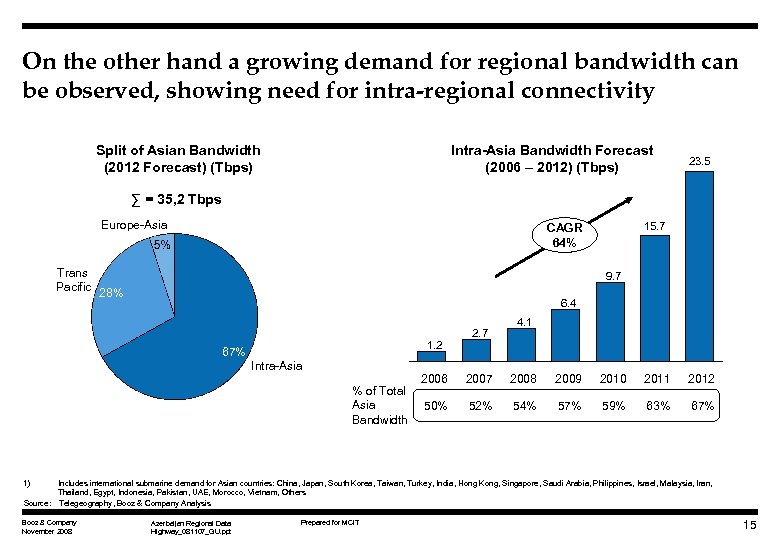
On the other hand a growing demand for regional bandwidth can be observed, showing need for intra-regional connectivity Split of Asian Bandwidth (2012 Forecast) (Tbps) Intra-Asia Bandwidth Forecast (2006 – 2012) (Tbps) 23. 5 ∑ = 35, 2 Tbps Europe-Asia 15. 7 CAGR 64% Trans Pacific 28% 9. 7 6. 4 1. 2 67% 2. 7 4. 1 Intra-Asia % of Total Asia Bandwidth 2006 2007 2008 2009 2010 2011 2012 50% 52% 54% 57% 59% 63% 67% 1) Includes international submarine demand for Asian countries: China, Japan, South Korea, Taiwan, Turkey, India, Hong Kong, Singapore, Saudi Arabia, Philippines, Israel, Malaysia, Iran, Thailand, Egypt, Indonesia, Pakistan, UAE, Morocco, Vietnam, Others Source: Telegeography, Booz & Company Analysis Booz & Company November 2008 Azerbaijan Regional Data Highway_081107_GU. ppt Prepared for MCIT 15
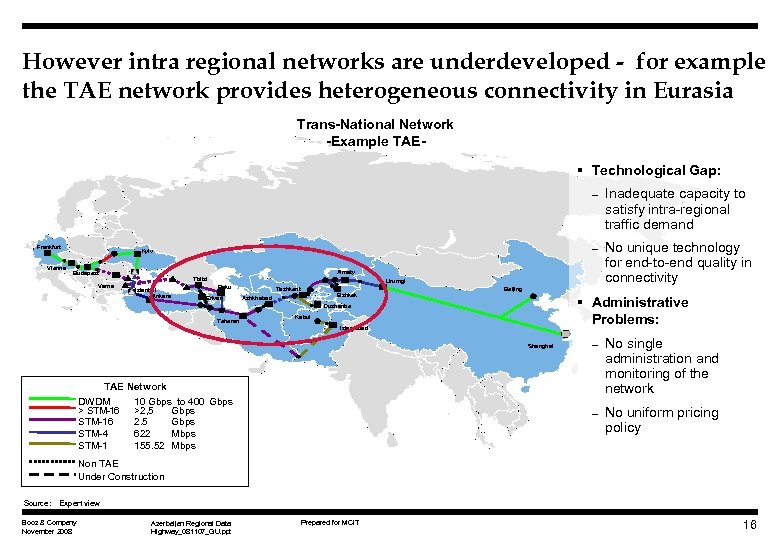
However intra regional networks are underdeveloped - for example the TAE network provides heterogeneous connectivity in Eurasia Trans-National Network -Example TAE- § Technological Gap: – Frankfurt Vienna – Kyiv Budapest Varna No unique technology for end-to-end quality in connectivity Almaty Tblisi Istanbul Ankara Inadequate capacity to satisfy intra-regional traffic demand Urumgi Baku Erivan Tashkent Bishkek Ashkhabad Beijing § Administrative Problems: Dushanbe Teheran Kabul Islamabad TAE Network DWDM 10 Gbps to 400 Gbps > STM-16 >2, 5 Gbps STM-16 2. 5 Gbps STM- 4 622 Mbps STM-1 155. 52 Mbps – No single administration and monitoring of the network – Shanghai No uniform pricing policy Non TAE Under Construction Source: Expert view Booz & Company November 2008 Azerbaijan Regional Data Highway_081107_GU. ppt Prepared for MCIT 16
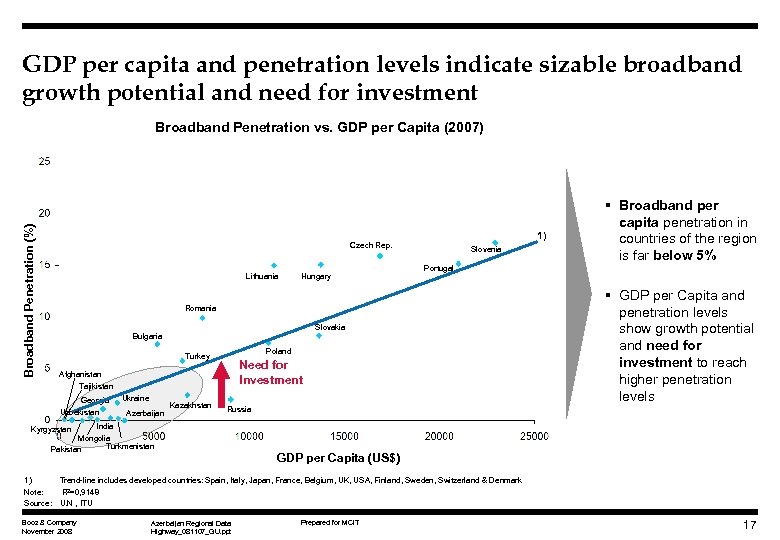
GDP per capita and penetration levels indicate sizable broadband growth potential and need for investment Broadband Penetration (%) Broadband Penetration vs. GDP per Capita (2007) 1) Czech Rep. Lithuania Hungary Slovenia Portugal Romania Slovakia Bulgaria Poland Turkey Need for Investment Afghanistan Tajikistan Georgia Uzbekistan Kyrgyzstan Ukraine Azerbaijan Kazakhstan § Broadband per capita penetration in countries of the region is far below 5% § GDP per Capita and penetration levels show growth potential and need for investment to reach higher penetration levels Russia India Mongolia Turkmenistan Pakistan GDP per Capita (US$) 1) Trend-line includes developed countries: Spain, Italy, Japan, France, Belgium, UK, USA, Finland, Sweden, Switzerland & Denmark Note: R²=0, 9148 Source: U. N , ITU Booz & Company November 2008 Azerbaijan Regional Data Highway_081107_GU. ppt Prepared for MCIT 17
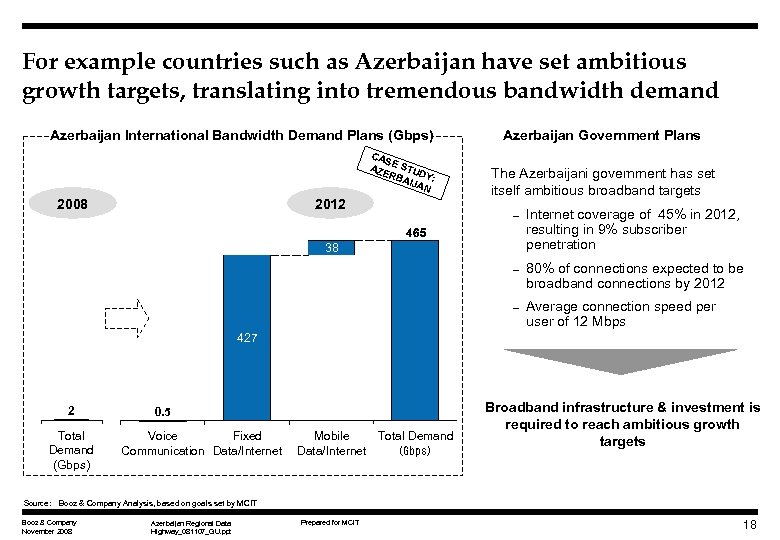
For example countries such as Azerbaijan have set ambitious growth targets, translating into tremendous bandwidth demand Azerbaijan International Bandwidth Demand Plans (Gbps) CAS E AZE STUD RBA Y IJA : N 2008 2012 Azerbaijan Government Plans The Azerbaijani government has set itself ambitious broadband targets – Internet coverage of 45% in 2012, resulting in 9% subscriber penetration – 80% of connections expected to be broadband connections by 2012 – Average connection speed per user of 12 Mbps 38 427 2 Total Demand (Gbps) 0. 5 Voice Fixed Communication Data/Internet Mobile Total Demand Data/Internet (Gbps) Broadband infrastructure & investment is required to reach ambitious growth targets Source: Booz & Company Analysis, based on goals set by MCIT Booz & Company November 2008 Azerbaijan Regional Data Highway_081107_GU. ppt Prepared for MCIT 18
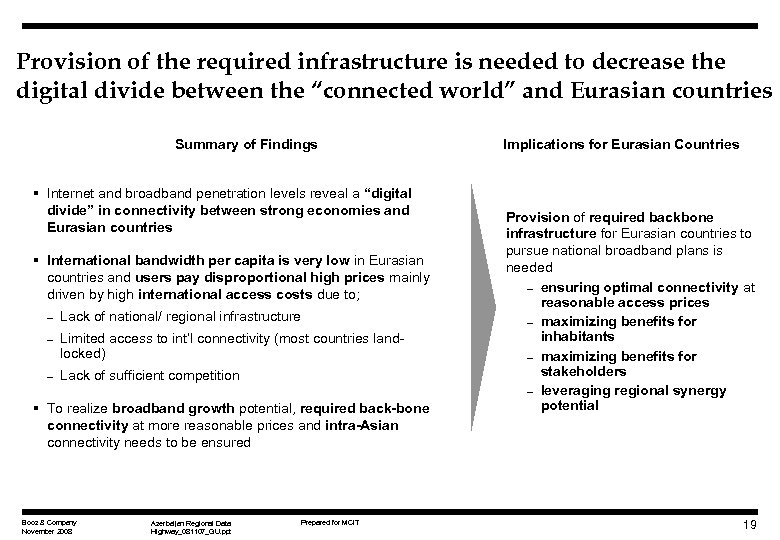
Provision of the required infrastructure is needed to decrease the digital divide between the “connected world” and Eurasian countries Summary of Findings § Internet and broadband penetration levels reveal a “digital divide” in connectivity between strong economies and Eurasian countries § International bandwidth per capita is very low in Eurasian countries and users pay disproportional high prices mainly driven by high international access costs due to; – Lack of national/ regional infrastructure – Limited access to int’l connectivity (most countries landlocked) – Lack of sufficient competition § To realize broadband growth potential, required back-bone connectivity at more reasonable prices and intra-Asian connectivity needs to be ensured Booz & Company November 2008 Azerbaijan Regional Data Highway_081107_GU. ppt Prepared for MCIT Implications for Eurasian Countries Provision of required backbone infrastructure for Eurasian countries to pursue national broadband plans is needed – ensuring optimal connectivity at reasonable access prices – maximizing benefits for inhabitants – maximizing benefits for stakeholders – leveraging regional synergy potential 19
The connected world of today The Eurasian disconnect How to close the gap Next Steps Booz & Company November 2008 Azerbaijan Regional Data Highway_081107_GU. ppt Prepared for MCIT 20
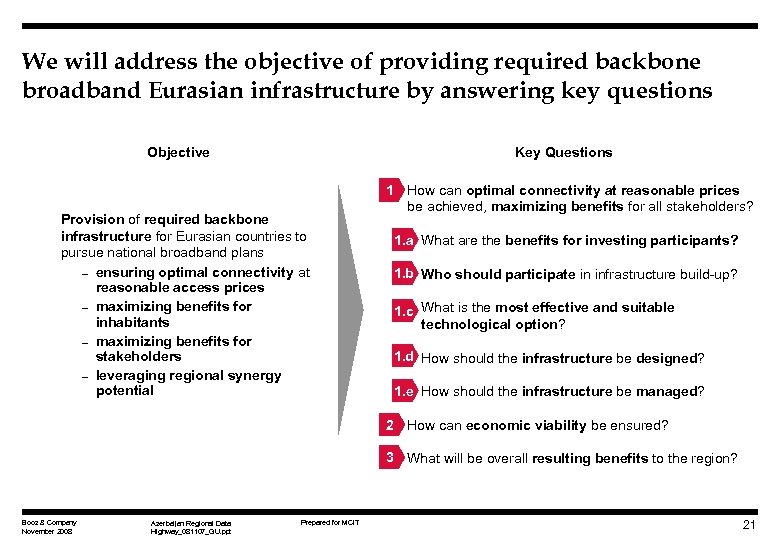
We will address the objective of providing required backbone broadband Eurasian infrastructure by answering key questions Objective Key Questions Provision of required backbone infrastructure for Eurasian countries to pursue national broadband plans – ensuring optimal connectivity at reasonable access prices – maximizing benefits for inhabitants – maximizing benefits for stakeholders – leveraging regional synergy potential 1§ How can optimal connectivity at reasonable prices be achieved, maximizing benefits for all stakeholders? 1. a What are the benefits for investing participants? – 1. b Who should participate in infrastructure build-up? – – 1. c What is the most effective and suitable technological option? 1. d How should the infrastructure be designed? – 1. e How should the infrastructure be managed? – 2§ How can economic viability be ensured? 3§ What will be overall resulting benefits to the region? Booz & Company November 2008 Azerbaijan Regional Data Highway_081107_GU. ppt Prepared for MCIT 21
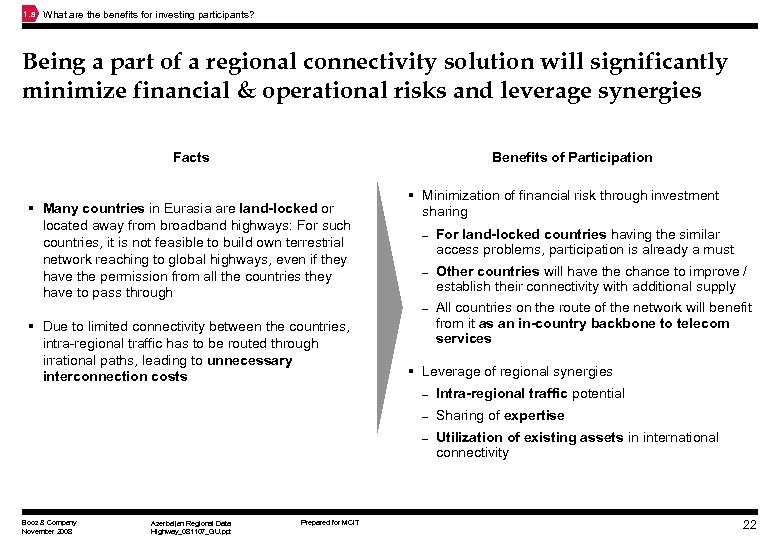
1. a What are the benefits for investing participants? Being a part of a regional connectivity solution will significantly minimize financial & operational risks and leverage synergies Facts Benefits of Participation § Many countries in Eurasia are land-locked or located away from broadband highways: For such countries, it is not feasible to build own terrestrial network reaching to global highways, even if they have the permission from all the countries they have to pass through § Minimization of financial risk through investment sharing For land-locked countries having the similar access problems, participation is already a must – Other countries will have the chance to improve / establish their connectivity with additional supply – § Due to limited connectivity between the countries, intra-regional traffic has to be routed through irrational paths, leading to unnecessary interconnection costs – All countries on the route of the network will benefit from it as an in-country backbone to telecom services § Leverage of regional synergies – – Azerbaijan Regional Data Highway_081107_GU. ppt Prepared for MCIT Sharing of expertise – Booz & Company November 2008 Intra-regional traffic potential Utilization of existing assets in international connectivity 22
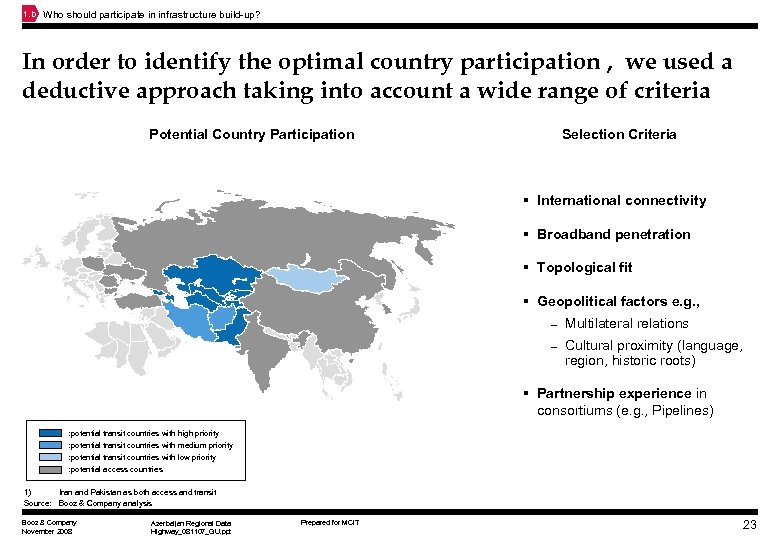
1. b Who should participate in infrastructure build-up? In order to identify the optimal country participation , we used a deductive approach taking into account a wide range of criteria Potential Country Participation Selection Criteria § International connectivity § Broadband penetration § Topological fit § Geopolitical factors e. g. , – Multilateral relations – Cultural proximity (language, region, historic roots) § Partnership experience in consortiums (e. g. , Pipelines) : potential transit countries with high priority : potential transit countries with medium priority : potential transit countries with low priority : potential access countries 1) Iran and Pakistan as both access and transit Source: Booz & Company analysis Booz & Company November 2008 Azerbaijan Regional Data Highway_081107_GU. ppt Prepared for MCIT 23
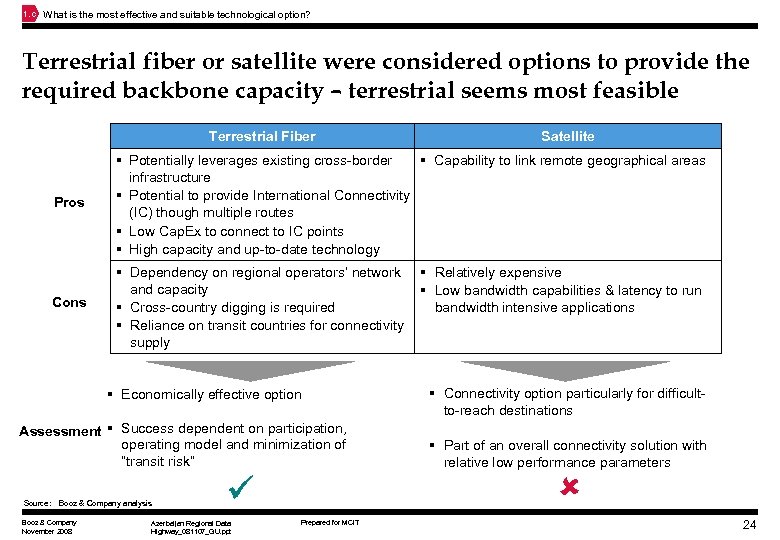
1. c What is the most effective and suitable technological option? Terrestrial fiber or satellite were considered options to provide the required backbone capacity – terrestrial seems most feasible Terrestrial Fiber Satellite Pros § Potentially leverages existing cross-border § Capability to link remote geographical areas infrastructure § Potential to provide International Connectivity (IC) though multiple routes § Low Cap. Ex to connect to IC points § High capacity and up-to-date technology Cons § Dependency on regional operators’ network § Relatively expensive and capacity § Low bandwidth capabilities & latency to run § Cross-country digging is required bandwidth intensive applications § Reliance on transit countries for connectivity supply § Economically effective option Assessment § Success dependent on participation, operating model and minimization of “transit risk” § Connectivity option particularly for difficultto-reach destinations § Part of an overall connectivity solution with relative low performance parameters Source: Booz & Company analysis Booz & Company November 2008 Azerbaijan Regional Data Highway_081107_GU. ppt Prepared for MCIT 24
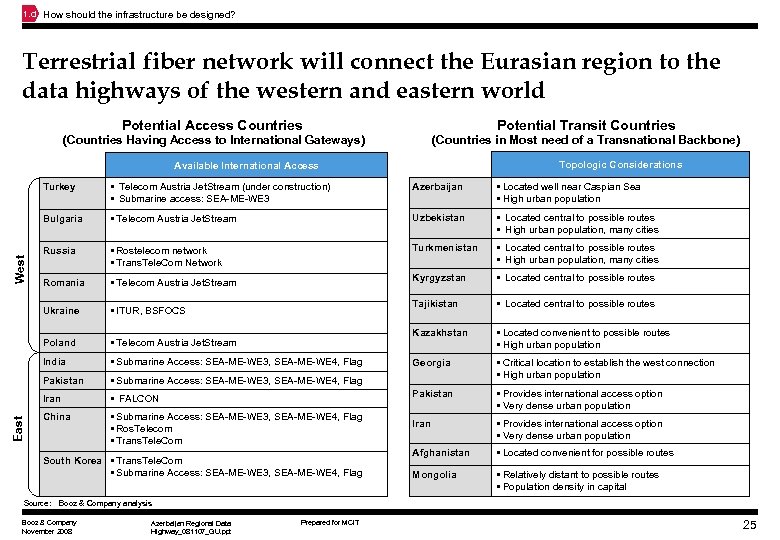
1. d How should the infrastructure be designed? Terrestrial fiber network will connect the Eurasian region to the data highways of the western and eastern world Potential Access Countries Potential Transit Countries (Countries Having Access to International Gateways) (Countries in Most need of a Transnational Backbone) Topologic Considerations Available International Access Azerbaijan § Located well near Caspian Sea § High urban population § Telecom Austria Jet. Stream Uzbekistan § Located central to possible routes § High urban population, many cities Russia § Rostelecom network § Trans. Tele. Com Network Turkmenistan § Located central to possible routes § High urban population, many cities Romania § Telecom Austria Jet. Stream Kyrgyzstan § Located central to possible routes Ukraine § ITUR, BSFOCS Tajikistan § Located central to possible routes Poland § Telecom Austria Jet. Stream Kazakhstan § Located convenient to possible routes § High urban population India § Submarine Access: SEA-ME-WE 3, SEA-ME-WE 4, Flag Georgia Pakistan § Submarine Access: SEA-ME-WE 3, SEA-ME-WE 4, Flag § Critical location to establish the west connection § High urban population Iran East § Telecom Austria Jet. Stream (under construction) § Submarine access: SEA-ME-WE 3 Bulgaria West Turkey § FALCON Pakistan China § Submarine Access: SEA-ME-WE 3, SEA-ME-WE 4, Flag § Ros. Telecom § Trans. Tele. Com § Provides international access option § Very dense urban population Iran § Provides international access option § Very dense urban population Afghanistan § Located convenient for possible routes Mongolia § Relatively distant to possible routes § Population density in capital South Korea § Trans. Tele. Com § Submarine Access: SEA-ME-WE 3, SEA-ME-WE 4, Flag Source: Booz & Company analysis Booz & Company November 2008 Azerbaijan Regional Data Highway_081107_GU. ppt Prepared for MCIT 25
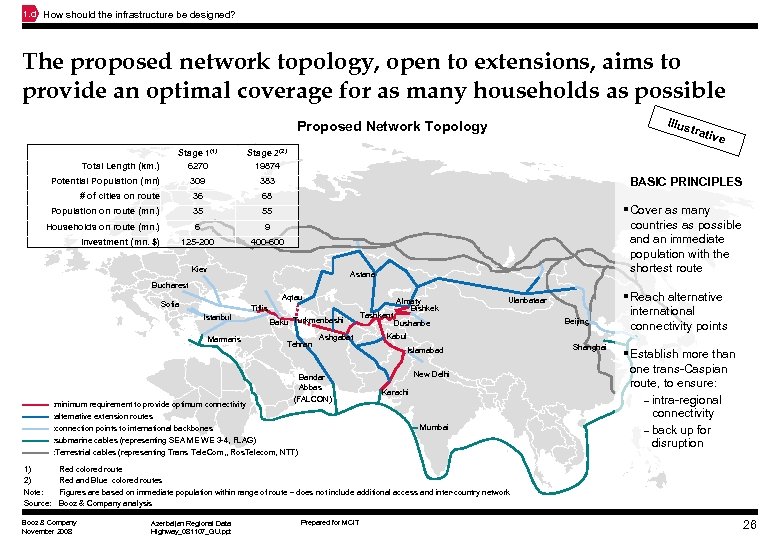
1. d How should the infrastructure be designed? The proposed network topology, open to extensions, aims to provide an optimal coverage for as many households as possible Illus Proposed Network Topology Stage 1(1) 6270 309 383 # of cities on route 36 68 Population on route (mn. ) 35 55 Households on route (mn. ) 6 9 125 -200 400 -600 ve Stage 2(2) 19874 Potential Population (mn) trati Total Length (km. ) Investment (mn. $) BASIC PRINCIPLES Kiev § Cover as many countries as possible and an immediate population with the shortest route Astana Bucharest Aqtau Sofia Tiflis Istanbul Marmaris Baku Turkmenbashi Tehran Ashgabat Bandar Abbas : minimum requirement to provide optimum connectivity (FALCON) : alternative extension routes : connection points to international backbones : submarine cables (representing SEA ME WE 3 -4, FLAG) : Terrestrial cables (representing Trans Tele. Com, , Ros. Telecom, NTT) 1) 2) Note: Source: Tashkent Almaty Bishkek Ulanbataar Dushanbe Beijing Kabul Islamabad New Delhi Karachi Mumbai Shanghai § Reach alternative international connectivity points § Establish more than one trans-Caspian route, to ensure: – intra-regional connectivity – back up for disruption Red colored route Red and Blue colored routes Figures are based on immediate population within range of route – does not include additional access and inter-country network Booz & Company analysis Booz & Company November 2008 Azerbaijan Regional Data Highway_081107_GU. ppt Prepared for MCIT 26
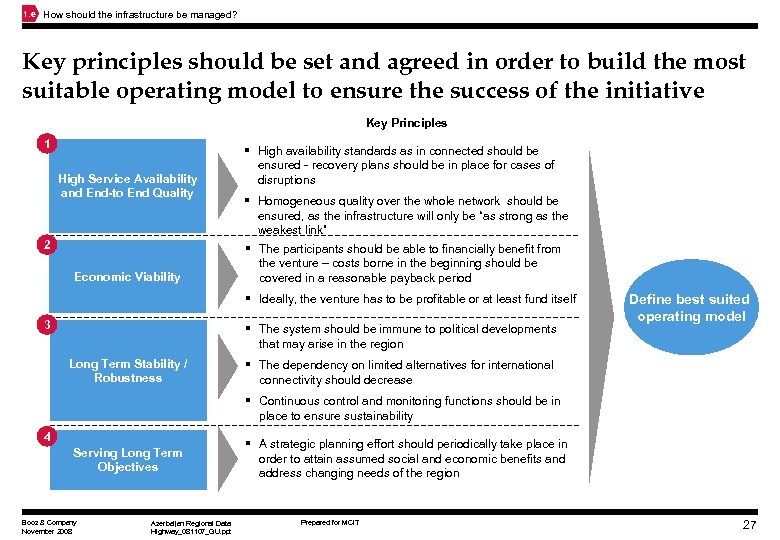
1. e How should the infrastructure be managed? Key principles should be set and agreed in order to build the most suitable operating model to ensure the success of the initiative Key Principles 1 High Service Availability and End-to End Quality 2 Economic Viability § High availability standards as in connected should be ensured - recovery plans should be in place for cases of disruptions § Homogeneous quality over the whole network should be ensured, as the infrastructure will only be “as strong as the weakest link” § The participants should be able to financially benefit from the venture – costs borne in the beginning should be covered in a reasonable payback period § Ideally, the venture has to be profitable or at least fund itself 3 § The system should be immune to political developments that may arise in the region Long Term Stability / Robustness Define best suited operating model § The dependency on limited alternatives for international connectivity should decrease § Continuous control and monitoring functions should be in place to ensure sustainability 4 Serving Long Term Objectives Booz & Company November 2008 Azerbaijan Regional Data Highway_081107_GU. ppt § A strategic planning effort should periodically take place in order to attain assumed social and economic benefits and address changing needs of the region Prepared for MCIT 27
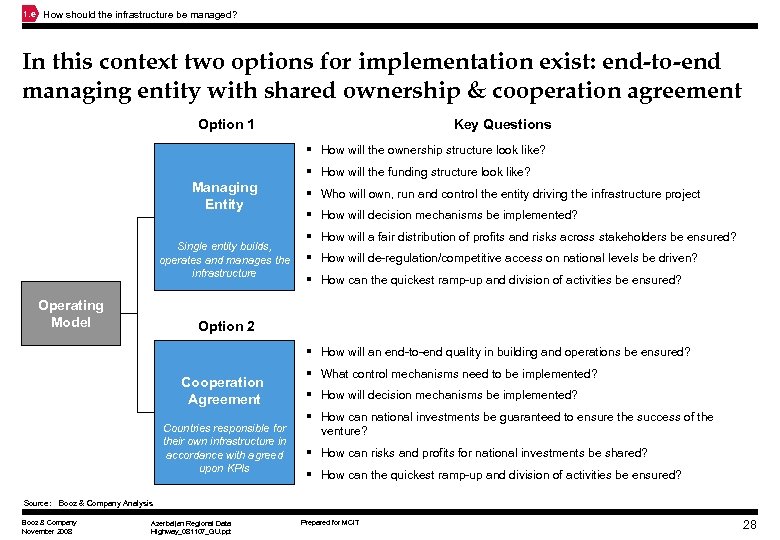
1. e How should the infrastructure be managed? In this context two options for implementation exist: end-to-end managing entity with shared ownership & cooperation agreement Option 1 Key Questions § How will the ownership structure look like? § How will the funding structure look like? Managing Entity Single entity builds, operates and manages the infrastructure Operating Model § Who will own, run and control the entity driving the infrastructure project § How will decision mechanisms be implemented? § How will a fair distribution of profits and risks across stakeholders be ensured? § How will de-regulation/competitive access on national levels be driven? § How can the quickest ramp-up and division of activities be ensured? Option 2 § How will an end-to-end quality in building and operations be ensured? Cooperation Agreement Countries responsible for their own infrastructure in accordance with agreed upon KPIs § What control mechanisms need to be implemented? § How will decision mechanisms be implemented? § How can national investments be guaranteed to ensure the success of the venture? § How can risks and profits for national investments be shared? § How can the quickest ramp-up and division of activities be ensured? Source: Booz & Company Analysis Booz & Company November 2008 Azerbaijan Regional Data Highway_081107_GU. ppt Prepared for MCIT 28
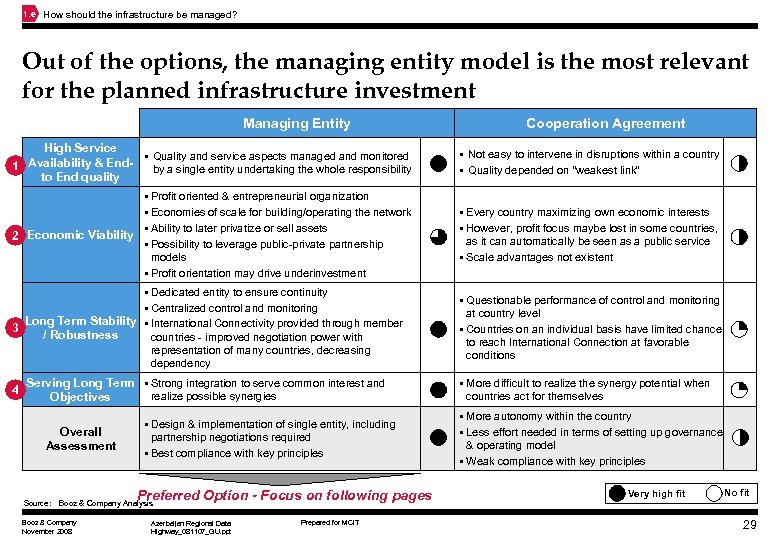
1. e How should the infrastructure be managed? Out of the options, the managing entity model is the most relevant for the planned infrastructure investment Managing Entity Cooperation Agreement High Service § Quality and service aspects managed and monitored Availability & End 1 by a single entity undertaking the whole responsibility to End quality § Not easy to intervene in disruptions within a country § Quality depended on “weakest link” § Profit oriented & entrepreneurial organization § Economies of scale for building/operating the network § Ability to later privatize or sell assets 2 Economic Viability § Possibility to leverage public-private partnership models § Profit orientation may drive underinvestment § Every country maximizing own economic interests § However, profit focus maybe lost in some countries, as it can automatically be seen as a public service § Scale advantages not existent § Dedicated entity to ensure continuity § Centralized control and monitoring Long Term Stability § International Connectivity provided through member 3 / Robustness countries - improved negotiation power with representation of many countries, decreasing dependency § Questionable performance of control and monitoring at country level § Countries on an individual basis have limited chance to reach International Connection at favorable conditions 4 Serving Long Term § Strong integration to serve common interest and realize possible synergies Objectives Overall Assessment § Design & implementation of single entity, including partnership negotiations required § Best compliance with key principles Preferred Option - Focus on following pages Source: Booz & Company Analysis Booz & Company November 2008 Azerbaijan Regional Data Highway_081107_GU. ppt Prepared for MCIT § More difficult to realize the synergy potential when countries act for themselves § More autonomy within the country § Less effort needed in terms of setting up governance & operating model § Weak compliance with key principles Very high fit No fit 29
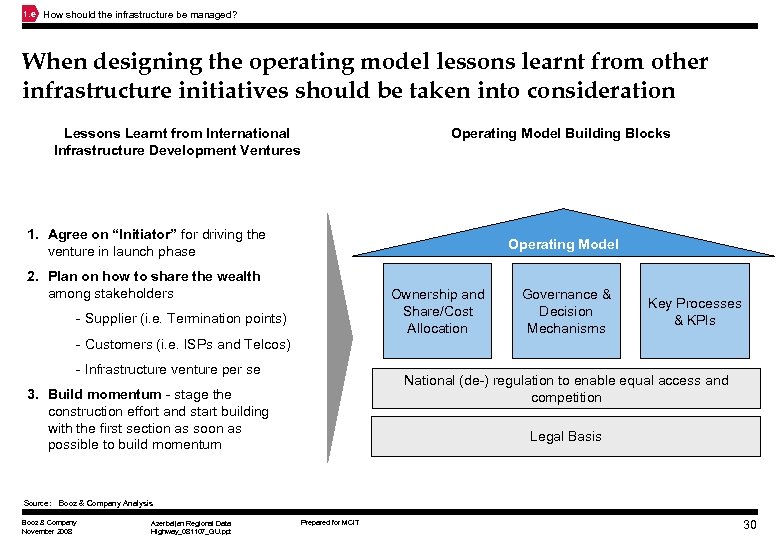
1. e How should the infrastructure be managed? When designing the operating model lessons learnt from other infrastructure initiatives should be taken into consideration Lessons Learnt from International Infrastructure Development Ventures Operating Model Building Blocks 1. Agree on “Initiator” for driving the venture in launch phase Operating Model 2. Plan on how to share the wealth among stakeholders Ownership and Share/Cost Allocation - Supplier (i. e. Termination points) Governance & Decision Mechanisms Key Processes & KPIs - Customers (i. e. ISPs and Telcos) - Infrastructure venture per se National (de-) regulation to enable equal access and competition 3. Build momentum - stage the construction effort and start building with the first section as soon as possible to build momentum Legal Basis Source: Booz & Company Analysis Booz & Company November 2008 Azerbaijan Regional Data Highway_081107_GU. ppt Prepared for MCIT 30
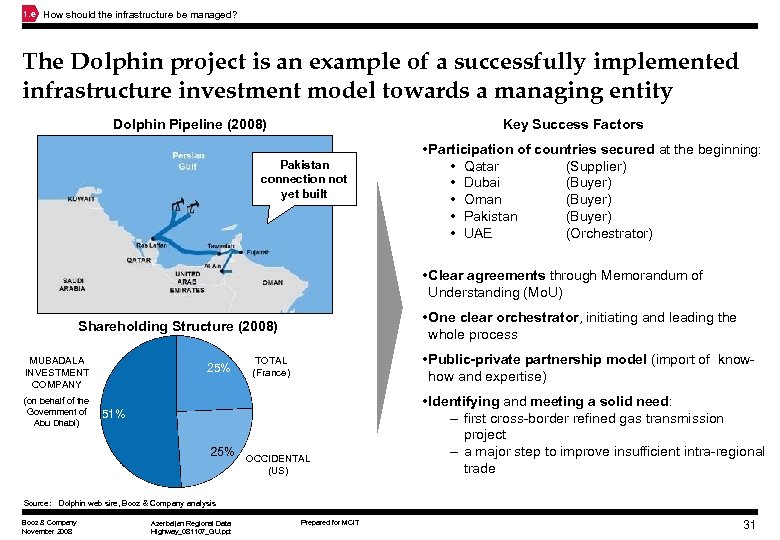
1. e How should the infrastructure be managed? The Dolphin project is an example of a successfully implemented infrastructure investment model towards a managing entity Dolphin Pipeline (2008) Key Success Factors Pakistan connection not yet built • Participation of countries secured at the beginning: • Qatar (Supplier) • Dubai (Buyer) • Oman (Buyer) • Pakistan (Buyer) • UAE (Orchestrator) • Clear agreements through Memorandum of Understanding (Mo. U) • One clear orchestrator, initiating and leading the whole process Shareholding Structure (2008) MUBADALA INVESTMENT COMPANY (on behalf of the Government of Abu Dhabi) 25% • Public-private partnership model (import of knowhow and expertise) TOTAL (France) 51% OCCIDENTAL (US) • Identifying and meeting a solid need: – first cross-border refined gas transmission project – a major step to improve insufficient intra-regional trade Source: Dolphin web sire, Booz & Company analysis Booz & Company November 2008 Azerbaijan Regional Data Highway_081107_GU. ppt Prepared for MCIT 31
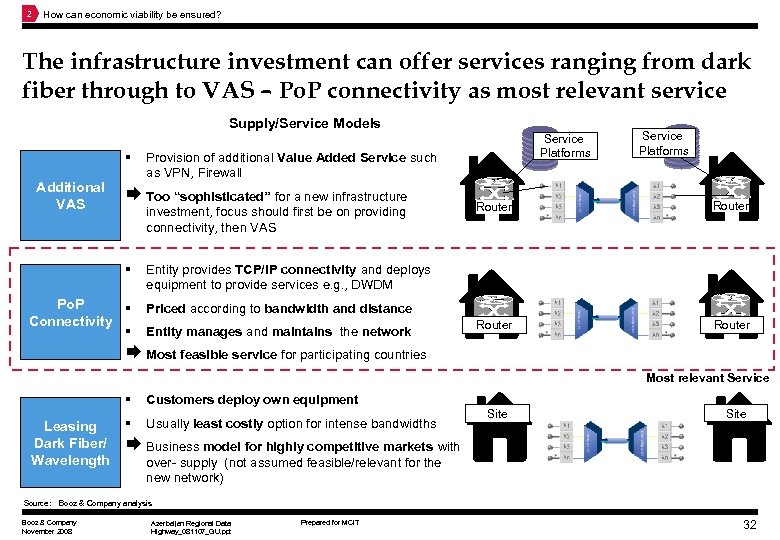
2 How can economic viability be ensured? The infrastructure investment can offer services ranging from dark fiber through to VAS – Po. P connectivity as most relevant service Supply/Service Models § Additional VAS Provision of additional Value Added Service such as VPN, Firewall Æ Too “sophisticated” for a new infrastructure investment, focus should first be on providing connectivity, then VAS § Po. P § Connectivity § Service Platforms Router Router Entity provides TCP/IP connectivity and deploys equipment to provide services e. g. , DWDM Priced according to bandwidth and distance Entity manages and maintains the network Æ Most feasible service for participating countries Most relevant Service § Leasing Dark Fiber/ Wavelength Customers deploy own equipment § Usually least costly option for intense bandwidths Site Æ Business model for highly competitive markets with over- supply (not assumed feasible/relevant for the new network) Source: Booz & Company analysis Booz & Company November 2008 Azerbaijan Regional Data Highway_081107_GU. ppt Prepared for MCIT 32
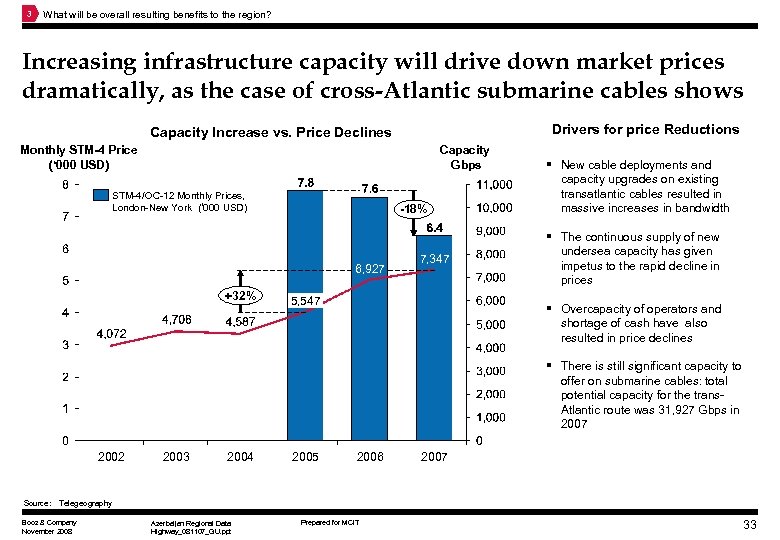
3 What will be overall resulting benefits to the region? Increasing infrastructure capacity will drive down market prices dramatically, as the case of cross-Atlantic submarine cables shows Drivers for price Reductions Capacity Increase vs. Price Declines Monthly STM-4 Price (‘ 000 USD) Capacity Gbps STM-4/OC-12 Monthly Prices, London-New York (‘ 000 USD) -18% 6, 927 +32% 7, 347 5, 547 § New cable deployments and capacity upgrades on existing transatlantic cables resulted in massive increases in bandwidth § The continuous supply of new undersea capacity has given impetus to the rapid decline in prices § Overcapacity of operators and shortage of cash have also resulted in price declines § There is still significant capacity to offer on submarine cables: total potential capacity for the trans. Atlantic route was 31, 927 Gbps in 2007 2002 2003 2004 2005 2006 2007 Source: Telegeography Booz & Company November 2008 Azerbaijan Regional Data Highway_081107_GU. ppt Prepared for MCIT 33
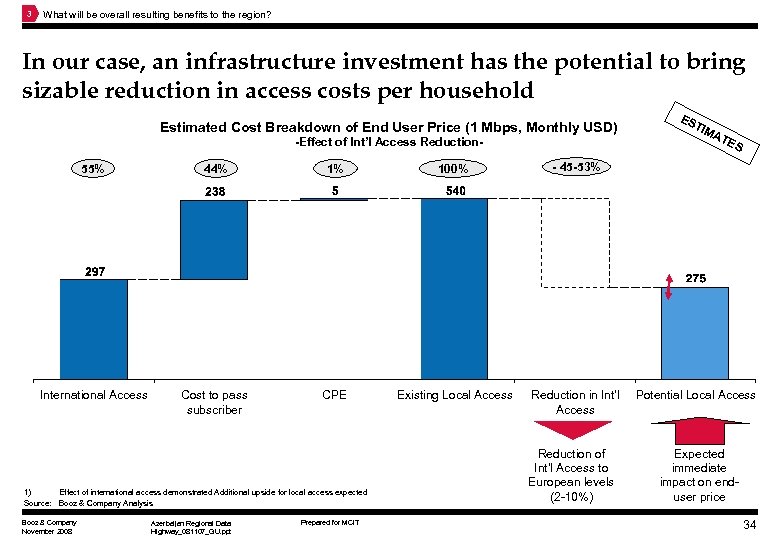
3 What will be overall resulting benefits to the region? In our case, an infrastructure investment has the potential to bring sizable reduction in access costs per household Estimated Cost Breakdown of End User Price (1 Mbps, Monthly USD) -Effect of Int’l Access Reduction- ES TIM AT E S 55% 44% 1% 100% - 45 -53% International Access Cost to pass subscriber CPE Existing Local Access Reduction in Int’l Access 1) Effect of international access demonstrated Additional upside for local access expected Source: Booz & Company Analysis Booz & Company November 2008 Azerbaijan Regional Data Highway_081107_GU. ppt Prepared for MCIT Reduction of Int’l Access to European levels (2 -10%) Potential Local Access Expected immediate impact on enduser price 34
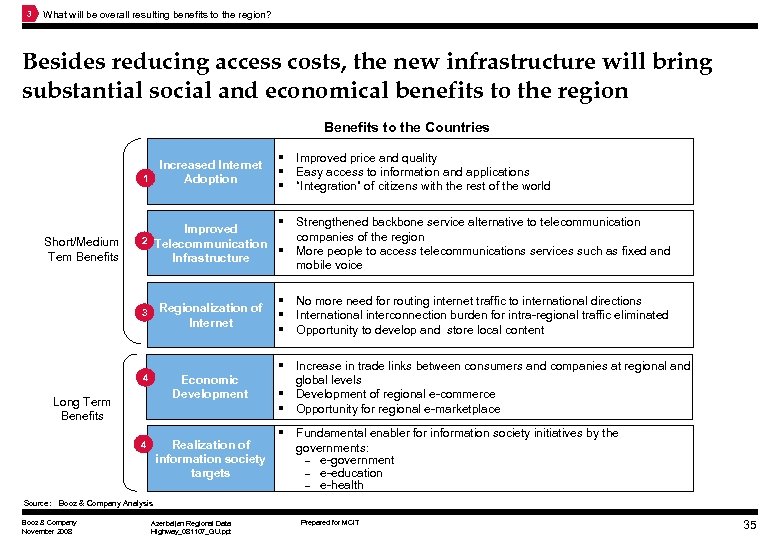
3 What will be overall resulting benefits to the region? Besides reducing access costs, the new infrastructure will bring substantial social and economical benefits to the region Benefits to the Countries Increased Internet 1 Adoption Short/Medium Tem Benefits § Improved price and quality § Easy access to information and applications § “Integration” of citizens with the rest of the world § Improved 2 Telecommunication § Infrastructure Regionalization of Internet 3 4 Economic Development 4 Realization of information society targets Long Term Benefits Strengthened backbone service alternative to telecommunication companies of the region More people to access telecommunications services such as fixed and mobile voice § No more need for routing internet traffic to international directions § International interconnection burden for intra-regional traffic eliminated § Opportunity to develop and store local content § Increase in trade links between consumers and companies at regional and global levels § Development of regional e-commerce § Opportunity for regional e-marketplace § Fundamental enabler for information society initiatives by the governments: – e-government – e-education – e-health Source: Booz & Company Analysis Booz & Company November 2008 Azerbaijan Regional Data Highway_081107_GU. ppt Prepared for MCIT 35
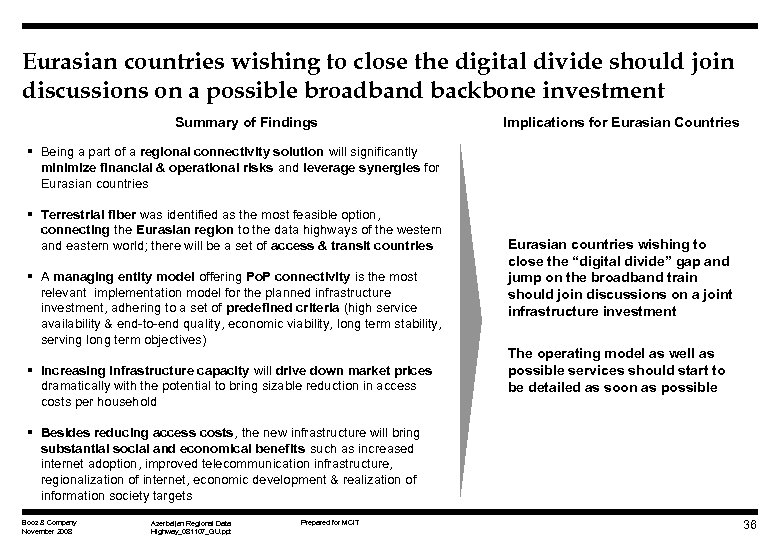
Eurasian countries wishing to close the digital divide should join discussions on a possible broadband backbone investment Summary of Findings Implications for Eurasian Countries § Being a part of a regional connectivity solution will significantly minimize financial & operational risks and leverage synergies for Eurasian countries § Terrestrial fiber was identified as the most feasible option, connecting the Eurasian region to the data highways of the western and eastern world; there will be a set of access & transit countries § A managing entity model offering Po. P connectivity is the most relevant implementation model for the planned infrastructure investment, adhering to a set of predefined criteria (high service availability & end-to-end quality, economic viability, long term stability, serving long term objectives) § Increasing infrastructure capacity will drive down market prices dramatically with the potential to bring sizable reduction in access costs per household Eurasian countries wishing to close the “digital divide” gap and jump on the broadband train should join discussions on a joint infrastructure investment The operating model as well as possible services should start to be detailed as soon as possible § Besides reducing access costs, the new infrastructure will bring substantial social and economical benefits such as increased internet adoption, improved telecommunication infrastructure, regionalization of internet, economic development & realization of information society targets Booz & Company November 2008 Azerbaijan Regional Data Highway_081107_GU. ppt Prepared for MCIT 36
The connected world of today The Eurasian disconnect How to close the gap Next Steps Booz & Company November 2008 Azerbaijan Regional Data Highway_081107_GU. ppt Prepared for MCIT 37
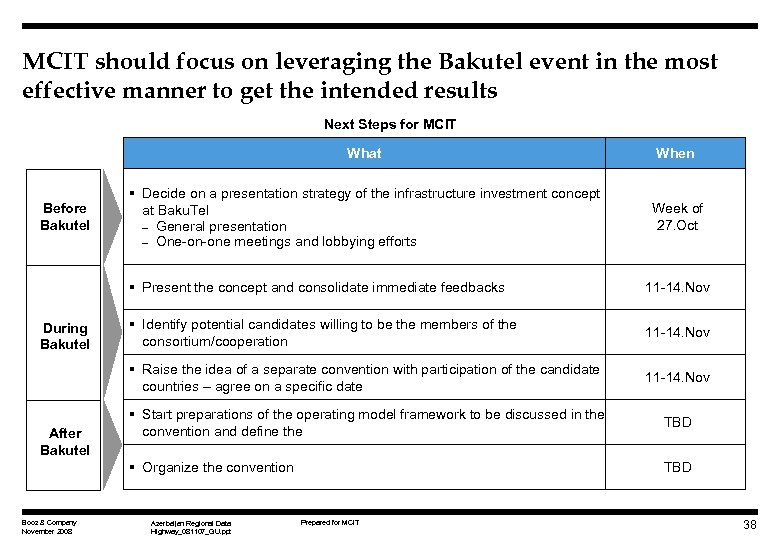
MCIT should focus on leveraging the Bakutel event in the most effective manner to get the intended results Next Steps for MCIT What Before Bakutel When § Decide on a presentation strategy of the infrastructure investment concept at Baku. Tel – General presentation – One-on-one meetings and lobbying efforts Week of 27. Oct § Present the concept and consolidate immediate feedbacks Booz & Company November 2008 11 -14. Nov § Start preparations of the operating model framework to be discussed in the convention and define the TBD § Organize the convention After Bakutel § Identify potential candidates willing to be the members of the consortium/cooperation § Raise the idea of a separate convention with participation of the candidate countries – agree on a specific date During Bakutel 11 -14. Nov TBD Azerbaijan Regional Data Highway_081107_GU. ppt Prepared for MCIT 38
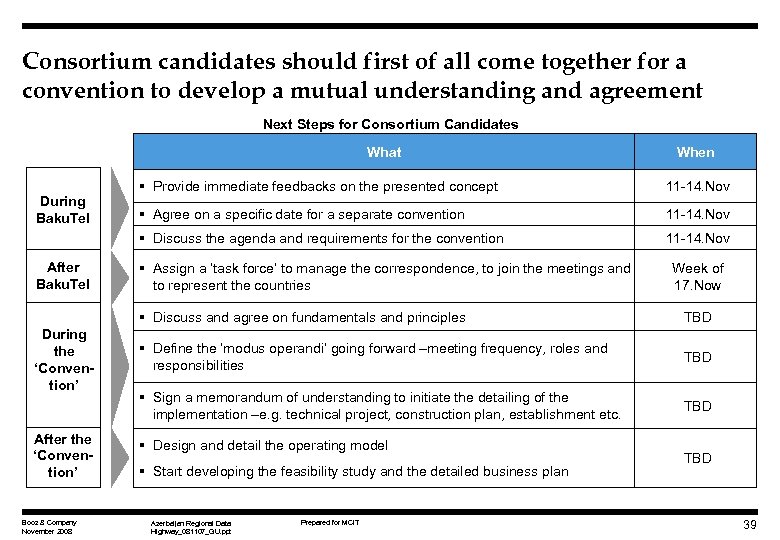
Consortium candidates should first of all come together for a convention to develop a mutual understanding and agreement Next Steps for Consortium Candidates What When After Baku. Tel 11 -14. Nov § Agree on a specific date for a separate convention 11 -14. Nov § Discuss the agenda and requirements for the convention During Baku. Tel § Provide immediate feedbacks on the presented concept 11 -14. Nov § Assign a ‘task force’ to manage the correspondence, to join the meetings and to represent the countries Week of 17. Now § Discuss and agree on fundamentals and principles During the ‘Convention’ After the ‘Convention’ Booz & Company November 2008 TBD § Define the ‘modus operandi’ going forward –meeting frequency, roles and responsibilities TBD § Sign a memorandum of understanding to initiate the detailing of the implementation –e. g. technical project, construction plan, establishment etc. TBD § Design and detail the operating model § Start developing the feasibility study and the detailed business plan Azerbaijan Regional Data Highway_081107_GU. ppt Prepared for MCIT TBD 39

Appendix Booz & Company November 2008 Azerbaijan Regional Data Highway_081107_GU. ppt Prepared for MCIT 40
Case Studies Country Selection and Profiles Sections of the Proposed Network Further Supporting Slides Booz & Company November 2008 Azerbaijan Regional Data Highway_081107_GU. ppt Prepared for MCIT 41
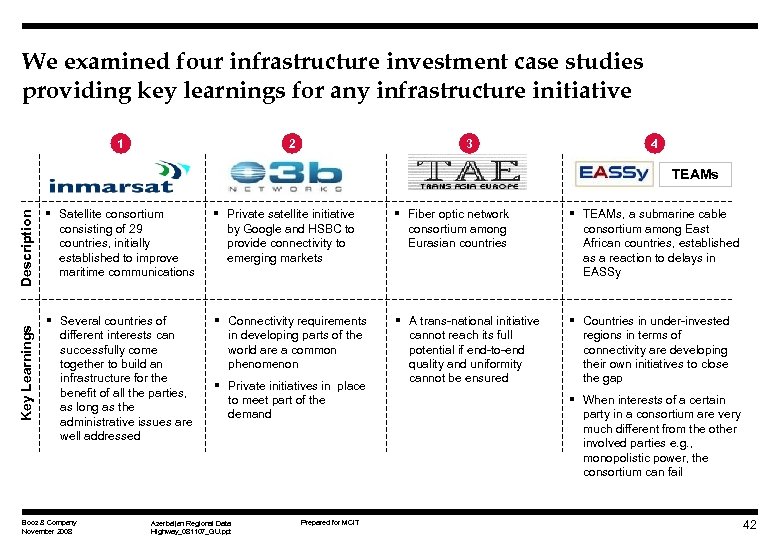
We examined four infrastructure investment case studies providing key learnings for any infrastructure initiative 1 2 3 4 Description § Satellite consortium consisting of 29 countries, initially established to improve maritime communications § Private satellite initiative by Google and HSBC to provide connectivity to emerging markets § Fiber optic network consortium among Eurasian countries § TEAMs, a submarine cable consortium among East African countries, established as a reaction to delays in EASSy Key Learnings TEAMs § Several countries of different interests can successfully come together to build an infrastructure for the benefit of all the parties, as long as the administrative issues are well addressed § Connectivity requirements in developing parts of the world are a common phenomenon § A trans-national initiative cannot reach its full potential if end-to-end quality and uniformity cannot be ensured § Countries in under-invested regions in terms of connectivity are developing their own initiatives to close the gap Booz & Company November 2008 § Private initiatives in place to meet part of the demand Azerbaijan Regional Data Highway_081107_GU. ppt Prepared for MCIT § When interests of a certain party in a consortium are very much different from the other involved parties e. g. , monopolistic power, the consortium can fail 42
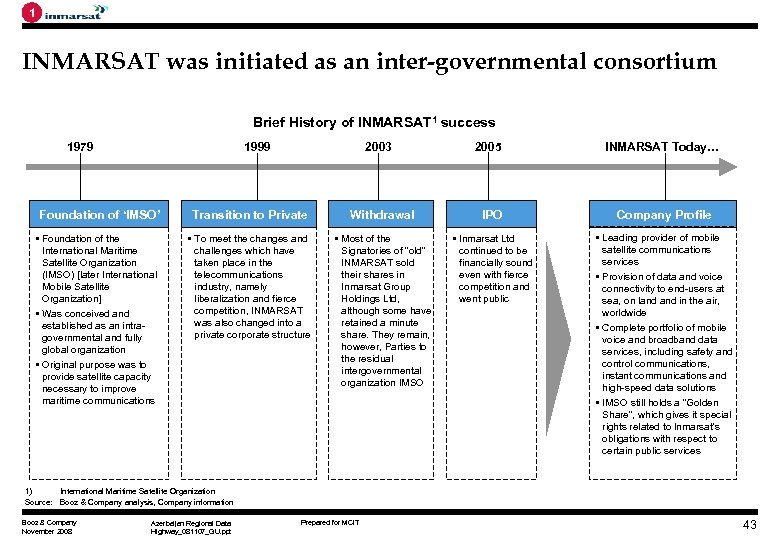
1 INMARSAT was initiated as an inter-governmental consortium Brief History of INMARSAT 1 success 1979 1999 2003 2005 INMARSAT Today… Foundation of ‘IMSO’ Transition to Private Withdrawal IPO Company Profile § Foundation of the International Maritime Satellite Organization (IMSO) [later International Mobile Satellite Organization] § Was conceived and established as an intragovernmental and fully global organization § Original purpose was to provide satellite capacity necessary to improve maritime communications § To meet the changes and challenges which have taken place in the telecommunications industry, namely liberalization and fierce competition, INMARSAT was also changed into a private corporate structure § Most of the Signatories of “old” INMARSAT sold their shares in Inmarsat Group Holdings Ltd, although some have retained a minute share. They remain, however, Parties to the residual intergovernmental organization IMSO § Inmarsat Ltd continued to be financially sound even with fierce competition and went public § Leading provider of mobile satellite communications services § Provision of data and voice connectivity to end-users at sea, on land in the air, worldwide § Complete portfolio of mobile voice and broadband data services, including safety and control communications, instant communications and high-speed data solutions § IMSO still holds a “Golden Share”, which gives it special rights related to Inmarsat’s obligations with respect to certain public services 1) International Maritime Satellite Organization Source: Booz & Company analysis, Company information Booz & Company November 2008 Azerbaijan Regional Data Highway_081107_GU. ppt Prepared for MCIT 43
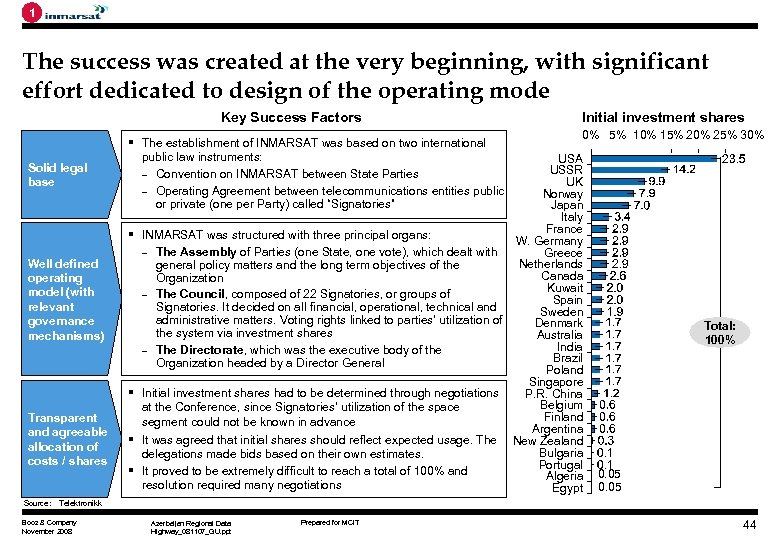
1 The success was created at the very beginning, with significant effort dedicated to design of the operating mode Key Success Factors Solid legal base § The establishment of INMARSAT was based on two international public law instruments: – Convention on INMARSAT between State Parties – Operating Agreement between telecommunications entities public or private (one per Party) called “Signatories” § Well defined operating model (with relevant governance mechanisms) § Transparent and agreeable allocation of costs / shares § § Initial investment shares 0% 5% 10% 15% 20% 25% 30% USA USSR UK Norway Japan Italy France INMARSAT was structured with three principal organs: W. Germany – The Assembly of Parties (one State, one vote), which dealt with Greece Netherlands general policy matters and the long term objectives of the Canada Organization Kuwait – The Council, composed of 22 Signatories, or groups of Spain Signatories. It decided on all financial, operational, technical and Sweden administrative matters. Voting rights linked to parties’ utilization of Denmark the system via investment shares Australia India – The Directorate, which was the executive body of the Brazil Organization headed by a Director General Poland Singapore Initial investment shares had to be determined through negotiations P. R. China Belgium at the Conference, since Signatories’ utilization of the space Finland segment could not be known in advance Argentina It was agreed that initial shares should reflect expected usage. The New Zealand Bulgaria delegations made bids based on their own estimates. Portugal It proved to be extremely difficult to reach a total of 100% and Algeria resolution required many negotiations Egypt Total: 100% 0. 05 Source: Telektronikk Booz & Company November 2008 Azerbaijan Regional Data Highway_081107_GU. ppt Prepared for MCIT 44
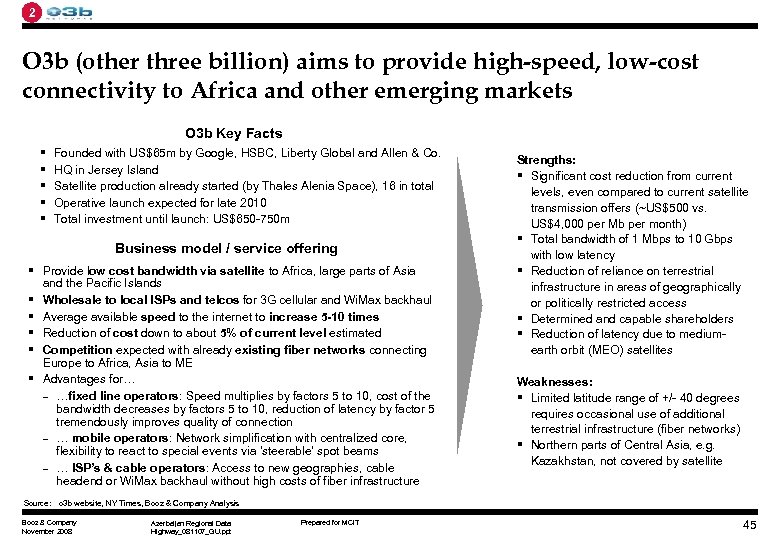
2 O 3 b (other three billion) aims to provide high-speed, low-cost connectivity to Africa and other emerging markets O 3 b Key Facts § § § Founded with US$65 m by Google, HSBC, Liberty Global and Allen & Co. HQ in Jersey Island Satellite production already started (by Thales Alenia Space), 16 in total Operative launch expected for late 2010 Total investment until launch: US$650 -750 m Business model / service offering § Provide low cost bandwidth via satellite to Africa, large parts of Asia and the Pacific Islands § Wholesale to local ISPs and telcos for 3 G cellular and Wi. Max backhaul § Average available speed to the internet to increase 5 -10 times § Reduction of cost down to about 5% of current level estimated § Competition expected with already existing fiber networks connecting Europe to Africa, Asia to ME § Advantages for… – …fixed line operators: Speed multiplies by factors 5 to 10, cost of the bandwidth decreases by factors 5 to 10, reduction of latency by factor 5 tremendously improves quality of connection – … mobile operators: Network simplification with centralized core, flexibility to react to special events via ‘steerable’ spot beams – … ISP’s & cable operators: Access to new geographies, cable headend or Wi. Max backhaul without high costs of fiber infrastructure Strengths: § Significant cost reduction from current levels, even compared to current satellite transmission offers (~US$500 vs. US$4, 000 per Mb per month) § Total bandwidth of 1 Mbps to 10 Gbps with low latency § Reduction of reliance on terrestrial infrastructure in areas of geographically or politically restricted access § Determined and capable shareholders § Reduction of latency due to mediumearth orbit (MEO) satellites Weaknesses: § Limited latitude range of +/- 40 degrees requires occasional use of additional terrestrial infrastructure (fiber networks) § Northern parts of Central Asia, e. g. Kazakhstan, not covered by satellite Source: o 3 b website, NY Times, Booz & Company Analysis Booz & Company November 2008 Azerbaijan Regional Data Highway_081107_GU. ppt Prepared for MCIT 45
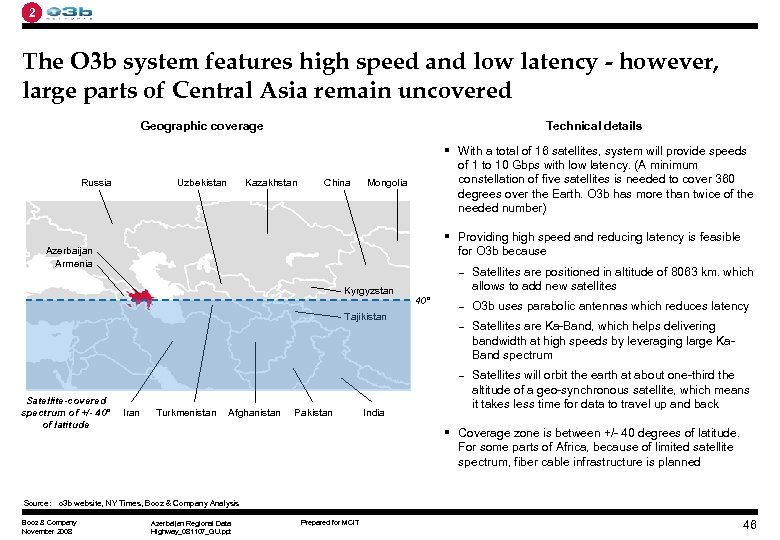
2 The O 3 b system features high speed and low latency - however, large parts of Central Asia remain uncovered Geographic coverage Russia Uzbekistan Technical details Kazakhstan China § With a total of 16 satellites, system will provide speeds of 1 to 10 Gbps with low latency. (A minimum constellation of five satellites is needed to cover 360 degrees over the Earth. O 3 b has more than twice of the needed number) Mongolia § Providing high speed and reducing latency is feasible for O 3 b because Azerbaijan Armenia – Satellite-covered spectrum of +/- 40° of latitude Iran Turkmenistan Afghanistan Pakistan India O 3 b uses parabolic antennas which reduces latency Satellites are Ka-Band, which helps delivering bandwidth at high speeds by leveraging large Ka. Band spectrum – Tajikistan 40° – – Kyrgyzstan Satellites are positioned in altitude of 8063 km. which allows to add new satellites Satellites will orbit the earth at about one-third the altitude of a geo-synchronous satellite, which means it takes less time for data to travel up and back § Coverage zone is between +/- 40 degrees of latitude. For some parts of Africa, because of limited satellite spectrum, fiber cable infrastructure is planned Source: o 3 b website, NY Times, Booz & Company Analysis Booz & Company November 2008 Azerbaijan Regional Data Highway_081107_GU. ppt Prepared for MCIT 46
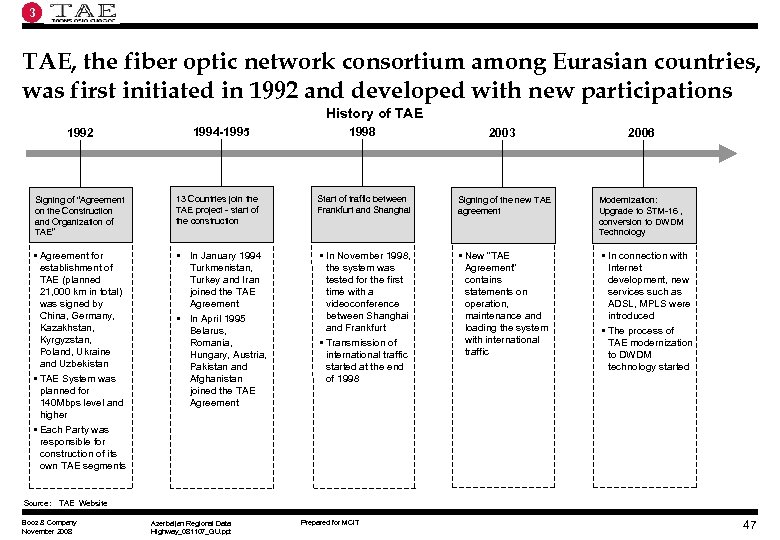
3 TAE, the fiber optic network consortium among Eurasian countries, was first initiated in 1992 and developed with new participations History of TAE 1992 1994 -1995 1998 2003 2006 Signing of “Agreement on the Construction and Organization of TAE” 13 Countries join the TAE project - start of the construction Start of traffic between Frankfurt and Shanghai Signing of the new TAE agreement Modernization: Upgrade to STM-16 , conversion to DWDM Technology § Agreement for establishment of TAE (planned 21, 000 km in total) was signed by China, Germany, Kazakhstan, Kyrgyzstan, Poland, Ukraine and Uzbekistan § TAE System was planned for 140 Mbps level and higher § Each Party was responsible for construction of its own TAE segments § In January 1994 Turkmenistan, Turkey and Iran joined the TAE Agreement § In April 1995 Belarus, Romania, Hungary, Austria, Pakistan and Afghanistan joined the TAE Agreement § In November 1998, the system was tested for the first time with a videoconference between Shanghai and Frankfurt § Transmission of international traffic started at the end of 1998 § New “TAE Agreement” contains statements on operation, maintenance and loading the system with international traffic § In connection with Internet development, new services such as ADSL, MPLS were introduced § The process of TAE modernization to DWDM technology started Source: TAE Website Booz & Company November 2008 Azerbaijan Regional Data Highway_081107_GU. ppt Prepared for MCIT 47
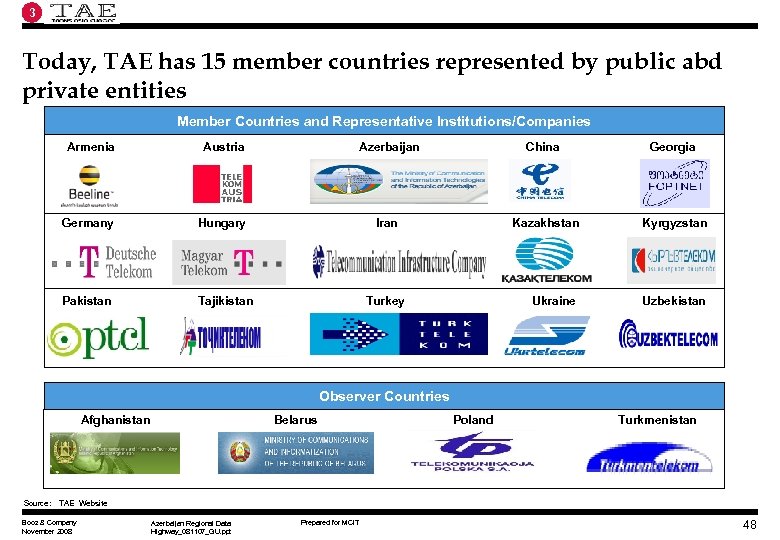
3 Today, TAE has 15 member countries represented by public abd private entities Member Countries and Representative Institutions/Companies Armenia Austria Azerbaijan China Georgia Germany Hungary Iran Kazakhstan Kyrgyzstan Pakistan Tajikistan Turkey Ukraine Uzbekistan Observer Countries Afghanistan Belarus Poland Turkmenistan Source: TAE Website Booz & Company November 2008 Azerbaijan Regional Data Highway_081107_GU. ppt Prepared for MCIT 48
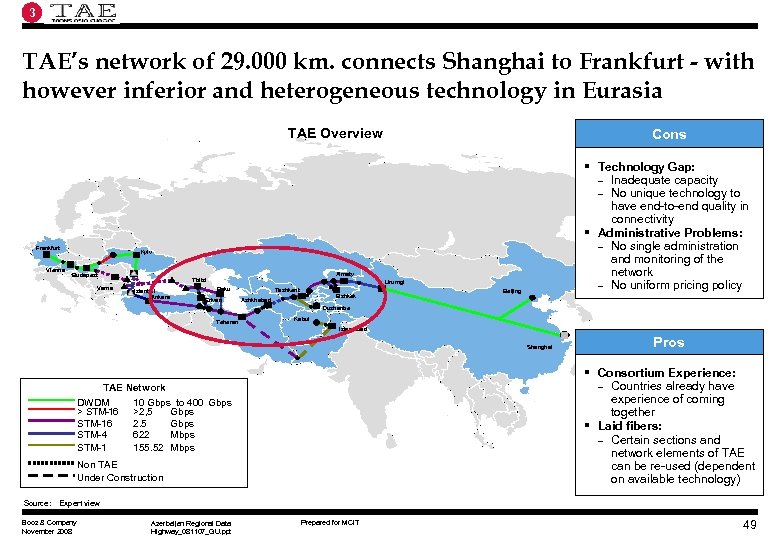
3 TAE’s network of 29. 000 km. connects Shanghai to Frankfurt - with however inferior and heterogeneous technology in Eurasia TAE Overview Frankfurt Vienna Cons § Technology Gap: – Inadequate capacity – No unique technology to have end-to-end quality in connectivity § Administrative Problems: – No single administration and monitoring of the network – No uniform pricing policy Kyiv Budapest Varna Almaty Tblisi Istanbul Ankara Urumgi Baku Erivan Tashkent Bishkek Ashkhabad Beijing Dushanbe Teheran Kabul Islamabad Shanghai Pros § Consortium Experience: – Countries already have experience of coming together § Laid fibers: – Certain sections and network elements of TAE can be re-used (dependent on available technology) TAE Network DWDM 10 Gbps to 400 Gbps > STM-16 >2, 5 Gbps STM-16 2. 5 Gbps STM- 4 622 Mbps STM-1 155. 52 Mbps Non TAE Under Construction Source: Expert view Booz & Company November 2008 Azerbaijan Regional Data Highway_081107_GU. ppt Prepared for MCIT 49
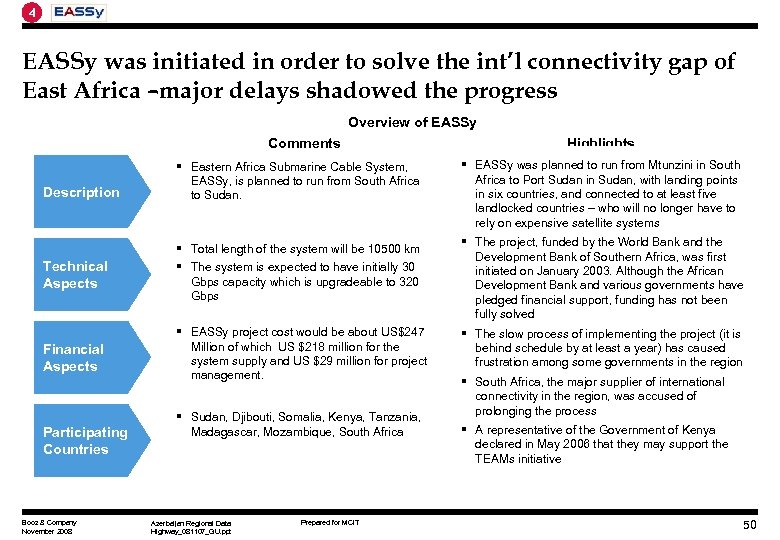
4 EASSy was initiated in order to solve the int’l connectivity gap of East Africa –major delays shadowed the progress Overview of EASSy Comments Description § Eastern Africa Submarine Cable System, EASSy, is planned to run from South Africa to Sudan. Highlights § EASSy was planned to run from Mtunzini in South Africa to Port Sudan in Sudan, with landing points in six countries, and connected to at least five landlocked countries – who will no longer have to rely on expensive satellite systems Technical Aspects § Total length of the system will be 10500 km § The system is expected to have initially 30 Gbps capacity which is upgradeable to 320 Gbps § The project, funded by the World Bank and the Development Bank of Southern Africa, was first initiated on January 2003. Although the African Development Bank and various governments have pledged financial support, funding has not been fully solved Financial Aspects § EASSy project cost would be about US$247 Million of which US $218 million for the system supply and US $29 million for project management. § The slow process of implementing the project (it is behind schedule by at least a year) has caused frustration among some governments in the region Participating Countries Booz & Company November 2008 § Sudan, Djibouti, Somalia, Kenya, Tanzania, Madagascar, Mozambique, South Africa Azerbaijan Regional Data Highway_081107_GU. ppt Prepared for MCIT § South Africa, the major supplier of international connectivity in the region, was accused of prolonging the process § A representative of the Government of Kenya declared in May 2006 that they may support the TEAMs initiative 50
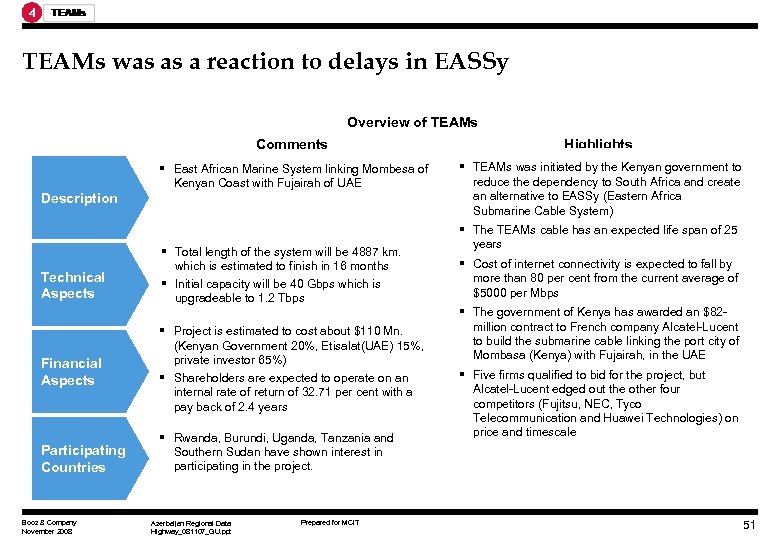
4 TEAMs was as a reaction to delays in EASSy Overview of TEAMs Comments Highlights § East African Marine System linking Mombesa of Kenyan Coast with Fujairah of UAE § TEAMs was initiated by the Kenyan government to reduce the dependency to South Africa and create an alternative to EASSy (Eastern Africa Submarine Cable System) Description Technical Aspects Financial Aspects Participating Countries Booz & Company November 2008 § Total length of the system will be 4887 km. which is estimated to finish in 16 months § Initial capacity will be 40 Gbps which is upgradeable to 1. 2 Tbps § Project is estimated to cost about $110 Mn. (Kenyan Government 20%, Etisalat(UAE) 15%, private investor 65%) § Shareholders are expected to operate on an internal rate of return of 32. 71 per cent with a pay back of 2. 4 years § Rwanda, Burundi, Uganda, Tanzania and Southern Sudan have shown interest in participating in the project. Azerbaijan Regional Data Highway_081107_GU. ppt Prepared for MCIT § The TEAMs cable has an expected life span of 25 years § Cost of internet connectivity is expected to fall by more than 80 per cent from the current average of $5000 per Mbps § The government of Kenya has awarded an $82 million contract to French company Alcatel-Lucent to build the submarine cable linking the port city of Mombasa (Kenya) with Fujairah, in the UAE § Five firms qualified to bid for the project, but Alcatel-Lucent edged out the other four competitors (Fujitsu, NEC, Tyco Telecommunication and Huawei Technologies) on price and timescale 51
Case Studies Country Selection and Profiles Sections of the Proposed Network Further Supporting Slides Booz & Company November 2008 Azerbaijan Regional Data Highway_081107_GU. ppt Prepared for MCIT 52
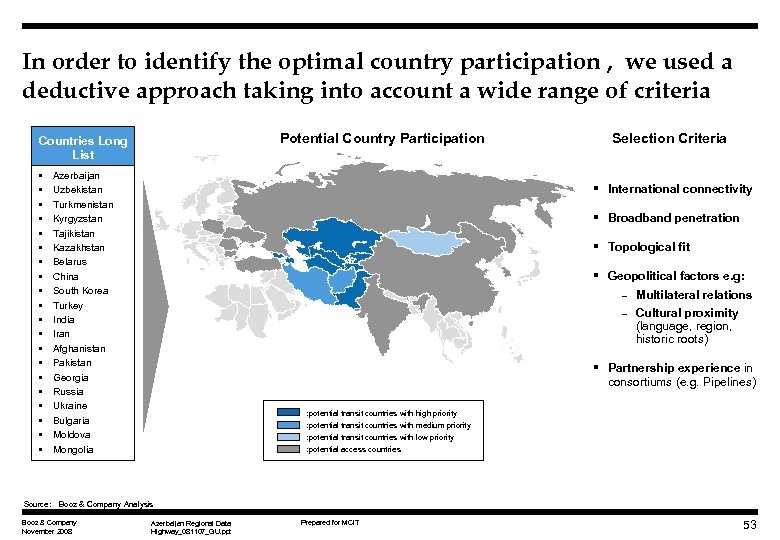
In order to identify the optimal country participation , we used a deductive approach taking into account a wide range of criteria Potential Country Participation Countries Long List § § § § § Azerbaijan Uzbekistan Turkmenistan Kyrgyzstan Tajikistan Kazakhstan Belarus China South Korea Turkey India Iran Afghanistan Pakistan Georgia Russia Ukraine Bulgaria Moldova Mongolia Selection Criteria § International connectivity § Broadband penetration § Topological fit § Geopolitical factors e. g: – Multilateral relations – Cultural proximity (language, region, historic roots) § Partnership experience in consortiums (e. g. Pipelines) : potential transit countries with high priority : potential transit countries with medium priority : potential transit countries with low priority : potential access countries Source: Booz & Company Analysis Booz & Company November 2008 Azerbaijan Regional Data Highway_081107_GU. ppt Prepared for MCIT 53
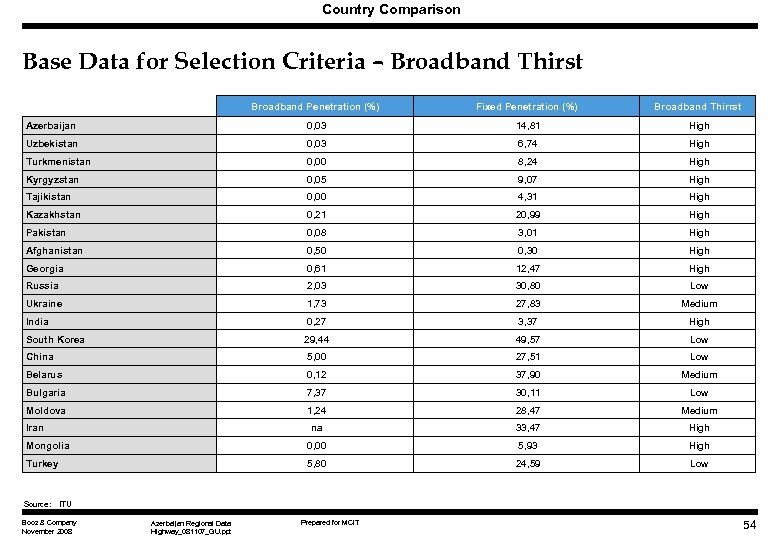
Country Comparison Base Data for Selection Criteria – Broadband Thirst Broadband Penetration (%) Fixed Penetration (%) Broadband Thirrst Azerbaijan 0, 03 14, 81 High Uzbekistan 0, 03 6, 74 High Turkmenistan 0, 00 8, 24 High Kyrgyzstan 0, 05 9, 07 High Tajikistan 0, 00 4, 31 High Kazakhstan 0, 21 20, 99 High Pakistan 0, 08 3, 01 High Afghanistan 0, 50 0, 30 High Georgia 0, 61 12, 47 High Russia 2, 03 30, 80 Low Ukraine 1, 73 27, 83 Medium India 0, 27 3, 37 High South Korea 29, 44 49, 57 Low China 5, 00 27, 51 Low Belarus 0, 12 37, 90 Medium Bulgaria 7, 37 30, 11 Low Moldova 1, 24 28, 47 Medium na 33, 47 High Mongolia 0, 00 5, 93 High Turkey 5, 80 24, 59 Low Iran Source: ITU Booz & Company November 2008 Azerbaijan Regional Data Highway_081107_GU. ppt Prepared for MCIT 54
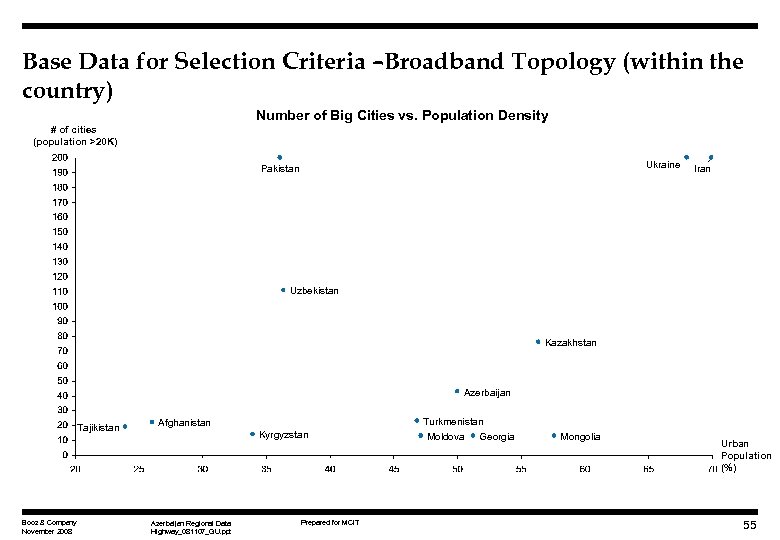
Base Data for Selection Criteria –Broadband Topology (within the country) Number of Big Cities vs. Population Density # of cities (population >20 K) Ukraine Pakistan Iran Uzbekistan Kazakhstan Azerbaijan Tajikistan Booz & Company November 2008 Afghanistan Kyrgyzstan Azerbaijan Regional Data Highway_081107_GU. ppt Prepared for MCIT Turkmenistan Moldova Georgia Mongolia Urban Population (%) 55
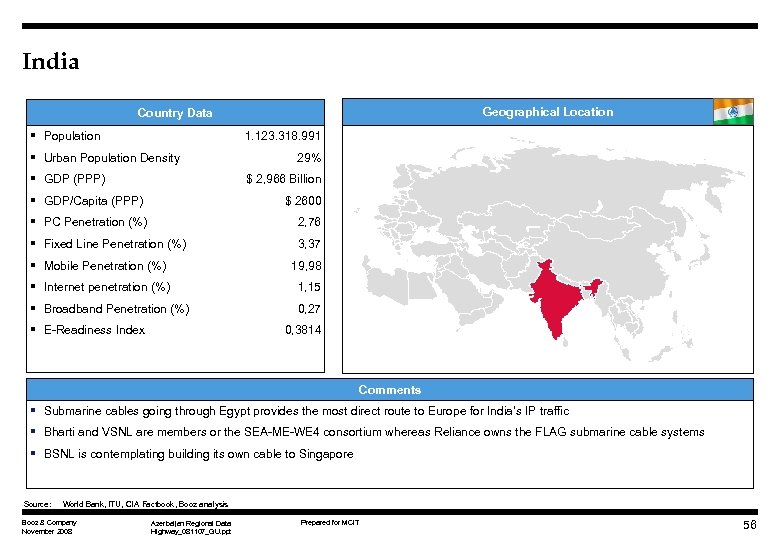
India Geographical Location Country Data § Population 1. 123. 318. 991 § Urban Population Density § GDP (PPP) 29% $ 2, 966 Billion § GDP/Capita (PPP) $ 2600 § PC Penetration (%) 2, 76 § Fixed Line Penetration (%) 3, 37 § Mobile Penetration (%) 19, 98 § Internet penetration (%) 1, 15 § Broadband Penetration (%) 0, 27 § E-Readiness Index 0, 3814 Comments § Submarine cables going through Egypt provides the most direct route to Europe for India’s IP traffic § Bharti and VSNL are members or the SEA-ME-WE 4 consortium whereas Reliance owns the FLAG submarine cable systems § BSNL is contemplating building its own cable to Singapore Source: World Bank, ITU, CIA Factbook, Booz analysis Booz & Company November 2008 Azerbaijan Regional Data Highway_081107_GU. ppt Prepared for MCIT 56
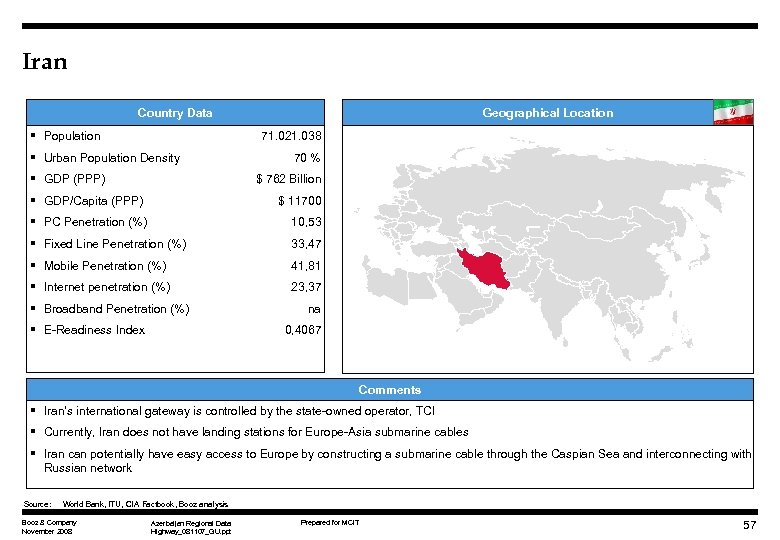
Iran Country Data § Population Geographical Location 71. 021. 038 § Urban Population Density § GDP (PPP) 70 % $ 762 Billion § GDP/Capita (PPP) $ 11700 § PC Penetration (%) 10, 53 § Fixed Line Penetration (%) 33, 47 § Mobile Penetration (%) 41, 81 § Internet penetration (%) 23, 37 § Broadband Penetration (%) § E-Readiness Index na 0, 4067 Comments § Iran’s international gateway is controlled by the state-owned operator, TCI § Currently, Iran does not have landing stations for Europe-Asia submarine cables § Iran can potentially have easy access to Europe by constructing a submarine cable through the Caspian Sea and interconnecting with Russian network Source: World Bank, ITU, CIA Factbook, Booz analysis Booz & Company November 2008 Azerbaijan Regional Data Highway_081107_GU. ppt Prepared for MCIT 57
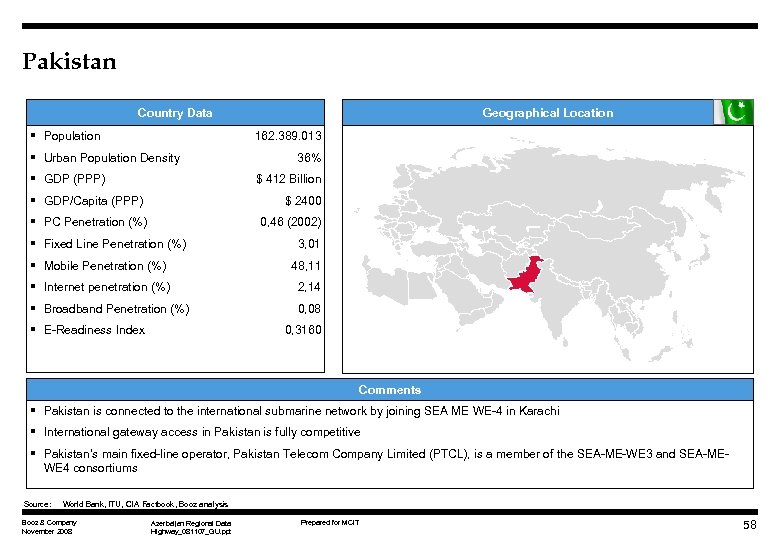
Pakistan Country Data § Population Geographical Location 162. 389. 013 § Urban Population Density § GDP (PPP) 36% $ 412 Billion § GDP/Capita (PPP) $ 2400 § PC Penetration (%) 0, 46 (2002) § Fixed Line Penetration (%) 3, 01 § Mobile Penetration (%) 48, 11 § Internet penetration (%) 2, 14 § Broadband Penetration (%) 0, 08 § E-Readiness Index 0, 3160 Comments § Pakistan is connected to the international submarine network by joining SEA ME WE-4 in Karachi § International gateway access in Pakistan is fully competitive § Pakistan’s main fixed-line operator, Pakistan Telecom Company Limited (PTCL), is a member of the SEA-ME-WE 3 and SEA-MEWE 4 consortiums Source: World Bank, ITU, CIA Factbook, Booz analysis Booz & Company November 2008 Azerbaijan Regional Data Highway_081107_GU. ppt Prepared for MCIT 58
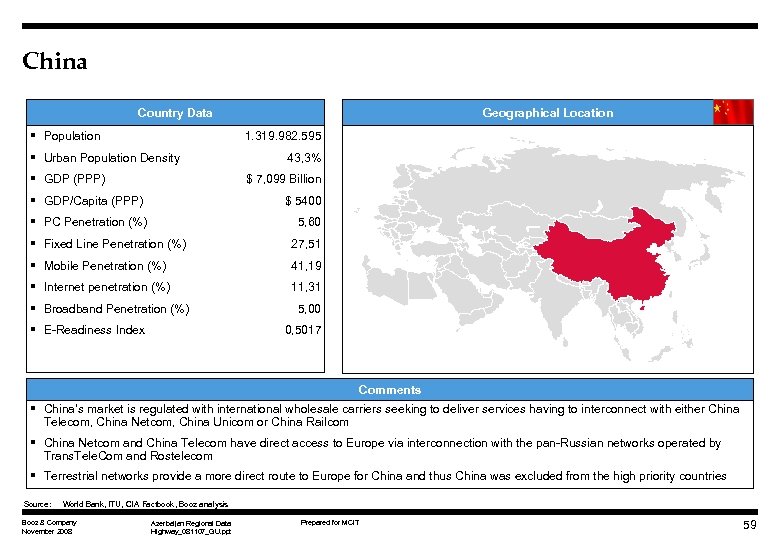
China Country Data § Population Geographical Location 1. 319. 982. 595 § Urban Population Density § GDP (PPP) 43, 3% $ 7, 099 Billion § GDP/Capita (PPP) $ 5400 § PC Penetration (%) 5, 60 § Fixed Line Penetration (%) 27, 51 § Mobile Penetration (%) 41, 19 § Internet penetration (%) 11, 31 § Broadband Penetration (%) § E-Readiness Index 5, 00 0, 5017 Comments § China’s market is regulated with international wholesale carriers seeking to deliver services having to interconnect with either China Telecom, China Netcom, China Unicom or China Railcom § China Netcom and China Telecom have direct access to Europe via interconnection with the pan-Russian networks operated by Trans. Tele. Com and Rostelecom § Terrestrial networks provide a more direct route to Europe for China and thus China was excluded from the high priority countries Source: World Bank, ITU, CIA Factbook, Booz analysis Booz & Company November 2008 Azerbaijan Regional Data Highway_081107_GU. ppt Prepared for MCIT 59
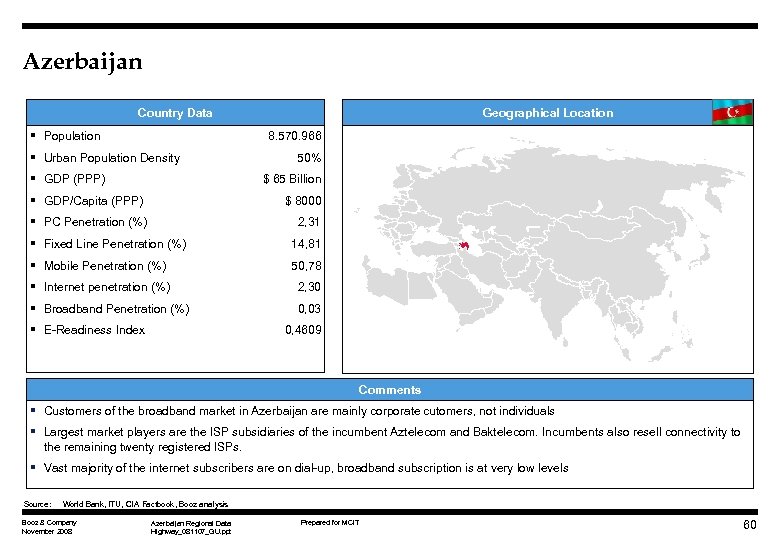
Azerbaijan Country Data § Population Geographical Location 8. 570. 966 § Urban Population Density § GDP (PPP) 50% $ 65 Billion § GDP/Capita (PPP) $ 8000 § PC Penetration (%) 2, 31 § Fixed Line Penetration (%) 14, 81 § Mobile Penetration (%) 50, 78 § Internet penetration (%) 2, 30 § Broadband Penetration (%) 0, 03 § E-Readiness Index 0, 4609 Comments § Customers of the broadband market in Azerbaijan are mainly corporate cutomers, not individuals § Largest market players are the ISP subsidiaries of the incumbent Aztelecom and Baktelecom. Incumbents also resell connectivity to the remaining twenty registered ISPs. § Vast majority of the internet subscribers are on dial-up, broadband subscription is at very low levels Source: World Bank, ITU, CIA Factbook, Booz analysis Booz & Company November 2008 Azerbaijan Regional Data Highway_081107_GU. ppt Prepared for MCIT 60
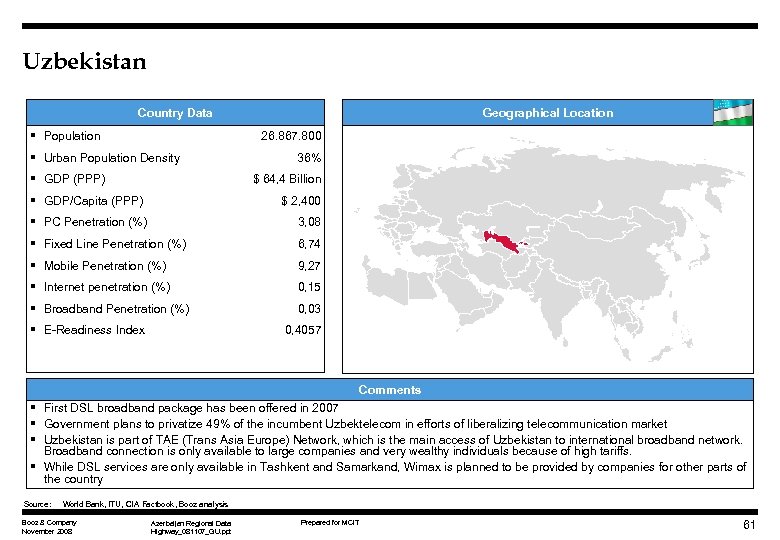
Uzbekistan Country Data § Population Geographical Location 26. 867. 800 § Urban Population Density § GDP (PPP) 36% $ 64, 4 Billion § GDP/Capita (PPP) $ 2, 400 § PC Penetration (%) 3, 08 § Fixed Line Penetration (%) 6, 74 § Mobile Penetration (%) 9, 27 § Internet penetration (%) 0, 15 § Broadband Penetration (%) 0, 03 § E-Readiness Index 0, 4057 Comments § First DSL broadband package has been offered in 2007 § Government plans to privatize 49% of the incumbent Uzbektelecom in efforts of liberalizing telecommunication market § Uzbekistan is part of TAE (Trans Asia Europe) Network, which is the main access of Uzbekistan to international broadband network. Broadband connection is only available to large companies and very wealthy individuals because of high tariffs. § While DSL services are only available in Tashkent and Samarkand, Wimax is planned to be provided by companies for other parts of the country Source: World Bank, ITU, CIA Factbook, Booz analysis Booz & Company November 2008 Azerbaijan Regional Data Highway_081107_GU. ppt Prepared for MCIT 61
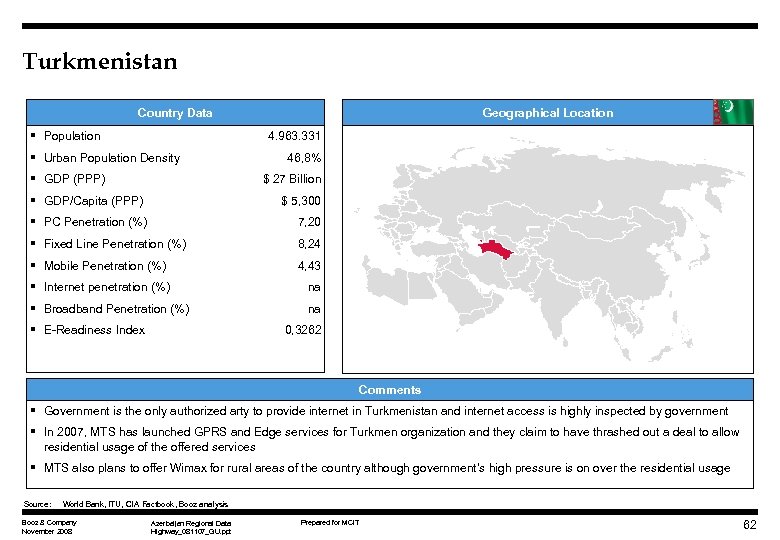
Turkmenistan Country Data § Population Geographical Location 4. 963. 331 § Urban Population Density § GDP (PPP) 46, 8% $ 27 Billion § GDP/Capita (PPP) $ 5, 300 § PC Penetration (%) 7, 20 § Fixed Line Penetration (%) 8, 24 § Mobile Penetration (%) 4, 43 § Internet penetration (%) na § Broadband Penetration (%) na § E-Readiness Index 0, 3262 Comments § Government is the only authorized arty to provide internet in Turkmenistan and internet access is highly inspected by government § In 2007, MTS has launched GPRS and Edge services for Turkmen organization and they claim to have thrashed out a deal to allow residential usage of the offered services § MTS also plans to offer Wimax for rural areas of the country although government’s high pressure is on over the residential usage Source: World Bank, ITU, CIA Factbook, Booz analysis Booz & Company November 2008 Azerbaijan Regional Data Highway_081107_GU. ppt Prepared for MCIT 62
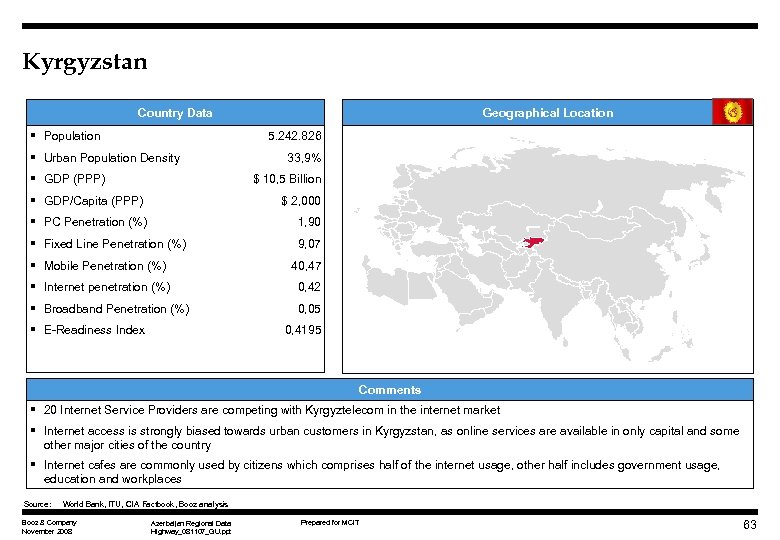
Kyrgyzstan Country Data § Population Geographical Location 5. 242. 826 § Urban Population Density § GDP (PPP) 33, 9% $ 10, 5 Billion § GDP/Capita (PPP) $ 2, 000 § PC Penetration (%) 1, 90 § Fixed Line Penetration (%) 9, 07 § Mobile Penetration (%) 40, 47 § Internet penetration (%) 0, 42 § Broadband Penetration (%) 0, 05 § E-Readiness Index 0, 4195 Comments § 20 Internet Service Providers are competing with Kyrgyztelecom in the internet market § Internet access is strongly biased towards urban customers in Kyrgyzstan, as online services are available in only capital and some other major cities of the country § Internet cafes are commonly used by citizens which comprises half of the internet usage, other half includes government usage, education and workplaces Source: World Bank, ITU, CIA Factbook, Booz analysis Booz & Company November 2008 Azerbaijan Regional Data Highway_081107_GU. ppt Prepared for MCIT 63
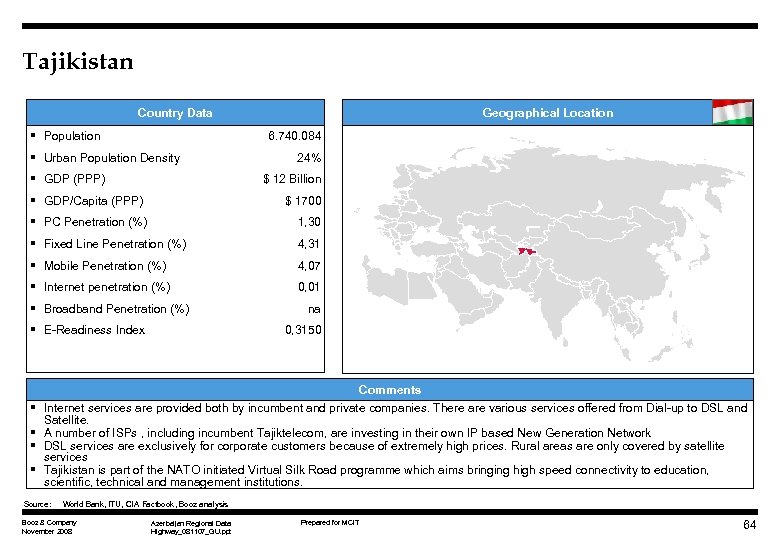
Tajikistan Country Data § Population Geographical Location 6. 740. 084 § Urban Population Density § GDP (PPP) 24% $ 12 Billion § GDP/Capita (PPP) $ 1700 § PC Penetration (%) 1, 30 § Fixed Line Penetration (%) 4, 31 § Mobile Penetration (%) 4, 07 § Internet penetration (%) 0, 01 § Broadband Penetration (%) § E-Readiness Index na 0, 3150 Comments § Internet services are provided both by incumbent and private companies. There are various services offered from Dial-up to DSL and Satellite. § A number of ISPs , including incumbent Tajiktelecom, are investing in their own IP based New Generation Network § DSL services are exclusively for corporate customers because of extremely high prices. Rural areas are only covered by satellite services § Tajikistan is part of the NATO initiated Virtual Silk Road programme which aims bringing high speed connectivity to education, scientific, technical and management institutions. Source: World Bank, ITU, CIA Factbook, Booz analysis Booz & Company November 2008 Azerbaijan Regional Data Highway_081107_GU. ppt Prepared for MCIT 64
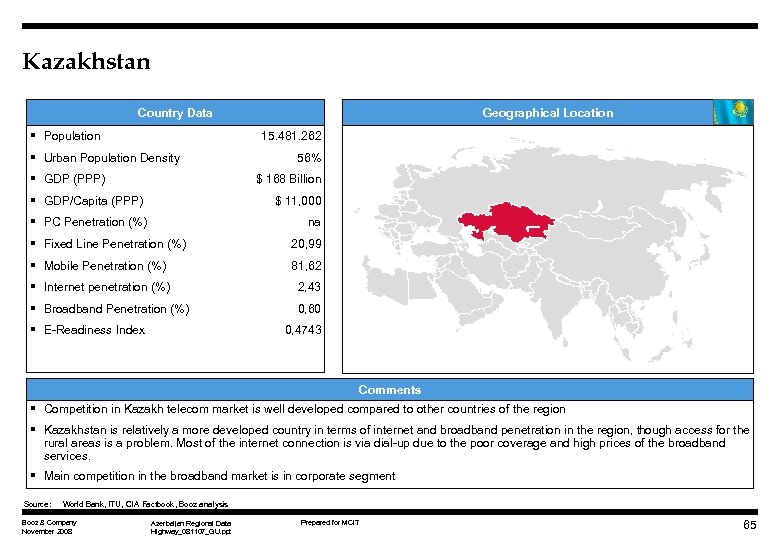
Kazakhstan Country Data § Population Geographical Location 15. 481. 262 § Urban Population Density § GDP (PPP) 56% $ 168 Billion § GDP/Capita (PPP) $ 11, 000 § PC Penetration (%) na § Fixed Line Penetration (%) 20, 99 § Mobile Penetration (%) 81, 62 § Internet penetration (%) 2, 43 § Broadband Penetration (%) 0, 60 § E-Readiness Index 0, 4743 Comments § Competition in Kazakh telecom market is well developed compared to other countries of the region § Kazakhstan is relatively a more developed country in terms of internet and broadband penetration in the region, though access for the rural areas is a problem. Most of the internet connection is via dial-up due to the poor coverage and high prices of the broadband services. § Main competition in the broadband market is in corporate segment Source: World Bank, ITU, CIA Factbook, Booz analysis Booz & Company November 2008 Azerbaijan Regional Data Highway_081107_GU. ppt Prepared for MCIT 65
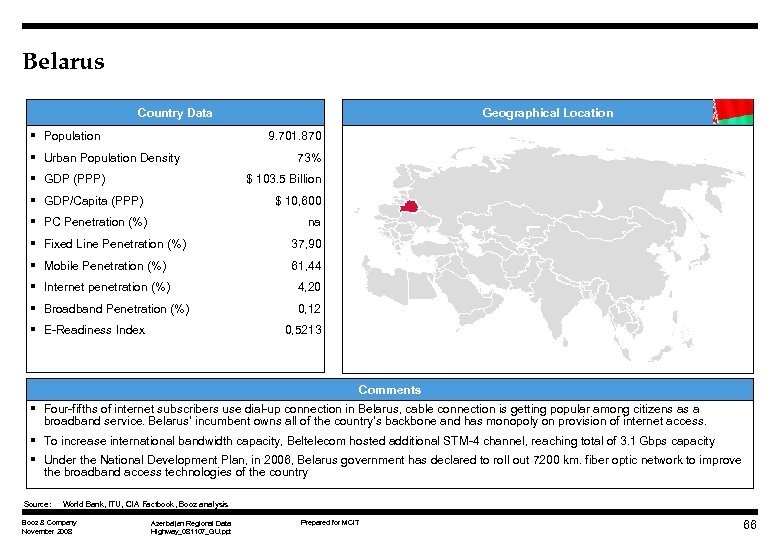
Belarus Country Data § Population Geographical Location 9. 701. 870 § Urban Population Density § GDP (PPP) 73% $ 103. 5 Billion § GDP/Capita (PPP) $ 10, 600 § PC Penetration (%) na § Fixed Line Penetration (%) 37, 90 § Mobile Penetration (%) 61, 44 § Internet penetration (%) 4, 20 § Broadband Penetration (%) 0, 12 § E-Readiness Index 0, 5213 Comments § Four-fifths of internet subscribers use dial-up connection in Belarus, cable connection is getting popular among citizens as a broadband service. Belarus’ incumbent owns all of the country’s backbone and has monopoly on provision of internet access. § To increase international bandwidth capacity, Beltelecom hosted additional STM-4 channel, reaching total of 3. 1 Gbps capacity § Under the National Development Plan, in 2006, Belarus government has declared to roll out 7200 km. fiber optic network to improve the broadband access technologies of the country Source: World Bank, ITU, CIA Factbook, Booz analysis Booz & Company November 2008 Azerbaijan Regional Data Highway_081107_GU. ppt Prepared for MCIT 66
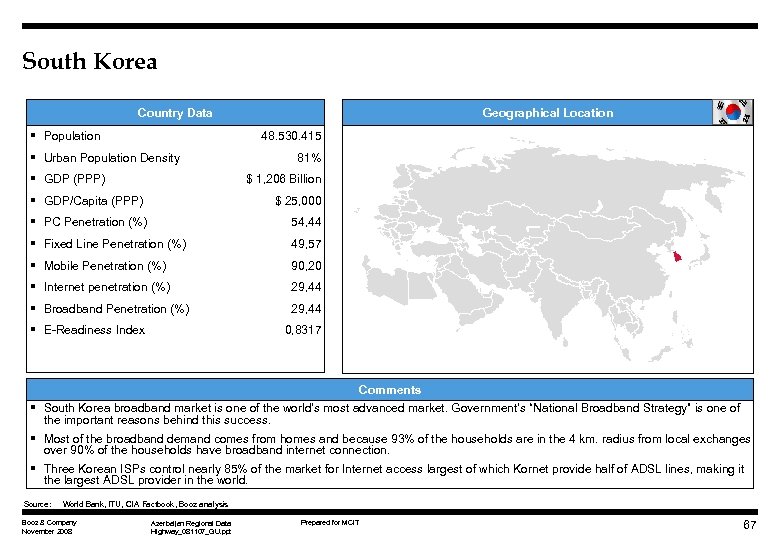
South Korea Country Data § Population Geographical Location 48. 530. 415 § Urban Population Density § GDP (PPP) 81% $ 1, 206 Billion § GDP/Capita (PPP) $ 25, 000 § PC Penetration (%) 54, 44 § Fixed Line Penetration (%) 49, 57 § Mobile Penetration (%) 90, 20 § Internet penetration (%) 29, 44 § Broadband Penetration (%) 29, 44 § E-Readiness Index 0, 8317 Comments § South Korea broadband market is one of the world’s most advanced market. Government’s “National Broadband Strategy” is one of the important reasons behind this success. § Most of the broadband demand comes from homes and because 93% of the households are in the 4 km. radius from local exchanges over 90% of the households have broadband internet connection. § Three Korean ISPs control nearly 85% of the market for Internet access largest of which Kornet provide half of ADSL lines, making it the largest ADSL provider in the world. Source: World Bank, ITU, CIA Factbook, Booz analysis Booz & Company November 2008 Azerbaijan Regional Data Highway_081107_GU. ppt Prepared for MCIT 67
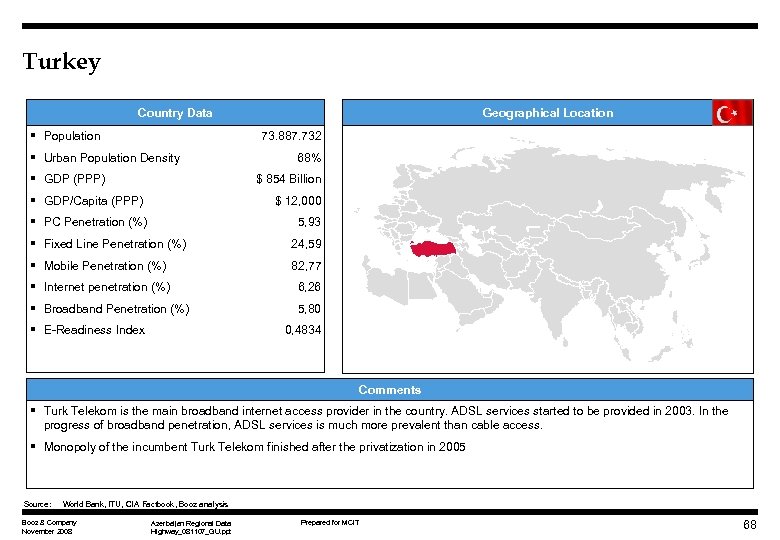
Turkey Country Data § Population Geographical Location 73. 887. 732 § Urban Population Density § GDP (PPP) 68% $ 854 Billion § GDP/Capita (PPP) $ 12, 000 § PC Penetration (%) 5, 93 § Fixed Line Penetration (%) 24, 59 § Mobile Penetration (%) 82, 77 § Internet penetration (%) 6, 26 § Broadband Penetration (%) 5, 80 § E-Readiness Index 0, 4834 Comments § Turk Telekom is the main broadband internet access provider in the country. ADSL services started to be provided in 2003. In the progress of broadband penetration, ADSL services is much more prevalent than cable access. § Monopoly of the incumbent Turk Telekom finished after the privatization in 2005 Source: World Bank, ITU, CIA Factbook, Booz analysis Booz & Company November 2008 Azerbaijan Regional Data Highway_081107_GU. ppt Prepared for MCIT 68
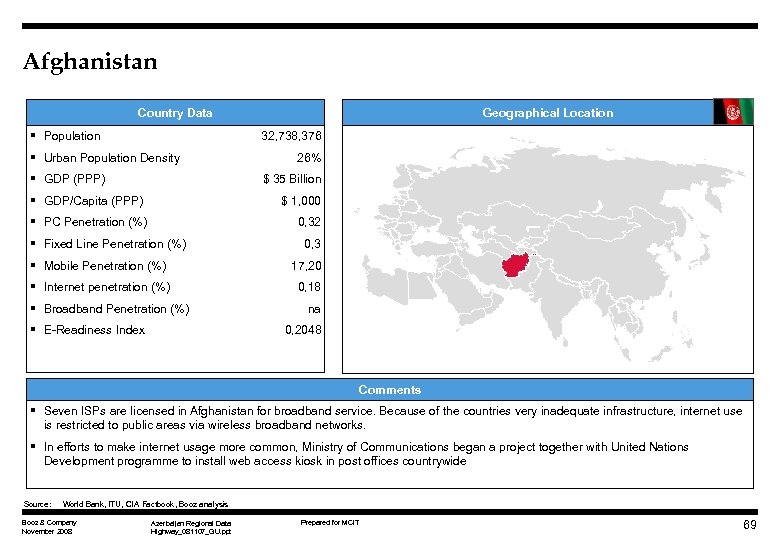
Afghanistan Country Data § Population Geographical Location 32, 738, 376 § Urban Population Density § GDP (PPP) 26% $ 35 Billion § GDP/Capita (PPP) $ 1, 000 § PC Penetration (%) 0, 32 § Fixed Line Penetration (%) 0, 3 § Mobile Penetration (%) 17, 20 § Internet penetration (%) 0, 18 § Broadband Penetration (%) § E-Readiness Index na 0, 2048 Comments § Seven ISPs are licensed in Afghanistan for broadband service. Because of the countries very inadequate infrastructure, internet use is restricted to public areas via wireless broadband networks. § In efforts to make internet usage more common, Ministry of Communications began a project together with United Nations Development programme to install web access kiosk in post offices countrywide Source: World Bank, ITU, CIA Factbook, Booz analysis Booz & Company November 2008 Azerbaijan Regional Data Highway_081107_GU. ppt Prepared for MCIT 69
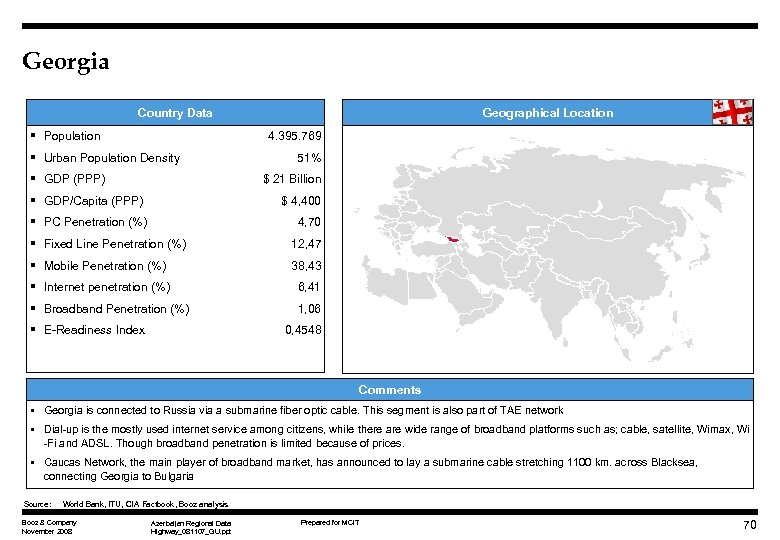
Georgia Country Data § Population Geographical Location 4. 395. 769 § Urban Population Density § GDP (PPP) 51% $ 21 Billion § GDP/Capita (PPP) $ 4, 400 § PC Penetration (%) 4, 70 § Fixed Line Penetration (%) 12, 47 § Mobile Penetration (%) 38, 43 § Internet penetration (%) 6, 41 § Broadband Penetration (%) 1, 06 § E-Readiness Index 0, 4548 Comments § Georgia is connected to Russia via a submarine fiber optic cable. This segment is also part of TAE network § Dial-up is the mostly used internet service among citizens, while there are wide range of broadband platforms such as; cable, satellite, Wimax, Wi -Fi and ADSL. Though broadband penetration is limited because of prices. § Caucas Network, the main player of broadband market, has announced to lay a submarine cable stretching 1100 km. across Blacksea, connecting Georgia to Bulgaria Source: World Bank, ITU, CIA Factbook, Booz analysis Booz & Company November 2008 Azerbaijan Regional Data Highway_081107_GU. ppt Prepared for MCIT 70
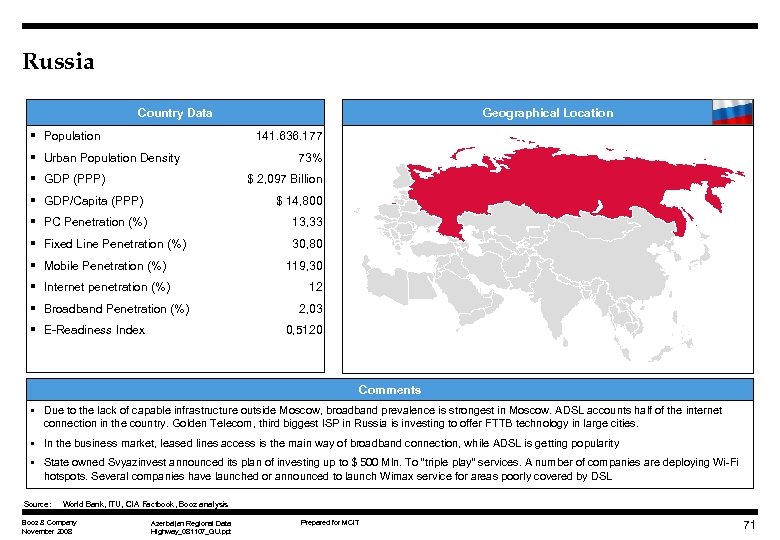
Russia Country Data § Population Geographical Location 141. 636. 177 § Urban Population Density § GDP (PPP) 73% $ 2, 097 Billion § GDP/Capita (PPP) $ 14, 800 § PC Penetration (%) 13, 33 § Fixed Line Penetration (%) 30, 80 § Mobile Penetration (%) § Internet penetration (%) § Broadband Penetration (%) § E-Readiness Index 119, 30 12 2, 03 0, 5120 Comments § Due to the lack of capable infrastructure outside Moscow, broadband prevalence is strongest in Moscow. ADSL accounts half of the internet connection in the country. Golden Telecom, third biggest ISP in Russia is investing to offer FTTB technology in large cities. § In the business market, leased lines access is the main way of broadband connection, while ADSL is getting popularity § State owned Svyazinvest announced its plan of investing up to $ 500 Mln. To “triple play” services. A number of companies are deploying Wi-Fi hotspots. Several companies have launched or announced to launch Wimax service for areas poorly covered by DSL Source: World Bank, ITU, CIA Factbook, Booz analysis Booz & Company November 2008 Azerbaijan Regional Data Highway_081107_GU. ppt Prepared for MCIT 71
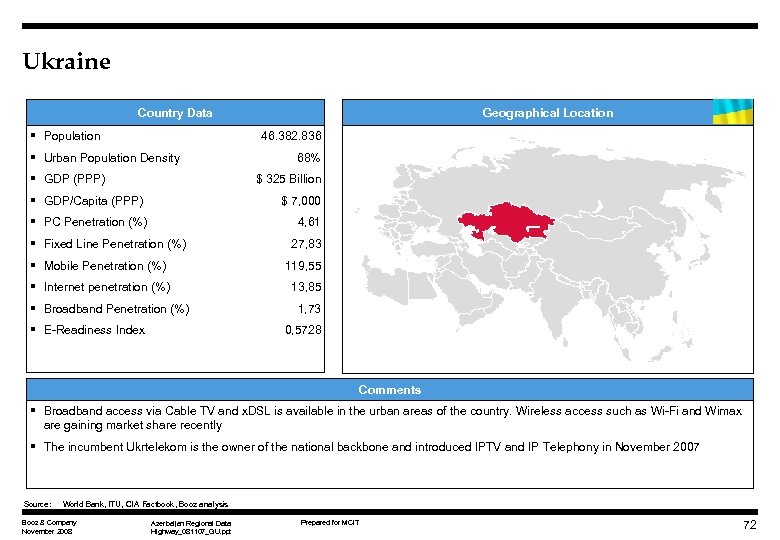
Ukraine Country Data § Population Geographical Location 46. 382. 836 § Urban Population Density § GDP (PPP) 68% $ 325 Billion § GDP/Capita (PPP) $ 7, 000 § PC Penetration (%) 4, 61 § Fixed Line Penetration (%) 27, 83 § Mobile Penetration (%) 119, 55 § Internet penetration (%) 13, 85 § Broadband Penetration (%) § E-Readiness Index 1, 73 0, 5728 Comments § Broadband access via Cable TV and x. DSL is available in the urban areas of the country. Wireless access such as Wi-Fi and Wimax are gaining market share recently § The incumbent Ukrtelekom is the owner of the national backbone and introduced IPTV and IP Telephony in November 2007 Source: World Bank, ITU, CIA Factbook, Booz analysis Booz & Company November 2008 Azerbaijan Regional Data Highway_081107_GU. ppt Prepared for MCIT 72
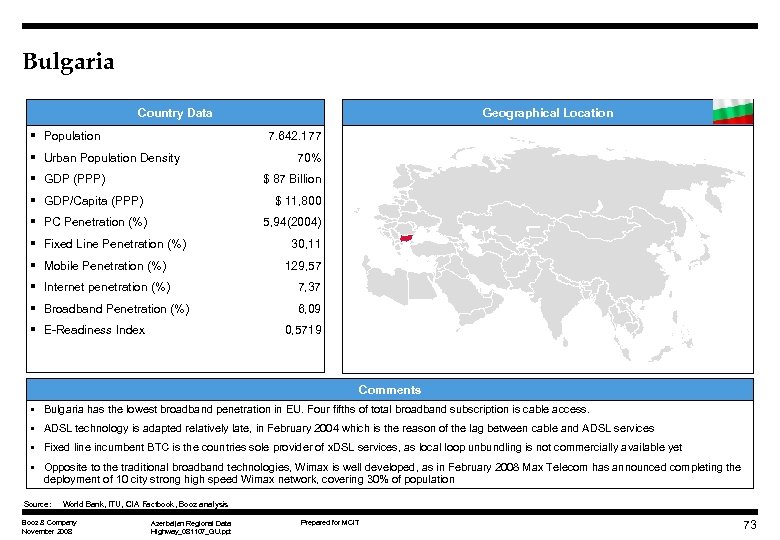
Bulgaria Country Data § Population Geographical Location 7. 642. 177 § Urban Population Density § GDP (PPP) 70% $ 87 Billion § GDP/Capita (PPP) $ 11, 800 § PC Penetration (%) 5, 94(2004) § Fixed Line Penetration (%) § Mobile Penetration (%) 30, 11 129, 57 § Internet penetration (%) 7, 37 § Broadband Penetration (%) 6, 09 § E-Readiness Index 0, 5719 Comments § Bulgaria has the lowest broadband penetration in EU. Four fifths of total broadband subscription is cable access. § ADSL technology is adapted relatively late, in February 2004 which is the reason of the lag between cable and ADSL services § Fixed line incumbent BTC is the countries sole provider of x. DSL services, as local loop unbundling is not commercially available yet § Opposite to the traditional broadband technologies, Wimax is well developed, as in February 2008 Max Telecom has announced completing the deployment of 10 city strong high speed Wimax network, covering 30% of population Source: World Bank, ITU, CIA Factbook, Booz analysis Booz & Company November 2008 Azerbaijan Regional Data Highway_081107_GU. ppt Prepared for MCIT 73
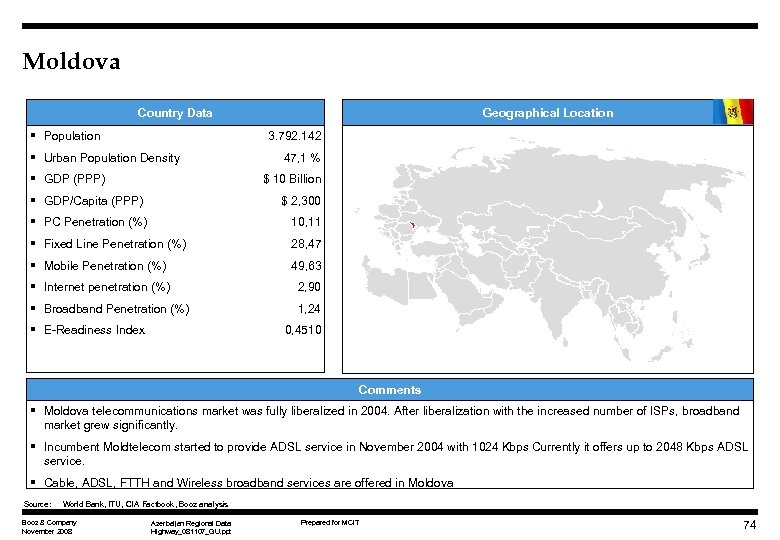
Moldova Country Data § Population Geographical Location 3. 792. 142 § Urban Population Density § GDP (PPP) 47, 1 % $ 10 Billion § GDP/Capita (PPP) $ 2, 300 § PC Penetration (%) 10, 11 § Fixed Line Penetration (%) 28, 47 § Mobile Penetration (%) 49, 63 § Internet penetration (%) 2, 90 § Broadband Penetration (%) 1, 24 § E-Readiness Index 0, 4510 Comments § Moldova telecommunications market was fully liberalized in 2004. After liberalization with the increased number of ISPs, broadband market grew significantly. § Incumbent Moldtelecom started to provide ADSL service in November 2004 with 1024 Kbps Currently it offers up to 2048 Kbps ADSL service. § Cable, ADSL, FTTH and Wireless broadband services are offered in Moldova Source: World Bank, ITU, CIA Factbook, Booz analysis Booz & Company November 2008 Azerbaijan Regional Data Highway_081107_GU. ppt Prepared for MCIT 74
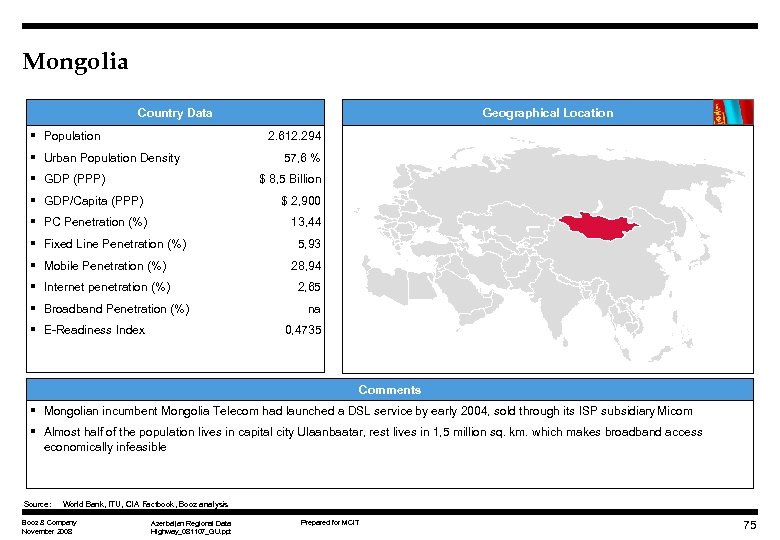
Mongolia Country Data § Population Geographical Location 2. 612. 294 § Urban Population Density § GDP (PPP) 57, 6 % $ 8, 5 Billion § GDP/Capita (PPP) $ 2, 900 § PC Penetration (%) 13, 44 § Fixed Line Penetration (%) 5, 93 § Mobile Penetration (%) 28, 94 § Internet penetration (%) 2, 65 § Broadband Penetration (%) § E-Readiness Index na 0, 4735 Comments § Mongolian incumbent Mongolia Telecom had launched a DSL service by early 2004, sold through its ISP subsidiary Micom § Almost half of the population lives in capital city Ulaanbaatar, rest lives in 1, 5 million sq. km. which makes broadband access economically infeasible Source: World Bank, ITU, CIA Factbook, Booz analysis Booz & Company November 2008 Azerbaijan Regional Data Highway_081107_GU. ppt Prepared for MCIT 75
Case Studies Country Selection and Profiles Sections of the Proposed Network Further Supporting Slides Booz & Company November 2008 Azerbaijan Regional Data Highway_081107_GU. ppt Prepared for MCIT 76
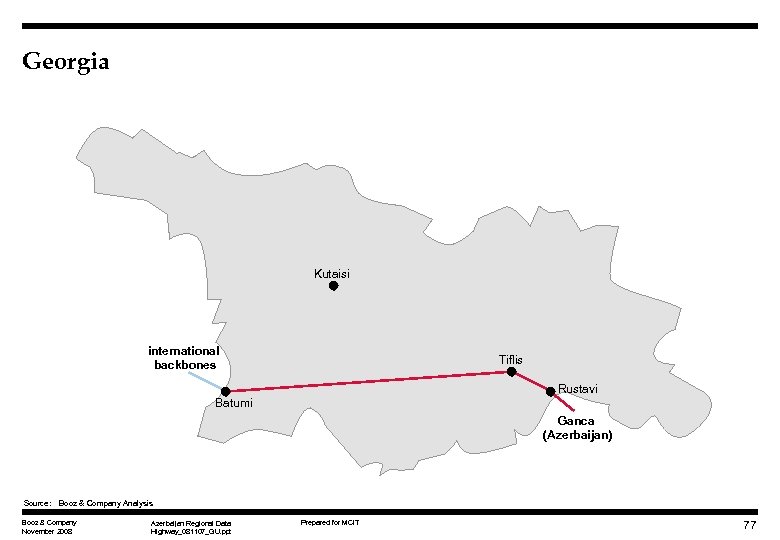
Georgia Kutaisi international backbones Tiflis Rustavi Batumi Ganca (Azerbaijan) Source: Booz & Company Analysis Booz & Company November 2008 Azerbaijan Regional Data Highway_081107_GU. ppt Prepared for MCIT 77
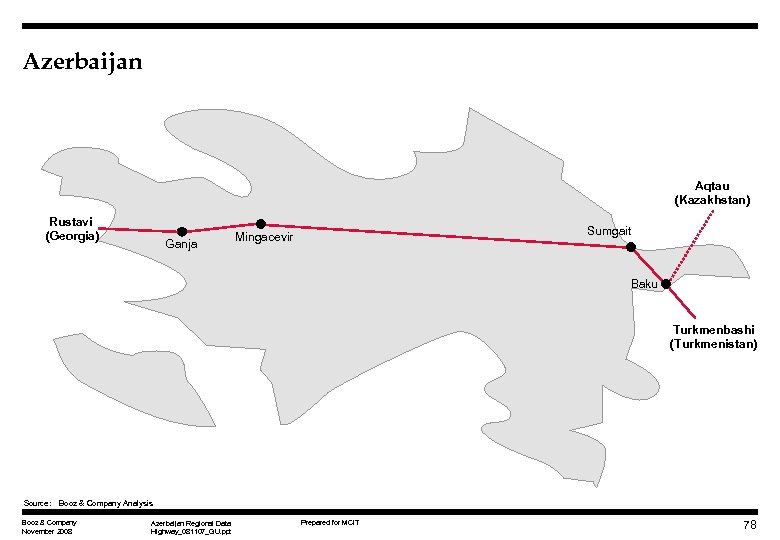
Azerbaijan Aqtau (Kazakhstan) Rustavi (Georgia) Ganja Sumgait Mingacevir Baku Turkmenbashi (Turkmenistan) Source: Booz & Company Analysis Booz & Company November 2008 Azerbaijan Regional Data Highway_081107_GU. ppt Prepared for MCIT 78
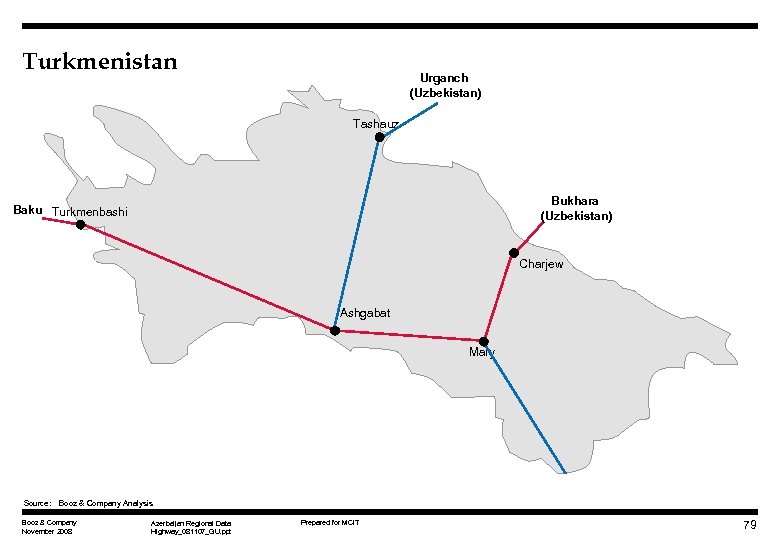
Turkmenistan Urganch (Uzbekistan) Tashauz Bukhara (Uzbekistan) Baku Turkmenbashi Charjew Ashgabat Mary Source: Booz & Company Analysis Booz & Company November 2008 Azerbaijan Regional Data Highway_081107_GU. ppt Prepared for MCIT 79
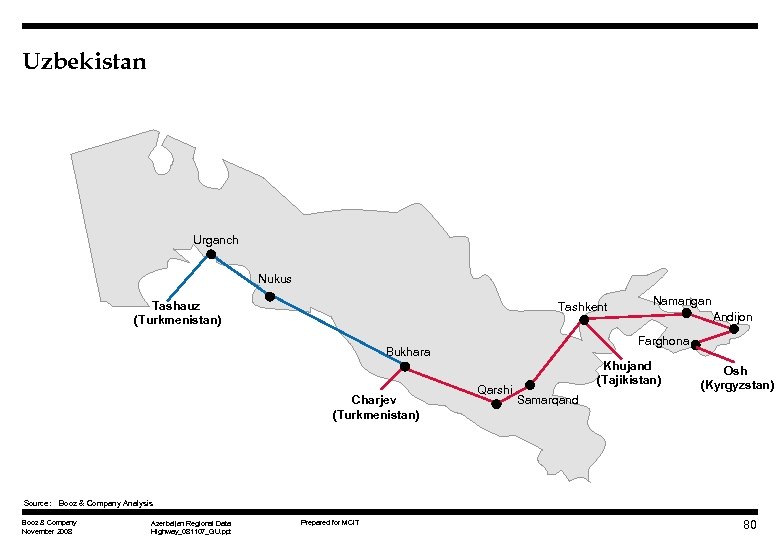
Uzbekistan Urganch Nukus Tashauz (Turkmenistan) Tashkent Andijon Farghona Bukhara Charjev (Turkmenistan) Namangan Qarshi Khujand (Tajikistan) Osh (Kyrgyzstan) Samarqand Source: Booz & Company Analysis Booz & Company November 2008 Azerbaijan Regional Data Highway_081107_GU. ppt Prepared for MCIT 80
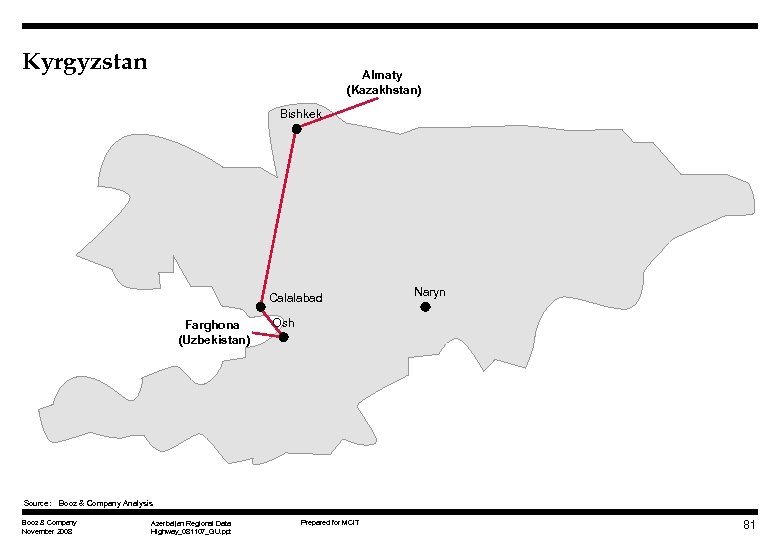
Kyrgyzstan Almaty (Kazakhstan) Bishkek Calalabad Farghona (Uzbekistan) Naryn Osh Source: Booz & Company Analysis Booz & Company November 2008 Azerbaijan Regional Data Highway_081107_GU. ppt Prepared for MCIT 81
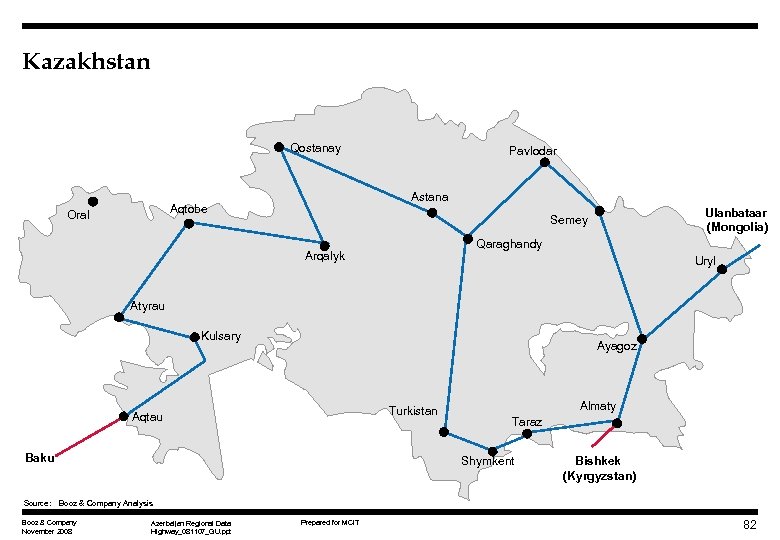
Kazakhstan Qostanay Astana Aqtobe Oral Pavlodar Ulanbataar (Mongolia) Semey Qaraghandy Arqalyk Uryl Atyrau Kulsary Ayagoz Turkistan Aqtau Baku Almaty Taraz Shymkent Bishkek (Kyrgyzstan) Source: Booz & Company Analysis Booz & Company November 2008 Azerbaijan Regional Data Highway_081107_GU. ppt Prepared for MCIT 82
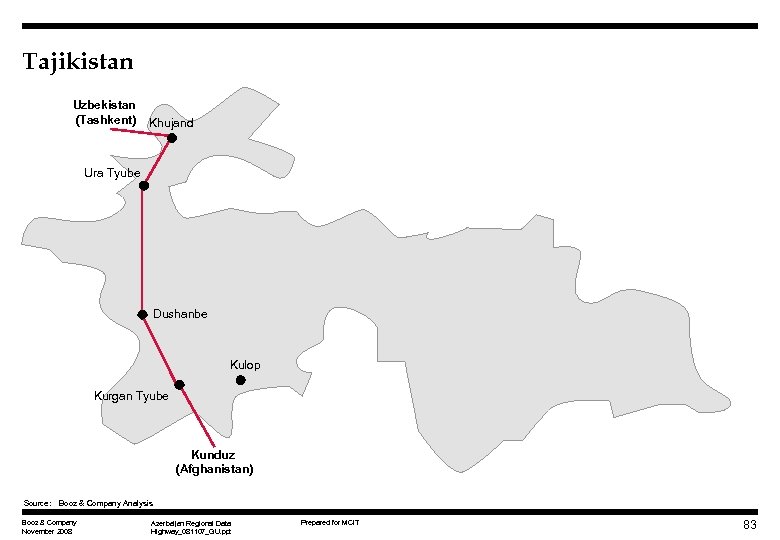
Tajikistan Uzbekistan (Tashkent) Khujand Ura Tyube Dushanbe Kulop Kurgan Tyube Kunduz (Afghanistan) Source: Booz & Company Analysis Booz & Company November 2008 Azerbaijan Regional Data Highway_081107_GU. ppt Prepared for MCIT 83
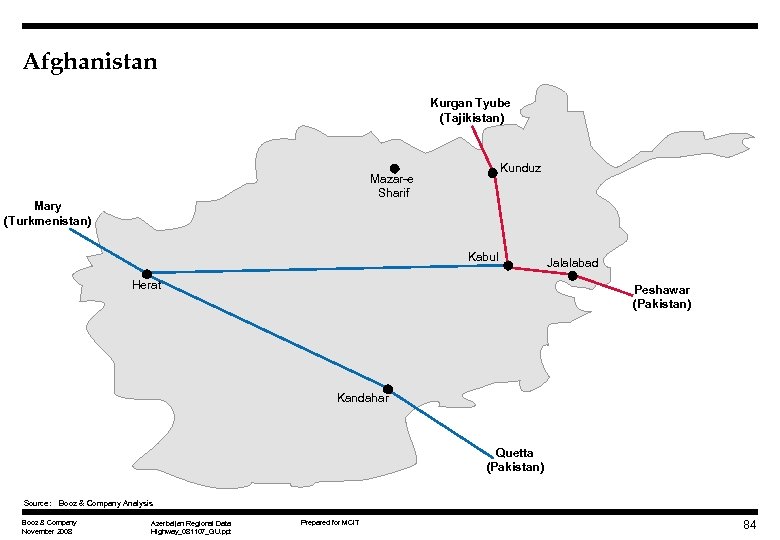
Afghanistan Kurgan Tyube (Tajikistan) Kunduz Mazar-e Sharif Mary (Turkmenistan) Kabul Herat Jalalabad Peshawar (Pakistan) Kandahar Quetta (Pakistan) Source: Booz & Company Analysis Booz & Company November 2008 Azerbaijan Regional Data Highway_081107_GU. ppt Prepared for MCIT 84
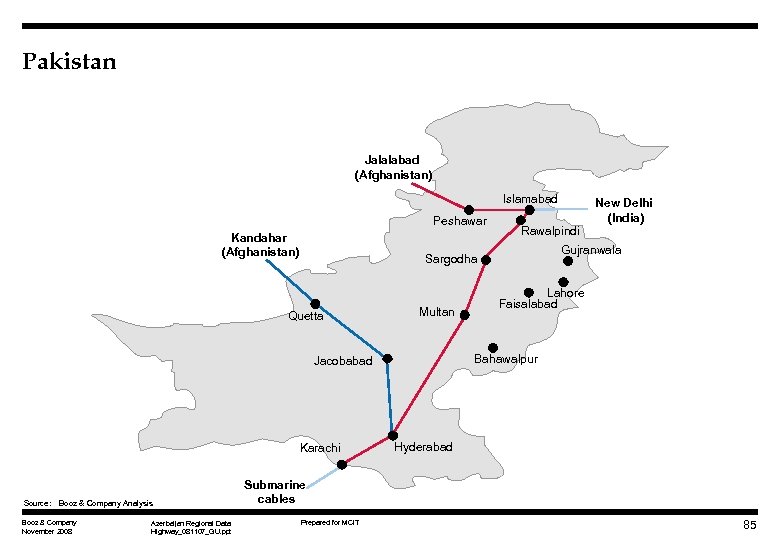
Pakistan Jalalabad (Afghanistan) Islamabad Peshawar Kandahar (Afghanistan) Multan Karachi Booz & Company November 2008 Azerbaijan Regional Data Highway_081107_GU. ppt Gujranwala Lahore Faisalabad Bahawalpur Jacobabad Source: Booz & Company Analysis Rawalpindi Sargodha Quetta New Delhi (India) Hyderabad Submarine cables Prepared for MCIT 85
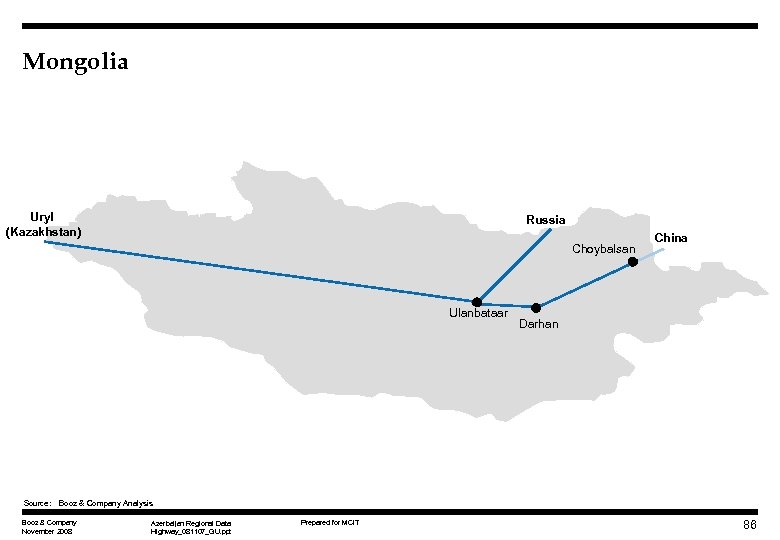
Mongolia Uryl (Kazakhstan) Russia Choybalsan Ulanbataar China Darhan Source: Booz & Company Analysis Booz & Company November 2008 Azerbaijan Regional Data Highway_081107_GU. ppt Prepared for MCIT 86
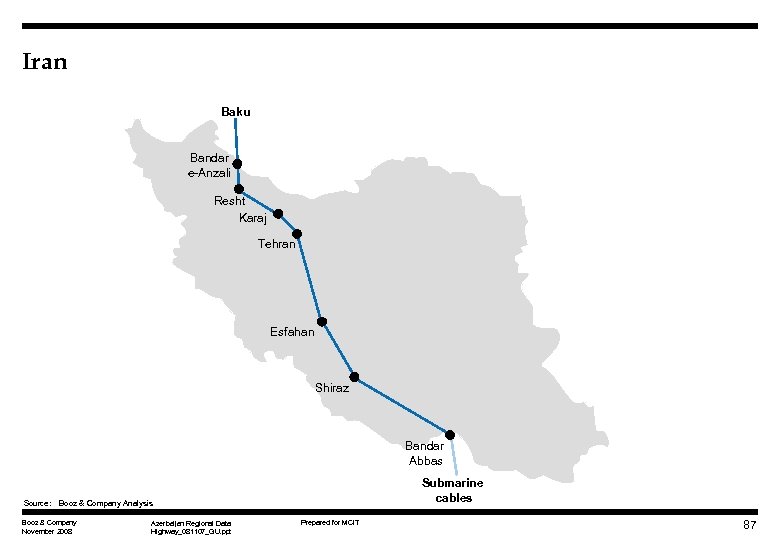
Iran Baku Bandar e-Anzali Resht Karaj Tehran Esfahan Shiraz Bandar Abbas Submarine cables Source: Booz & Company Analysis Booz & Company November 2008 Azerbaijan Regional Data Highway_081107_GU. ppt Prepared for MCIT 87
Case Studies Country Selection and Profiles Sections of the Proposed Network Further Supporting Slides Booz & Company November 2008 Azerbaijan Regional Data Highway_081107_GU. ppt Prepared for MCIT 88
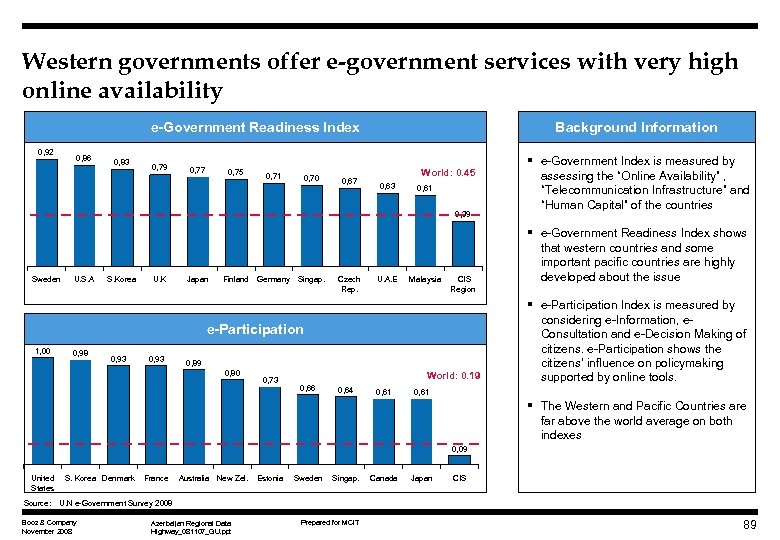
Western governments offer e-government services with very high online availability e-Government Readiness Index 0, 92 0, 86 0, 83 0, 79 0, 77 0, 75 0, 71 0, 70 0, 67 Background Information World: 0. 45 0, 63 0, 61 0, 39 Sweden U. S. A S. Korea U. K Japan Finland Germany Singap. Czech Rep. U. A. E Malaysia CIS Region e-Participation 1, 00 0, 98 0, 93 0, 89 0, 80 0, 73 World: 0. 19 0, 66 0, 64 0, 61 § e-Government Index is measured by assessing the “Online Availability” , “Telecommunication Infrastructure” and “Human Capital” of the countries § e-Government Readiness Index shows that western countries and some important pacific countries are highly developed about the issue § e-Participation Index is measured by considering e-Information, e. Consultation and e-Decision Making of citizens. e-Participation shows the citizens’ influence on policymaking supported by online tools. 0, 61 § The Western and Pacific Countries are far above the world average on both indexes 0, 09 United States S. Korea Denmark France Australia New Zel. Estonia Sweden Singap. Canada Japan CIS Source: U. N e-Government Survey 2008 Booz & Company November 2008 Azerbaijan Regional Data Highway_081107_GU. ppt Prepared for MCIT 89
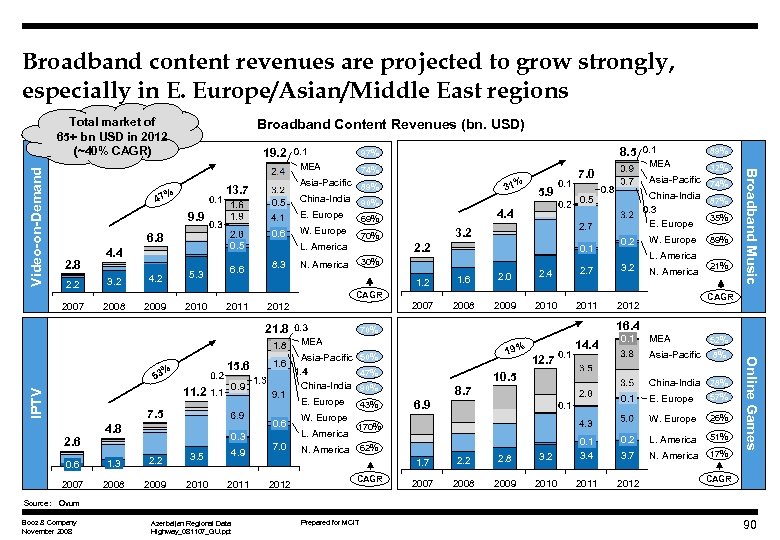
Broadband content revenues are projected to grow strongly, especially in E. Europe/Asian/Middle East regions Broadband Content Revenues (bn. USD) 19. 2 MEA 13. 7 7% 4 0. 5 0. 6 6. 8 2. 8 0. 5 4. 4 2. 2 3. 2 2007 2008 5. 3 4. 2 Asia-Pacific 89% China-India 90% 8. 3 31% 7. 0 5. 9 0. 1 30% 0. 2 W. Europe L. America 1. 6 2. 0 2. 4 2. 7 3. 2 1. 2 6. 6 2007 2008 2009 2010 2011 2012 N. America CAGR 2009 2010 2011 2012 1. 8 % 53 IPTV 11. 2 1. 6 7. 5 0. 6 4. 8 0. 3 2. 2 3. 5 4. 9 0. 6 1. 3 2007 2008 2009 2010 2011 19% Asia-Pacific 50% 47% L. America 12. 7 10. 5 8. 7 0. 1 6. 9 2012 2. 8 3. 2 0. 1 3. 4 2007 2008 2009 2010 2011 62% CAGR MEA 52% Asia-Pacific 0. 1 170% N. America CAGR 8% China-India 14. 4 1. 7 7. 0 21% 28% E. Europe 57% W. Europe MEA W. Europe 89% 16. 4 70% China-India 90% E. Europe 43% 0. 9 35% 26% 0. 2 L. America 51% 3. 7 N. America 17% 2012 Online Games 15. 6 32% 87% E. Europe 2. 2 N. America 0. 5 3. 2 70% 89% MEA Asia-Pacific 74% China-India 4. 4 69% W. Europe L. America 21. 8 2. 6 74% E. Europe 9. 9 8. 5 97% Broadband Music Video-on-Demand Total market of 65+ bn USD in 2012 (~40% CAGR) CAGR Source: Ovum Booz & Company November 2008 Azerbaijan Regional Data Highway_081107_GU. ppt Prepared for MCIT 90
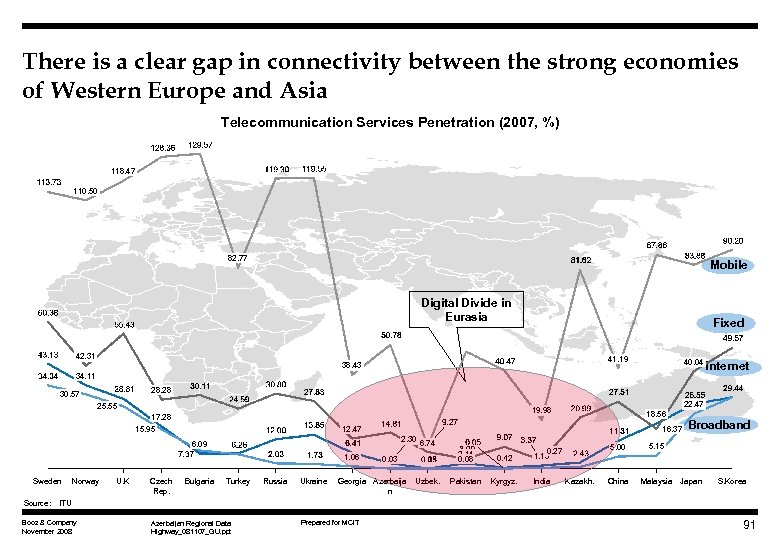
There is a clear gap in connectivity between the strong economies of Western Europe and Asia Telecommunication Services Penetration (2007, %) 118. 47 110. 50 82. 77 Mobile Digital Divide in Eurasia Fixed 42. 31 41. 19 38. 43 40. 04 34. 11 28. 28 30. 57 25. 55 17. 28 16. 37 2. 30 6. 74 1. 06 U. K Czech Rep. 18. 56 12. 47 6. 09 Norway 22. 47 19. 98 15. 95 Sweden Internet Bulgaria Turkey Russia Ukraine Georgia Azerbaija n Uzbek. Pakistan 5. 00 0. 27 1. 15 2. 14 0. 08 0. 03 Kyrgyz. India Kazakh. 5. 15 China Malaysia Broadband Japan S. Korea Source: ITU Booz & Company November 2008 Azerbaijan Regional Data Highway_081107_GU. ppt Prepared for MCIT 91
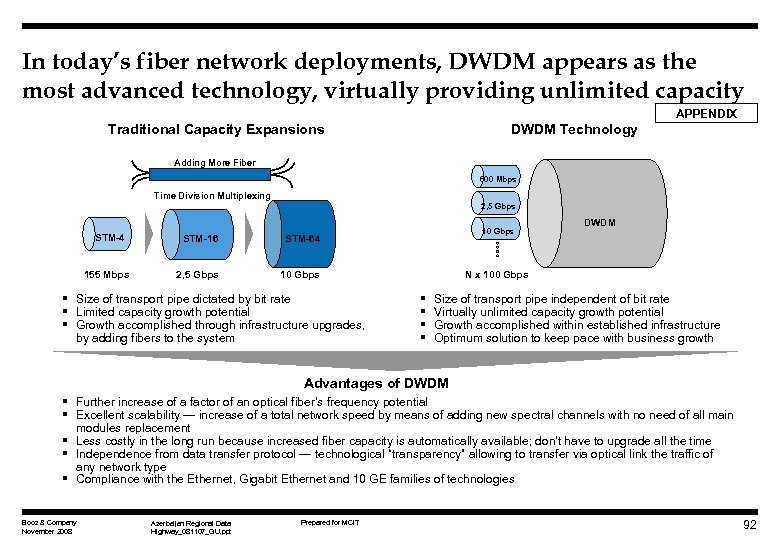
In today’s fiber network deployments, DWDM appears as the most advanced technology, virtually providing unlimited capacity APPENDIX Traditional Capacity Expansions DWDM Technology Adding More Fiber 600 Mbps Time Division Multiplexing 2, 5 Gbps STM-4 155 Mbps STM-16 STM-64 2, 5 Gbps 10 Gbps § Size of transport pipe dictated by bit rate § Limited capacity growth potential § Growth accomplished through infrastructure upgrades, by adding fibers to the system DWDM N x 100 Gbps § § Size of transport pipe independent of bit rate Virtually unlimited capacity growth potential Growth accomplished within established infrastructure Optimum solution to keep pace with business growth Advantages of DWDM § Further increase of a factor of an optical fiber’s frequency potential § Excellent scalability — increase of a total network speed by means of adding new spectral channels with no need of all main modules replacement § Less costly in the long run because increased fiber capacity is automatically available; don't have to upgrade all the time § Independence from data transfer protocol — technological “transparency” allowing to transfer via optical link the traffic of any network type § Compliance with the Ethernet, Gigabit Ethernet and 10 GE families of technologies Booz & Company November 2008 Azerbaijan Regional Data Highway_081107_GU. ppt Prepared for MCIT 92
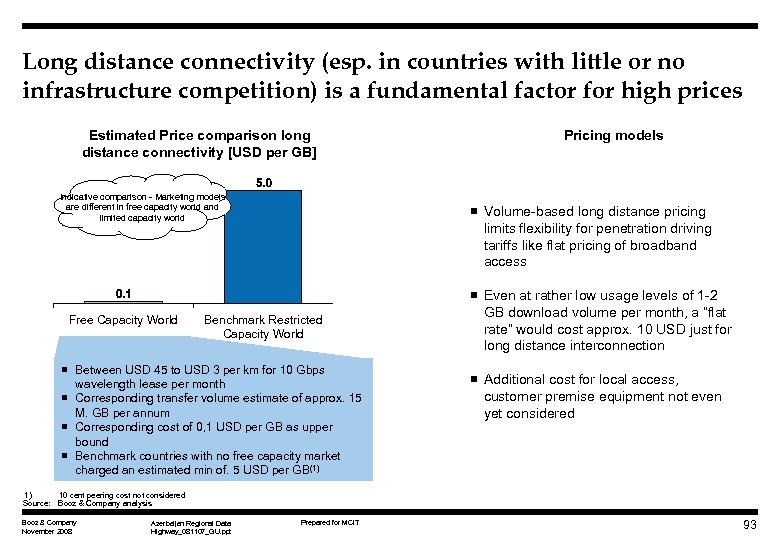
Long distance connectivity (esp. in countries with little or no infrastructure competition) is a fundamental factor for high prices Estimated Price comparison long distance connectivity [USD per GB] Indicative comparison - Marketing models are different in free capacity world and limited capacity world Free Capacity World Pricing models ■ Volume-based long distance pricing limits flexibility for penetration driving tariffs like flat pricing of broadband access Benchmark Restricted Capacity World ■ Between USD 45 to USD 3 per km for 10 Gbps wavelength lease per month ■ Corresponding transfer volume estimate of approx. 15 M. GB per annum ■ Corresponding cost of 0, 1 USD per GB as upper bound ■ Benchmark countries with no free capacity market charged an estimated min of. 5 USD per GB(1) ■ Even at rather low usage levels of 1 -2 GB download volume per month, a “flat rate” would cost approx. 10 USD just for long distance interconnection ■ Additional cost for local access, customer premise equipment not even yet considered 1) 10 cent peering cost not considered Source: Booz & Company analysis Booz & Company November 2008 Azerbaijan Regional Data Highway_081107_GU. ppt Prepared for MCIT 93
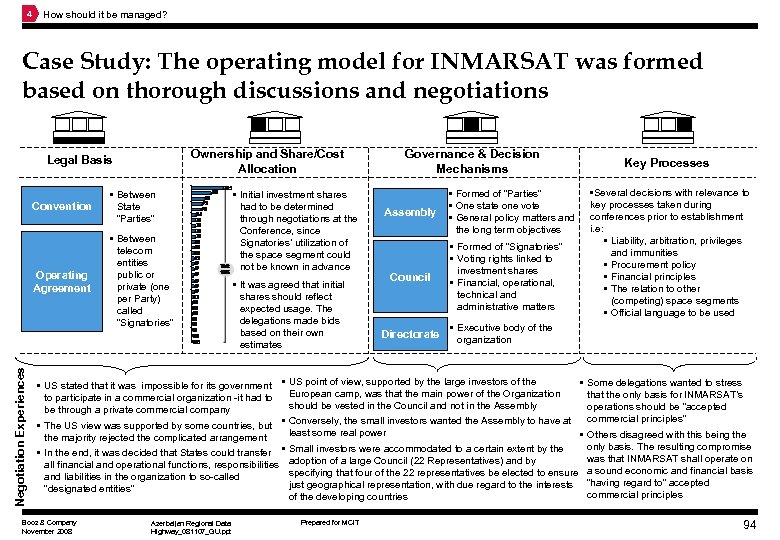
4 How should it be managed? Case Study: The operating model for INMARSAT was formed based on thorough discussions and negotiations Ownership and Share/Cost Allocation Legal Basis Operating Agreement Negotiation Experiences Convention • Between State “Parties” • Between telecom entities public or private (one per Party) called “Signatories” • Initial investment shares had to be determined through negotiations at the Conference, since Signatories’ utilization of the space segment could not be known in advance • It was agreed that initial shares should reflect expected usage. The delegations made bids based on their own estimates • US stated that it was impossible for its government • to participate in a commercial organization -it had to be through a private commercial company • The US view was supported by some countries, but • the majority rejected the complicated arrangement • In the end, it was decided that States could transfer • all financial and operational functions, responsibilities and liabilities in the organization to so-called “designated entities“ Booz & Company November 2008 Azerbaijan Regional Data Highway_081107_GU. ppt Governance & Decision Mechanisms Assembly Council Directorate • Formed of “Parties” • One state one vote • General policy matters and the long term objectives • Formed of “Signatories” • Voting rights linked to investment shares • Financial, operational, technical and administrative matters Key Processes • Several decisions with relevance to key processes taken during conferences prior to establishment i. e: • Liability, arbitration, privileges and immunities • Procurement policy • Financial principles • The relation to other (competing) space segments • Official language to be used • Executive body of the organization US point of view, supported by the large investors of the European camp, was that the main power of the Organization should be vested in the Council and not in the Assembly • Some delegations wanted to stress that the only basis for INMARSAT’s operations should be “accepted Conversely, the small investors wanted the Assembly to have at commercial principles” least some real power • Others disagreed with this being the only basis. The resulting compromise Small investors were accommodated to a certain extent by the was that INMARSAT shall operate on adoption of a large Council (22 Representatives) and by specifying that four of the 22 representatives be elected to ensure a sound economic and financial basis just geographical representation, with due regard to the interests “having regard to” accepted commercial principles of the developing countries Prepared for MCIT 94
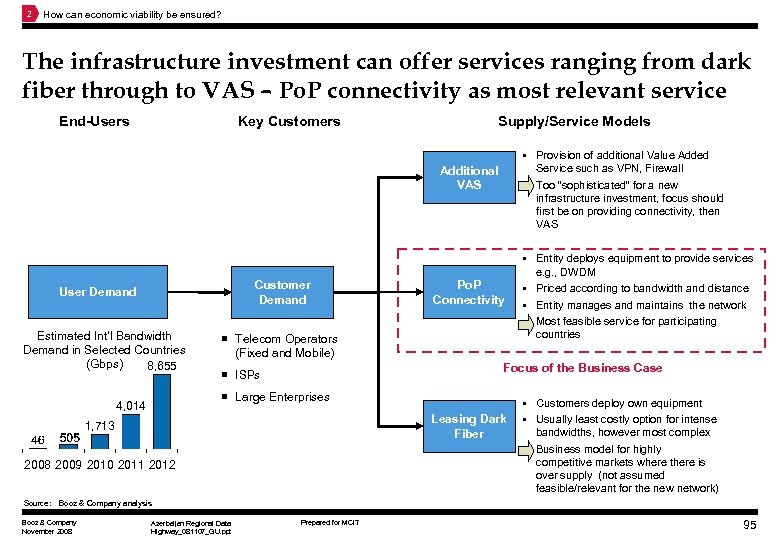
2 How can economic viability be ensured? The infrastructure investment can offer services ranging from dark fiber through to VAS – Po. P connectivity as most relevant service End-Users Key Customers Supply/Service Models § Provision of additional Value Added Service such as VPN, Firewall § Too “sophisticated” for a new infrastructure investment, focus should first be on providing connectivity, then VAS Additional VAS Customer Demand User Demand Estimated Int’l Bandwidth Demand in Selected Countries (Gbps) 8, 655 Po. P Connectivity ■ Telecom Operators (Fixed and Mobile) Focus of the Business Case ■ ISPs ■ Large Enterprises 4, 014 § Entity deploys equipment to provide services e. g. , DWDM § Priced according to bandwidth and distance § Entity manages and maintains the network § Most feasible service for participating countries Leasing Dark Fiber 1, 713 2008 2009 2010 2011 2012 § Customers deploy own equipment § Usually least costly option for intense bandwidths, however most complex § Business model for highly competitive markets where there is over supply (not assumed feasible/relevant for the new network) Source: Booz & Company analysis Booz & Company November 2008 Azerbaijan Regional Data Highway_081107_GU. ppt Prepared for MCIT 95
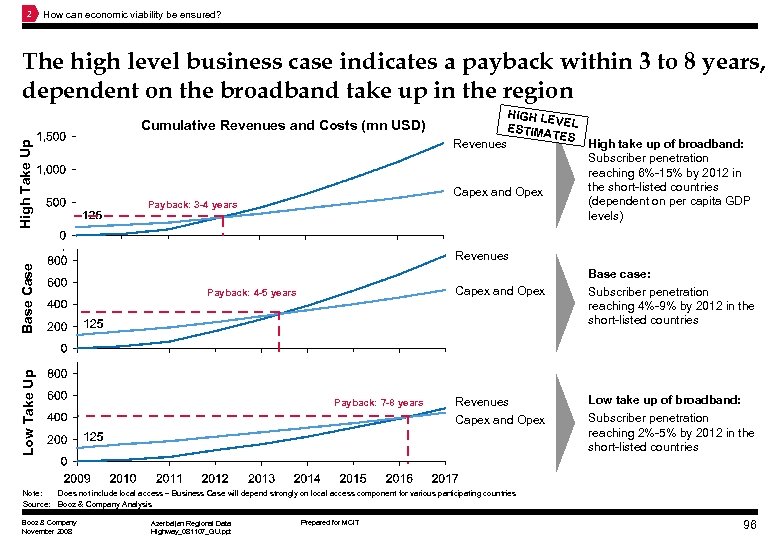
2 How can economic viability be ensured? The high level business case indicates a payback within 3 to 8 years, dependent on the broadband take up in the region High Take Up Cumulative Revenues and Costs (mn USD) Payback: 3 -4 years HIGH LE VEL ESTIMA TES High take up of broadband: Revenues Subscriber penetration reaching 6%-15% by 2012 in the short-listed countries Capex and Opex (dependent on per capita GDP levels) Capex and Opex Payback: 4 -5 years Low Take Up Base Case Revenues Payback: 7 -8 years Revenues Capex and Opex Base case: Subscriber penetration reaching 4%-9% by 2012 in the short-listed countries Low take up of broadband: Subscriber penetration reaching 2%-5% by 2012 in the short-listed countries Note: Does not include local access – Business Case will depend strongly on local access component for various participating countries Source: Booz & Company Analysis Booz & Company November 2008 Azerbaijan Regional Data Highway_081107_GU. ppt Prepared for MCIT 96
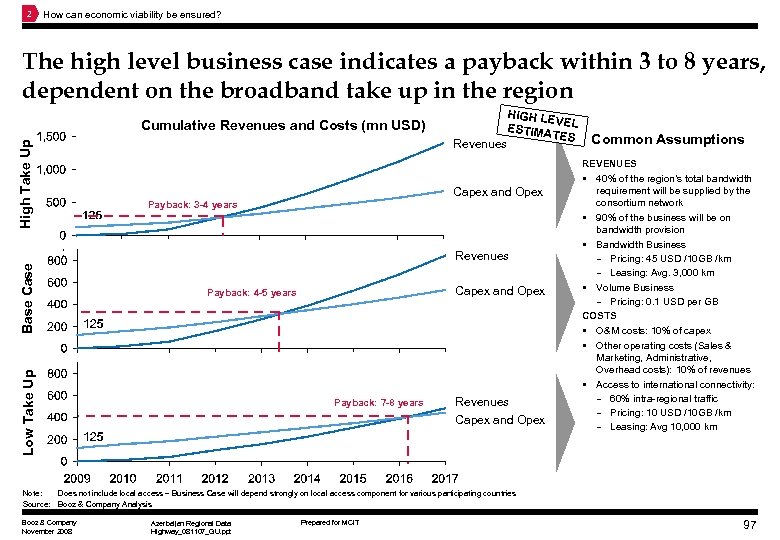
2 How can economic viability be ensured? The high level business case indicates a payback within 3 to 8 years, dependent on the broadband take up in the region High Take Up Cumulative Revenues and Costs (mn USD) HIGH LE VEL ESTIMA TES Revenues Capex and Opex Payback: 3 -4 years Capex and Opex Payback: 4 -5 years Low Take Up Base Case Revenues Payback: 7 -8 years Revenues Capex and Opex Common Assumptions REVENUES § 40% of the region’s total bandwidth requirement will be supplied by the consortium network § 90% of the business will be on bandwidth provision § Bandwidth Business – Pricing: 45 USD /10 GB /km – Leasing: Avg. 3, 000 km § Volume Business – Pricing: 0. 1 USD per GB COSTS § O&M costs: 10% of capex § Other operating costs (Sales & Marketing, Administrative, Overhead costs): 10% of revenues § Access to international connectivity: – 60% intra-regional traffic – Pricing: 10 USD /10 GB /km – Leasing: Avg 10, 000 km Note: Does not include local access – Business Case will depend strongly on local access component for various participating countries Source: Booz & Company Analysis Booz & Company November 2008 Azerbaijan Regional Data Highway_081107_GU. ppt Prepared for MCIT 97
Скачать презентацию Booz Company Baku November 2008 Building Connectivity
41d281f705410bd3aacb906300955caf.ppt