 Скачать презентацию Bonneville Power Administration Update to FY 2008 Integrated
02f8f617c515d4310e6c1cfa79170751.ppt
- Количество слайдов: 72



Bonneville Power Administration Update to FY 2008 Integrated Program Review (IPR-2) March 18, 2009 BPA Integrated Program Review II – Refresher Spring 2009
IPR-2 Materials • Background, Objectives, Schedule and Scope of the Integrated Program Review Update (IPR 2) • Overview • Power – – Expense Overview – • Rates Capital Overview Transmission – – Expense Overview – • Rates Capital Overview Agency Services – Expense Overview – Capital Overview • Next Steps • Financial Disclosure BPA Integrated Program Review II – Refresher Spring 2009 2
Integrated Program Review Update Background • BPA held a public process, the Integrated Program Review, from May 2008 through August 2008. • The purpose of that process was to: – Present all BPA’s costs, Power, Transmission and Agency Services, both expense and capital, in one forum, consistent with the structure developed coming out of the Regional Dialogue. – Allow customers, other stakeholders and interested parties an opportunity to review, ask questions about, and comment on any changes since the Close-Out Report from November 2008 to BPA’s proposed spending levels for FY 2010 -2011 and proposed capital investment levels for FY 2009 -2013. • A Close-Out Report was released in November 2008, laying out the decisions and explanations for those decisions on spending levels and capital investment levels. • In that report, BPA stated: Integrated Program Review Parameters – The rate case is a formal hearing process, with a Hearing Officer, which sets rates based on costs. The Integrated Program Review (IPR) is a collaborative informal process designed to lay out the major program costs and seek customer feedback and suggestions for each program area prior to these numbers being included in rates. BPA Integrated Program Review II – Refresher Spring 2009 3
Integrated Program Review Update Background (continued) (Continued from the November 2008 Close-Out Report) • The decisions on FY 2010 -2011 program spending levels outlined here are based on the best information available. We believe that by next spring we should have additional information that may cause revisions to some program levels for FY 2010 -2011. Additional information will likely become available on the following topics: – A better understanding of BPA’s role in the development of energy efficiency and renewable resources as a result of the Northwest Energy Efficiency Task Force activities, recommendations from the Northwest Power and Conservation Council’s 6 th Power Plan which will establish new conservation targets for the region, and a public process BPA intends to hold to discuss its role in energy efficiency; – Better understanding of the internal costs associated with the transition to new power contracts and rates in 2012; – More clarity on fish and wildlife costs; – Further work on Network Open Season planning; – Further work on BPA’s asset planning and resource strategy resulting in improved estimates of realistically achievable capital spending; and – Evaluation of the implications for BPA and the region of recent events in global financial markets and indications of a severe economic downturn. – The decisions outlined here will be the basis for our initial rate proposals. We intend to hold a subsequent, abbreviated program review next spring to reconsider the program levels in light of the increased information available at that time. BPA Integrated Program Review II – Refresher Spring 2009 4
Objective • The IPR 2 is intended to provide participants with: – BPA’s current forecasts of costs for the FY 2010 -2011 period. – Reasons for any changes from the forecasts in the 2008 IPR process. – An opportunity to comment on these forecasts and to suggest changes. • Pages with a in the upper right hand corner are Power-related. • Pages with a in the upper right hand corner are Transmission-related. • Pages with a in the upper right hand corner are Agency Services-related. BPA Integrated Program Review II – Refresher Spring 2009 5
Integrated Program Review Scope • • • The IPR is BPA’s public involvement process for: – The costs that go into power and transmission rates, with a primary focus on the major program areas that make up the bulk of power and transmission costs. Input received in this process will inform BPA’s decisions on the program levels that will be included in the 2010 -2011 Power and Transmission Rate Case Final Proposals. Program levels will not be revisited in the two rate cases. The decision processes for the following topics are in the Power and Transmission rate cases, and they will not be addressed here: – Loads and Resources – Revenue Credits including Secondary Sales Revenues – Billing Determinants – Residential Exchange Costs – Reserve Levels – Ancillary Services – Rate Design – Rate Level While depreciation, amortization, net interest and non-Federal debt service are described in this process, those are also not decided in this process. They are results of many factors, including capital investment levels, interest rate environment, and debt management decisions. A preliminary estimate of Power and Transmission Services interest, depreciation and non-federal debt service has been provided for information only. The final amounts will be determined in the rate case and could be considerably different based on changes in capital forecast, debt management actions, and changes in projected interest income on cash in the BPA Fund. BPA Integrated Program Review II – Refresher Spring 2009 6
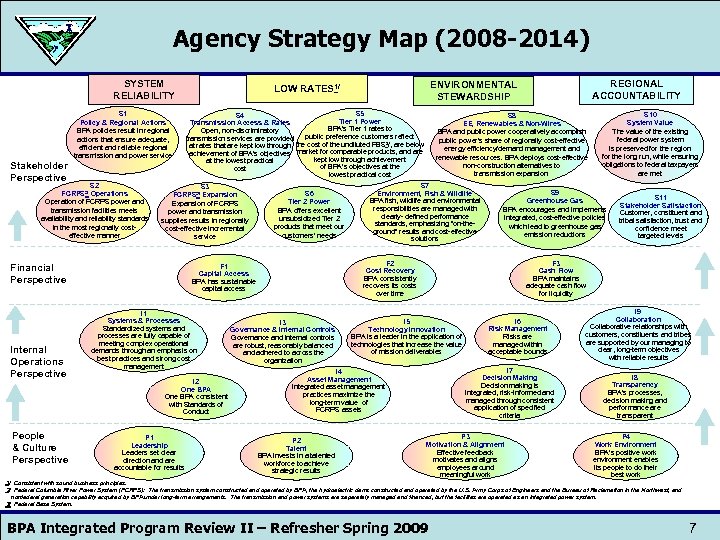
Agency Strategy Map (2008 -2014) SYSTEM RELIABILITY Stakeholder Perspective S 1 Policy & Regional Actions BPA policies result in regional actions that ensure adequate, efficient and reliable regional transmission and power service S 2 FCRPS 2/ Operations Operation of FCRPS power and transmission facilities meets availability and reliability standards in the most regionally costeffective manner Financial Perspective Internal Operations Perspective People & Culture Perspective S 5 S 4 Tier Transmission Access & Rates 1 Power BPA’s Tier 1 rates to Open, non-discriminatory transmission services are provided public preference customers reflect 3 at rates that are kept low through the cost of the undiluted FBS /, are below market for comparable products, and are achievement of BPA’s objectives kept low through achievement at the lowest practical of BPA’s objectives at the cost lowest practical cost S 3 FCRPS 2/ Expansion of FCRPS power and transmission supplies results in regionally cost-effective incremental service S 6 Tier 2 Power BPA offers excellent unsubsidized Tier 2 products that meet our customers’ needs F 1 Capital Access BPA has sustainable capital access REGIONAL ACCOUNTABILITY ENVIRONMENTAL STEWARDSHIP LOW RATES 1/ S 10 S 8 System Value EE, Renewables & Non-Wires BPA and public power cooperatively accomplish The value of the existing federal power system public power’s share of regionally cost-effective is preserved for the region energy efficiency/demand management and for the long run, while ensuring renewable resources. BPA deploys cost-effective obligations to federal taxpayers non-construction alternatives to are met transmission expansion. S 7 Environment, Fish & Wildlife BPA fish, wildlife and environmental responsibilities are managed with clearly- defined performance standards, emphasizing "on-theground" results and cost-effective solutions S 9 S 11 Greenhouse Gas Stakeholder Satisfaction BPA encourages and implements Customer, constituent and integrated, cost-effective policies tribal satisfaction, trust and which lead to greenhouse gas confidence meet emission reductions targeted levels F 2 Cost Recovery BPA consistently recovers its costs over time F 3 Cash Flow BPA maintains adequate cash flow for liquidity I 9 Collaboration I 6 I 5 I 3 Collaborative relationships with Risk Management Technology Innovation Governance & Internal Controls customers, constituents and tribes Risks are BPA is a leader in the application of Governance and internal controls are supported by our managing to managed within technologies that increase the value are robust, reasonably balanced clear, long-term objectives acceptable bounds of mission deliverables and adhered to across the with reliable results organization I 7 I 4 I 8 Decision Making Asset Management I 2 Decision making is Transparency Integrated asset management One BPA’s processes, integrated, risk-informed and practices maximize the One BPA consistent decision making and managed through consistent long-term value of with Standards of application of specified performance are FCRPS assets Conduct transparent criteria I 1 Systems & Processes Standardized systems and processes are fully capable of meeting complex operational demands through an emphasis on best practices and strong cost management P 1 Leadership Leaders set clear direction and are accountable for results P 2 Talent BPA invests in a talented workforce to achieve strategic results P 3 Motivation & Alignment Effective feedback motivates and aligns employees around meaningful work P 4 Work Environment BPA’s positive work environment enables its people to do their best work 1/ Consistent with sound business principles. 2/ Federal Columbia River Power System (FCRPS): The transmission system constructed and operated by BPA, the hydroelectric dams constructed and operated by the U. S. Army Corps of Engineers and the Bureau of Reclamation in the Northwest, and nonfederal generation capability acquired by BPA under long-term arrangements. The transmission and power systems are separately managed and financed, but the facilities are operated as an integrated power system. 3/ Federal Base System. BPA Integrated Program Review II – Refresher Spring 2009 7
Power BPA Integrated Program Review II – Refresher Spring 2009 8
Drivers of Power Costs The increases in Power Services costs as described in IPR are largely attributable to: • Columbia Generating Station nuclear plant costs, due to increases in operations, maintenance and capital expenses needed to ensure safe, reliable and efficient operation of the plant. Notably, this includes replacement of the main condenser in 2011. In addition, the extended outage needed for the condenser replacement will cause significant lost revenues and power replacement costs in 2011. BPA does not directly control these costs, but agrees that increases are necessary. • New 2008 Biological Opinion requirements and implementation of new agreements with participating tribes and states (the Columbia Basin Fish Accords) will result in substantial increased spending for on-the-ground projects to boost protection and survival of threatened and endangered Columbia Basin salmon. • Increased Operations and Maintenance costs on the hydro system to maintain and improve its reliability and output. BPA Integrated Program Review II – Refresher Spring 2009 9
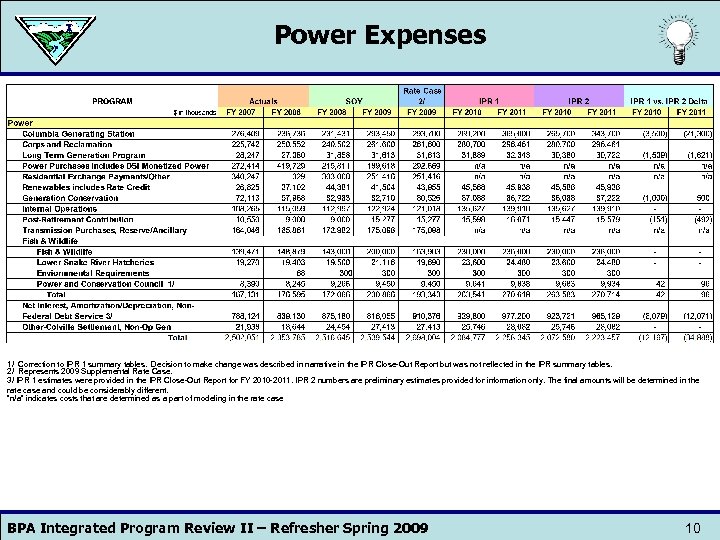
Power Expenses 1/ Correction to IPR 1 summary tables. Decision to make change was described in narrative in the IPR Close-Out Report but was not reflected in the IPR summary tables. 2/ Represents 2009 Supplemental Rate Case. 3/ IPR 1 estimates were provided in the IPR Close-Out Report for FY 2010 -2011. IPR 2 numbers are preliminary estimates provided for information only. The final amounts will be determined in the rate case and could be considerably different. “n/a” indicates costs that are determined as a part of modeling in the rate case BPA Integrated Program Review II – Refresher Spring 2009 10
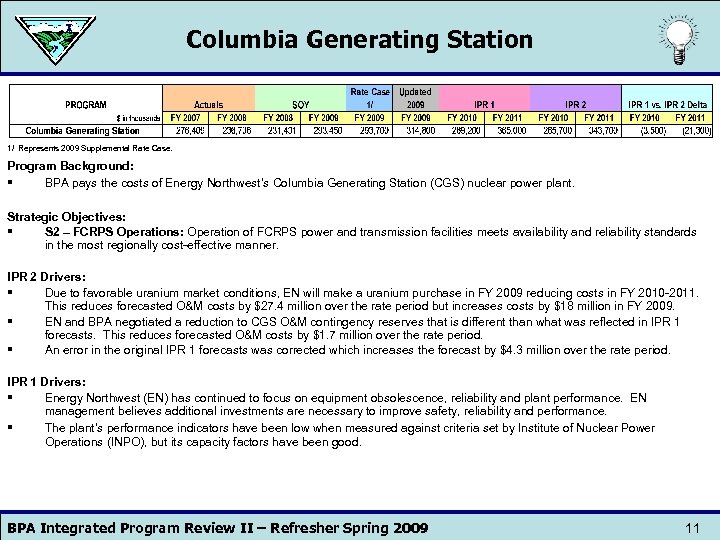
Columbia Generating Station 1/ Represents 2009 Supplemental Rate Case. Program Background: § BPA pays the costs of Energy Northwest’s Columbia Generating Station (CGS) nuclear power plant. Strategic Objectives: § S 2 – FCRPS Operations: Operation of FCRPS power and transmission facilities meets availability and reliability standards in the most regionally cost-effective manner. IPR 2 Drivers: § Due to favorable uranium market conditions, EN will make a uranium purchase in FY 2009 reducing costs in FY 2010 -2011. This reduces forecasted O&M costs by $27. 4 million over the rate period but increases costs by $18 million in FY 2009. § EN and BPA negotiated a reduction to CGS O&M contingency reserves that is different than what was reflected in IPR 1 forecasts. This reduces forecasted O&M costs by $1. 7 million over the rate period. § An error in the original IPR 1 forecasts was corrected which increases the forecast by $4. 3 million over the rate period. IPR 1 Drivers: § Energy Northwest (EN) has continued to focus on equipment obsolescence, reliability and plant performance. EN management believes additional investments are necessary to improve safety, reliability and performance. § The plant’s performance indicators have been low when measured against criteria set by Institute of Nuclear Power Operations (INPO), but its capacity factors have been good. BPA Integrated Program Review II – Refresher Spring 2009 11
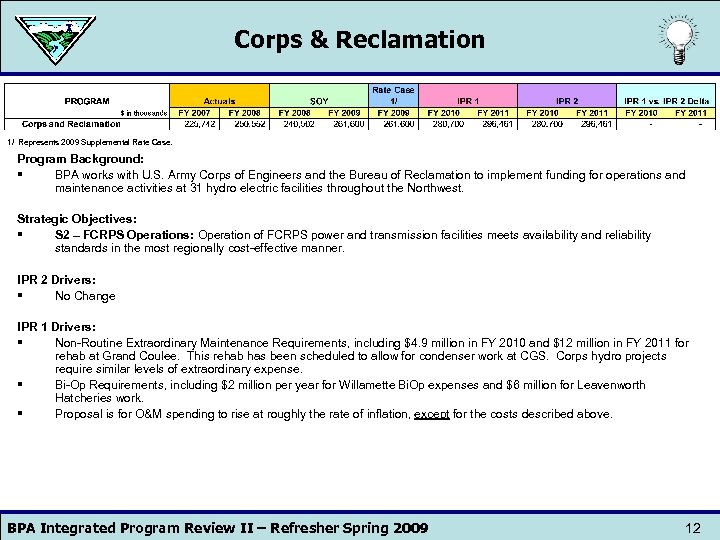
Corps & Reclamation 1/ Represents 2009 Supplemental Rate Case. Program Background: § BPA works with U. S. Army Corps of Engineers and the Bureau of Reclamation to implement funding for operations and maintenance activities at 31 hydro electric facilities throughout the Northwest. Strategic Objectives: § S 2 – FCRPS Operations: Operation of FCRPS power and transmission facilities meets availability and reliability standards in the most regionally cost-effective manner. IPR 2 Drivers: § No Change IPR 1 Drivers: § Non-Routine Extraordinary Maintenance Requirements, including $4. 9 million in FY 2010 and $12 million in FY 2011 for rehab at Grand Coulee. This rehab has been scheduled to allow for condenser work at CGS. Corps hydro projects require similar levels of extraordinary expense. § Bi-Op Requirements, including $2 million per year for Willamette Bi. Op expenses and $6 million for Leavenworth Hatcheries work. § Proposal is for O&M spending to rise at roughly the rate of inflation, except for the costs described above. BPA Integrated Program Review II – Refresher Spring 2009 12
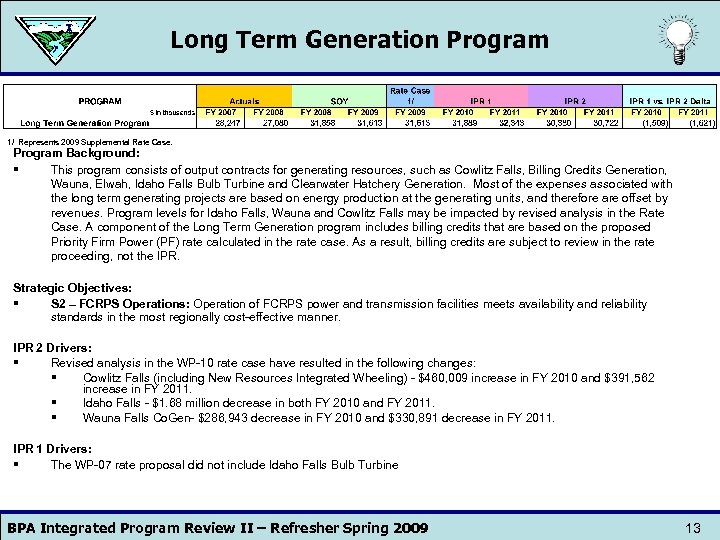
Long Term Generation Program 1/ Represents 2009 Supplemental Rate Case. Program Background: § This program consists of output contracts for generating resources, such as Cowlitz Falls, Billing Credits Generation, Wauna, Elwah, Idaho Falls Bulb Turbine and Clearwater Hatchery Generation. Most of the expenses associated with the long term generating projects are based on energy production at the generating units, and therefore are offset by revenues. Program levels for Idaho Falls, Wauna and Cowlitz Falls may be impacted by revised analysis in the Rate Case. A component of the Long Term Generation program includes billing credits that are based on the proposed Priority Firm Power (PF) rate calculated in the rate case. As a result, billing credits are subject to review in the rate proceeding, not the IPR. Strategic Objectives: § S 2 – FCRPS Operations: Operation of FCRPS power and transmission facilities meets availability and reliability standards in the most regionally cost-effective manner. IPR 2 Drivers: § Revised analysis in the WP-10 rate case have resulted in the following changes: § Cowlitz Falls (including New Resources Integrated Wheeling) - $460, 009 increase in FY 2010 and $391, 562 increase in FY 2011. § Idaho Falls - $1. 68 million decrease in both FY 2010 and FY 2011. § Wauna Falls Co. Gen- $286, 943 decrease in FY 2010 and $330, 891 decrease in FY 2011. IPR 1 Drivers: § The WP-07 rate proposal did not include Idaho Falls Bulb Turbine BPA Integrated Program Review II – Refresher Spring 2009 13
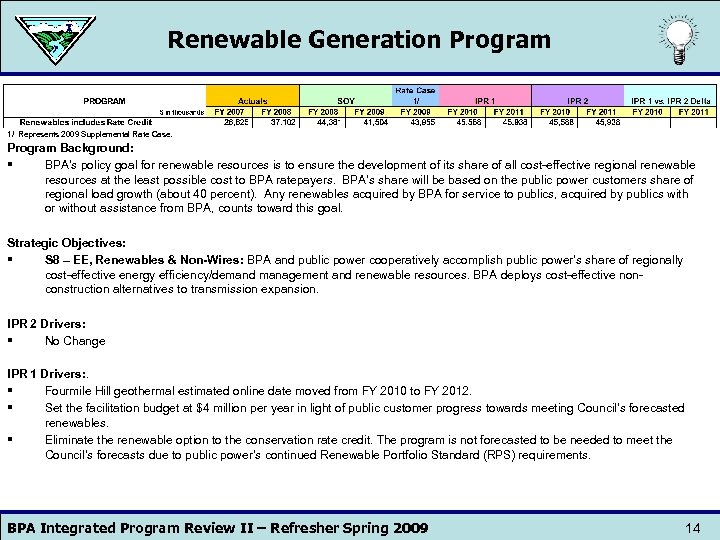
Renewable Generation Program 1/ Represents 2009 Supplemental Rate Case. Program Background: § BPA’s policy goal for renewable resources is to ensure the development of its share of all cost-effective regional renewable resources at the least possible cost to BPA ratepayers. BPA’s share will be based on the public power customers share of regional load growth (about 40 percent). Any renewables acquired by BPA for service to publics, acquired by publics with or without assistance from BPA, counts toward this goal. Strategic Objectives: § S 8 – EE, Renewables & Non-Wires: BPA and public power cooperatively accomplish public power’s share of regionally cost-effective energy efficiency/demand management and renewable resources. BPA deploys cost-effective nonconstruction alternatives to transmission expansion. IPR 2 Drivers: § No Change IPR 1 Drivers: . § Fourmile Hill geothermal estimated online date moved from FY 2010 to FY 2012. § Set the facilitation budget at $4 million per year in light of public customer progress towards meeting Council’s forecasted renewables. § Eliminate the renewable option to the conservation rate credit. The program is not forecasted to be needed to meet the Council’s forecasts due to public power’s continued Renewable Portfolio Standard (RPS) requirements. BPA Integrated Program Review II – Refresher Spring 2009 14
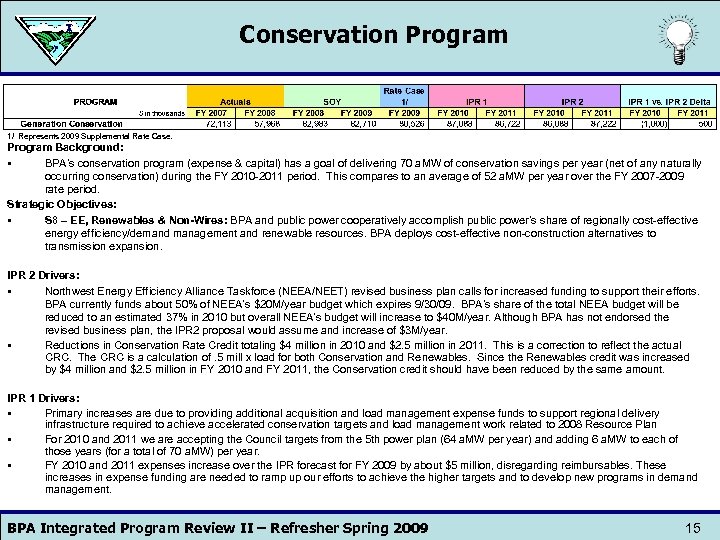
Conservation Program 1/ Represents 2009 Supplemental Rate Case. Program Background: § BPA’s conservation program (expense & capital) has a goal of delivering 70 a. MW of conservation savings per year (net of any naturally occurring conservation) during the FY 2010 -2011 period. This compares to an average of 52 a. MW per year over the FY 2007 -2009 rate period. Strategic Objectives: § S 8 – EE, Renewables & Non-Wires: BPA and public power cooperatively accomplish public power’s share of regionally cost-effective energy efficiency/demand management and renewable resources. BPA deploys cost-effective non-construction alternatives to transmission expansion. IPR 2 Drivers: § Northwest Energy Efficiency Alliance Taskforce (NEEA/NEET) revised business plan calls for increased funding to support their efforts. BPA currently funds about 50% of NEEA’s $20 M/year budget which expires 9/30/09. BPA’s share of the total NEEA budget will be reduced to an estimated 37% in 2010 but overall NEEA’s budget will increase to $40 M/year. Although BPA has not endorsed the revised business plan, the IPR 2 proposal would assume and increase of $3 M/year. § Reductions in Conservation Rate Credit totaling $4 million in 2010 and $2. 5 million in 2011. This is a correction to reflect the actual CRC. The CRC is a calculation of. 5 mill x load for both Conservation and Renewables. Since the Renewables credit was increased by $4 million and $2. 5 million in FY 2010 and FY 2011, the Conservation credit should have been reduced by the same amount. IPR 1 Drivers: § Primary increases are due to providing additional acquisition and load management expense funds to support regional delivery infrastructure required to achieve accelerated conservation targets and load management work related to 2008 Resource Plan § For 2010 and 2011 we are accepting the Council targets from the 5 th power plan (64 a. MW per year) and adding 6 a. MW to each of those years (for a total of 70 a. MW) per year. § FY 2010 and 2011 expenses increase over the IPR forecast for FY 2009 by about $5 million, disregarding reimbursables. These increases in expense funding are needed to ramp up our efforts to achieve the higher targets and to develop new programs in demand management. BPA Integrated Program Review II – Refresher Spring 2009 15
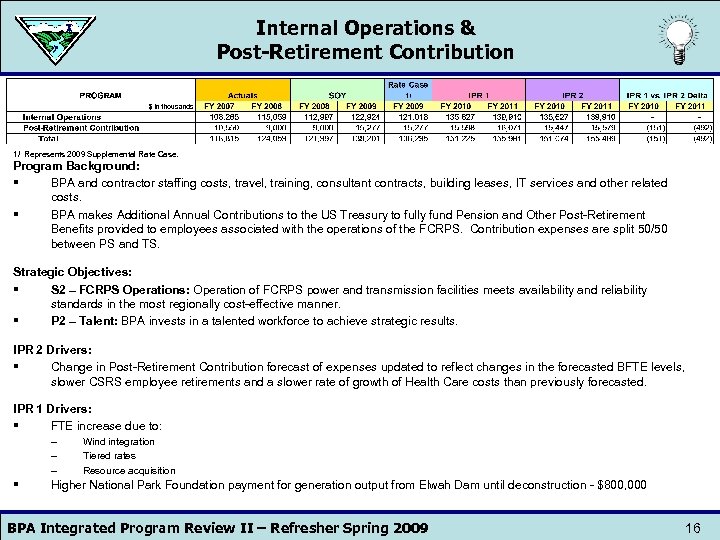
Internal Operations & Post-Retirement Contribution 1/ Represents 2009 Supplemental Rate Case. Program Background: § BPA and contractor staffing costs, travel, training, consultant contracts, building leases, IT services and other related costs. § BPA makes Additional Annual Contributions to the US Treasury to fully fund Pension and Other Post-Retirement Benefits provided to employees associated with the operations of the FCRPS. Contribution expenses are split 50/50 between PS and TS. Strategic Objectives: § S 2 – FCRPS Operations: Operation of FCRPS power and transmission facilities meets availability and reliability standards in the most regionally cost-effective manner. § P 2 – Talent: BPA invests in a talented workforce to achieve strategic results. IPR 2 Drivers: § Change in Post-Retirement Contribution forecast of expenses updated to reflect changes in the forecasted BFTE levels, slower CSRS employee retirements and a slower rate of growth of Health Care costs than previously forecasted. IPR 1 Drivers: § FTE increase due to: – – – § Wind integration Tiered rates Resource acquisition Higher National Park Foundation payment for generation output from Elwah Dam until deconstruction - $800, 000 BPA Integrated Program Review II – Refresher Spring 2009 16
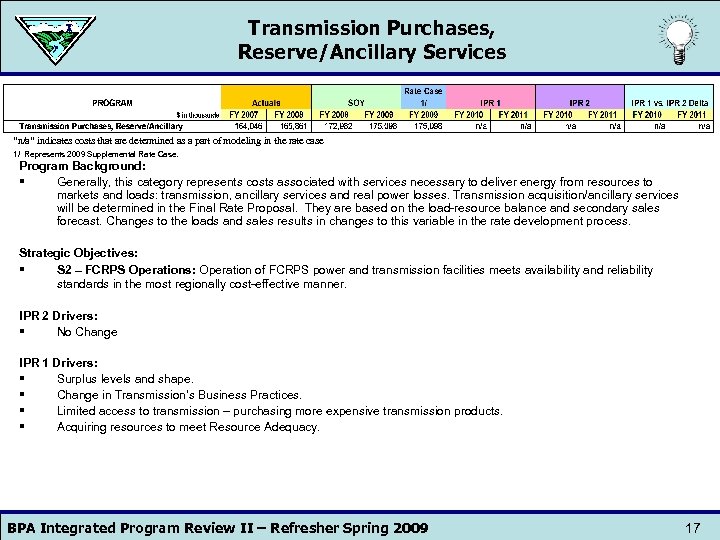
Transmission Purchases, Reserve/Ancillary Services “n/a” indicates costs that are determined as a part of modeling in the rate case 1/ Represents 2009 Supplemental Rate Case. Program Background: § Generally, this category represents costs associated with services necessary to deliver energy from resources to markets and loads: transmission, ancillary services and real power losses. Transmission acquisition/ancillary services will be determined in the Final Rate Proposal. They are based on the load-resource balance and secondary sales forecast. Changes to the loads and sales results in changes to this variable in the rate development process. Strategic Objectives: § S 2 – FCRPS Operations: Operation of FCRPS power and transmission facilities meets availability and reliability standards in the most regionally cost-effective manner. IPR 2 Drivers: § No Change IPR 1 Drivers: § Surplus levels and shape. § Change in Transmission’s Business Practices. § Limited access to transmission – purchasing more expensive transmission products. § Acquiring resources to meet Resource Adequacy. BPA Integrated Program Review II – Refresher Spring 2009 17
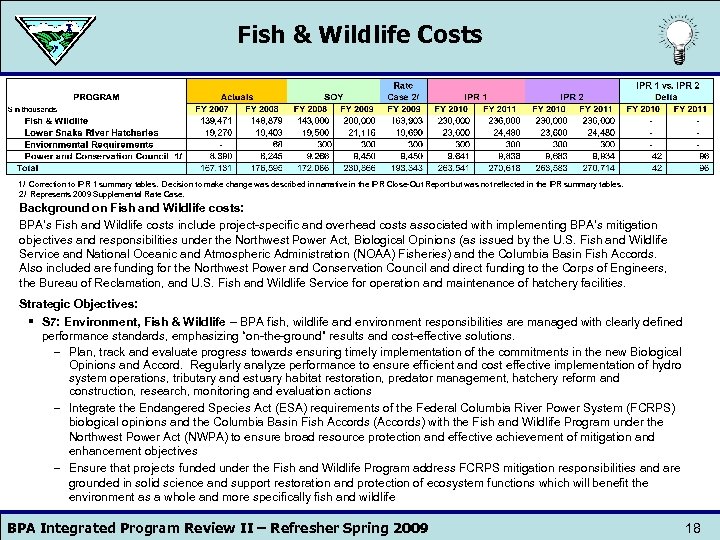
Fish & Wildlife Costs 1/ Correction to IPR 1 summary tables. Decision to make change was described in narrative in the IPR Close-Out Report but was not reflected in the IPR summary tables. 2/ Represents 2009 Supplemental Rate Case. Background on Fish and Wildlife costs: BPA’s Fish and Wildlife costs include project-specific and overhead costs associated with implementing BPA’s mitigation objectives and responsibilities under the Northwest Power Act, Biological Opinions (as issued by the U. S. Fish and Wildlife Service and National Oceanic and Atmospheric Administration (NOAA) Fisheries) and the Columbia Basin Fish Accords. Also included are funding for the Northwest Power and Conservation Council and direct funding to the Corps of Engineers, the Bureau of Reclamation, and U. S. Fish and Wildlife Service for operation and maintenance of hatchery facilities. Strategic Objectives: § S 7: Environment, Fish & Wildlife – BPA fish, wildlife and environment responsibilities are managed with clearly defined performance standards, emphasizing “on-the-ground” results and cost-effective solutions. – Plan, track and evaluate progress towards ensuring timely implementation of the commitments in the new Biological Opinions and Accord. Regularly analyze performance to ensure efficient and cost effective implementation of hydro system operations, tributary and estuary habitat restoration, predator management, hatchery reform and construction, research, monitoring and evaluation actions – Integrate the Endangered Species Act (ESA) requirements of the Federal Columbia River Power System (FCRPS) biological opinions and the Columbia Basin Fish Accords (Accords) with the Fish and Wildlife Program under the Northwest Power Act (NWPA) to ensure broad resource protection and effective achievement of mitigation and enhancement objectives – Ensure that projects funded under the Fish and Wildlife Program address FCRPS mitigation responsibilities and are grounded in solid science and support restoration and protection of ecosystem functions which will benefit the environment as a whole and more specifically fish and wildlife BPA Integrated Program Review II – Refresher Spring 2009 18
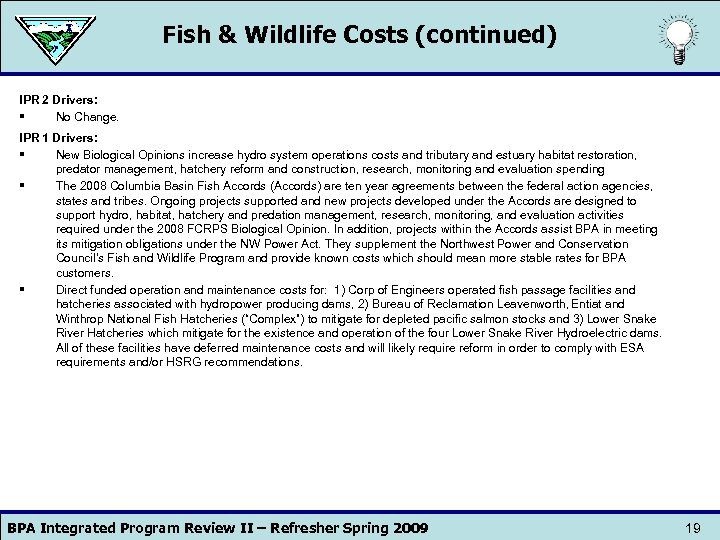
Fish & Wildlife Costs (continued) IPR 2 Drivers: § No Change. IPR 1 Drivers: § New Biological Opinions increase hydro system operations costs and tributary and estuary habitat restoration, predator management, hatchery reform and construction, research, monitoring and evaluation spending § The 2008 Columbia Basin Fish Accords (Accords) are ten year agreements between the federal action agencies, states and tribes. Ongoing projects supported and new projects developed under the Accords are designed to support hydro, habitat, hatchery and predation management, research, monitoring, and evaluation activities required under the 2008 FCRPS Biological Opinion. In addition, projects within the Accords assist BPA in meeting its mitigation obligations under the NW Power Act. They supplement the Northwest Power and Conservation Council's Fish and Wildlife Program and provide known costs which should mean more stable rates for BPA customers. § Direct funded operation and maintenance costs for: 1) Corp of Engineers operated fish passage facilities and hatcheries associated with hydropower producing dams, 2) Bureau of Reclamation Leavenworth, Entiat and Winthrop National Fish Hatcheries (“Complex”) to mitigate for depleted pacific salmon stocks and 3) Lower Snake River Hatcheries which mitigate for the existence and operation of the four Lower Snake River Hydroelectric dams. All of these facilities have deferred maintenance costs and will likely require reform in order to comply with ESA requirements and/or HSRG recommendations. BPA Integrated Program Review II – Refresher Spring 2009 19
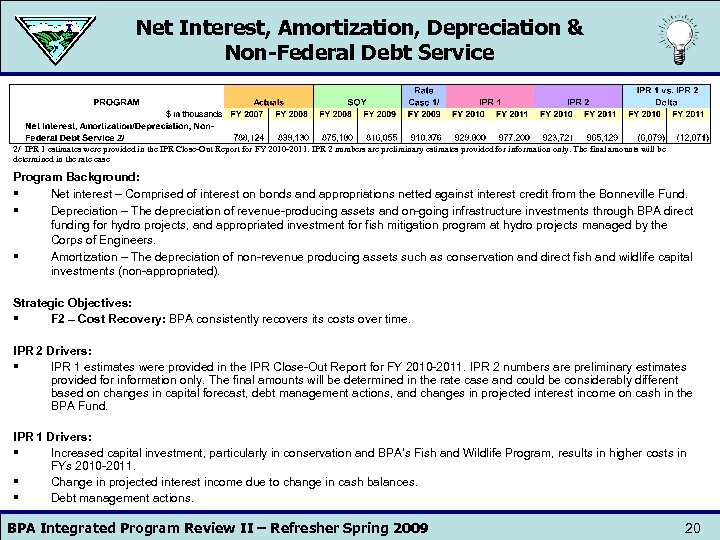
Net Interest, Amortization, Depreciation & Non-Federal Debt Service 2/ IPR 1 estimates were provided in the IPR Close-Out Report for FY 2010 -2011. IPR 2 numbers are preliminary estimates provided for information only. The final amounts will be determined in the rate case Program Background: § Net interest – Comprised of interest on bonds and appropriations netted against interest credit from the Bonneville Fund. § Depreciation – The depreciation of revenue-producing assets and on-going infrastructure investments through BPA direct funding for hydro projects, and appropriated investment for fish mitigation program at hydro projects managed by the Corps of Engineers. § Amortization – The depreciation of non-revenue producing assets such as conservation and direct fish and wildlife capital investments (non-appropriated). Strategic Objectives: § F 2 – Cost Recovery: BPA consistently recovers its costs over time. IPR 2 Drivers: § IPR 1 estimates were provided in the IPR Close-Out Report for FY 2010 -2011. IPR 2 numbers are preliminary estimates provided for information only. The final amounts will be determined in the rate case and could be considerably different based on changes in capital forecast, debt management actions, and changes in projected interest income on cash in the BPA Fund. IPR 1 Drivers: § Increased capital investment, particularly in conservation and BPA’s Fish and Wildlife Program, results in higher costs in FYs 2010 -2011. § Change in projected interest income due to change in cash balances. § Debt management actions. BPA Integrated Program Review II – Refresher Spring 2009 20
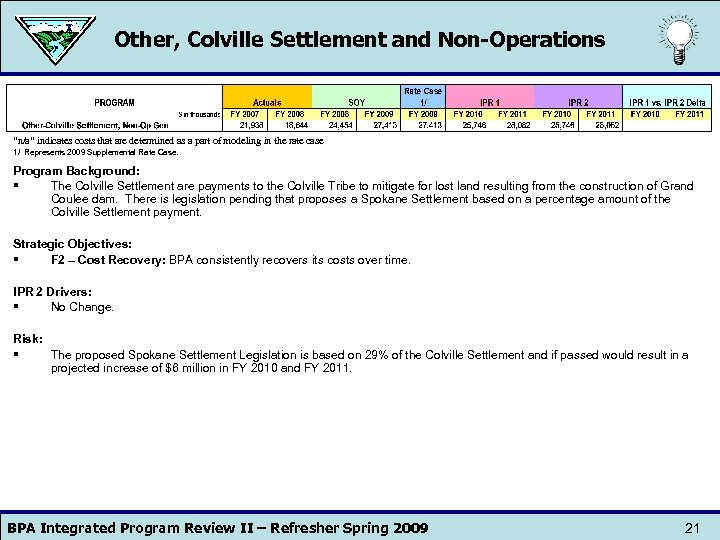
Other, Colville Settlement and Non-Operations “n/a” indicates costs that are determined as a part of modeling in the rate case 1/ Represents 2009 Supplemental Rate Case. Program Background: § The Colville Settlement are payments to the Colville Tribe to mitigate for lost land resulting from the construction of Grand Coulee dam. There is legislation pending that proposes a Spokane Settlement based on a percentage amount of the Colville Settlement payment. Strategic Objectives: § F 2 – Cost Recovery: BPA consistently recovers its costs over time. IPR 2 Drivers: § No Change. Risk: § The proposed Spokane Settlement Legislation is based on 29% of the Colville Settlement and if passed would result in a projected increase of $6 million in FY 2010 and FY 2011. BPA Integrated Program Review II – Refresher Spring 2009 21
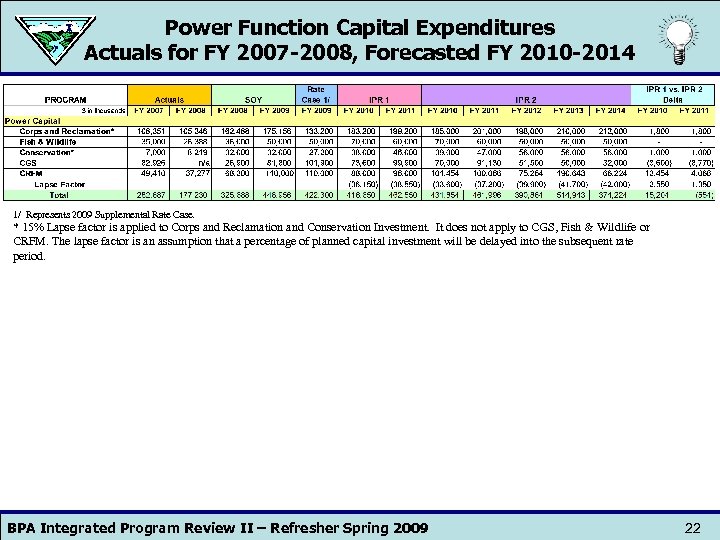
Power Function Capital Expenditures Actuals for FY 2007 -2008, Forecasted FY 2010 -2014 1/ Represents 2009 Supplemental Rate Case. * 15% Lapse factor is applied to Corps and Reclamation and Conservation Investment. It does not apply to CGS, Fish & Wildlife or CRFM. The lapse factor is an assumption that a percentage of planned capital investment will be delayed into the subsequent rate period. BPA Integrated Program Review II – Refresher Spring 2009 22
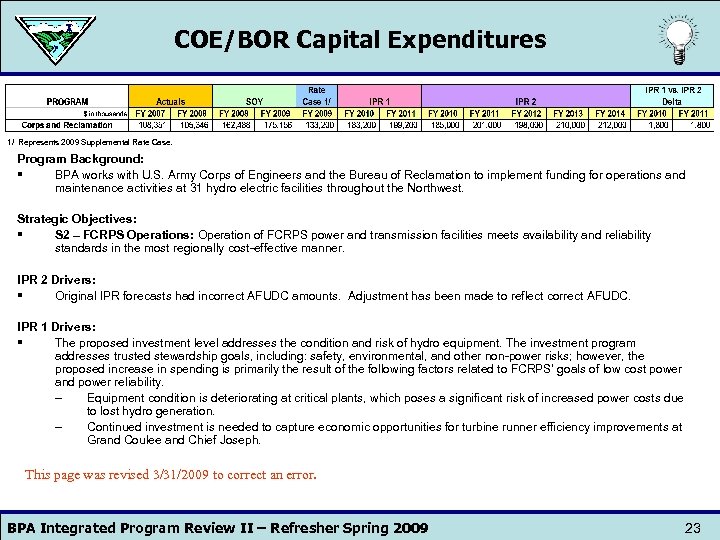
COE/BOR Capital Expenditures 1/ Represents 2009 Supplemental Rate Case. Program Background: § BPA works with U. S. Army Corps of Engineers and the Bureau of Reclamation to implement funding for operations and maintenance activities at 31 hydro electric facilities throughout the Northwest. Strategic Objectives: § S 2 – FCRPS Operations: Operation of FCRPS power and transmission facilities meets availability and reliability standards in the most regionally cost-effective manner. IPR 2 Drivers: § Original IPR forecasts had incorrect AFUDC amounts. Adjustment has been made to reflect correct AFUDC. IPR 1 Drivers: § The proposed investment level addresses the condition and risk of hydro equipment. The investment program addresses trusted stewardship goals, including: safety, environmental, and other non-power risks; however, the proposed increase in spending is primarily the result of the following factors related to FCRPS’ goals of low cost power and power reliability. – Equipment condition is deteriorating at critical plants, which poses a significant risk of increased power costs due to lost hydro generation. – Continued investment is needed to capture economic opportunities for turbine runner efficiency improvements at Grand Coulee and Chief Joseph. This page was revised 3/31/2009 to correct an error. BPA Integrated Program Review II – Refresher Spring 2009 23
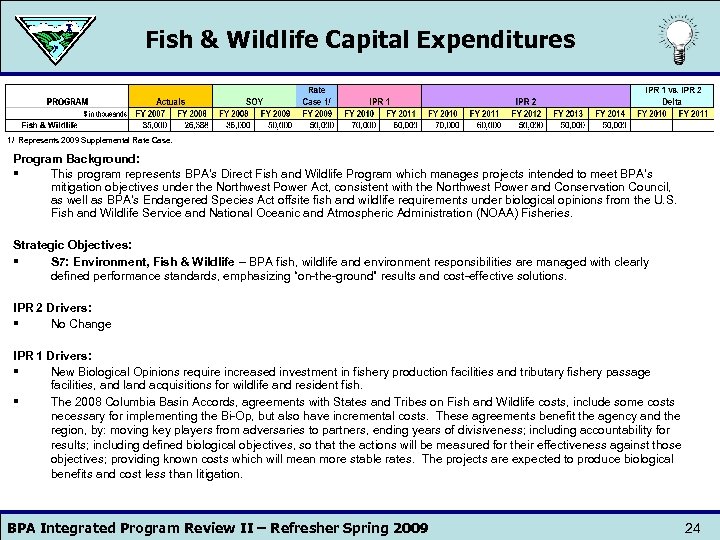
Fish & Wildlife Capital Expenditures 1/ Represents 2009 Supplemental Rate Case. Program Background: § This program represents BPA’s Direct Fish and Wildlife Program which manages projects intended to meet BPA’s mitigation objectives under the Northwest Power Act, consistent with the Northwest Power and Conservation Council, as well as BPA’s Endangered Species Act offsite fish and wildlife requirements under biological opinions from the U. S. Fish and Wildlife Service and National Oceanic and Atmospheric Administration (NOAA) Fisheries. Strategic Objectives: § S 7: Environment, Fish & Wildlife – BPA fish, wildlife and environment responsibilities are managed with clearly defined performance standards, emphasizing “on-the-ground” results and cost-effective solutions. IPR 2 Drivers: § No Change IPR 1 Drivers: § New Biological Opinions require increased investment in fishery production facilities and tributary fishery passage facilities, and land acquisitions for wildlife and resident fish. § The 2008 Columbia Basin Accords, agreements with States and Tribes on Fish and Wildlife costs, include some costs necessary for implementing the Bi-Op, but also have incremental costs. These agreements benefit the agency and the region, by: moving key players from adversaries to partners, ending years of divisiveness; including accountability for results; including defined biological objectives, so that the actions will be measured for their effectiveness against those objectives; providing known costs which will mean more stable rates. The projects are expected to produce biological benefits and cost less than litigation. BPA Integrated Program Review II – Refresher Spring 2009 24
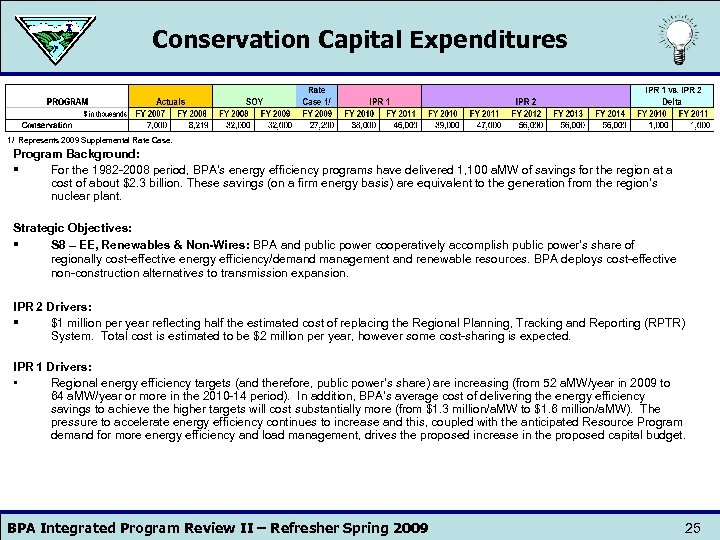
Conservation Capital Expenditures 1/ Represents 2009 Supplemental Rate Case. Program Background: § For the 1982 -2008 period, BPA’s energy efficiency programs have delivered 1, 100 a. MW of savings for the region at a cost of about $2. 3 billion. These savings (on a firm energy basis) are equivalent to the generation from the region’s nuclear plant. Strategic Objectives: § S 8 – EE, Renewables & Non-Wires: BPA and public power cooperatively accomplish public power’s share of regionally cost-effective energy efficiency/demand management and renewable resources. BPA deploys cost-effective non-construction alternatives to transmission expansion. IPR 2 Drivers: § $1 million per year reflecting half the estimated cost of replacing the Regional Planning, Tracking and Reporting (RPTR) System. Total cost is estimated to be $2 million per year, however some cost-sharing is expected. IPR 1 Drivers: • Regional energy efficiency targets (and therefore, public power’s share) are increasing (from 52 a. MW/year in 2009 to 64 a. MW/year or more in the 2010 -14 period). In addition, BPA’s average cost of delivering the energy efficiency savings to achieve the higher targets will cost substantially more (from $1. 3 million/a. MW to $1. 6 million/a. MW). The pressure to accelerate energy efficiency continues to increase and this, coupled with the anticipated Resource Program demand for more energy efficiency and load management, drives the proposed increase in the proposed capital budget. BPA Integrated Program Review II – Refresher Spring 2009 25
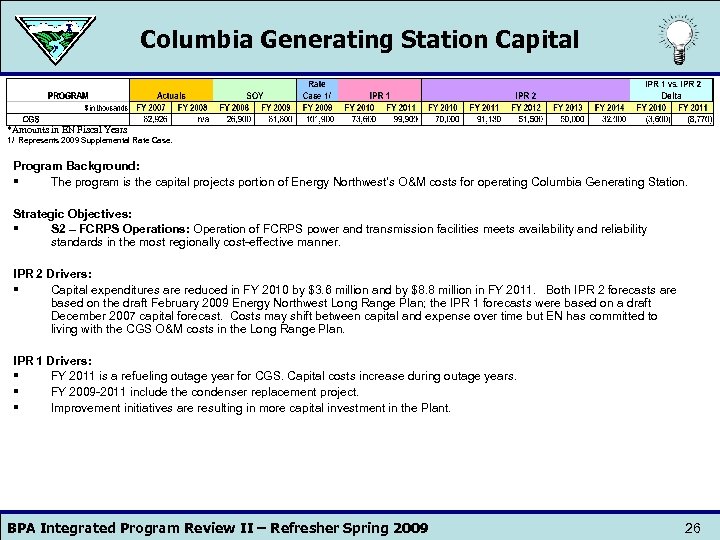
Columbia Generating Station Capital *Amounts in EN Fiscal Years 1/ Represents 2009 Supplemental Rate Case. Program Background: § The program is the capital projects portion of Energy Northwest’s O&M costs for operating Columbia Generating Station. Strategic Objectives: § S 2 – FCRPS Operations: Operation of FCRPS power and transmission facilities meets availability and reliability standards in the most regionally cost-effective manner. IPR 2 Drivers: § Capital expenditures are reduced in FY 2010 by $3. 6 million and by $8. 8 million in FY 2011. Both IPR 2 forecasts are based on the draft February 2009 Energy Northwest Long Range Plan; the IPR 1 forecasts were based on a draft December 2007 capital forecast. Costs may shift between capital and expense over time but EN has committed to living with the CGS O&M costs in the Long Range Plan. IPR 1 Drivers: § FY 2011 is a refueling outage year for CGS. Capital costs increase during outage years. § FY 2009 -2011 include the condenser replacement project. § Improvement initiatives are resulting in more capital investment in the Plant. BPA Integrated Program Review II – Refresher Spring 2009 26
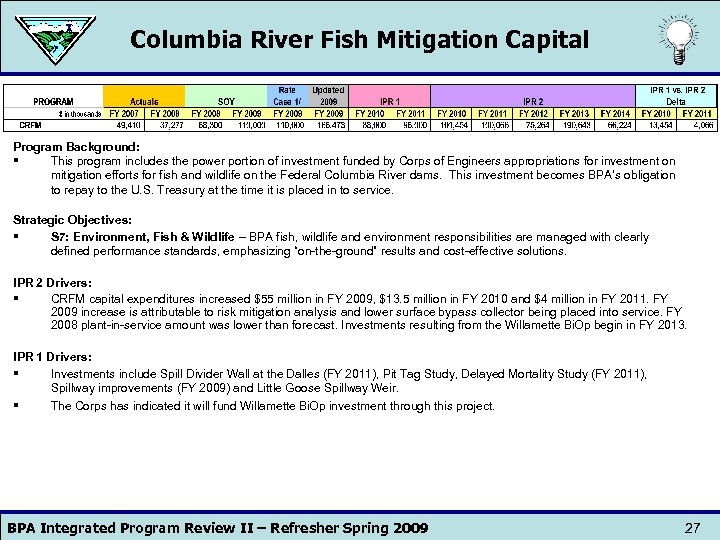
Columbia River Fish Mitigation Capital Program Background: § This program includes the power portion of investment funded by Corps of Engineers appropriations for investment on mitigation efforts for fish and wildlife on the Federal Columbia River dams. This investment becomes BPA’s obligation to repay to the U. S. Treasury at the time it is placed in to service. Strategic Objectives: § S 7: Environment, Fish & Wildlife – BPA fish, wildlife and environment responsibilities are managed with clearly defined performance standards, emphasizing “on-the-ground” results and cost-effective solutions. IPR 2 Drivers: § CRFM capital expenditures increased $55 million in FY 2009, $13. 5 million in FY 2010 and $4 million in FY 2011. FY 2009 increase is attributable to risk mitigation analysis and lower surface bypass collector being placed into service. FY 2008 plant-in-service amount was lower than forecast. Investments resulting from the Willamette Bi. Op begin in FY 2013. IPR 1 Drivers: § Investments include Spill Divider Wall at the Dalles (FY 2011), Pit Tag Study, Delayed Mortality Study (FY 2011), Spillway improvements (FY 2009) and Little Goose Spillway Weir. § The Corps has indicated it will fund Willamette Bi. Op investment through this project. BPA Integrated Program Review II – Refresher Spring 2009 27
Transmission BPA Integrated Program Review II – Refresher Spring 2009 28
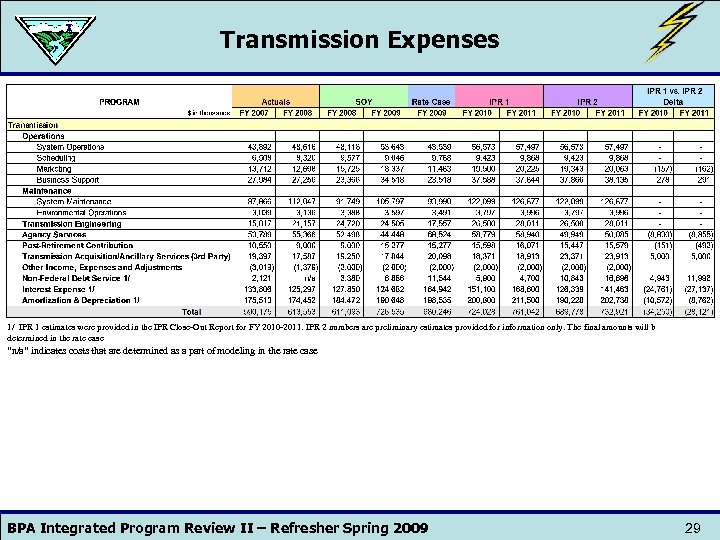
Transmission Expenses 1/ IPR 1 estimates were provided in the IPR Close-Out Report for FY 2010 -2011. IPR 2 numbers are preliminary estimates provided for information only. The final amounts will b determined in the rate case “n/a” indicates costs that are determined as a part of modeling in the rate case BPA Integrated Program Review II – Refresher Spring 2009 29
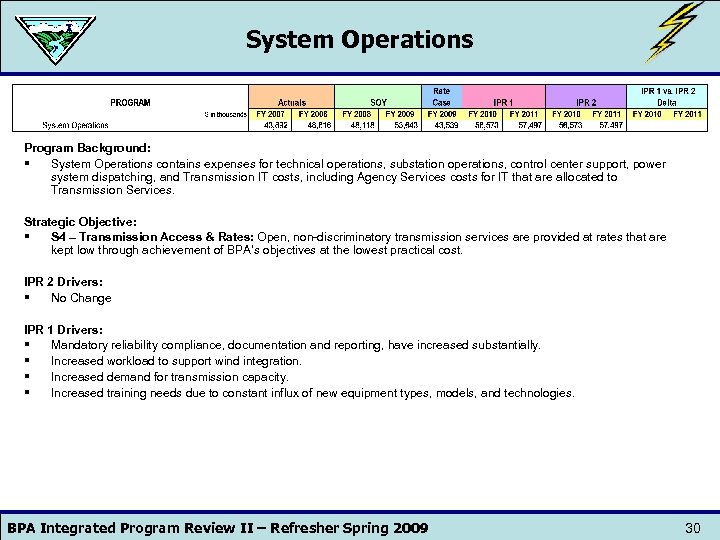
System Operations Program Background: § System Operations contains expenses for technical operations, substation operations, control center support, power system dispatching, and Transmission IT costs, including Agency Services costs for IT that are allocated to Transmission Services. Strategic Objective: § S 4 – Transmission Access & Rates: Open, non-discriminatory transmission services are provided at rates that are kept low through achievement of BPA’s objectives at the lowest practical cost. IPR 2 Drivers: § No Change IPR 1 Drivers: § Mandatory reliability compliance, documentation and reporting, have increased substantially. § Increased workload to support wind integration. § Increased demand for transmission capacity. § Increased training needs due to constant influx of new equipment types, models, and technologies. BPA Integrated Program Review II – Refresher Spring 2009 30
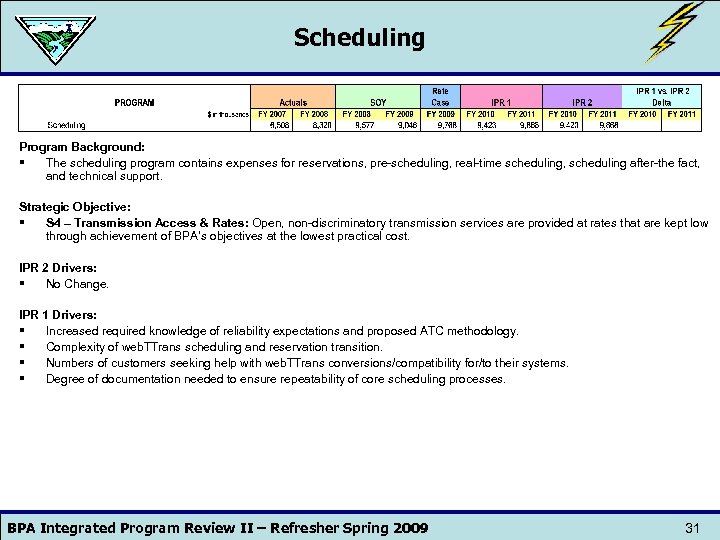
Scheduling Program Background: § The scheduling program contains expenses for reservations, pre-scheduling, real-time scheduling, scheduling after-the fact, and technical support. Strategic Objective: § S 4 – Transmission Access & Rates: Open, non-discriminatory transmission services are provided at rates that are kept low through achievement of BPA’s objectives at the lowest practical cost. IPR 2 Drivers: § No Change. IPR 1 Drivers: § Increased required knowledge of reliability expectations and proposed ATC methodology. § Complexity of web. TTrans scheduling and reservation transition. § Numbers of customers seeking help with web. TTrans conversions/compatibility for/to their systems. § Degree of documentation needed to ensure repeatability of core scheduling processes. BPA Integrated Program Review II – Refresher Spring 2009 31
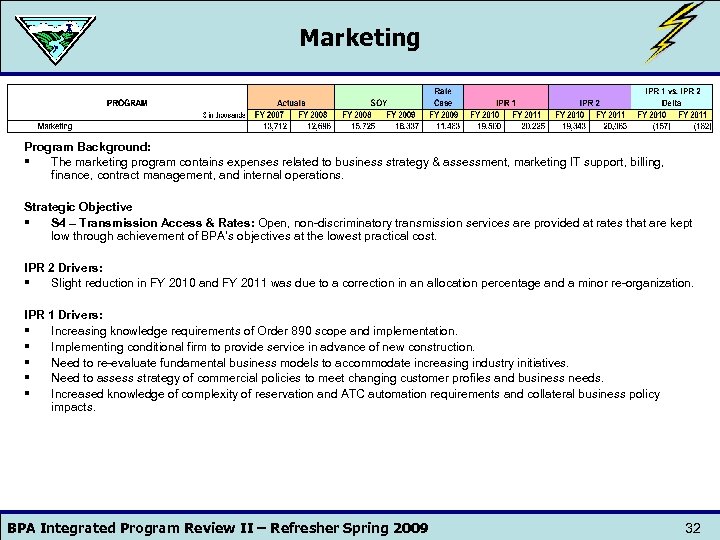
Marketing Program Background: § The marketing program contains expenses related to business strategy & assessment, marketing IT support, billing, finance, contract management, and internal operations. Strategic Objective § S 4 – Transmission Access & Rates: Open, non-discriminatory transmission services are provided at rates that are kept low through achievement of BPA’s objectives at the lowest practical cost. IPR 2 Drivers: § Slight reduction in FY 2010 and FY 2011 was due to a correction in an allocation percentage and a minor re-organization. IPR 1 Drivers: § Increasing knowledge requirements of Order 890 scope and implementation. § Implementing conditional firm to provide service in advance of new construction. § Need to re-evaluate fundamental business models to accommodate increasing industry initiatives. § Need to assess strategy of commercial policies to meet changing customer profiles and business needs. § Increased knowledge of complexity of reservation and ATC automation requirements and collateral business policy impacts. BPA Integrated Program Review II – Refresher Spring 2009 32
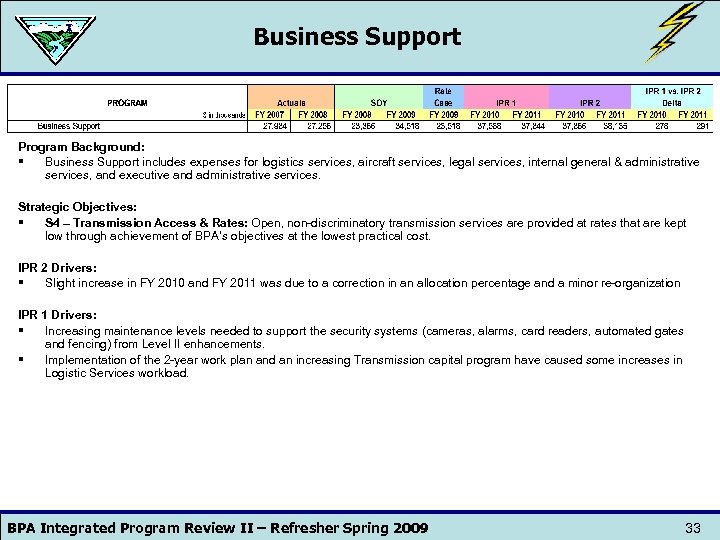
Business Support Program Background: § Business Support includes expenses for logistics services, aircraft services, legal services, internal general & administrative services, and executive and administrative services. Strategic Objectives: § S 4 – Transmission Access & Rates: Open, non-discriminatory transmission services are provided at rates that are kept low through achievement of BPA’s objectives at the lowest practical cost. IPR 2 Drivers: § Slight increase in FY 2010 and FY 2011 was due to a correction in an allocation percentage and a minor re-organization IPR 1 Drivers: § Increasing maintenance levels needed to support the security systems (cameras, alarms, card readers, automated gates and fencing) from Level II enhancements. § Implementation of the 2 -year work plan and an increasing Transmission capital program have caused some increases in Logistic Services workload. BPA Integrated Program Review II – Refresher Spring 2009 33
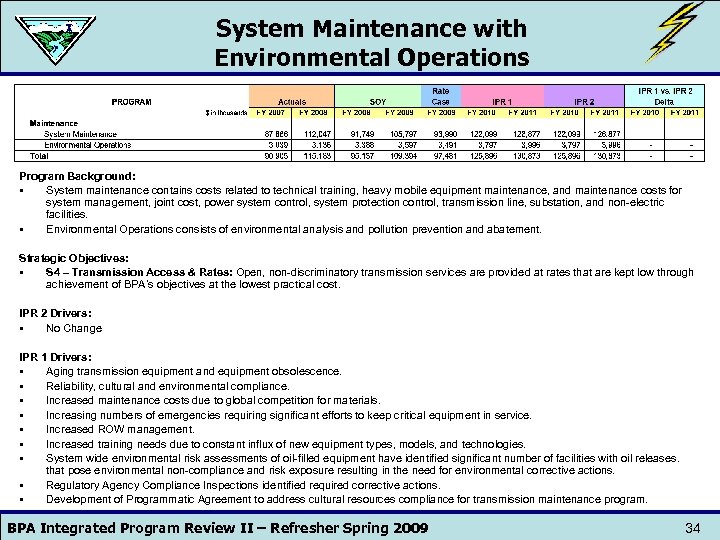
System Maintenance with Environmental Operations Program Background: § System maintenance contains costs related to technical training, heavy mobile equipment maintenance, and maintenance costs for system management, joint cost, power system control, system protection control, transmission line, substation, and non-electric facilities. § Environmental Operations consists of environmental analysis and pollution prevention and abatement. Strategic Objectives: § S 4 – Transmission Access & Rates: Open, non-discriminatory transmission services are provided at rates that are kept low through achievement of BPA’s objectives at the lowest practical cost. IPR 2 Drivers: § No Change IPR 1 Drivers: § Aging transmission equipment and equipment obsolescence. § Reliability, cultural and environmental compliance. § Increased maintenance costs due to global competition for materials. § Increasing numbers of emergencies requiring significant efforts to keep critical equipment in service. § Increased ROW management. § Increased training needs due to constant influx of new equipment types, models, and technologies. § System wide environmental risk assessments of oil-filled equipment have identified significant number of facilities with oil releases. that pose environmental non-compliance and risk exposure resulting in the need for environmental corrective actions. § Regulatory Agency Compliance Inspections identified required corrective actions. § Development of Programmatic Agreement to address cultural resources compliance for transmission maintenance program. BPA Integrated Program Review II – Refresher Spring 2009 34
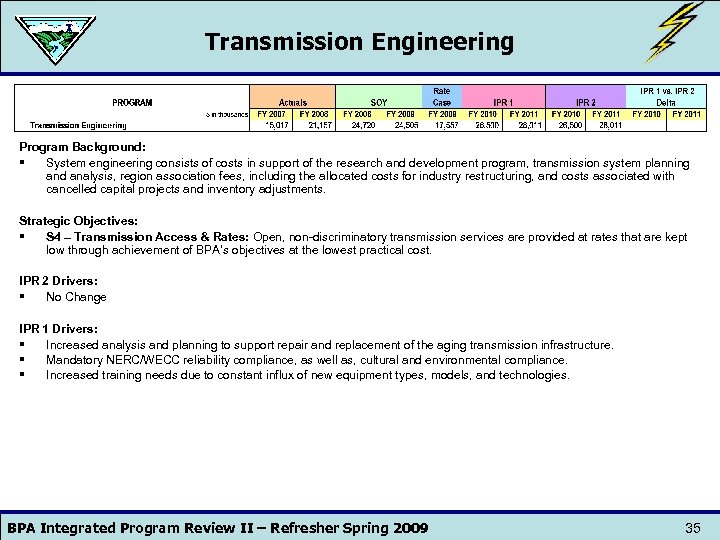
Transmission Engineering Program Background: § System engineering consists of costs in support of the research and development program, transmission system planning and analysis, region association fees, including the allocated costs for industry restructuring, and costs associated with cancelled capital projects and inventory adjustments. Strategic Objectives: § S 4 – Transmission Access & Rates: Open, non-discriminatory transmission services are provided at rates that are kept low through achievement of BPA’s objectives at the lowest practical cost. IPR 2 Drivers: § No Change IPR 1 Drivers: § Increased analysis and planning to support repair and replacement of the aging transmission infrastructure. § Mandatory NERC/WECC reliability compliance, as well as, cultural and environmental compliance. § Increased training needs due to constant influx of new equipment types, models, and technologies. BPA Integrated Program Review II – Refresher Spring 2009 35
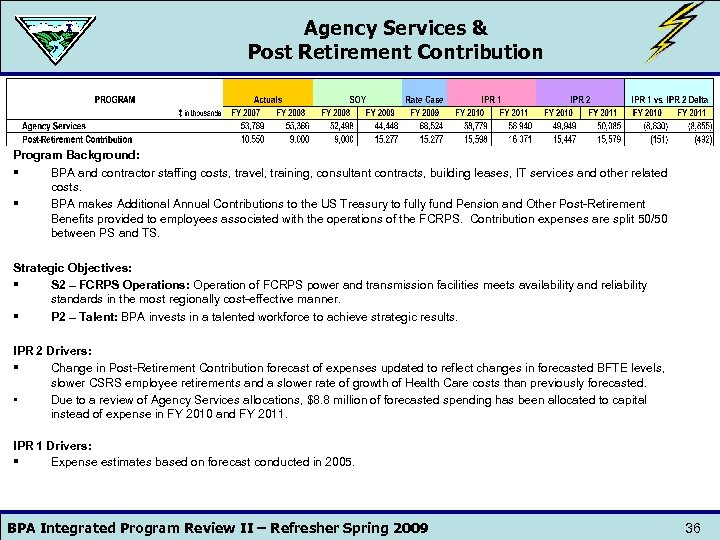
Agency Services & Post Retirement Contribution Program Background: § BPA and contractor staffing costs, travel, training, consultant contracts, building leases, IT services and other related costs. § BPA makes Additional Annual Contributions to the US Treasury to fully fund Pension and Other Post-Retirement Benefits provided to employees associated with the operations of the FCRPS. Contribution expenses are split 50/50 between PS and TS. Strategic Objectives: § S 2 – FCRPS Operations: Operation of FCRPS power and transmission facilities meets availability and reliability standards in the most regionally cost-effective manner. § P 2 – Talent: BPA invests in a talented workforce to achieve strategic results. IPR 2 Drivers: § Change in Post-Retirement Contribution forecast of expenses updated to reflect changes in forecasted BFTE levels, slower CSRS employee retirements and a slower rate of growth of Health Care costs than previously forecasted. • Due to a review of Agency Services allocations, $8. 8 million of forecasted spending has been allocated to capital instead of expense in FY 2010 and FY 2011. IPR 1 Drivers: § Expense estimates based on forecast conducted in 2005. BPA Integrated Program Review II – Refresher Spring 2009 36
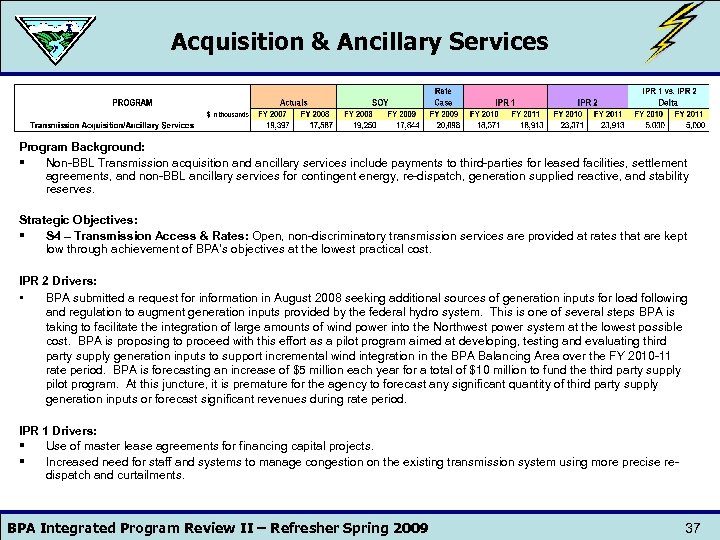
Acquisition & Ancillary Services Program Background: § Non-BBL Transmission acquisition and ancillary services include payments to third-parties for leased facilities, settlement agreements, and non-BBL ancillary services for contingent energy, re-dispatch, generation supplied reactive, and stability reserves. Strategic Objectives: § S 4 – Transmission Access & Rates: Open, non-discriminatory transmission services are provided at rates that are kept low through achievement of BPA’s objectives at the lowest practical cost. IPR 2 Drivers: • BPA submitted a request for information in August 2008 seeking additional sources of generation inputs for load following and regulation to augment generation inputs provided by the federal hydro system. This is one of several steps BPA is taking to facilitate the integration of large amounts of wind power into the Northwest power system at the lowest possible cost. BPA is proposing to proceed with this effort as a pilot program aimed at developing, testing and evaluating third party supply generation inputs to support incremental wind integration in the BPA Balancing Area over the FY 2010 -11 rate period. BPA is forecasting an increase of $5 million each year for a total of $10 million to fund the third party supply pilot program. At this juncture, it is premature for the agency to forecast any significant quantity of third party supply generation inputs or forecast significant revenues during rate period. IPR 1 Drivers: § Use of master lease agreements for financing capital projects. § Increased need for staff and systems to manage congestion on the existing transmission system using more precise redispatch and curtailments. BPA Integrated Program Review II – Refresher Spring 2009 37
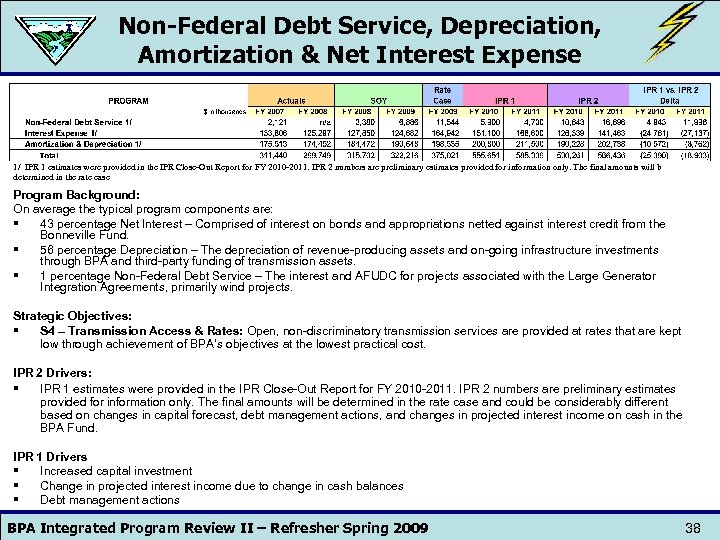
Non-Federal Debt Service, Depreciation, Amortization & Net Interest Expense 1/ IPR 1 estimates were provided in the IPR Close-Out Report for FY 2010 -2011. IPR 2 numbers are preliminary estimates provided for information only. The final amounts will b determined in the rate case Program Background: On average the typical program components are: § 43 percentage Net Interest – Comprised of interest on bonds and appropriations netted against interest credit from the Bonneville Fund. § 56 percentage Depreciation – The depreciation of revenue-producing assets and on-going infrastructure investments through BPA and third-party funding of transmission assets. § 1 percentage Non-Federal Debt Service – The interest and AFUDC for projects associated with the Large Generator Integration Agreements, primarily wind projects. Strategic Objectives: § S 4 – Transmission Access & Rates: Open, non-discriminatory transmission services are provided at rates that are kept low through achievement of BPA’s objectives at the lowest practical cost. IPR 2 Drivers: § IPR 1 estimates were provided in the IPR Close-Out Report for FY 2010 -2011. IPR 2 numbers are preliminary estimates provided for information only. The final amounts will be determined in the rate case and could be considerably different based on changes in capital forecast, debt management actions, and changes in projected interest income on cash in the BPA Fund. IPR 1 Drivers § Increased capital investment § Change in projected interest income due to change in cash balances § Debt management actions BPA Integrated Program Review II – Refresher Spring 2009 38
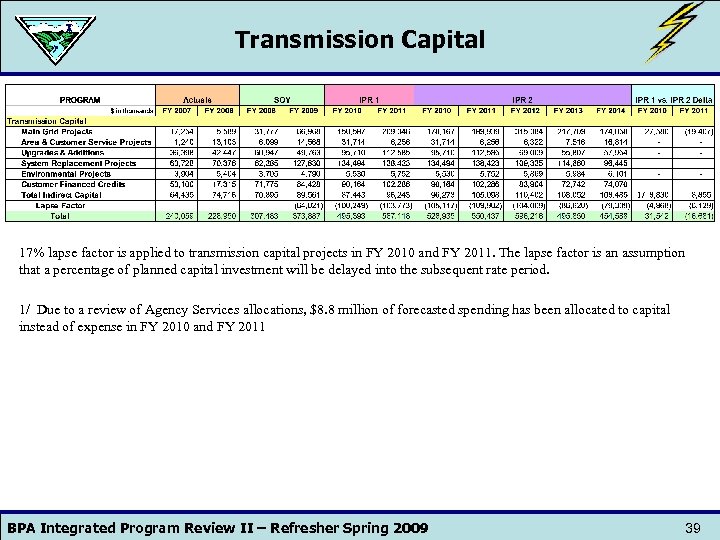
Transmission Capital 1/ 17% lapse factor is applied to transmission capital projects in FY 2010 and FY 2011. The lapse factor is an assumption that a percentage of planned capital investment will be delayed into the subsequent rate period. 1/ Due to a review of Agency Services allocations, $8. 8 million of forecasted spending has been allocated to capital instead of expense in FY 2010 and FY 2011 BPA Integrated Program Review II – Refresher Spring 2009 39
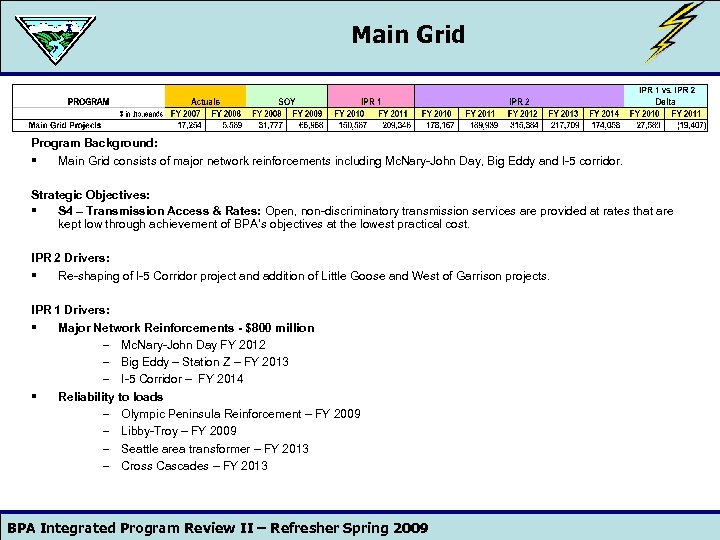
Main Grid Program Background: § Main Grid consists of major network reinforcements including Mc. Nary-John Day, Big Eddy and I-5 corridor. Strategic Objectives: § S 4 – Transmission Access & Rates: Open, non-discriminatory transmission services are provided at rates that are kept low through achievement of BPA’s objectives at the lowest practical cost. IPR 2 Drivers: § Re-shaping of I-5 Corridor project and addition of Little Goose and West of Garrison projects. IPR 1 Drivers: § Major Network Reinforcements - $800 million – Mc. Nary-John Day FY 2012 – Big Eddy – Station Z – FY 2013 – I-5 Corridor – FY 2014 § Reliability to loads – Olympic Peninsula Reinforcement – FY 2009 – Libby-Troy – FY 2009 – Seattle area transformer – FY 2013 – Cross Cascades – FY 2013 BPA Integrated Program Review II – Refresher Spring 2009
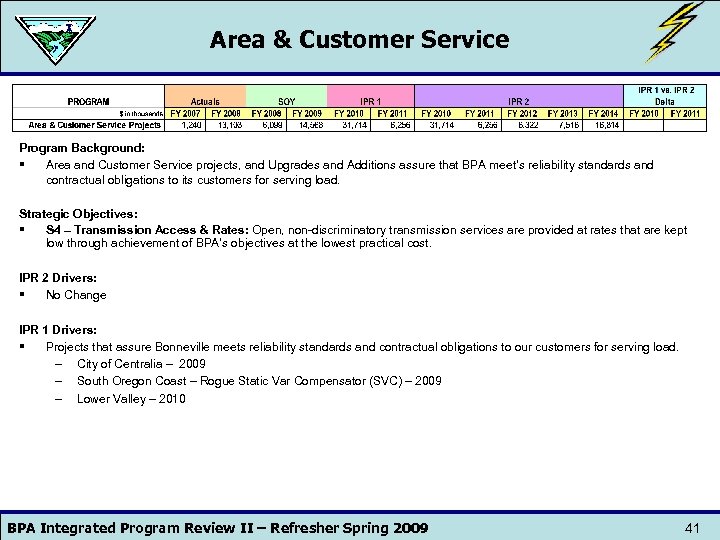
Area & Customer Service Program Background: § Area and Customer Service projects, and Upgrades and Additions assure that BPA meet’s reliability standards and contractual obligations to its customers for serving load. Strategic Objectives: § S 4 – Transmission Access & Rates: Open, non-discriminatory transmission services are provided at rates that are kept low through achievement of BPA’s objectives at the lowest practical cost. IPR 2 Drivers: § No Change IPR 1 Drivers: § Projects that assure Bonneville meets reliability standards and contractual obligations to our customers for serving load. – City of Centralia – 2009 – South Oregon Coast – Rogue Static Var Compensator (SVC) – 2009 – Lower Valley – 2010 BPA Integrated Program Review II – Refresher Spring 2009 41
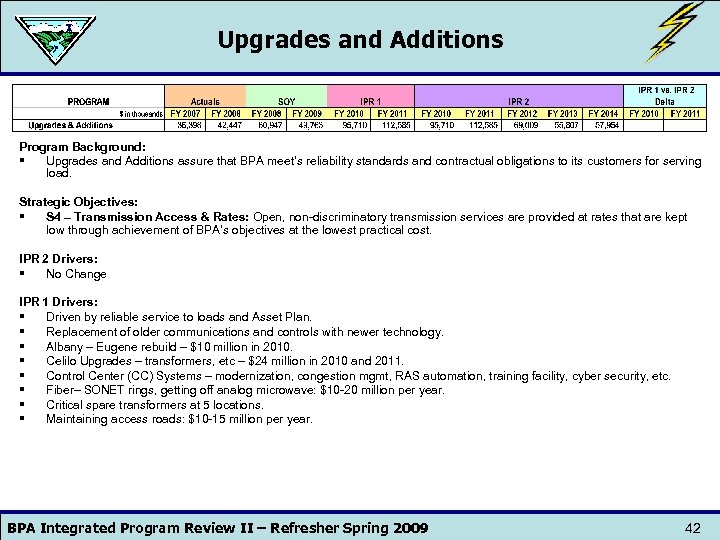
Upgrades and Additions Program Background: § Upgrades and Additions assure that BPA meet’s reliability standards and contractual obligations to its customers for serving load. Strategic Objectives: § S 4 – Transmission Access & Rates: Open, non-discriminatory transmission services are provided at rates that are kept low through achievement of BPA’s objectives at the lowest practical cost. IPR 2 Drivers: § No Change IPR 1 Drivers: § Driven by reliable service to loads and Asset Plan. § Replacement of older communications and controls with newer technology. § Albany – Eugene rebuild – $10 million in 2010. § Celilo Upgrades – transformers, etc – $24 million in 2010 and 2011. § Control Center (CC) Systems – modernization, congestion mgmt, RAS automation, training facility, cyber security, etc. § Fiber– SONET rings, getting off analog microwave: $10 -20 million per year. § Critical spare transformers at 5 locations. § Maintaining access roads: $10 -15 million per year. BPA Integrated Program Review II – Refresher Spring 2009 42
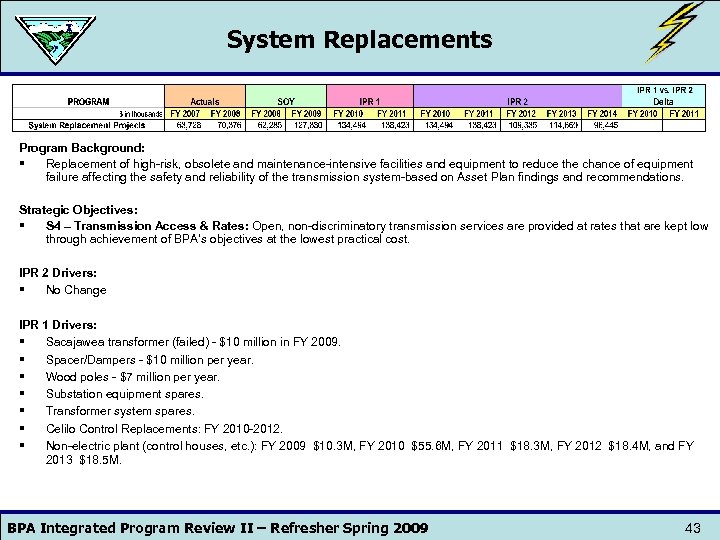
System Replacements Program Background: § Replacement of high-risk, obsolete and maintenance-intensive facilities and equipment to reduce the chance of equipment failure affecting the safety and reliability of the transmission system-based on Asset Plan findings and recommendations. Strategic Objectives: § S 4 – Transmission Access & Rates: Open, non-discriminatory transmission services are provided at rates that are kept low through achievement of BPA’s objectives at the lowest practical cost. IPR 2 Drivers: § No Change IPR 1 Drivers: § Sacajawea transformer (failed) - $10 million in FY 2009. § Spacer/Dampers - $10 million per year. § Wood poles - $7 million per year. § Substation equipment spares. § Transformer system spares. § Celilo Control Replacements: FY 2010 -2012. § Non-electric plant (control houses, etc. ): FY 2009 $10. 3 M, FY 2010 $55. 6 M, FY 2011 $18. 3 M, FY 2012 $18. 4 M, and FY 2013 $18. 5 M. BPA Integrated Program Review II – Refresher Spring 2009 43
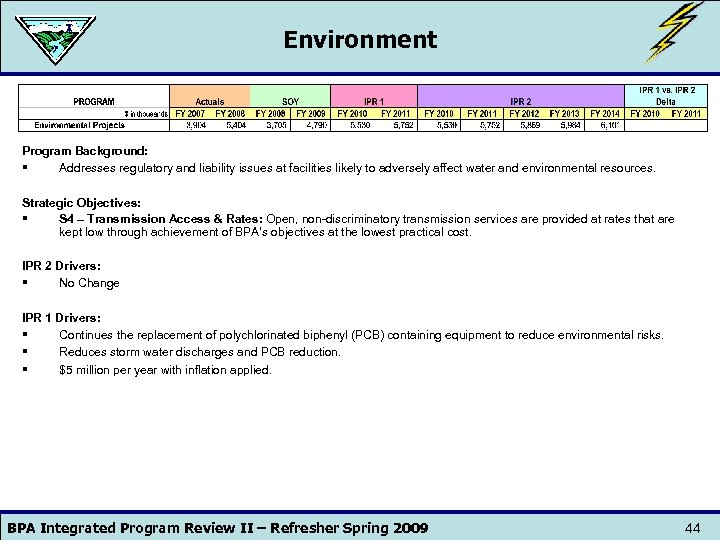
Environment Program Background: § Addresses regulatory and liability issues at facilities likely to adversely affect water and environmental resources. Strategic Objectives: § S 4 – Transmission Access & Rates: Open, non-discriminatory transmission services are provided at rates that are kept low through achievement of BPA’s objectives at the lowest practical cost. IPR 2 Drivers: § No Change IPR 1 Drivers: § Continues the replacement of polychlorinated biphenyl (PCB) containing equipment to reduce environmental risks. § Reduces storm water discharges and PCB reduction. § $5 million per year with inflation applied. BPA Integrated Program Review II – Refresher Spring 2009 44
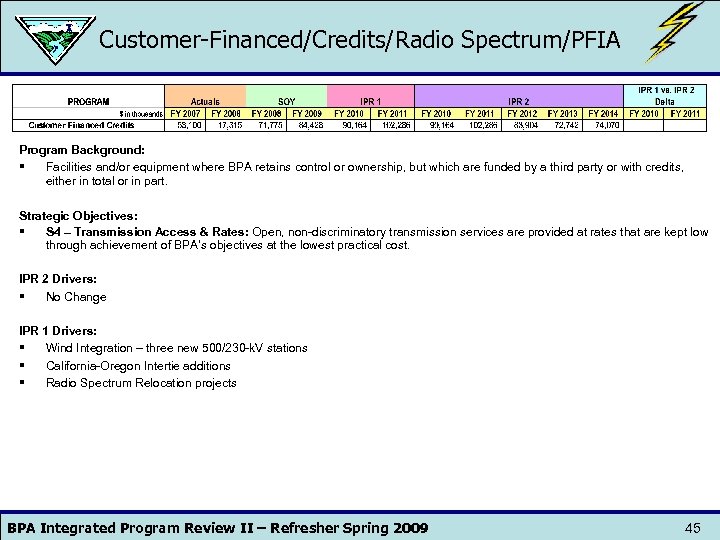
Customer-Financed/Credits/Radio Spectrum/PFIA Program Background: § Facilities and/or equipment where BPA retains control or ownership, but which are funded by a third party or with credits, either in total or in part. Strategic Objectives: § S 4 – Transmission Access & Rates: Open, non-discriminatory transmission services are provided at rates that are kept low through achievement of BPA’s objectives at the lowest practical cost. IPR 2 Drivers: § No Change IPR 1 Drivers: § Wind Integration – three new 500/230 -k. V stations § California-Oregon Intertie additions § Radio Spectrum Relocation projects BPA Integrated Program Review II – Refresher Spring 2009 45
Agency Services BPA Integrated Program Review II – Refresher Spring 2009 46
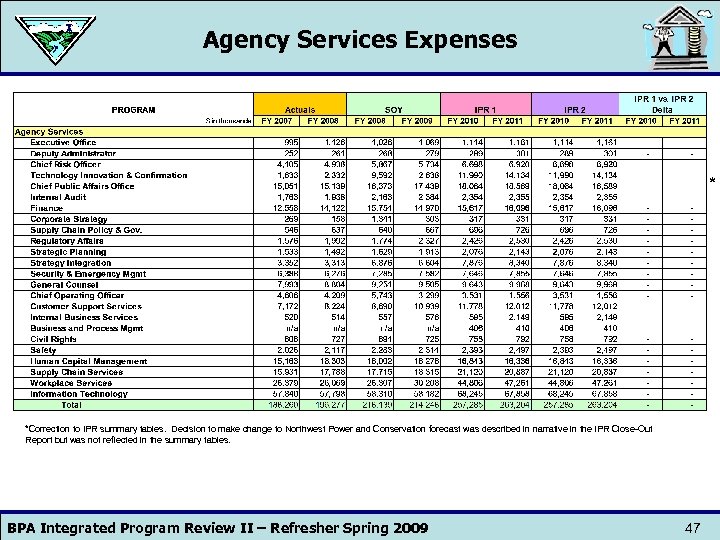
Agency Services Expenses * *Correction to IPR summary tables. Decision to make change to Northwest Power and Conservation forecast was described in narrative in the IPR Close-Out Report but was not reflected in the summary tables. BPA Integrated Program Review II – Refresher Spring 2009 47
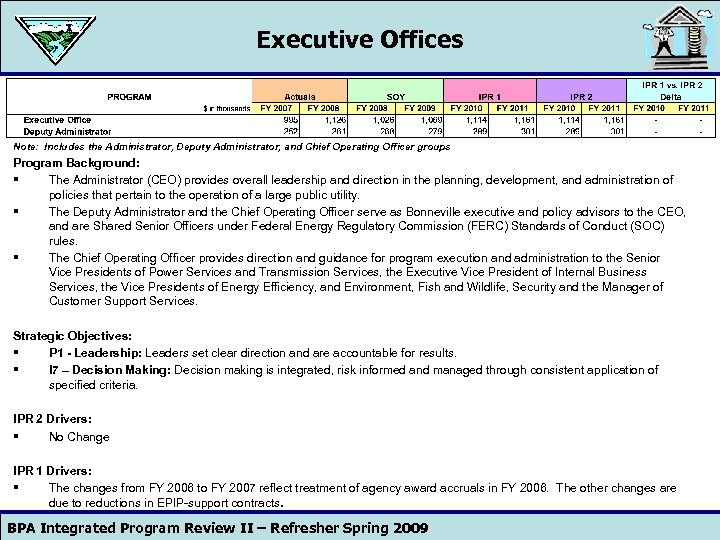
Executive Offices Note: Includes the Administrator, Deputy Administrator, and Chief Operating Officer groups Program Background: § The Administrator (CEO) provides overall leadership and direction in the planning, development, and administration of policies that pertain to the operation of a large public utility. § The Deputy Administrator and the Chief Operating Officer serve as Bonneville executive and policy advisors to the CEO, and are Shared Senior Officers under Federal Energy Regulatory Commission (FERC) Standards of Conduct (SOC) rules. § The Chief Operating Officer provides direction and guidance for program execution and administration to the Senior Vice Presidents of Power Services and Transmission Services, the Executive Vice President of Internal Business Services, the Vice Presidents of Energy Efficiency, and Environment, Fish and Wildlife, Security and the Manager of Customer Support Services. Strategic Objectives: § P 1 - Leadership: Leaders set clear direction and are accountable for results. § I 7 – Decision Making: Decision making is integrated, risk informed and managed through consistent application of specified criteria. IPR 2 Drivers: § No Change IPR 1 Drivers: § The changes from FY 2006 to FY 2007 reflect treatment of agency award accruals in FY 2006. The other changes are due to reductions in EPIP-support contracts. BPA Integrated Program Review II – Refresher Spring 2009
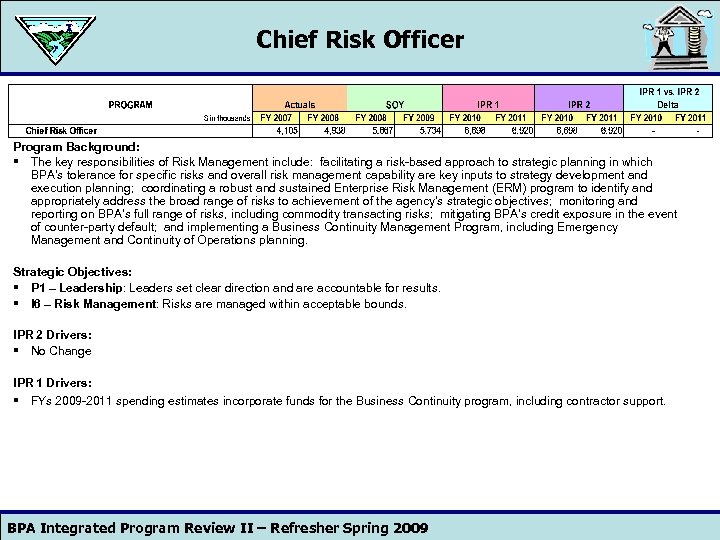
Chief Risk Officer Program Background: § The key responsibilities of Risk Management include: facilitating a risk-based approach to strategic planning in which BPA’s tolerance for specific risks and overall risk management capability are key inputs to strategy development and execution planning; coordinating a robust and sustained Enterprise Risk Management (ERM) program to identify and appropriately address the broad range of risks to achievement of the agency's strategic objectives; monitoring and reporting on BPA’s full range of risks, including commodity transacting risks; mitigating BPA’s credit exposure in the event of counter-party default; and implementing a Business Continuity Management Program, including Emergency Management and Continuity of Operations planning. Strategic Objectives: § P 1 – Leadership: Leaders set clear direction and are accountable for results. § I 6 – Risk Management: Risks are managed within acceptable bounds. IPR 2 Drivers: § No Change IPR 1 Drivers: § FYs 2009 -2011 spending estimates incorporate funds for the Business Continuity program, including contractor support. BPA Integrated Program Review II – Refresher Spring 2009
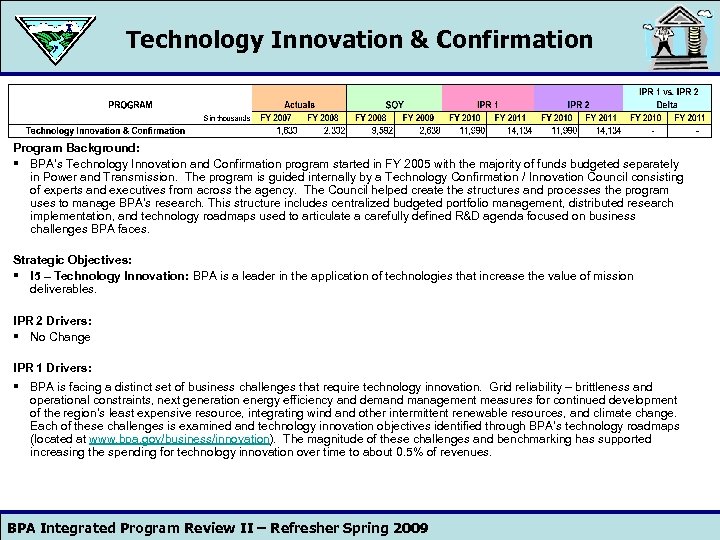
Technology Innovation & Confirmation Program Background: § BPA’s Technology Innovation and Confirmation program started in FY 2005 with the majority of funds budgeted separately in Power and Transmission. The program is guided internally by a Technology Confirmation / Innovation Council consisting of experts and executives from across the agency. The Council helped create the structures and processes the program uses to manage BPA’s research. This structure includes centralized budgeted portfolio management, distributed research implementation, and technology roadmaps used to articulate a carefully defined R&D agenda focused on business challenges BPA faces. Strategic Objectives: § I 5 – Technology Innovation: BPA is a leader in the application of technologies that increase the value of mission deliverables. IPR 2 Drivers: § No Change IPR 1 Drivers: § BPA is facing a distinct set of business challenges that require technology innovation. Grid reliability – brittleness and operational constraints, next generation energy efficiency and demand management measures for continued development of the region’s least expensive resource, integrating wind and other intermittent renewable resources, and climate change. Each of these challenges is examined and technology innovation objectives identified through BPA’s technology roadmaps (located at www. bpa. gov/business/innovation). The magnitude of these challenges and benchmarking has supported increasing the spending for technology innovation over time to about 0. 5% of revenues. BPA Integrated Program Review II – Refresher Spring 2009
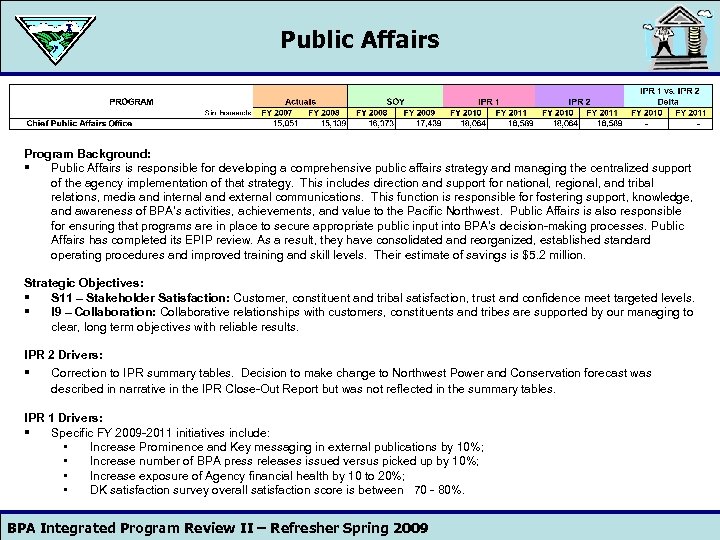
Public Affairs Program Background: § Public Affairs is responsible for developing a comprehensive public affairs strategy and managing the centralized support of the agency implementation of that strategy. This includes direction and support for national, regional, and tribal relations, media and internal and external communications. This function is responsible for fostering support, knowledge, and awareness of BPA’s activities, achievements, and value to the Pacific Northwest. Public Affairs is also responsible for ensuring that programs are in place to secure appropriate public input into BPA’s decision-making processes. Public Affairs has completed its EPIP review. As a result, they have consolidated and reorganized, established standard operating procedures and improved training and skill levels. Their estimate of savings is $5. 2 million. Strategic Objectives: § S 11 – Stakeholder Satisfaction: Customer, constituent and tribal satisfaction, trust and confidence meet targeted levels. § I 9 – Collaboration: Collaborative relationships with customers, constituents and tribes are supported by our managing to clear, long term objectives with reliable results. IPR 2 Drivers: § Correction to IPR summary tables. Decision to make change to Northwest Power and Conservation forecast was described in narrative in the IPR Close-Out Report but was not reflected in the summary tables. IPR 1 Drivers: § Specific FY 2009 -2011 initiatives include: • Increase Prominence and Key messaging in external publications by 10%; • Increase number of BPA press releases issued versus picked up by 10%; • Increase exposure of Agency financial health by 10 to 20%; • DK satisfaction survey overall satisfaction score is between 70 - 80%. BPA Integrated Program Review II – Refresher Spring 2009
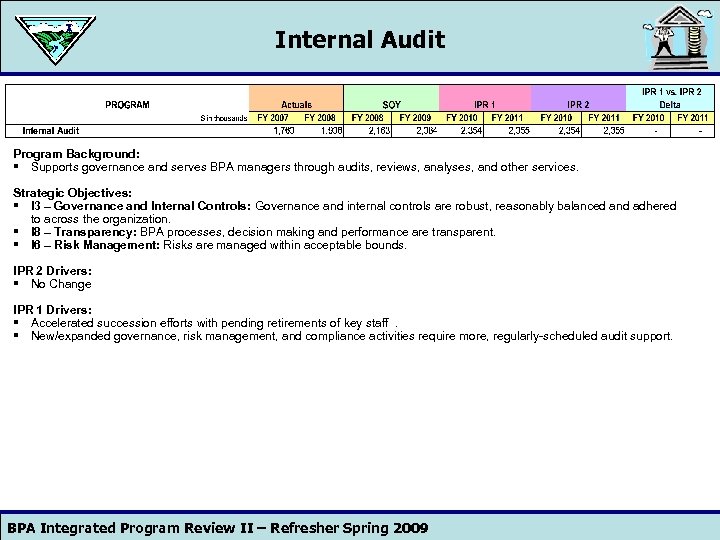
Internal Audit Program Background: § Supports governance and serves BPA managers through audits, reviews, analyses, and other services. Strategic Objectives: § I 3 – Governance and Internal Controls: Governance and internal controls are robust, reasonably balanced and adhered to across the organization. § I 8 – Transparency: BPA processes, decision making and performance are transparent. § I 6 – Risk Management: Risks are managed within acceptable bounds. IPR 2 Drivers: § No Change IPR 1 Drivers: § Accelerated succession efforts with pending retirements of key staff . § New/expanded governance, risk management, and compliance activities require more, regularly-scheduled audit support. BPA Integrated Program Review II – Refresher Spring 2009
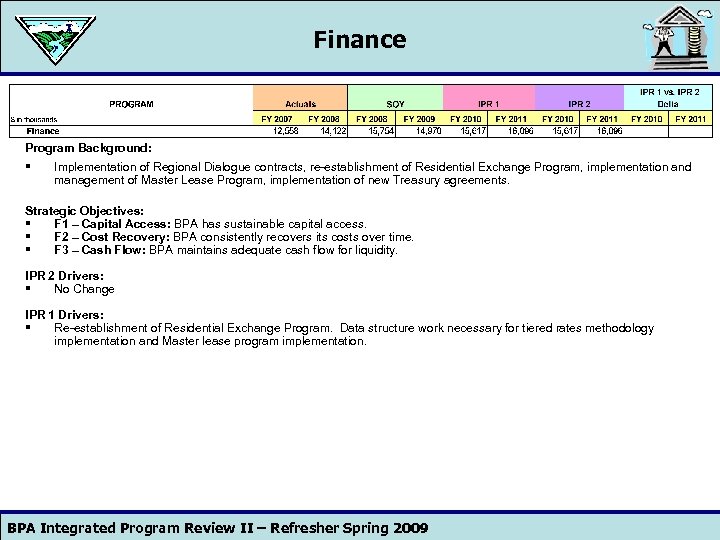
Finance Program Background: § Implementation of Regional Dialogue contracts, re-establishment of Residential Exchange Program, implementation and management of Master Lease Program, implementation of new Treasury agreements. Strategic Objectives: § F 1 – Capital Access: BPA has sustainable capital access. § F 2 – Cost Recovery: BPA consistently recovers its costs over time. § F 3 – Cash Flow: BPA maintains adequate cash flow for liquidity. IPR 2 Drivers: § No Change IPR 1 Drivers: § Re-establishment of Residential Exchange Program. Data structure work necessary for tiered rates methodology implementation and Master lease program implementation. BPA Integrated Program Review II – Refresher Spring 2009
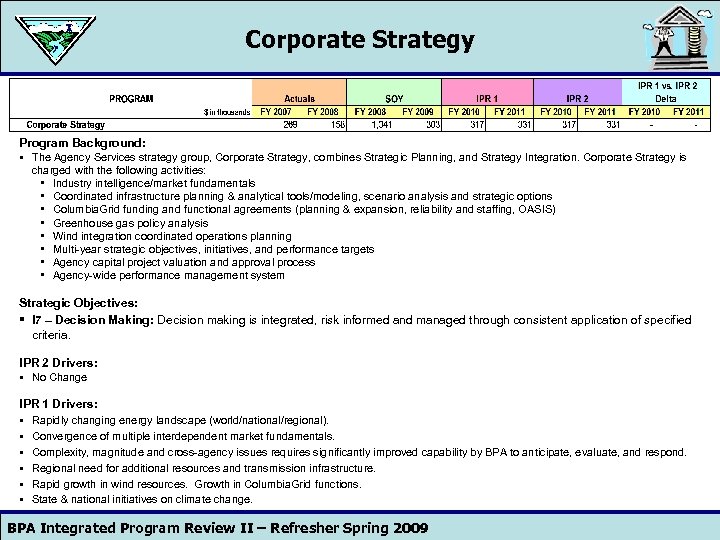
Corporate Strategy Program Background: § The Agency Services strategy group, Corporate Strategy, combines Strategic Planning, and Strategy Integration. Corporate Strategy is charged with the following activities: • Industry intelligence/market fundamentals • Coordinated infrastructure planning & analytical tools/modeling, scenario analysis and strategic options • Columbia. Grid funding and functional agreements (planning & expansion, reliability and staffing, OASIS) • Greenhouse gas policy analysis • Wind integration coordinated operations planning • Multi-year strategic objectives, initiatives, and performance targets • Agency capital project valuation and approval process • Agency-wide performance management system Strategic Objectives: § I 7 – Decision Making: Decision making is integrated, risk informed and managed through consistent application of specified criteria. IPR 2 Drivers: § No Change IPR 1 Drivers: § Rapidly changing energy landscape (world/national/regional). § Convergence of multiple interdependent market fundamentals. § Complexity, magnitude and cross-agency issues requires significantly improved capability by BPA to anticipate, evaluate, and respond. § Regional need for additional resources and transmission infrastructure. § Rapid growth in wind resources. Growth in Columbia. Grid functions. § State & national initiatives on climate change. BPA Integrated Program Review II – Refresher Spring 2009
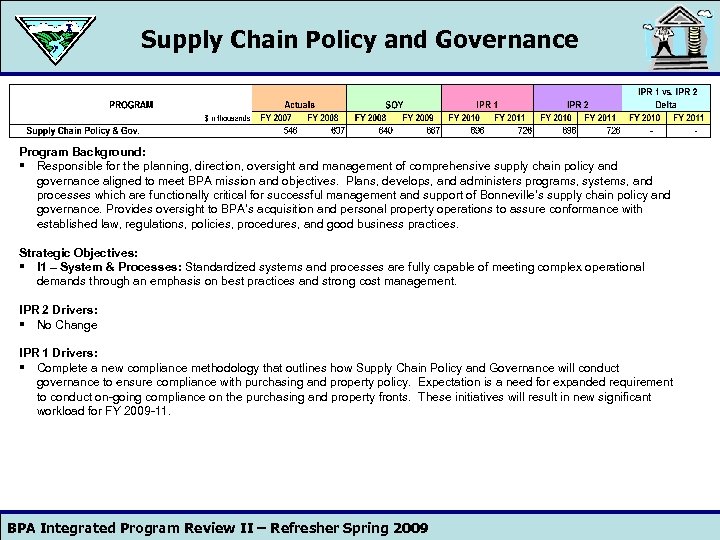
Supply Chain Policy and Governance Program Background: § Responsible for the planning, direction, oversight and management of comprehensive supply chain policy and governance aligned to meet BPA mission and objectives. Plans, develops, and administers programs, systems, and processes which are functionally critical for successful management and support of Bonneville’s supply chain policy and governance. Provides oversight to BPA’s acquisition and personal property operations to assure conformance with established law, regulations, policies, procedures, and good business practices. Strategic Objectives: § I 1 – System & Processes: Standardized systems and processes are fully capable of meeting complex operational demands through an emphasis on best practices and strong cost management. IPR 2 Drivers: § No Change IPR 1 Drivers: § Complete a new compliance methodology that outlines how Supply Chain Policy and Governance will conduct governance to ensure compliance with purchasing and property policy. Expectation is a need for expanded requirement to conduct on-going compliance on the purchasing and property fronts. These initiatives will result in new significant workload for FY 2009 -11. BPA Integrated Program Review II – Refresher Spring 2009
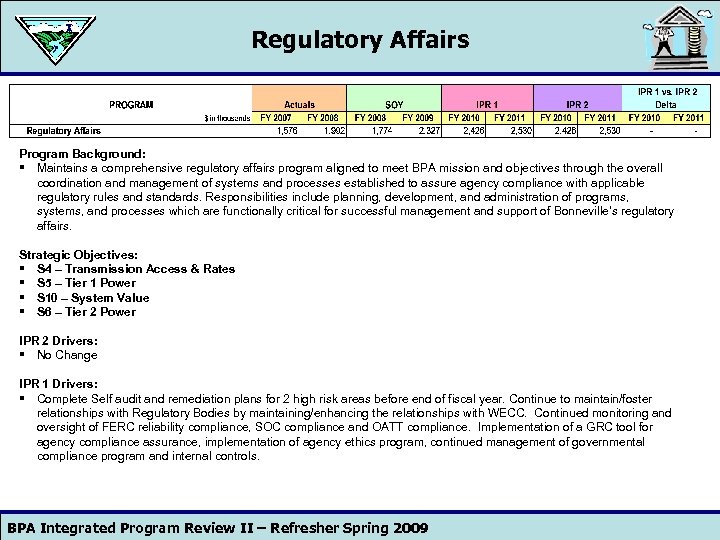
Regulatory Affairs Program Background: § Maintains a comprehensive regulatory affairs program aligned to meet BPA mission and objectives through the overall coordination and management of systems and processes established to assure agency compliance with applicable regulatory rules and standards. Responsibilities include planning, development, and administration of programs, systems, and processes which are functionally critical for successful management and support of Bonneville’s regulatory affairs. Strategic Objectives: § S 4 – Transmission Access & Rates § S 5 – Tier 1 Power § S 10 – System Value § S 6 – Tier 2 Power IPR 2 Drivers: § No Change IPR 1 Drivers: § Complete Self audit and remediation plans for 2 high risk areas before end of fiscal year. Continue to maintain/foster relationships with Regulatory Bodies by maintaining/enhancing the relationships with WECC. Continued monitoring and oversight of FERC reliability compliance, SOC compliance and OATT compliance. Implementation of a GRC tool for agency compliance assurance, implementation of agency ethics program, continued management of governmental compliance program and internal controls. BPA Integrated Program Review II – Refresher Spring 2009
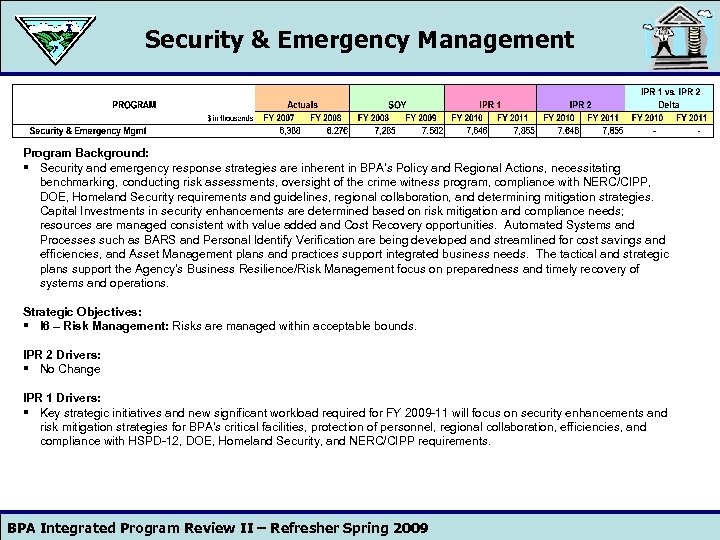
Security & Emergency Management Program Background: § Security and emergency response strategies are inherent in BPA's Policy and Regional Actions, necessitating benchmarking, conducting risk assessments, oversight of the crime witness program, compliance with NERC/CIPP, DOE, Homeland Security requirements and guidelines, regional collaboration, and determining mitigation strategies. Capital Investments in security enhancements are determined based on risk mitigation and compliance needs; resources are managed consistent with value added and Cost Recovery opportunities. Automated Systems and Processes such as BARS and Personal Identify Verification are being developed and streamlined for cost savings and efficiencies, and Asset Management plans and practices support integrated business needs. The tactical and strategic plans support the Agency's Business Resilience/Risk Management focus on preparedness and timely recovery of systems and operations. Strategic Objectives: § I 6 – Risk Management: Risks are managed within acceptable bounds. IPR 2 Drivers: § No Change IPR 1 Drivers: § Key strategic initiatives and new significant workload required for FY 2009 -11 will focus on security enhancements and risk mitigation strategies for BPA's critical facilities, protection of personnel, regional collaboration, efficiencies, and compliance with HSPD-12, DOE, Homeland Security, and NERC/CIPP requirements. BPA Integrated Program Review II – Refresher Spring 2009
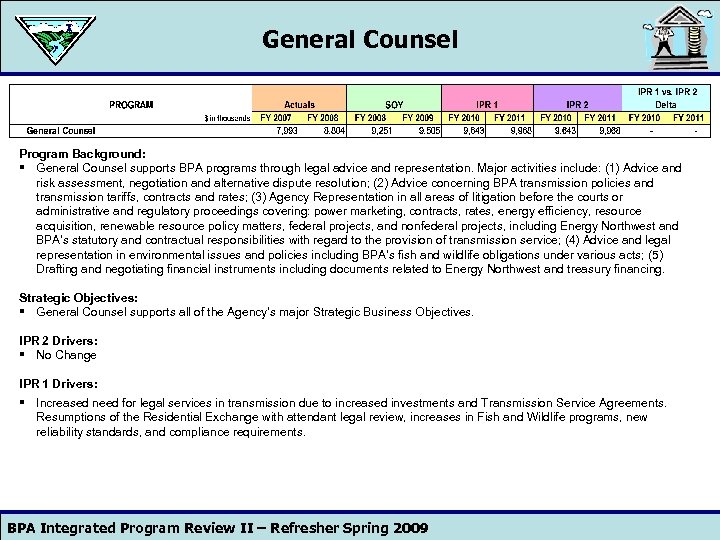
General Counsel Program Background: § General Counsel supports BPA programs through legal advice and representation. Major activities include: (1) Advice and risk assessment, negotiation and alternative dispute resolution; (2) Advice concerning BPA transmission policies and transmission tariffs, contracts and rates; (3) Agency Representation in all areas of litigation before the courts or administrative and regulatory proceedings covering: power marketing, contracts, rates, energy efficiency, resource acquisition, renewable resource policy matters, federal projects, and nonfederal projects, including Energy Northwest and BPA’s statutory and contractual responsibilities with regard to the provision of transmission service; (4) Advice and legal representation in environmental issues and policies including BPA’s fish and wildlife obligations under various acts; (5) Drafting and negotiating financial instruments including documents related to Energy Northwest and treasury financing. Strategic Objectives: § General Counsel supports all of the Agency’s major Strategic Business Objectives. IPR 2 Drivers: § No Change IPR 1 Drivers: § Increased need for legal services in transmission due to increased investments and Transmission Service Agreements. Resumptions of the Residential Exchange with attendant legal review, increases in Fish and Wildlife programs, new reliability standards, and compliance requirements. BPA Integrated Program Review II – Refresher Spring 2009
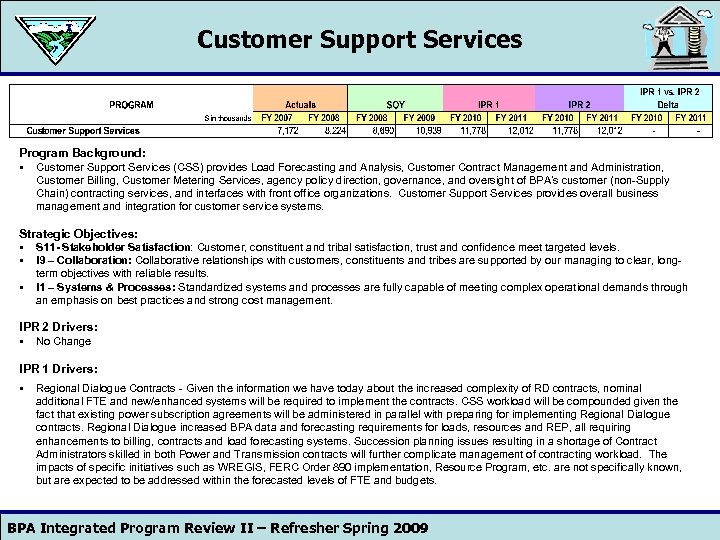
Customer Support Services Program Background: § Customer Support Services (CSS) provides Load Forecasting and Analysis, Customer Contract Management and Administration, Customer Billing, Customer Metering Services, agency policy direction, governance, and oversight of BPA’s customer (non-Supply Chain) contracting services, and interfaces with front office organizations. Customer Support Services provides overall business management and integration for customer service systems. Strategic Objectives: § S 11 - Stakeholder Satisfaction: Customer, constituent and tribal satisfaction, trust and confidence meet targeted levels. § I 9 – Collaboration: Collaborative relationships with customers, constituents and tribes are supported by our managing to clear, longterm objectives with reliable results. § I 1 – Systems & Processes: Standardized systems and processes are fully capable of meeting complex operational demands through an emphasis on best practices and strong cost management. IPR 2 Drivers: § No Change IPR 1 Drivers: § Regional Dialogue Contracts - Given the information we have today about the increased complexity of RD contracts, nominal additional FTE and new/enhanced systems will be required to implement the contracts. CSS workload will be compounded given the fact that existing power subscription agreements will be administered in parallel with preparing for implementing Regional Dialogue contracts. Regional Dialogue increased BPA data and forecasting requirements for loads, resources and REP, all requiring enhancements to billing, contracts and load forecasting systems. Succession planning issues resulting in a shortage of Contract Administrators skilled in both Power and Transmission contracts will further complicate management of contracting workload. The impacts of specific initiatives such as WREGIS, FERC Order 890 implementation, Resource Program, etc. are not specifically known, but are expected to be addressed within the forecasted levels of FTE and budgets. BPA Integrated Program Review II – Refresher Spring 2009
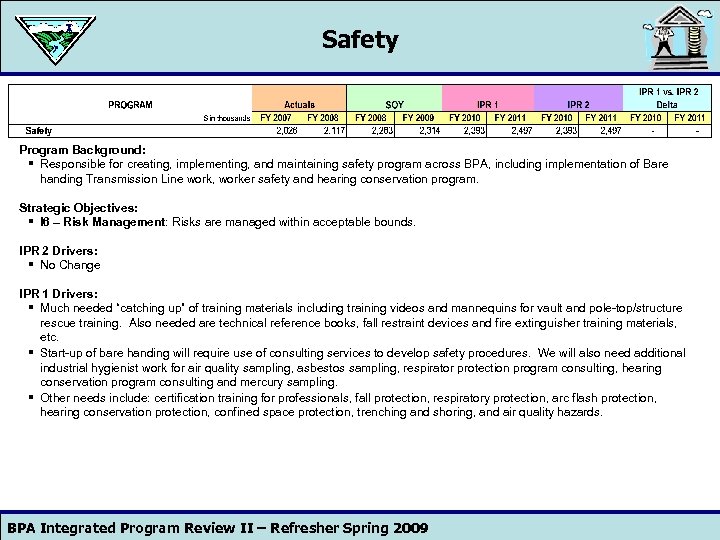
Safety Program Background: § Responsible for creating, implementing, and maintaining safety program across BPA, including implementation of Bare handing Transmission Line work, worker safety and hearing conservation program. Strategic Objectives: § I 6 – Risk Management: Risks are managed within acceptable bounds. IPR 2 Drivers: § No Change IPR 1 Drivers: § Much needed “catching up” of training materials including training videos and mannequins for vault and pole-top/structure rescue training. Also needed are technical reference books, fall restraint devices and fire extinguisher training materials, etc. § Start-up of bare handing will require use of consulting services to develop safety procedures. We will also need additional industrial hygienist work for air quality sampling, asbestos sampling, respirator protection program consulting, hearing conservation program consulting and mercury sampling. § Other needs include: certification training for professionals, fall protection, respiratory protection, arc flash protection, hearing conservation protection, confined space protection, trenching and shoring, and air quality hazards. BPA Integrated Program Review II – Refresher Spring 2009
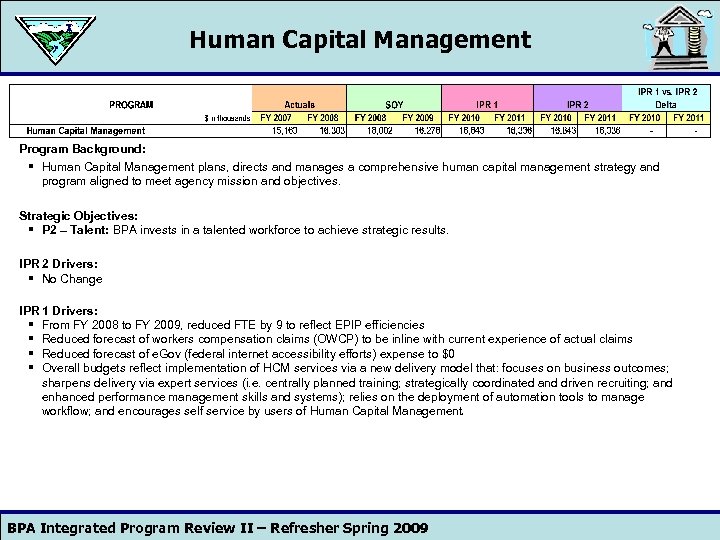
Human Capital Management Program Background: § Human Capital Management plans, directs and manages a comprehensive human capital management strategy and program aligned to meet agency mission and objectives. Strategic Objectives: § P 2 – Talent: BPA invests in a talented workforce to achieve strategic results. IPR 2 Drivers: § No Change IPR 1 Drivers: § From FY 2008 to FY 2009, reduced FTE by 9 to reflect EPIP efficiencies § Reduced forecast of workers compensation claims (OWCP) to be inline with current experience of actual claims § Reduced forecast of e. Gov (federal internet accessibility efforts) expense to $0 § Overall budgets reflect implementation of HCM services via a new delivery model that: focuses on business outcomes; sharpens delivery via expert services (i. e. centrally planned training; strategically coordinated and driven recruiting; and enhanced performance management skills and systems); relies on the deployment of automation tools to manage workflow; and encourages self service by users of Human Capital Management. BPA Integrated Program Review II – Refresher Spring 2009
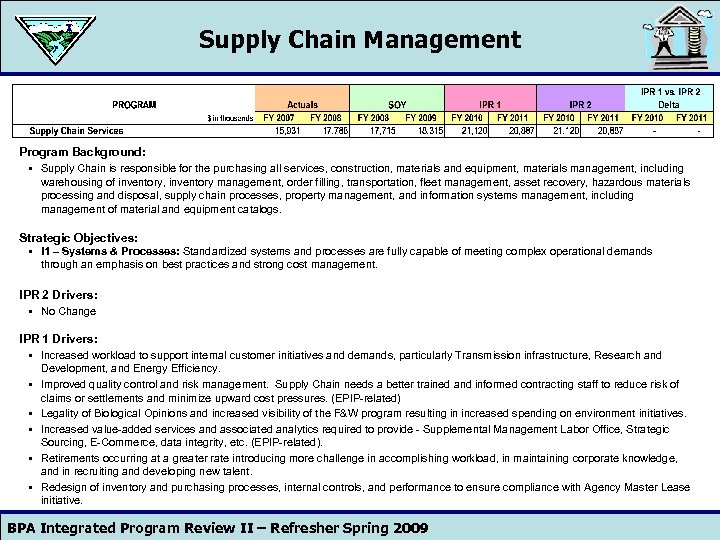
Supply Chain Management Program Background: § Supply Chain is responsible for the purchasing all services, construction, materials and equipment, materials management, including warehousing of inventory, inventory management, order filling, transportation, fleet management, asset recovery, hazardous materials processing and disposal, supply chain processes, property management, and information systems management, including management of material and equipment catalogs. Strategic Objectives: § I 1 – Systems & Processes: Standardized systems and processes are fully capable of meeting complex operational demands through an emphasis on best practices and strong cost management. IPR 2 Drivers: § No Change IPR 1 Drivers: § Increased workload to support internal customer initiatives and demands, particularly Transmission infrastructure, Research and § § § Development, and Energy Efficiency. Improved quality control and risk management. Supply Chain needs a better trained and informed contracting staff to reduce risk of claims or settlements and minimize upward cost pressures. (EPIP-related) Legality of Biological Opinions and increased visibility of the F&W program resulting in increased spending on environment initiatives. Increased value-added services and associated analytics required to provide - Supplemental Management Labor Office, Strategic Sourcing, E-Commerce, data integrity, etc. (EPIP-related). Retirements occurring at a greater rate introducing more challenge in accomplishing workload, in maintaining corporate knowledge, and in recruiting and developing new talent. Redesign of inventory and purchasing processes, internal controls, and performance to ensure compliance with Agency Master Lease initiative. BPA Integrated Program Review II – Refresher Spring 2009
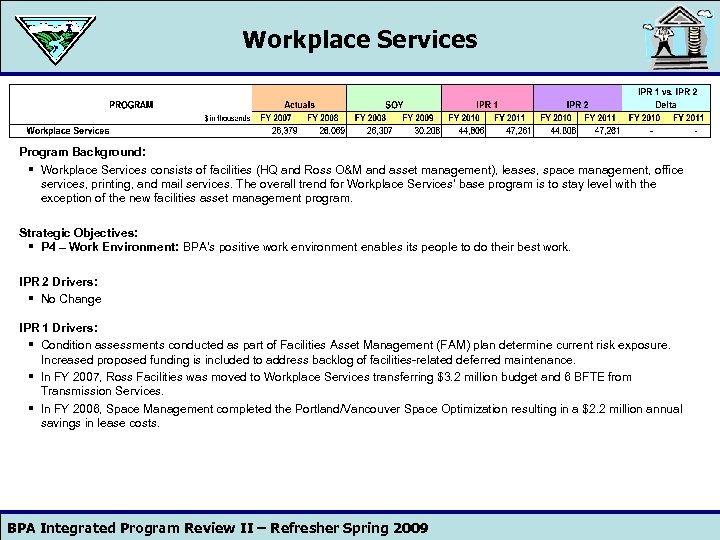
Workplace Services Program Background: § Workplace Services consists of facilities (HQ and Ross O&M and asset management), leases, space management, office services, printing, and mail services. The overall trend for Workplace Services’ base program is to stay level with the exception of the new facilities asset management program. Strategic Objectives: § P 4 – Work Environment: BPA’s positive work environment enables its people to do their best work. IPR 2 Drivers: § No Change IPR 1 Drivers: § Condition assessments conducted as part of Facilities Asset Management (FAM) plan determine current risk exposure. Increased proposed funding is included to address backlog of facilities-related deferred maintenance. § In FY 2007, Ross Facilities was moved to Workplace Services transferring $3. 2 million budget and 6 BFTE from Transmission Services. § In FY 2006, Space Management completed the Portland/Vancouver Space Optimization resulting in a $2. 2 million annual savings in lease costs. BPA Integrated Program Review II – Refresher Spring 2009
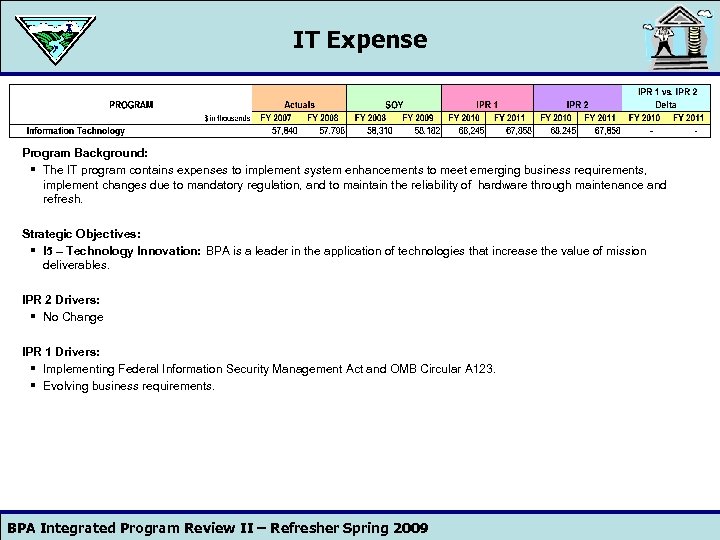
IT Expense Program Background: § The IT program contains expenses to implement system enhancements to meet emerging business requirements, implement changes due to mandatory regulation, and to maintain the reliability of hardware through maintenance and refresh. Strategic Objectives: § I 5 – Technology Innovation: BPA is a leader in the application of technologies that increase the value of mission deliverables. IPR 2 Drivers: § No Change IPR 1 Drivers: § Implementing Federal Information Security Management Act and OMB Circular A 123. § Evolving business requirements. BPA Integrated Program Review II – Refresher Spring 2009
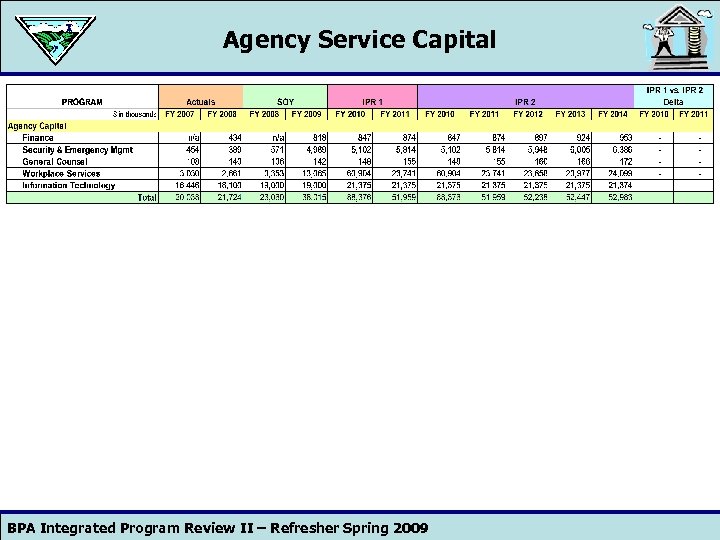
Agency Service Capital BPA Integrated Program Review II – Refresher Spring 2009
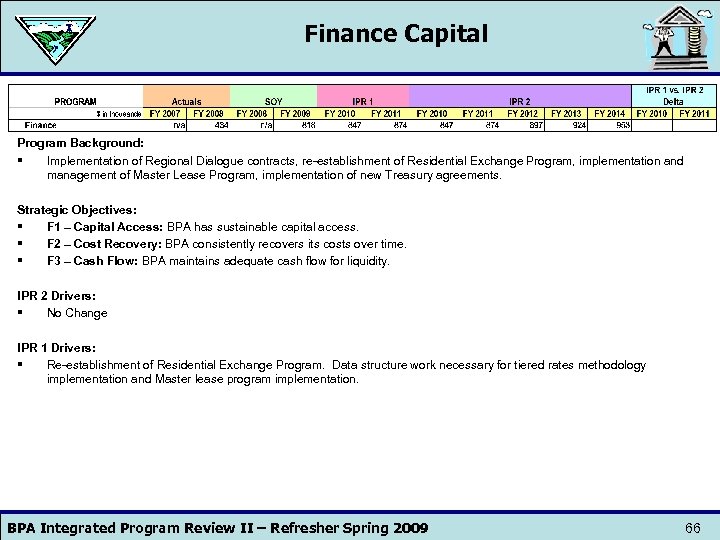
Finance Capital Program Background: § Implementation of Regional Dialogue contracts, re-establishment of Residential Exchange Program, implementation and management of Master Lease Program, implementation of new Treasury agreements. Strategic Objectives: § F 1 – Capital Access: BPA has sustainable capital access. § F 2 – Cost Recovery: BPA consistently recovers its costs over time. § F 3 – Cash Flow: BPA maintains adequate cash flow for liquidity. IPR 2 Drivers: § No Change IPR 1 Drivers: § Re-establishment of Residential Exchange Program. Data structure work necessary for tiered rates methodology implementation and Master lease program implementation. BPA Integrated Program Review II – Refresher Spring 2009 66
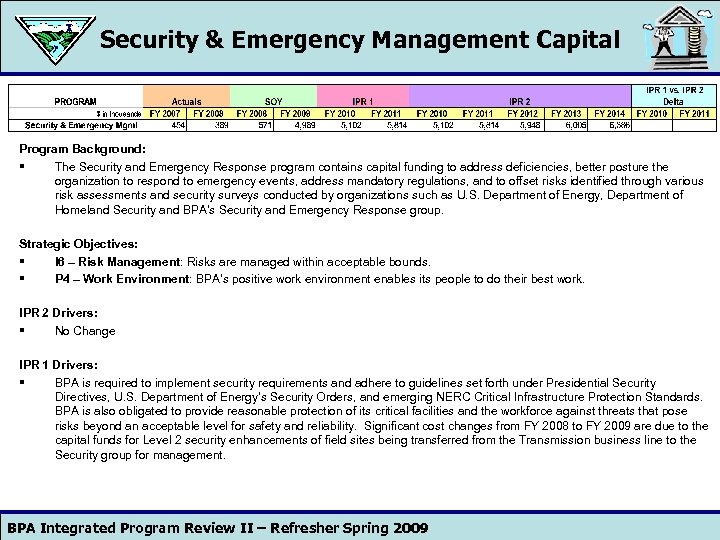
Security & Emergency Management Capital Program Background: § The Security and Emergency Response program contains capital funding to address deficiencies, better posture the organization to respond to emergency events, address mandatory regulations, and to offset risks identified through various risk assessments and security surveys conducted by organizations such as U. S. Department of Energy, Department of Homeland Security and BPA’s Security and Emergency Response group. Strategic Objectives: § I 6 – Risk Management: Risks are managed within acceptable bounds. § P 4 – Work Environment: BPA’s positive work environment enables its people to do their best work. IPR 2 Drivers: § No Change IPR 1 Drivers: § BPA is required to implement security requirements and adhere to guidelines set forth under Presidential Security Directives, U. S. Department of Energy’s Security Orders, and emerging NERC Critical Infrastructure Protection Standards. BPA is also obligated to provide reasonable protection of its critical facilities and the workforce against threats that pose risks beyond an acceptable level for safety and reliability. Significant cost changes from FY 2008 to FY 2009 are due to the capital funds for Level 2 security enhancements of field sites being transferred from the Transmission business line to the Security group for management. BPA Integrated Program Review II – Refresher Spring 2009
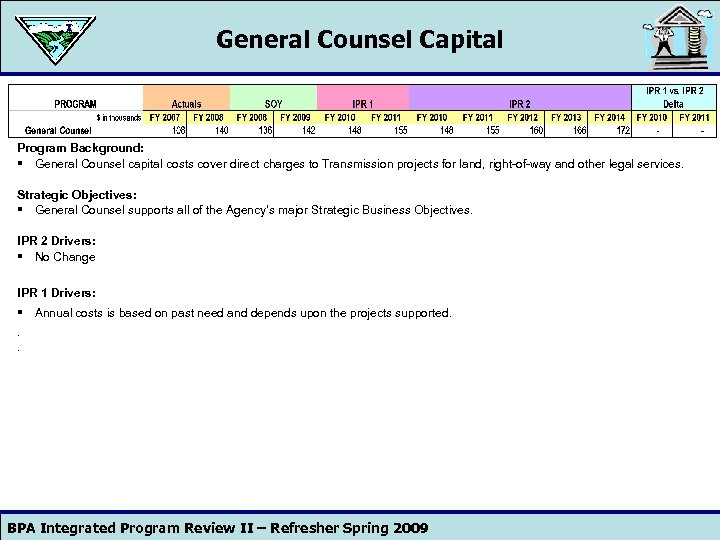
General Counsel Capital Program Background: § General Counsel capital costs cover direct charges to Transmission projects for land, right-of-way and other legal services. Strategic Objectives: § General Counsel supports all of the Agency’s major Strategic Business Objectives. IPR 2 Drivers: § No Change IPR 1 Drivers: § Annual costs is based on past need and depends upon the projects supported. . . BPA Integrated Program Review II – Refresher Spring 2009
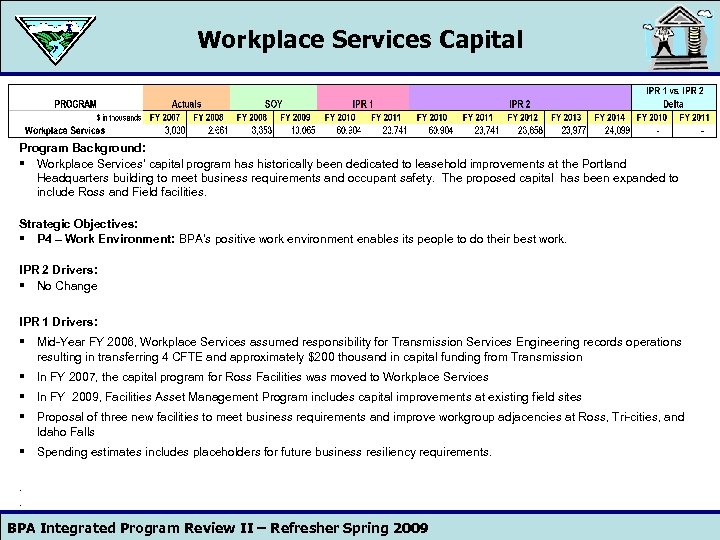
Workplace Services Capital Program Background: § Workplace Services’ capital program has historically been dedicated to leasehold improvements at the Portland Headquarters building to meet business requirements and occupant safety. The proposed capital has been expanded to include Ross and Field facilities. Strategic Objectives: § P 4 – Work Environment: BPA’s positive work environment enables its people to do their best work. IPR 2 Drivers: § No Change IPR 1 Drivers: § Mid-Year FY 2006, Workplace Services assumed responsibility for Transmission Services Engineering records operations resulting in transferring 4 CFTE and approximately $200 thousand in capital funding from Transmission § In FY 2007, the capital program for Ross Facilities was moved to Workplace Services § In FY 2009, Facilities Asset Management Program includes capital improvements at existing field sites § Proposal of three new facilities to meet business requirements and improve workgroup adjacencies at Ross, Tri-cities, and Idaho Falls § Spending estimates includes placeholders for future business resiliency requirements. . . BPA Integrated Program Review II – Refresher Spring 2009
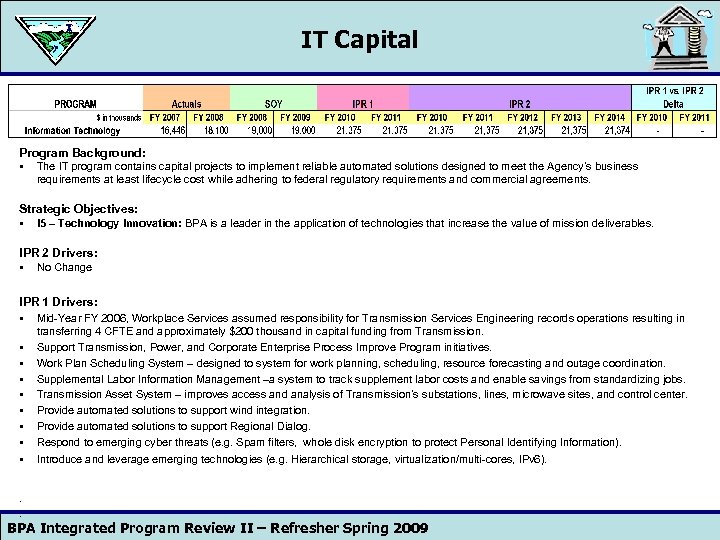
IT Capital Program Background: § The IT program contains capital projects to implement reliable automated solutions designed to meet the Agency’s business requirements at least lifecycle cost while adhering to federal regulatory requirements and commercial agreements. Strategic Objectives: § I 5 – Technology Innovation: BPA is a leader in the application of technologies that increase the value of mission deliverables. IPR 2 Drivers: § No Change IPR 1 Drivers: § Mid-Year FY 2006, Workplace Services assumed responsibility for Transmission Services Engineering records operations resulting in § § § § transferring 4 CFTE and approximately $200 thousand in capital funding from Transmission. Support Transmission, Power, and Corporate Enterprise Process Improve Program initiatives. Work Plan Scheduling System – designed to system for work planning, scheduling, resource forecasting and outage coordination. Supplemental Labor Information Management –a system to track supplement labor costs and enable savings from standardizing jobs. Transmission Asset System – improves access and analysis of Transmission’s substations, lines, microwave sites, and control center. Provide automated solutions to support wind integration. Provide automated solutions to support Regional Dialog. Respond to emerging cyber threats (e. g. Spam filters, whole disk encryption to protect Personal Identifying Information). Introduce and leverage emerging technologies (e. g. Hierarchical storage, virtualization/multi-cores, IPv 6). . . BPA Integrated Program Review II – Refresher Spring 2009
Ways to Participate • • All forums are open to the public and will be noticed on the IBR external web site at: http: //www. bpa. gov/corporate/Finance/IBR/IPR/ All Technical and Managerial workshops will be held at BPA Headquarters. The comment period for the IPR 2 opens Wednesday, March 18, 2009. Close of comment is April 18, 2008. You have several options to provide comments to BPA: 1. Attend one or more of the scheduled workshops and give BPA your comments. 2. Discuss your input with your Customer Account Executive, Constituent Account Executive, or Tribal Liaison. 3. Submit written comments to Bonneville Power Administration, P. O. Box 14428, Portland, OR 97293 -4428. 4. Submit comments via e-mail to: comment@bpa. gov or submit on line at: http: //www. bpa. gov/comment. 5. Comments can also be sent via fax to (503) 230 -3285. BPA Integrated Program Review II – Refresher Spring 2009 71
BPA’s Financial Disclosure Information • All FY 2009 -2013 information was provided in March 2009 and cannot be found in BPA-approved Agency Financial Information but is provided for discussion or exploratory purposes only as projections of program activity levels, etc. • All FY 2007 -2008 actuals are provided in March 2009 and are consistent with audited actuals that contain BPA-approved Agency Financial Information. • FY 2009 Rate Case data has been developed for publication in rates proceeding documents and is being provided by BPA on March 18, 2009. BPA Integrated Program Review II – Refresher Spring 2009 72
Скачать презентацию Bonneville Power Administration Update to FY 2008 Integrated
02f8f617c515d4310e6c1cfa79170751.ppt