 Скачать презентацию Bond Valuation Risk and Cost of Capital and
ed3364bd97e8abc29b8bdc807f6cd494.ppt
- Количество слайдов: 83



Bond Valuation, Risk and Cost of Capital and capital structure Where does the discount rate come from? FIN 819: lecture 4&5
Today’s plan l l Bond valuation • Yield to maturity • Term structure of interest rates and yield curve Risk and returns • How to measure risk • Individual security risk • Portfolio risk • Diversification • Unique risk • Systematic risk or market risk • Measure market risk: beta FIN 819: lecture 4&5
Today’s plan (continue) l l l Portfolio rules and diversification Measure market risk: beta CAPM WACC Levered betas and unlevered betas FIN 819: lecture 4&5
Bonds l l Bond – a security or a financial instrument that obligates the issuer (borrower) to make specified payments to the bondholder during some time horizon. Coupon - The interest payments made to the bondholder. Face Value (Par Value, Principal or Maturity Value) - Payment at the maturity of the bond. Coupon Rate - Annual interest payment, as a percentage of face value. FIN 819: lecture 4 &5 4
Bonds l A bond also has (legal) rights attached to it: • if the borrower doesn’t make the required • payments, bondholders can force bankruptcy proceedings in the event of bankruptcy, bond holders get paid before equity holders FIN 819: lecture 4 &5 5
An example of a bond l A coupon bond that pays coupon of 10% annually, with a face value of $1000, has a discount rate of 8% and matures in three years. • • The coupon payment is $100 annually The discount rate is different from the coupon rate. In the third year, the bondholder is supposed to get $100 coupon payment plus the face value of $1000. Can you visualize the cash flows pattern? FIN 819: lecture 4 & 5 6
Bonds WARNING The coupon rate IS NOT the discount rate used in the Present Value calculations. The coupon rate merely tells us what cash flow the bond will produce. Since the coupon rate is listed as a %, this misconception is quite common. FIN 819: lecture 4 & 5 7
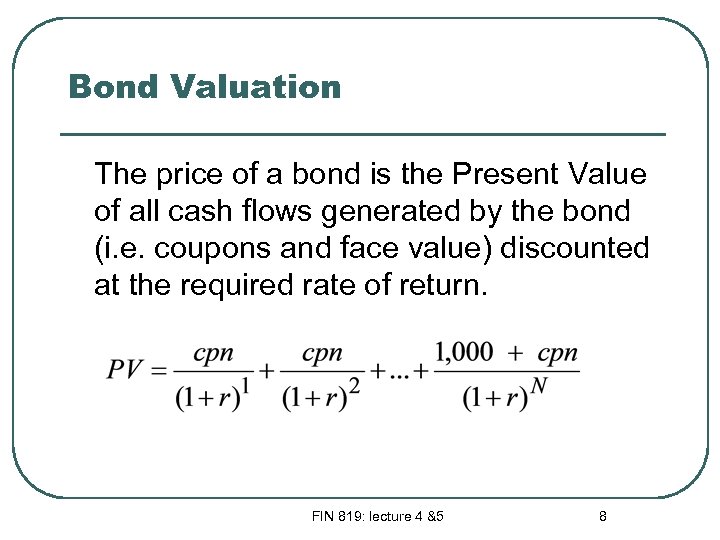
Bond Valuation The price of a bond is the Present Value of all cash flows generated by the bond (i. e. coupons and face value) discounted at the required rate of return. FIN 819: lecture 4 &5 8
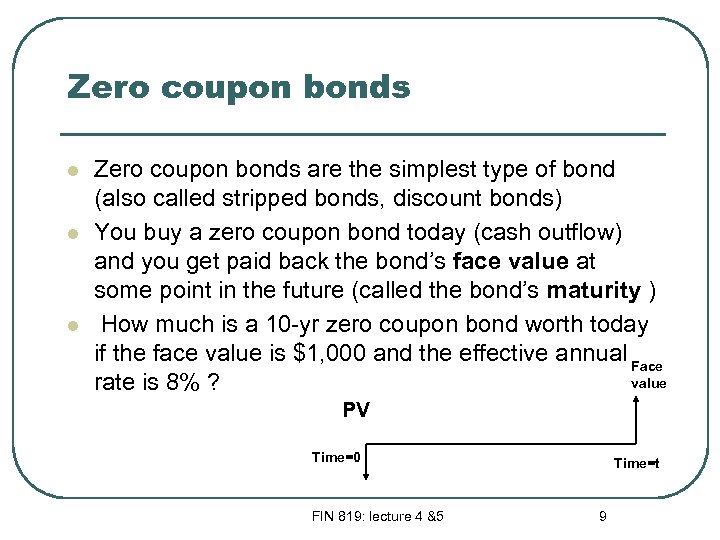
Zero coupon bonds l l l Zero coupon bonds are the simplest type of bond (also called stripped bonds, discount bonds) You buy a zero coupon bond today (cash outflow) and you get paid back the bond’s face value at some point in the future (called the bond’s maturity ) How much is a 10 -yr zero coupon bond worth today if the face value is $1, 000 and the effective annual Face value rate is 8% ? PV Time=0 FIN 819: lecture 4 &5 Time=t 9
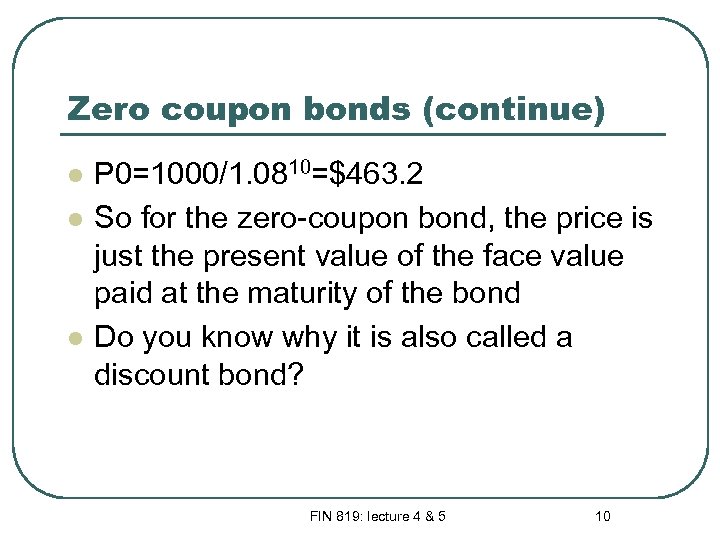
Zero coupon bonds (continue) l l l P 0=1000/1. 0810=$463. 2 So for the zero-coupon bond, the price is just the present value of the face value paid at the maturity of the bond Do you know why it is also called a discount bond? FIN 819: lecture 4 & 5 10
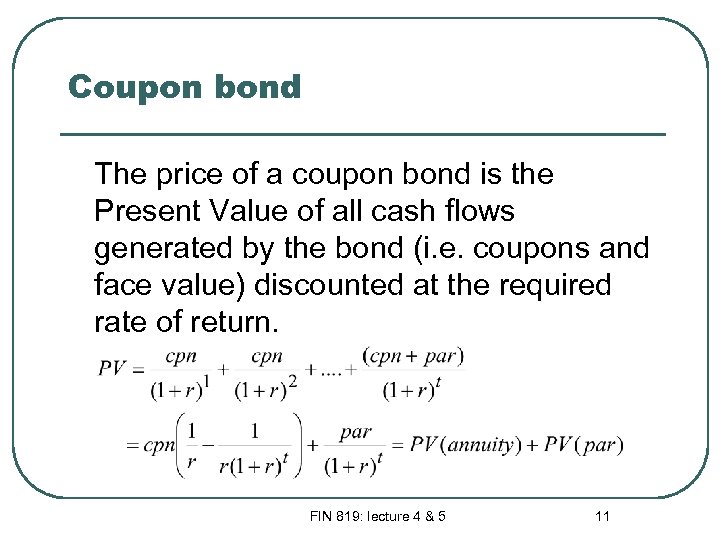
Coupon bond The price of a coupon bond is the Present Value of all cash flows generated by the bond (i. e. coupons and face value) discounted at the required rate of return. FIN 819: lecture 4 & 5 11
Bond Pricing Example What is the price of a 6 % annual coupon bond, with a $1, 000 face value, which matures in 3 years? Assume a required return of 5. 6%. FIN 819: lecture 4 & 5 12
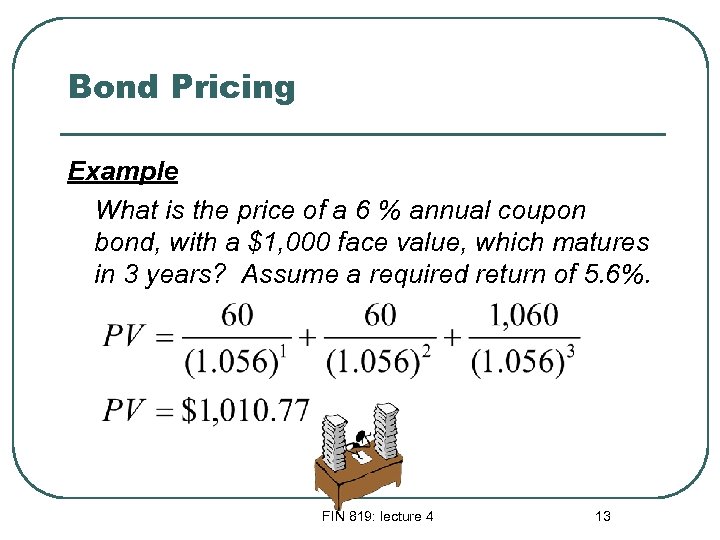
Bond Pricing Example What is the price of a 6 % annual coupon bond, with a $1, 000 face value, which matures in 3 years? Assume a required return of 5. 6%. FIN 819: lecture 4 13
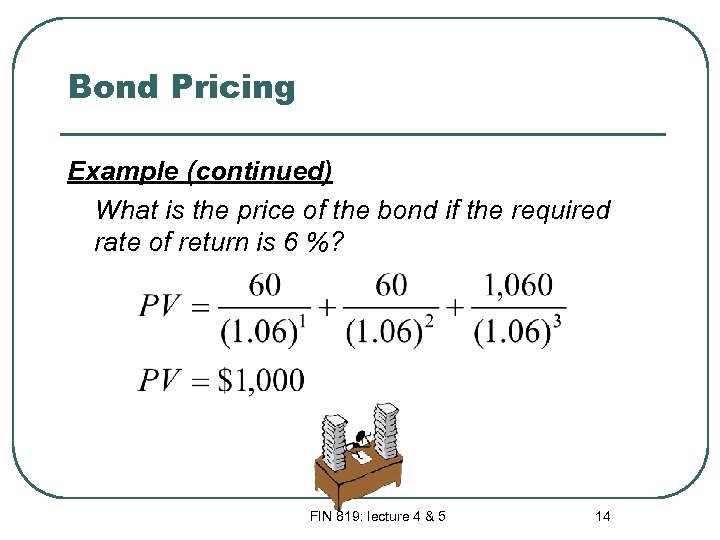
Bond Pricing Example (continued) What is the price of the bond if the required rate of return is 6 %? FIN 819: lecture 4 & 5 14
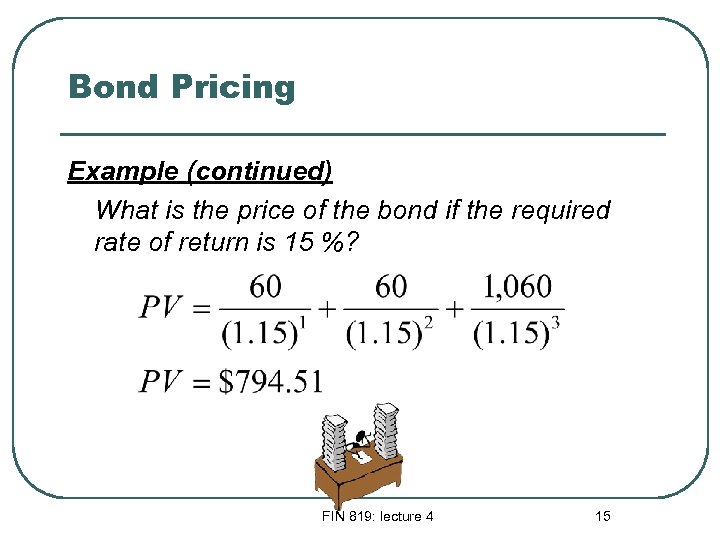
Bond Pricing Example (continued) What is the price of the bond if the required rate of return is 15 %? FIN 819: lecture 4 15
Bond Pricing Example (continued) What is the price of the bond if the required rate of return is 5. 6% AND the coupons are paid semi-annually? FIN 819: lecture 4 16
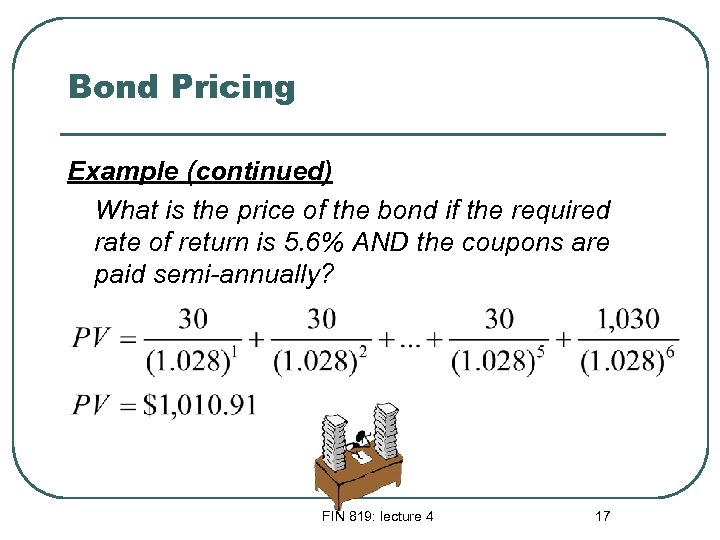
Bond Pricing Example (continued) What is the price of the bond if the required rate of return is 5. 6% AND the coupons are paid semi-annually? FIN 819: lecture 4 17
Bond Pricing Example (continued) Q: How did the calculation change, given semiannual coupons versus annual coupon payments? FIN 819: lecture 4 18
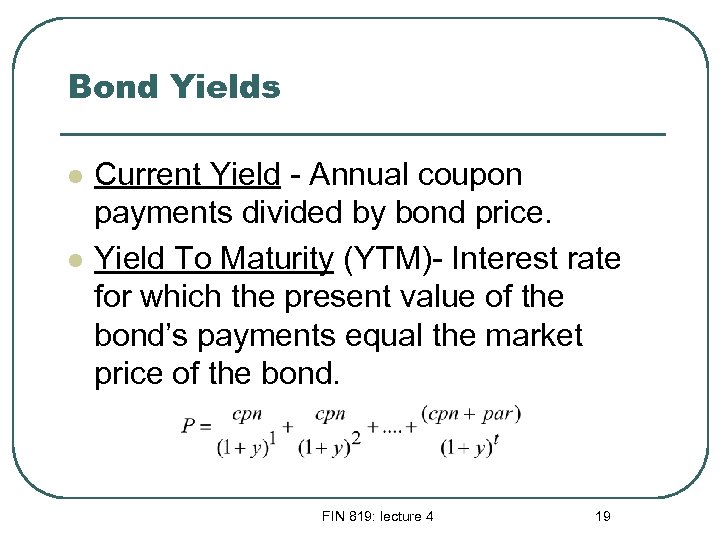
Bond Yields l l Current Yield - Annual coupon payments divided by bond price. Yield To Maturity (YTM)- Interest rate for which the present value of the bond’s payments equal the market price of the bond. FIN 819: lecture 4 19
An example of a bond l A coupon bond that pays coupon of 10% annually, with a face value of $1000, has a discount rate of 8% and matures in three years. It is assumed that the market price of the bond is the present value of the bond at the discount rate of 8%. • What is the current yield? • What is the yield to maturity. FIN 819: lecture 4 20
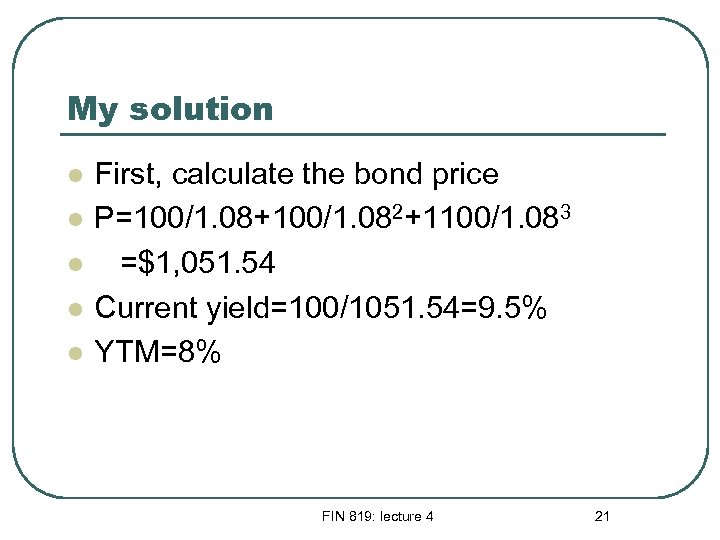
My solution l l l First, calculate the bond price P=100/1. 08+100/1. 082+1100/1. 083 =$1, 051. 54 Current yield=100/1051. 54=9. 5% YTM=8% FIN 819: lecture 4 21
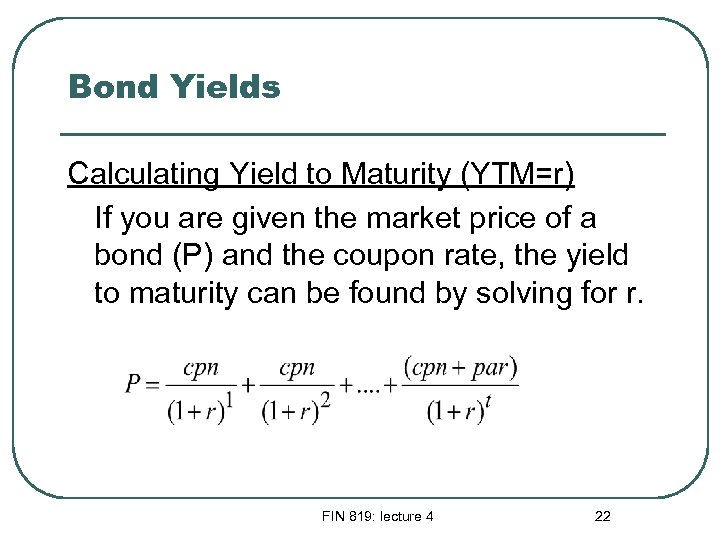
Bond Yields Calculating Yield to Maturity (YTM=r) If you are given the market price of a bond (P) and the coupon rate, the yield to maturity can be found by solving for r. FIN 819: lecture 4 22
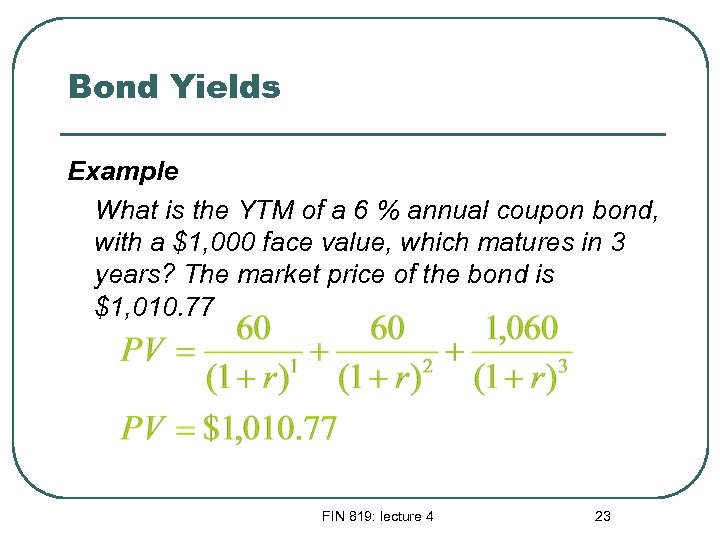
Bond Yields Example What is the YTM of a 6 % annual coupon bond, with a $1, 000 face value, which matures in 3 years? The market price of the bond is $1, 010. 77 FIN 819: lecture 4 23
Bond Yields l l l In general, there is no simple formula that can be used to calculate YTM unless for zero coupon bonds Calculating YTM by hand can be very tedious. We don’t have this kind of problems in the quiz or exam You may use the trial by errors approach get it. FIN 819: lecture 4 24
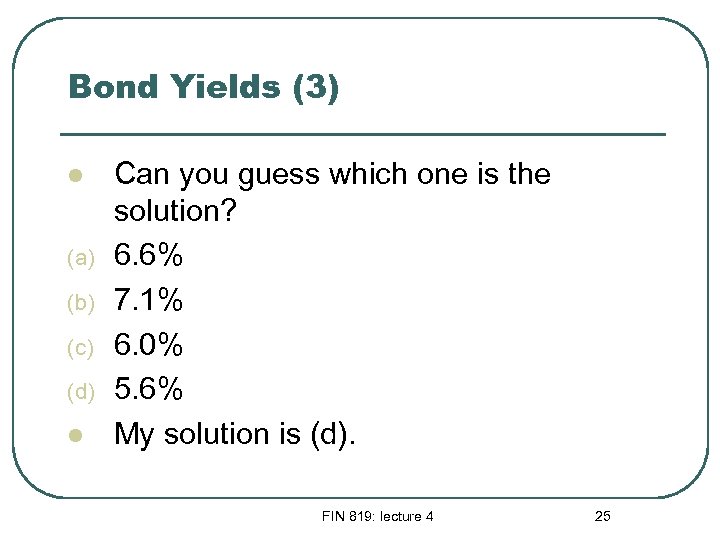
Bond Yields (3) l (a) (b) (c) (d) l Can you guess which one is the solution? 6. 6% 7. 1% 6. 0% 5. 6% My solution is (d). FIN 819: lecture 4 25
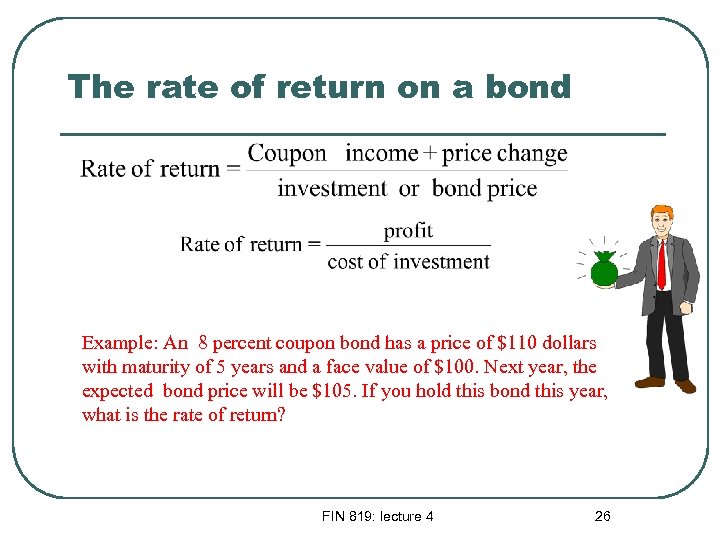
The rate of return on a bond Example: An 8 percent coupon bond has a price of $110 dollars with maturity of 5 years and a face value of $100. Next year, the expected bond price will be $105. If you hold this bond this year, what is the rate of return? FIN 819: lecture 4 26
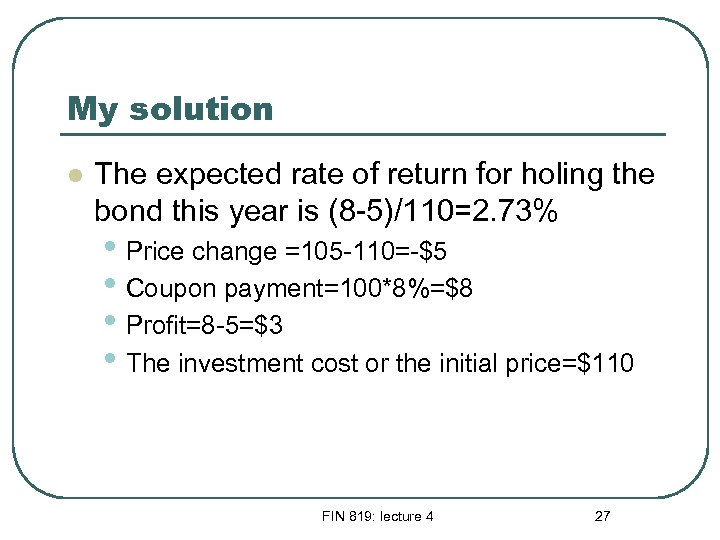
My solution l The expected rate of return for holing the bond this year is (8 -5)/110=2. 73% • Price change =105 -110=-$5 • Coupon payment=100*8%=$8 • Profit=8 -5=$3 • The investment cost or the initial price=$110 FIN 819: lecture 4 27
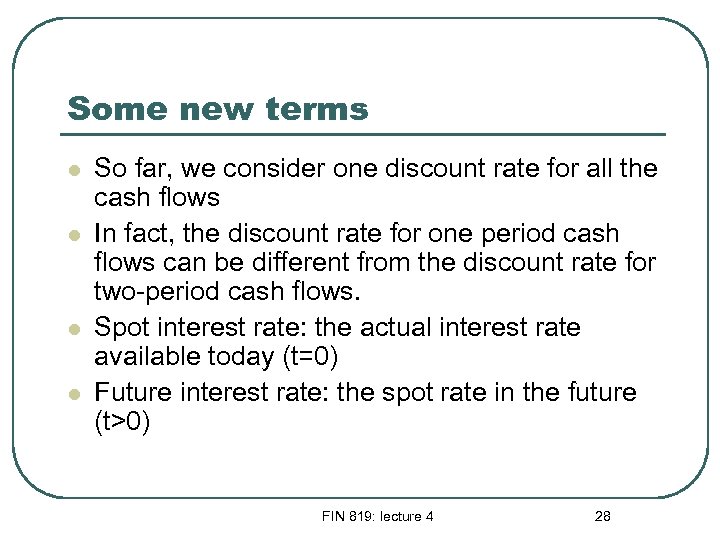
Some new terms l l So far, we consider one discount rate for all the cash flows In fact, the discount rate for one period cash flows can be different from the discount rate for two-period cash flows. Spot interest rate: the actual interest rate available today (t=0) Future interest rate: the spot rate in the future (t>0) FIN 819: lecture 4 28
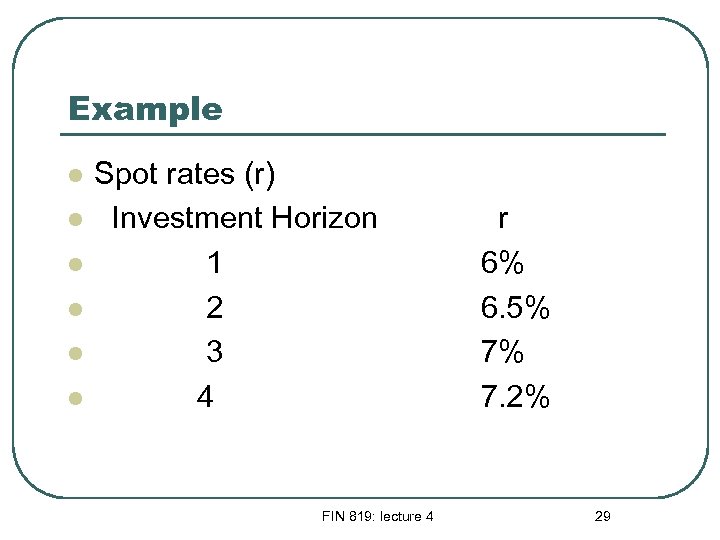
Example l l l Spot rates (r) Investment Horizon 1 2 3 4 FIN 819: lecture 4 r 6% 6. 5% 7% 7. 2% 29
The Yield Curve Term Structure of Interest Rates: is the relationship between the spot rates and their maturity dates Yield Curve - Graph of the term structure. FIN 819: lecture 4 30
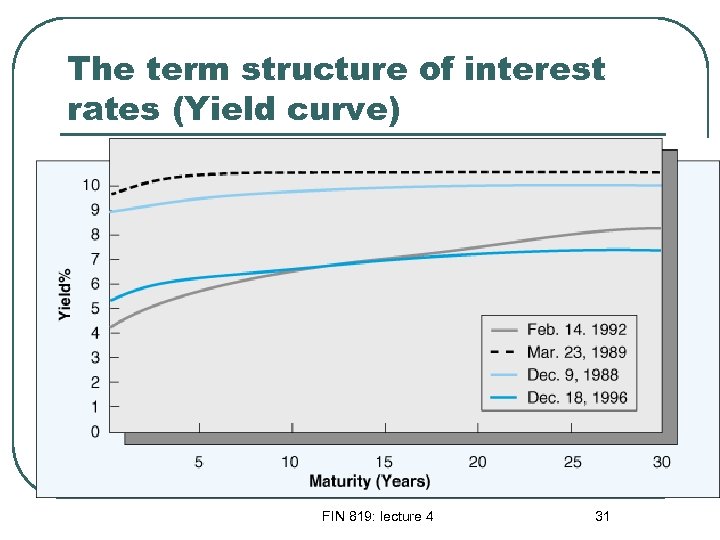
The term structure of interest rates (Yield curve) FIN 819: lecture 4 31
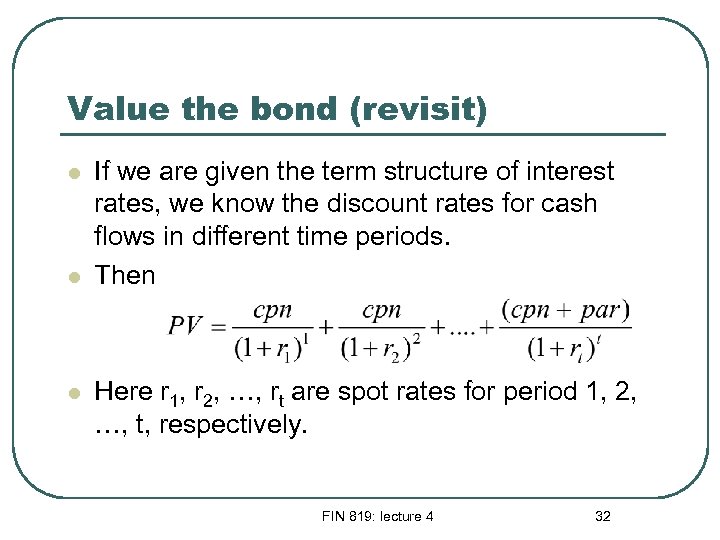
Value the bond (revisit) l l l If we are given the term structure of interest rates, we know the discount rates for cash flows in different time periods. Then Here r 1, r 2, …, rt are spot rates for period 1, 2, …, t, respectively. FIN 819: lecture 4 32
Question l l Which kind of the yield curve can make you use a single discount rate for the bond valuation? For what kind of bonds, YTM is the same as spot rates? FIN 819: lecture 4 33
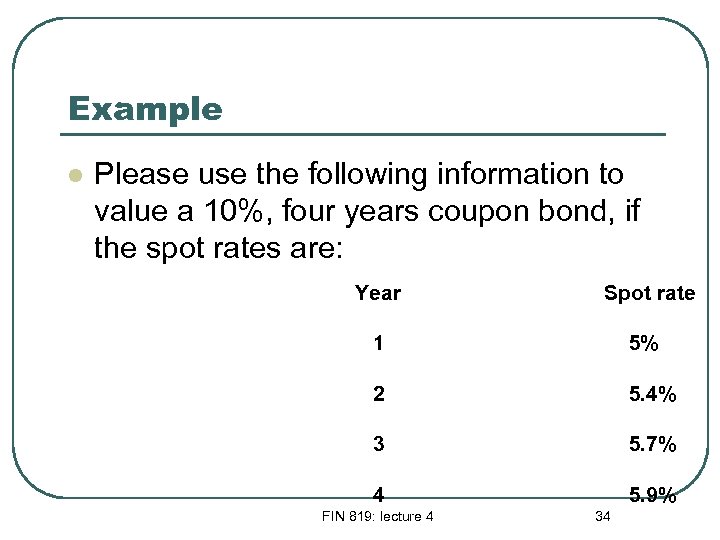
Example l Please use the following information to value a 10%, four years coupon bond, if the spot rates are: Year Spot rate 1 5% 2 5. 4% 3 5. 7% 4 5. 9% FIN 819: lecture 4 34
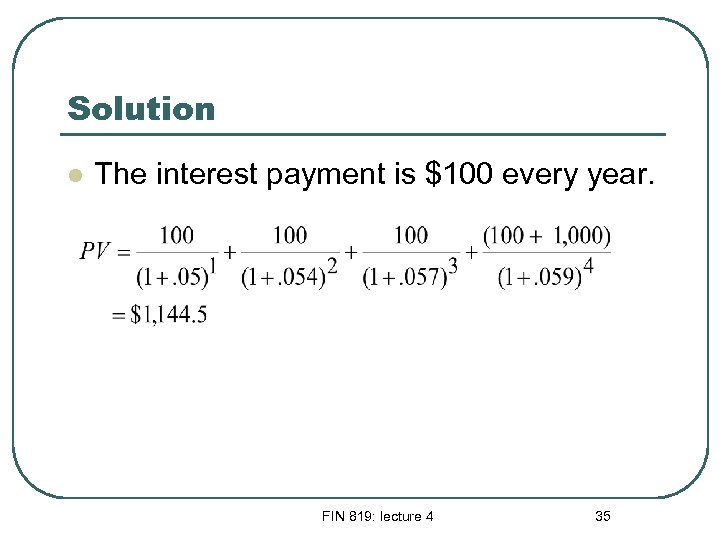
Solution l The interest payment is $100 every year. FIN 819: lecture 4 35
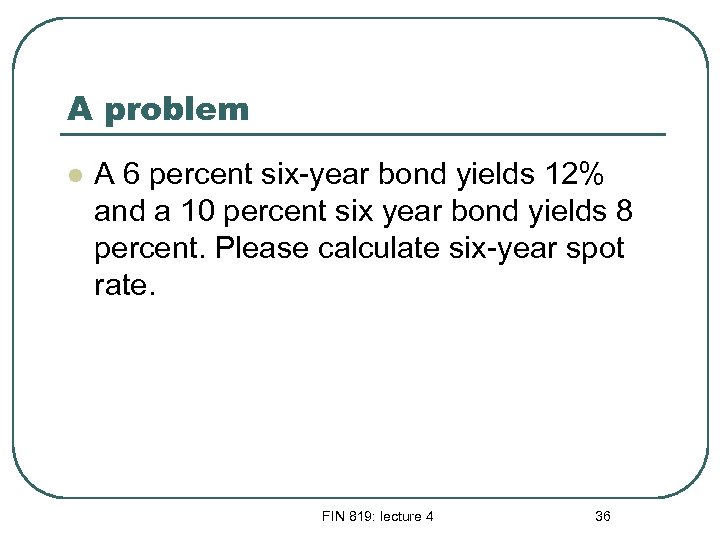
A problem l A 6 percent six-year bond yields 12% and a 10 percent six year bond yields 8 percent. Please calculate six-year spot rate. FIN 819: lecture 4 36
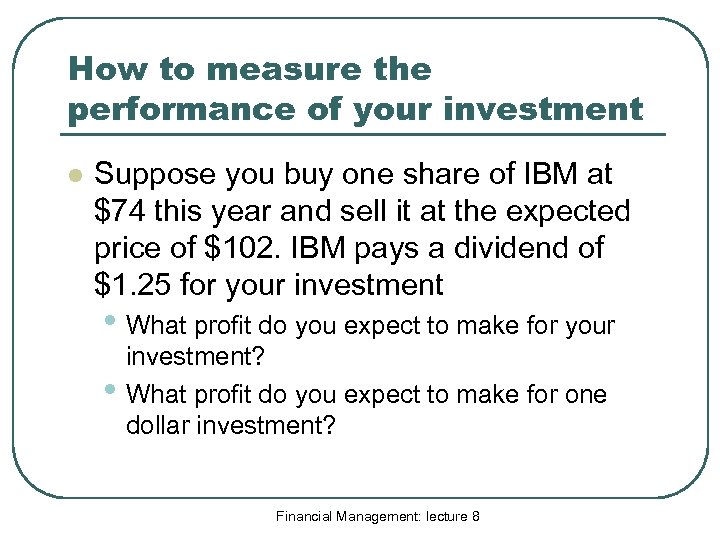
How to measure the performance of your investment l Suppose you buy one share of IBM at $74 this year and sell it at the expected price of $102. IBM pays a dividend of $1. 25 for your investment • What profit do you expect to make for your • investment? What profit do you expect to make for one dollar investment? Financial Management: lecture 8
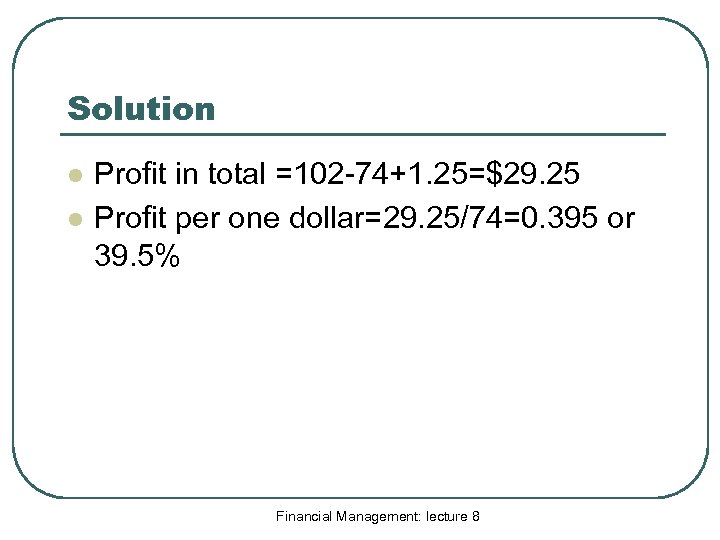
Solution l l Profit in total =102 -74+1. 25=$29. 25 Profit per one dollar=29. 25/74=0. 395 or 39. 5% Financial Management: lecture 8
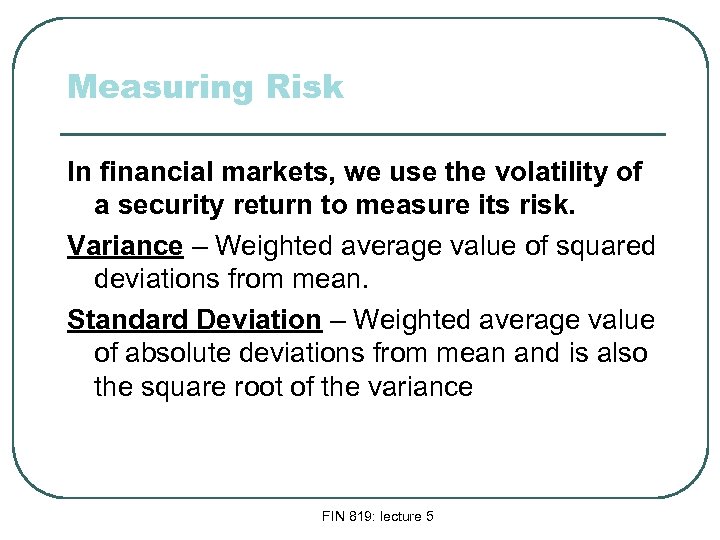
Measuring Risk In financial markets, we use the volatility of a security return to measure its risk. Variance – Weighted average value of squared deviations from mean. Standard Deviation – Weighted average value of absolute deviations from mean and is also the square root of the variance FIN 819: lecture 5
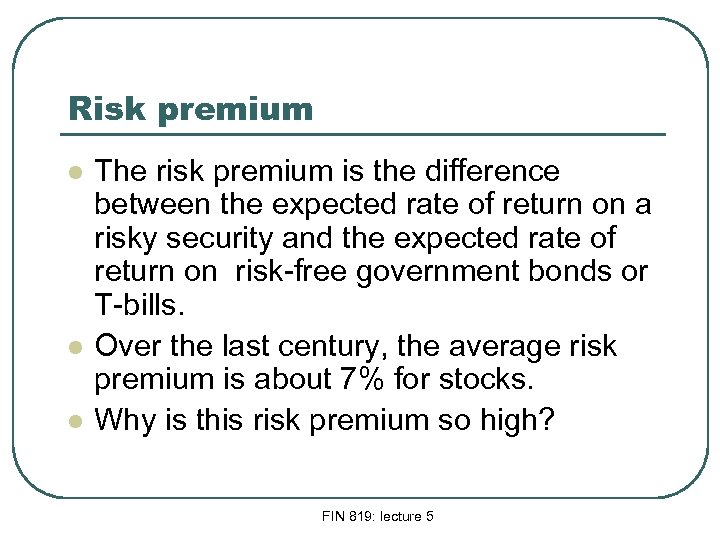
Risk premium l l l The risk premium is the difference between the expected rate of return on a risky security and the expected rate of return on risk-free government bonds or T-bills. Over the last century, the average risk premium is about 7% for stocks. Why is this risk premium so high? FIN 819: lecture 5
Calculating the risk of a security l There may be two approaches for calculating the risk of a security. Specifically, • Using the basic definition of expectation and • l variance for both individual securities and securities that are portfolios. Using the portfolio rule for only the security that is a portfolio. In fact, these two approaches are exactly the same, but the second one can omit some calculation details. FIN 819: lecture 5
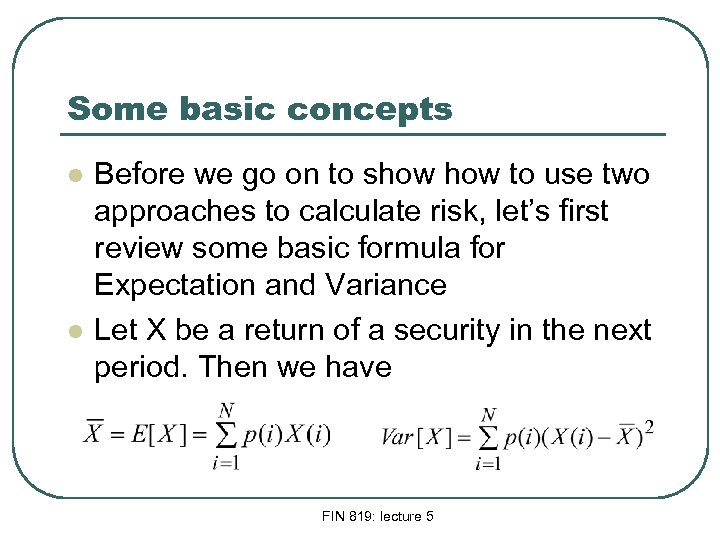
Some basic concepts l l Before we go on to show to use two approaches to calculate risk, let’s first review some basic formula for Expectation and Variance Let X be a return of a security in the next period. Then we have FIN 819: lecture 5
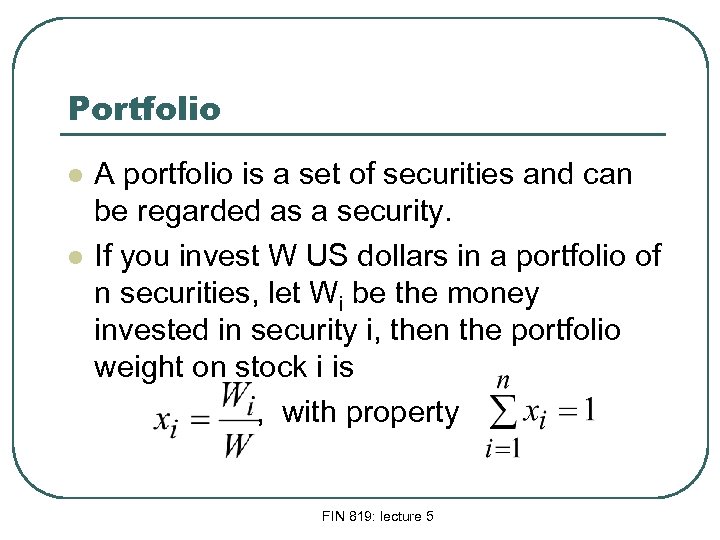
Portfolio l l A portfolio is a set of securities and can be regarded as a security. If you invest W US dollars in a portfolio of n securities, let Wi be the money invested in security i, then the portfolio weight on stock i is , with property FIN 819: lecture 5
Example 1 l Suppose that you want to invest $1, 000 in a portfolio of IBM and GE. You spend $200 on IBM and the other on GE. What is the portfolio weight on each stock? FIN 819: lecture 5
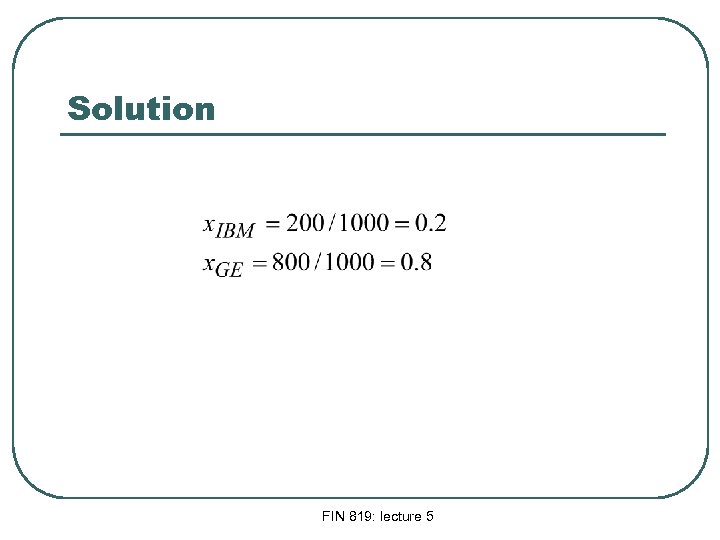
Solution FIN 819: lecture 5
Example 2 l Suppose that you have $1, 000 and borrow another $1, 000 from the bank to invest in IBM and GE. You spend $500 on IBM and the other on GE. What is the portfolio weight on each stock? FIN 819: lecture 5
Three portfolio rules A: The return of a portfolio is the weighted average of the returns of the securities in the portfolio. B: The expected return of a portfolio is the weighted average of the expected returns of the securities in the portfolio. C: The Beta of a portfolio is the weighted average of the Betas of the securities in the portfolio. FIN 819: lecture 5
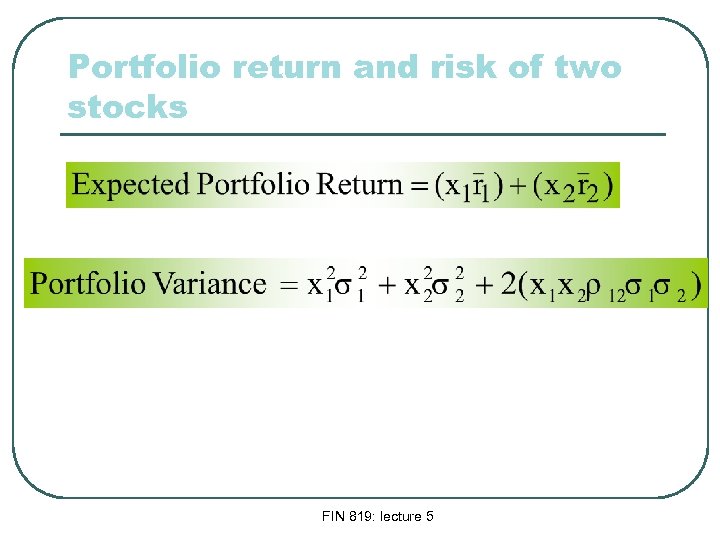
Portfolio return and risk of two stocks FIN 819: lecture 5
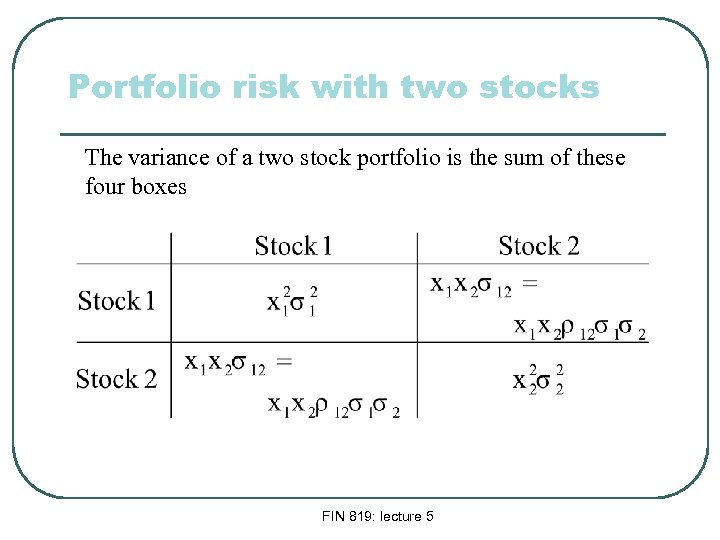
Portfolio risk with two stocks The variance of a two stock portfolio is the sum of these four boxes FIN 819: lecture 5
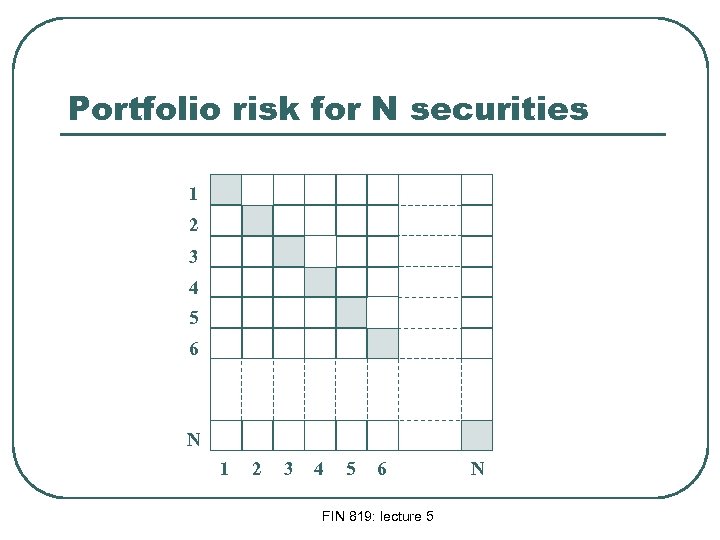
Portfolio risk for N securities 1 2 3 4 5 6 N 1 2 3 4 5 6 FIN 819: lecture 5 N
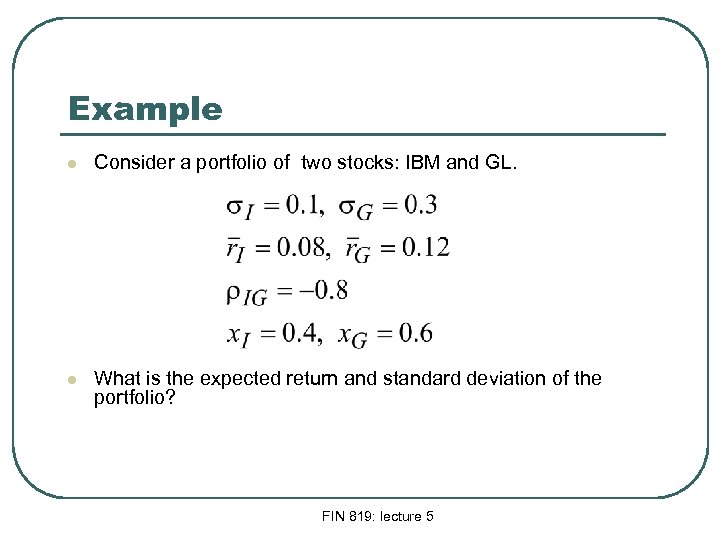
Example l Consider a portfolio of two stocks: IBM and GL. l What is the expected return and standard deviation of the portfolio? FIN 819: lecture 5
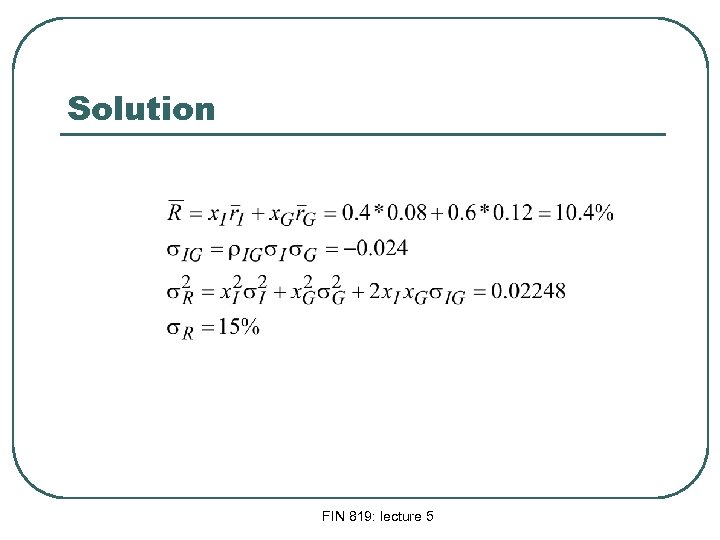
Solution FIN 819: lecture 5
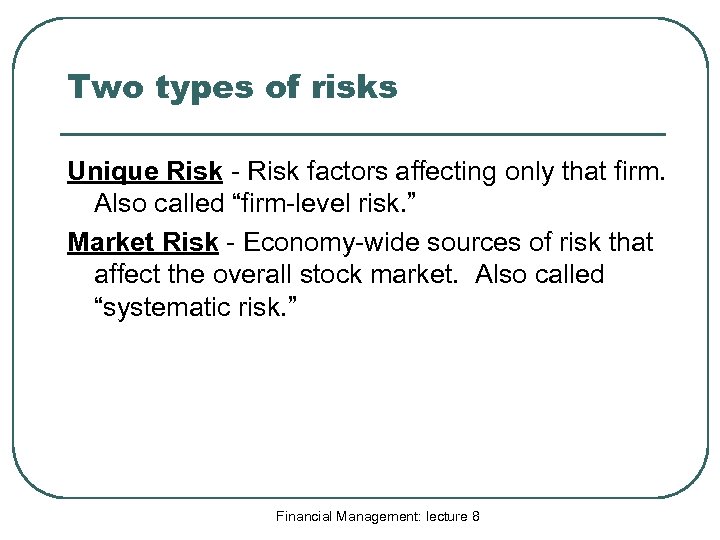
Two types of risks Unique Risk - Risk factors affecting only that firm. Also called “firm-level risk. ” Market Risk - Economy-wide sources of risk that affect the overall stock market. Also called “systematic risk. ” Financial Management: lecture 8
Diversification l What have your observed from the above example • Risk for each individual stock • Risk for your portfolio l l Diversification: put a lot of different assets in a portfolio to reduce risk Why can diversification be used to reduce risk? FIN 819: lecture 5
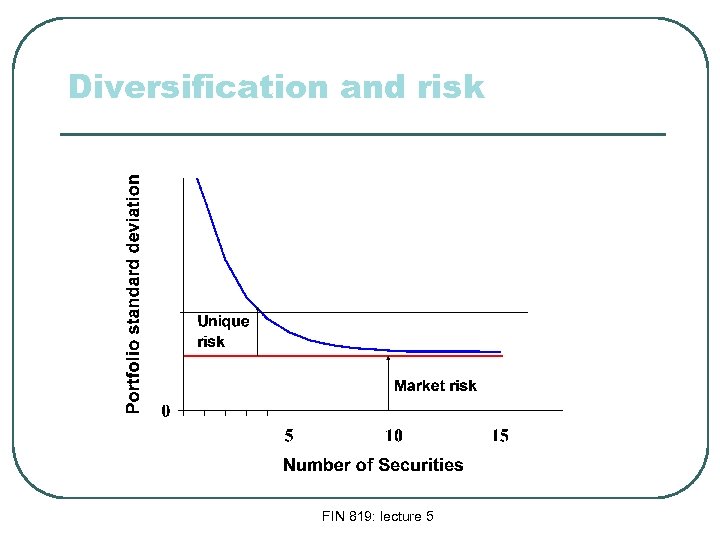
Diversification and risk FIN 819: lecture 5
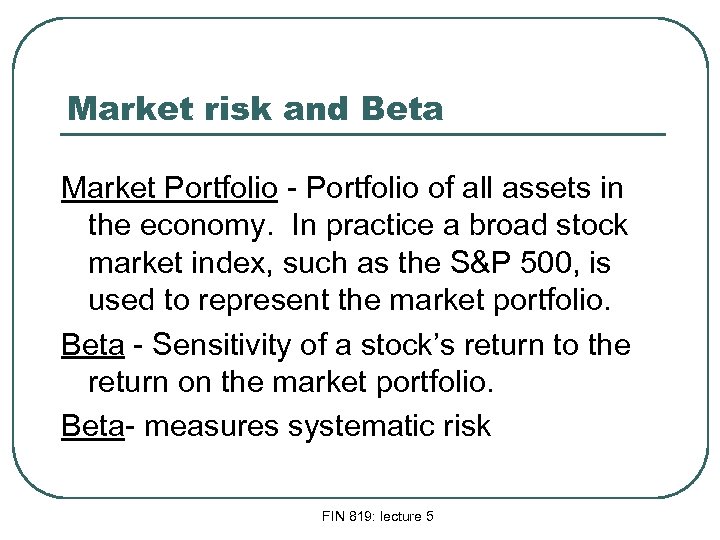
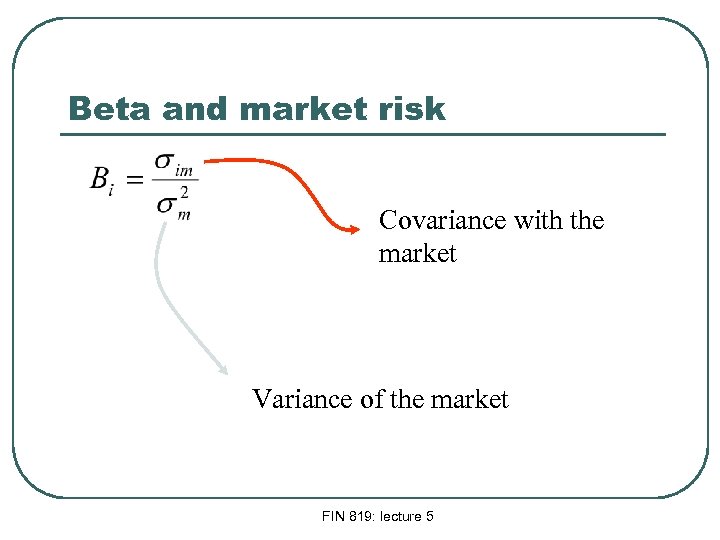
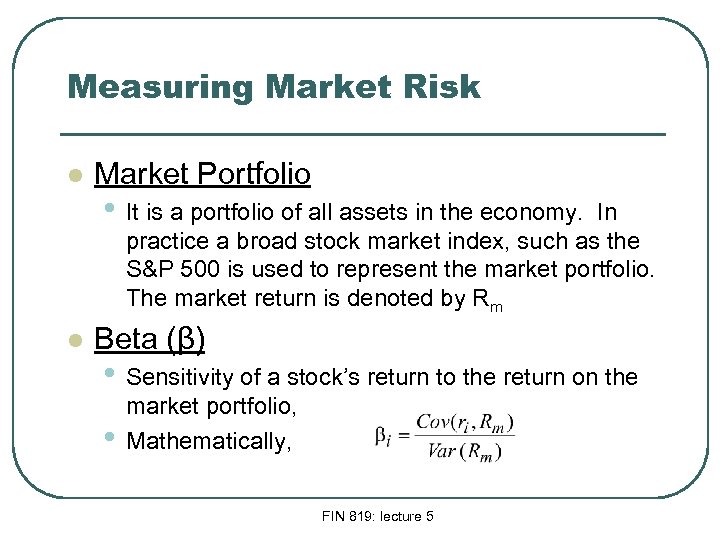
Market risk and Beta Market Portfolio - Portfolio of all assets in the economy. In practice a broad stock market index, such as the S&P 500, is used to represent the market portfolio. Beta - Sensitivity of a stock’s return to the return on the market portfolio. Beta- measures systematic risk FIN 819: lecture 5
Beta and market risk Covariance with the market Variance of the market FIN 819: lecture 5
Some true or false questions 1. A market index is used to measure performance of a broad-based portfolio of stocks. 2. Long-term corporate bonds are riskier than common stocks. 3. If one portfolio's variance exceeds that of another portfolio, its standard deviation will also be greater than that of the other portfolio. 4. Portfolio weights are always positive. FIN 819: lecture 5
Some true or false questions 5. Standard deviation can be calculated as the square of the variance. 6. Market risk can be eliminated in a stock portfolio through diversification. 7. Macro risks are faced by all common stock investors. 8. The risk that remains in a stock portfolio after efforts to diversify is known as unique risk. 9. We use the standard deviation of future stock prices to measure the risk of a stock. FIN 819: lecture 5
Measuring Market Risk l Market Portfolio • It is a portfolio of all assets in the economy. In practice a broad stock market index, such as the S&P 500 is used to represent the market portfolio. The market return is denoted by Rm l Beta (β) • Sensitivity of a stock’s return to the return on the • market portfolio, Mathematically, FIN 819: lecture 5
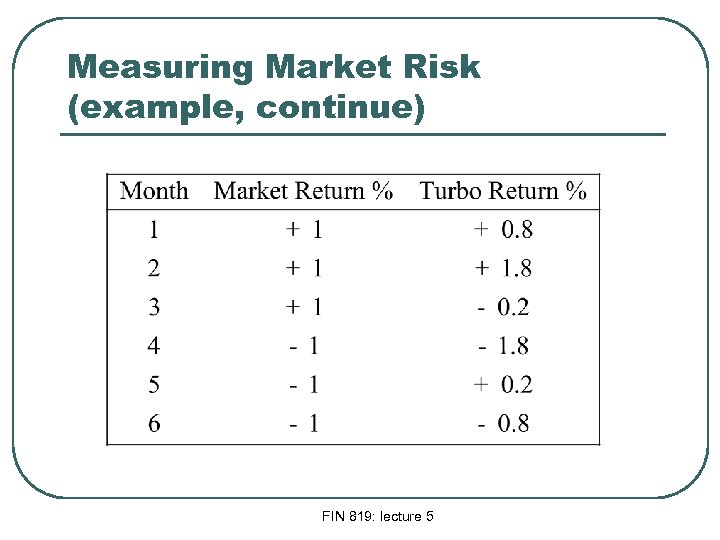
An intuitive example for Beta Turbo Charged Seafood has the following % returns on its stock, relative to the listed changes in the % return on the market portfolio. The beta of Turbo Charged Seafood can be derived from this information. FIN 819: lecture 5
Measuring Market Risk (example, continue) FIN 819: lecture 5
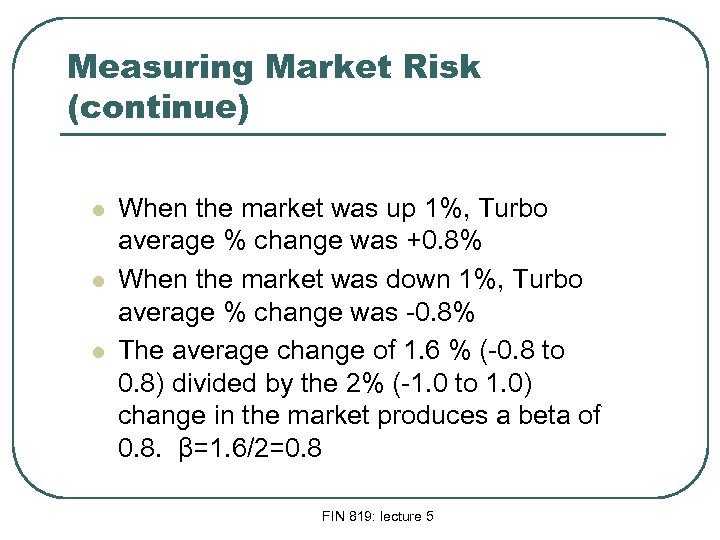
Measuring Market Risk (continue) l l l When the market was up 1%, Turbo average % change was +0. 8% When the market was down 1%, Turbo average % change was -0. 8% The average change of 1. 6 % (-0. 8 to 0. 8) divided by the 2% (-1. 0 to 1. 0) change in the market produces a beta of 0. 8. β=1. 6/2=0. 8 FIN 819: lecture 5
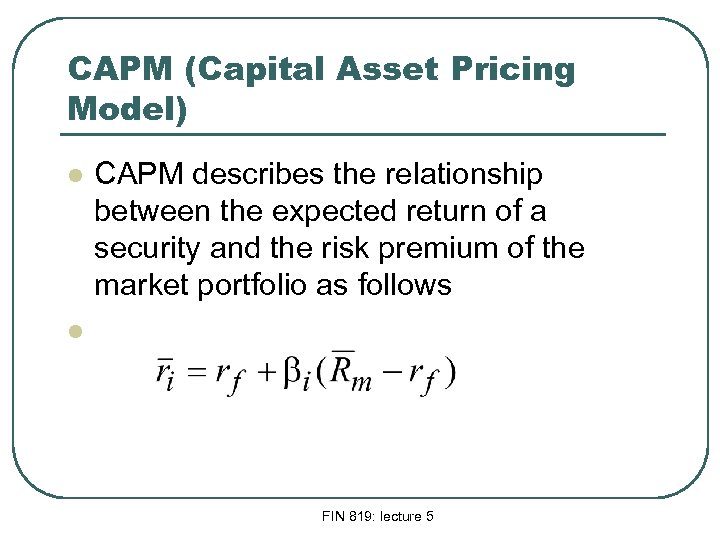
CAPM (Capital Asset Pricing Model) l CAPM describes the relationship between the expected return of a security and the risk premium of the market portfolio as follows l FIN 819: lecture 5
Security Market Line l l l The graph used to describe CAPM is called the security market line In the security market line is drawn in the expected-return-beta plane. Do you know the name of the line drawn in the expected-return-standarddeviation? FIN 819: lecture 5
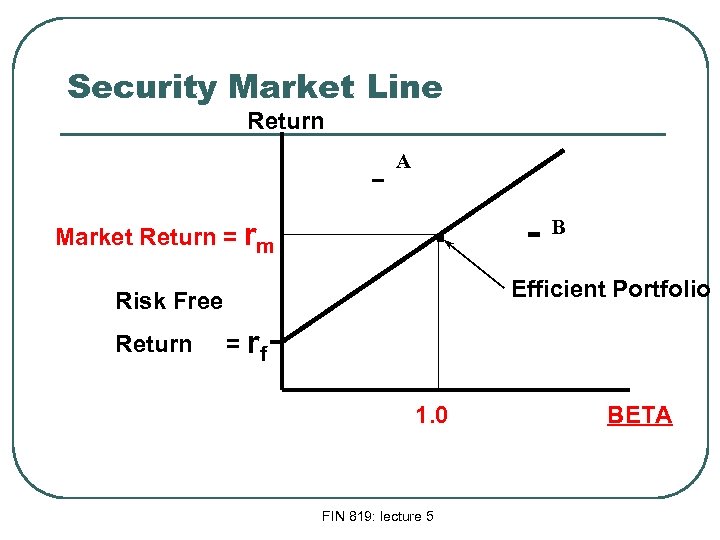
Security Market Line Return A Market Return = rm . Efficient Portfolio Risk Free Return B = rf 1. 0 FIN 819: lecture 5 BETA
Apply CAPM and portfolio theory in capital budgeting l l l So far, we have discussed portfolio diversification theory and the relation between expected returns and risk. Our objective is to use theories to calculate the discount rate for a project a firm may be interested in. Now how can we approach this question? FIN 819: lecture 5
The risk of a project l l l One simple approach to calculate the discount rate of a project to assume that the project to be taken has the same risk as the existing business or assets of the firm Then we can decided what is the required return of the existing business or assets. Then use this rate of return on the existing assets as the discount rate of the project FIN 819: lecture 5
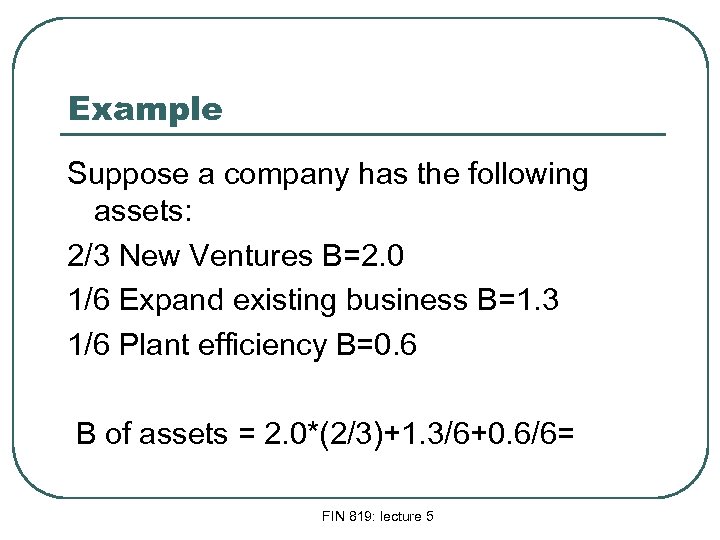
Example Suppose a company has the following assets: 2/3 New Ventures B=2. 0 1/6 Expand existing business B=1. 3 1/6 Plant efficiency B=0. 6 B of assets = 2. 0*(2/3)+1. 3/6+0. 6/6= FIN 819: lecture 5
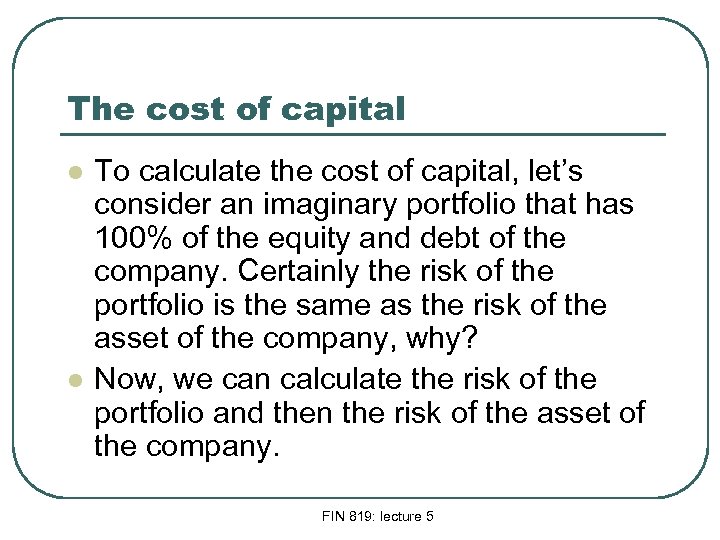
The cost of capital l l To calculate the cost of capital, let’s consider an imaginary portfolio that has 100% of the equity and debt of the company. Certainly the risk of the portfolio is the same as the risk of the asset of the company, why? Now, we can calculate the risk of the portfolio and then the risk of the asset of the company. FIN 819: lecture 5
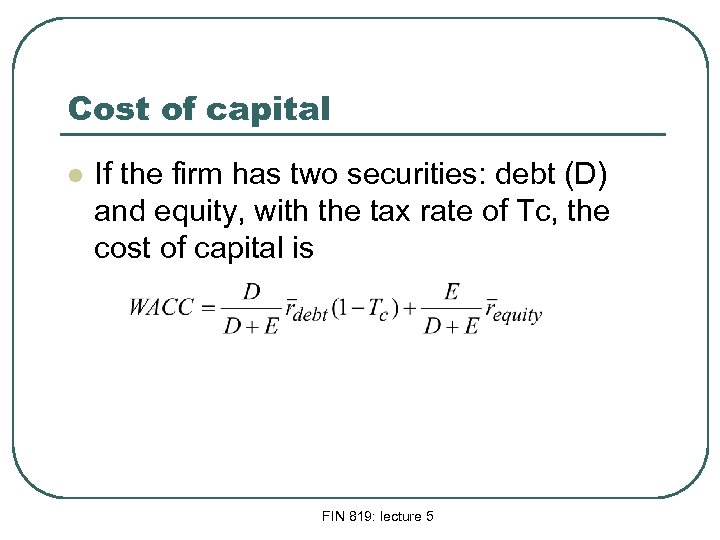
Cost of capital l If the firm has two securities: debt (D) and equity, with the tax rate of Tc, the cost of capital is FIN 819: lecture 5
How does debt financing affect the risk of equity? l When firms issue debt, the introduced financial risk impacts the risk of equity l To understand how financing affects equity risk, we will introduce several variables. FIN 819: lecture 6
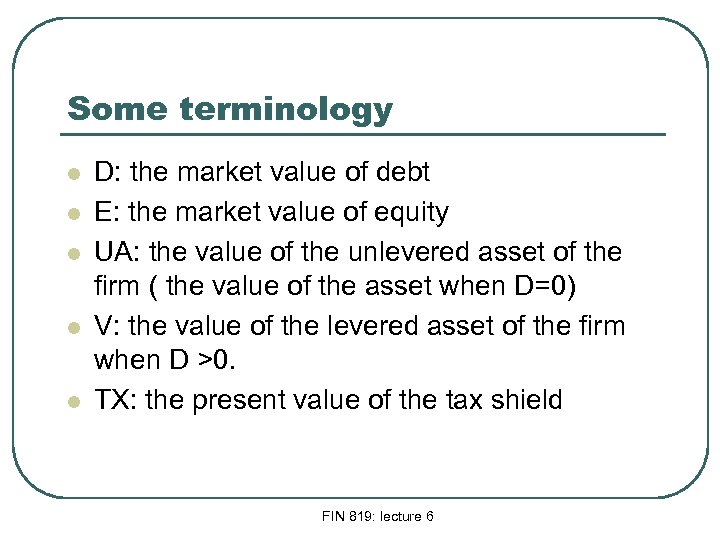
Some terminology l l l D: the market value of debt E: the market value of equity UA: the value of the unlevered asset of the firm ( the value of the asset when D=0) V: the value of the levered asset of the firm when D >0. TX: the present value of the tax shield FIN 819: lecture 6
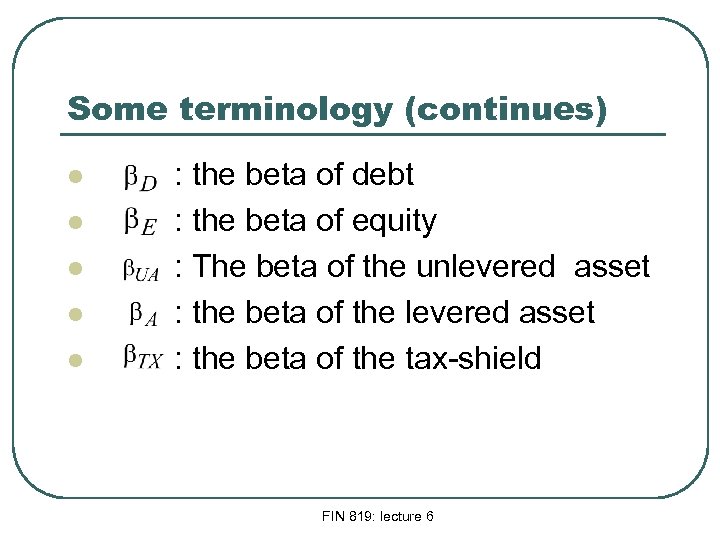
Some terminology (continues) l l l : the beta of debt : the beta of equity : The beta of the unlevered asset : the beta of the tax-shield FIN 819: lecture 6
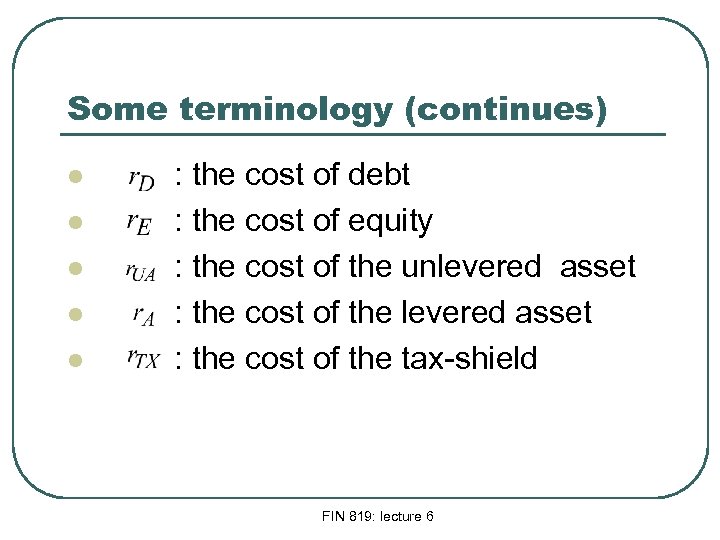
Some terminology (continues) l l l : the cost of debt : the cost of equity : the cost of the unlevered asset : the cost of the tax-shield FIN 819: lecture 6
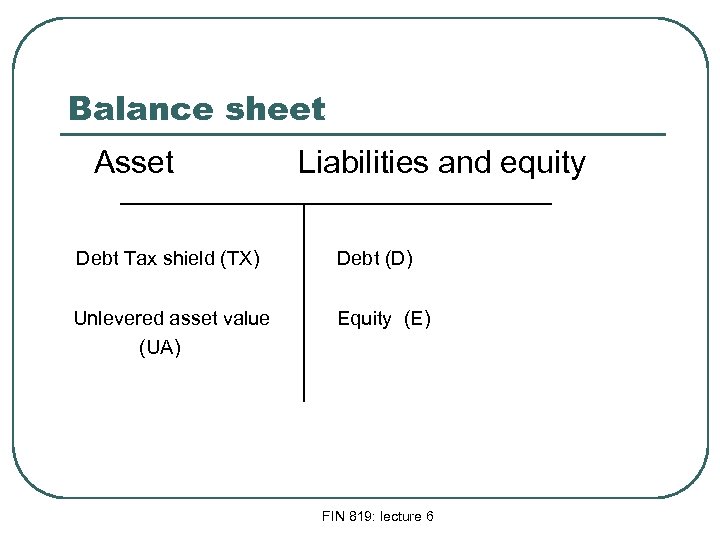
Balance sheet Asset Liabilities and equity Debt Tax shield (TX) Debt (D) Unlevered asset value (UA) Equity (E) FIN 819: lecture 6
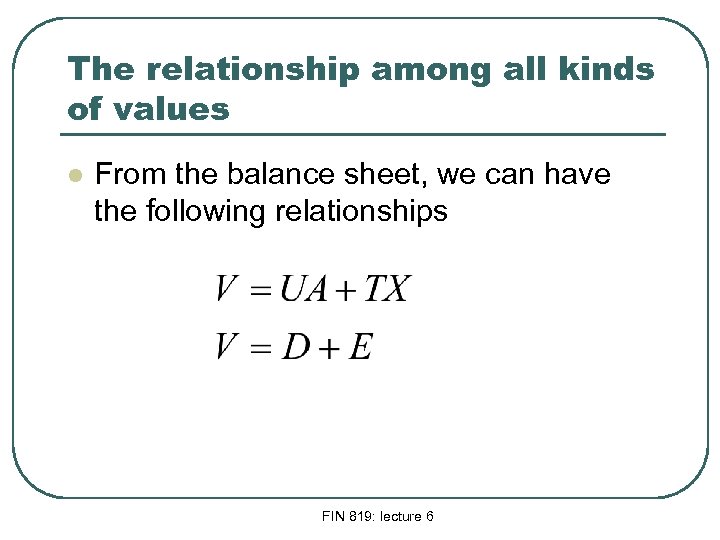
The relationship among all kinds of values l From the balance sheet, we can have the following relationships FIN 819: lecture 6
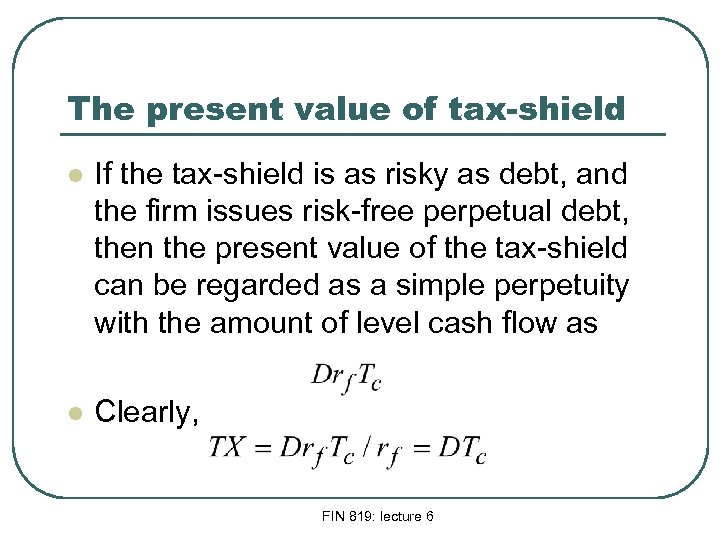
The present value of tax-shield l If the tax-shield is as risky as debt, and the firm issues risk-free perpetual debt, then the present value of the tax-shield can be regarded as a simple perpetuity with the amount of level cash flow as l Clearly, FIN 819: lecture 6
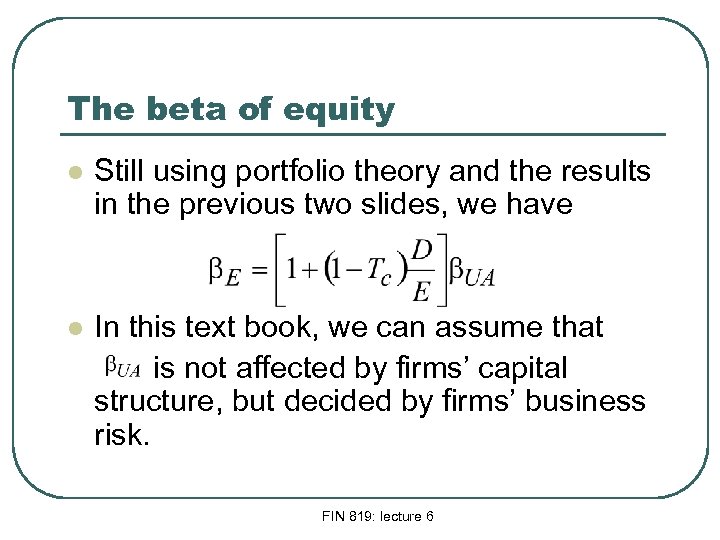
The beta of equity l Still using portfolio theory and the results in the previous two slides, we have l In this text book, we can assume that is not affected by firms’ capital structure, but decided by firms’ business risk. FIN 819: lecture 6
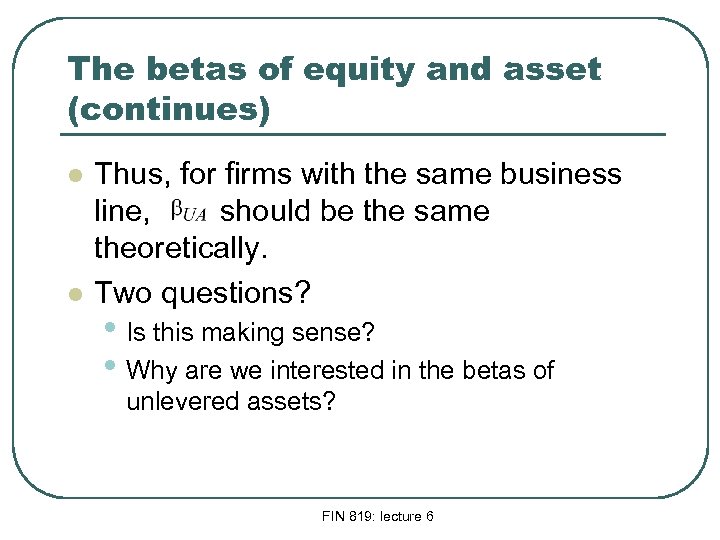
The betas of equity and asset (continues) l l Thus, for firms with the same business line, should be the same theoretically. Two questions? • Is this making sense? • Why are we interested in the betas of unlevered assets? FIN 819: lecture 6
An important question to think? l In the textbook, the authors also introduce a way to calculate the unlevered and levered betas or costs, how do you like their idea? Why or why not? FIN 819: lecture 6
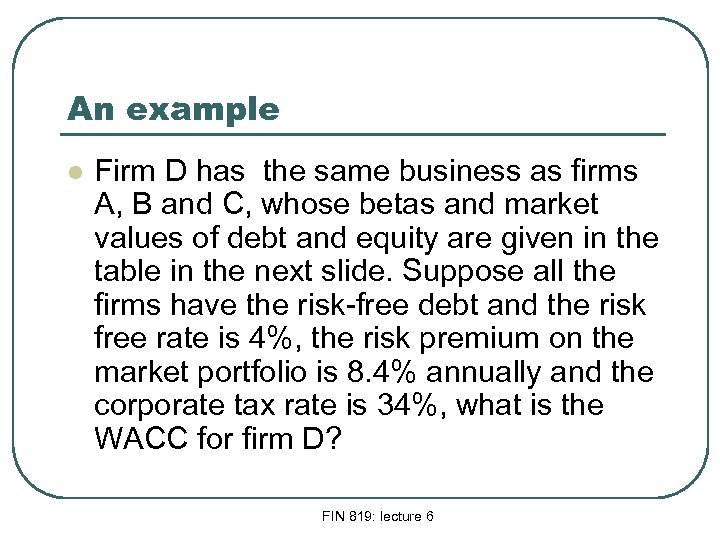
An example l Firm D has the same business as firms A, B and C, whose betas and market values of debt and equity are given in the table in the next slide. Suppose all the firms have the risk-free debt and the risk free rate is 4%, the risk premium on the market portfolio is 8. 4% annually and the corporate tax rate is 34%, what is the WACC for firm D? FIN 819: lecture 6
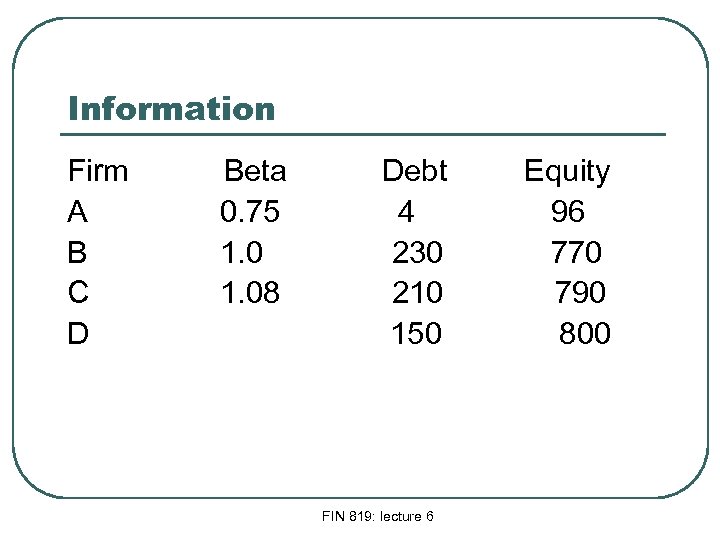
Information Firm A B C D Beta 0. 75 1. 08 Debt 4 230 210 150 FIN 819: lecture 6 Equity 96 770 790 800
Скачать презентацию Bond Valuation Risk and Cost of Capital and
ed3364bd97e8abc29b8bdc807f6cd494.ppt