 Скачать презентацию BOARD OF STUDIES IN ARABIC REGULATIONS FOR
cbc7b43ee3977568e039b0e7da83def8.ppt
- Количество слайдов: 48




BOARD OF STUDIES IN ARABIC
REGULATIONS FOR THE FIRST DEGREE PROGRAMME (FDP) UNDER THE CHOICE BASED CREDIT & SEMESTER SYSTEM (CBCS) IN THE AFFLIATED COLLEGES 2009 FROM THE ACADEMIC YEAR 2010 -11
RESTRUCTURING UG EDUCATION The U G reforms through: - • 1. SEMESTERISATION • 2. CHOICE BASED CREDITS • 3. CONTINUOUS EVALUATION • 4. GRADING
SEMESTER • A term consisting of a min. of 90 working days distributed over a min. of 18 weeks (5 months inclusive of exam. Days ie, 450 hours of instructions) • Academic year is divided into two semesters • Odd Semesters from June to October • Even Semesters from December to April • (1 month leave in November & May ) • For a programme min. 6 semesters & not more than 12 continuous semesters
SEMESTER SYSTEM (1) • More focused learning through manageable modules • Comprehensive coverage of topics of study • Greater depth of study • Less demand of massive memory recall
SEMESTER SYSTEM (2) • Evaluation within a short span of time • Thorough assessment during each semester • More productive learning environment • Feedback for the appraisal of students level for improvement
SEMESTER SYSTEM (3) • Mechanism for effective grievance redressal • Scope for new addition of emerging areas of learning • Selection of multi-disciplinary courses • Good platform for continuous assessment
SEMESTER SYSTEM (4) • Opportunity to select subject combinations • Platform for choice based credits • Freedom for redesigning curriculum at regular intervals • Inclusion of self study components
SEMESTER SYSTEM (5) • Cultivating skill development: critical thinking, creative ability and communicative competence • Relevant need based education for employment • Transformation in teaching and learning practices
CREDITS • Systematic way of describing educational programme • Credit is a quantum of instructional package • Credits reflect the quantity of work each component requires to achieve specific objectives
COURSE - CREDIT SYSTEM • Papers will be referred as “Courses” • Course will be referred as “Programme” • Not every course is treated equal • Courses have weightages • Weightages are credits
CREDIT UNITS • Credit is measured in units • A credit unit reflects the time spent for study during a semester • Each credit hour is roughly equivalent to one hour of class time per week in a semester
DISTRIBUTION OF CREDITS (1) • Credits spreads through different courses in a programme • Students will be permitted to graduate by accumulating specified credits
DISTRIBUTION OF CREDITS (2) • Students can select certain courses on their Choice • Choice is based on their needs and interest and on the availability of courses in the institution
No. OF CREDITS IN FDP • The three year under graduate programme in 6 Semesters consist with a minimum of 120 credits spreads through a minimum of 30 courses • Each Course be designed through lectures/ tutorials/ laboratory or field work/ seminar/ practical training/ assignments/ extension activities
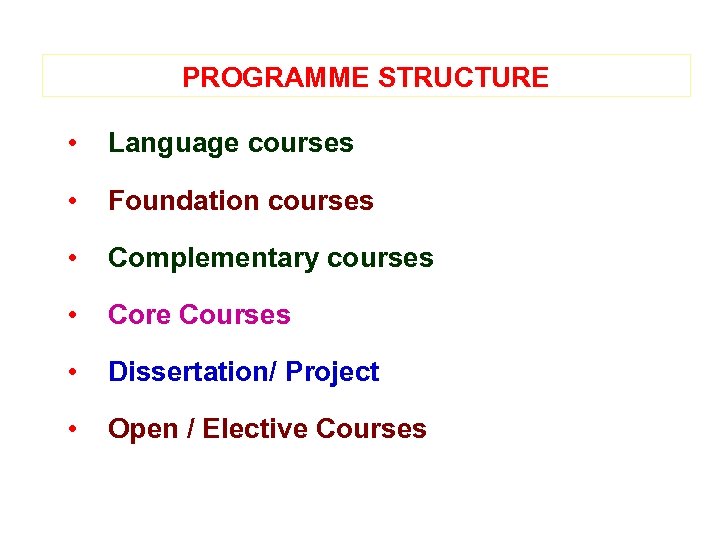
PROGRAMME STRUCTURE • Language courses • Foundation courses • Complementary courses • Core Courses • Dissertation/ Project • Open / Elective Courses
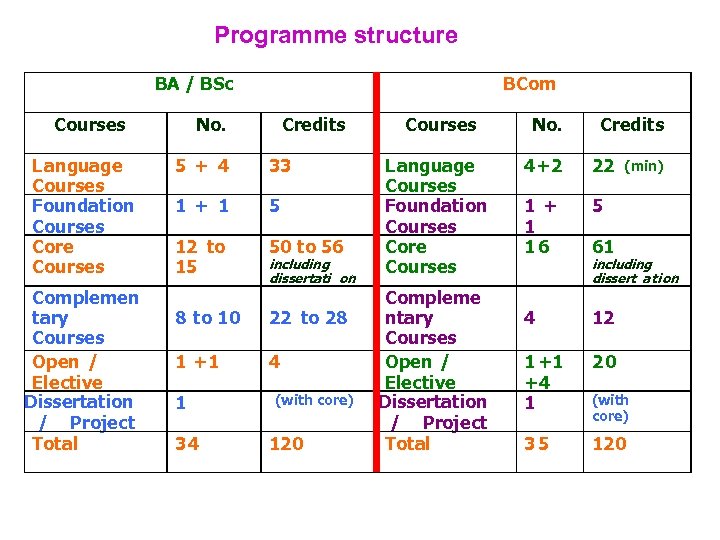
Programme structure BA / BSc Courses Language Courses Foundation Courses Core Courses Complemen tary Courses Open / Elective Dissertation / Project Total BCom No. Credits 5 + 4 33 1 + 1 5 12 to 15 50 to 56 including dissertati on 8 to 10 22 to 28 1 +1 4 1 34 (with core) 120 Courses No. Language Courses Foundation Courses Core Courses 4+2 22 1+ 1 16 5 4 12 1 +1 +4 1 20 35 120 Compleme ntary Courses Open / Elective Dissertation / Project Total Credits (min) 61 including dissert ati on (with core)
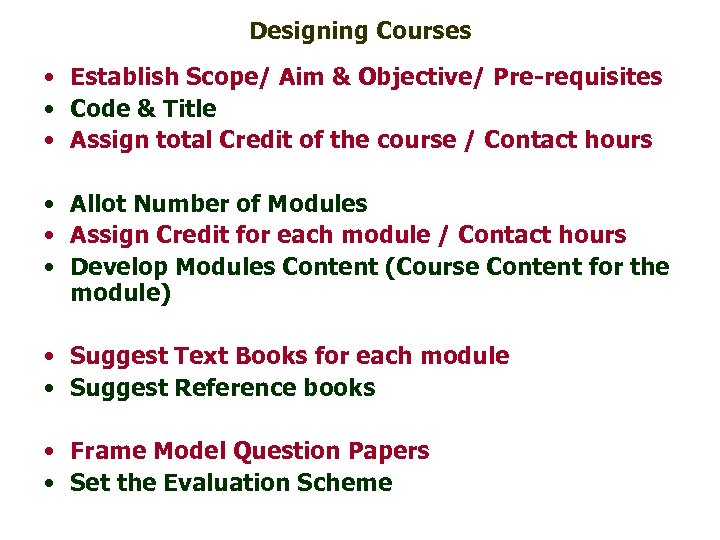
Designing Courses • Establish Scope/ Aim & Objective/ Pre-requisites • Code & Title • Assign total Credit of the course / Contact hours • Allot Number of Modules • Assign Credit for each module / Contact hours • Develop Modules Content (Course Content for the module) • Suggest Text Books for each module • Suggest Reference books • Frame Model Question Papers • Set the Evaluation Scheme
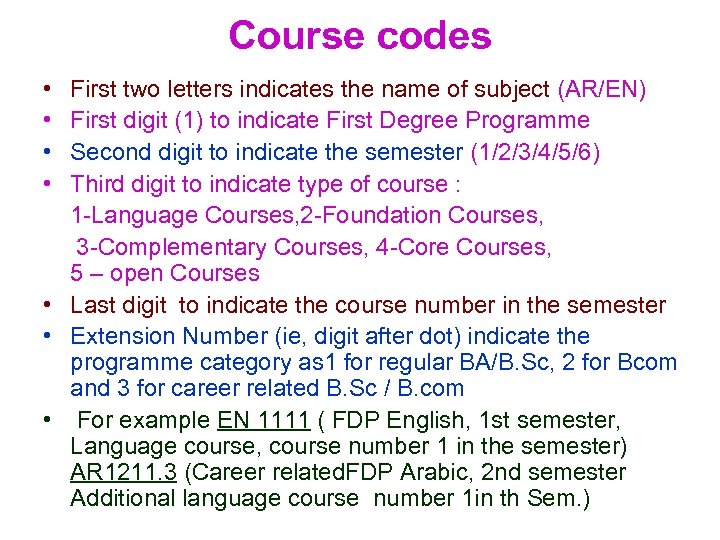
Course codes • • First two letters indicates the name of subject (AR/EN) First digit (1) to indicate First Degree Programme Second digit to indicate the semester (1/2/3/4/5/6) Third digit to indicate type of course : 1 -Language Courses, 2 -Foundation Courses, 3 -Complementary Courses, 4 -Core Courses, 5 – open Courses • Last digit to indicate the course number in the semester • Extension Number (ie, digit after dot) indicate the programme category as 1 for regular BA/B. Sc, 2 for Bcom and 3 for career related B. Sc / B. com • For example EN 1111 ( FDP English, 1 st semester, Language course, course number 1 in the semester) AR 1211. 3 (Career related. FDP Arabic, 2 nd semester Additional language course number 1 in th Sem. )
CO-CURRICULAR ACTIVITIES § The student registering for Sports/ Arts/NCC/NSS / shall get Grace Grade
Social Service / Extension Activity • Mandatory for all students • Social Service / Extension Activities, not less than forty hours, during third and fourth semester
Audit Courses • Courses for more than the stated number may be obtained through Audit Courses • Audit Courses has zero credits
Dissertation / project • Report in duplicate before sixth semester • No continuous assessment • External evaluation by two examiners • It can be done either individually or by a group of not exceeding five students. How ever viva shall be conducted individually. • Not more than fifteen students shall be assigned to a teacher for supervisory works
Faculty Advisor • The teacher from the dept. which offer Major Course • To advise students in academic matters • Each student shall register for the courses in the prescribed registration form in consultation with the faculty Advisor within two weeks from the commencement of each semester
Monitoring of the Programme Monitoring by three levels: • DLMC- Ho. D & all teachers of the dept. • CLMC- principal & Ho. Ds & elected representatives of teachers in the college council • ULMC- PVC, Member Syndicate, Dean, CE, DCDC, Member Syndicate (Student), A member of Academic council
EVALUATION BY: • CONTINUOUS EVALUATION ( CE ) and • END SEMESTER EVALUATION ( ESE ) • Ratio between CE & ESE be 1 : 3
EVALUATION: - GRADING • The performance in a course / programme be assessed, represented in terms of grades • Grades indicate the level of a student’s performance • Direct grading with five point scale and certification by seven point scale • Grade letters be A, B, C, D, E
MECHANICS OF DIRECT GRADING • Assessment of quality on a five point scale for each question • Assigning weightage depending on the nature of the question • Calculation of weighted average § Certification on a seven point scale
PROCESS OF DIRECT GRADING(1) • Each answer is graded with letters • Weightage is then given based on the range of the question • Grades and weightages are assigned numerical values • The weighted grade points arrived by multiplying grade points by weightage
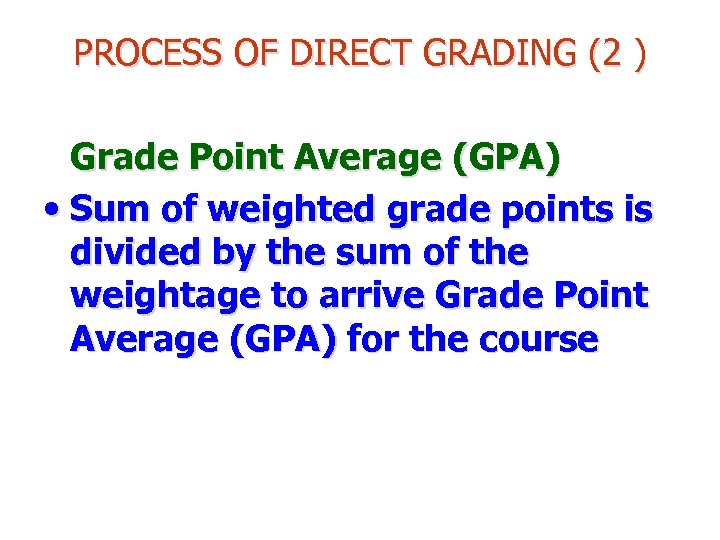
PROCESS OF DIRECT GRADING (2 ) Grade Point Average (GPA) • Sum of weighted grade points is divided by the sum of the weightage to arrive Grade Point Average (GPA) for the course
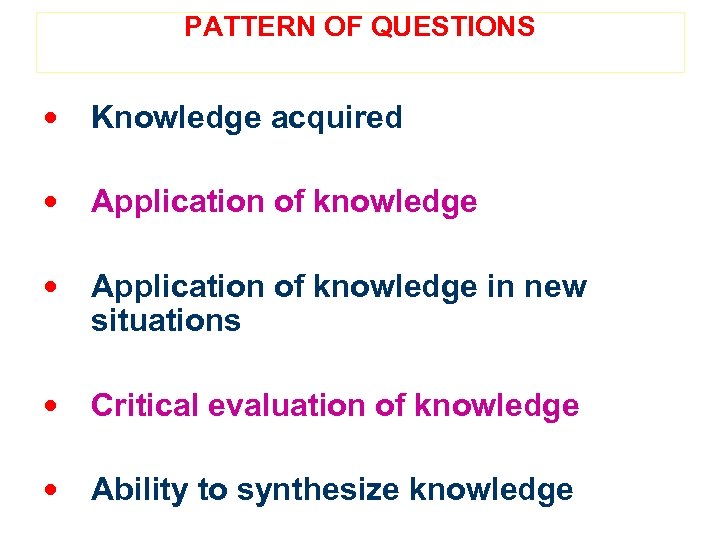
PATTERN OF QUESTIONS • Knowledge acquired • Application of knowledge in new situations • Critical evaluation of knowledge • Ability to synthesize knowledge
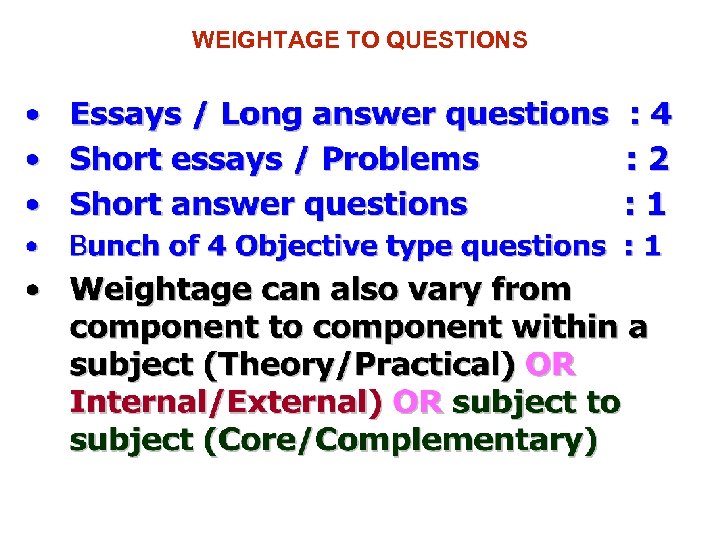
WEIGHTAGE TO QUESTIONS
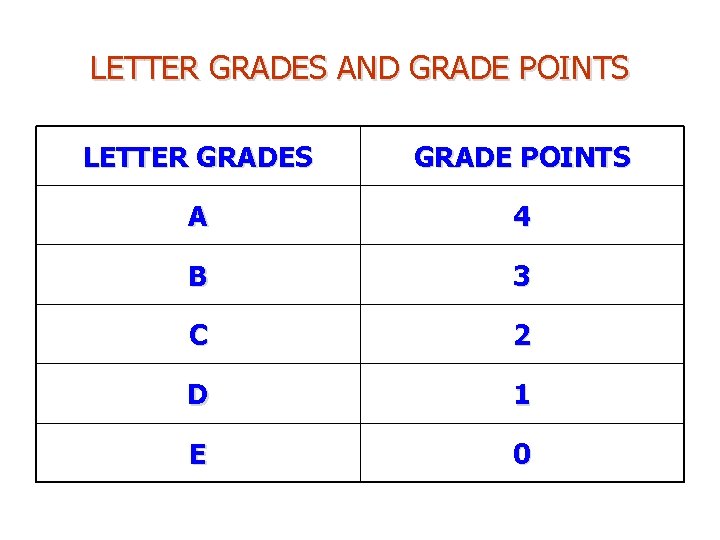
LETTER GRADES AND GRADE POINTS LETTER GRADES GRADE POINTS A 4 B 3 C 2 D 1 E 0
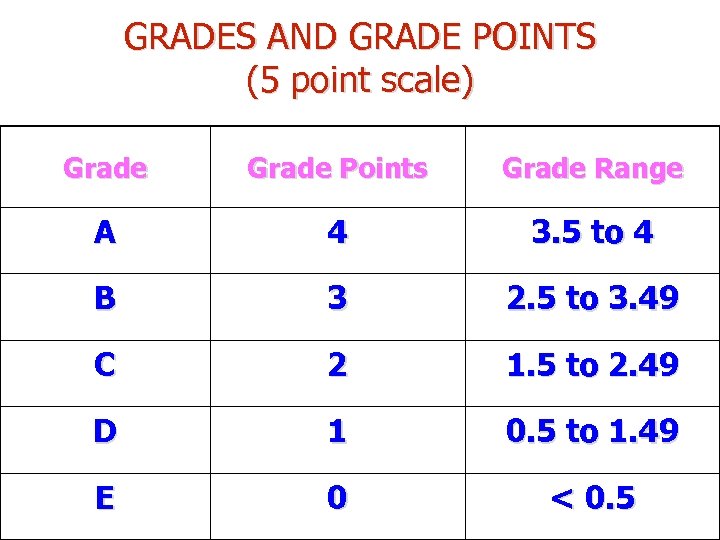
GRADES AND GRADE POINTS (5 point scale) Grade Points Grade Range A 4 3. 5 to 4 B 3 2. 5 to 3. 49 C 2 1. 5 to 2. 49 D 1 0. 5 to 1. 49 E 0 < 0. 5
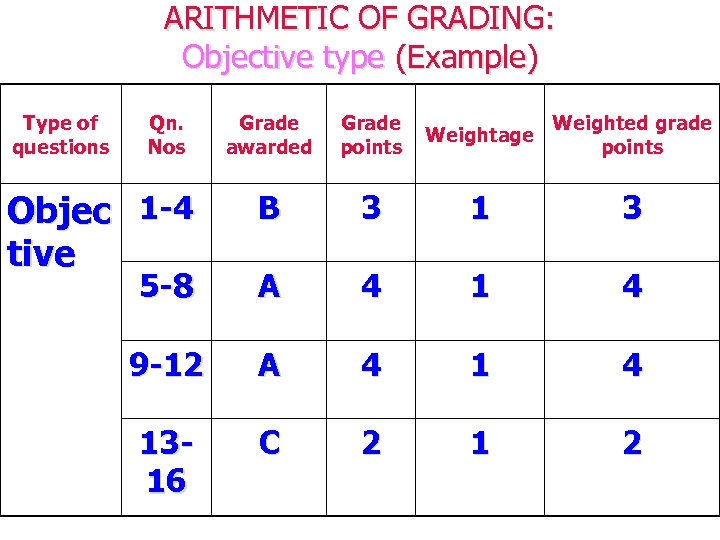
ARITHMETIC OF GRADING: Objective type (Example) Type of questions Qn. Nos Grade awarded Grade points Weightage Weighted grade points B 3 1 3 5 -8 A 4 1 4 9 -12 A 4 1316 C 2 1 2 Objec 1 -4 tive
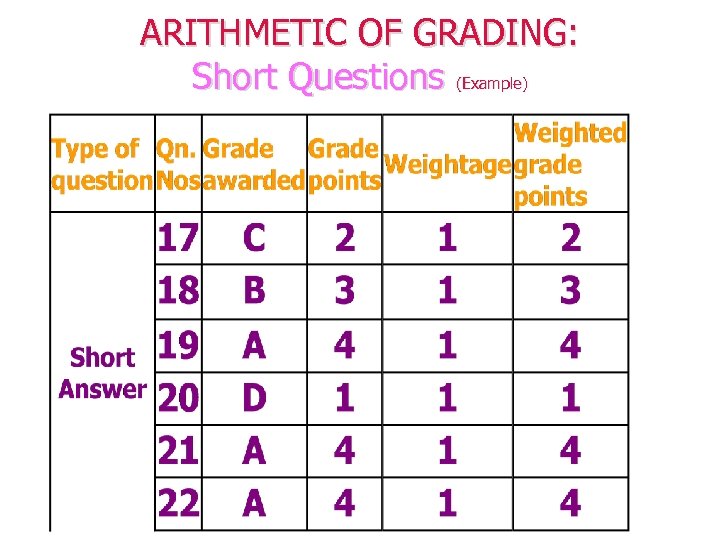
ARITHMETIC OF GRADING: Short Questions (Example)
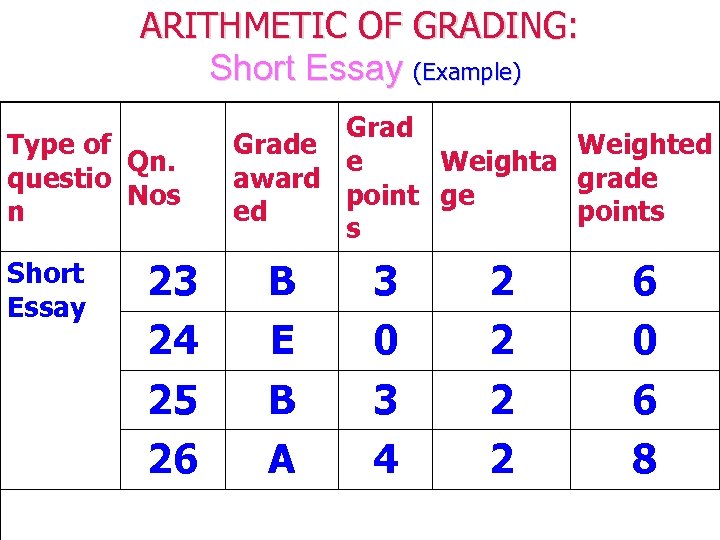
ARITHMETIC OF GRADING: Short Essay (Example) Type of Qn. questio Nos n Short Essay 23 24 25 26 Grade Weighted Weighta e award grade point ge ed points s B E B A 3 0 3 4 2 2 6 0 6 8
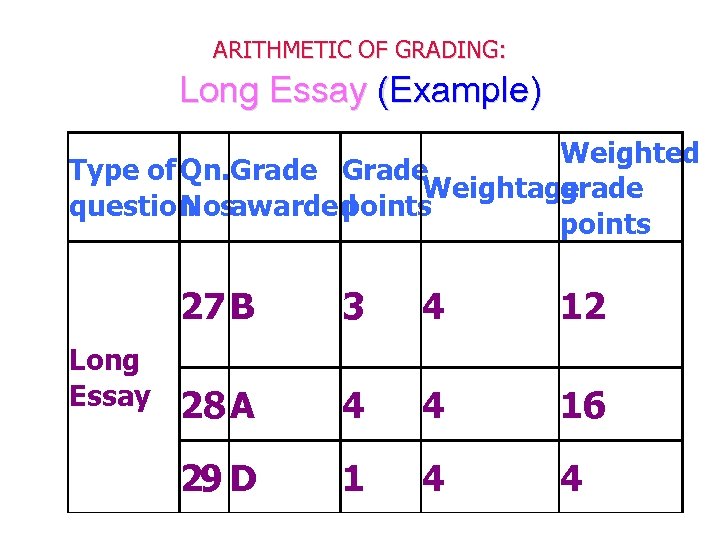
ARITHMETIC OF GRADING: Long Essay (Example) Weighted Type of Qn. Grade Weightage grade question awarded Nos points 27 B Long Essay 3 4 12 28 A 4 4 16 29 D 1 4 4
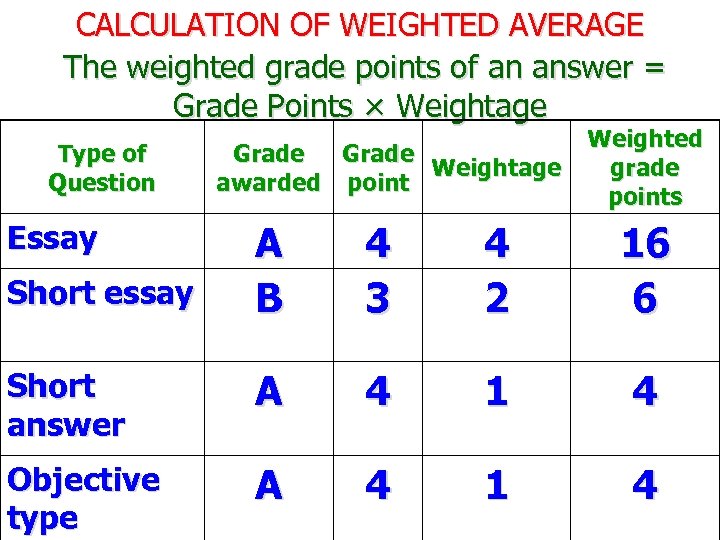
CALCULATION OF WEIGHTED AVERAGE The weighted grade points of an answer = Grade Points × Weightage Type of Question Grade Weightage awarded point Weighted grade points A B 4 3 4 2 16 6 Short answer A 4 1 4 Objective type A 4 1 4 Essay Short essay
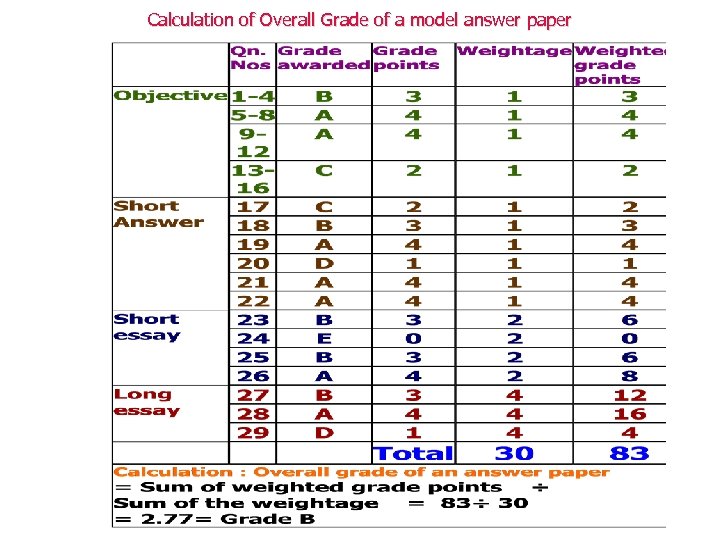
Calculation of Overall Grade of a model answer paper
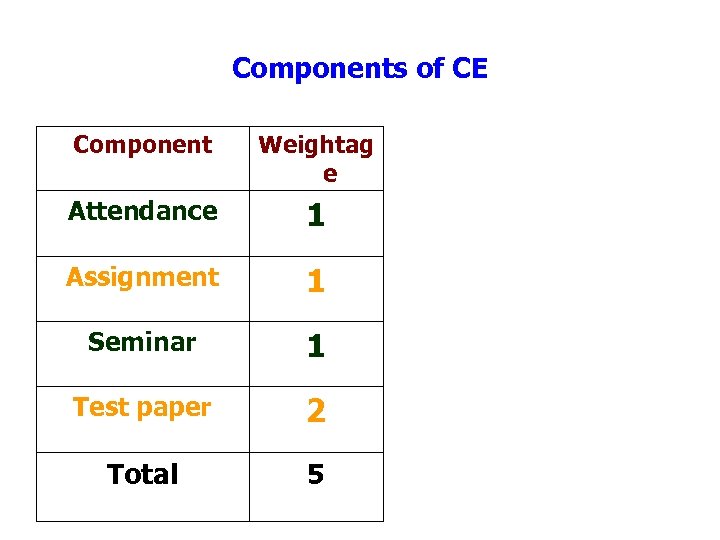
Components of CE Component Weightag e Attendance 1 Assignment 1 Seminar 1 Test paper 2 Total 5
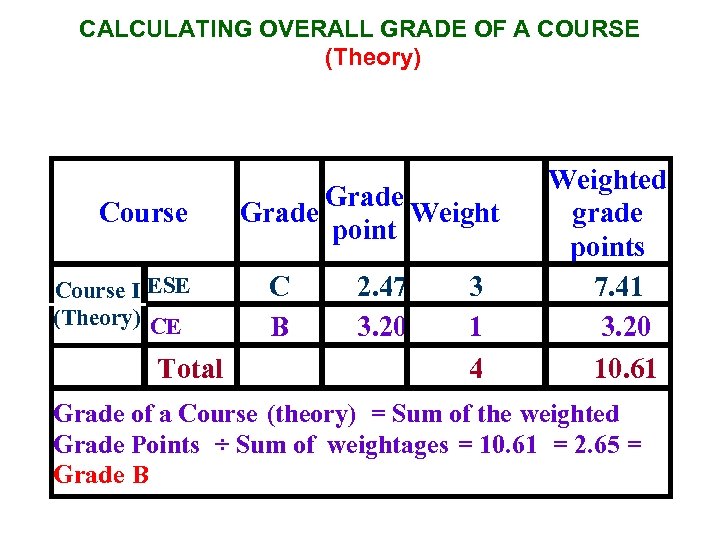
CALCULATING OVERALL GRADE OF A COURSE (Theory) Course I ESE (Theory) CE Total Grade Weight point C B 2. 47 3. 20 3 1 4 Weighted grade points 7. 41 3. 20 10. 61 Grade of a Course (theory) = Sum of the weighted Grade Points ÷ Sum of weightages = 10. 61 = 2. 65 = Grade B
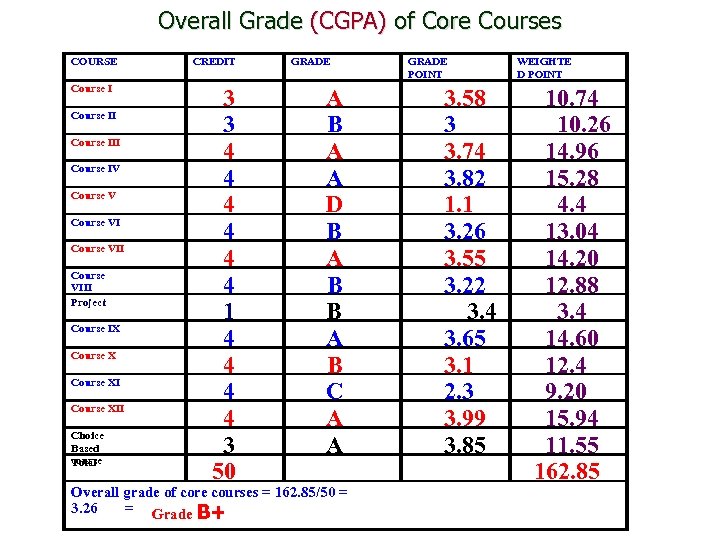
Overall Grade (CGPA) of Core Courses COURSE Course III Course IV Course VIII Project Course IX Course XII Choice Based course Total CREDIT 3 3 4 4 4 1 4 4 3 50 GRADE A B A A D B A B C A A Overall grade of core courses = 162. 85/50 = 3. 26 = Grade B+ GRADE POINT 3. 58 3 3. 74 3. 82 1. 1 3. 26 3. 55 3. 22 3. 4 3. 65 3. 1 2. 3 3. 99 3. 85 WEIGHTE D POINT 10. 74 10. 26 14. 96 15. 28 4. 4 13. 04 14. 20 12. 88 3. 4 14. 60 12. 4 9. 20 15. 94 11. 55 162. 85
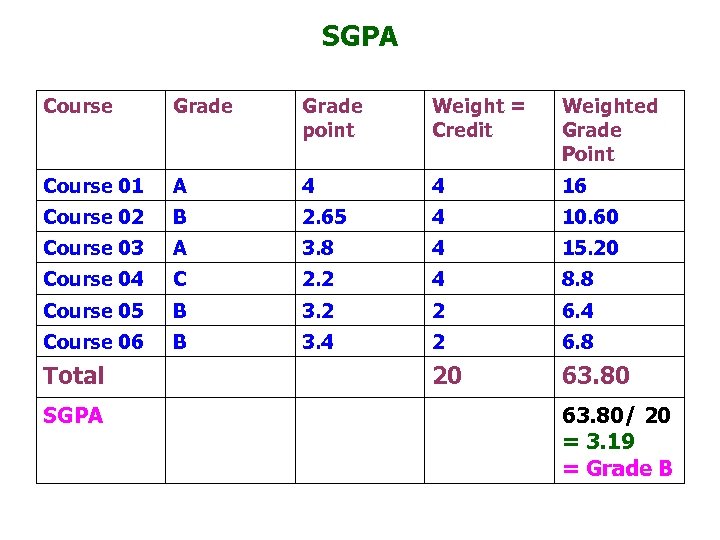
SGPA Course Grade point Weight = Credit Weighted Grade Point Course 01 A 4 4 16 Course 02 B 2. 65 4 10. 60 Course 03 A 3. 8 4 15. 20 Course 04 C 2. 2 4 8. 8 Course 05 B 3. 2 2 6. 4 Course 06 B 3. 4 2 6. 8 20 63. 80 Total SGPA 63. 80/ 20 = 3. 19 = Grade B
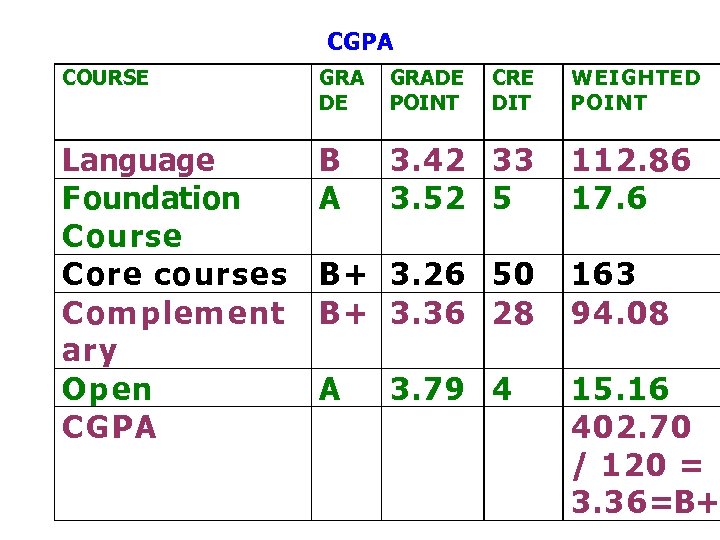
CGPA COURSE GRA DE GRADE POINT CRE DIT Language Foundation Course Core courses Com plem ent ary O pen CGPA B A 3. 42 33 3. 52 5 W EIGHTED POINT 112. 86 17. 6 B+ 3. 26 50 B+ 3. 36 28 163 94. 08 A 15. 16 402. 70 / 120 = 3. 36=B+ 3. 79 4
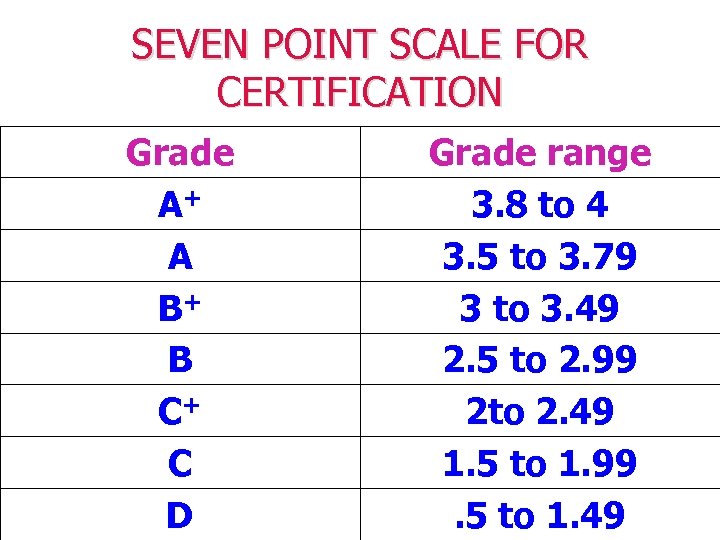
SEVEN POINT SCALE FOR CERTIFICATION Grade A+ A B+ B C+ C D Grade range 3. 8 to 4 3. 5 to 3. 79 3 to 3. 49 2. 5 to 2. 99 2 to 2. 49 1. 5 to 1. 99. 5 to 1. 49
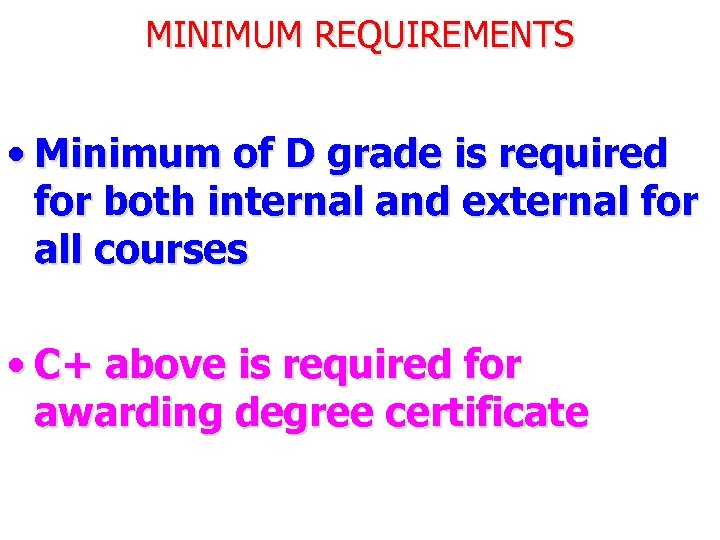
MINIMUM REQUIREMENTS • Minimum of D grade is required for both internal and external for all courses • C+ above is required for awarding degree certificate
 Скачать презентацию BOARD OF STUDIES IN ARABIC REGULATIONS FOR
cbc7b43ee3977568e039b0e7da83def8.ppt