 Скачать презентацию BM_M 0050 GSLM 54700 Purchasing and Supply Management 1
8080d5c30804461b43ba6990bbaf8473.ppt
- Количество слайдов: 43



BM_M 0050/GSLM 54700 Purchasing and Supply Management 1
Outline è What to Teach and How to Teach è House-keeping Issues è Importance of Purchasing and Supply Management è è observations from Industrial Statistics è observations from Business Operations è è observations from news observations from Companies An Overview of Purchasing è è factors, process, types, levels and issues Evolution of Purchasing and SCM 2
What and How to Teach? è introduce purchasing and supply management è processes, modes, and interactions among various players in a supply chain è illustrate with industrial cases and practices è stimulate students to think about subtleties and to ask questions instead of feeding facts 3
House-keeping Issues 4
House-Keeping Issues è Course Webpage è Course Outline 5
Importance of Purchasing and Supply Management Observations from News 6
Meaty and Spicy Positions è Suppose that you ask a person working in High-Tech: Which position in a company è (1) is most likely to a pay a crucial role, to some extent meaty and spicy è (2) has most confidence from the boss, and è (3) most commanding in interaction with outside 7
Meaty and Spicy Positions è according to商業周刊1369期 p 44 -46,80% to 90% of persons working in High-Tech would say that the position is purchasing è a key person in a procurement committee detained for allegedly bribery of NT$100 mill è legal income (stock, salary, and bonus) in 15 years: NT$600 mill 8
Importance of Purchasing and Supply Management Observations from Industrial Statistics 9
Simple Question è Total Cost of Material / Value of Shipments = ? ? ? 10
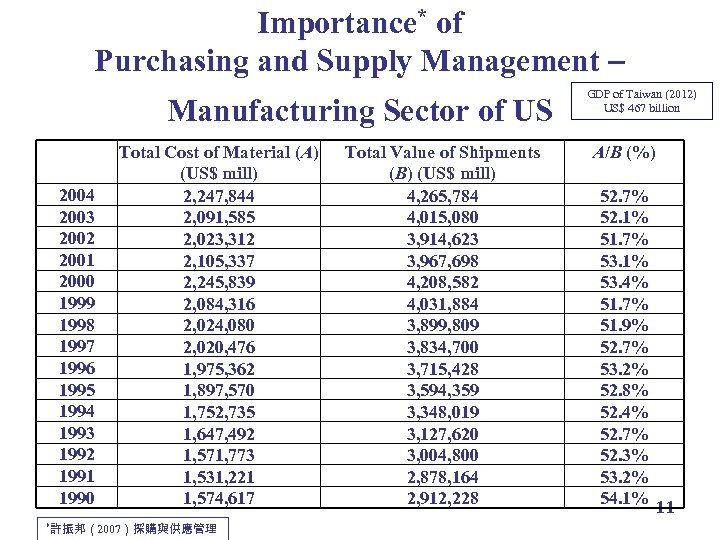
Importance* of Purchasing and Supply Management Manufacturing Sector of US 2004 2003 2002 2001 2000 1999 1998 1997 1996 1995 1994 1993 1992 1991 1990 Total Cost of Material (A) (US$ mill) 2, 247, 844 2, 091, 585 2, 023, 312 2, 105, 337 2, 245, 839 2, 084, 316 2, 024, 080 2, 020, 476 1, 975, 362 1, 897, 570 1, 752, 735 1, 647, 492 1, 571, 773 1, 531, 221 1, 574, 617 *許振邦(2007)採購與供應管理 Total Value of Shipments (B) (US$ mill) 4, 265, 784 4, 015, 080 3, 914, 623 3, 967, 698 4, 208, 582 4, 031, 884 3, 899, 809 3, 834, 700 3, 715, 428 3, 594, 359 3, 348, 019 3, 127, 620 3, 004, 800 2, 878, 164 2, 912, 228 GDP of Taiwan (2012) US$ 467 billion A/B (%) 52. 7% 52. 1% 51. 7% 53. 1% 53. 4% 51. 7% 51. 9% 52. 7% 53. 2% 52. 8% 52. 4% 52. 7% 52. 3% 53. 2% 54. 1% 11
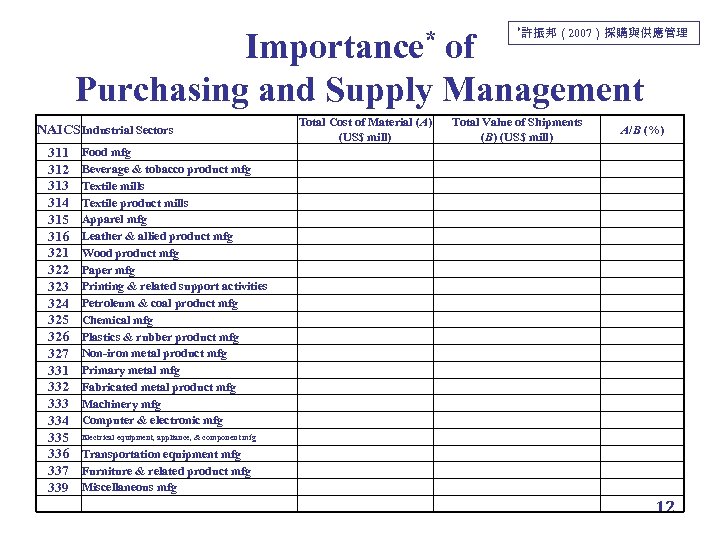
Importance* *許振邦(2007)採購與供應管理 of Purchasing and Supply Management NAICS Industrial Sectors 311 312 313 314 315 316 321 322 323 324 325 326 327 331 332 333 334 335 336 337 339 Total Cost of Material (A) (US$ mill) Total Value of Shipments (B) (US$ mill) A/B (%) Food mfg Beverage & tobacco product mfg Textile mills Textile product mills Apparel mfg Leather & allied product mfg Wood product mfg Paper mfg Printing & related support activities Petroleum & coal product mfg Chemical mfg Plastics & rubber product mfg Non-iron metal product mfg Primary metal mfg Fabricated metal product mfg Machinery mfg Computer & electronic mfg Electrical equipment, appliance, & component mfg Transportation equipment mfg Furniture & related product mfg Miscellaneous mfg 12
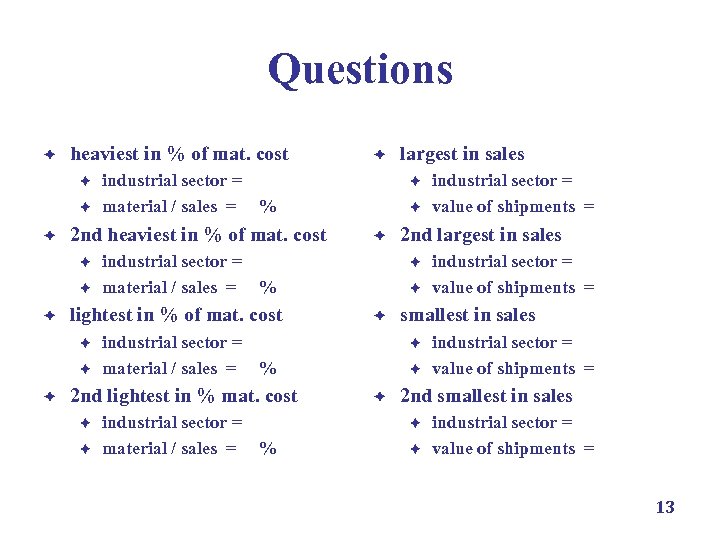
Questions è heaviest in % of mat. cost è è è industrial sector = material / sales = % industrial sector = value of shipments = smallest in sales è è è industrial sector = value of shipments = 2 nd largest in sales è industrial sector = material / sales = % 2 nd lightest in % mat. cost largest in sales è industrial sector = material / sales = % lightest in % of mat. cost è è industrial sector = material / sales = % 2 nd heaviest in % of mat. cost è è industrial sector = value of shipments = 2 nd smallest in sales è è industrial sector = value of shipments = 13
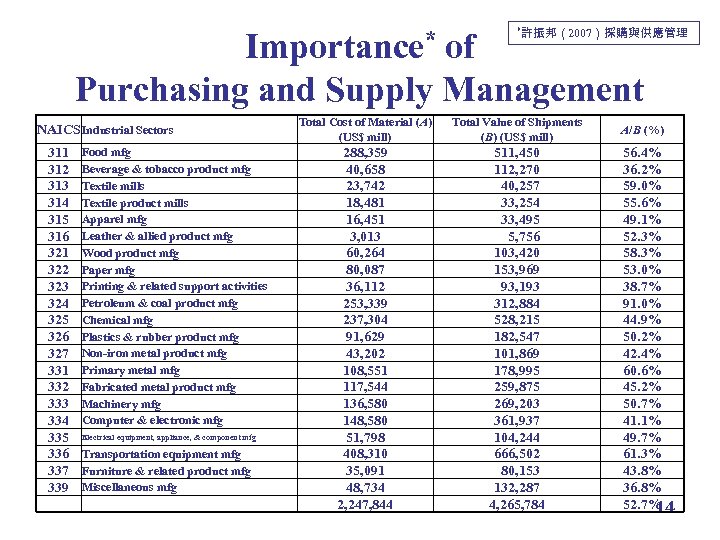
Importance* *許振邦(2007)採購與供應管理 of Purchasing and Supply Management NAICS Industrial Sectors 311 312 313 314 315 316 321 322 323 324 325 326 327 331 332 333 334 335 336 337 339 Food mfg Beverage & tobacco product mfg Textile mills Textile product mills Apparel mfg Leather & allied product mfg Wood product mfg Paper mfg Printing & related support activities Petroleum & coal product mfg Chemical mfg Plastics & rubber product mfg Non-iron metal product mfg Primary metal mfg Fabricated metal product mfg Machinery mfg Computer & electronic mfg Electrical equipment, appliance, & component mfg Transportation equipment mfg Furniture & related product mfg Miscellaneous mfg Total Cost of Material (A) (US$ mill) Total Value of Shipments (B) (US$ mill) 288, 359 40, 658 23, 742 18, 481 16, 451 3, 013 60, 264 80, 087 36, 112 253, 339 237, 304 91, 629 43, 202 108, 551 117, 544 136, 580 148, 580 51, 798 408, 310 35, 091 48, 734 2, 247, 844 511, 450 112, 270 40, 257 33, 254 33, 495 5, 756 103, 420 153, 969 93, 193 312, 884 528, 215 182, 547 101, 869 178, 995 259, 875 269, 203 361, 937 104, 244 666, 502 80, 153 132, 287 4, 265, 784 A/B (%) 56. 4% 36. 2% 59. 0% 55. 6% 49. 1% 52. 3% 58. 3% 53. 0% 38. 7% 91. 0% 44. 9% 50. 2% 42. 4% 60. 6% 45. 2% 50. 7% 41. 1% 49. 7% 61. 3% 43. 8% 36. 8% 52. 7% 14
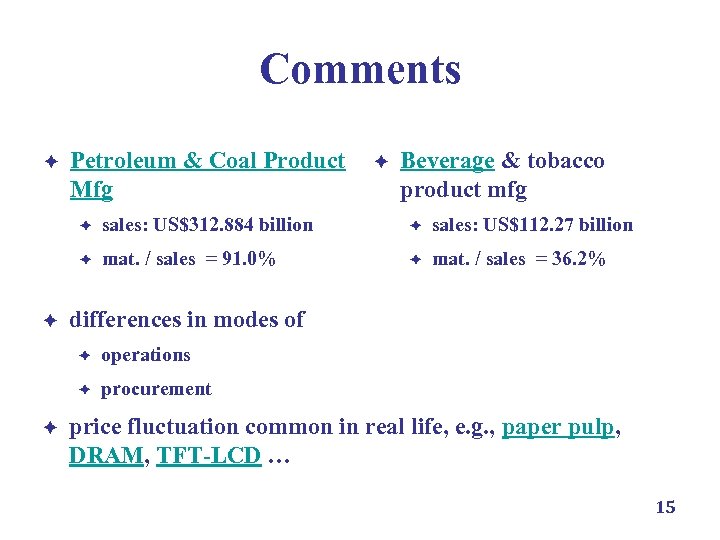
Comments è Petroleum & Coal Product Mfg è Beverage & tobacco product mfg è è sales: US$112. 27 billion è è sales: US$312. 884 billion mat. / sales = 91. 0% è mat. / sales = 36. 2% differences in modes of è è è operations procurement price fluctuation common in real life, e. g. , paper pulp, DRAM, TFT-LCD … 15
Importance of Purchasing and Supply Management Observations from Business Operations 16
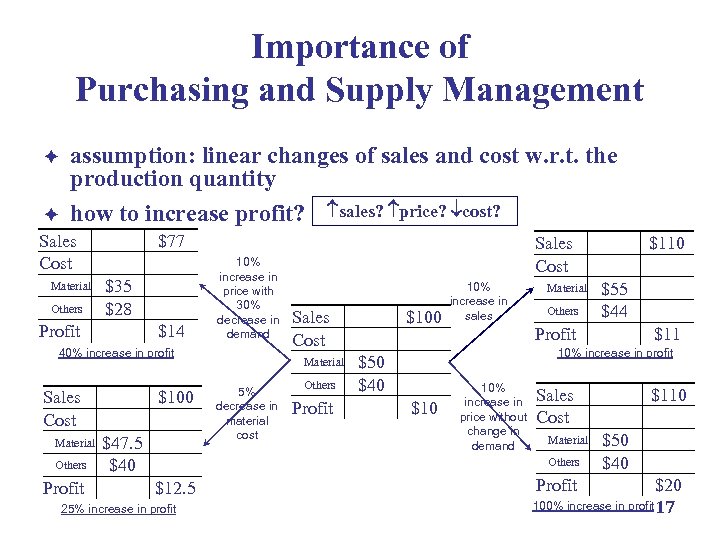
Importance of Purchasing and Supply Management è assumption: linear changes of sales and cost w. r. t. the production quantity how to increase profit? sales? price? cost? è Sales Cost Material Others $77 $35 $28 Profit $14 10% increase in price with 30% decrease in demand 40% increase in profit Sales Cost Material Others Profit $100 $47. 5 $40 Sales Cost Material 5% decrease in material cost Others Profit $100 10% increase in sales Material Others 25% increase in profit $55 $44 Profit $11 10% increase in profit $50 $40 $10 10% increase in price without change in demand Sales Cost Material Others $12. 5 $110 Profit $110 $50 $40 $20 100% increase in profit 17
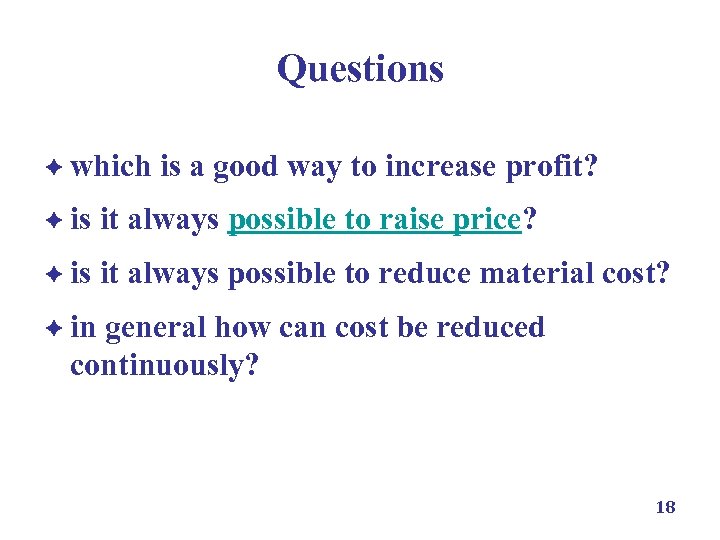
Questions è which is a good way to increase profit? è is it always possible to raise price? è is it always possible to reduce material cost? è in general how can cost be reduced continuously? 18
Importance of Purchasing and Supply Management Observations from Companies 19
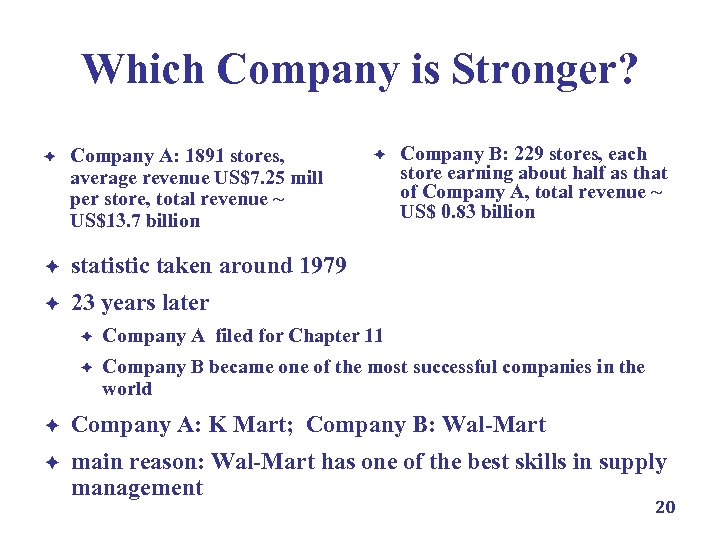
Which Company is Stronger? è Company A: 1891 stores, average revenue US$7. 25 mill per store, total revenue ~ US$13. 7 billion è è Company B: 229 stores, each store earning about half as that of Company A, total revenue ~ US$ 0. 83 billion statistic taken around 1979 23 years later è è Company A filed for Chapter 11 è Company B became one of the most successful companies in the world è Company A: K Mart; Company B: Wal-Mart è main reason: Wal-Mart has one of the best skills in supply management 20
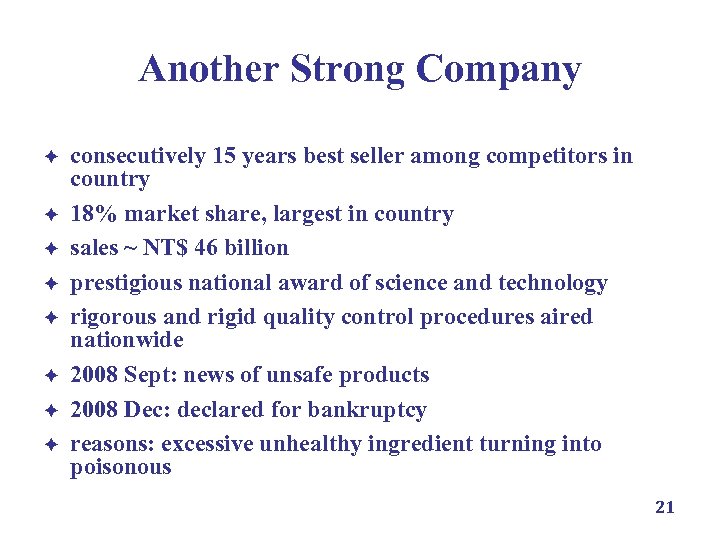
Another Strong Company è è è è consecutively 15 years best seller among competitors in country 18% market share, largest in country sales ~ NT$ 46 billion prestigious national award of science and technology rigorous and rigid quality control procedures aired nationwide 2008 Sept: news of unsafe products 2008 Dec: declared for bankruptcy reasons: excessive unhealthy ingredient turning into poisonous 21
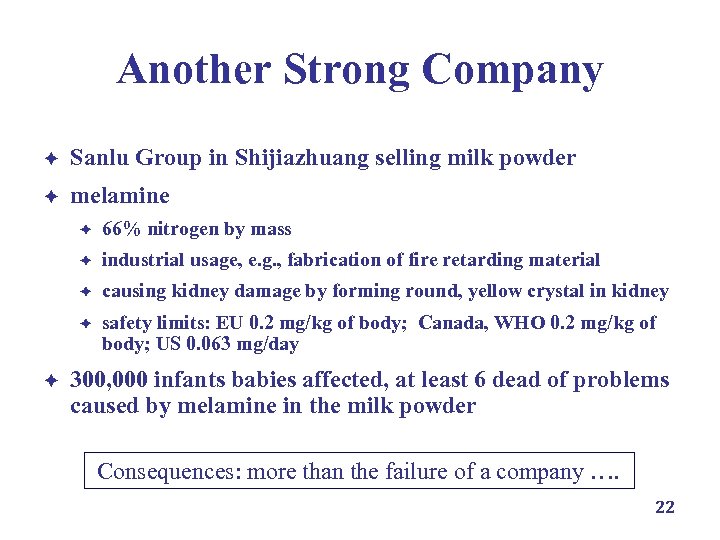
Another Strong Company è Sanlu Group in Shijiazhuang selling milk powder è melamine è è industrial usage, e. g. , fabrication of fire retarding material è causing kidney damage by forming round, yellow crystal in kidney è è 66% nitrogen by mass safety limits: EU 0. 2 mg/kg of body; Canada, WHO 0. 2 mg/kg of body; US 0. 063 mg/day 300, 000 infants babies affected, at least 6 dead of problems caused by melamine in the milk powder Consequences: more than the failure of a company …. 22
An Overview of Purchasing Factors, Process, Types, Levels and Issues 23
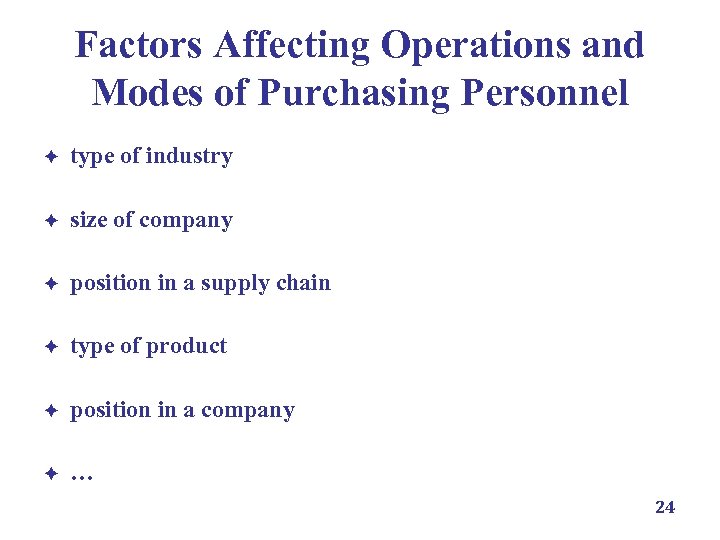
Factors Affecting Operations and Modes of Purchasing Personnel è type of industry è è size of company è è capital equipment, spare parts, consumables, … position in a company è è a supplier, a wholesaler, a distributor, a retailer type of product è è Walmart vs. a corner store position in a supply chain è è Coca Cola vs. Formosa Petrochemical Corporation a VP vs. a clerk … 24
Types of Products capital equipment, e. g. , machinery for self-consumption spare parts, maintenance service, consumables raw material for production processes or customers semi-finished products and components finished products, e. g. , Carrefour, a retail channel, or Li & Fung, a trader services, e. g. , transportation and third-party purchasing production support items 25
Aspects to Consider in a Transaction è main aspects: supplier, time, price, quantity, quality è means to align incentives by various contract mechanisms 26
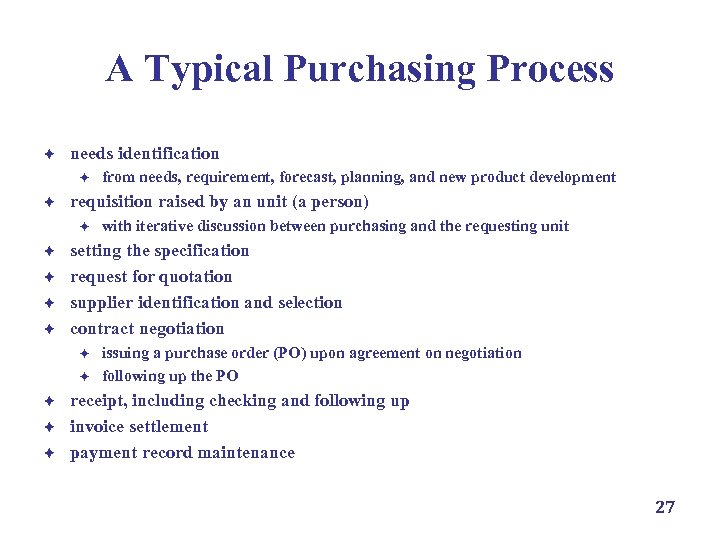
A Typical Purchasing Process è needs identification è è requisition raised by an unit (a person) è è è è with iterative discussion between purchasing and the requesting unit setting the specification request for quotation supplier identification and selection contract negotiation è è from needs, requirement, forecast, planning, and new product development issuing a purchase order (PO) upon agreement on negotiation following up the PO receipt, including checking and following up invoice settlement payment record maintenance 27
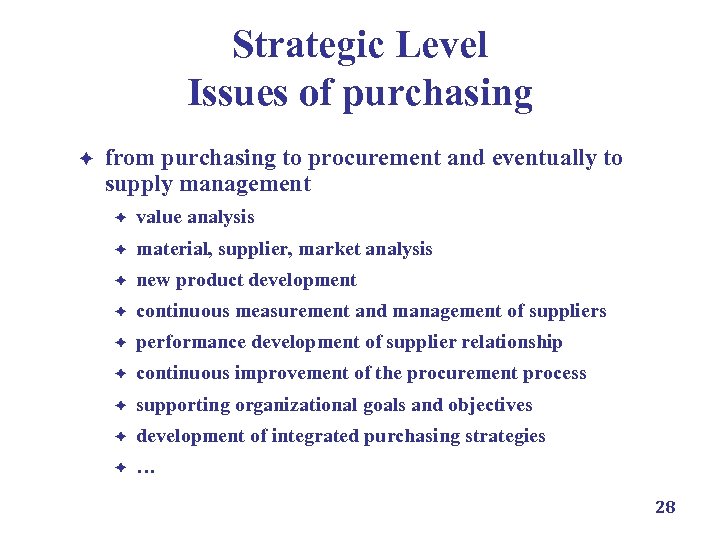
Strategic Level Issues of purchasing è from purchasing to procurement and eventually to supply management è value analysis è material, supplier, market analysis è new product development è continuous measurement and management of suppliers è performance development of supplier relationship è continuous improvement of the procurement process è supporting organizational goals and objectives è development of integrated purchasing strategies è … 28
Evolution of Purchasing and SCM in USA 29
Evolution of Purchasing and SCM in USA è events and phenomena: consequences è background and trend: driving forces è any idea about the timeline of the following events (some major, some minor): è Collapse of Communism in Eastern Europe, Completion of Transcontinental Railway, Disintegration of USSR, Industrial Revolution, Iranian Revolution, Iran–Iraq War, Vietnam War, Oil and energy crises, Oil Embargo, $1. 5 billion federal bailout of Chrysler, Open-Door of China, Trouble of US automobile industry, US Civil War, Watt steam engine, WWI , WW II 30
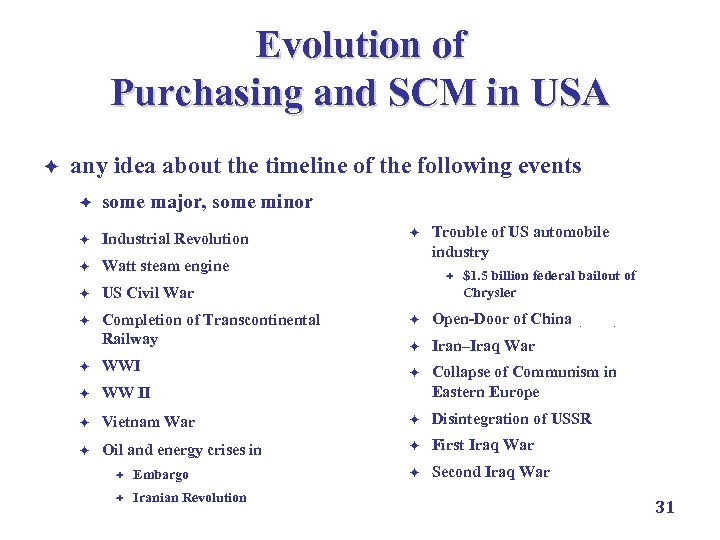
Evolution of Purchasing and SCM in USA è any idea about the timeline of the following events è some major, some minor è Industrial Revolution (1750 – 1850) è Watt steam engine (1765) è US Civil War (1861 – 1865) è Completion of Transcontinental Railway (5/1869) è Trouble of US automobile industry (late 70’s) è $1. 5 billion federal bailout of Chrysler (1979) è Open-Door of China (1979) è Iran–Iraq War (9/1980 to 8/1988) è Collapse of Communism in Eastern Europe (1989) è WWI (1914 – 1918) è WW II (1939 – 1945) è Vietnam War (1964 (? ) – 1975) è Disintegration of USSR (1991) è Oil and energy crises in 70’s è First Iraq War (1991) è Second Iraq War (2003) è Embargo (10/1973 to 3/1974) è Iranian Revolution (1979) 31
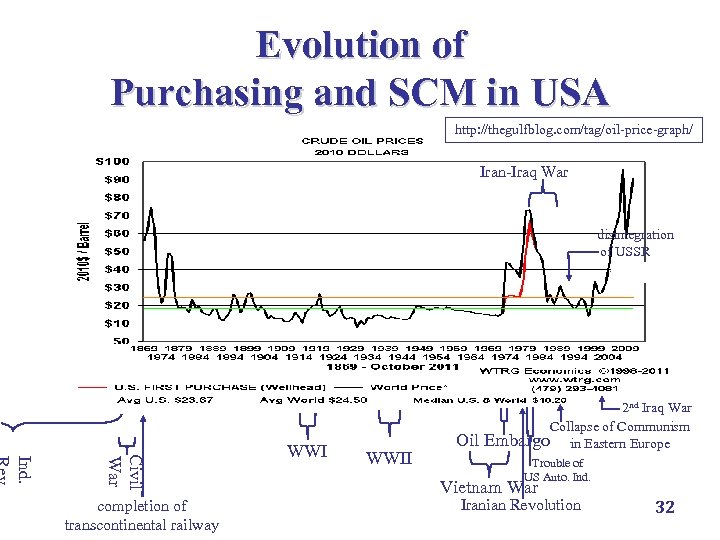
Evolution of Purchasing and SCM in USA http: //thegulfblog. com/tag/oil-price-graph/ Iran-Iraq War disintegration of USSR, 1 st Iraq War Civil War Ind. completion of transcontinental railway WWII Oil 2 nd Iraq War Collapse of Communism Embargo in Eastern Europe Trouble of US Auto. Ind. Vietnam War Iranian Revolution; Open door of China 32
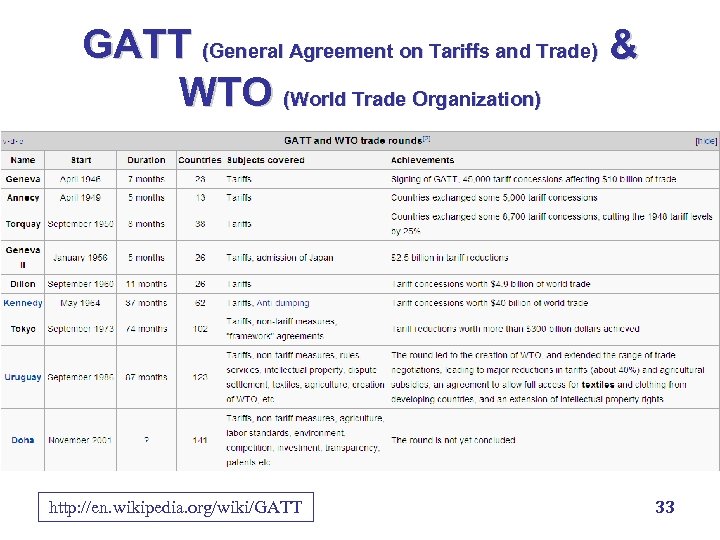
GATT (General Agreement on Tariffs and Trade) & WTO (World Trade Organization) è rounds of negotiation of GATT http: //en. wikipedia. org/wiki/GATT 33
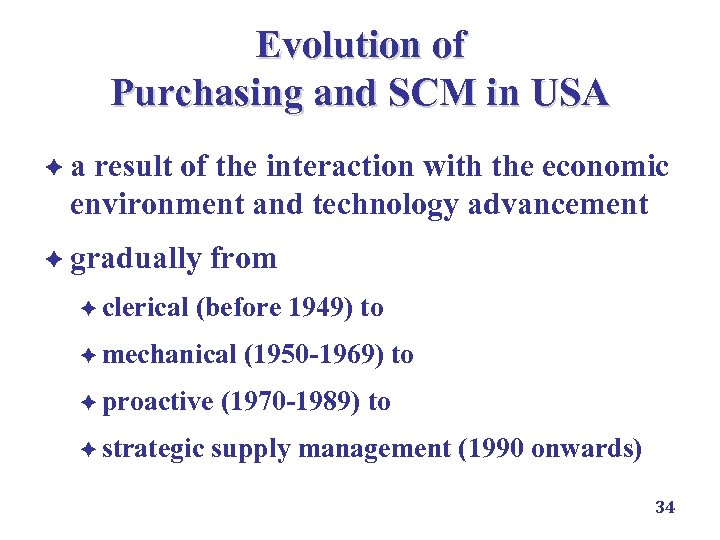
Evolution of Purchasing and SCM in USA èa result of the interaction with the economic environment and technology advancement è gradually è clerical from (before 1949) to è mechanical è proactive è strategic (1950 -1969) to (1970 -1989) to supply management (1990 onwards) 34
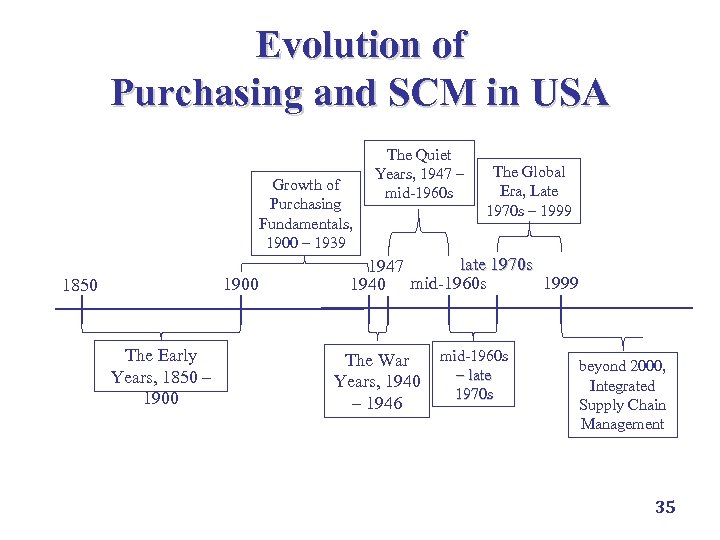
Evolution of Purchasing and SCM in USA Growth of Purchasing Fundamentals, 1900 – 1939 1900 1850 The Early Years, 1850 – 1900 The Quiet Years, 1947 – mid-1960 s The Global Era, Late 1970 s – 1999 late 1970 s 1947 1999 1940 mid-1960 s The War Years, 1940 – 1946 mid-1960 s – late 1970 s beyond 2000, Integrated Supply Chain Management 35
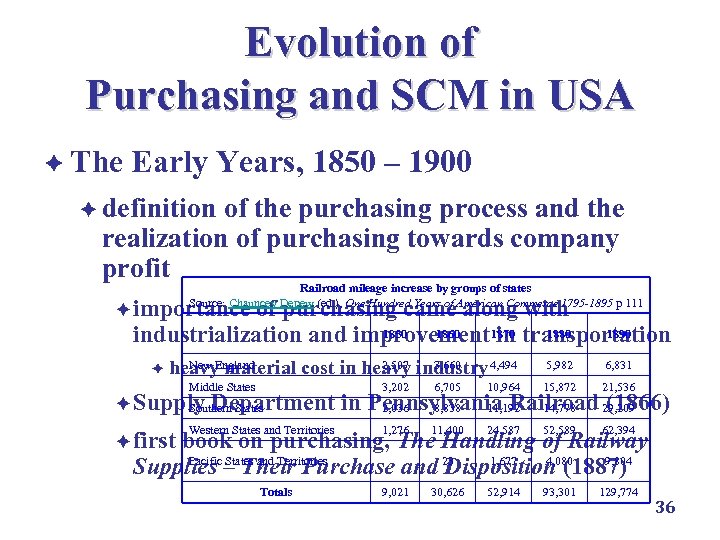
Evolution of Purchasing and SCM in USA è The Early Years, 1850 – 1900 è definition of the purchasing process and the realization of purchasing towards company profit Railroad mileage increase by groups of states Source: Chauncey Depew (ed. ), One Hundred Years of American Commerce 1795 -1895 p 111 è importance of purchasing came along with 1850 1860 industrialization and improvement 1870 transportation in 1880 1890 New England è heavy material 2, 507 3, 660 cost in heavy industry 4, 494 Middle States è Supply Department Southern States è first Western States and Territories 5, 982 6, 831 3, 202 6, 705 10, 964 15, 872 21, 536 1, 276 11, 400 24, 587 52, 589 62, 394 9, 021 30, 626 52, 914 93, 301 129, 774 in Pennsylvania Railroad 29, 209 (1866) 2, 036 8, 838 11, 192 14, 778 book on purchasing, The Handling of Railway Pacific States and Territories 1, 677 4, 080 9, 804 Supplies – Their Purchase and 23 Disposition (1887) Totals 36
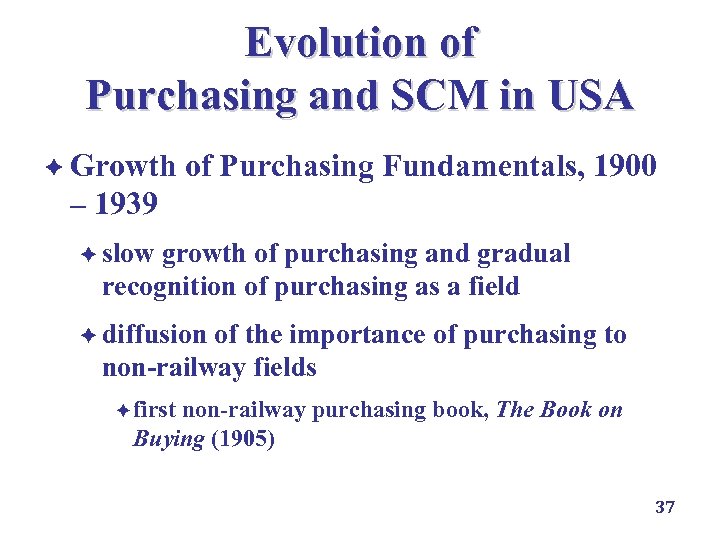
Evolution of Purchasing and SCM in USA è Growth of Purchasing Fundamentals, 1900 – 1939 è slow growth of purchasing and gradual recognition of purchasing as a field è diffusion of the importance of purchasing to non-railway fields è first non-railway purchasing book, The Book on Buying (1905) 37
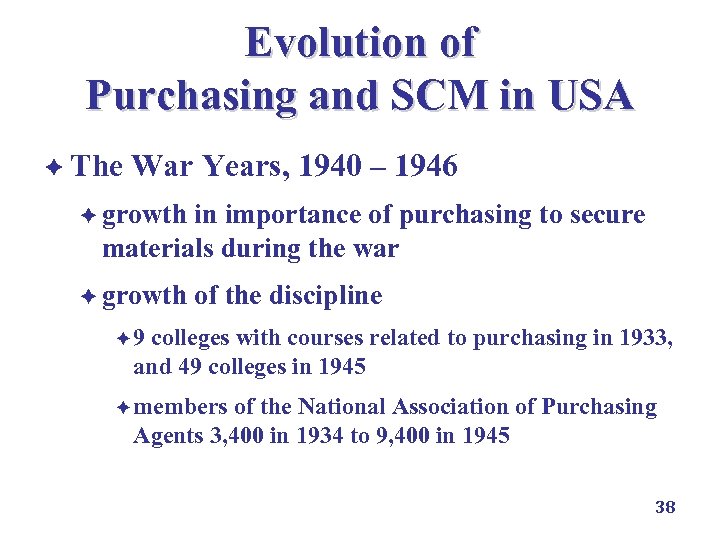
Evolution of Purchasing and SCM in USA è The War Years, 1940 – 1946 è growth in importance of purchasing to secure materials during the war è growth of the discipline è 9 colleges with courses related to purchasing in 1933, and 49 colleges in 1945 è members of the National Association of Purchasing Agents 3, 400 in 1934 to 9, 400 in 1945 38
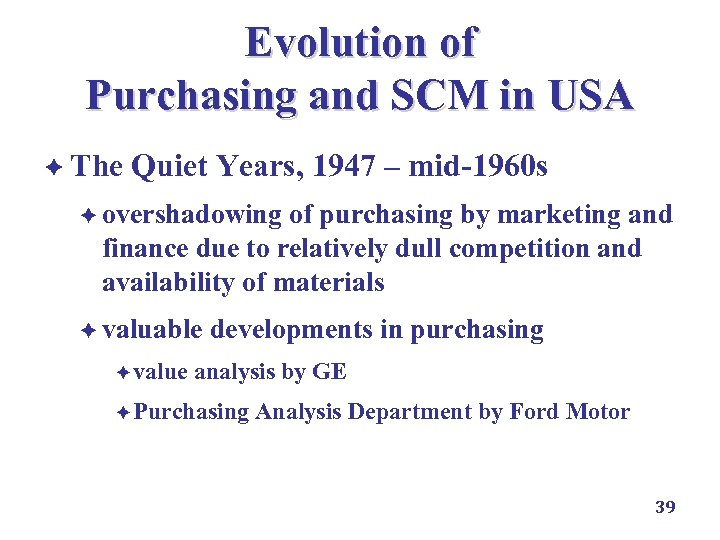
Evolution of Purchasing and SCM in USA è The Quiet Years, 1947 – mid-1960 s è overshadowing of purchasing by marketing and finance due to relatively dull competition and availability of materials è valuable è value developments in purchasing analysis by GE è Purchasing Analysis Department by Ford Motor 39
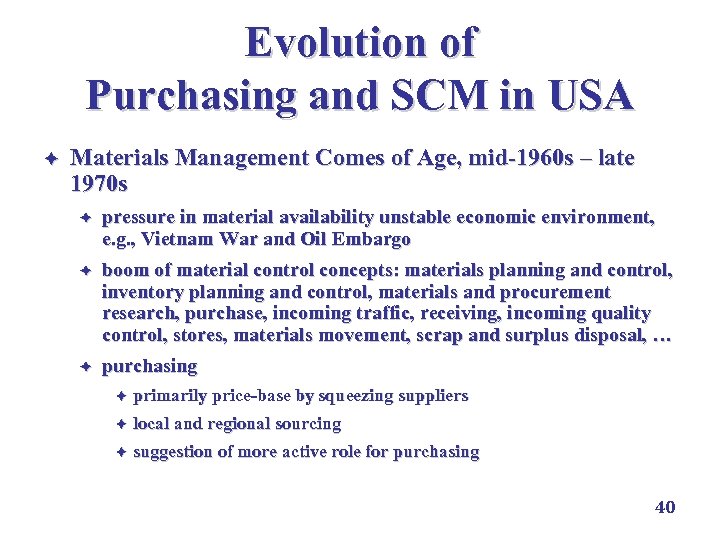
Evolution of Purchasing and SCM in USA è Materials Management Comes of Age, mid-1960 s – late 1970 s è pressure in material availability unstable economic environment, e. g. , Vietnam War and Oil Embargo è boom of material control concepts: materials planning and control, inventory planning and control, materials and procurement research, purchase, incoming traffic, receiving, incoming quality control, stores, materials movement, scrap and surplus disposal, … è purchasing è primarily price-base by squeezing suppliers è local and regional sourcing è suggestion of more active role for purchasing 40
Evolution of Purchasing and SCM in USA è The Global Era, Late 1970 s – 1999 è intensive global competition è realization of the importance of the management of the process to transform raw materials to end products of customers è Supply Chain Management 41
Evolution of Purchasing and SCM in USA è Integrated Supply Chain Management, beyond 2000 è emphasis on integration and collaboration è enterprisewide system and integrated internet linkage è ideas such as supplier development, supplier design involvement, adoption of full-service suppliers, total cost concepts on supplier selection, long-term supplier relationship, … è co-ordination and collaboration of purchasing with customer requirements, operations, logistics, finance, human resoruces, accounting, marketing, information systems 42
Evolution of Purchasing and SCM è what would happen in the future? è oil reserve, new sources of energy, food supply, water supply …. 43
Скачать презентацию BM_M 0050 GSLM 54700 Purchasing and Supply Management 1
8080d5c30804461b43ba6990bbaf8473.ppt