 Скачать презентацию Blue 102 IP Service Architecture Futures Geoff Huston
7dd3b5a6d2719521475ef82862ddec91.ppt
- Количество слайдов: 32



Blue 102 IP Service Architecture Futures Geoff Huston May 2000
Next Wave IP Services • Service Requirements – – – – Connectivity service for customer-operated routers Service payload is IP packet High peak carriage capacity Extremely rapid service activation Lightweight Operations and Management load Rudimentary Qo. S capabilities Customer control of Service Profile
Data Service Evolution • Data Service Platforms are changing: – IP service networks have evolved in terms of their architecture to respond to demands for increased capacity and reduced unit cost – Each evolutionary step has been directed to removing an additional layer of network switching hierarchy
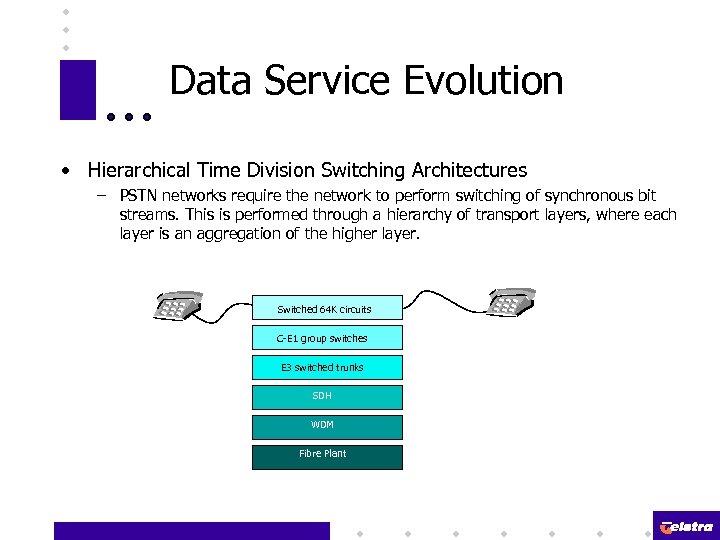
Data Service Evolution • Hierarchical Time Division Switching Architectures – PSTN networks require the network to perform switching of synchronous bit streams. This is performed through a hierarchy of transport layers, where each layer is an aggregation of the higher layer. Switched 64 K circuits C-E 1 group switches E 3 switched trunks SDH WDM Fibre Plant
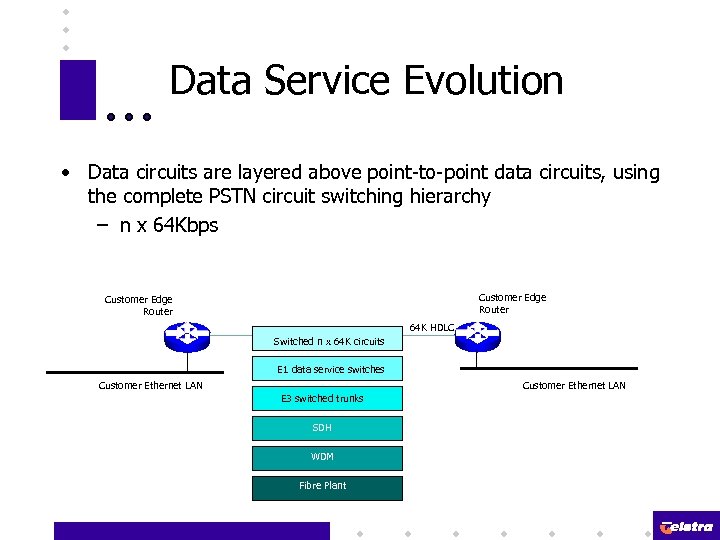
Data Service Evolution • Data circuits are layered above point-to-point data circuits, using the complete PSTN circuit switching hierarchy – n x 64 Kbps Customer Edge Router 64 K HDLC Switched n x 64 K circuits E 1 data service switches Customer Ethernet LAN E 3 switched trunks SDH WDM Fibre Plant
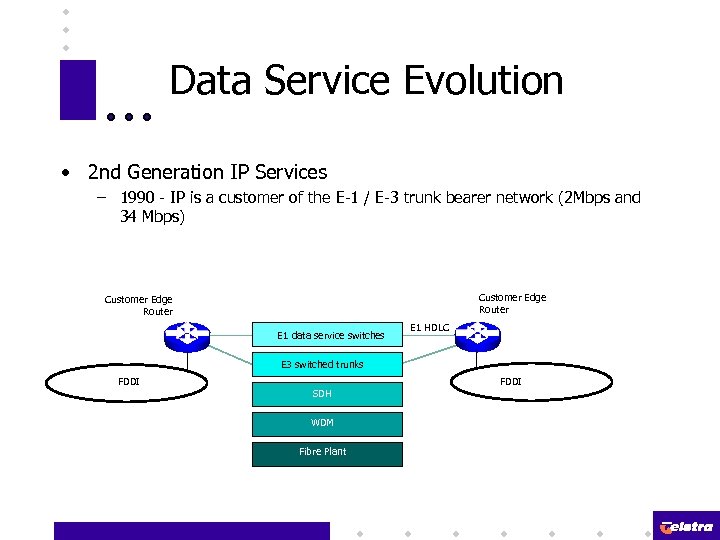
Data Service Evolution • 2 nd Generation IP Services – 1990 - IP is a customer of the E-1 / E-3 trunk bearer network (2 Mbps and 34 Mbps) Customer Edge Router E 1 data service switches E 1 HDLC E 3 switched trunks FDDI SDH WDM Fibre Plant FDDI
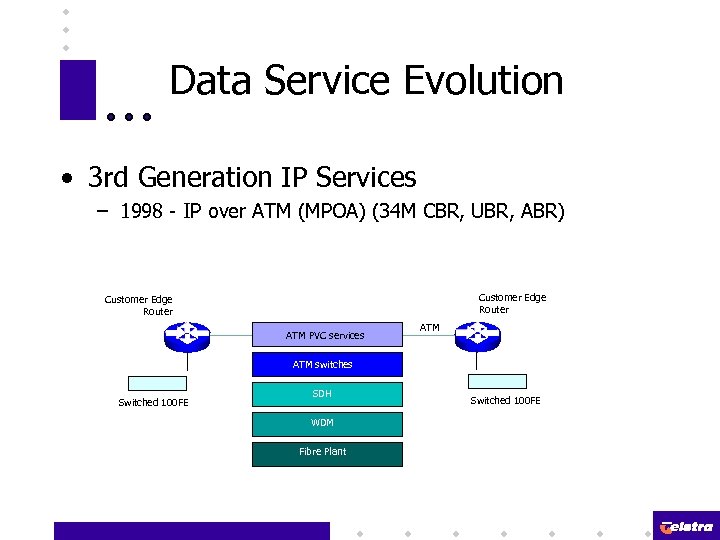
Data Service Evolution • 3 rd Generation IP Services – 1998 - IP over ATM (MPOA) (34 M CBR, UBR, ABR) Customer Edge Router ATM PVC services ATM switches Switched 100 FE SDH WDM Fibre Plant Switched 100 FE
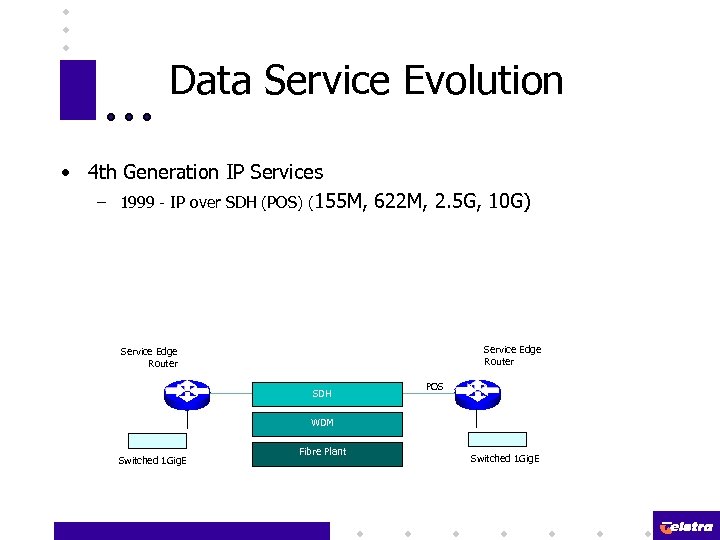
Data Service Evolution • 4 th Generation IP Services – 1999 - IP over SDH (POS) (155 M, 622 M, 2. 5 G, 10 G) Service Edge Router SDH POS WDM Switched 1 Gig. E Fibre Plant Switched 1 Gig. E
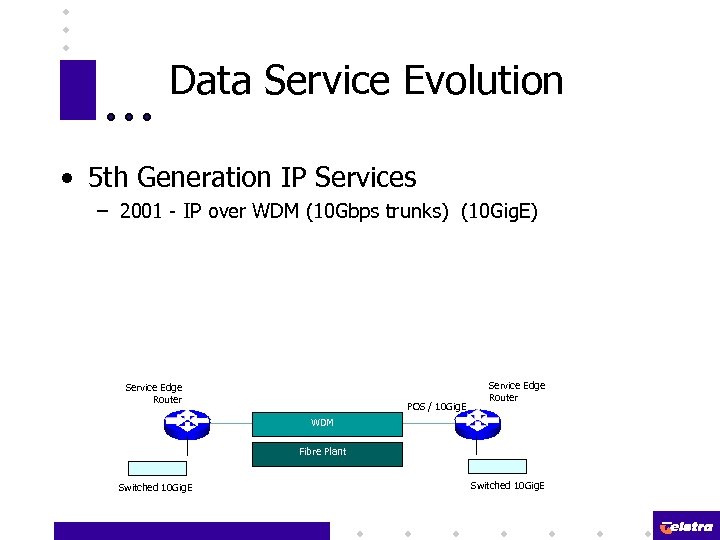
Data Service Evolution • 5 th Generation IP Services – 2001 - IP over WDM (10 Gbps trunks) (10 Gig. E) Service Edge Router POS / 10 Gig. E Service Edge Router WDM Fibre Plant Switched 10 Gig. E
Data Service Evolution • Each Service generation: – uses fewer elements of the PSTN carriage hierarchy – reduces the number of infrastructure support groups – requires longer planning cycles and coarser provisioning increments, but involve fewer provisioning groups – results in: • order of magnitude increase in capacity • order of magnitude decrease in unit cost of IP carriage
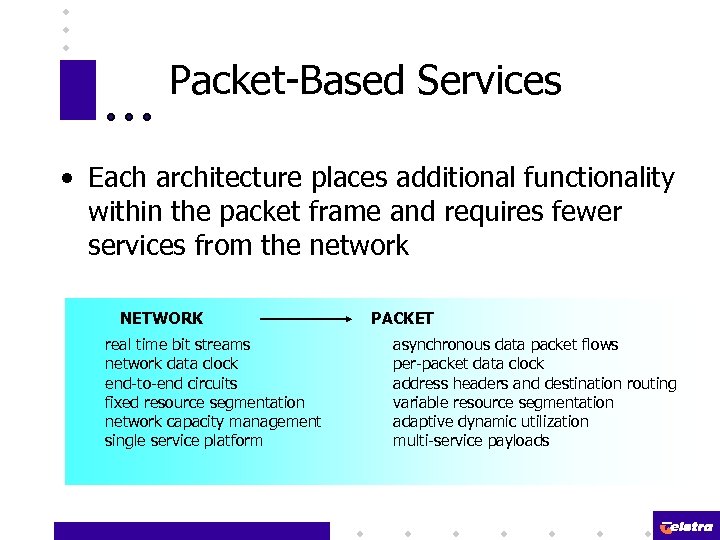
Packet-Based Services • Each architecture places additional functionality within the packet frame and requires fewer services from the network NETWORK real time bit streams network data clock end-to-end circuits fixed resource segmentation network capacity management single service platform PACKET asynchronous data packet flows per-packet data clock address headers and destination routing variable resource segmentation adaptive dynamic utilization multi-service payloads
IP Service Architecture • Major elements in the platform architecture: – carrier network edge switch to customer handover demarcation point access network – network edge-to-edge internal transit core network – network core to inter-carrier handover interconnect network
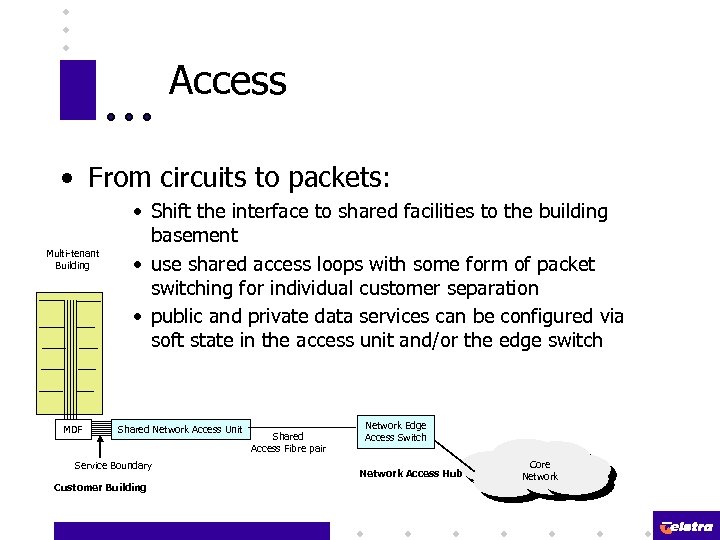
Access • From circuits to packets: Multi-tenant Building MDF • Shift the interface to shared facilities to the building basement • use shared access loops with some form of packet switching for individual customer separation • public and private data services can be configured via soft state in the access unit and/or the edge switch Shared Network Access Unit Service Boundary Customer Building Shared Access Fibre pair Network Edge Access Switch Network Access Hub Core Network
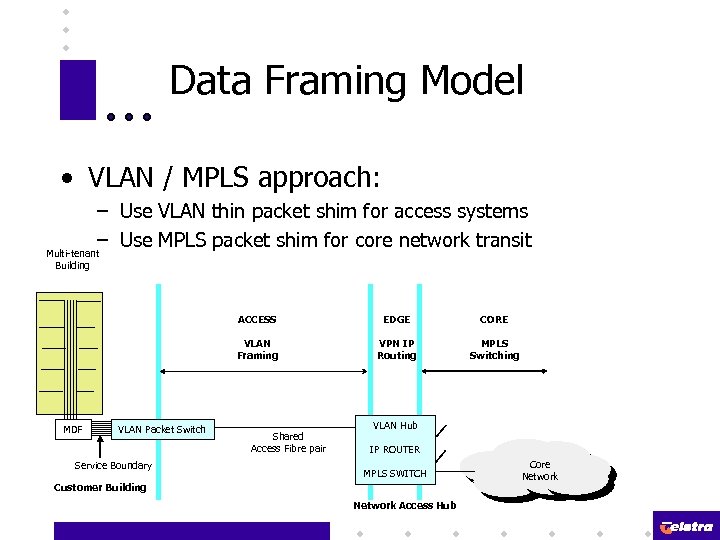
Data Framing Model • VLAN / MPLS approach: – Use VLAN thin packet shim for access systems – Use MPLS packet shim for core network transit Multi-tenant Building ACCESS VLAN Packet Switch Service Boundary CORE VLAN Framing MDF EDGE VPN IP Routing MPLS Switching Shared Access Fibre pair VLAN Hub IP ROUTER MPLS SWITCH Customer Building Network Access Hub Core Network
Access Data Services • There a set of service requirements: – point-to-point virtual wireline service ‘traditional’ data circuit service – point-to-multipoint VPN services PVC mesh services without explicit VC enumeration – point -to network access service Carrier Public Internet access services – point-to-interconnect wholesale service competitive access to the customer for carrier services
Access Technology Options • Various access technologies can achieve many of the desired objectives. The differences lie in resiliency, capital cost and operational robustness – – SDH city loops IP Packet over SONET Framing (POS) DPT Point-to-point GIG-Ethernet
Trends in IP architectures • IP trunk networks will continue to grow – from OC-n to Gig. E-based framing – from SDH switching to Wave Switching – 10 G networks that scale to 100 G
Target • SDH and Packet Services • Growth Factors • Requirements – Characteristics – Ops and Management – Service Availability
Outline of Direction • Packet-based services from edge to core
Critical Technologies for Future IP platforms • Future IP networks will probably rely on elements of the following technologies: – – – – Gigabit Ethernet (10 G) SDH switching (STM-16 c and STM-64 c) Dense Wave Division Multiplexing (DWDM) Wavelength Switching (WLS) Multi-Protocol Label Switching (MPLS) Virtual LAN Switching (VLAN) IP Routing (BGP) Path Resource Management (RSVP)
Quality of Service Multi-Service IP network architectures
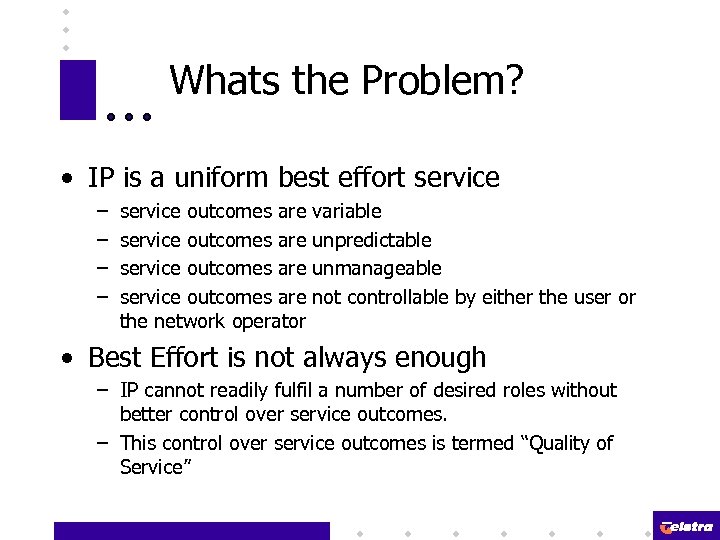
Whats the Problem? • IP is a uniform best effort service – – service outcomes are variable service outcomes are unpredictable service outcomes are unmanageable service outcomes are not controllable by either the user or the network operator • Best Effort is not always enough – IP cannot readily fulfil a number of desired roles without better control over service outcomes. – This control over service outcomes is termed “Quality of Service”
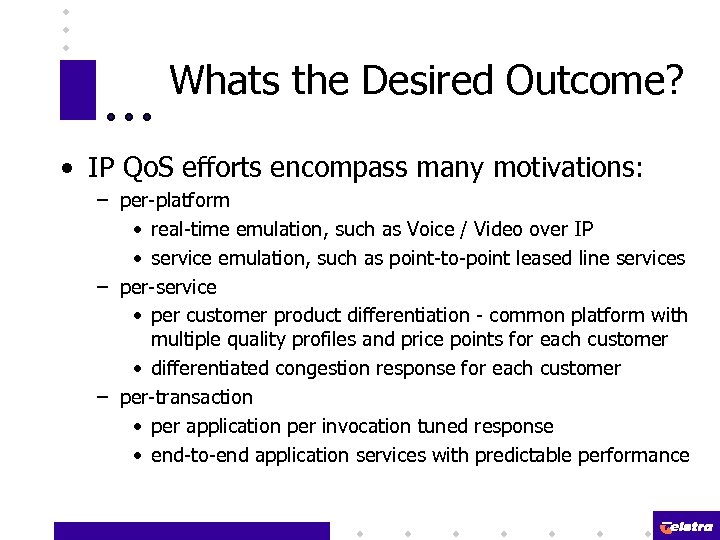
Whats the Desired Outcome? • IP Qo. S efforts encompass many motivations: – per-platform • real-time emulation, such as Voice / Video over IP • service emulation, such as point-to-point leased line services – per-service • per customer product differentiation - common platform with multiple quality profiles and price points for each customer • differentiated congestion response for each customer – per-transaction • per application per invocation tuned response • end-to-end application services with predictable performance
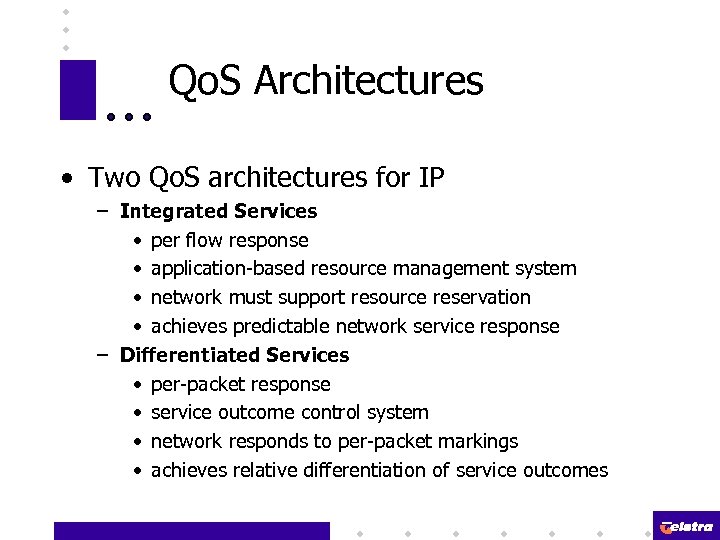
Qo. S Architectures • Two Qo. S architectures for IP – Integrated Services • per flow response • application-based resource management system • network must support resource reservation • achieves predictable network service response – Differentiated Services • per-packet response • service outcome control system • network responds to per-packet markings • achieves relative differentiation of service outcomes
Qo. S Weaknesses • Neither architecture is adequate for IP Qo. S service provider networks – per-flow systems do not scale – aggregated systems deliver only approximate outcomes • More refinement of IP Qo. S architectures is necessary – and is underway
Qo. S Developments • Qo. S is a major area of technology refinement today: – Windows 2000 has support for Integrated Services Qo. S – Router vendors now support Integrated Services for enterprise networks (RSVP signalling and local queue management) – Router vendors developing Differentiated Services support for service provider networks – MPLS-based Qo. S characteristics are still being defined by the industry
Potential IP Qo. S Products • Differentiated Services will be the base platform architecture, supporting: – 1. IP Qo. S VPNs • MPLS or IP/IP or IPSEC VPNs to achieve network-level traffic segregation using an edge-to-edge approach • Network ingress Diff. Serv tools to achieve a rough approximation of the point-to-point private circuit service behaviour • ‘cheaper net’ VPNs, allowing the IP provider to value-add Qo. S attributes to basic edge-to-edge VPN
Potential IP Qo. S Products – 2. IP SLAs • premium IP service offerings with some form of SLA relating to minimum delivered service attributes (delay, jitter and loss) • SLAs will be inherently limited to the service provider’s network - multi-provider transit SLAs may follow, or they may not • Most useful for customer-operated VPN environments, or for common community of interest distributed environments (e. g. dealer networks) where the common SLA can be translated to an approximate service response profile
Potential IP Qo. S Products – 3. IP Service on Demand • customer-selectable premium network service • Customer marks packets with a service selector code which triggers a network service response – – elevated queuing priority discard precedence level lower than best effort real-time emulation (jitter intolerant) • on demand service availability • useful to high value applications such as voice and video transport or real time signalling applications.
Positioning Qo. S • Qo. S services may be an essential attribute of ISP service offerings – IP transport is a commodity service with no inherent differentiation – Qo. S may allow the ISP to position a premium product into the market, with a price point midway between base IP carriage and point-to-point dedicated circuit services – Qo. S may allow the ISP to cover a broader range of market service requirements from a single platform architecture
But. . . • Remember, IP Qo. S is just a means of injecting a level of resource management control signals into the IP network. • IP Qo. S is not a panacea
IP Qo. S is not. . . • IP Qo. S is unlikely to provide: – – a full range of real time synchronous bit stream services strict end-to-end application performance guarantees unlimited bandwidth on demand fully automated resource management with no resource demand conflict at all
Скачать презентацию Blue 102 IP Service Architecture Futures Geoff Huston
7dd3b5a6d2719521475ef82862ddec91.ppt