 Скачать презентацию Bloom s taxonomy is a set of three hierarchical
Blooms taxonomy.pptx
- Количество слайдов: 30



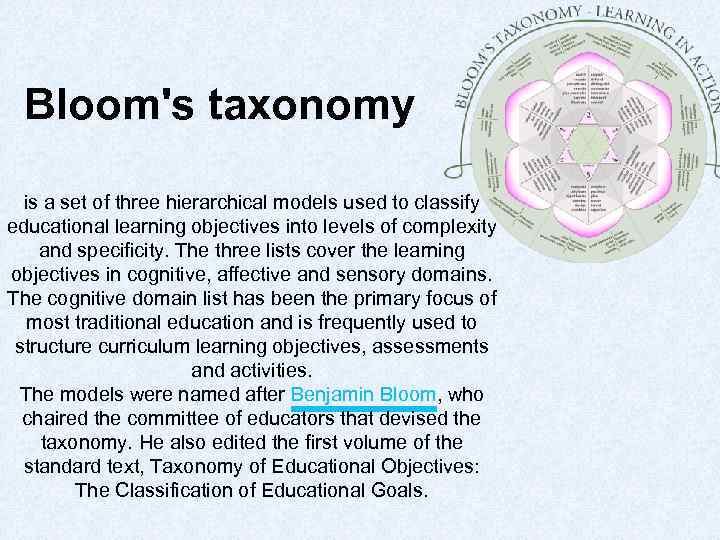
Bloom's taxonomy is a set of three hierarchical models used to classify educational learning objectives into levels of complexity and specificity. The three lists cover the learning objectives in cognitive, affective and sensory domains. The cognitive domain list has been the primary focus of most traditional education and is frequently used to structure curriculum learning objectives, assessments and activities. The models were named after Benjamin Bloom, who chaired the committee of educators that devised the taxonomy. He also edited the first volume of the standard text, Taxonomy of Educational Objectives: The Classification of Educational Goals.
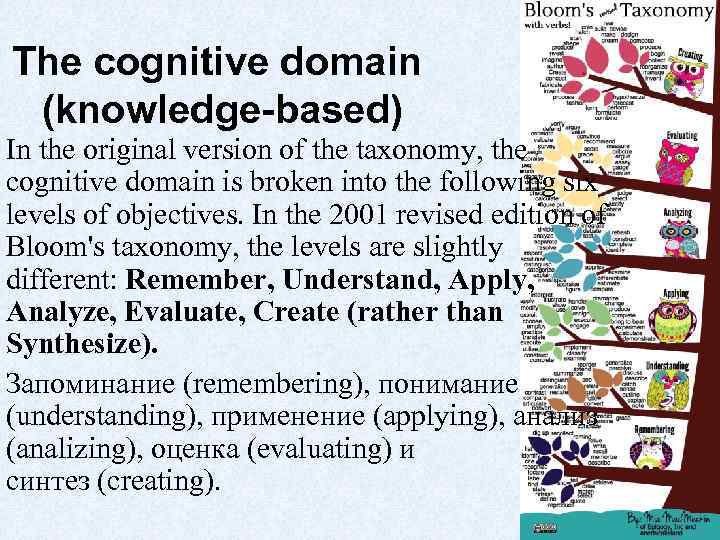
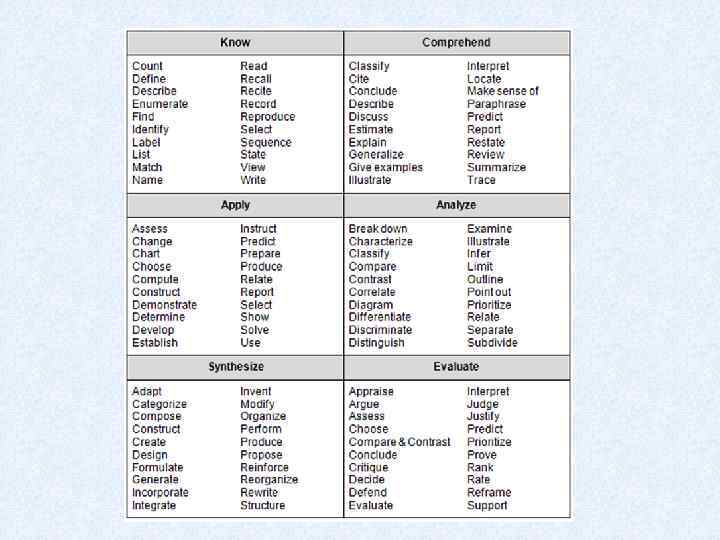
The cognitive domain (knowledge-based) In the original version of the taxonomy, the cognitive domain is broken into the following six levels of objectives. In the 2001 revised edition of Bloom's taxonomy, the levels are slightly different: Remember, Understand, Apply, Analyze, Evaluate, Create (rather than Synthesize). Запоминание (remembering), понимание (understanding), применение (applying), анализ (analizing), оценка (evaluating) и синтез (creating).
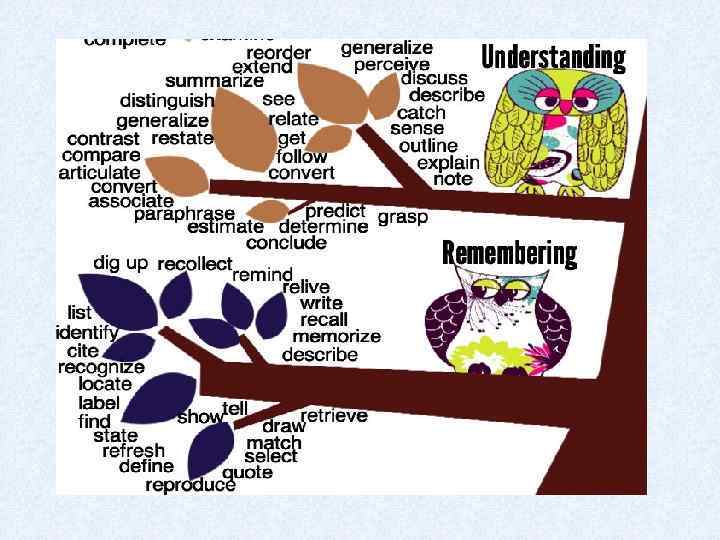
Remembering involves recognizing or remembering facts, terms, basic concepts, or answers without necessarily understanding what they mean. Its characteristics may include: Knowledge of specifics—terminology, specific facts Knowledge of ways and means of dealing with specifics—conventions, trends and sequences, classifications and categories, criteria, methodology Knowledge of the universals and abstractions in a field—principles and generalizations, theories and structures Example: Name three common varieties of apple.
Comprehending Comprehension involves demonstrating understanding of facts and ideas by organizing, comparing, translating, interpreting, giving descriptions, and stating the main ideas. Example: Compare the identifying characteristics of a Golden Delicious apple with a Granny Smith apple.
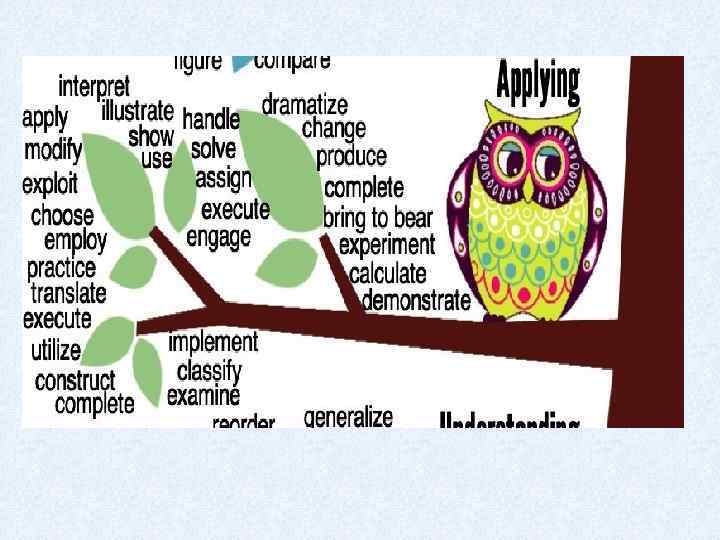
Applying involves using acquired knowledge— solving problems in new situations by applying acquired knowledge, facts, techniques and rules. Learners should be able to use prior knowledge to solve problems, identify connections and relationships and how they apply in new situations. Example: Would apples prevent scurvy, a disease caused by a deficiency in vitamin C?
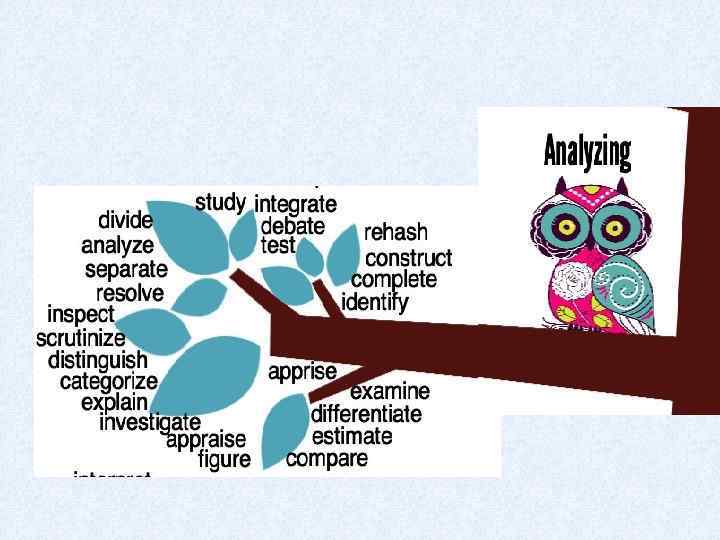
Analyzing involves examining and breaking information into component parts, determining how the parts relate to one another, identifying motives or causes, making inferences, and finding evidence to support generalizations. Its characteristics include: Analysis of elements Analysis of relationships Analysis of organization Example: List four ways of serving foods made with apples and explain which ones have the highest health benefits. Provide references to support your statements.
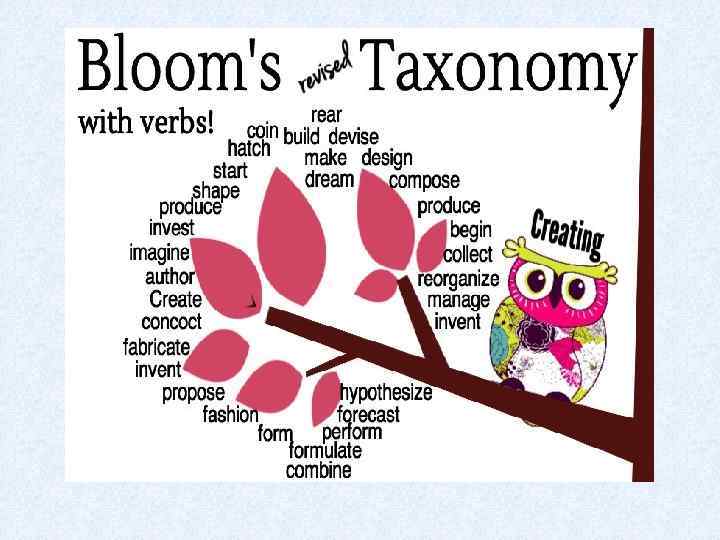
Synthesizing involves building a structure or pattern from diverse elements; it also refers to the act of putting parts together to form a whole. Its characteristics include: Production of a unique communication Production of a plan, or proposed set of operations Derivation of a set of abstract relations Example: Convert an "unhealthy" recipe for apple pie to a "healthy" recipe by replacing your choice of ingredients. Explain the health benefits of using the ingredients you chose vs. the original ones.
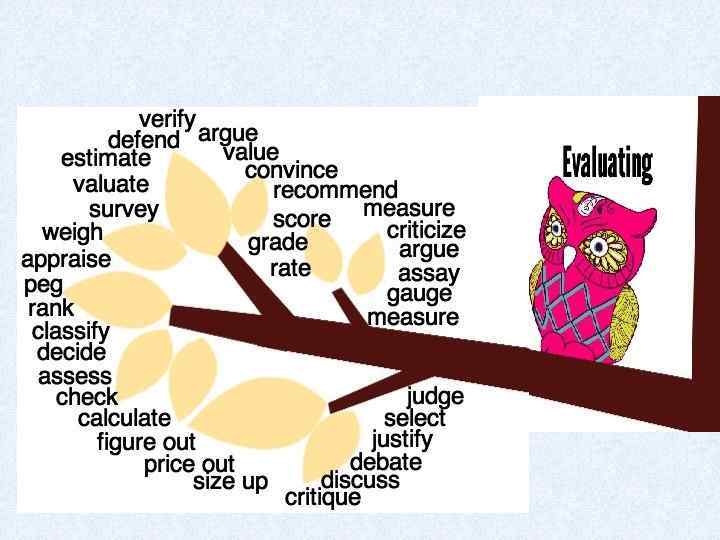
Evaluating involves presenting and defending opinions by making judgments about information, the validity of ideas, or quality of work based on a set of criteria. Its characteristics include: Judgments in terms of internal evidence Judgments in terms of external criteria Example: Which kinds of apples are best for baking a pie, and why?
The affective domain (emotivebased) Skills in the affective domain describe the way people react emotionally and their ability to feel other living things' pain or joy. Affective objectives typically target the awareness and growth in attitudes, emotion, and feelings. There are five levels in the affective domain moving through the lowest-order processes to the highest: • Receiving • Responding • Valuing • Organizing • Characterizing
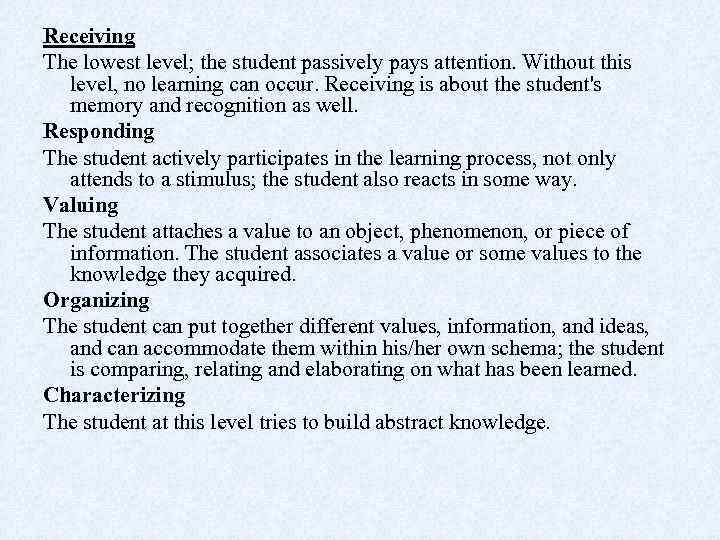
Receiving The lowest level; the student passively pays attention. Without this level, no learning can occur. Receiving is about the student's memory and recognition as well. Responding The student actively participates in the learning process, not only attends to a stimulus; the student also reacts in some way. Valuing The student attaches a value to an object, phenomenon, or piece of information. The student associates a value or some values to the knowledge they acquired. Organizing The student can put together different values, information, and ideas, and can accommodate them within his/her own schema; the student is comparing, relating and elaborating on what has been learned. Characterizing The student at this level tries to build abstract knowledge.
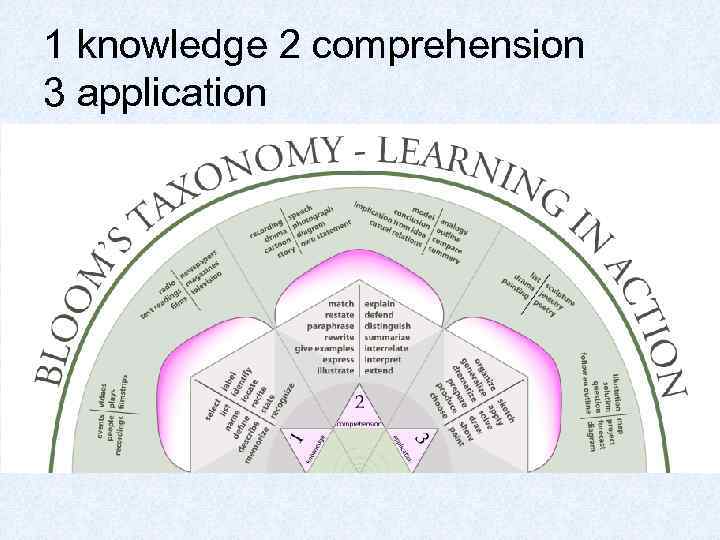
1 knowledge 2 comprehension 3 application
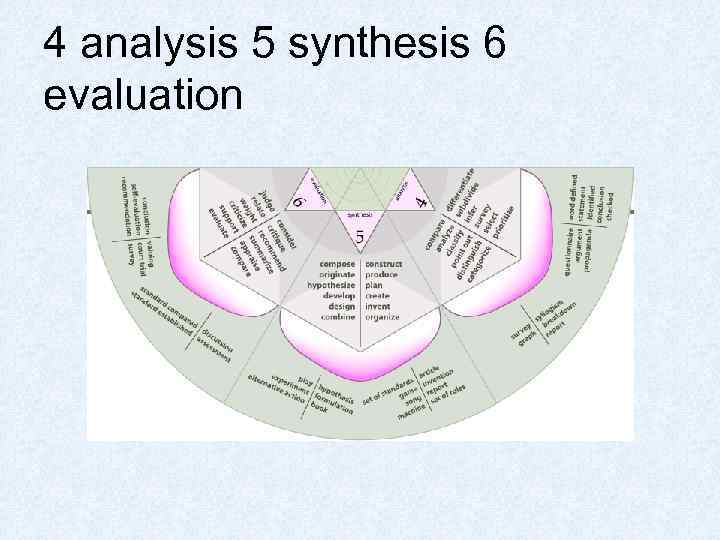
4 analysis 5 synthesis 6 evaluation
The psychomotor domain (actionbased) Skills in the psychomotor domain describe the ability to physically manipulate a tool or instrument like a hand or a hammer. Psychomotor objectives usually focus on change and/or development in behavior and/or skills. Bloom and his colleagues never created subcategories for skills in the psychomotor domain, but since then other educators have created their own psychomotor taxonomies. Simpson (1972) proposed the following levels
Perception Set Guided response Mechanism Complex overt response Adaptation Origination
Perception The ability to use sensory cues to guide motor activity: This ranges from sensory stimulation, through cue selection, to translation. Examples: Detects non-verbal communication cues. Estimate where a ball will land after it is thrown and then moving to the correct location to catch the ball. Adjusts heat of the stove to correct temperature by smell and taste of food. Adjusts the height of the forks on a forklift by comparing where the forks are in relation to the pallet. Key words: chooses, describes, detects, differentiates, distinguishes, identifies, isolates, relates, selects.
Set Readiness to act: It includes mental, physical, and emotional sets. These three sets are dispositions that predetermine a person's response to different situations (sometimes called mindsets). This subdivision of psychomotor is closely related with the "responding to phenomena" subdivision of the affective domain. Examples: Knows and acts upon a sequence of steps in a manufacturing process. Recognizes his or her abilities and limitations. Shows desire to learn a new process (motivation). Key words: begins, displays, explains, moves, proceeds, reacts, shows, states, volunteers.
Guided response The early stages of learning a complex skill that includes imitation and trial and error: Adequacy of performance is achieved by practicing. Examples: Performs a mathematical equation as demonstrated. Follows instructions to build a model. Responds to hand-signals of the instructor while learning to operate a forklift. Key words: copies, traces, follows, react, reproduce, responds.
Mechanism The intermediate stage in learning a complex skill: Learned responses have become habitual and the movements can be performed with some confidence and proficiency. Examples: Use a personal computer. Repair a leaking tap. Drive a car. Key words: assembles, calibrates, constructs, dismantles, displays, fastens, fixes, grinds, heats, manipulates, measures, mends, mixes, organizes, sketches.
Complex overt response • The skillful performance of motor acts that involve complex movement patterns: Proficiency is indicated by a quick, accurate, and highly coordinated performance, requiring a minimum of energy. This category includes performing without hesitation and automatic performance. For example, players will often utter sounds of satisfaction or expletives as soon as they hit a tennis ball or throw a football because they can tell by the feel of the act what the result will produce. • Examples: Maneuvers a car into a tight parallel parking spot. Operates a computer quickly and accurately. Displays competence while playing the piano. • Key words: assembles, builds, calibrates, constructs, dismantles, displays, fastens, fixes, grinds, heats, manipulates, measures, mends, mixes, organizes, sketches. (Note: The key words are the same as in mechanism, but will have adverbs or adjectives that indicate that the performance is quicker, better, more accurate, etc. )
Adaptation Skills are well developed and the individual can modify movement patterns to fit special requirements. Examples: Responds effectively to unexpected experiences. Modifies instruction to meet the needs of the learners. Performs a task with a machine that was not originally intended for that purpose (the machine is not damaged and there is no danger in performing the new task). Key words: adapts, alters, changes, rearranges, reorganizes, revises, varies.
Origination Creating new movement patterns to fit a particular situation or specific problem: Learning outcomes emphasize creativity based upon highly developed skills. Examples: Constructs a new set or pattern of movements organized around a novel concept or theory. Develops a new and comprehensive training program. Creates a new gymnastic routine. Key words: arranges, builds, combines, composes, constructs, creates, designs, initiate, makes, originates.
Definition of knowledge In the appendix to Handbook I, there is a definition of knowledge which serves as the apex for an alternative, summary classification of the educational goals. This is significant as the taxonomy has been called upon significantly in other fields such as knowledge management, potentially out of context. "Knowledge, as defined here, involves the recall of specifics and universals, the recall of methods and processes, or the recall of a pattern, structure, or setting. "
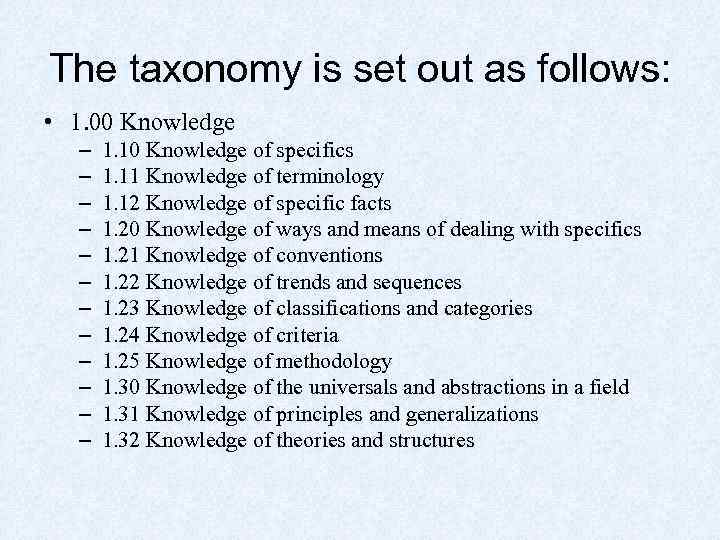
The taxonomy is set out as follows: • 1. 00 Knowledge – – – 1. 10 Knowledge of specifics 1. 11 Knowledge of terminology 1. 12 Knowledge of specific facts 1. 20 Knowledge of ways and means of dealing with specifics 1. 21 Knowledge of conventions 1. 22 Knowledge of trends and sequences 1. 23 Knowledge of classifications and categories 1. 24 Knowledge of criteria 1. 25 Knowledge of methodology 1. 30 Knowledge of the universals and abstractions in a field 1. 31 Knowledge of principles and generalizations 1. 32 Knowledge of theories and structures

Thank you for your attention
Скачать презентацию Bloom s taxonomy is a set of three hierarchical
Blooms taxonomy.pptx