 Скачать презентацию Blood Glucose Control with Sports Fitness Activities
87a52f5a5f1e1fb4811763949b035e0a.ppt
- Количество слайдов: 51




Blood Glucose Control with Sports & Fitness Activities Gary Scheiner MS, CDE Owner/Clinical Director Integrated Diabetes Services Wynnewood, PA 877 -735 -3648 www. integrateddiabetes. com Gary@integrateddiabetes. com
Objectives 1. Optimize glycemic control to enhance physical/athletic performance 2. Prevent hypoglycemia during and after physical activity 3. Prevent exercise-induced hyperglycemia, ketosis and DKA 4. Manage the logistics of wearing an insulin pump during physical activity
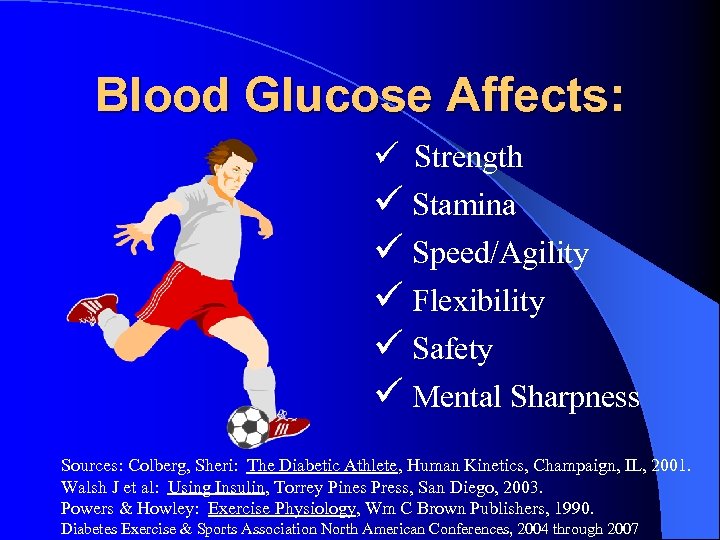
Blood Glucose Affects: Strength Stamina Speed/Agility Flexibility Safety Mental Sharpness Sources: Colberg, Sheri: The Diabetic Athlete, Human Kinetics, Champaign, IL, 2001. Walsh J et al: Using Insulin, Torrey Pines Press, San Diego, 2003. Powers & Howley: Exercise Physiology, Wm C Brown Publishers, 1990. Diabetes Exercise & Sports Association North American Conferences, 2004 through 2007
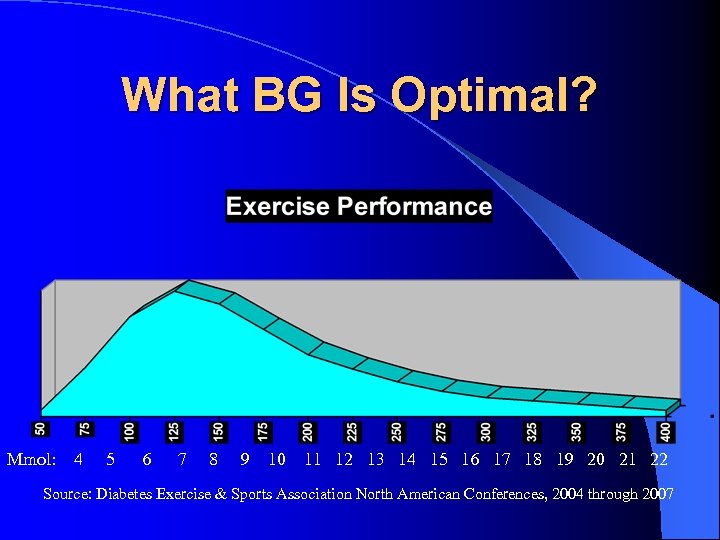
What BG Is Optimal? Mmol: 4 5 6 7 8 9 10 11 12 13 14 15 16 17 18 19 20 21 22 Source: Diabetes Exercise & Sports Association North American Conferences, 2004 through 2007
Hypoglycemia Prevention
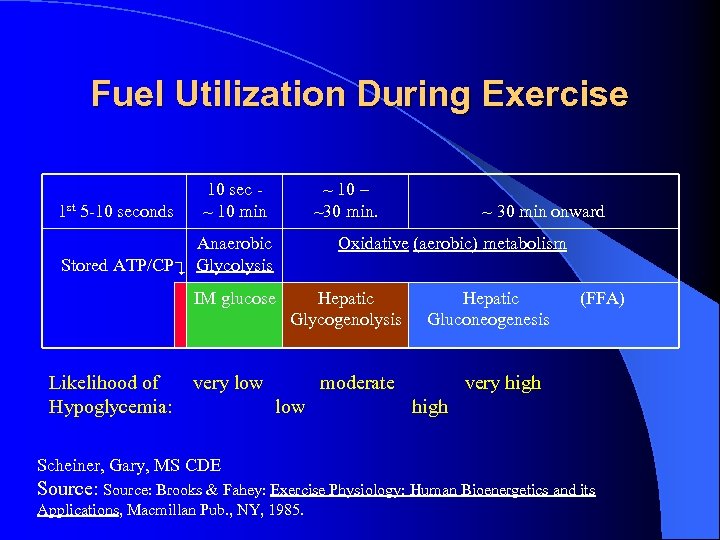
Fuel Utilization During Exercise 1 st 5 -10 seconds 10 sec - ~ 10 min Anaerobic Stored ATP/CP Glycolysis IM glucose Likelihood of Hypoglycemia: ~ 10 – ~30 min. ~ 30 min onward Oxidative (aerobic) metabolism Hepatic (FFA) Glycogenolysis Gluconeogenesis very low moderate very high low high Scheiner, Gary, MS CDE Source: Brooks & Fahey: Exercise Physiology: Human Bioenergetics and its Applications, Macmillan Pub. , NY, 1985.
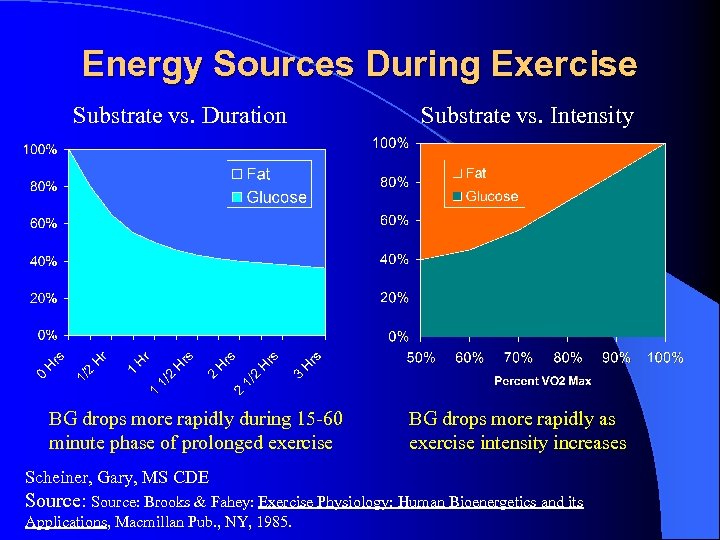
Energy Sources During Exercise Substrate vs. Duration BG drops more rapidly during 15 -60 minute phase of prolonged exercise Substrate vs. Intensity BG drops more rapidly as exercise intensity increases Scheiner, Gary, MS CDE Source: Brooks & Fahey: Exercise Physiology: Human Bioenergetics and its Applications, Macmillan Pub. , NY, 1985.
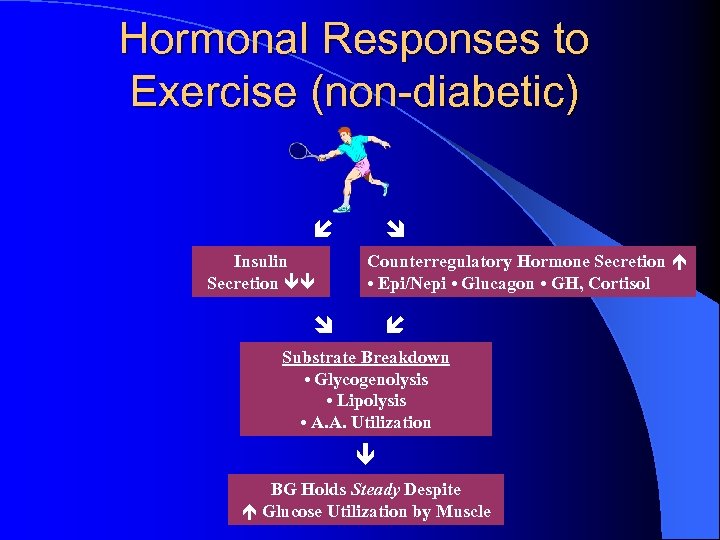
Hormonal Responses to Exercise (non-diabetic) Insulin Secretion Counterregulatory Hormone Secretion • Epi/Nepi • Glucagon • GH, Cortisol Substrate Breakdown • Glycogenolysis • Lipolysis • A. A. Utilization BG Holds Steady Despite Glucose Utilization by Muscle
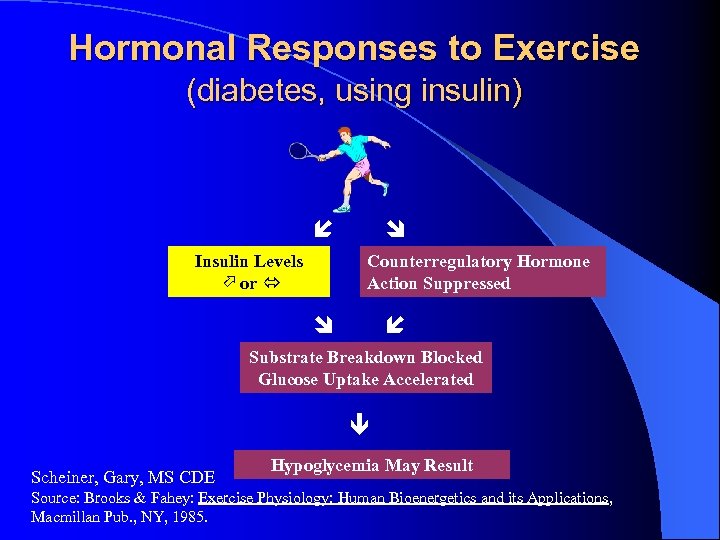
Hormonal Responses to Exercise (diabetes, using insulin) Insulin Levels or Counterregulatory Hormone Action Suppressed Substrate Breakdown Blocked Glucose Uptake Accelerated Scheiner, Gary, MS CDE Hypoglycemia May Result Source: Brooks & Fahey: Exercise Physiology: Human Bioenergetics and its Applications, Macmillan Pub. , NY, 1985.
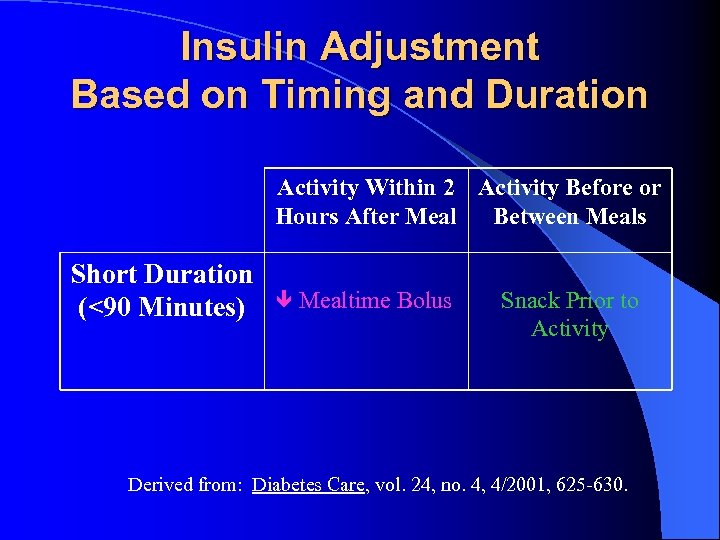
Insulin Adjustment Based on Timing and Duration Activity Within 2 Activity Before or Hours After Meal Between Meals Short Duration (<90 Minutes) Mealtime Bolus Snack Prior to Activity Derived from: Diabetes Care, vol. 24, no. 4, 4/2001, 625 -630.
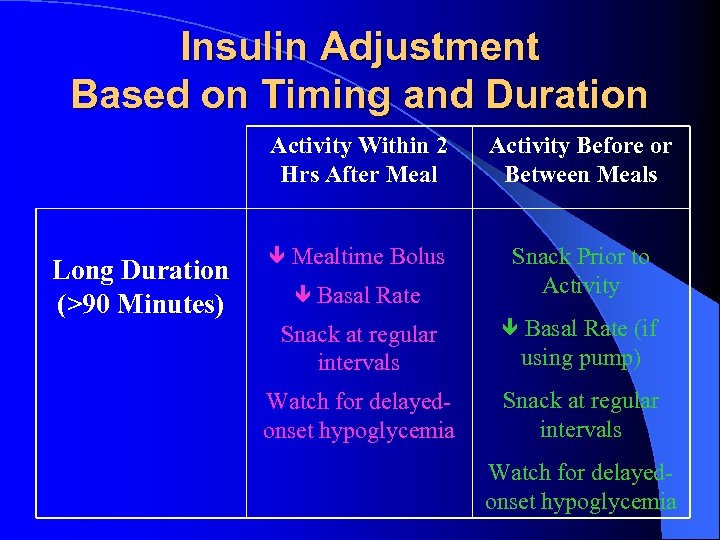
Insulin Adjustment Based on Timing and Duration Activity Within 2 Hrs After Meal Long Duration (>90 Minutes) Mealtime Bolus Basal Rate Activity Before or Between Meals Snack Prior to Activity Snack at regular intervals Basal Rate (if Watch for delayedonset hypoglycemia Snack at regular intervals using pump) Watch for delayedonset hypoglycemia
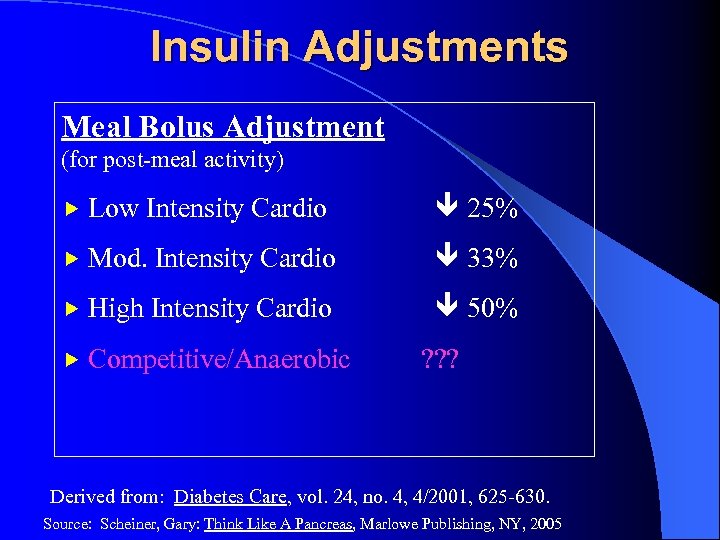
Insulin Adjustments Meal Bolus Adjustment (for post-meal activity) Low Intensity Cardio 25% Mod. Intensity Cardio 33% High Intensity Cardio 50% Competitive/Anaerobic ? ? ? Derived from: Diabetes Care, vol. 24, no. 4, 4/2001, 625 -630. Source: Scheiner, Gary: Think Like A Pancreas, Marlowe Publishing, NY, 2005
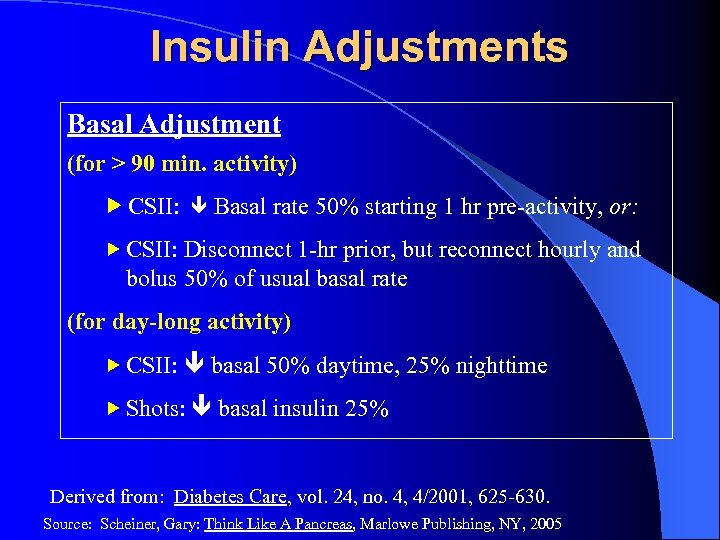
Insulin Adjustments Basal Adjustment (for > 90 min. activity) CSII: Basal rate 50% starting 1 hr pre-activity, or: CSII: Disconnect 1 -hr prior, but reconnect hourly and bolus 50% of usual basal rate (for day-long activity) CSII: basal 50% daytime, 25% nighttime Shots: basal insulin 25% Derived from: Diabetes Care, vol. 24, no. 4, 4/2001, 625 -630. Source: Scheiner, Gary: Think Like A Pancreas, Marlowe Publishing, NY, 2005
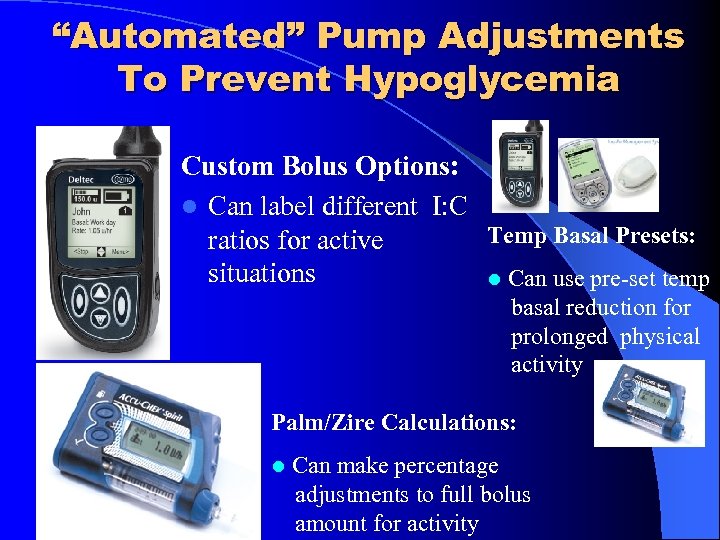
“Automated” Pump Adjustments To Prevent Hypoglycemia Custom Bolus Options: Can label different I: C Temp Basal Presets: ratios for active situations Can use pre-set temp basal reduction for prolonged physical activity Palm/Zire Calculations: Can make percentage adjustments to full bolus amount for activity
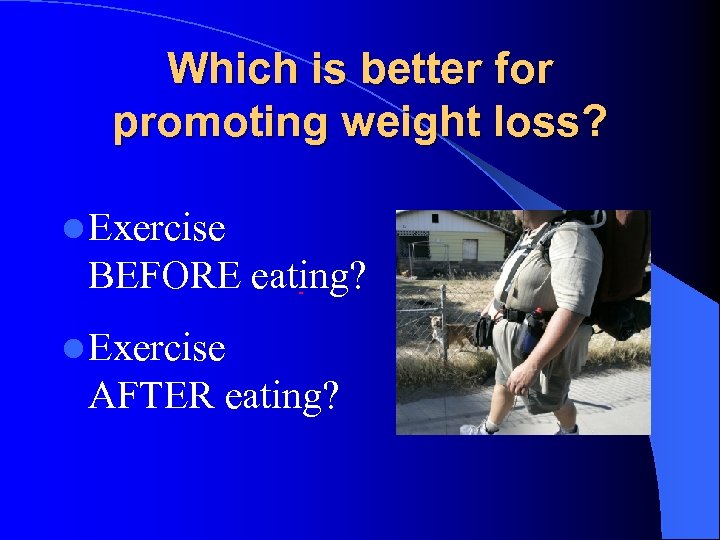
Which is better for promoting weight loss? Exercise BEFORE eating? Exercise AFTER eating?
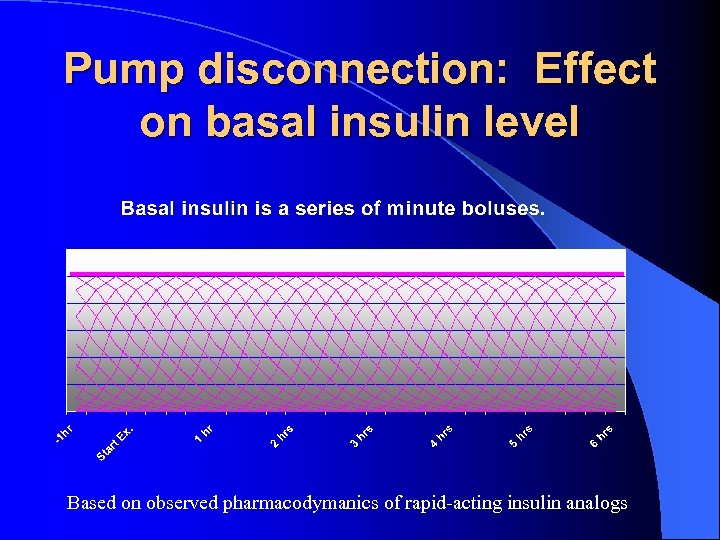
Pump disconnection: Effect on basal insulin level Based on observed pharmacodymanics of rapid-acting insulin analogs
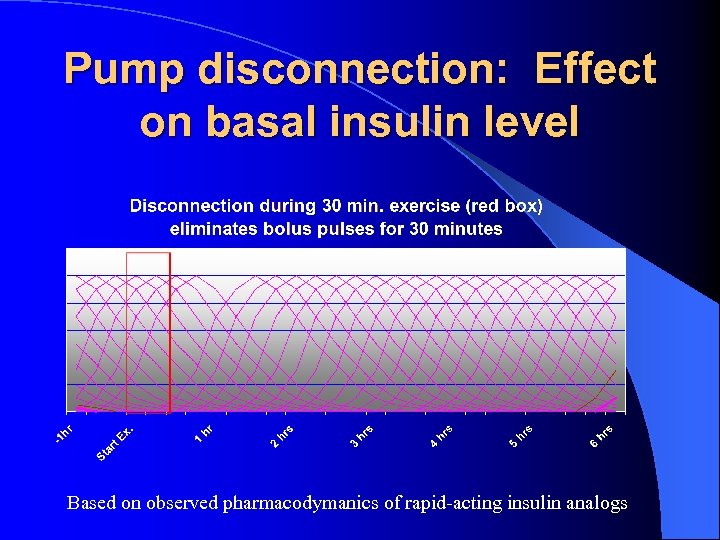
Pump disconnection: Effect on basal insulin level Based on observed pharmacodymanics of rapid-acting insulin analogs
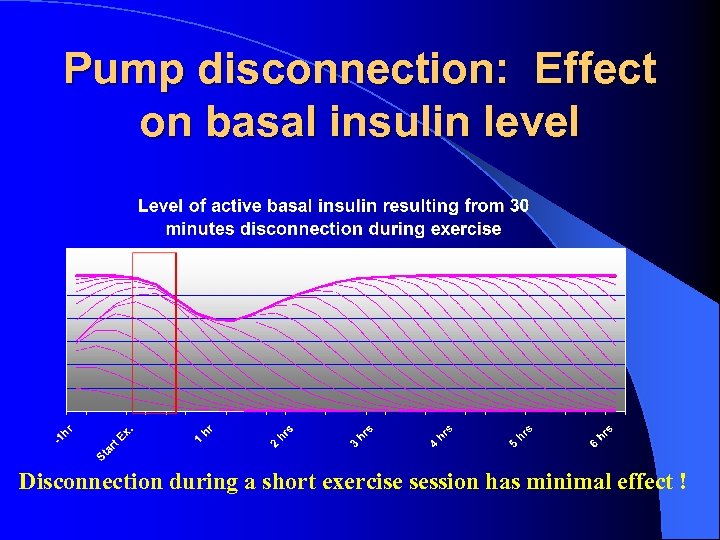
Pump disconnection: Effect on basal insulin level Disconnection during a short exercise session has minimal effect !
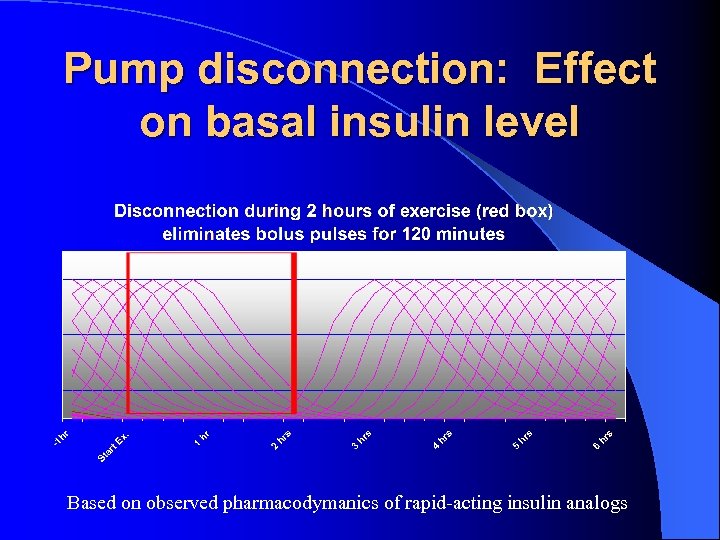
Pump disconnection: Effect on basal insulin level Based on observed pharmacodymanics of rapid-acting insulin analogs
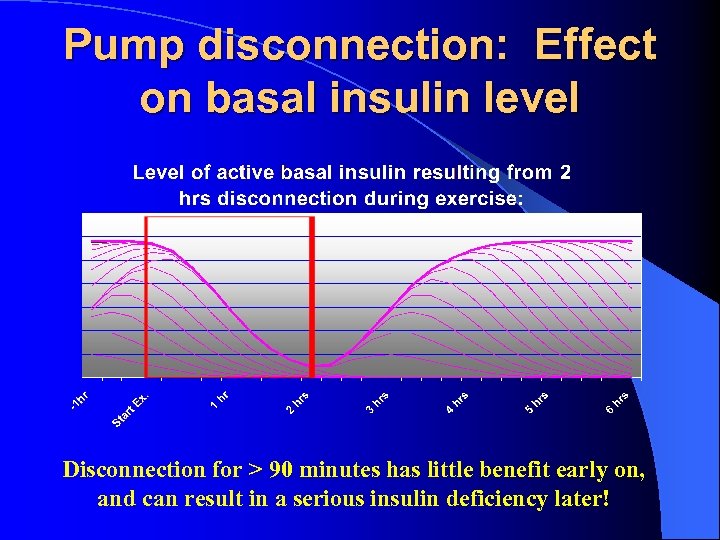
Pump disconnection: Effect on basal insulin level Disconnection for > 90 minutes has little benefit early on, and can result in a serious insulin deficiency later!
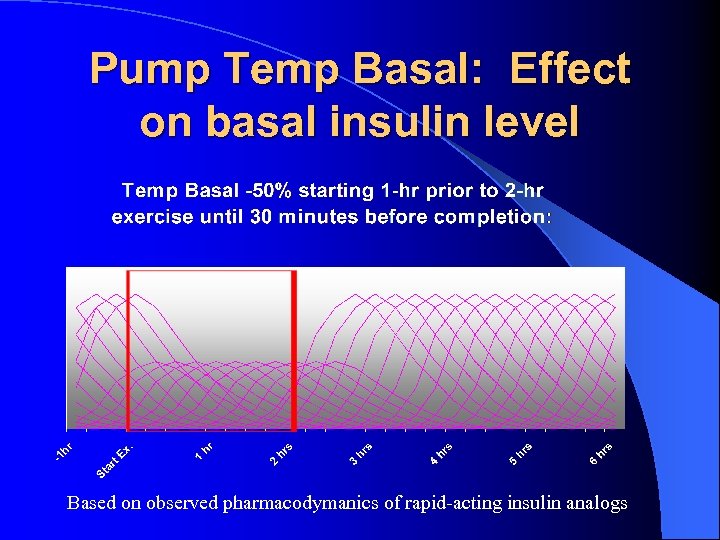
Pump Temp Basal: Effect on basal insulin level Based on observed pharmacodymanics of rapid-acting insulin analogs
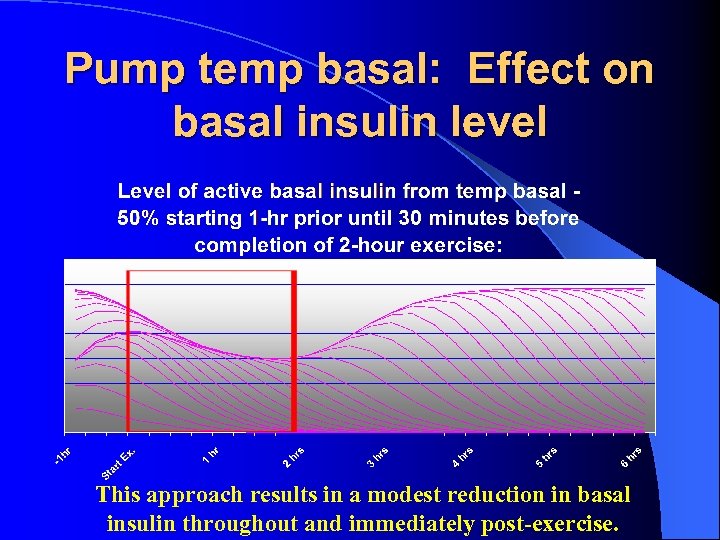
Pump temp basal: Effect on basal insulin level This approach results in a modest reduction in basal insulin throughout and immediately post-exercise.
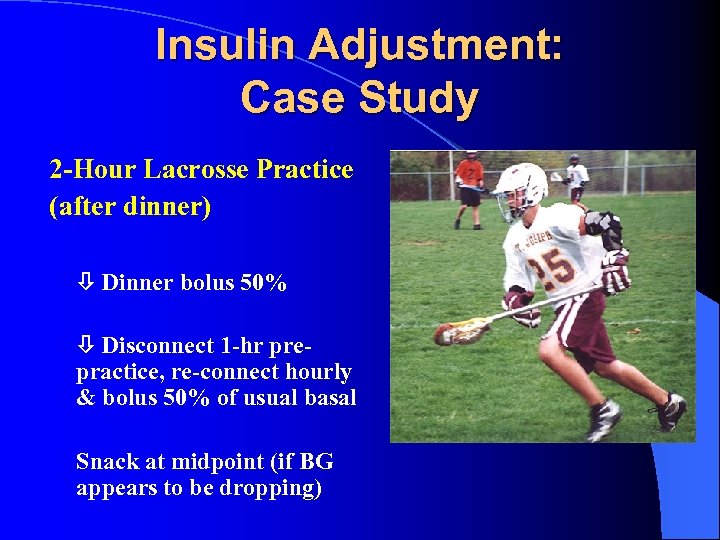
Insulin Adjustment: Case Study 2 -Hour Lacrosse Practice (after dinner) Dinner bolus 50% Disconnect 1 -hr prepractice, re-connect hourly & bolus 50% of usual basal Snack at midpoint (if BG appears to be dropping)
Snacking to prevent hypoglycemia Basic Rules: Snack prior to activity to prevent hypoglycemia Adjust quantity based on pre-activity BG or direction of BG low or dropping: usual carbs BG OK or stable: usual carbs BG High or rising: usual carbs Snack at least once per hour during prolonged activity Choose high-glycemic-index forms of carbohydrate Sports drinks / Sweetened beverages Dry cereal, pretzels, crackers Source: Scheiner, Gary: Think Like A Pancreas, Marlowe Publishing, NY, 2005
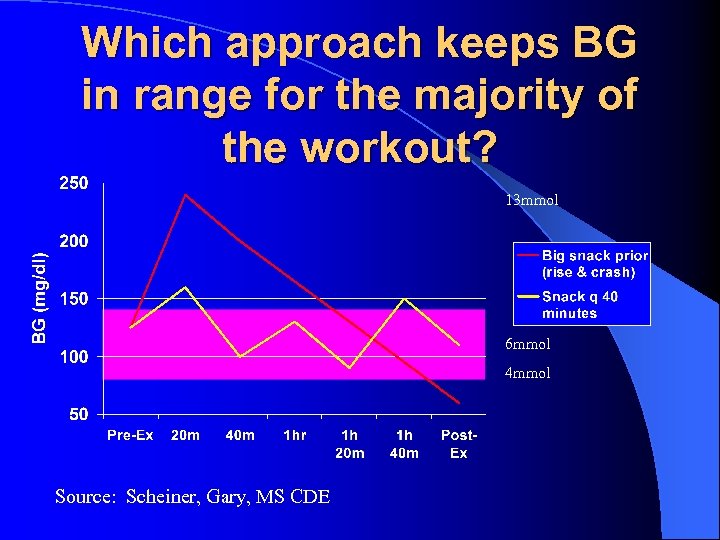
Which approach keeps BG in range for the majority of the workout? 13 mmol 6 mmol 4 mmol Source: Scheiner, Gary, MS CDE
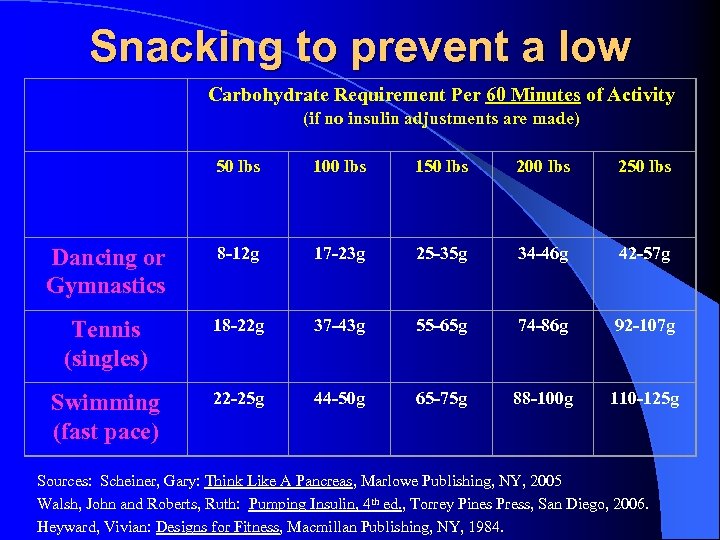
Snacking to prevent a low Carbohydrate Requirement Per 60 Minutes of Activity (if no insulin adjustments are made) 50 lbs 100 lbs 150 lbs 200 lbs 250 lbs Dancing or Gymnastics 8 -12 g 17 -23 g 25 -35 g 34 -46 g 42 -57 g Tennis (singles) 18 -22 g 37 -43 g 55 -65 g 74 -86 g 92 -107 g Swimming (fast pace) 22 -25 g 44 -50 g 65 -75 g 88 -100 g 110 -125 g Sources: Scheiner, Gary: Think Like A Pancreas, Marlowe Publishing, NY, 2005 Walsh, John and Roberts, Ruth: Pumping Insulin, 4 th ed. , Torrey Pines Press, San Diego, 2006. Heyward, Vivian: Designs for Fitness, Macmillan Publishing, NY, 1984.
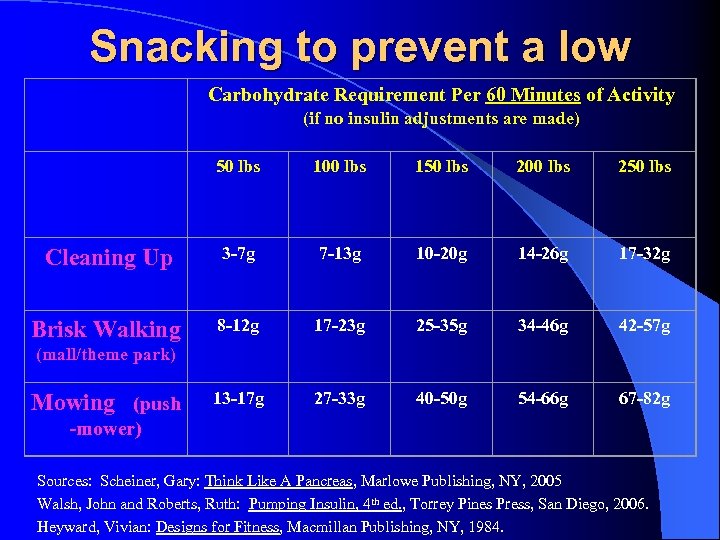
Snacking to prevent a low Carbohydrate Requirement Per 60 Minutes of Activity (if no insulin adjustments are made) 50 lbs 100 lbs 150 lbs 200 lbs 250 lbs Cleaning Up 3 -7 g 7 -13 g 10 -20 g 14 -26 g 17 -32 g Brisk Walking 8 -12 g 17 -23 g 25 -35 g 34 -46 g 42 -57 g 13 -17 g 27 -33 g 40 -50 g 54 -66 g 67 -82 g (mall/theme park) Mowing (push -mower) Sources: Scheiner, Gary: Think Like A Pancreas, Marlowe Publishing, NY, 2005 Walsh, John and Roberts, Ruth: Pumping Insulin, 4 th ed. , Torrey Pines Press, San Diego, 2006. Heyward, Vivian: Designs for Fitness, Macmillan Publishing, NY, 1984.
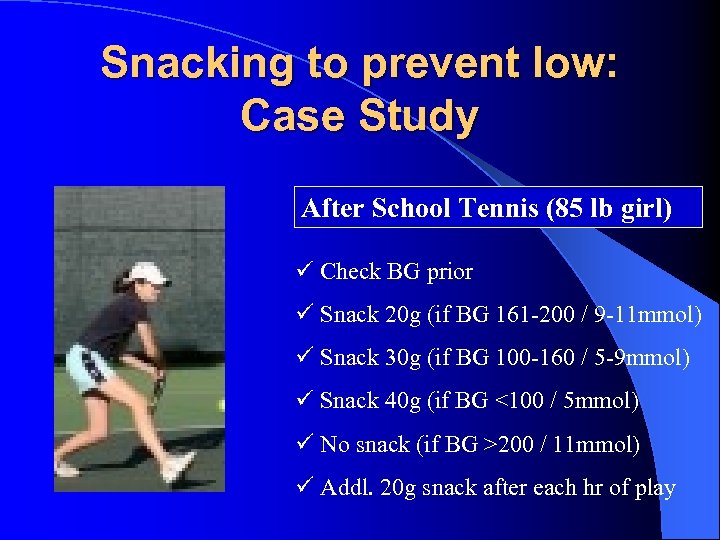
Snacking to prevent low: Case Study After School Tennis (85 lb girl) Check BG prior Snack 20 g (if BG 161 -200 / 9 -11 mmol) Snack 30 g (if BG 100 -160 / 5 -9 mmol) Snack 40 g (if BG <100 / 5 mmol) No snack (if BG >200 / 11 mmol) Addl. 20 g snack after each hr of play
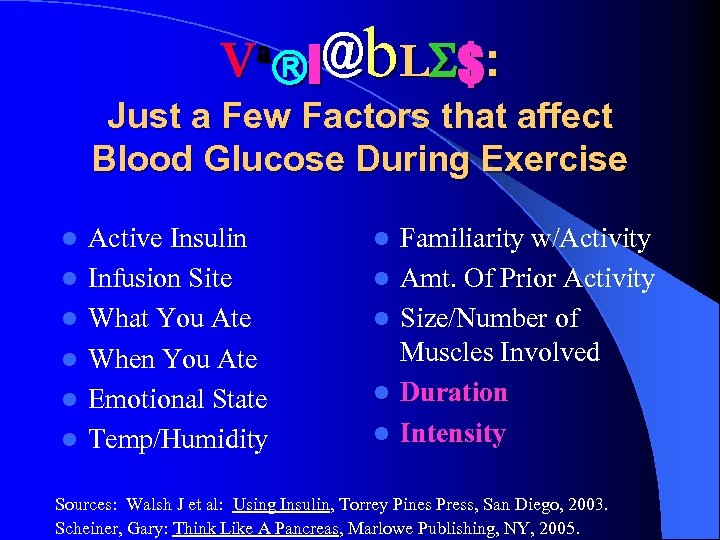
i@b. L $: a V Just a Few Factors that affect Blood Glucose During Exercise Active Insulin Infusion Site What You Ate When You Ate Emotional State Temp/Humidity Familiarity w/Activity Amt. Of Prior Activity Size/Number of Muscles Involved Duration Intensity Sources: Walsh J et al: Using Insulin, Torrey Pines Press, San Diego, 2003. Scheiner, Gary: Think Like A Pancreas, Marlowe Publishing, NY, 2005.
Watch Out for D’OH! (Delayed Onset Hypoglycemia) Following high-intensity exercise Following extended duration activity Due to replenishment of muscle glycogen stores, enhanced insulin sensitivity May occur up to 24 hours afterwards (typically 6 -12 hours later) Source: Colberg, Sheri: The Diabetic Athlete, Human Kinetics, Champaign, IL, 2001.
D’OH! Prevention Keep records – track the patterns Decrease basal insulin (modestly) or meal/snack boluses post-activity “Free” Snacks (slowacting carbs) following activity
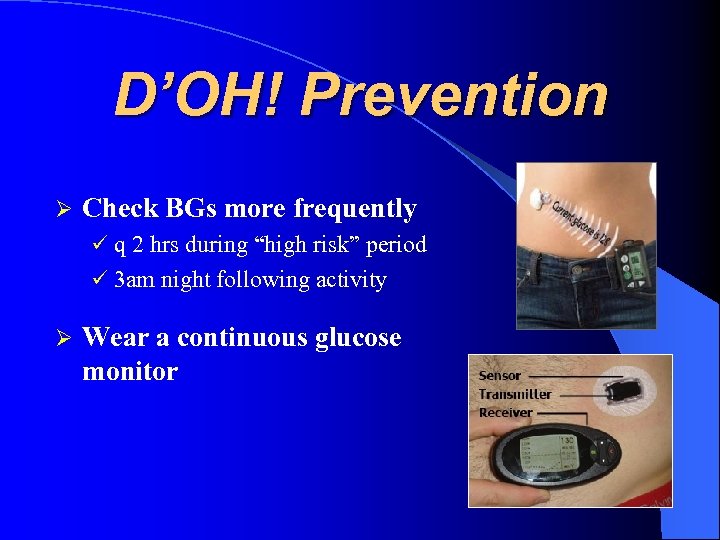
D’OH! Prevention Check BGs more frequently q 2 hrs during “high risk” period 3 am night following activity Wear a continuous glucose monitor
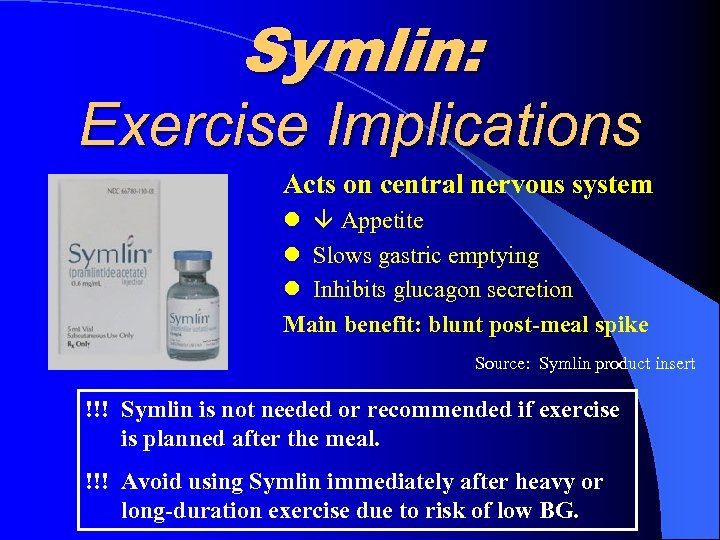
Symlin: Exercise Implications Acts on central nervous system Appetite Slows gastric emptying Inhibits glucagon secretion Main benefit: blunt post-meal spike Source: Symlin product insert !!! Symlin is not needed or recommended if exercise is planned after the meal. !!! Avoid using Symlin immediately after heavy or long-duration exercise due to risk of low BG.
Can Exercise Cause Rise in BG? Ketoacidosis?
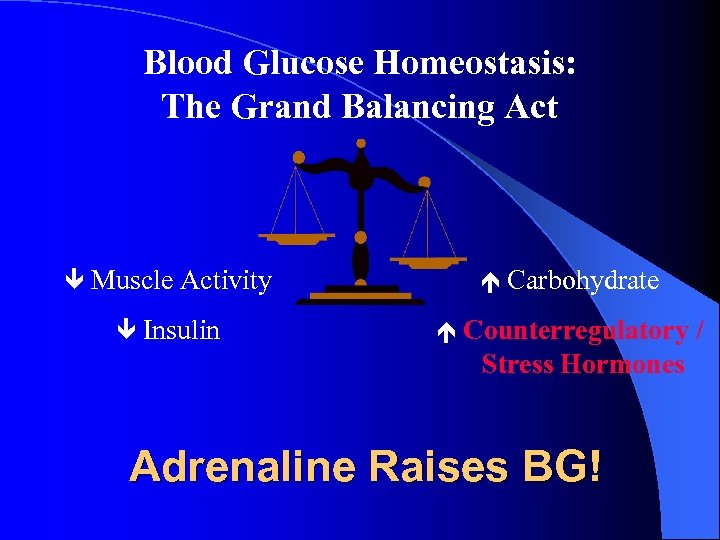
Blood Glucose Homeostasis: The Grand Balancing Act Muscle Activity Carbohydrate Insulin Counterregulatory / Stress Hormones Adrenaline Raises BG!
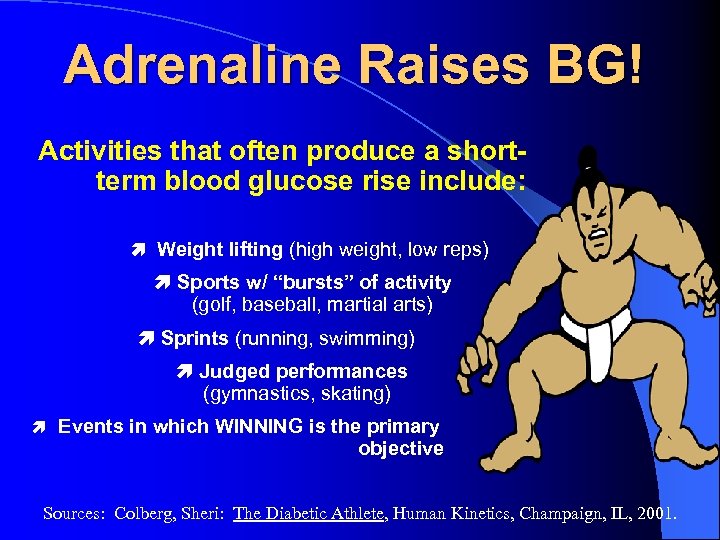
Adrenaline Raises BG! Activities that often produce a shortterm blood glucose rise include: Weight lifting (high weight, low reps) Sports w/ “bursts” of activity (golf, baseball, martial arts) Sprints (running, swimming) Judged performances (gymnastics, skating) Events in which WINNING is the primary objective Sources: Colberg, Sheri: The Diabetic Athlete, Human Kinetics, Champaign, IL, 2001.
Preventing / Offsetting BG Rise Keep Records to determine avg. BG rise Check BG 30 -60 Min. Pre-Activity Bolus 30 -60 min. prior to activity to offset rise (give 50% of usual amount required) Take 50% of Usual “Correction Dose” If High (reduce based on insulin-on-board) Sources: Scheiner, Gary: Think Like A Pancreas, Marlowe Publishing, NY, 2005
Snacking to prevent high: Case Study Late-Morning Basketball; disconnects for 1 hour; BG typically rises from 100 s to 300 s (5 to 15 mmol). Check BG 30 min prior Bolus 50% of amount required to cover current BG (including IOB) Bolus 50% of amount needed to offset 200 mg/dl rise Check BG at halftime; keep sugared drinks handy.
Dehydration Can Raise Blood Glucose Concentration u Decreased blood volume will give the impression that blood sugar level has risen u Water is needed to convert fat & glucose into energy u Adequate hydration improves performance and prevents cramping u Thirst occurs after dehydration has occurred u Drink before & after exercise u Extra fluids during extended exercise or with warm/humid conditions Source: Osterberg, Kris, MS, RD – Senior Scientist, Gatorade Sports Science Institute
What the *&!%#! Is a KETONE? ? ?
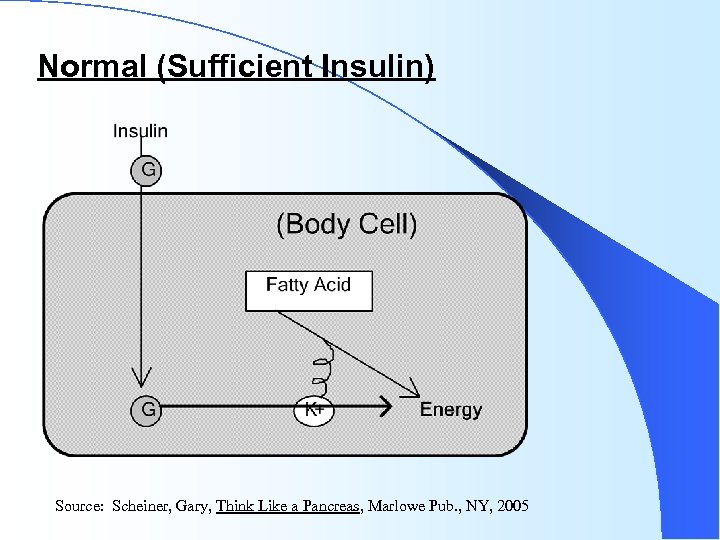
Normal (Sufficient Insulin) Source: Scheiner, Gary, Think Like a Pancreas, Marlowe Pub. , NY, 2005
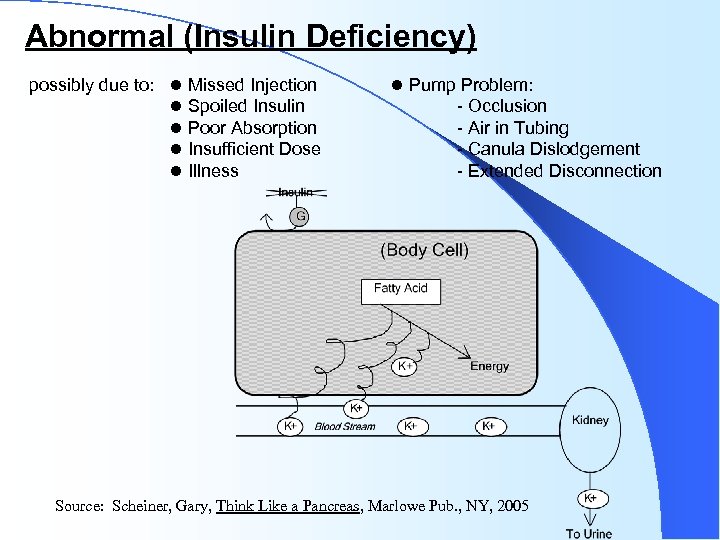
Abnormal (Insulin Deficiency) possibly due to: Missed Injection Spoiled Insulin Poor Absorption Insufficient Dose Illness Pump Problem: - Occlusion - Air in Tubing - Canula Dislodgement - Extended Disconnection Source: Scheiner, Gary, Think Like a Pancreas, Marlowe Pub. , NY, 2005
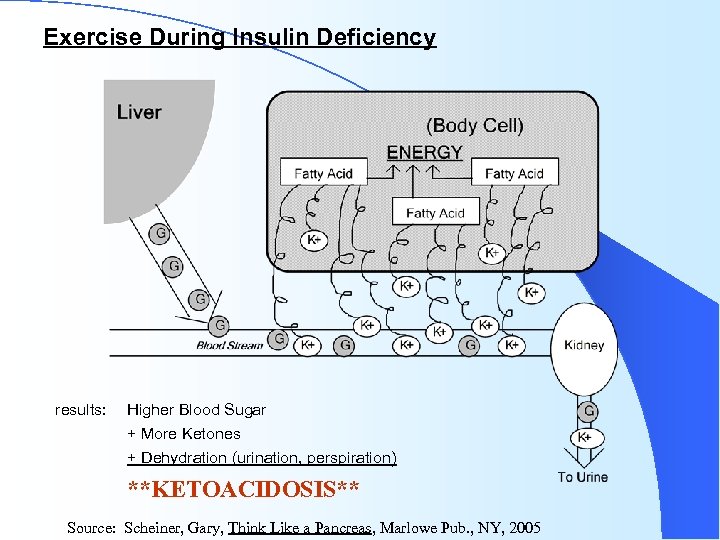
Exercise During Insulin Deficiency results: Higher Blood Sugar + More Ketones + Dehydration (urination, perspiration) **KETOACIDOSIS** Source: Scheiner, Gary, Think Like a Pancreas, Marlowe Pub. , NY, 2005
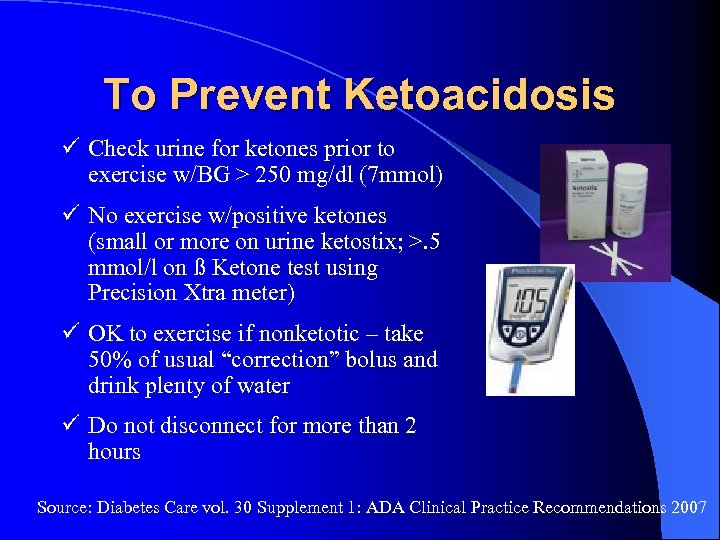
To Prevent Ketoacidosis Check urine for ketones prior to exercise w/BG > 250 mg/dl (7 mmol) No exercise w/positive ketones (small or more on urine ketostix; >. 5 mmol/l on ß Ketone test using Precision Xtra meter) OK to exercise if nonketotic – take 50% of usual “correction” bolus and drink plenty of water Do not disconnect for more than 2 hours Source: Diabetes Care vol. 30 Supplement 1: ADA Clinical Practice Recommendations 2007
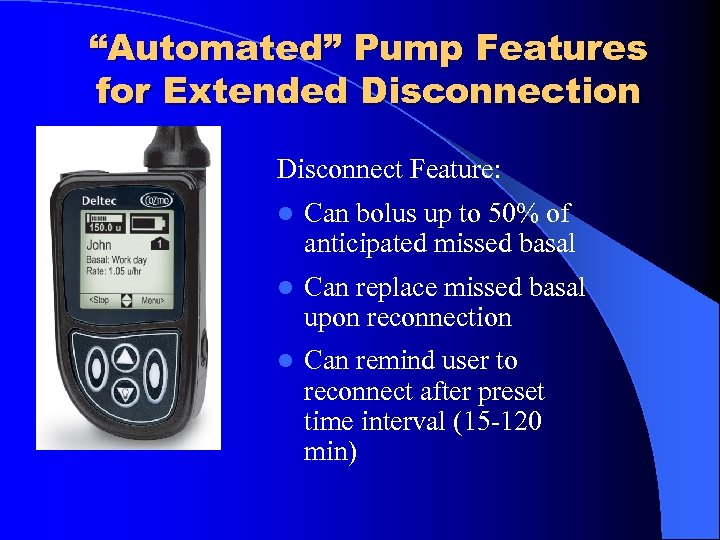
“Automated” Pump Features for Extended Disconnection Disconnect Feature: Can bolus up to 50% of anticipated missed basal Can replace missed basal upon reconnection Can remind user to reconnect after preset time interval (15 -120 min)
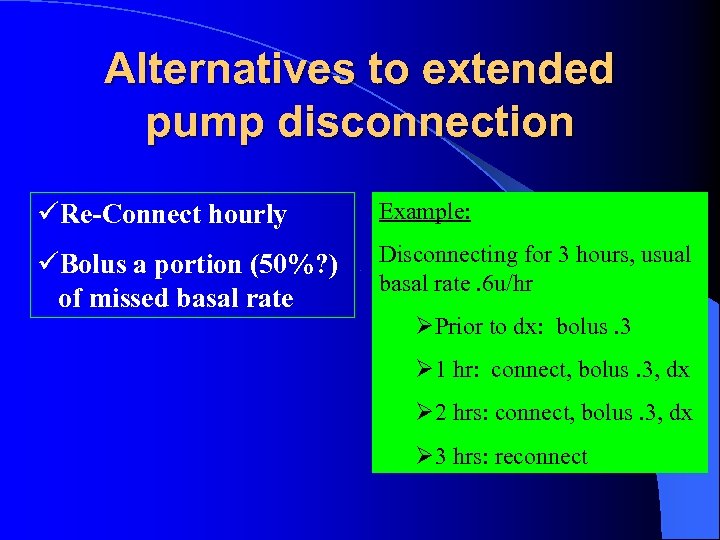
Alternatives to extended pump disconnection Re-Connect hourly Example: Bolus a portion (50%? ) Disconnecting for 3 hours, usual basal rate. 6 u/hr of missed basal rate Prior to dx: bolus. 3 1 hr: connect, bolus. 3, dx 2 hrs: connect, bolus. 3, dx 3 hrs: reconnect
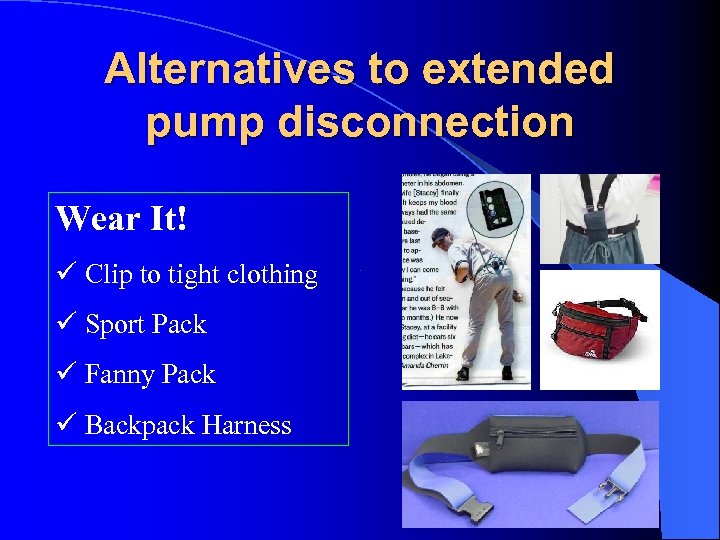
Alternatives to extended pump disconnection Wear It! Clip to tight clothing Sport Pack Fanny Pack Backpack Harness
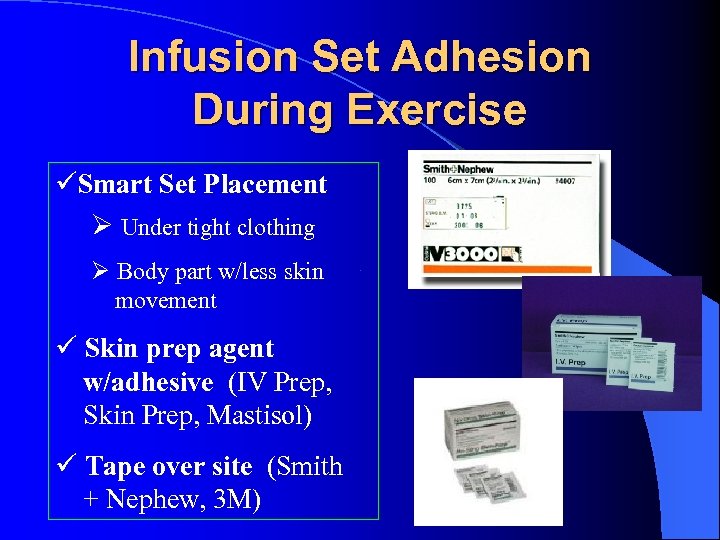
Infusion Set Adhesion During Exercise Smart Set Placement Under tight clothing Body part w/less skin movement Skin prep agent w/adhesive (IV Prep, Skin Prep, Mastisol) Tape over site (Smith + Nephew, 3 M)
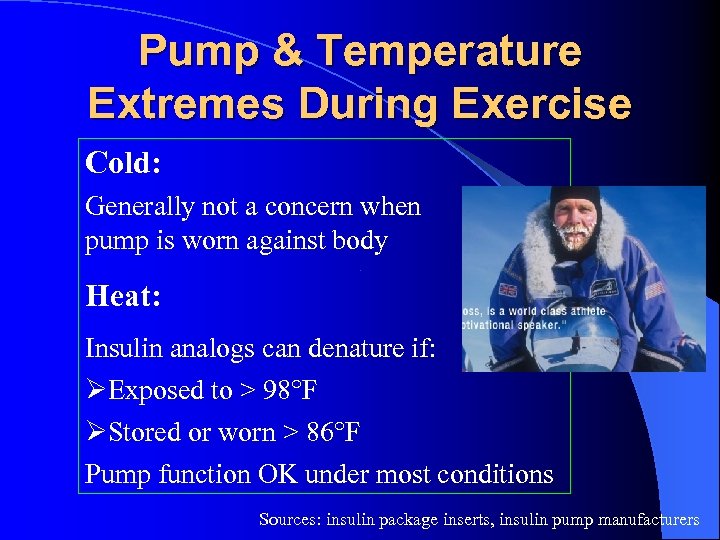
Pump & Temperature Extremes During Exercise Cold: Generally not a concern when pump is worn against body Heat: Insulin analogs can denature if: Exposed to > 98°F Stored or worn > 86°F Pump function OK under most conditions Sources: insulin package inserts, insulin pump manufacturers
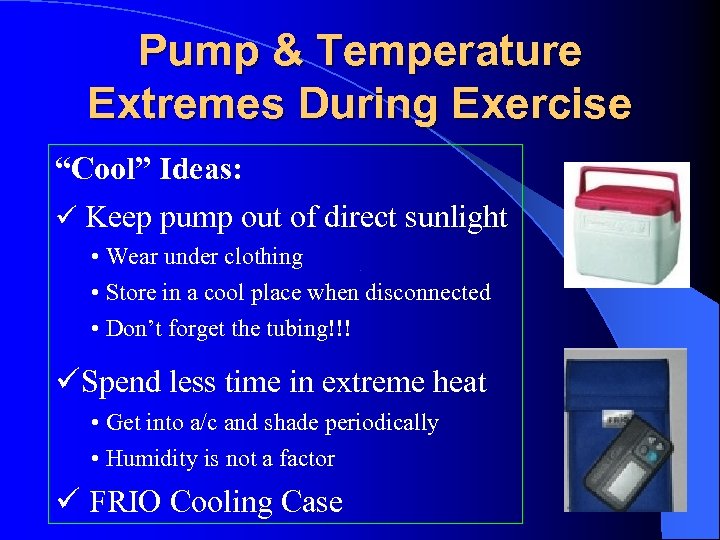
Pump & Temperature Extremes During Exercise “Cool” Ideas: Keep pump out of direct sunlight • Wear under clothing • Store in a cool place when disconnected • Don’t forget the tubing!!! Spend less time in extreme heat • Get into a/c and shade periodically • Humidity is not a factor FRIO Cooling Case
Diabetes Exercise & Sports Association (DESA) • Information • Resources • Networking • Inspiration 800 -898 -4322 www. diabetes-exercise. org
Скачать презентацию Blood Glucose Control with Sports Fitness Activities
87a52f5a5f1e1fb4811763949b035e0a.ppt