 Скачать презентацию Blind Aid Project Mid-Presentation Sandra Mau Nik Melchior
a99a19233574c05997407fff5394bfa4.ppt
- Количество слайдов: 15



Blind Aid Project Mid-Presentation Sandra Mau, Nik Melchior, Maxim Makatchev
Contents ➲ Project overview ➲ What we've learned ➲ Related projects ➲ Website tour
Project Overview ➲ Develop an Electronic Travel Aid for the blind ➲ indoor navigation and obstacle avoidance outdoor navigation and path planning Range sensors and/or GPS
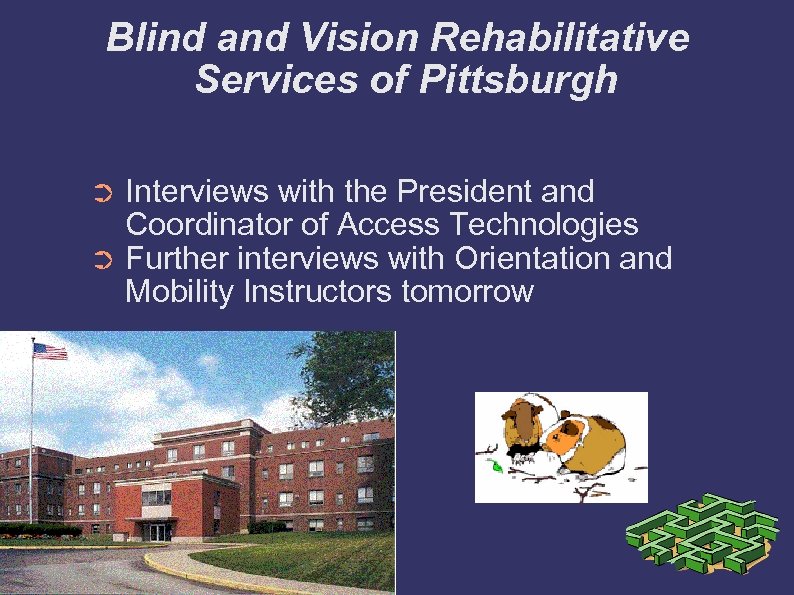
Blind and Vision Rehabilitative Services of Pittsburgh Interviews with the President and Coordinator of Access Technologies ➲ Further interviews with Orientation and Mobility Instructors tomorrow ➲
Blind and Vision Rehabilitative Services of Pittsburgh ➲ ➲ Optometrist services Training facilities including a kitchen Dormitories We merited a mention in their monthly newsletter
What We Have Learned 90% of the blind cannot travel independently ➲ 7% use canes ➲ Trailing: following a fine discrimination such as curb/grass border 3% use guide dogs ➲ Batteries don't die Take initiative (intelligent disobedience) Recognize limited classes of objects Follow Asimov's Laws
Interfaces Most blind people don't read braille (especially elderly) ➲ Vibration can be useful ➲ Audible is preferred ➲ In general: ➲ Should not chatter too much User should take initiative Do not need an inventory of a room Need a hand free
Interesting Problems Need to know what's nearby without actually passing by everything ➲ Indoor navigation is more important ➲ College campuses and hospitals Instrumented environments Hard to sell
Interesting Problems (1)Buses at a bus stop (2)GPS interface: current location and what's nearby (3)Where to go and what to do at airports, hotels, convention centers, etc.
Related Research ➲ Stated Preferences for Components of a Personal Guidance System for Nonvisual Navigation [Golledge, Marston, Loomis, Klatzky] Preferred input type for PGS Voice input was strongest Braille was surprisingly not very popular Preferred output type for PGS Most accepted was a collar-or shoulder-mounted speech sound device Least accepted was output via headphones over ears For devices with extra directional cues, speech or tonal sound output was preferred
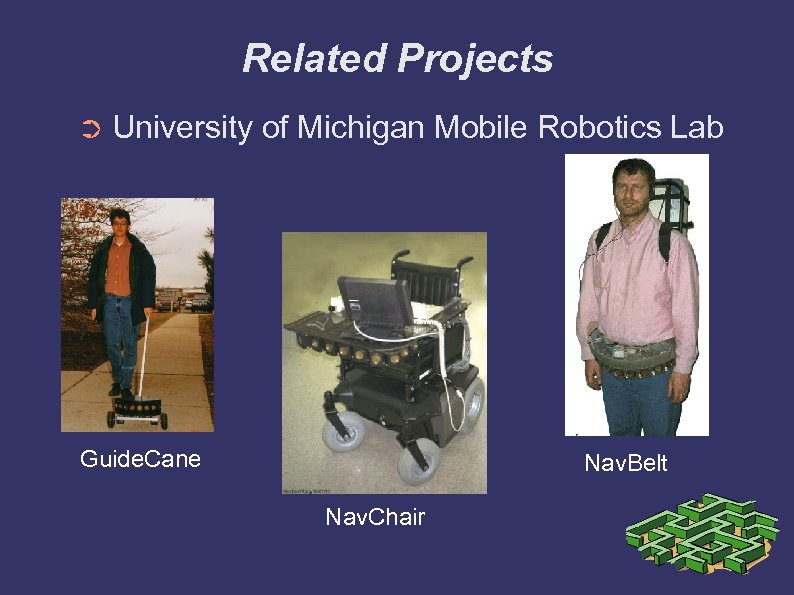
Related Projects ➲ University of Michigan Mobile Robotics Lab Guide. Cane Nav. Belt Nav. Chair
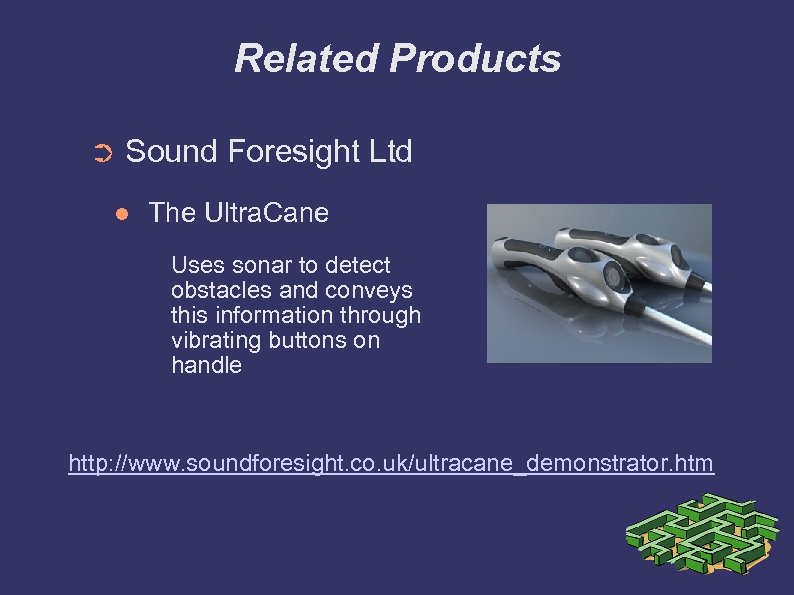
Related Products ➲ Sound Foresight Ltd The Ultra. Cane Uses sonar to detect obstacles and conveys this information through vibrating buttons on handle http: //www. soundforesight. co. uk/ultracane_demonstrator. htm
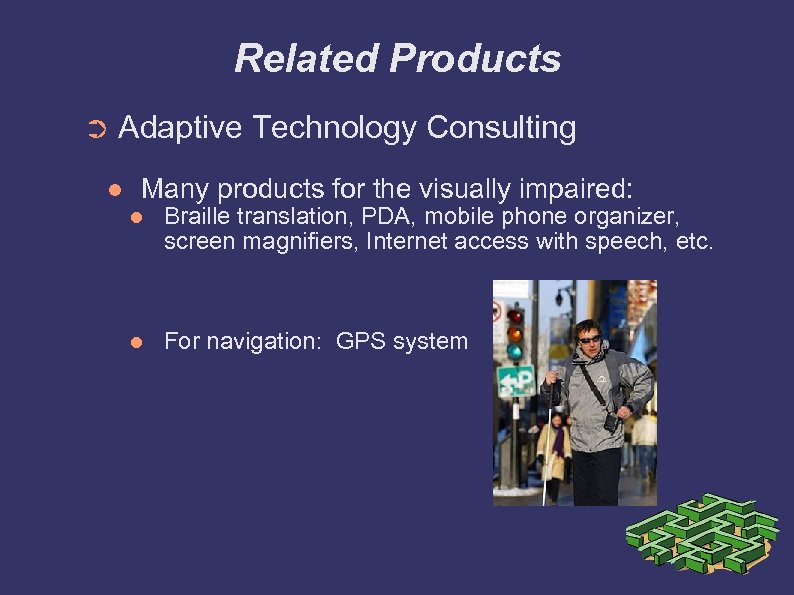
Related Products ➲ Adaptive Technology Consulting Many products for the visually impaired: Braille translation, PDA, mobile phone organizer, screen magnifiers, Internet access with speech, etc. For navigation: GPS system
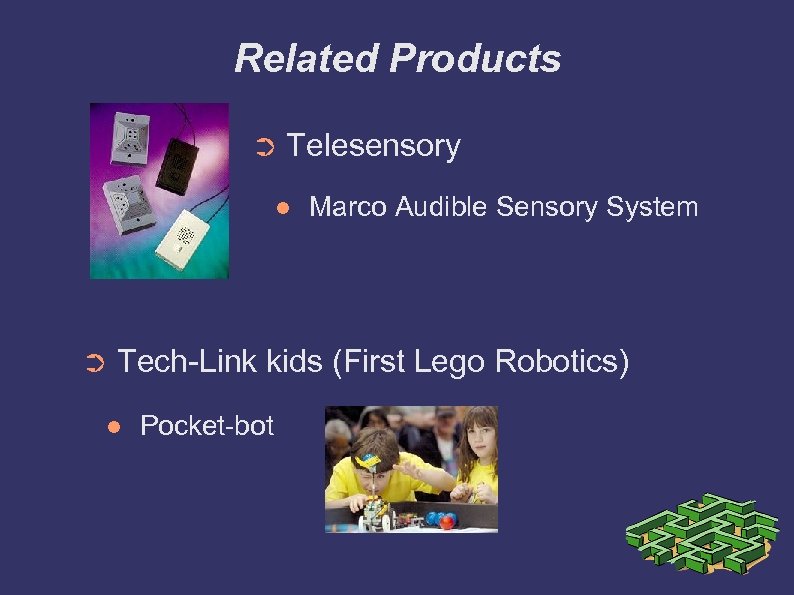
Related Products ➲ Telesensory ➲ Marco Audible Sensory System Tech-Link kids (First Lego Robotics) Pocket-bot
To the web. . .
Скачать презентацию Blind Aid Project Mid-Presentation Sandra Mau Nik Melchior
a99a19233574c05997407fff5394bfa4.ppt