 Скачать презентацию Blaise Pascal 1623 1662 Adamson Donald Pascal s
8df3137fe6fd42f8efe6b874f92d7ca5.ppt
- Количество слайдов: 31



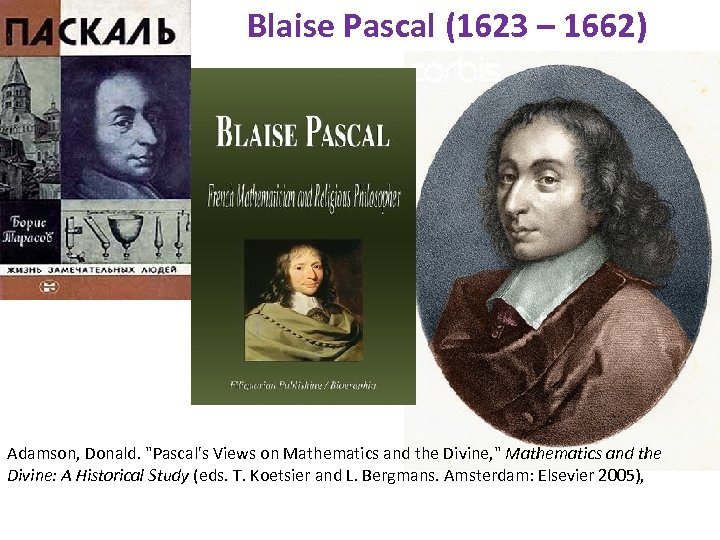
Blaise Pascal (1623 – 1662) Adamson, Donald. "Pascal's Views on Mathematics and the Divine, " Mathematics and the Divine: A Historical Study (eds. T. Koetsier and L. Bergmans. Amsterdam: Elsevier 2005),
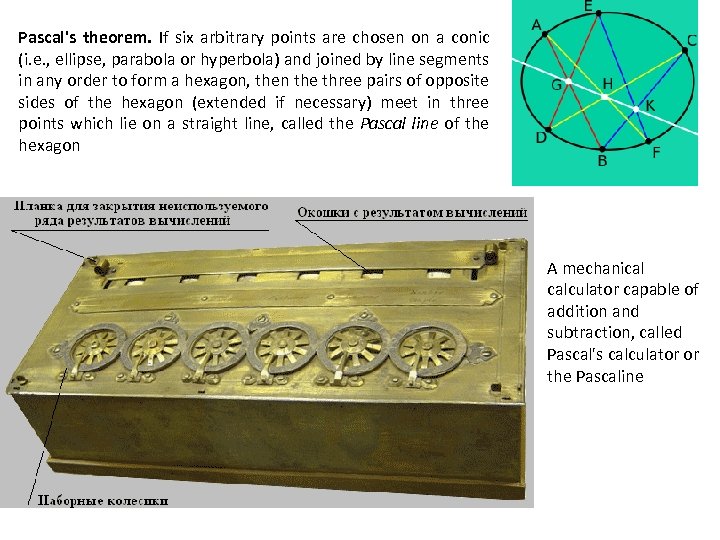
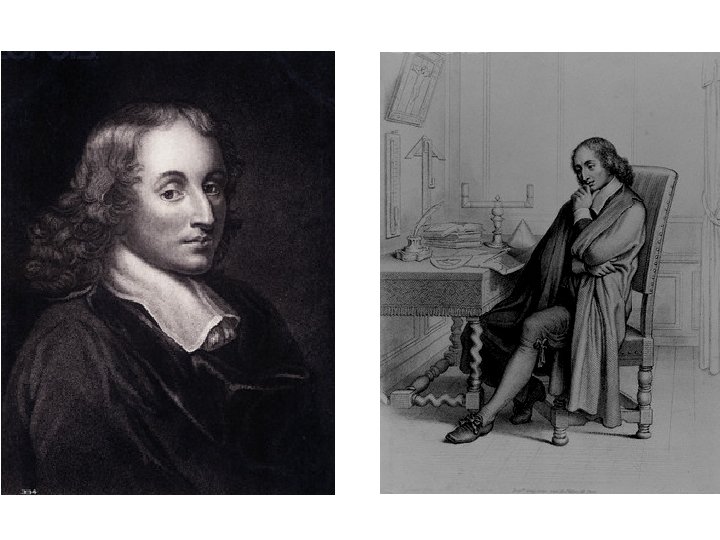
Pascal's theorem. If six arbitrary points are chosen on a conic (i. e. , ellipse, parabola or hyperbola) and joined by line segments in any order to form a hexagon, then the three pairs of opposite sides of the hexagon (extended if necessary) meet in three points which lie on a straight line, called the Pascal line of the hexagon A mechanical calculator capable of addition and subtraction, called Pascal's calculator or the Pascaline
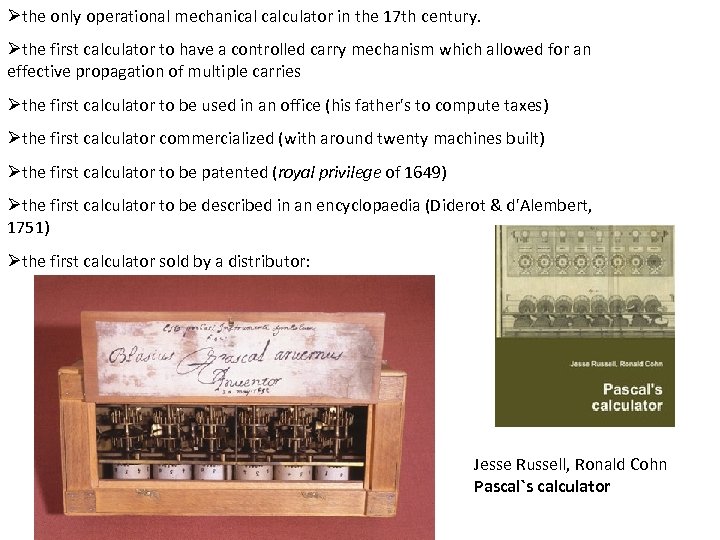
Øthe only operational mechanical calculator in the 17 th century. Øthe first calculator to have a controlled carry mechanism which allowed for an effective propagation of multiple carries Øthe first calculator to be used in an office (his father's to compute taxes) Øthe first calculator commercialized (with around twenty machines built) Øthe first calculator to be patented (royal privilege of 1649) Øthe first calculator to be described in an encyclopaedia (Diderot & d'Alembert, 1751) Øthe first calculator sold by a distributor: Jesse Russell, Ronald Cohn Pascal`s calculator
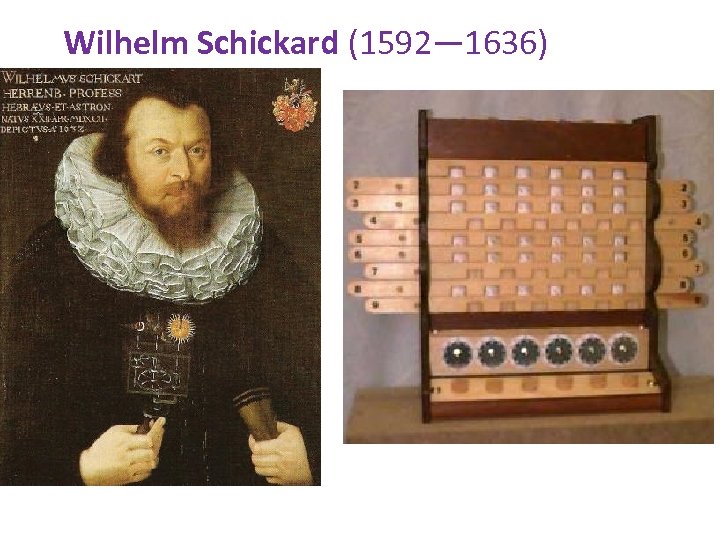
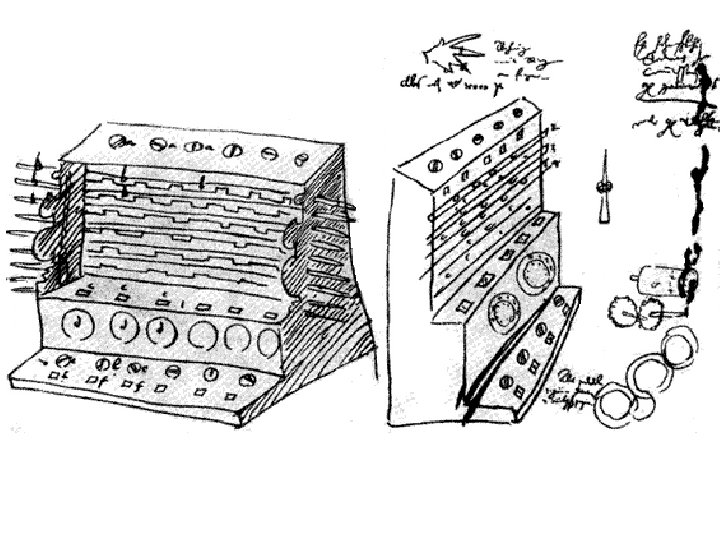
Wilhelm Schickard (1592— 1636)
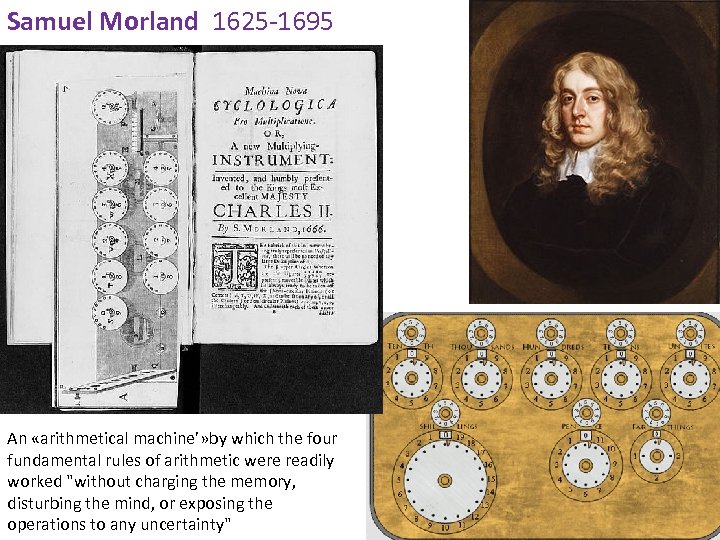
Samuel Morland 1625 -1695 An «arithmetical machine’» by which the four fundamental rules of arithmetic were readily worked "without charging the memory, disturbing the mind, or exposing the operations to any uncertainty"
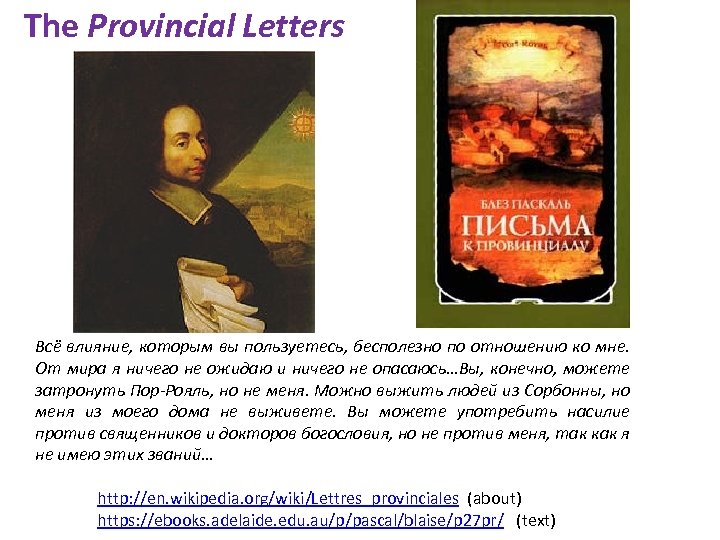
The Provincial Letters Всё влияние, которым вы пользуетесь, бесполезно по отношению ко мне. От мира я ничего не ожидаю и ничего не опасаюсь…Вы, конечно, можете затронуть Пор-Рояль, но не меня. Можно выжить людей из Сорбонны, но меня из моего дома не выживете. Вы можете употребить насилие против священников и докторов богословия, но не против меня, так как я не имею этих званий… http: //en. wikipedia. org/wiki/Lettres_provinciales (about) https: //ebooks. adelaide. edu. au/p/pascal/blaise/p 27 pr/ (text)
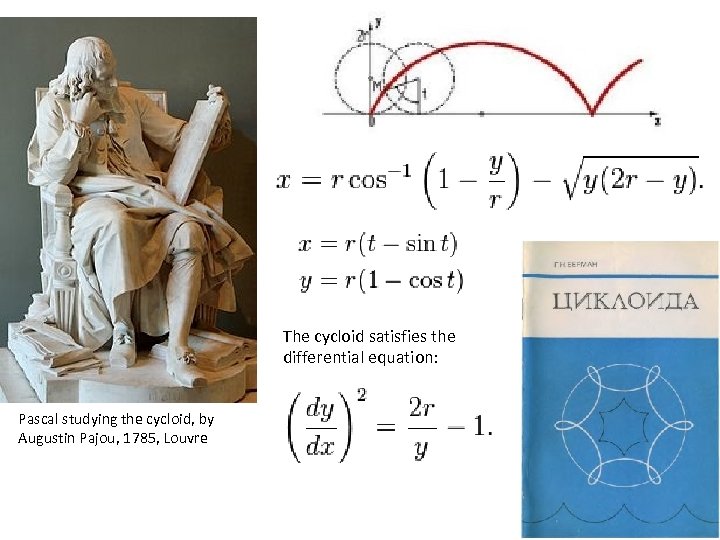
The cycloid satisfies the differential equation: Pascal studying the cycloid, by Augustin Pajou, 1785, Louvre
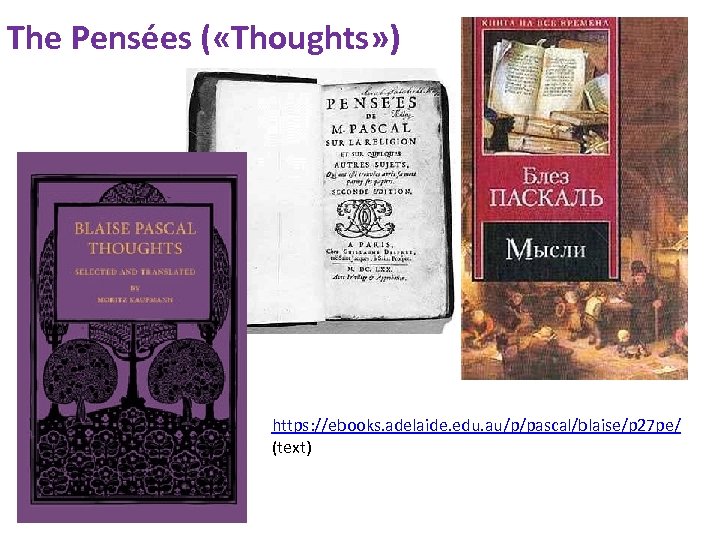
The Pensées ( «Thoughts» ) https: //ebooks. adelaide. edu. au/p/pascal/blaise/p 27 pe/ (text)
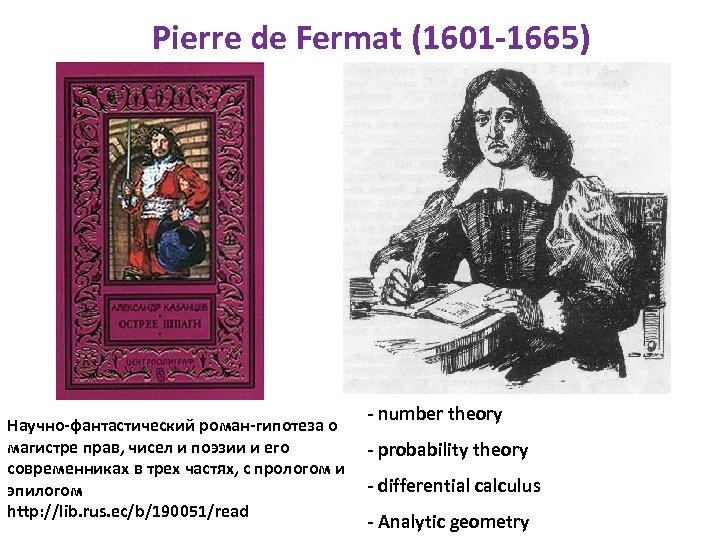
Pierre de Fermat (1601 -1665) - number theory Научно-фантастический роман-гипотеза о магистре прав, чисел и поэзии и его - probability theory современниках в трех частях, с прологом и - differential calculus эпилогом http: //lib. rus. ec/b/190051/read - Analytic geometry
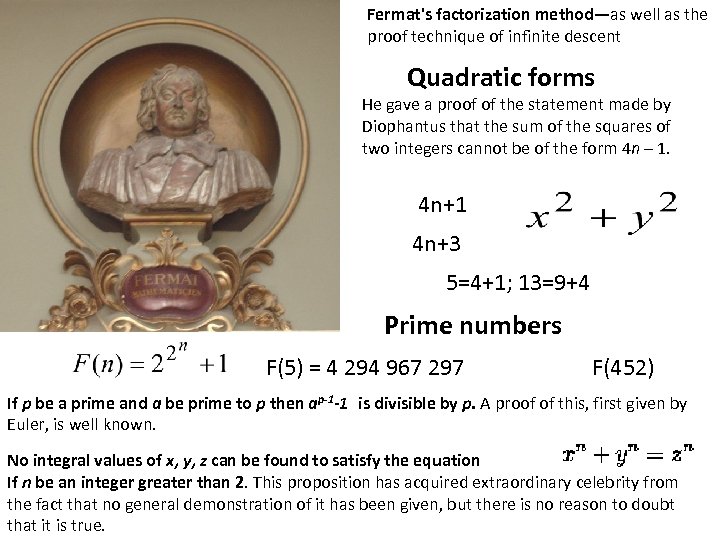
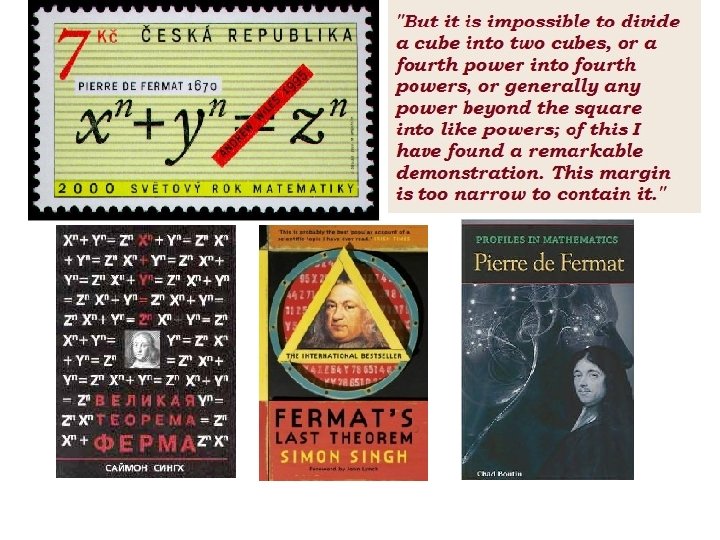
Fermat's factorization method—as well as the proof technique of infinite descent Quadratic forms He gave a proof of the statement made by Diophantus that the sum of the squares of two integers cannot be of the form 4 n – 1. 4 n+1 4 n+3 5=4+1; 13=9+4 Prime numbers F(5) = 4 294 967 297 F(452) If p be a prime and a be prime to p then ap-1 -1 is divisible by p. A proof of this, first given by Euler, is well known. No integral values of x, y, z can be found to satisfy the equation If n be an integer greater than 2. This proposition has acquired extraordinary celebrity from the fact that no general demonstration of it has been given, but there is no reason to doubt that it is true.
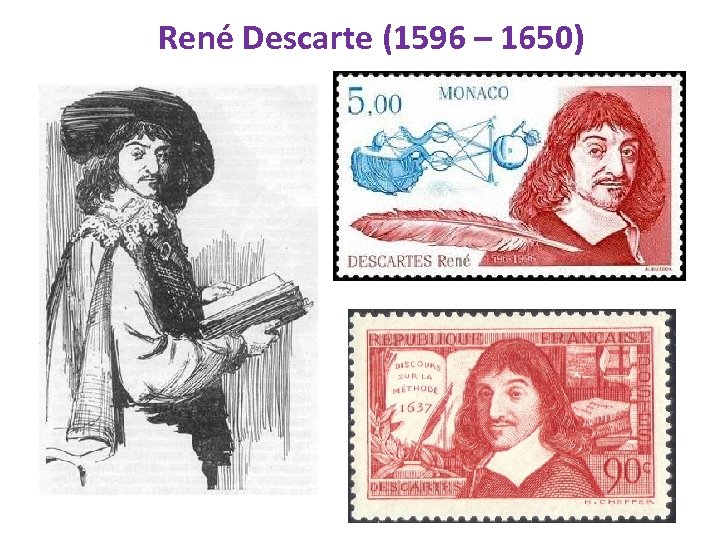
René Descarte (1596 – 1650)
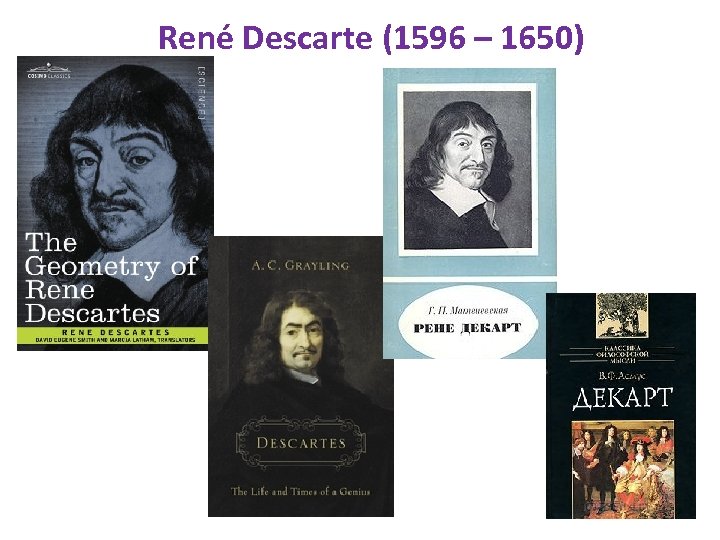
René Descarte (1596 – 1650)
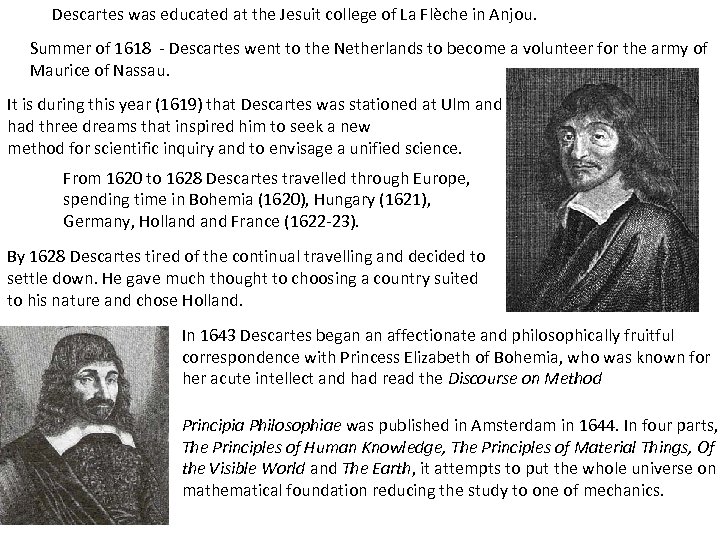
Descartes was educated at the Jesuit college of La Flèche in Anjou. Summer of 1618 - Descartes went to the Netherlands to become a volunteer for the army of Maurice of Nassau. It is during this year (1619) that Descartes was stationed at Ulm and had three dreams that inspired him to seek a new method for scientific inquiry and to envisage a unified science. From 1620 to 1628 Descartes travelled through Europe, spending time in Bohemia (1620), Hungary (1621), Germany, Holland France (1622 -23). By 1628 Descartes tired of the continual travelling and decided to settle down. He gave much thought to choosing a country suited to his nature and chose Holland. In 1643 Descartes began an affectionate and philosophically fruitful correspondence with Princess Elizabeth of Bohemia, who was known for her acute intellect and had read the Discourse on Method Principia Philosophiae was published in Amsterdam in 1644. In four parts, The Principles of Human Knowledge, The Principles of Material Things, Of the Visible World and The Earth, it attempts to put the whole universe on mathematical foundation reducing the study to one of mechanics.
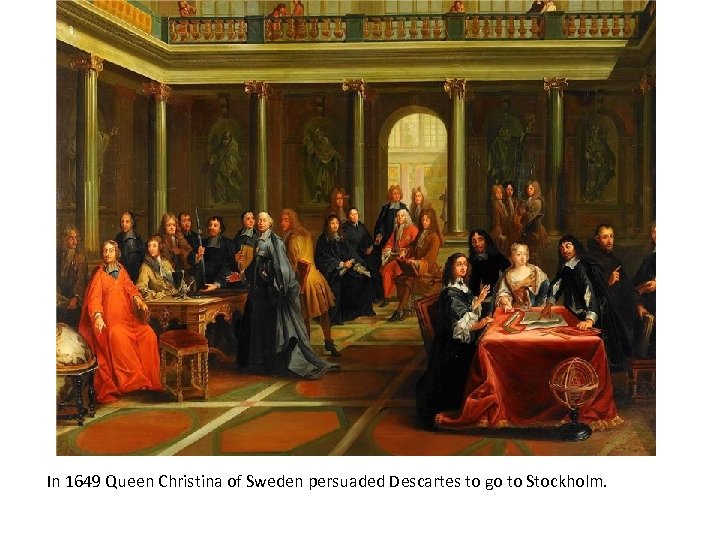
In 1649 Queen Christina of Sweden persuaded Descartes to go to Stockholm.
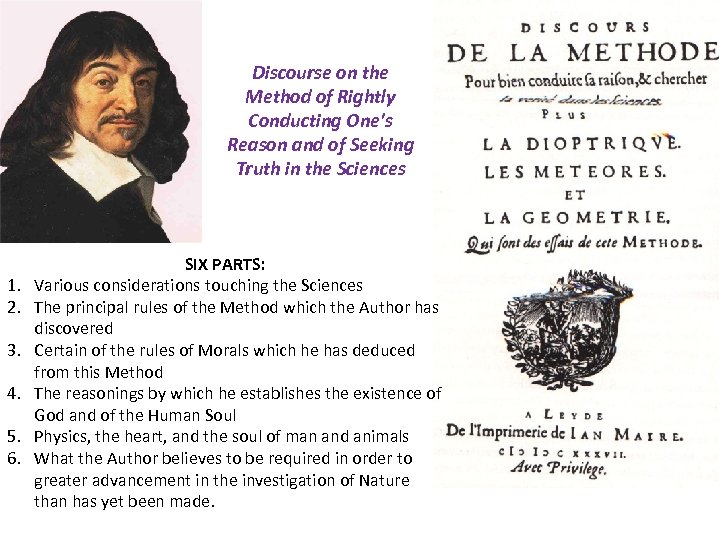
Discourse on the Method of Rightly Conducting One's Reason and of Seeking Truth in the Sciences 1. 2. 3. 4. 5. 6. SIX PARTS: Various considerations touching the Sciences The principal rules of the Method which the Author has discovered Certain of the rules of Morals which he has deduced from this Method The reasonings by which he establishes the existence of God and of the Human Soul Physics, the heart, and the soul of man and animals What the Author believes to be required in order to greater advancement in the investigation of Nature than has yet been made.
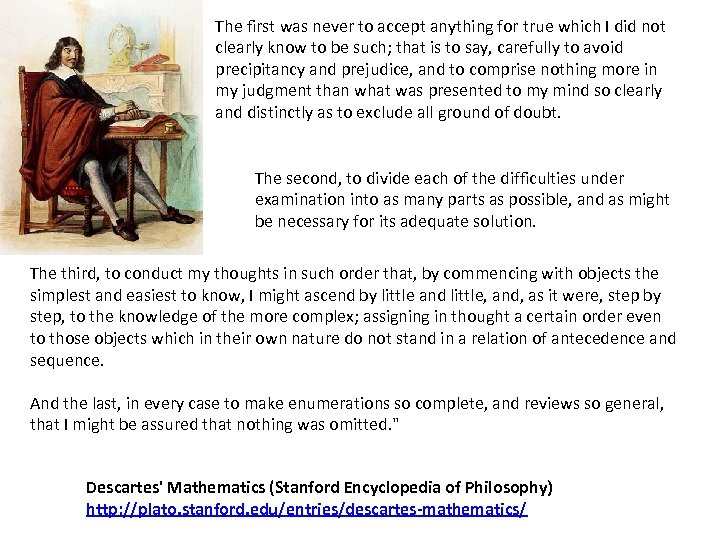
The first was never to accept anything for true which I did not clearly know to be such; that is to say, carefully to avoid precipitancy and prejudice, and to comprise nothing more in my judgment than what was presented to my mind so clearly and distinctly as to exclude all ground of doubt. The second, to divide each of the difficulties under examination into as many parts as possible, and as might be necessary for its adequate solution. The third, to conduct my thoughts in such order that, by commencing with objects the simplest and easiest to know, I might ascend by little and little, and, as it were, step by step, to the knowledge of the more complex; assigning in thought a certain order even to those objects which in their own nature do not stand in a relation of antecedence and sequence. And the last, in every case to make enumerations so complete, and reviews so general, that I might be assured that nothing was omitted. " Descartes' Mathematics (Stanford Encyclopedia of Philosophy) http: //plato. stanford. edu/entries/descartes-mathematics/
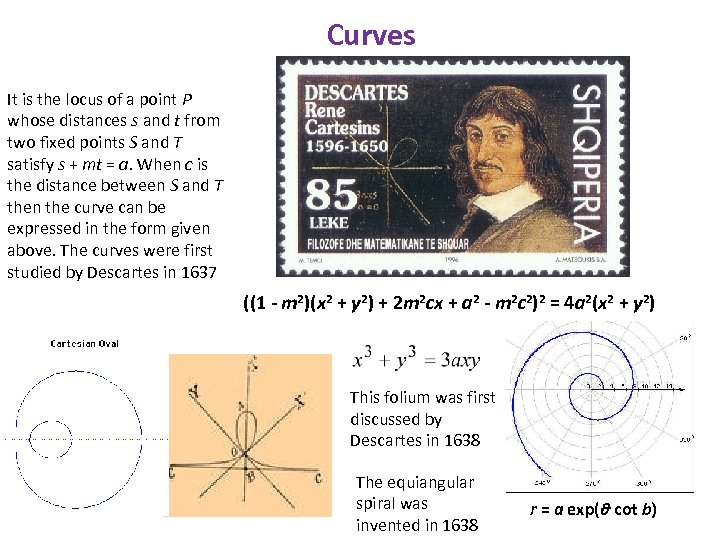
Curves It is the locus of a point P whose distances s and t from two fixed points S and T satisfy s + mt = a. When c is the distance between S and T then the curve can be expressed in the form given above. The curves were first studied by Descartes in 1637 ((1 - m 2)(x 2 + y 2) + 2 m 2 cx + a 2 - m 2 c 2)2 = 4 a 2(x 2 + y 2) This folium was first discussed by Descartes in 1638 The equiangular spiral was invented in 1638 r = a exp(θ cot b)
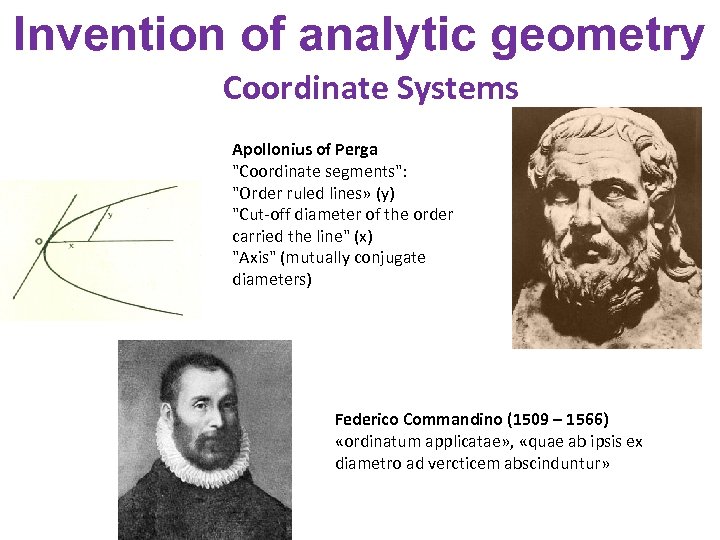
Invention of analytic geometry Coordinate Systems Apollonius of Perga "Coordinate segments": "Order ruled lines» (y) "Cut-off diameter of the order carried the line" (x) "Axis" (mutually conjugate diameters) Federico Commandino (1509 – 1566) «ordinatum applicatae» , «quae ab ipsis ex diametro ad vercticem abscinduntur»

Polar coordinate system Hipparchus of Rhode Gregorius Saint-Vincent Habash al-Hasib al. Marwazi (ab. 770 –ab 880) Abu Arrayhan Muhammad ibn Ahmad al-Biruni Bonaventura Cavalieri
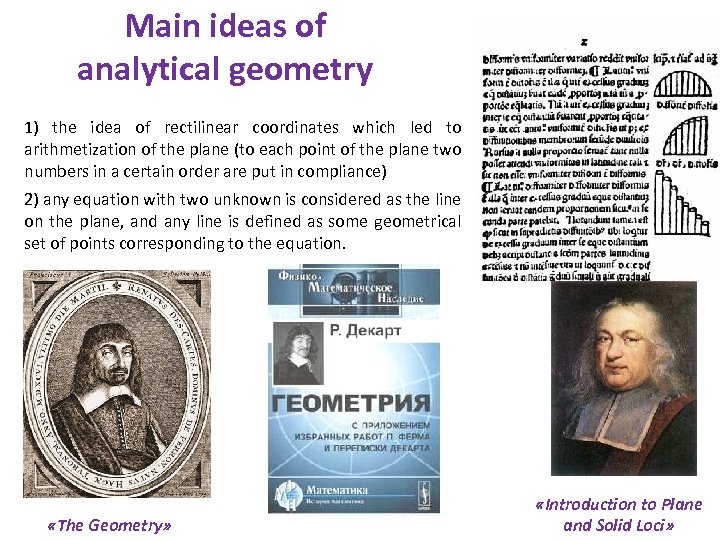
Main ideas of analytical geometry 1) the idea of rectilinear coordinates which led to arithmetization of the plane (to each point of the plane two numbers in a certain order are put in compliance) 2) any equation with two unknown is considered as the line on the plane, and any line is defined as some geometrical set of points corresponding to the equation. «The Geometry» «Introduction to Plane and Solid Loci»
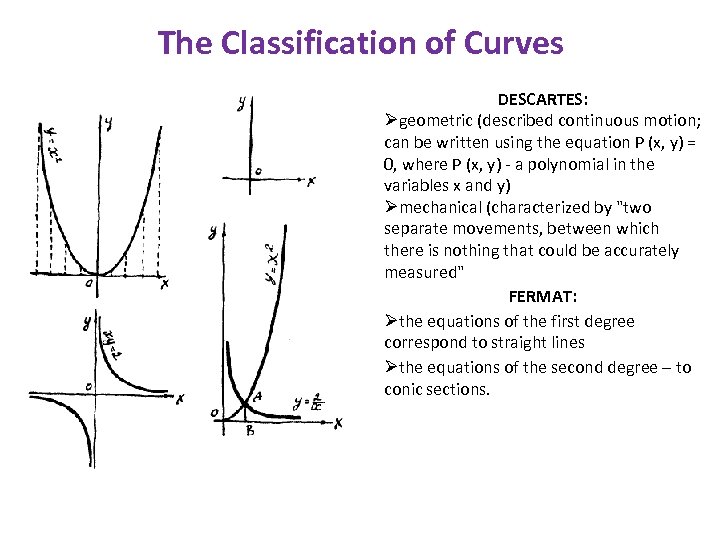
The Classification of Curves DESCARTES: Øgeometric (described continuous motion; can be written using the equation P (x, y) = 0, where P (x, y) - a polynomial in the variables x and y) Ømechanical (characterized by "two separate movements, between which there is nothing that could be accurately measured" FERMAT: Øthe equations of the first degree correspond to straight lines Øthe equations of the second degree – to conic sections.
Creation of probabilities
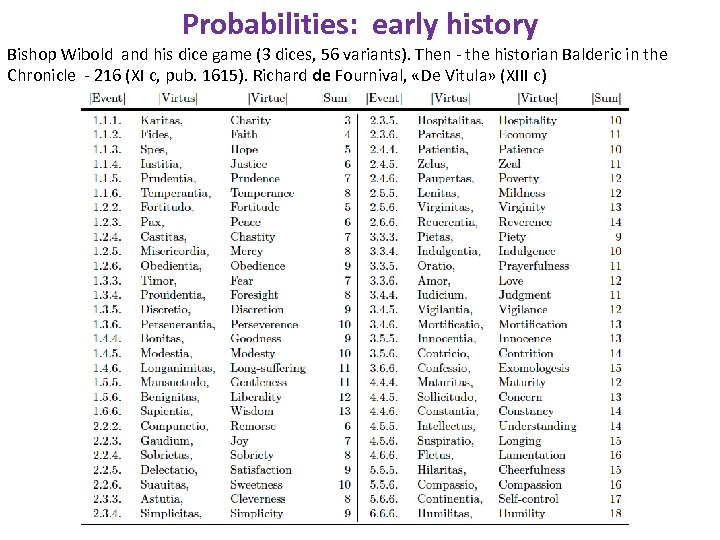
Probabilities: early history Bishop Wibold and his dice game (3 dices, 56 variants). Then - the historian Balderic in the Chronicle - 216 (XI c, pub. 1615). Richard de Fournival, «De Vitula» (XIII c)
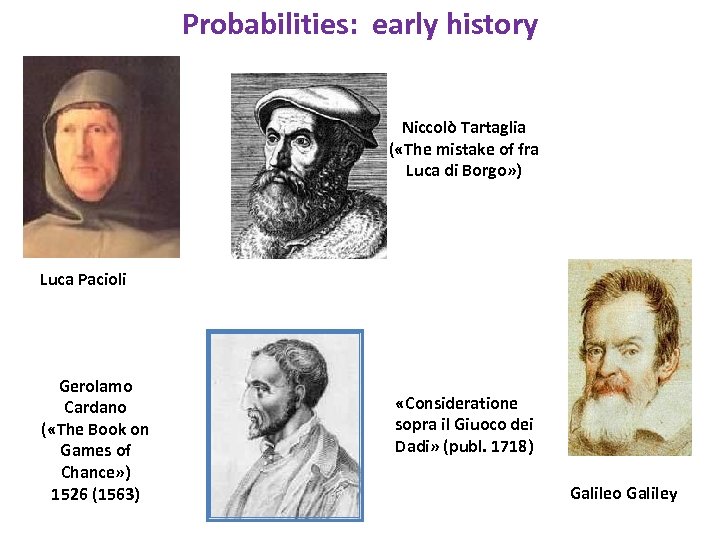
Probabilities: early history Niccolò Tartaglia ( «The mistake of fra Luca di Borgo» ) Luca Pacioli Gerolamo Cardano ( «The Book on Games of Chance» ) 1526 (1563) «Consideratione sopra il Giuoco dei Dadi» (publ. 1718) Galileo Galiley
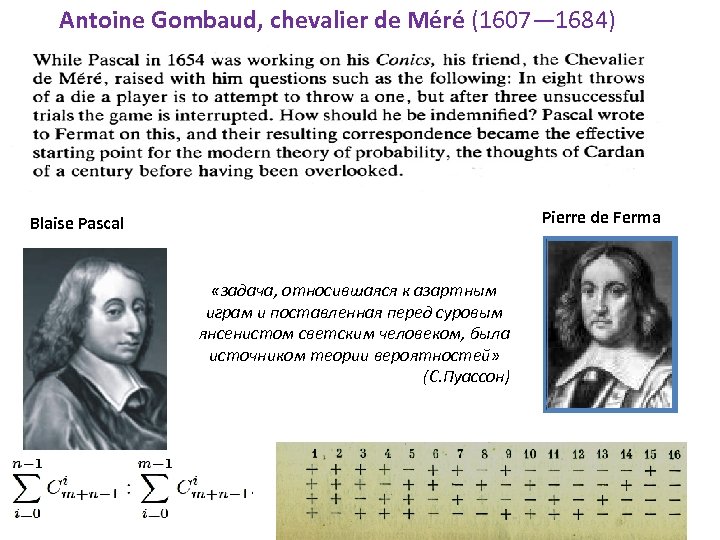
Antoine Gombaud, chevalier de Méré (1607— 1684) Pierre de Ferma Blaise Pascal «задача, относившаяся к азартным играм и поставленная перед суровым янсенистом светским человеком, была источником теории вероятностей» (С. Пуассон)
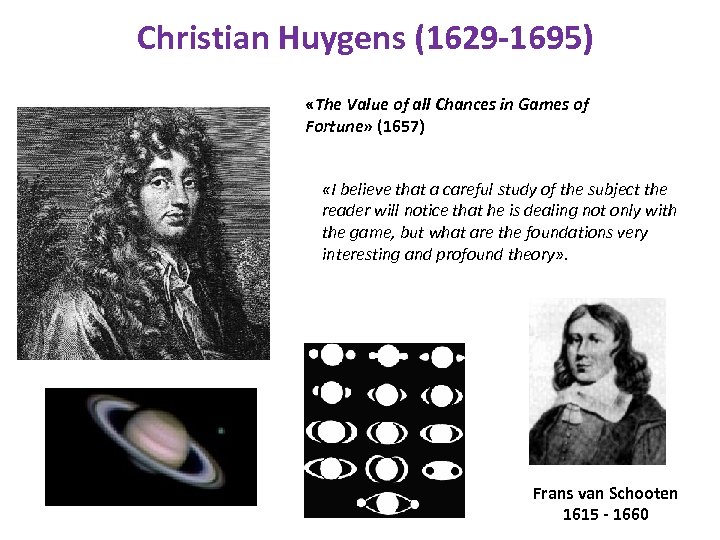
Christian Huygens (1629 -1695) «The Value of all Chances in Games of Fortune» (1657) «I believe that a careful study of the subject the reader will notice that he is dealing not only with the game, but what are the foundations very interesting and profound theory» . Frans van Schooten 1615 - 1660
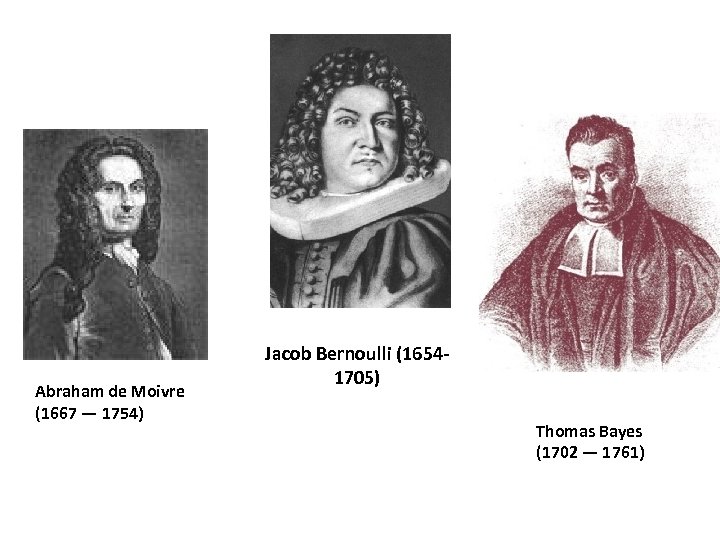
Abraham de Moivre (1667 — 1754) Jacob Bernoulli (16541705) Thomas Bayes (1702 — 1761)
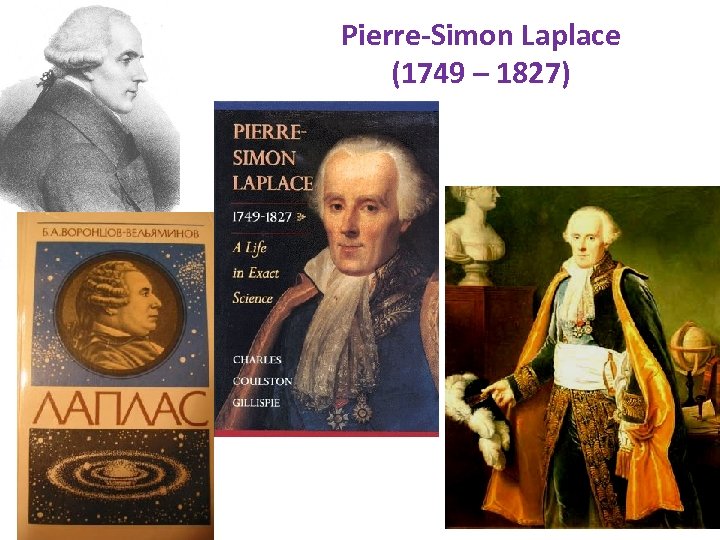
Pierre-Simon Laplace (1749 – 1827)
Скачать презентацию Blaise Pascal 1623 1662 Adamson Donald Pascal s
8df3137fe6fd42f8efe6b874f92d7ca5.ppt