 Скачать презентацию BLACK SEA HORIZON INTERNATIONAL WORKSHOP Applied research in
474f632c45512b6b8c9d9f75e96ce43d.ppt
- Количество слайдов: 25



BLACK SEA HORIZON INTERNATIONAL WORKSHOP “Applied research in chemistry: Smart materials for a smart future” SMART MATERIALS FOR HEALTH BASED ON SPONTANEOUS FLORA OF BLACK SEA REGION Prof. Emeritus Aurelia MEGHEA University POLITEHNICA of Bucharest, Romania Faculty of Applied Chemistry and Materials Sciences Head of Projects and Grants Office of Romanian Academy 31 March 2016 Sofia, Bulgaria
PREVIOUS EXPERTISE IN EUROPEAN PROGRAMS Prof. Emeritus Aurelia Meghea (UPB) • 1998 – present – Expert UE for Scientific Excellence in Framwork Programmes FP 5, FP 6, FP 7 • Member in 15 UE panels of Human Potential Marie Curie Programs • Member of PEOPLE Committee of FP 7 Programme • Coordinator after 2000 of over 50 national research programs and 7 European projects: Marie Curie To. K (10 European partners), Bilateral programs with Greece, France, Moldova, Norway; PIRSES (France, Romania, Russia, Brazil); • Participant in a Black Sea Program: Romania, Turkey, Moldova, Armenia – training farmers on biofertilisers; • Participant in ERA-NET projects: Euro. Nano. Med (Romania, Germany, Israel, Turkey), Era. Min, Steel&Coal (Romania, Spain, Portugal); • Applicant in 2016 in ERA-NET: Marine. Biotechnology (RO, Norway, Iceland), FLAG-ERA – Digital Medicine for Cancer (RO, FR, BE, Latvia), ERA-NET LAC: Smart Cities: Latvia, RO, BE, Chile, Mexico, Peru, Dominican Rep… Head of Projects and Grants Office of Romanian Academy: 2014 - present
FUNDING OPPORTUNITIES FOR SCIENCE IN ROMANIA • HORIZON 2020 – including ERA-NET COFUNDS – HORIZON 2020 STRATEGY - 3 Society targets : SMART, SUSTAINABLE, INCLUSIVE – 3 PILARS: EXCELLENCE SCIENCE, INDUSTRIAL LIEDERSHIP, SOCIETAL CHALLENGES • STRUCTURAL FUNDS for integration of Romania in UE • ROMANIAN Ministry of Education and Research. • Thematic priorities – SMART SPECIALIZATIONS: – Bioeconomy; ICT; Energy & Climate changes; Nanomaterials • Main trends – Toward industry – Transfer of Knowledge to economic partner – Demonstrative experimental projects – Transfer to economic agent
H 2020 WORK PROGRAMME 2016 – 2017 5. ii. Nanotechnologies, Advanced Materials, Biotechnologies and Advanced Manufacturing and Processing • CALL for ENERGY-EFFICIENT BUILDINGS • CALL for NANOTECHNOLOGIES, ADVANCED MATERIALS, BIOTECHNOLOGY AND PRODUCTION • GREEN VEHICLES • ADVANCED MATERIALS AND NANOTECHNOLOGIES FOR HEALTHCARE • ADVANCED MATERIALS AND NANOTECHNOLOGIES FOR ENERGY • ECO-DESIGN AND NEW SUSTAINABLE BUSINESS MODELS • BIOTECHNOLOGY • MODELLING FOR DEVELOPMENT OF NANOTECHNOLOGIES AND ADVANCED MATERIALS • SCIENCE-BASED RISK ASSESSMENT AND MANAGEMENT OF NANOTECHNOLOGIES, ADVANCED MATERIALS AND BIOTECHNOLOGIES
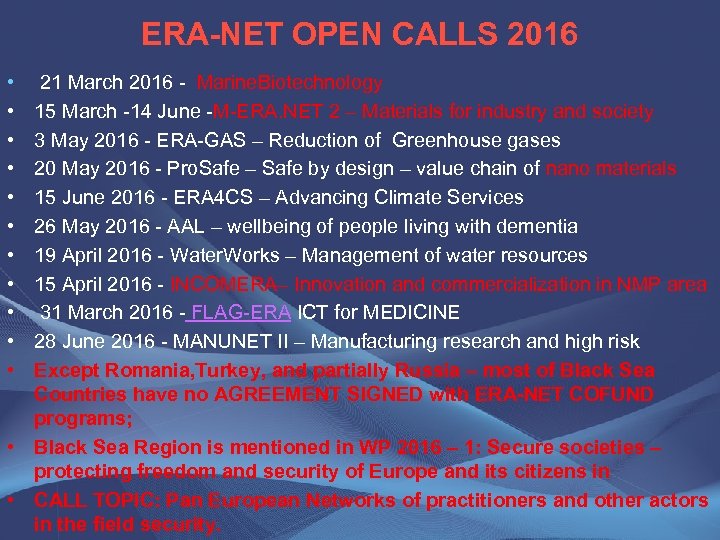
ERA-NET OPEN CALLS 2016 • • • 21 March 2016 - Marine. Biotechnology 15 March -14 June -M-ERA. NET 2 – Materials for industry and society 3 May 2016 - ERA-GAS – Reduction of Greenhouse gases 20 May 2016 - Pro. Safe – Safe by design – value chain of nano materials 15 June 2016 - ERA 4 CS – Advancing Climate Services 26 May 2016 - AAL – wellbeing of people living with dementia 19 April 2016 - Water. Works – Management of water resources 15 April 2016 - INCOMERA– Innovation and commercialization in NMP area 31 March 2016 - FLAG-ERA ICT for MEDICINE 28 June 2016 - MANUNET II – Manufacturing research and high risk Except Romania, Turkey, and partially Russia – most of Black Sea Countries have no AGREEMENT SIGNED with ERA-NET COFUND programs; • Black Sea Region is mentioned in WP 2016 – 1: Secure societies – protecting freedom and security of Europe and its citizens in • CALL TOPIC: Pan European Networks of practitioners and other actors in the field security.
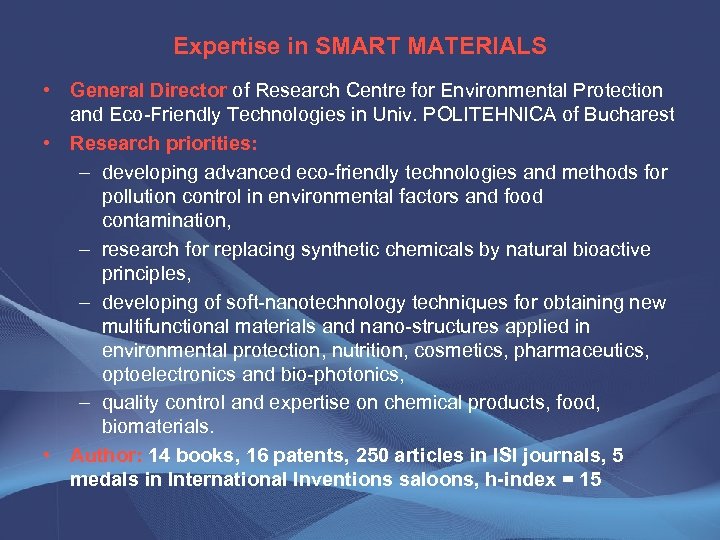
Expertise in SMART MATERIALS • General Director of Research Centre for Environmental Protection and Eco-Friendly Technologies in Univ. POLITEHNICA of Bucharest • Research priorities: – developing advanced eco-friendly technologies and methods for pollution control in environmental factors and food contamination, – research for replacing synthetic chemicals by natural bioactive principles, – developing of soft-nanotechnology techniques for obtaining new multifunctional materials and nano-structures applied in environmental protection, nutrition, cosmetics, pharmaceutics, optoelectronics and bio-photonics, – quality control and expertise on chemical products, food, biomaterials. • Author: 14 books, 16 patents, 250 articles in ISI journals, 5 medals in International Inventions saloons, h-index = 15
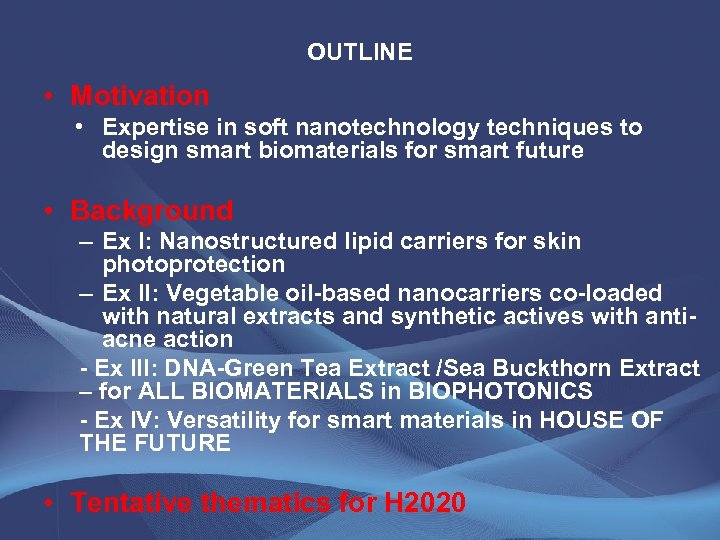
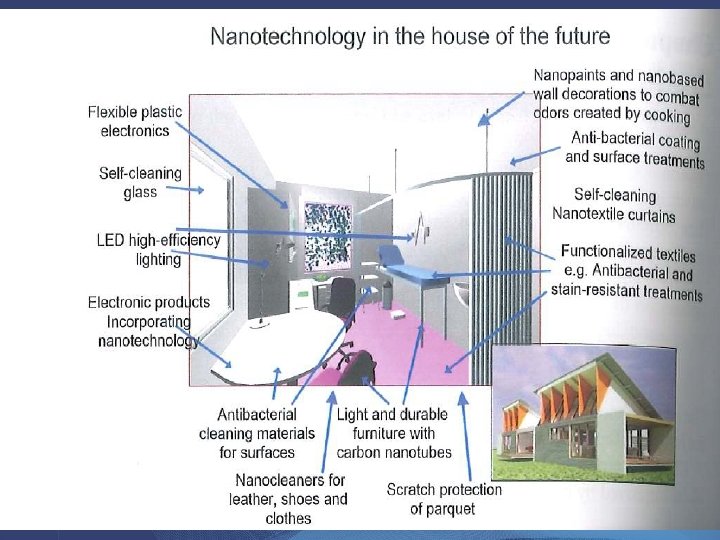
OUTLINE • Motivation • Expertise in soft nanotechnology techniques to design smart biomaterials for smart future • Background – Ex I: Nanostructured lipid carriers for skin photoprotection – Ex II: Vegetable oil-based nanocarriers co-loaded with natural extracts and synthetic actives with antiacne action - Ex III: DNA-Green Tea Extract /Sea Buckthorn Extract – for ALL BIOMATERIALS in BIOPHOTONICS - Ex IV: Versatility for smart materials in HOUSE OF THE FUTURE • Tentative thematics for H 2020
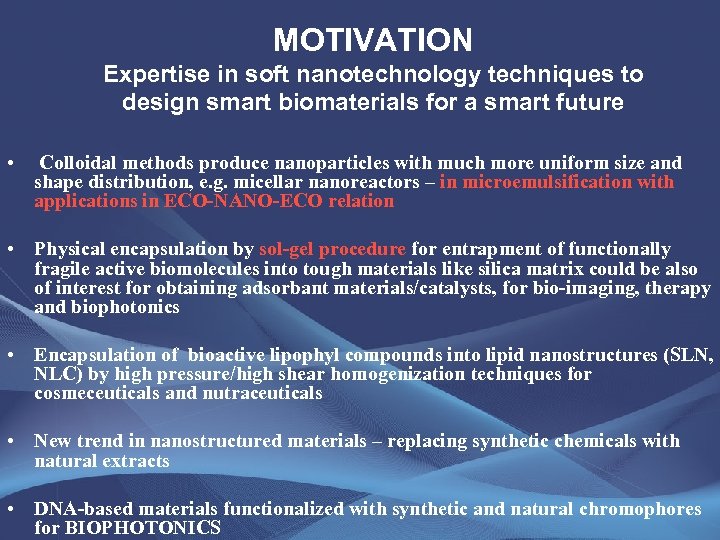
MOTIVATION Expertise in soft nanotechnology techniques to design smart biomaterials for a smart future • Colloidal methods produce nanoparticles with much more uniform size and shape distribution, e. g. micellar nanoreactors – in microemulsification with applications in ECO-NANO-ECO relation • Physical encapsulation by sol-gel procedure for entrapment of functionally fragile active biomolecules into tough materials like silica matrix could be also of interest for obtaining adsorbant materials/catalysts, for bio-imaging, therapy and biophotonics • Encapsulation of bioactive lipophyl compounds into lipid nanostructures (SLN, NLC) by high pressure/high shear homogenization techniques for cosmeceuticals and nutraceuticals • New trend in nanostructured materials – replacing synthetic chemicals with natural extracts • DNA-based materials functionalized with synthetic and natural chromophores for BIOPHOTONICS
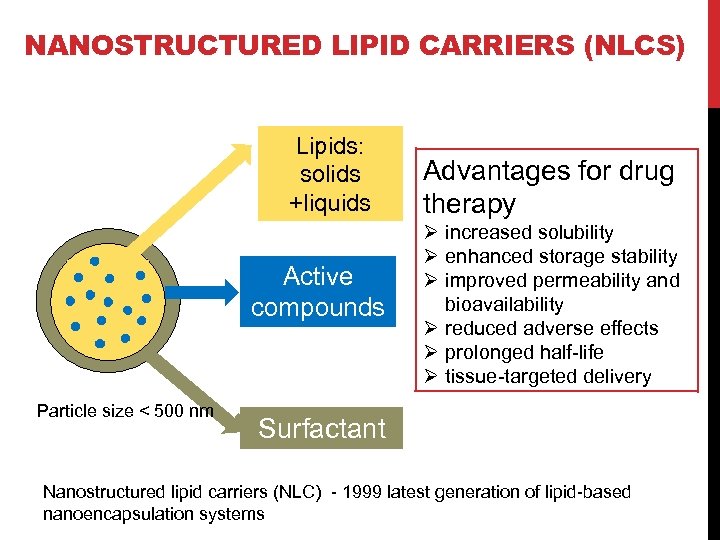
NANOSTRUCTURED LIPID CARRIERS (NLCS) Lipids: solids +liquids Active compounds Particle size < 500 nm Advantages for drug therapy Ø increased solubility Ø enhanced storage stability Ø improved permeability and bioavailability Ø reduced adverse effects Ø prolonged half-life Ø tissue-targeted delivery Surfactant Nanostructured lipid carriers (NLC) - 1999 latest generation of lipid-based nanoencapsulation systems
EX I: NANOSTRUCTURED LIPID CARRIERS FOR SKIN PHOTOPROTECTION • Objective • Evaluating the potential benefits of flavonoid Naringenin in developing polyphenol-rich sunscreens. – Synthesis of vegetable oil-based nanostructured lipid carriers co-encapsulated with the flavonoid Naringenin together with a synthetic UVA filter for the development of polyphenol-rich sunscreens*. *G. Badea, I. Lacatusu, L. I. Brasoveanu, M. Mihaila, T. Balaci, R. Stan, N. Badea, A. Meghea, Naringenin improves the sunscreen performance of hydrogel formulations based on vegetable nanocarriers, Arabian Journal of Chemistry. 9, (1) 9 -17, 2016
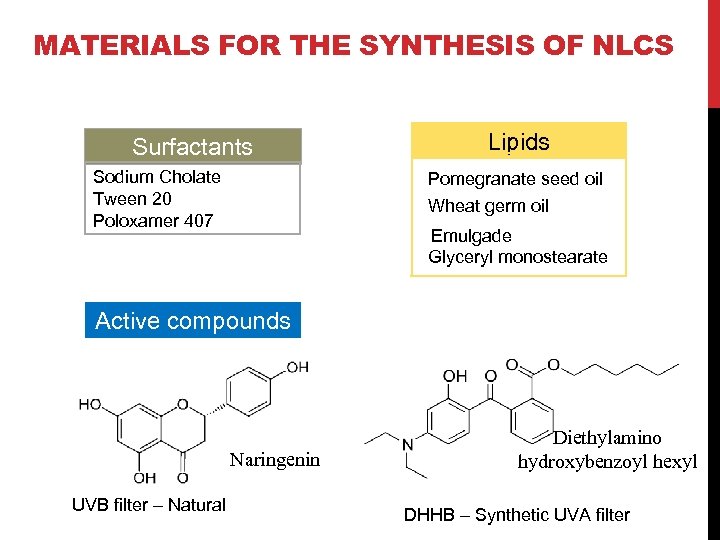
MATERIALS FOR THE SYNTHESIS OF NLCS Surfactants Sodium Cholate Tween 20 Poloxamer 407 Lipids Pomegranate seed oil Wheat germ oil Emulgade Glyceryl monostearate Active compounds Naringenin UVB filter – Natural flavonoid - lipophil Diethylamino hydroxybenzoyl hexyl benzoate DHHB – Synthetic UVA filter
Ex II: Vegetable oil-based nanocarriers co-loaded with natural extracts and synthetic actives with antiacne action Objective Evaluating the potential of oils isolated from Nigella sativa seeds and Rosehip seeds in developing appropriate vegetable-based nanocarriers that are able to load both natural and synthetic actives for developing anti-acne cosmetic formulations. • Synthesis of vegetable oil-based nanostructured lipid carriers co-encapsulated with the marigold extract rich in carotenoids and with the synthetic drug azelaic acid.
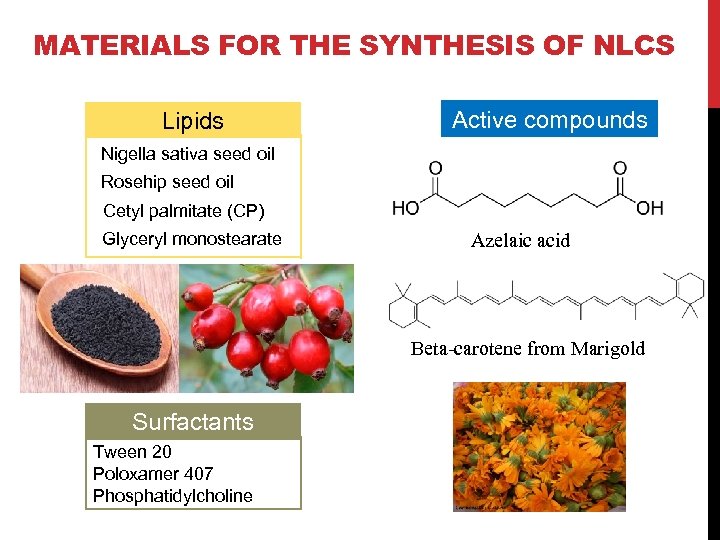
MATERIALS FOR THE SYNTHESIS OF NLCS Lipids Active compounds Nigella sativa seed oil Rosehip seed oil Cetyl palmitate (CP) Glyceryl monostearate Azelaic acid Beta-carotene from Marigold Surfactants Tween 20 Poloxamer 407 Phosphatidylcholine
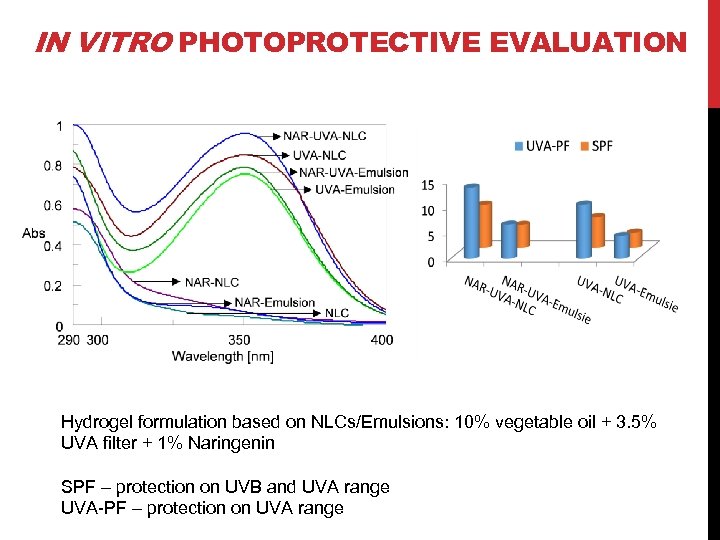
IN VITRO PHOTOPROTECTIVE EVALUATION Hydrogel formulation based on NLCs/Emulsions: 10% vegetable oil + 3. 5% UVA filter + 1% Naringenin SPF – protection on UVB and UVA range UVA-PF – protection on UVA range
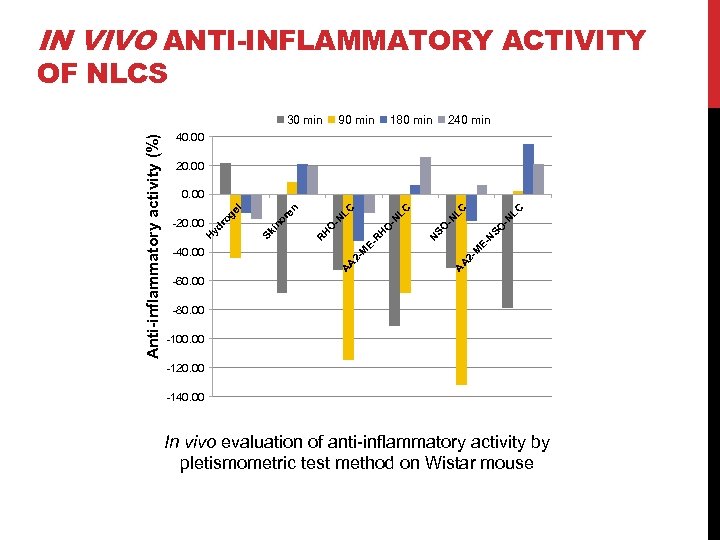
IN VIVO ANTI-INFLAMMATORY ACTIVITY 180 min 240 min LC 90 min 40. 00 20. 00 A LC SO -N A 2 - M EN N A 2 - M E- R R H H O O -N -N LC n no re A -40. 00 Sk i yd r -20. 00 og el 0. 00 H Anti-inflammatory activity (%) 30 min LC OF NLCS -60. 00 -80. 00 -100. 00 -120. 00 -140. 00 In vivo evaluation of anti-inflammatory activity by pletismometric test method on Wistar mouse
GREEN NANOTECHNOLOGY – IN KEY ENABLE TECHNOLOGIES – NEED OF ALL-BIO MATERIALS BIOPHOTONICS - BIOTRONICS • Biopolymers like deoxyribonucleic acid – DNA and collagen show very interesting properties as possible matrices for active molecules, being able to replace synthetic polymers. • These biopolymers are extracted from waste of food processing industry and their sources are practically unlimited. • Their degradation time is much faster than that of synthetic polymers in similar conditions. • Recently the scientists turn their attention to natural photosensitive materials, which can be extracted from flowers or fruits, like anthocyanines showing some photoresponsive properties for biophotonic applications.
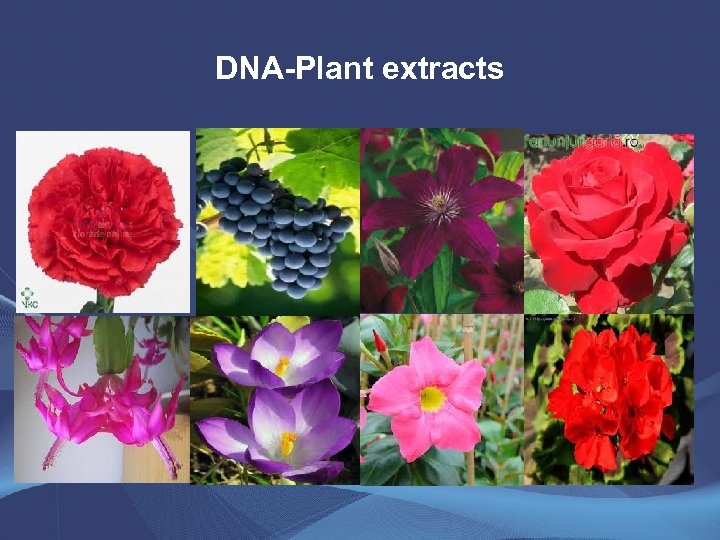
DNA-Plant extracts
INTERCALATION OF GREEN TEA AND SEABUCKTHORN EXTRACT WITHIN DNA The aim of this research is: • To obtain new functional materials by using DNA-GTE / DNA-CTMA-SBE complexes for applications in photonics. • DNA is extracted from waste of food processing industry and its sources are practically unlimited. • Green tea is known as a very powerful antioxidant and antimicrobial agent, production is important in world, close to 700 000 tonnes in 2010 and is increasing. • The sea buckthorn berries are rich in vitamins, minerals and antioxidant components, including ascorbic acid, tocopherols, polyphenols and carotenoids.
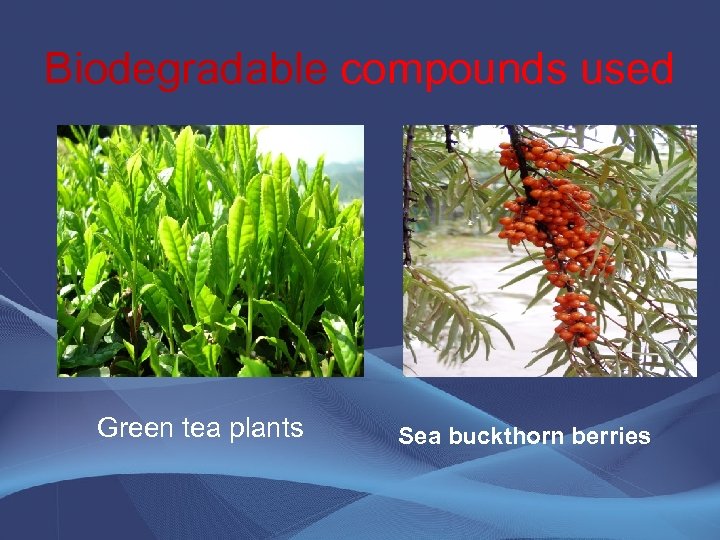
Biodegradable compounds used Green tea plants Sea buckthorn berries
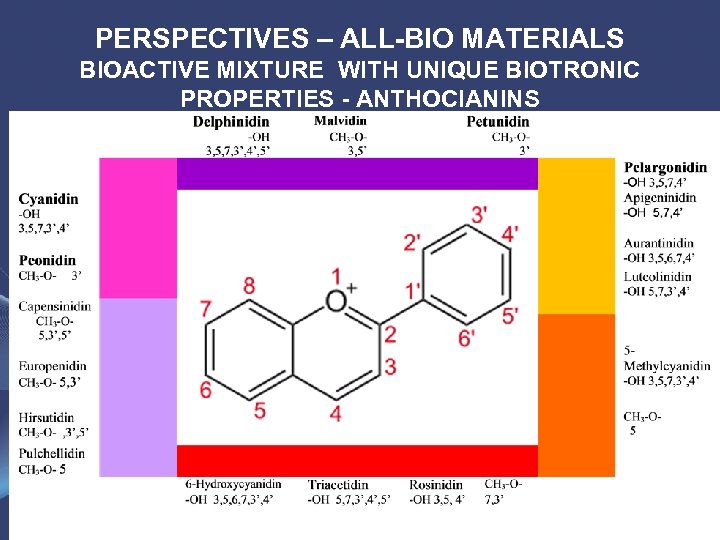
PERSPECTIVES – ALL-BIO MATERIALS BIOACTIVE MIXTURE WITH UNIQUE BIOTRONIC PROPERTIES - ANTHOCIANINS
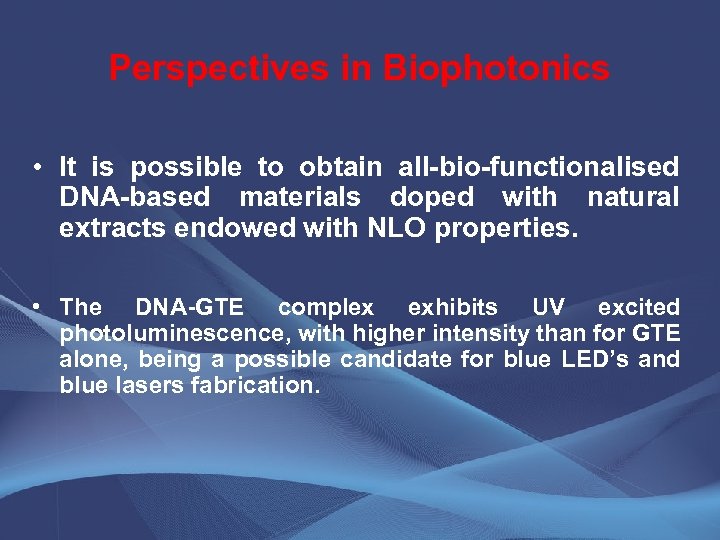
Perspectives in Biophotonics • It is possible to obtain all-bio-functionalised DNA-based materials doped with natural extracts endowed with NLO properties. • The DNA-GTE complex exhibits UV excited photoluminescence, with higher intensity than for GTE alone, being a possible candidate for blue LED’s and blue lasers fabrication.
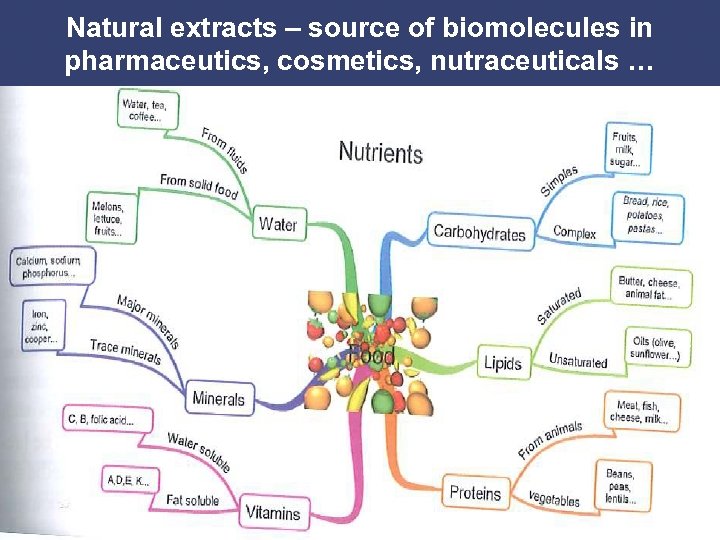
Natural extracts – source of biomolecules in pharmaceutics, cosmetics, nutraceuticals …
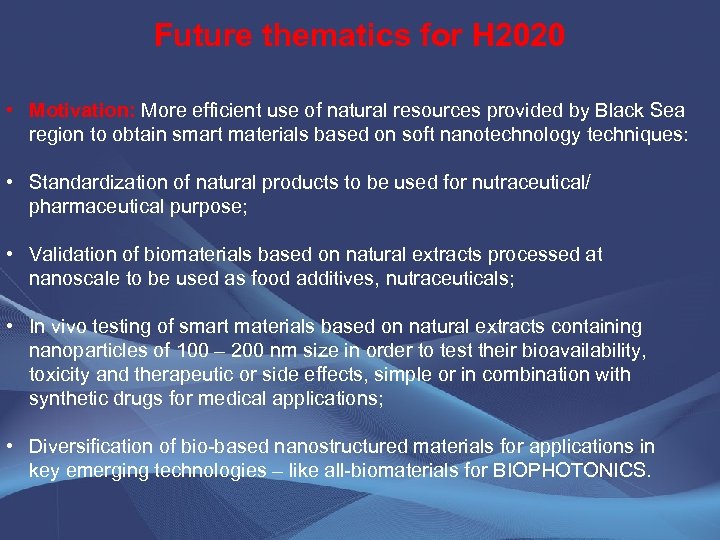
Future thematics for H 2020 • Motivation: More efficient use of natural resources provided by Black Sea region to obtain smart materials based on soft nanotechnology techniques: • Standardization of natural products to be used for nutraceutical/ pharmaceutical purpose; • Validation of biomaterials based on natural extracts processed at nanoscale to be used as food additives, nutraceuticals; • In vivo testing of smart materials based on natural extracts containing nanoparticles of 100 – 200 nm size in order to test their bioavailability, toxicity and therapeutic or side effects, simple or in combination with synthetic drugs for medical applications; • Diversification of bio-based nanostructured materials for applications in key emerging technologies – like all-biomaterials for BIOPHOTONICS.
Скачать презентацию BLACK SEA HORIZON INTERNATIONAL WORKSHOP Applied research in
474f632c45512b6b8c9d9f75e96ce43d.ppt