 Скачать презентацию Black Carbon Air Pollution in Berlin Andreas Kerschbaumer
9746a2d265a94bbb26916ff24ef238b8.ppt
- Количество слайдов: 23



Black Carbon Air Pollution in Berlin Andreas Kerschbaumer Berlin Senate Department for Urban Development and Environment Directorate IX, Environment Policy ÖBC situation: measurements ÖSource apportionment ÖAbatement strategies Andreas Kerschbaumer, Senate Department for Urban Development and Environment, Berlin 1
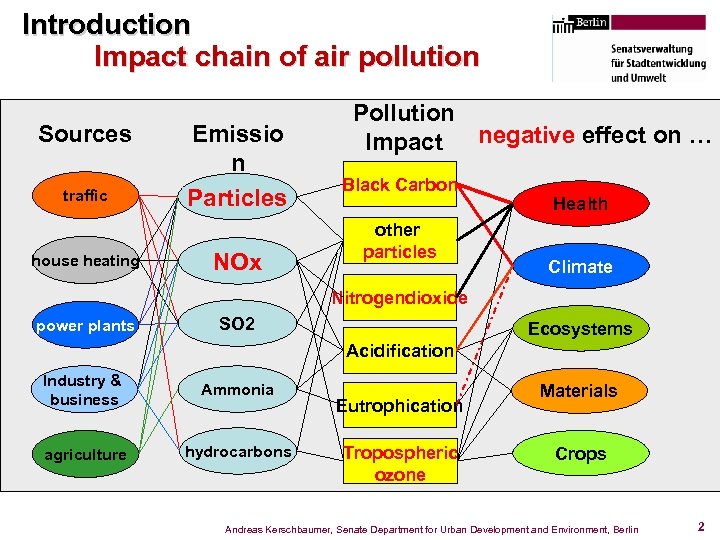
Introduction Impact chain of air pollution Sources traffic house heating Emissio n Particles NOx Pollution Impact negative effect on … Black Carbon other particles Health Climate Nitrogendioxide power plants SO 2 Ecosystems Acidification Industry & business Ammonia agriculture hydrocarbons Eutrophication Tropospheric ozone Materials Crops Andreas Kerschbaumer, Senate Department for Urban Development and Environment, Berlin 2
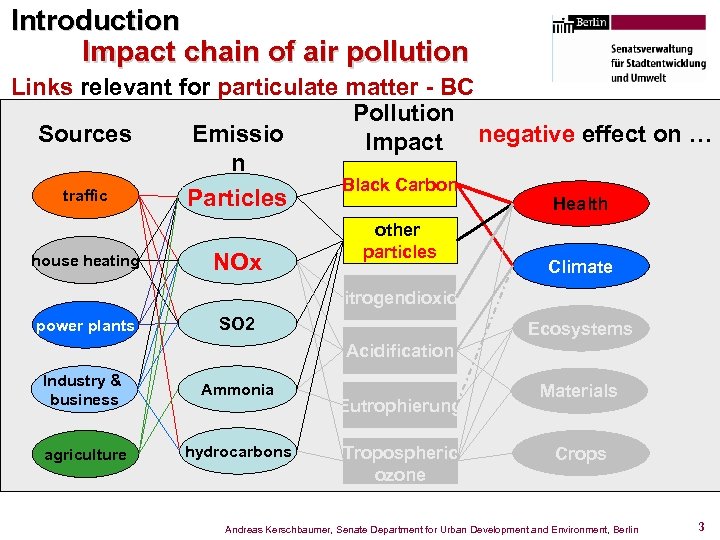
Introduction Impact chain of air pollution Links relevant for particulate matter - BC Pollution Emissio Sources Impact negative effect on … n Black Carbon traffic Particles Health house heating NOx other particles Climate Nitrogendioxide power plants SO 2 Ecosystems Acidification Industry & business Ammonia agriculture hydrocarbons Eutrophierung Tropospheric ozone Materials Crops Andreas Kerschbaumer, Senate Department for Urban Development and Environment, Berlin 3
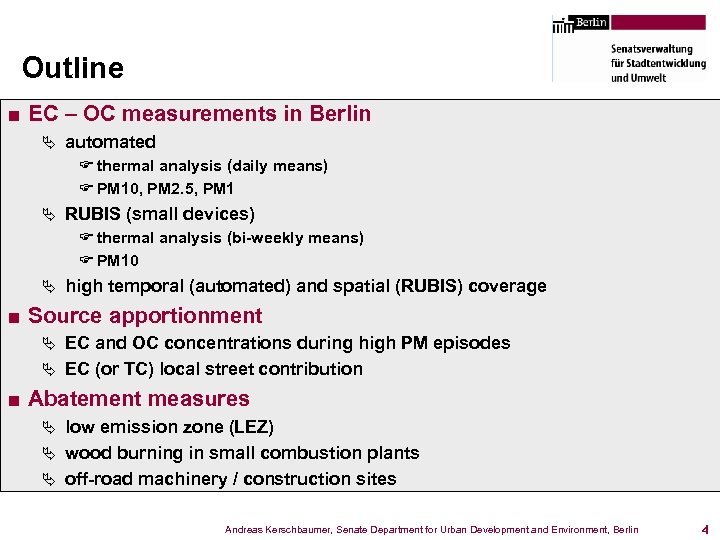
Outline ■ EC – OC measurements in Berlin Ä automated F thermal analysis (daily means) F PM 10, PM 2. 5, PM 1 Ä RUBIS (small devices) F thermal analysis (bi-weekly means) F PM 10 Ä high temporal (automated) and spatial (RUBIS) coverage ■ Source apportionment Ä EC and OC concentrations during high PM episodes Ä EC (or TC) local street contribution ■ Abatement measures Ä low emission zone (LEZ) Ä wood burning in small combustion plants Ä off-road machinery / construction sites Andreas Kerschbaumer, Senate Department for Urban Development and Environment, Berlin 4
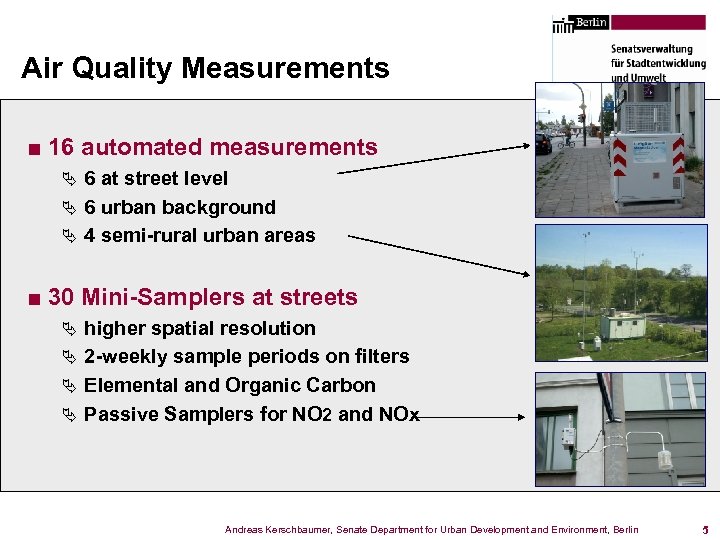
Air Quality Measurements ■ 16 automated measurements Ä 6 at street level Ä 6 urban background Ä 4 semi-rural urban areas ■ 30 Mini-Samplers at streets Ä higher spatial resolution Ä 2 -weekly sample periods on filters Ä Elemental and Organic Carbon Ä Passive Samplers for NO 2 and NOx Andreas Kerschbaumer, Senate Department for Urban Development and Environment, Berlin 5
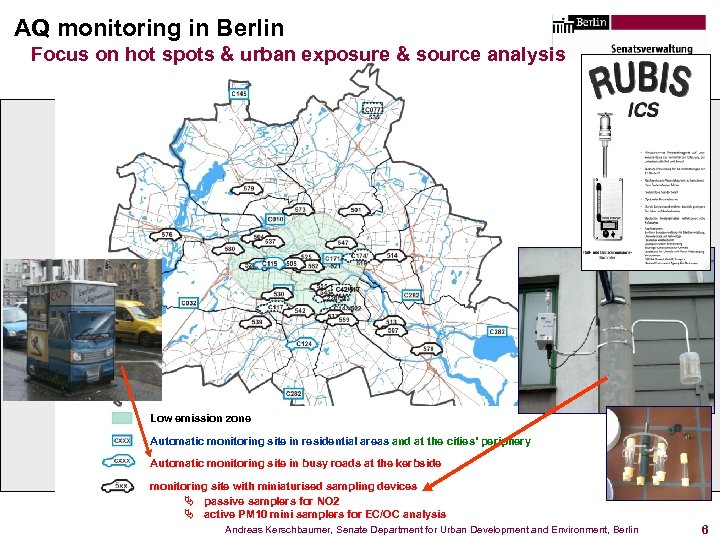
AQ monitoring in Berlin Focus on hot spots & urban exposure & source analysis Low emission zone Automatic monitoring site in residential areas and at the cities’ periphery Automatic monitoring site in busy roads at the kerbside monitoring site with miniaturised sampling devices Ä passive samplers for NO 2 Ä active PM 10 mini samplers for EC/OC analysis Andreas Kerschbaumer, Senate Department for Urban Development and Environment, Berlin 6
PM 2. 5 at kerbside Andreas Kerschbaumer, Senate Department for Urban Development and Environment, Berlin 7
Trend EC+OC in Berlin Andreas Kerschbaumer, Senate Department for Urban Development and Environment, Berlin 8
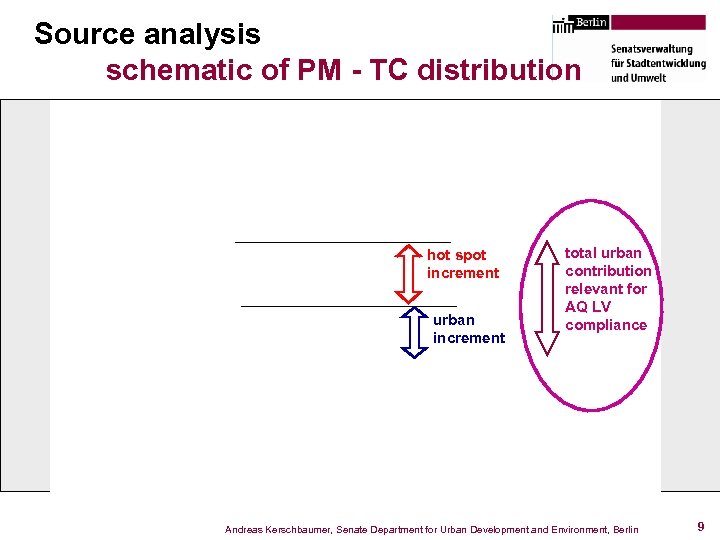
Source analysis schematic of PM - TC distribution hot spot increment urban increment total urban contribution relevant for AQ LV compliance Andreas Kerschbaumer, Senate Department for Urban Development and Environment, Berlin 9
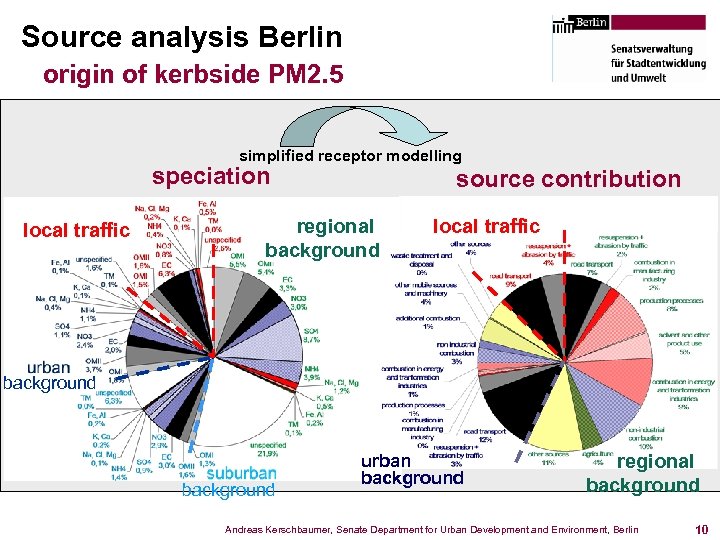
Source analysis Berlin origin of kerbside PM 2. 5 simplified receptor modelling speciation Composition of PM 2. 5 -Contributions local traffic source contribution regional background local traffic background urban background regional background Andreas Kerschbaumer, Senate Department for Urban Development and Environment, Berlin 10
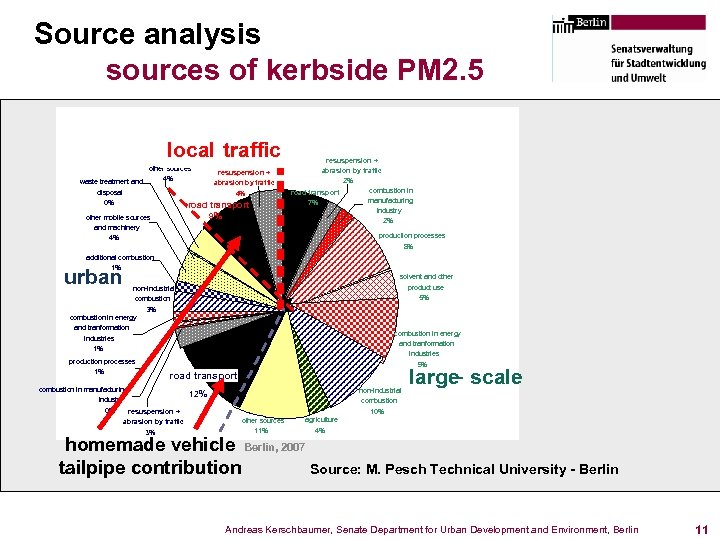
Source analysis sources of kerbside PM 2. 5 local traffic resuspension+ resuspension + other sources abrasion by traffic resuspension + 4% abrasion by 2% waste treatment and abrasion by traffic combustion in disposal road transport 4% 4% manufacturing 0% 7% road transport industry 9% 9% other mobile sources 2% and machinery production processes 4% 8% additional combustion 1% urban solvent and other product use 5% non-industrial combustion 3% combustion in energy and tranformation industries 1% combustion in energy and tranformation industries 9% production processes 1% road transport combustion in manufacturing road transport 12% industry 12% 0% resuspension+ resuspension + abrasion by traffic 3% large- scale background non-industrial combustion 10% other sources 11% agriculture 4% homemade vehicle Berlin, 2007 tailpipe contribution Source: M. Pesch Technical University - Berlin Andreas Kerschbaumer, Senate Department for Urban Development and Environment, Berlin 11
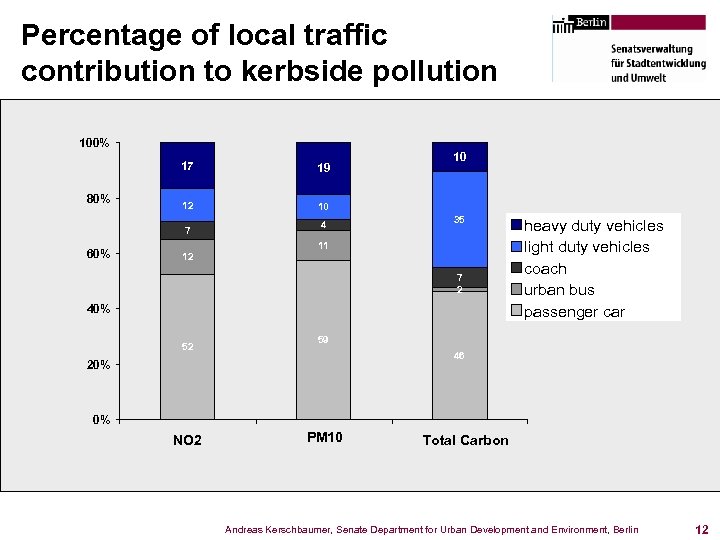
Percentage of local traffic contribution to kerbside pollution 100% 17 80% 19 12 10 7 60% 10 4 35 11 12 7 2 40% 52 heavy duty vehicles light duty vehicles coach urban bus passenger car 59 46 20% 0% NO 2 PM 10 Total Carbon Andreas Kerschbaumer, Senate Department for Urban Development and Environment, Berlin 12
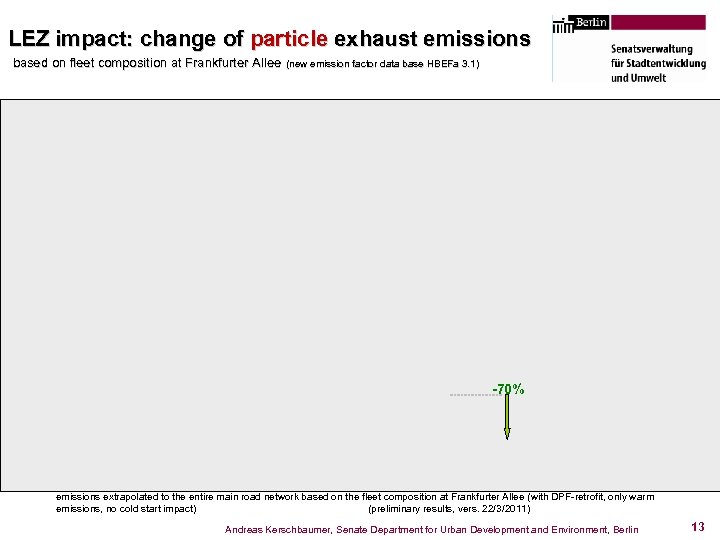
LEZ impact: change of particle exhaust emissions based on fleet composition at Frankfurter Allee (new emission factor data base HBEFa 3. 1) -70% emissions extrapolated to the entire main road network based on the fleet composition at Frankfurter Allee (with DPF-retrofit, only warm emissions, no cold start impact) (preliminary results, vers. 22/3/2011) Andreas Kerschbaumer, Senate Department for Urban Development and Environment, Berlin 13
Berlin LEZ – impact analysis total carbon concentration traffic related* black¥ carbon particle concentration in Berlin * local BC increment at traffic sites, adjusted to traffic volumes trend relative to 2007 before LEZ came into force ¥ elemental carbon (EC) particles plus other deposited organic compounds (OC) Andreas Kerschbaumer, Senate Department for Urban Development and Environment, Berlin 14
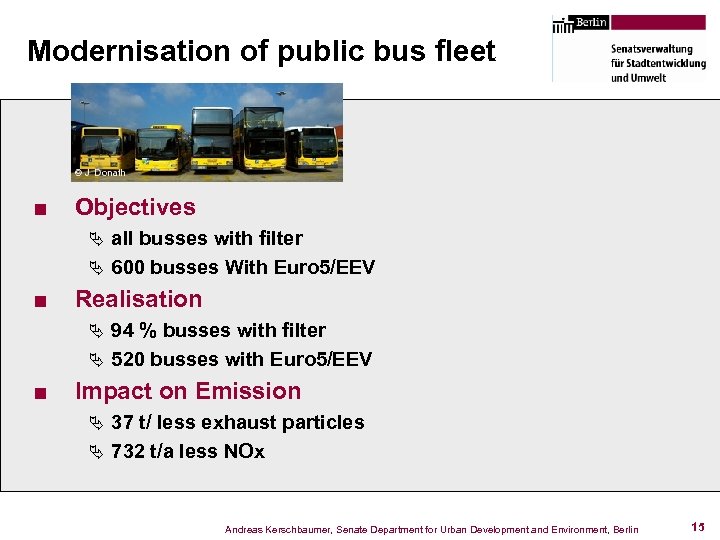
Modernisation of public bus fleet ■ Objectives Ä all busses with filter Ä 600 busses With Euro 5/EEV ■ Realisation Ä 94 % busses with filter Ä 520 busses with Euro 5/EEV ■ Impact on Emission Ä 37 t/ less exhaust particles Ä 732 t/a less NOx Andreas Kerschbaumer, Senate Department for Urban Development and Environment, Berlin 15
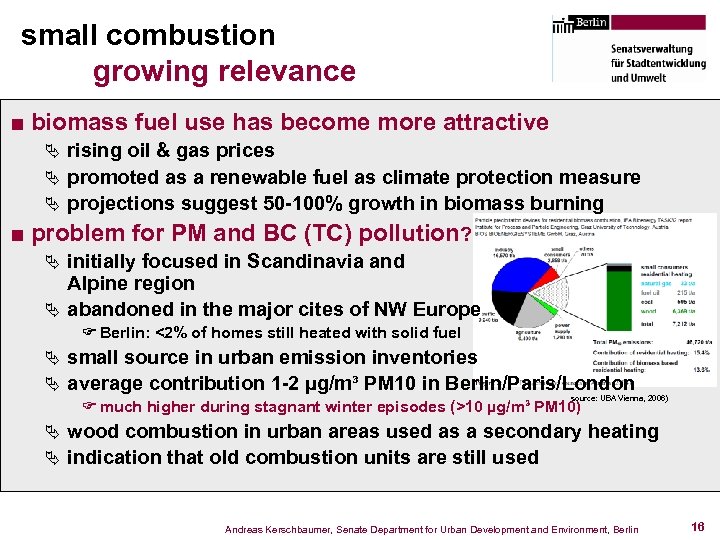
small combustion growing relevance ■ biomass fuel use has become more attractive Ä rising oil & gas prices Ä promoted as a renewable fuel as climate protection measure Ä projections suggest 50 -100% growth in biomass burning ■ problem for PM and BC (TC) pollution? Ä initially focused in Scandinavia and Alpine region Ä abandoned in the major cites of NW Europe F Berlin: <2% of homes still heated with solid fuel Ä small source in urban emission inventories Ä average contribution 1 -2 µg/m³ PM 10 in Berlin/Paris/London source: UBA Vienna, 2006) F much higher during stagnant winter episodes (>10 µg/m³ PM 10) Ä wood combustion in urban areas used as a secondary heating Ä indication that old combustion units are still used Andreas Kerschbaumer, Senate Department for Urban Development and Environment, Berlin 16
source analysis Berlin contribution of biomass burning result of speciation and PMF analysis Source: Wagener et al. (EAC 2011) Andreas Kerschbaumer, Senate Department for Urban Development and Environment, Berlin 17
Small combustion Regulation in Aachen – Option for Berlin ■ applies to single room heaters with 4 -15 k. W ■ requires already now stricter standards for new equipment Ä 40 mg/m³ for new devices ■ existing units need to comply already by 2015 Ä 75 mg/m³ for existing units ■ no extra transition periods granted Ä requires filter technology for retrofit & sufficient market coverage ■ initial problems for the regulator: Ä missing framework for monitoring and control of in use filter efficiency F project with real-world tests of retrofitted filters Ä lacking market for type-approved retrofit kits Ä lacking demand for market development F similarity with road vehicle DPF retrofit development Ä retrofit costs relatively high compared to value of heating devices Andreas Kerschbaumer, Senate Department for Urban Development and Environment, Berlin 18
Particle filters for construction machinery ■ Problem: Ä ca. 140 t/a Diesel exhaust particles from construction machines Ä comparison: Diesel exhaust particles from road traffic: F 2009: ca. 224 t/a (LEZ) F 2015: ca. 124 t/a (LEZ without exemption) ■ Goal: Ä Reduction of Diesel exhaust emissions: 75% until 2015 Ä i. e. 100 t/a less ■ Obstacle: Ä Filter-Regeneration at different operating conditions Ä Costs Ä Filter availability Andreas Kerschbaumer, Senate Department for Urban Development and Environment, Berlin 19
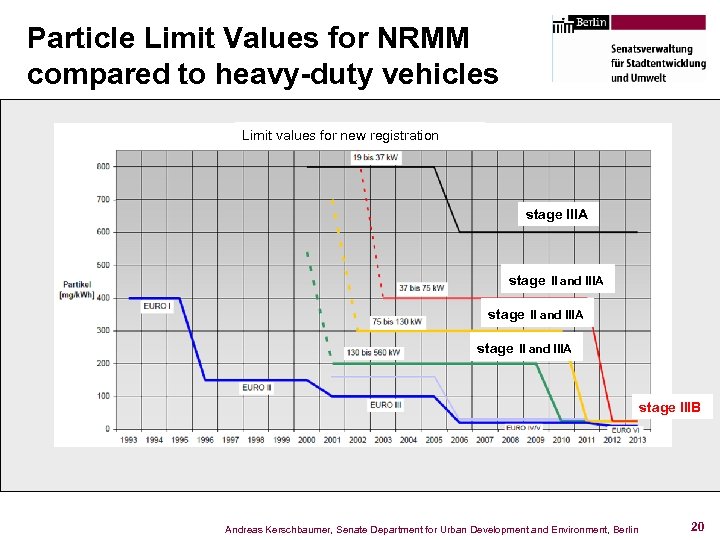
Particle Limit Values for NRMM compared to heavy-duty vehicles Limit values for new registration stage IIIA stage II and IIIA stage IIIB Andreas Kerschbaumer, Senate Department for Urban Development and Environment, Berlin 20
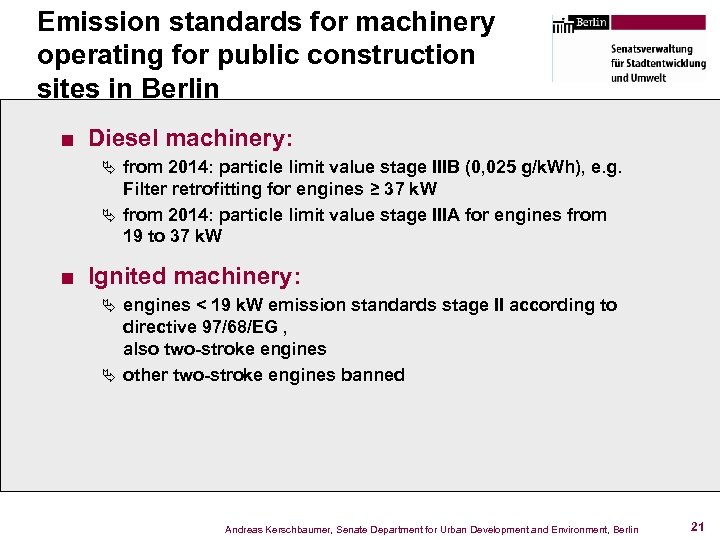
Emission standards for machinery operating for public construction sites in Berlin ■ Diesel machinery: Ä from 2014: particle limit value stage IIIB (0, 025 g/k. Wh), e. g. Filter retrofitting for engines ≥ 37 k. W Ä from 2014: particle limit value stage IIIA for engines from 19 to 37 k. W ■ Ignited machinery: Ä engines < 19 k. W emission standards stage II according to directive 97/68/EG , also two-stroke engines Ä other two-stroke engines banned Andreas Kerschbaumer, Senate Department for Urban Development and Environment, Berlin 21
Thank you ! Andreas Kerschbaumer, Senate Department for Urban Development and Environment, Berlin 22

Andreas Kerschbaumer, Senate Department for Urban Development and Environment, Berlin 23
Скачать презентацию Black Carbon Air Pollution in Berlin Andreas Kerschbaumer
9746a2d265a94bbb26916ff24ef238b8.ppt