 Скачать презентацию Bistability Bifurcations and Regime Changes in Economics and
5afde63afbc440c26ac6e886ef5cb3b7.ppt
- Количество слайдов: 34



Bistability, Bifurcations and Regime Changes in Economics and Finance Gerald Silverberg UNU-MERIT Maastricht University and International Institute for Applied Systems Analysis 1
Economic Systems Occasionally Seem to be Characterized by Rapid and Large Change without Apparent External Cause • Recent common descriptions in the business press: – ‘financial meltdown’ – ‘the economy is in free fall’ – ‘house of cards’ • The system may then remain in the new state for an indefinite length of time – The USA did not exit from the great depression until rearmament for WW 2 began in earnest around 1939 • Asymmetry between rapid onset of recession and more gradual expansion phases 2
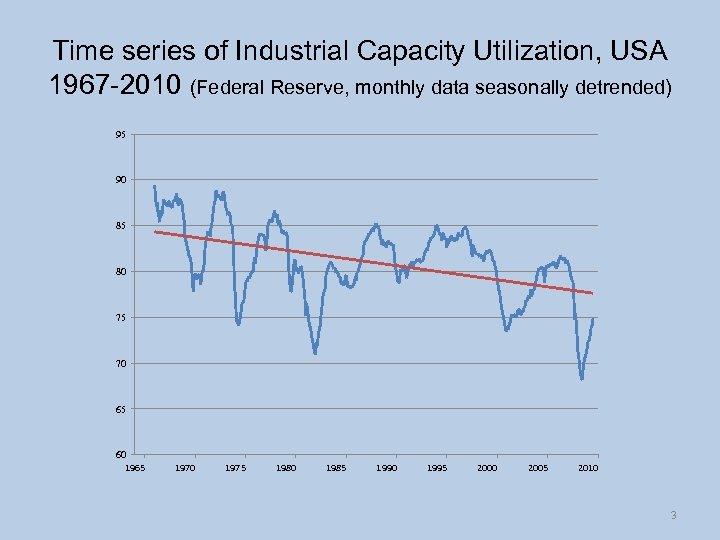
Time series of Industrial Capacity Utilization, USA 1967 -2010 (Federal Reserve, monthly data seasonally detrended) 95 90 85 80 75 70 65 60 1965 1970 1975 1980 1985 1990 1995 2000 2005 2010 3
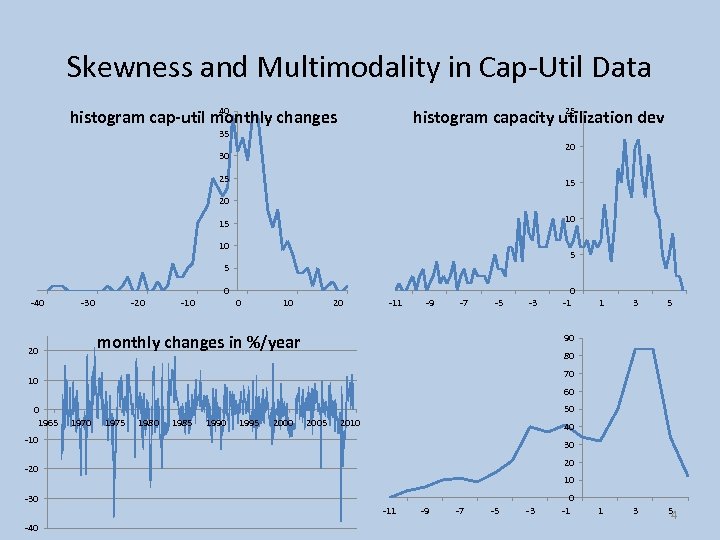
Skewness and Multimodality in Cap-Util Data 40 histogram cap-util monthly changes 25 histogram capacity utilization dev 35 20 30 25 15 20 10 15 10 5 5 0 -40 -30 -20 -10 0 10 20 -11 -9 -7 -5 -3 monthly changes in %/year 20 5 1 3 5 70 60 50 1975 1980 1985 1990 1995 2000 2005 2010 40 30 20 -40 3 80 -10 -30 1 90 10 0 1965 0 -1 10 -11 -9 -7 -5 -3 0 -1 4
Difficulties for Economic Theory • The standard model of a shocked, linear stable system (impulse-propagation model, Frisch 1933) would not generate fluctuations of sufficiently large amplitude without very large exogenous shocks • Internal stochastic noise should decline markedly in relative size as the numbers of actors increases • Asymmetry and persistence are inexplicable in a linear model 5
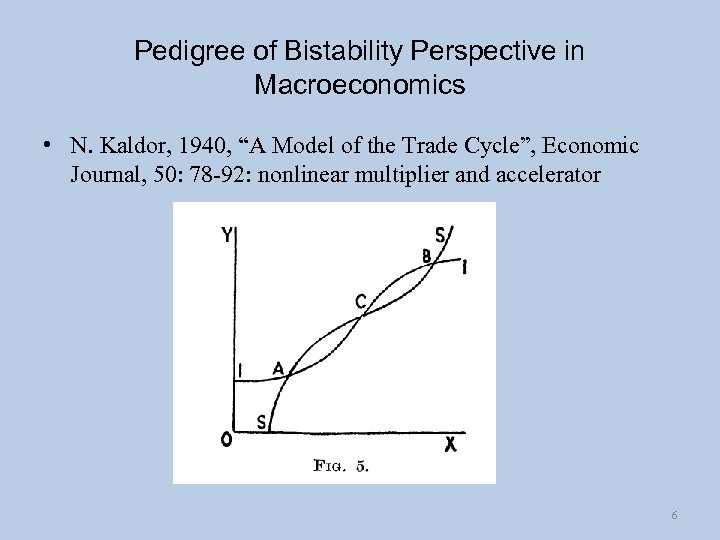
Pedigree of Bistability Perspective in Macroeconomics • N. Kaldor, 1940, “A Model of the Trade Cycle”, Economic Journal, 50: 78 -92: nonlinear multiplier and accelerator 6
Pedigree of Bistability Analysis II • • J. T. Schwartz, 1965, Theory of Money: the essence of Keynesianism is the assertion that there are coordination full and underemployment Nash equilibrium Cooper, R. and John, A. , 1988, “Coordinating Coordination Failures in Keynesian Models”, Quarterly Journal of Economics, 103: 441 -461 Hamilton, JD, 1989, “A new approach to the economic analysis of nonstationary time series and the business cycle”, Econometrica 57: 357– 384: Markov-switching model A. Manning, 1990, “Imperfect Competition, Multiple Equilibria and Unemployment Policy”, Economic Journal, 100: 151 -162 Durlauf, Steven N. , 1991, “Multiple Equilibria and Persistence in Aggregate Fluctuations”, American Economic Review. Papers and Proceedings, 81: 70 -74: social interaction models Duncan Foley, 2009, “The Anatomy of Financial and Economic Crisis”, Gildersleeve Lecture: role of externalities W. A. Brock, S. R. Carpenter, M. Scheffer, 2010, “Regime Shifts, Environmental Signals, Uncertainty, and Policy Choice”, in J. Norberg, G. S. Cumming (eds), Complexity Theory for a Sustainable Future 7
Attempts to Confirm Multistability Empirically • John Dagsvik, Boyan Jovanovic, 1991, “Was The Great Depression A Lowlevel Equilibrium? ”, NBER Working Paper No. 3726 (rejects) • Alan Manning, 1992, “Multiple Equilibria in the British Labour Market: Some Empirical Evidence”, European Economic Review, 36: 1333 -1365 (accepts based on evidence for increasing returns) • Extensive results of Markov-switching literature, which often finds evidence for three states (reviewed in e. g. Hamilton and Raj, 2002, “New directions in business cycle research and financial analysis”, Empirical Economics, 27: 149– 162) • Fuzzy-logic cluster analysis and Markov-switching model also finds three states relating unemployment and inflation (P. Ormerod, B. Rosewell, P. Phelps, 2009, “Inflation/Unemployment Regimes and the Instability of the Phillips Curve”) 8
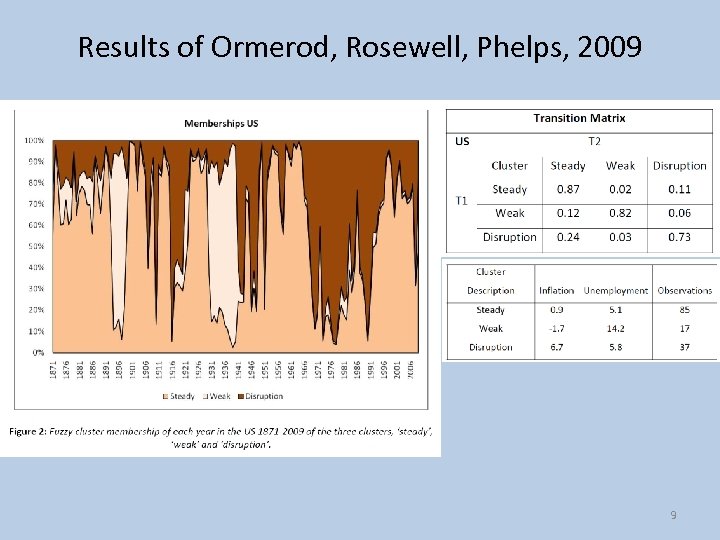
Results of Ormerod, Rosewell, Phelps, 2009 9
Is a More Thoroughgoingly Dynamic and Structural Approach Needed? • In Markov-switching models, in general the number and location of regimes is fixed, as are the transition probabilities • One can conjecture, however, that there may be a ‘metaregime shift’ corresponding to the transition from a unique equilibrium, self-restorative economy (normal business cycle, ‘efficient financial markets’) to a bistable regime (prosperity/depression, bubble/crash), as a function of (slowly) varying structural parameters such as – the extent of highly leveraged debt – trade imbalances – government stimulus investment 10
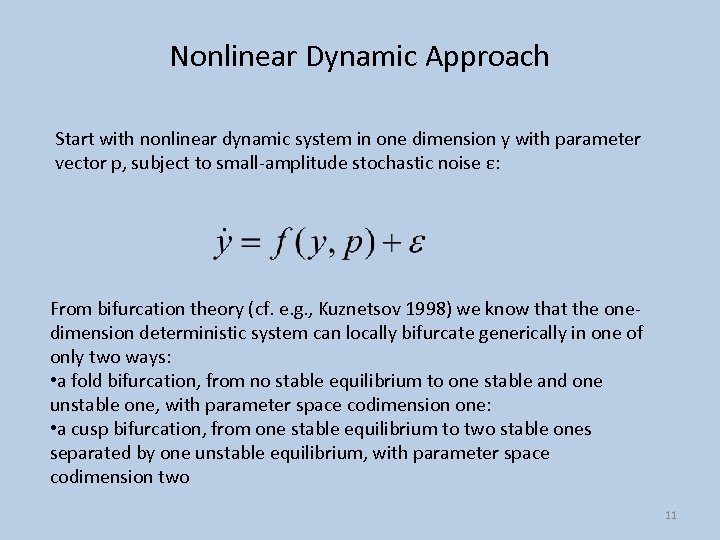
Nonlinear Dynamic Approach Start with nonlinear dynamic system in one dimension y with parameter vector p, subject to small-amplitude stochastic noise ε: From bifurcation theory (cf. e. g. , Kuznetsov 1998) we know that the onedimension deterministic system can locally bifurcate generically in one of only two ways: • a fold bifurcation, from no stable equilibrium to one stable and one unstable one, with parameter space codimension one: • a cusp bifurcation, from one stable equilibrium to two stable ones separated by one unstable equilibrium, with parameter space codimension two 11

Canonical form of cusp bifurcation PV: Equilibrium condition: Bifurcation set in parameter space: 12

Relation of Canonical Form to Empirical System (x, p) • The state space variable and parameters will be related to the canonical ones by a smooth invertible transformation: • To a first approximation we can take the functions g and h to be linear. 13
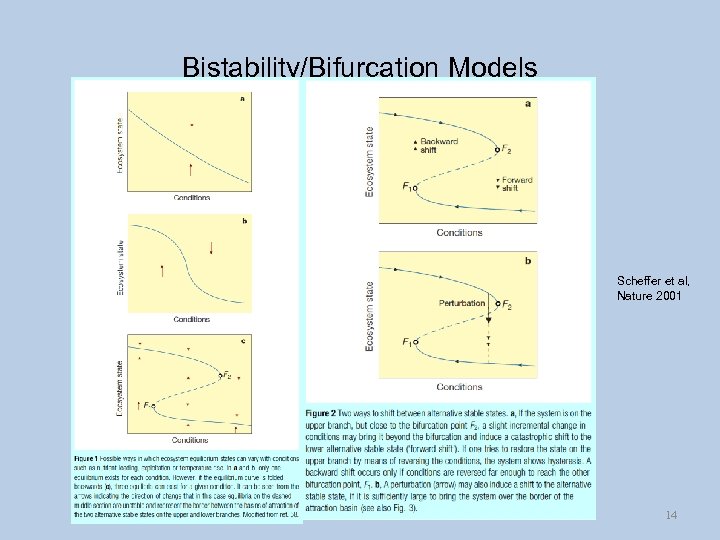
Bistability/Bifurcation Models Scheffer et al, Nature 2001 14

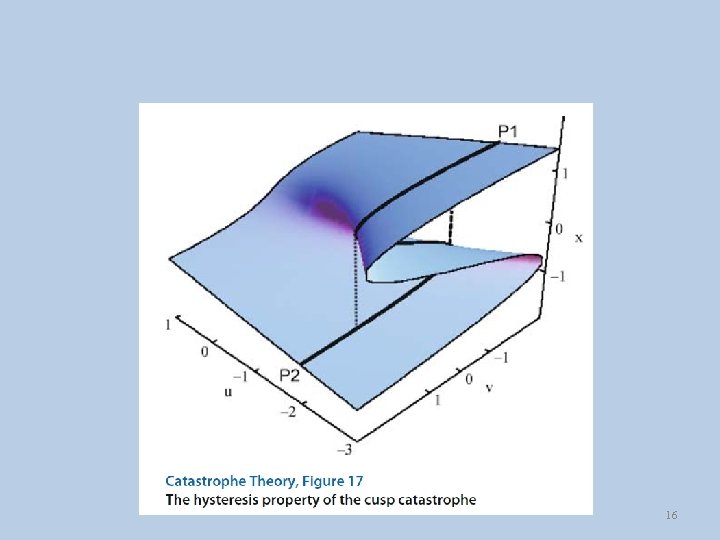
Cusp Catastrophe Derived from a Potential Function • Slow changes in parameters can push system between one and twostate regimes • perturbations can push system over barrier between regimes • hysteresis Scheffer et al, Nature 2001 15
16

The catastrophe-theoretic approach of Haag, G. , Weidlich, W. Mensch, G. O. , 1985, “A Macroeconomic Potential Describing Structural Change of the Economy”, Theory and Decision, 19: 279 -299 17
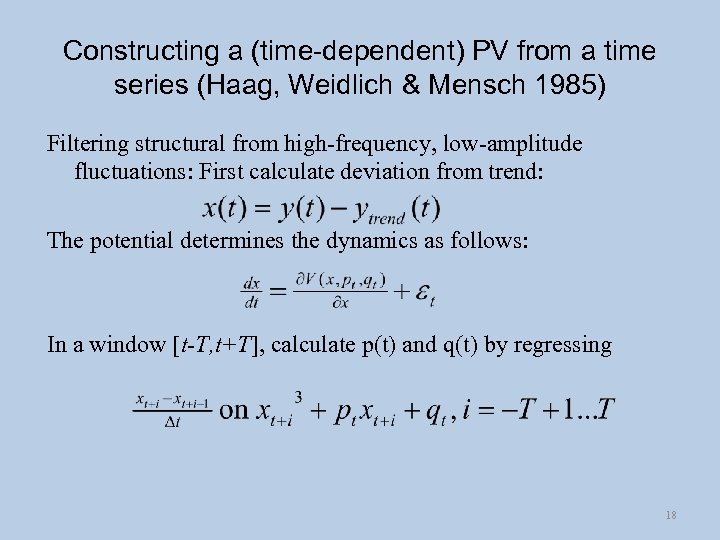
Constructing a (time-dependent) PV from a time series (Haag, Weidlich & Mensch 1985) Filtering structural from high-frequency, low-amplitude fluctuations: First calculate deviation from trend: The potential determines the dynamics as follows: In a window [t-T, t+T], calculate p(t) and q(t) by regressing 18
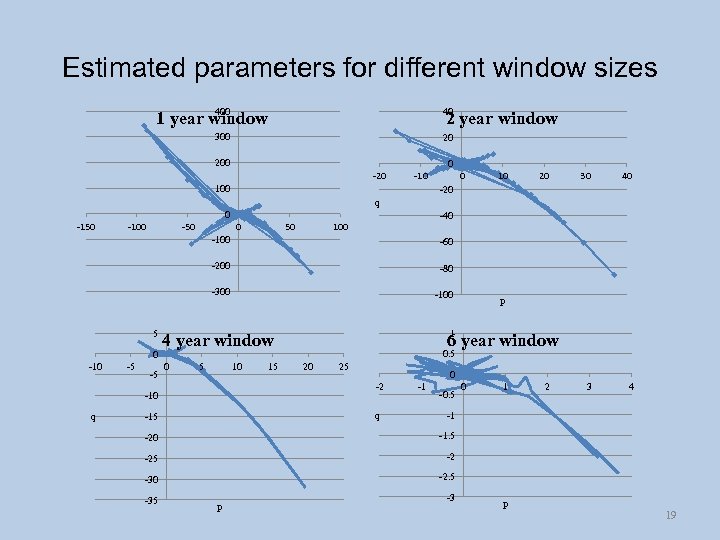
Estimated parameters for different window sizes 400 40 300 20 1 year window 200 0 -20 -10 100 0 10 20 30 40 3 4 -20 q 0 -150 -100 -50 0 50 -40 100 -200 0 -10 -5 -5 -80 -300 5 -60 -100 5 10 15 6 year window 0. 5 20 25 0 -2 -10 q 1 4 year window 0 q -15 p -1 -0. 5 0 1 2 -1 -20 -1. 5 -2 -30 -2. 5 -35 p -3 p 19
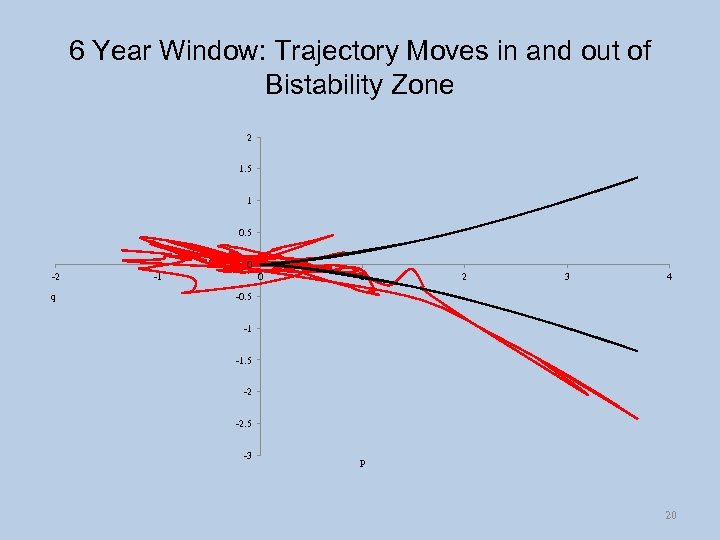
6 Year Window: Trajectory Moves in and out of Bistability Zone 2 1. 5 1 0. 5 0 -2 q -1 0 1 2 3 4 -0. 5 -1 -1. 5 -2 -2. 5 -3 p 20
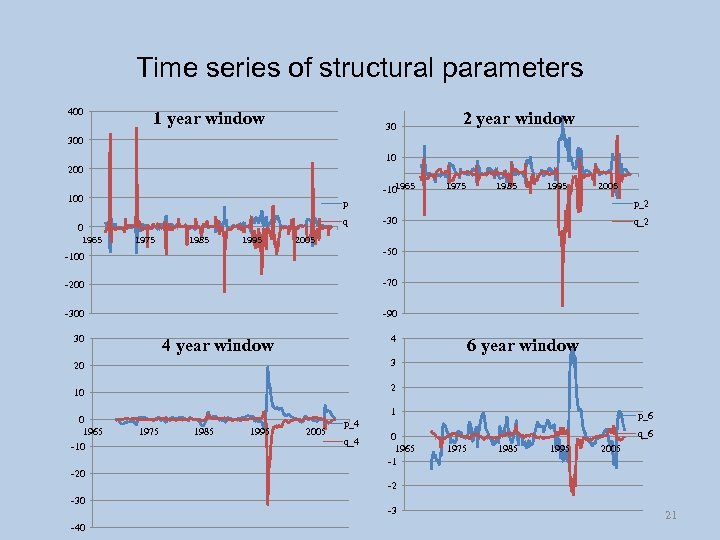
Time series of structural parameters 400 1 year window 30 2 year window 300 10 200 -101965 100 0 1965 1975 1985 1995 2005 p q 1975 1985 1995 p_2 -30 q_2 2005 -100 -50 -200 -70 -300 -90 30 4 4 year window 20 3 10 6 year window 2 0 1965 -10 1 1975 1985 1995 2005 p_6 p_4 q_4 0 1965 -1 q_6 1975 1985 1995 2005 -20 -2 -30 -40 -3 21
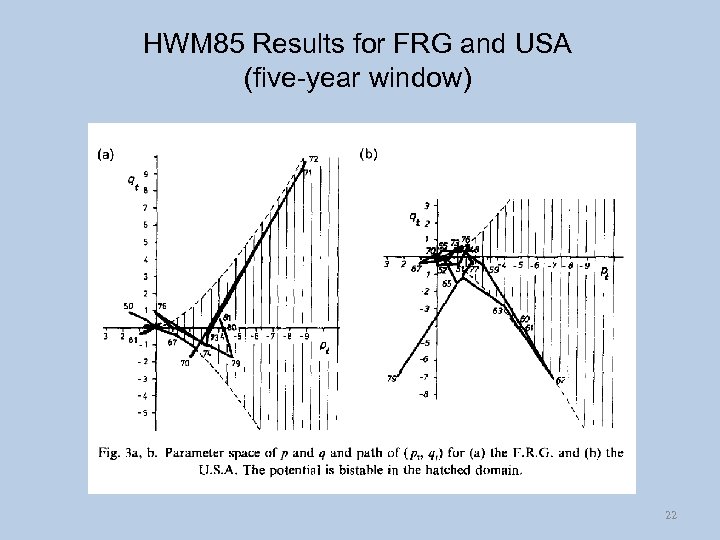
HWM 85 Results for FRG and USA (five-year window) 22
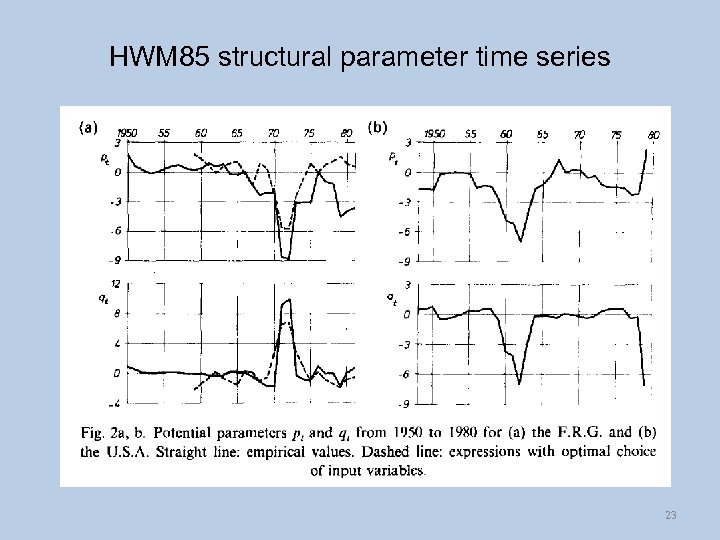
HWM 85 structural parameter time series 23
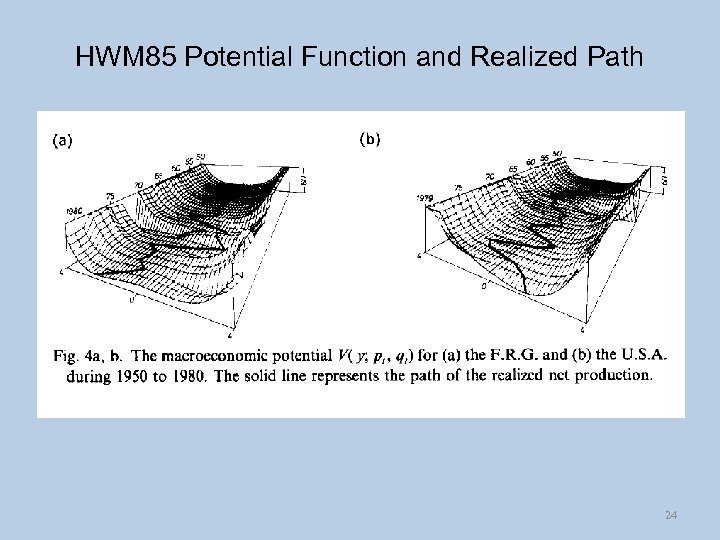
HWM 85 Potential Function and Realized Path 24
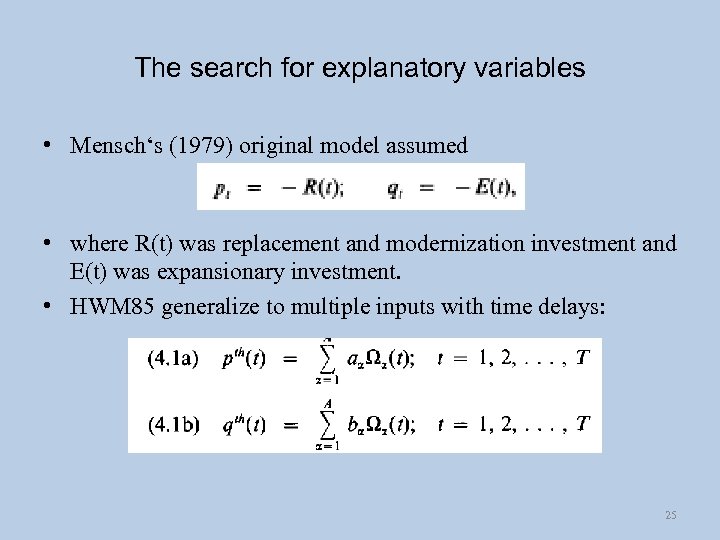
The search for explanatory variables • Mensch‘s (1979) original model assumed • where R(t) was replacement and modernization investment and E(t) was expansionary investment. • HWM 85 generalize to multiple inputs with time delays: 25
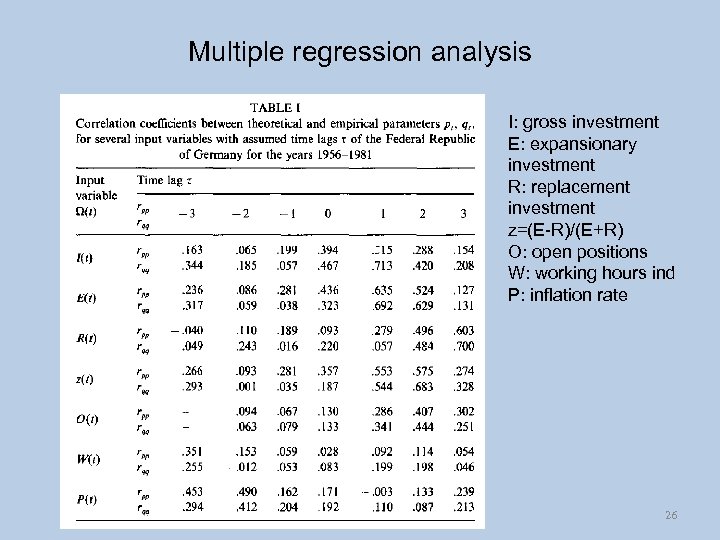
Multiple regression analysis I: gross investment E: expansionary investment R: replacement investment z=(E-R)/(E+R) O: open positions W: working hours ind P: inflation rate 26
Explanations of Bistability Behavior • Investment coordination problem due to investment externalities in demand • Double-edged implications of composition of investment: modernization investment has both demand enhancing (multiplier) effects and employment-replacing effects • Herding behavior (informational externality)? 27
Implications of Bistability for Macrodynamics and Policy • Slowing varying structural variables can move the economy into or out of the bistability region, thus triggering or allowing for regime change • Once in the bistability region, small shocks can trigger rapid selfreinforcing movement ‘over the cliff’ into the other basin of attraction. Thus the relationship between size of causes and size of effects can break down • Hysteresis: reversing a regime transition can be more difficult and costly than triggering it. Implications for stimulous programs: until they induce a spontaneous return to the upper sheet, they are costly and relativelyineffectual. Once they do, the multiplier is very much higher. • If there are multiple (Nash) equilibria, the notion of ‘rationality’ loses its meaning except locally. Individual ‘rationality’ can be in conflict with social rationality. 28
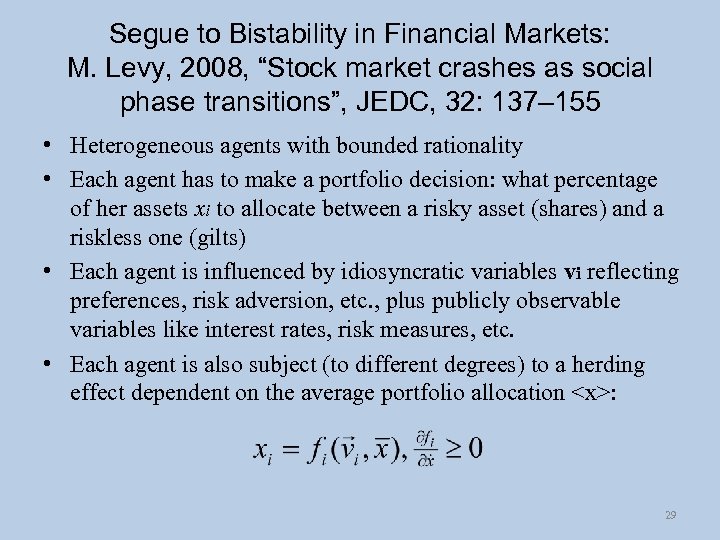
Segue to Bistability in Financial Markets: M. Levy, 2008, “Stock market crashes as social phase transitions”, JEDC, 32: 137– 155 • Heterogeneous agents with bounded rationality • Each agent has to make a portfolio decision: what percentage of her assets xi to allocate between a risky asset (shares) and a riskless one (gilts) • Each agent is influenced by idiosyncratic variables vi reflecting preferences, risk adversion, etc. , plus publicly observable variables like interest rates, risk measures, etc. • Each agent is also subject (to different degrees) to a herding effect dependent on the average portfolio allocation <x>: 29
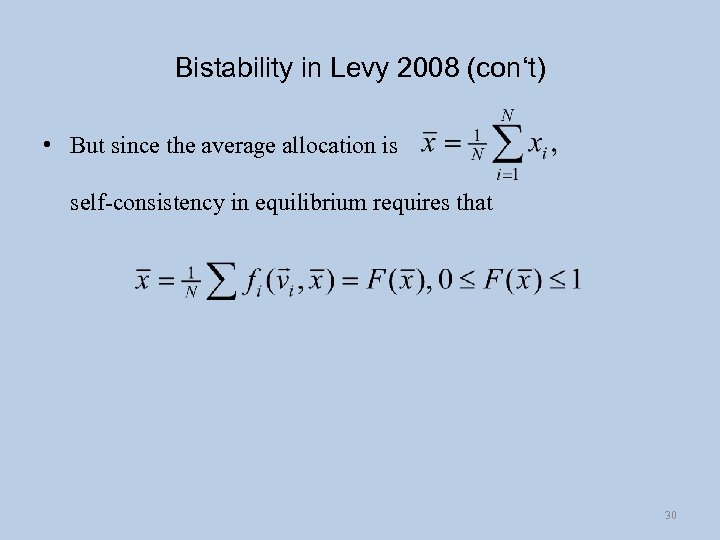
Bistability in Levy 2008 (con‘t) • But since the average allocation is self-consistency in equilibrium requires that 30
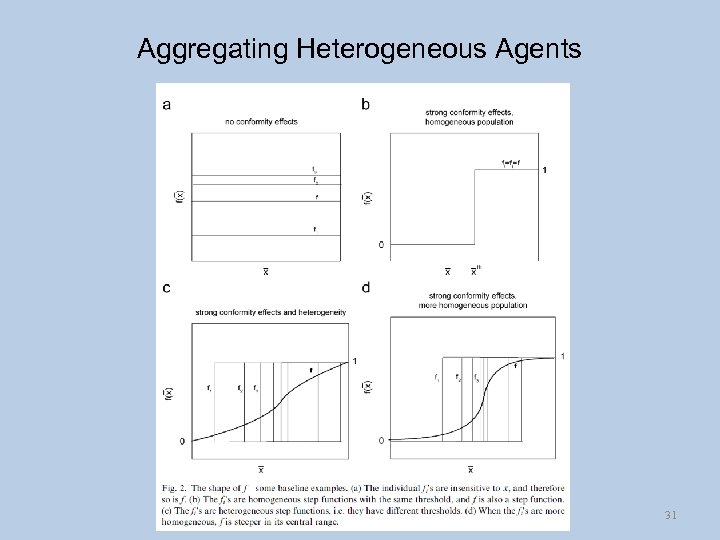
Aggregating Heterogeneous Agents 31

Cusp Catastrophe in Aggregate Market Dynamics 32
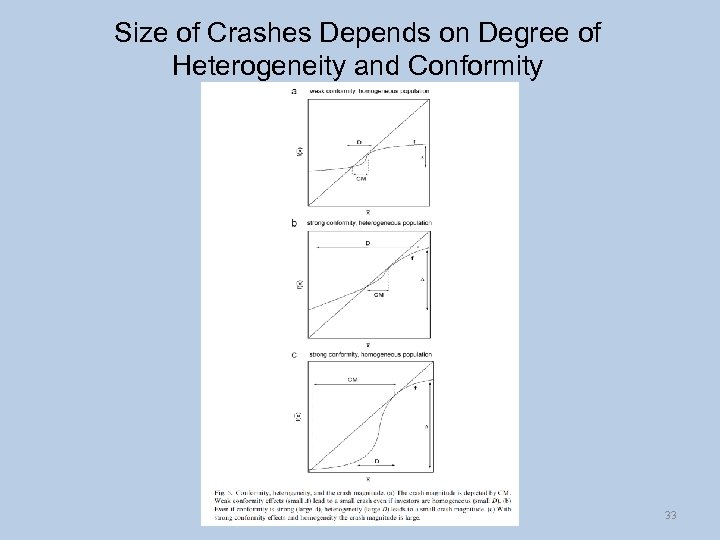
Size of Crashes Depends on Degree of Heterogeneity and Conformity 33
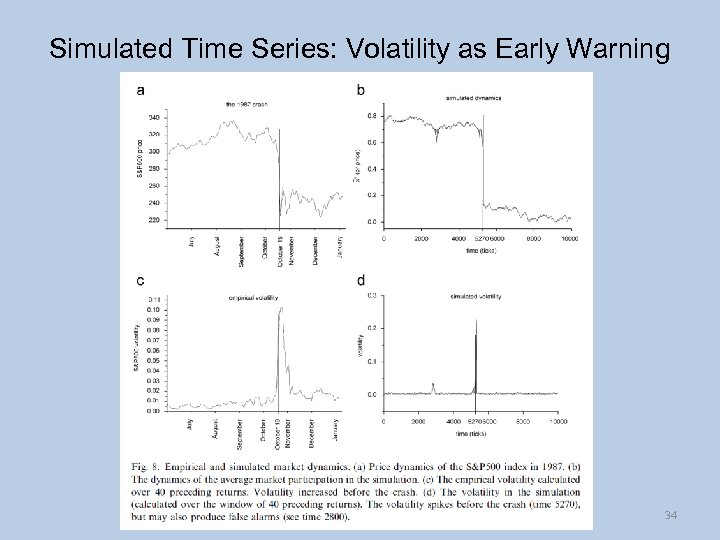
Simulated Time Series: Volatility as Early Warning 34
Скачать презентацию Bistability Bifurcations and Regime Changes in Economics and
5afde63afbc440c26ac6e886ef5cb3b7.ppt