 Скачать презентацию Birth of Modern Urban Life Mr Meester AP
6d6b3247ece0c4cd2132245a4fcc31d6.ppt
- Количество слайдов: 15



Birth of Modern Urban Life Mr. Meester AP European History
Consumer Growth n n The demand for consumer goods brought the economy out of the depression by 1900. Low food prices allowed for more discretionary income. Urbanization also created larger markets for consumer goods. New forms of marketing developed during the last part of the 19 th century. n Department stores, chain stores, mail-order businesses, and improved advertising stimulated the demand for consumer durables.
Rise of the Middle Class n The latter half of the 19 th century saw the emergence the middle class in Europe. n n n The 1 st half of the century, the middle class were the leaders of revolution, now they are the leaders of commerce. Due to their increase in wealth, the middle class often united with the upper class to fend off socialism and other liberal movements. The middle class were the leaders of the consumer market in Europe and the United States.
Middle Class? ? ? n n The middle class of Europe was actually quite diverse in its membership. Large business owners and bankers were the richest and their lifestyle rivaled that of the aristocracy. n n n W. H. Smith (newsstands) became a member of the House of Lords. The Krupp family (munitions and steel) were highly respected. Only a few hundred of such families gained this kind of wealth.
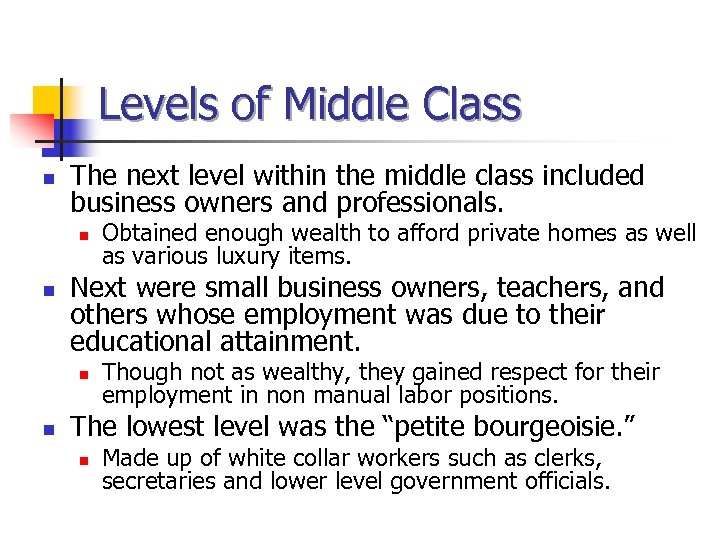
Levels of Middle Class n The next level within the middle class included business owners and professionals. n n Next were small business owners, teachers, and others whose employment was due to their educational attainment. n n Obtained enough wealth to afford private homes as well as various luxury items. Though not as wealthy, they gained respect for their employment in non manual labor positions. The lowest level was the “petite bourgeoisie. ” n Made up of white collar workers such as clerks, secretaries and lower level government officials.
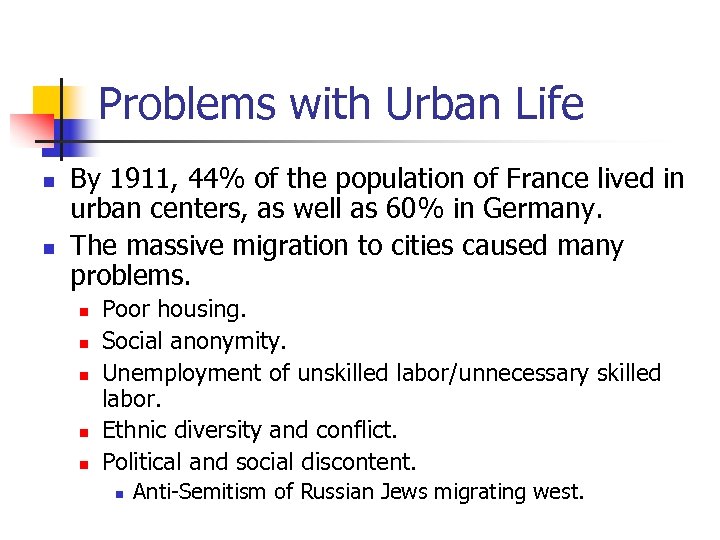
Problems with Urban Life n n By 1911, 44% of the population of France lived in urban centers, as well as 60% in Germany. The massive migration to cities caused many problems. n n n Poor housing. Social anonymity. Unemployment of unskilled labor/unnecessary skilled labor. Ethnic diversity and conflict. Political and social discontent. n Anti-Semitism of Russian Jews migrating west.
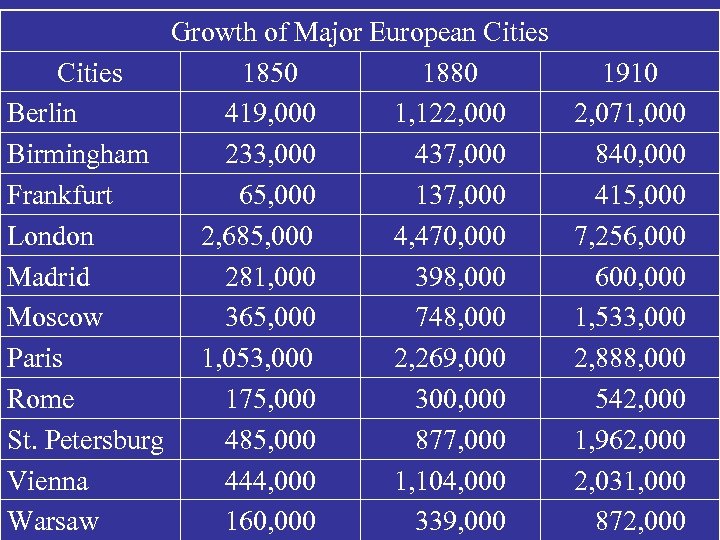
Growth of Major European Cities 1850 1880 Berlin 419, 000 1, 122, 000 Birmingham 233, 000 437, 000 Frankfurt 65, 000 137, 000 London 2, 685, 000 4, 470, 000 Madrid 281, 000 398, 000 Moscow 365, 000 748, 000 Paris 1, 053, 000 2, 269, 000 Rome 175, 000 300, 000 St. Petersburg 485, 000 877, 000 Vienna 444, 000 1, 104, 000 Warsaw 160, 000 339, 000 1910 2, 071, 000 840, 000 415, 000 7, 256, 000 600, 000 1, 533, 000 2, 888, 000 542, 000 1, 962, 000 2, 031, 000 872, 000
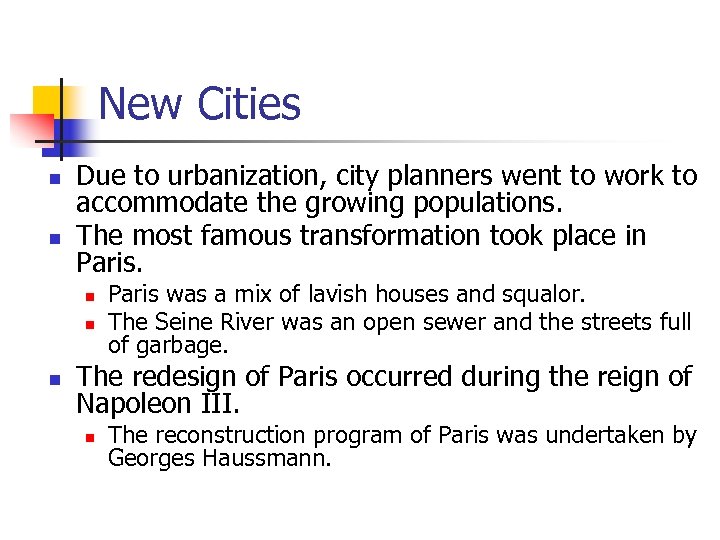
New Cities n n Due to urbanization, city planners went to work to accommodate the growing populations. The most famous transformation took place in Paris. n n n Paris was a mix of lavish houses and squalor. The Seine River was an open sewer and the streets full of garbage. The redesign of Paris occurred during the reign of Napoleon III. n The reconstruction program of Paris was undertaken by Georges Haussmann.
A New Paris n Whole districts were destroyed for wider streets. n n At the end of the Third Republic and the Commune, Paris saw further expansion. n n n Wide streets were not popular but allowed for the quick movement of troops throughout the city. Several parks such as the Bois de Boulogne were built. Structures such as the Paris Opera House along with several other public buildings. Departments stores, office buildings and middle class housing sprung up throughout the city. Two other major constructions were the Eiffel Tower and the Basilica of the Sacred Heart Construction of a subway began in 1895.
The Crystal Palace n Built for the Great Exhibition of 1851 in the Hyde Park area of London n Used the new cast plate glass method to make large plate glass windows n n n Designed by John Paxton Showed the self-satisfaction of Victorian England Was used to display over 13, 000 exhibits of a variety of British goods
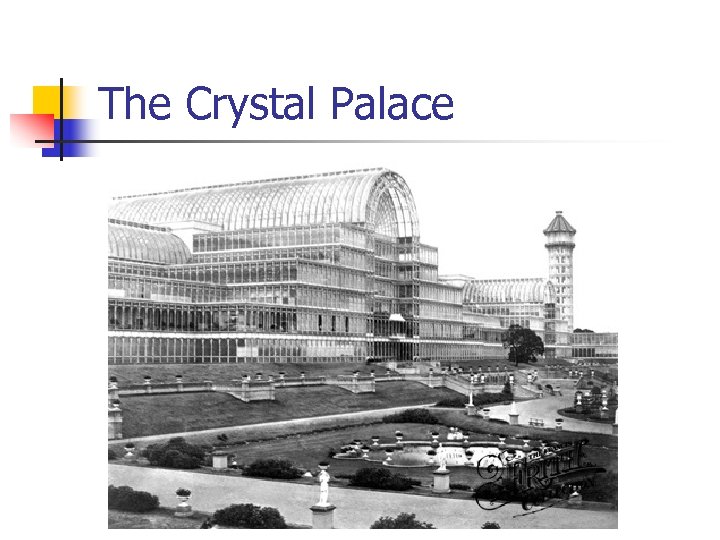
The Crystal Palace
Development of Suburbs n Due to the redevelopment of cities people were forced to find other housing. n n n The middle class looked for less congestion. The working class looked for affordability. New housing districts called suburbs developed because of the expansion of the railway systems. n n Low daily fares allowed workers to live on the outskirts of the cities and commute to their jobs within the city. The development of the subway and electrical tram systems also promoted such growth.
Urban Sanitation n Another concern was providing proper sanitation systems for their growing cities. n n Largely due to the great Cholera epidemics of the 1830 s and 1840 s. This epidemic all classes which put greater pressure on city officials to solve the problem. n n Several books were also published during this period describing the filth found within European cities. Edwin Chadwick’s “Report on the Sanitary Conditions of the Labouring Population, ” shocked England.
Public Health Programs n Several government programs were established during this period to solve the urban health issue. n n n Public health officials were given power to investigate structures and homes in the name of public health. n n n Public Health Act of 1848 (England) Melon Act of 1851 (France) Private property could be condemned for posing health hazards to the community. Private land could be purchased for the construction of sewer and water systems. By the end of the century, the bacterial theory of disease was fully accepted due to the work of Louis Pasteur, Robert Koch and Joseph Lister.
Housing Reforms n Housing reforms looked to solve the medical, political and moral issues posed by the slums. n n Early leaders of such reform were A. V. Huber of Germany and Jules Simon of France. They believed that adequate, respectable housing would solve many of Europe’s social and political problems. Several countries provided tax breaks and provided low interest loans for lower income housing. By 1914, Europe was attempting to solve the issue of proper housing for people.
Скачать презентацию Birth of Modern Urban Life Mr Meester AP
6d6b3247ece0c4cd2132245a4fcc31d6.ppt