 Скачать презентацию Birth of Broadband IP Symposium for CEE CIS
e6660b3737ee9dba9faa6ca4c3b53079.ppt
- Количество слайдов: 50



Birth of Broadband IP Symposium for CEE, CIS and Baltic States Moscow, Russia 16 -19 September 2003 Robert Shaw <robert. shaw@itu. int> ITU Internet Strategy and Policy Advisor International Telecommunication Union
Agenda • • Introduction The Impact of New Communication Technologies Reflections on Human Connectivity Innovations Broadband: the Next Big Thing? Broadband in Leading Economies Japan and Korea Country Case Studies Some Regulatory and Policy Experiences Conclusions: Which strategies work and which don’t International Telecommunication Union
Introduction: International Telecommunication Union • International organization where governments and private sector coordinate global telecom networks and services • Founded in 1865, it is the oldest specialized agency of the UN system • 189 Member States, 650 Sector Members, 75 Sector Associates • Headquarters Geneva, 11 regional offices, 790 staff / 83 nationalities International Telecommunication Union
ITU Mission • Maintain and extend international cooperation in telecommunications • Technical and policy assistance to developing countries • To harmonize actions of Member States and promote cooperation between Member States and Sector Members International Telecommunication Union
ITU mission • To promote at international level, the adoption of a broader approach to issues of telecommunications in the global information economy and society • To extend the benefits of telecoms to all the world’s inhabitants • “Helping the world communicate” International Telecommunication Union
The Impact of New Technologies • Technology-driven industries like telecommunications historically characterized by steady growth punctuated by “giant leaps” forward, usually when “new” technology is introduced International Telecommunication Union
Impact of New Technologies • This historical pattern has been repeated in the development of every new communications network technology: – – – – – 1840’s: telegraph 1870’s: telephone 1890’s: radio telegraphy or “wireless” 1920’s: radio broadcasting 1950’s: television broadcasting 1960’s: geostationary satellite communications 1970’s: computer communications 1980’s: optical communications 1990’s: Internet and mobile communications International Telecommunication Union
Impact of New Technologies • In the last part of the twentieth century, the almost simultaneous arrival of two major innovations — mobile phones and the Internet — not only changed the face of communications, but also gave the impetus to dramatic economic growth International Telecommunication Union
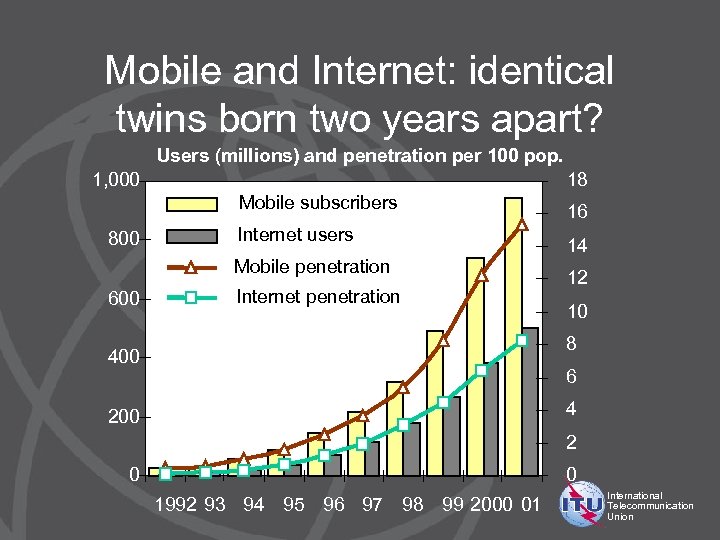
Mobile and Internet: identical twins born two years apart? Users (millions) and penetration per 100 pop. 1, 000 18 Mobile subscribers 800 16 Internet users 14 Mobile penetration 600 12 Internet penetration 10 8 400 6 4 200 2 0 0 1992 93 94 95 96 97 98 99 2000 01 International Telecommunication Union
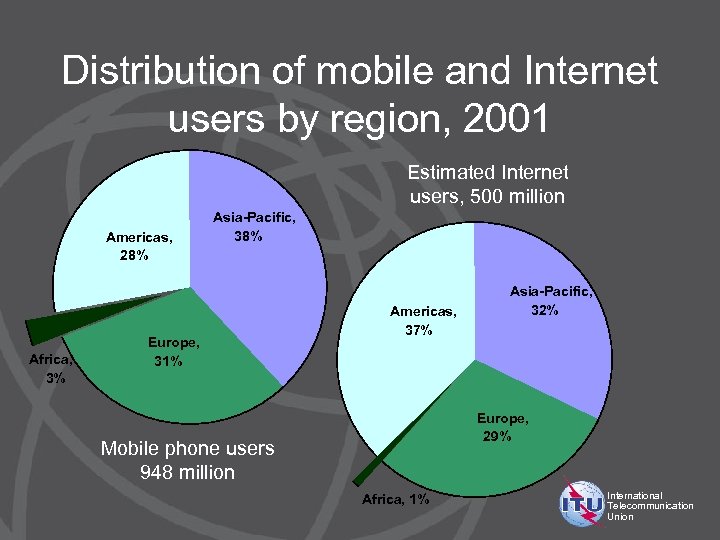
Distribution of mobile and Internet users by region, 2001 Estimated Internet users, 500 million Americas, 28% Africa, 3% Asia-Pacific, 38% Europe, 31% Americas, 37% Asia-Pacific, 32% Europe, 29% Mobile phone users 948 million Africa, 1% International Telecommunication Union

Predicting the Future International Telecommunication Union
The Historical Perspective • Napoleon: “History is the version of past events that people have decided to agree upon. ” • When we look back over history at any advancement in electronic communication networks, we tend to forget about the highs and the lows, the boom-bust cycles and the failed predictions about likely usage • Some examples… International Telecommunication Union
We often get it wrong: telephone • “For the first 30 years of the telephone, promoters struggled to identify the killer application that would promote its wide adoption by home owners and businesses. At first the telephone was promoted as a replacement for the telegraph, allowing businesses to send messages more easily and without an operator. Telephone promoters in the early years touted the telephone as new service to broadcast news, concerts, church services, weather reports, etc. Industry journals publicized inventive uses of the telephone such as sales by telephone, consulting with doctors, ordering groceries over the telephone, listening to school lectures and even long distance Christian Science healing! The concept that someone would buy the telephone to chat was simply inconceivable at that time. ” - C. Fischer, America Calling International Telecommunication Union
We often get it wrong: email • “The popularity of email was not foreseen by the ARPANET's planners. Roberts had not included electronic mail in the original blueprint for the network. In fact, in 1967 he had called the ability to send messages between users “not an important motivation for a network of scientific computers”. . Why then was the popularity of email such a surprise? One answer is that it represented a radical shift in the ARPANET's identity and purpose. The rationale for building the network had focused on providing access to computers rather than to people. ” - J. Abbate, Inventing the Internet International Telecommunication Union
We often get it wrong: dot. com • Ten years ago – The Public Switched Telephone Network (PSTN) was just completing the transition to digital – The Internet was starting to move from academia • Three years ago – Dot. com mania and hype ruled – Widely forecast that the Internet was about to take over as the sole communications medium – Massive overbuilding of capacity compared to need International Telecommunication Union
Today • Once high-flying telecom companies like Worldcom and Global Crossing have dramatically gone bankrupt, leaving behind massive debts. • Others teeter on edge of bankruptcy • Billions of dollars have evaporated in stock market valuations • US telecom operators and equipment manufactures have probably laid off close to a million people since the beginning of last year • Industry searching for the “next big thing” to drive new wave of innovation and growth International Telecommunication Union

So what’s the next big thing? • <caveat> Our track record of predicting the future isn’t so good… </caveat> • But let’s try… International Telecommunication Union
So what do these things have in common? • • • 1840’s: telegraph 1870’s: telephone 1890’s: radio telegraphy or “wireless” 1920’s: radio broadcasting 1950’s: television broadcasting 1960’s: geostationary satellite communications 1970’s: computer communications 1980’s: optical communications 1990’s: Internet and mobile communications International Telecommunication Union

The Next Big Thing? • History suggests there is class of innovations that can propel growth in economies • On examination, common characteristics are their contribution to human interconnectivity • According to the consulting firm Accenture, there are six overriding features that these kind of innovations share… International Telecommunication Union
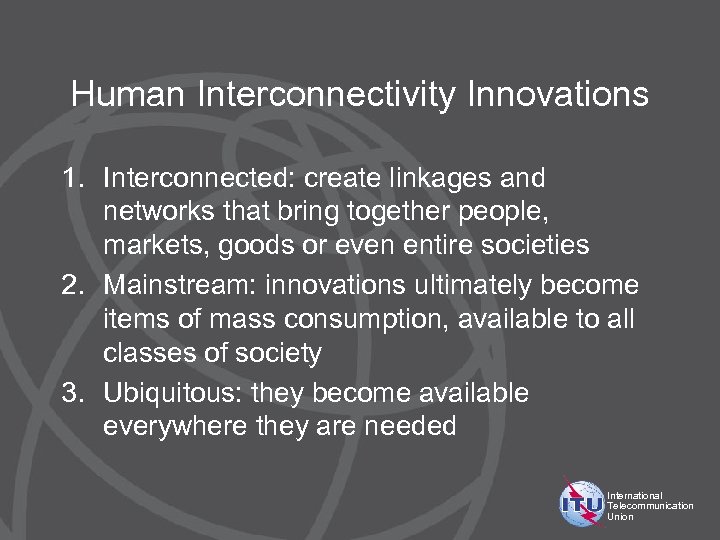
Human Interconnectivity Innovations 1. Interconnected: create linkages and networks that bring together people, markets, goods or even entire societies 2. Mainstream: innovations ultimately become items of mass consumption, available to all classes of society 3. Ubiquitous: they become available everywhere they are needed International Telecommunication Union
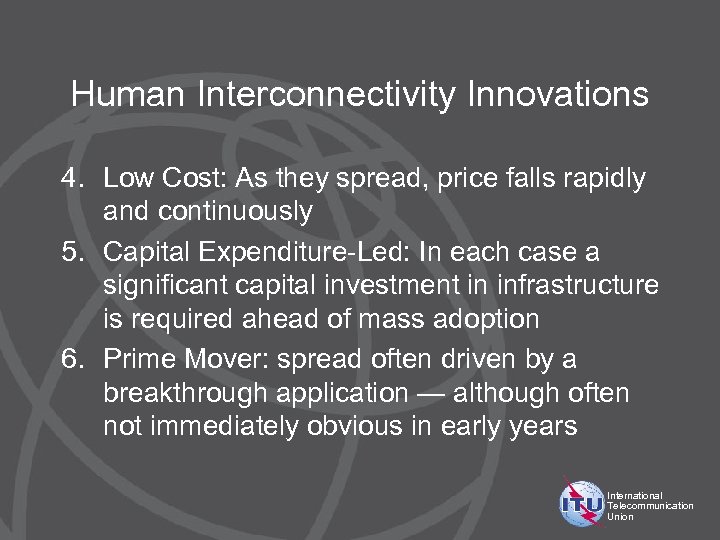
Human Interconnectivity Innovations 4. Low Cost: As they spread, price falls rapidly and continuously 5. Capital Expenditure-Led: In each case a significant capital investment in infrastructure is required ahead of mass adoption 6. Prime Mover: spread often driven by a breakthrough application — although often not immediately obvious in early years International Telecommunication Union
Industry searching for the “next big thing” to drive new wave of innovation and growth Is Broadband the Next Big Thing? International Telecommunication Union
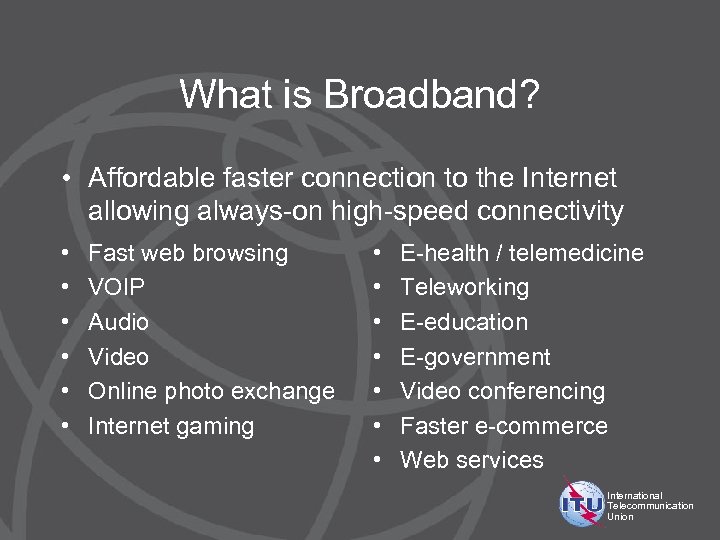
What is Broadband? • Affordable faster connection to the Internet allowing always-on high-speed connectivity • • • Fast web browsing VOIP Audio Video Online photo exchange Internet gaming • • E-health / telemedicine Teleworking E-education E-government Video conferencing Faster e-commerce Web services International Telecommunication Union
What is Broadband? • No consensus about what constitutes broadband, generally greater than 256 kbit/sec • Others say “life begins at 100 Mbit/sec” • Some technologies – – – – Digital subscriber lines (copper phone lines) Cable modem (copper coax) Fibre optical cable WLAN Fixed broadband wireless (e. . g, IEEE 802. 16) Satellite Free space optics (lasers) International Telecommunication Union
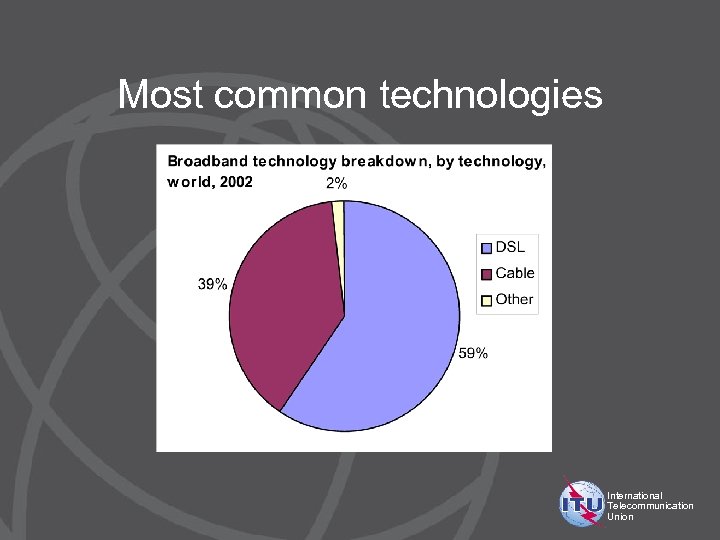
Most common technologies International Telecommunication Union
Broadband penetration is very uneven throughout the world so we naturally look to leading economies for what works International Telecommunication Union
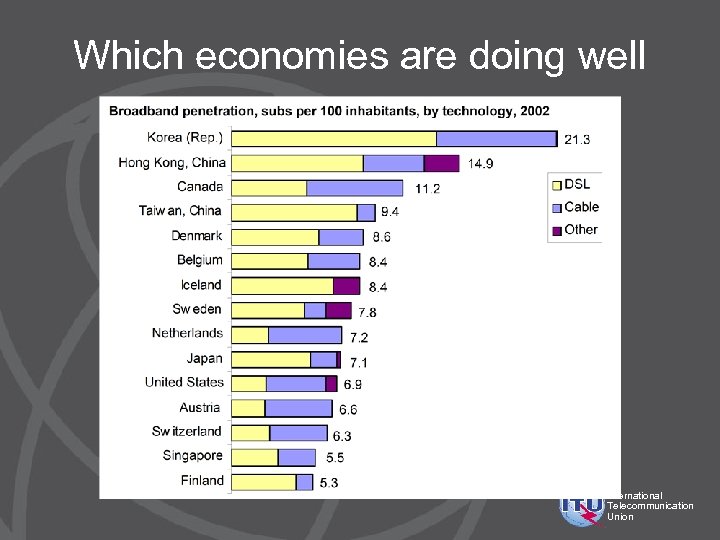
Which economies are doing well International Telecommunication Union
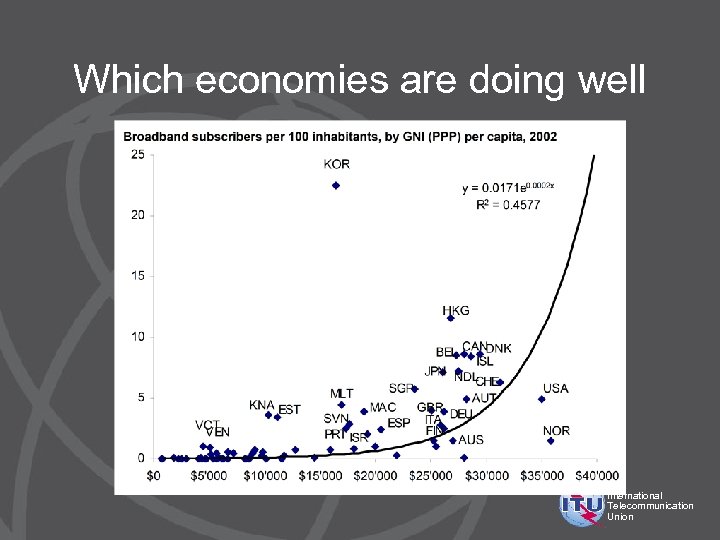
Which economies are doing well International Telecommunication Union
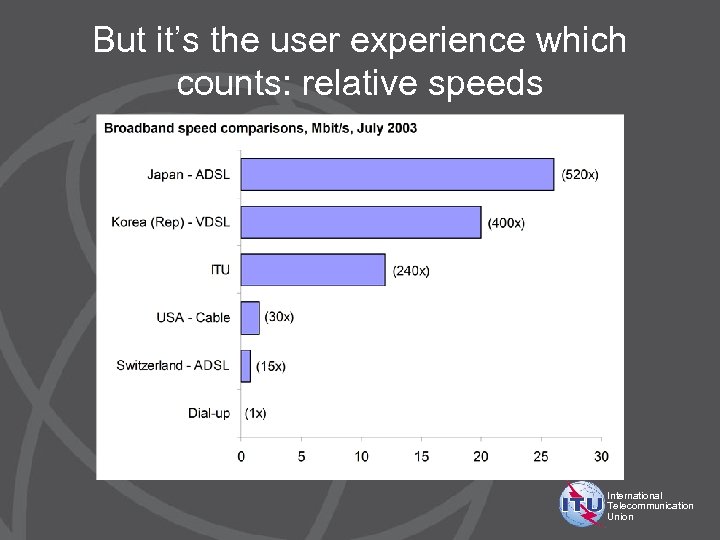
But it’s the user experience which counts: relative speeds International Telecommunication Union
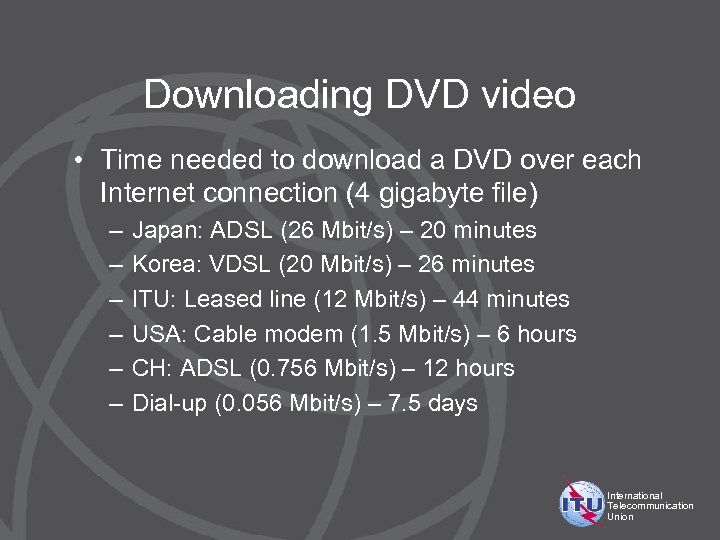
Downloading DVD video • Time needed to download a DVD over each Internet connection (4 gigabyte file) – – – Japan: ADSL (26 Mbit/s) – 20 minutes Korea: VDSL (20 Mbit/s) – 26 minutes ITU: Leased line (12 Mbit/s) – 44 minutes USA: Cable modem (1. 5 Mbit/s) – 6 hours CH: ADSL (0. 756 Mbit/s) – 12 hours Dial-up (0. 056 Mbit/s) – 7. 5 days International Telecommunication Union
There is “Broadband Digital Divide” even in OECD Countries • Some OECD countries have barely started while Korea questions whether it has reached penetration ceiling • DSL availability ranges from “not offered” to 98% population coverage. • Some evidence of gaining new class of users: Telekom Austria claims that 40% of its broadband subscribers previously had no Internet access… Source: OECD International Telecommunication Union
Japan Country Case Study International Telecommunication Union
Case Study: Japan • In 2000, the Ministry of Public Management, Home Affairs, Posts and Telecommunications (MPHPT), in order to encourage deployment of DSL, established rules for local-loop unbundling and co-location. • These rules made it much easier for new ADSL operators to interconnect with the local networks of the incumbent, NTT • Since then, number of new ADSL service providers entered the market and the most successful has been Yahoo!BB which started an ADSL service in September 2001 at low monthly charge of JPY 2400 (~US$ 20) for up to 1. 5 Mbit/s connection speed International Telecommunication Union
Case Study: Japan • Like Hanaro Telecom in Korea, Yahoo!BB's entry from outside normal telecom circles, energized competition among ADSL providers and set a price benchmark • Providers' monthly charges rapidly fell to around JPY 3000 (US$ 25), and the quality of service has also rapidly increased from 1. 5 to 8 to 12 to 26 Mbit/s! • Competition also energizes FTTH market: 100 Mbit/s available for ~ US$ 49 (USEN) International Telecommunication Union
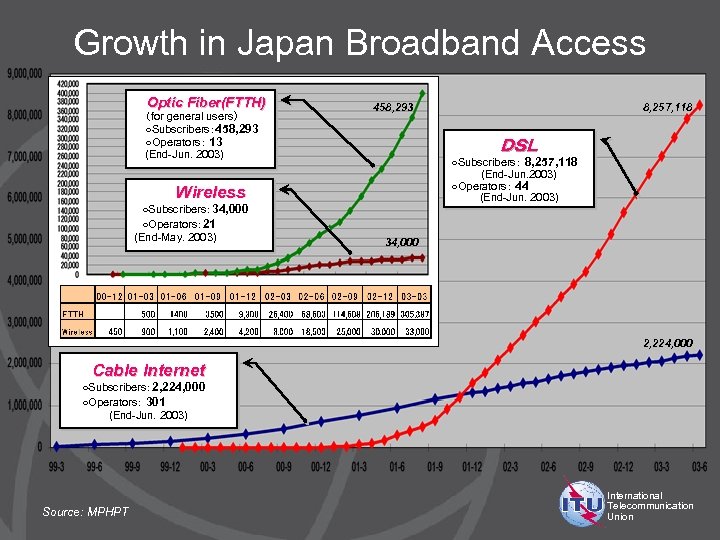
Growth in Japan Broadband Access Optic Fiber(FTTH) (for general users) ○Subscribers: 458, 293 ○Operators: 13 (End-Jun. 2003) 458, 293 DSL ○Subscribers: 8, 257, 118 (End-Jun. 2003) ○Operators: 44 (End-Jun. 2003) Wireless ○Subscribers: 34, 000 ○Operators: 21 (End-May. 2003) 8, 257, 118 34, 000 2, 224, 000 Cable Internet ○Subscribers: 2, 224, 000 ○Operators: 301 (End-Jun. 2003) Source: MPHPT International Telecommunication Union
Japan and VOIP: Market Dynamics • Yahoo!BB bundled Vo. IP with subscriptions allowing free calls to other Yahoo!BB users and cheap calls to regular phones in Japan or internationally • However still had to keep your other phone for incoming calls as there was no way to address/terminate incoming calls • Popularity of VOIP services and requirement to better interconnect PSTN and IP-based services lead to Japan taking unique regulatory approach to numbering plan allocation for IP terminal devices International Telecommunication Union
Japan and VOIP: Policy & Regulatory Reaction • MPHPT decided last year to issue telephone numbers specifically for IP devices (starting with a 050 prefix) – you’ll be able to call a PC in Japan from a telephone • In November 2002, MPHPT handed out ~7 million numbers to ISPs • VOIP Development Consortium in cooperation with MPHPT working to set standards on quality requirements for number allocation, interconnection, tariffs and termination International Telecommunication Union
Korea Country Case Study International Telecommunication Union
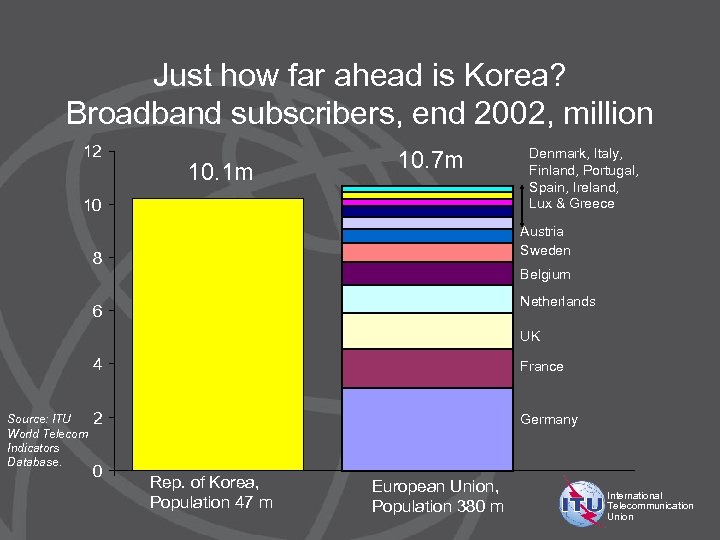
Just how far ahead is Korea? Broadband subscribers, end 2002, million 12 10. 1 m 10. 7 m 10 Denmark, Italy, Finland, Portugal, Spain, Ireland, Lux & Greece Austria Sweden 8 Belgium Netherlands 6 UK 4 Source: ITU World Telecom Indicators Database. France 2 Germany 0 Rep. of Korea, Population 47 m European Union, Population 380 m International Telecommunication Union
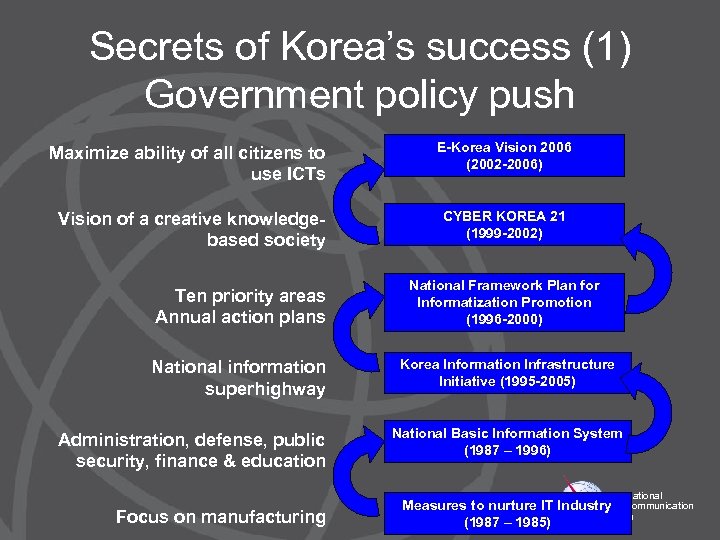
Secrets of Korea’s success (1) Government policy push Maximize ability of all citizens to use ICTs Vision of a creative knowledgebased society E-Korea Vision 2006 (2002 -2006) CYBER KOREA 21 (1999 -2002) Ten priority areas Annual action plans National Framework Plan for Informatization Promotion (1996 -2000) National information superhighway Korea Information Infrastructure Initiative (1995 -2005) Administration, defense, public security, finance & education National Basic Information System (1987 – 1996) International Focus on manufacturing Telecommunication Measures to nurture IT Industry Union (1987 – 1985)
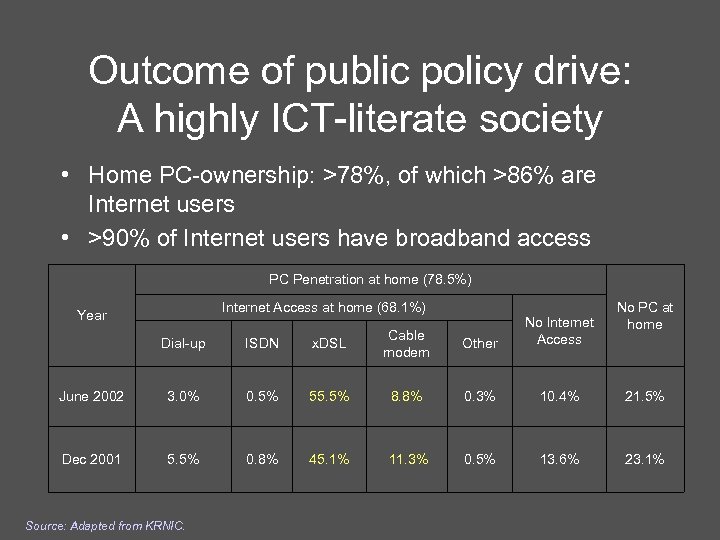
Outcome of public policy drive: A highly ICT-literate society • Home PC-ownership: >78%, of which >86% are Internet users • >90% of Internet users have broadband access PC Penetration at home (78. 5%) Internet Access at home (68. 1%) Year No PC at home Dial-up ISDN x. DSL Cable modem Other No Internet Access June 2002 3. 0% 0. 5% 55. 5% 8. 8% 0. 3% 10. 4% 21. 5% Dec 2001 5. 5% 0. 8% 45. 1% 11. 3% 0. 5% 13. 6% 23. 1% Source: Adapted from KRNIC.
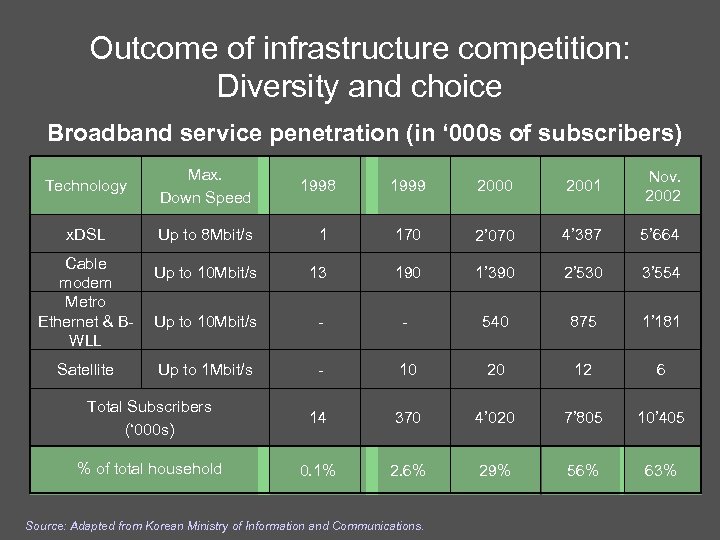
Outcome of infrastructure competition: Diversity and choice Broadband service penetration (in ‘ 000 s of subscribers) Technology Max. Down Speed x. DSL Up to 8 Mbit/s 1999 2000 2001 Nov. 2002 1 170 2’ 070 4’ 387 5’ 664 Up to 10 Mbit/s 13 190 1’ 390 2’ 530 3’ 554 Up to 10 Mbit/s - - 540 875 1’ 181 Up to 1 Mbit/s - 10 20 12 6 Total Subscribers (‘ 000 s) 14 370 4’ 020 7’ 805 10’ 405 % of total household 0. 1% 2. 6% 29% 56% 63% Cable modem Metro Ethernet & BWLL Satellite 1998 Source: Adapted from Korean Ministry of Information and Communications.
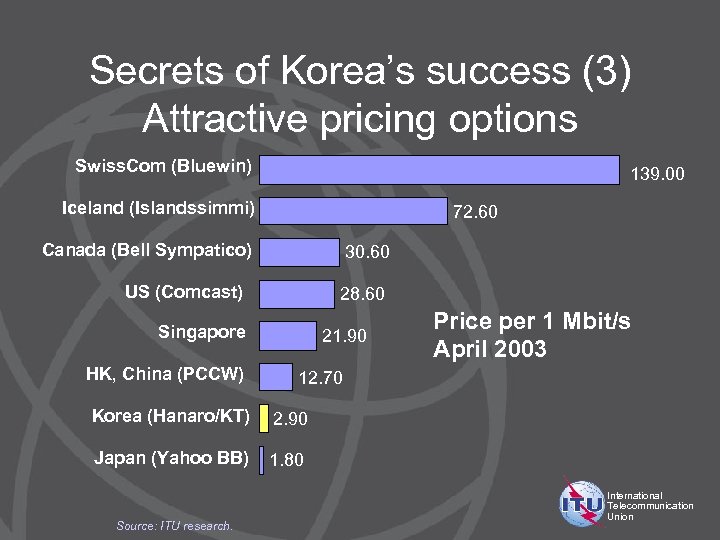
Secrets of Korea’s success (3) Attractive pricing options Swiss. Com (Bluewin) 139. 00 Iceland (Islandssimmi) 72. 60 Canada (Bell Sympatico) 30. 60 US (Comcast) 28. 60 Singapore HK, China (PCCW) 21. 90 Price per 1 Mbit/s April 2003 12. 70 Korea (Hanaro/KT) 2. 90 Japan (Yahoo BB) 1. 80 Source: ITU research. International Telecommunication Union
More secrets of Korea’s success • Emphasis on education – Broadband seen as family investment in education • Highly-urbanized population – 80% living in urbanized areas – 48% of housing stock is apartment blocks • Favourable regulatory environment – Local loop unbundling – Government support for facilities-based competition • Local manufacturing and local content – Emphasis on R&D – High performance IP backbone – Korean content (e. g. , DAUM portal) and games • Government support – Spectrum fees and other remain within sector International Telecommunication Union

Some Conclusions International Telecommunication Union
Is Broadband a “Human Interconnectivity Innovation”? • Early lessons from leading economies like Korea and Japan suggest yes: – Create linkages and networks that bring together people, markets, goods or even entire societies: Yes – Ultimately become items of mass consumption, available to all classes of society: Yes – Becomes available everywhere needed: Yes – Price falling rapidly and continuously: Yes – In each case a significant capital investment in infrastructure is required ahead of mass adoption: Yes – Spread often driven by a breakthrough application: VOIP (Japan) International Telecommunication Union
What does work • Government policy initiatives to maximize ability of all citizens to use ICTs • High level commitment to policies aimed at promoting competition – – Independent regulator Facilities-based competition: Korea, Canada Unbundling & line sharing: Denmark, Iceland, Japan Cable divestiture by incumbent telecommunication carriers: Netherlands & Switzerland – Ensuring spectrum is available for innovative solutions • Competition drives higher speeds – Belgium, Korea and Japan • Flat rate and affordable pricing International Telecommunication Union
What doesn’t work • Monopolies • Telco ownership of cable networks • Technologies that require high installation costs (truck rolls) • High and/or Metered Pricing – Australia and New Zealand experiences suggest users do not like download caps (e. g. 500 Mbytes) or metered pricing as they limit use of streaming media • Low speeds – “If poorly understood, consumers may be seriously disappointed when they realise that although they had been promised high-speed Internet access, in practice, it is not much better than dial-up. ” ART-Telecom “Internet, a review of the French market”, March 2003 International Telecommunication Union
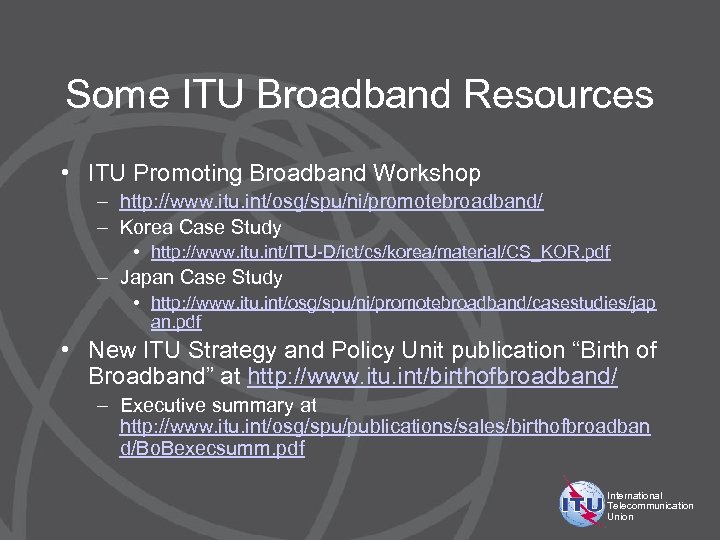
Some ITU Broadband Resources • ITU Promoting Broadband Workshop – http: //www. itu. int/osg/spu/ni/promotebroadband/ – Korea Case Study • http: //www. itu. int/ITU-D/ict/cs/korea/material/CS_KOR. pdf – Japan Case Study • http: //www. itu. int/osg/spu/ni/promotebroadband/casestudies/jap an. pdf • New ITU Strategy and Policy Unit publication “Birth of Broadband” at http: //www. itu. int/birthofbroadband/ – Executive summary at http: //www. itu. int/osg/spu/publications/sales/birthofbroadban d/Bo. Bexecsumm. pdf International Telecommunication Union
Thank you International Telecommunication Union Helping the world communicate International Telecommunication Union
Скачать презентацию Birth of Broadband IP Symposium for CEE CIS
e6660b3737ee9dba9faa6ca4c3b53079.ppt