


BIPS C O M P U T A T I O N A L R E S E A R C H D I V I S I O Communication Analysis of Ultrascale Applications using IPM Shoaib Kamil, Leonid Oliker, John Shalf, David Skinner NERSC/CRD jshalf@lbl. gov DOE, NSA Review, July 19 -20, 2005 N
Overview BIPS • CPU clock scaling bonanza has ended – – • Heat density New physics below 90 nm (departure from bulk material properties) Yet, by end of decade mission critical applications expected to have 100 X computational demands of current levels (PITAC Report, Feb 1999) • The path forward for high end computing is increasingly reliant on massive parallelism – – • Petascale platforms will likely have hundreds of thousands of processors System costs and performance may soon be dominated by interconnect What kind of an interconnect is required for a >100 k processor system? – – – What topological requirements? (fully connected, mesh) Bandwidth/Latency characteristics? Specialized support for collective communications?
Questions (How do we determine appropriate interconnect requirements? ) BIPS • Topology: will the apps inform us what kind of topology to use? – – – Crossbars: Not scalable Fat-Trees: Cost scales superlinearly with number of processors Lower Degree Interconnects: (n-Dim Mesh, Torus, Hypercube, Cayley) • Costs scale linearly with number of processors • Problems with application mapping/scheduling fault tolerance • Bandwidth/Latency/Overhead – – Which is most important? (trick question: they are intimately connected) Requirements for a “balanced” machine? (eg. performance is not dominated by communication costs) • Collectives – – – How important/what type? Do they deserve a dedicated interconnect? Should we put floating point hardware into the NIC?
BIPS Approach • Identify candidate set of “Ultrascale Applications” that span scientific disciplines – Applications demanding enough to require Ultrascale computing resources – Applications that are capable of scaling up to hundreds of thousands of processors – Not every app is “Ultrascale!” • Find communication profiling methodology that is – Scalable: Need to be able to run for a long time with many processors. Traces are too large – Non-invasive: Some of these codes are large and can be difficult to instrument even using automated tools – Low-impact on performance: Full scale apps… not proxies!
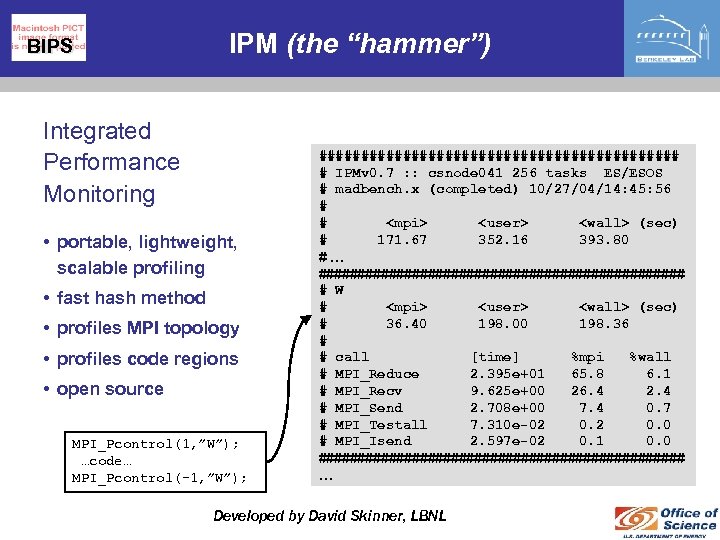
BIPS IPM (the “hammer”) Integrated Performance Monitoring • portable, lightweight, scalable profiling • fast hash method • profiles MPI topology • profiles code regions • open source MPI_Pcontrol(1, ”W”); …code… MPI_Pcontrol(-1, ”W”); ###################### # IPMv 0. 7 : : csnode 041 256 tasks ES/ESOS # madbench. x (completed) 10/27/04/14: 45: 56 # # <mpi> <user> <wall> (sec) # 171. 67 352. 16 393. 80 #… ######################## # W # <mpi> <user> <wall> (sec) # 36. 40 198. 00 198. 36 # # call [time] %mpi %wall # MPI_Reduce 2. 395 e+01 65. 8 6. 1 # MPI_Recv 9. 625 e+00 26. 4 2. 4 # MPI_Send 2. 708 e+00 7. 4 0. 7 # MPI_Testall 7. 310 e-02 0. 0 # MPI_Isend 2. 597 e-02 0. 1 0. 0 ######################## … Developed by David Skinner, LBNL
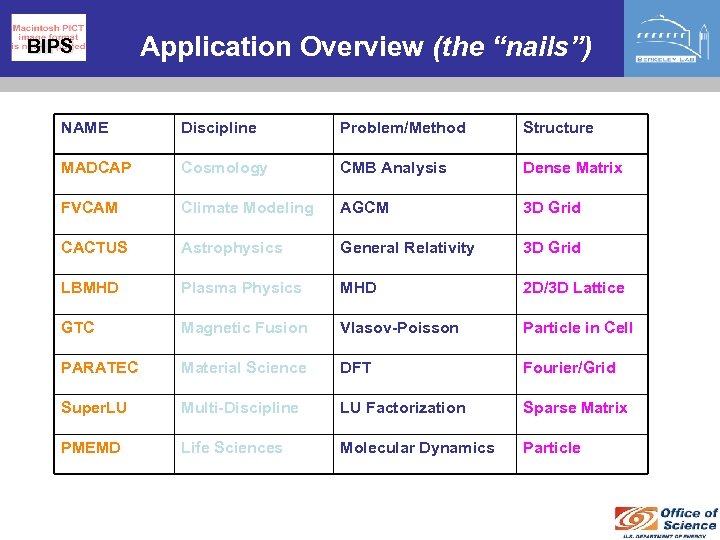
BIPS Application Overview (the “nails”) NAME Discipline Problem/Method Structure MADCAP Cosmology CMB Analysis Dense Matrix FVCAM Climate Modeling AGCM 3 D Grid CACTUS Astrophysics General Relativity 3 D Grid LBMHD Plasma Physics MHD 2 D/3 D Lattice GTC Magnetic Fusion Vlasov-Poisson Particle in Cell PARATEC Material Science DFT Fourier/Grid Super. LU Multi-Discipline LU Factorization Sparse Matrix PMEMD Life Sciences Molecular Dynamics Particle
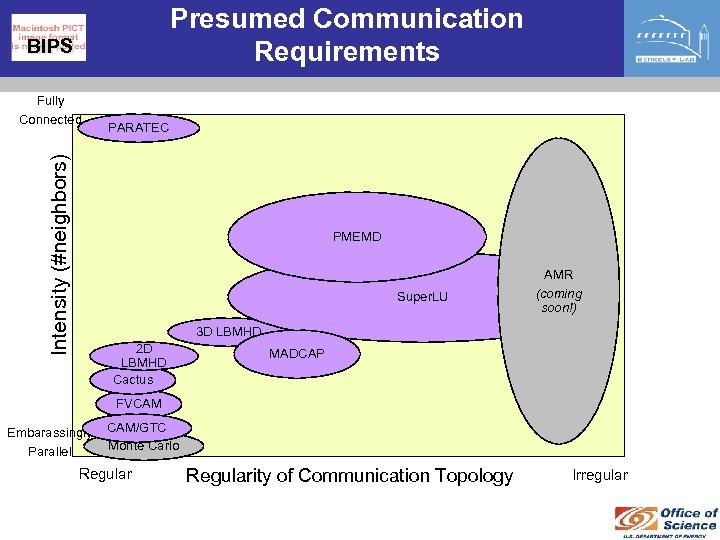
Presumed Communication Requirements BIPS Intensity (#neighbors) Fully Connected PARATEC PMEMD Super. LU AMR (coming soon!) 3 D LBMHD 2 D LBMHD Cactus MADCAP FVCAM Embarassingly Parallel CAM/GTC Monte Carlo Regularity of Communication Topology Irregular
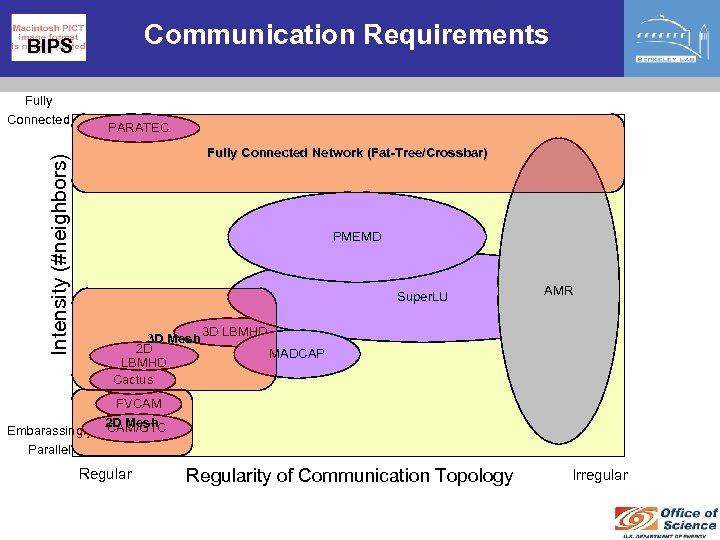
Communication Requirements BIPS Fully Connected PARATEC Intensity (#neighbors) Fully Connected Network (Fat-Tree/Crossbar) PMEMD Super. LU 3 D Mesh 2 D LBMHD Cactus Embarassingly Parallel AMR 3 D LBMHD MADCAP FVCAM 2 D Mesh CAM/GTC Regularity of Communication Topology Irregular
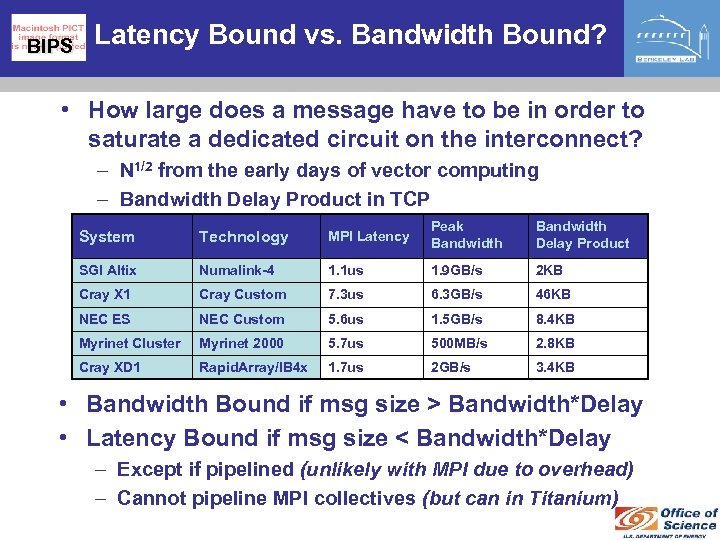
BIPS Latency Bound vs. Bandwidth Bound? • How large does a message have to be in order to saturate a dedicated circuit on the interconnect? – N 1/2 from the early days of vector computing – Bandwidth Delay Product in TCP System Technology MPI Latency Peak Bandwidth Delay Product SGI Altix Numalink-4 1. 1 us 1. 9 GB/s 2 KB Cray X 1 Cray Custom 7. 3 us 6. 3 GB/s 46 KB NEC ES NEC Custom 5. 6 us 1. 5 GB/s 8. 4 KB Myrinet Cluster Myrinet 2000 5. 7 us 500 MB/s 2. 8 KB Cray XD 1 Rapid. Array/IB 4 x 1. 7 us 2 GB/s 3. 4 KB • Bandwidth Bound if msg size > Bandwidth*Delay • Latency Bound if msg size < Bandwidth*Delay – Except if pipelined (unlikely with MPI due to overhead) – Cannot pipeline MPI collectives (but can in Titanium)
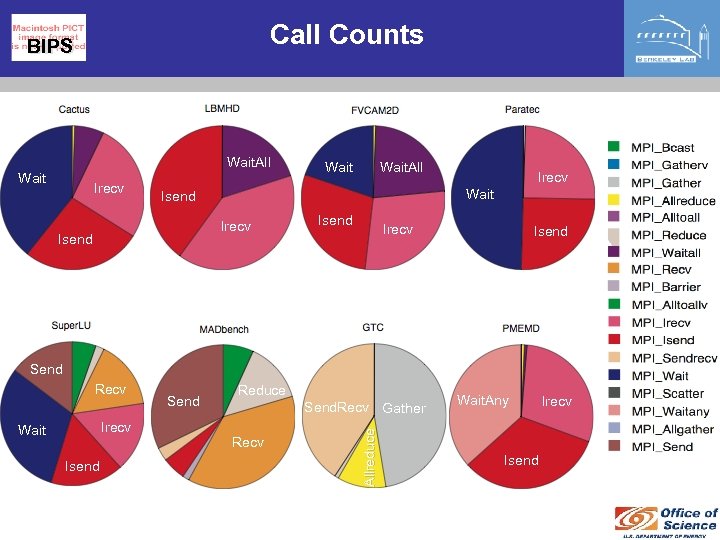
Call Counts BIPS Wait. All Wait Irecv Wait. All Wait Isend Irecv Isend Send Irecv Wait Isend Send Reduce Send. Recv Gather Recv Allreduce Recv Wait. Any Isend Irecv
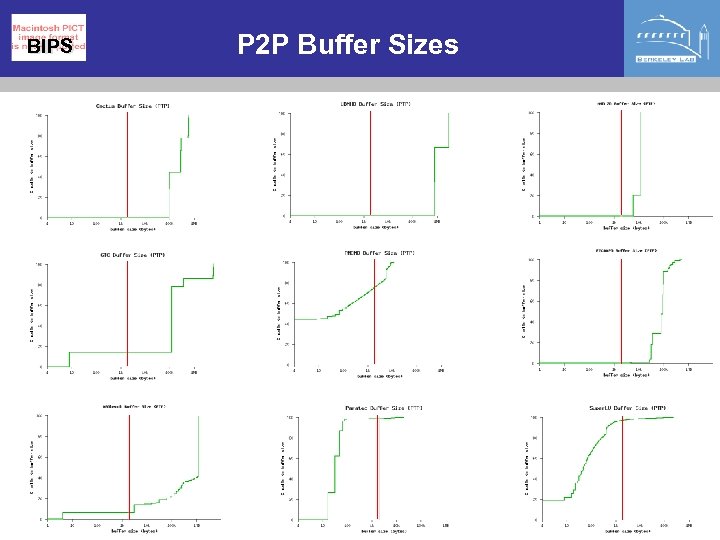
BIPS P 2 P Buffer Sizes
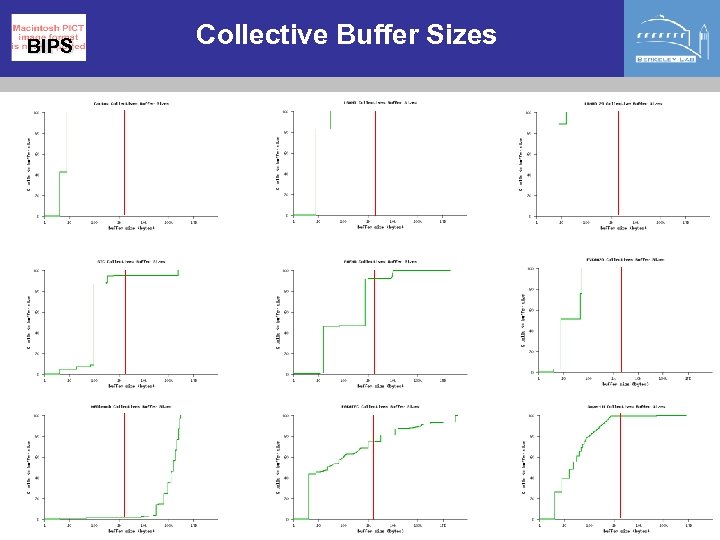
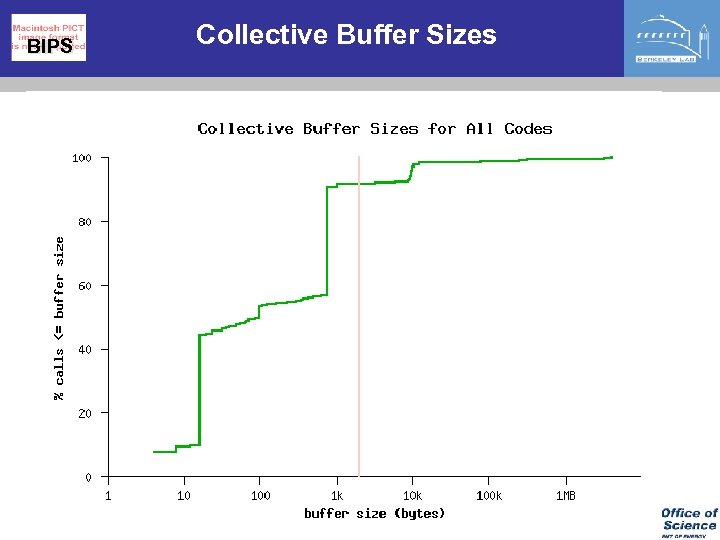
BIPS Collective Buffer Sizes
BIPS Collective Buffer Sizes
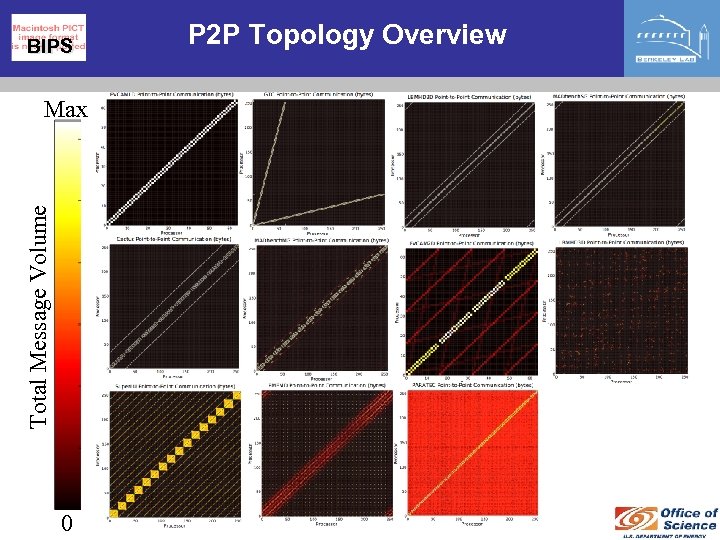
BIPS Total Message Volume Max 0 P 2 P Topology Overview
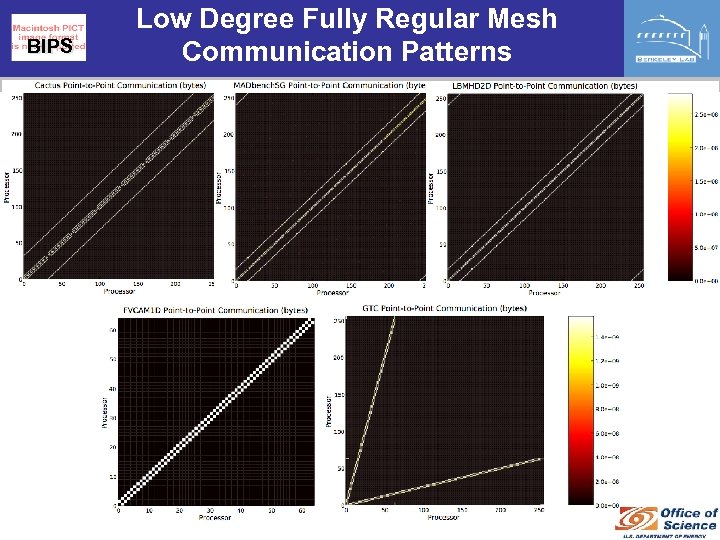
BIPS Low Degree Fully Regular Mesh Communication Patterns
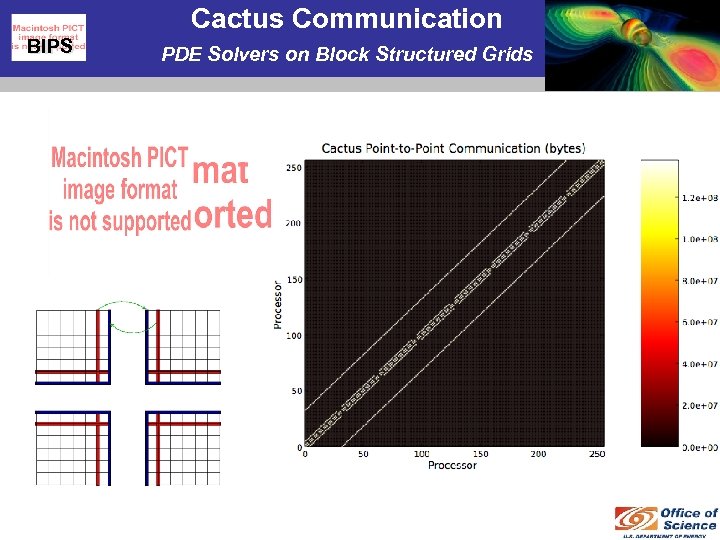
Cactus Communication BIPS PDE Solvers on Block Structured Grids
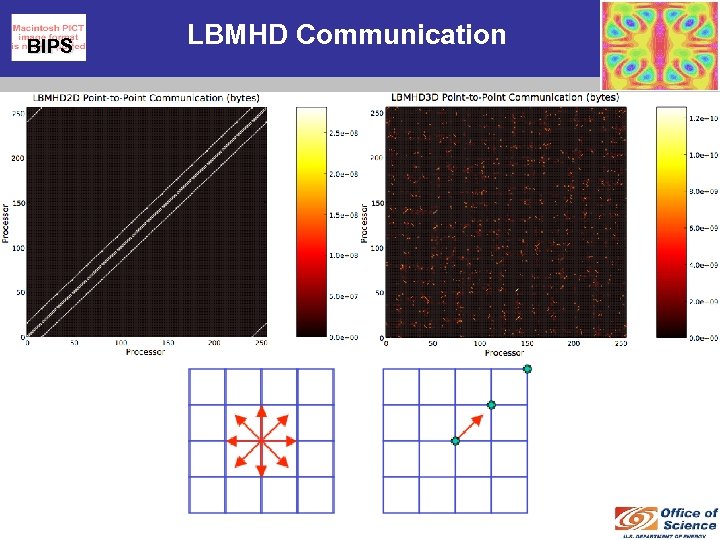
BIPS LBMHD Communication
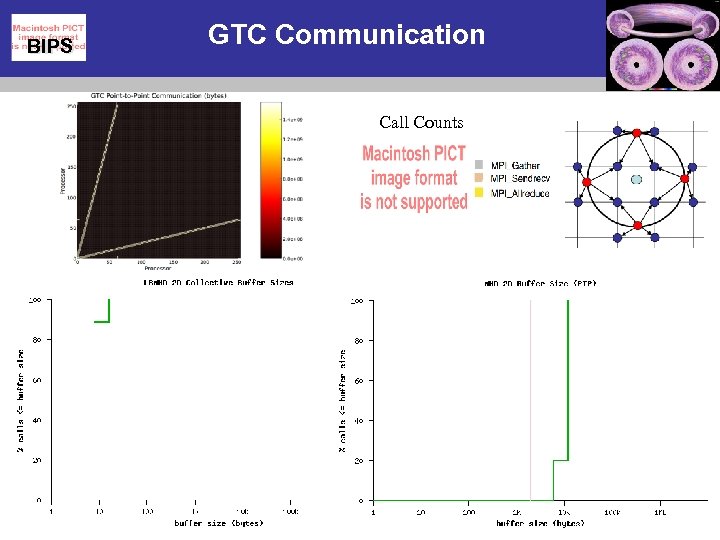
BIPS GTC Communication Call Counts
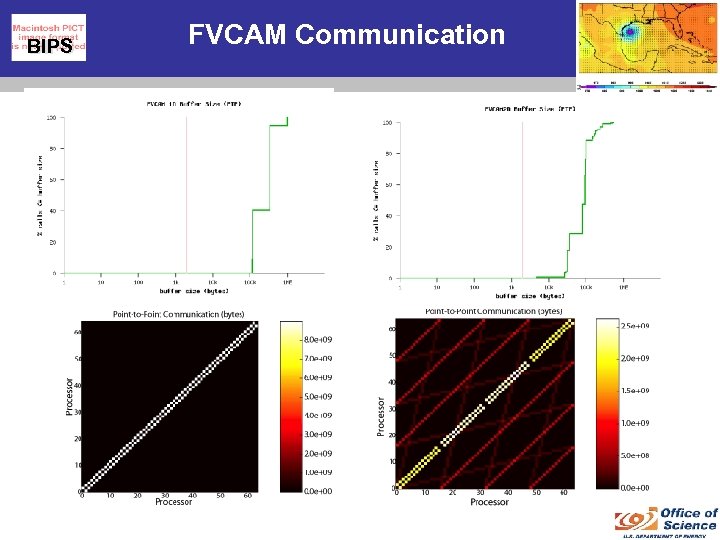
BIPS FVCAM Communication
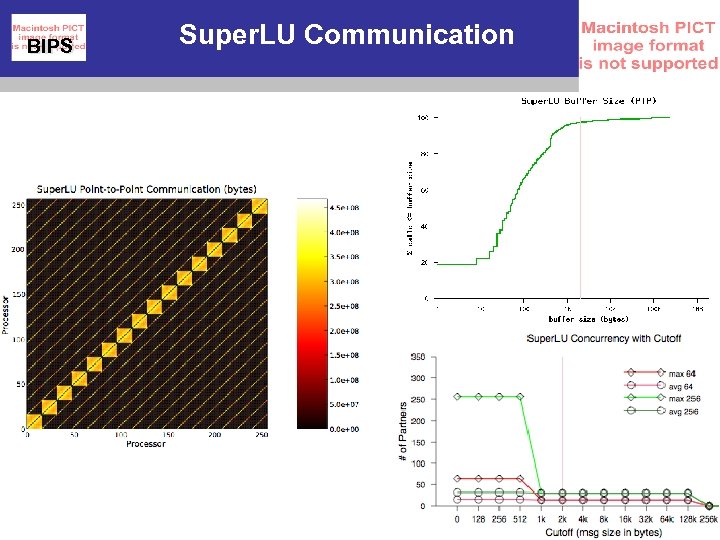
BIPS Super. LU Communication
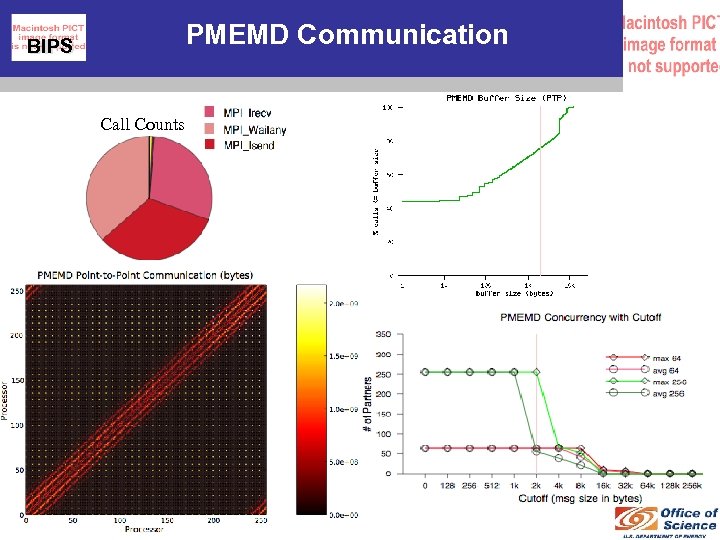
PMEMD Communication BIPS Call Counts
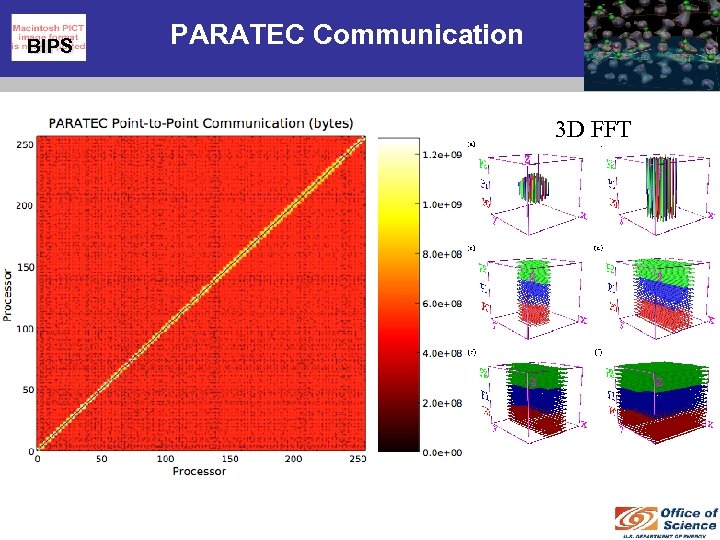
BIPS PARATEC Communication 3 D FFT
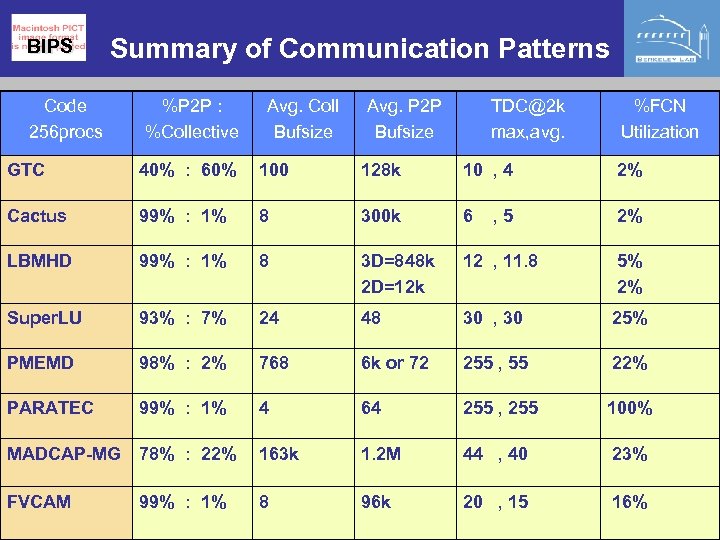
BIPS Summary of Communication Patterns Code 256 procs %P 2 P : %Collective Avg. Coll Bufsize Avg. P 2 P Bufsize TDC@2 k max, avg. %FCN Utilization GTC 40% : 60% 100 128 k 10 , 4 2% Cactus 99% : 1% 8 300 k 6 , 5 2% LBMHD 99% : 1% 8 3 D=848 k 2 D=12 k 12 , 11. 8 5% 2% Super. LU 93% : 7% 24 48 30 , 30 25% PMEMD 98% : 2% 768 6 k or 72 255 , 55 22% PARATEC 99% : 1% 4 64 255 , 255 100% MADCAP-MG 78% : 22% 163 k 1. 2 M 44 , 40 23% FVCAM 99% : 1% 8 96 k 20 , 15 16%
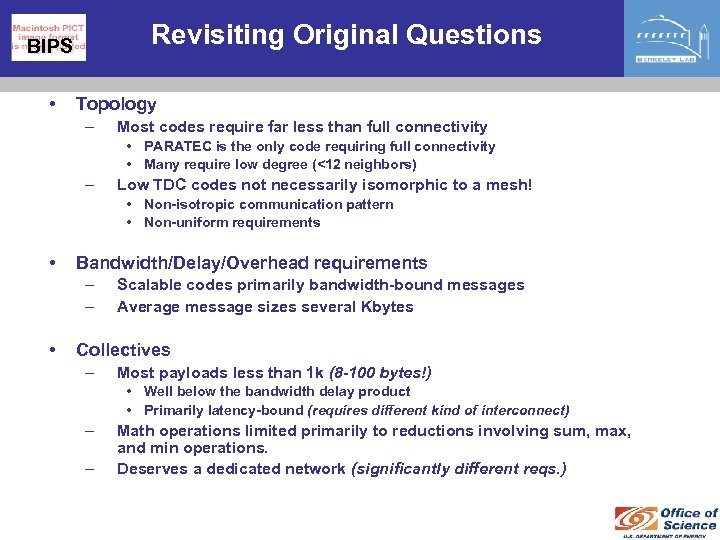
Revisiting Original Questions BIPS • Topology – Most codes require far less than full connectivity • PARATEC is the only code requiring full connectivity • Many require low degree (<12 neighbors) – Low TDC codes not necessarily isomorphic to a mesh! • Non-isotropic communication pattern • Non-uniform requirements • Bandwidth/Delay/Overhead requirements – – • Scalable codes primarily bandwidth-bound messages Average message sizes several Kbytes Collectives – Most payloads less than 1 k (8 -100 bytes!) • Well below the bandwidth delay product • Primarily latency-bound (requires different kind of interconnect) – – Math operations limited primarily to reductions involving sum, max, and min operations. Deserves a dedicated network (significantly different reqs. )
BIPS Whats Next? • What does the data tell us to do? – P 2 P: Focus on messages that are bandwidth-bound (eg. larger than bandwidth-delay product) • Switch Latency=50 ns • Propagation Delay = 5 ns/meter propagation delay • End-to-End Latency = 1000 -1500 ns for the very best interconnects! Shunt collectives to their own tree network (BG/L) – – Route latency-bound messages along non-dedicated links (multiple hops) or alternate network (just like collectives) – Try to assign a direct/dedicated link to each of the distinct destinations that a process communicates with
BIPS Conundrum • Can’t afford to continue with Fat-trees or other Fully-Connected Networks (FCNs) • Can’t map many Ultrascale applications to lower degree networks like meshes, hypercubes or torii • How can we wire up a custom interconnect topology for each application?
BIPS Switch Technology • Packet Switch: – Read each packet header and decide where it should go fast! – Requires expensive ASICs for line-rate switching decisions – Optical Transceivers Force 10 E 1200 1260 x 1 Gig. E 56 x 10 Gig. E • Circuit Switch: – Establishes direct circuit from point-topoint (telephone switchboard) – Commodity MEMS optical circuit switch • Common in telecomm industry • Scalable to large crossbars – Slow switching (~100 microseconds) 400 x 400 l 1 -40 Gig. E Movaz i. WSS – Blind to message boundaries
BIPS A Hybrid Approach to Interconnects HFAST • Hybrid Flexibly Assignable Switch Topology (HFAST) – Use optical circuit switches to create custom interconnect topology for each application as it runs (adaptive topology) – Why? Because circuit switches are • Cheaper: Much simpler, passive components • Scalable: Already available in large crossbar configurations • Allow non-uniform assignment of switching resources – GMPLS manages changes to packet routing tables in tandem with circuit switch reconfigurations
BIPS HFAST • HFAST Solves Some Sticky Issues with Other Low. Degree Networks – Fault Tolerance: 100 k processors… 800 k links between them using a 3 D mesh (probability of failures? ) – Job Scheduling: Finding right sized slot – Job Packing: n-Dimensional Tetris… – Handles apps with low comm degree but not isomorphic to a mesh or nonuniform requirements • How/When to Assign Topology? – Job Submit Time: Put topology hints in batch script (BG/L, RS) – Runtime: Provision mesh topology and monitor with IPM. Then – – use data to reconfigure circuit switch during barrier. Runtime: Pay attention to MPI Topology directives (if used) Compile Time: Code analysis and/or instrumentation using UPC, CAF or Titanium.
BIPS HFAST Outstanding Issues Mapping Complexity • Simple linear-time algorithm works well with low TDC but not for TDC > packet switch block size. • Use clique-mapping to improve switch port utilization efficiency – The general solution is NP-complete – Bounded clique size creates an upper-bound that is < NP-complete, but still potentially very large – Examining good “heuristics” and solutions to restricted cases for mapping that completes within our lifetime • Hot-spot monitoring – Gradually adjust topology to remove hot-spots – Similar to port-mapper problem for source-routed interconnects like Myrinet
Conclusions/Future Work? BIPS • Not currently funded – – • Expansion of IPM studies – – • Outgrowth of Lenny’s vector evaluation work Future work == getting funding to do future work! More DOE codes (eg. AMR: Cactus/SAMARAI, Chombo, Enzo) Temporal changes in communication patterns (AMR examples) More architectures (Comparative study like Vector Evaluation project) Put results in context of real DOE workload analysis HFAST – – – • Performance prediction using discrete event simulation Cost Analysis (price out the parts for mock-up and compare to equivalent fat. Time domain switching studies (eg. how do we deal with PARATEC? ) tree or torus) Probes – – Use results to create proxy applications/probes Apply to HPCC benchmarks (generates more realistic communication patterns than the “randomly ordered rings” without complexity of the full application code)
