 Скачать презентацию Biotechnology Workforce An Overview Russ Read Executive
6e3d36d34ec38d2cf78f6b0d09d0be1a.ppt
- Количество слайдов: 28



Biotechnology Workforce – An Overview Russ Read, Executive Director National Center Biotechnology Workforce Forsyth Technical Community College AURP - November 3, 2005
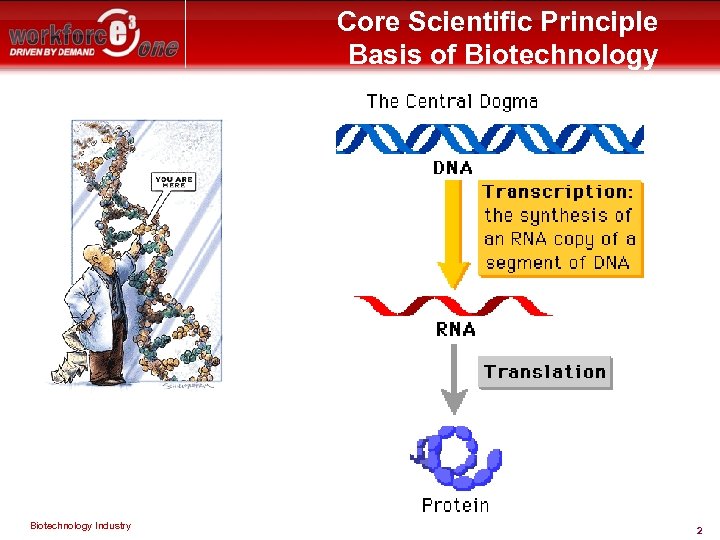
Core Scientific Principle Basis of Biotechnology Industry 2
Objectives § Industry Sectors & General Overview § Skills & Education Required Within the Industry § Demand-Driven Workforce Solutions Biotechnology Industry 3
Biotechnology Industry Characteristics § Small § Highly Regulated § Young and Still Developing Biotechnology Industry 4
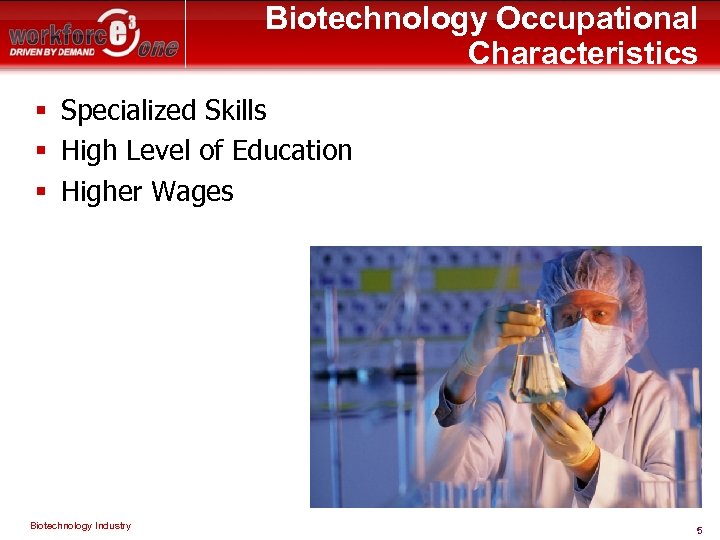
Biotechnology Occupational Characteristics § Specialized Skills § High Level of Education § Higher Wages Biotechnology Industry 5
Workforce Challenges § Pipeline Development – Recruitment – Retention § Skills Competencies & Training – Competencies & Career Ladders – Mapping to Other Industries § Image & Outreach to the Public – Data & Definition – Image Biotechnology Industry 6
Workforce Solutions Examples § Pipeline – Recruitment & Retention – Provide students & faculty with opportunities such as job shadowing, mentoring, industry speakers, career clubs, etc. – Create flexible, short-term training options to keep up with ongoing industry training. – Create a system for continuous skills-upgrade training, career enhancement, and career ladders and lattices. § Skill Competencies & Training – Create a map & matrix of existing competencies and models, assess gaps, and validate/update regularly. – Develop models with incentives for K-12 institutions to work with college and corporate partners. Biotechnology Industry 7
Long & Short-Term Solutions § Community Colleges Hold the Key Biotechnology Industry 8
Opportunities § With each new industry breakthrough and advancement comes new jobs. Biotechnology Industry 9
Regional Partnerships & Collaboration § Know what resources exist within your region. Biotechnology Industry 10
Employment Projections 2002 -12 § Industry – Scientific research, development & technical services: 70% – Pharmaceutical & medical manufacturing: 23% § Occupations – Life, physical & social scientists: 17% – Biological scientists: 19% – Biological technicians: 19% Biotechnology Industry 11
Introduction: Biotechnology Community College Training Programs § Demand (or workforce) driven § Fulfill local workforce needs § Training requirement varies to locale Biotechnology Industry 12
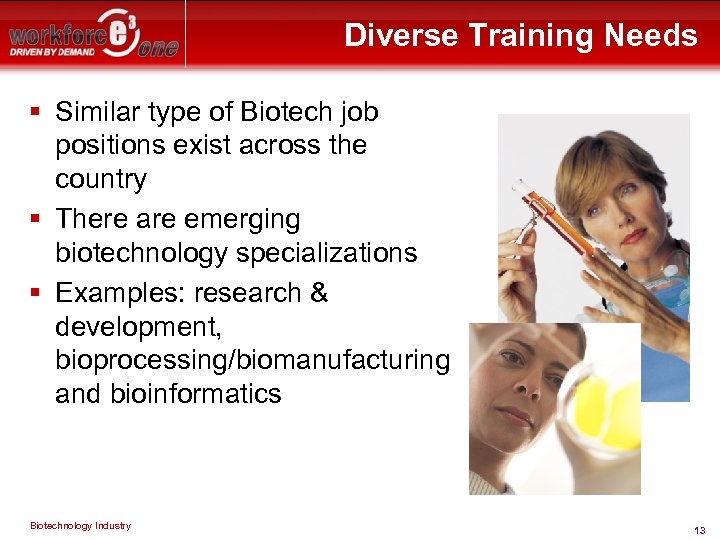
Diverse Training Needs § Similar type of Biotech job positions exist across the country § There are emerging biotechnology specializations § Examples: research & development, bioprocessing/biomanufacturing and bioinformatics Biotechnology Industry 13
Diverse Communities § Agricultural biotechnology - rural clusters § Manufacturing - Biomanufacturing/ bioprocessing § Informatics - life science applications linked to software/ IT clusters § Research & Development – adjacent to universities with biotechnology / biomedical research focus Biotechnology Industry 14
Skills/Education Requirements Biotechnology Discovery Research Technician or Assistant § Description: – Perform research tasks & experiments – Analyze & interpret data – Write experimental protocols, reports, & summaries – Handle & purchase lab equipment and supplies § Entry- Level Position: – Associate degree in science with related experience with annual salary of $25, 000+ § Other Positions: – R&D positions linked to bioinformatics Biotechnology Industry 15
Skills/Education Bioinformatics Associate § Description: – Store, retrieve & analyze biological information such as DNA and protein sequences – Run data analysis programs & data mining on public gene databases – Work closely with research scientists to prepare software design specifications – Routinely use Linux, Oracle or Access database programs and Perl or Java language § Entry-Level Position: – B. S. in life science field with lab experience and 0 -2 years computer science experience – A. S. in computer science with biotechnology lab and bioinformatics certificates Biotechnology Industry 16
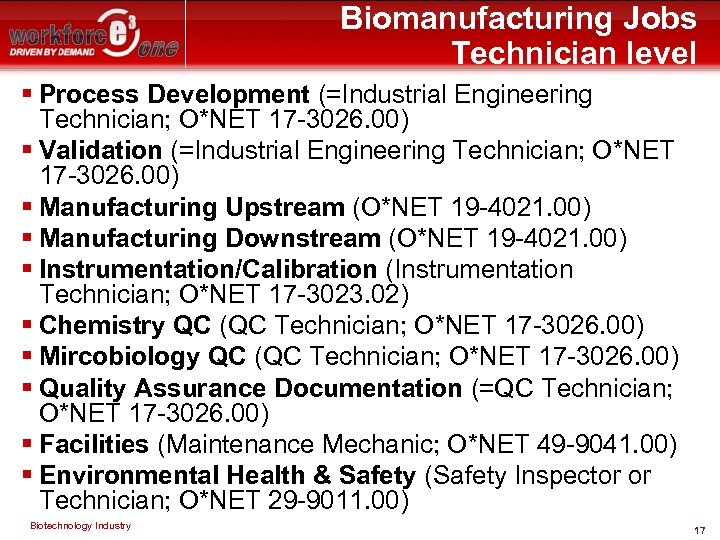
Biomanufacturing Jobs Technician level § Process Development (=Industrial Engineering Technician; O*NET 17 -3026. 00) § Validation (=Industrial Engineering Technician; O*NET 17 -3026. 00) § Manufacturing Upstream (O*NET 19 -4021. 00) § Manufacturing Downstream (O*NET 19 -4021. 00) § Instrumentation/Calibration (Instrumentation Technician; O*NET 17 -3023. 02) § Chemistry QC (QC Technician; O*NET 17 -3026. 00) § Mircobiology QC (QC Technician; O*NET 17 -3026. 00) § Quality Assurance Documentation (=QC Technician; O*NET 17 -3026. 00) § Facilities (Maintenance Mechanic; O*NET 49 -9041. 00) § Environmental Health & Safety (Safety Inspector or Technician; O*NET 29 -9011. 00) Biotechnology Industry 17
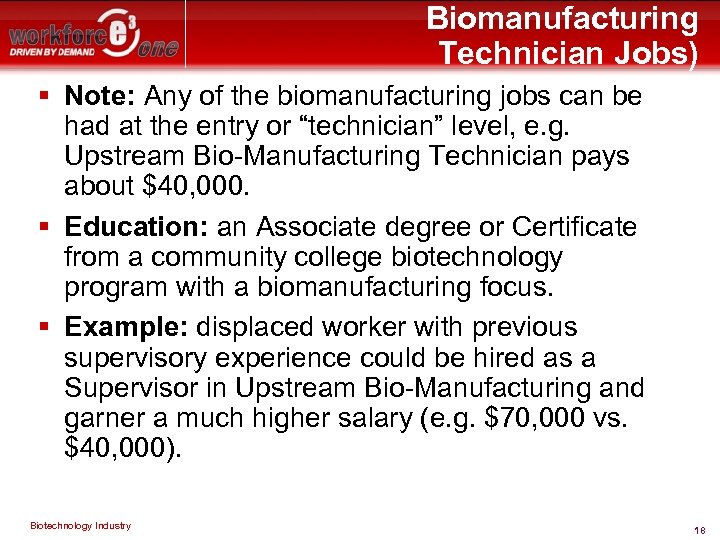
Biomanufacturing Technician Jobs) § Note: Any of the biomanufacturing jobs can be had at the entry or “technician” level, e. g. Upstream Bio-Manufacturing Technician pays about $40, 000. § Education: an Associate degree or Certificate from a community college biotechnology program with a biomanufacturing focus. § Example: displaced worker with previous supervisory experience could be hired as a Supervisor in Upstream Bio-Manufacturing and garner a much higher salary (e. g. $70, 000 vs. $40, 000). Biotechnology Industry 18
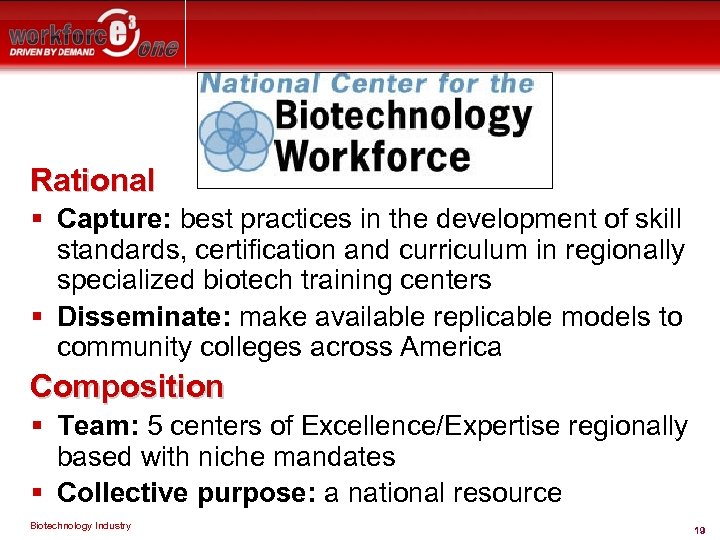
Rational § Capture: best practices in the development of skill standards, certification and curriculum in regionally specialized biotech training centers § Disseminate: make available replicable models to community colleges across America Composition § Team: 5 centers of Excellence/Expertise regionally based with niche mandates § Collective purpose: a national resource Biotechnology Industry 19
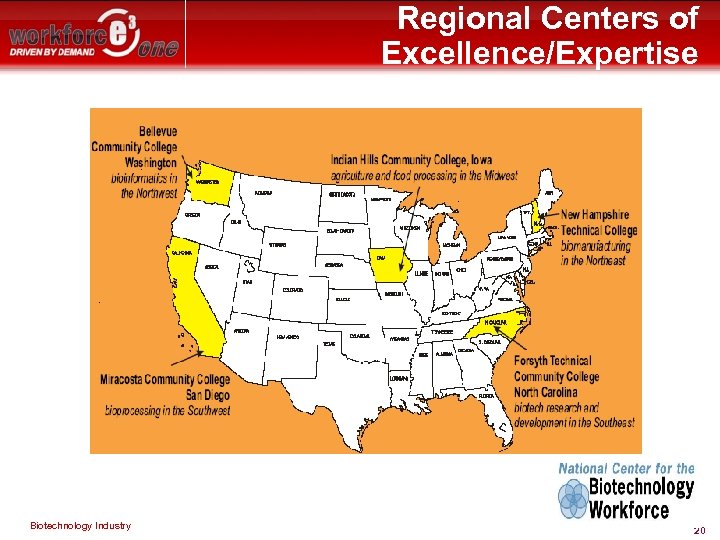
Regional Centers of Excellence/Expertise Biotechnology Industry 20
Problem/Solutions/Products § Bellevue CC retrains displaced workers from IT layoffs to become in demand Life Science Informatics specialist –process, skill requirements, job descriptions & curriculum available § Forsyth Tech CC ( 3 years old, largest BT Training program in NC) retrains displaced workers of manufacturing lay offs to become needed research lab technicians- curriculum available § Indian Hills CC trains biofermentor technicians to address the increased demands for biofuelscurriculum available Biotechnology Industry 21
Partnerships/Models/Replication § Mira Costa CC develops unique ways of dealing with industry and professional partners- attitude based- create win/ win for community to fulfill the need for trained workers – results in-kind opportunities § New Hampshire CTC works closely with biomanufacturing companies in the Northeast to fulfill their needs for skilled technicians and professionals Biotechnology Industry 22
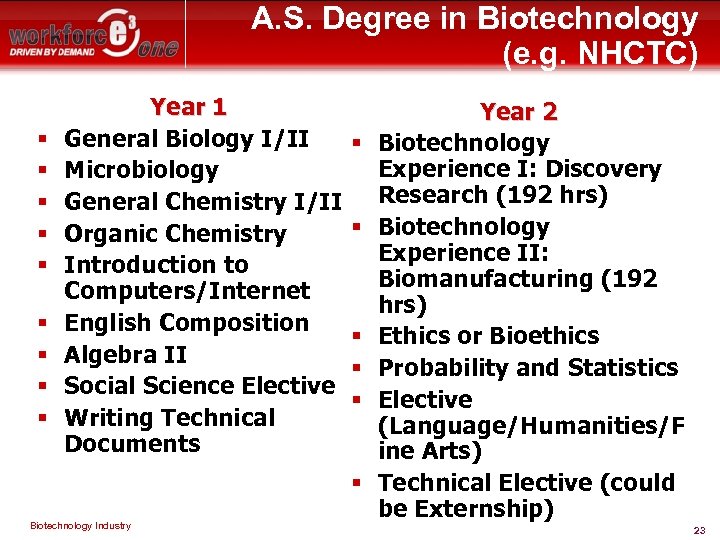
A. S. Degree in Biotechnology (e. g. NHCTC) § § § § § Year 1 General Biology I/II Microbiology General Chemistry I/II Organic Chemistry Introduction to Computers/Internet English Composition Algebra II Social Science Elective Writing Technical Documents § § § Biotechnology Industry Year 2 Biotechnology Experience I: Discovery Research (192 hrs) Biotechnology Experience II: Biomanufacturing (192 hrs) Ethics or Bioethics Probability and Statistics Elective (Language/Humanities/F ine Arts) Technical Elective (could be Externship) 23
E. g. Certificate in Biotechnology § Biotechnology Experience I: Discovery Research (192 hrs) Biotechnology Industry § Biotechnology Experience II: Biomanufacturing (192 hrs) 24
Universality of Biotechnology Curricula § The Bioscience Industry Skill Standards define the skills, knowledge and attributes required for Biotechnology jobs. Published in 1995, they can be found at § http: //www 2. edc. org/bec/standards/gatew ay/Pages%2072 -73. pdf Biotechnology Industry 25
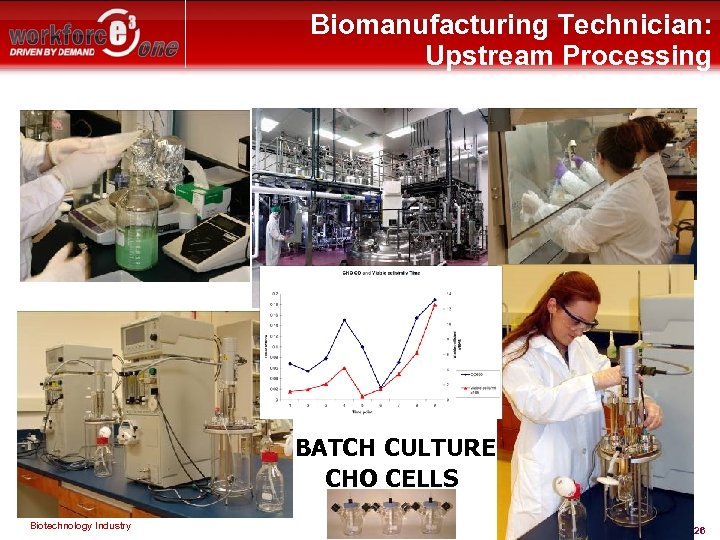
Biomanufacturing Technician: Upstream Processing BATCH CULTURE CHO CELLS Biotechnology Industry 26
Communication Life Science Informatics Bellevue Community College Life Science Informatics Patricia Dombrowski Director, Life Science Informatics pdombrow@bcc. ctc. edu Agriculture & Food Processing Indian Hills Community College Michael Ott Director of Iowa Bio. Development otterm@gmail. com Biomanufacturing New Hampshire Community Technical College Director Sonia Wallman, Ph. D. swallman@nhctc. edu Research and Development Forsyth Tech Dr. Lucas D. Shallua (VMD, Ph. D) Department Chair lshallua@forsythtech. edu Biotechnology Industry Bioprocessing Mira. Costa College Ric Matthews Dean, Math and Sciences rmatthews@miracosta. edu Russ H. Read Executive Director rread@forsythtech. edu 27
For information please visit the following web sites: www. workforce 3 one. org www. biotechworkforce. org Please visit a DOL/ ETA webinar on the Biotechnology Workforce originally broadcast 9/14/05 by connecting to either of these sites Biotechnology Industry 28
Скачать презентацию Biotechnology Workforce An Overview Russ Read Executive
6e3d36d34ec38d2cf78f6b0d09d0be1a.ppt