 Скачать презентацию Biophysics Camp 2006 Introducing Graduate Institute of Systems
1a298c8a582fb679c5f05fdd517b3e71.ppt
- Количество слайдов: 22



Biophysics Camp 2006 Introducing Graduate Institute of Systems Biology & Bioinformatics (Sy. BBi) 系統生物與生物資訊研究所 2006 October 28 Science Building 4, Room 209 National Central University
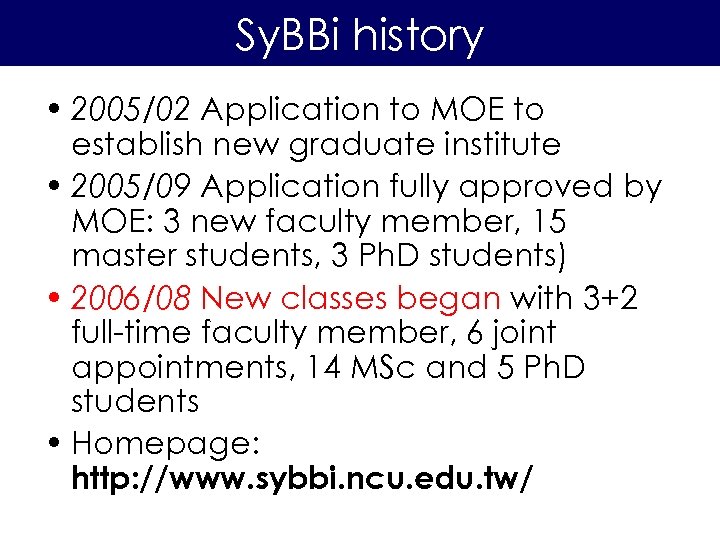
Sy. BBi history • 2005/02 Application to MOE to establish new graduate institute • 2005/09 Application fully approved by MOE: 3 new faculty member, 15 master students, 3 Ph. D students) • 2006/08 New classes began with 3+2 full-time faculty member, 6 joint appointments, 14 MSc and 5 Ph. D students • Homepage: http: //www. sybbi. ncu. edu. tw/
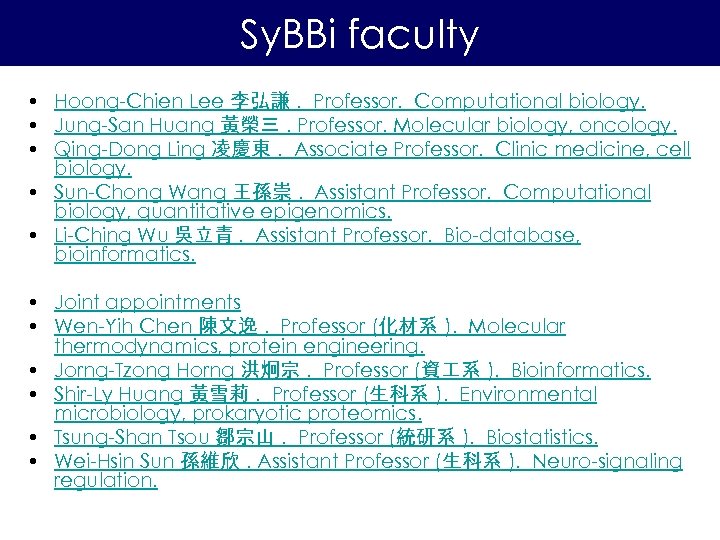
Sy. BBi faculty • Hoong-Chien Lee 李弘謙. Professor. Computational biology. • Jung-San Huang 黃榮三. Professor. Molecular biology, oncology. • Qing-Dong Ling 凌慶東. Associate Professor. Clinic medicine, cell biology. • Sun-Chong Wang 王孫崇. Assistant Professor. Computational biology, quantitative epigenomics. • Li-Ching Wu 吳立青. Assistant Professor. Bio-database, bioinformatics. • Joint appointments • Wen-Yih Chen 陳文逸. Professor (化材系 ). Molecular thermodynamics, protein engineering. • Jorng-Tzong Horng 洪炯宗. Professor (資 系 ). Bioinformatics. • Shir-Ly Huang 黃雪莉. Professor (生科系 ). Environmental microbiology, prokaryotic proteomics. • Tsung-Shan Tsou 鄒宗山. Professor (統研系 ). Biostatistics. • Wei-Hsin Sun 孫維欣. Assistant Professor (生科系 ). Neuro-signaling regulation.
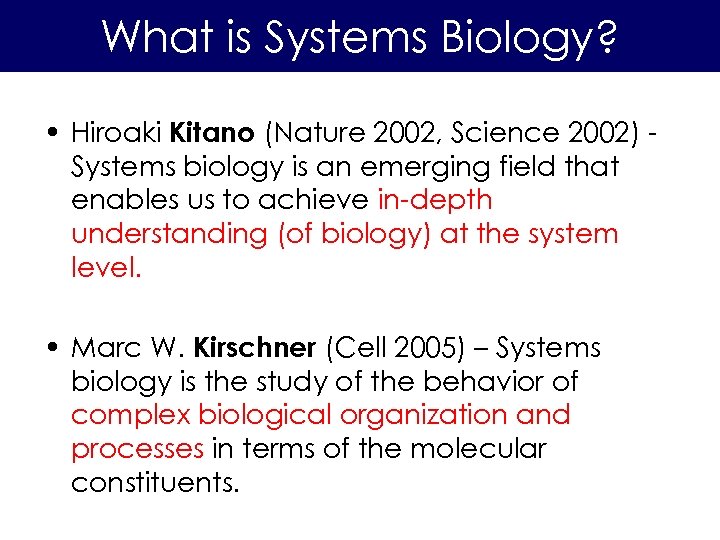
What is Systems Biology? • Hiroaki Kitano (Nature 2002, Science 2002) Systems biology is an emerging field that enables us to achieve in-depth understanding (of biology) at the system level. • Marc W. Kirschner (Cell 2005) – Systems biology is the study of the behavior of complex biological organization and processes in terms of the molecular constituents.
What is Systems Biology? • 系統生物是一項以生物分子為基礎探索複雜 的生物組織與機制在系統層次行為的新興跨 領域學門。他的特徵是用尖端物理 /化學原理 設計的高通量測量儀器(如基因晶片、雷射測 序儀、質譜儀等)取得系統性的生物數據,經 過高速及高容量電腦與先進資料庫技術及演 算法整理之後,依此根據物理及統計原理衍生 對生物系統的假設(或推論),再由該假設推動 系統模型的建立與分析。經過模型行為與生物 數據之對比,再對模型做適當之修正,或產生 新的數據需求。如此反覆回饋,即可望能向以 生物分子為基礎對生物系統的宏觀行為取得 瞭解漸進。 Brief by HCL to NSC Interdisciplinary Panel, 2006/9/13
A historic perspective • The “old fashioned” biology era • The information era (> 1990) • The systems era (> 2000)
The “old fashioned” biology era • Rise of molecular biology 1953 • Single element issues – structure and function proteins & genes • Many, many techniques invented and developed in 2 nd half of 2 oth century
The information era – Human genome project (>1990) led to avalanche of data – Bioinformatics - creation and advancement of algorithms, computational and statistical techniques, management and analysis of biological data. – Computational biology - hypothesis-driven investigation of a specific biological problem using computers towards discovery and the advancement of biological knowledge.
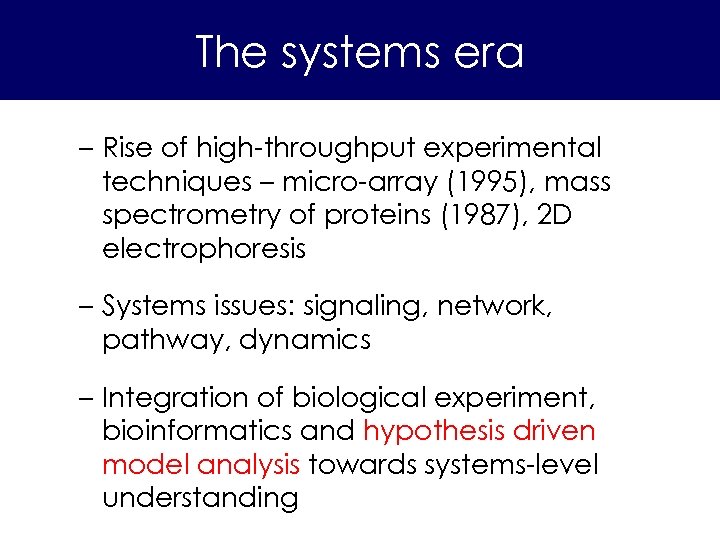
The systems era – Rise of high-throughput experimental techniques – micro-array (1995), mass spectrometry of proteins (1987), 2 D electrophoresis – Systems issues: signaling, network, pathway, dynamics – Integration of biological experiment, bioinformatics and hypothesis driven model analysis towards systems-level understanding
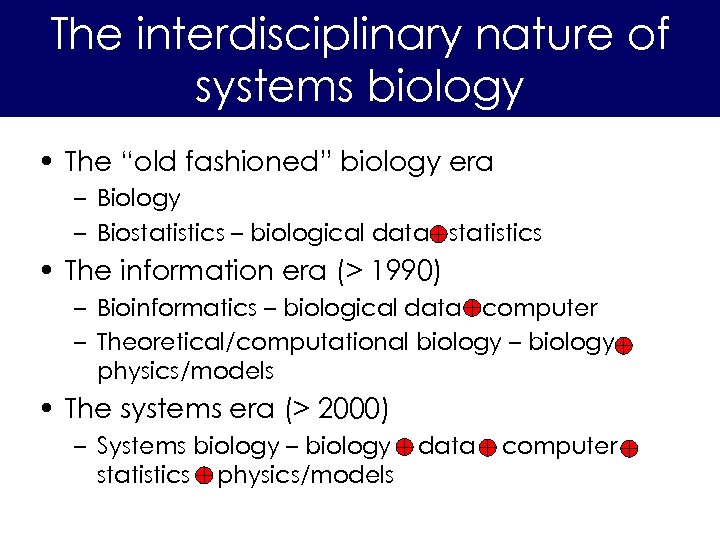
The interdisciplinary nature of systems biology • The “old fashioned” biology era – Biology – Biostatistics – biological data statistics • The information era (> 1990) – Bioinformatics – biological data computer – Theoretical/computational biology – biology physics/models • The systems era (> 2000) – Systems biology – biology data statistics physics/models computer
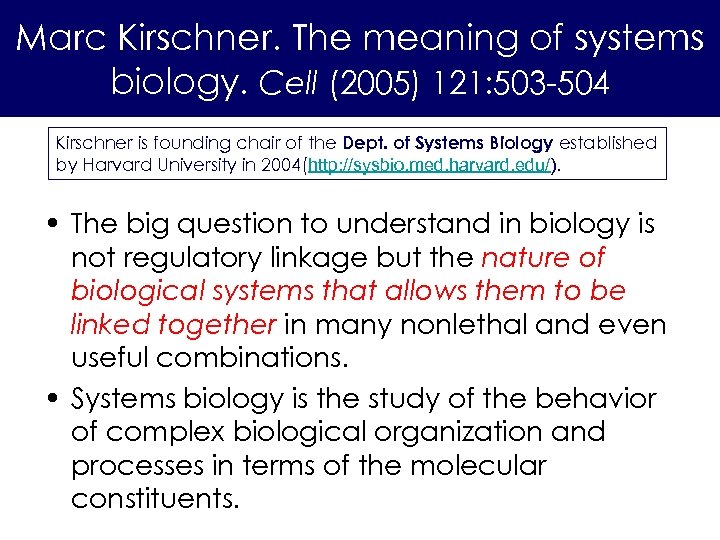
Marc Kirschner. The meaning of systems biology. Cell (2005) 121: 503 -504 Kirschner is founding chair of the Dept. of Systems Biology established by Harvard University in 2004(http: //sysbio. med. harvard. edu/). • The big question to understand in biology is not regulatory linkage but the nature of biological systems that allows them to be linked together in many nonlethal and even useful combinations. • Systems biology is the study of the behavior of complex biological organization and processes in terms of the molecular constituents.
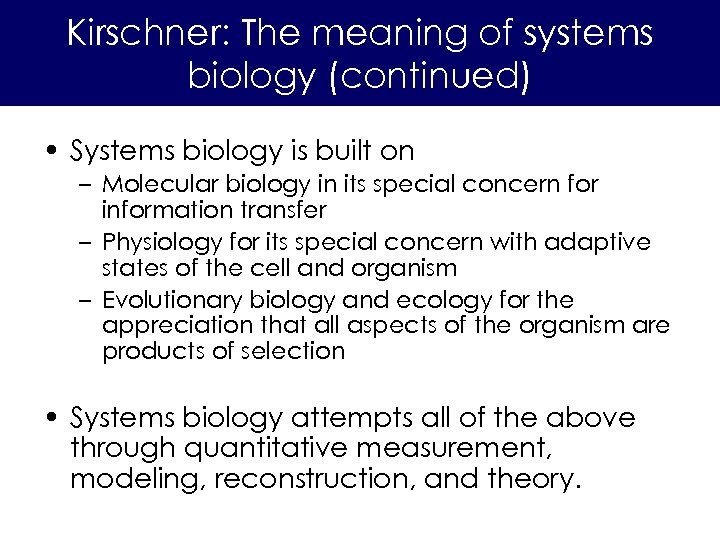
Kirschner: The meaning of systems biology (continued) • Systems biology is built on – Molecular biology in its special concern for information transfer – Physiology for its special concern with adaptive states of the cell and organism – Evolutionary biology and ecology for the appreciation that all aspects of the organism are products of selection • Systems biology attempts all of the above through quantitative measurement, modeling, reconstruction, and theory.
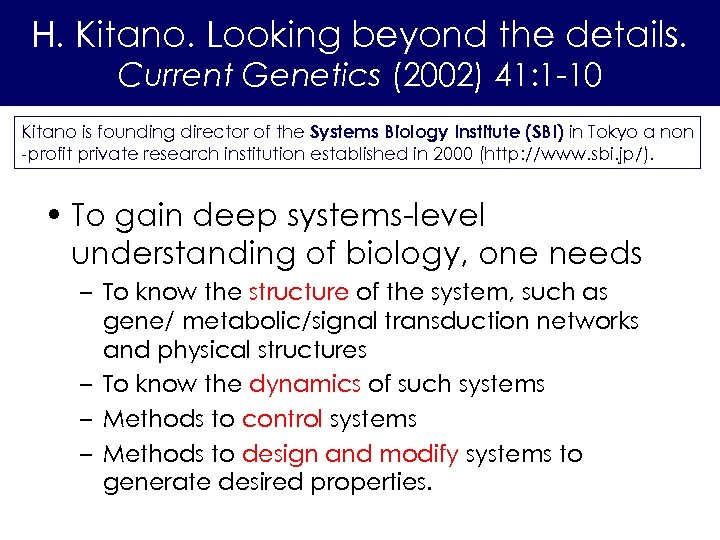
H. Kitano. Looking beyond the details. Current Genetics (2002) 41: 1 -10 Kitano is founding director of the Systems Biology Institute (SBI) in Tokyo a non -profit private research institution established in 2000 (http: //www. sbi. jp/). • To gain deep systems-level understanding of biology, one needs – To know the structure of the system, such as gene/ metabolic/signal transduction networks and physical structures – To know the dynamics of such systems – Methods to control systems – Methods to design and modify systems to generate desired properties.
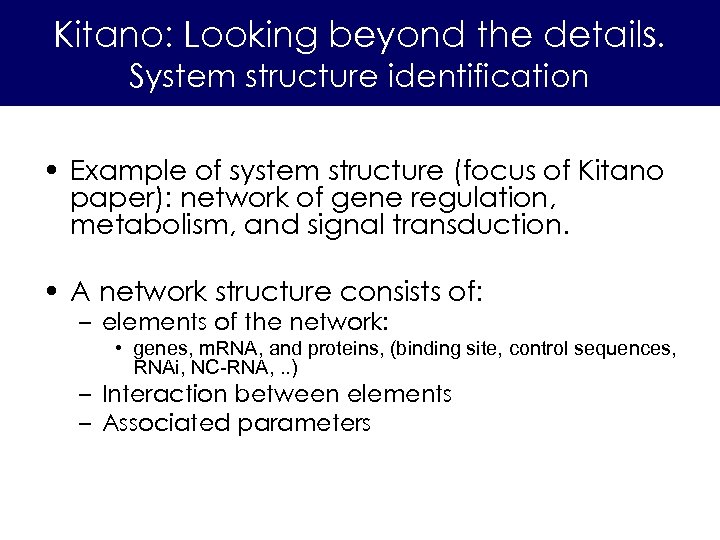
Kitano: Looking beyond the details. System structure identification • Example of system structure (focus of Kitano paper): network of gene regulation, metabolism, and signal transduction. • A network structure consists of: – elements of the network: • genes, m. RNA, and proteins, (binding site, control sequences, RNAi, NC-RNA, . . ) – Interaction between elements – Associated parameters
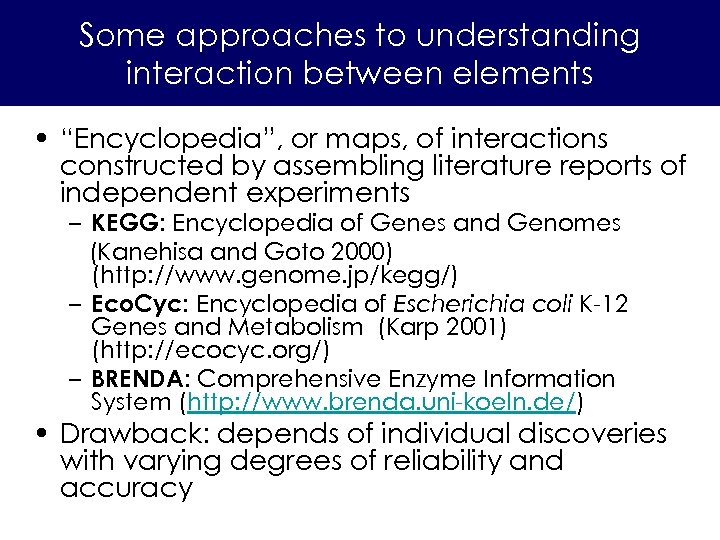
Some approaches to understanding interaction between elements • “Encyclopedia”, or maps, of interactions constructed by assembling literature reports of independent experiments – KEGG: Encyclopedia of Genes and Genomes (Kanehisa and Goto 2000) (http: //www. genome. jp/kegg/) – Eco. Cyc: Encyclopedia of Escherichia coli K-12 Genes and Metabolism (Karp 2001) (http: //ecocyc. org/) – BRENDA: Comprehensive Enzyme Information System (http: //www. brenda. uni-koeln. de/) • Drawback: depends of individual discoveries with varying degrees of reliability and accuracy
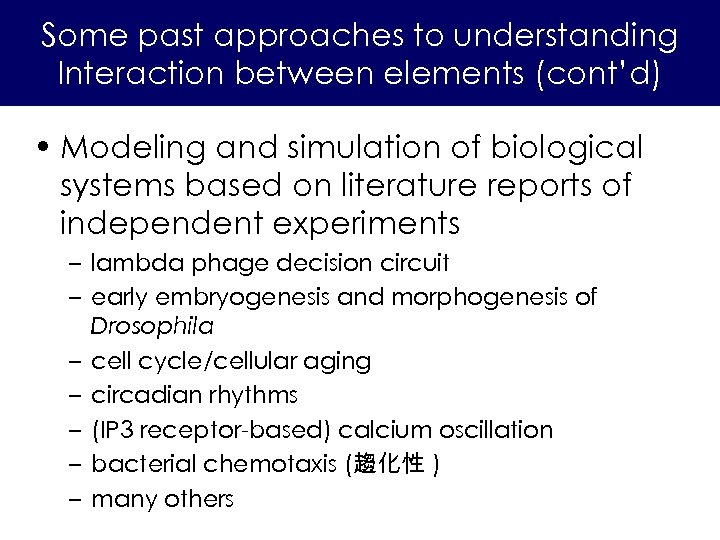
Some past approaches to understanding Interaction between elements (cont’d) • Modeling and simulation of biological systems based on literature reports of independent experiments – lambda phage decision circuit – early embryogenesis and morphogenesis of Drosophila – cell cycle/cellular aging – circadian rhythms – (IP 3 receptor-based) calcium oscillation – bacterial chemotaxis (趨化性 ) – many others
Pro and con for modeling and simulation • Pro – resolves conflicts in hypotheses – finds hypothesis to explain counterintuitive and contradictory data – provides conceptual understanding (added by hcl) • Con – depends on fragmented data with varying degrees of reliability and accuracy – too many factors left unknown • Usefulness and impact will increase with
High-throughput biology • Microarray – clustering of expression profiles – gene-disruption data • (protein–protein interaction) yeast twohybrid data • Many high-throughput experimental methods and equipments developed since Kitano’s 2002 paper – Mass spectrometry – Protein microarray
Kitano: Looking beyond the details. System control • One of the most important areas in systems biology; research not yet taken off • Method to control the state of biological systems: – – controlled environmental stimuli chemical injection drug absorption physical intervention • Some key questions: – How can we transform malfunctioning cells into healthy cells? – How can we control cancer cells, to turn them into normal cells or cause apoptosis? – Can we control the differentiation of a specific cell into a stem cell and control its subsequent differentiation into the desired cell type?
Kitano: Looking beyond the details. System design • No meaningful results as yet • Some futuristic applications – Design and grow organs from the tissue of the patient him/herself – Use biological materials for robotics or computation – Revolutionize industrial systems by using materials that have self-repair and selfsustaining capabilities
For more reading material and links, see http: //sansan. phy. ncu. edu. tw/ ~hclee/SB_course/index. htm

Happy reading!
Скачать презентацию Biophysics Camp 2006 Introducing Graduate Institute of Systems
1a298c8a582fb679c5f05fdd517b3e71.ppt