 Скачать презентацию Biomanufacturing Grid for rapid response to emerging infectious
54e2c20f56f17c60608f7f07b16bfce5.ppt
- Количество слайдов: 27



Biomanufacturing Grid for rapid response to emerging infectious diseases: Workflow Integration for data, computational and bioinstrumentation grids Tan Tin Wee (NUS), Lim Teck Sin (KOOPrime), Lim Beng Siong (SIMTech), Robert Gay (NTU) Funded by A*STAR TSRP Pilot Program
Examples of Successful e-Science Integrated Workflows • Bio. Information Integration UK e. Science Taverna/My. Grid • Bio. Instrument Integration Joint Centre for Structural Genomics – workflow integration for high throughput determination of protein structural folds (UCSD, SDSC, Stanford SSRL et al)
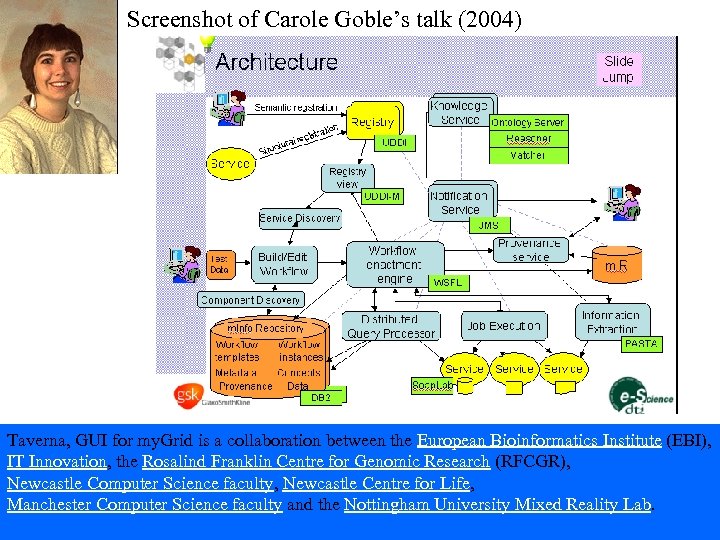
Screenshot of Carole Goble’s talk (2004) Taverna, GUI for my. Grid is a collaboration between the European Bioinformatics Institute (EBI), IT Innovation, the Rosalind Franklin Centre for Genomic Research (RFCGR), Newcastle Computer Science faculty, Newcastle Centre for Life, Manchester Computer Science faculty and the Nottingham University Mixed Reality Lab.
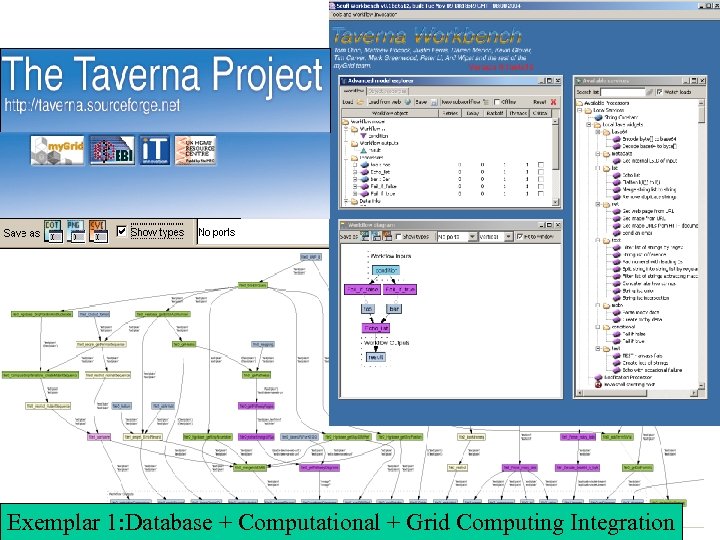
Exemplar 1: Database + Computational + Grid Computing Integration

© John Wooley, JCSG/UCSD 2003
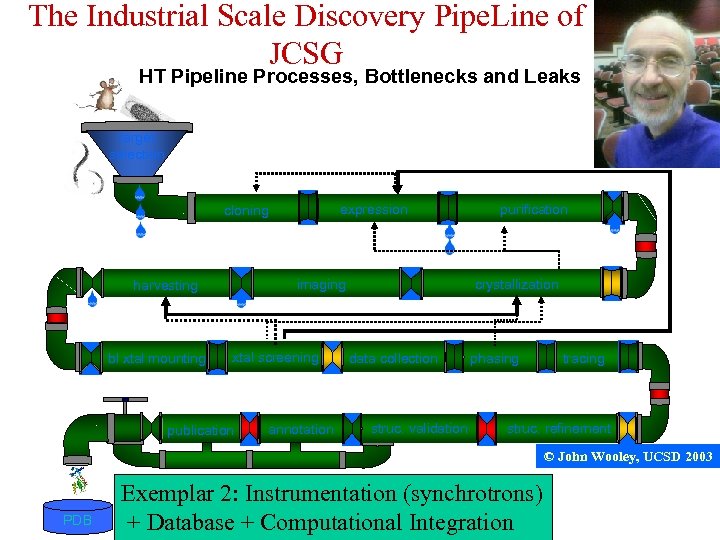
The Industrial Scale Discovery Pipe. Line of JCSG HT Pipeline Processes, Bottlenecks and Leaks target selection expression cloning imaging harvesting bl xtal mounting xtal screening publication annotation purification crystallization data collection struc. validation phasing tracing struc. refinement © John Wooley, UCSD 2003 PDB Exemplar 2: Instrumentation (synchrotrons) + Database + Computational Integration
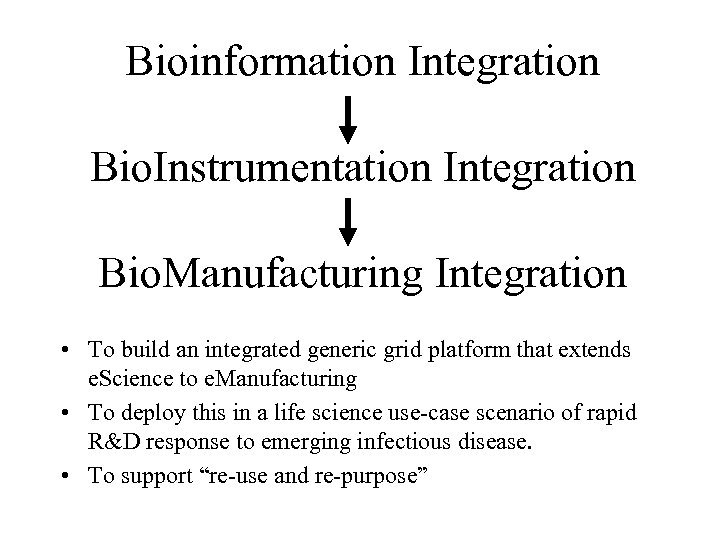
Bioinformation Integration Bio. Instrumentation Integration Bio. Manufacturing Integration • To build an integrated generic grid platform that extends e. Science to e. Manufacturing • To deploy this in a life science use-case scenario of rapid R&D response to emerging infectious disease. • To support “re-use and re-purpose”
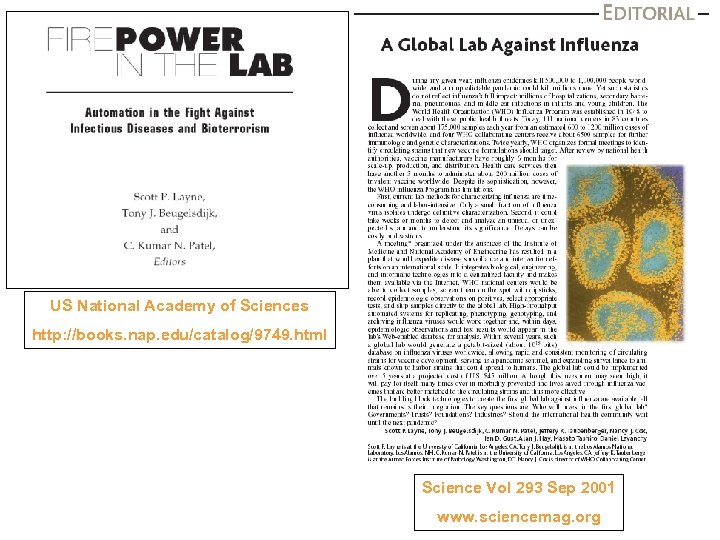
US National Academy of Sciences http: //books. nap. edu/catalog/9749. html Science Vol 293 Sep 2001 www. sciencemag. org
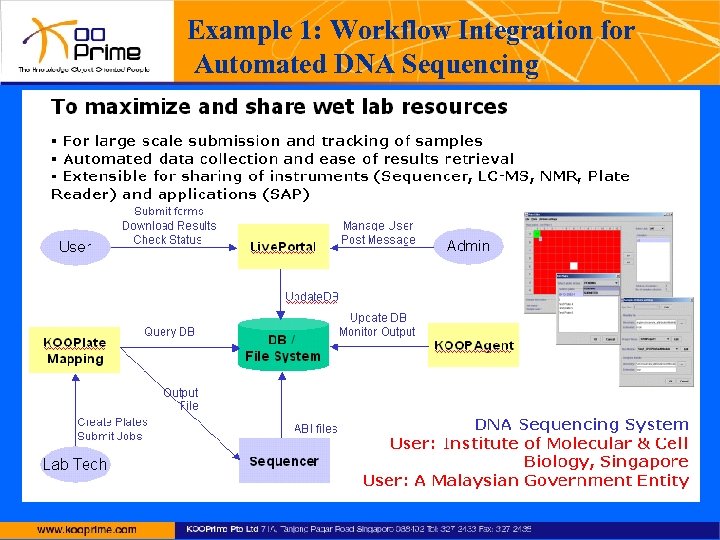
Example 1: Workflow Integration for Automated DNA Sequencing
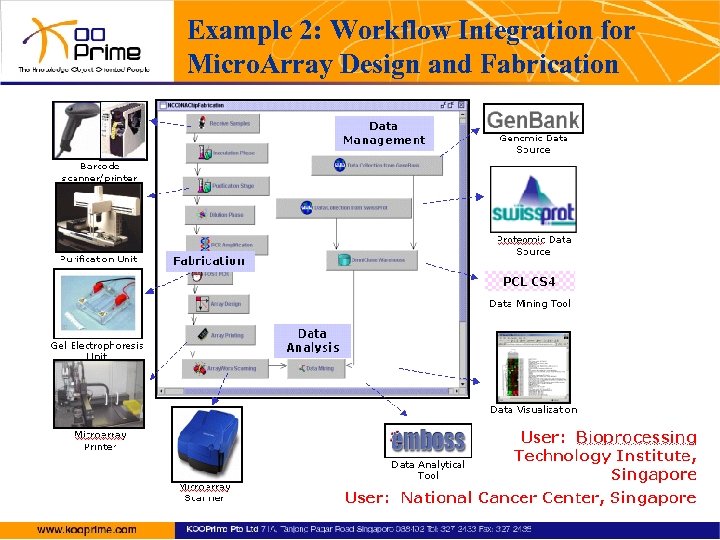
Example 2: Workflow Integration for Micro. Array Design and Fabrication
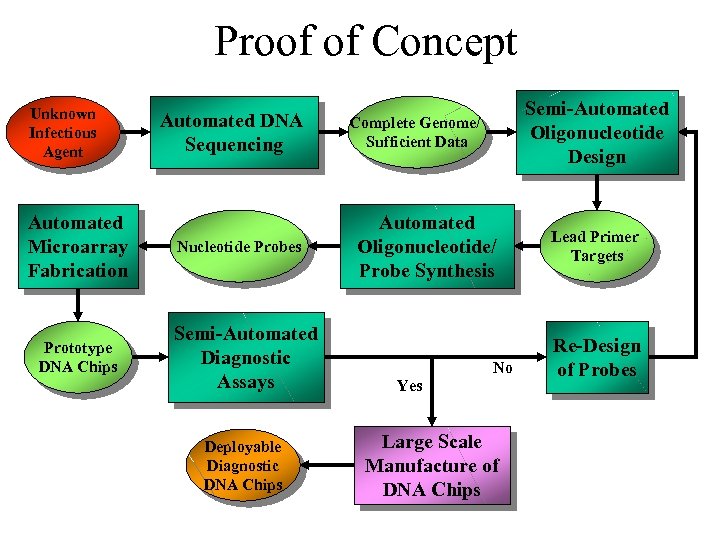
Proof of Concept Unknown Infectious Agent Automated Microarray Fabrication Prototype DNA Chips Automated DNA Sequencing Nucleotide Probes Semi-Automated Diagnostic Assays Deployable Diagnostic DNA Chips Semi-Automated Oligonucleotide Design Complete Genome/ Sufficient Data Automated Oligonucleotide/ Probe Synthesis No Yes Large Scale Manufacture of DNA Chips Lead Primer Targets Re-Design of Probes
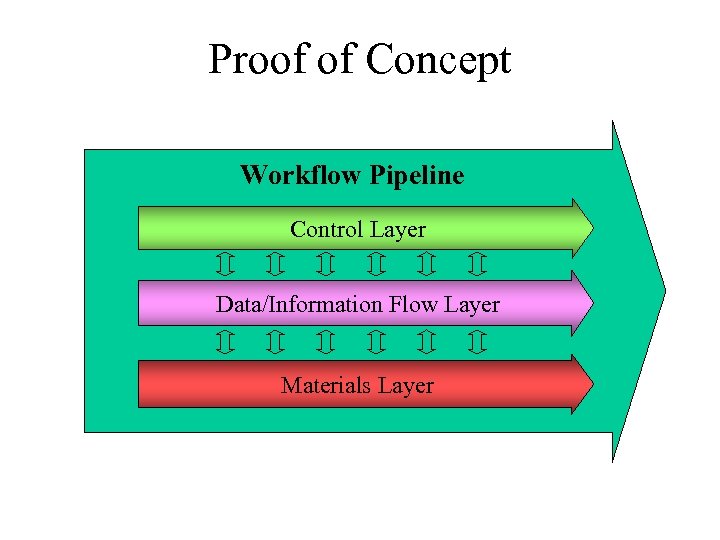
Proof of Concept Workflow Pipeline Control Layer Data/Information Flow Layer Materials Layer
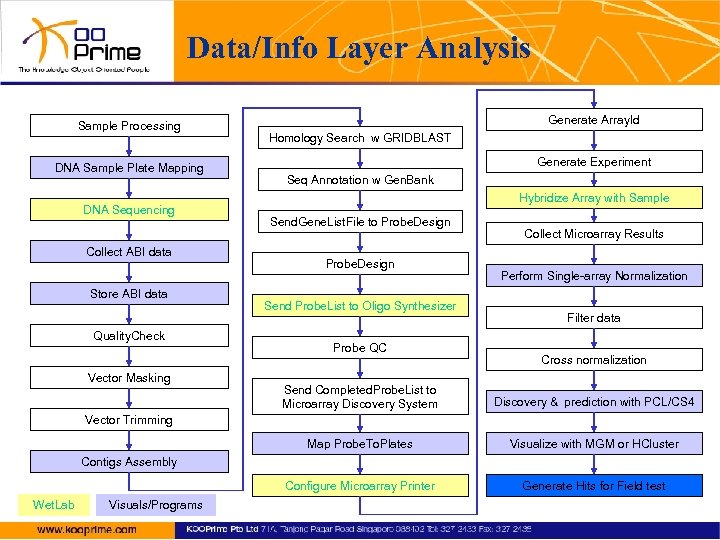
Data/Info Layer Analysis Sample Processing DNA Sample Plate Mapping DNA Sequencing Collect ABI data Store ABI data Quality. Check Vector Masking Generate Array. Id Homology Search w GRIDBLAST Generate Experiment Seq Annotation w Gen. Bank Hybridize Array with Sample Send. Gene. List. File to Probe. Design Send Probe. List to Oligo Synthesizer Probe QC Collect Microarray Results Perform Single-array Normalization Filter data Cross normalization Send Completed. Probe. List to Microarray Discovery System Discovery & prediction with PCL/CS 4 Map Probe. To. Plates Visualize with MGM or HCluster Configure Microarray Printer Generate Hits for Field test Vector Trimming Contigs Assembly Wet. Lab Visuals/Programs
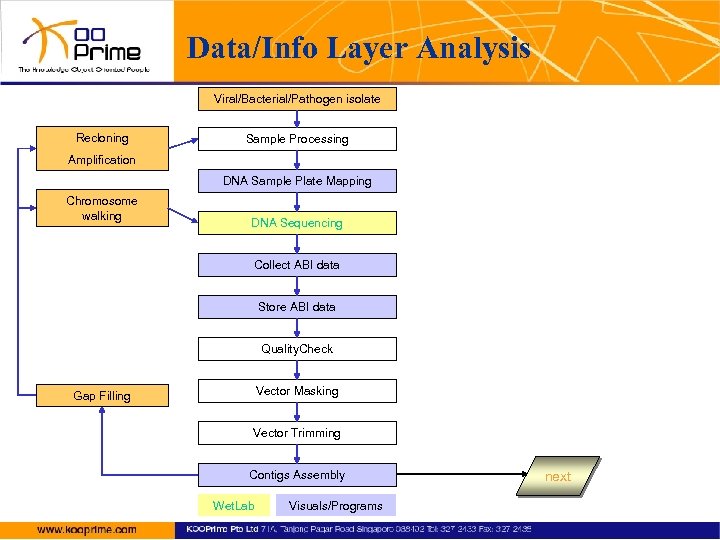
Data/Info Layer Analysis Viral/Bacterial/Pathogen isolate Recloning Sample Processing Amplification DNA Sample Plate Mapping Chromosome walking DNA Sequencing Collect ABI data Store ABI data Quality. Check Vector Masking Gap Filling Vector Trimming Contigs Assembly Wet. Lab Visuals/Programs next
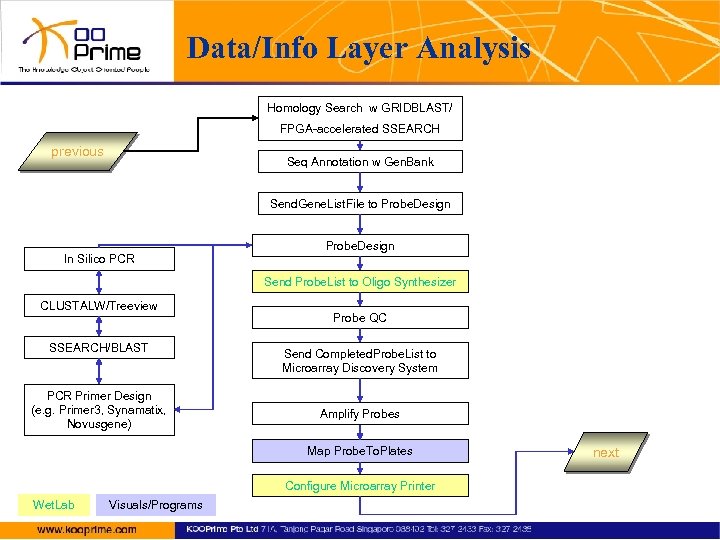
Data/Info Layer Analysis Homology Search w GRIDBLAST/ FPGA-accelerated SSEARCH previous Seq Annotation w Gen. Bank Send. Gene. List. File to Probe. Design In Silico PCR Send Probe. List to Oligo Synthesizer CLUSTALW/Treeview SSEARCH/BLAST PCR Primer Design (e. g. Primer 3, Synamatix, Novusgene) Probe QC Send Completed. Probe. List to Microarray Discovery System Amplify Probes Map Probe. To. Plates Configure Microarray Printer Wet. Lab Visuals/Programs next
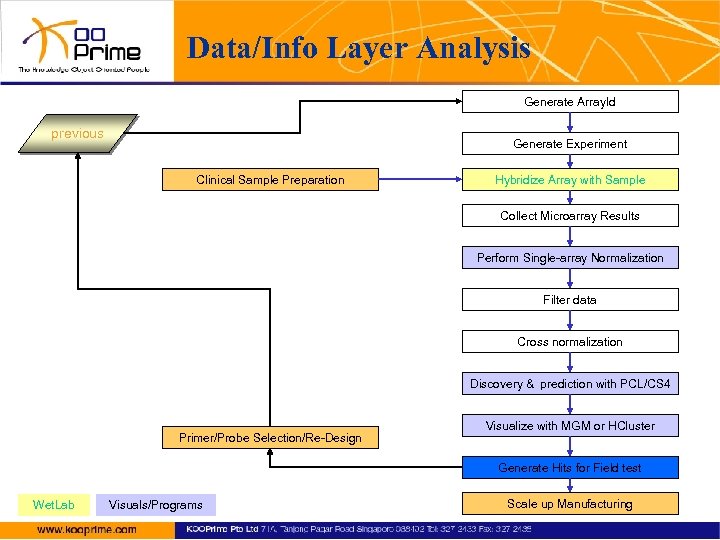
Data/Info Layer Analysis Generate Array. Id previous Generate Experiment Clinical Sample Preparation Hybridize Array with Sample Collect Microarray Results Perform Single-array Normalization Filter data Cross normalization Discovery & prediction with PCL/CS 4 Primer/Probe Selection/Re-Design Visualize with MGM or HCluster Generate Hits for Field test Wet. Lab Visuals/Programs Scale up Manufacturing
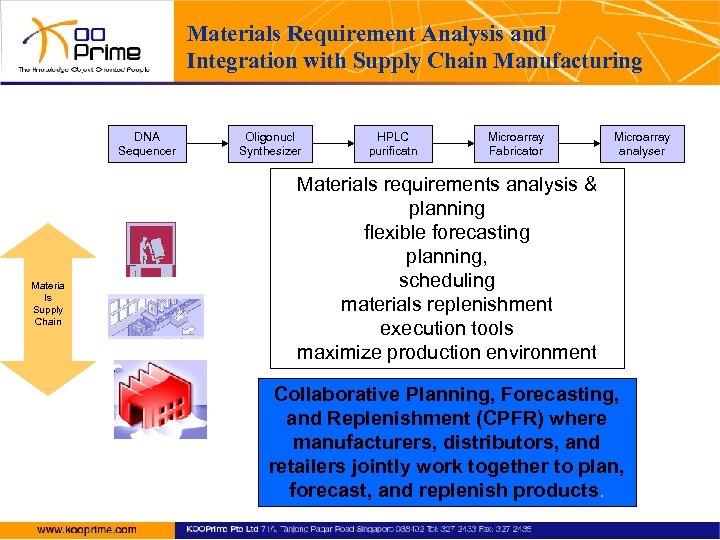
Materials Requirement Analysis and Integration with Supply Chain Manufacturing DNA Sequencer Materia ls Supply Chain Oligonucl Synthesizer HPLC purificatn Microarray Fabricator Microarray analyser Materials requirements analysis & planning flexible forecasting planning, scheduling materials replenishment execution tools maximize production environment Collaborative Planning, Forecasting, and Replenishment (CPFR) where manufacturers, distributors, and retailers jointly work together to plan, forecast, and replenish products.
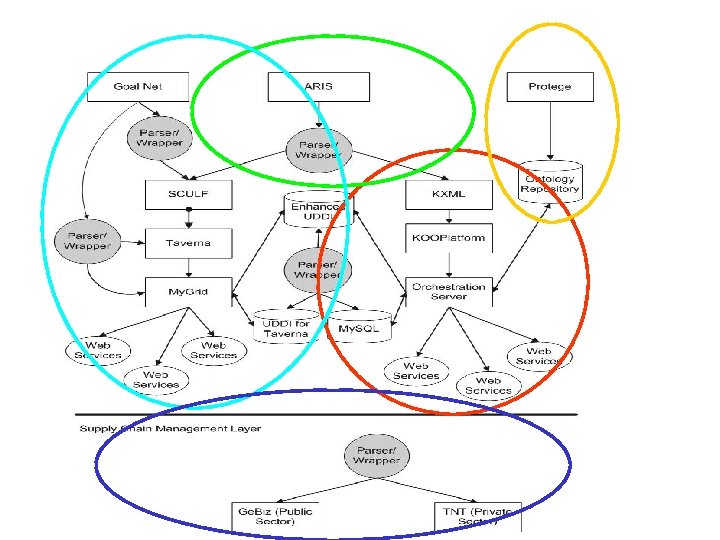
Supporting layers • Goal. Net high level model decomposition and scheduling optimising system • Protégé ontology deployment for life science diagnostic manufacturing • Aris UML modeling of integrated workflows • Supply chain manufacturing and materials analysis systems • Laboratory LIMS systems
Project Partners and Collaborators Vendors and Suppliers R&D TO DIAGNOSTIC KITS
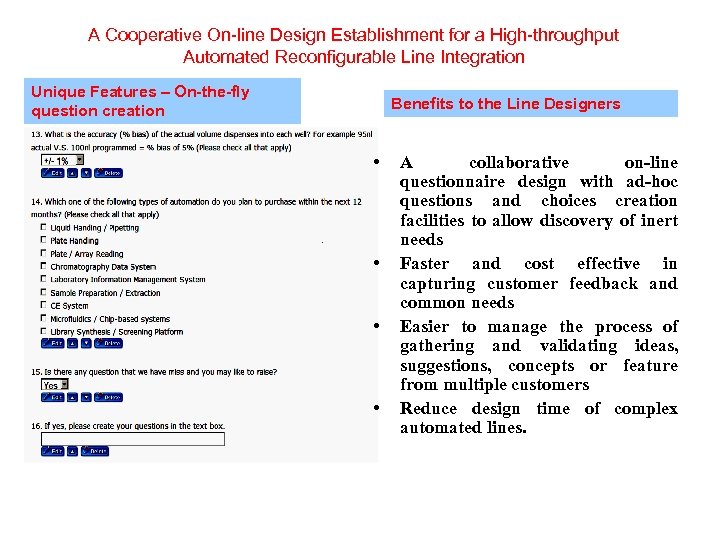
A Cooperative On-line Design Establishment for a High-throughput Automated Reconfigurable Line Integration Unique Features – On-the-fly question creation Benefits to the Line Designers • • A collaborative on-line questionnaire design with ad-hoc questions and choices creation facilities to allow discovery of inert needs Faster and cost effective in capturing customer feedback and common needs Easier to manage the process of gathering and validating ideas, suggestions, concepts or feature from multiple customers Reduce design time of complex automated lines.
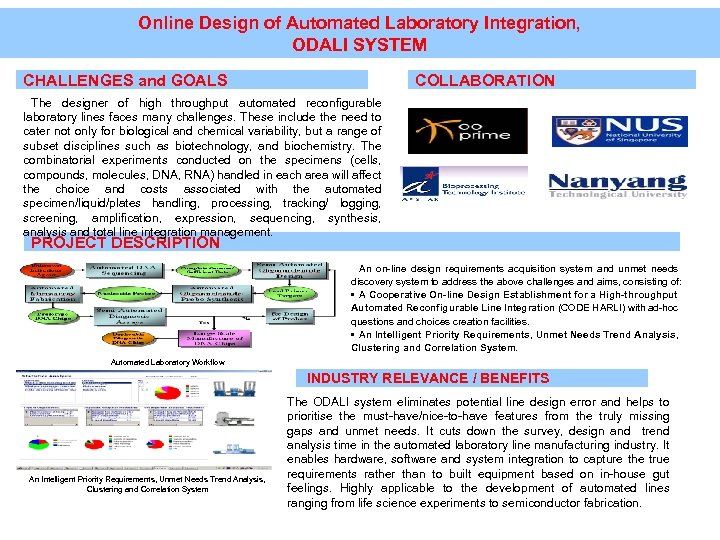
Online Design of Automated Laboratory Integration, ODALI SYSTEM CHALLENGES and GOALS COLLABORATION The designer of high throughput automated reconfigurable laboratory lines faces many challenges. These include the need to cater not only for biological and chemical variability, but a range of subset disciplines such as biotechnology, and biochemistry. The combinatorial experiments conducted on the specimens (cells, compounds, molecules, DNA, RNA) handled in each area will affect the choice and costs associated with the automated specimen/liquid/plates handling, processing, tracking/ logging, screening, amplification, expression, sequencing, synthesis, analysis and total line integration management. PROJECT DESCRIPTION An on-line design requirements acquisition system and unmet needs discovery system to address the above challenges and aims, consisting of: • A Cooperative On-line Design Establishment for a High-throughput Automated Reconfigurable Line Integration (CODE HARLI) with ad-hoc questions and choices creation facilities. • An Intelligent Priority Requirements, Unmet Needs Trend Analysis, Clustering and Correlation System. Automated Laboratory Workflow INDUSTRY RELEVANCE / BENEFITS An Intelligent Priority Requirements, Unmet Needs Trend Analysis, Clustering and Correlation System The ODALI system eliminates potential line design error and helps to prioritise the must-have/nice-to-have features from the truly missing gaps and unmet needs. It cuts down the survey, design and trend analysis time in the automated laboratory line manufacturing industry. It enables hardware, software and system integration to capture the true requirements rather than to built equipment based on in-house gut feelings. Highly applicable to the development of automated lines ranging from life science experiments to semiconductor fabrication.
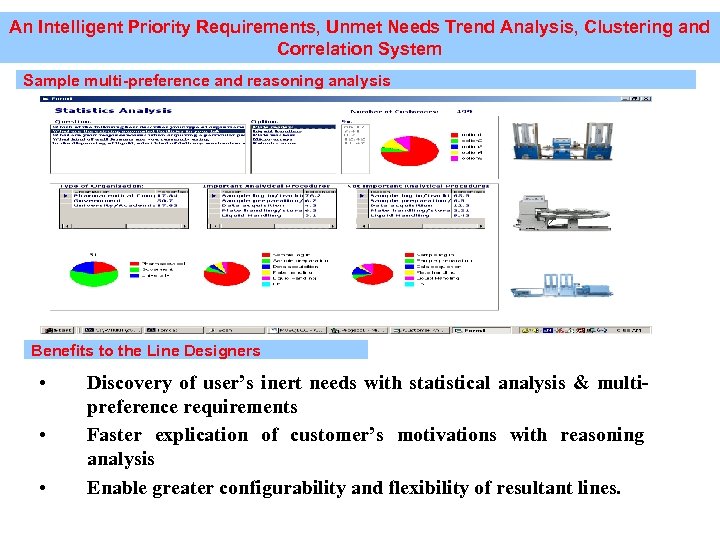
An Intelligent Priority Requirements, Unmet Needs Trend Analysis, Clustering and Correlation System Sample multi-preference and reasoning analysis Benefits to the Line Designers • • • Discovery of user’s inert needs with statistical analysis & multipreference requirements Faster explication of customer’s motivations with reasoning analysis Enable greater configurability and flexibility of resultant lines.
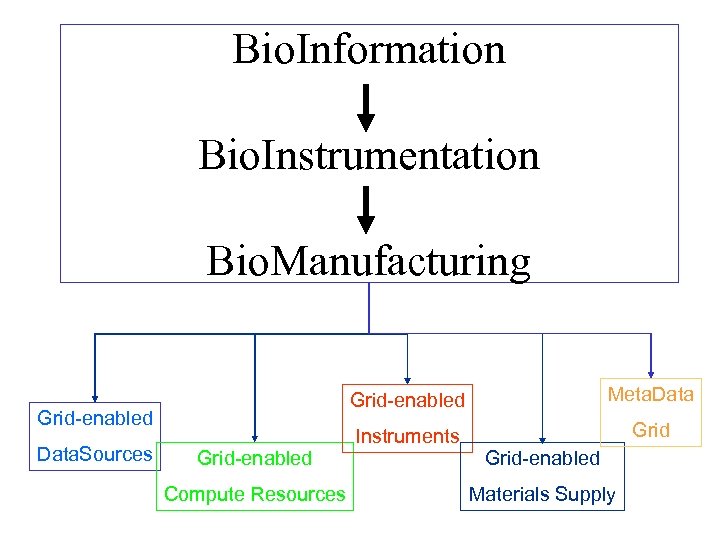
Bio. Information Bio. Instrumentation Bio. Manufacturing Grid-enabled Data. Sources Grid-enabled Compute Resources Meta. Data Instruments Grid-enabled Materials Supply
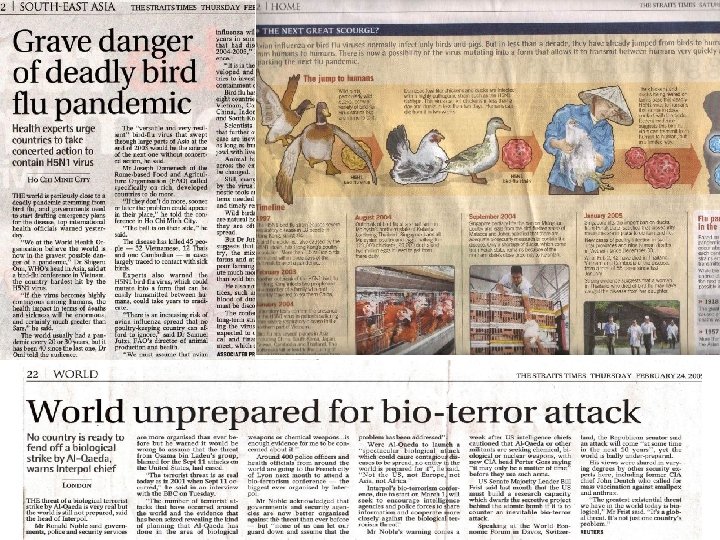
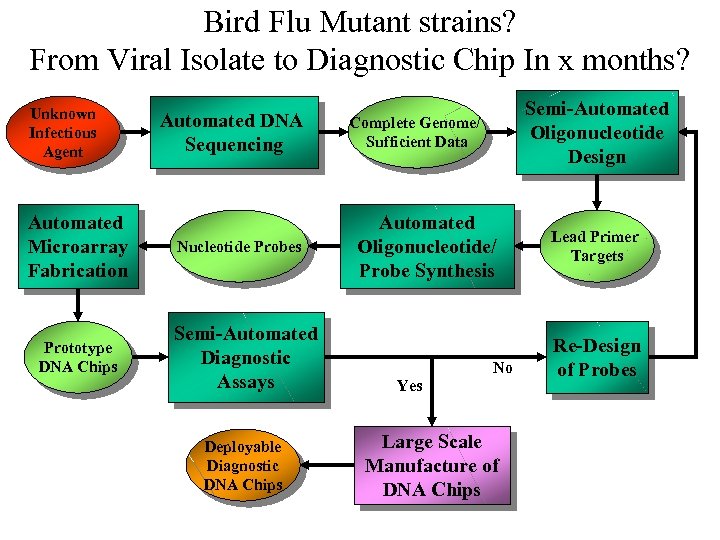
Bird Flu Mutant strains? From Viral Isolate to Diagnostic Chip In x months? Unknown Infectious Agent Automated Microarray Fabrication Prototype DNA Chips Automated DNA Sequencing Nucleotide Probes Semi-Automated Diagnostic Assays Deployable Diagnostic DNA Chips Semi-Automated Oligonucleotide Design Complete Genome/ Sufficient Data Automated Oligonucleotide/ Probe Synthesis No Yes Large Scale Manufacture of DNA Chips Lead Primer Targets Re-Design of Probes

Conclusion • If ever we need to do this, we need to do it now! • Asia is the epicenter of predictable and unpredicatable calamities, epidemics etc. • Killer Flu (1997), Nipah virus (1998/99), SARS (2003) [Tsunami (2004)] • How about other regions? Ebola? West Nile virus? Low cost flights make for rapid dissemination. • Unpreparedness spells pandemic if we cannot cope with these outbreaks at source. • Life Science and Biomedical Grids can help!
Скачать презентацию Biomanufacturing Grid for rapid response to emerging infectious
54e2c20f56f17c60608f7f07b16bfce5.ppt