 Скачать презентацию Biology Slide 1 of 41 Copyright Pearson Prentice
Chapter38_Section01_edit.ppt
- Количество слайдов: 42



Biology Slide 1 of 41 Copyright Pearson Prentice Hall End Show
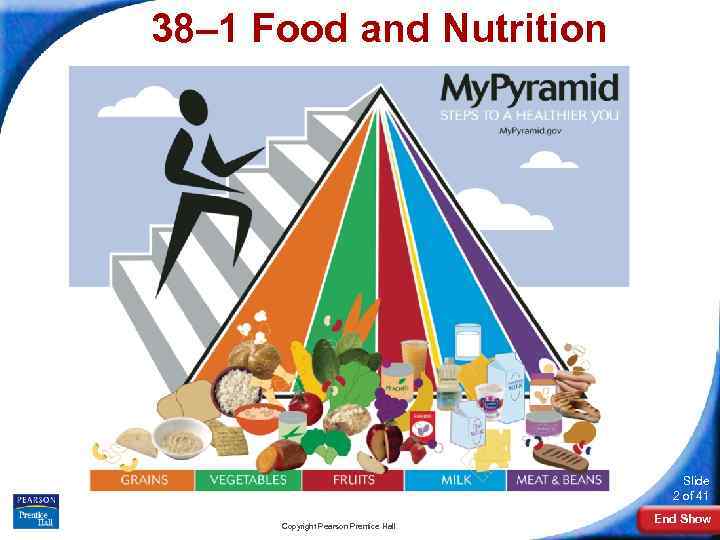
38– 1 Food and Nutrition Slide 2 of 41 Copyright Pearson Prentice Hall End Show
38– 1 Food and Nutrition Food and Energy You need to eat food to obtain energy. The energy in food is measured in Calories (capital C). One Calorie is equal to 1000 calories. One calorie is the amount of heat needed to raise the temperature of one gram of water by one degree Celsius. Slide 3 of 41 Copyright Pearson Prentice Hall End Show
38– 1 Food and Nutrition Food and Energy Caloric needs vary for each person. An average-sized female teenager needs about 2200 Calories a day. An average-sized male teenager needs about 2800 Calories a day. If you exercise regularly, your energy needs may be higher. Slide 4 of 41 Copyright Pearson Prentice Hall End Show
38– 1 Food and Nutrition Nutrients are substances in food that supply the energy and raw materials your body uses for growth, repair, and maintenance. Slide 5 of 41 Copyright Pearson Prentice Hall End Show
38– 1 Food and Nutrition Nutrients What are the nutrients your body needs? Slide 6 of 41 Copyright Pearson Prentice Hall End Show
38– 1 Food and Nutrition Nutrients The nutrients that the body needs are: • water • carbohydrates • fats • proteins • vitamins • minerals Slide 7 of 41 Copyright Pearson Prentice Hall End Show
38– 1 Food and Nutrition Nutrients Water Why is water such an important nutrient? Slide 8 of 41 Copyright Pearson Prentice Hall End Show
38– 1 Food and Nutrition Nutrients Every cell in the human body needs water because many of the body's processes take place in water. Slide 9 of 41 Copyright Pearson Prentice Hall End Show
38– 1 Food and Nutrition Nutrients Water makes up blood, lymph, and other bodily fluids. Water is lost during sweating, when it evaporates to cool the body. Water vapor is also lost from the body with every breath you exhale and in urine. Humans need to drink at least one liter of water each day. Slide 10 of 41 Copyright Pearson Prentice Hall End Show
38– 1 Food and Nutrition Nutrients Carbohydrates are the main source of energy for the body. There are two types of carbohydrates: • simple • complex Slide 11 of 41 Copyright Pearson Prentice Hall End Show
38– 1 Food and Nutrition Nutrients Simple carbohydrates are found in fruits, honey, and sugar cane. Simple carbohydrates do not need to be digested or broken down. Slide 12 of 41 Copyright Pearson Prentice Hall End Show
38– 1 Food and Nutrition Nutrients Complex carbohydrates, or starches, are found in grains, potatoes, and vegetables. Complex carbohydrates need to be broken down before they can be used by the body. Many foods contain the complex carbohydrate cellulose, or fiber. Slide 13 of 41 Copyright Pearson Prentice Hall End Show
38– 1 Food and Nutrition Nutrients Fiber is needed in your diet. Bulk supplied by fiber helps muscles keep food and wastes moving through your digestive and excretory systems. Whole-grain breads and many fruits and vegetables have fiber. Slide 14 of 41 Copyright Pearson Prentice Hall End Show
38– 1 Food and Nutrition Nutrients Fats, or lipids, are an important part of a healthy diet. Fats are formed from fatty acids and glycerol. Slide 15 of 41 Copyright Pearson Prentice Hall End Show
38– 1 Food and Nutrition Nutrients Fats are needed: • to produce cell membranes, myelin sheaths around neurons, and certain hormones. • to help the body absorb fat-soluble vitamins. • to protect body organs and insulate the body. Slide 16 of 41 Copyright Pearson Prentice Hall End Show
38– 1 Food and Nutrition Nutrients Fats are classified as saturated or unsaturated. When there are only single bonds between carbon atoms in the fatty acids, the fat is saturated. Most saturated fats are solids at room temperature— including butter and other animal fats. Slide 17 of 41 Copyright Pearson Prentice Hall End Show
38– 1 Food and Nutrition Nutrients Unsaturated fats have at least one double bond in a fatty acid chain. Unsaturated fats are usually liquids at room temperature. Because many vegetable oils contain more than one double bond, they are called polyunsaturated. Slide 18 of 41 Copyright Pearson Prentice Hall End Show
38– 1 Food and Nutrition Nutrients Proteins supply raw materials for growth and repair of structures such as skin and muscle. They have regulatory and transport functions. Slide 19 of 41 Copyright Pearson Prentice Hall End Show
38– 1 Food and Nutrition Nutrients Proteins are polymers of amino acids. The body can synthesize only 12 of the 20 amino acids used to make proteins. The other 8 amino acids are called essential amino acids; they must come from food. Slide 20 of 41 Copyright Pearson Prentice Hall End Show
38– 1 Food and Nutrition Nutrients Animal products, including meat, fish, eggs, and milk, contain all 8 essential amino acids. Foods derived from plants, such as grains and beans, do not. Therefore, people who don’t eat animal products must eat a combination of plant foods to obtain all of the essential amino acids. Slide 21 of 41 Copyright Pearson Prentice Hall End Show
38– 1 Food and Nutrition Nutrients Vitamins are organic molecules that help regulate body processes, often working with enzymes. Most vitamins must be obtained from food. A diet lacking certain vitamins can have serious, even fatal, consequences. Slide 22 of 41 Copyright Pearson Prentice Hall End Show
38– 1 Food and Nutrition Nutrients There are two types of vitamins: • fat-soluble • water-soluble The fat-soluble vitamins A, D, E, and K can be stored in the fatty tissues of the body. The body can build up stores of these vitamins for future use. Slide 23 of 41 Copyright Pearson Prentice Hall End Show
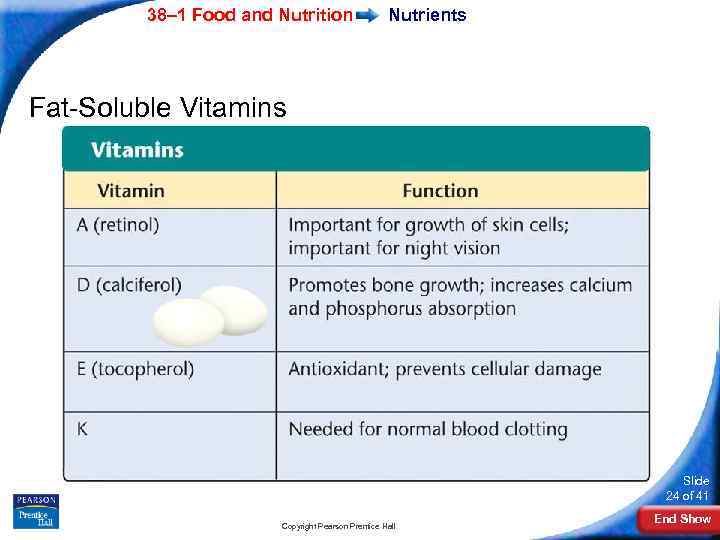
38– 1 Food and Nutrition Nutrients Fat-Soluble Vitamins Slide 24 of 41 Copyright Pearson Prentice Hall End Show
38– 1 Food and Nutrition Nutrients The water-soluble vitamins dissolve in water and cannot be stored in the body. Eating a diet containing a variety of foods will supply the daily vitamin needs of nearly everyone. Slide 25 of 41 Copyright Pearson Prentice Hall End Show
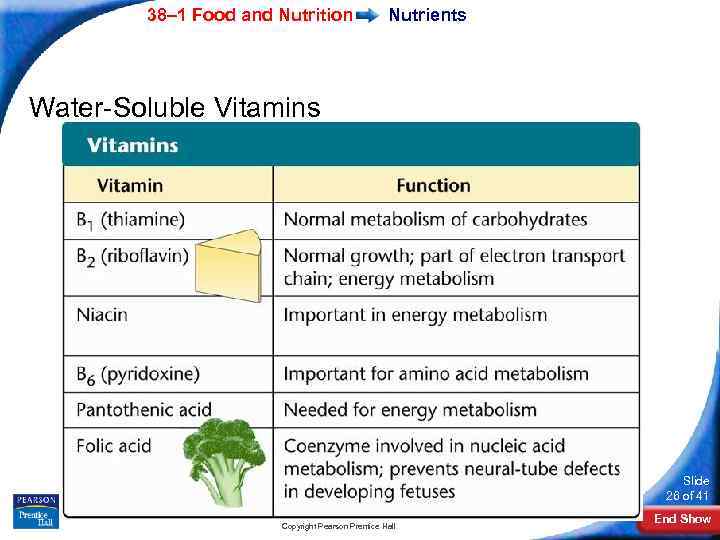
38– 1 Food and Nutrition Nutrients Water-Soluble Vitamins Slide 26 of 41 Copyright Pearson Prentice Hall End Show
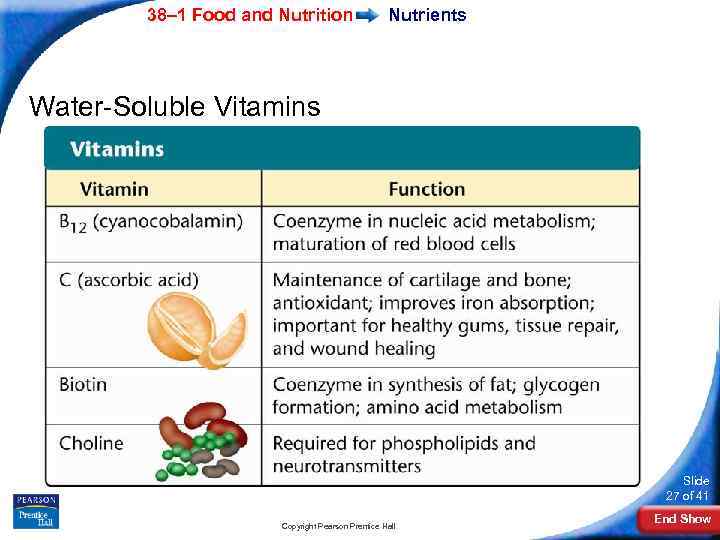
38– 1 Food and Nutrition Nutrients Water-Soluble Vitamins Slide 27 of 41 Copyright Pearson Prentice Hall End Show
38– 1 Food and Nutrition Nutrients Minerals Inorganic nutrients that the body needs, usually in small amounts, are called minerals. By eating a variety of foods, you can meet your daily requirement of minerals. Slide 28 of 41 Copyright Pearson Prentice Hall End Show
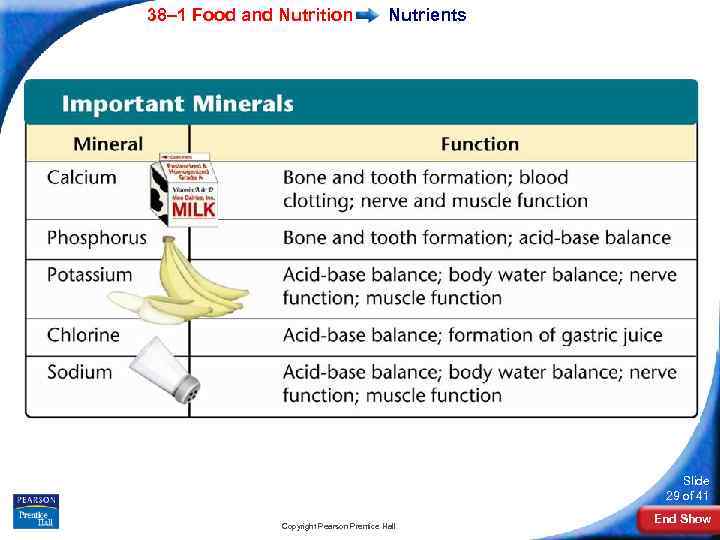
38– 1 Food and Nutrition Nutrients Slide 29 of 41 Copyright Pearson Prentice Hall End Show
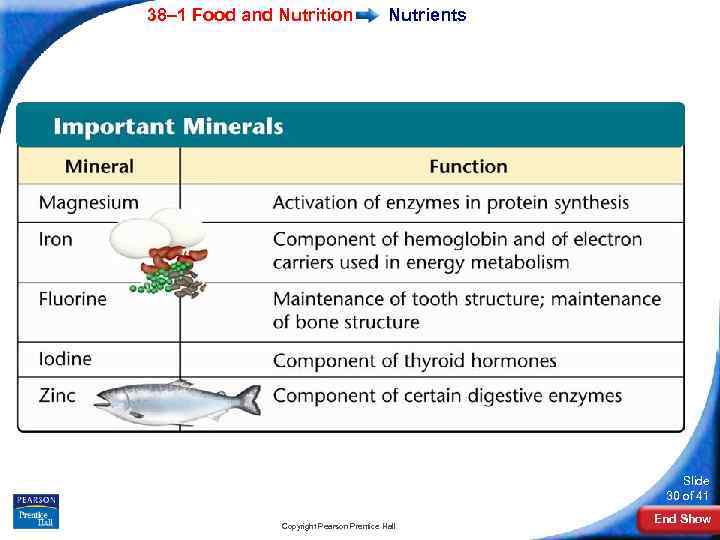
38– 1 Food and Nutrition Nutrients Slide 30 of 41 Copyright Pearson Prentice Hall End Show
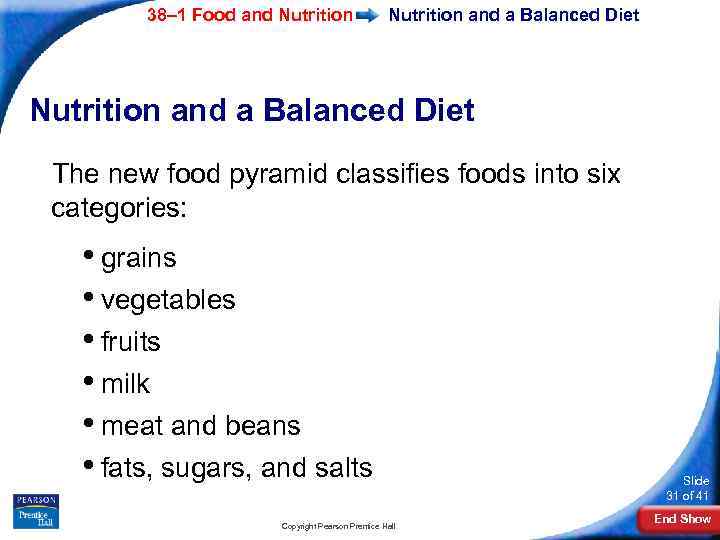
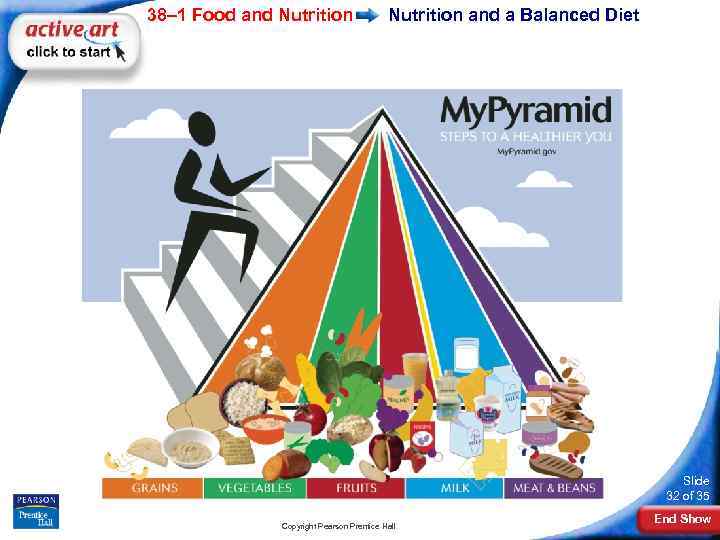
38– 1 Food and Nutrition and a Balanced Diet The new food pyramid classifies foods into six categories: • grains • vegetables • fruits • milk • meat and beans • fats, sugars, and salts Copyright Pearson Prentice Hall Slide 31 of 41 End Show
38– 1 Food and Nutrition and a Balanced Diet Slide 32 of 35 Copyright Pearson Prentice Hall End Show
38– 1 Food and Nutrition and a Balanced Diet The figure climbing up the side of the pyramid represents exercise. You should get at least 30 minutes of exercise each day. Slide 33 of 41 Copyright Pearson Prentice Hall End Show
38– 1 Food and Nutrition and a Balanced Diet A food label provides information about nutrition. Daily values are based on a 2000 -Calorie diet, and nutrient needs are affected by age, gender, and lifestyle. Slide 34 of 41 Copyright Pearson Prentice Hall End Show
38– 1 Food and Nutrition and a Balanced Diet When choosing foods, you should compare similar foods on the basis of their proportion of nutrients to Calories. When you choose a food, it should be high in nutrition and low in Calories. Slide 35 of 41 Copyright Pearson Prentice Hall End Show
38– 1 Click to Launch: Continue to: - or - Slide 36 of 41 End Show Copyright Pearson Prentice Hall
38– 1 Which nutrient is found in fruits, sugars, and whole-grain breads? a. protein b. fat c. carbohydrates d. vitamins Slide 37 of 41 End Show Copyright Pearson Prentice Hall
38– 1 Organic molecules that help regulate body processes and often work with enzymes are a. fats. b. minerals. c. vitamins. d. amino acids. Slide 38 of 41 End Show Copyright Pearson Prentice Hall
38– 1 Which two vitamins can be made by the body? a. vitamins a and B b. vitamins C and D c. vitamins A and K d. vitamins D and K Slide 39 of 41 End Show Copyright Pearson Prentice Hall
38– 1 The most important nutrient is a. fat b. water c. vitamins d. protein. Slide 40 of 41 End Show Copyright Pearson Prentice Hall
38– 1 The foods that should make up the largest part of your diet are a. fats and sweets. b. meat, poultry, and fish c. milk, yogurt, and cheese. d. breads, cereals, rice, and pasta. Slide 41 of 41 End Show Copyright Pearson Prentice Hall

END OF SECTION
Скачать презентацию Biology Slide 1 of 41 Copyright Pearson Prentice
Chapter38_Section01_edit.ppt