 Скачать презентацию Biology Mr Moore Genetics DNA to Protein Genes
11b64efc10e813614fe545be4d3de7c8.ppt
- Количество слайдов: 118



Biology Mr. Moore Genetics: DNA to Protein Genes to Traits Chapter # _____ Pages # _____ 1
Rewind Your Mind § 1. 2. 3. 4. What are the functions of the following organelles? Ribosome Nucleus Mitochondria Cell Membrane 1. Protein synthesis (r. RNA) 2. Holds the instructions for making proteins (DNA) 3. Cellular Respiration (ATP) 4. Maintains homeostasis § What is the difference between a Diploid cell and a Haploid cell? • Diploid cell: has 2 copies of the genetic material. One copy from each parent. • Haploid cell: has a single copy of the genetic code. Formed during Meiosis. 2
Year in Progress Scientific Method Genetics: One generation to the next Cell Cycle and Replication Eukaryotic Organelles Cells (Prokaryotic vs. Eukaryotic) Macromolecules Molecules (H 2 O) Basic Chem. Characteristics Of Life 3
Genetics: DNA Molecule p Sim le e ienc Sc A DN asic B s 4
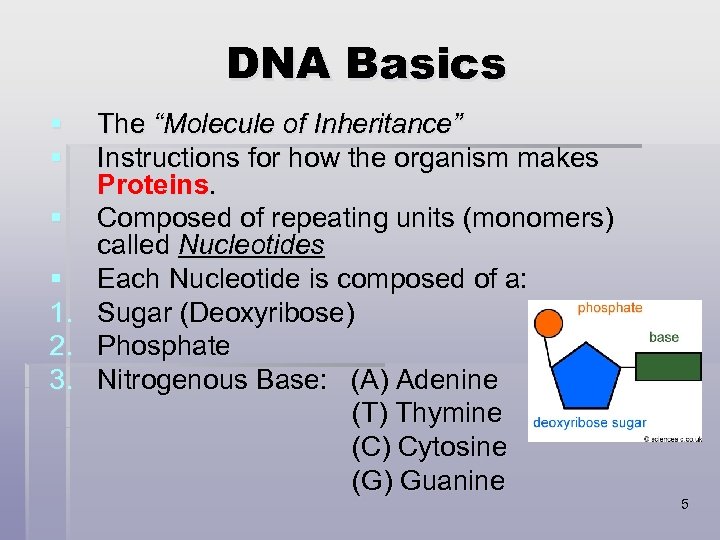
DNA Basics § § 1. 2. 3. The “Molecule of Inheritance” Instructions for how the organism makes Proteins. Composed of repeating units (monomers) called Nucleotides Each Nucleotide is composed of a: Sugar (Deoxyribose) Phosphate Nitrogenous Base: (A) Adenine (T) Thymine (C) Cytosine (G) Guanine 5
DNA Formation § Formed by two separate strands that face each other forming a “ladder structure”. § The “backbone” made by the phosphate of one nucleotide attaching to the sugar of another nucleotide. § The “rungs” connect with a Weak Hydrogen Bond between the Nitrogenous Bases of one strand to the other. § The entire structure is twisted (to condense it’s size) to form a “Helix” James Watson & Francis Crick Were credited for discovering this design! 6
Complimentary Base Pairs § § Nitrogenous Base pairs always form specific combinations in their two strand structure: (A) Adenine to (T) Thymine Straight with Straight (C) Cytosine to (G) Guanine Curve with Curve Because of these “Complimentary Base Pairs”, Pairs if you can determine the order of bases on one strand, you can determine the order of bases on the complimentary strand. Example Of this Idea: 7
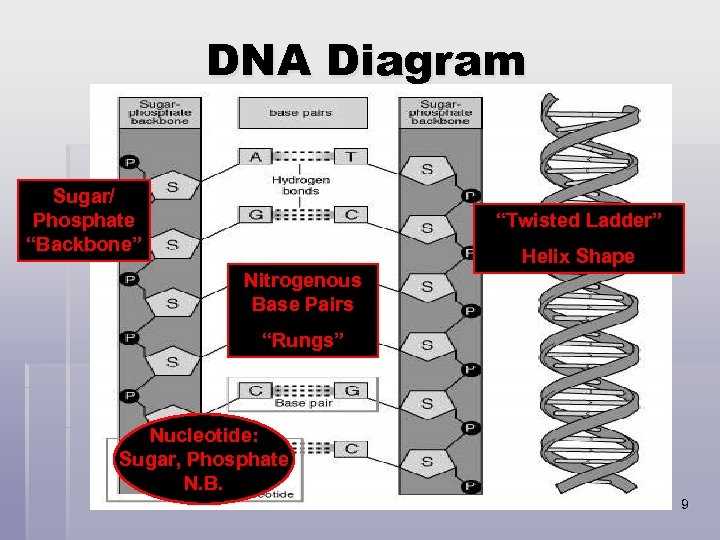
DNA Diagram Sugar/ Phosphate “Backbone” “Twisted Ladder” Helix Shape Nitrogenous Base Pairs “Rungs” Nucleotide: Sugar, Phosphate N. B. 9
DNA “Metaphor” § DNA receives all of its power by determining what “proteins” are produced. “DNA is to Life What Cook Books are to Food” § Because so much information is needed to produce life, the DNA in our cells is extremely long! FYI: All of the DNA in just humans could stretch from here to Jupiter and back 60 times!!!! 10
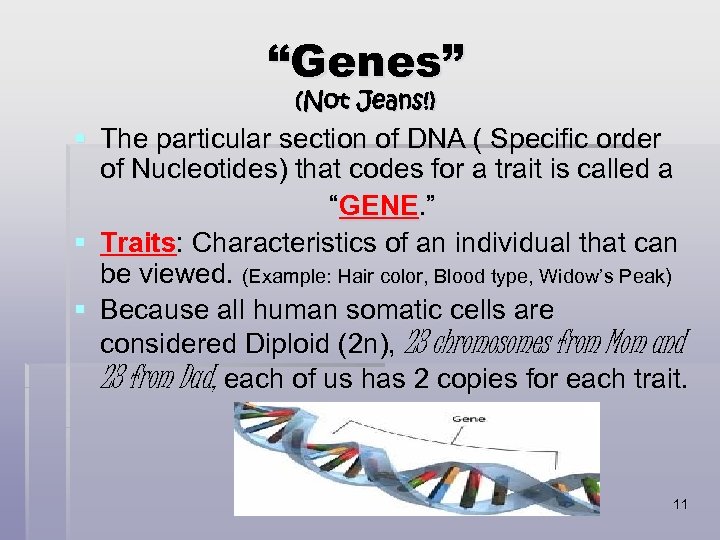
“Genes” (Not Jeans!) § The particular section of DNA ( Specific order of Nucleotides) that codes for a trait is called a “GENE. ” § Traits: Characteristics of an individual that can be viewed. (Example: Hair color, Blood type, Widow’s Peak) § Because all human somatic cells are considered Diploid (2 n), 23 chromosomes from Mom and 23 from Dad, each of us has 2 copies for each trait. 11
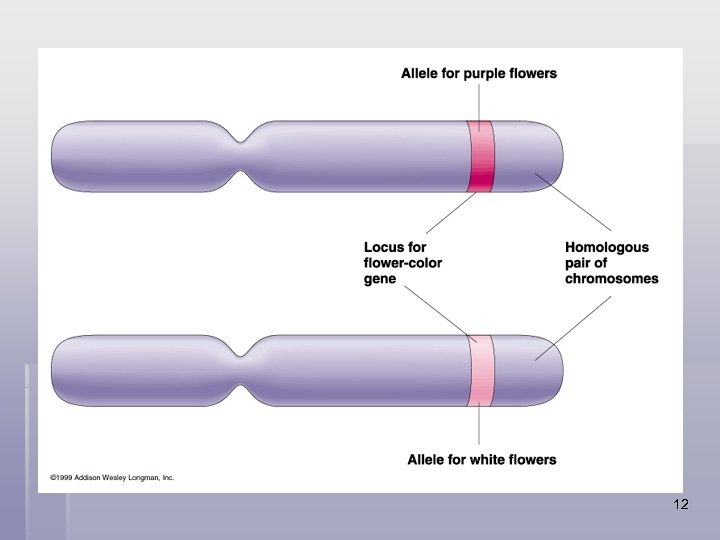
“Alleles” § Alternative (different) forms of a trait, and therefore Genes, are called Alleles. § Example: “Both of your parents gave you a gene for hair color: however mom could have given you the gene for Brown hair, and dad given you the gene for Red hair. ” 12
Homozygous & Heterozygous § Prefix: Homo- “Same” Hetero- “Different” § There are 2 possibilities for the combinations of genes you received for each trait: 1. Homozygous: Both of the genes received from your parents are the SAME 2. Heterozygous: The genes that you received from your parents for a trait are DIFFERENT 13
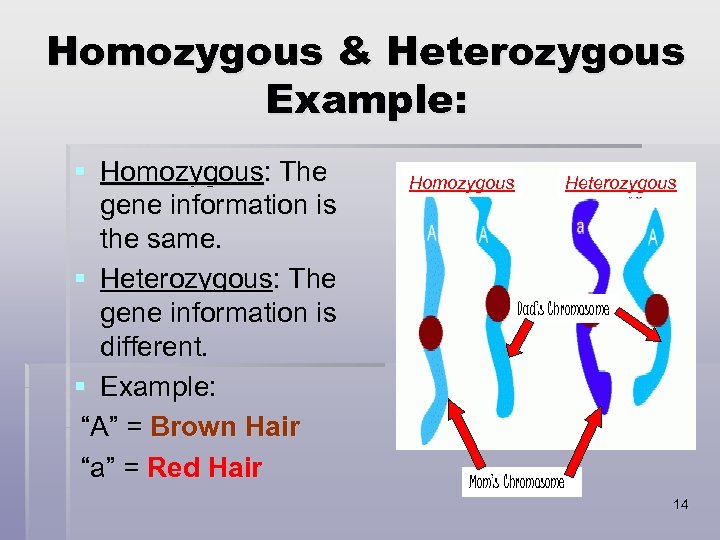
Homozygous & Heterozygous Example: § Homozygous: The gene information is the same. § Heterozygous: The gene information is different. § Example: “A” = Brown Hair “a” = Red Hair Homozygous Heterozygous Dad’s Chromosome Mom’s Chromosome 14
Dominant & Recessive Traits § If there are different forms of a trait (alleles), there has to be some that are “more powerful” then others. § We call the traits that are expressed (shown) over other traits DOMINANT. § The traits that can be hidden in the presence of other forms are considered RECESSIVE. 15
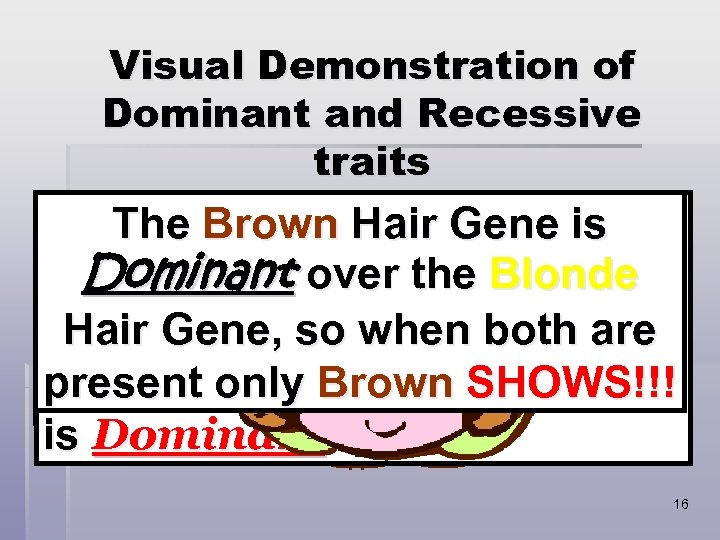
Visual Demonstration of Dominant and Recessive traits However, if a person inherits The Brown Hair Gene is Dominantreceives 2 Blonde one gene forover the hair and Blonde If a person is Dominant to Brown Hair one forgenes…. Person has Brown when the Hair Gene, so hair… both are hair Blond Hair Brown hair shows because it present only Brown SHOWS!!! Blonde hair is Dominant!!! 16
pe typ o en Ph s. ev G oty en Vocabulary § Scientists needed a better way to describe the difference between what an individual “looks” like, and what their genes (DNA) look like: § Phenotype: What an individual looks like, their outer “Physical” appearance. § Genotype: What an individuals’ “Genes” (order of nucleotides) look like, their inner genetic code. 17
Genetics § All of these discoveries about “DNA”, its importance and functions fall into a large area of study called: GENETICS. § Genetics: The study of Heredity (The passing of genes from one generation to the next). § This field of study is the key to understanding species uniqueness, and how information is passed from parents to their offspring. 18
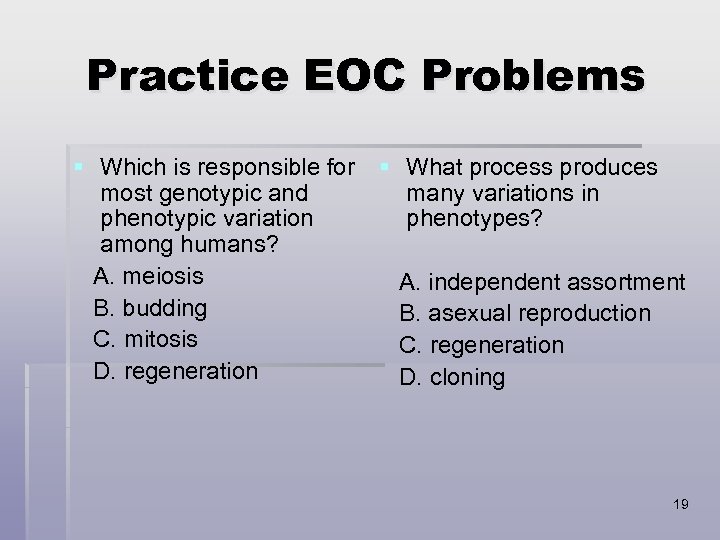
Practice EOC Problems § Which is responsible for § What process produces most genotypic and many variations in phenotypic variation phenotypes? among humans? A. meiosis A. independent assortment B. budding B. asexual reproduction C. mitosis C. regeneration D. cloning 19
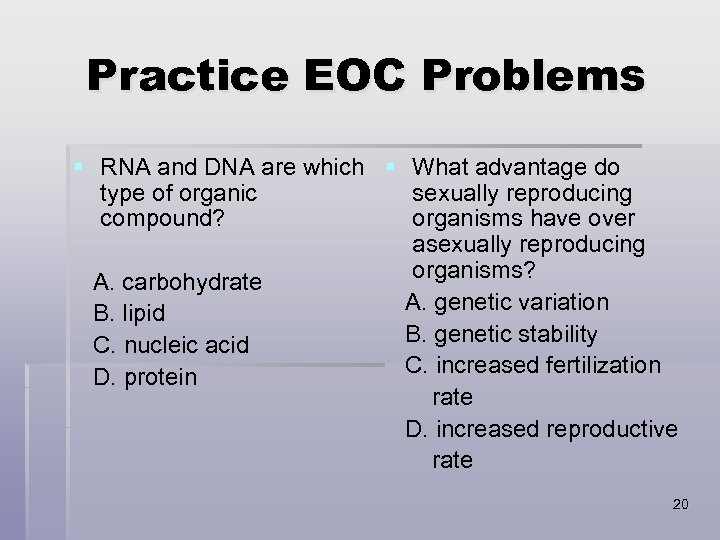
Practice EOC Problems § RNA and DNA are which § What advantage do type of organic sexually reproducing compound? organisms have over asexually reproducing organisms? A. carbohydrate A. genetic variation B. lipid B. genetic stability C. nucleic acid C. increased fertilization D. protein rate D. increased reproductive rate 20
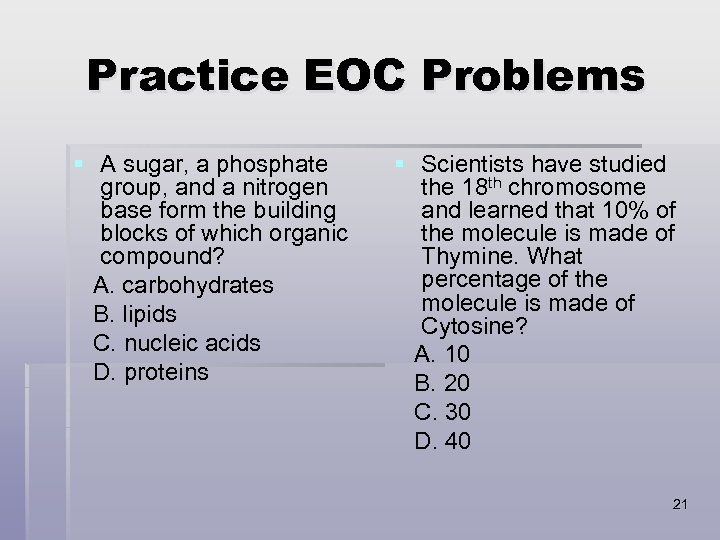
Practice EOC Problems § A sugar, a phosphate group, and a nitrogen base form the building blocks of which organic compound? A. carbohydrates B. lipids C. nucleic acids D. proteins § Scientists have studied the 18 th chromosome and learned that 10% of the molecule is made of Thymine. What percentage of the molecule is made of Cytosine? A. 10 B. 20 C. 30 D. 40 21
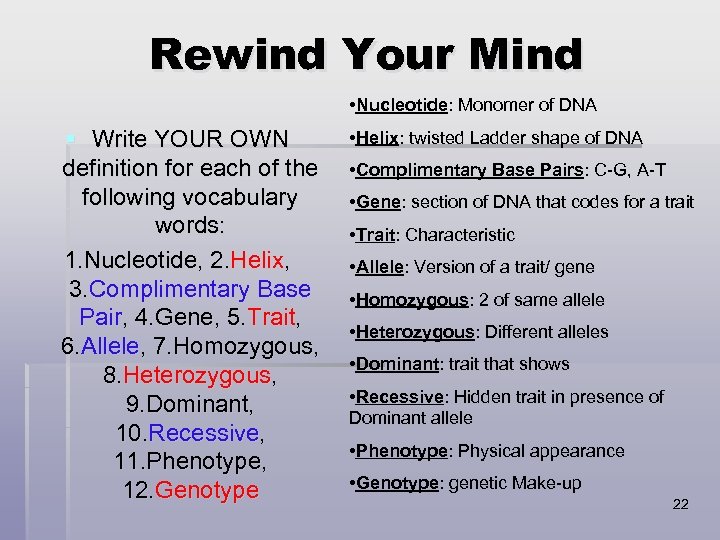
Rewind Your Mind • Nucleotide: Monomer of DNA § Write YOUR OWN definition for each of the following vocabulary words: 1. Nucleotide, 2. Helix, 3. Complimentary Base Pair, 4. Gene, 5. Trait, 6. Allele, 7. Homozygous, 8. Heterozygous, 9. Dominant, 10. Recessive, 11. Phenotype, 12. Genotype • Helix: twisted Ladder shape of DNA • Complimentary Base Pairs: C-G, A-T • Gene: section of DNA that codes for a trait • Trait: Characteristic • Allele: Version of a trait/ gene • Homozygous: 2 of same allele • Heterozygous: Different alleles • Dominant: trait that shows • Recessive: Hidden trait in presence of Dominant allele • Phenotype: Physical appearance • Genotype: genetic Make-up 22
Genetics: Punnett Squares o! ide t. V a Gre 23
Genetics ( FYI ) § Every living thing –Plant or animal, microbe or human being– has a set of characteristics inherited from its parent (Asexual) or parents (Sexual) reproduction. § Scientists have begun to appreciate that heredity holds the key to understanding what makes each species unique. § Genetics: is the scientific study of heredity. Genetics 24
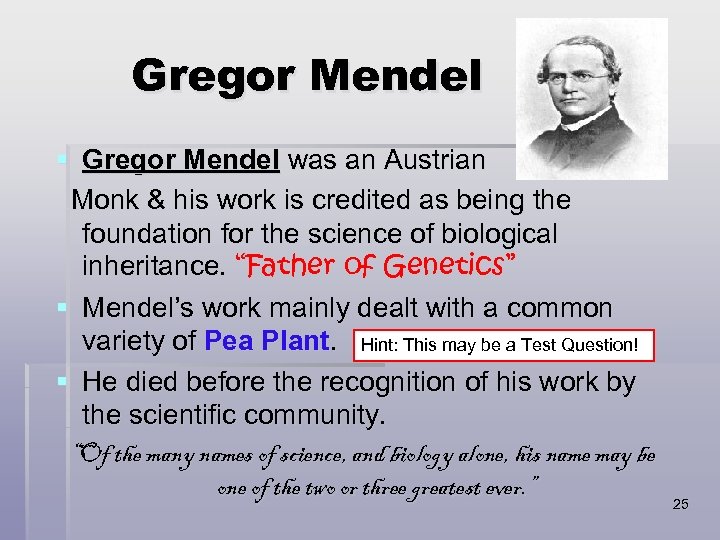
Gregor Mendel § Gregor Mendel was an Austrian Monk & his work is credited as being the foundation for the science of biological inheritance. “Father of Genetics” § Mendel’s work mainly dealt with a common variety of Pea Plant. Hint: This may be a Test Question! § He died before the recognition of his work by the scientific community. “Of the many names of science, and biology alone, his name may be one of the two or three greatest ever. ” 25
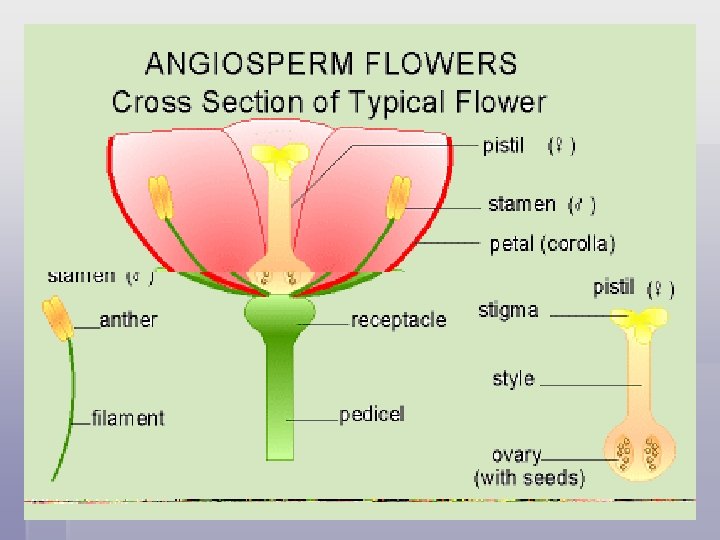
Pea Plants Garden peas: § Like many plants, peas use parts of their flowers to reproduce. § Male parts of flower produce pollen (male gamete) and female parts produce eggs (female gamete). § Flowers (unlike humans) have ability to self pollinate. Draw the cross section of the typical flower!! Note the Male sex organs (Stamen) & Female Sex organs (Pistil) 26
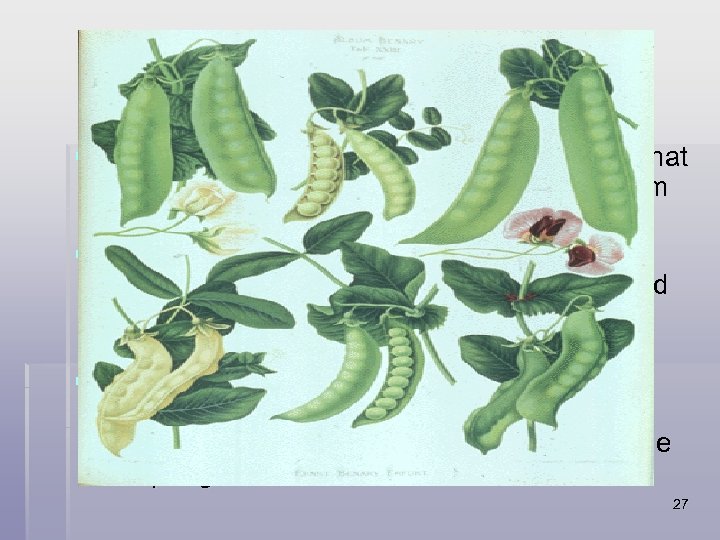
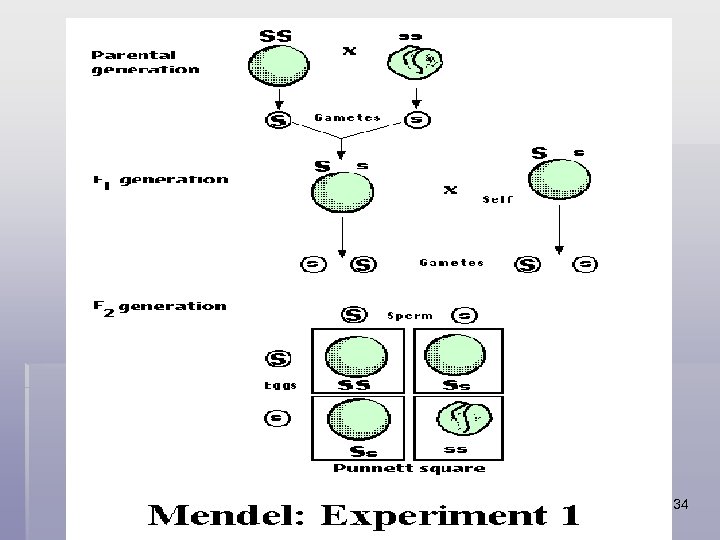
Mendel’s Experimental Design § Mendel took several varieties of Pea plants that had differing characteristics and allowed them to mate. § Most notably the differing characteristics included: Seed Color (green vs. yellow), Seed texture (smooth vs. wrinkled), and Flower color (white vs. pink). § The biggest improvement that Mendel did to this experiment (the experiment had been previously done for decades) was COUNT the Offspring! 27
Mendel’s Luck (Non EOC Material) § Mendel did his work prior to any understanding of DNA, Genes, Mitosis or Meiosis… Most historians think that no one even knew of their existence at all during this time period! § By Mendel choosing Pea Plants to work with, he was extremely lucky: 1. Plants having Male and Female parts can reproduce on their own 2. They have short germination periods (so he could study many generations quickly) 3. The traits he decided to study were the “right” ones to look at…easily distinguished! 28
Mendel’s Findings § He noticed that several plants, when left to reproduce by themselves, would always recreate a copy of the original parent. (He called these True-breeding) § We now know that these true-breeding plants would be called Homozygous (2 of the same alleles) § He also noticed that some of the plants would produce offspring that were different from the original plant. He called these Hybrids, we now refer to them as Heterozygous (2 different alleles) 29
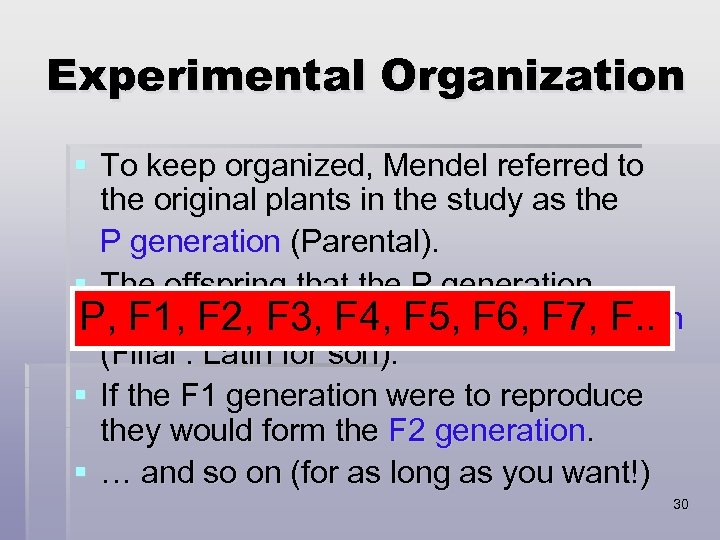
Experimental Organization § To keep organized, Mendel referred to the original plants in the study as the P generation (Parental). § The offspring that the P generation produced were F 4, F 5, F 1 F 7, F. . P, F 1, F 2, F 3, labeled the. F 6, generation (Filial : Latin for son). § If the F 1 generation were to reproduce they would form the F 2 generation. § … and so on (for as long as you want!) 30
Mendel’s Great Contribution § While counting the offspring of different crosses (mating between plants), Mendel noticed that you could use PROBABILITY to predict the outcome of the next generation! § Mendel (with the help of some other mathematicians) had discovered a way to predict what future generations would look like! § The method that he used are called “Punnett Squares” and they are still used today. 31
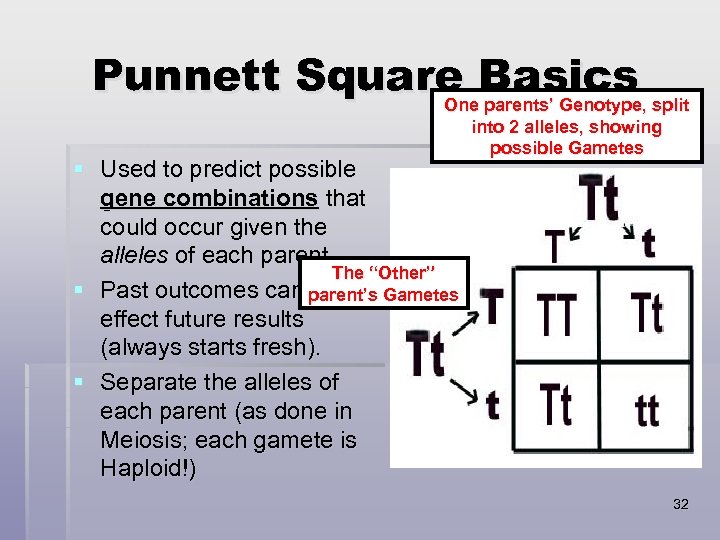
Punnett Square Basics split One parents’ Genotype, § Used to predict possible gene combinations that could occur given the alleles of each parent. The “Other” § Past outcomes can parent’s Gametes NOT effect future results (always starts fresh). § Separate the alleles of each parent (as done in Meiosis; each gamete is Haploid!) into 2 alleles, showing possible Gametes 32
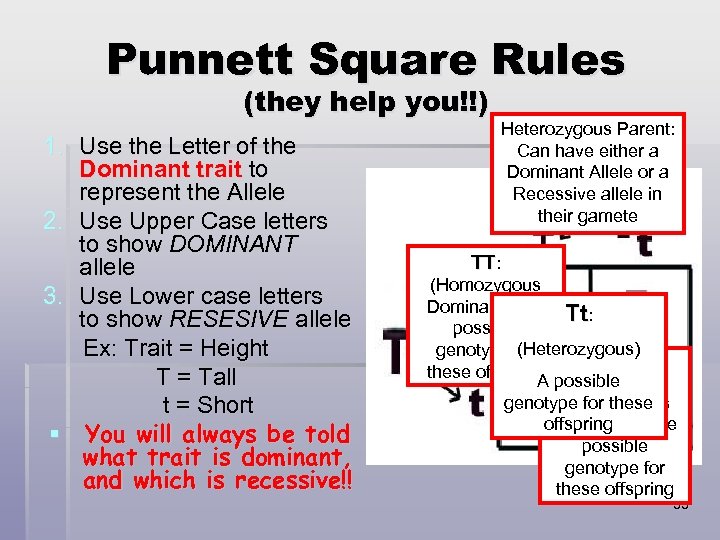
Punnett Square Rules (they help you!!) 1. Use the Letter of the Dominant trait to represent the Allele 2. Use Upper Case letters to show DOMINANT allele 3. Use Lower case letters to show RESESIVE allele Ex: Trait = Height T = Tall t = Short § You will always be told what trait is dominant, and which is recessive!! Heterozygous Parent: Can have either a Dominant Allele or a Recessive allele in their gamete TT: (Homozygous Dominant) one Tt: possible (Heterozygous) genotype for tt: tt these offspring A possible (Homozygous genotype for these Recessive) one offspring possible genotype for these offspring 33
34
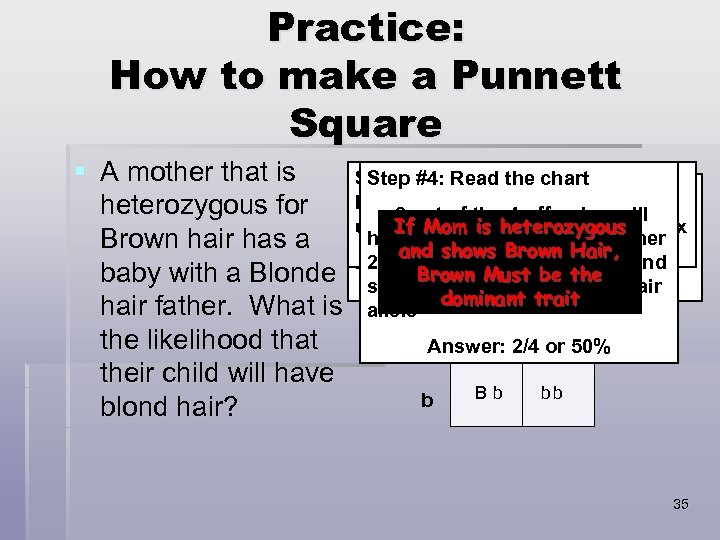
Practice: How to make a Punnett Square § A mother that is heterozygous for Brown hair has a baby with a Blonde hair father. What is the likelihood that their child will have blond hair? Step #3: Place eachchart in the Step #4: Read the letter Step #2: Place Parents alleles Step #1: or next box that is below it, Draw atoo, alongsideof the 4 offspring will 2 out of square. until. If Mom is 2 letters in each box you have heterozygous Punnett square Mom: Heterozygous (Bb) other have blonde hair (bb), the and shows Brown Hair, Dad: Homozygous Recessiveand ) 2 will be heterozygous (Bb) (bb Brown B Must be the b Only Dominant Brown hair show theway to have Blond hair!! dominant trait allele Bb bb b Answer: 2/4 or 50% b Bb bb 35
Mendel’s Next Question (Non EOC Material) § After Mendel had become comfortable using Punnett squares on one trait, he started to wonder; “could you look at two different traits (Example: Flower color & Seed texture) at the same time? ” YES! And they seemed not to have any effect on one another!!! 36
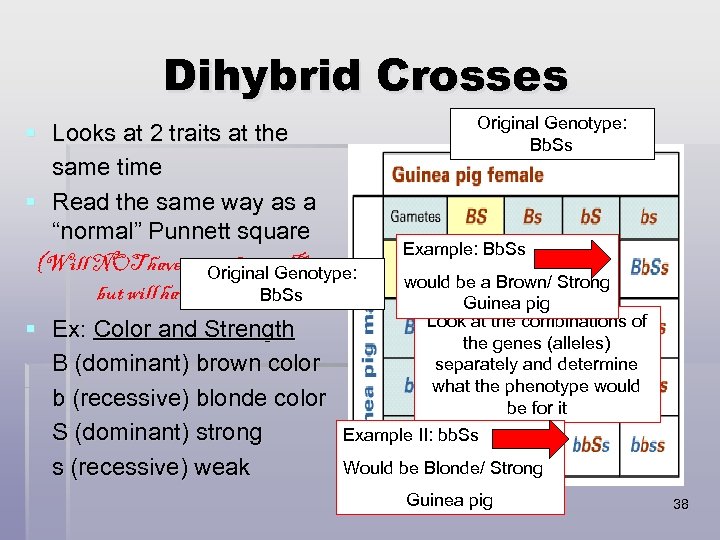
Dihybrid Crosses § Looks at 2 traits at the same time § Read the same way as a “normal” Punnett square (Will NOT have to produce on Exam, Original Genotype: but will have to “read”Bb. Ss one!) § Ex: Color and Strength B (dominant) brown color b (recessive) blonde color S (dominant) strong s (recessive) weak Original Genotype: Bb. Ss Example: Bb. Ss would be a Brown/ Strong Guinea pig Look at the combinations of the genes (alleles) separately and determine what the phenotype would be for it Example II: bb. Ss Would be Blonde/ Strong Guinea pig 38
Test Cross § If given an organism that shows the dominant Phenotype, can you determine it’s Genotype just by looking at it? NO • A Test Cross was designed to determine the Genotype of a Dominant Phenotype • Simply cross the unknown Dominant Phenotype with a Homozygous Recessive organism. Your % of offspring will tell you what the original organism was. 39
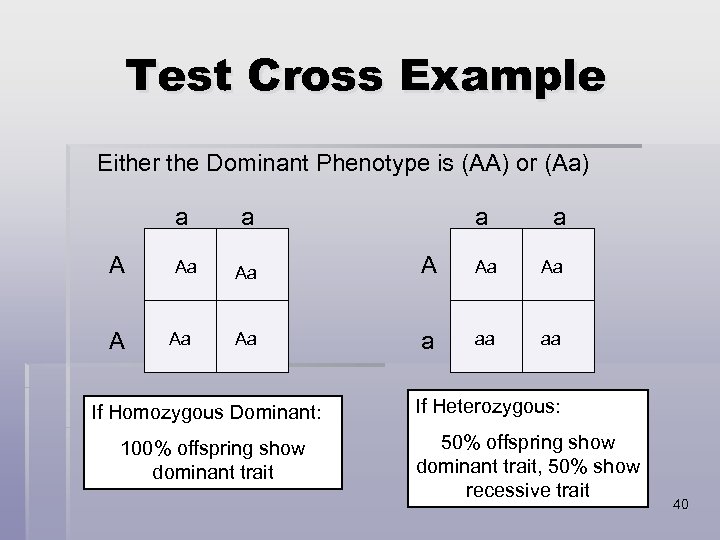
Test Cross Example Either the Dominant Phenotype is (AA) or (Aa) a A A a Aa Aa Aa a aa aa Aa If Homozygous Dominant: 100% offspring show dominant trait a a If Heterozygous: 50% offspring show dominant trait, 50% show recessive trait 40
Mendel’s Laws (So after all this, what did he learn? ) Mendel’s Laws of Heredity: 1. Principle of Dominance: Some alleles (traits) are dominant over others. 2. Law of Segregation: alternative alleles of a trait segregate (split) in a heterozygous individual and remain distinct from each other. (Meiosis) 3. Law of Independent Assortment: Genes assort (separate) completely independent of one another Examples 41
Exceptions to the Rules (Rules were made to be broken) § § 1. 2. 3. 4. 5. Mendel’s Laws are referred to as “Simple Mendelian Inheritance” As with all things, there are exceptions. We will focus on 5: Incomplete Dominance Codominance Multiple Alleles Polygenetic Inheritance Sex Determination (Sex Chromosomes) 43
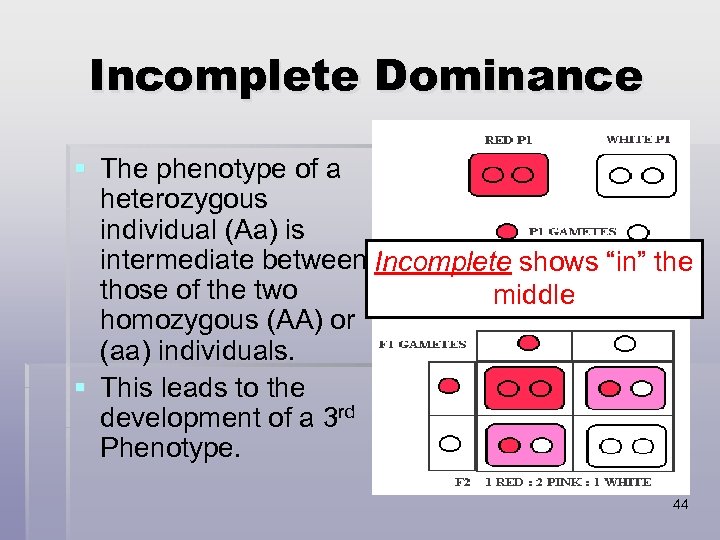
Incomplete Dominance § The phenotype of a heterozygous individual (Aa) is intermediate between Incomplete shows “in” the those of the two middle homozygous (AA) or (aa) individuals. § This leads to the development of a 3 rd Phenotype. 44
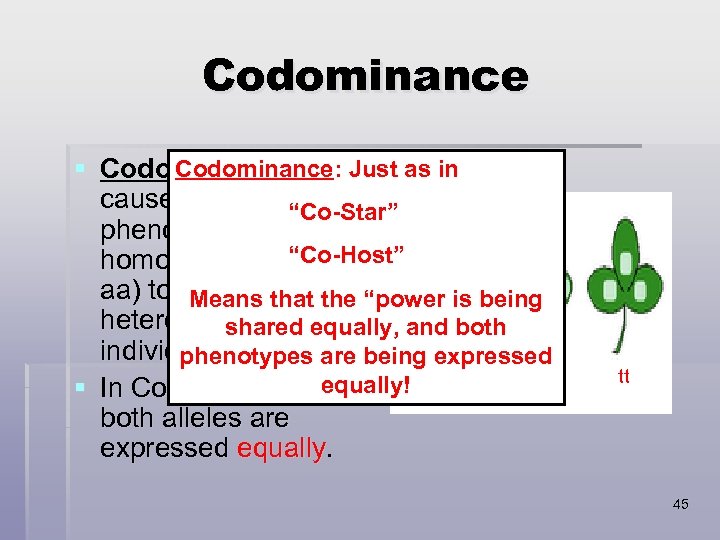
Codominance: § Codominant alleles. Just as in cause the “Co-Star” phenotypes of both “Co-Host” homozygotes (AA, aa) to be produced in“power is being Means that the heterozygous (Aa) shared equally, and both individuals. phenotypes are being expressed Tt TT § In Codominance, equally! both alleles are expressed equally. tt 45
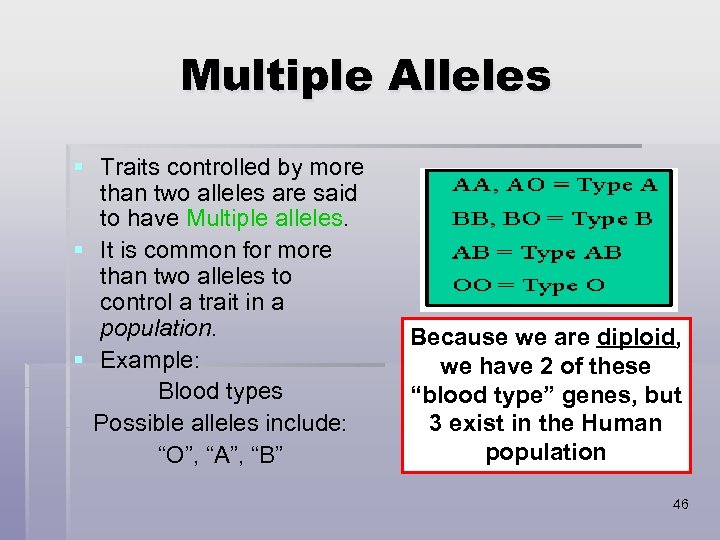
Multiple Alleles § Traits controlled by more than two alleles are said to have Multiple alleles. § It is common for more than two alleles to control a trait in a population. § Example: Blood types Possible alleles include: “O”, “A”, “B” Because we are diploid, we have 2 of these “blood type” genes, but 3 exist in the Human population 46
Blood Types (while we are discussing it!) § § § 3 different alleles exist in nature: A, B, and O. “A” and “B” are both dominant to “O” If a person has both an “A” allele and a “B” allele, they show Codominance. § We use a capital i (“I”) to show the dominant form (ex. IA), and a lower case “i” for the recessive O allele. § Example: Someone who has an “A” allele and an “O” allele would be written as (IA, i) 47
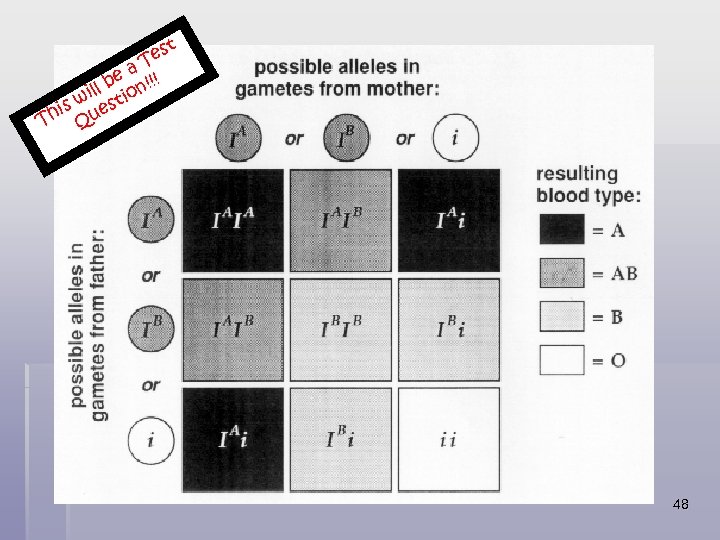
t s Te e a !!! b ill tion w is ues Th Q 48
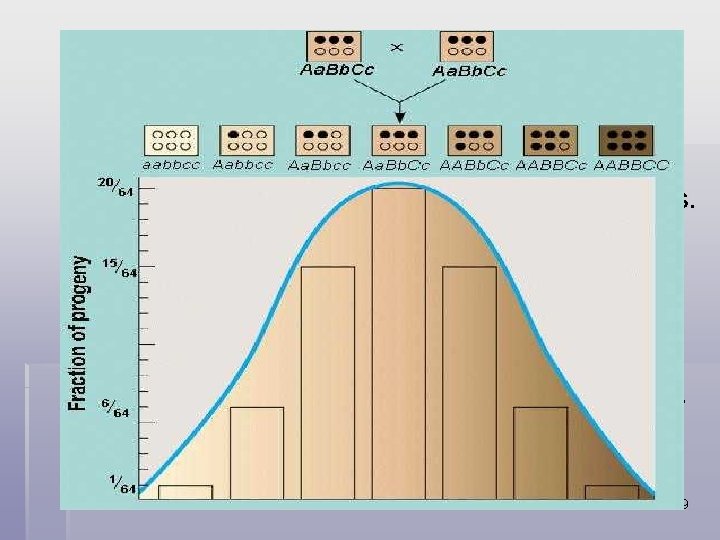
Polygenetic Inheritance § Polygenic inheritance is the inheritance pattern of a trait that is controlled by two or more genes. § The genes may/ or may not be on the same chromosome, and often have more than two alleles. § The result is that the phenotype usually shows a continuous range of variability from the minimum value to the maximum value. 49
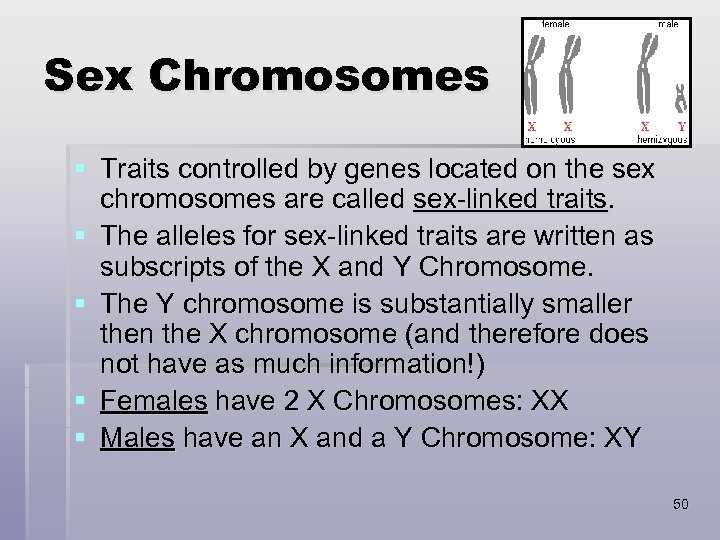
Sex Chromosomes § Traits controlled by genes located on the sex chromosomes are called sex-linked traits. § The alleles for sex-linked traits are written as subscripts of the X and Y Chromosome. § The Y chromosome is substantially smaller then the X chromosome (and therefore does not have as much information!) § Females have 2 X Chromosomes: XX § Males have an X and a Y Chromosome: XY 50
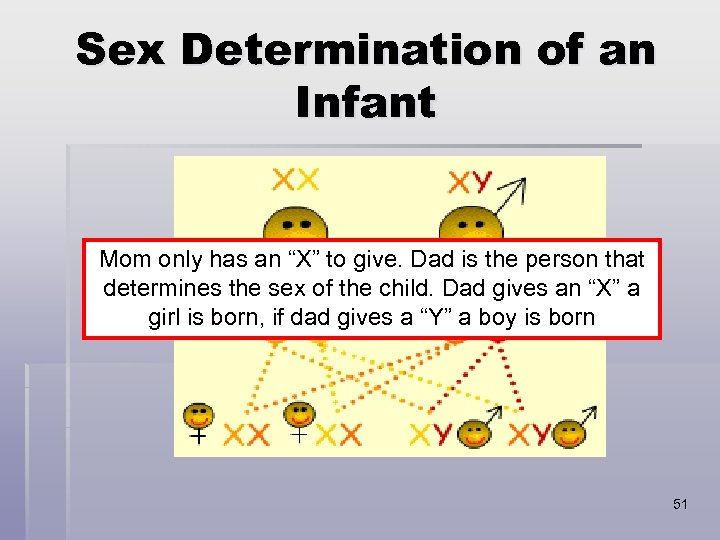
Sex Determination of an Infant Mom only has an “X” to give. Dad is the person that determines the sex of the child. Dad gives an “X” a girl is born, if dad gives a “Y” a boy is born 51
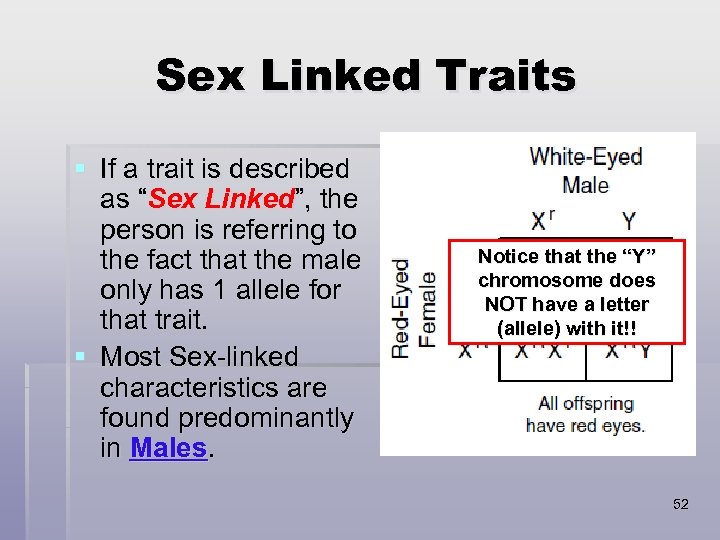
Sex Linked Traits § If a trait is described as “Sex Linked”, the person is referring to the fact that the male only has 1 allele for that trait. § Most Sex-linked characteristics are found predominantly in Males. Notice that the “Y” chromosome does NOT have a letter (allele) with it!! 52
Pedigree § Scientists sometimes need a way to follow a trait threw multiple generations, this is done with the use of a special flow diagram. § A Pedigree is: A diagram made up of a set of symbols that identify; Male/ Female, relationships with other generations, and people affected by “studied trait” thru generations. 53
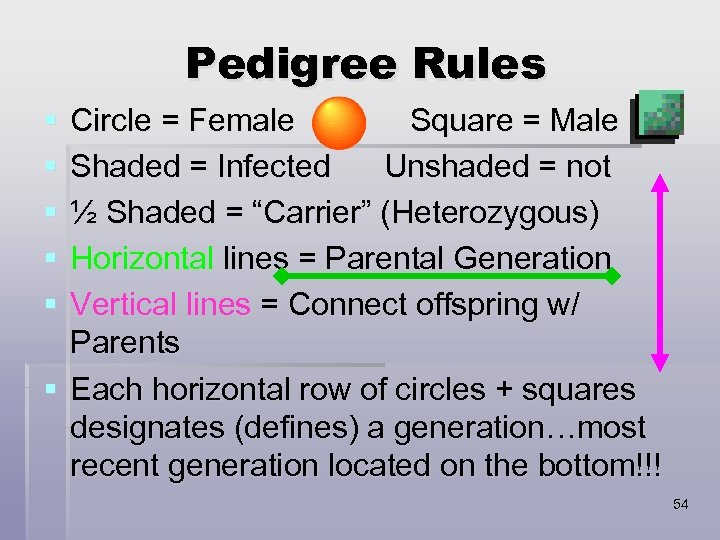
Pedigree Rules § § § Circle = Female Square = Male Shaded = Infected Unshaded = not ½ Shaded = “Carrier” (Heterozygous) Horizontal lines = Parental Generation Vertical lines = Connect offspring w/ Parents § Each horizontal row of circles + squares designates (defines) a generation…most recent generation located on the bottom!!! 54
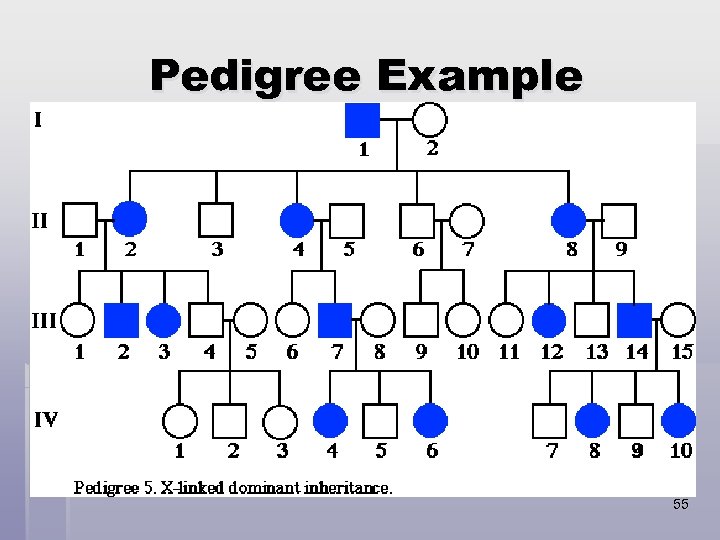
Pedigree Example 55
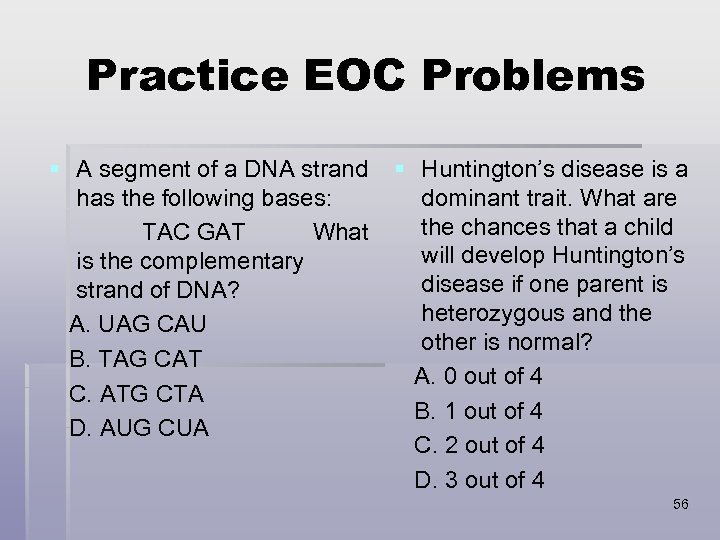
Practice EOC Problems § A segment of a DNA strand has the following bases: TAC GAT What is the complementary strand of DNA? A. UAG CAU B. TAG CAT C. ATG CTA D. AUG CUA § Huntington’s disease is a dominant trait. What are the chances that a child will develop Huntington’s disease if one parent is heterozygous and the other is normal? A. 0 out of 4 B. 1 out of 4 C. 2 out of 4 D. 3 out of 4 56
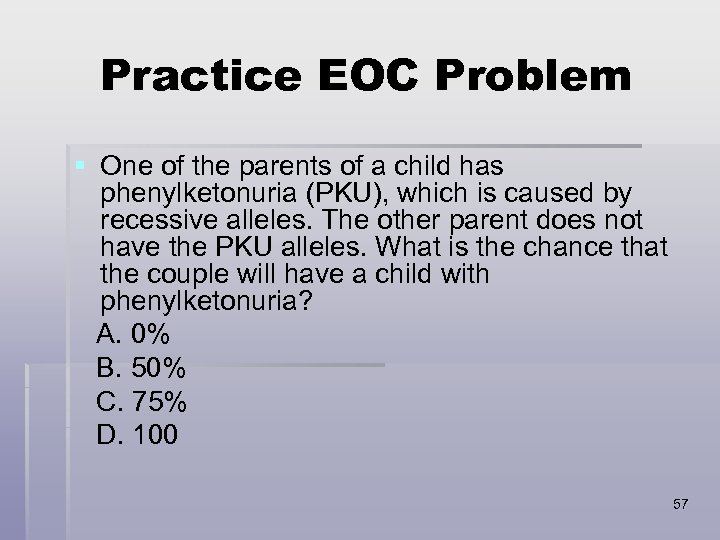
Practice EOC Problem § One of the parents of a child has phenylketonuria (PKU), which is caused by recessive alleles. The other parent does not have the PKU alleles. What is the chance that the couple will have a child with phenylketonuria? A. 0% B. 50% C. 75% D. 100 57
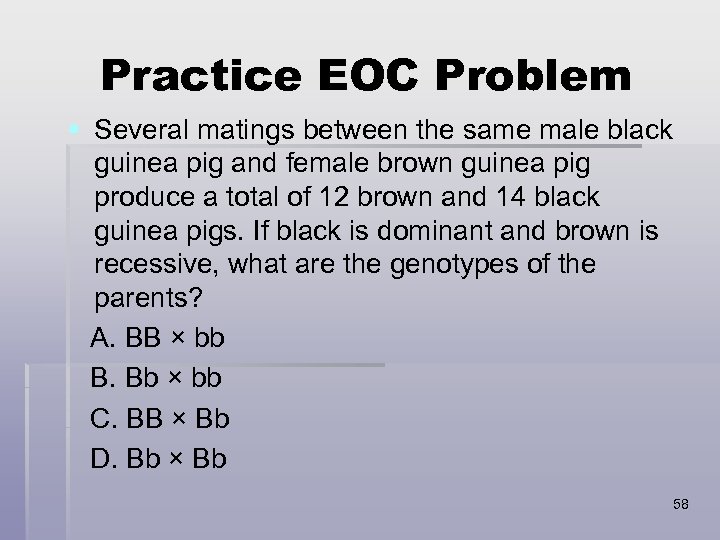
Practice EOC Problem § Several matings between the same male black guinea pig and female brown guinea pig produce a total of 12 brown and 14 black guinea pigs. If black is dominant and brown is recessive, what are the genotypes of the parents? A. BB × bb B. Bb × bb C. BB × Bb D. Bb × Bb 58
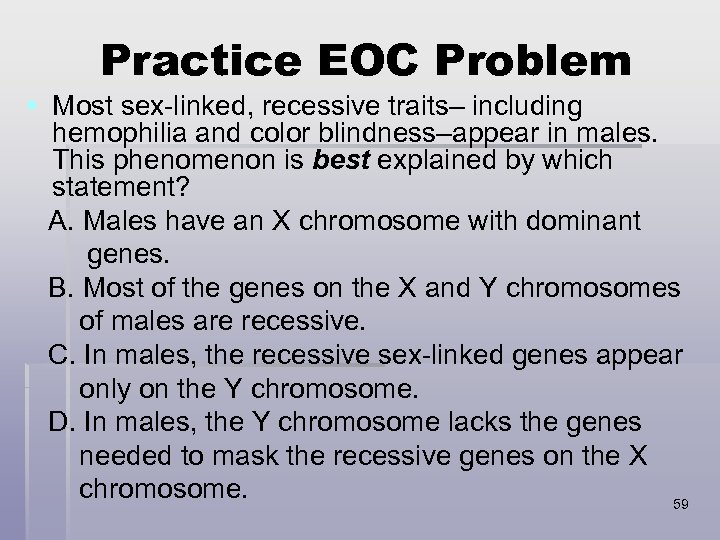
Practice EOC Problem § Most sex-linked, recessive traits– including hemophilia and color blindness–appear in males. This phenomenon is best explained by which statement? A. Males have an X chromosome with dominant genes. B. Most of the genes on the X and Y chromosomes of males are recessive. C. In males, the recessive sex-linked genes appear only on the Y chromosome. D. In males, the Y chromosome lacks the genes needed to mask the recessive genes on the X chromosome. 59
Practice EOC Problem § In genetics research, what is the purpose of a test cross? A. to determine the phenotypes of the parents B. to determine the genotypes of the parents C. to determine whether or not two parents could produce viable offspring D. to determine how many offspring can be produced by two parents 60
Practice EOC Problem § A couple has five children, all with blood type A. The mother’s blood type is O, and the father’s blood type is A. Based on this information, which describes the most probable genotype of the father? A. diploid B. haploid C. heterozygous D. homozygous 61
Practice EOC Problem § Some flowers show incomplete dominance. If RR = white and R′R′ = red, which phenotypic ratio would be expected in the offspring of two pink flowers? A. 1 red : 2 pink : 1 white B. 0 red : 4 pink : 0 white C. 3 red : 0 pink : 1 white D. 4 red : 0 pink : 0 white 62
Practice EOC Problem § Which set of parents can most likely produce a child with type O blood? A. one parent with type AB blood, and the other parent with type A blood B. one parent with type AB blood, and the other parent with type O blood C. one parent with heterozygous type A blood, and the other parent with type O blood D. one parent with homozygous type A blood, and the other parent with homozygous type B blood 63
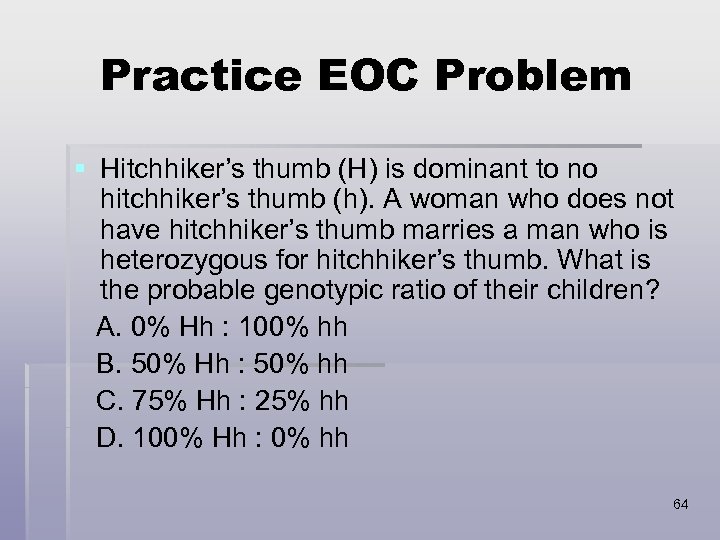
Practice EOC Problem § Hitchhiker’s thumb (H) is dominant to no hitchhiker’s thumb (h). A woman who does not have hitchhiker’s thumb marries a man who is heterozygous for hitchhiker’s thumb. What is the probable genotypic ratio of their children? A. 0% Hh : 100% hh B. 50% Hh : 50% hh C. 75% Hh : 25% hh D. 100% Hh : 0% hh 64
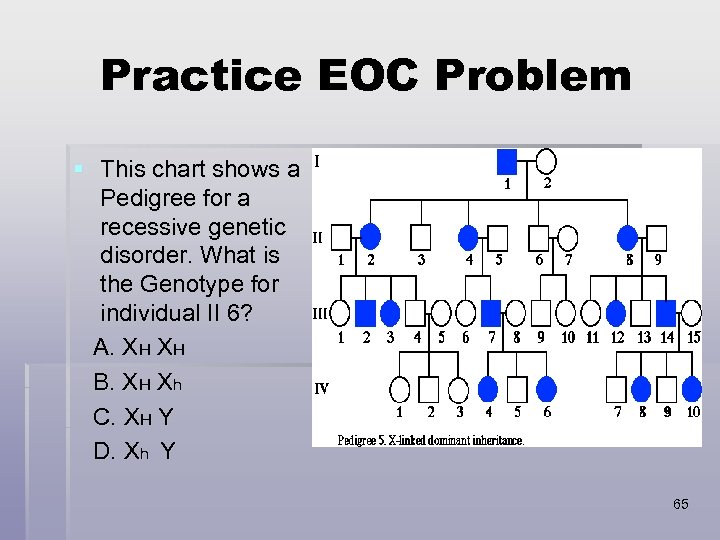
Practice EOC Problem § This chart shows a Pedigree for a recessive genetic disorder. What is the Genotype for individual II 6? A. XH XH B. XH Xh C. XH Y D. Xh Y 65
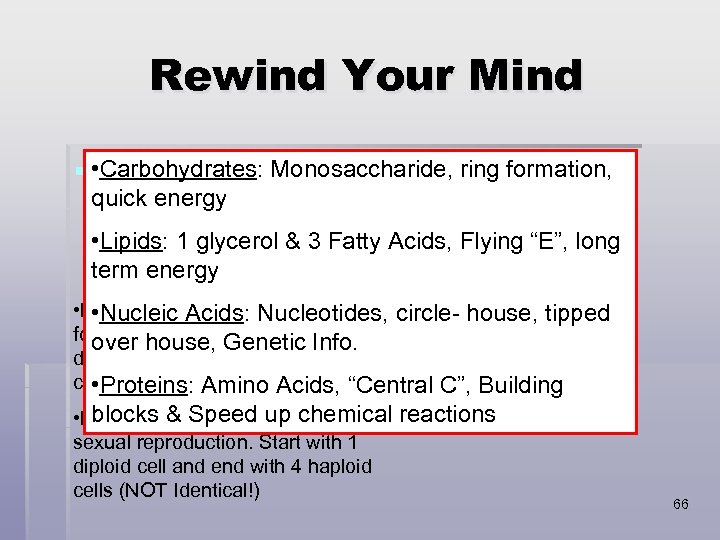
Rewind Your Mind § • Carbohydrates: Monosaccharide, ringare the 4 What are the § What formation, quick energy fundamental Macromolecules, differences between their monomers, • Lipids: 1 glycerol & 3 Fatty Acids, Flying “E”, long term energy Meiosis? Mitosis and structure, and function? • Mitosis occurs in Somatic Cells, • Nucleic Acids: Nucleotides, circle- house, tipped for growth and repair. Start Info. 1 over house, Genetic with diploid cell and end with 2 diploid cells (Identical) • Proteins: Amino Acids, “Central C”, Building blocks & Speed up chemical reactions • Meiosis occurs in gametes, for sexual reproduction. Start with 1 diploid cell and end with 4 haploid cells (NOT Identical!) 66
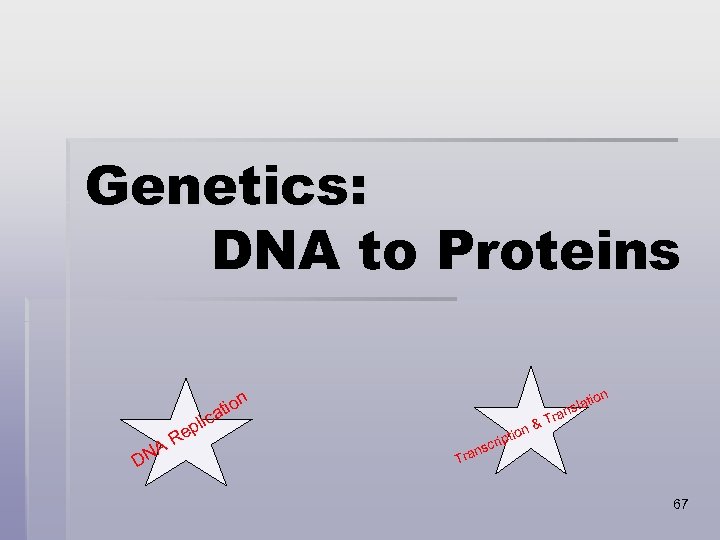
Genetics: DNA to Proteins n tio ca pli DN Re A on lati ns ra T n& tio rip nsc Tra 67
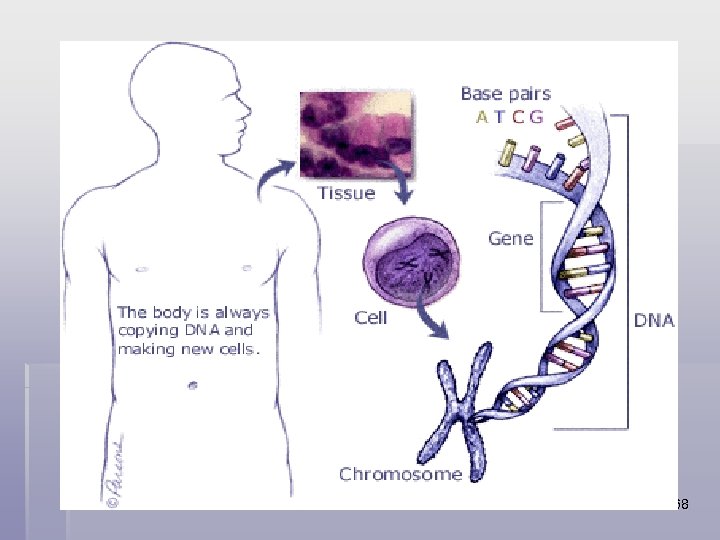
68
So How does DNA Actually Get its Power? (FYI) § This section will focus on the processes that Nucleic Acids go thru to actually make the Proteins (and therefore the Traits!) that we have been discussing!! 69
Nucleic Acid Processes § The Nucleic Acids in each of your cells goes thru 3 distinct processes in its lifetime. § Each of these are very important, and some of the mechanics on how they are done is similar. § The 3 processes are: 1. DNA Replication 2. Transcription 3. Translation 70
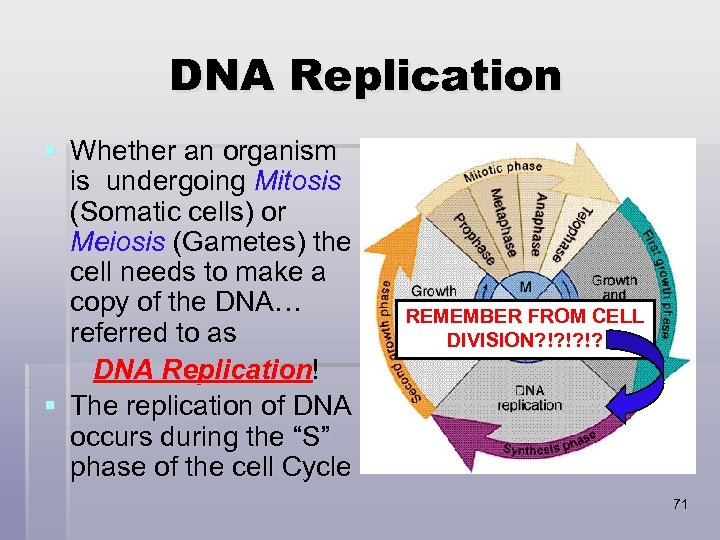
DNA Replication § Whether an organism is undergoing Mitosis (Somatic cells) or Meiosis (Gametes) the cell needs to make a copy of the DNA… referred to as DNA Replication! § The replication of DNA occurs during the “S” phase of the cell Cycle REMEMBER FROM CELL DIVISION? !? !? !? 71
How DNA Replicates § Because each molecule of DNA is composed of 2 strands, the bases of one strand can tell you the order of the other strand (Complimentary Base Pairs) § During replication each strand serves as a template to form a new strand of DNA. § Replication begins with the breaking of Weak Hydrogen bonds…done by an enzyme!! 72
Continued… § As the DNA “unzips”, nucleotides that are free in the surrounding solution start to form hydrogen bonds with the old DNA. (With help from different enzymes!) § The process continues until all of the DNA has been “copied”…and the process of Mitosis or Meiosis can begin…ensuring that all daughter cells have a complete copy of the original information stored in the DNA. 73
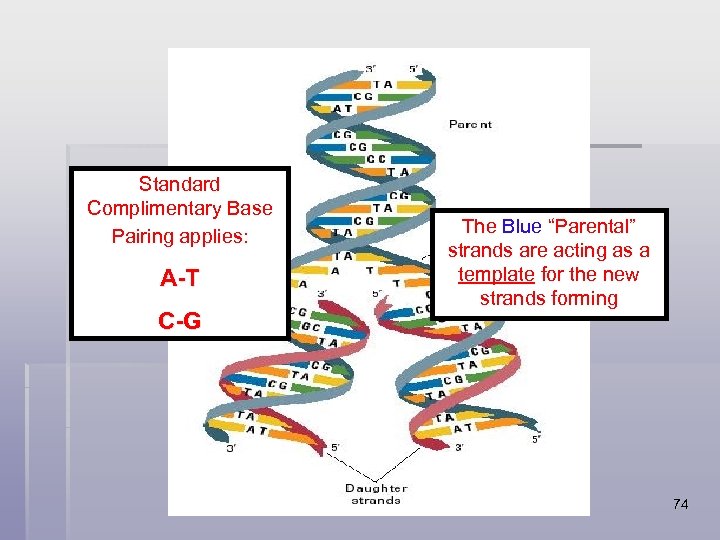
Standard Complimentary Base Pairing applies: A-T C-G The Blue “Parental” strands are acting as a template for the new strands forming 74
From DNA to Protein § The process of turning DNA into an Amino Acid (protein) sequence takes 2 parts: Transcription and Translation § For these events to occur, DNA needs the assistance of RNA (Ribonucleic Acid) § There are 3 types of RNA: m. RNA (Messenger) r. RNA (Ribosome) t. RNA (Transfer) 75
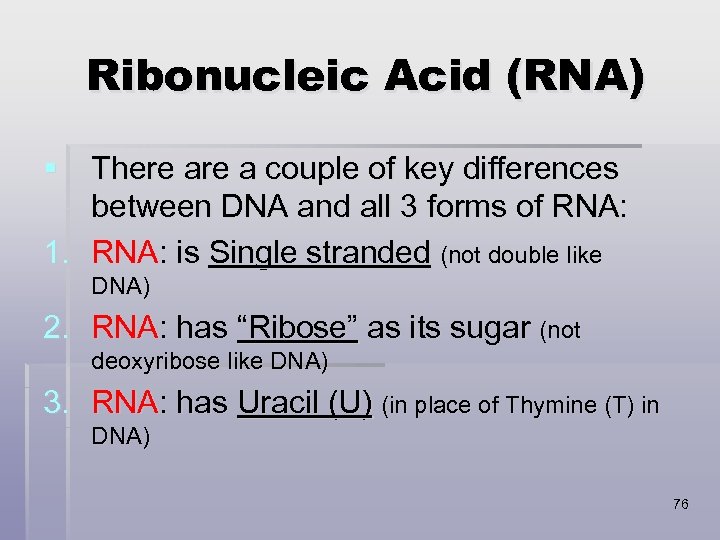
Ribonucleic Acid (RNA) § There a couple of key differences between DNA and all 3 forms of RNA: 1. RNA: is Single stranded (not double like DNA) 2. RNA: has “Ribose” as its sugar (not deoxyribose like DNA) 3. RNA: has Uracil (U) (in place of Thymine (T) in DNA) 76
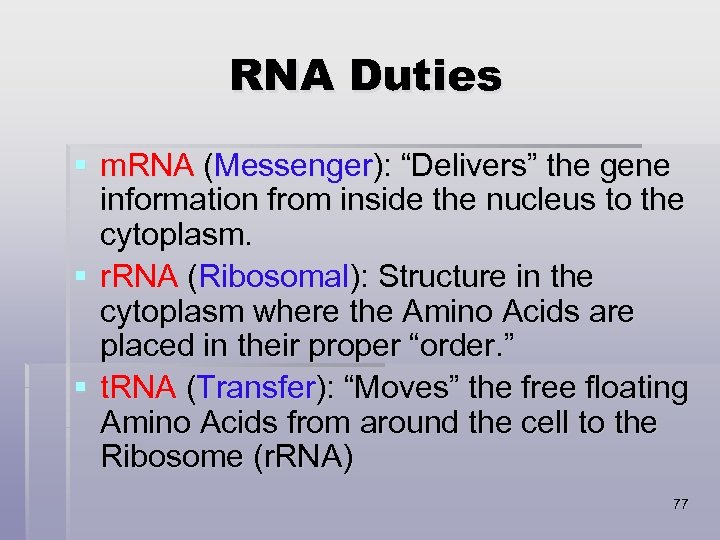
RNA Duties § m. RNA (Messenger): “Delivers” the gene information from inside the nucleus to the cytoplasm. § r. RNA (Ribosomal): Structure in the cytoplasm where the Amino Acids are placed in their proper “order. ” § t. RNA (Transfer): “Moves” the free floating Amino Acids from around the cell to the Ribosome (r. RNA) 77
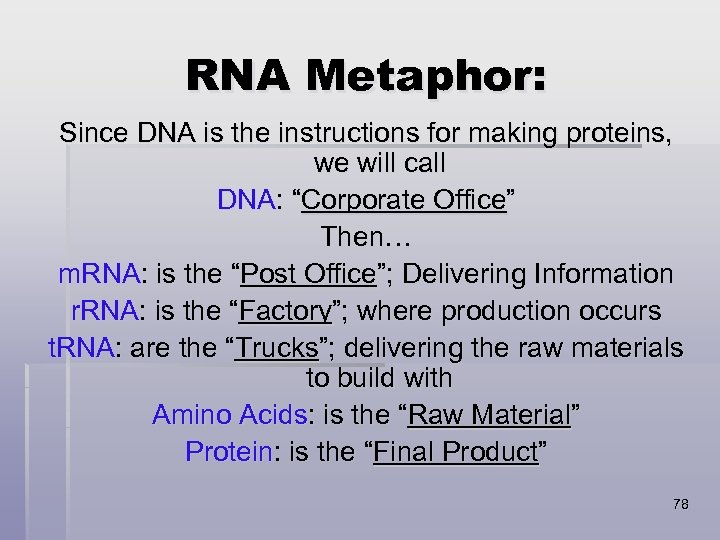
RNA Metaphor: Since DNA is the instructions for making proteins, we will call DNA: “Corporate Office” Then… m. RNA: is the “Post Office”; Delivering Information r. RNA: is the “Factory”; where production occurs t. RNA: are the “Trucks”; delivering the raw materials to build with Amino Acids: is the “Raw Material” Protein: is the “Final Product” 78
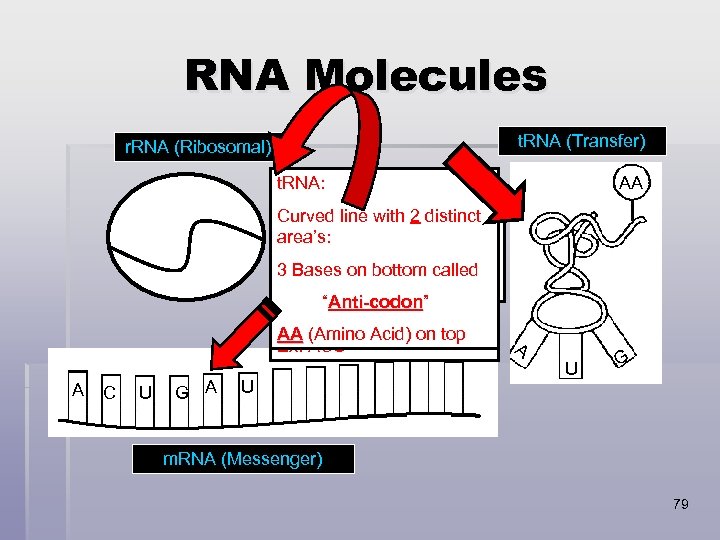
RNA Molecules t. RNA (Transfer) r. RNA (Ribosomal) t. RNA: m. RNA: Curved line with 2 distinct Shown r. RNA: as a straight line area’s: with Nitrogenous bases Basically a circle with 2 3 sticking on bottomsection Bases up. Each called parts. Floats in called of 3 Bases cytoplasm “Anti-codon” Anti-codon “CODON” CODON AA (Amino Acid) on top Ex: ACU A C U G A U AA A U G m. RNA (Messenger) 79
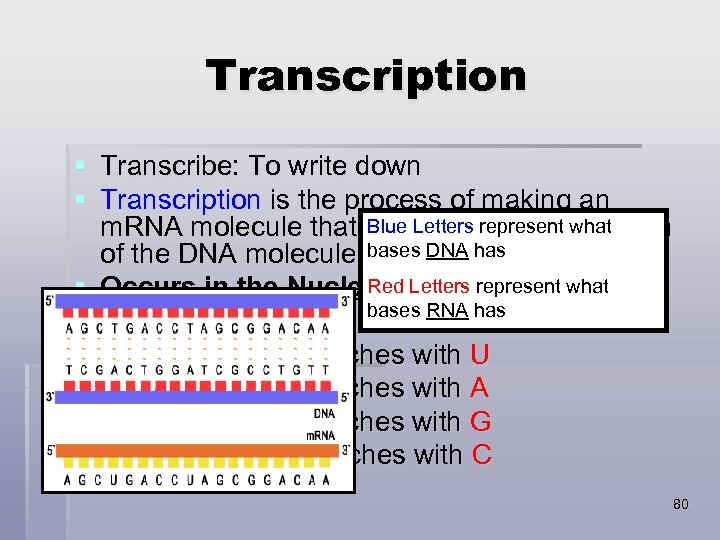
Transcription § Transcribe: To write down § Transcription is the process of making an Blue Letters a small section m. RNA molecule that codes forrepresent what bases DNA of the DNA molecule (1 gene). has Red § Occurs in the Nucleus Letters represent what bases RNA has § DNA to m. RNA: A matches with U T matches with A C matches with G G matches with C 80
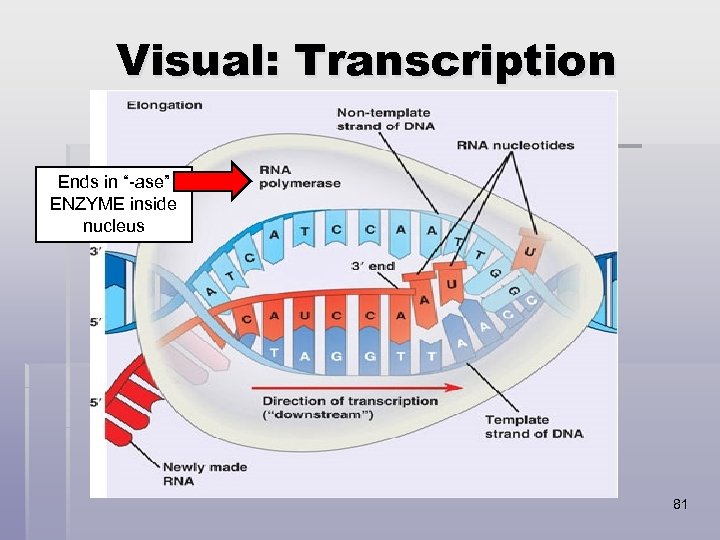
Visual: Transcription Ends in “-ase” ENZYME inside nucleus 81
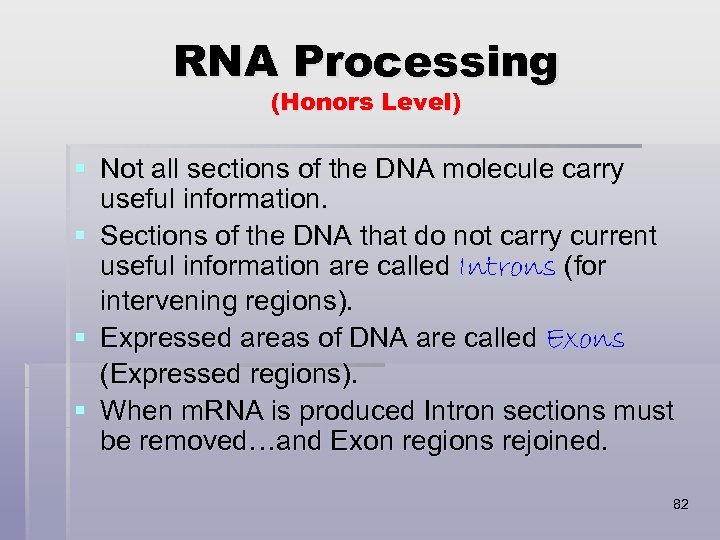
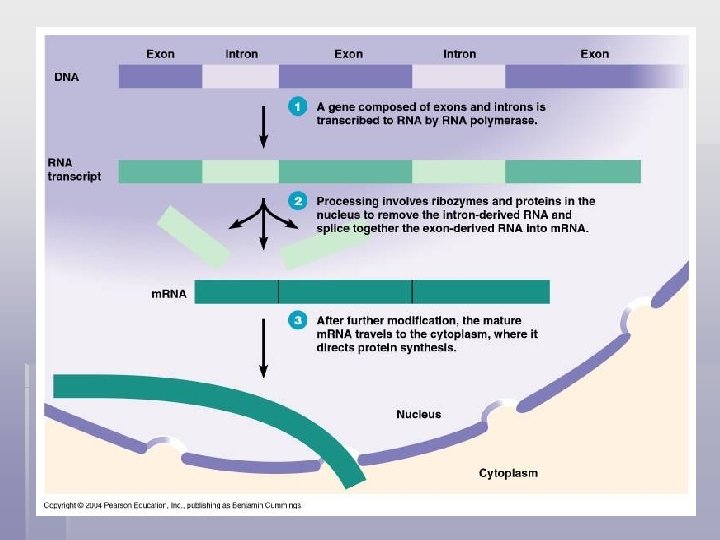
RNA Processing (Honors Level) § Not all sections of the DNA molecule carry useful information. § Sections of the DNA that do not carry current useful information are called Introns (for intervening regions). § Expressed areas of DNA are called Exons (Expressed regions). § When m. RNA is produced Intron sections must be removed…and Exon regions rejoined. 82
83
Translation § Translate: To change from one form of communication into another. § The process of converting the information in m. RNA into a sequence of Amino Acids in a protein is known as Translation. § Translation takes place at the ribosomes (r. RNA) in the cytoplasm. § m. RNA to Amino Acids 84
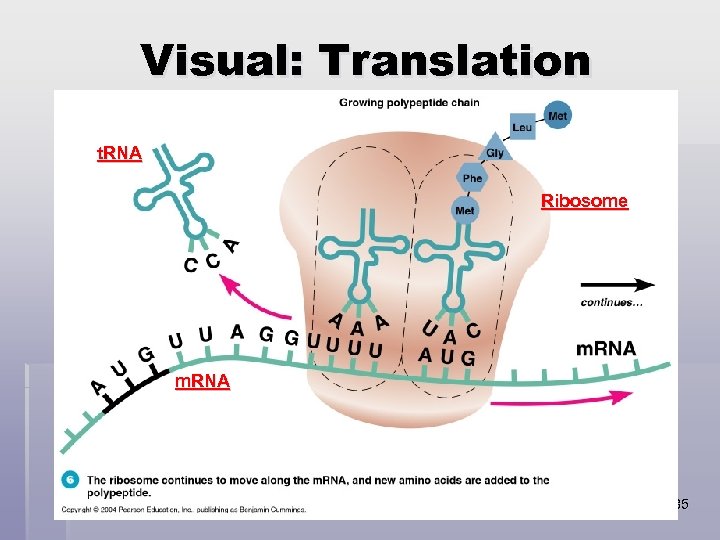
Visual: Translation t. RNA Ribosome m. RNA 85
The Role of Transfer RNA (t. RNA) § For proteins to be built, the 20 different amino acids must be brought to the ribosome. This is the role of t. RNA. § Each t. RNA molecule attaches to only one type of Amino Acid. § Correct “Translation” of the m. RNA gene depends on the proper joining of the m. RNA molecule with the corresponding t. RNA molecule. 86
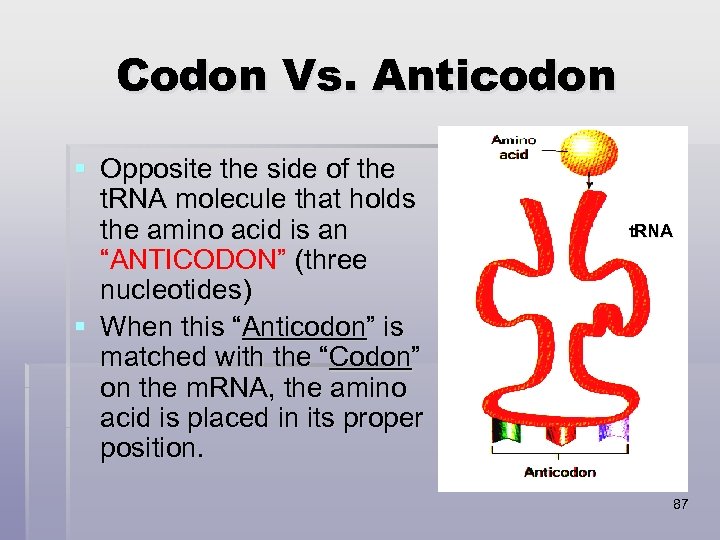
Codon Vs. Anticodon § Opposite the side of the t. RNA molecule that holds the amino acid is an “ANTICODON” (three nucleotides) § When this “Anticodon” is matched with the “Codon” on the m. RNA, the amino acid is placed in its proper position. t. RNA 87
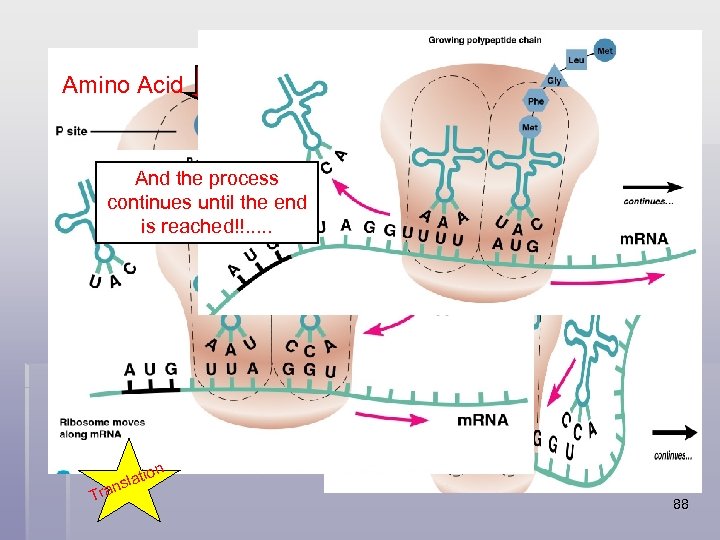
Peptide Bond forming in-between t. RNA Amino Acids Amino Acid And the process continues until the end is reached!!. . . As one t. RNA leaves, another new t. RNA comes in dropping off another Amino Acid n latio ns Tra 88
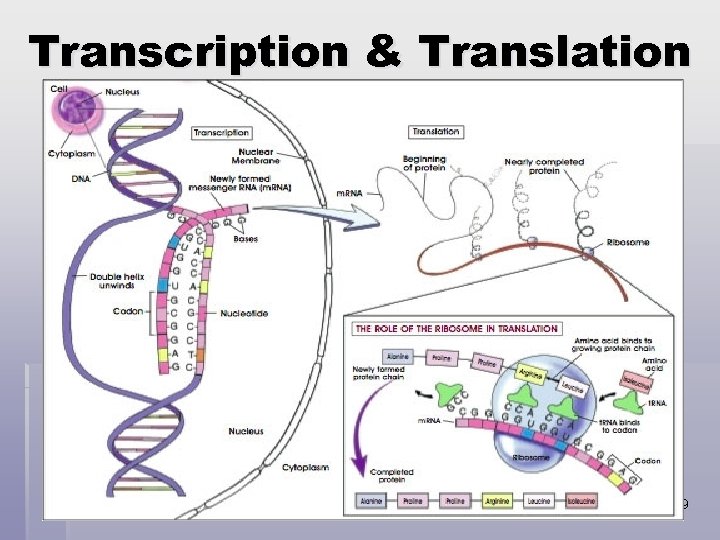
Transcription & Translation 89
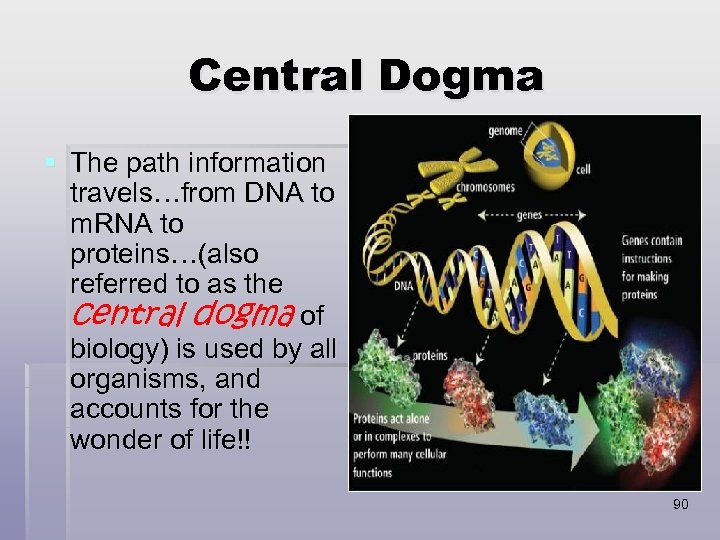
Central Dogma § The path information travels…from DNA to m. RNA to proteins…(also referred to as the central dogma of biology) is used by all organisms, and accounts for the wonder of life!! 90
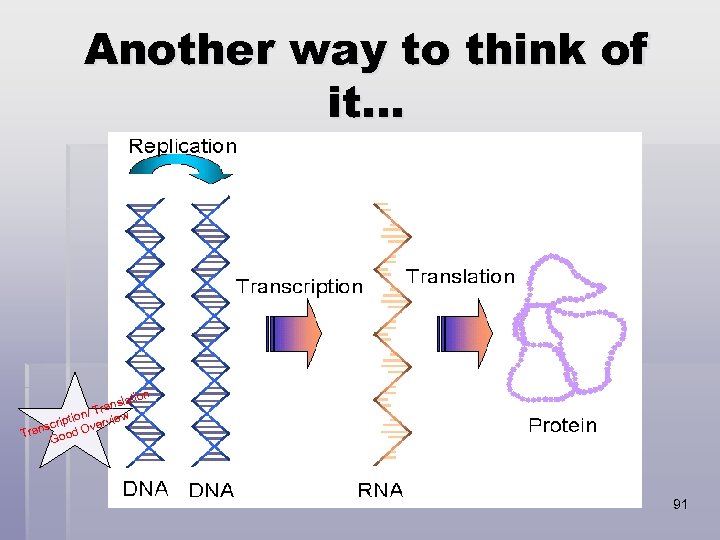
Another way to think of it… ation ansl r n/ T riptio verview sc Tran Good O 91
The “Big Idea”… (Non EOC Material) § The sequence of nucleotides in DNA contains information by holding “building instructions” for Amino Acids. § Amino Acids are able to fold into three dimensional figures (Proteins) that are essential in cell metabolism. Example: Enzymes “The sequence of nucleotides in each gene contains information for making the string of Amino Acids that make up a single protein. ” § How do scientists go from one to the other? 92
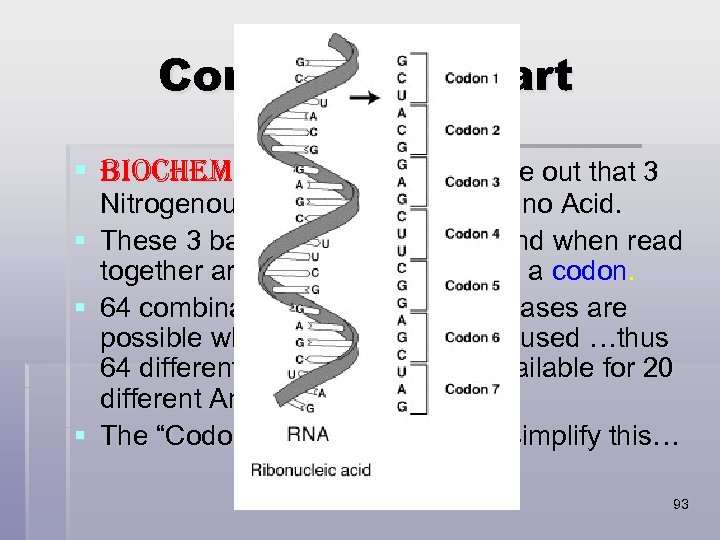
Conversion Chart § Biochemists were able to figure out that 3 Nitrogenous bases code for 1 Amino Acid. § These 3 bases on the m. RNA strand when read together are collectively known as a codon. § 64 combinations of Nitrogenous Bases are possible when a sequence of 3 is used …thus 64 different m. RNA codons are available for 20 different Amino Acids. § The “Codon Chart” was made to simplify this… 93
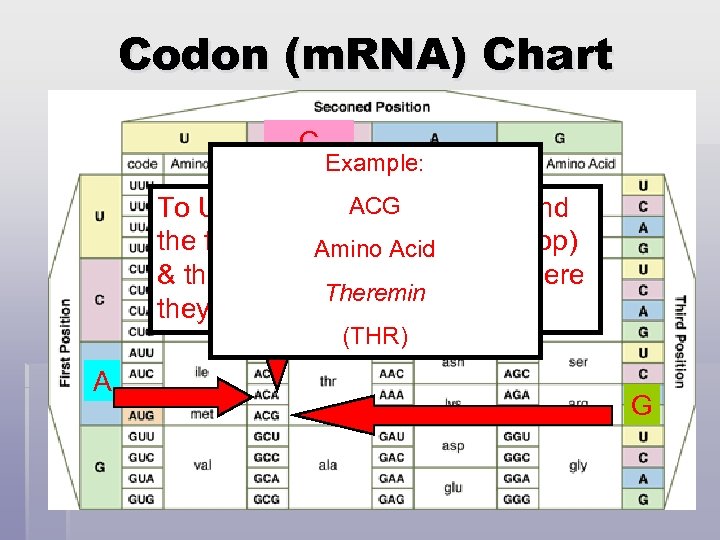
Codon (m. RNA) Chart C Example: ACG To Use this chart, you simply find the first NB (left), second NB (top) Amino ACG Example: Acid & third NB (right)… and see where Theremin they meet! (THR) A G 94
The “Big” Question (FYI) § If all organisms DNA has the same 4 nitrogenous bases… how can we be so different? § The order of the letters is the key to decoding the information…the closer the letters are from one organism to the next, the closer the evolutionary relationship. 95
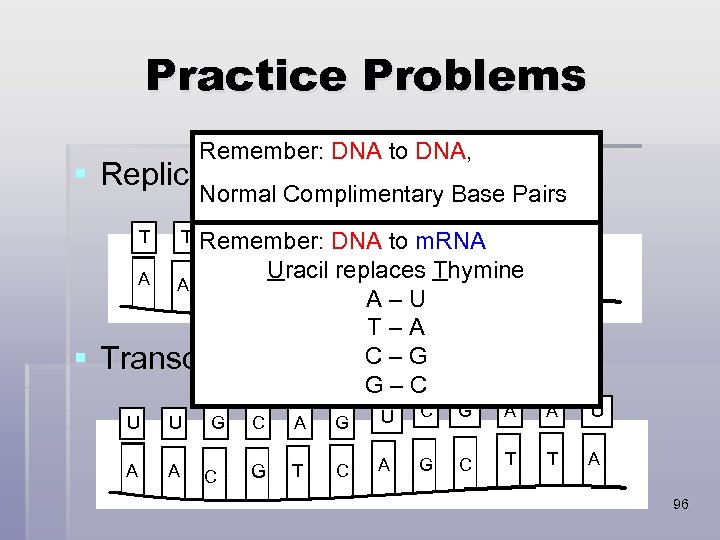
Practice Problems Remember: DNA to DNA, § Replicate: Normal Complimentary Base Pairs T T A G G C A DNATto T G A– C Remember: m. RNA Uracil replaces Thymine T A G C A C G T C C-G A–U T–A C–G Transcribe: G–C A § U U A A G C A T T A C A G U C G A A U G T C A G C T T A 96
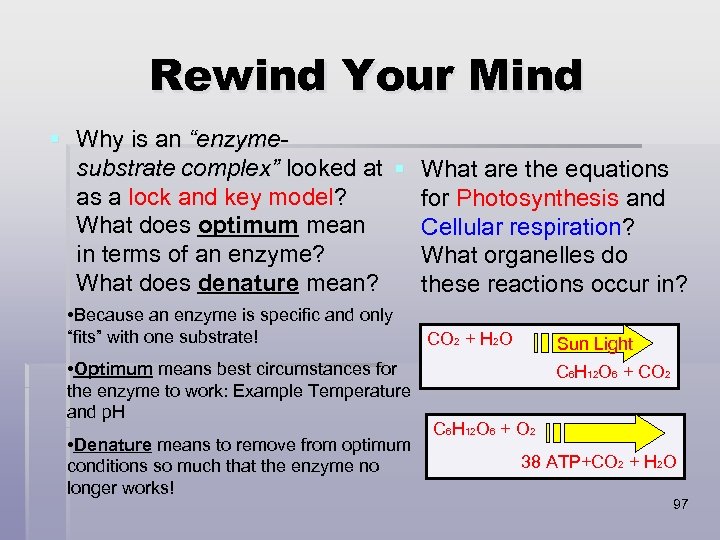
Rewind Your Mind § Why is an “enzymesubstrate complex” looked at § What are the equations as a lock and key model? for Photosynthesis and What does optimum mean Cellular respiration? in terms of an enzyme? What organelles do What does denature mean? these reactions occur in? • Because an enzyme is specific and only “fits” with one substrate! • Optimum means best circumstances for the enzyme to work: Example Temperature and p. H • Denature means to remove from optimum conditions so much that the enzyme no longer works! CO 2 + H 2 O Sun Light C 6 H 12 O 6 + CO 2 C 6 H 12 O 6 + O 2 38 ATP+CO 2 + H 2 O 97
Genetics: Genetic Disease &Technology t c roje P me no Ge rview n ma Ove Hu 98
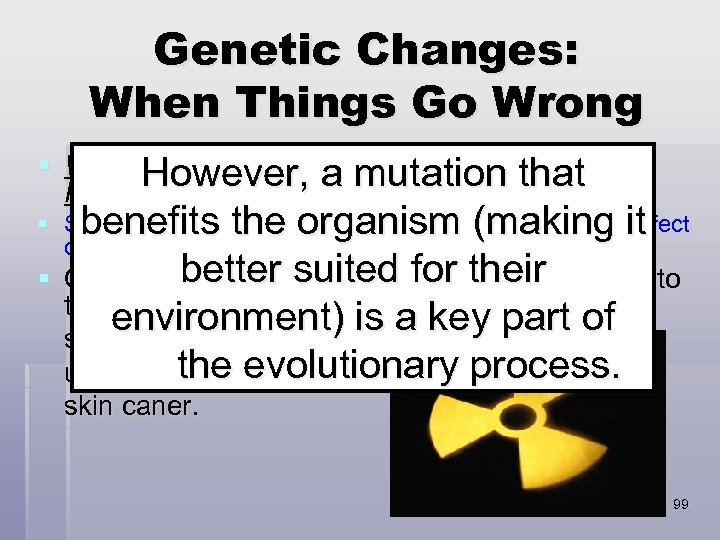
Genetic Changes: When Things Go Wrong § What happens when a mutationof DNA sequence However, the changed by that Nucleotides in a gene is mistake? benefits the organism (making it better suited for lethal Other times the changes can be their(Deadly) to the organism… environment) is a key part of such as the case with the causing ultraviolet lightevolutionary process. § Sometimes the change can have little or no negative effect on the organism. § skin caner. 99
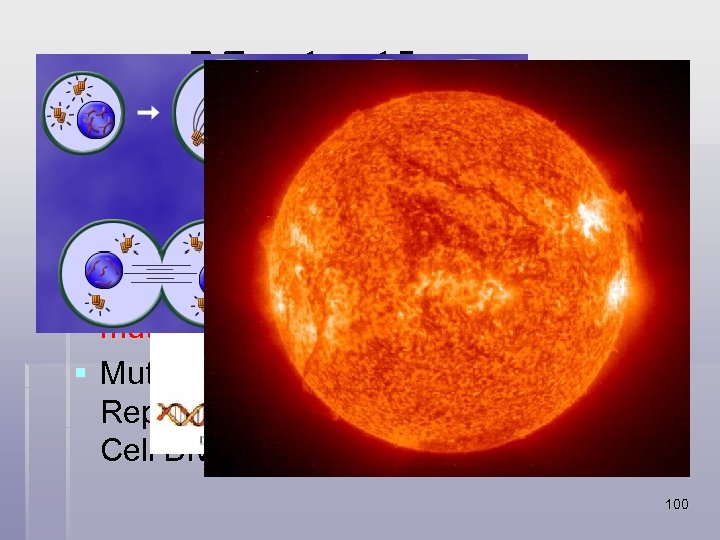
Mutations § Organisms have evolved many mechanism to ensure that DNA is replicated properly…however mistakes happen. These mistakes are called mutations. § Mutations can be caused by errors in Replication, Transcription/ Translation, Cell Division, or by external factors. 100
Causes of Mutations § Some mutations are just random mistakes of nature, however many are caused by a MUTAGEN (any agent that causes a change in DNA). § Mutagens include: radiation, chemicals, and even high temperatures. 101
Cell Type Mutations § Mutations in Gametes (Sex Cells) can be passed onto future generations, and usually occur during Meiosis. § Mutations in Somatic Cells (Body Cells) can not be passed onto future generations, and usually occur during Mitosis. § If this change effects cell reproduction, the change may produce rapid & uncontrolled cell division…also known as cancer. 102
Types of Mutations § 1. 2. 3. 4. Molecular Level: Point Frameshift Chromosomal Level: Deletion Insertion Inversion Translocation 103
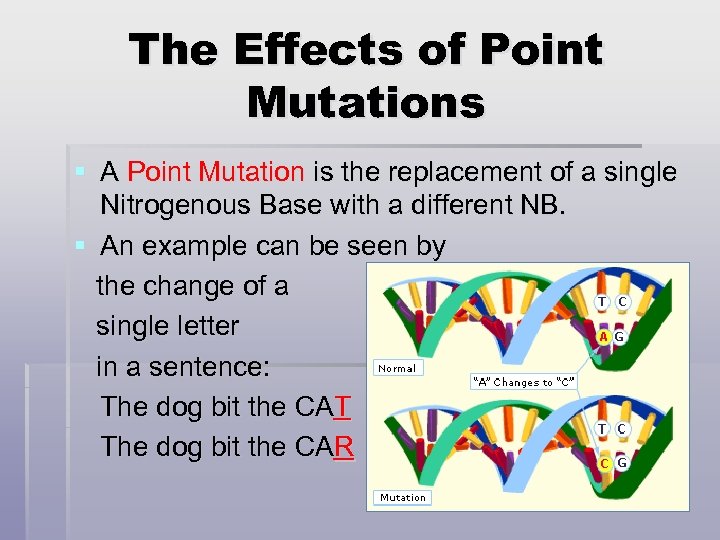
The Effects of Point Mutations § A Point Mutation is the replacement of a single Nitrogenous Base with a different NB. § An example can be seen by the change of a single letter in a sentence: The dog bit the CAT The dog bit the CAR 104
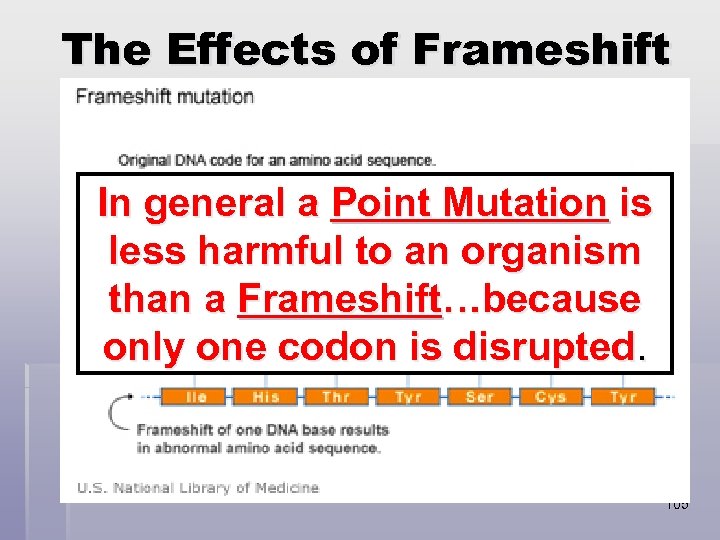
The Effects of Frameshift Mutations § A Frameshift Mutation is the removal or addition of a single Nitrogenous Base. In general a Point Mutation is § This mutation would to an organism to less harmful cause every amino acid be off by one notch… than athe sentence used before would now Frameshift…because § Example: only (if the G was deleted) becomeone codon is disrupted. THE DOB ITT HEC AT …instead of THE DOG BIT THE CAT. 105
Chromosomal Level § Changes may occur in chromosomes as well as in the genes themselves. § These changes can occur during Mitosis or Meiosis. During these processes, fractions of the chromosomes are often broken off and rejoined incorrectly. § These changes in the structure of chromosomes are called Chromosomal Mutations. 106
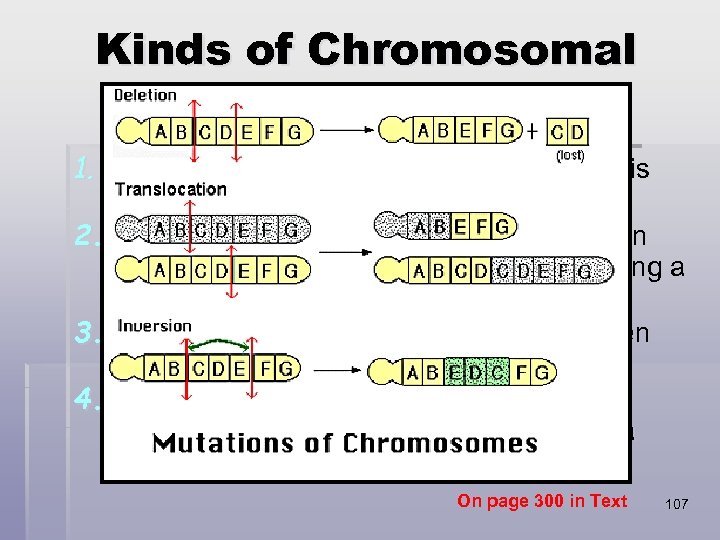
Kinds of Chromosomal Mutations 1. Deletion: When a part of a chromosome is left out. 2. Insertion: A piece of chromosome broken off of sister chromatid and inserted, causing a duplication of information. 3. Inversion: When a piece of DNA is broken off and replaced in the opposite direction. 4. Translocation: When part of one chromosome breaks off and is added to a different chromosome. On page 300 in Text 107
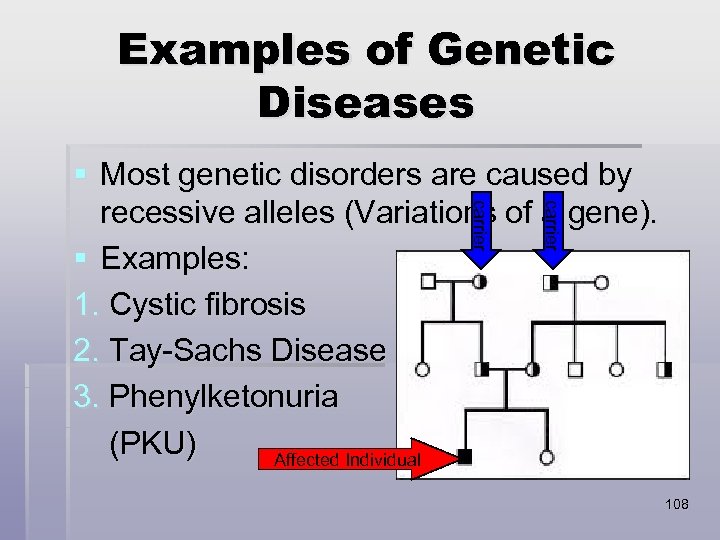
Examples of Genetic Diseases carrier § Most genetic disorders are caused by recessive alleles (Variations of a gene). § Examples: 1. Cystic fibrosis 2. Tay-Sachs Disease 3. Phenylketonuria (PKU) Affected Individual 108
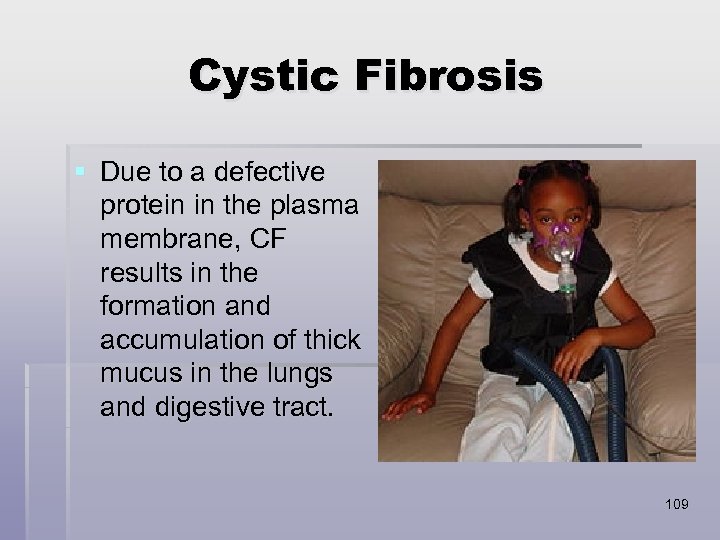
Cystic Fibrosis § Due to a defective protein in the plasma membrane, CF results in the formation and accumulation of thick mucus in the lungs and digestive tract. 109
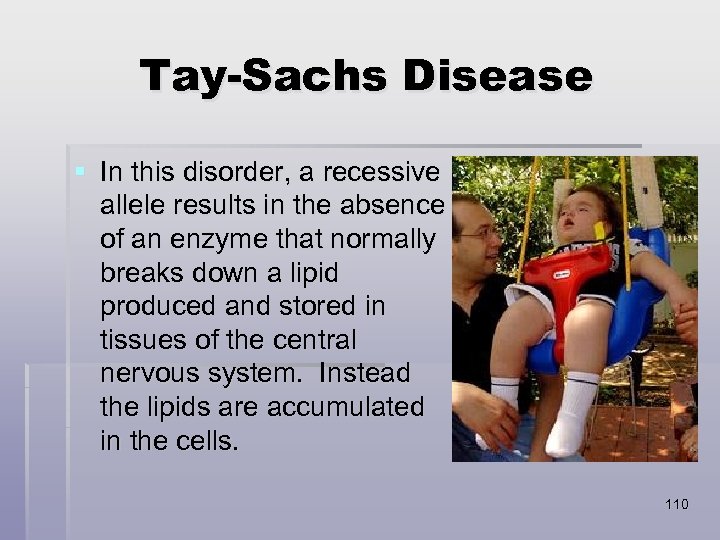
Tay-Sachs Disease § In this disorder, a recessive allele results in the absence of an enzyme that normally breaks down a lipid produced and stored in tissues of the central nervous system. Instead the lipids are accumulated in the cells. 110
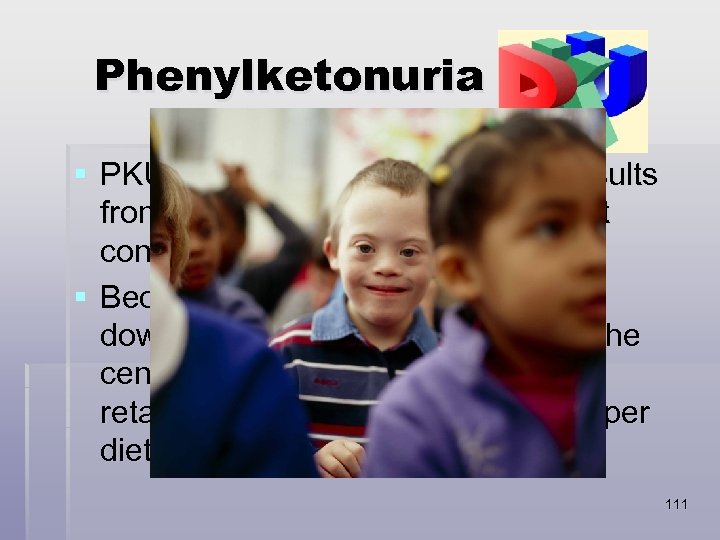
Phenylketonuria (PKU) § PKU is a recessive disorder that results from the absence of an enzyme that converts one amino acid to another. § Because this AA can not be broken down, its accumulation messes up the central nervous system. (Mental retardation will occur in time if a proper diet and precautions are not taken). 111
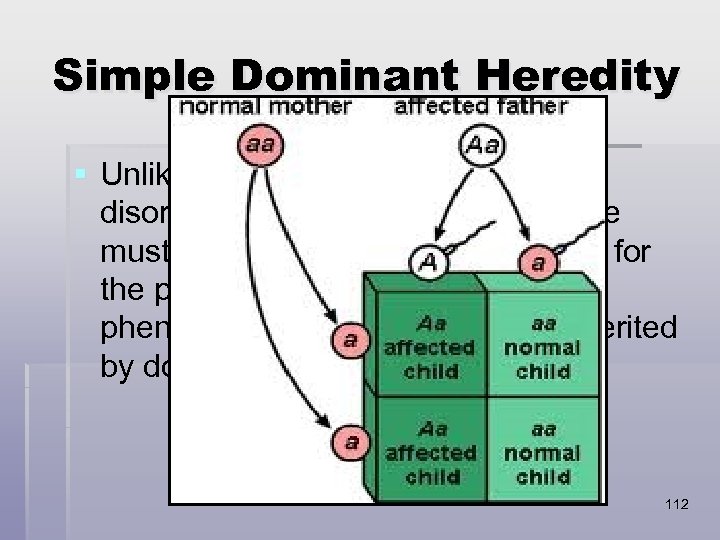
Simple Dominant Heredity § Unlike the inheritance of recessive disorders (in which a recessive allele must be inherited from both parents for the person to show the recessive phenotype), some diseases are inherited by dominant traits. 112
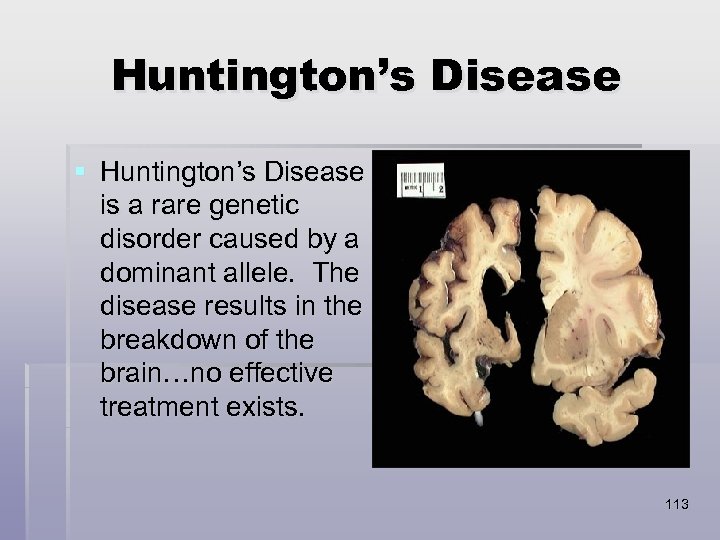
Huntington’s Disease § Huntington’s Disease is a rare genetic disorder caused by a dominant allele. The disease results in the breakdown of the brain…no effective treatment exists. 113
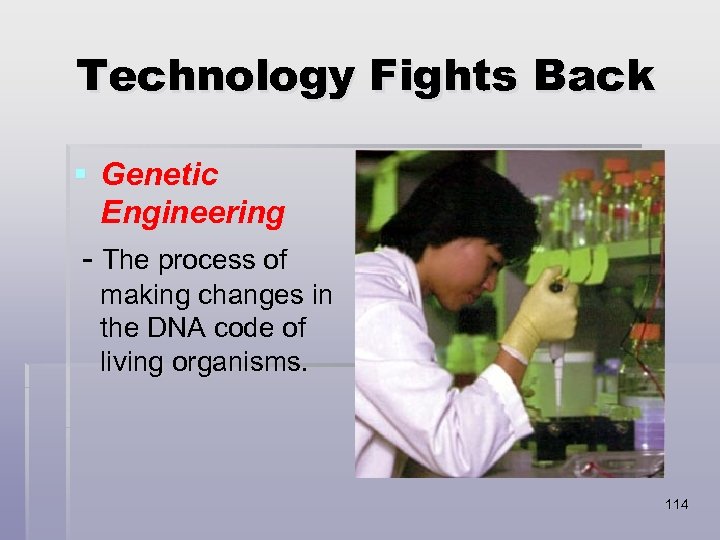
Technology Fights Back § Genetic Engineering - The process of making changes in the DNA code of living organisms. 114
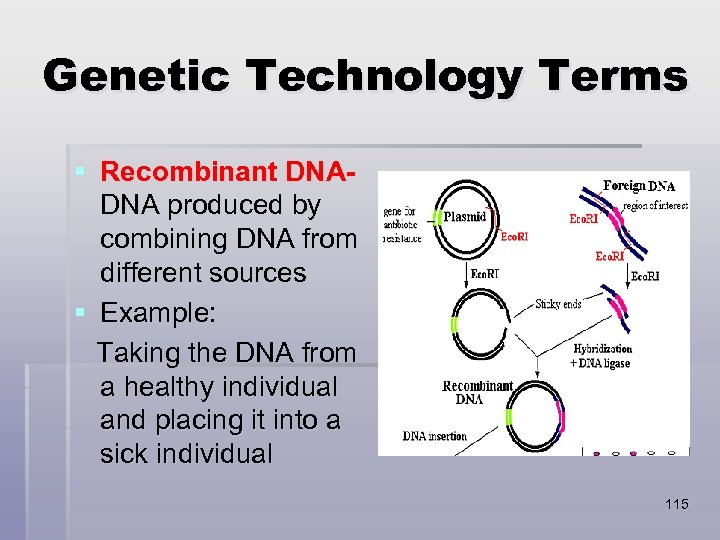
Genetic Technology Terms § Recombinant DNADNA produced by combining DNA from different sources § Example: Taking the DNA from a healthy individual and placing it into a sick individual 115
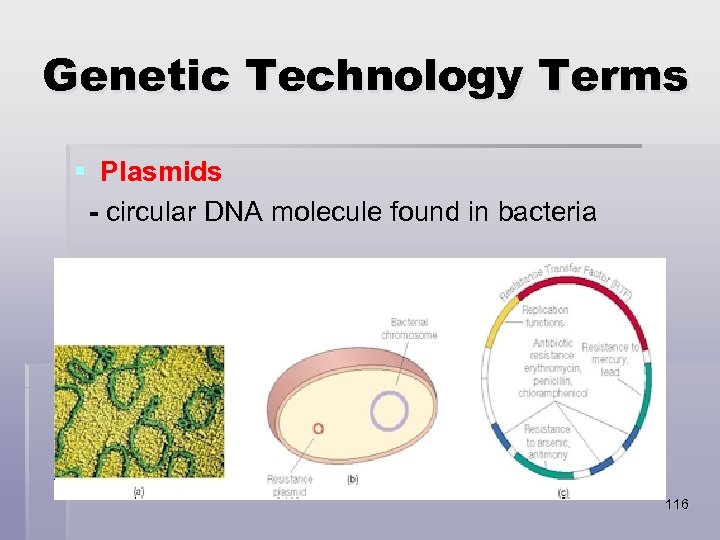
Genetic Technology Terms § Plasmids - circular DNA molecule found in bacteria 116
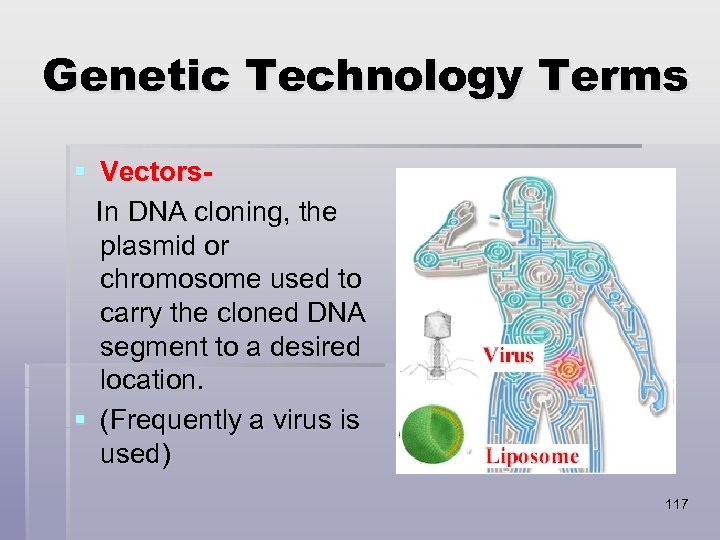
Genetic Technology Terms § Vectors. In DNA cloning, the plasmid or chromosome used to carry the cloned DNA segment to a desired location. § (Frequently a virus is used) 117
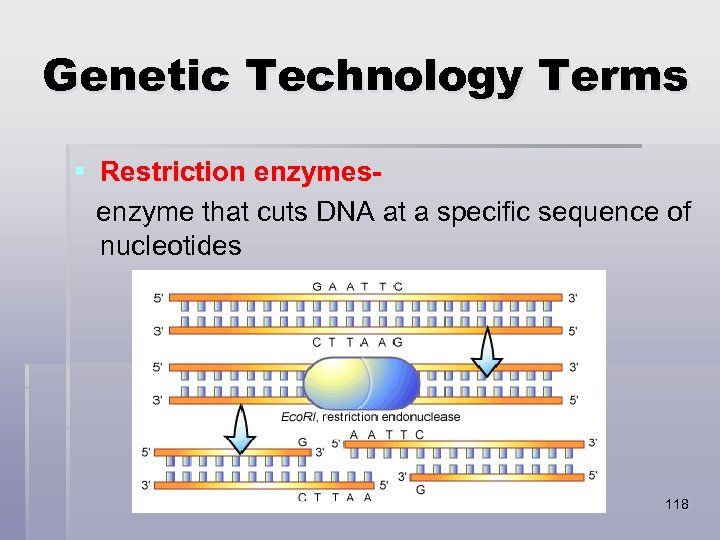
Genetic Technology Terms § Restriction enzymesenzyme that cuts DNA at a specific sequence of nucleotides 118
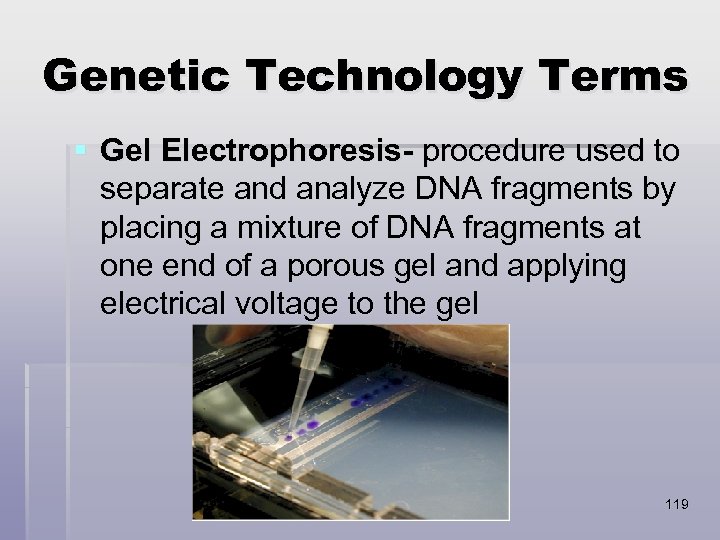
Genetic Technology Terms § Gel Electrophoresis- procedure used to separate and analyze DNA fragments by placing a mixture of DNA fragments at one end of a porous gel and applying electrical voltage to the gel 119
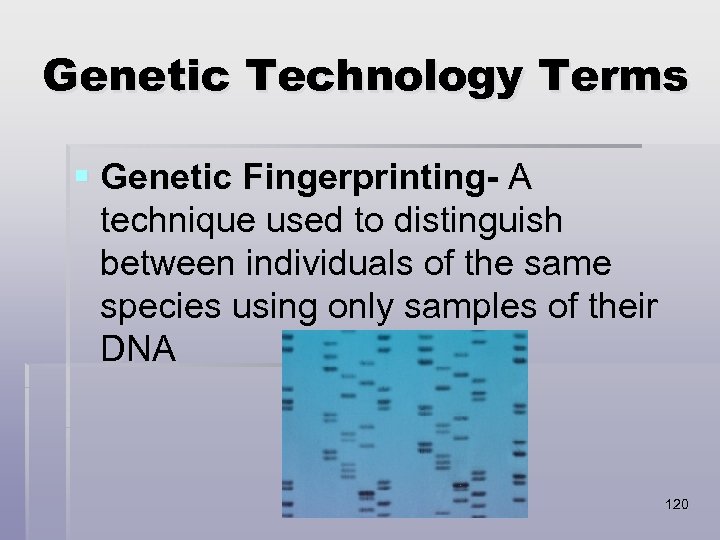
Genetic Technology Terms § Genetic Fingerprinting- A technique used to distinguish between individuals of the same species using only samples of their DNA 120
Human Genome Project § Genetic Disease- caused by abnormalities in an individual’s genetic material (genome). § Genetic (gene) therapy- When a gene is inserted in a cell to replace a defective or missing gene 121
Скачать презентацию Biology Mr Moore Genetics DNA to Protein Genes
11b64efc10e813614fe545be4d3de7c8.ppt