 Скачать презентацию BIOLOGY Chapter 4 pp 59 -84 10 th
2529a4be0aa552e2f58a04690879b168.ppt
- Количество слайдов: 69



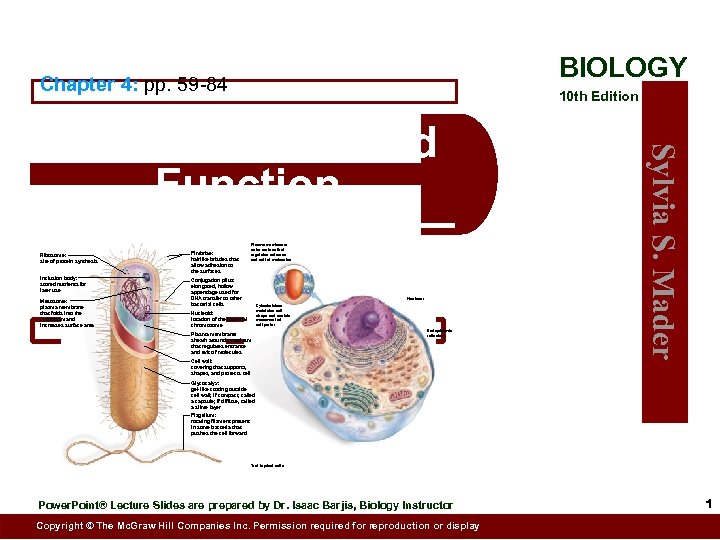
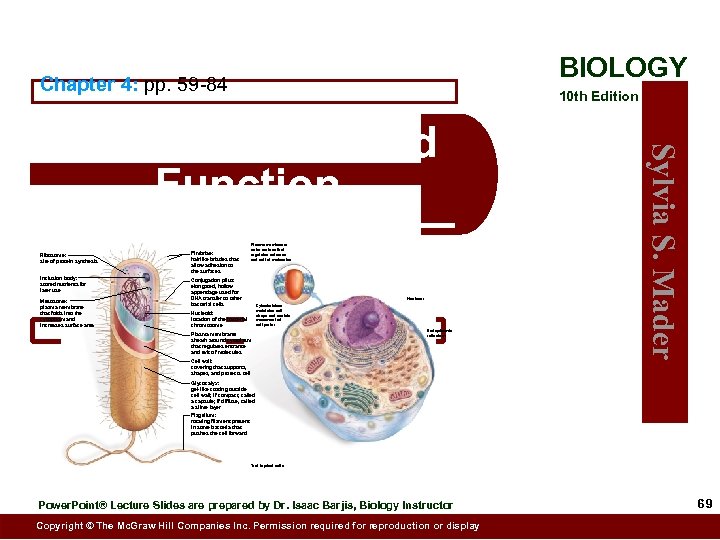
BIOLOGY Chapter 4: pp. 59 -84 10 th Edition Ribosome: site of protein synthesis Fimbriae: hairlike bristles that allow adhesion to the surfaces Inclusion body: stored nutrients for later use Plasma membrane: outer surface that regulates entrance and exit of molecules Conjugation pilus: elongated, hollow appendage used for DNA transfer to other bacterial cells Mesosome: plasma membrane that folds into the cytoplasm and increases surface area Nucleus: Cytoskeleton: maintains cell shape and assists movement of cell parts: Nucleoid: location of the bacterial chromosome Plasma membrane: sheath around cytoplasm that regulates entrance and exit of molecules Endoplasmic reticulum: Cell wall: covering that supports, shapes, and protects cell Sylvia S. Mader Cell Structure and Function Glycocalyx: gel-like coating outside cell wall; if compact, called a capsule; if diffuse, called a slime layer Flagellum: rotating filament present in some bacteria that pushes the cell forward *not in plant cells Power. Point® Lecture Slides are prepared by Dr. Isaac Barjis, Biology Instructor Copyright © The Mc. Graw Hill Companies Inc. Permission required for reproduction or display 1
Outline l Cellular Level of Organization l l Cell theory Cell size Prokaryotic Cells l Eukaryotic Cells l l l l Organelles Nucleus and Ribosome Endomembrane System Other Vesicles and Vacuoles Energy related organelles Cytoskeleton l Centrioles, Cilia, and Flagella 2
Cell Theory Detailed study of the cell began in the 1830 s l A unifying concept in biology l Originated from the work of biologists Schleiden and Schwann in 1838 -9 l States that: l l All organisms are composed of cells l l l All cells come only from preexisting cells l l German botanist Matthais Schleiden in 1838 German zoologist Theodor Schwann in 1839 German physician Rudolph Virchow in 1850’s Cells are the smallest structural and functional unit of organisms 3
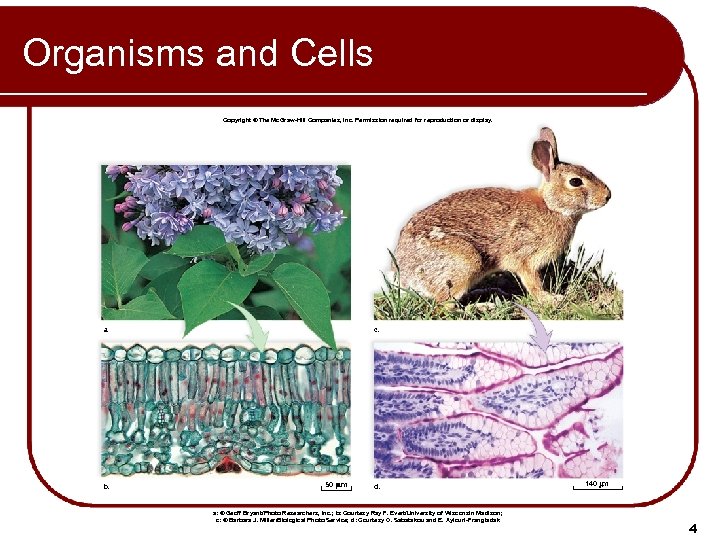
Organisms and Cells Copyright © The Mc. Graw-Hill Companies, Inc. Permission required for reproduction or display. a. b. c. 50 m d. a: © Geoff Bryant/Photo Researchers, Inc. ; b: Courtesy Ray F. Evert/University of Wisconsin Madison; c: © Barbara J. Miller/Biological Photo Service; d: Courtesy O. Sabatakou and E. Xylouri-Frangiadak 140 m 4
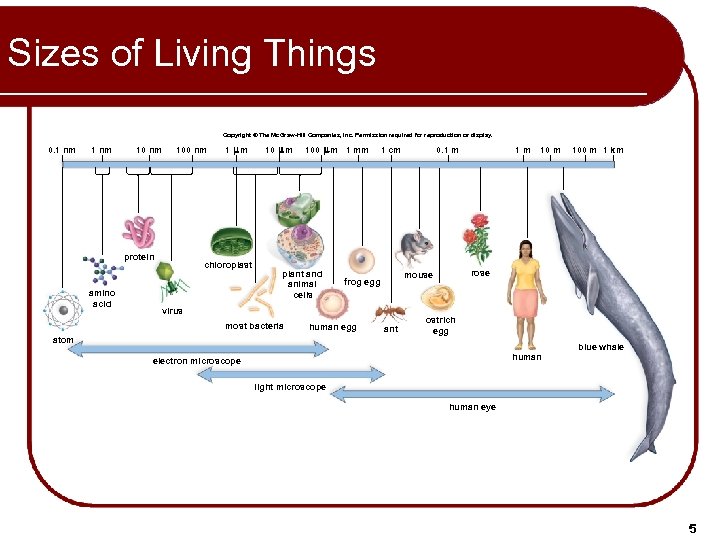
Sizes of Living Things Copyright © The Mc. Graw-Hill Companies, Inc. Permission required for reproduction or display. 0. 1 nm 100 nm protein amino acid 1 m chloroplast 10 m 100 plant and animal cells m 1 mm 1 cm human egg atom ant 1 m 100 m 1 km rose mouse frog egg virus most bacteria 0. 1 m ostrich egg blue whale human electron microscope light microscope human eye 5
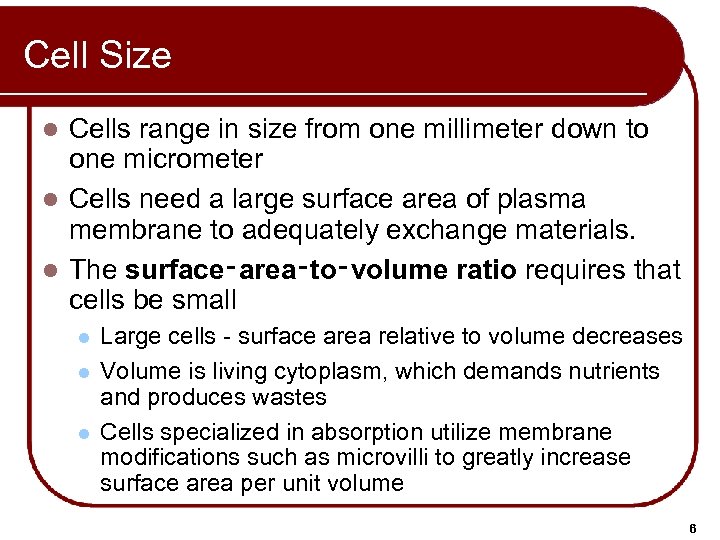
Cell Size Cells range in size from one millimeter down to one micrometer l Cells need a large surface area of plasma membrane to adequately exchange materials. l The surface‑area‑to‑volume ratio requires that cells be small l l Large cells - surface area relative to volume decreases Volume is living cytoplasm, which demands nutrients and produces wastes Cells specialized in absorption utilize membrane modifications such as microvilli to greatly increase surface area per unit volume 6
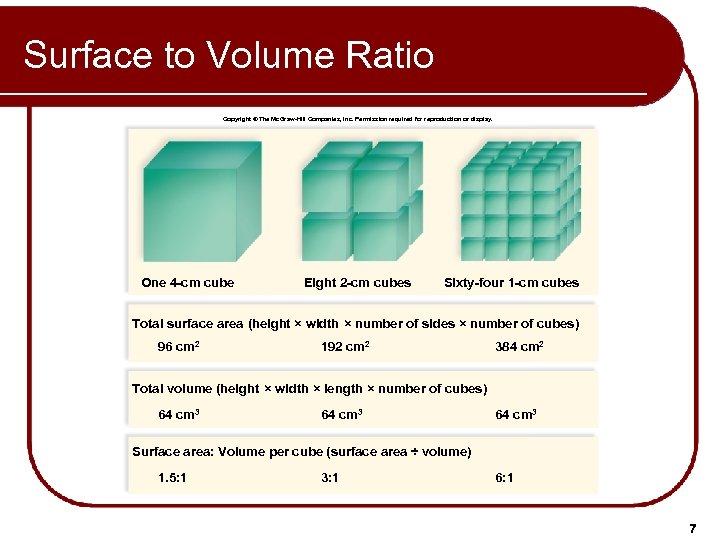
Surface to Volume Ratio Copyright © The Mc. Graw-Hill Companies, Inc. Permission required for reproduction or display. One 4 -cm cube Eight 2 -cm cubes Sixty-four 1 -cm cubes Total surface area (height × width × number of sides × number of cubes) 96 cm 2 192 cm 2 384 cm 2 Total volume (height × width × length × number of cubes) 64 cm 3 Surface area: Volume per cube (surface area ÷ volume) 1. 5: 1 3: 1 6: 1 7
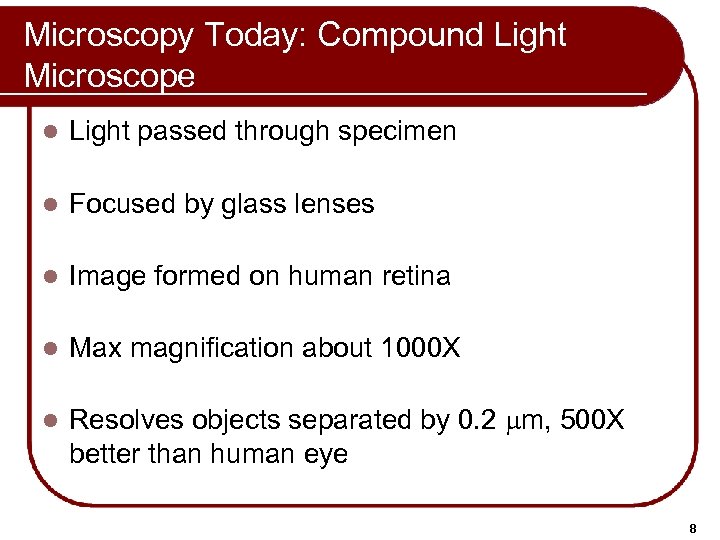
Microscopy Today: Compound Light Microscope l Light passed through specimen l Focused by glass lenses l Image formed on human retina l Max magnification about 1000 X l Resolves objects separated by 0. 2 mm, 500 X better than human eye 8
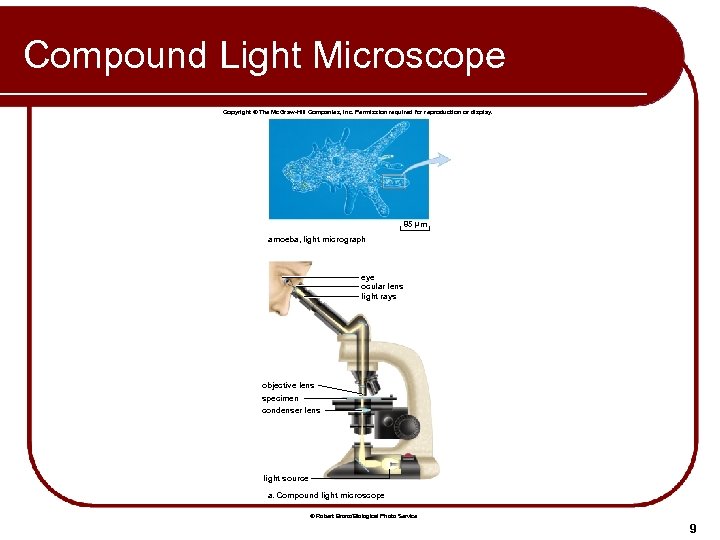
Compound Light Microscope Copyright © The Mc. Graw-Hill Companies, Inc. Permission required for reproduction or display. 85 µm amoeba, light micrograph eye ocular lens light rays objective lens specimen condenser lens light source a. Compound light microscope © Robert Brons/Biological Photo Service 9
Microscopy Today: Transmission Electron Microscope l Abbreviated T. E. M. l Electrons passed through specimen l Focused by magnetic lenses l Image formed on fluorescent screen l Similar to TV screen l Image is then photographed l Max magnification 1000, 000 s. X l Resolves objects separated by 0. 00002 mm, 100, 000 X better than human eye 10
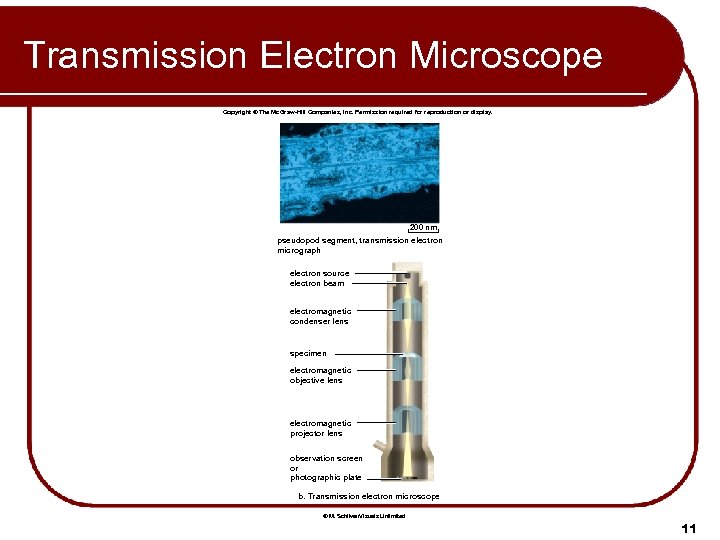
Transmission Electron Microscope Copyright © The Mc. Graw-Hill Companies, Inc. Permission required for reproduction or display. 200 nm pseudopod segment, transmission electron micrograph electron source electron beam electromagnetic condenser lens specimen electromagnetic objective lens electromagnetic projector lens observation screen or photographic plate b. Transmission electron microscope © M. Schliwa/Visuals Unlimited 11
Microscopy Today: Scanning Electron Microscope l Abbreviated S. E. M. l Specimen sprayed with thin coat of metal l Electron beam scanned across surface of specimen l Metal emits secondary electrons l Emitted electrons focused by magnetic lenses l Image formed on fluorescent screen l Similar to TV screen l Image is then photographed 12
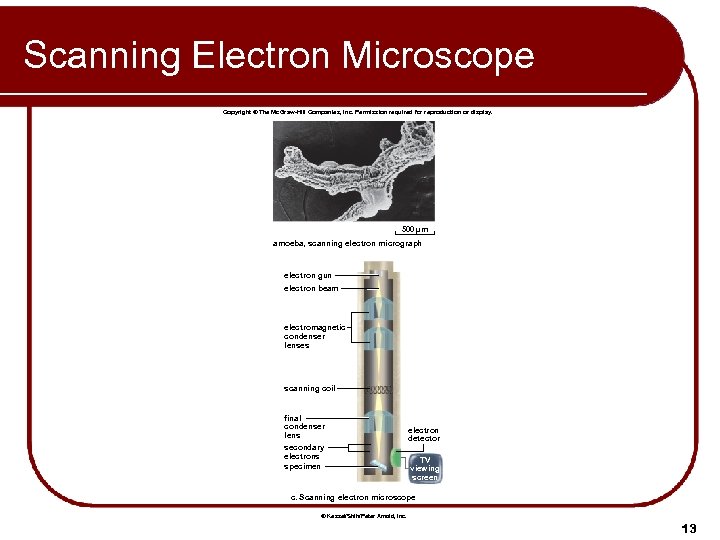
Scanning Electron Microscope Copyright © The Mc. Graw-Hill Companies, Inc. Permission required for reproduction or display. 500 µ m amoeba, scanning electron micrograph electron gun electron beam electromagnetic condenser lenses scanning coil final condenser lens secondary electrons specimen electron detector TV viewing screen c. Scanning electron microscope © Kessel/Shih/Peter Arnold, Inc. 13
Microscopy Today: Immunofluorescence Light Microscope l Antibodies developed against a specific protein l l l Ultra-violet light (black light) passed through specimen l l l Fluorescent dye molecule attached to antibody molecules Specimen exposed to fluorescent antibodies Fluorescent dye glows in color where antigen is located Emitted light is focused by glass lenses onto human retina Allows mapping distribution of a specific protein in cell 14
Microscopy Today: Confocal Microscopy l Narrow laser beam scanned across transparent specimen l Beam is focused at a very thin plane l Allows microscopist to optically section a specimen l Sections made at different levels l Allows assembly of 3 d image on computer screen that can be rotated 15
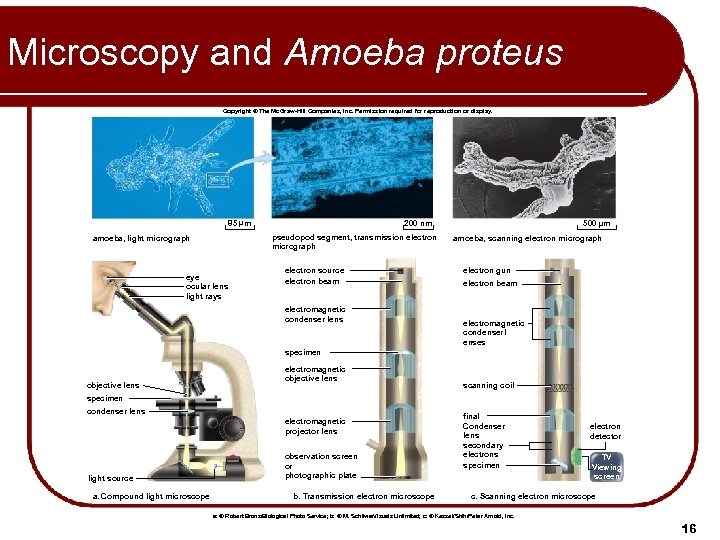
Microscopy and Amoeba proteus Copyright © The Mc. Graw-Hill Companies, Inc. Permission required for reproduction or display. 85 µm amoeba, light micrograph eye ocular lens light rays 500 µm 200 nm pseudopod segment, transmission electron micrograph electron source electron beam electromagnetic condenser lens amoeba, scanning electron micrograph electron gun electron beam electromagnetic condenserl enses specimen objective lens electromagnetic objective lens scanning coil specimen condenser lens electromagnetic projector lens light source a. Compound light microscope observation screen or photographic plate b. Transmission electron microscope final Condenser lens secondary electrons specimen electron detector TV Viewing screen c. Scanning electron microscope a: © Robert Brons/Biological Photo Service; b: © M. Schliwa/Visuals Unlimited; c: © Kessel/Shih/Peter Arnold, Inc. 16
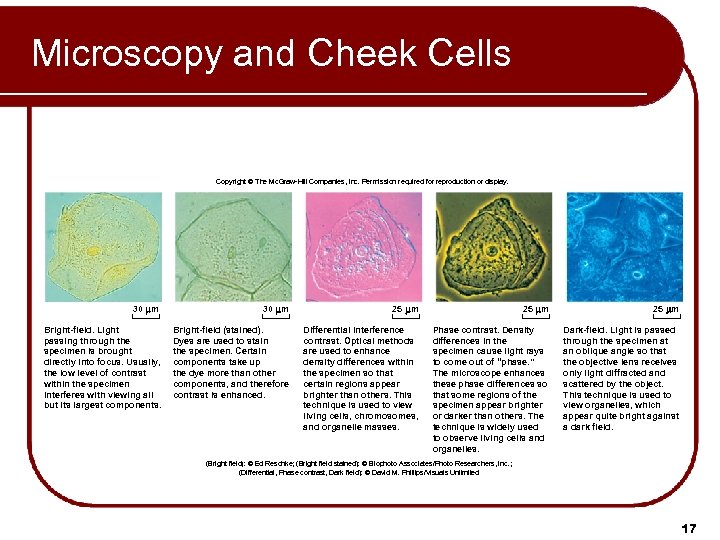
Microscopy and Cheek Cells Copyright © The Mc. Graw-Hill Companies, Inc. Permission required for reproduction or display. 30 m 25 m Bright-field. Light passing through the specimen is brought directly into focus. Usually, the low level of contrast within the specimen interferes with viewing all but its largest components. Bright-field (stained). Dyes are used to stain the specimen. Certain components take up the dye more than other components, and therefore contrast is enhanced. Differential interference contrast. Optical methods are used to enhance density differences within the specimen so that certain regions appear brighter than others. This technique is used to view living cells, chromosomes, and organelle masses. Phase contrast. Density differences in the specimen cause light rays to come out of “phase. ” The microscope enhances these phase differences so that some regions of the specimen appear brighter or darker than others. The technique is widely used to observe living cells and organelles. Dark-field. Light is passed through the specimen at an oblique angle so that the objective lens receives only light diffracted and scattered by the object. This technique is used to view organelles, which appear quite bright against a dark field. (Bright field): © Ed Reschke; (Bright field stained): © Biophoto Associates/Photo Researchers, Inc. ; (Differential, Phase contrast, Dark field): © David M. Phillips/Visuals Unlimited 17
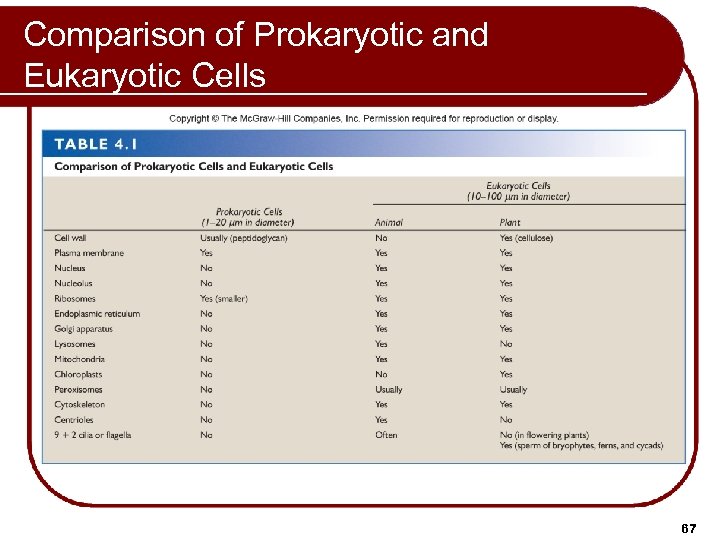
Prokaryotic Cells l Lack a membrane-bound nucleus l Structurally smaller and simpler than eukaryotic cells (which have a nucleus). l Prokaryotic cells are placed in two taxonomic domains: l Bacteria l Archaea l l Live in extreme habitats Domains are structurally similar but biochemically different 18
The Structure of Bacteria Extremely small - 1– 1. 5 μm wide and 2– 6 μm long l Occur in three basic shapes: l l l Spherical coccus, Rod-shaped bacillus, Spiral spirillum (if rigid) or spirochete (if flexible). Cell Envelope includes: l Plasma membrane - lipid bilayer with imbedded and peripheral protein l l l Form internal pouches (mesosomes) Cell wall - maintains the shape of the cell and is strengthened by peptidoglycan Glycocalyx - layer of polysaccharides on the outside of the cell wall l Well organized and resistant to removal (capsule) 19
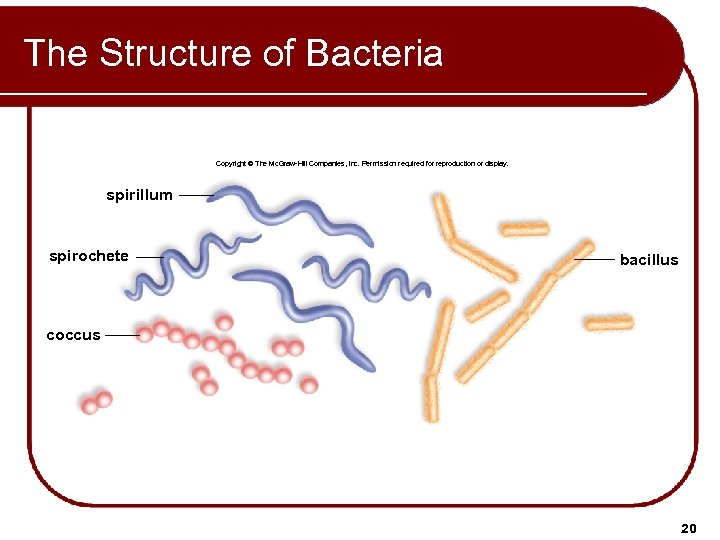
The Structure of Bacteria Copyright © The Mc. Graw-Hill Companies, Inc. Permission required for reproduction or display. spirillum spirochete bacillus coccus 20
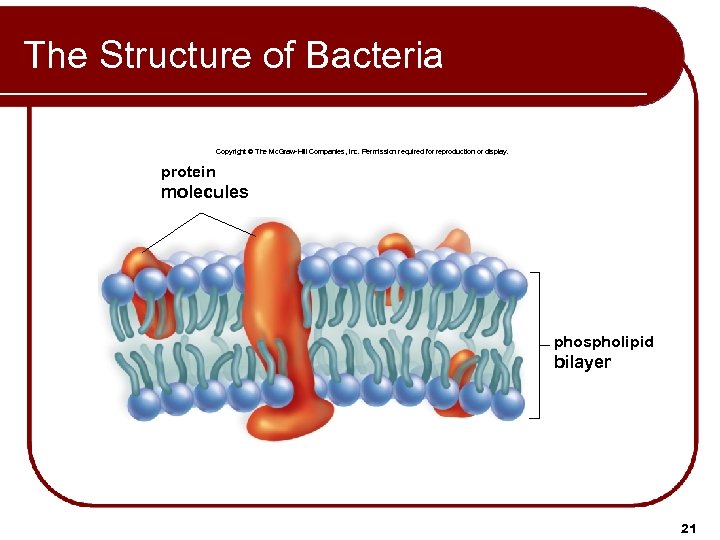
The Structure of Bacteria Copyright © The Mc. Graw-Hill Companies, Inc. Permission required for reproduction or display. protein molecules phospholipid bilayer 21
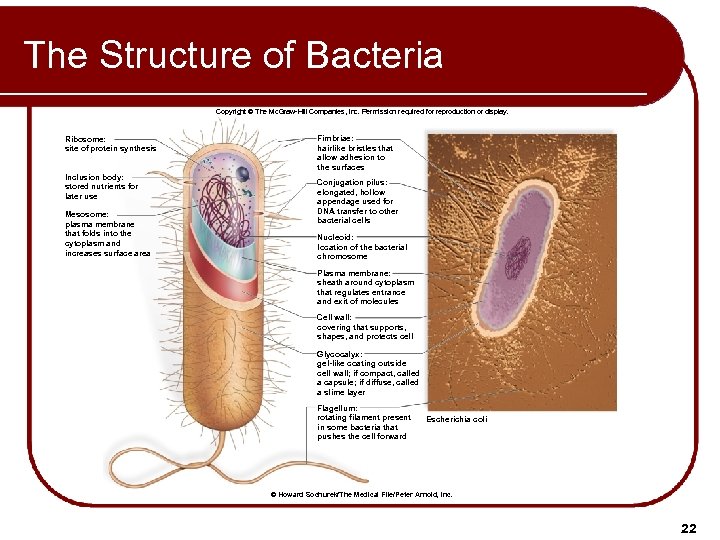
The Structure of Bacteria Copyright © The Mc. Graw-Hill Companies, Inc. Permission required for reproduction or display. Ribosome: site of protein synthesis Inclusion body: stored nutrients for later use Mesosome: plasma membrane that folds into the cytoplasm and increases surface area Fimbriae: hairlike bristles that allow adhesion to the surfaces Conjugation pilus: elongated, hollow appendage used for DNA transfer to other bacterial cells Nucleoid: location of the bacterial chromosome Plasma membrane: sheath around cytoplasm that regulates entrance and exit of molecules Cell wall: covering that supports, shapes, and protects cell Glycocalyx: gel-like coating outside cell wall; if compact, called a capsule; if diffuse, called a slime layer Flagellum: rotating filament present in some bacteria that pushes the cell forward Escherichia coli © Howard Sochurek/The Medical File/Peter Arnold, Inc. 22
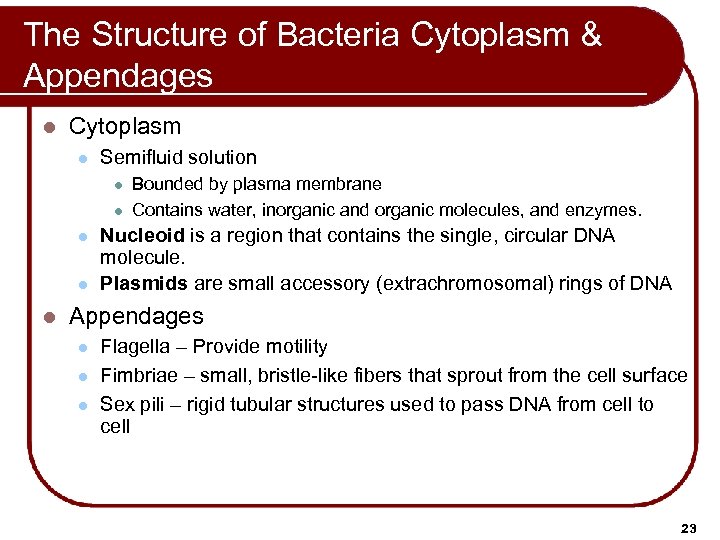
The Structure of Bacteria Cytoplasm & Appendages l Cytoplasm l Semifluid solution l l l Bounded by plasma membrane Contains water, inorganic and organic molecules, and enzymes. Nucleoid is a region that contains the single, circular DNA molecule. Plasmids are small accessory (extrachromosomal) rings of DNA Appendages l l l Flagella – Provide motility Fimbriae – small, bristle-like fibers that sprout from the cell surface Sex pili – rigid tubular structures used to pass DNA from cell to cell 23
Eukaryotic Cells l Domain Eukarya includes: l l Fungi l Plants l l Protists Animals Cells contain: l Membrane-bound nucleus that houses DNA l Specialized organelles l Plasma membrane l Much larger than prokaryotic cells l Some cells (e. g. , plant cells) have a cell wall 24
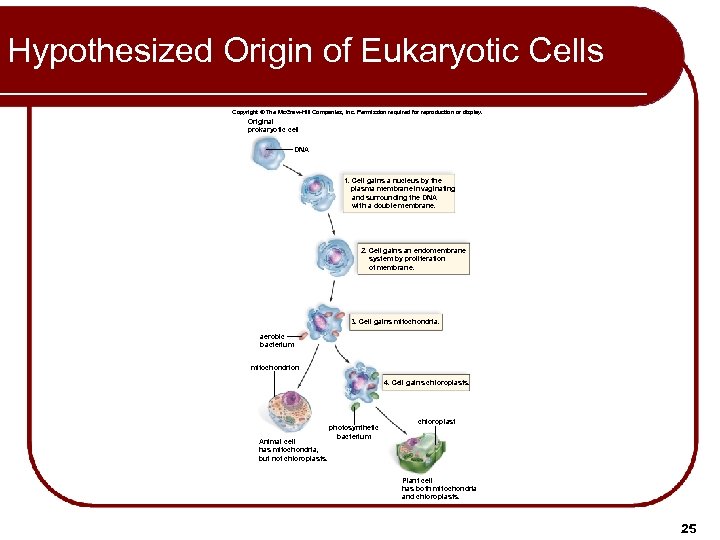
Hypothesized Origin of Eukaryotic Cells Copyright © The Mc. Graw-Hill Companies, Inc. Permission required for reproduction or display. Original prokaryotic cell DNA 1. Cell gains a nucleus by the plasma membrane invaginating and surrounding the DNA with a double membrane. 2. Cell gains an endomembrane system by proliferation of membrane. 3. Cell gains mitochondria. aerobic bacterium mitochondrion 4. Cell gains chloroplasts. Animal cell has mitochondria, but not chloroplasts. photosynthetic bacterium chloroplast Plant cell has both mitochondria and chloroplasts. 25
Eukaryotic Cells: Organelles l Eukaryotic cells are compartmentalized l They contain small structures called organelles l l l Perform specific functions Isolates reactions from others Two classes of organelles: l Endomembrane system: l Organelles that communicate with one another l l l Via membrane channels Via small vesicles Energy related organelles l l Mitochondria & chloroplasts Basically independent & self-sufficient 26
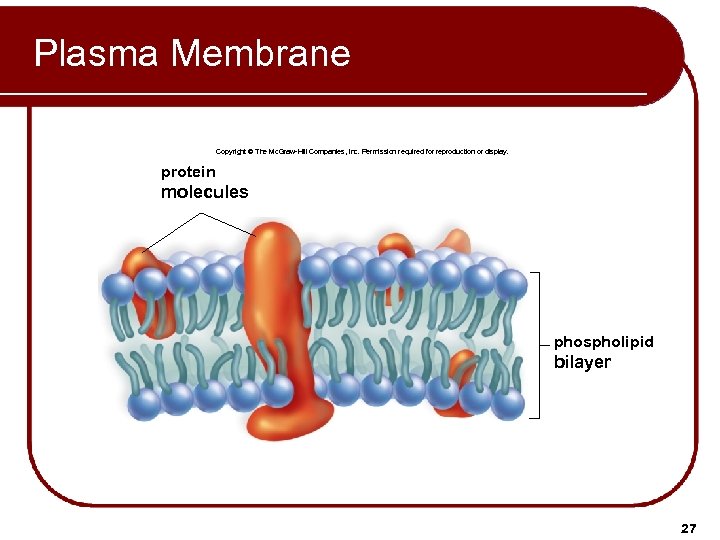
Plasma Membrane Copyright © The Mc. Graw-Hill Companies, Inc. Permission required for reproduction or display. protein molecules phospholipid bilayer 27
Cell Fractionation and Differential Centrifugation l Cell fractionation is the breaking apart of cellular components l Differential centrifugation: l Allows separation of cell parts l Separated out by size & density l Works like spin cycle of washer l The faster the machine spins, the smaller the parts that are settled out 28
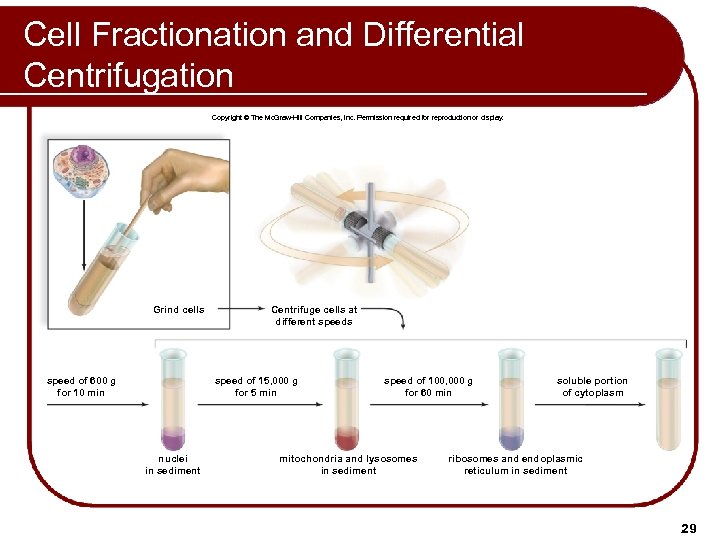
Cell Fractionation and Differential Centrifugation Copyright © The Mc. Graw-Hill Companies, Inc. Permission required for reproduction or display. Grind cells speed of 600 g for 10 min Centrifuge cells at different speeds speed of 15, 000 g for 5 min nuclei in sediment speed of 100, 000 g for 60 min mitochondria and lysosomes in sediment soluble portion of cytoplasm ribosomes and endoplasmic reticulum in sediment 29
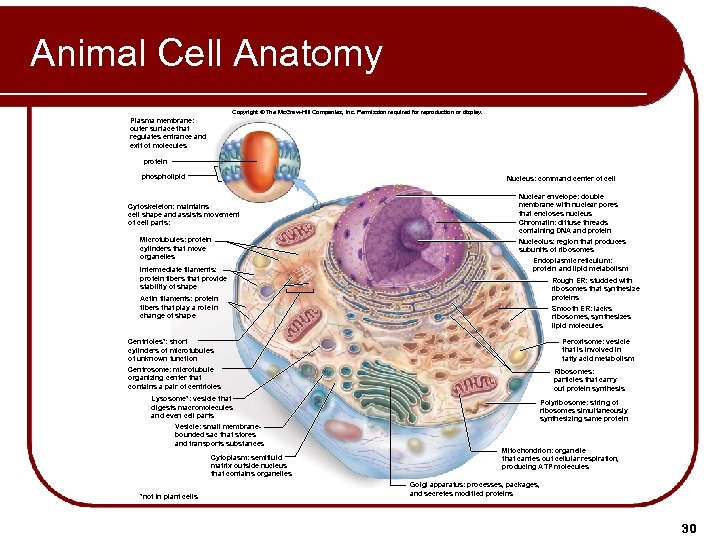
Animal Cell Anatomy Copyright © The Mc. Graw-Hill Companies, Inc. Permission required for reproduction or display. Plasma membrane: outer surface that regulates entrance and exit of molecules protein phospholipid Nucleus: command center of cell Cytoskeleton: maintains cell shape and assists movement of cell parts: Microtubules: protein cylinders that move organelles Intermediate filaments: protein fibers that provide stability of shape Nuclear envelope: double membrane with nuclear pores that encloses nucleus Chromatin: diffuse threads containing DNA and protein Nucleolus: region that produces subunits of ribosomes Endoplasmic reticulum: protein and lipid metabolism Rough ER: studded with ribosomes that synthesize proteins Actin filaments: protein fibers that play a role in change of shape Smooth ER: lacks ribosomes, synthesizes lipid molecules Peroxisome: vesicle that is involved in fatty acid metabolism Centrioles*: short cylinders of microtubules of unknown function Centrosome: microtubule organizing center that contains a pair of centrioles Ribosomes: particles that carry out protein synthesis Lysosome*: vesicle that digests macromolecules and even cell parts Vesicle: small membranebounded sac that stores and transports substances Cytoplasm: semifluid matrix outside nucleus that contains organelles *not in plant cells Polyribosome: string of ribosomes simultaneously synthesizing same protein Mitochondrion: organelle that carries out cellular respiration, producing ATP molecules Golgi apparatus: processes, packages, and secretes modified proteins 30

Plant Cell Anatomy Copyright © The Mc. Graw-Hill Companies, Inc. Permission required for reproduction or display. Nucleus: command center of cell Nuclear envelope: double membrane with nuclear pores that encloses nucleus Nucleolus: produces subunits of ribosomes Central vacuole*: large, fluid-filled sac that stores metabolites and helps maintain turgor pressure Cell wall of adjacent cell Chromatin: diffuse threads containing DNA and protein Middle lamella: cements together the primary cell walls of adjacent plant cells Nuclear pore: permits passage of proteins into nucleus and ribosomal subunits out of nucleus Ribosomes: carry out protein synthesis Chloroplast*: carries out photosynthesis, producing sugars Centrosome: microtubule organizing center (lacks centrioles) Endoplasmic reticulum: protein and lipid metabolism Granum*: a stack of chlorophyll-containing thylakoids in a chloroplast Rough ER: studded with ribosomes that synthesize proteins Mitochondrion: organelle that carries out cellular respiration, producing ATP molecules Smooth ER: lacks ribosomes, synthesizes lipid molecules Peroxisome: vesicle that is involved in fatty acid metabolism Golgi apparatus: processes, packages, and secretes modified proteins Cytoplasm: semifluid matrix outside nucleus that contains organelles Microtubules: protein cylinders that aid movement of organelles Actin filaments: protein fibers that play a role in movement of cell and organelles Plasma membrane: surrounds cytoplasm, and regulates entrance and exit of molecules Cell wall*: outer surface that shapes, supports, and protects cell *not in animal cells 31
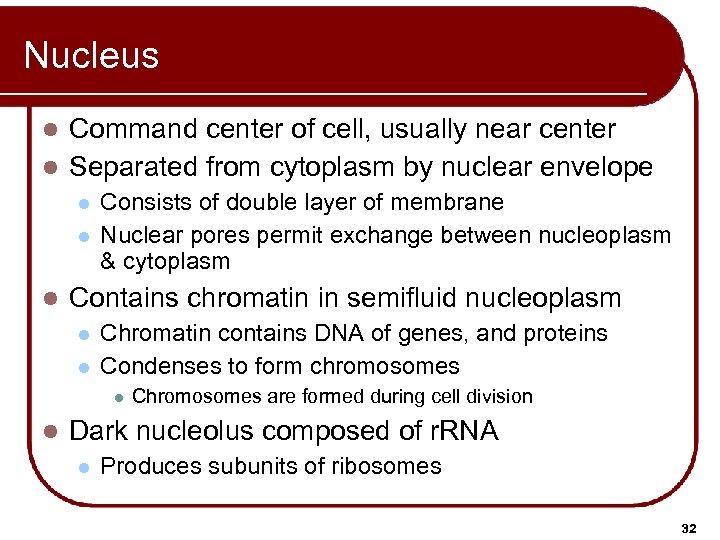
Nucleus Command center of cell, usually near center l Separated from cytoplasm by nuclear envelope l l Consists of double layer of membrane Nuclear pores permit exchange between nucleoplasm & cytoplasm Contains chromatin in semifluid nucleoplasm l l Chromatin contains DNA of genes, and proteins Condenses to form chromosomes l l Chromosomes are formed during cell division Dark nucleolus composed of r. RNA l Produces subunits of ribosomes 32
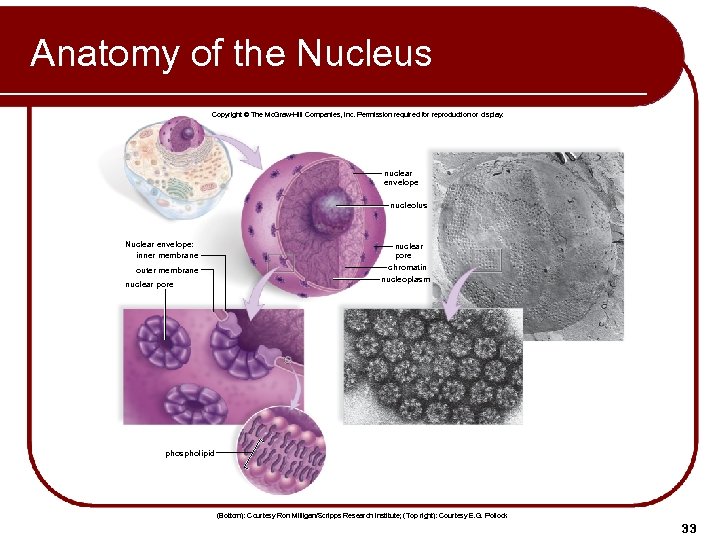
Anatomy of the Nucleus Copyright © The Mc. Graw-Hill Companies, Inc. Permission required for reproduction or display. nuclear envelope nucleolus Nuclear envelope: inner membrane outer membrane nuclear pore chromatin nucleoplasm phospholipid (Bottom): Courtesy Ron Milligan/Scripps Research Institute; (Top right): Courtesy E. G. Pollock 33
Ribosomes l Are the site of protein synthesis in the cell l Composed of r. RNA l l l Consists of a large subunit and a small subunit Subunits made in nucleolus May be located: l On the endoplasmic reticulum (thereby making it “rough”), or l Free in the cytoplasm, either singly or in groups, called polyribosomes 34
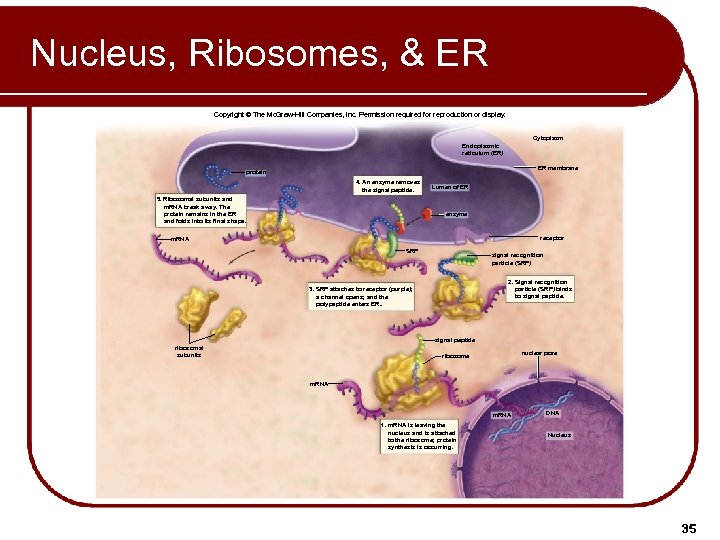
Nucleus, Ribosomes, & ER Copyright © The Mc. Graw-Hill Companies, Inc. Permission required for reproduction or display. Cytoplasm Endoplasmic reticulum (ER) ER membrane protein 4. An enzyme removes the signal peptide. 5. Ribosomal subunits and m. RNA break away. The protein remains in the ER and folds into its final shape. Lumen of ER enzyme receptor m. RNA SRP signal recognition particle (SRP) 2. Signal recognition particle (SRP) binds to signal peptide. 3. SRP attaches to receptor (purple); a channel opens; and the polypeptide enters ER. . signal peptide ribosomal subunits nuclear pore ribosome m. RNA 1. m. RNA is leaving the nucleus and is attached to the ribosome; protein synthesis is occurring. DNA Nucleus 35
Endomembrane System Series of intracellular membranes that compartmentalize the cell l Restrict enzymatic reactions to specific compartments within cell l Consists of: l l l Nuclear envelope Membranes of endoplasmic reticulum Golgi apparatus Vesicles l l Several types Transport materials between organelles of system 36
Endomembrane System: The Endoplasmic Reticulum A system of membrane channels and saccules (flattened vesicles) continuous with the outer membrane of the nuclear envelope l Rough ER l l l Studded with ribosomes on cytoplasmic side Protein anabolism l l Synthesizes proteins Modifies and processes proteins l l l Adds sugar to protein Results in glycoproteins Smooth ER l l No ribosomes Synthesis of lipids Site of various synthetic processes, detoxification, and storage Forms transport vesicles 37
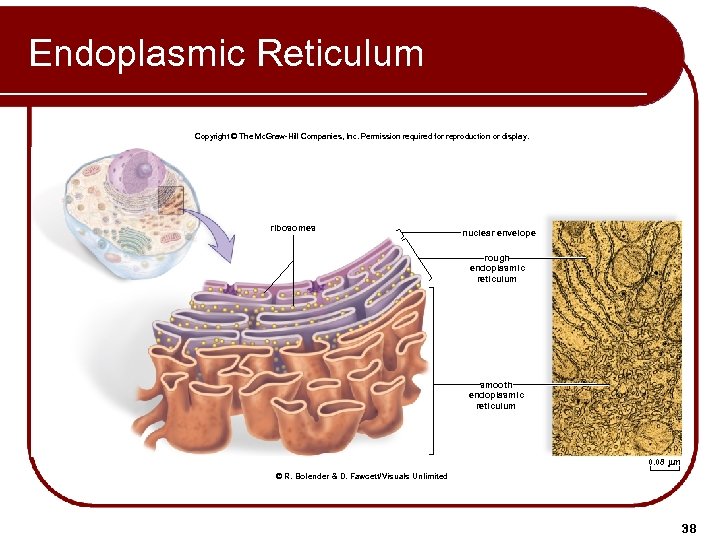
Endoplasmic Reticulum Copyright © The Mc. Graw-Hill Companies, Inc. Permission required for reproduction or display. ribosomes nuclear envelope rough endoplasmic reticulum smooth endoplasmic reticulum 0. 08 m © R. Bolender & D. Fawcett/Visuals Unlimited 38
Endomembrane System: The Golgi Apparatus l Consists of 3 -20 flattened, curved saccules l Resembles stack of hollow pancakes l Modifies proteins and lipids l Receives vesicles from ER on cis (or inner face) l Packages them in vesicles l Prepares for “shipment” in v Packages them in vesicles from trans (or outer face) l Within cell l Export from cell (secretion, exocytosis) 39
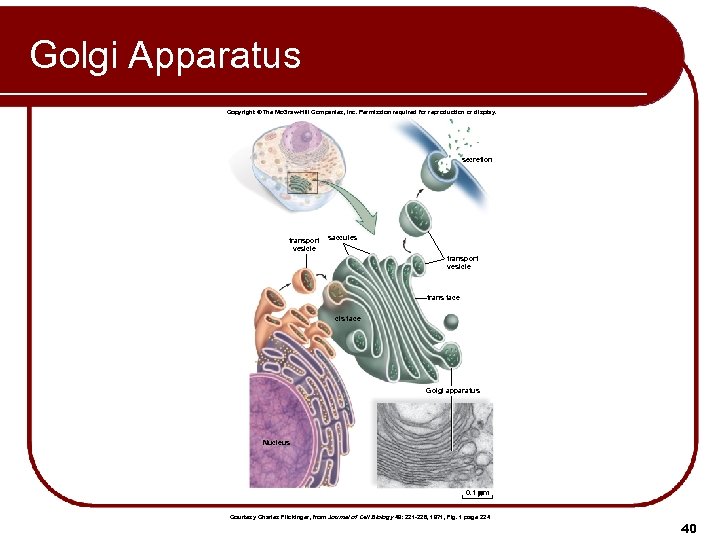
Golgi Apparatus Copyright © The Mc. Graw-Hill Companies, Inc. Permission required for reproduction or display. secretion transport vesicle saccules transport vesicle trans face cis face Golgi apparatus Nucleus 0. 1 m Courtesy Charles Flickinger, from Journal of Cell Biology 49: 221 -226, 1971, Fig. 1 page 224 40
Endomembrane System: Lysosomes l Membrane-bound vesicles (not in plants) l Produced by the Golgi apparatus l Contain powerful digestive enzymes and are highly acidic l l Recycling of cellular resources l l Digestion of large molecules Apoptosis (programmed cell death, like tadpole losing tail) Some genetic diseases l Caused by defect in lysosomal enzyme l Lysosomal storage diseases (Tay-Sachs) 41
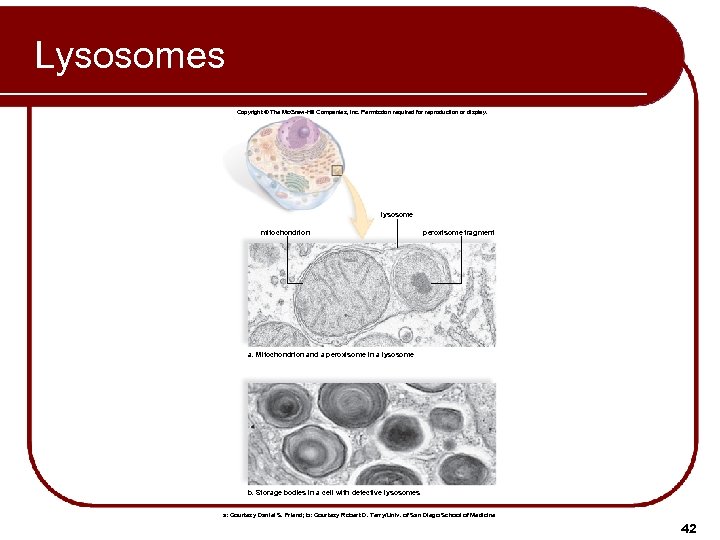
Lysosomes Copyright © The Mc. Graw-Hill Companies, Inc. Permission required for reproduction or display. lysosome mitochondrion peroxisome fragment a. Mitochondrion and a peroxisome in a lysosome b. Storage bodies in a cell with defective lysosomes a: Courtesy Daniel S. Friend; b: Courtesy Robert D. Terry/Univ. of San Diego School of Medicine 42
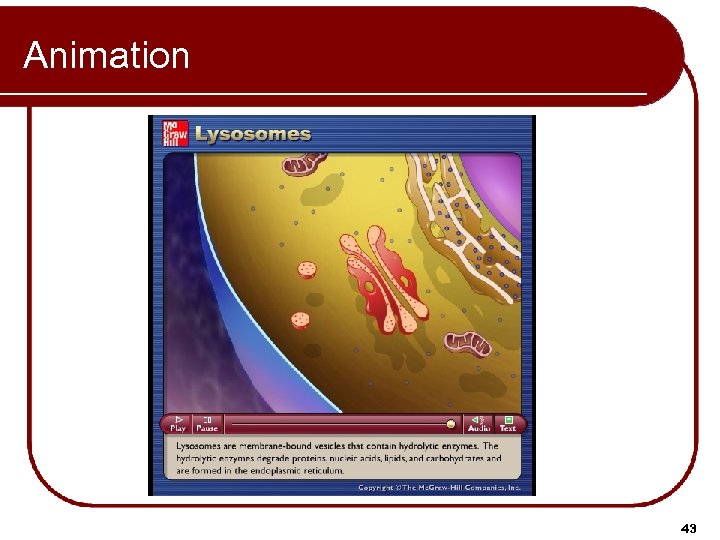
Animation Please note that due to differing operating systems, some animations will not appear until the presentation is viewed in Presentation Mode (Slide Show view). You may see blank slides in the “Normal” or “Slide Sorter” views. All animations will appear after viewing in Presentation Mode and playing each animation. Most animations will require the latest version of the Flash Player, which is available at http: //get. adobe. com/flashplayer. 43
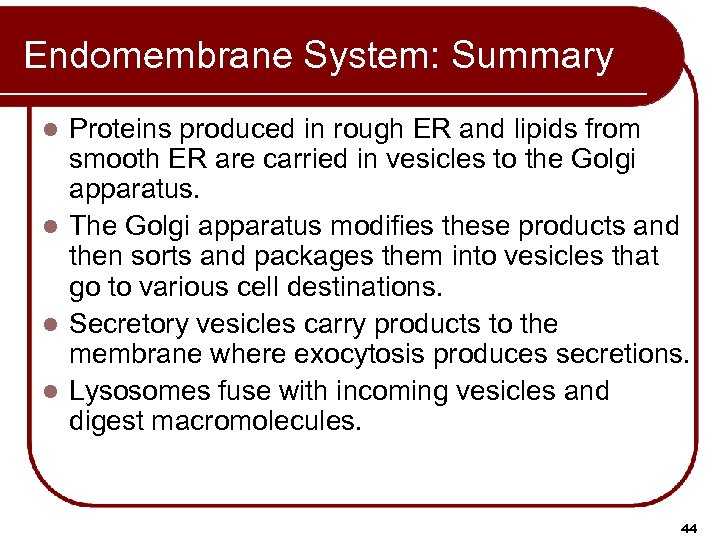
Endomembrane System: Summary Proteins produced in rough ER and lipids from smooth ER are carried in vesicles to the Golgi apparatus. l The Golgi apparatus modifies these products and then sorts and packages them into vesicles that go to various cell destinations. l Secretory vesicles carry products to the membrane where exocytosis produces secretions. l Lysosomes fuse with incoming vesicles and digest macromolecules. l 44
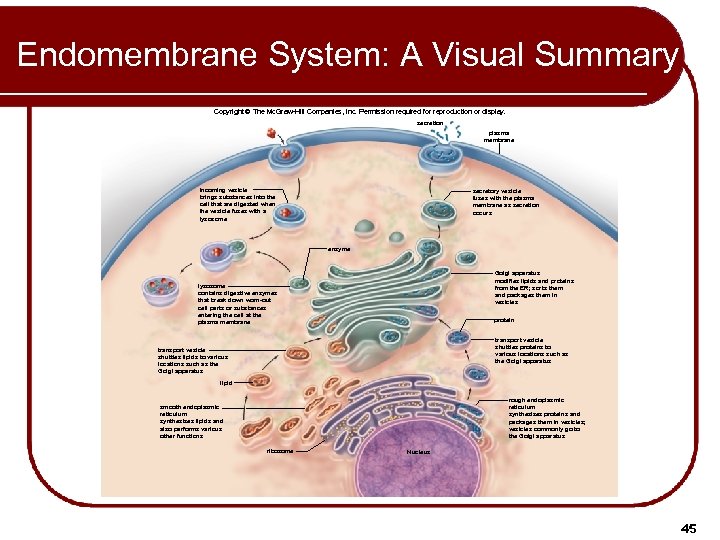
Endomembrane System: A Visual Summary Copyright © The Mc. Graw-Hill Companies, Inc. Permission required for reproduction or display. secretion plasma membrane incoming vesicle brings substances into the cell that are digested when the vesicle fuses with a lysosome secretory vesicle fuses with the plasma membrane as secretion occurs enzyme Golgi apparatus modifies lipids and proteins from the ER; sorts them and packages them in vesicles lysosome contains digestive enzymes that break down worn-out cell parts or substances entering the cell at the plasma membrane protein transport vesicle shuttles proteins to various locations such as the Golgi apparatus transport vesicle shuttles lipids to various locations such as the Golgi apparatus lipid rough endoplasmic reticulum synthesizes proteins and packages them in vesicles; vesicles commonly go to the Golgi apparatus smooth endoplasmic reticulum synthesizes lipids and also performs various other functions ribosome Nucleus 45
Peroxisomes l Similar to lysosomes l l l Membrane-bounded vesicles Enclose enzymes However l l l Enzymes synthesized by free ribosomes in cytoplasm (instead of ER) Active in lipid metabolism Catalyze reactions that produce hydrogen peroxide H 2 O 2 l l Toxic Broken down to water & O 2 by catalase 46
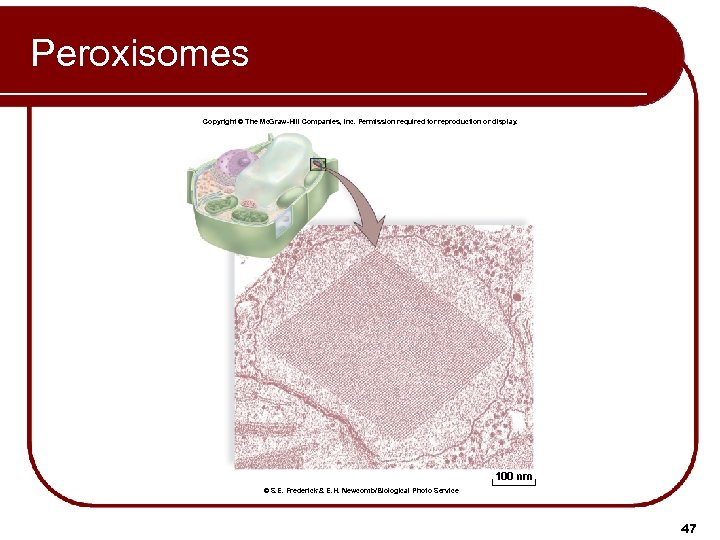
Peroxisomes Copyright © The Mc. Graw-Hill Companies, Inc. Permission required for reproduction or display. 100 nm © S. E. Frederick & E. H. Newcomb/Biological Photo Service 47
Vacuoles l Membranous sacs that are larger than vesicles l l l Store materials that occur in excess Others very specialized (contractile vacuole) Plants cells typically have a central vacuole l l Up to 90% volume of some cells Functions in: l l l Storage of water, nutrients, pigments, and waste products Development of turgor pressure Some functions performed by lysosomes in other eukaryotes 48
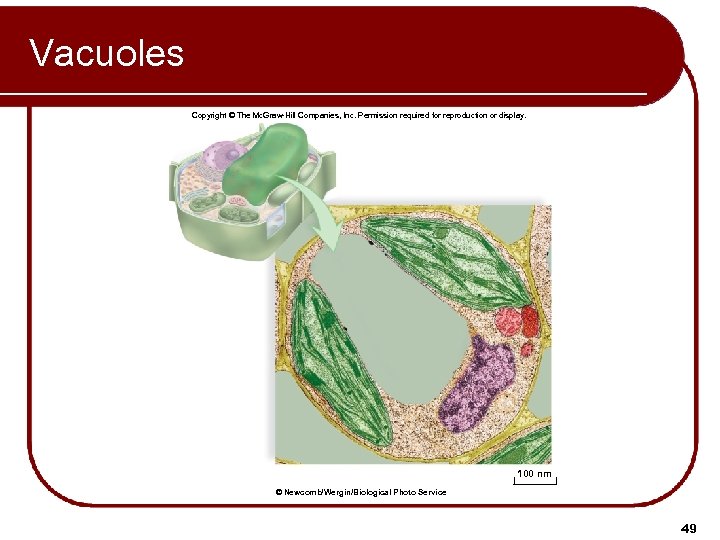
Vacuoles Copyright © The Mc. Graw-Hill Companies, Inc. Permission required for reproduction or display. 100 nm © Newcomb/Wergin/Biological Photo Service 49
Energy-Related Organelles: Chloroplast Structure l Bounded by double membrane l Inner membrane infolded l l l Forms disc-like thylakoids, which are stacked to form grana Suspended in semi-fluid stroma Green due to chlorophyll l Green photosynthetic pigment l Found ONLY in inner membranes of chloroplast 50
Energy-Related Organelles: Chloroplasts l Membranous organelles (a type of plastid) that serve as the site of photosynthesis l Captures light energy to drive cellular machinery l Photosynthesis l Synthesizes carbohydrates from CO 2 & H 2 O l Makes own food using CO 2 as only carbon source l Energy-poor compounds converted to energy-rich compounds solar energy + carbon dioxide + water → carbohydrate + oxygen l Only plants, algae, and certain bacteria are capable of conducting photosynthesis 51
Energy-Related Organelles: Chloroplasts l Bound by a double membrane organized into flattened disc-like sacs called thylakoids l Chlorophyll and other pigments capture solar energy l Enzymes synthesize carbohydrates 52
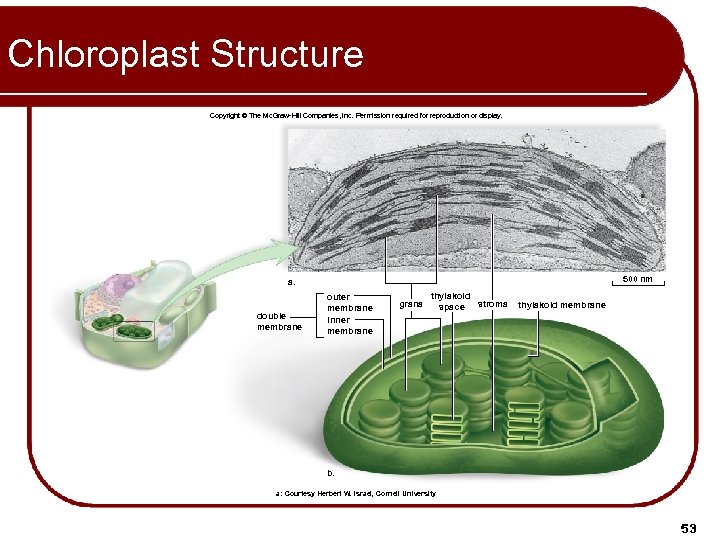
Chloroplast Structure Copyright © The Mc. Graw-Hill Companies, Inc. Permission required for reproduction or display. 500 nm a. double membrane outer membrane inner membrane grana thylakoid space stroma thylakoid membrane b. a: Courtesy Herbert W. Israel, Cornell University 53
Energy-Related Organelles: Mitochondria l Smaller than chloroplast l Contain ribosomes and their own DNA l Surrounded by a double membrane l Inner membrane surrounds the matrix and is convoluted (folds) to form cristae. l Matrix – Inner semifluid containing respiratory enzymes l Break down carbohydrates l Involved in cellular respiration l Produce most of ATP utilized by the cell 54
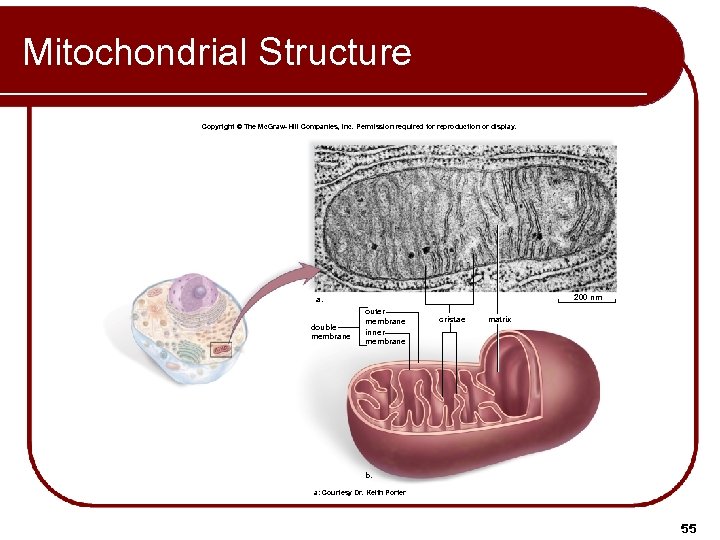
Mitochondrial Structure Copyright © The Mc. Graw-Hill Companies, Inc. Permission required for reproduction or display. 200 nm a. double membrane outer membrane inner membrane cristae matrix b. a: Courtesy Dr. Keith Porter 55
The Cytoskeleton l Maintains cell shape l Assists in movement of cell and organelles l Three types of macromolecular fibers l l Intermediate Filaments l l Actin Filaments Microtubules Assemble and disassemble as needed 56
The Cytoskeleton: Actin Filaments Extremely thin filaments like twisted pearl necklace l Dense web just under plasma membrane maintains cell shape l Support for microvilli in intestinal cells l Intracellular traffic control l l l For moving stuff around within cell Cytoplasmic streaming Function in pseudopods of amoeboid cells Pinch mother cell in two after animal mitosis Important component in muscle contraction (other is myosin) 57
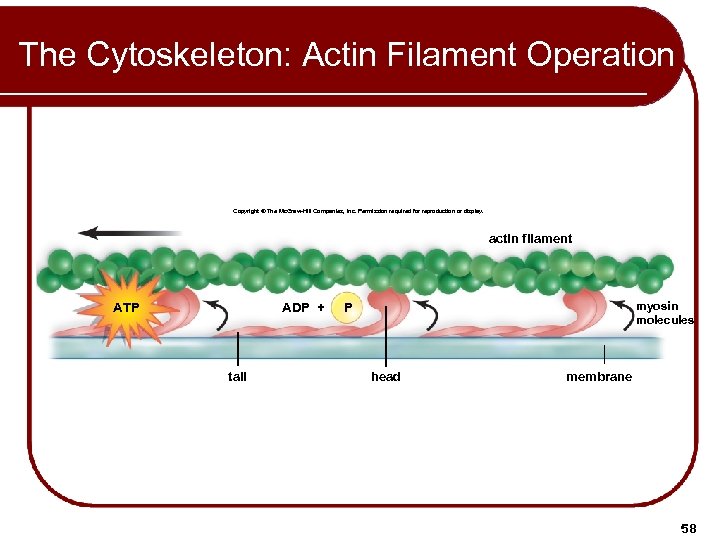
The Cytoskeleton: Actin Filament Operation Copyright © The Mc. Graw-Hill Companies, Inc. Permission required for reproduction or display. actin filament ADP + ATP tail myosin molecules P head membrane 58
The Cytoskeleton: Intermediate Filaments l Intermediate in size between actin filaments and microtubules l Rope-like assembly of fibrous polypeptides l Vary in nature l l l From tissue to tissue From time to time Functions: l Support nuclear envelope l Cell-cell junctions, like those holding skin cells tightly together 59
The Cytoskeleton: Microtubules Hollow cylinders made of two globular proteins called a and b tubulin l Spontaneous pairing of a and b tubulin molecules form structures called dimers l Dimers then arrange themselves into tubular spirals of 13 dimers around l Assembly: l l Under control of Microtubule Organizing Center (MTOC) Most important MTOC is centrosome Interacts with proteins kinesin and dynein to cause movement of organelles 60
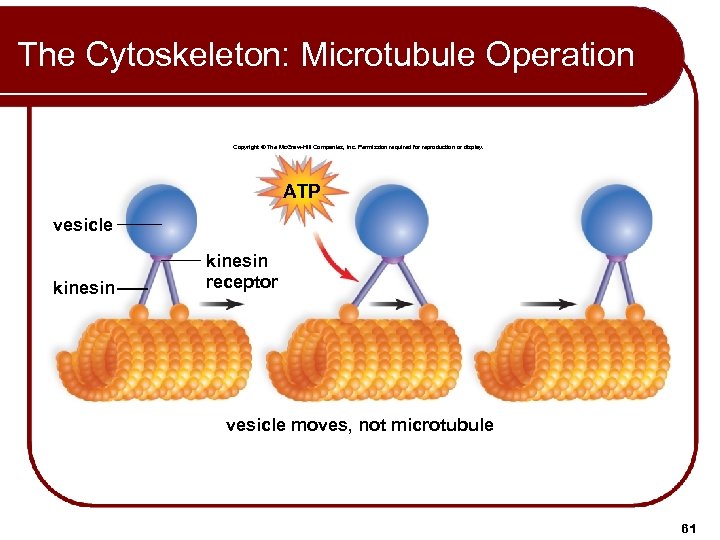
The Cytoskeleton: Microtubule Operation Copyright © The Mc. Graw-Hill Companies, Inc. Permission required for reproduction or display. ATP vesicle kinesin receptor vesicle moves, not microtubule 61
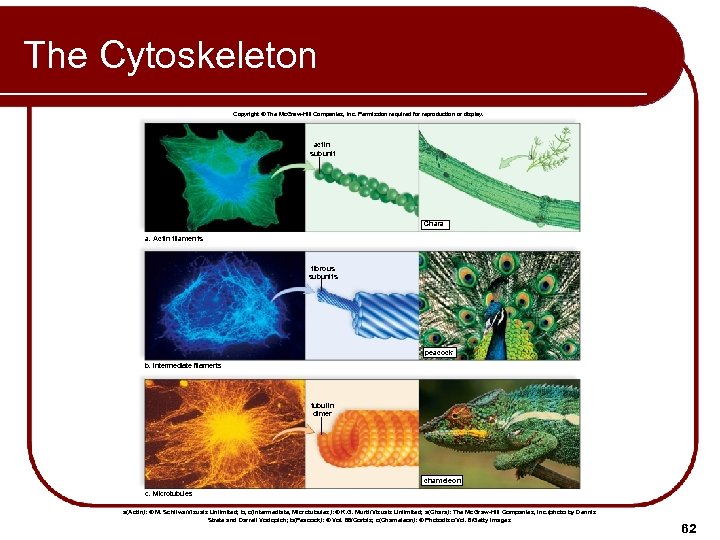
The Cytoskeleton Copyright © The Mc. Graw-Hill Companies, Inc. Permission required for reproduction or display. actin subunit Chara a. Actin filaments fibrous subunits peacock b. Intermediate filaments tubulin dimer chameleon c. Microtubules a(Actin): © M. Schliwa/Visuals Unlimited; b, c(Intermediate, Microtubules): © K. G. Murti/Visuals Unlimited; a(Chara): The Mc. Graw-Hill Companies, Inc. /photo by Dennis Strete and Darrell Vodopich; b(Peacock): © Vol. 86/Corbis; c(Chameleon): © Photodisc/Vol. 6/Getty Images 62
Microtubular Arrays: Centrioles l Short, hollow cylinders l l l Composed of 27 microtubules Microtubules arranged into 9 overlapping triplets One pair per animal cell l l Oriented at right angles to each other l l Located in centrosome of animal cells Separate during mitosis to determine plane of division May give rise to basal bodies of cilia and flagella 63
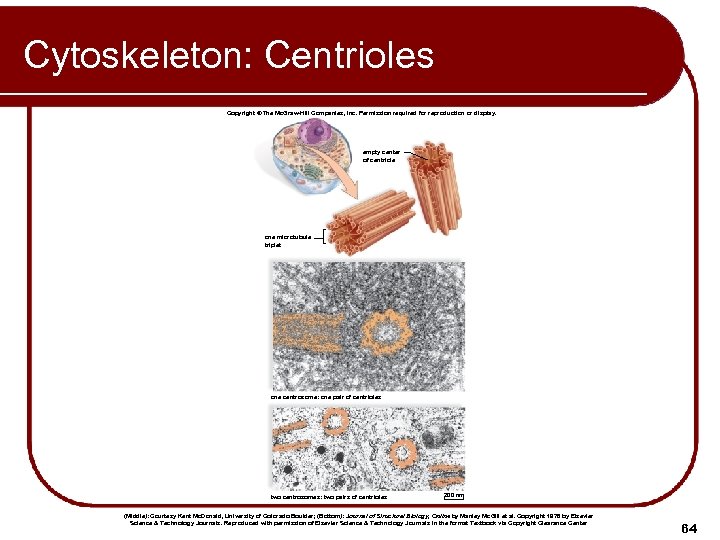
Cytoskeleton: Centrioles Copyright © The Mc. Graw-Hill Companies, Inc. Permission required for reproduction or display. empty center of centriole one microtubule triplet one centrosome: one pair of centrioles two centrosomes: two pairs of centrioles 200 nm (Middle): Courtesy Kent Mc. Donald, University of Colorado Boulder; (Bottom): Journal of Structural Biology, Online by Manley Mc. Gill et al. Copyright 1976 by Elsevier Science & Technology Journals. Reproduced with permission of Elsevier Science & Technology Journals in the format Textbook via Copyright Clearance Center 64
Microtubular Arrays: Cilia and Flagella Hair-like projections from cell surface that aid in cell movement l Very different from prokaryote flagella l l l Outer covering of plasma membrane Inside this is a cylinder of 18 microtubules arranged in 9 pairs In center are two single microtubules This 9 + 2 pattern used by all cilia & flagella In eukaryotes, cilia are much shorter than flagella l l Cilia move in coordinated waves like oars Flagella move like a propeller or cork screw 65
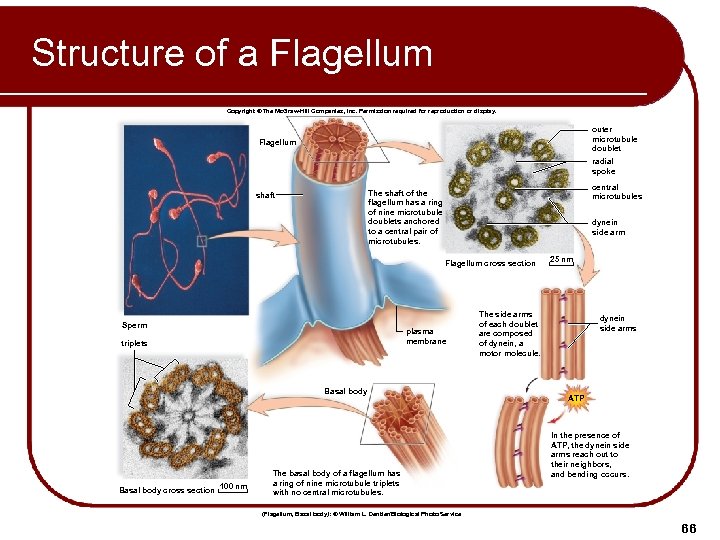
Structure of a Flagellum Copyright © The Mc. Graw-Hill Companies, Inc. Permission required for reproduction or display. outer microtubule doublet Flagellum radial spoke central microtubules The shaft of the flagellum has a ring of nine microtubule doublets anchored to a central pair of microtubules. shaft dynein side arm Flagellum cross section Sperm plasma membrane triplets Basal body cross section 100 nm The basal body of a flagellum has a ring of nine microtubule triplets with no central microtubules. 25 nm The side arms of each doublet are composed of dynein, a motor molecule. dynein side arms ATP In the presence of ATP, the dynein side arms reach out to their neighbors, and bending occurs. (Flagellum, Basal body): © William L. Dentler/Biological Photo Service 66
Comparison of Prokaryotic and Eukaryotic Cells 67
Review l Cellular Level of Organization l l Cell theory Cell size Prokaryotic Cells l Eukaryotic Cells l l l l Organelles Nucleus and Ribosome Endomembrane System Other Vesicles and Vacuoles Energy related organelles Cytoskeleton l Centrioles, Cilia, and Flagella 68
BIOLOGY Chapter 4: pp. 59 -84 10 th Edition Ribosome: site of protein synthesis Fimbriae: hairlike bristles that allow adhesion to the surfaces Inclusion body: stored nutrients for later use Plasma membrane: outer surface that regulates entrance and exit of molecules Conjugation pilus: elongated, hollow appendage used for DNA transfer to other bacterial cells Mesosome: plasma membrane that folds into the cytoplasm and increases surface area Nucleus: Cytoskeleton: maintains cell shape and assists movement of cell parts: Nucleoid: location of the bacterial chromosome Plasma membrane: sheath around cytoplasm that regulates entrance and exit of molecules Endoplasmic reticulum: Cell wall: covering that supports, shapes, and protects cell Sylvia S. Mader Cell Structure and Function Glycocalyx: gel-like coating outside cell wall; if compact, called a capsule; if diffuse, called a slime layer Flagellum: rotating filament present in some bacteria that pushes the cell forward *not in plant cells Power. Point® Lecture Slides are prepared by Dr. Isaac Barjis, Biology Instructor Copyright © The Mc. Graw Hill Companies Inc. Permission required for reproduction or display 69
Скачать презентацию BIOLOGY Chapter 4 pp 59 -84 10 th
2529a4be0aa552e2f58a04690879b168.ppt