 Скачать презентацию Biological Chemical Countermeasures RDT E at the Department of Homeland
05c002ebeb5ecbd9808d14d92aed5bff.ppt
- Количество слайдов: 33



Biological/Chemical Countermeasures RDT&E: at the Department of Homeland Security 6 th Annual Science & Engineering Technology Conference Charleston Area Convention Center April 20, 2005 Mr. Lance Brooks Biological/Chemical Countermeasures Plans, Programs, & Budgets Science & Technology Page 1
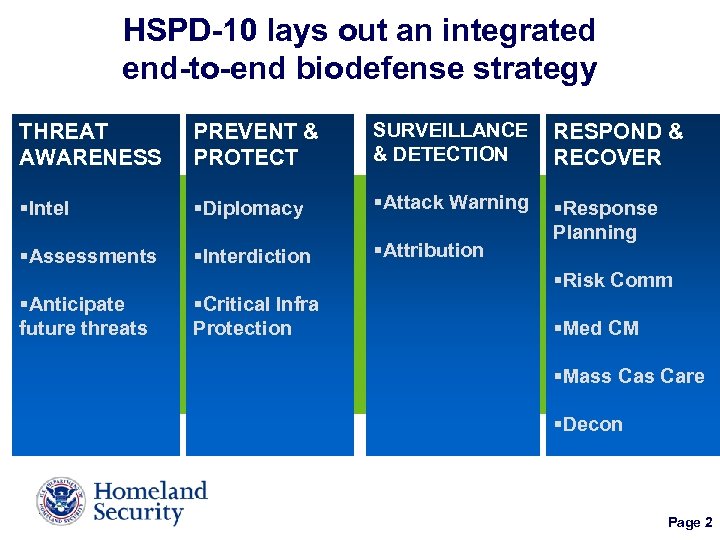
HSPD-10 lays out an integrated end-to-end biodefense strategy THREAT AWARENESS PREVENT & PROTECT SURVEILLANCE & DETECTION RESPOND & RECOVER §Intel §Diplomacy §Attack Warning §Assessments §Interdiction §Attribution §Response Planning §Risk Comm §Anticipate future threats §Critical Infra Protection §Med CM §Mass Care §Decon Page 2
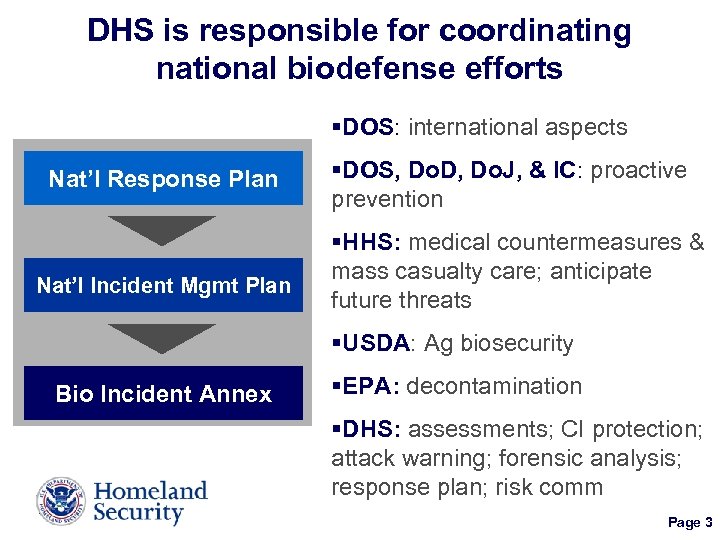
DHS is responsible for coordinating national biodefense efforts §DOS: international aspects Nat’l Response Plan Nat’l Incident Mgmt Plan §DOS, Do. D, Do. J, & IC: proactive prevention §HHS: medical countermeasures & mass casualty care; anticipate future threats §USDA: Ag biosecurity Bio Incident Annex §EPA: decontamination §DHS: assessments; CI protection; attack warning; forensic analysis; response plan; risk comm Page 3
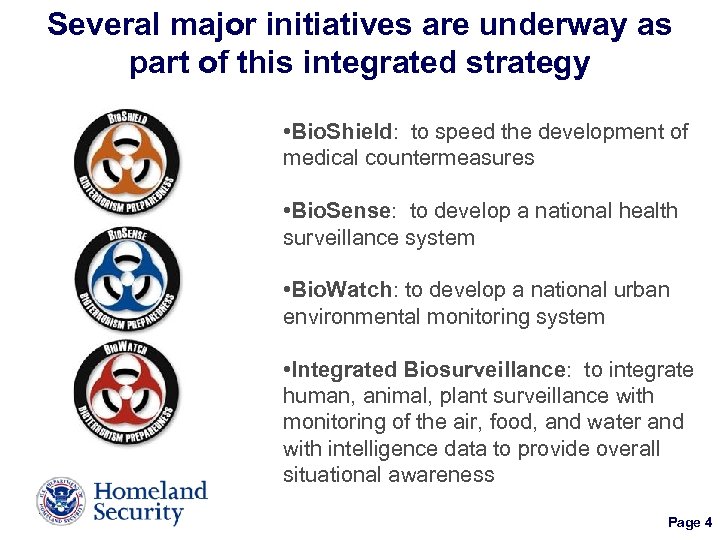
Several major initiatives are underway as part of this integrated strategy • Bio. Shield: to speed the development of medical countermeasures • Bio. Sense: to develop a national health surveillance system • Bio. Watch: to develop a national urban environmental monitoring system • Integrated Biosurveillance: to integrate human, animal, plant surveillance with monitoring of the air, food, and water and with intelligence data to provide overall situational awareness Page 4
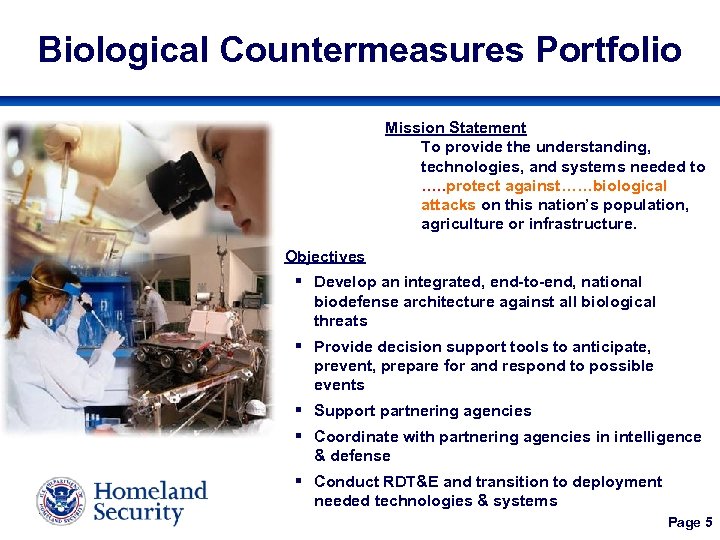
Biological Countermeasures Portfolio Mission Statement To provide the understanding, technologies, and systems needed to …. . protect against……biological attacks on this nation’s population, agriculture or infrastructure. Objectives § Develop an integrated, end-to-end, national biodefense architecture against all biological threats § Provide decision support tools to anticipate, prevent, prepare for and respond to possible events § Support partnering agencies § Coordinate with partnering agencies in intelligence & defense § Conduct RDT&E and transition to deployment needed technologies & systems Page 5
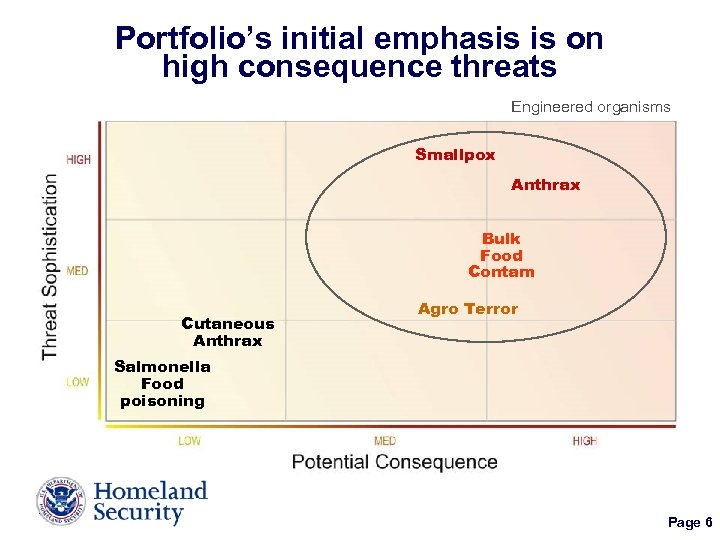
Portfolio’s initial emphasis is on high consequence threats Engineered organisms Smallpox Anthrax Bulk Food Contam Cutaneous Anthrax Agro Terror Salmonella Food poisoning Page 6
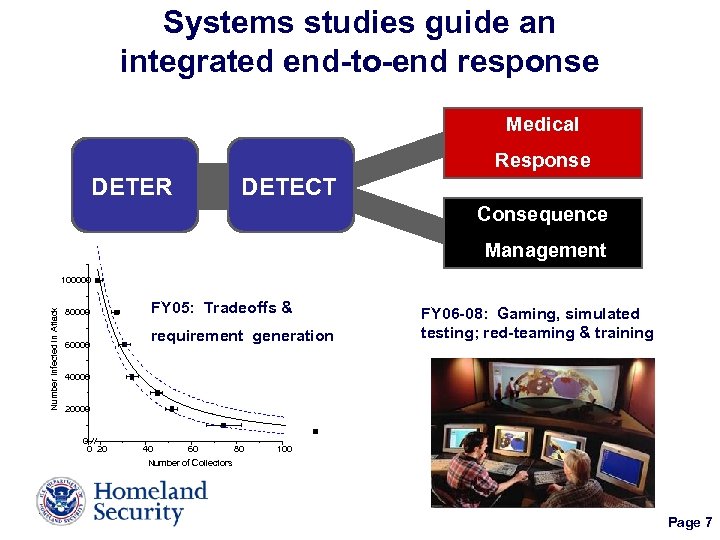
Systems studies guide an integrated end-to-end response FY 04: End-to-end studies (strategies, gaps & priorities) Medical Response DETER DETECT Consequence Management Number Infected in Attack 100000 80000 60000 FY 05: Tradeoffs & requirement generation FY 06 -08: Gaming, simulated testing; red-teaming & training 40000 20000 0 0 20 40 60 80 Number of Collectors 100 Page 7
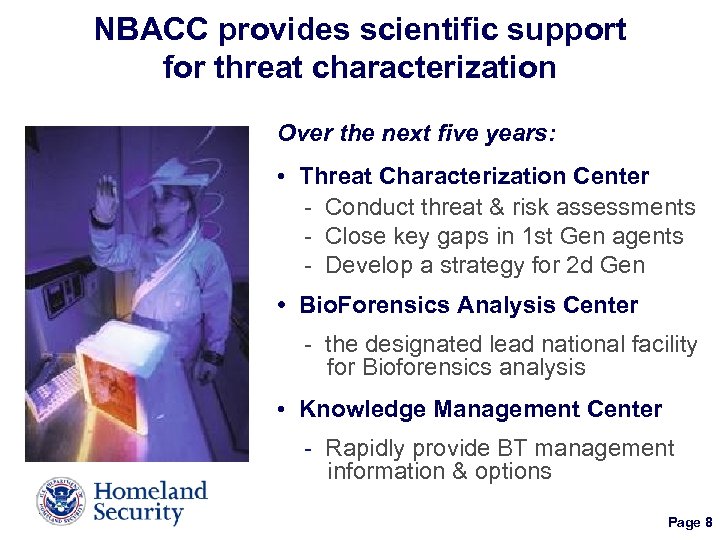
NBACC provides scientific support for threat characterization Over the next five years: • Threat Characterization Center - Conduct threat & risk assessments - Close key gaps in 1 st Gen agents - Develop a strategy for 2 d Gen • Bio. Forensics Analysis Center - the designated lead national facility for Bioforensics analysis • Knowledge Management Center - Rapidly provide BT management information & options Page 8
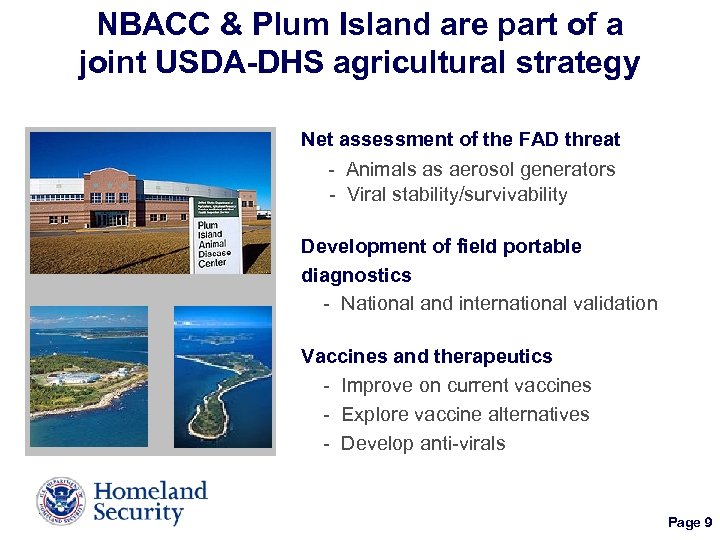
NBACC & Plum Island are part of a joint USDA-DHS agricultural strategy Net assessment of the FAD threat - Animals as aerosol generators - Viral stability/survivability Development of field portable diagnostics and assays - National and international validation Vaccines and therapeutics - Improve on current vaccines - Explore vaccine alternatives - Develop anti-virals Page 9
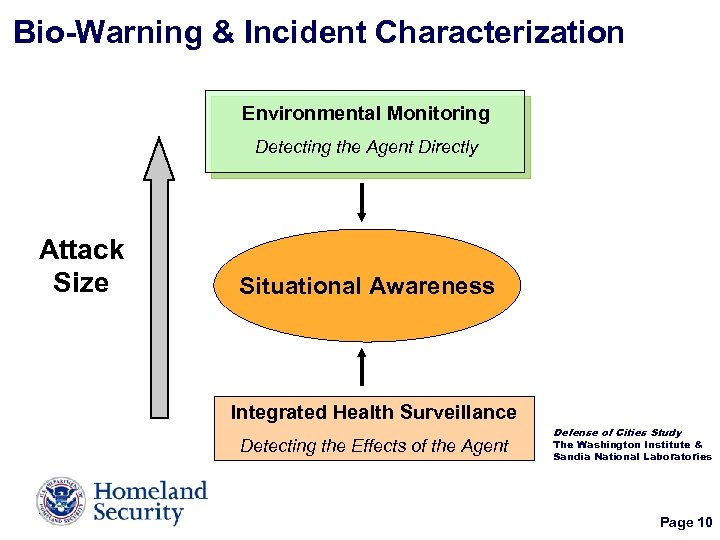
Bio-Warning & Incident Characterization Environmental Monitoring Detecting the Agent Directly Attack Size Situational Awareness Integrated Health Surveillance Detecting the Effects of the Agent Defense of Cities Study The Washington Institute & Sandia National Laboratories Page 10
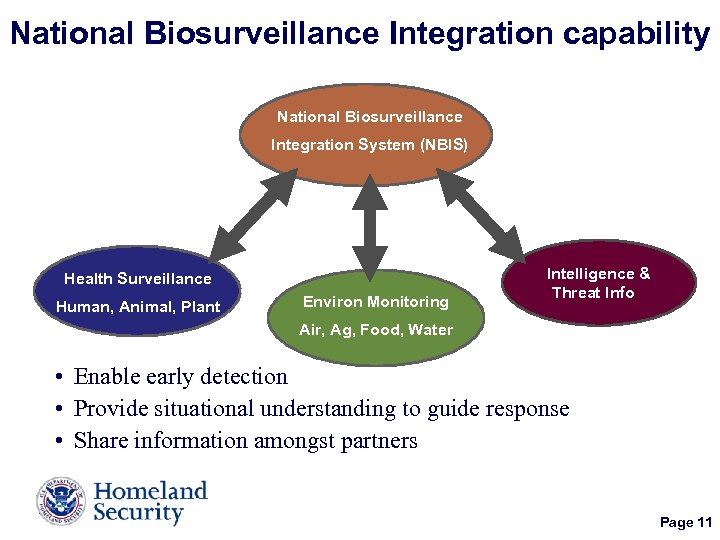
National Biosurveillance Integration capability National Biosurveillance Integration System (NBIS) Health Surveillance Human, Animal, Plant Environ Monitoring Intelligence & Threat Info Air, Ag, Food, Water • Enable early detection • Provide situational understanding to guide response • Share information amongst partners Page 11
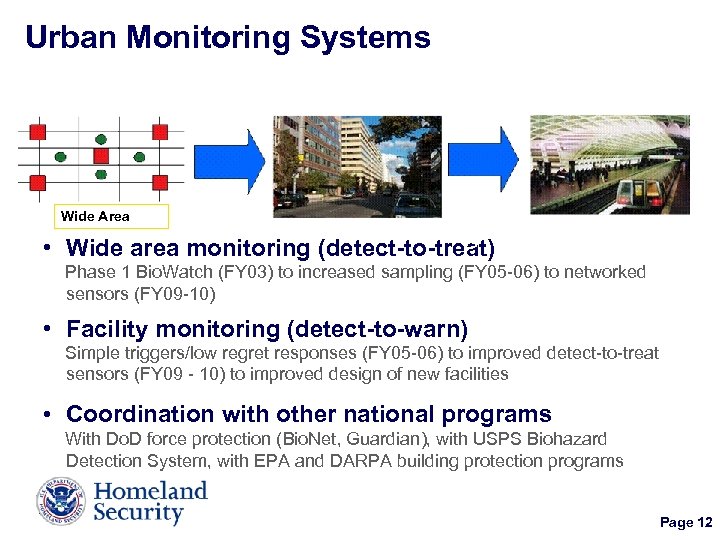
Urban Monitoring Systems Wide Area + + • Wide area monitoring (detect-to-treat) Hi-value facilities Phase 1 Bio. Watch (FY 03) to increased sampling (FY 05 -06) to networked sensors (FY 09 -10) • Facility monitoring (detect-to-warn) Simple triggers/low regret responses (FY 05 -06) to improved detect-to-treat sensors (FY 09 - 10) to improved design of new facilities • Coordination with other national programs With Do. D force protection (Bio. Net, Guardian), with USPS Biohazard Detection System, with EPA and DARPA building protection programs Page 12
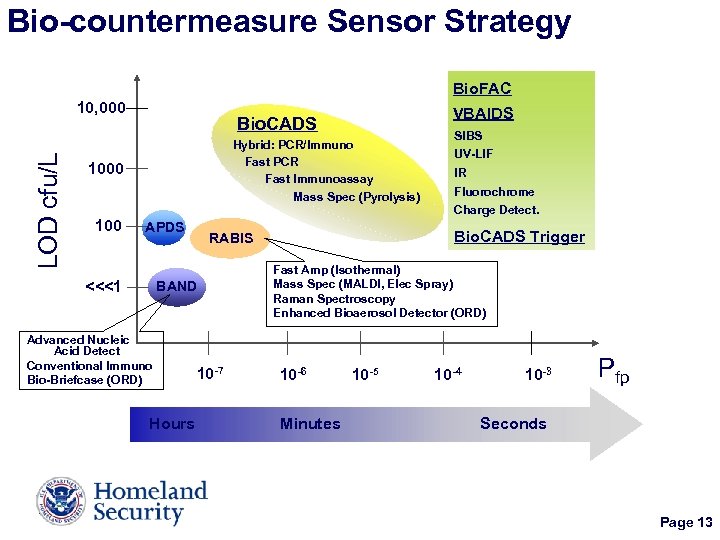
Bio-countermeasure Sensor Strategy Bio. FAC LOD cfu/L 10, 000 Hybrid: PCR/Immuno Fast PCR Fast Immunoassay Mass Spec (Pyrolysis) 1000 100 VBAIDS Bio. CADS SIBS UV-LIF IR Fluorochrome Charge Detect. APDS <<<1 BAND Advanced Nucleic Acid Detect Conventional Immuno Bio-Briefcase (ORD) Hours Bio. CADS Trigger RABIS 10 -7 Fast Amp (Isothermal) Mass Spec (MALDI, Elec Spray) Raman Spectroscopy Enhanced Bioaerosol Detector (ORD) 10 -6 Minutes 10 -5 10 -4 10 -3 Pfp Seconds Page 13
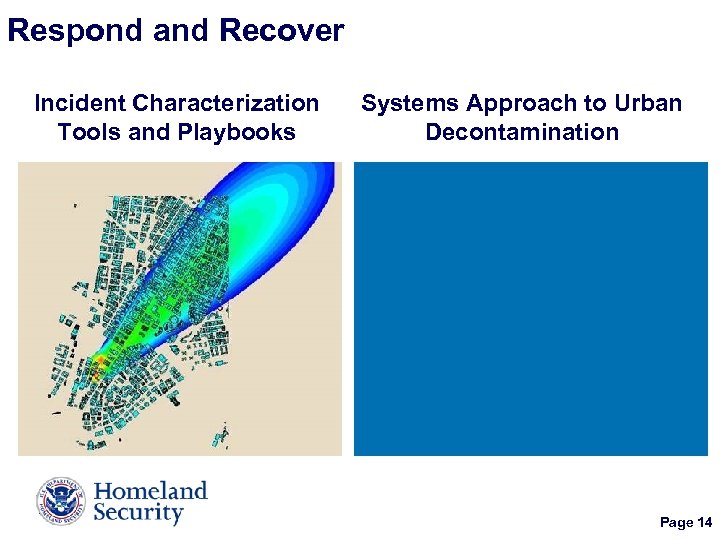
Respond and Recover Incident Characterization Tools and Playbooks Systems Approach to Urban Decontamination Page 14
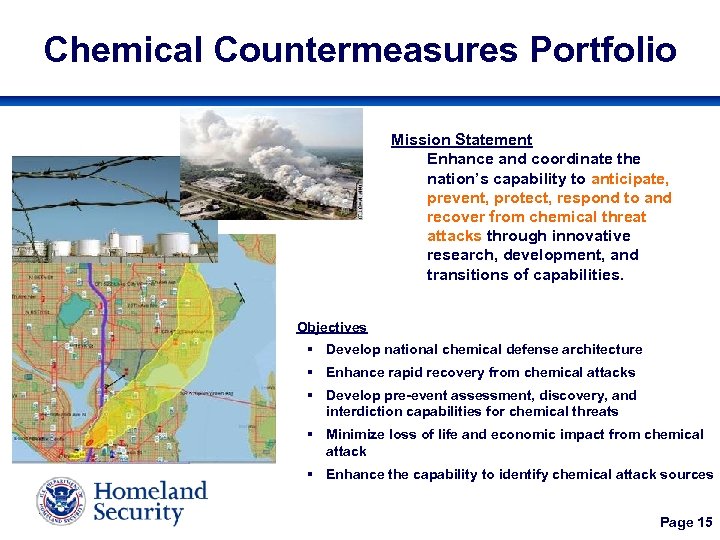
Chemical Countermeasures Portfolio Mission Statement Enhance and coordinate the nation’s capability to anticipate, prevent, protect, respond to and recover from chemical threat attacks through innovative research, development, and transitions of capabilities. Objectives § Develop national chemical defense architecture § Enhance rapid recovery from chemical attacks § Develop pre-event assessment, discovery, and interdiction capabilities for chemical threats § Minimize loss of life and economic impact from chemical attack § Enhance the capability to identify chemical attack sources Page 15
Some Guiding Principles • DHS program addresses non-medical challenges • Strive to engage the interagency in developing strategy • Strive to utilize existing infrastructure Ø Recognize Do. D “specialties” in this area • Technology demos will down-select from all potential technology candidates Critical Enablers Binding interagency agreements Definition of agency roles/responsibilities Security classification guidance Page 16
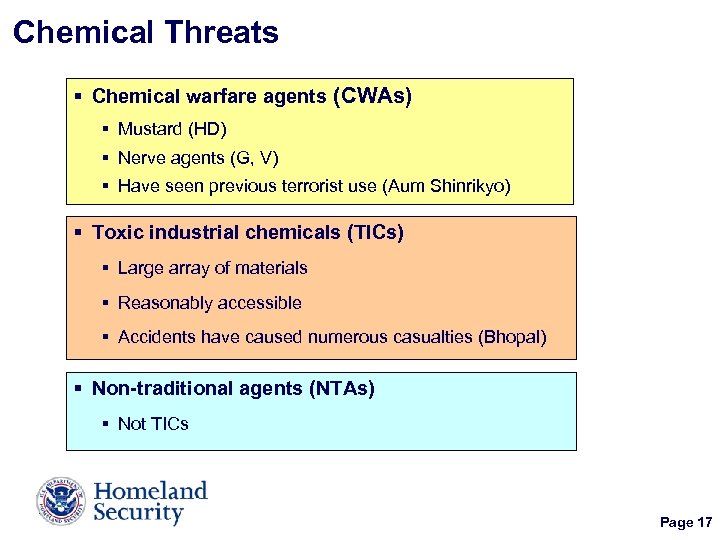
Chemical Threats § Chemical warfare agents (CWAs) § Mustard (HD) § Nerve agents (G, V) § Have seen previous terrorist use (Aum Shinrikyo) § Toxic industrial chemicals (TICs) § Large array of materials § Reasonably accessible § Accidents have caused numerous casualties (Bhopal) § Non-traditional agents (NTAs) § Not TICs Page 17
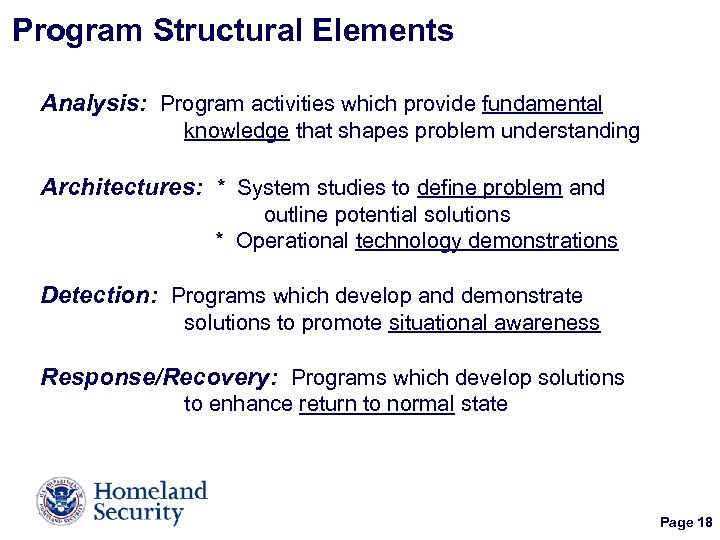
Program Structural Elements Analysis: Program activities which provide fundamental knowledge that shapes problem understanding Architectures: * System studies to define problem and outline potential solutions * Operational technology demonstrations Detection: Programs which develop and demonstrate solutions to promote situational awareness Response/Recovery: Programs which develop solutions to enhance return to normal state Page 18
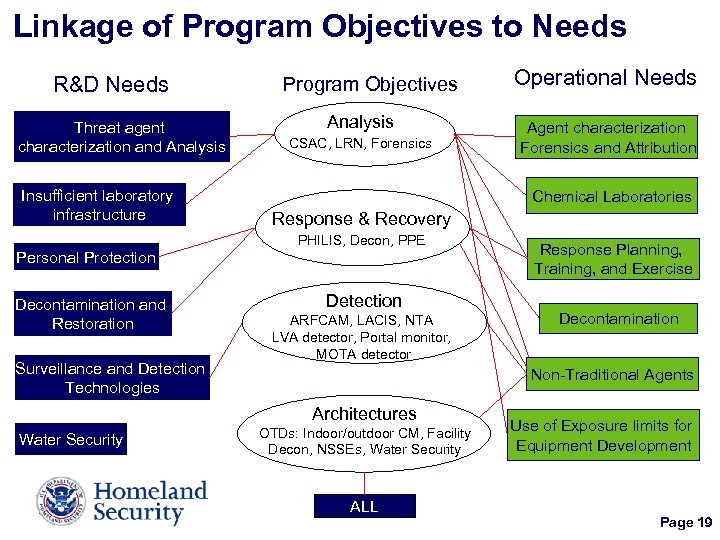
Linkage of Program Objectives to Needs R&D Needs Threat agent characterization and Analysis Insufficient laboratory infrastructure Personal Protection Decontamination and Restoration Surveillance and Detection Technologies Program Objectives Analysis CSAC, LRN, Forensics Agent characterization Forensics and Attribution Chemical Laboratories Response & Recovery PHILIS, Decon, PPE Detection ARFCAM, LACIS, NTA LVA detector, Portal monitor, MOTA detector Response Planning, Training, and Exercise Decontamination Non-Traditional Agents Architectures Water Security Operational Needs OTDs: Indoor/outdoor CM, Facility Decon, NSSEs, Water Security ALL Use of Exposure limits for Equipment Development Page 19
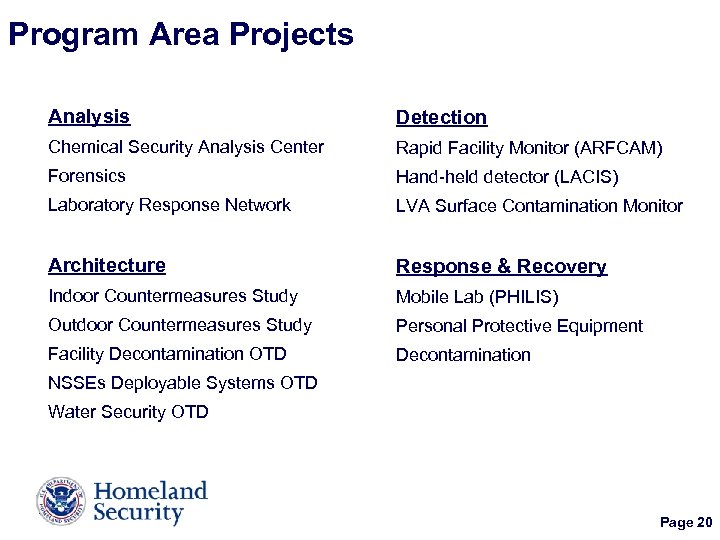
Program Area Projects Analysis Detection Chemical Security Analysis Center Rapid Facility Monitor (ARFCAM) Forensics Hand-held detector (LACIS) Laboratory Response Network LVA Surface Contamination Monitor Architecture Response & Recovery Indoor Countermeasures Study Mobile Lab (PHILIS) Outdoor Countermeasures Study Personal Protective Equipment Facility Decontamination OTD Decontamination NSSEs Deployable Systems OTD Water Security OTD Page 20
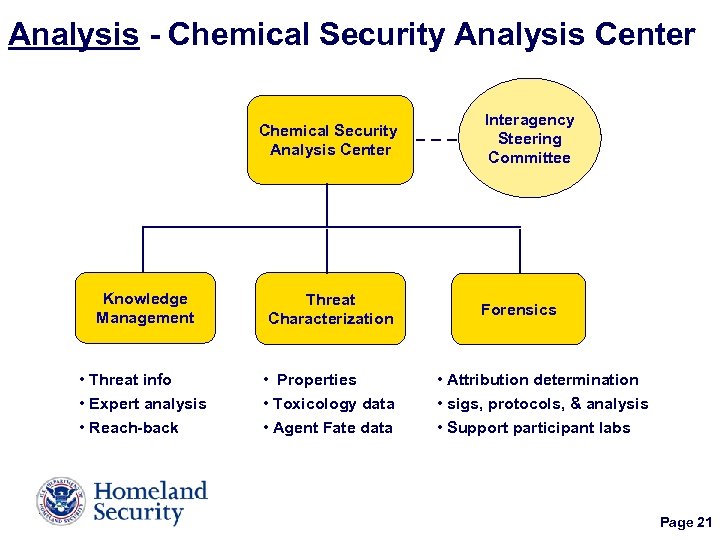
Analysis - Chemical Security Analysis Center Knowledge Management Threat Characterization • Threat info • Expert analysis • Reach-back • Properties • Toxicology data • Agent Fate data Interagency Steering Committee Forensics • Attribution determination • sigs, protocols, & analysis • Support participant labs Page 21
Analysis - Chemical Environmental Lab Response Network Description: § Organized process for the sampling and analysis of very large numbers of environmental samples containing highly toxic chemicals. § The CLRN will be populated by laboratories qualified by an interagency-agreed accreditation process. § CLRN will include triage laboratories for analysis of unknown samples potentially containing highly toxic chemicals such as classical chemical agents. § Support incident response through rapid analysis of samples from chemical release events as well as potentially toxic samples of suspect origin. Page 22
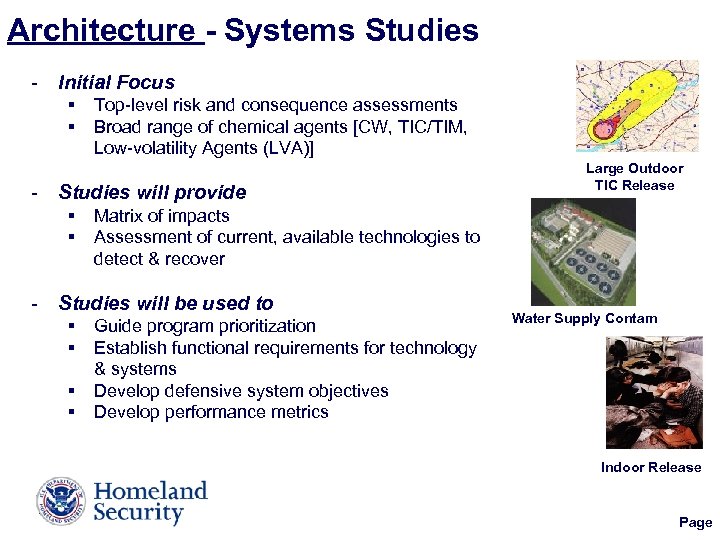
Architecture - Systems Studies - Initial Focus § § Top-level risk and consequence assessments Broad range of chemical agents [CW, TIC/TIM, Low-volatility Agents (LVA)] - Studies will provide § § Matrix of impacts Assessment of current, available technologies to detect & recover - Studies will be used to § § Large Outdoor TIC Release Guide program prioritization Establish functional requirements for technology & systems Develop defensive system objectives Develop performance metrics Water Supply Contam Indoor Release Page
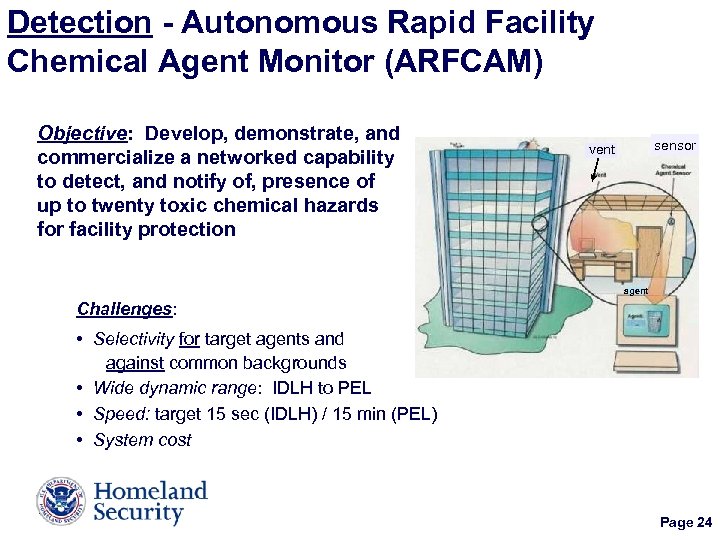
Detection - Autonomous Rapid Facility Chemical Agent Monitor (ARFCAM) Objective: Develop, demonstrate, and commercialize a networked capability to detect, and notify of, presence of up to twenty toxic chemical hazards for facility protection sensor vent agent Challenges: • Selectivity for target agents and against common backgrounds • Wide dynamic range: IDLH to PEL • Speed: target 15 sec (IDLH) / 15 min (PEL) • System cost Page 24
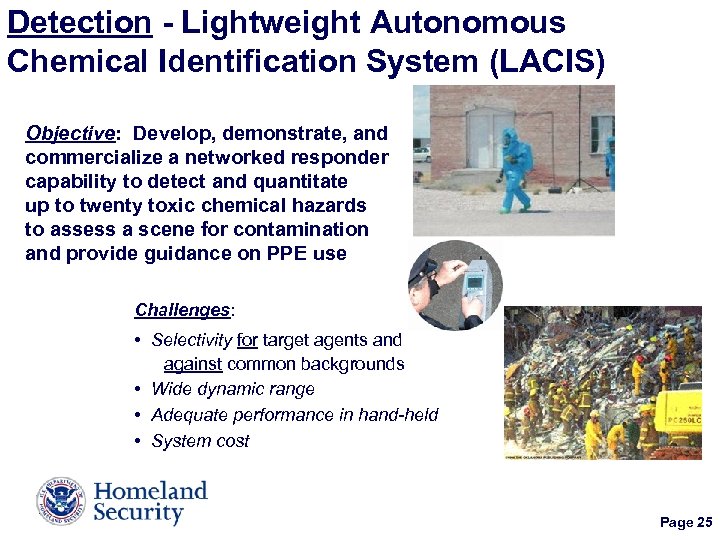
Detection - Lightweight Autonomous Chemical Identification System (LACIS) Objective: Develop, demonstrate, and commercialize a networked responder capability to detect and quantitate up to twenty toxic chemical hazards to assess a scene for contamination and provide guidance on PPE use Challenges: • Selectivity for target agents and against common backgrounds • Wide dynamic range • Adequate performance in hand-held • System cost Page 25
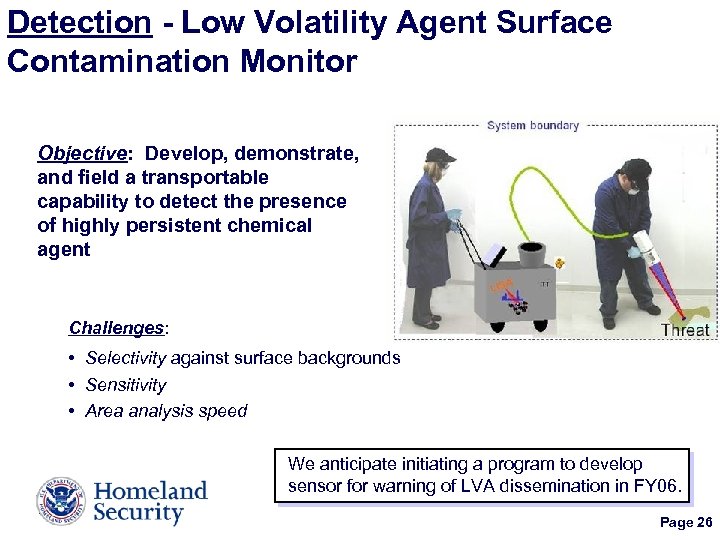
Detection - Low Volatility Agent Surface Contamination Monitor Objective: Develop, demonstrate, and field a transportable capability to detect the presence of highly persistent chemical agent Challenges: • Selectivity against surface backgrounds • Sensitivity • Area analysis speed We anticipate initiating a program to develop sensor for warning of LVA dissemination in FY 06. Page 26
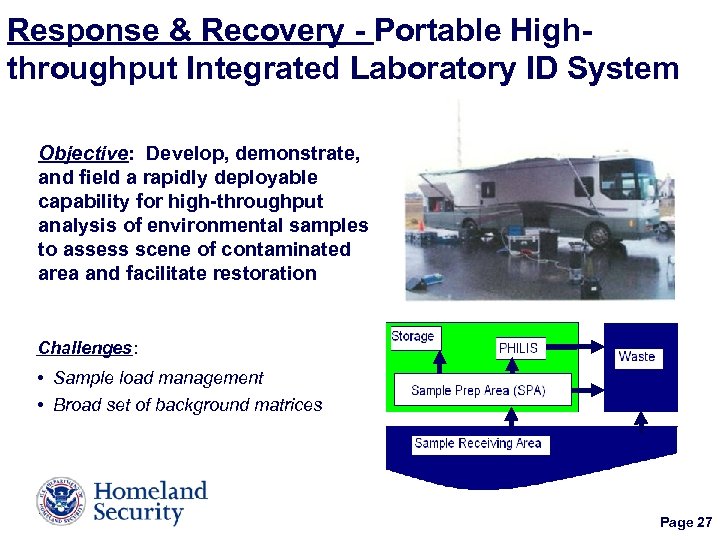
Response & Recovery - Portable Highthroughput Integrated Laboratory ID System Objective: Develop, demonstrate, and field a rapidly deployable capability for high-throughput analysis of environmental samples to assess scene of contaminated area and facilitate restoration Challenges: • Sample load management • Broad set of background matrices Page 27
rs h, es T ng ti -S cqu A nd a E s an l , P B) s am (PP gr ts o s Pr dge ed s s f u o Ne ap am e d. B e G r c fin tify rog ffi an e s : es O -D en e P on sur i al v h rc t: a se en hip Re pm rds of elo wa e v e fic De l St y f rit ch O nd era u r A Fed ec ea S s d Re cy ctor n la ed gen Se e m nc s A vate Ho dva ect Pri A roj age P ng & -E s ing t: and m r n te ee me sting s n Sy ngi lop s Te E eve em ion D yst isit e Us nd De elo v e pm t, n l. E na p tio ra pe O O io a p Ca ty ili b Pu / sh M t ke ar P -Id ritiz iss mea ysis ect M r rio y te al rot -P rit oun An e P n r cu Se E C atio uctu ds N m tr ar BR nfor fras and i C I In St l. M al na io S, tic i nt Cr ve USS n Co G, C US t ra e Page 28
HSARPA Solicitations Past BAA: • Detection systems for bio & chem countermeasures • Bio-informatics & assay development Current BAAs: • Instantaneous bioaerosol detector systems (IBADS) • Food Biological Agent Detection Sensor (FBADS) Past SBIR solicitations: • Chem-bio sensors employing novel receptor scaffolds • Advanced low cost aerosol collectors for surv & … For more information see www. hsarpabaa. com Page 29

Page 30
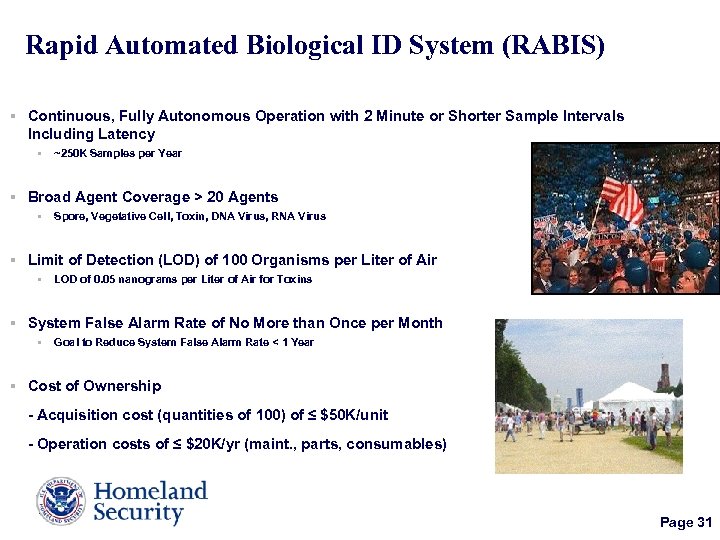
Rapid Automated Biological ID System (RABIS) § Continuous, Fully Autonomous Operation with 2 Minute or Shorter Sample Intervals Including Latency § ~250 K Samples per Year § Broad Agent Coverage > 20 Agents § Spore, Vegetative Cell, Toxin, DNA Virus, RNA Virus § Limit of Detection (LOD) of 100 Organisms per Liter of Air § LOD of 0. 05 nanograms per Liter of Air for Toxins § System False Alarm Rate of No More than Once per Month § Goal to Reduce System False Alarm Rate < 1 Year § Cost of Ownership - Acquisition cost (quantities of 100) of ≤ $50 K/unit - Operation costs of ≤ $20 K/yr (maint. , parts, consumables) Page 31
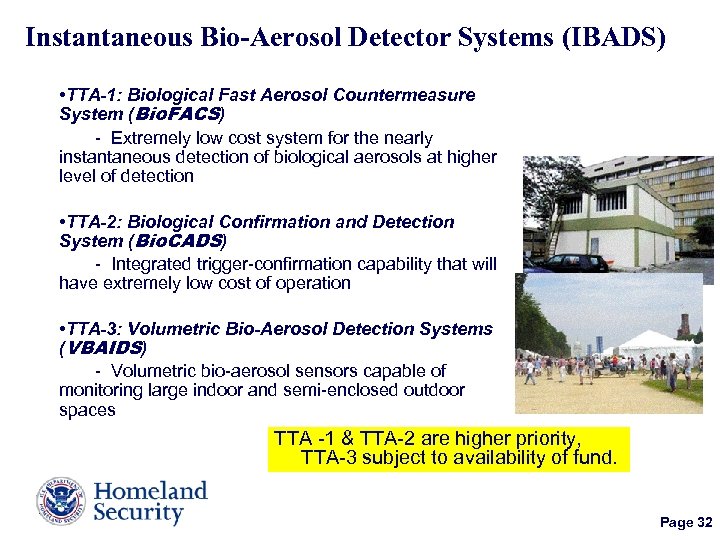
Instantaneous Bio-Aerosol Detector Systems (IBADS) • TTA-1: Biological Fast Aerosol Countermeasure System (Bio. FACS) - Extremely low cost system for the nearly instantaneous detection of biological aerosols at higher level of detection • TTA-2: Biological Confirmation and Detection System (Bio. CADS) - Integrated trigger-confirmation capability that will have extremely low cost of operation • TTA-3: Volumetric Bio-Aerosol Detection Systems (VBAIDS) - Volumetric bio-aerosol sensors capable of monitoring large indoor and semi-enclosed outdoor spaces TTA -1 & TTA-2 are higher priority, TTA-3 subject to availability of fund. Page 32
Instantaneous Bio-Aerosol Detector Systems (IBADS) Bio. FACS - Trigger < 1 min, goal of 15 seconds - Acquisition cost target of < $10 K, with <$1000 as an optimal goal in quantities of 1, 000 Bio. CADS - 5 min or less for confirmation, trigger speed is goal - Acquisition cost target of < $25 K, with <$1000 as an optimal goal in quantities of 1, 000 VBAIDS - trigger <2 -3 min, goal <1 min - Acquisition cost target of < $50 K, with low O&M costs All- ROC curves for - 1000, 10, 000 and 100, 000 CFU(PFU)/Liter of air (Spores, vegetative bacteria, RNA and DNA Viruses) - 0. 5, 5 and 50 ng/Liter of air for toxins Page 33
Скачать презентацию Biological Chemical Countermeasures RDT E at the Department of Homeland
05c002ebeb5ecbd9808d14d92aed5bff.ppt