 Скачать презентацию Bioinformatics CSM 17 Week 3 Biological Identification
f90157aff1409a88d2637e4b1c47ee2c.ppt
- Количество слайдов: 24



Bioinformatics CSM 17 Week 3: Biological Identification • • A fundamental activity Traditional methods - keys Special problems Computer-based methods JYC: CSM 17
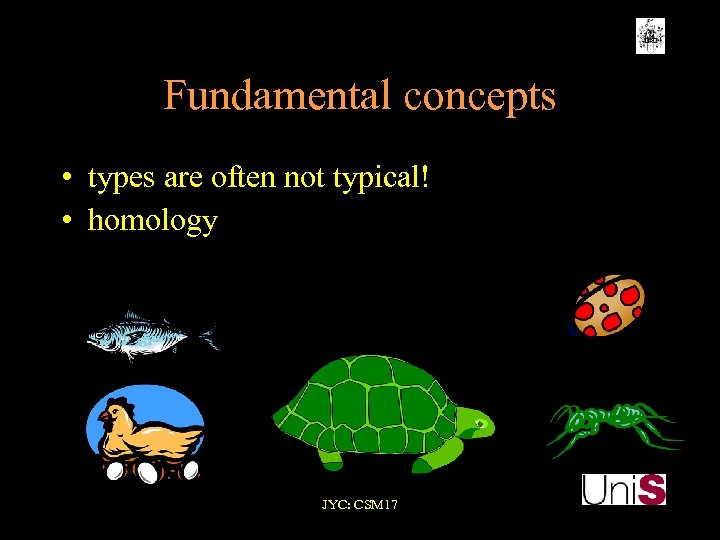
Fundamental concepts • types are often not typical! • homology JYC: CSM 17
How to identify an organism? Traditional/classical methods. . . • Find someone who knows what it is ! • Indented and bracketed Keys – since the 1600 s ! • Floras and monographs • Mostly phenotypic characters JYC: CSM 17
Traditional Methods. . . • A key to identify Human, Cow, Dog (only!) 1. Number of legs two. . . . Human 1. Number of legs four. . . . 2. 2. Stomach chambers four; eats grass. . . . Cow 2. Stomach chambers one; eats meat. . . . Dog JYC: CSM 17
Difficulties caused by. . . • • new taxa (e. g. new species) phenotypic variation genotypic variation maturity sexual dimorphism incomplete material ‘incorrect’ classification JYC: CSM 17
The value of characters • Ease of observation • Clarity / unambiguous • Information content: Entropy (H) JYC: CSM 17
Computer-based methods • Key generators eg. DELTA • On-line keys – Polyclaves e. g. Luc. ID, CABIKEY • Expert Systems JYC: CSM 17
DELTA • • DEscriptive Language for TAxonomy a suite of programs and tools a database format KEY generator JYC: CSM 17
Main files • ITEMS • CHARS • SPECS JYC: CSM 17
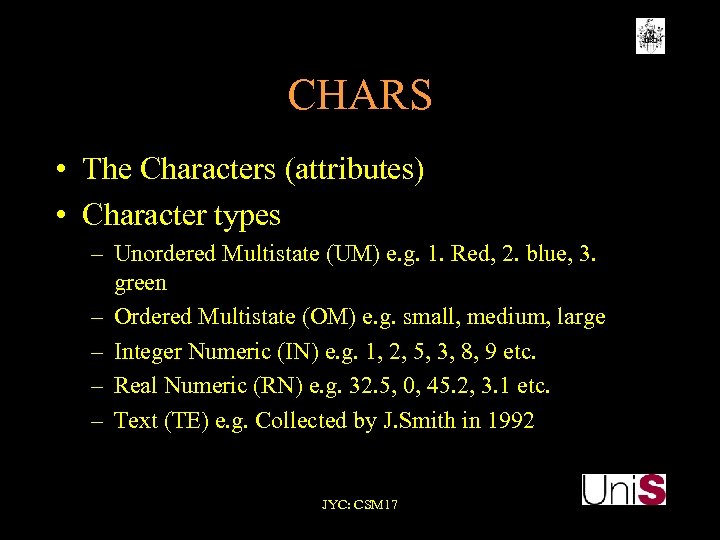
CHARS • The Characters (attributes) • Character types – Unordered Multistate (UM) e. g. 1. Red, 2. blue, 3. green – Ordered Multistate (OM) e. g. small, medium, large – Integer Numeric (IN) e. g. 1, 2, 5, 3, 8, 9 etc. – Real Numeric (RN) e. g. 32. 5, 0, 45. 2, 3. 1 etc. – Text (TE) e. g. Collected by J. Smith in 1992 JYC: CSM 17
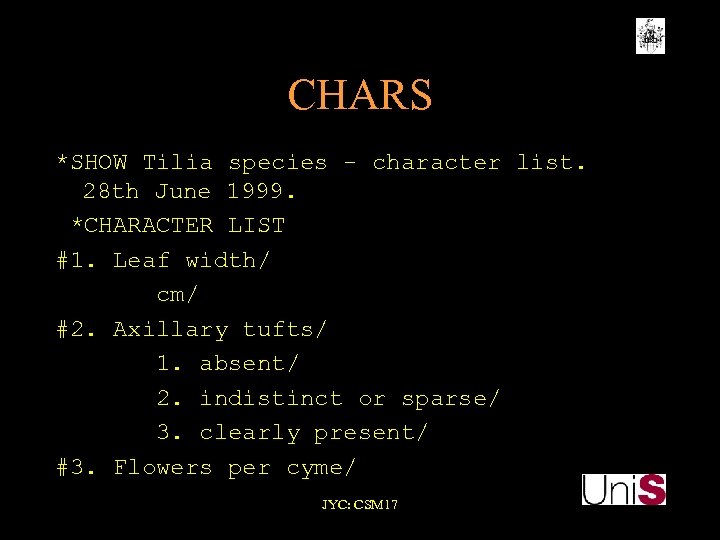
CHARS *SHOW Tilia species - character list. 28 th June 1999. *CHARACTER LIST #1. Leaf width/ cm/ #2. Axillary tufts/ 1. absent/ 2. indistinct or sparse/ 3. clearly present/ #3. Flowers per cyme/ JYC: CSM 17
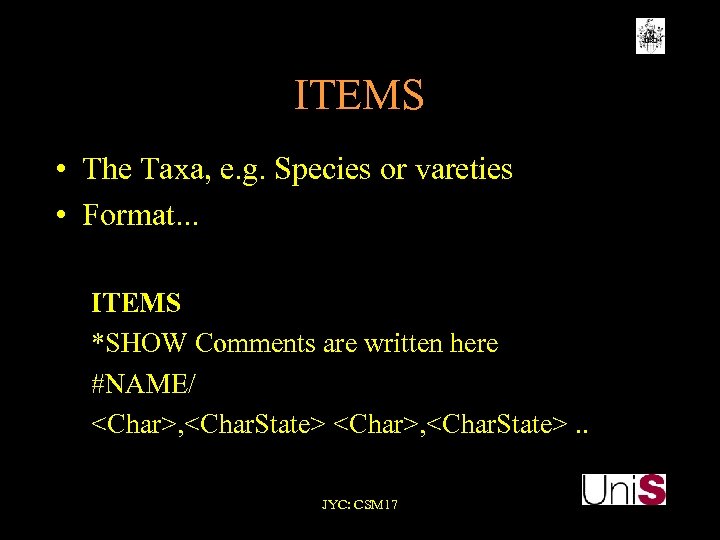
ITEMS • The Taxa, e. g. Species or vareties • Format. . . ITEMS *SHOW Comments are written here #NAME/ <Char>, <Char. State>. . JYC: CSM 17
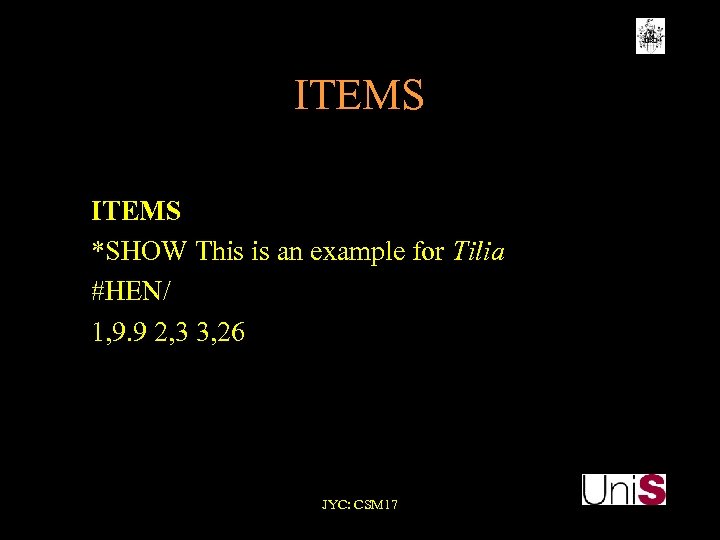
ITEMS *SHOW This is an example for Tilia #HEN/ 1, 9. 9 2, 3 3, 26 JYC: CSM 17
SPECS • • • Number of characters Maximum number of character states Maximum number of items (taxa) Character types Number of states per character JYC: CSM 17
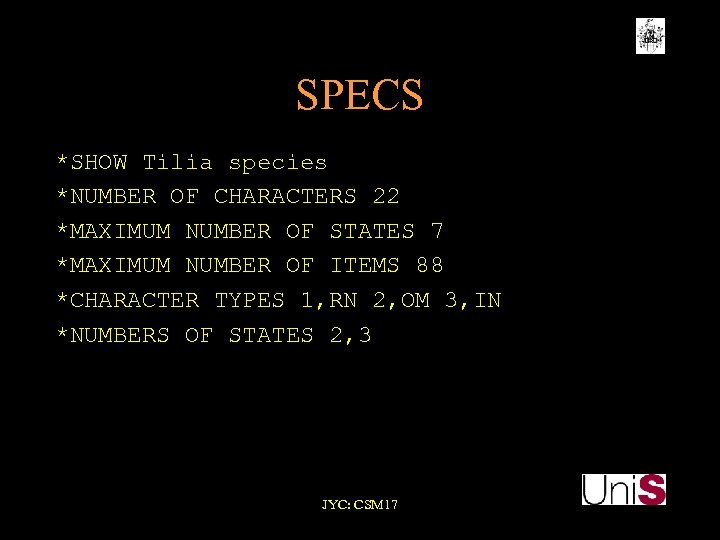
SPECS *SHOW Tilia species *NUMBER OF CHARACTERS 22 *MAXIMUM NUMBER OF STATES 7 *MAXIMUM NUMBER OF ITEMS 88 *CHARACTER TYPES 1, RN 2, OM 3, IN *NUMBERS OF STATES 2, 3 JYC: CSM 17
DELTA KEY Generator • • Creates a ‘paper’ identification key Chooses ‘best’ characters first Uses a ‘comparison’ function Finds the character which requires fewest questions JYC: CSM 17
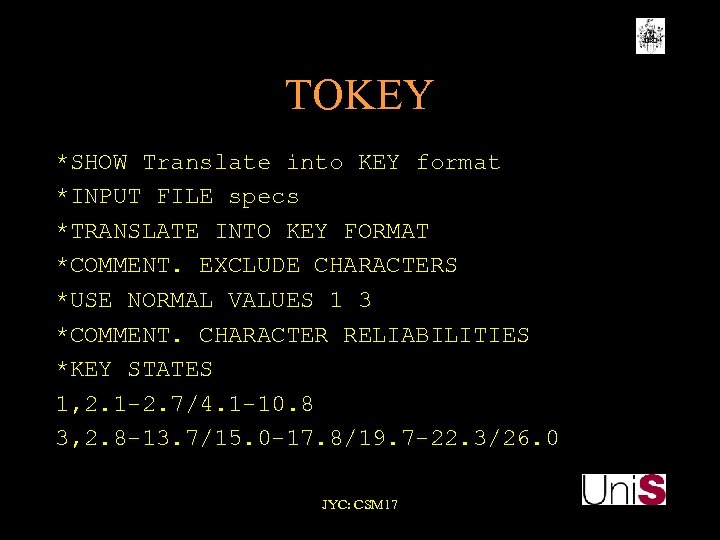
TOKEY *SHOW Translate into KEY format *INPUT FILE specs *TRANSLATE INTO KEY FORMAT *COMMENT. EXCLUDE CHARACTERS *USE NORMAL VALUES 1 3 *COMMENT. CHARACTER RELIABILITIES *KEY STATES 1, 2. 1 -2. 7/4. 1 -10. 8 3, 2. 8 -13. 7/15. 0 -17. 8/19. 7 -22. 3/26. 0 JYC: CSM 17
DIANA • A DELTA shell • Integrates functionality in Windows JYC: CSM 17
INTKEY • An interactive multimedia on-line key system bundled with DELTA • Example for Grasses • Can include pictures • User chooses order of characters JYC: CSM 17
ETI - Expert center for Taxonomic Identification • • University of Amsterdam, The Netherlands Series of Multimedia interactive software Includes interactive key, pictures, videos. . . Written by acknowledged experts JYC: CSM 17
AI: Expert Systems, Neural Nets • EXPERT KEY (Atkinson & Gammerman) • ISAR (Chesmore et al. ) • ANNKEY (Clark & Warwick) JYC: CSM 17
Leading to the Future. . . • DNA and RNA – CATCATCAT • eg. Forensic science, Paternity, Maternity • XDELTA uses XML - e. Xtensible Markup Language (L. Dodds) • Taxonomic Markup Language (R. Gilmour) JYC: CSM 17
Useful Websites • DELTA: http: //www. biodiversity. uno. edu/delta/ • DIANA: http: //www. biodiversity. uno. edu/delta/diana/ • LUCID: http: //www. lucidcentral. org • Digital Taxonomy: http: //www. geocities. com/Rain. Forest/Vines/8695/ JYC: CSM 17
References & Bibliography • Chesmore, E. D. et al. (1998). Automated analysis of insect sounds. In Bridge, P. et. al. (eds. ) Information Technology, Plant Pathology and Biodiversity, CAB International, pp. 273 -287. • Dallwitz, M. J. , Paine, T. A. & Zurcher, E. J. (1997). User’s guide to the DELTA system -a general system for processing taxonomic descriptions, Edition 4. 07, CSIRO Division of Entomology: Canberra, Australia. • Pankhurst, R. J. (1991). Practical Taxonomic Computing. University of Cambridge Press: UK. • Pankhurst, R. J. (1978). Biological Identification. The Principles and Practice of Identification Methods in Biology. Edward Arnold, London • Pankhurst, R. J. (1998). A historical review of identification by computer. In Bridge, P. et. al. (eds. ) Information Technology, Plant Pathology and Biodiversity, CAB International, pp. 289 -303 JYC: CSM 17
Скачать презентацию Bioinformatics CSM 17 Week 3 Biological Identification
f90157aff1409a88d2637e4b1c47ee2c.ppt