

BIOGRAPHY Emerson was born in Boston, Massachusetts. He

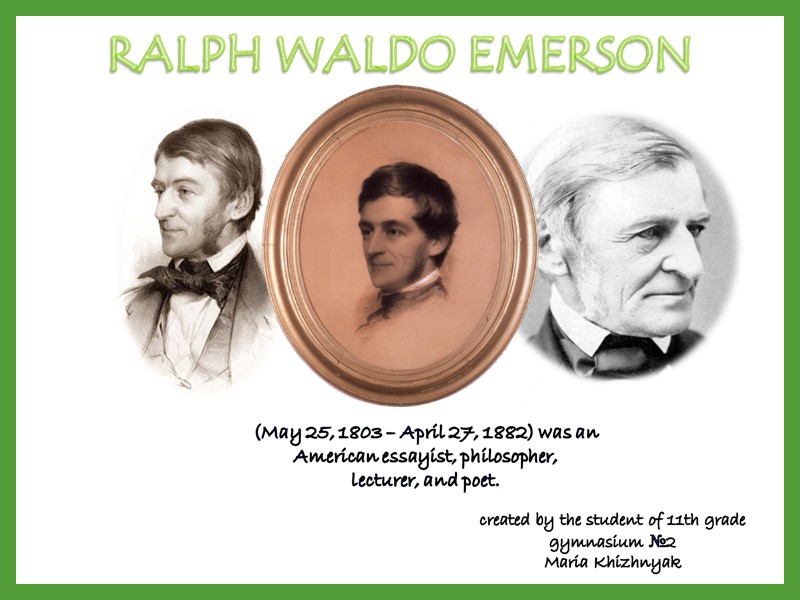
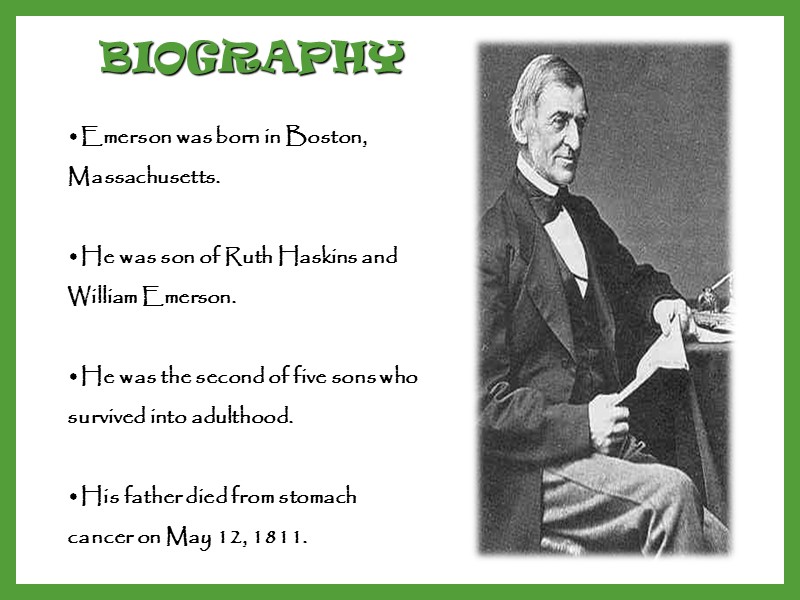
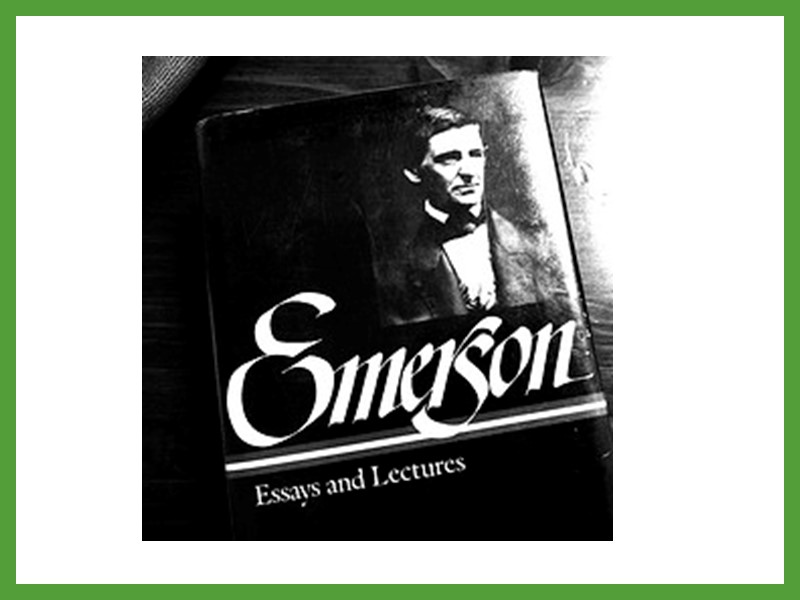
BIOGRAPHY Emerson was born in Boston, Massachusetts. He was son of Ruth Haskins and William Emerson. He was the second of five sons who survived into adulthood. His father died from stomach cancer on May 12, 1811.
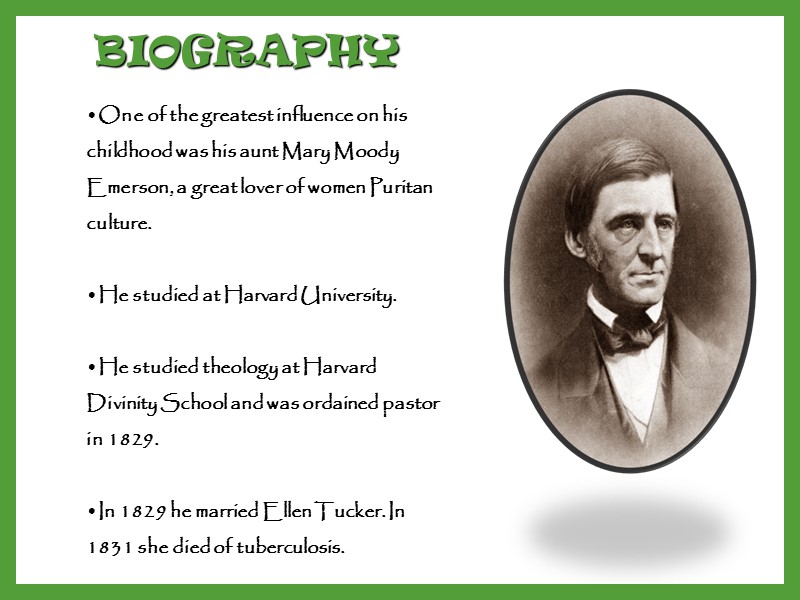
BIOGRAPHY One of the greatest influence on his childhood was his aunt Mary Moody Emerson, a great lover of women Puritan culture. He studied at Harvard University. He studied theology at Harvard Divinity School and was ordained pastor in 1829. In 1829 he married Ellen Tucker. In 1831 she died of tuberculosis.
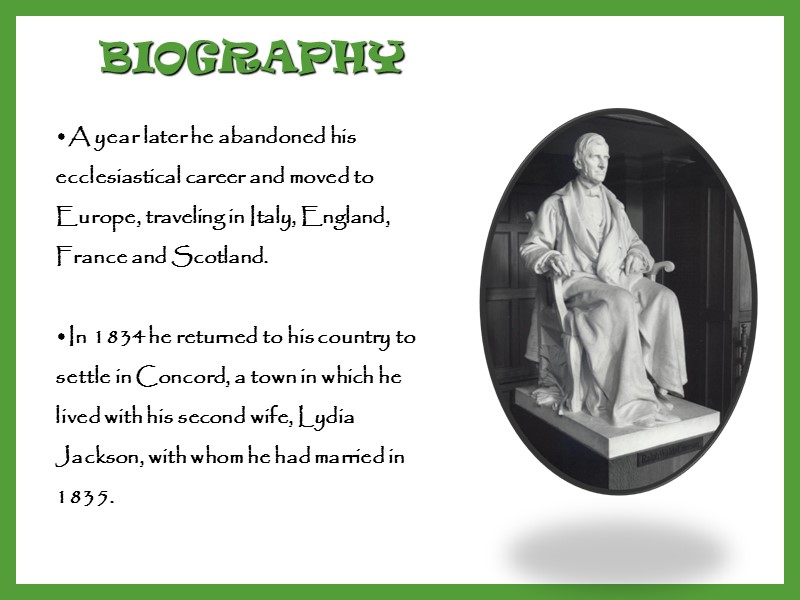
BIOGRAPHY A year later he abandoned his ecclesiastical career and moved to Europe, traveling in Italy, England, France and Scotland. In 1834 he returned to his country to settle in Concord, a town in which he lived with his second wife, Lydia Jackson, with whom he had married in 1835.
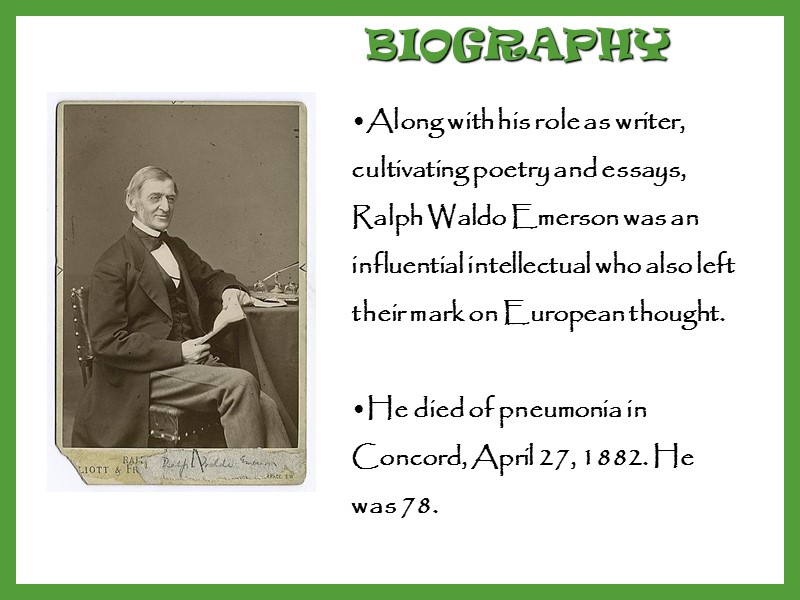
Along with his role as writer, cultivating poetry and essays, Ralph Waldo Emerson was an influential intellectual who also left their mark on European thought. He died of pneumonia in Concord, April 27, 1882. He was 78. BIOGRAPHY
Emerson’s works
Emerson’s works
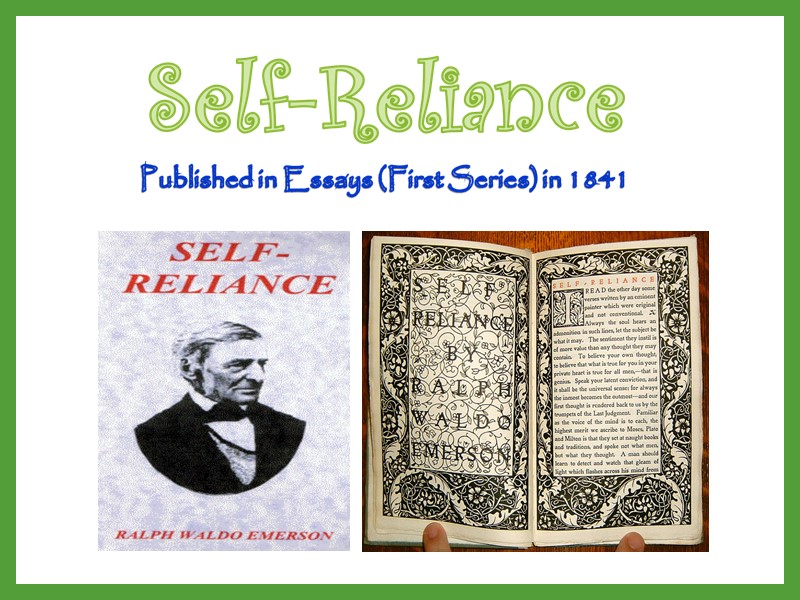
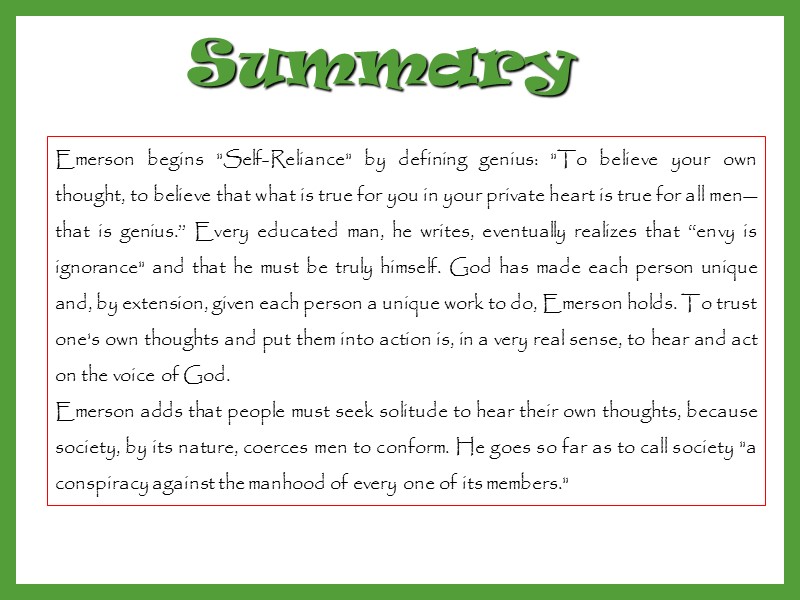
Summary Emerson begins "Self-Reliance" by defining genius: "To believe your own thought, to believe that what is true for you in your private heart is true for all men—that is genius.’’ Every educated man, he writes, eventually realizes that ‘‘envy is ignorance" and that he must be truly himself. God has made each person unique and, by extension, given each person a unique work to do, Emerson holds. To trust one's own thoughts and put them into action is, in a very real sense, to hear and act on the voice of God. Emerson adds that people must seek solitude to hear their own thoughts, because society, by its nature, coerces men to conform. He goes so far as to call society "a conspiracy against the manhood of every one of its members."
Individualism Emerson repeatedly calls on individuals to value their own thoughts, opinions, and experiences above those presented to them by other individuals, society, and religion. This radical individualism springs from Emerson's belief that each individual is not just unique but divinely unique; i.e., each individual is a unique expression of God's creativity and will. Trust Your Own Inner Voice Emerson urges his readers to retain the outspokenness of a small child who freely speaks his mind. A child he has not yet been corrupted by adults who tell him to do otherwise. He also urges readers to avoid envying or imitating others viewed as models of perfection; instead, he says, readers should take pride in their own individuality and never be afraid to express their own original ideas.
Main message Every individual possesses a unique genius, that can only be revealed when that individual has the courage to trust his or her own thoughts, attitudes, and inclinations against all public disapproval.
Notable Quotations From "Self-Reliance" Trust thyself: every heart vibrates to that iron string. Whoso would be a man must be a nonconformist. What I must do is all that concerns me, not what the people think. Insist on yourself; never imitate.
 Скачать презентацию BIOGRAPHY Emerson was born in Boston, Massachusetts. He
27942-r_emerson.ppt
- Количество слайдов: 15