 Скачать презентацию Biofuels Think outside the Barrel Vinod Khosla vk khoslaventures
8389cb64ae159ecbfca1fa3d3f5fa582.ppt
- Количество слайдов: 111




Biofuels: Think outside the Barrel Vinod Khosla vk@khoslaventures. com Feb 2006 1 Ver 3. 2
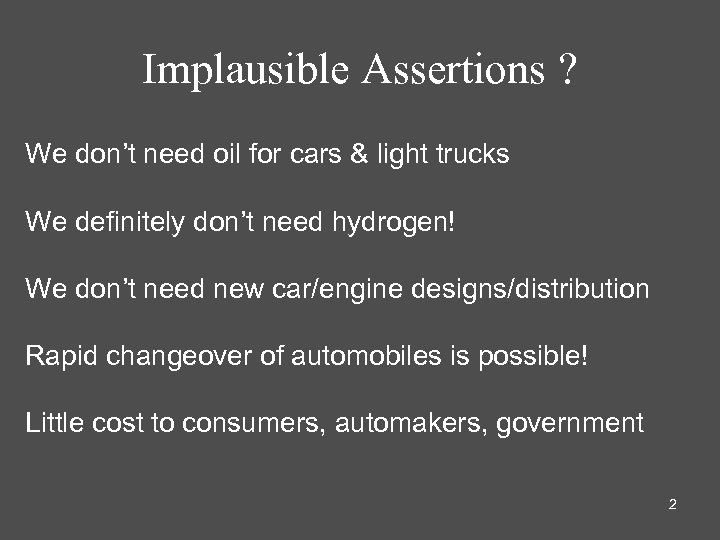
Implausible Assertions ? We don’t need oil for cars & light trucks We definitely don’t need hydrogen! We don’t need new car/engine designs/distribution Rapid changeover of automobiles is possible! Little cost to consumers, automakers, government 2
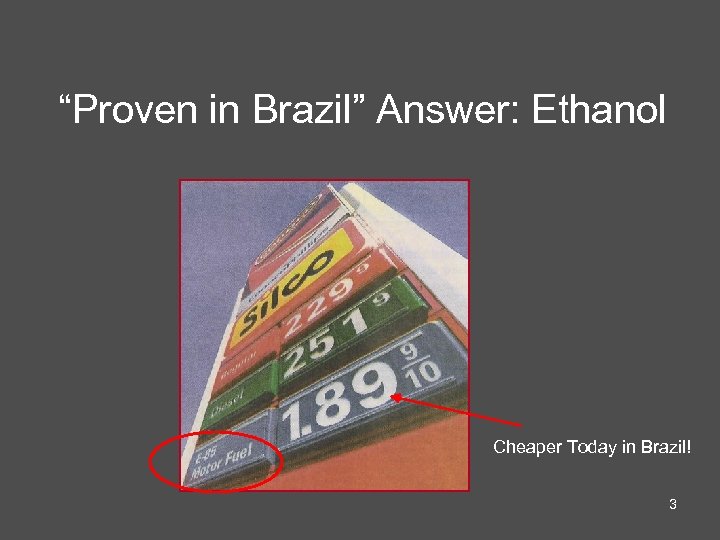
“Proven in Brazil” Answer: Ethanol Cheaper Today in Brazil! 3
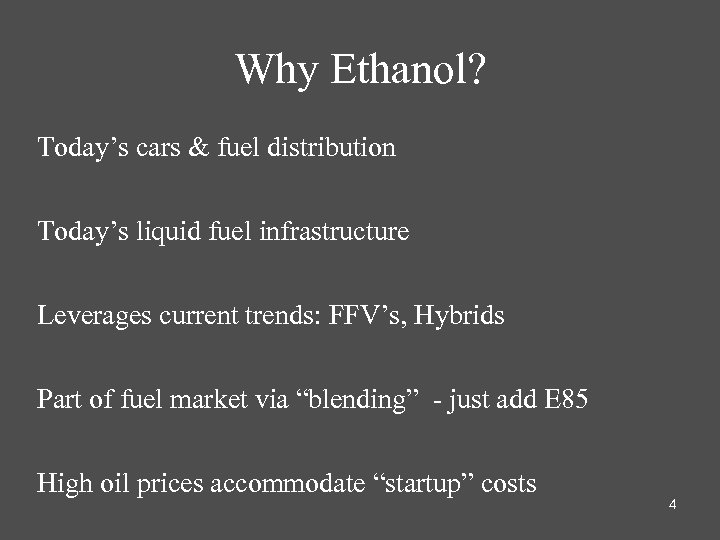
Why Ethanol? Today’s cars & fuel distribution Today’s liquid fuel infrastructure Leverages current trends: FFV’s, Hybrids Part of fuel market via “blending” - just add E 85 High oil prices accommodate “startup” costs 4
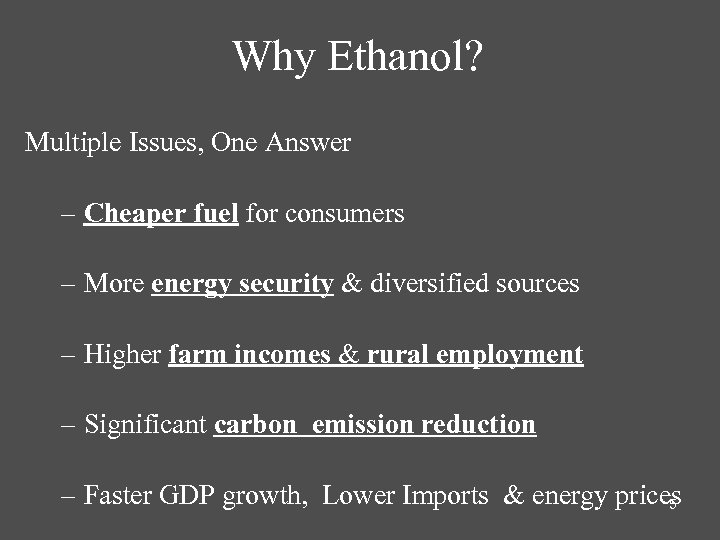
Why Ethanol? Multiple Issues, One Answer – Cheaper fuel for consumers – More energy security & diversified sources – Higher farm incomes & rural employment – Significant carbon emission reduction – Faster GDP growth, Lower Imports & energy prices 5
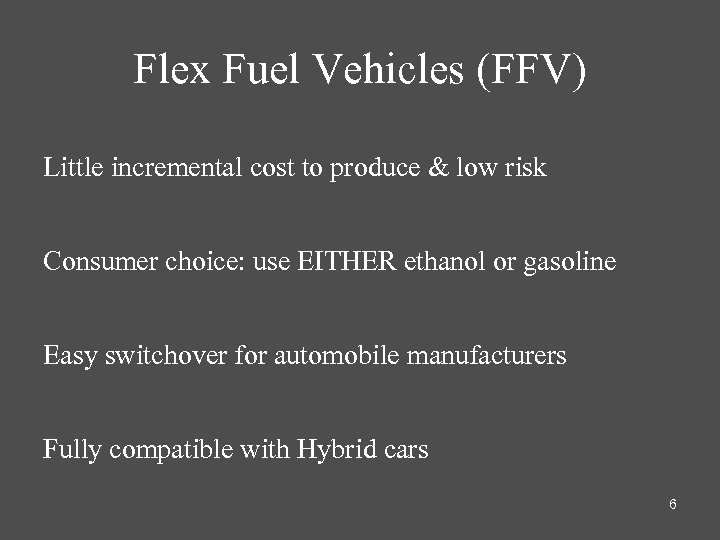
Flex Fuel Vehicles (FFV) Little incremental cost to produce & low risk Consumer choice: use EITHER ethanol or gasoline Easy switchover for automobile manufacturers Fully compatible with Hybrid cars 6
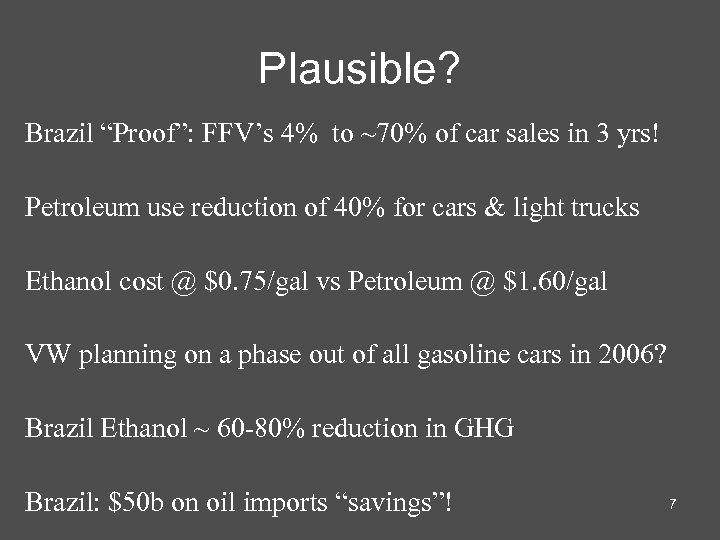
Plausible? Brazil “Proof”: FFV’s 4% to ~70% of car sales in 3 yrs! Petroleum use reduction of 40% for cars & light trucks Ethanol cost @ $0. 75/gal vs Petroleum @ $1. 60/gal VW planning on a phase out of all gasoline cars in 2006? Brazil Ethanol ~ 60 -80% reduction in GHG Brazil: $50 b on oil imports “savings”! 7
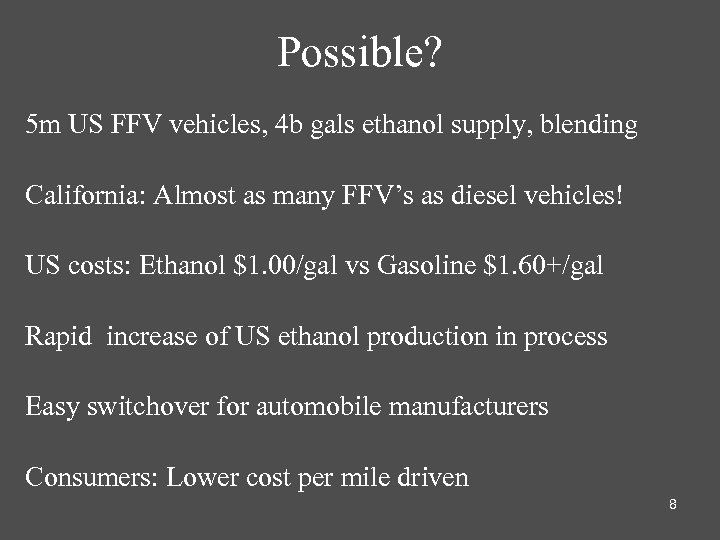
Possible? 5 m US FFV vehicles, 4 b gals ethanol supply, blending California: Almost as many FFV’s as diesel vehicles! US costs: Ethanol $1. 00/gal vs Gasoline $1. 60+/gal Rapid increase of US ethanol production in process Easy switchover for automobile manufacturers Consumers: Lower cost per mile driven 8
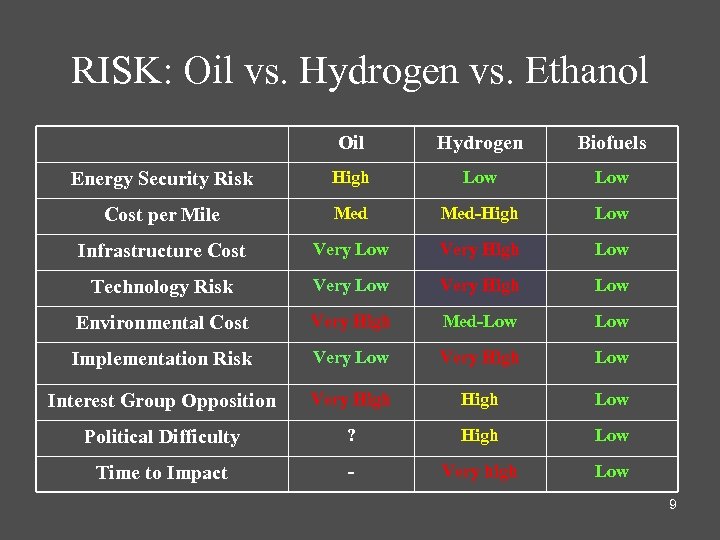
RISK: Oil vs. Hydrogen vs. Ethanol Oil Hydrogen Biofuels Energy Security Risk High Low Cost per Mile Med-High Low Infrastructure Cost Very Low Very High Low Technology Risk Very Low Very High Low Environmental Cost Very High Med-Low Implementation Risk Very Low Very High Low Interest Group Opposition Very High Low Political Difficulty ? High Low Time to Impact - Very high Low 9
What makes it Probable? Interest Groups Land Use Energy Balance Emissions Kickstart? 10
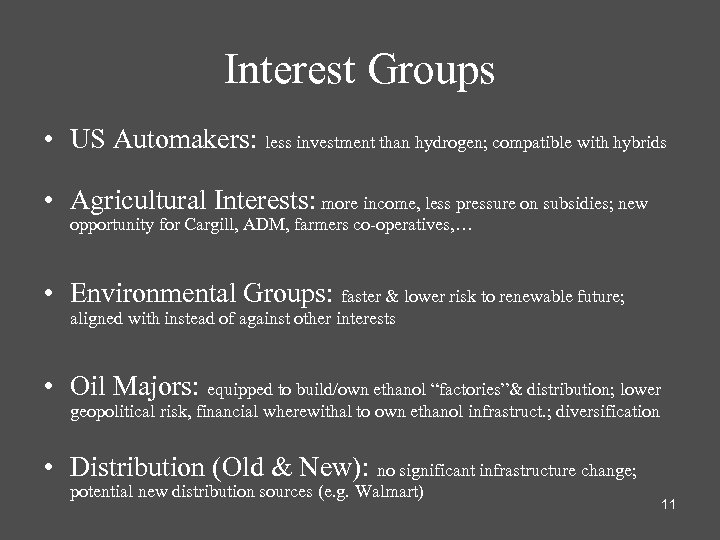
Interest Groups • US Automakers: less investment than hydrogen; compatible with hybrids • Agricultural Interests: more income, less pressure on subsidies; new opportunity for Cargill, ADM, farmers co-operatives, … • Environmental Groups: faster & lower risk to renewable future; aligned with instead of against other interests • Oil Majors: equipped to build/own ethanol “factories”& distribution; lower geopolitical risk, financial wherewithal to own ethanol infrastruct. ; diversification • Distribution (Old & New): no significant infrastructure change; potential new distribution sources (e. g. Walmart) 11
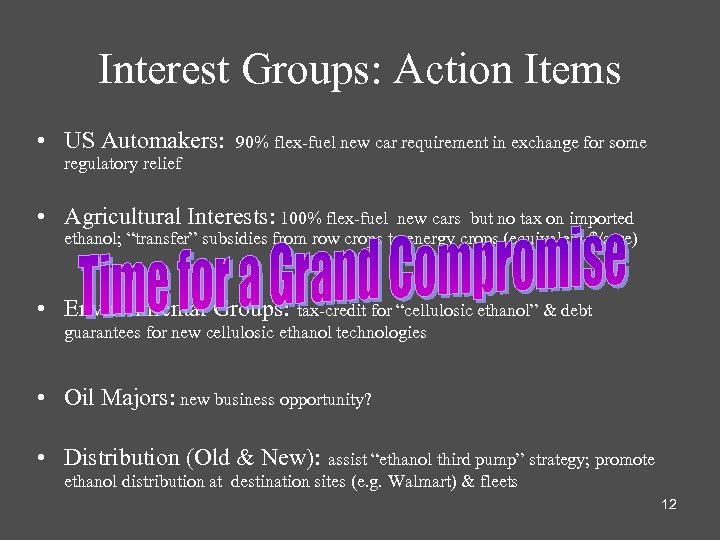
Interest Groups: Action Items • US Automakers: 90% flex-fuel new car requirement in exchange for some regulatory relief • Agricultural Interests: 100% flex-fuel new cars but no tax on imported ethanol; “transfer” subsidies from row crops to energy crops (equivalent $/acre) • Environmental Groups: tax-credit for “cellulosic ethanol” & debt guarantees for new cellulosic ethanol technologies • Oil Majors: new business opportunity? • Distribution (Old & New): assist “ethanol third pump” strategy; promote ethanol distribution at destination sites (e. g. Walmart) & fleets 12
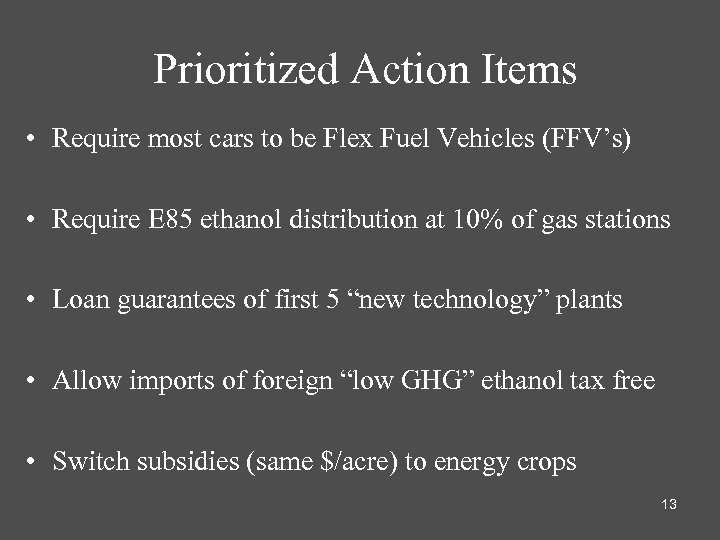
Prioritized Action Items • Require most cars to be Flex Fuel Vehicles (FFV’s) • Require E 85 ethanol distribution at 10% of gas stations • Loan guarantees of first 5 “new technology” plants • Allow imports of foreign “low GHG” ethanol tax free • Switch subsidies (same $/acre) to energy crops 13
Other Easy Action Items • Call for a grand bi-partisan summit of interested parties • Switch CAFÉ mileage to “petroleum mileage” • Require FFV owners be given colored gas caps • Legislate a “cheap oil” tax if it drops below $40/barrel. • Allow fleets to import ethanol without tax burden 14

Land Use 15
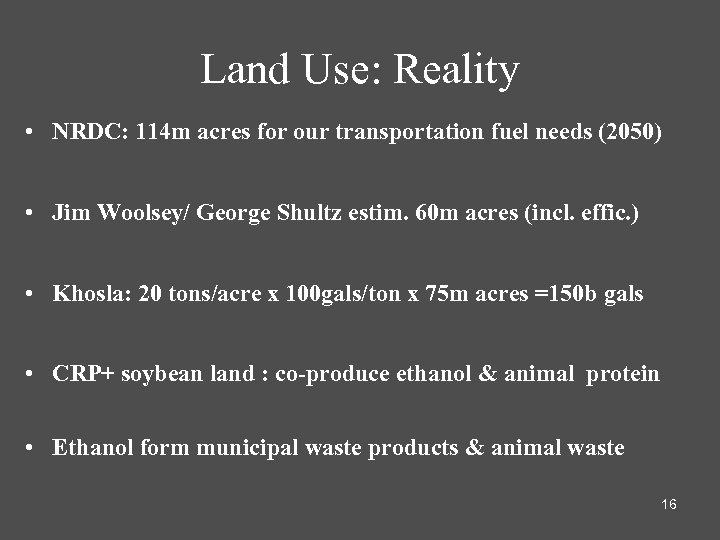
Land Use: Reality • NRDC: 114 m acres for our transportation fuel needs (2050) • Jim Woolsey/ George Shultz estim. 60 m acres (incl. effic. ) • Khosla: 20 tons/acre x 100 gals/ton x 75 m acres =150 b gals • CRP+ soybean land : co-produce ethanol & animal protein • Ethanol form municipal waste products & animal waste 16
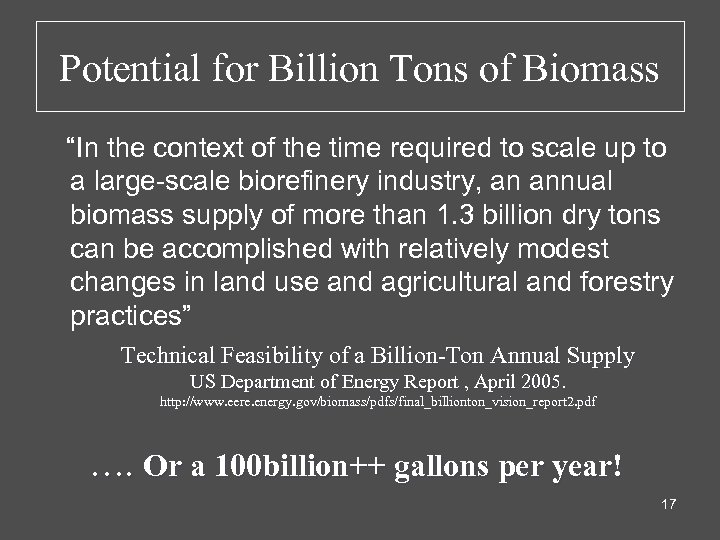
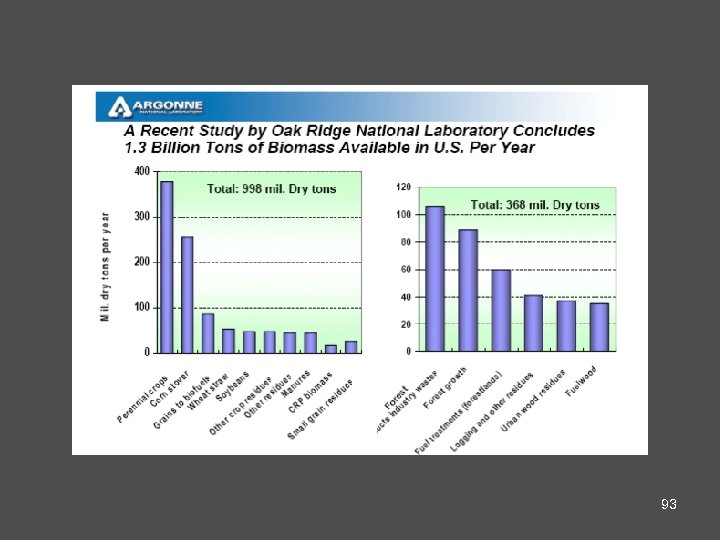
Potential for Billion Tons of Biomass “In the context of the time required to scale up to a large-scale biorefinery industry, an annual biomass supply of more than 1. 3 billion dry tons can be accomplished with relatively modest changes in land use and agricultural and forestry practices” Technical Feasibility of a Billion-Ton Annual Supply US Department of Energy Report , April 2005. http: //www. eere. energy. gov/biomass/pdfs/final_billionton_vision_report 2. pdf …. Or a 100 billion++ gallons per year! 17
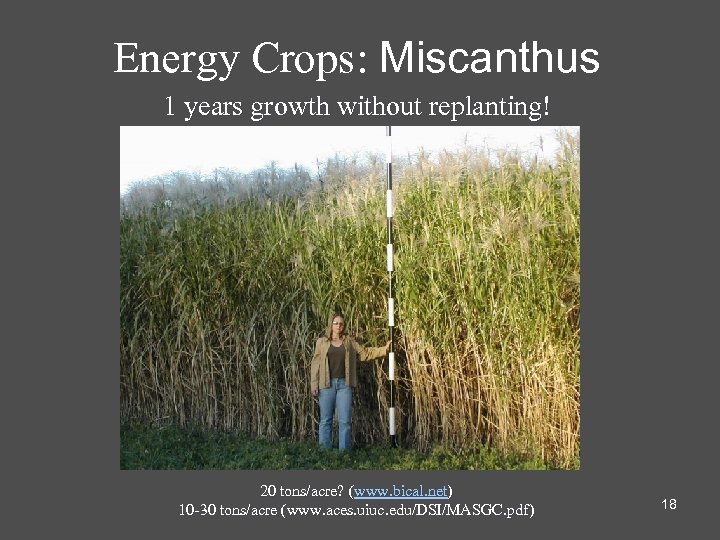
Energy Crops: Miscanthus 1 years growth without replanting! 20 tons/acre? (www. bical. net) 10 -30 tons/acre (www. aces. uiuc. edu/DSI/MASGC. pdf) 18
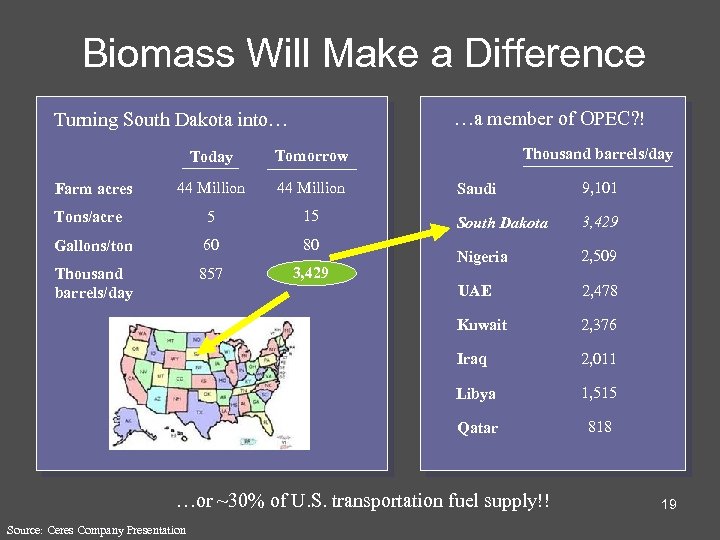
Biomass Will Make a Difference …a member of OPEC? ! Turning South Dakota into… Today 44 Million Tons/acre 5 15 Gallons/ton 60 80 Thousand barrels/day 857 3, 429 Thousand barrels/day Tomorrow Saudi 9, 101 South Dakota 3, 429 Nigeria 2, 509 UAE 2, 478 Kuwait 2, 376 Iraq 2, 011 Libya 1, 515 Qatar Farm acres 818 …or ~30% of U. S. transportation fuel supply!! Source: Ceres Company Presentation 19
Energy Balance & Fossil Fuel Use Reductions 20
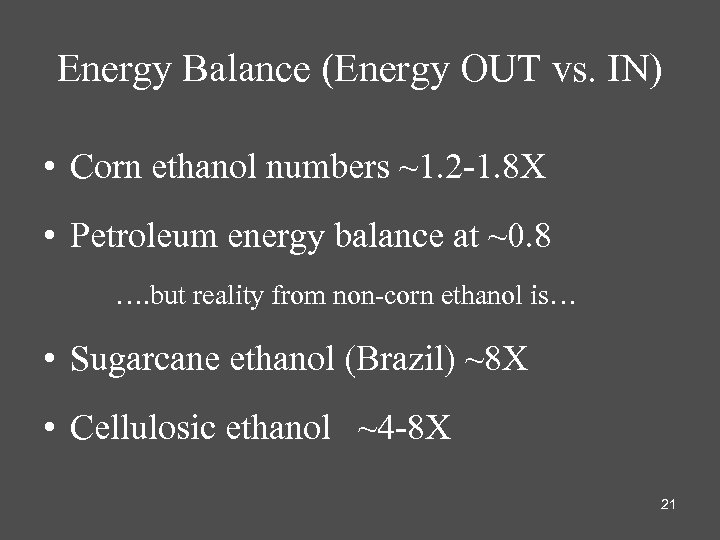
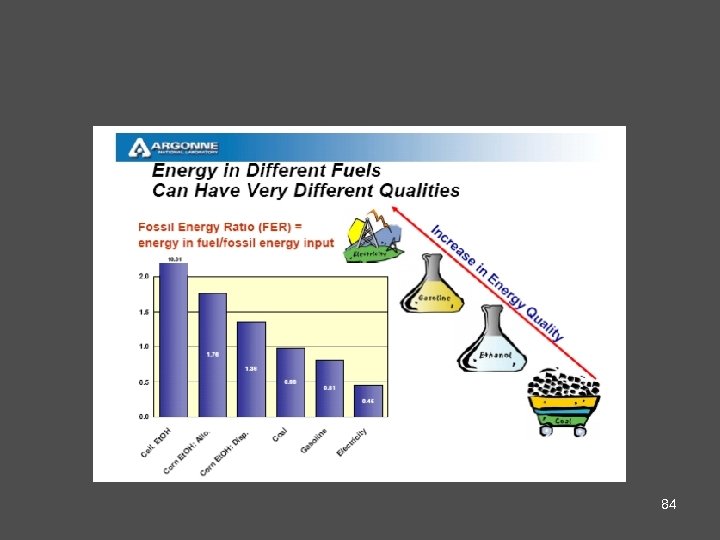
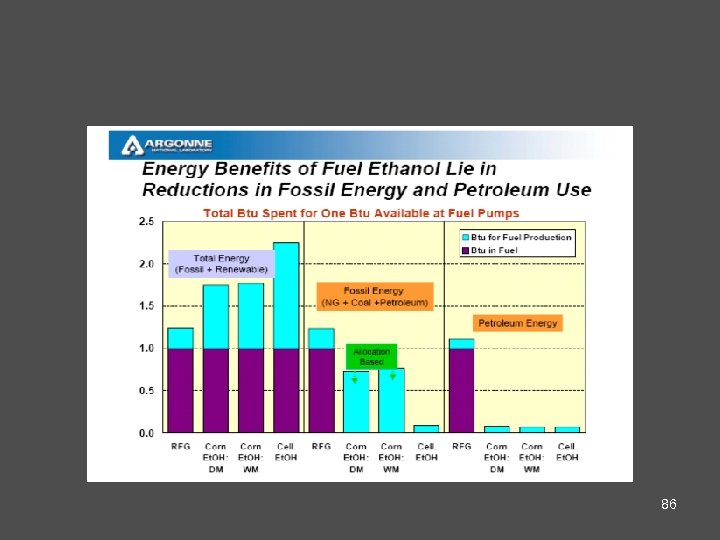
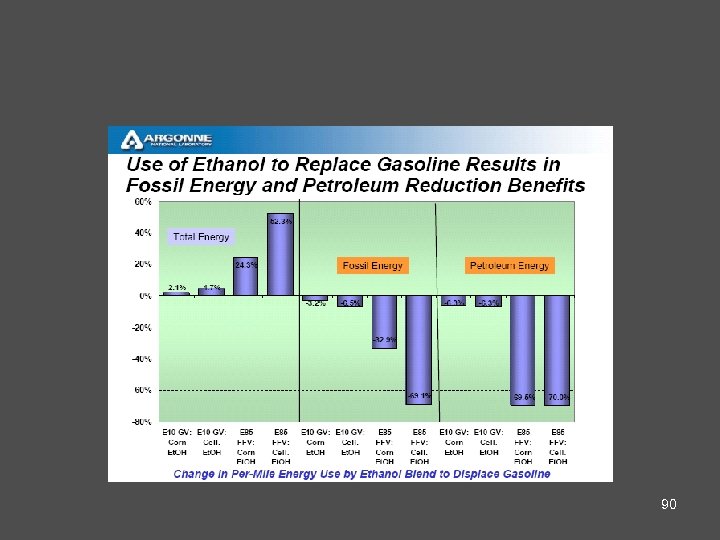
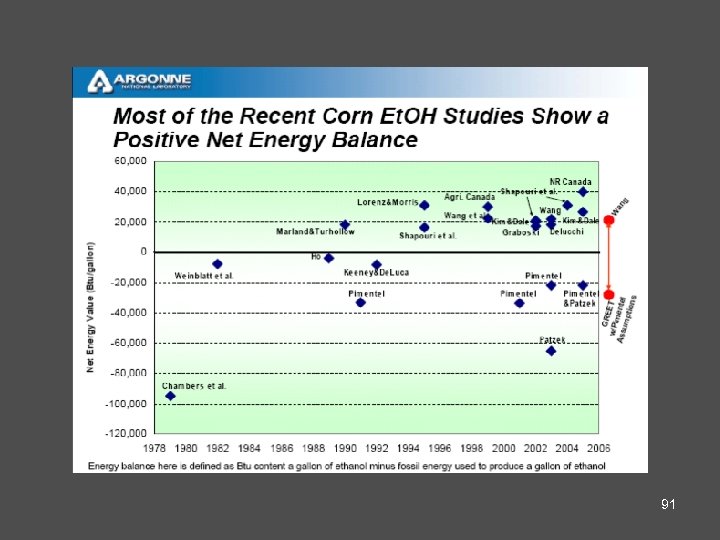
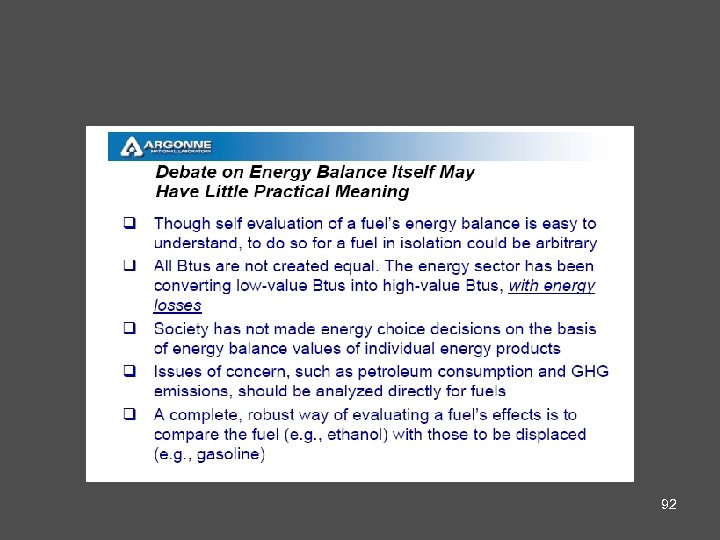
Energy Balance (Energy OUT vs. IN) • Corn ethanol numbers ~1. 2 -1. 8 X • Petroleum energy balance at ~0. 8 …. but reality from non-corn ethanol is… • Sugarcane ethanol (Brazil) ~8 X • Cellulosic ethanol ~4 -8 X 21
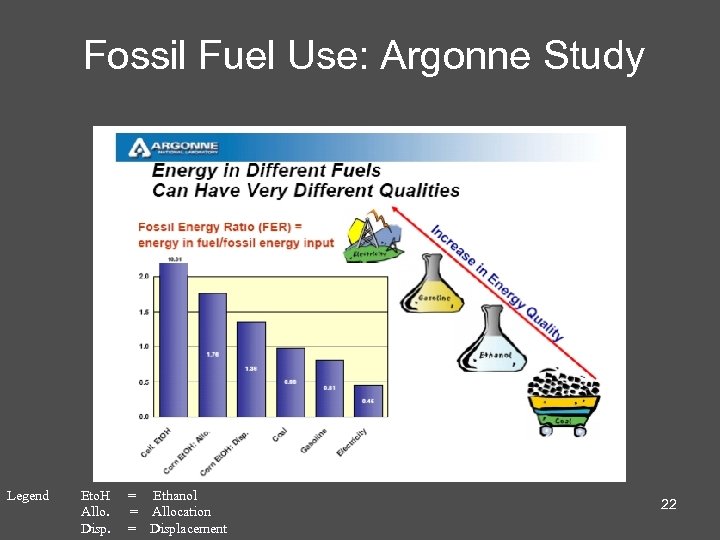
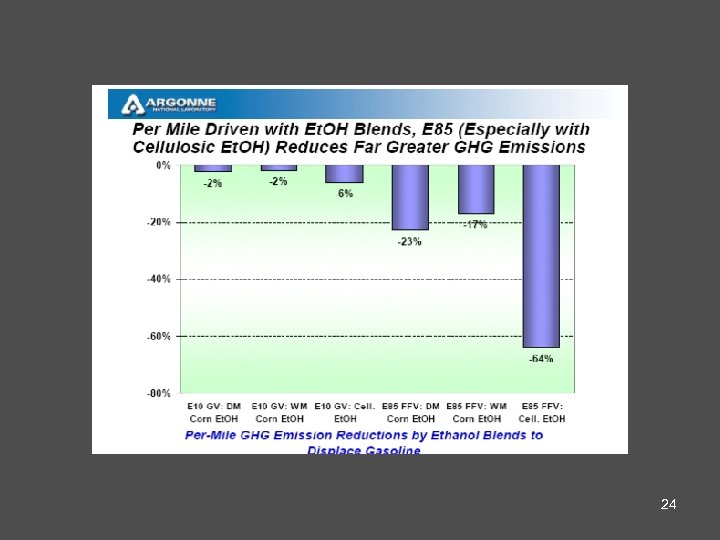
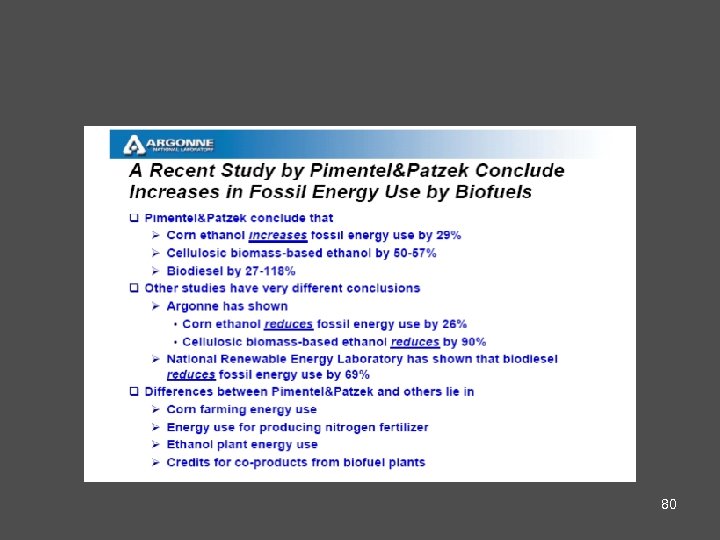
Fossil Fuel Use: Argonne Study Legend Eto. H Allo. Disp. = Ethanol = Allocation = Displacement 22
Environmental Issues 23
24
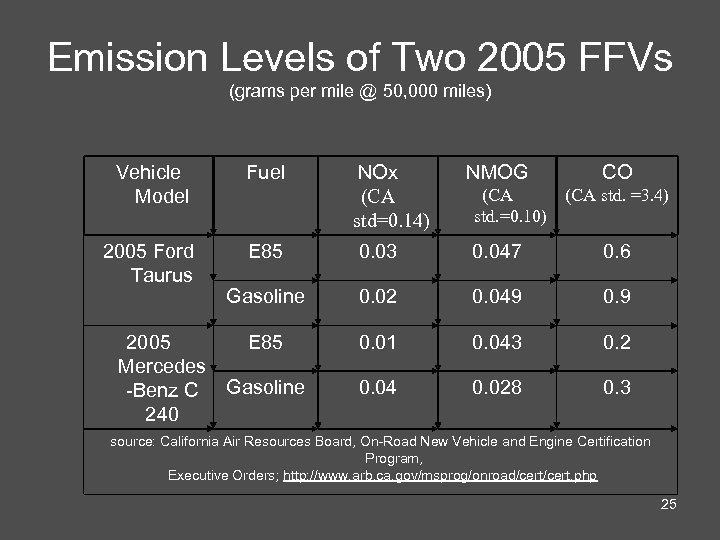
Emission Levels of Two 2005 FFVs (grams per mile @ 50, 000 miles) Vehicle Model Fuel 2005 Ford Taurus E 85 0. 03 0. 047 0. 6 Gasoline 0. 02 0. 049 0. 9 E 85 0. 01 0. 043 0. 2 Gasoline 0. 04 0. 028 0. 3 2005 Mercedes -Benz C 240 NOx (CA std=0. 14) NMOG CO (CA std. =3. 4) std. =0. 10) source: California Air Resources Board, On-Road New Vehicle and Engine Certification Program, Executive Orders; http: //www. arb. ca. gov/msprog/onroad/cert. php 25
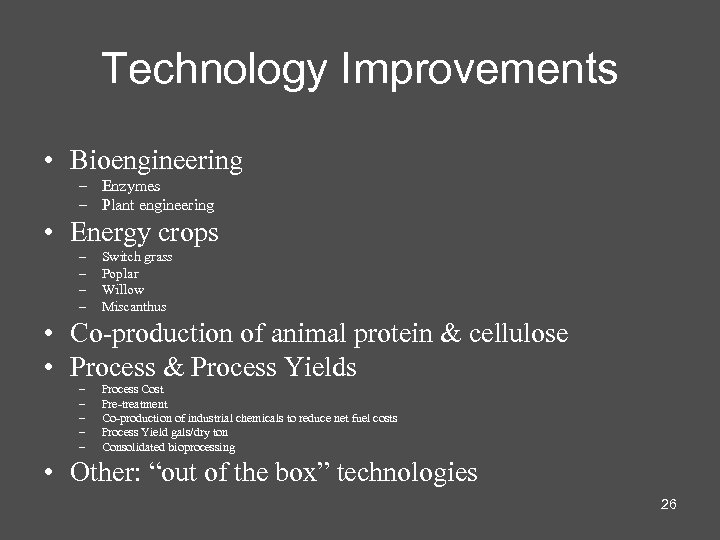
Technology Improvements • Bioengineering – Enzymes – Plant engineering • Energy crops – – Switch grass Poplar Willow Miscanthus • Co-production of animal protein & cellulose • Process & Process Yields – – – Process Cost Pre-treatment Co-production of industrial chemicals to reduce net fuel costs Process Yield gals/dry ton Consolidated bioprocessing • Other: “out of the box” technologies 26
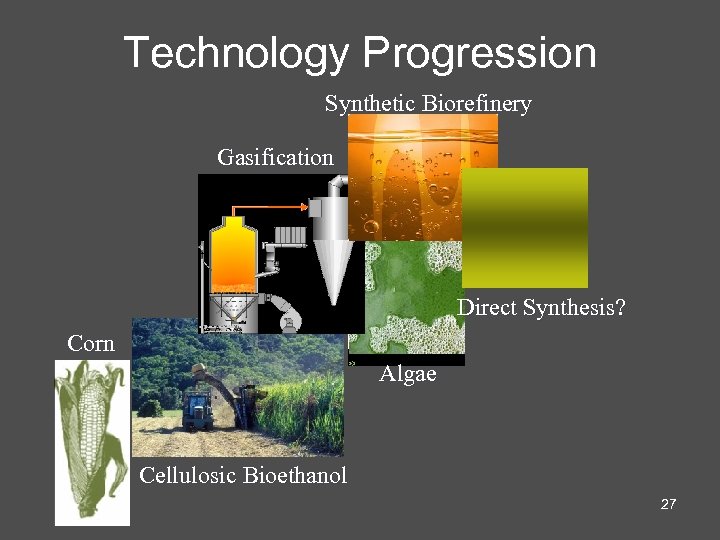
Technology Progression Synthetic Biorefinery Gasification Direct Synthesis? Corn Algae Cellulosic Bioethanol 27
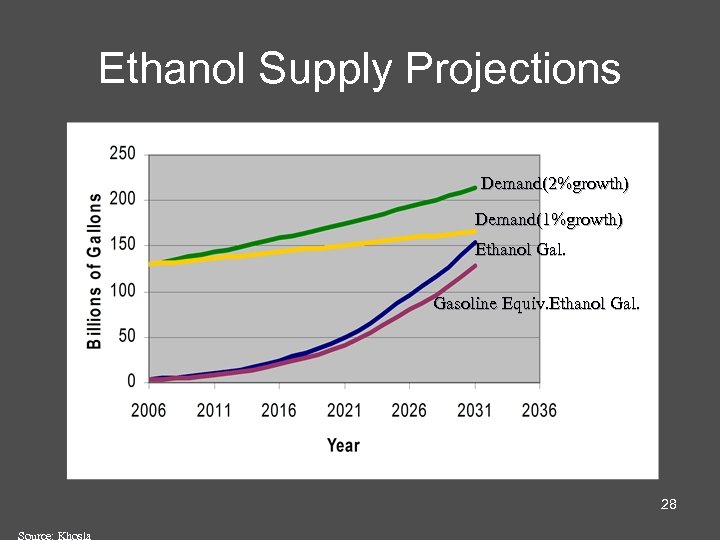
Ethanol Supply Projections Demand(2%growth) Demand(1%growth) Ethanol Gal. Gasoline Equiv. Ethanol Gal. 28
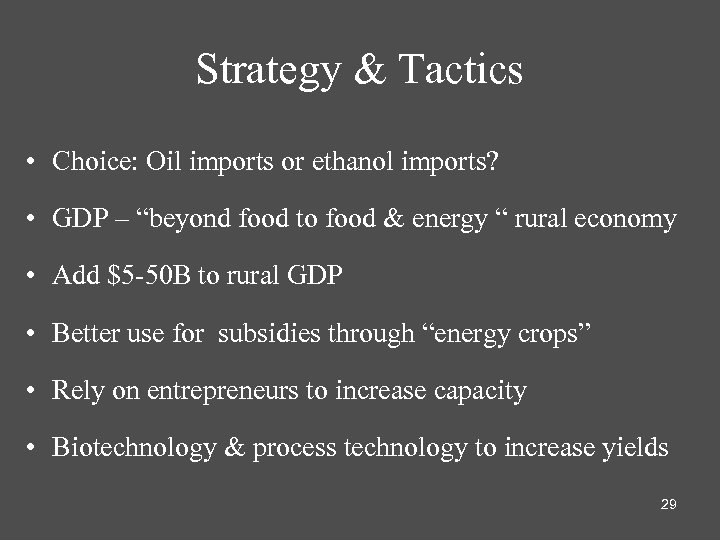
Strategy & Tactics • Choice: Oil imports or ethanol imports? • GDP – “beyond food to food & energy “ rural economy • Add $5 -50 B to rural GDP • Better use for subsidies through “energy crops” • Rely on entrepreneurs to increase capacity • Biotechnology & process technology to increase yields 29
What makes it Probable? Interest Groups Land Use Energy Balance Emissions Kickstart? 30
The Clean Alternative Energy Act A voter initiative for the November 2006 ballot 31
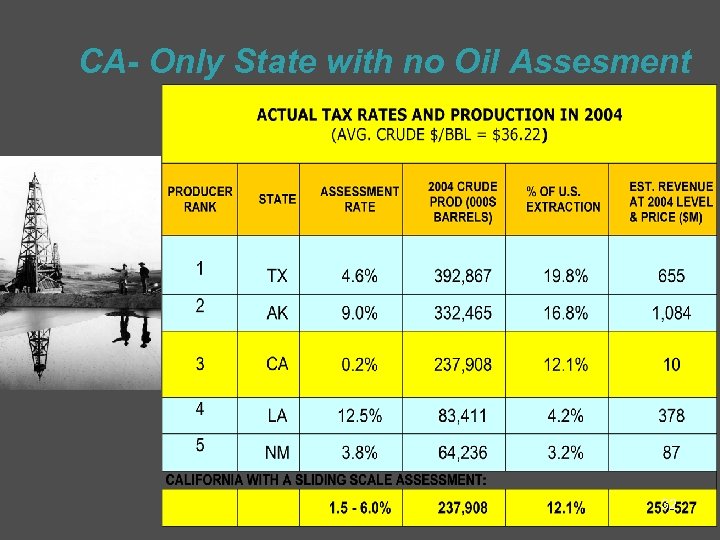
CA- Only State with no Oil Assesment 32
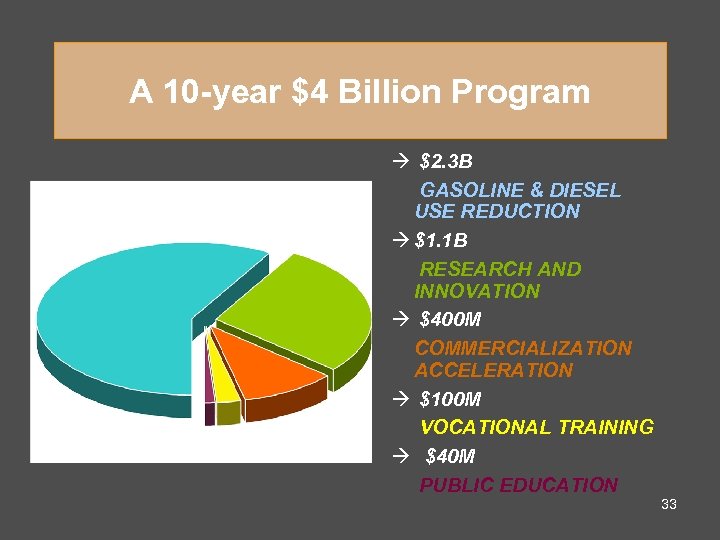
A 10 -year $4 Billion Program $2. 3 B GASOLINE & DIESEL USE REDUCTION $1. 1 B RESEARCH AND INNOVATION $400 M COMMERCIALIZATION ACCELERATION $100 M VOCATIONAL TRAINING $40 M PUBLIC EDUCATION 33
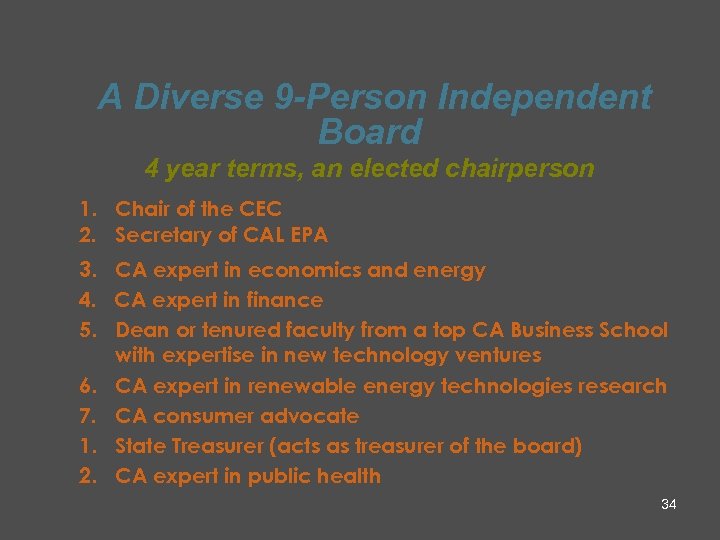
A Diverse 9 -Person Independent Board 4 year terms, an elected chairperson 1. Chair of the CEC 2. Secretary of CAL EPA 3. CA expert in economics and energy 4. CA expert in finance 5. Dean or tenured faculty from a top CA Business School with expertise in new technology ventures 6. CA expert in renewable energy technologies research 7. CA consumer advocate 1. State Treasurer (acts as treasurer of the board) 2. CA expert in public health 34
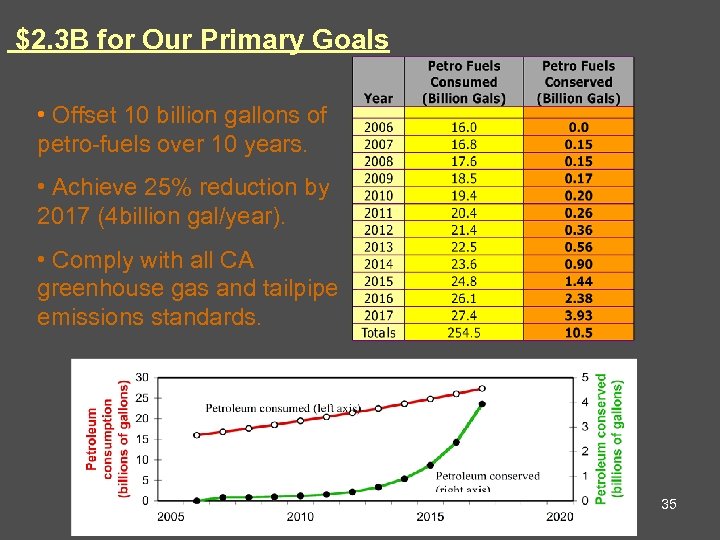
$2. 3 B for Our Primary Goals • Offset 10 billion gallons of petro-fuels over 10 years. • Achieve 25% reduction by 2017 (4 billion gal/year). • Comply with all CA greenhouse gas and tailpipe emissions standards. 35
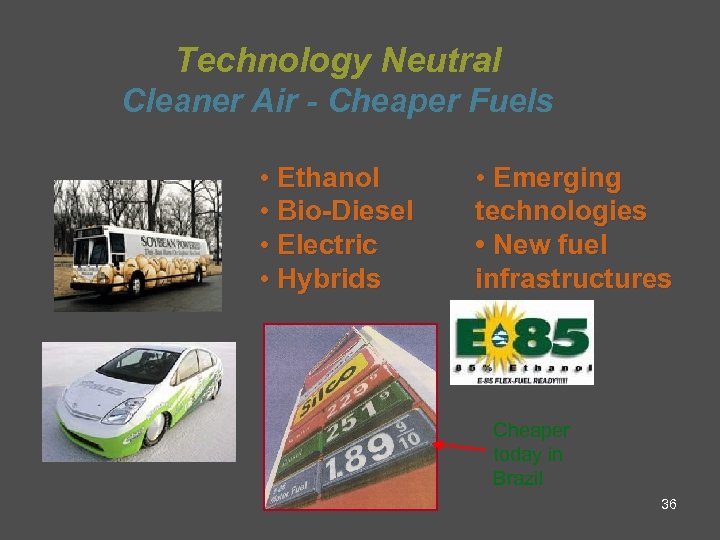
Technology Neutral Cleaner Air - Cheaper Fuels • Ethanol • Bio-Diesel • Electric • Hybrids • Emerging technologies • New fuel infrastructures Cheaper today in Brazil 36
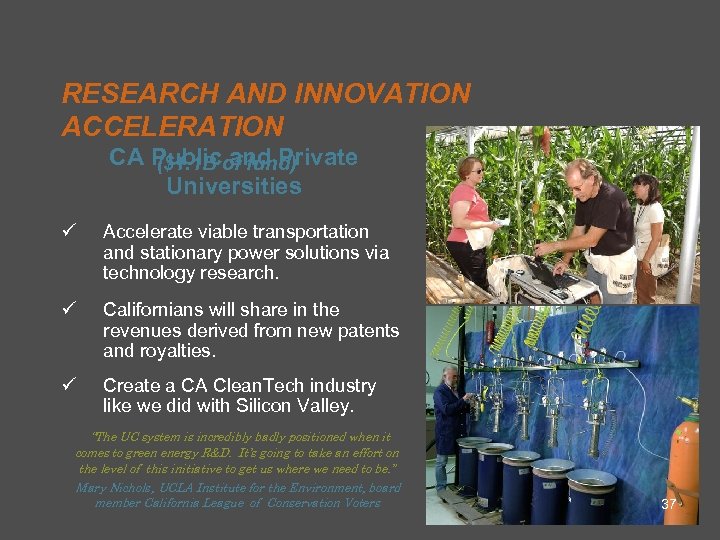
RESEARCH AND INNOVATION ACCELERATION CA Public and Private ($1. 1 B of fund) Universities ü Accelerate viable transportation and stationary power solutions via technology research. ü Californians will share in the revenues derived from new patents and royalties. ü Create a CA Clean. Tech industry like we did with Silicon Valley. “The UC system is incredibly badly positioned when it comes to green energy R&D. It’s going to take an effort on the level of this initiative to get us where we need to be. ” Mary Nichols, UCLA Institute for the Environment, board member California League of Conservation Voters 37
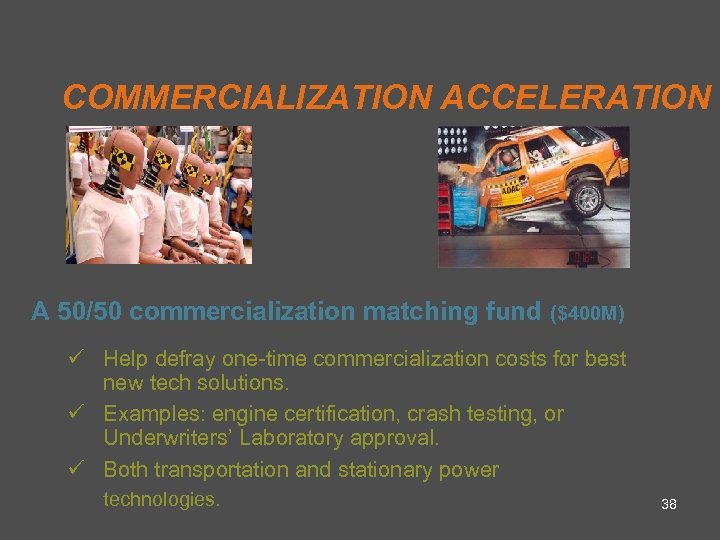
COMMERCIALIZATION ACCELERATION A 50/50 commercialization matching fund ($400 M) ü Help defray one-time commercialization costs for best new tech solutions. ü Examples: engine certification, crash testing, or Underwriters’ Laboratory approval. ü Both transportation and stationary power technologies. 38
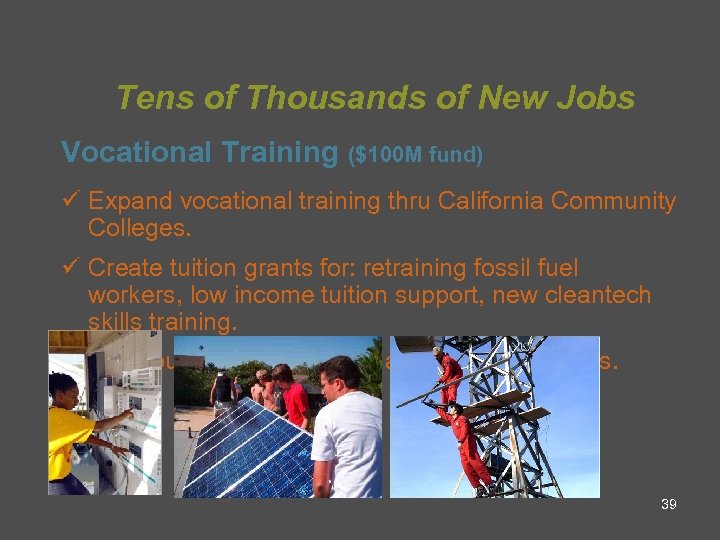
Tens of Thousands of New Jobs Vocational Training ($100 M fund) ü Expand vocational training thru California Community Colleges. ü Create tuition grants for: retraining fossil fuel workers, low income tuition support, new cleantech skills training. ü “Non-outsource-able” blue and white collar jobs. 39
Shift Consumer Behavior Public Education ($40 M fund) ü Grow consumer markets for newly funded technologies. ü Stimulate awareness for buy-downs, rebates, tuitions, etc. ü Promote conservation. 40
No New Bureaucracy • The initiative will revive and restructure a moribund state agency to administer these programs. • The California Alternative Energy and Advanced Transportation Financing Authority (CAEATFA), was set forth in Public Resources Code Section 26000 since 1980 but now is dormant. 41
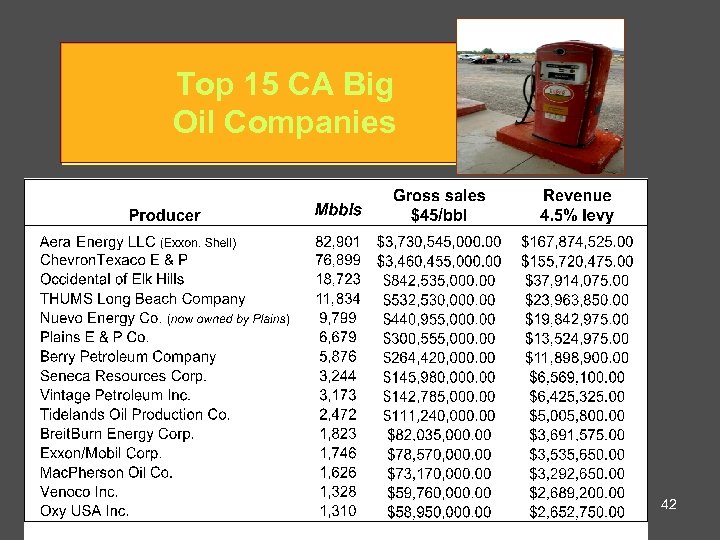
Top 15 CA Big Oil Companies 42
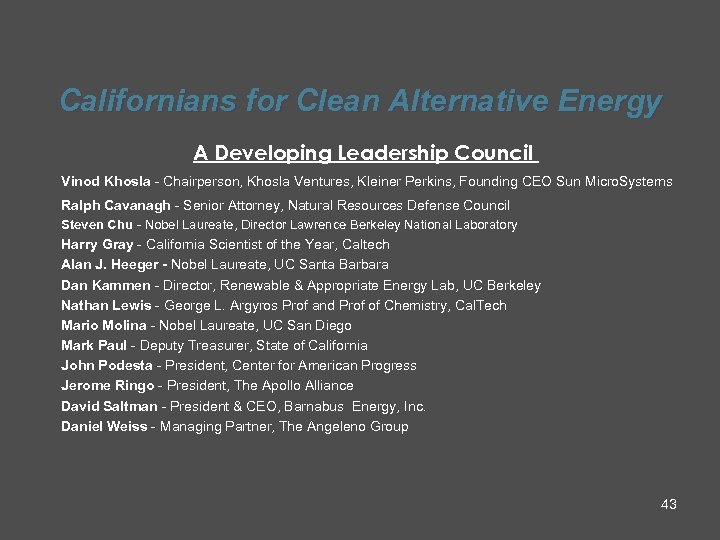
Californians for Clean Alternative Energy A Developing Leadership Council Vinod Khosla - Chairperson, Khosla Ventures, Kleiner Perkins, Founding CEO Sun Micro. Systems Ralph Cavanagh - Senior Attorney, Natural Resources Defense Council Steven Chu - Nobel Laureate, Director Lawrence Berkeley National Laboratory Harry Gray - California Scientist of the Year, Caltech Alan J. Heeger - Nobel Laureate, UC Santa Barbara Dan Kammen - Director, Renewable & Appropriate Energy Lab, UC Berkeley Nathan Lewis - George L. Argyros Prof and Prof of Chemistry, Cal. Tech Mario Molina - Nobel Laureate, UC San Diego Mark Paul - Deputy Treasurer, State of California John Podesta - President, Center for American Progress Jerome Ringo - President, The Apollo Alliance David Saltman - President & CEO, Barnabus Energy, Inc. Daniel Weiss - Managing Partner, The Angeleno Group 43
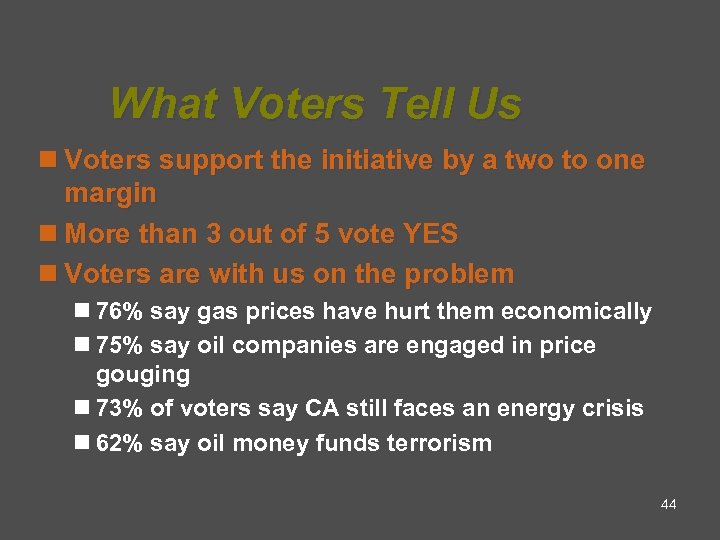
What Voters Tell Us n Voters support the initiative by a two to one margin n More than 3 out of 5 vote YES n Voters are with us on the problem n 76% say gas prices have hurt them economically n 75% say oil companies are engaged in price gouging n 73% of voters say CA still faces an energy crisis n 62% say oil money funds terrorism 44
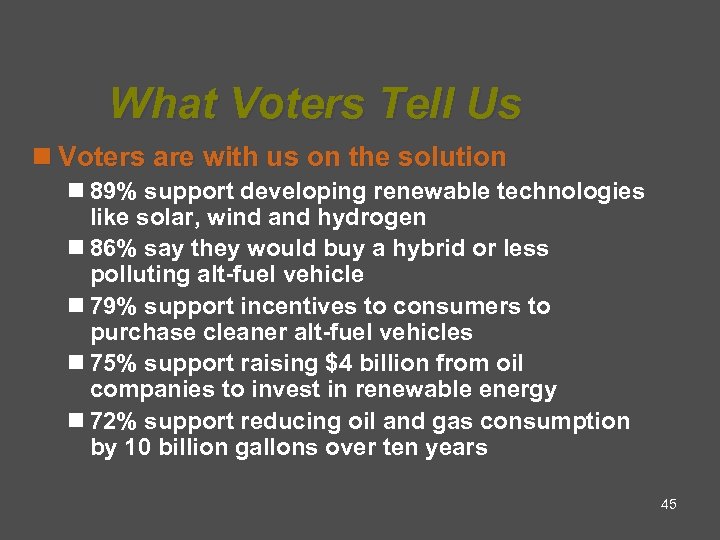
What Voters Tell Us n Voters are with us on the solution n 89% support developing renewable technologies like solar, wind and hydrogen n 86% say they would buy a hybrid or less polluting alt-fuel vehicle n 79% support incentives to consumers to purchase cleaner alt-fuel vehicles n 75% support raising $4 billion from oil companies to invest in renewable energy n 72% support reducing oil and gas consumption by 10 billion gallons over ten years 45
The Clean Alternative Energy Act A voter initiative for the November 2006 ballot 46

Brazil: A Role Model 47
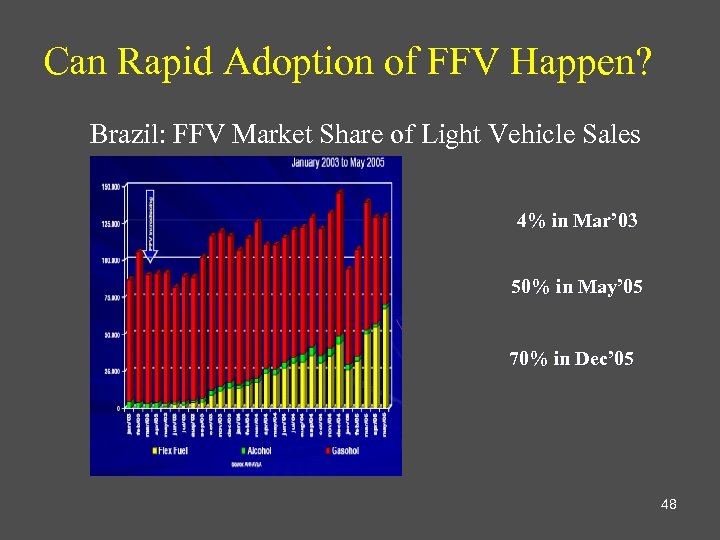
Can Rapid Adoption of FFV Happen? Brazil: FFV Market Share of Light Vehicle Sales 4% in Mar’ 03 50% in May’ 05 70% in Dec’ 05 48
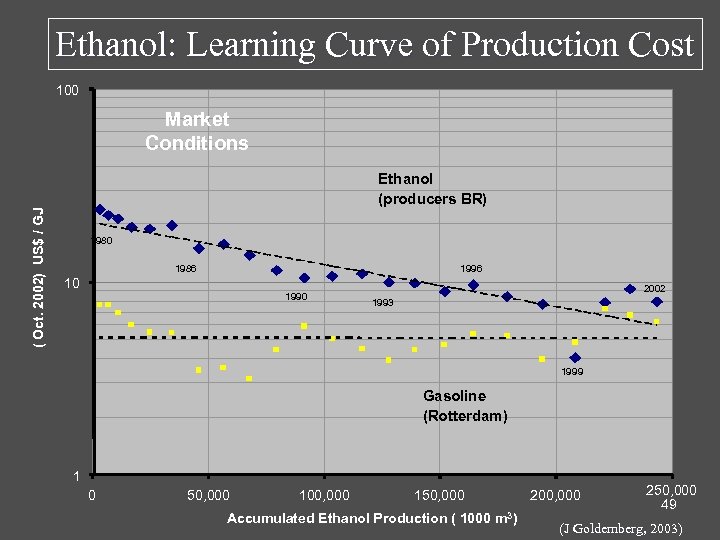
Ethanol: Learning Curve of Production Cost 100 ( Oct. 2002) US$ / GJ Market Conditions Ethanol (producers BR) 1980 1986 1996 10 1990 2002 1993 1999 Gasoline (Rotterdam) 1 0 50, 000 100, 000 150, 000 Accumulated Ethanol Production ( 1000 m 3) 200, 000 250, 000 49 (J Goldemberg, 2003)
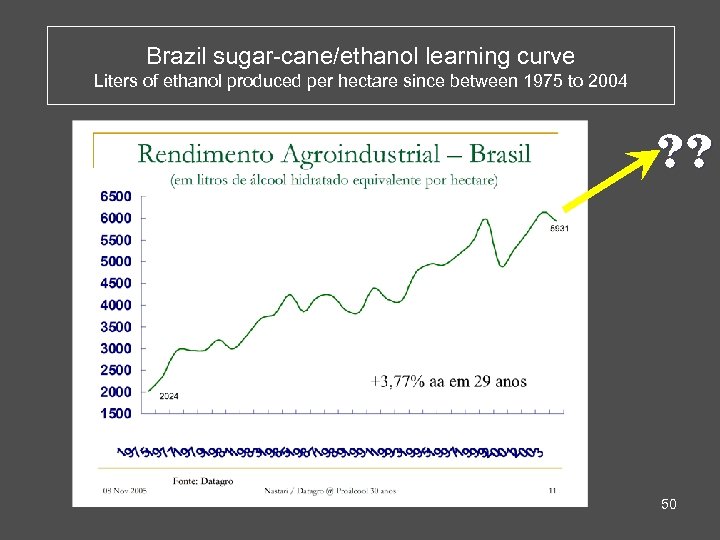
Brazil sugar-cane/ethanol learning curve Liters of ethanol produced per hectare since between 1975 to 2004 ? ? 50
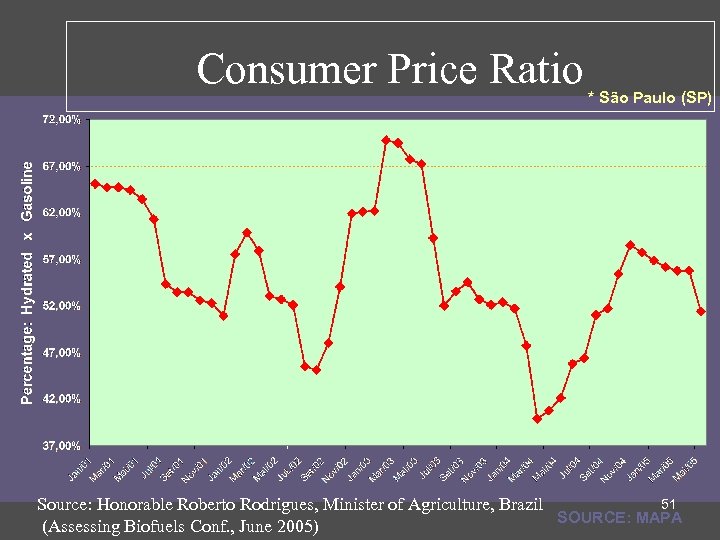
Consumer Price Ratio * São Paulo (SP) 51 Source: Honorable Roberto Rodrigues, Minister of Agriculture, Brazil SOURCE: MAPA (Assessing Biofuels Conf. , June 2005)

Status: United States 52
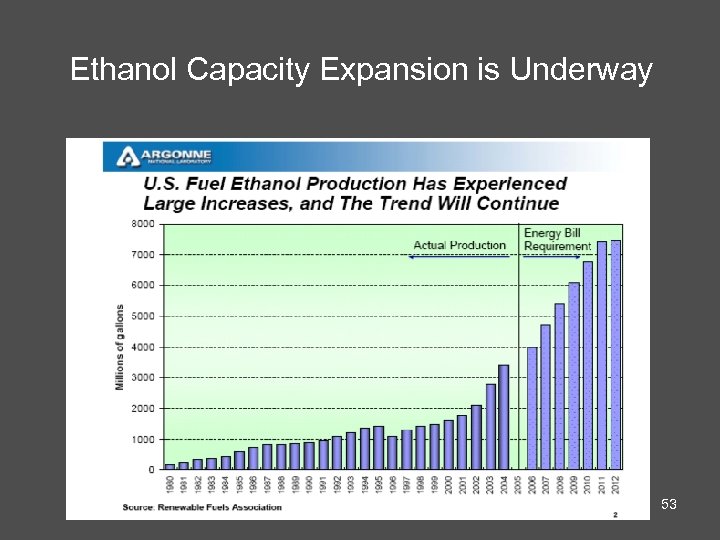
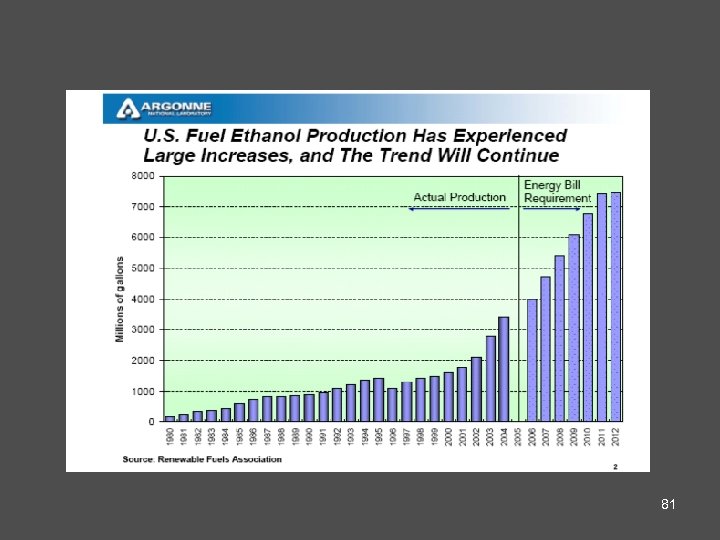
Ethanol Capacity Expansion is Underway 53
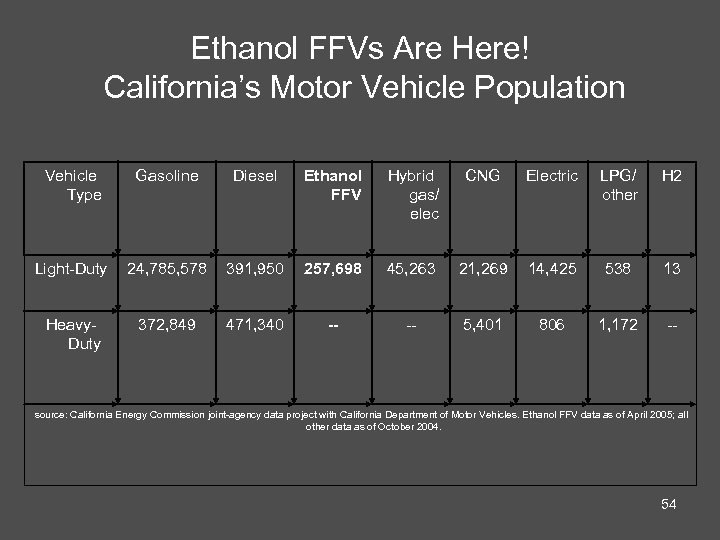
Ethanol FFVs Are Here! California’s Motor Vehicle Population Vehicle Type Gasoline Diesel Ethanol FFV Hybrid CNG gas/ elec Electric LPG/ other H 2 Light-Duty 24, 785, 578 391, 950 257, 698 45, 263 21, 269 14, 425 538 13 Heavy. Duty 372, 849 471, 340 -- -- 5, 401 806 1, 172 -- source: California Energy Commission joint-agency data project with California Department of Motor Vehicles. Ethanol FFV data as of April 2005; all other data as of October 2004. 54
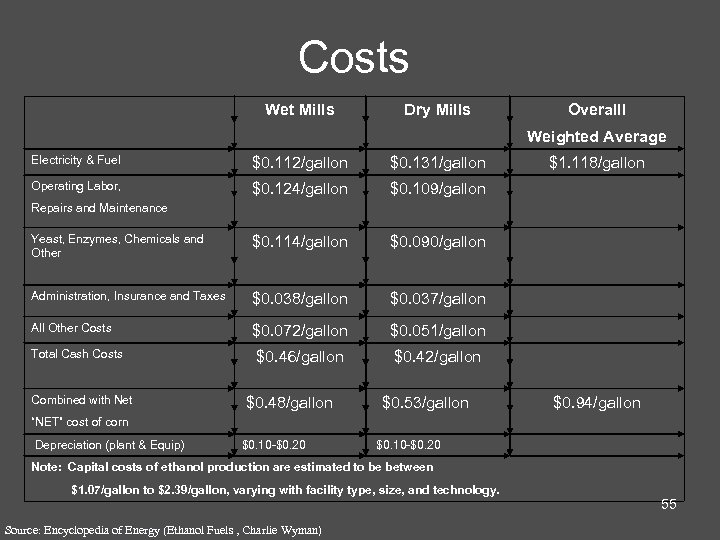
Costs Wet Mills Dry Mills Overalll Weighted Average Electricity & Fuel $0. 112/gallon $0. 131/gallon $1. 118/gallon Operating Labor, $0. 124/gallon $0. 109/gallon Yeast, Enzymes, Chemicals and Other $0. 114/gallon $0. 090/gallon Administration, Insurance and Taxes $0. 038/gallon $0. 037/gallon All Other Costs $0. 072/gallon $0. 051/gallon $0. 46/gallon $0. 42/gallon Repairs and Maintenance Total Cash Costs Combined with Net $0. 48/gallon $0. 53/gallon $0. 10 -$0. 20 $0. 94/gallon “NET” cost of corn Depreciation (plant & Equip) Note: Capital costs of ethanol production are estimated to be between $1. 07/gallon to $2. 39/gallon, varying with facility type, size, and technology. 55 Source: Encyclopedia of Energy (Ethanol Fuels , Charlie Wyman)
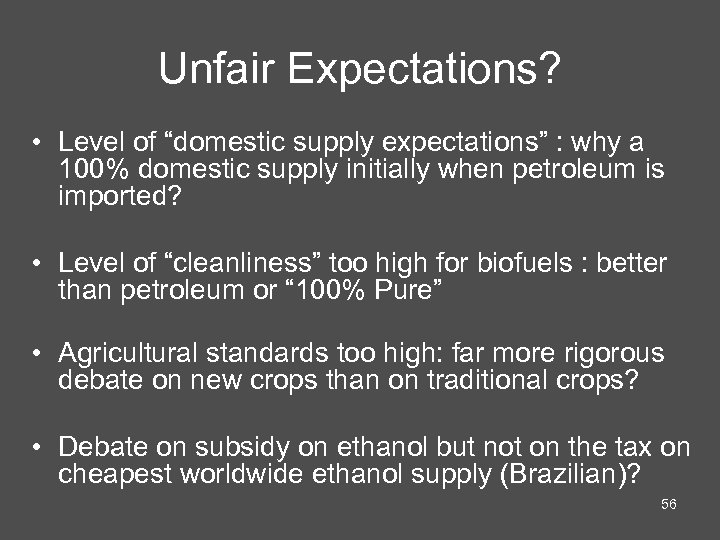
Unfair Expectations? • Level of “domestic supply expectations” : why a 100% domestic supply initially when petroleum is imported? • Level of “cleanliness” too high for biofuels : better than petroleum or “ 100% Pure” • Agricultural standards too high: far more rigorous debate on new crops than on traditional crops? • Debate on subsidy on ethanol but not on the tax on cheapest worldwide ethanol supply (Brazilian)? 56
References • NRDC Report: “Growing Energy” (Dec 2004) • http: //soilcarboncenter. k-state. edu/conference/carbon 2/Fiedler 1_Baltimore_05. pdf • George Schultz & Jim Woolsey white paper “Oil & Security” • Rocky Mountain Institute: “Winning the Oil Endgame” • http: //www. unfoundation. org/features/biofuels. asp • http: //www. transportation. anl. gov/pdfs/TA/354. pdf • The Future of the Hydrogen Economy ( http: //www. oilcrash. com/articles/h 2_eco. htm#8. 2 ) • Fuel Ethanol: Background & Public Policy Issues (CRS Report for Congress, Dec. 2004) 57

Comments? Vinod Khosla vk@khoslaventures. com 58
ETHANOL: MARKET PERSPECTIVE Luiz Carlos Corrêa Carvalho Sugar and Alcohol Sectorial Chamber, Ministry of Agriculture, Brazil Assessing the Biofuels Option Joint Seminar of the International Energy Agency, the Brazilian Government and the 59 United Nations Foundation Paris, 20 – 21 June 2005
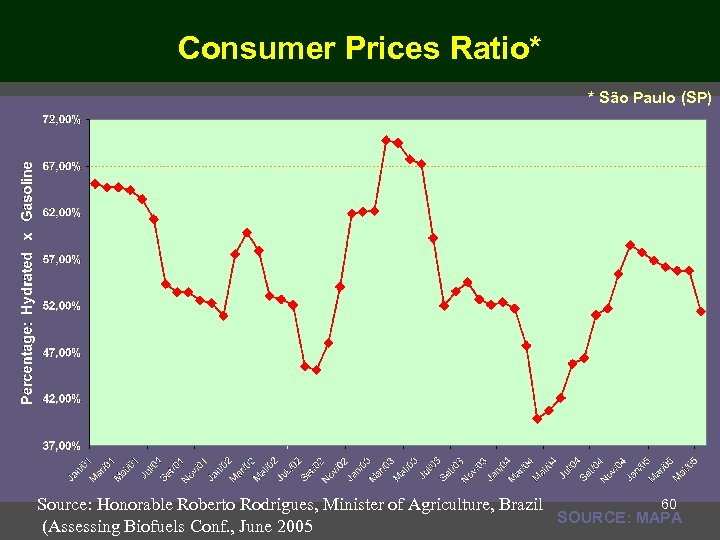
Consumer Prices Ratio* * São Paulo (SP) 60 Source: Honorable Roberto Rodrigues, Minister of Agriculture, Brazil SOURCE: MAPA (Assessing Biofuels Conf. , June 2005
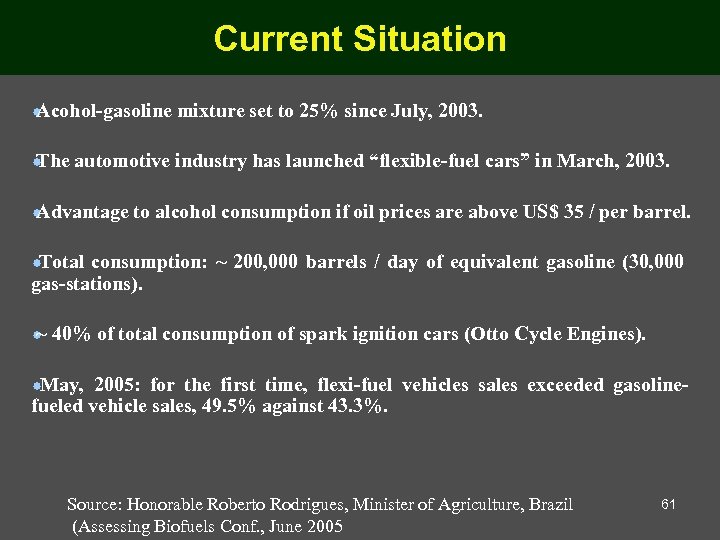
Current Situation Acohol-gasoline The mixture set to 25% since July, 2003. automotive industry has launched “flexible-fuel cars” in March, 2003. Advantage to alcohol consumption if oil prices are above US$ 35 / per barrel. Total consumption: ~ 200, 000 barrels / day of equivalent gasoline (30, 000 gas-stations). ~ 40% of total consumption of spark ignition cars (Otto Cycle Engines). May, 2005: for the first time, flexi-fuel vehicles sales exceeded gasolinefueled vehicle sales, 49. 5% against 43. 3%. Source: Honorable Roberto Rodrigues, Minister of Agriculture, Brazil (Assessing Biofuels Conf. , June 2005 61
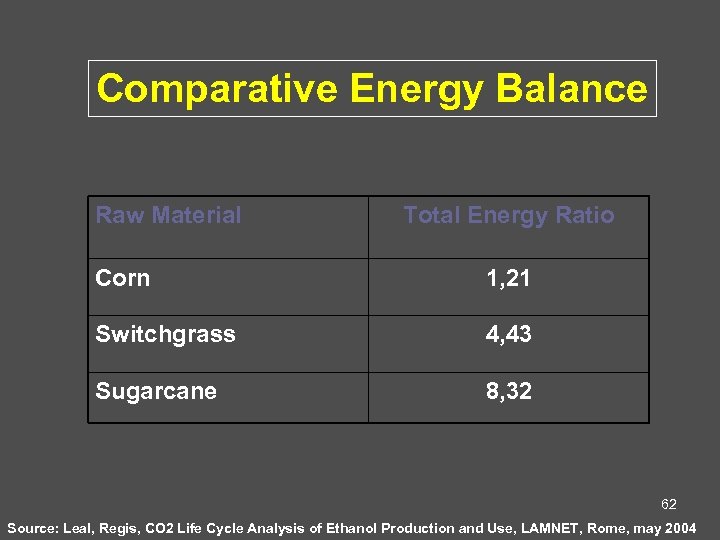
Comparative Energy Balance Raw Material Total Energy Ratio Corn 1, 21 Switchgrass 4, 43 Sugarcane 8, 32 62 Source: Leal, Regis, CO 2 Life Cycle Analysis of Ethanol Production and Use, LAMNET, Rome, may 2004
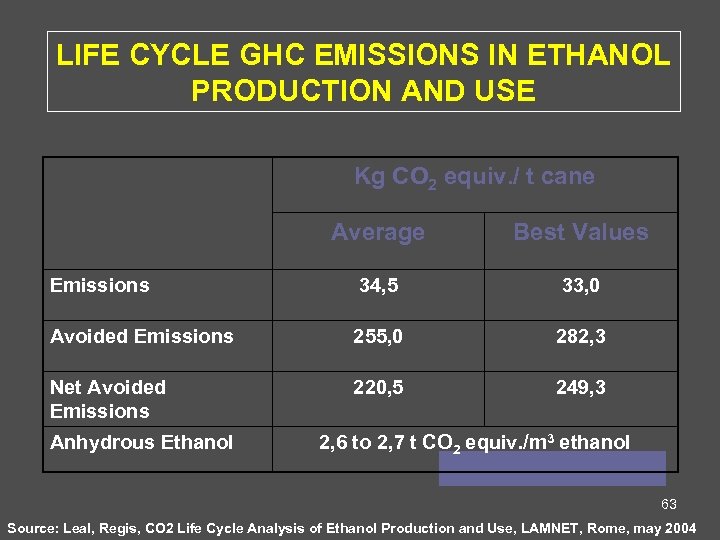
LIFE CYCLE GHC EMISSIONS IN ETHANOL PRODUCTION AND USE Kg CO 2 equiv. / t cane Average Best Values Emissions 34, 5 33, 0 Avoided Emissions 255, 0 282, 3 Net Avoided Emissions 220, 5 249, 3 Anhydrous Ethanol 2, 6 to 2, 7 t CO 2 equiv. /m 3 ethanol 63 Source: Leal, Regis, CO 2 Life Cycle Analysis of Ethanol Production and Use, LAMNET, Rome, may 2004
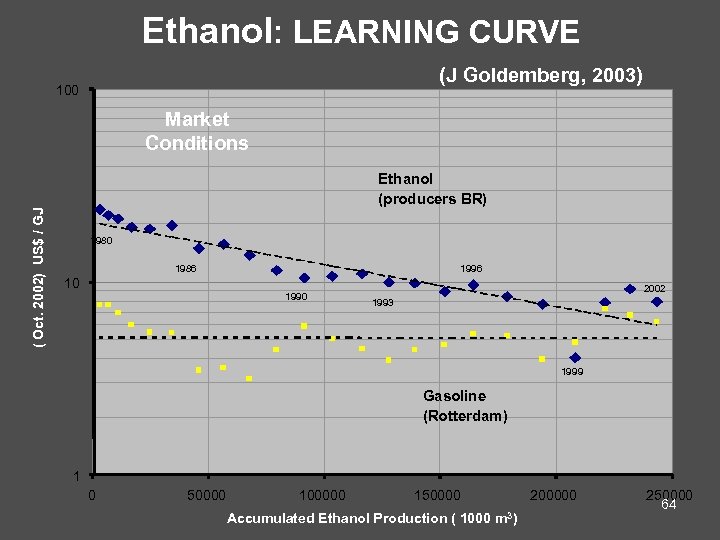
Ethanol: LEARNING CURVE (J Goldemberg, 2003) 100 ( Oct. 2002) US$ / GJ Market Conditions Ethanol (producers BR) 1980 1986 1996 10 1990 2002 1993 1999 Gasoline (Rotterdam) 1 0 50000 100000 150000 Accumulated Ethanol Production ( 1000 m 3) 200000 250000 64
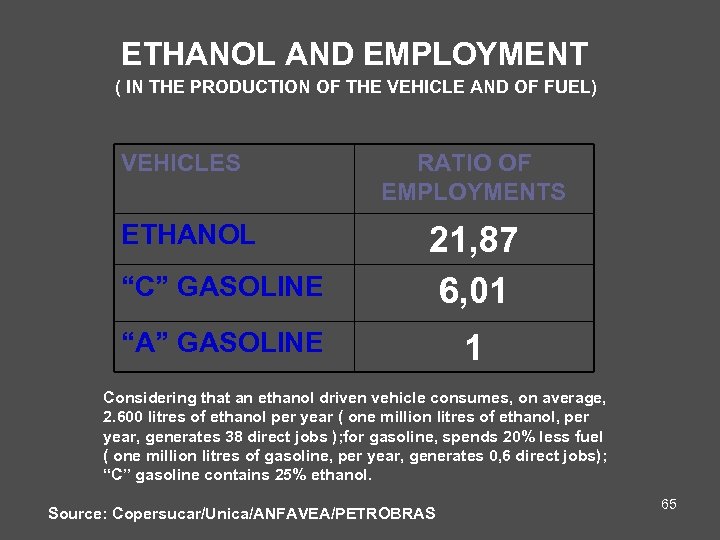
ETHANOL AND EMPLOYMENT ( IN THE PRODUCTION OF THE VEHICLE AND OF FUEL) VEHICLES ETHANOL RATIO OF EMPLOYMENTS “C” GASOLINE 21, 87 6, 01 “A” GASOLINE 1 Considering that an ethanol driven vehicle consumes, on average, 2. 600 litres of ethanol per year ( one million litres of ethanol, per year, generates 38 direct jobs ); for gasoline, spends 20% less fuel ( one million litres of gasoline, per year, generates 0, 6 direct jobs); “C” gasoline contains 25% ethanol. Source: Copersucar/Unica/ANFAVEA/PETROBRAS 65
66
The Ethanol application as vehicular fuel in Brazilian Automotive Industry Association - ANFAVEA Energy & Environment Commission Henry Joseph Jr. 67
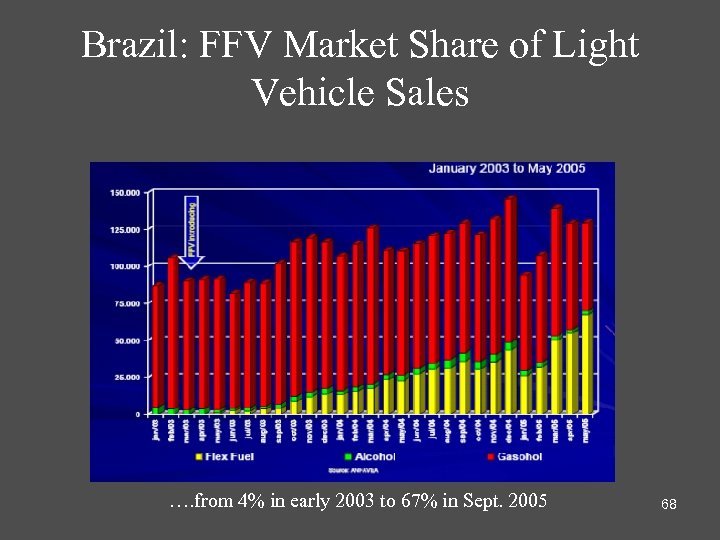
Brazil: FFV Market Share of Light Vehicle Sales …. from 4% in early 2003 to 67% in Sept. 2005 68
69
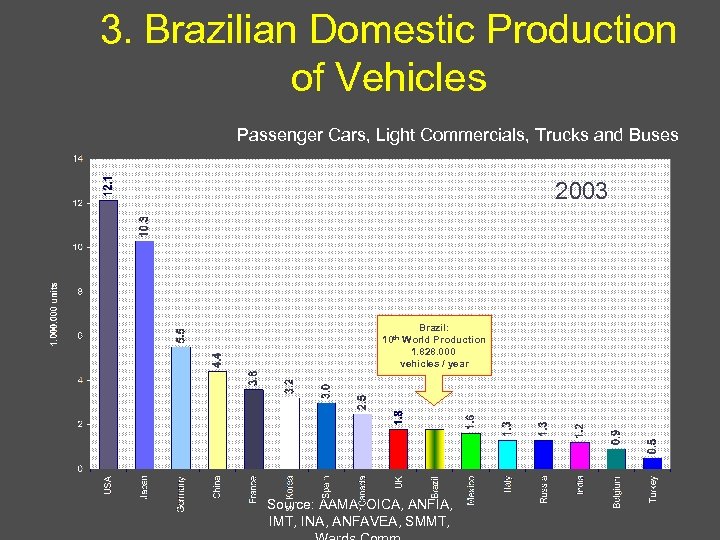
3. Brazilian Domestic Production of Vehicles Passenger Cars, Light Commercials, Trucks and Buses 2003 Brazil: 10 th World Production 1. 828. 000 vehicles / year Source: AAMA, OICA, ANFIA, IMT, INA, ANFAVEA, SMMT,
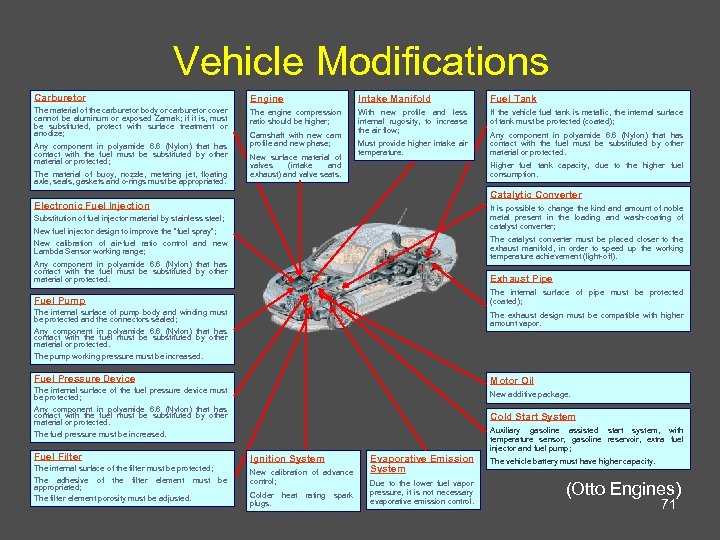
Vehicle Modifications Carburetor Engine Intake Manifold Fuel Tank The material of the carburetor body or carburetor cover cannot be aluminum or exposed Zamak; if it is, must be substituted, protect with surface treatment or anodize; The engine compression ratio should be higher; With new profile and less internal rugosity, to increase the air flow; If the vehicle fuel tank is metallic, the internal surface of tank must be protected (coated); Any component in polyamide 6. 6 (Nylon) that has contact with the fuel must be substituted by other material or protected; The material of buoy, nozzle, metering jet, floating axle, seals, gaskets and o-rings must be appropriated. Camshaft with new cam profile and new phase; New surface material of valves (intake and exhaust) and valve seats. Must provide higher intake air temperature. Any component in polyamide 6. 6 (Nylon) that has contact with the fuel must be substituted by other material or protected. Higher fuel tank capacity, due to the higher fuel consumption. Catalytic Converter Electronic Fuel Injection It is possible to change the kind amount of noble metal present in the loading and wash-coating of catalyst converter; Substitution of fuel injector material by stainless steel; New fuel injector design to improve the “fuel spray”; The catalyst converter must be placed closer to the exhaust manifold, in order to speed up the working temperature achievement (light-off). New calibration of air-fuel ratio control and new Lambda Sensor working range; Any component in polyamide 6. 6 (Nylon) that has contact with the fuel must be substituted by other material or protected. Exhaust Pipe The internal surface of pipe must be protected (coated); Fuel Pump The internal surface of pump body and winding must be protected and the connectors sealed; Any component in polyamide 6. 6 (Nylon) that has contact with the fuel must be substituted by other material or protected. The pump working pressure must be increased. The exhaust design must be compatible with higher amount vapor. Fuel Pressure Device Motor Oil The internal surface of the fuel pressure device must be protected; Any component in polyamide 6. 6 (Nylon) that has contact with the fuel must be substituted by other material or protected. The fuel pressure must be increased. New additive package. Cold Start System Auxiliary gasoline assisted start system, with temperature sensor, gasoline reservoir, extra fuel injector and fuel pump; Fuel Filter Ignition System The internal surface of the filter must be protected; The adhesive of the filter element must be appropriated; The filter element porosity must be adjusted. New calibration of advance control; Colder heat rating spark plugs. Evaporative Emission System Due to the lower fuel vapor pressure, it is not necessary evaporative emission control. The vehicle battery must have higher capacity. (Otto Engines) 71
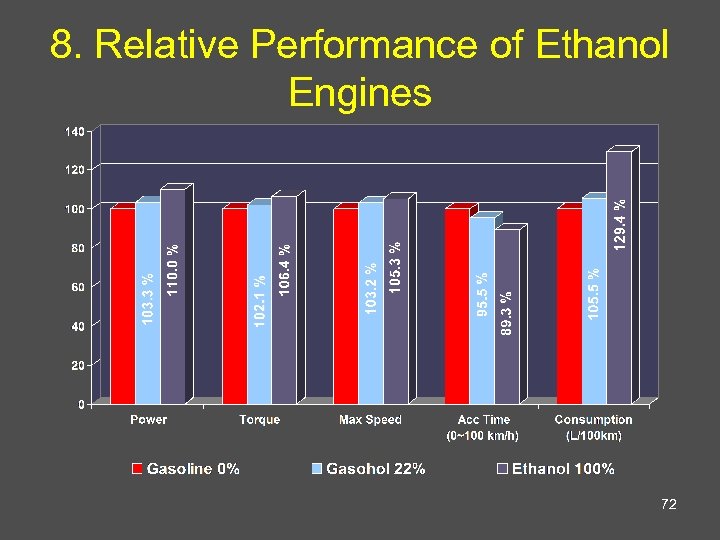
8. Relative Performance of Ethanol Engines 72
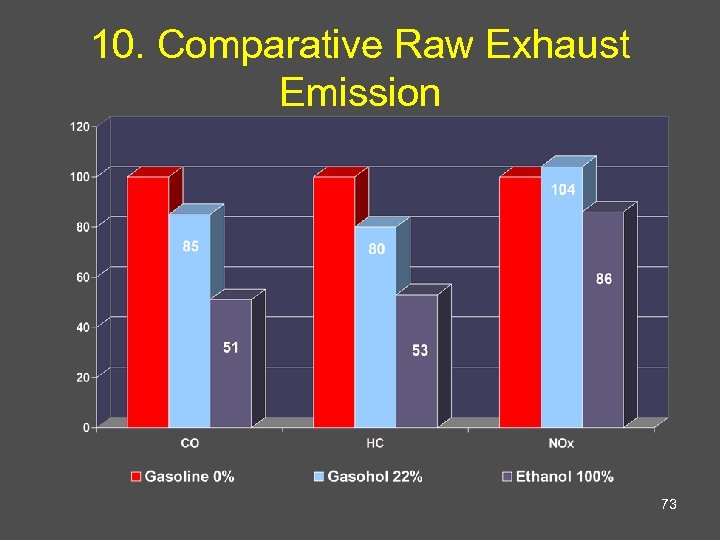
10. Comparative Raw Exhaust Emission 73
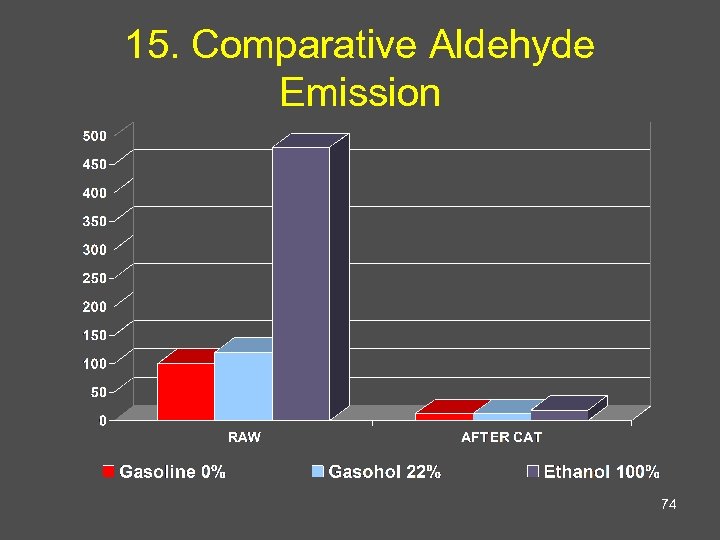
15. Comparative Aldehyde Emission 74
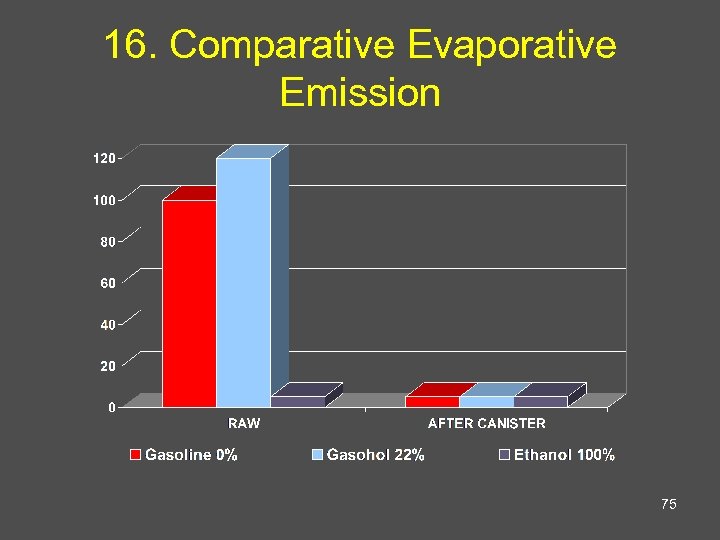
16. Comparative Evaporative Emission 75
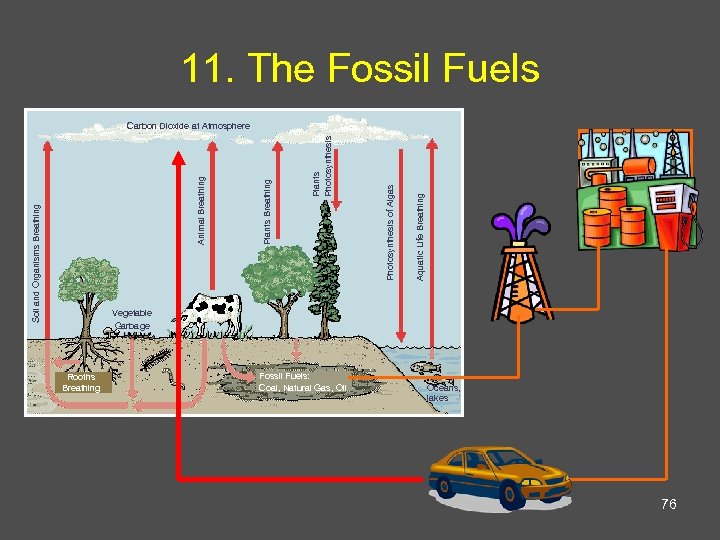
11. The Fossil Fuels Aquatic Life Breathing Photosynthesis of Algas Plants Photosynthesis Plants Breathing Soil and Organisms Breathing Animal Breathing Carbon Dioxide at Atmosphere Vegetable Garbage Rooths Breathing Fossil Fuels: Coal, Natural Gas, Oil Oceans, lakes 76
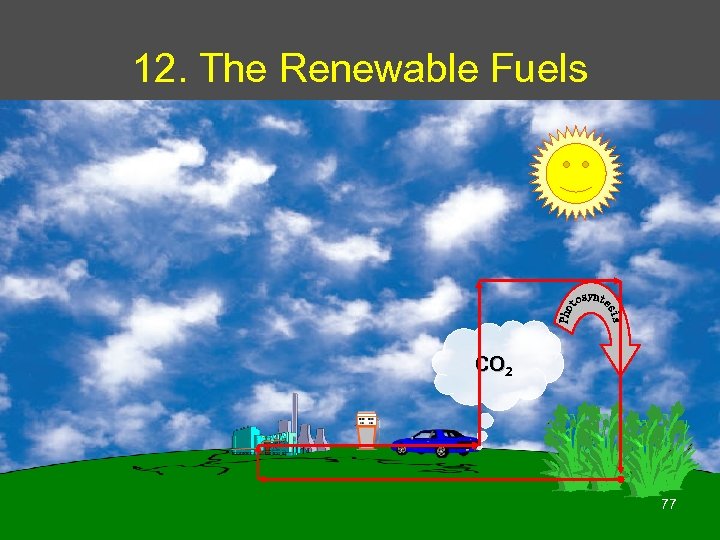
12. The Renewable Fuels CO 2 77
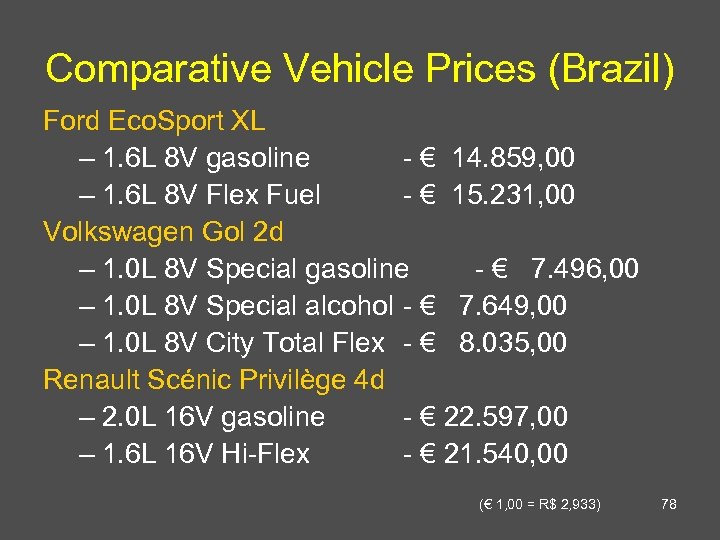
Comparative Vehicle Prices (Brazil) Ford Eco. Sport XL – 1. 6 L 8 V gasoline - € 14. 859, 00 – 1. 6 L 8 V Flex Fuel - € 15. 231, 00 Volkswagen Gol 2 d – 1. 0 L 8 V Special gasoline - € 7. 496, 00 – 1. 0 L 8 V Special alcohol - € 7. 649, 00 – 1. 0 L 8 V City Total Flex - € 8. 035, 00 Renault Scénic Privilège 4 d – 2. 0 L 16 V gasoline - € 22. 597, 00 – 1. 6 L 16 V Hi-Flex - € 21. 540, 00 (€ 1, 00 = R$ 2, 933) 78
http: //www. transportation. anl. gov 79
80
81
82
83
84
85
86
87
88
89
90
91
92
93
94
95
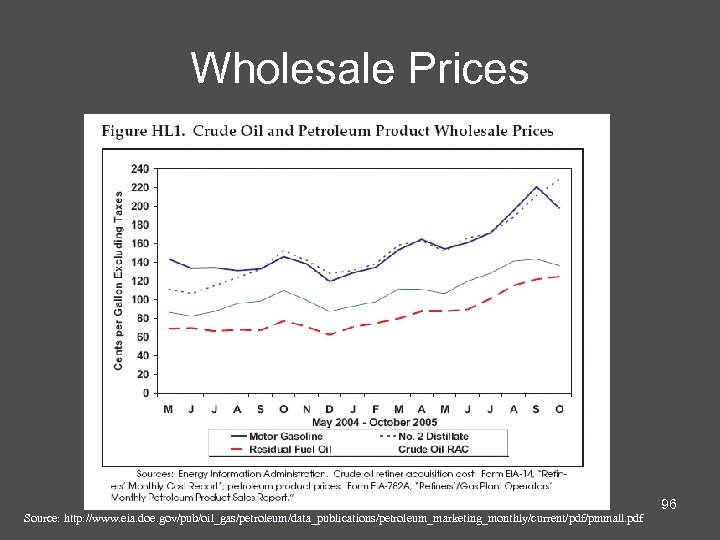
Wholesale Prices Source: http: //www. eia. doe. gov/pub/oil_gas/petroleum/data_publications/petroleum_marketing_monthly/current/pdf/pmmall. pdf 96
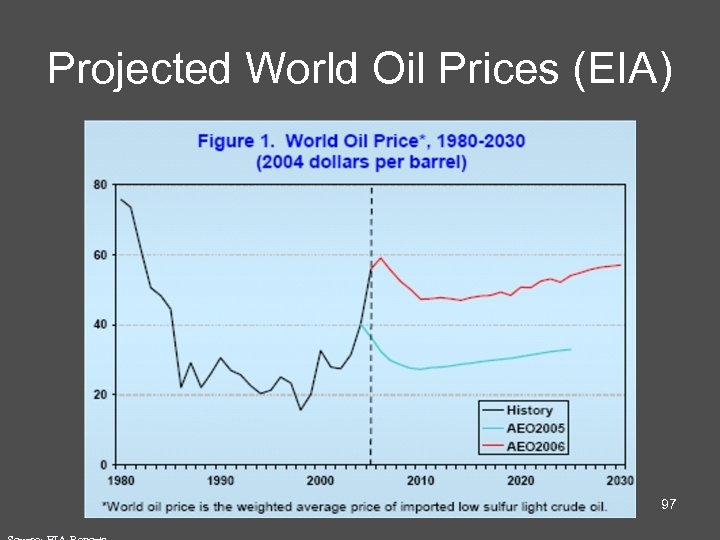
Projected World Oil Prices (EIA) 97
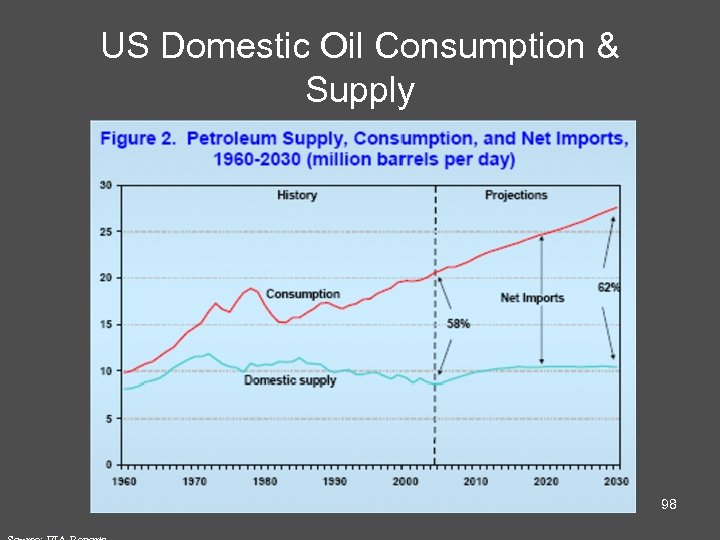
US Domestic Oil Consumption & Supply 98
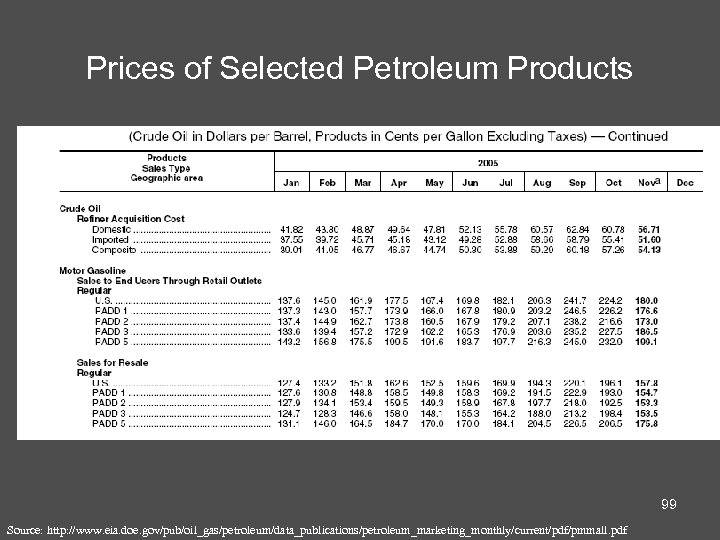
Prices of Selected Petroleum Products 99 Source: http: //www. eia. doe. gov/pub/oil_gas/petroleum/data_publications/petroleum_marketing_monthly/current/pdf/pmmall. pdf
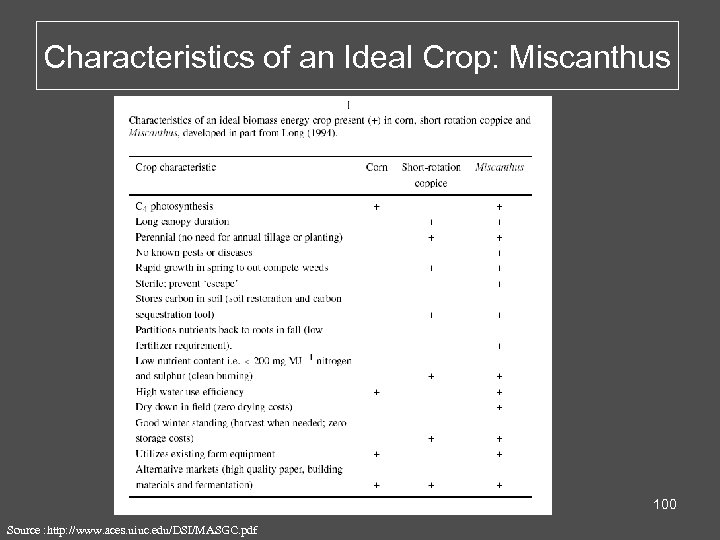
Characteristics of an Ideal Crop: Miscanthus 100 Source : http: //www. aces. uiuc. edu/DSI/MASGC. pdf
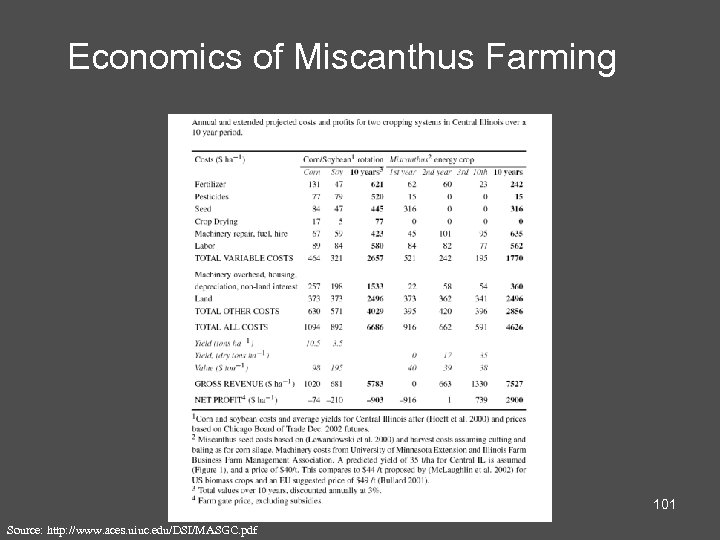
Economics of Miscanthus Farming 101 Source: http: //www. aces. uiuc. edu/DSI/MASGC. pdf
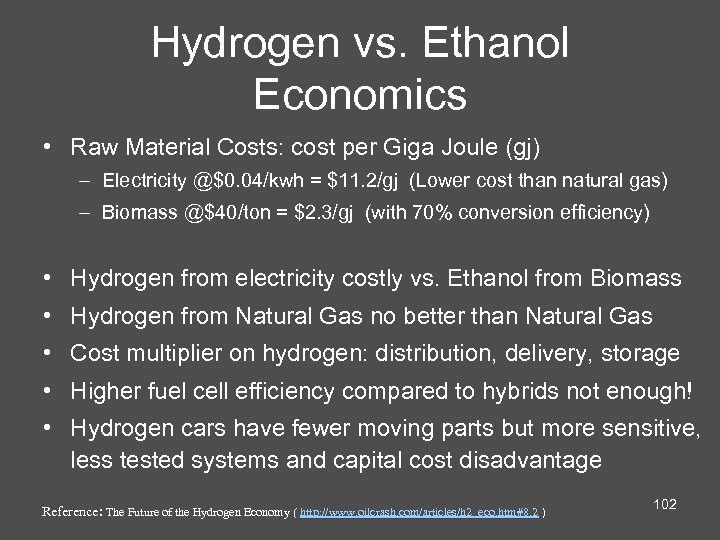
Hydrogen vs. Ethanol Economics • Raw Material Costs: cost per Giga Joule (gj) – Electricity @$0. 04/kwh = $11. 2/gj (Lower cost than natural gas) – Biomass @$40/ton = $2. 3/gj (with 70% conversion efficiency) • Hydrogen from electricity costly vs. Ethanol from Biomass • Hydrogen from Natural Gas no better than Natural Gas • Cost multiplier on hydrogen: distribution, delivery, storage • Higher fuel cell efficiency compared to hybrids not enough! • Hydrogen cars have fewer moving parts but more sensitive, less tested systems and capital cost disadvantage Reference: The Future of the Hydrogen Economy ( http: //www. oilcrash. com/articles/h 2_eco. htm#8. 2 ) 102
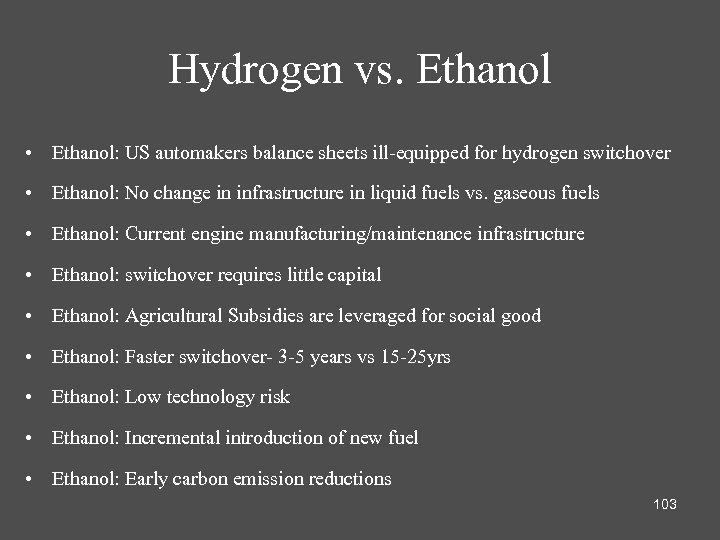
Hydrogen vs. Ethanol • Ethanol: US automakers balance sheets ill-equipped for hydrogen switchover • Ethanol: No change in infrastructure in liquid fuels vs. gaseous fuels • Ethanol: Current engine manufacturing/maintenance infrastructure • Ethanol: switchover requires little capital • Ethanol: Agricultural Subsidies are leveraged for social good • Ethanol: Faster switchover- 3 -5 years vs 15 -25 yrs • Ethanol: Low technology risk • Ethanol: Incremental introduction of new fuel • Ethanol: Early carbon emission reductions 103
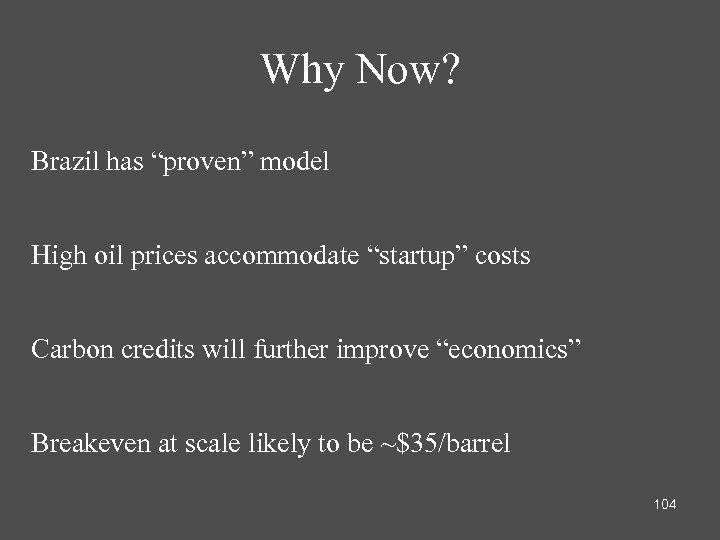
Why Now? Brazil has “proven” model High oil prices accommodate “startup” costs Carbon credits will further improve “economics” Breakeven at scale likely to be ~$35/barrel 104
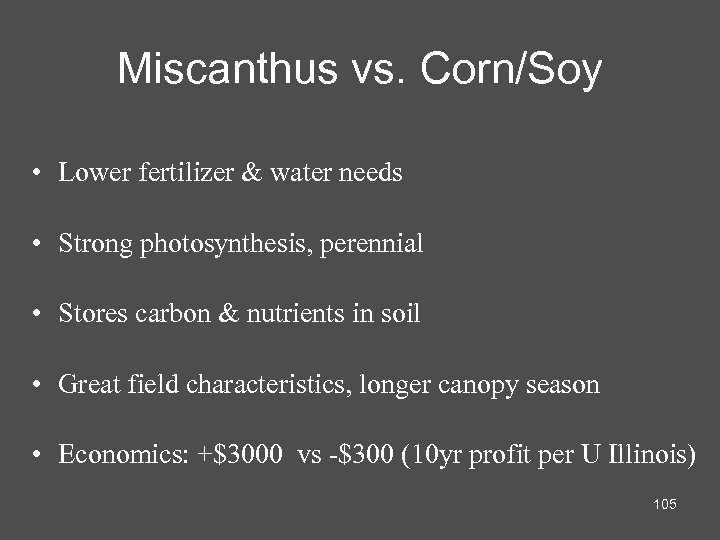
Miscanthus vs. Corn/Soy • Lower fertilizer & water needs • Strong photosynthesis, perennial • Stores carbon & nutrients in soil • Great field characteristics, longer canopy season • Economics: +$3000 vs -$300 (10 yr profit per U Illinois) 105
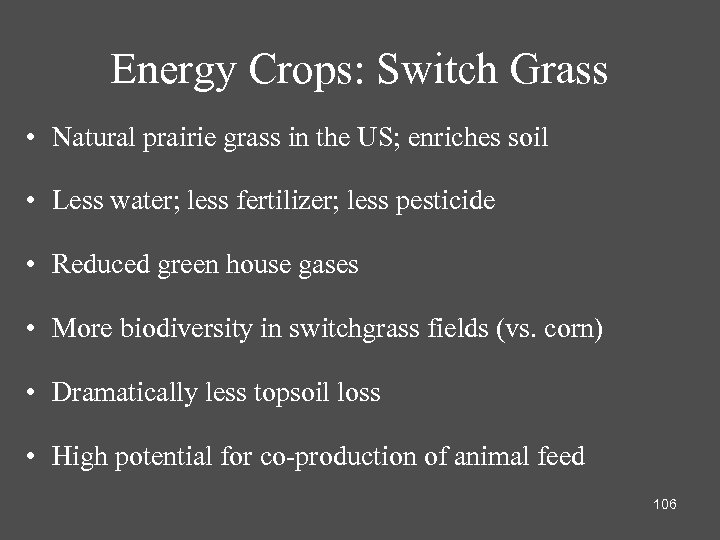
Energy Crops: Switch Grass • Natural prairie grass in the US; enriches soil • Less water; less fertilizer; less pesticide • Reduced green house gases • More biodiversity in switchgrass fields (vs. corn) • Dramatically less topsoil loss • High potential for co-production of animal feed 106
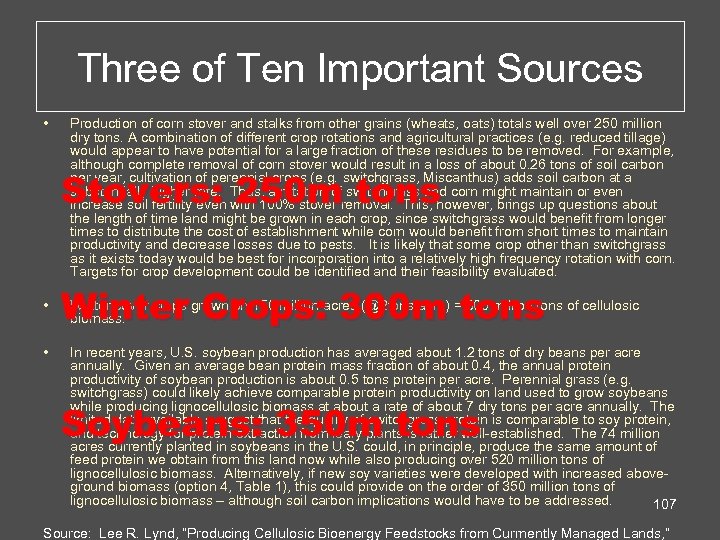
Three of Ten Important Sources • Production of corn stover and stalks from other grains (wheats, oats) totals well over 250 million dry tons. A combination of different crop rotations and agricultural practices (e. g. reduced tillage) would appear to have potential for a large fraction of these residues to be removed. For example, although complete removal of corn stover would result in a loss of about 0. 26 tons of soil carbon per year, cultivation of perennial crops (e. g. switchgrass, Miscanthus) adds soil carbon at a substantially higher rate. Thus, a rotation of switchgrass and corn might maintain or even increase soil fertility even with 100% stover removal. This, however, brings up questions about the length of time land might be grown in each crop, since switchgrass would benefit from longer times to distribute the cost of establishment while corn would benefit from short times to maintain productivity and decrease losses due to pests. It is likely that some crop other than switchgrass as it exists today would be best for incorporation into a relatively high frequency rotation with corn. Targets for crop development could be identified and their feasibility evaluated. Stovers: 250 m tons • • Winter Crops: 300 m tons Winter cover crops grown on 150 million acres (@2 tons/acre) = 300 million tons of cellulosic biomass. In recent years, U. S. soybean production has averaged about 1. 2 tons of dry beans per acre annually. Given an average bean protein mass fraction of about 0. 4, the annual protein productivity of soybean production is about 0. 5 tons protein per acre. Perennial grass (e. g. switchgrass) could likely achieve comparable protein productivity on land used to grow soybeans while producing lignocellulosic biomass at about a rate of about 7 dry tons per acre annually. The limited data available suggest that the quality of switchgrass protein is comparable to soy protein, and technology for protein extraction from leafy plants is rather well-established. The 74 million acres currently planted in soybeans in the U. S. could, in principle, produce the same amount of feed protein we obtain from this land now while also producing over 520 million tons of lignocellulosic biomass. Alternatively, if new soy varieties were developed with increased aboveground biomass (option 4, Table 1), this could provide on the order of 350 million tons of lignocellulosic biomass – although soil carbon implications would have to be addressed. 107 Soybeans: 350 m tons Source: Lee R. Lynd, “Producing Cellulosic Bioenergy Feedstocks from Currnently Managed Lands, ”
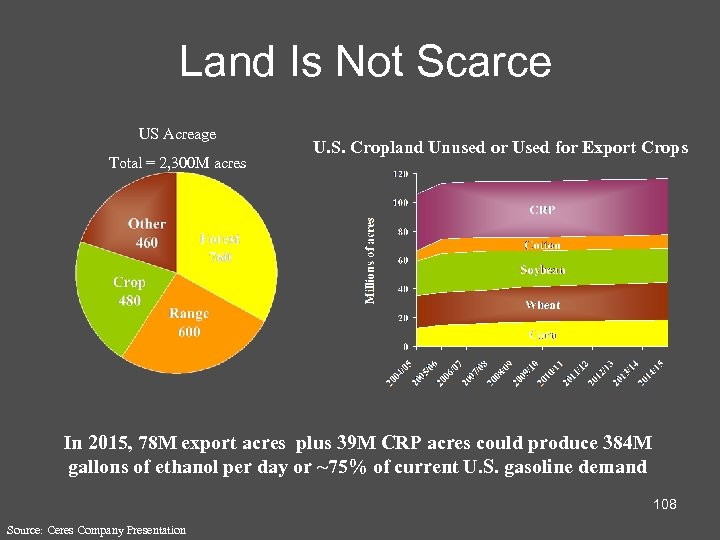
Land Is Not Scarce US Acreage Total = 2, 300 M acres U. S. Cropland Unused or Used for Export Crops In 2015, 78 M export acres plus 39 M CRP acres could produce 384 M gallons of ethanol per day or ~75% of current U. S. gasoline demand 108 Source: Ceres Company Presentation
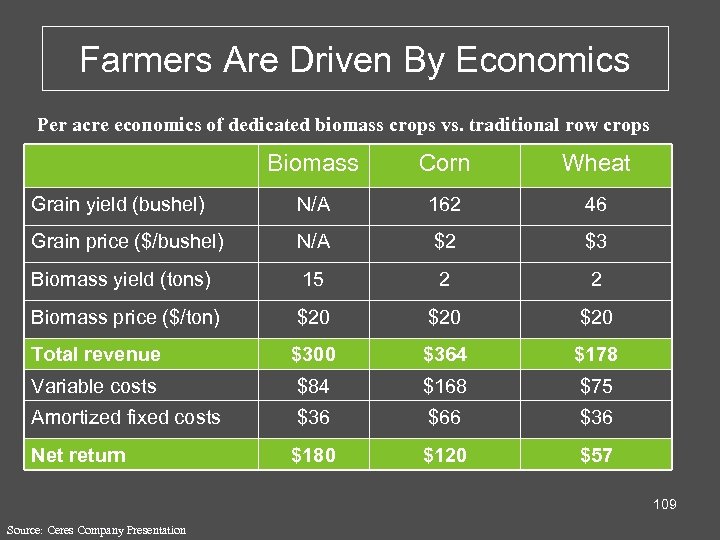
Farmers Are Driven By Economics Per acre economics of dedicated biomass crops vs. traditional row crops Biomass Corn Wheat Grain yield (bushel) N/A 162 46 Grain price ($/bushel) N/A $2 $3 Biomass yield (tons) 15 2 2 Biomass price ($/ton) $20 $20 Total revenue $300 $364 $178 Variable costs $84 $168 $75 Amortized fixed costs $36 $66 $36 Net return $180 $120 $57 109 Source: Ceres Company Presentation
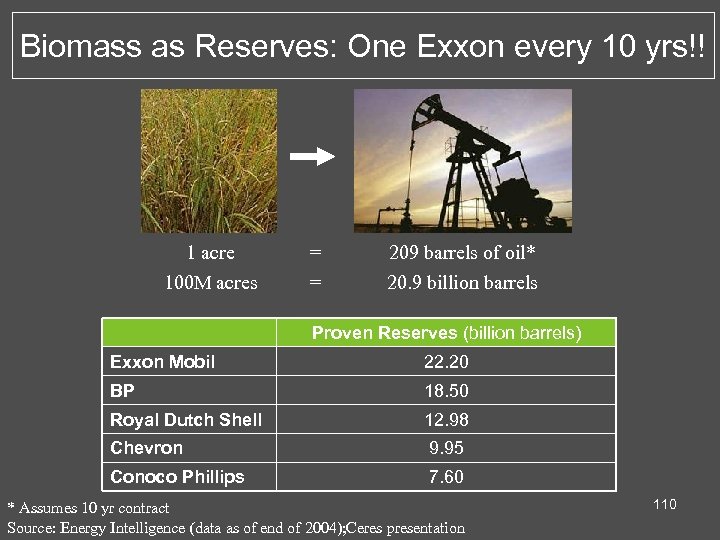
Biomass as Reserves: One Exxon every 10 yrs!! 1 acre 100 M acres = = 209 barrels of oil* 20. 9 billion barrels Proven Reserves (billion barrels) Exxon Mobil 22. 20 BP 18. 50 Royal Dutch Shell 12. 98 Chevron 9. 95 Conoco Phillips 7. 60 * Assumes 10 yr contract Source: Energy Intelligence (data as of end of 2004); Ceres presentation 110

Tutorial • http: //www. eere. energy. gov/biomass/understanding_biomass. html 111
Скачать презентацию Biofuels Think outside the Barrel Vinod Khosla vk khoslaventures
8389cb64ae159ecbfca1fa3d3f5fa582.ppt