 Скачать презентацию BIOFUELS OVERVIEW Al Mannato API Biofuels Overview
85cff42ad4353df30c35a81fe0b83bcd.ppt
- Количество слайдов: 16



BIOFUELS OVERVIEW Al Mannato API
Biofuels Overview • Our nation needs ALL sources of commercially viable energy, as well as a greater commitment to energy efficiency and energy conservation • Almost 50% of all gasoline now produced in the U. S. includes ethanol • Our companies have long been pioneers in developing alternatives and expanding our utilization of existing sources of energy
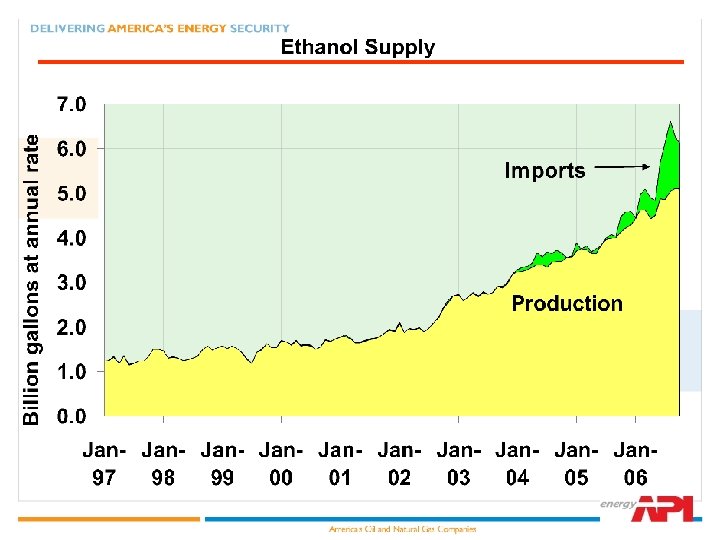
Ethanol Overview · Oil companies are the leading user of ethanol and a key player in increasing the use of ethanol · Flexibility in the national renewable fuel standard (RFS) program will help ease ethanol and other biofuels integration soonest into the nation’s gasoline pool · Reliance on market forces is the best way to both deliver the greatest value to our customers and to ensure a long-term vibrant ethanol industry · A patchwork of state-by-state ethanol mandates beyond the national RFS create additional boutique fuels that will likely interfere with the flexibility that Congress provided in the national RFS program
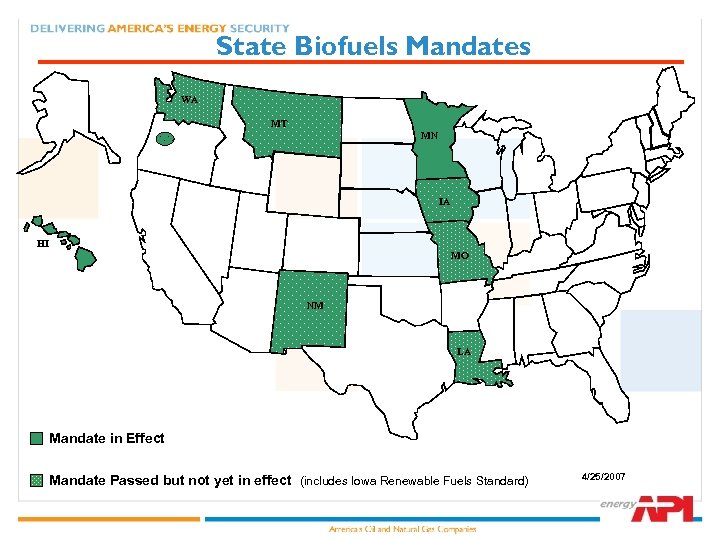
State Biofuels Mandates WA MT MN IA HI MO NM LA Mandate in Effect Mandate Passed but not yet in effect (includes Iowa Renewable Fuels Standard) 4/25/2007
Ethanol Challenges • Ethanol energy content is ~35% less than gasoline üFewer miles per gallon • Ethanol generally cannot be transported via pipeline üAffinity for water requires segregation from gasoline during distribution • Higher vapor pressure
Handling Ethanol • Ethanol use requires increased awareness of fuel impacts on the entire distribution system ü Ethanol blends are not sent through pipeline systems because they may pick up water and other impurities in transit. ü Ethanol blending occurs at the terminal rack into trucks Ethanol + RBOB = Reformulated Gasoline § Two products, neither usable until they are blended § Supply system changes have been made to handle base gasoline (RBOB) and ethanol ü Particular care is needed during change of service (i. e. , change dispenser filters, swelling/shrinking of gaskets and seals) ü Stress corrosion cracking in steel tanks, vessels, and piping is being investigated
Ethanol as a Fuel • Ethanol has been used as an additive in gasoline in amounts up to 10% (E 10) for some time ü E 10 can be used in the virtually all vehicles that operate on gasoline • E 85 is an alternative fuel that can only be used in specially designed “flexible-fuel” vehicles (FFVs) ü Less than 3% of the current light-duty fleet are FFVs ü Some auto makers have promised to produce more
State Ethanol Blending Issues • Several states (mainly in Southeast) have gasoline specifications making ethanol blending with conventional gasoline problematic • In those states ethanol can only be blended with a customized blendstock (BOB), causing boutique fuel concerns • API has been encouraging states to adopt language in the NIST 130 Handbook • Meeting increased Federal RFS levels could become difficult without changes to state regulations
E 85 Overview • Products offered for sale must meet consumers expectations. Care should be taken not to over-promise on E 85’s capabilities by not recognizing cost tradeoffs, poorer fuel economy, and shorter range • Ethanol has a role as a transportation energy source but its role is limited until significant technology breakthroughs yields economic production of ethanol from cellulosic biomass Timing of technological breakthroughs is unknown No assurance that technologies will emerge • Government policies should not pick winners and losers
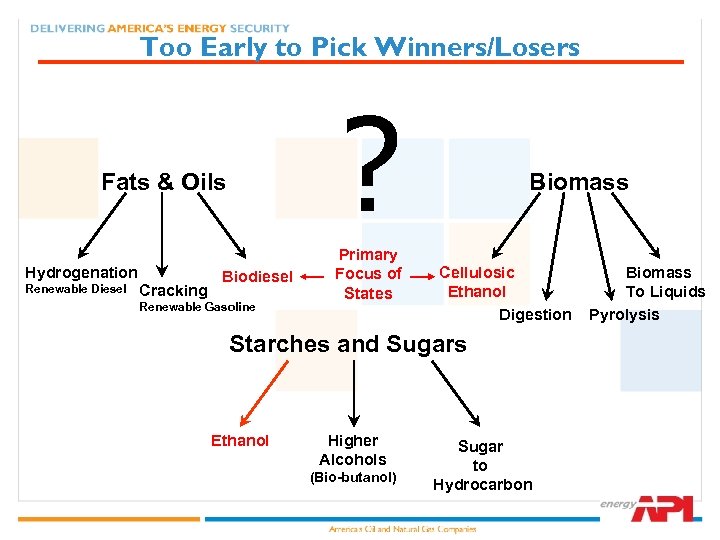
Too Early to Pick Winners/Losers ? Fats & Oils Hydrogenation Renewable Diesel Cracking Biodiesel Renewable Gasoline Primary Focus of States Biomass Cellulosic Ethanol Digestion Starches and Sugars Ethanol Higher Alcohols (Bio-butanol) Sugar to Hydrocarbon Biomass To Liquids Pyrolysis
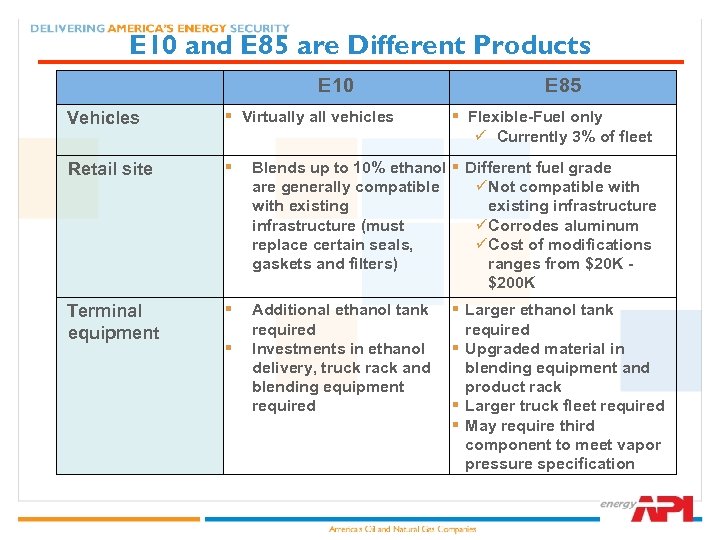
E 10 and E 85 are Different Products E 10 E 85 Vehicles § Virtually all vehicles Retail site § Blends up to 10% ethanol § Different fuel grade are generally compatible ü Not compatible with existing infrastructure (must ü Corrodes aluminum replace certain seals, ü Cost of modifications gaskets and filters) ranges from $20 K $200 K Terminal equipment § Additional ethanol tank required Investments in ethanol delivery, truck rack and blending equipment required § § Flexible-Fuel only ü Currently 3% of fleet § Larger ethanol tank required § Upgraded material in blending equipment and product rack § Larger truck fleet required § May require third component to meet vapor pressure specification
Ethanol Blends Above 10% • Significantly higher mandates would require more ethanol than can be used as an E 10 blend • Moving beyond E 10 will require a breakthrough in cellulosic ethanol technology • However, there are many unanswered questions on emissions, and vehicle and engine compatibility with higher blends (E 10 to E 20+) • Testing currently being conducted by: ü University of Minnesota/ RFA ü DOE ü CRC ü Small engine manufacturers
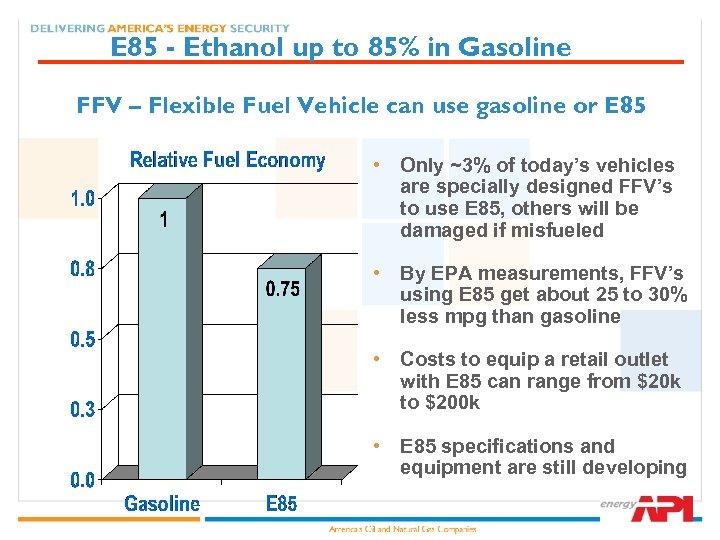
E 85 - Ethanol up to 85% in Gasoline FFV – Flexible Fuel Vehicle can use gasoline or E 85 • Only ~3% of today’s vehicles are specially designed FFV’s to use E 85, others will be damaged if misfueled • By EPA measurements, FFV’s using E 85 get about 25 to 30% less mpg than gasoline • Costs to equip a retail outlet with E 85 can range from $20 k to $200 k • E 85 specifications and equipment are still developing
E 85 Fueling Stations* • The number of E 85 fueling stations has nearly doubled since 2005 • According to DOE, there are 1229 E 85 fueling stations currently in operation ü 1106 public access ü 123 government or private fleet only • 446 public access stations are in just 2 states ü Minnesota – 300 ü Illinois – 146 • 15 states now have 10 or more public access stations ü CO, IA, IL, IN, KS, MI, MN, MO, ND, NE, OH, SC, SD, TX and WI * As of September 6, 2007
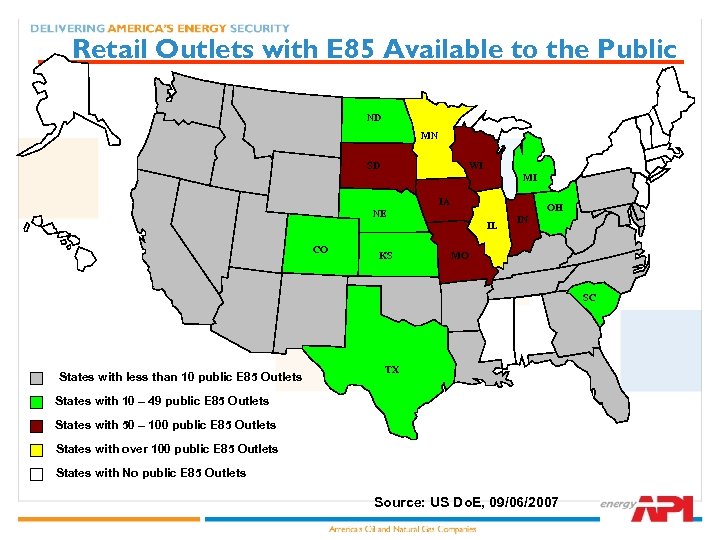
Retail Outlets with E 85 Available to the Public ND MN WI SD MI IA OH NE IL CO KS IN MO SC States with less than 10 public E 85 Outlets TX States with 10 – 49 public E 85 Outlets States with 50 – 100 public E 85 Outlets States with over 100 public E 85 Outlets States with No public E 85 Outlets Source: US Do. E, 09/06/2007
Скачать презентацию BIOFUELS OVERVIEW Al Mannato API Biofuels Overview
85cff42ad4353df30c35a81fe0b83bcd.ppt