 Скачать презентацию Biodiversity markets in the climate change era Legal
103822133be1949cda9a2497dfadbd90.ppt
- Количество слайдов: 29



Biodiversity markets in the climate change era. Legal challenges to the implementation of “non-carbon dependent” biodiversity markets 8 th IUCN Academy of Environmental Law Colloquium Source (pictures): Braintree Eco-Blog /Natural Resources Canada/ Parks Carla C. Gomez Wichtendahl LLD Candidate Faculty of Law-University of Ottawa Canada// Allianz Knowledge Partnersite By Canada/ Par Ghent, Belgium/ Sept. 2010 Canada/ Braintree Eco- 1
Introduction / Problem BIODIVERSITY Fundamental contributor to human wellbeing◦ Source of Ecosystem goods and services (EG&S) for food, clean air, clean and abundant water, etc. PROBLEM: - It is lost at alarming rates Drivers: land use changes, over-exploitation of natural resources, and climate change ( Source: Millennium Ecosystem Assessment, 2005) • Underlying problem: undervaluation/ lack or missing biodiversity conservation market. (European Commission DG Environment, Eftec, Feb, 2010), The use of Market Based Instruments for Biodiversity Protection- The case of Habitat Banking) However: EG&S offer new and interesting economic opportunities Source (pictures): Natural Resources Canada/ Vale of Glamorgan Council 2
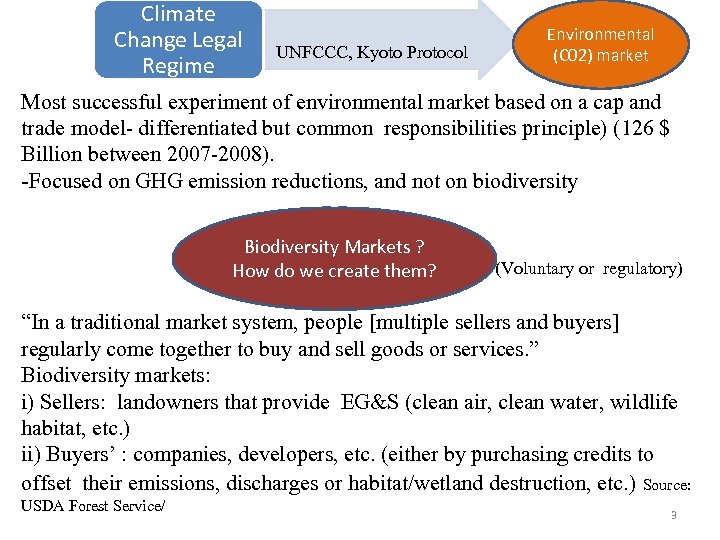
Climate Change Legal Regime UNFCCC, Kyoto Protocol Environmental (C 02) market Most successful experiment of environmental market based on a cap and trade model- differentiated but common responsibilities principle) (126 $ Billion between 2007 -2008). -Focused on GHG emission reductions, and not on biodiversity Biodiversity Markets ? How do we create them? (Voluntary or regulatory) “In a traditional market system, people [multiple sellers and buyers] regularly come together to buy and sell goods or services. ” Biodiversity markets: i) Sellers: landowners that provide EG&S (clean air, clean water, wildlife habitat, etc. ) ii) Buyers’ : companies, developers, etc. (either by purchasing credits to offset their emissions, discharges or habitat/wetland destruction, etc. ) Source: USDA Forest Service/ 3
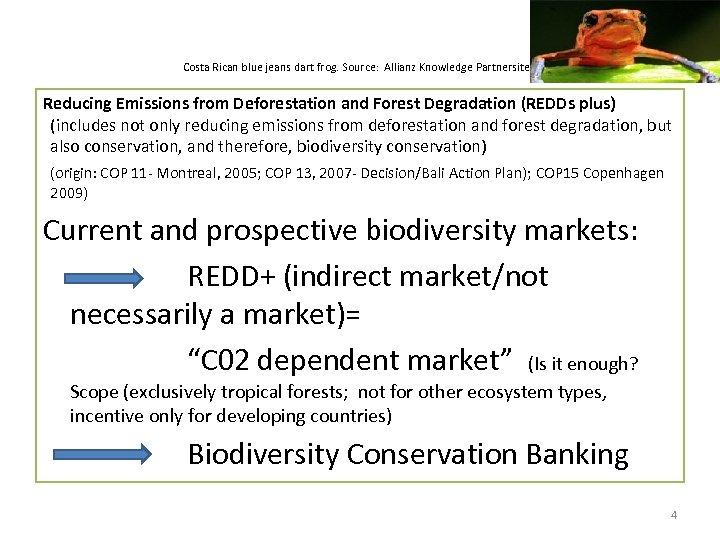
Costa Rican blue jeans dart frog. Source: Allianz Knowledge Partnersite Reducing Emissions from Deforestation and Forest Degradation (REDDs plus) (includes not only reducing emissions from deforestation and forest degradation, but also conservation, and therefore, biodiversity conservation) (origin: COP 11 - Montreal, 2005; COP 13, 2007 - Decision/Bali Action Plan); COP 15 Copenhagen 2009) Current and prospective biodiversity markets: REDD+ (indirect market/not necessarily a market)= “C 02 dependent market” (Is it enough? Scope (exclusively tropical forests; not for other ecosystem types, incentive only for developing countries) Biodiversity Conservation Banking 4
Questions - Biodiversity markets are intended to value biodiversity addressing aspects not covered by REDDs] - Beyond the international carbon market, what are the legal challenges to the implementation of non carbon dependent biodiversity markets (mostly those emerging from biodiversity banking) - Not intended to provide answers, but to identify questions and promote further analysis 5
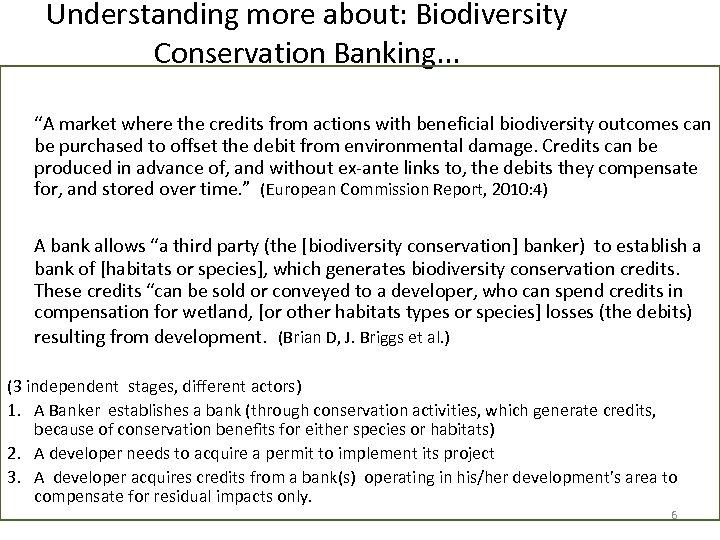
Understanding more about: Biodiversity Conservation Banking. . . “A market where the credits from actions with beneficial biodiversity outcomes can be purchased to offset the debit from environmental damage. Credits can be produced in advance of, and without ex-ante links to, the debits they compensate for, and stored over time. ” (European Commission Report, 2010: 4) A bank allows “a third party (the [biodiversity conservation] banker) to establish a bank of [habitats or species], which generates biodiversity conservation credits. These credits “can be sold or conveyed to a developer, who can spend credits in compensation for wetland, [or other habitats types or species] losses (the debits) resulting from development. (Brian D, J. Briggs et al. ) (3 independent stages, different actors) 1. A Banker establishes a bank (through conservation activities, which generate credits, because of conservation benefits for either species or habitats) 2. A developer needs to acquire a permit to implement its project 3. A developer acquires credits from a bank(s) operating in his/her development’s area to compensate for residual impacts only. 6
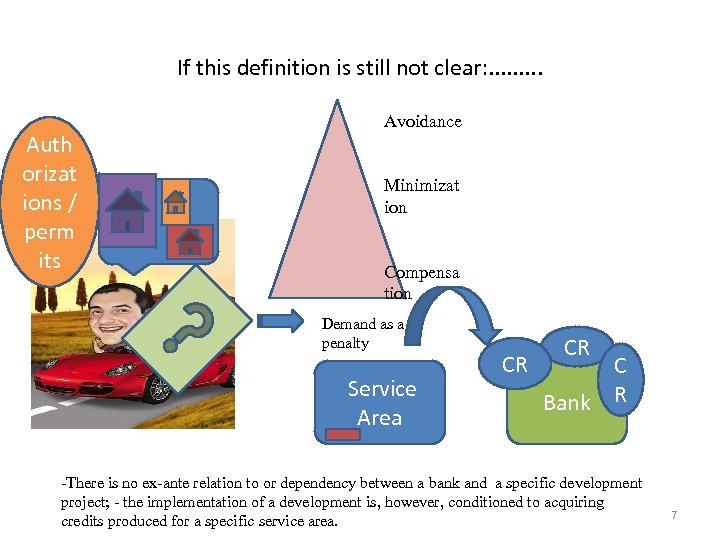
If this definition is still not clear: . . mi Auth orizat ions / perm IDe its Avoidance Minimizat ion Compensa tion Demand as a penalty Service Area CR CR C Bank R -There is no ex-ante relation to or dependency between a bank and a specific development project; - the implementation of a development is, however, conditioned to acquiring credits produced for a specific service area. 7
Who can create biodiversity markets? How to create these markets? --- Legal questions----8
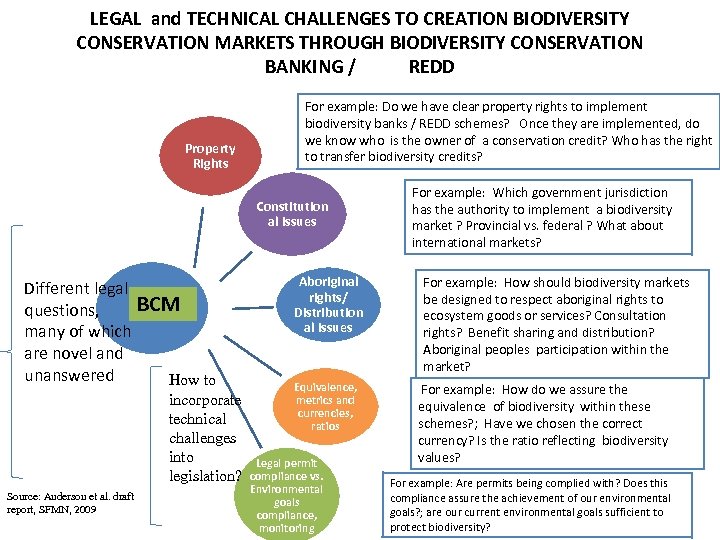
LEGAL and TECHNICAL CHALLENGES TO CREATION BIODIVERSITY CONSERVATION MARKETS THROUGH BIODIVERSITY CONSERVATION BANKING / REDD Property Rights For example: Do we have clear property rights to implement biodiversity banks / REDD schemes? Once they are implemented, do we know who is the owner of a conservation credit? Who has the right to transfer biodiversity credits? Constitution al Issues Different legal BCM questions, many of which are novel and unanswered How to incorporate technical challenges into legislation? Source: Anderson et al. draft report, SFMN, 2009 Aboriginal rights/ Distribution al issues Equivalence, metrics and currencies, ratios Legal permit compliance vs. Environmental goals compliance, monitoring For example: Which government jurisdiction has the authority to implement a biodiversity market ? Provincial vs. federal ? What about international markets? For example: How should biodiversity markets be designed to respect aboriginal rights to ecosystem goods or services? Consultation rights? Benefit sharing and distribution? Aboriginal peoples participation within the market? For example: How do we assure the equivalence of biodiversity within these schemes? ; Have we chosen the correct currency? Is the ratio reflecting biodiversity values? For example: Are permits being complied with? Does this compliance assure the achievement of our environmental goals? ; are our current environmental goals sufficient to 9 protect biodiversity?
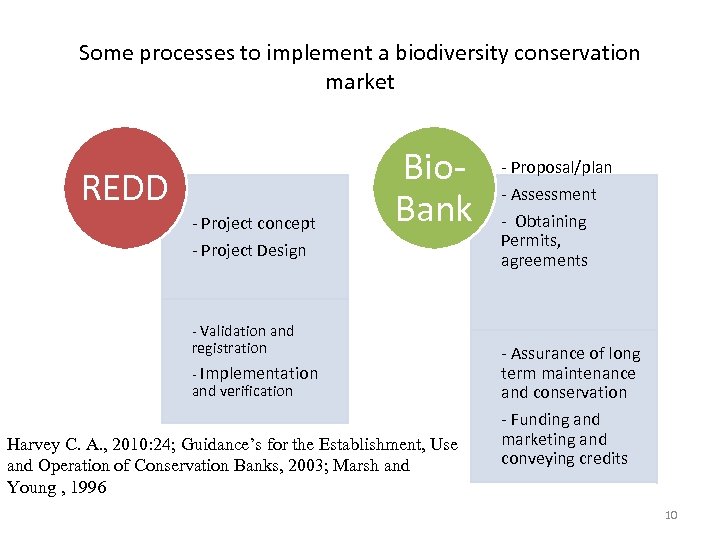
Some processes to implement a biodiversity conservation market REDD - Project concept - Project Design Bio. Bank - Validation and registration - Implementation and verification Harvey C. A. , 2010: 24; Guidance’s for the Establishment, Use and Operation of Conservation Banks, 2003; Marsh and Young , 1996 - Proposal/plan - Assessment - Obtaining Permits, agreements - Assurance of long term maintenance and conservation - Funding and marketing and conveying credits 10
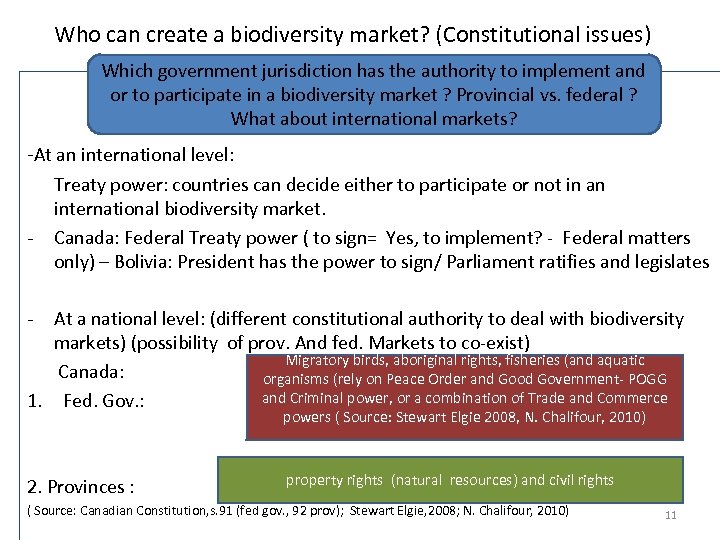
Who can create a biodiversity market? (Constitutional issues) Which government jurisdiction has the authority to implement and or to participate in a biodiversity market ? Provincial vs. federal ? What about international markets? -At an international level: - Treaty power: countries can decide either to participate or not in an international biodiversity market. Canada: Federal Treaty power ( to sign= Yes, to implement? - Federal matters only) – Bolivia: President has the power to sign/ Parliament ratifies and legislates - At a national level: (different constitutional authority to deal with biodiversity markets) (possibility of prov. And fed. Markets to co-exist) Migratory birds, aboriginal rights, fisheries (and aquatic Canada: organisms (rely on Peace Order and Good Government- POGG and Criminal power, or a combination of Trade and Commerce 1. Fed. Gov. : powers ( Source: Stewart Elgie 2008, N. Chalifour, 2010) 2. Provinces : property rights (natural resources) and civil rights ( Source: Canadian Constitution, s. 91 (fed gov. , 92 prov); Stewart Elgie, 2008; N. Chalifour, 2010) 11
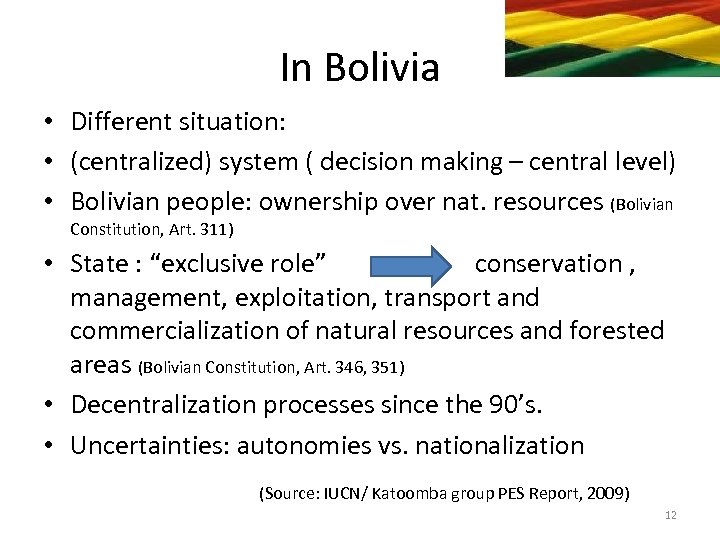
In Bolivia • Different situation: • (centralized) system ( decision making – central level) • Bolivian people: ownership over nat. resources (Bolivian Constitution, Art. 311) • State : “exclusive role” conservation , management, exploitation, transport and commercialization of natural resources and forested areas (Bolivian Constitution, Art. 346, 351) • Decentralization processes since the 90’s. • Uncertainties: autonomies vs. nationalization (Source: IUCN/ Katoomba group PES Report, 2009) 12
i) Proposing a biodiversity market…. Proposal or plan. 1. Identification of location and size Important to reducing any potential threat of fragmentation and address other threats (non-native species invasion , natural regimes disturbance) - Mostly implemented on private lands, but also on public lands property rights issues, Constitutional issues, aboriginal rights, Equivalence, monitoring and compliance Questions: e. g. Do we have clear property rights to implement biodiversity banks / REDD schemes? Once they are implemented, do we know who is the owner of a conservation credit? Who has the right to transfer biodiversity credits? 13
Issues relating to property rights While clearly defined rights to the ecosystem goods and services = KEY aspect for market creation (Pearse, 1988: 308; Kennett, 2005 -2006; Malavasi and Kellenberg, 2002). -In a perfect scenario: complete and clear property rights (exclusivity, inheritability, transferability, and enforcement measures). However, it is not always the case. More problematic for REDD schemes , because of the property rights situation in developing countries. Questi ons • - Challenges if ownerships or rights are not clearly specified • important role of legislation
Who owns ecosystem services? : Do we need legislation to identify owners? Approximately 93% of forests within Canada are publicly owned, with 77 % owned by the provinces and territories and 16% by the federal government (Source: Natural Resources Canada, 2009) Theoretical analysis and legal incorporation for carbon (property right attached to land; or separate interest? ) -In Canada: only Alberta has begun to clarify ownership rights forest carbon (carbon sink right). • Missing points in the REDD discussion: - Biodiversity, which is not expressly considered within those rights. - Other questions: who owns REDD co-benefits? Are these rights subject to property? Are they subject to transfer, independently from carbon rights ? Natural Resources Canada
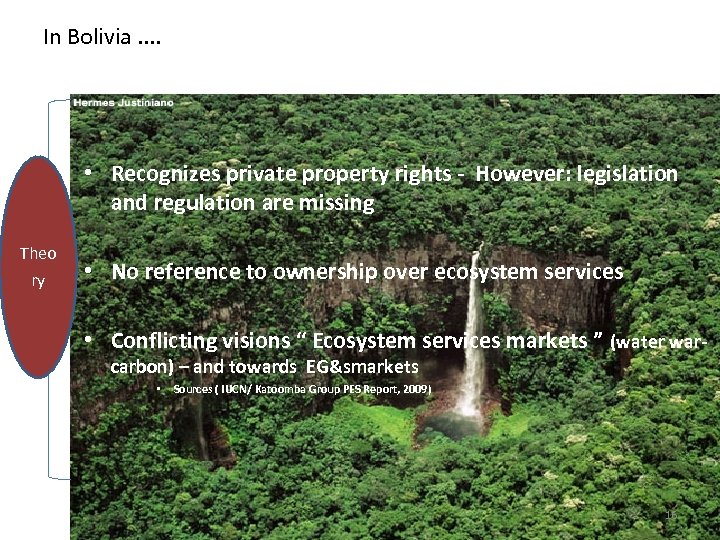
• Sources (Pictures) Los Tiempos. com, and Hermes Justiniano In Bolivia. . • National State has the “initial” ownership of natural • Recognizes private property rights - However: legislation and regulation are missing Theo ry • No reference to ownership over ecosystem services • Conflicting visions “ Ecosystem services markets ” (water warcarbon) – and towards EG&smarkets • Sources ( IUCN/ Katoomba Group PES Report, 2009) 16
In practice…. In Bolivia Unclear property rights and land tenure context – property rights titles and registry are an exception – Failure of Saneamiento (prop. Right regularization process– ( obj: 107 million hectares within 10 (1996 -2006 – only 18 million to 2006) ( Source: Pacheco, 2006) - 37 millon in 2010, El Dia) - Despite this situation, some PES initiatives were successfully implemented (Los Negros, La Aguada, Mairana, etc. ) (UICN/ Katoomba Group PES Report, 2009) Potential solutions: (more flexible approach ) i) expanding the possibilities of rights required to participate in the implementation of PES ( people with full ownership over the land, but also of other use rights holders); ii) establishing registries to clarify existing property rights over forests (to record the creation, transfer and restrictions of property rights); and iii) accepting alternative ways to establish property rights (Source: IUCN/ Katoomba Group PES Report, 2009) - Is it a good sign for biod. Markets in - Developing countries? 17
i ii) Assessment of a proposal • Overlapping land use – natural recourses rights – conflicts of interests (different actors- same land: e. g. Mining, fishing, rural activities, forestry, etc. = land disturbance and negative environmental consequences) • In Bolivia: conflicting policies (e. g. agriculture vs. conservation : misconceptions of socio-economic function of the land – leading to deforestation) • Aboriginal rights – participation • Distributional issues – 18
Aboriginal Peoples’ Rights To biodiversity markets In Canada : Federal Gov. - Constitution, – to protect “aboriginal and treaty rights of the aboriginal peoples of Canada. ” Nationally: Internationally: • Ownership Rights: reserve lands and ab original title Aboriginal use or harvest rights The Duty to Consult and Accommodate Benefit Sharing right Aboriginal peoples - not owners of reserve lands. They can have recognized aboriginal title. A tool to participate in biodiversity markets? (i) old treaties (limited rights and land allocations) (ii) modern treaties- land claim agreements (more extensive land allocations and rights over natural resources) - However, property rights over natural resources and participation in biodiversity markets is still unclear (Little red River Cree in Alberta – carbon market in Alberta – to sell sequestered carbon from crown lands) (Source: Krcmar, E. , and van Kooten G. C. , 2005) – Unclear property rights over carbon. • In Bolivia, indigenous peoples are getting more recognition. There is, however, no current official position regarding their participation in REDDs or other PES schemes ( Source: CIDOP, PES Congress, LP- Bolivia 2009).
iii) Permits, agreements. . . Co ntractual issues Who has the authority to enter into a contract? – (constitutional powers and legislation) Major question: How to include technical aspects: baselines, ratios, etc. into agreements in such a way that they reflect the heterogeneous character of biodiversity? 20
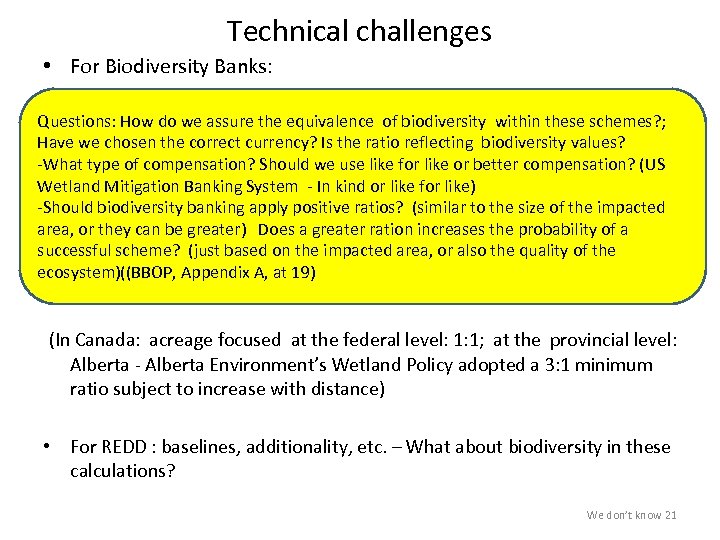
Technical challenges • For Biodiversity Banks: Questions: How do we assure the equivalence of biodiversity within these schemes? ; Have we chosen the correct currency? Is the ratio reflecting biodiversity values? -What type of compensation? Should we use like for like or better compensation? (US Wetland Mitigation Banking System - In kind or like for like) -Should biodiversity banking apply positive ratios? (similar to the size of the impacted area, or they can be greater) Does a greater ration increases the probability of a successful scheme? (just based on the impacted area, or also the quality of the ecosystem)((BBOP, Appendix A, at 19) (In Canada: acreage focused at the federal level: 1: 1; at the provincial level: Alberta - Alberta Environment’s Wetland Policy adopted a 3: 1 minimum ratio subject to increase with distance) • For REDD : baselines, additionality, etc. – What about biodiversity in these calculations? We don’t know 21
iv) Long term maintenance, conservation and Compliance A bank owner has responsibilities to assure compliance with mitigation requirements, and achievement of environmental goals. Questions: Are permits being complied with? Does this compliance assure the achievement of our environmental goals? ; are our current environmental goals sufficient to protect biodiversity? 22
Long term maintenance, conservation and Compliance In Canada : Little experience in Canada - At the federal level: Fisheries program, but effectiveness was not achieved (success from an acreage point of view, but not since an environmental goals compliance : no net loss, or net gain) - Almost 63% not compliance with environmental goal (no net loss). (Quingley, J. T. and Harper, 2006: 351 (b)) 23
- Studies showed: limited compliance/ Lack or limited compliance is not the only driver for not achieving environmental goals (Quingley, J. T. and Harper D. J. , 2002), 2006) - But MORE is not always BETTER: failure: focusing on acreage and not on functions replacement/ compliance success does not necessarily ensure ecological success, which also depends on other factors such well designed ratios, capable to replicate ecosystem functions reflecting the impacts occurring at the impacted area (Quingley, J. T. and Harper D. J. ) 24
v) Credits and Transfer of rights Who is entitled to transfer or sell the credit? – It needs to be clearly defined by legislation / Constitutional powers - How to quantify the credits? - How to include technical aspects into legislation? - How to standardize technical aspects to make them applicable to biodiversity markets, considering the heterogeneous character of biodiversity? 25
Conclusions - Despite some national and sub-national examples, biodiversity markets are still in their infancy - PES, Biodiversity conservation banks and REDDs – just examples of creating either direct or indirect biodiversity markets which might complement each other- to achieve biodiversity conservation. - Biodiversity Banks can be used as an incentive to promote planning and biodiversity conservation in developed countries such as Canada – complementing the indirect job done by REDD in tropical forests. - Some attempts: low success level of existing programs. Different legal challenges and more technical challenges which need to be addressed - Still more questions than answers/ But there is hope that biodiversity will be valued by users. 26
• Despite all the technical and legal challenges to their implementation and operation, biodiversity markets have a possibility to succeed. The extent of this success will depend, however, on our capability to i) understand in a better way the heterogeneous character of biodiversity, and ii) to incorporate technical aspects within our legislation, in such a way that they reflect biodiversity values and processes in an accurate way. 27
THANK YOU!!! Source: Nationalgeographic. co m 28
Acknowledgements IUCN Academy of Environmental Law Faculty of Law – University of Ottawa Faculty of Graduate and Postdoctoral Studies (FGPS)- University of Ottawa 29
Скачать презентацию Biodiversity markets in the climate change era Legal
103822133be1949cda9a2497dfadbd90.ppt