 Скачать презентацию Biochemistry of Blood František Duška Overview
[Медкниги]blood_fd.ppt
- Количество слайдов: 26



Biochemistry of Blood František Duška
Overview • Blood as an important diagnostic material • Transport of blood gases • Metabolism of RBC • Iron metabolism • Haematopoesis from the biochemical point of view • Anemias
Blood is… • …easily available material useful for a huge of various assays and measurements • . . . plazma and cells.
Gas transport • Oxygen is a major e- acceptor – indispensable for ATP production. • CO 2 (and water as well) is a major byproduct of energy metabolism • Gas transport is continuous interchange of CO 2 and O 2 between lungs and tissues.
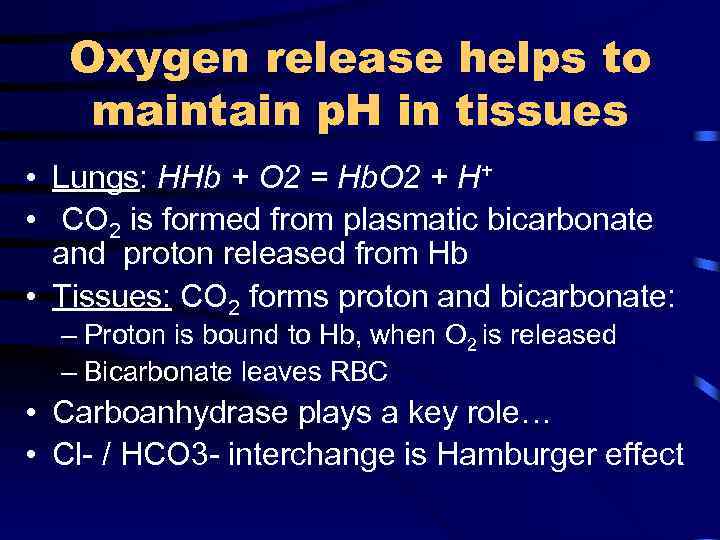
Oxygen release helps to maintain p. H in tissues • Lungs: HHb + O 2 = Hb. O 2 + H+ • CO 2 is formed from plasmatic bicarbonate and proton released from Hb • Tissues: CO 2 forms proton and bicarbonate: – Proton is bound to Hb, when O 2 is released – Bicarbonate leaves RBC • Carboanhydrase plays a key role… • Cl- / HCO 3 - interchange is Hamburger effect
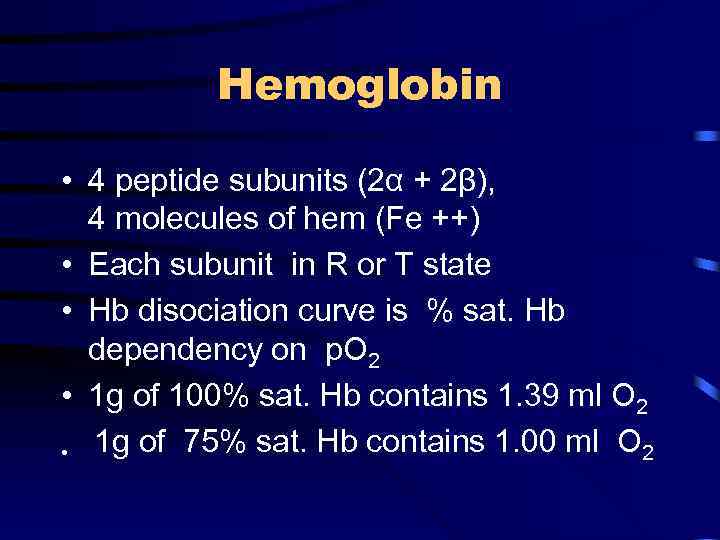
Hemoglobin • 4 peptide subunits (2α + 2β), 4 molecules of hem (Fe ++) • Each subunit in R or T state • Hb disociation curve is % sat. Hb dependency on p. O 2 • 1 g of 100% sat. Hb contains 1. 39 ml O 2 • 1 g of 75% sat. Hb contains 1. 00 ml O 2
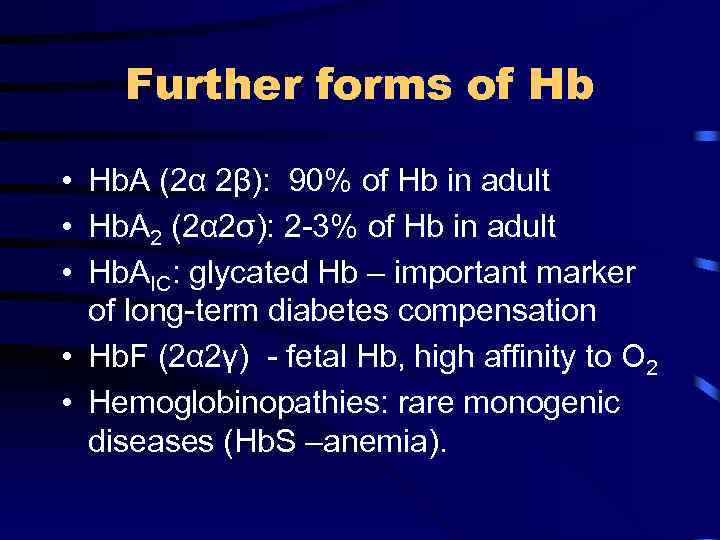
Further forms of Hb • Hb. A (2α 2β): 90% of Hb in adult • Hb. A 2 (2α 2σ): 2 -3% of Hb in adult • Hb. AIC: glycated Hb – important marker of long-term diabetes compensation • Hb. F (2α 2γ) - fetal Hb, high affinity to O 2 • Hemoglobinopathies: rare monogenic diseases (Hb. S –anemia).
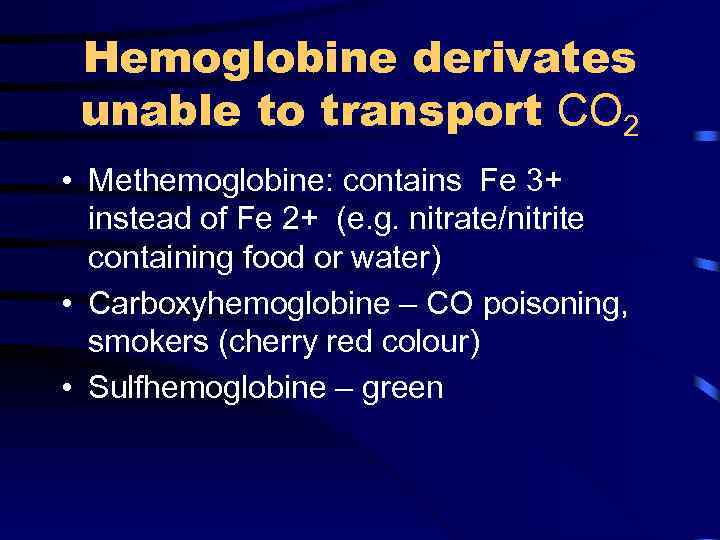
Hemoglobine derivates unable to transport CO 2 • Methemoglobine: contains Fe 3+ instead of Fe 2+ (e. g. nitrate/nitrite containing food or water) • Carboxyhemoglobine – CO poisoning, smokers (cherry red colour) • Sulfhemoglobine – green
Factors with influence on Hb affinity to O 2 • Right shift means higher ability of Hb to release O 2 , but lower ability to bind it. • Is useful in tissues (site of O 2 release): higher temperature – lower p. H (Bohr effect) – higher 2, 3 BPG level –
2, 3 -Bisphoglycerate • Is very important for long-term regulation of Hb affinity to O 2 • 2, 3 BPG shunt is a pathway derived from glycolysis. • Competition with oxygen for binding site on ß-subunits • Hypoxy stimulates 2, 3 BPG synthesis, i. e. improve O 2 release.
There are 3 ways of CO 2 transport… • • • Bicarbonate formation within RBC (carboanhydrase) and Cl interchange… CO 2 dissolved in blood plasma Carbaminohemoglobine formation (reaction with amino groups of globine)
Clinical interpretation of Astrup assay • Arterial (or capillary) blood sample • Measurements of p. H (7. 35 – 7. 45), p. O 2 = 9. 9 – 13. 6 k. Pa , p. CO 2 = 4. 5 – 6. 0 k. Pa and calculation of further ABB parameters… • Pulse oxymetry is noninvasive monitoring of Hb saturation.
Metabolic specialities of red blood cell • No organellae – no mitochondria • Anaerobic glycolysis (lactate formation) is the only one source of ATP! • 2, 3 BPG shunt is unique for RBC • 20% of glucose is metabolised via pentosa phosphate pathway
Defense against oxygen radicals • High tension of oxygen… • GSH as a defense against harmful oxygen radicals • Inactivation of O • is coupled with GSH oxidation, back reduction need NADPH + GSSG = NADP + GSH • Pentose phosphate pathway is a source of NADPH • Glc-6 -P deficiency – haemolytic anemia

Coffee break
Iron metabolism • Iron is indipensable for life (either in heme or non-heme form essential for oxygen transport, electron transfer, DNA synthesis, etc. ) • Iron is insoluble ([Fe] cannot exceed 10 -17) • Iron is potentially toxic (unless appropriately chelated, Fe plays a key role in the formation of oxygen radicals)
Iron storage - ferritin • Protein, 24 subunits, up to 4 500 Fe atoms per ferritin molecule • Ferritin is important for intracellular iron storage • Ferritin synthesis is stimulated by higher iron stores…
Transferrin (Tf) transports Fe in plasma • Glycoprotein with 2 high affinity binding sites for Fe 3+ • Tf transports Fe between sites of absorption, storage and utilization • Cells (esp. Erythroid precursors) strip Fe from Tf by expressing Tf-R • Tf synthesis is stimulated by lack of Fe in the body.
When iron stores are sufficient… • Ferritin expression in the enterocyte is stimulated. More Fe is then waist with stool. • Transferrin synthesis is supressed, plasmatic Tf level is low, Tf is highly saturated… • Only a small part of ingested iron is absorbed.
When iron is needed… • Ferritin expression in the enterocyte is supressed, only a small part of ingested iron is lost with stool. • Transferrin synthesis is accelerated, plasmatic Tf level is high and Tf is unsaturated… • However, iron is absorbed with high efficacy.
It is interesting, that… • …iron regulates ferritin and Tf –R synthesis at the level of translation (and not transcription) • IRE of m. RNA binds IRP in the presence of Fe and: • Activates ferritin translation • Block Tf-R translation
Heme synhesis • 80% of body Fe is used for heme synthesis in developing erythroid cells • The 1. step is ALA formation from Gly + suc. Co. A (ALA-S 1 –regulatory in liver) • The 8. step is heme synthesis from proto-IX, (ferrochelatase – regulatory in erythroid cells in the presence of ALA-S 2) • ALA-S 2 m. RNA contains IRE
Iron overload • There is no physiological mechanism for the excretion of excess iron! • Causes: – Hemochromatosis: congenital enhancement of iron absorbtion – Hemosiderosis: acquired, e. g. regular blood transfusion (aplastic anemias) • Symptoms (over 28 g Fe): diabetes, cirrhosis, hypoadrenalism, slow growth in childhood
Lack of iron causes anemia and microcytosis • Causes: chronic bleeding (GIT, menstr. ), malignancy, extreme diet • Symptomatology : – low hemoglobine level – red blood cell count normal or high – RBC are small (vol. < 80 fl)
„WHY OUR BLOOD IS RED…“ • Iron stores in the body are regulated only at the level of iron absorbtion… • Transferrin and ferritin play a key role in iron intake and delivery for tissues… • Iron overload cause hemosiderosis, lack of iron is the main cause of microcytic anaemia.

Questions…?
Скачать презентацию Biochemistry of Blood František Duška Overview
[Медкниги]blood_fd.ppt