 Скачать презентацию Bio Carbon Fund Status Bio CF Workshop World
be63b2a18822c9b01c8bba9ab3193e3a.ppt
- Количество слайдов: 17



Bio. Carbon Fund Status Bio. CF Workshop, World Bank February 5 -8, 2008 Harnessing the carbon market to sustain ecosystems and alleviate poverty
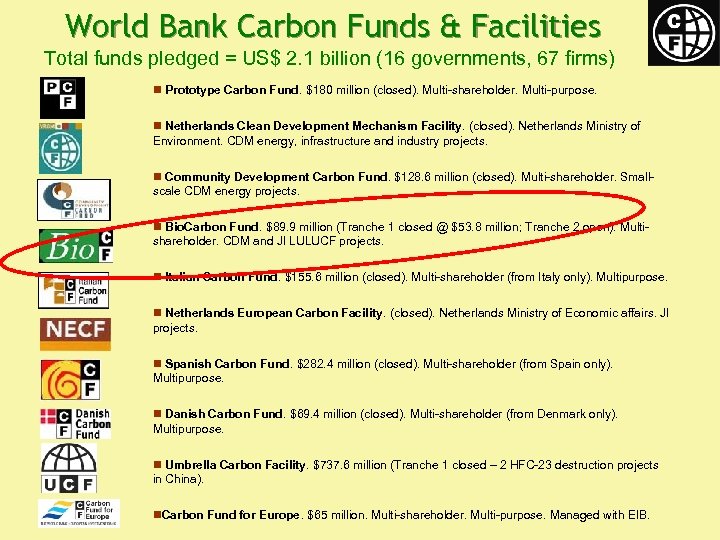
World Bank Carbon Funds & Facilities Total funds pledged = US$ 2. 1 billion (16 governments, 67 firms) n Prototype Carbon Fund. $180 million (closed). Multi-shareholder. Multi-purpose. n Netherlands Clean Development Mechanism Facility. (closed). Netherlands Ministry of Environment. CDM energy, infrastructure and industry projects. n Community Development Carbon Fund. $128. 6 million (closed). Multi-shareholder. Smallscale CDM energy projects. n Bio. Carbon Fund. $89. 9 million (Tranche 1 closed @ $53. 8 million; Tranche 2 open). Multishareholder. CDM and JI LULUCF projects. n Italian Carbon Fund. $155. 6 million (closed). Multi-shareholder (from Italy only). Multipurpose. n Netherlands European Carbon Facility. (closed). Netherlands Ministry of Economic affairs. JI projects. n Spanish Carbon Fund. $282. 4 million (closed). Multi-shareholder (from Spain only). Multipurpose. n Danish Carbon Fund. $69. 4 million (closed). Multi-shareholder (from Denmark only). Multipurpose. n Umbrella Carbon Facility. $737. 6 million (Tranche 1 closed – 2 HFC-23 destruction projects in China). n. Carbon Fund for Europe. $65 million. Multi-shareholder. Multi-purpose. Managed with EIB.
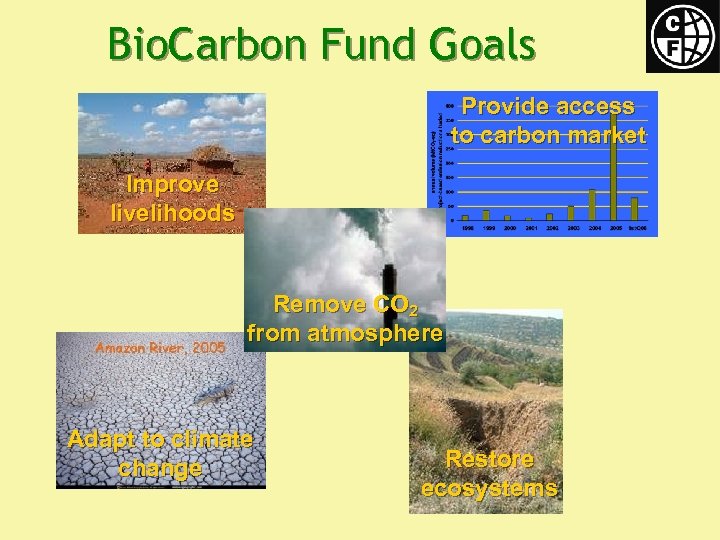
Bio. Carbon Fund Goals Provide access to carbon market Improve livelihoods Remove CO 2 from atmosphere Adapt to climate change Restore ecosystems
Co-benefits n n Bio. CF wants to buy “green carbon with human face” Social: Improve livelihoods People receive carbon payments n New job creation n Additional income from alternative activities n Know-how n n Environmental n n n n Conserve biodiversity Expand natural habitat Reconnect forest fragments Protect soil against erosion Protect savannah against fires Fight against desertification Moisture retention Stabilize radionuclides in biomass
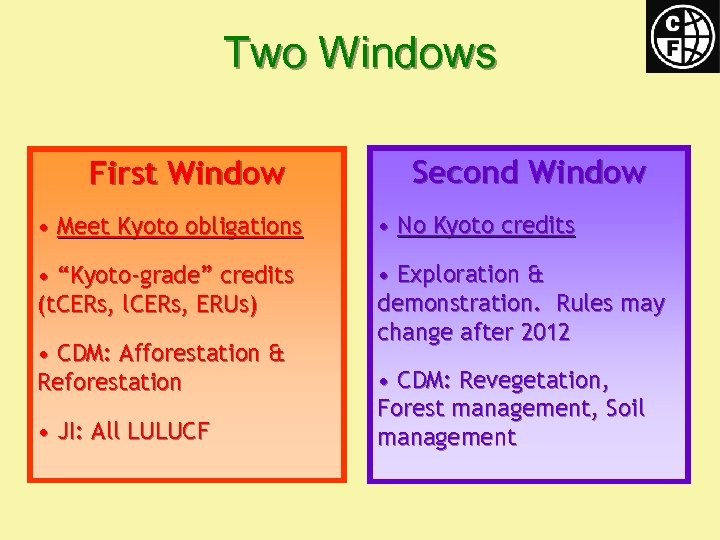
Two Windows First Window Second Window • Meet Kyoto obligations • No Kyoto credits • “Kyoto-grade” credits (t. CERs, l. CERs, ERUs) • Exploration & demonstration. Rules may change after 2012 • CDM: Afforestation & Reforestation • JI: All LULUCF • CDM: Revegetation, Forest management, Soil management
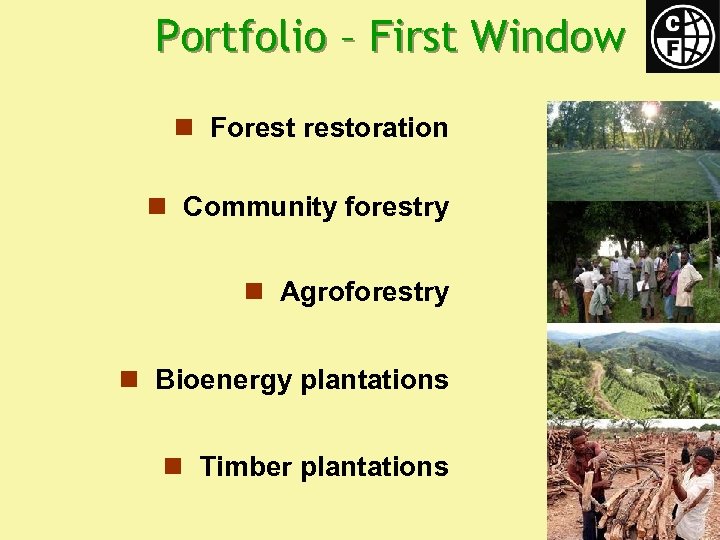
Portfolio – First Window n Forestoration n Community forestry n Agroforestry n Bioenergy plantations n Timber plantations
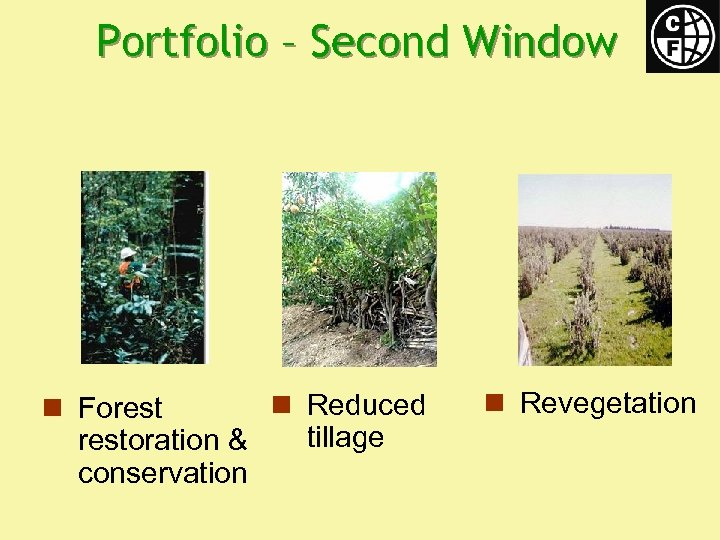
Portfolio – Second Window n Reduced n Forest tillage restoration & conservation n Revegetation
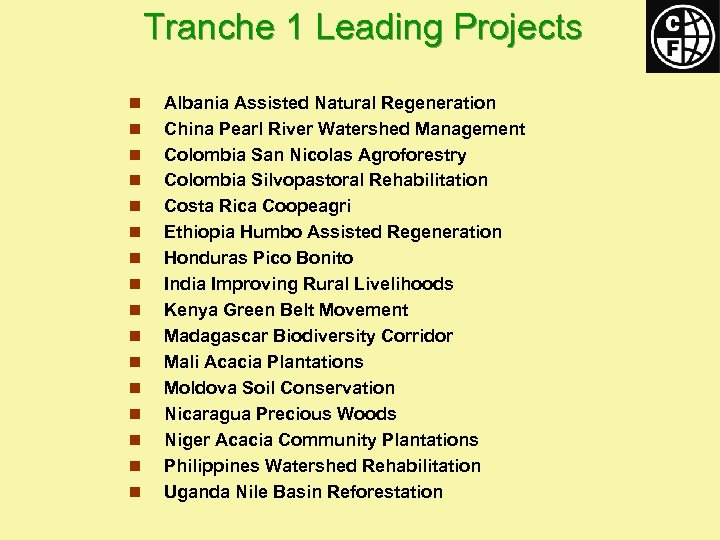
Tranche 1 Leading Projects n n n n Albania Assisted Natural Regeneration China Pearl River Watershed Management Colombia San Nicolas Agroforestry Colombia Silvopastoral Rehabilitation Costa Rica Coopeagri Ethiopia Humbo Assisted Regeneration Honduras Pico Bonito India Improving Rural Livelihoods Kenya Green Belt Movement Madagascar Biodiversity Corridor Mali Acacia Plantations Moldova Soil Conservation Nicaragua Precious Woods Niger Acacia Community Plantations Philippines Watershed Rehabilitation Uganda Nile Basin Reforestation
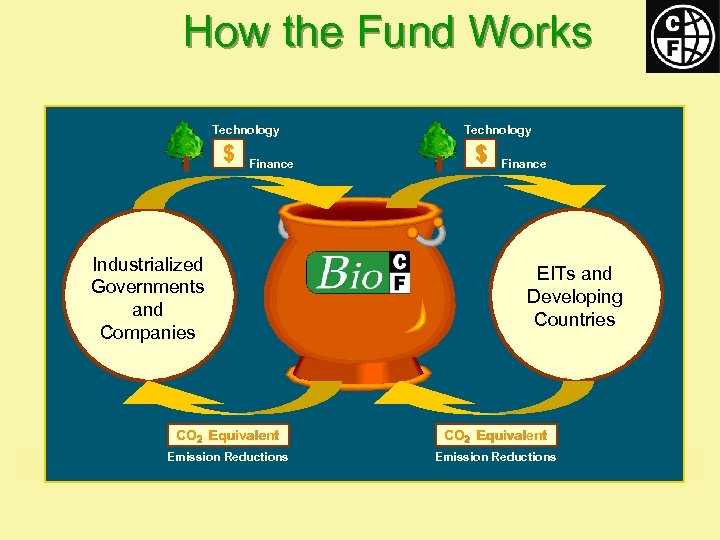
How the Fund Works Technology $ Finance Industrialized Governments and Companies Technology $ Finance EITs and Developing Countries CO 2 Equivalent Emission Reductions
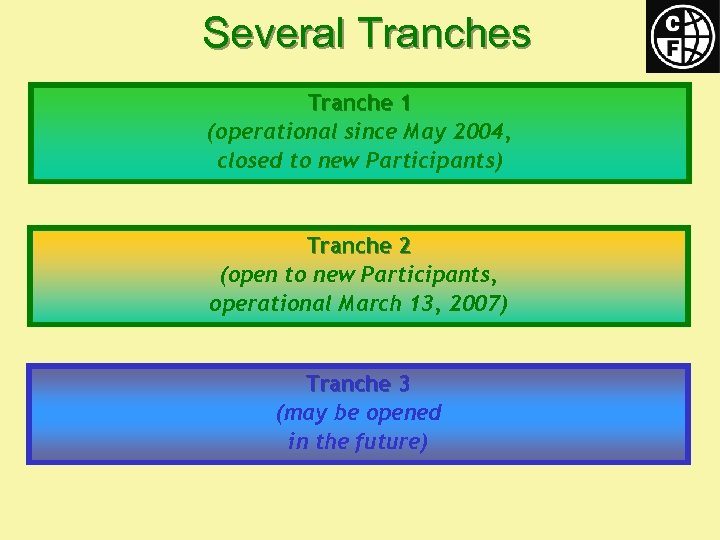
Several Tranches Tranche 1 (operational since May 2004, closed to new Participants) Tranche 2 (open to new Participants, operational March 13, 2007) Tranche 3 (may be opened in the future)
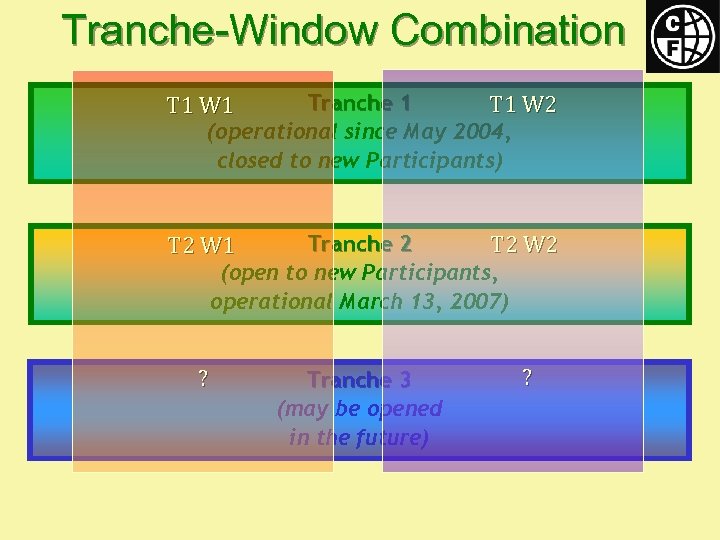
Tranche-Window Combination Tranche 1 T 1 W 2 (operational since May 2004, closed to new Participants) T 1 W 1 Tranche 2 T 2 W 2 (open to new Participants, operational March 13, 2007) T 2 W 1 ? Tranche 3 (may be opened in the future) ?
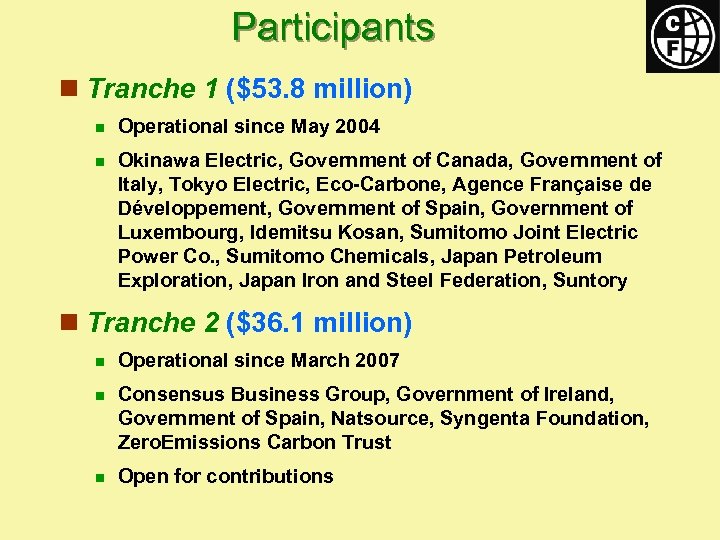
Participants n Tranche 1 ($53. 8 million) n Operational since May 2004 n Okinawa Electric, Government of Canada, Government of Italy, Tokyo Electric, Eco-Carbone, Agence Française de Développement, Government of Spain, Government of Luxembourg, Idemitsu Kosan, Sumitomo Joint Electric Power Co. , Sumitomo Chemicals, Japan Petroleum Exploration, Japan Iron and Steel Federation, Suntory n Tranche 2 ($36. 1 million) n Operational since March 2007 n Consensus Business Group, Government of Ireland, Government of Spain, Natsource, Syngenta Foundation, Zero. Emissions Carbon Trust n Open for contributions
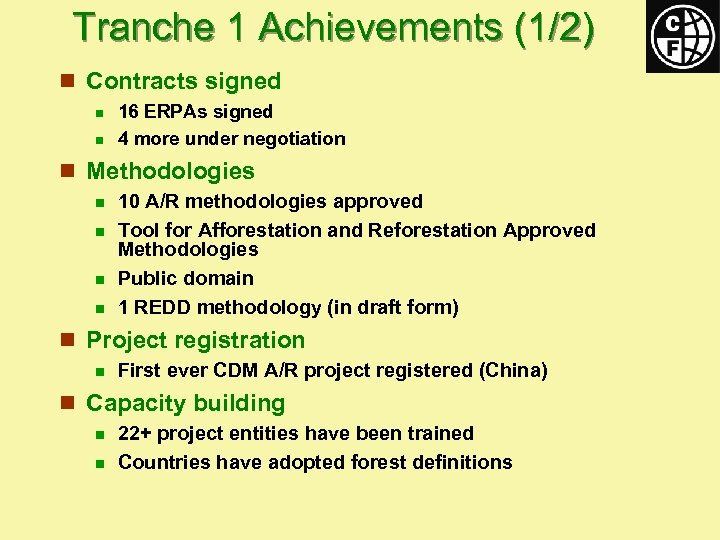
Tranche 1 Achievements (1/2) n Contracts signed n n 16 ERPAs signed 4 more under negotiation n Methodologies n n 10 A/R methodologies approved Tool for Afforestation and Reforestation Approved Methodologies Public domain 1 REDD methodology (in draft form) n Project registration n First ever CDM A/R project registered (China) n Capacity building n n 22+ project entities have been trained Countries have adopted forest definitions
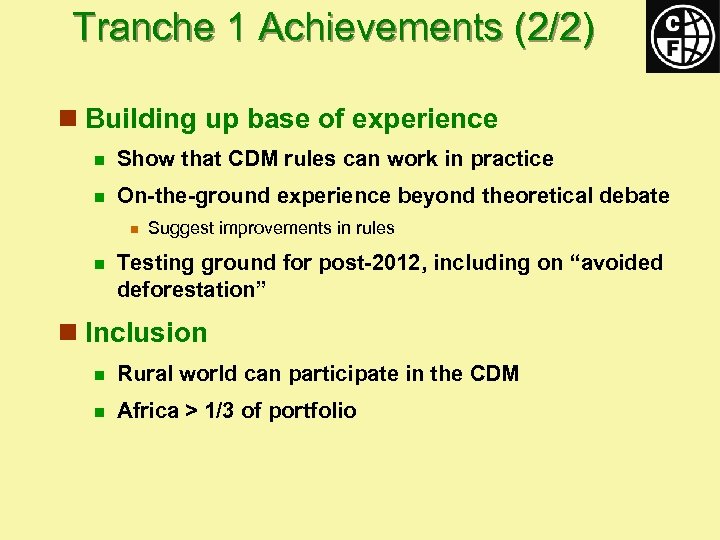
Tranche 1 Achievements (2/2) n Building up base of experience n Show that CDM rules can work in practice n On-the-ground experience beyond theoretical debate n n Suggest improvements in rules Testing ground for post-2012, including on “avoided deforestation” n Inclusion n Rural world can participate in the CDM n Africa > 1/3 of portfolio
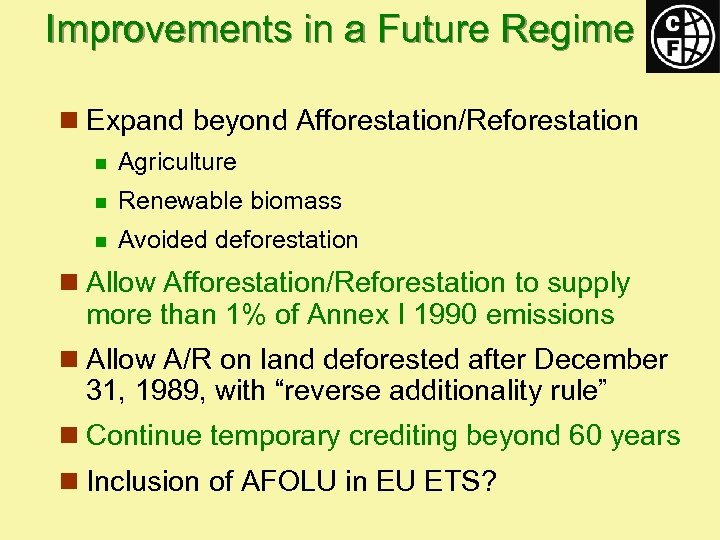
Improvements in a Future Regime n Expand beyond Afforestation/Reforestation n Agriculture n Renewable biomass n Avoided deforestation n Allow Afforestation/Reforestation to supply more than 1% of Annex I 1990 emissions n Allow A/R on land deforested after December 31, 1989, with “reverse additionality rule” n Continue temporary crediting beyond 60 years n Inclusion of AFOLU in EU ETS?
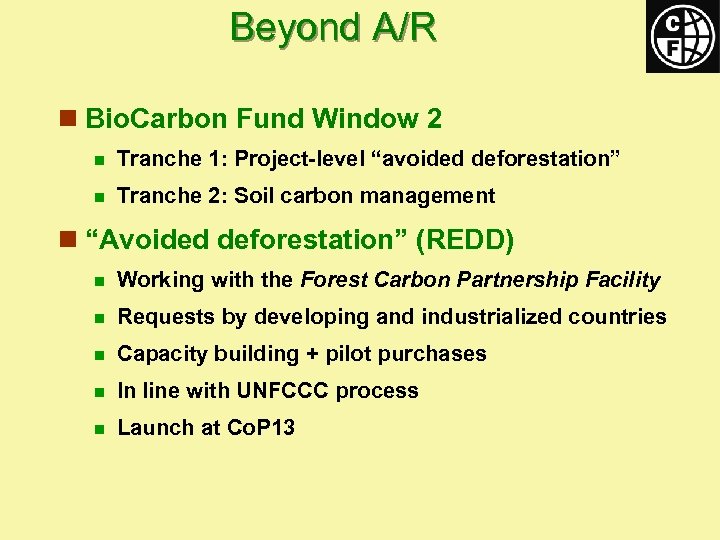
Beyond A/R n Bio. Carbon Fund Window 2 n Tranche 1: Project-level “avoided deforestation” n Tranche 2: Soil carbon management n “Avoided deforestation” (REDD) n Working with the Forest Carbon Partnership Facility n Requests by developing and industrialized countries n Capacity building + pilot purchases n In line with UNFCCC process n Launch at Co. P 13
www. carbonfinance. org www. biocarbonfund. org
Скачать презентацию Bio Carbon Fund Status Bio CF Workshop World
be63b2a18822c9b01c8bba9ab3193e3a.ppt