 Скачать презентацию Bio- and landscape diversity: Theme # 6 Theme
Biodiversity-6.ppt
- Количество слайдов: 11



Bio- and landscape diversity: Theme # 6 Theme 6: Community diversity • What is community diversity • Abundance • Species richness • How to measure community diversity
Bio- and landscape diversity: Theme # 6 What is community A biological community is an association or assemblage of populations of organisms whose composition, dynamics and other features are determined by the properties of the environment and by the relations of the organisms to each other. In simpler words, a community is an assemblage of populations living in a localized area or habitat. It is a group of interdependent organisms living and interacting with each other within the same habitat. The difference between population and community: a population is an assemblage of individuals all belonging to one species, while a community is an assemblage of few populations. Communities may be large or small, ranging from the microscopic to the level of biome and biosphere. The difference between ecosystem and community: a community consists of biological species only, it does not include the physical environment or the habitat of a particular group of organisms, while the ecosystem includes biological organisms and their environment. Biological population = assemblage of organisms of one species Biological community = assemblage of populations Ecosystem = biological community with its environment In ecology the term “community” refers to all the living components in an ecosystem which interact between themselves. For both practical and research reasons it is useful to define communities composed with populations similar in some respect (taxonomic, spatial, functional etc). Therefore one can study plant communities (composed of plant species); animal communities, microbial communities, avian (composed of bird species); soil microbial communities (composed of microbes species living in soil). The term “biological community” is often referred to an assemblage of all species within a particular habitat or type of habitat.
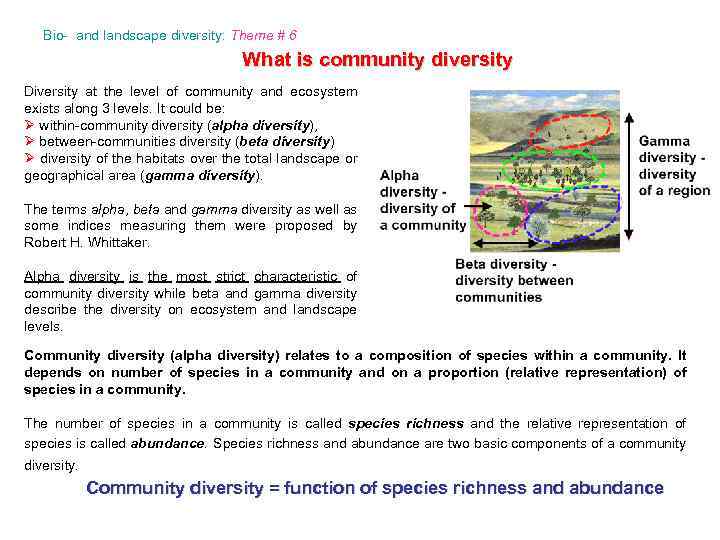
Bio- and landscape diversity: Theme # 6 What is community diversity Diversity at the level of community and ecosystem exists along 3 levels. It could be: Ø within-community diversity (alpha diversity), Ø between-communities diversity (beta diversity) Ø diversity of the habitats over the total landscape or geographical area (gamma diversity). The terms alpha, beta and gamma diversity as well as some indices measuring them were proposed by Robert H. Whittaker. Alpha diversity is the most strict characteristic of community diversity while beta and gamma diversity describe the diversity on ecosystem and landscape levels. Community diversity (alpha diversity) relates to a composition of species within a community. It depends on number of species in a community and on a proportion (relative representation) of species in a community. The number of species in a community is called species richness and the relative representation of species is called abundance. Species richness and abundance are two basic components of a community diversity. Community diversity = function of species richness and abundance
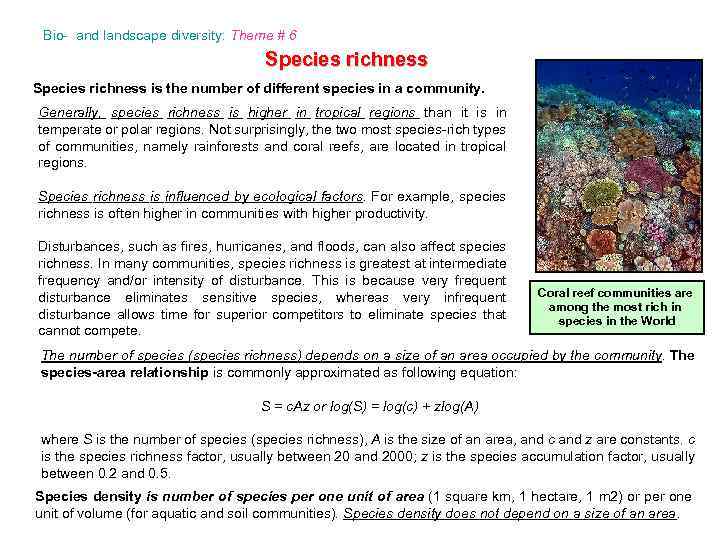
Bio- and landscape diversity: Theme # 6 Species richness is the number of different species in a community. Generally, species richness is higher in tropical regions than it is in temperate or polar regions. Not surprisingly, the two most species-rich types of communities, namely rainforests and coral reefs, are located in tropical regions. Species richness is influenced by ecological factors. For example, species richness is often higher in communities with higher productivity. Disturbances, such as fires, hurricanes, and floods, can also affect species richness. In many communities, species richness is greatest at intermediate frequency and/or intensity of disturbance. This is because very frequent disturbance eliminates sensitive species, whereas very infrequent disturbance allows time for superior competitors to eliminate species that cannot compete. Coral reef communities are among the most rich in species in the World The number of species (species richness) depends on a size of an area occupied by the community. The species-area relationship is commonly approximated as following equation: S = c. Az or log(S) = log(c) + zlog(A) where S is the number of species (species richness), A is the size of an area, and c and z are constants. c is the species richness factor, usually between 20 and 2000; z is the species accumulation factor, usually between 0. 2 and 0. 5. Species density is number of species per one unit of area (1 square km, 1 hectare, 1 m 2) or per one unit of volume (for aquatic and soil communities). Species density does not depend on a size of an area.
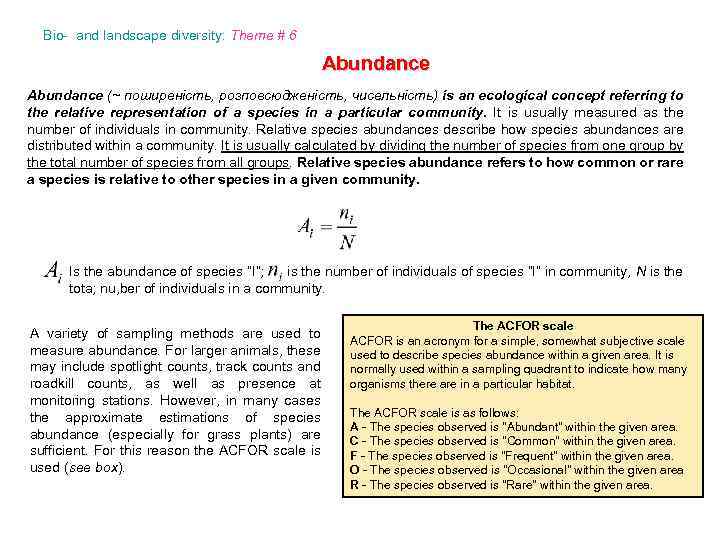
Bio- and landscape diversity: Theme # 6 Abundance (~ поширеність, розповсюдженість, чисельність) is an ecological concept referring to the relative representation of a species in a particular community. It is usually measured as the number of individuals in community. Relative species abundances describe how species abundances are distributed within a community. It is usually calculated by dividing the number of species from one group by the total number of species from all groups. Relative species abundance refers to how common or rare a species is relative to other species in a given community. Is the abundance of species “I”; is the number of individuals of species “I” in community, N is the tota; nu, ber of individuals in a community. A variety of sampling methods are used to measure abundance. For larger animals, these may include spotlight counts, track counts and roadkill counts, as well as presence at monitoring stations. However, in many cases the approximate estimations of species abundance (especially for grass plants) are sufficient. For this reason the ACFOR scale is used (see box). The ACFOR scale ACFOR is an acronym for a simple, somewhat subjective scale used to describe species abundance within a given area. It is normally used within a sampling quadrant to indicate how many organisms there are in a particular habitat. The ACFOR scale is as follows: A - The species observed is "Abundant" within the given area. C - The species observed is "Common" within the given area. F - The species observed is "Frequent" within the given area. O - The species observed is "Occasional" within the given area R - The species observed is "Rare" within the given area.
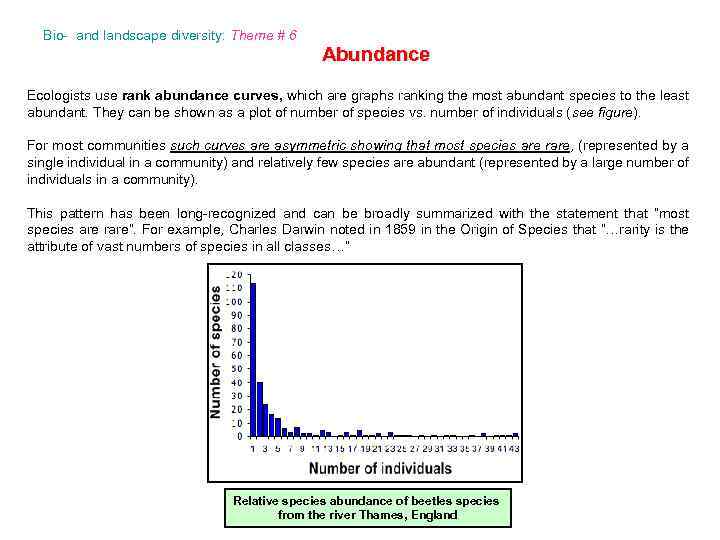
Bio- and landscape diversity: Theme # 6 Abundance Ecologists use rank abundance curves, which are graphs ranking the most abundant species to the least abundant. They can be shown as a plot of number of species vs. number of individuals (see figure). For most communities such curves are asymmetric showing that most species are rare, (represented by a single individual in a community) and relatively few species are abundant (represented by a large number of individuals in a community). This pattern has been long-recognized and can be broadly summarized with the statement that “most species are rare”. For example, Charles Darwin noted in 1859 in the Origin of Species that “…rarity is the attribute of vast numbers of species in all classes…” Relative species abundance of beetles species from the river Thames, England
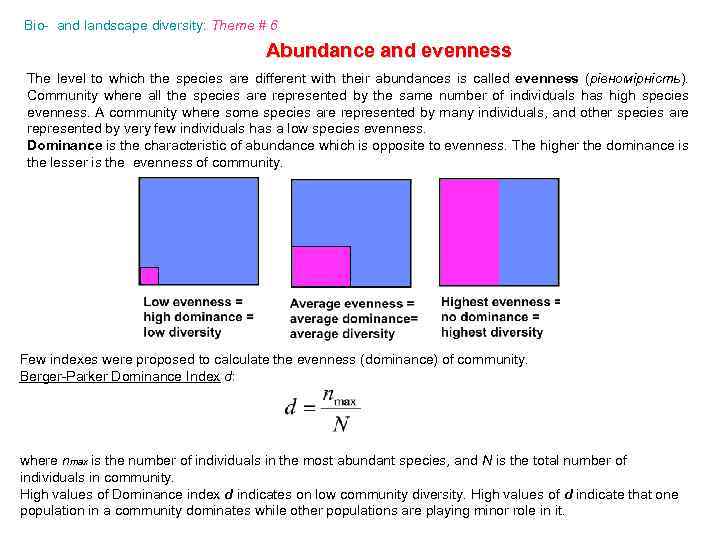
Bio- and landscape diversity: Theme # 6 Abundance and evenness The level to which the species are different with their abundances is called evenness (рівномірність). Community where all the species are represented by the same number of individuals has high species evenness. A community where some species are represented by many individuals, and other species are represented by very few individuals has a low species evenness. Dominance is the characteristic of abundance which is opposite to evenness. The higher the dominance is the lesser is the evenness of community. Few indexes were proposed to calculate the evenness (dominance) of community. Berger-Parker Dominance Index d: where nmax is the number of individuals in the most abundant species, and N is the total number of individuals in community. High values of Dominance index d indicates on low community diversity. High values of d indicate that one population in a community dominates while other populations are playing minor role in it.
Bio- and landscape diversity: Theme # 6 How to measure community diversity Community diversity is measured for three main reasons: 1 – to analyze the stability of communities and to determine if an environment is degrading, 2 – to compare two or more communities, regions or environments, 3 – to eliminate the need for extensive lists of species and their abundances. Diversity indices provide important information about the composition of a community. These indices not only measure species richness, but also take into account the relative abundance of species. When measuring species diversity, species richness and abundances are both considered. In addition, diversity indices provide important information about species rarity in a population. There are several approaches to measuring the diversity of biological communities. One way is to examine the energy flow through food webs that unite the species within the community; the extent of community diversity can be measured by the number of links in the food web. However, in practice, it can be very difficult to quantify the functional interactions between the species within a community. It is easier to measure the community diversity by counting the numbers of species present (species richness) and the population size of each species (abundance). There are many indices that can be used to calculate community diversity. Some of the most often used indices include the following: Simpson diversity index, Margalef index, Shannon index, Species Evenness Index.
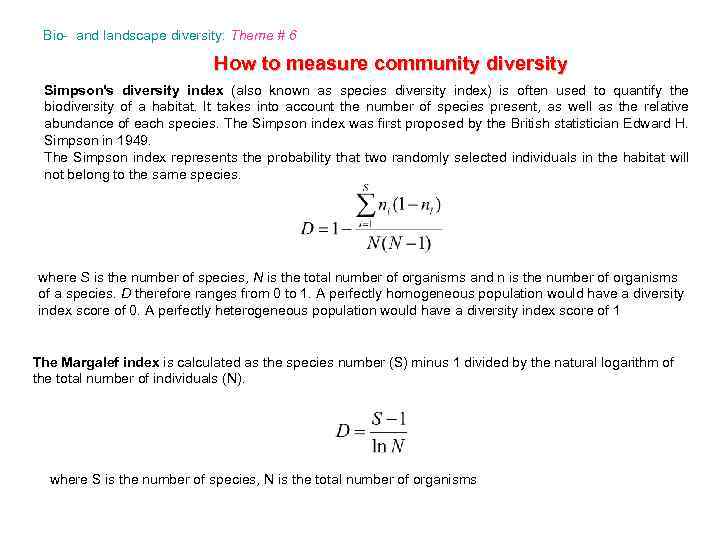
Bio- and landscape diversity: Theme # 6 How to measure community diversity Simpson's diversity index (also known as species diversity index) is often used to quantify the biodiversity of a habitat. It takes into account the number of species present, as well as the relative abundance of each species. The Simpson index was first proposed by the British statistician Edward H. Simpson in 1949. The Simpson index represents the probability that two randomly selected individuals in the habitat will not belong to the same species. where S is the number of species, N is the total number of organisms and n is the number of organisms of a species. D therefore ranges from 0 to 1. A perfectly homogeneous population would have a diversity index score of 0. A perfectly heterogeneous population would have a diversity index score of 1 The Margalef index is calculated as the species number (S) minus 1 divided by the natural logarithm of the total number of individuals (N). where S is the number of species, N is the total number of organisms
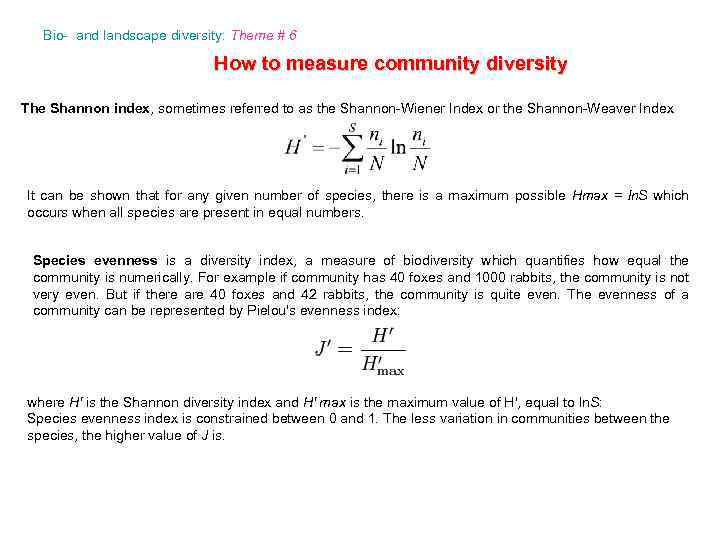
Bio- and landscape diversity: Theme # 6 How to measure community diversity The Shannon index, sometimes referred to as the Shannon-Wiener Index or the Shannon-Weaver Index It can be shown that for any given number of species, there is a maximum possible Hmax = ln. S which occurs when all species are present in equal numbers. Species evenness is a diversity index, a measure of biodiversity which quantifies how equal the community is numerically. For example if community has 40 foxes and 1000 rabbits, the community is not very even. But if there are 40 foxes and 42 rabbits, the community is quite even. The evenness of a community can be represented by Pielou's evenness index: where H' is the Shannon diversity index and H' max is the maximum value of H', equal to ln. S: Species evenness index is constrained between 0 and 1. The less variation in communities between the species, the higher value of J is.
Bio- and landscape diversity: Theme # 6 New theme: Ecosystem diversity • What is ecosystem diversity • Factors of ecosystem diversity • Stability and diversity • Fragile ecosystems • Ecotones
Скачать презентацию Bio- and landscape diversity: Theme # 6 Theme
Biodiversity-6.ppt