 Скачать презентацию Bio- and landscape diversity Theme 4 Theme
Biodiversity-2015-4.pptx
- Количество слайдов: 19



Bio- and landscape diversity: Theme # 4 Theme 4: Loss of biodiversity • Extinction • Threatened species • Geography of extinction • Threats to biodiversity • Biodiversity crises in the geological past
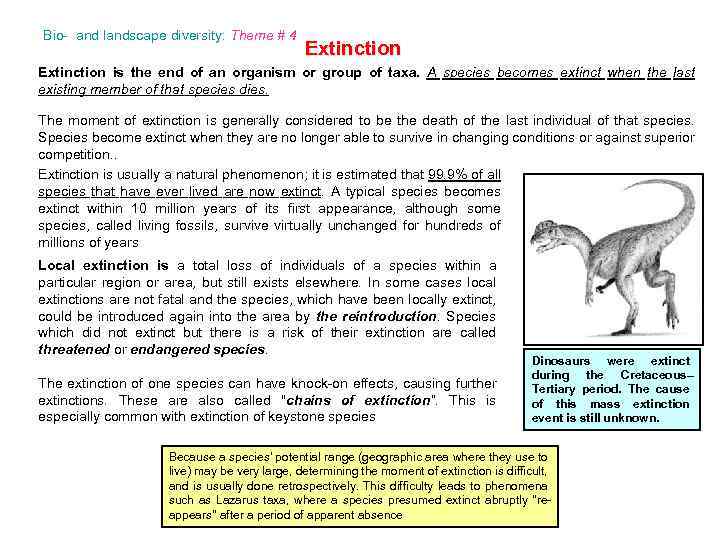
Bio- and landscape diversity: Theme # 4 Extinction is the end of an organism or group of taxa. A species becomes extinct when the last existing member of that species dies. The moment of extinction is generally considered to be the death of the last individual of that species. Species become extinct when they are no longer able to survive in changing conditions or against superior competition. . Extinction is usually a natural phenomenon; it is estimated that 99. 9% of all species that have ever lived are now extinct. A typical species becomes extinct within 10 million years of its first appearance, although some species, called living fossils, survive virtually unchanged for hundreds of millions of years Local extinction is a total loss of individuals of a species within a particular region or area, but still exists elsewhere. In some cases local extinctions are not fatal and the species, which have been locally extinct, could be introduced again into the area by the reintroduction. Species which did not extinct but there is a risk of their extinction are called threatened or endangered species. The extinction of one species can have knock-on effects, causing further extinctions. These are also called "chains of extinction“. This is especially common with extinction of keystone species Dinosaurs were extinct during the Cretaceous– Tertiary period. The cause of this mass extinction event is still unknown. Because a species' potential range (geographic area where they use to live) may be very large, determining the moment of extinction is difficult, and is usually done retrospectively. This difficulty leads to phenomena such as Lazarus taxa, where a species presumed extinct abruptly "reappears" after a period of apparent absence
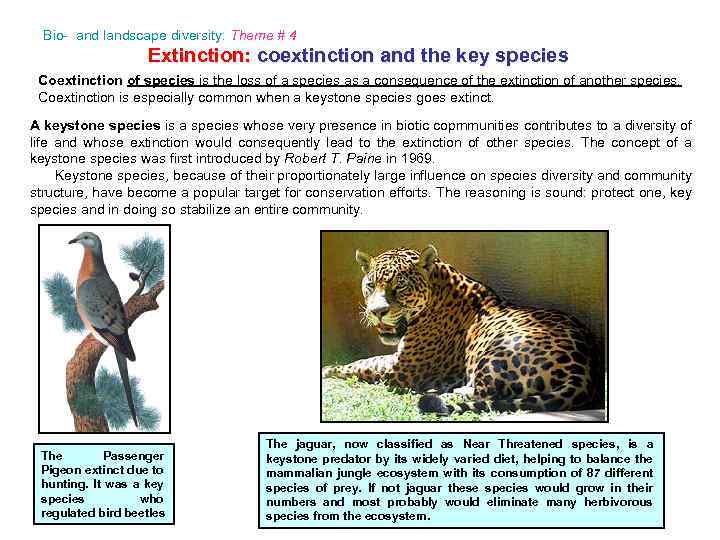
Bio- and landscape diversity: Theme # 4 Extinction: coextinction and the key species Coextinction of species is the loss of a species as a consequence of the extinction of another species. Coextinction is especially common when a keystone species goes extinct. A keystone species is a species whose very presence in biotic copmmunities contributes to a diversity of life and whose extinction would consequently lead to the extinction of other species. The concept of a keystone species was first introduced by Robert T. Paine in 1969. Keystone species, because of their proportionately large influence on species diversity and community structure, have become a popular target for conservation efforts. The reasoning is sound: protect one, key species and in doing so stabilize an entire community. The Passenger Pigeon extinct due to hunting. It was a key species who regulated bird beetles The jaguar, now classified as Near Threatened species, is a keystone predator by its widely varied diet, helping to balance the mammalian jungle ecosystem with its consumption of 87 different species of prey. If not jaguar these species would grow in their numbers and most probably would eliminate many herbivorous species from the ecosystem.
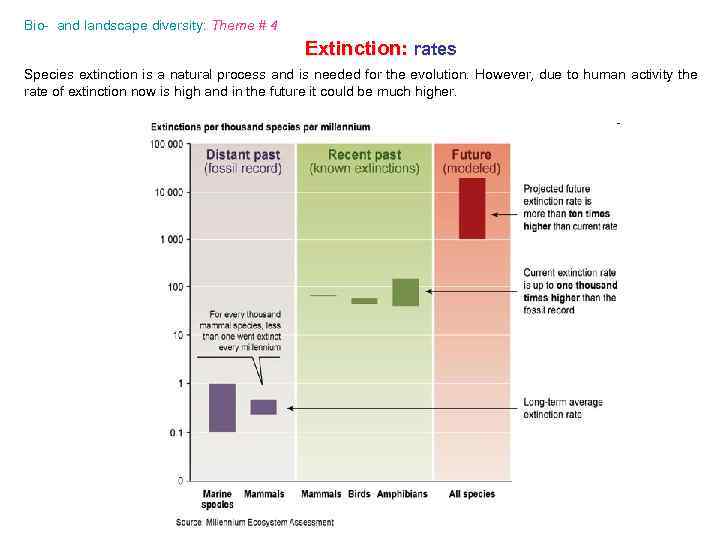
Bio- and landscape diversity: Theme # 4 Extinction: rates Species extinction is a natural process and is needed for the evolution. However, due to human activity the rate of extinction now is high and in the future it could be much higher.
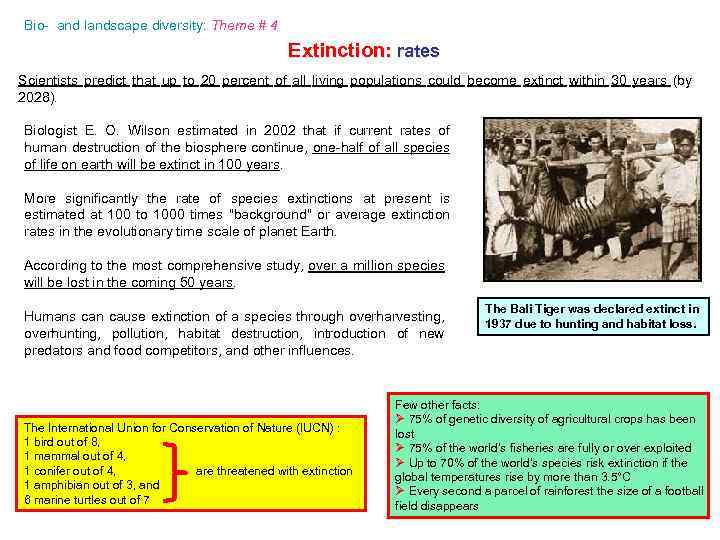
Bio- and landscape diversity: Theme # 4 Extinction: rates Scientists predict that up to 20 percent of all living populations could become extinct within 30 years (by 2028). Biologist E. O. Wilson estimated in 2002 that if current rates of human destruction of the biosphere continue, one-half of all species of life on earth will be extinct in 100 years. More significantly the rate of species extinctions at present is estimated at 100 to 1000 times "background" or average extinction rates in the evolutionary time scale of planet Earth. According to the most comprehensive study, over a million species will be lost in the coming 50 years. Humans can cause extinction of a species through overharvesting, overhunting, pollution, habitat destruction, introduction of new predators and food competitors, and other influences. The International Union for Conservation of Nature (IUCN) : 1 bird out of 8, 1 mammal out of 4, 1 conifer out of 4, are threatened with extinction 1 amphibian out of 3, and 6 marine turtles out of 7 The Bali Tiger was declared extinct in 1937 due to hunting and habitat loss. Few other facts: Ø 75% of genetic diversity of agricultural crops has been lost Ø 75% of the world’s fisheries are fully or over exploited Ø Up to 70% of the world’s species risk extinction if the global temperatures rise by more than 3. 5°C Ø Every second a parcel of rainforest the size of a football field disappears
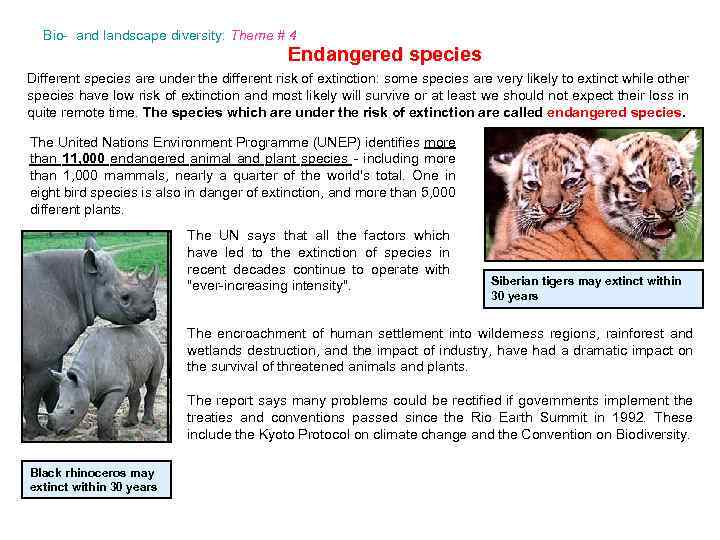
Bio- and landscape diversity: Theme # 4 Endangered species Different species are under the different risk of extinction: some species are very likely to extinct while other species have low risk of extinction and most likely will survive or at least we should not expect their loss in quite remote time. The species which are under the risk of extinction are called endangered species. The United Nations Environment Programme (UNEP) identifies more than 11, 000 endangered animal and plant species - including more than 1, 000 mammals, nearly a quarter of the world's total. One in eight bird species is also in danger of extinction, and more than 5, 000 different plants. The UN says that all the factors which have led to the extinction of species in recent decades continue to operate with "ever-increasing intensity". Siberian tigers may extinct within 30 years The encroachment of human settlement into wilderness regions, rainforest and wetlands destruction, and the impact of industry, have had a dramatic impact on the survival of threatened animals and plants. The report says many problems could be rectified if governments implement the treaties and conventions passed since the Rio Earth Summit in 1992. These include the Kyoto Protocol on climate change and the Convention on Biodiversity. Black rhinoceros may extinct within 30 years
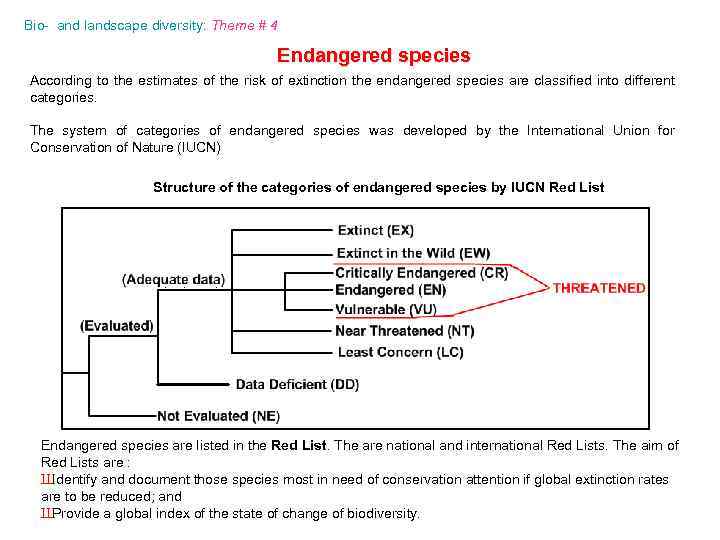
Bio- and landscape diversity: Theme # 4 Endangered species According to the estimates of the risk of extinction the endangered species are classified into different categories. The system of categories of endangered species was developed by the International Union for Conservation of Nature (IUCN) Structure of the categories of endangered species by IUCN Red List Endangered species are listed in the Red List. The are national and international Red Lists. The aim of Red Lists are : Ш Identify and document those species most in need of conservation attention if global extinction rates are to be reduced; and Ш Provide a global index of the state of change of biodiversity.
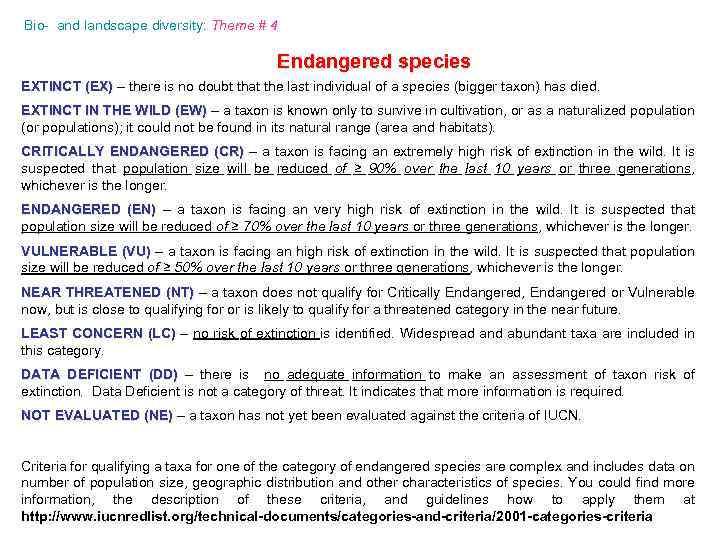
Bio- and landscape diversity: Theme # 4 Endangered species EXTINCT (EX) – there is no doubt that the last individual of a species (bigger taxon) has died. EXTINCT IN THE WILD (EW) – a taxon is known only to survive in cultivation, or as a naturalized population (or populations); it could not be found in its natural range (area and habitats). CRITICALLY ENDANGERED (CR) – a taxon is facing an extremely high risk of extinction in the wild. It is suspected that population size will be reduced of ≥ 90% over the last 10 years or three generations, whichever is the longer. ENDANGERED (EN) – a taxon is facing an very high risk of extinction in the wild. It is suspected that population size will be reduced of ≥ 70% over the last 10 years or three generations, whichever is the longer. VULNERABLE (VU) – a taxon is facing an high risk of extinction in the wild. It is suspected that population size will be reduced of ≥ 50% over the last 10 years or three generations, whichever is the longer. NEAR THREATENED (NT) – a taxon does not qualify for Critically Endangered, Endangered or Vulnerable now, but is close to qualifying for or is likely to qualify for a threatened category in the near future. LEAST CONCERN (LC) – no risk of extinction is identified. Widespread and abundant taxa are included in this category. DATA DEFICIENT (DD) – there is no adequate information to make an assessment of taxon risk of extinction. Data Deficient is not a category of threat. It indicates that more information is required. NOT EVALUATED (NE) – a taxon has not yet been evaluated against the criteria of IUCN. Criteria for qualifying a taxa for one of the category of endangered species are complex and includes data on number of population size, geographic distribution and other characteristics of species. You could find more information, the description of these criteria, and guidelines how to apply them at http: //www. iucnredlist. org/technical-documents/categories-and-criteria/2001 -categories-criteria
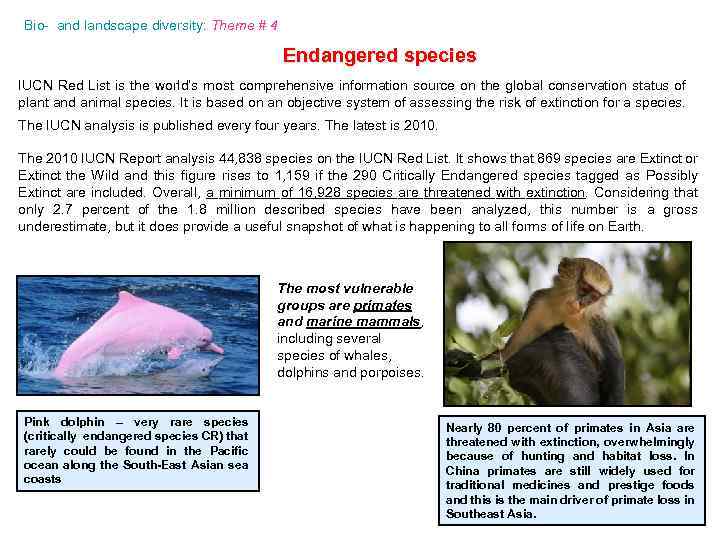
Bio- and landscape diversity: Theme # 4 Endangered species IUCN Red List is the world’s most comprehensive information source on the global conservation status of plant and animal species. It is based on an objective system of assessing the risk of extinction for a species. The IUCN analysis is published every four years. The latest is 2010. The 2010 IUCN Report analysis 44, 838 species on the IUCN Red List. It shows that 869 species are Extinct or Extinct the Wild and this figure rises to 1, 159 if the 290 Critically Endangered species tagged as Possibly Extinct are included. Overall, a minimum of 16, 928 species are threatened with extinction. Considering that only 2. 7 percent of the 1. 8 million described species have been analyzed, this number is a gross underestimate, but it does provide a useful snapshot of what is happening to all forms of life on Earth. The most vulnerable groups are primates and marine mammals, including several species of whales, dolphins and porpoises. Pink dolphin – very rare species (critically endangered species CR) that rarely could be found in the Pacific ocean along the South-East Asian sea coasts Nearly 80 percent of primates in Asia are threatened with extinction, overwhelmingly because of hunting and habitat loss. In China primates are still widely used for traditional medicines and prestige foods and this is the main driver of primate loss in Southeast Asia.
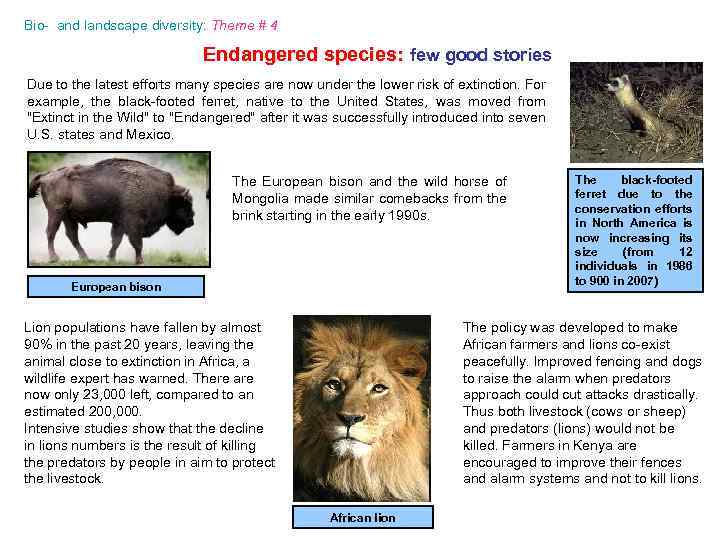
Bio- and landscape diversity: Theme # 4 Endangered species: few good stories Due to the latest efforts many species are now under the lower risk of extinction. For example, the black-footed ferret, native to the United States, was moved from "Extinct in the Wild" to "Endangered" after it was successfully introduced into seven U. S. states and Mexico. The European bison and the wild horse of Mongolia made similar comebacks from the brink starting in the early 1990 s. European bison Lion populations have fallen by almost 90% in the past 20 years, leaving the animal close to extinction in Africa, a wildlife expert has warned. There are now only 23, 000 left, compared to an estimated 200, 000. Intensive studies show that the decline in lions numbers is the result of killing the predators by people in aim to protect the livestock. The black-footed ferret due to the conservation efforts in North America is now increasing its size (from 12 individuals in 1986 to 900 in 2007) The policy was developed to make African farmers and lions co-exist peacefully. Improved fencing and dogs to raise the alarm when predators approach could cut attacks drastically. Thus both livestock (cows or sheep) and predators (lions) would not be killed. Farmers in Kenya are encouraged to improve their fences and alarm systems and not to kill lions. African lion
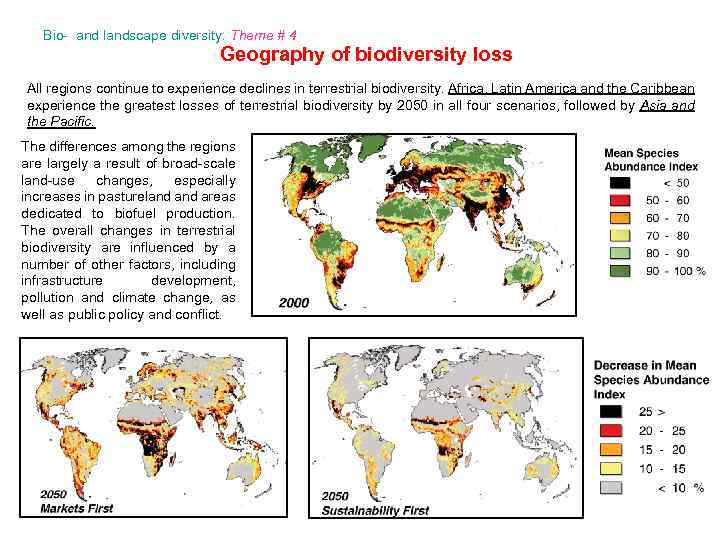
Bio- and landscape diversity: Theme # 4 Geography of biodiversity loss All regions continue to experience declines in terrestrial biodiversity. Africa, Latin America and the Caribbean experience the greatest losses of terrestrial biodiversity by 2050 in all four scenarios, followed by Asia and the Pacific. The differences among the regions are largely a result of broad-scale land-use changes, especially increases in pastureland areas dedicated to biofuel production. The overall changes in terrestrial biodiversity are influenced by a number of other factors, including infrastructure development, pollution and climate change, as well as public policy and conflict.
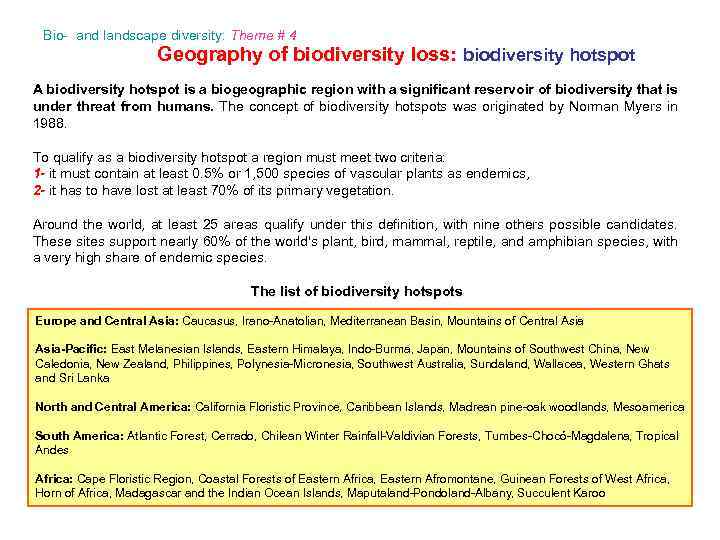
Bio- and landscape diversity: Theme # 4 Geography of biodiversity loss: biodiversity hotspot A biodiversity hotspot is a biogeographic region with a significant reservoir of biodiversity that is under threat from humans. The concept of biodiversity hotspots was originated by Norman Myers in 1988. To qualify as a biodiversity hotspot a region must meet two criteria: 1 - it must contain at least 0. 5% or 1, 500 species of vascular plants as endemics, 2 - it has to have lost at least 70% of its primary vegetation. Around the world, at least 25 areas qualify under this definition, with nine others possible candidates. These sites support nearly 60% of the world's plant, bird, mammal, reptile, and amphibian species, with a very high share of endemic species. The list of biodiversity hotspots Europe and Central Asia: Caucasus, Irano-Anatolian, Mediterranean Basin, Mountains of Central Asia-Pacific: East Melanesian Islands, Eastern Himalaya, Indo-Burma, Japan, Mountains of Southwest China, New Caledonia, New Zealand, Philippines, Polynesia-Micronesia, Southwest Australia, Sundaland, Wallacea, Western Ghats and Sri Lanka North and Central America: California Floristic Province, Caribbean Islands, Madrean pine-oak woodlands, Mesoamerica South America: Atlantic Forest, Cerrado, Chilean Winter Rainfall-Valdivian Forests, Tumbes-Chocó-Magdalena, Tropical Andes Africa: Cape Floristic Region, Coastal Forests of Eastern Africa, Eastern Afromontane, Guinean Forests of West Africa, Horn of Africa, Madagascar and the Indian Ocean Islands, Maputaland-Pondoland-Albany, Succulent Karoo
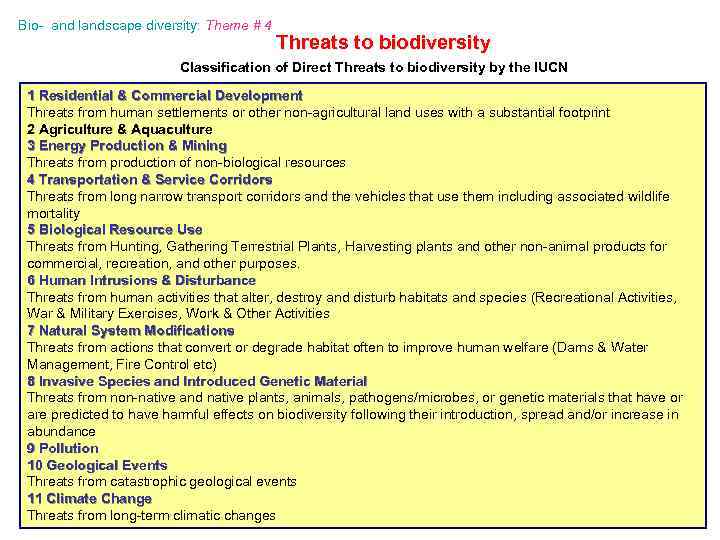
Bio- and landscape diversity: Theme # 4 Threats to biodiversity Classification of Direct Threats to biodiversity by the IUCN 1 Residential & Commercial Development Threats from human settlements or other non-agricultural land uses with a substantial footprint 2 Agriculture & Aquaculture 3 Energy Production & Mining Threats from production of non-biological resources 4 Transportation & Service Corridors Threats from long narrow transport corridors and the vehicles that use them including associated wildlife mortality 5 Biological Resource Use Threats from Hunting, Gathering Terrestrial Plants, Harvesting plants and other non-animal products for commercial, recreation, and other purposes. 6 Human Intrusions & Disturbance Threats from human activities that alter, destroy and disturb habitats and species (Recreational Activities, War & Military Exercises, Work & Other Activities 7 Natural System Modifications Threats from actions that convert or degrade habitat often to improve human welfare (Dams & Water Management, Fire Control etc) 8 Invasive Species and Introduced Genetic Material Threats from non-native and native plants, animals, pathogens/microbes, or genetic materials that have or are predicted to have harmful effects on biodiversity following their introduction, spread and/or increase in abundance 9 Pollution 10 Geological Events Threats from catastrophic geological events 11 Climate Change Threats from long-term climatic changes
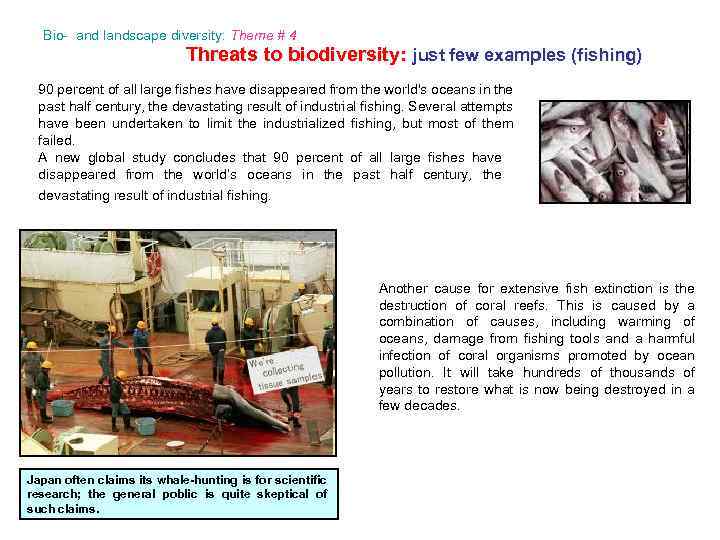
Bio- and landscape diversity: Theme # 4 Threats to biodiversity: just few examples (fishing) 90 percent of all large fishes have disappeared from the world's oceans in the past half century, the devastating result of industrial fishing. Several attempts have been undertaken to limit the industrialized fishing, but most of them failed. A new global study concludes that 90 percent of all large fishes have disappeared from the world’s oceans in the past half century, the devastating result of industrial fishing. Another cause for extensive fish extinction is the destruction of coral reefs. This is caused by a combination of causes, including warming of oceans, damage from fishing tools and a harmful infection of coral organisms promoted by ocean pollution. It will take hundreds of thousands of years to restore what is now being destroyed in a few decades. Japan often claims its whale-hunting is for scientific research; the general poblic is quite skeptical of such claims.
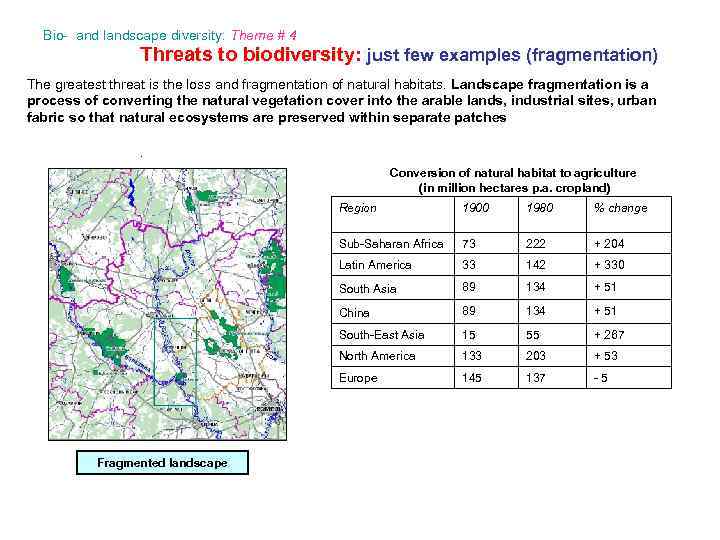
Bio- and landscape diversity: Theme # 4 Threats to biodiversity: just few examples (fragmentation) The greatest threat is the loss and fragmentation of natural habitats. Landscape fragmentation is a process of converting the natural vegetation cover into the arable lands, industrial sites, urban fabric so that natural ecosystems are preserved within separate patches. Conversion of natural habitat to agriculture (in million hectares p. a. cropland) Region 1980 % change Sub-Saharan Africa 73 222 + 204 Latin America 33 142 + 330 South Asia 89 134 + 51 China 89 134 + 51 South-East Asia 15 55 + 267 North America 133 203 + 53 Europe Fragmented landscape 1900 145 137 -5
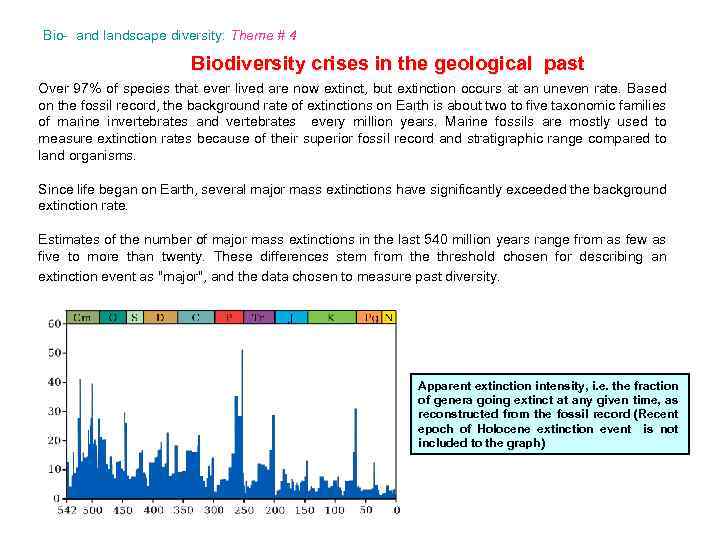
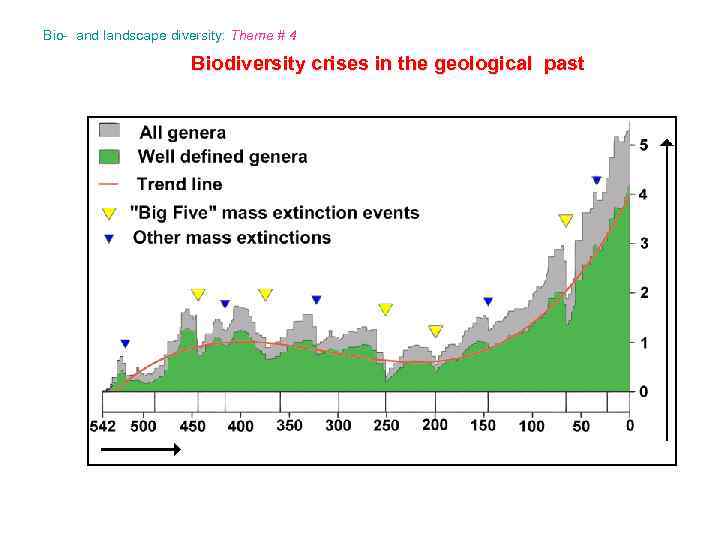
Bio- and landscape diversity: Theme # 4 Biodiversity crises in the geological past Over 97% of species that ever lived are now extinct, but extinction occurs at an uneven rate. Based on the fossil record, the background rate of extinctions on Earth is about two to five taxonomic families of marine invertebrates and vertebrates every million years. Marine fossils are mostly used to measure extinction rates because of their superior fossil record and stratigraphic range compared to land organisms. Since life began on Earth, several major mass extinctions have significantly exceeded the background extinction rate. Estimates of the number of major mass extinctions in the last 540 million years range from as few as five to more than twenty. These differences stem from the threshold chosen for describing an extinction event as "major", and the data chosen to measure past diversity. Apparent extinction intensity, i. e. the fraction of genera going extinct at any given time, as reconstructed from the fossil record (Recent epoch of Holocene extinction event is not included to the graph)
Bio- and landscape diversity: Theme # 4 Biodiversity crises in the geological past Jack Sepkoski and David Raup in 1982 identified "Big Five" mass extinctions, namely End Ordovician, Late devonian, End permain, End triassic, and End Cretaceous. 1 - Ordovician-Silurian extinction event 440 -450 million years ago at the Ordovician-Silurian transition. Two events occurred that killed off 27% of all families and 57% of all genera. It is the second largest of the five major extinctions in Earth's history in terms of percentage of genera that went extinct. 2 - Late Devonian extinction event 360 -375 Ma near the Devonian-Carboniferous transition. At later parts of the Devonian Period, a prolonged series of extinctions eliminated about 19% of all families, 50% of all genera and 70% of all species. 3 - Permain-Triassic extinction event - 251 Ma is the Earth's largest extinction killed 57% of all families and 83% of all genera (53% of marine families, 84% of marine genera, about 96% of all marine species and an estimated 70% of land species) including vertebrates, insects and plants. The "Great Dying" had enormous evolutionary significance: on land, it ended the primacy of mammal-like reptiles. The recovery of vertebrates took 30 million years. The whole late Permian was a difficult time for at least marine life, even before the "Great Dying". 4 - Triassic-Jurassic extinction event - 205 Ma; about 23% of all families and 48% of all genera (20% of marine families and 55% of marine genera) went extinct. Most non-dinosaurian archsaurs, most therapsids, and most of the large amphibians were eliminated, leaving dinosaurus with little terrestrial competition. 5 – End Cretaceous-tertiary extinction event (K-T extinction) - 65 Ma ago; about 17% of all families, 50% of all genera and 75% of species went extinct. It ended the reign of dinosaurus and opened the way for mammals and birds to become the dominant land vertebrates. In the seas it reduced the percentage of sessile (fixed to a place) animals to about 33%. The K-T extinction was rather uneven — some groups of organisms became extinct, some suffered heavy losses and some appear to have been only minimally affected.
Bio- and landscape diversity: Theme # 4 Biodiversity crises in the geological past
Bio- and landscape diversity: Theme # 4 Next theme: Species diversity • What is species and species diversity • Population and its diversity • Minimum viable population • Factors that regulates species diversity • Rare species • Endemic species • Umbrella species • Flagship species
Скачать презентацию Bio- and landscape diversity Theme 4 Theme
Biodiversity-2015-4.pptx