 Скачать презентацию Binnenlandse Francqui Leerstoel VUB 2004 -2005 1 Black
0987b3a378b7ac3e7a4ed813b12cf875.ppt
- Количество слайдов: 33



Binnenlandse Francqui Leerstoel VUB 2004 -2005 1. Black Scholes and beyond André Farber Solvay Business School University of Brussels VUB 01 Black Scholes and beyond
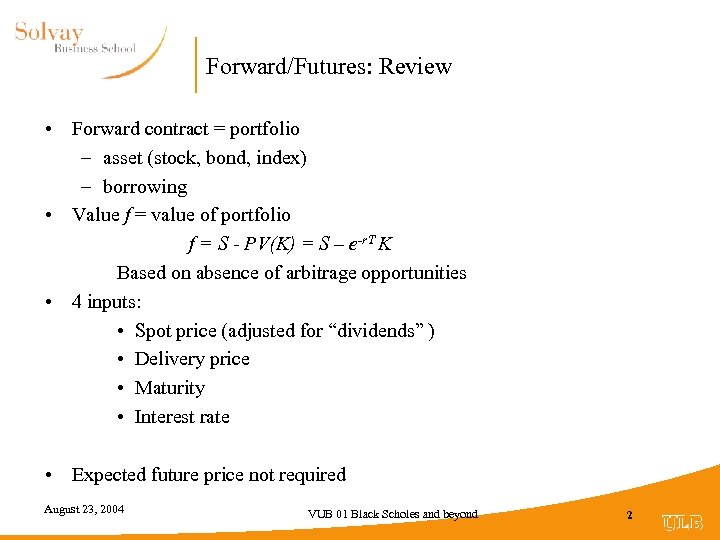
Forward/Futures: Review • Forward contract = portfolio – asset (stock, bond, index) – borrowing • Value f = value of portfolio f = S - PV(K) = S – e-r. T K Based on absence of arbitrage opportunities • 4 inputs: • Spot price (adjusted for “dividends” ) • Delivery price • Maturity • Interest rate • Expected future price not required August 23, 2004 VUB 01 Black Scholes and beyond 2
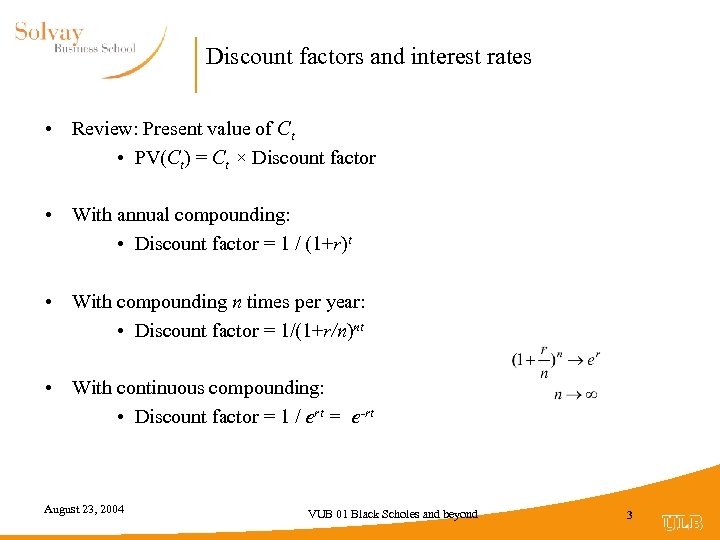
Discount factors and interest rates • Review: Present value of Ct • PV(Ct) = Ct × Discount factor • With annual compounding: • Discount factor = 1 / (1+r)t • With compounding n times per year: • Discount factor = 1/(1+r/n)nt • With continuous compounding: • Discount factor = 1 / ert = e-rt August 23, 2004 VUB 01 Black Scholes and beyond 3
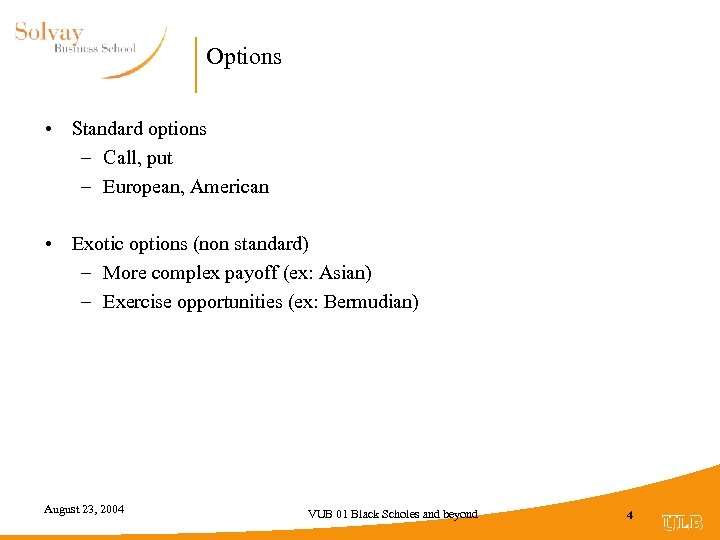
Options • Standard options – Call, put – European, American • Exotic options (non standard) – More complex payoff (ex: Asian) – Exercise opportunities (ex: Bermudian) August 23, 2004 VUB 01 Black Scholes and beyond 4
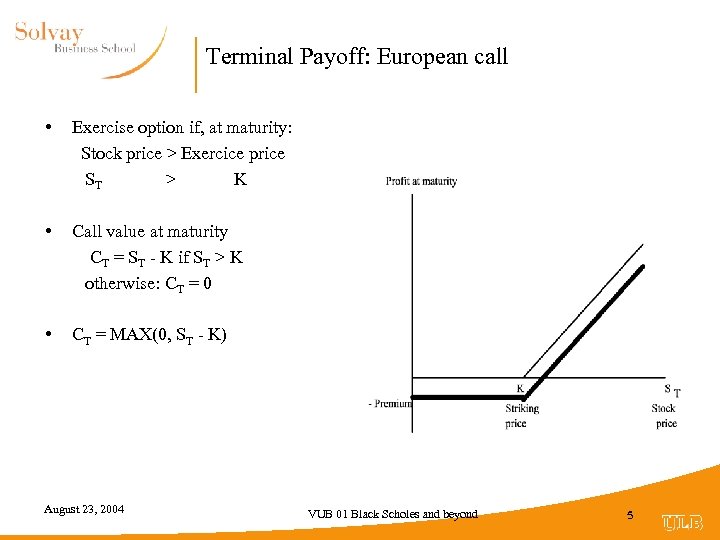
Terminal Payoff: European call • Exercise option if, at maturity: Stock price > Exercice price ST > K • Call value at maturity CT = ST - K if ST > K otherwise: CT = 0 • CT = MAX(0, ST - K) August 23, 2004 VUB 01 Black Scholes and beyond 5
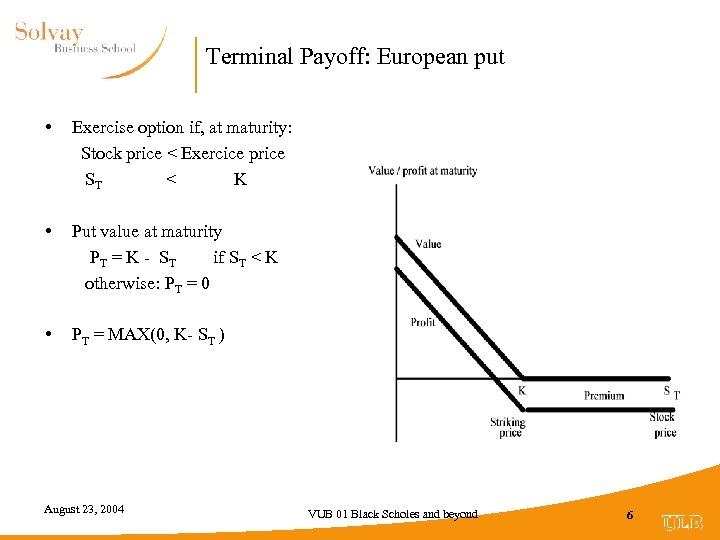
Terminal Payoff: European put • Exercise option if, at maturity: Stock price < Exercice price ST < K • Put value at maturity PT = K - ST if ST < K otherwise: PT = 0 • PT = MAX(0, K- ST ) August 23, 2004 VUB 01 Black Scholes and beyond 6
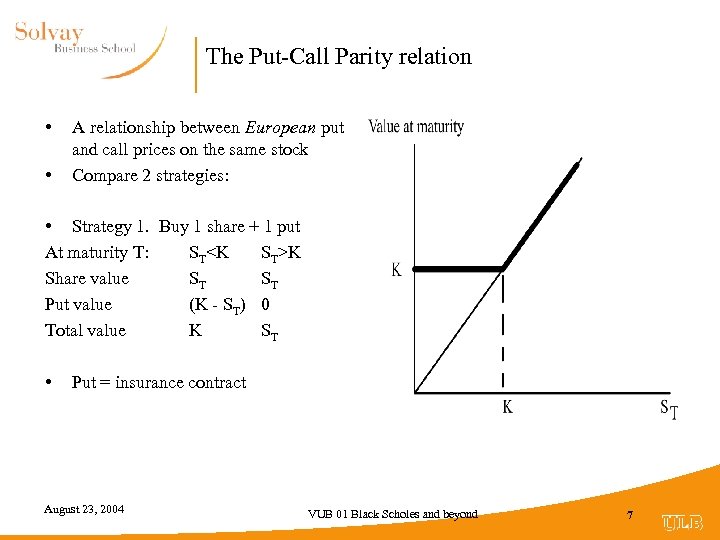
The Put-Call Parity relation • • A relationship between European put and call prices on the same stock Compare 2 strategies: • Strategy 1. Buy 1 share + 1 put At maturity T: ST<K ST>K Share value ST ST Put value (K - ST) 0 Total value K ST • Put = insurance contract August 23, 2004 VUB 01 Black Scholes and beyond 7
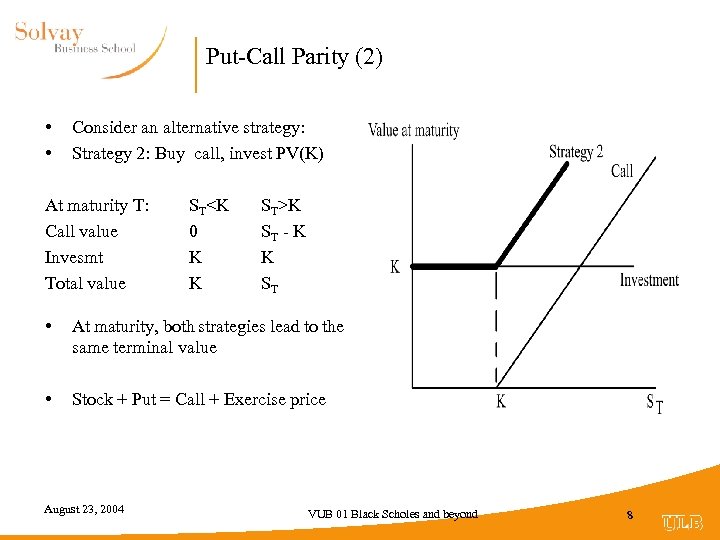
Put-Call Parity (2) • • Consider an alternative strategy: Strategy 2: Buy call, invest PV(K) At maturity T: Call value Invesmt Total value ST<K 0 K K ST>K ST - K K ST • At maturity, both strategies lead to the same terminal value • Stock + Put = Call + Exercise price August 23, 2004 VUB 01 Black Scholes and beyond 8
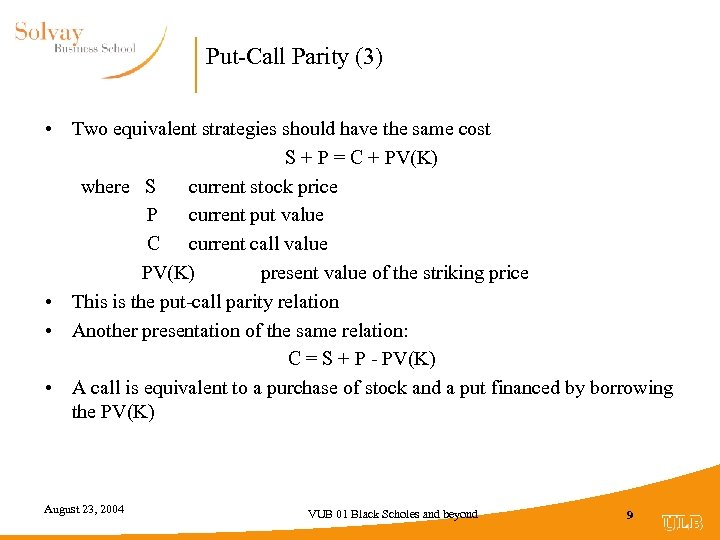
Put-Call Parity (3) • Two equivalent strategies should have the same cost S + P = C + PV(K) where S current stock price P current put value C current call value PV(K) present value of the striking price • This is the put-call parity relation • Another presentation of the same relation: C = S + P - PV(K) • A call is equivalent to a purchase of stock and a put financed by borrowing the PV(K) August 23, 2004 VUB 01 Black Scholes and beyond 9
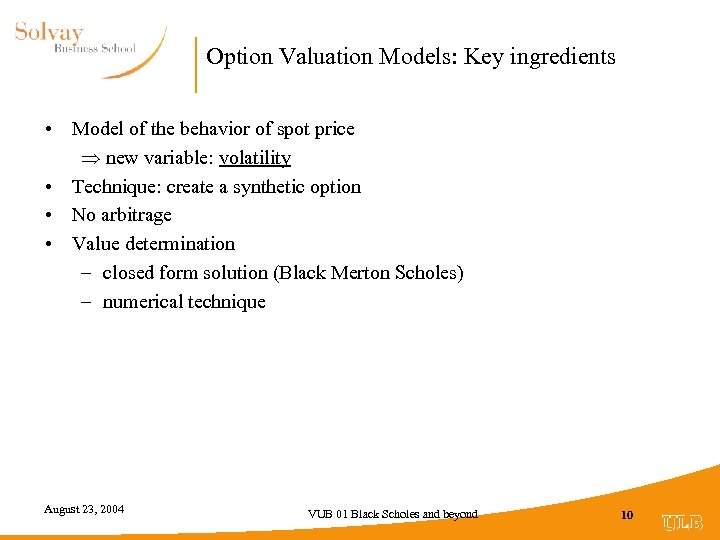
Option Valuation Models: Key ingredients • Model of the behavior of spot price new variable: volatility • Technique: create a synthetic option • No arbitrage • Value determination – closed form solution (Black Merton Scholes) – numerical technique August 23, 2004 VUB 01 Black Scholes and beyond 10
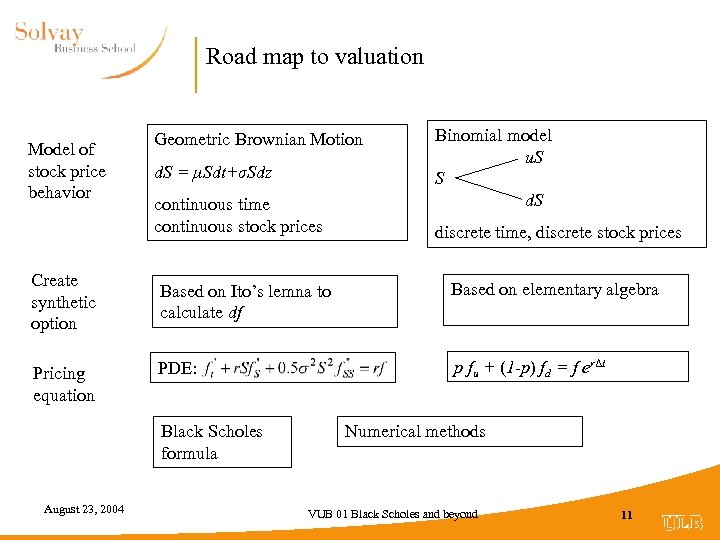
Road map to valuation Model of stock price behavior Create synthetic option Pricing equation Geometric Brownian Motion d. S = μSdt+σSdz continuous time continuous stock prices discrete time, discrete stock prices Based on Ito’s lemna to calculate df Based on elementary algebra PDE: p fu + (1 -p) fd = f erΔt Black Scholes formula August 23, 2004 Binomial model u. S S d. S Numerical methods VUB 01 Black Scholes and beyond 11
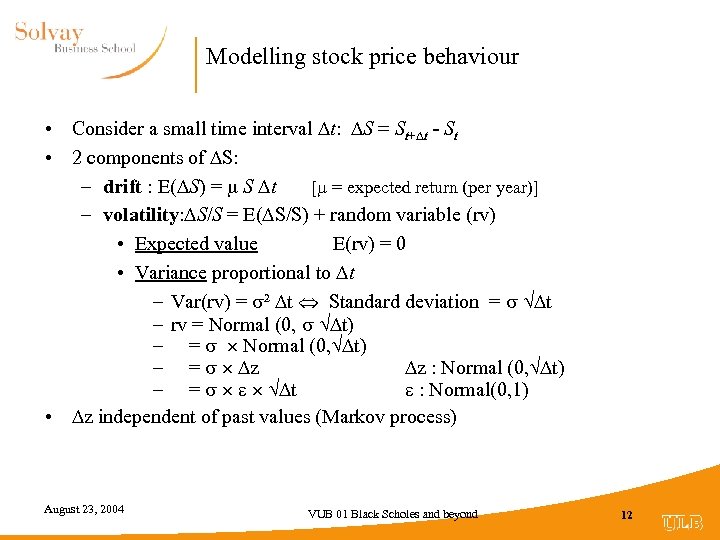
Modelling stock price behaviour • Consider a small time interval t: S = St+ t - St • 2 components of S: – drift : E( S) = S t [ = expected return (per year)] – volatility: S/S = E( S/S) + random variable (rv) • Expected value E(rv) = 0 • Variance proportional to t – Var(rv) = ² t Standard deviation = t – rv = Normal (0, t) – = Normal (0, t) – = z z : Normal (0, t) – = t : Normal(0, 1) • z independent of past values (Markov process) August 23, 2004 VUB 01 Black Scholes and beyond 12

Geometric Brownian motion illustrated August 23, 2004 VUB 01 Black Scholes and beyond 13
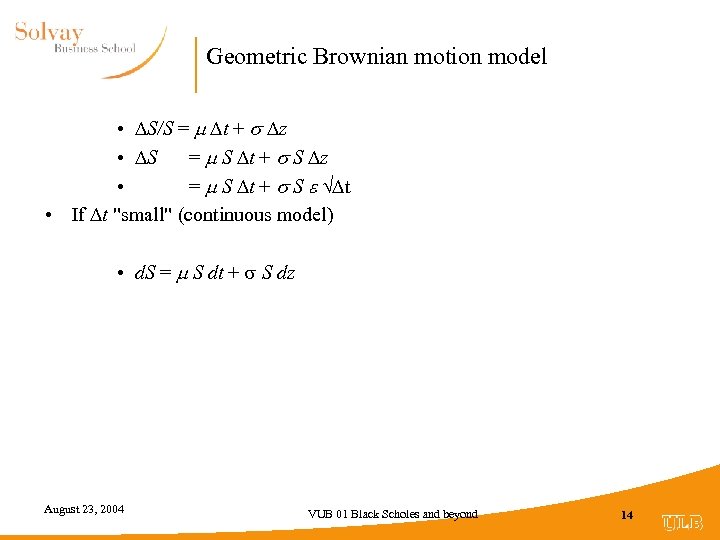
Geometric Brownian motion model • S/S = t + z • S = S t + S z • = S t + S t • If t "small" (continuous model) • d. S = S dt + S dz August 23, 2004 VUB 01 Black Scholes and beyond 14
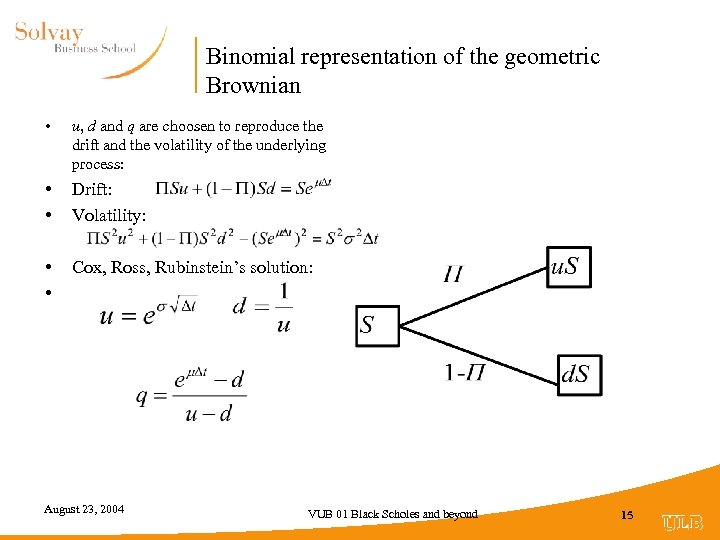
Binomial representation of the geometric Brownian • u, d and q are choosen to reproduce the drift and the volatility of the underlying process: • • Drift: Volatility: • • Cox, Ross, Rubinstein’s solution: August 23, 2004 VUB 01 Black Scholes and beyond 15
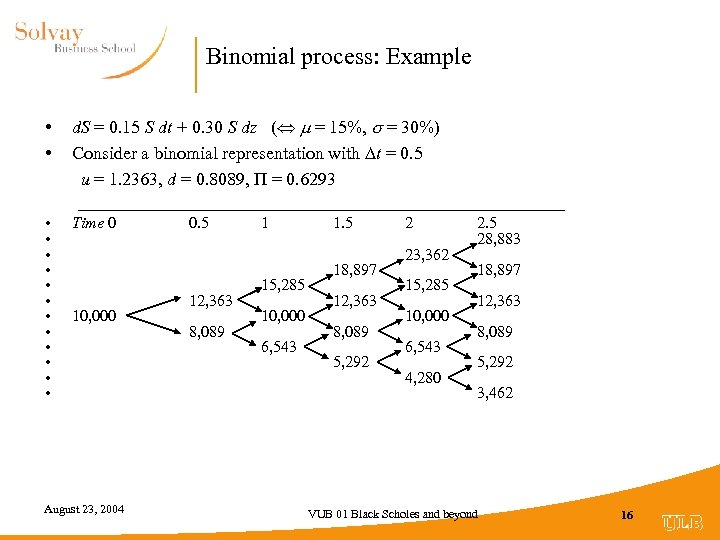
Binomial process: Example • • d. S = 0. 15 S dt + 0. 30 S dz ( = 15%, = 30%) Consider a binomial representation with t = 0. 5 u = 1. 2363, d = 0. 8089, Π = 0. 6293 • • • Time 0 10, 000 August 23, 2004 0. 5 12, 363 8, 089 1 15, 285 10, 000 6, 543 1. 5 18, 897 12, 363 8, 089 5, 292 2 23, 362 15, 285 10, 000 6, 543 4, 280 2. 5 28, 883 18, 897 12, 363 8, 089 5, 292 3, 462 VUB 01 Black Scholes and beyond 16
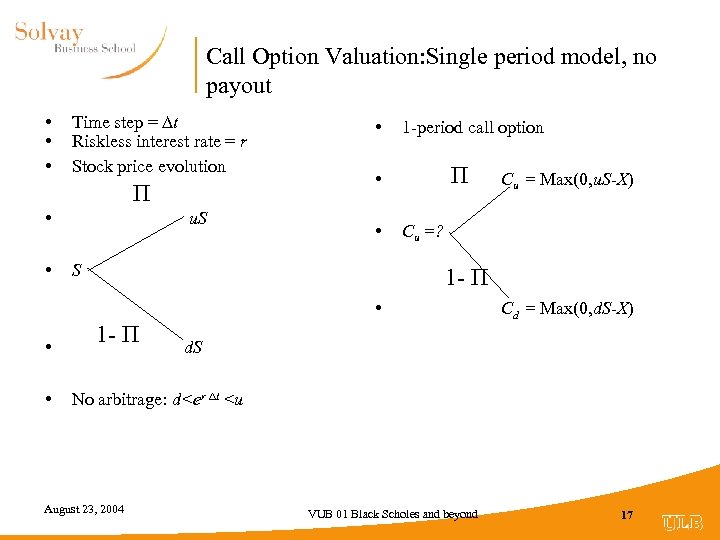
Call Option Valuation: Single period model, no payout • • • Time step = t Riskless interest rate = r Stock price evolution Π • u. S • • 1 -period call option • Π Cu = Max(0, u. S-X) • Cu =? S 1 - Π • • • 1 - Π Cd = Max(0, d. S-X) d. S No arbitrage: d<er t <u August 23, 2004 VUB 01 Black Scholes and beyond 17
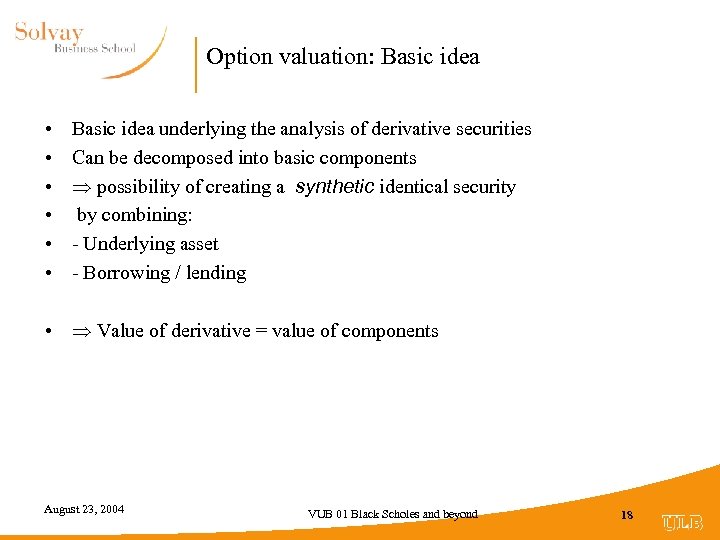
Option valuation: Basic idea • • • Basic idea underlying the analysis of derivative securities Can be decomposed into basic components possibility of creating a synthetic identical security by combining: - Underlying asset - Borrowing / lending • Value of derivative = value of components August 23, 2004 VUB 01 Black Scholes and beyond 18
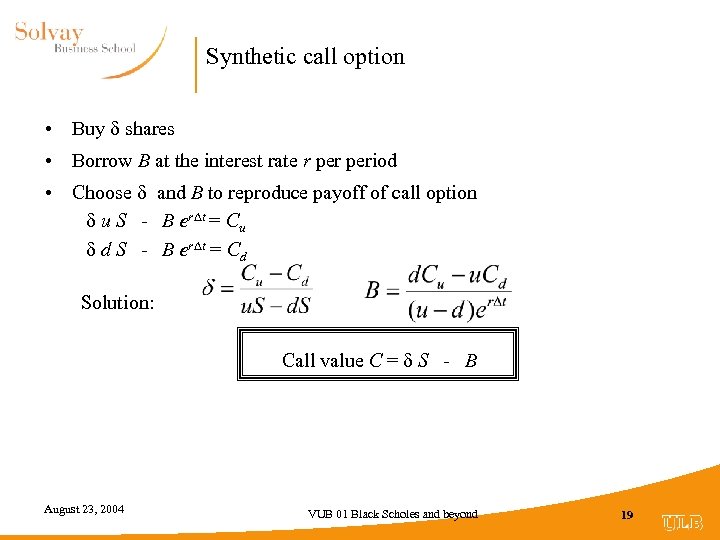
Synthetic call option • Buy shares • Borrow B at the interest rate r period • Choose and B to reproduce payoff of call option u S - B er t = Cu d S - B er t = Cd Solution: Call value C = S - B August 23, 2004 VUB 01 Black Scholes and beyond 19
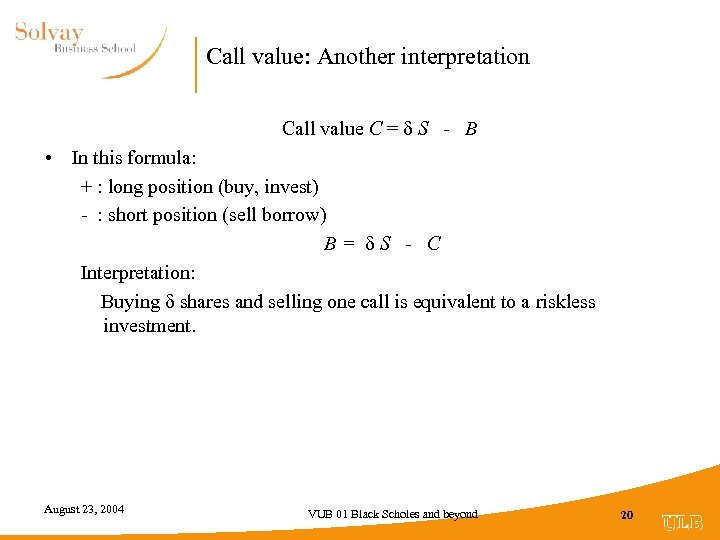
Call value: Another interpretation Call value C = S - B • In this formula: + : long position (buy, invest) - : short position (sell borrow) B = S - C Interpretation: Buying shares and selling one call is equivalent to a riskless investment. August 23, 2004 VUB 01 Black Scholes and beyond 20
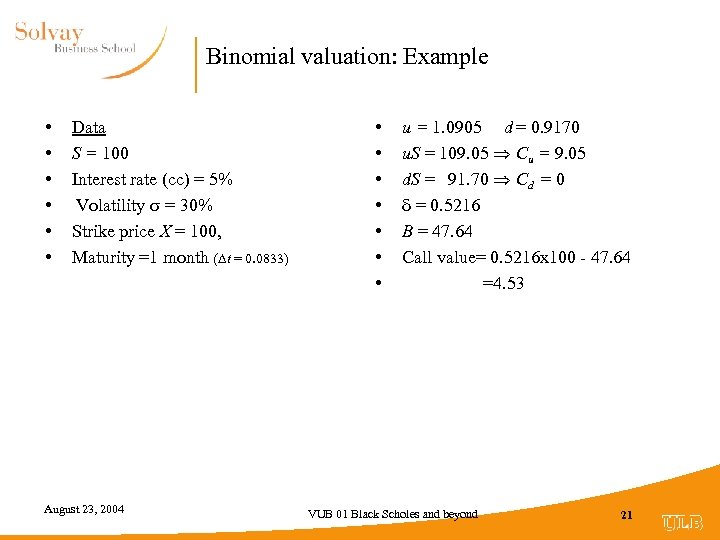
Binomial valuation: Example • • • Data S = 100 Interest rate (cc) = 5% Volatility = 30% Strike price X = 100, Maturity =1 month ( t = 0. 0833) August 23, 2004 • • u = 1. 0905 d = 0. 9170 u. S = 109. 05 Cu = 9. 05 d. S = 91. 70 Cd = 0. 5216 B = 47. 64 Call value= 0. 5216 x 100 - 47. 64 =4. 53 VUB 01 Black Scholes and beyond 21
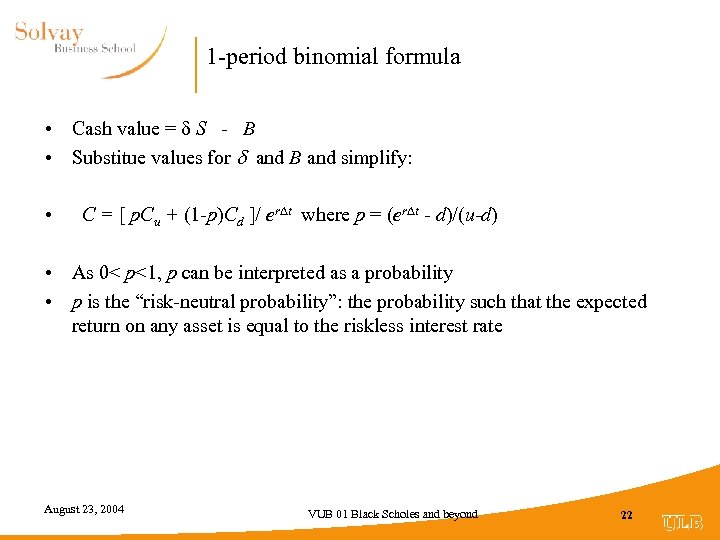
1 -period binomial formula • Cash value = S - B • Substitue values for and B and simplify: • C = [ p. Cu + (1 -p)Cd ]/ er t where p = (er t - d)/(u-d) • As 0< p<1, p can be interpreted as a probability • p is the “risk-neutral probability”: the probability such that the expected return on any asset is equal to the riskless interest rate August 23, 2004 VUB 01 Black Scholes and beyond 22
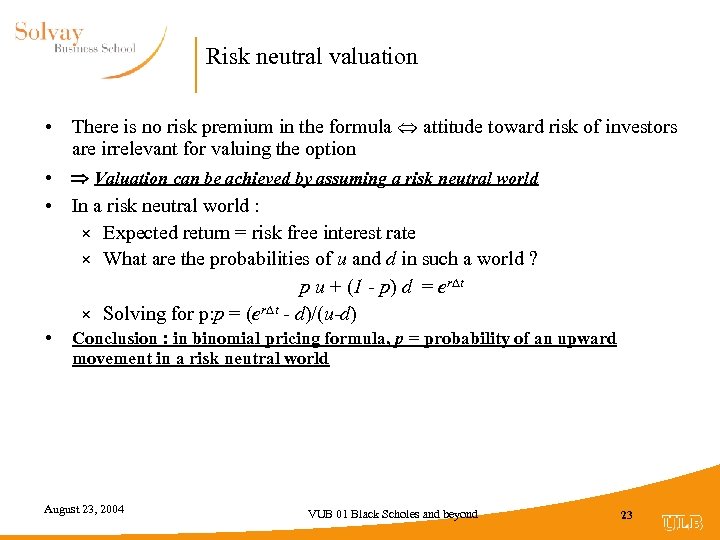
Risk neutral valuation • There is no risk premium in the formula attitude toward risk of investors are irrelevant for valuing the option • Valuation can be achieved by assuming a risk neutral world • In a risk neutral world : r Expected return = risk free interest rate r What are the probabilities of u and d in such a world ? p u + (1 - p) d = er t - d)/(u-d) r Solving for p: p = (e • Conclusion : in binomial pricing formula, p = probability of an upward movement in a risk neutral world August 23, 2004 VUB 01 Black Scholes and beyond 23
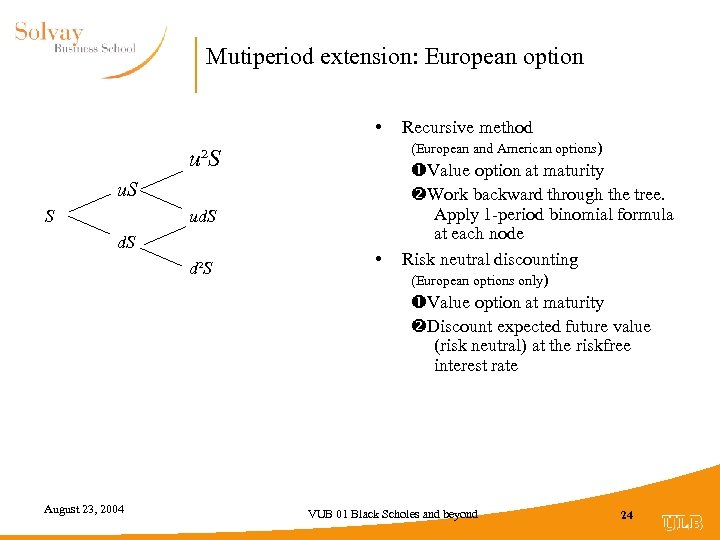
Mutiperiod extension: European option • (European and American options) u²S u. S S ud. S d²S Recursive method • Value option at maturity Work backward through the tree. Apply 1 -period binomial formula at each node Risk neutral discounting (European options only) Value option at maturity Discount expected future value (risk neutral) at the riskfree interest rate August 23, 2004 VUB 01 Black Scholes and beyond 24
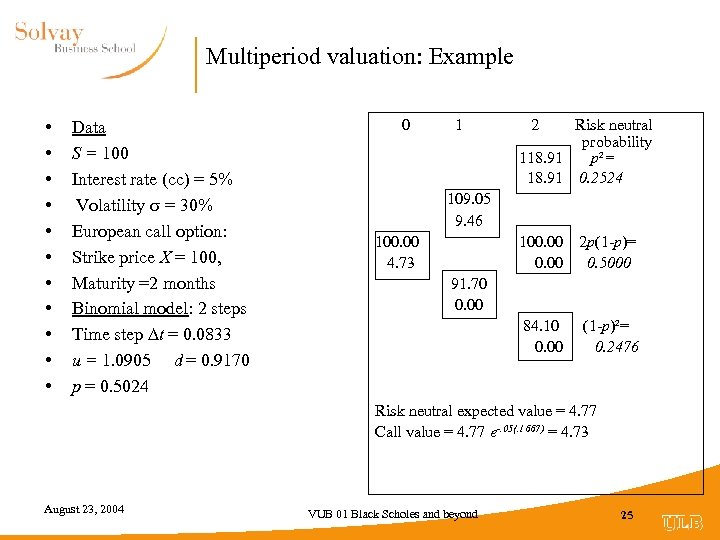
Multiperiod valuation: Example • • • Data S = 100 Interest rate (cc) = 5% Volatility = 30% European call option: Strike price X = 100, Maturity =2 months Binomial model: 2 steps Time step t = 0. 0833 u = 1. 0905 d = 0. 9170 p = 0. 5024 0 1 2 Risk neutral probability 118. 91 p²= 18. 91 0. 2524 109. 05 9. 46 100. 00 4. 73 100. 00 2 p(1 -p)= 0. 00 0. 5000 91. 70 0. 00 84. 10 (1 -p)²= 0. 00 0. 2476 Risk neutral expected value = 4. 77 Call value = 4. 77 e-. 05(. 1667) = 4. 73 August 23, 2004 VUB 01 Black Scholes and beyond 25
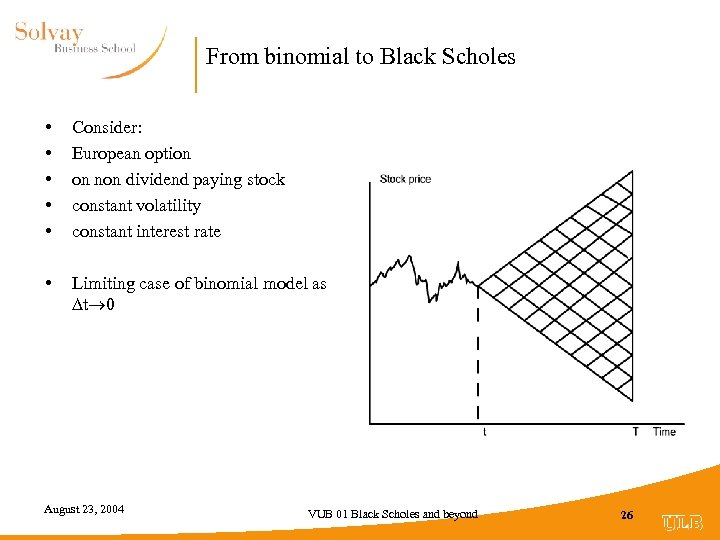
From binomial to Black Scholes • • • Consider: European option on non dividend paying stock constant volatility constant interest rate • Limiting case of binomial model as t 0 August 23, 2004 VUB 01 Black Scholes and beyond 26
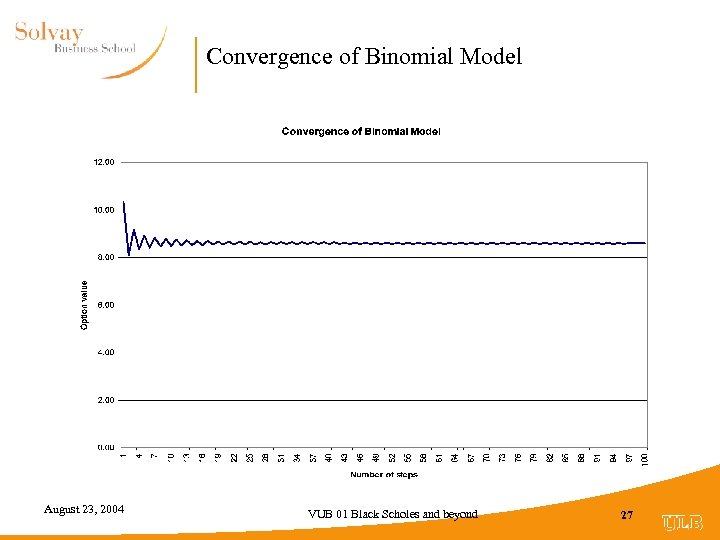
Convergence of Binomial Model August 23, 2004 VUB 01 Black Scholes and beyond 27
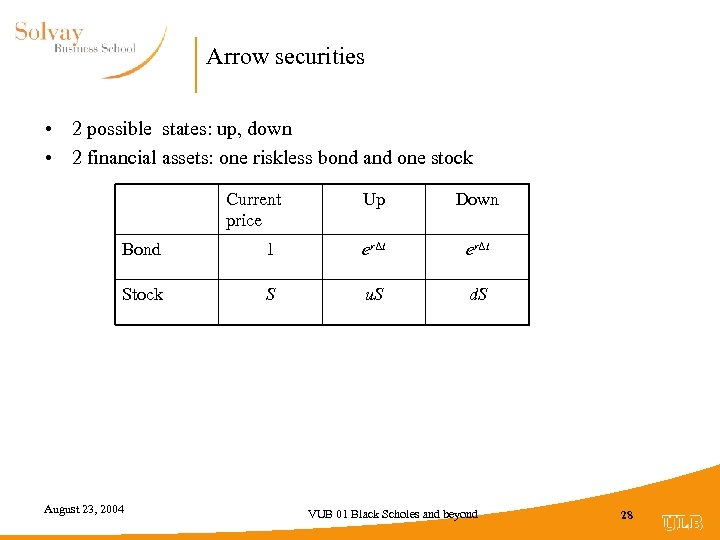
Arrow securities • 2 possible states: up, down • 2 financial assets: one riskless bond and one stock Current price Up Down Bond 1 erΔt Stock S u. S d. S August 23, 2004 VUB 01 Black Scholes and beyond 28
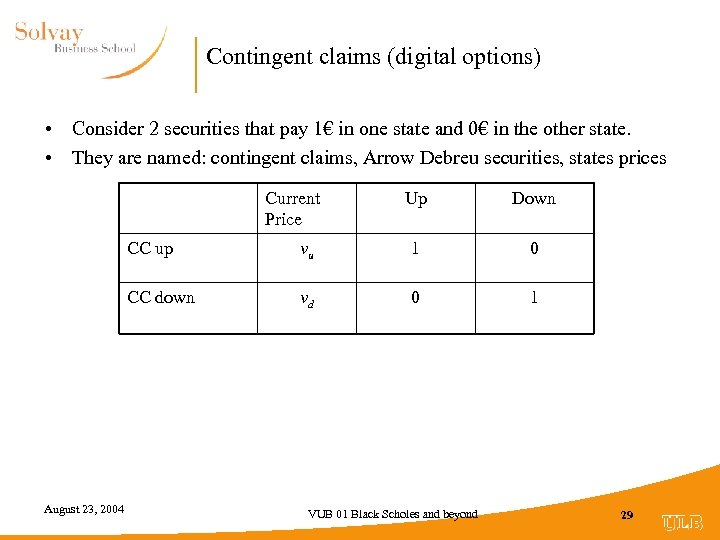
Contingent claims (digital options) • Consider 2 securities that pay 1€ in one state and 0€ in the other state. • They are named: contingent claims, Arrow Debreu securities, states prices Current Price Up Down CC up 1 0 CC down August 23, 2004 vu vd 0 1 VUB 01 Black Scholes and beyond 29
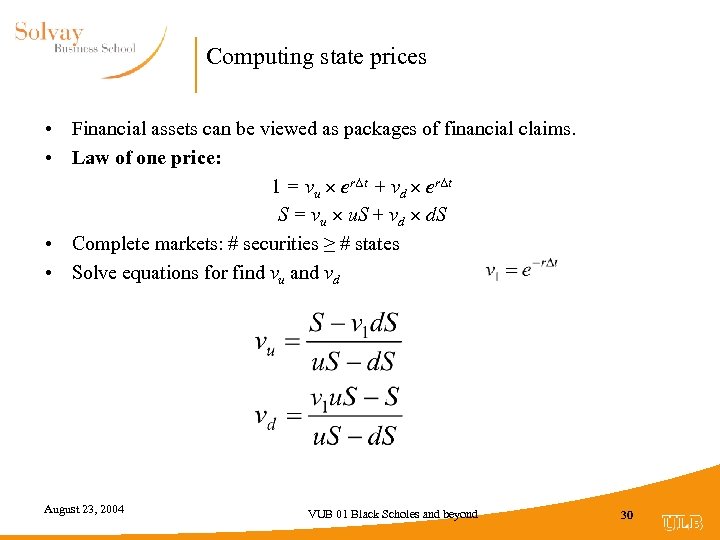
Computing state prices • Financial assets can be viewed as packages of financial claims. • Law of one price: 1 = vu erΔt + vd erΔt S = vu u. S + vd d. S • Complete markets: # securities ≥ # states • Solve equations for find vu and vd August 23, 2004 VUB 01 Black Scholes and beyond 30
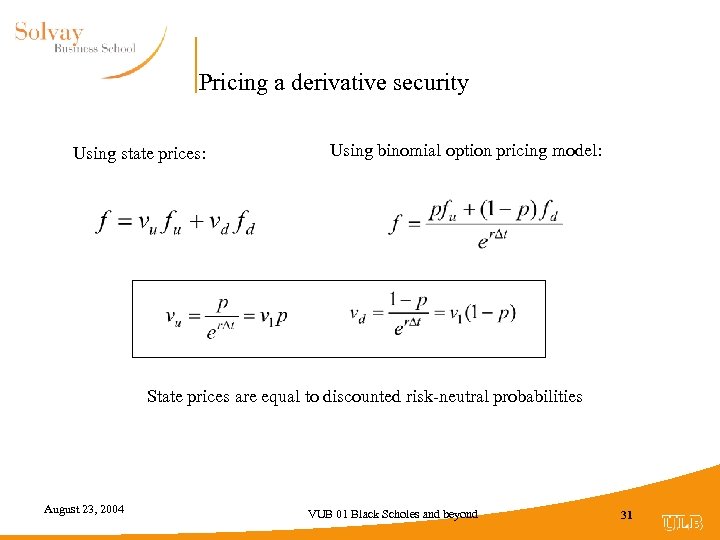
Pricing a derivative security Using state prices: Using binomial option pricing model: State prices are equal to discounted risk-neutral probabilities August 23, 2004 VUB 01 Black Scholes and beyond 31
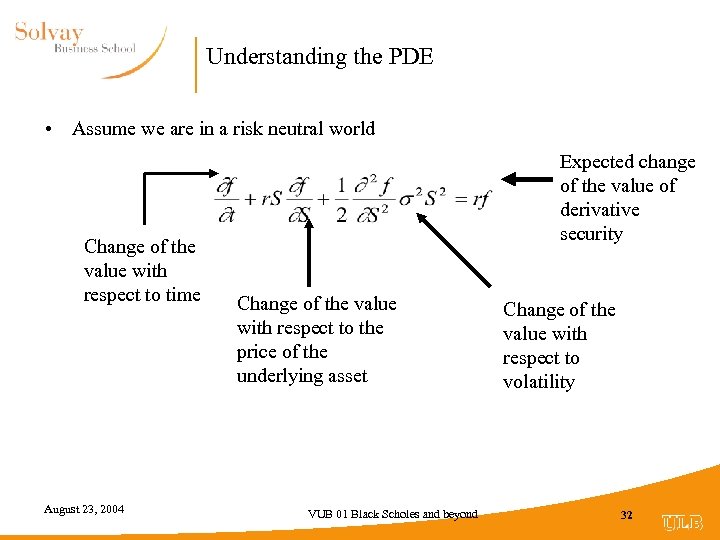
Understanding the PDE • Assume we are in a risk neutral world Change of the value with respect to time August 23, 2004 Expected change of the value of derivative security Change of the value with respect to the price of the underlying asset VUB 01 Black Scholes and beyond Change of the value with respect to volatility 32
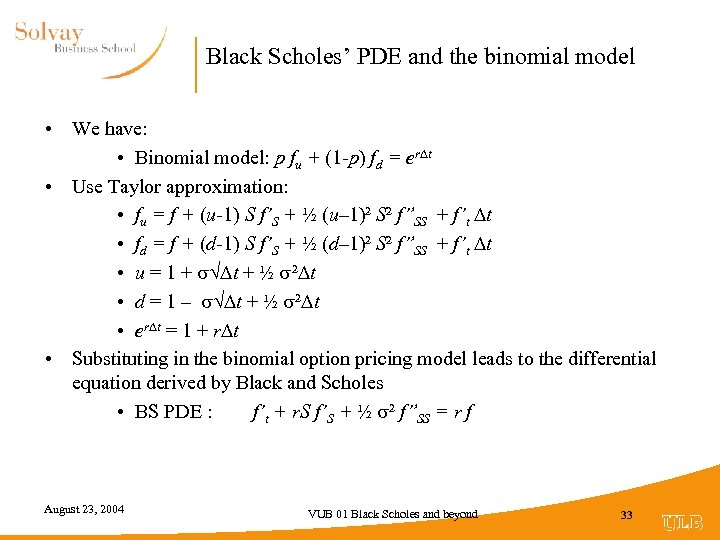
Black Scholes’ PDE and the binomial model • We have: • Binomial model: p fu + (1 -p) fd = er t • Use Taylor approximation: • fu = f + (u-1) S f’S + ½ (u– 1)² S² f”SS + f’t t • fd = f + (d-1) S f’S + ½ (d– 1)² S² f”SS + f’t t • u = 1 + √ t + ½ ² t • d = 1 – √ t + ½ ² t • er t = 1 + r t • Substituting in the binomial option pricing model leads to the differential equation derived by Black and Scholes • BS PDE : f’t + r. S f’S + ½ ² f”SS = r f August 23, 2004 VUB 01 Black Scholes and beyond 33
Скачать презентацию Binnenlandse Francqui Leerstoel VUB 2004 -2005 1 Black
0987b3a378b7ac3e7a4ed813b12cf875.ppt