 Скачать презентацию Binary Searching Earl Paine Stu Schwartz Copyright
67dc515ff37164f7a342bba245547f51.ppt
- Количество слайдов: 15



Binary Searching Earl Paine Stu Schwartz © Copyright 2005, used by permission

Who we are § Combining curriculums § The art of collaboration
The problem § You have 10 alphabetized names along with the last 4 digits of their social security number. § You input a name and the program will search for it. § If found, the SS# 4 digits will appear § If not found, the user will be asked the person’s SS# 4 digits which will be added to the list.
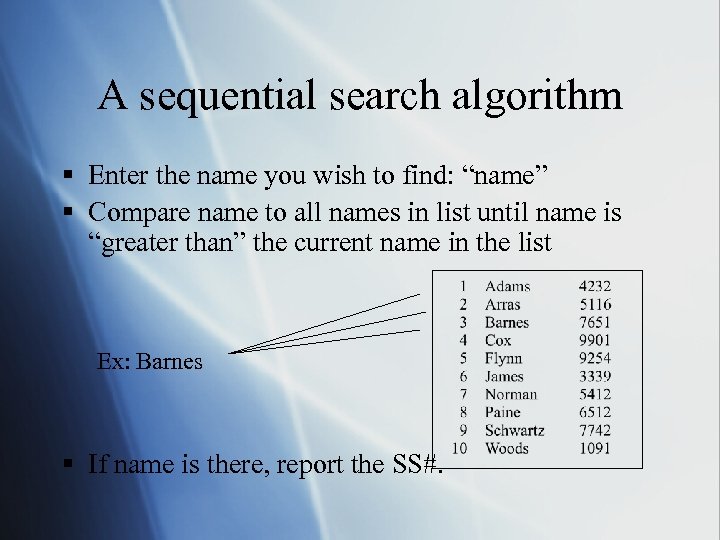
A sequential search algorithm § Enter the name you wish to find: “name” § Compare name to all names in list until name is “greater than” the current name in the list Ex: Barnes § If name is there, report the SS#.
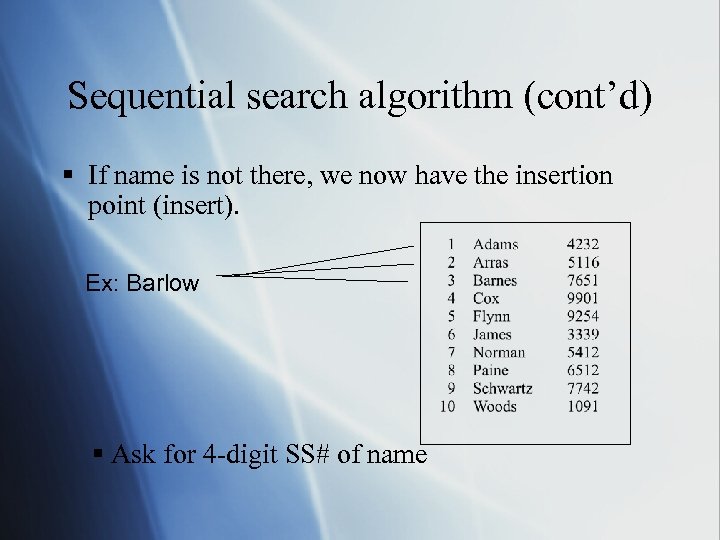
Sequential search algorithm (cont’d) § If name is not there, we now have the insertion point (insert). Ex: Barlow § Ask for 4 -digit SS# of name
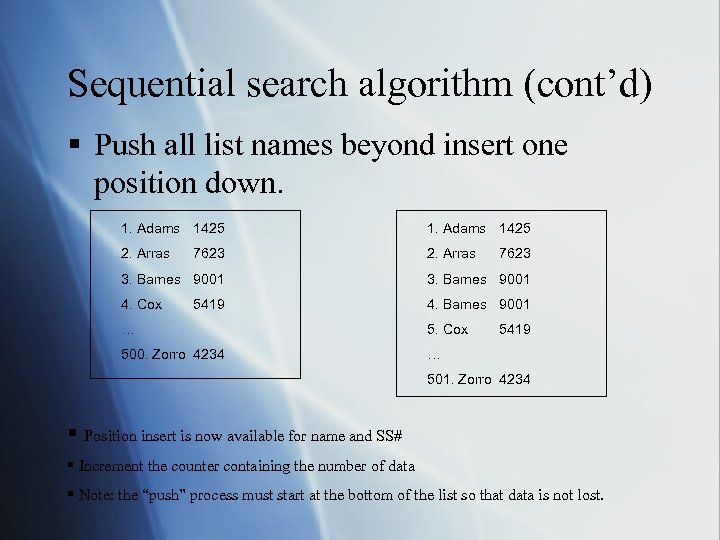
Sequential search algorithm (cont’d) § Push all list names beyond insert one position down. 1. Adams 1425 2. Arras 7623 3. Barnes 9001 4. Cox 4. Barnes 9001 5419 … 5. Cox 500. Zorro 4234 5419 … 501. Zorro 4234 § Position insert is now available for name and SS# § Increment the counter containing the number of data § Note: the “push” process must start at the bottom of the list so that data is not lost.
Problem with Sequential Search § Inefficiency 1. On the average, it will take 5 searches to find a name (assuming no bias in choice of name) 2. If name is not found, it will take 10 searches to ascertain that information. A list of 500 names requires 500 searches. Note: in this age of speed, 500 searches can be done in a microsecond. It is hard to justify a need to generate a more efficient method to save such a small amount of time. It should be mentioned that if there were 10 million names with the process continuing over and over, the need for efficiency is much more pronounced. Hence a more efficient method is needed.
The binary search § We start with the same premises. 10 names and name. § We also introduce 3 new integer variables: low, high and target. § low is initially set equal to 1. § high is initally set equal to 11. § target will be the average of high and low.
Binary search (cont’d) § If target is a decimal, the decimal part of it is chopped off. § We always compare name to the name in the target position. If they match, we printout the SS#. We are done.
Binary search (cont’d) § If they don’t match, we find if name is greater than target name. If so, we know that name is further down in the list and we change: low = target. § Otherwise we know that name is alphabetically before the target name and we change: high = target
Binary search (cont’d) § Continue the process target = (low + high)/2 - integer value § We are done (name not found) when high = low. § If the name is not found, we push all names from the target position down as before insert the new name into target, and increment the counter of names.
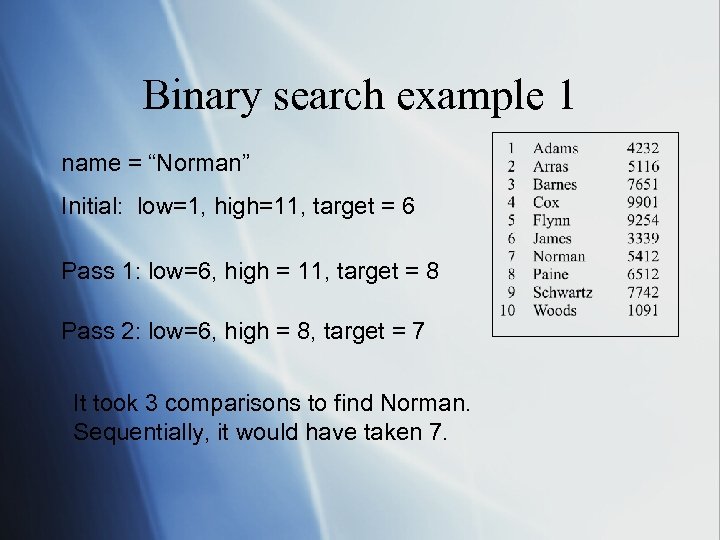
Binary search example 1 name = “Norman” Initial: low=1, high=11, target = 6 Pass 1: low=6, high = 11, target = 8 Pass 2: low=6, high = 8, target = 7 It took 3 comparisons to find Norman. Sequentially, it would have taken 7.
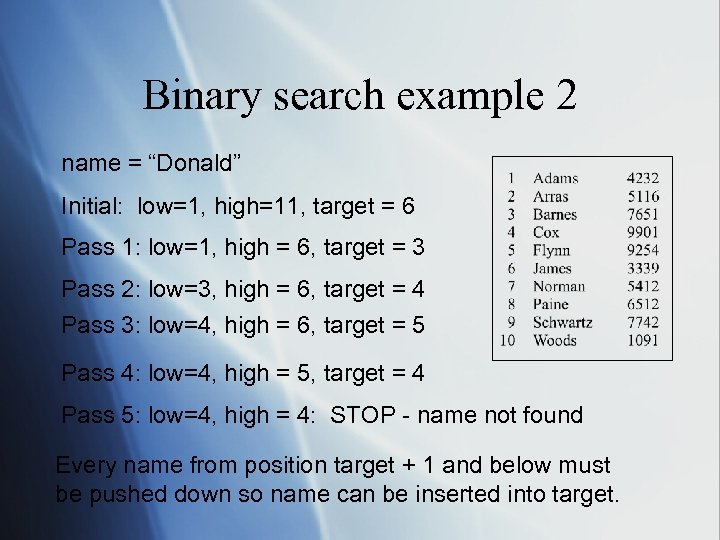
Binary search example 2 name = “Donald” Initial: low=1, high=11, target = 6 Pass 1: low=1, high = 6, target = 3 Pass 2: low=3, high = 6, target = 4 Pass 3: low=4, high = 6, target = 5 Pass 4: low=4, high = 5, target = 4 Pass 5: low=4, high = 4: STOP - name not found Every name from position target + 1 and below must be pushed down so name can be inserted into target.
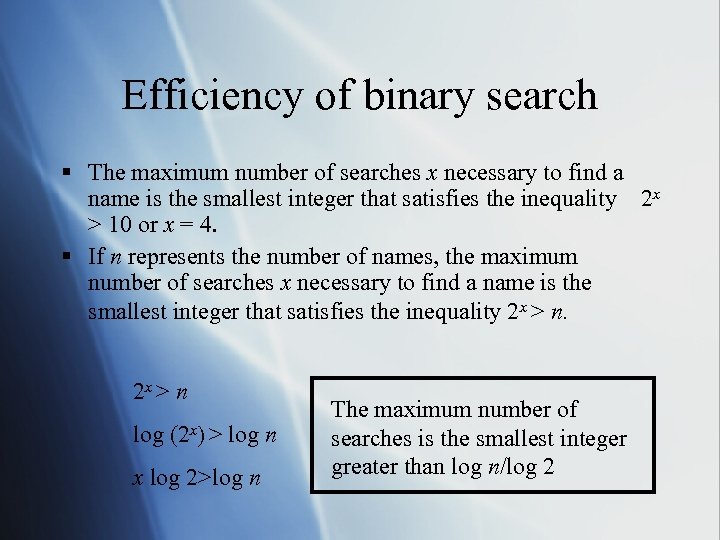
Efficiency of binary search § The maximum number of searches x necessary to find a name is the smallest integer that satisfies the inequality 2 x > 10 or x = 4. § If n represents the number of names, the maximum number of searches x necessary to find a name is the smallest integer that satisfies the inequality 2 x > n log (2 x) > log n x log 2>log n The maximum number of searches is the smallest integer greater than log n/log 2
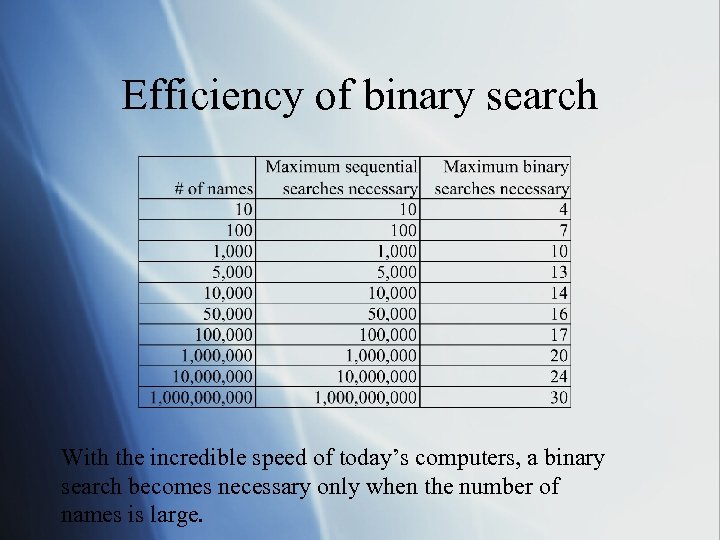
Efficiency of binary search With the incredible speed of today’s computers, a binary search becomes necessary only when the number of names is large.
Скачать презентацию Binary Searching Earl Paine Stu Schwartz Copyright
67dc515ff37164f7a342bba245547f51.ppt