 Скачать презентацию Big Sim Tutorial Celso L Mendes — Ryan
c0bf01238a9329ce703286fbfe1e69a5.ppt
- Количество слайдов: 99



Big. Sim Tutorial Celso L. Mendes - Ryan Mokos Department of Computer Science University of Illinois at Urbana-Champaign {cmendes, mokos}@illinois. edu http: //charm. cs. uiuc. edu April 20, 2011 9 th Annual Charm++ Workshop
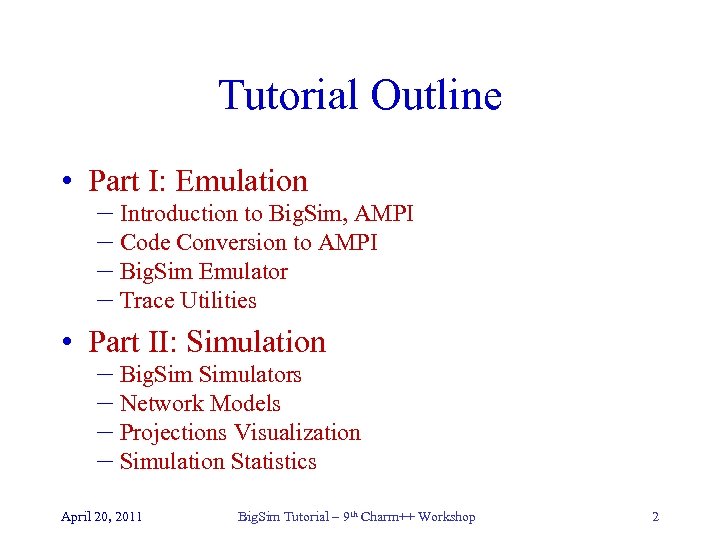
Tutorial Outline • Part I: Emulation – Introduction to Big. Sim, AMPI – Code Conversion to AMPI – Big. Sim Emulator – Trace Utilities • Part II: Simulation – Big. Simulators – Network Models – Projections Visualization – Simulation Statistics April 20, 2011 Big. Sim Tutorial – 9 th Charm++ Workshop 2
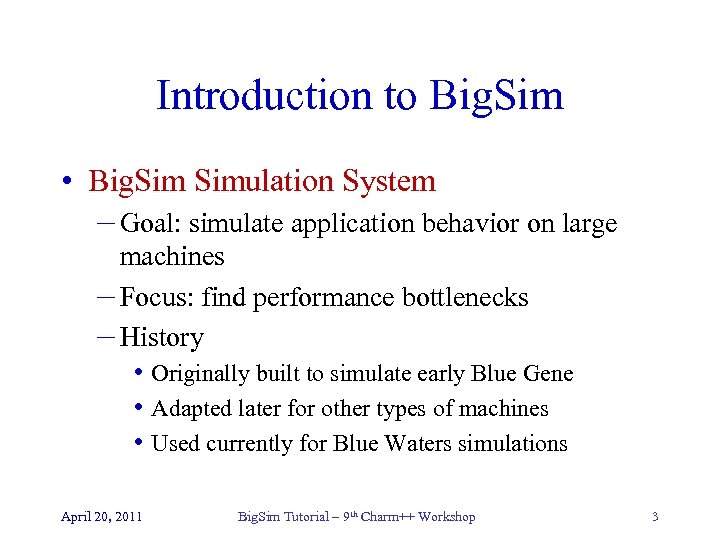
Introduction to Big. Sim • Big. Simulation System – Goal: simulate application behavior on large machines – Focus: find performance bottlenecks – History • Originally built to simulate early Blue Gene • Adapted later for other types of machines • Used currently for Blue Waters simulations April 20, 2011 Big. Sim Tutorial – 9 th Charm++ Workshop 3
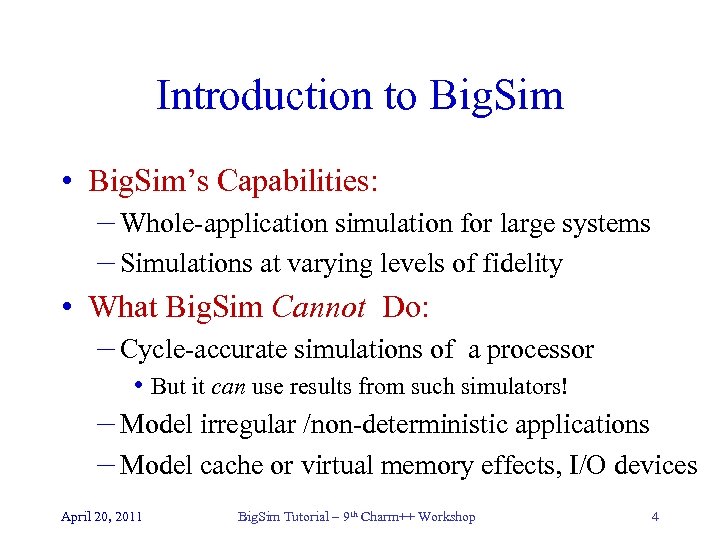
Introduction to Big. Sim • Big. Sim’s Capabilities: – Whole-application simulation for large systems – Simulations at varying levels of fidelity • What Big. Sim Cannot Do: – Cycle-accurate simulations of a processor • But it can use results from such simulators! – Model irregular /non-deterministic applications – Model cache or virtual memory effects, I/O devices April 20, 2011 Big. Sim Tutorial – 9 th Charm++ Workshop 4
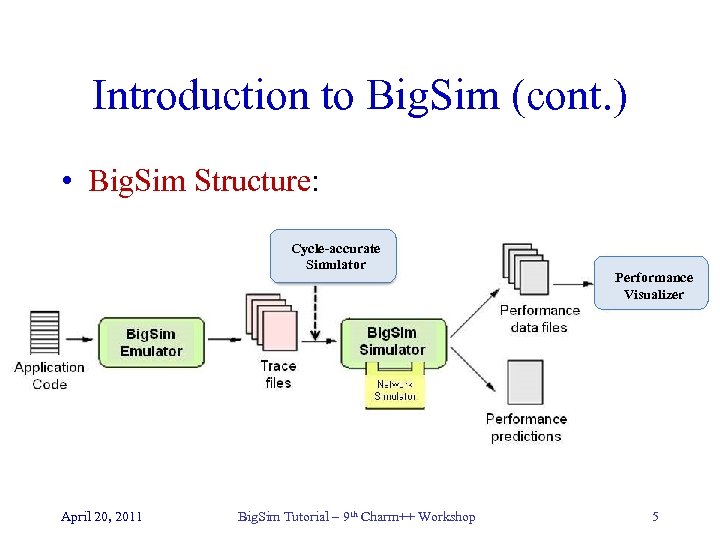
Introduction to Big. Sim (cont. ) • Big. Sim Structure: Cycle-accurate Simulator April 20, 2011 Big. Sim Tutorial – 9 th Charm++ Workshop Performance Visualizer 5
Introduction to Big. Sim (cont. ) • Big. Sim: Application Requirements – MPI codes: • Must be converted to Adaptive MPI (AMPI) – i. e. must not have global or static variables – Charm++ codes: • Must have dependencies manually added • Structured-dagger programs are OK April 20, 2011 Big. Sim Tutorial – 9 th Charm++ Workshop 6
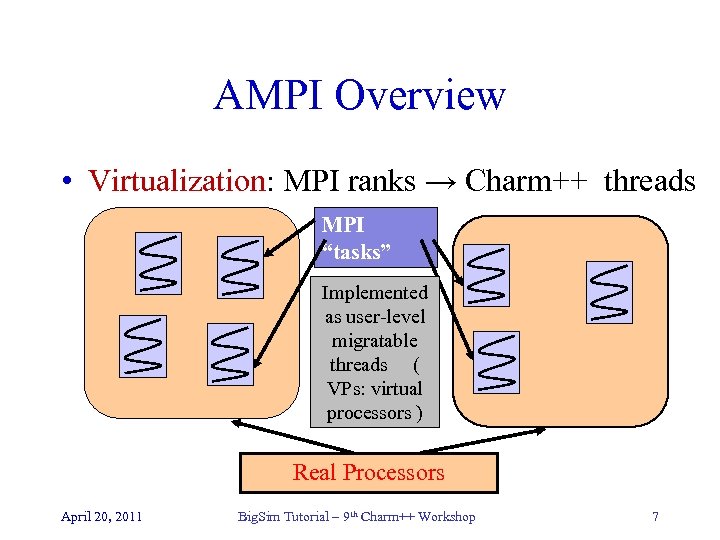
AMPI Overview • Virtualization: MPI ranks → Charm++ threads MPI “tasks” Implemented as user-level migratable threads ( VPs: virtual processors ) Real Processors April 20, 2011 Big. Sim Tutorial – 9 th Charm++ Workshop 7
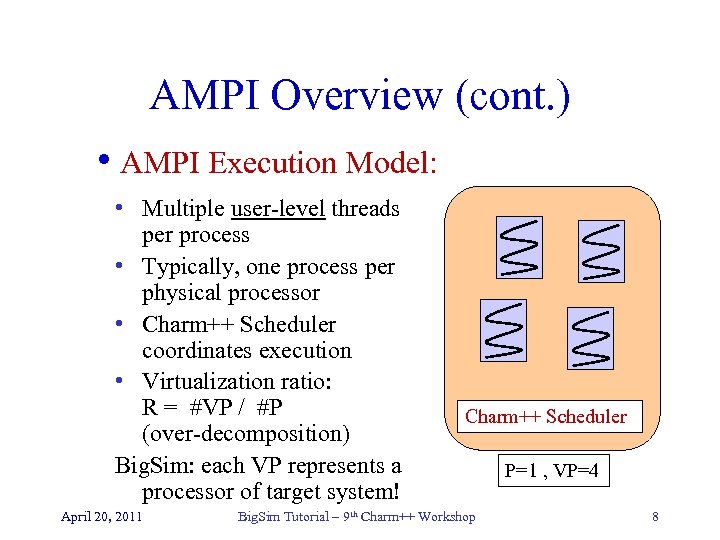
AMPI Overview (cont. ) • AMPI Execution Model: • Multiple user-level threads per process • Typically, one process per physical processor • Charm++ Scheduler coordinates execution • Virtualization ratio: R = #VP / #P (over-decomposition) Big. Sim: each VP represents a processor of target system! April 20, 2011 Charm++ Scheduler Big. Sim Tutorial – 9 th Charm++ Workshop P=1 , VP=4 8
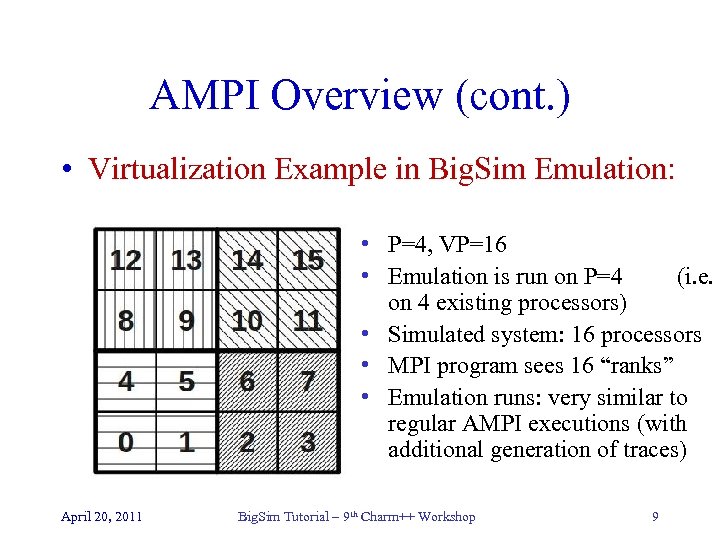
AMPI Overview (cont. ) • Virtualization Example in Big. Sim Emulation: • P=4, VP=16 • Emulation is run on P=4 (i. e. on 4 existing processors) • Simulated system: 16 processors • MPI program sees 16 “ranks” • Emulation runs: very similar to regular AMPI executions (with additional generation of traces) April 20, 2011 Big. Sim Tutorial – 9 th Charm++ Workshop 9
Code Conversion to AMPI • Fortran codes: – Replace program by subroutine MPI_Main • C/C++ codes: – Just make sure that mpi. h is included in the same file as main() • Both Fortran/C/C++ codes: – Handle (e. g. remove) global and static variables April 20, 2011 Big. Sim Tutorial – 9 th Charm++ Workshop 10
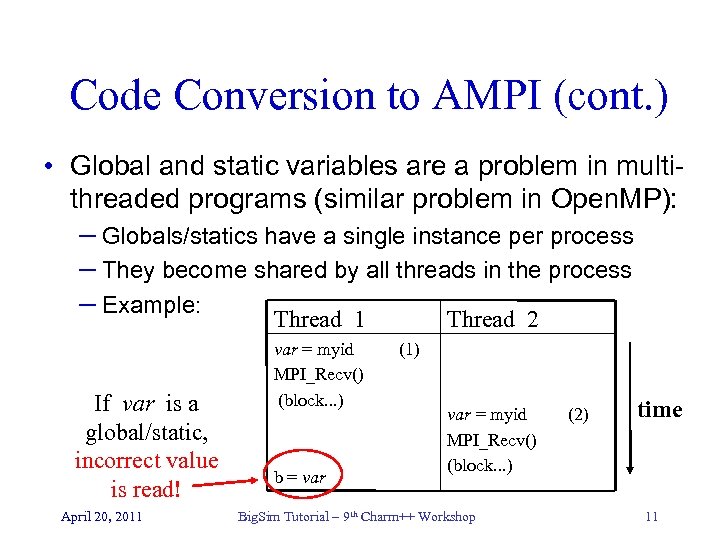
Code Conversion to AMPI (cont. ) • Global and static variables are a problem in multithreaded programs (similar problem in Open. MP): – Globals/statics have a single instance per process – They become shared by all threads in the process – Example: Thread 1 Thread 2 If var is a global/static, incorrect value is read! April 20, 2011 var = myid MPI_Recv() (block. . . ) b = var (1) var = myid MPI_Recv() (block. . . ) Big. Sim Tutorial – 9 th Charm++ Workshop (2) time 11
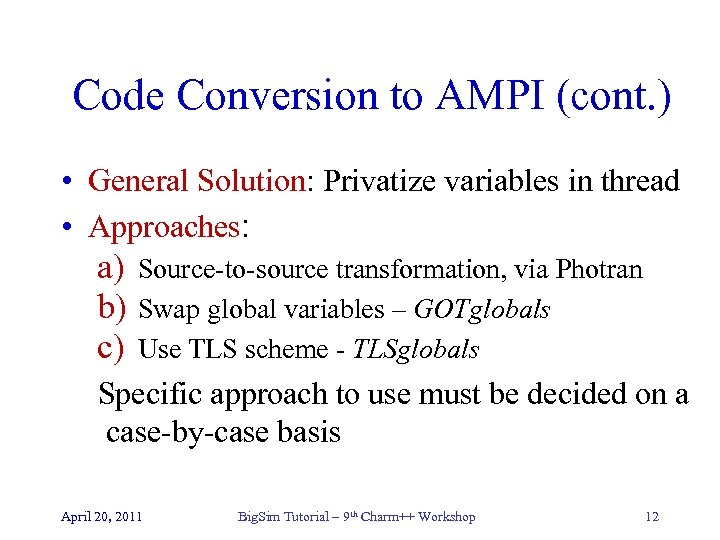
Code Conversion to AMPI (cont. ) • General Solution: Privatize variables in thread • Approaches: a) b) c) Source-to-source transformation, via Photran Swap global variables – GOTglobals Use TLS scheme - TLSglobals Specific approach to use must be decided on a case-by-case basis April 20, 2011 Big. Sim Tutorial – 9 th Charm++ Workshop 12
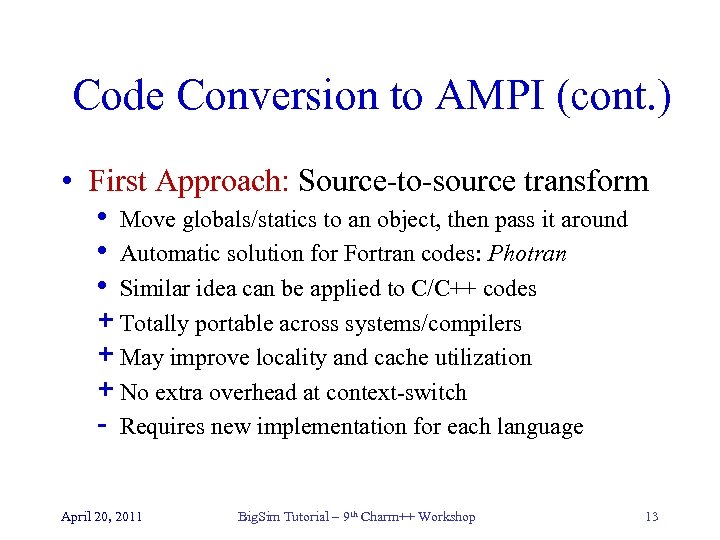
Code Conversion to AMPI (cont. ) • First Approach: Source-to-source transform • Move globals/statics to an object, then pass it around • Automatic solution for Fortran codes: Photran • Similar idea can be applied to C/C++ codes + Totally portable across systems/compilers + May improve locality and cache utilization + No extra overhead at context-switch - Requires new implementation for each language April 20, 2011 Big. Sim Tutorial – 9 th Charm++ Workshop 13
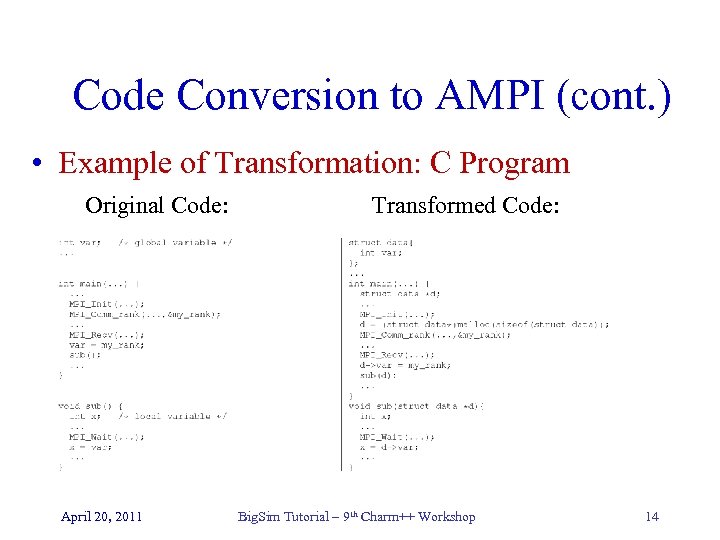
Code Conversion to AMPI (cont. ) • Example of Transformation: C Program Original Code: April 20, 2011 Transformed Code: Big. Sim Tutorial – 9 th Charm++ Workshop 14
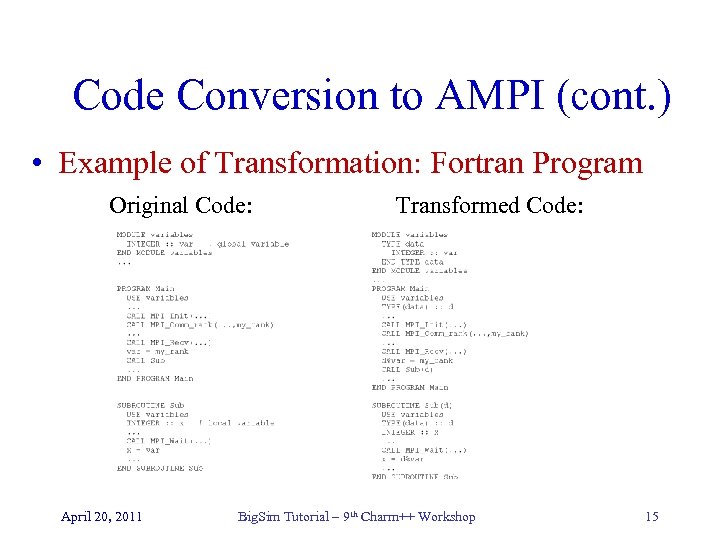
Code Conversion to AMPI (cont. ) • Example of Transformation: Fortran Program Original Code: April 20, 2011 Transformed Code: Big. Sim Tutorial – 9 th Charm++ Workshop 15
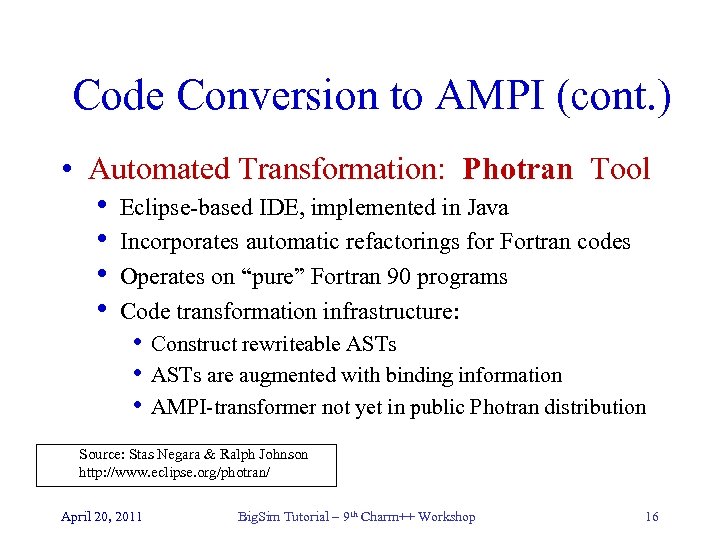
Code Conversion to AMPI (cont. ) • Automated Transformation: Photran Tool • • Eclipse-based IDE, implemented in Java Incorporates automatic refactorings for Fortran codes Operates on “pure” Fortran 90 programs Code transformation infrastructure: • Construct rewriteable ASTs • ASTs are augmented with binding information • AMPI-transformer not yet in public Photran distribution Source: Stas Negara & Ralph Johnson http: //www. eclipse. org/photran/ April 20, 2011 Big. Sim Tutorial – 9 th Charm++ Workshop 16
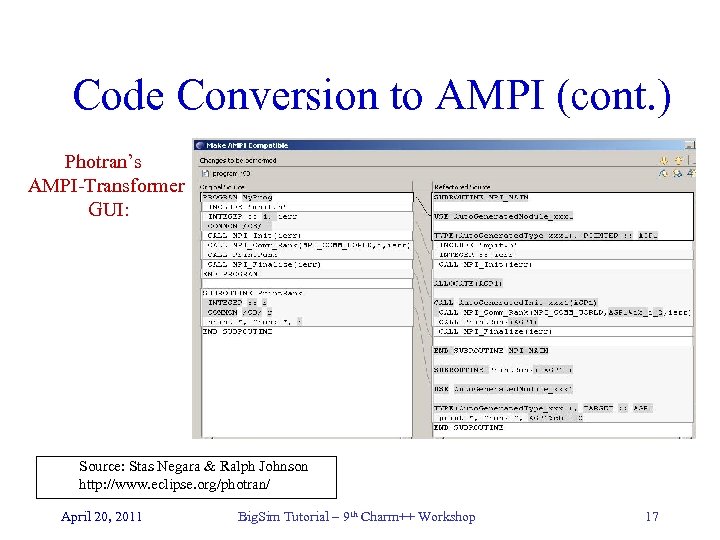
Code Conversion to AMPI (cont. ) Photran’s AMPI-Transformer GUI: Source: Stas Negara & Ralph Johnson http: //www. eclipse. org/photran/ April 20, 2011 Big. Sim Tutorial – 9 th Charm++ Workshop 17
Code Conversion to AMPI (cont. ) • Second Approach: GOT-Globals • Leverage ELF – Execut. & Linking Format (e. g. Linux) • ELF maintains a Global Offset Table (GOT) for globals • Switch GOT contents at thread context-switch • Implemented in AMPI via build flag –swapglobals + No source code changes needed + Works with any language (C, C++, Fortran, etc) - Does not handle static variables - Context-switch overhead grows with num. variables April 20, 2011 Big. Sim Tutorial – 9 th Charm++ Workshop 18
Code Conversion to AMPI (cont. ) • Third Approach: TLS-Globals • Originally employed in kernel threads • In C/C++ code, variables can be annotated with __thread • Modified/adapted gfortran compiler available • Implemented in AMPI via build flag –tlsglobals + Handles uniformly both globals and statics + No extra overhead at context-switch - Although popular, not yet a standard for compilers - Current Charm++ support only for x 86 platforms April 20, 2011 Big. Sim Tutorial – 9 th Charm++ Workshop 19
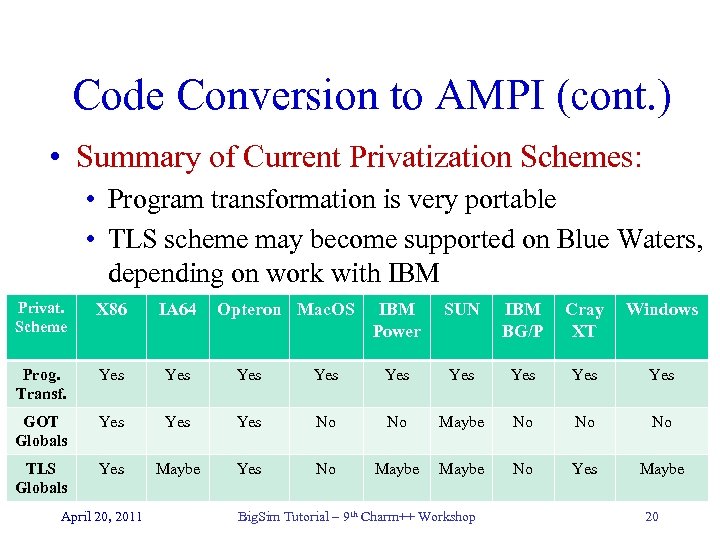
Code Conversion to AMPI (cont. ) • Summary of Current Privatization Schemes: • Program transformation is very portable • TLS scheme may become supported on Blue Waters, depending on work with IBM Privat. Scheme X 86 IA 64 Prog. Transf. Yes Yes GOT Globals Yes TLS Globals Yes Maybe April 20, 2011 Opteron Mac. OS IBM Power SUN IBM BG/P Cray XT Windows Yes Yes No No Maybe No No No Yes No Maybe No Yes Maybe Big. Sim Tutorial – 9 th Charm++ Workshop 20
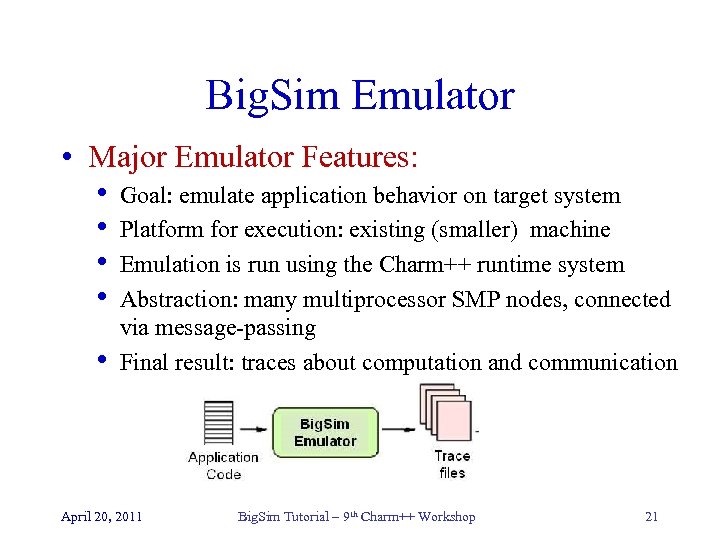
Big. Sim Emulator • Major Emulator Features: • • • Goal: emulate application behavior on target system Platform for execution: existing (smaller) machine Emulation is run using the Charm++ runtime system Abstraction: many multiprocessor SMP nodes, connected via message-passing Final result: traces about computation and communication April 20, 2011 Big. Sim Tutorial – 9 th Charm++ Workshop 21
Big. Sim Emulator (cont. ) • Preparing Big. Sim Emulator for Use: • Download Charm++ • http: //charm. cs. uiuc. edu/downloads. shtml • Build Charm++/AMPI with “bigemulator” option: • e. g. . /build AMPI net-linux-x 86_64 bigemulator –O • This builds Charm++ and emulator libraries under subdir net-linux-x 86_64 -bigemulator/ • Compiler wrappers available for MPI applications: net-linux-x 86_64 -bigemulator/bin/ampicc, ampicxx, ampif 90, . . . April 20, 2011 Big. Sim Tutorial – 9 th Charm++ Workshop 22
Big. Sim Emulator (cont. ) • Big. Sim Emulator Usage: • Emulation is run via charmrun (like any AMPI run) • e. g. charmrun +p 4 +vp 16 prog_emul • Emulation controlled via flags or configuration file • Command-line flags: • Any Charm++/AMPI flags will work as usual • Other Big. Sim-specific flags can be employed too • Configuration file: specified via +bgconfig_file • Command-line flags have precedence over config. file April 20, 2011 Big. Sim Tutorial – 9 th Charm++ Workshop 23
Big. Sim Emulator (cont. ) • Big. Sim Emulator – Major Flags: • +x, +y, +z: specify number of SMP target nodes • Only make full sense on target systems with 3 D-topology • Typically, one can use +x=K, +y=1, +z=1 where K is the number of nodes in the target system • +cth, +wth: specify communic. and worker threads • Typically, cth=1, wth=M where M is the number of cores in each node of the target system • +bglog: produce trace files at end, for simulation April 20, 2011 Big. Sim Tutorial – 9 th Charm++ Workshop 24
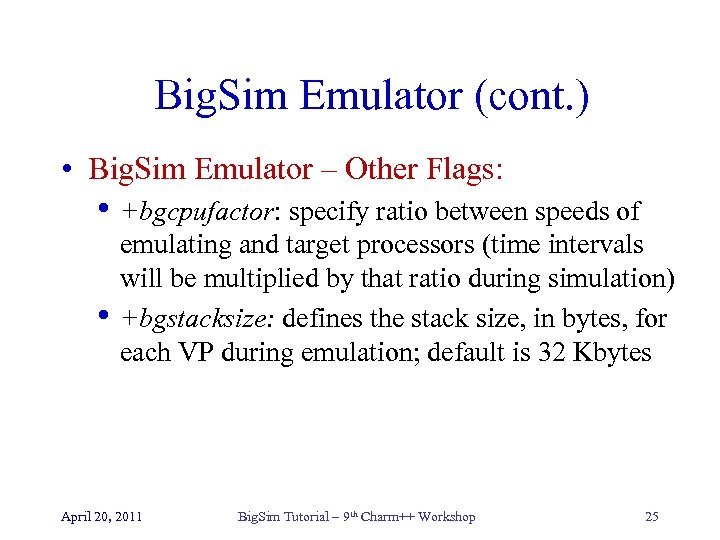
Big. Sim Emulator (cont. ) • Big. Sim Emulator – Other Flags: • +bgcpufactor: specify ratio between speeds of • emulating and target processors (time intervals will be multiplied by that ratio during simulation) +bgstacksize: defines the stack size, in bytes, for each VP during emulation; default is 32 Kbytes April 20, 2011 Big. Sim Tutorial – 9 th Charm++ Workshop 25
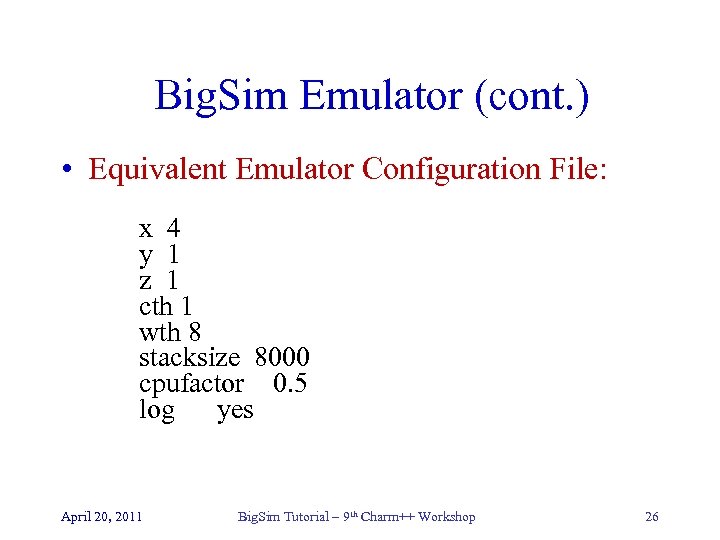
Big. Sim Emulator (cont. ) • Equivalent Emulator Configuration File: x 4 y 1 z 1 cth 1 wth 8 stacksize 8000 cpufactor 0. 5 log yes April 20, 2011 Big. Sim Tutorial – 9 th Charm++ Workshop 26
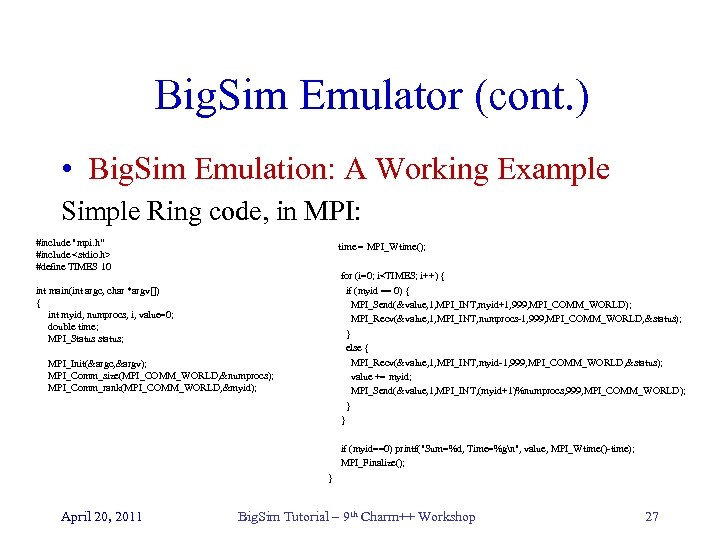
Big. Sim Emulator (cont. ) • Big. Sim Emulation: A Working Example Simple Ring code, in MPI: #include "mpi. h“ #include <stdio. h> #define TIMES 10 time = MPI_Wtime(); for (i=0; i<TIMES; i++) { if (myid == 0) { MPI_Send(&value, 1, MPI_INT, myid+1, 999, MPI_COMM_WORLD); MPI_Recv(&value, 1, MPI_INT, numprocs-1, 999, MPI_COMM_WORLD, &status); } else { MPI_Recv(&value, 1, MPI_INT, myid-1, 999, MPI_COMM_WORLD, &status); value += myid; MPI_Send(&value, 1, MPI_INT, (myid+1)%numprocs, 999, MPI_COMM_WORLD); } } int main(int argc, char *argv[]) { int myid, numprocs, i, value=0; double time; MPI_Status status; MPI_Init(&argc, &argv); MPI_Comm_size(MPI_COMM_WORLD, &numprocs); MPI_Comm_rank(MPI_COMM_WORLD, &myid); if (myid==0) printf("Sum=%d, Time=%gn", value, MPI_Wtime()-time); MPI_Finalize(); } April 20, 2011 Big. Sim Tutorial – 9 th Charm++ Workshop 27
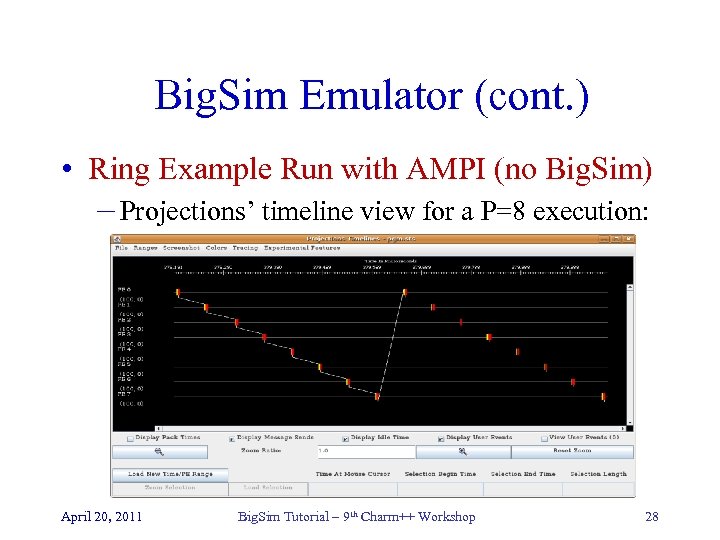
Big. Sim Emulator (cont. ) • Ring Example Run with AMPI (no Big. Sim) – Projections’ timeline view for a P=8 execution: April 20, 2011 Big. Sim Tutorial – 9 th Charm++ Workshop 28
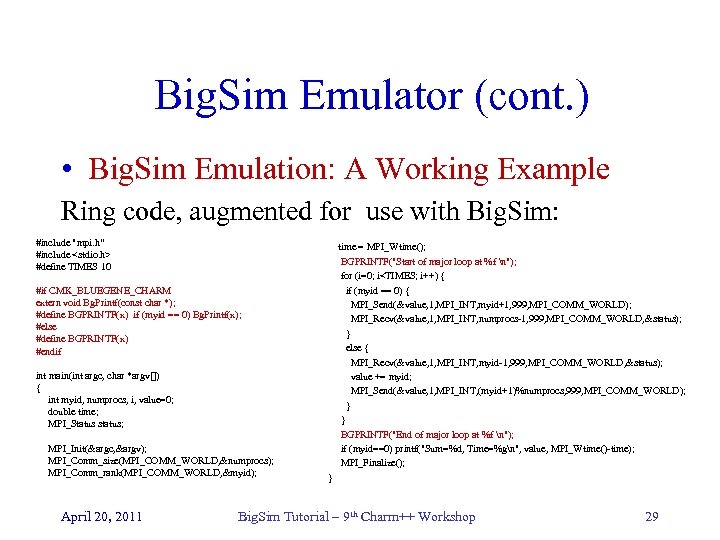
Big. Sim Emulator (cont. ) • Big. Sim Emulation: A Working Example Ring code, augmented for use with Big. Sim: #include "mpi. h“ #include <stdio. h> #define TIMES 10 time = MPI_Wtime(); BGPRINTF("Start of major loop at %f n"); for (i=0; i<TIMES; i++) { if (myid == 0) { MPI_Send(&value, 1, MPI_INT, myid+1, 999, MPI_COMM_WORLD); MPI_Recv(&value, 1, MPI_INT, numprocs-1, 999, MPI_COMM_WORLD, &status); } else { MPI_Recv(&value, 1, MPI_INT, myid-1, 999, MPI_COMM_WORLD, &status); value += myid; MPI_Send(&value, 1, MPI_INT, (myid+1)%numprocs, 999, MPI_COMM_WORLD); } } BGPRINTF("End of major loop at %f n"); if (myid==0) printf("Sum=%d, Time=%gn", value, MPI_Wtime()-time); MPI_Finalize(); #if CMK_BLUEGENE_CHARM extern void Bg. Printf(const char *); #define BGPRINTF(x) if (myid == 0) Bg. Printf(x); #else #define BGPRINTF(x) #endif int main(int argc, char *argv[]) { int myid, numprocs, i, value=0; double time; MPI_Status status; MPI_Init(&argc, &argv); MPI_Comm_size(MPI_COMM_WORLD, &numprocs); MPI_Comm_rank(MPI_COMM_WORLD, &myid); April 20, 2011 } Big. Sim Tutorial – 9 th Charm++ Workshop 29
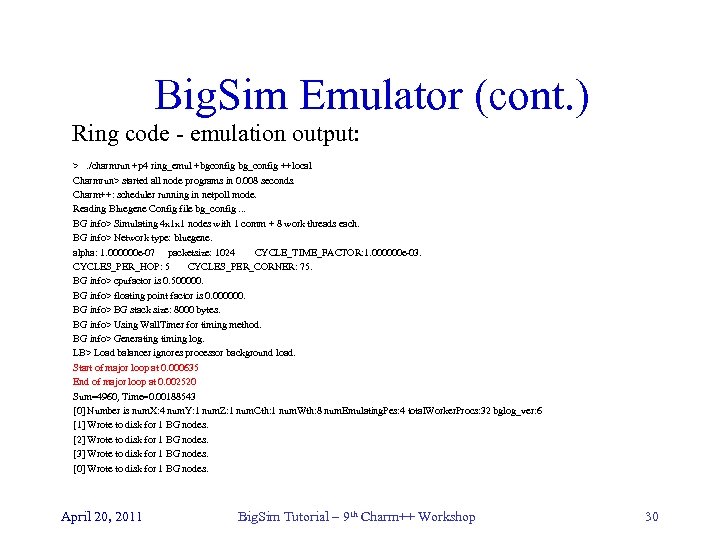
Big. Sim Emulator (cont. ) Ring code - emulation output: >. /charmrun +p 4 ring_emul +bgconfig bg_config ++local Charmrun> started all node programs in 0. 008 seconds. Charm++: scheduler running in netpoll mode. Reading Bluegene Config file bg_config. . . BG info> Simulating 4 x 1 x 1 nodes with 1 comm + 8 work threads each. BG info> Network type: bluegene. alpha: 1. 000000 e-07 packetsize: 1024 CYCLE_TIME_FACTOR: 1. 000000 e-03. CYCLES_PER_HOP: 5 CYCLES_PER_CORNER: 75. BG info> cpufactor is 0. 500000. BG info> floating point factor is 0. 000000. BG info> BG stack size: 8000 bytes. BG info> Using Wall. Timer for timing method. BG info> Generating timing log. LB> Load balancer ignores processor background load. Start of major loop at 0. 000635 End of major loop at 0. 002520 Sum=4960, Time=0. 00188543 [0] Number is num. X: 4 num. Y: 1 num. Z: 1 num. Cth: 1 num. Wth: 8 num. Emulating. Pes: 4 total. Worker. Procs: 32 bglog_ver: 6 [1] Wrote to disk for 1 BG nodes. [2] Wrote to disk for 1 BG nodes. [3] Wrote to disk for 1 BG nodes. [0] Wrote to disk for 1 BG nodes. April 20, 2011 Big. Sim Tutorial – 9 th Charm++ Workshop 30
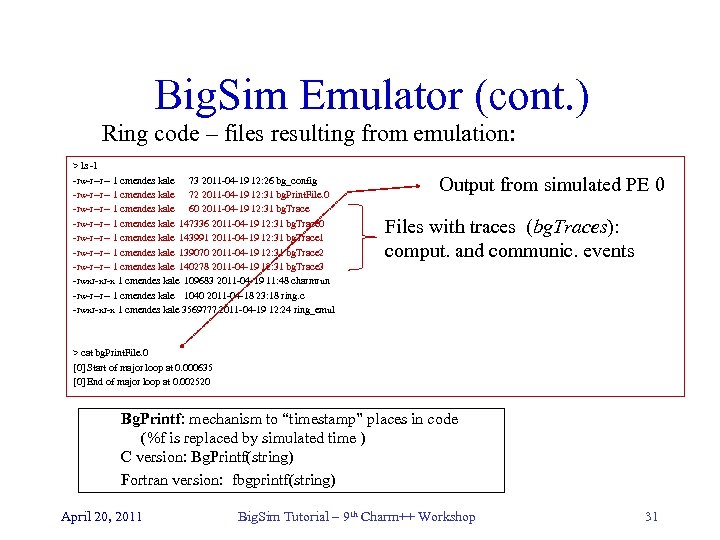
Big. Sim Emulator (cont. ) Ring code – files resulting from emulation: > ls -l -rw-r--r-- 1 cmendes kale 73 2011 -04 -19 12: 26 bg_config -rw-r--r-- 1 cmendes kale 72 2011 -04 -19 12: 31 bg. Print. File. 0 -rw-r--r-- 1 cmendes kale 60 2011 -04 -19 12: 31 bg. Trace -rw-r--r-- 1 cmendes kale 147336 2011 -04 -19 12: 31 bg. Trace 0 -rw-r--r-- 1 cmendes kale 143991 2011 -04 -19 12: 31 bg. Trace 1 -rw-r--r-- 1 cmendes kale 139070 2011 -04 -19 12: 31 bg. Trace 2 -rw-r--r-- 1 cmendes kale 140278 2011 -04 -19 12: 31 bg. Trace 3 -rwxr-xr-x 1 cmendes kale 109683 2011 -04 -19 11: 48 charmrun -rw-r--r-- 1 cmendes kale 1040 2011 -04 -18 23: 18 ring. c -rwxr-xr-x 1 cmendes kale 3569777 2011 -04 -19 12: 24 ring_emul Output from simulated PE 0 Files with traces (bg. Traces): comput. and communic. events > cat bg. Print. File. 0 [0] Start of major loop at 0. 000635 [0] End of major loop at 0. 002520 Bg. Printf: mechanism to “timestamp” places in code (%f is replaced by simulated time ) C version: Bg. Printf(string) Fortran version: fbgprintf(string) April 20, 2011 Big. Sim Tutorial – 9 th Charm++ Workshop 31
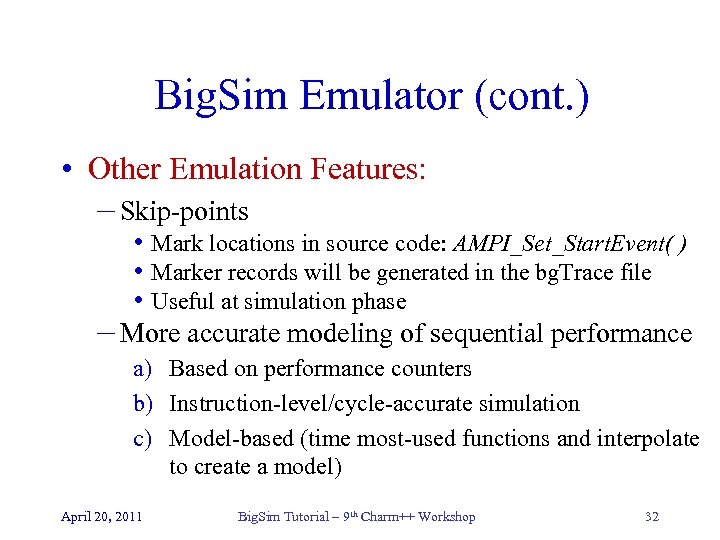
Big. Sim Emulator (cont. ) • Other Emulation Features: – Skip-points • Mark locations in source code: AMPI_Set_Start. Event( ) • Marker records will be generated in the bg. Trace file • Useful at simulation phase – More accurate modeling of sequential performance a) Based on performance counters b) Instruction-level/cycle-accurate simulation c) Model-based (time most-used functions and interpolate to create a model) April 20, 2011 Big. Sim Tutorial – 9 th Charm++ Workshop 32
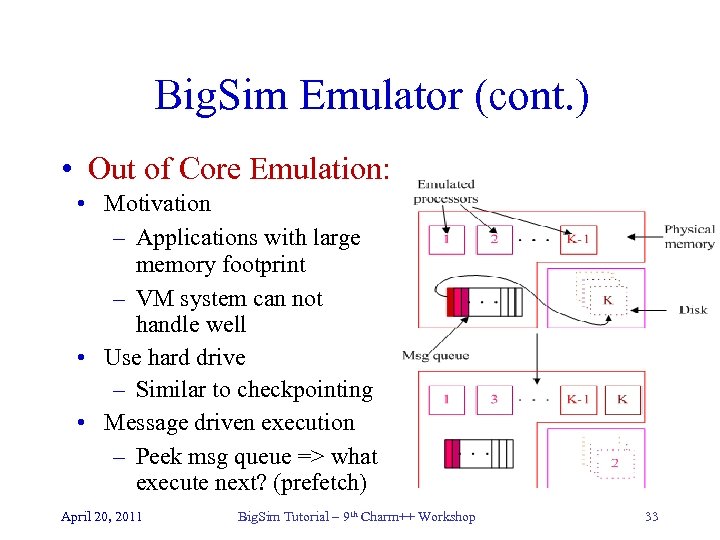
Big. Sim Emulator (cont. ) • Out of Core Emulation: • Motivation – Applications with large memory footprint – VM system can not handle well • Use hard drive – Similar to checkpointing • Message driven execution – Peek msg queue => what execute next? (prefetch) April 20, 2011 Big. Sim Tutorial – 9 th Charm++ Workshop 33
Big. Sim Emulator (cont. ) • Use of Out-of-Core Emulation : • Change charm/tmp/Conv-mach-bigemulator. h • #define BIGSIM_OUT_OF_CORE 1 • Recompile Charm++ and application • Run the emulated application with +bgooc 1024 April 20, 2011 Big. Sim Tutorial – 9 th Charm++ Workshop 34
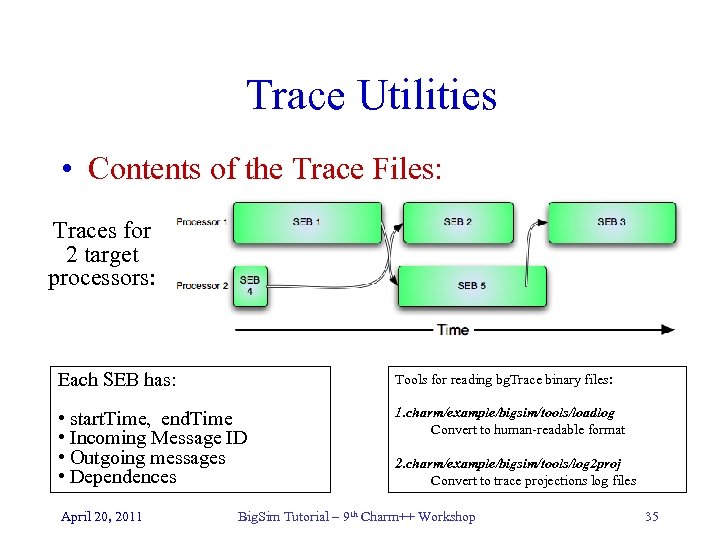
Trace Utilities • Contents of the Trace Files: Traces for 2 target processors: Each SEB has: Tools for reading bg. Trace binary files: • start. Time, end. Time • Incoming Message ID • Outgoing messages • Dependences 1. charm/example/bigsim/tools/loadlog Convert to human-readable format April 20, 2011 2. charm/example/bigsim/tools/log 2 proj Convert to trace projections log files Big. Sim Tutorial – 9 th Charm++ Workshop 35
Trace Utilities (cont. ) • Log. Analyzer : Tool for Analyzing Trace Files – Various options available: • Display number of records for each target processor • Dump events from a target processor, in ASCII • Show number of msgs sent by each target processor • Show number of msgs received by each target processor – Can optionally be used in interactive mode • Log. Analyzer –i – Distributed with the Big. Sim simulation component April 20, 2011 Big. Sim Tutorial – 9 th Charm++ Workshop 36
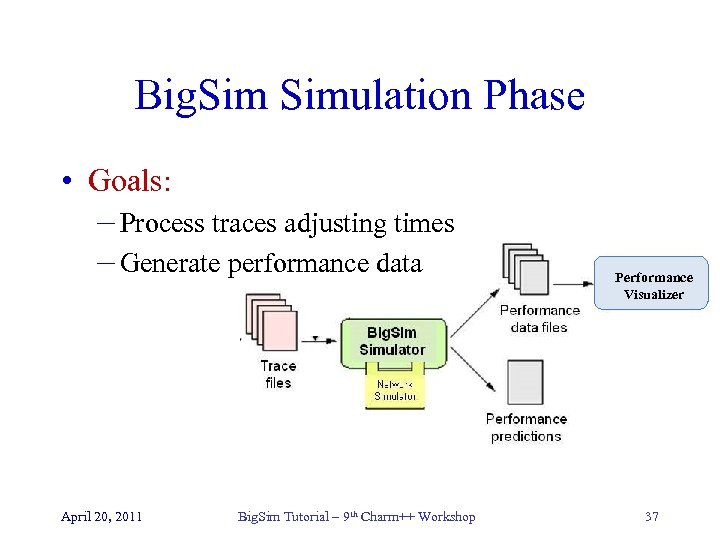
Big. Simulation Phase • Goals: – Process traces adjusting times – Generate performance data Cycle-accurate Simulator April 20, 2011 Big. Sim Tutorial – 9 th Charm++ Workshop Performance Visualizer 37
Simulation Explanation Approach • Difficult to explain all features/dimensions of Big. Sim simulators at once – Lots of options and “branches” • Approach – Show overview of possible build/config paths – Explain features and capabilities – Examples of specific build/config paths – Discuss output April 20, 2011 Big. Sim Tutorial – 9 th Charm++ Workshop 38
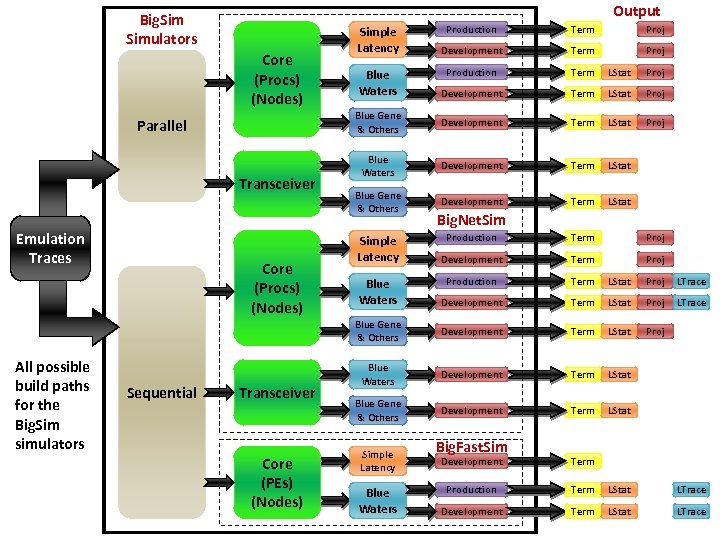
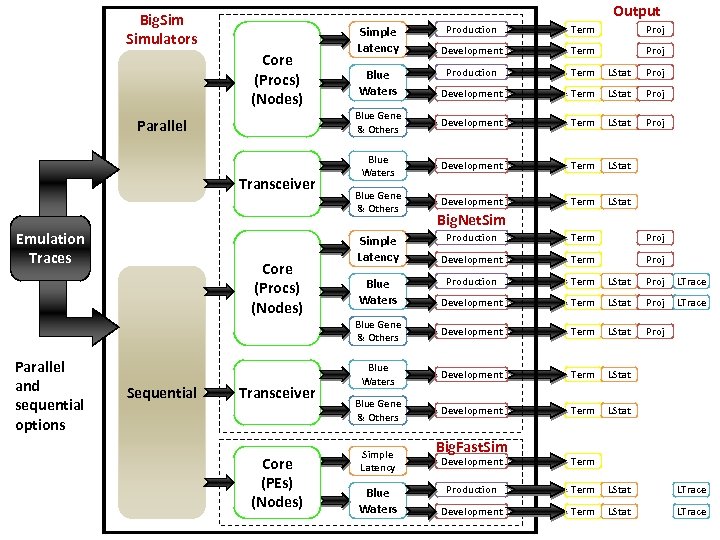
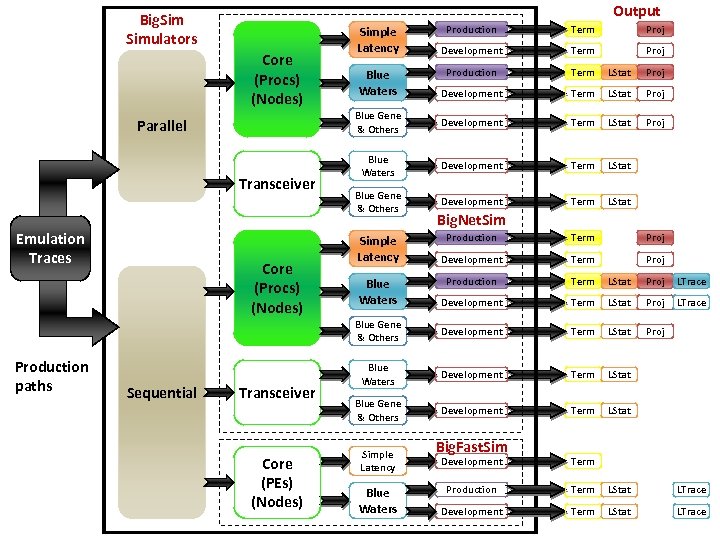
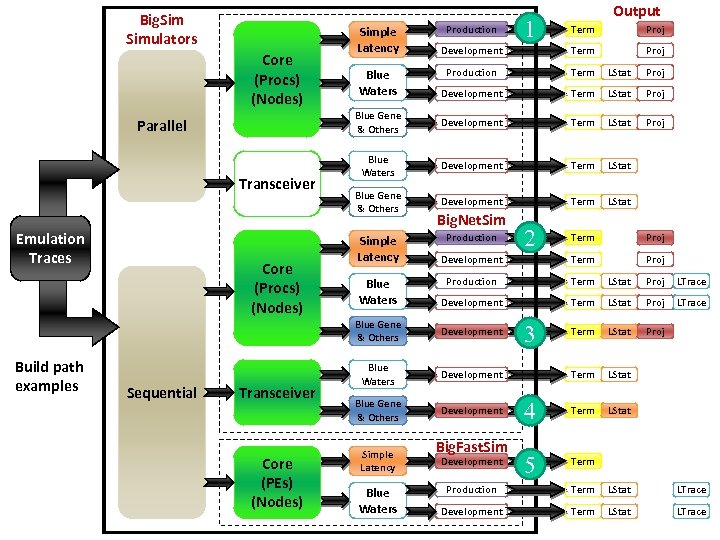
Output Big. Simulators Parallel Transceiver Emulation Traces Term Proj Development Term Proj Production Term LStat Proj Development Term LStat Proj Blue Gene & Others Core (Procs) (Nodes) Production Development Term LStat Proj Blue Waters Development Term LStat Blue Gene & Others Development Term LStat Simple Latency Blue Waters Big. Net. Sim All possible build paths for the Big. Sim simulators Sequential Transceiver Core (PEs) (Nodes) Term Proj Development Term Proj Production Term LStat Proj LTrace Development Term LStat Proj LTrace Blue Gene & Others Core (Procs) (Nodes) Production Development Term LStat Proj Blue Waters Development Term LStat Blue Gene & Others Development Term LStat Simple Latency Blue Waters Big. Fast. Sim Development Term Production Term LStat LTrace Development Term LStat LTrace
Big. Simulation • Packet-level • Post-mortem simulation on emulation traces – Application only run once on emulator to generate traces • Goal: examine network performance – Less concerned about final run time prediction – Most useful for analyzing communicationbound applications April 20, 2011 Big. Sim Tutorial – 9 th Charm++ Workshop 40
Output Big. Simulators Parallel Transceiver Emulation Traces Term Proj Development Term Proj Production Term LStat Proj Development Term LStat Proj Blue Gene & Others Core (Procs) (Nodes) Production Development Term LStat Proj Blue Waters Development Term LStat Blue Gene & Others Development Term LStat Simple Latency Blue Waters Big. Net. Sim Parallel and sequential options Sequential Transceiver Core (PEs) (Nodes) Term Proj Development Term Proj Production Term LStat Proj LTrace Development Term LStat Proj LTrace Blue Gene & Others Core (Procs) (Nodes) Production Development Term LStat Proj Blue Waters Development Term LStat Blue Gene & Others Development Term LStat Simple Latency Blue Waters Big. Fast. Sim Development Term Production Term LStat LTrace Development Term LStat LTrace
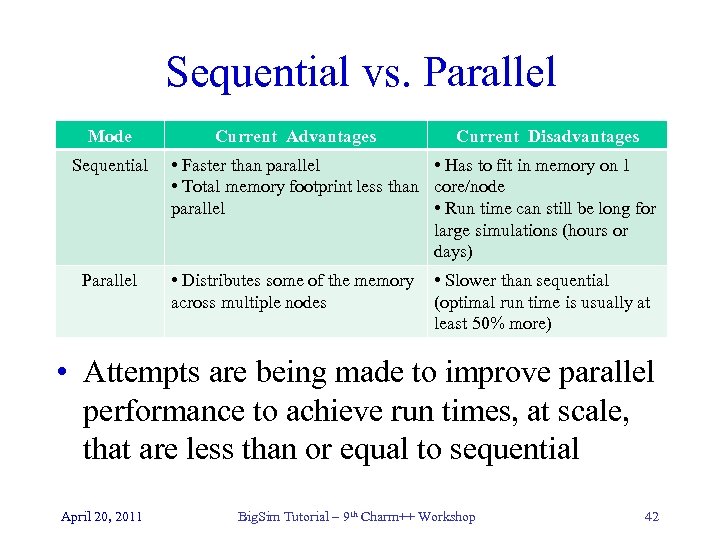
Sequential vs. Parallel Mode Sequential Parallel Current Advantages Current Disadvantages • Faster than parallel • Has to fit in memory on 1 • Total memory footprint less than core/node parallel • Run time can still be long for large simulations (hours or days) • Distributes some of the memory across multiple nodes • Slower than sequential (optimal run time is usually at least 50% more) • Attempts are being made to improve parallel performance to achieve run times, at scale, that are less than or equal to sequential April 20, 2011 Big. Sim Tutorial – 9 th Charm++ Workshop 42
Output Big. Simulators Parallel Transceiver Emulation Traces Term Proj Development Term Proj Production Term LStat Proj Development Term LStat Proj Blue Gene & Others Core (Procs) (Nodes) Production Development Term LStat Proj Blue Waters Development Term LStat Blue Gene & Others Development Term LStat Simple Latency Blue Waters Big. Net. Sim Two Simulators: Big. Net. Sim and Big. Fast. Sim Sequential Transceiver Core (PEs) (Nodes) Term Proj Development Term Proj Production Term LStat Proj LTrace Development Term LStat Proj LTrace Blue Gene & Others Core (Procs) (Nodes) Production Development Term LStat Proj Blue Waters Development Term LStat Blue Gene & Others Development Term LStat Simple Latency Blue Waters Big. Fast. Sim Development Term Production Term LStat LTrace Development Term LStat LTrace
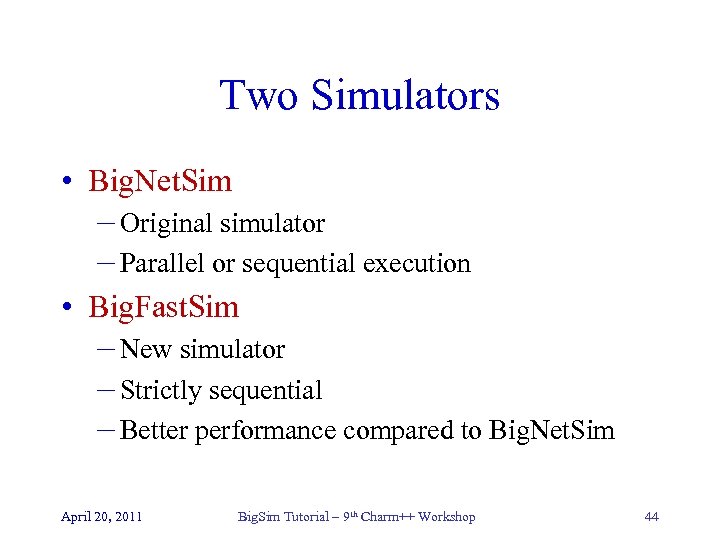
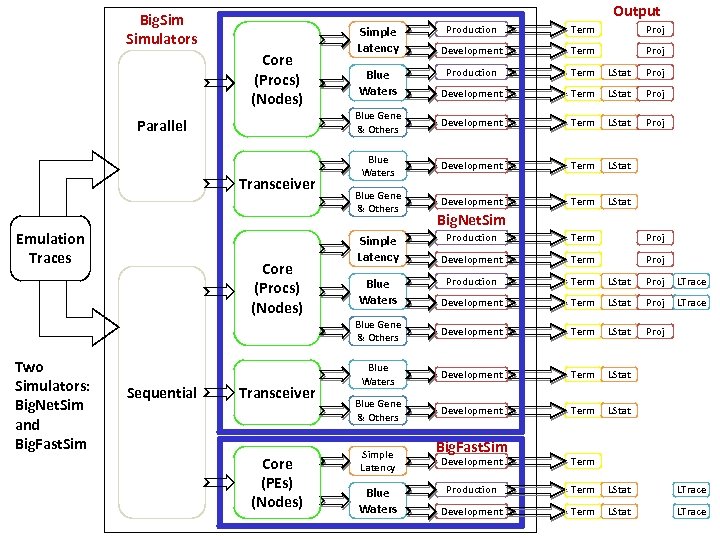
Two Simulators • Big. Net. Sim – Original simulator – Parallel or sequential execution • Big. Fast. Sim – New simulator – Strictly sequential – Better performance compared to Big. Net. Sim April 20, 2011 Big. Sim Tutorial – 9 th Charm++ Workshop 44
Big. Simulators - Big. Net. Sim • Parallel Discrete Event Simulator (PDES) • Built on POSE (Parallel Object-oriented Simulation Environment) – Simulation framework built on Charm++ – Each simulation object (processor, node, switch, etc. ) implemented as a poser • Can take advantage of Charm++ features – Checkpoint-to-disk allows restart after hardware failures or end of allocation time – Load balancing April 20, 2011 Big. Sim Tutorial – 9 th Charm++ Workshop 45
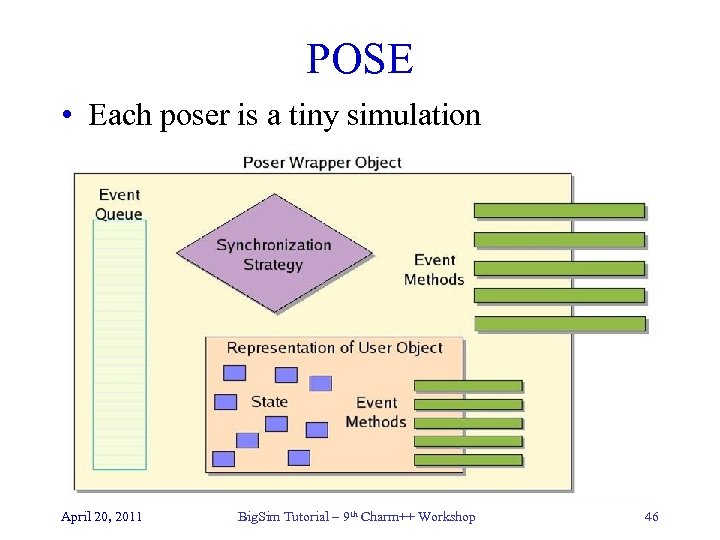
POSE • Each poser is a tiny simulation April 20, 2011 Big. Sim Tutorial – 9 th Charm++ Workshop 46
Big. Simulators – Big. Fast. Sim • Stand-alone C++ program • Does not use Charm++ runtime, but does use some libraries • Runs only on 1 processor – Results in faster execution and smaller memory footprint • Interface is similar to Big. Net. Sim – Still converging April 20, 2011 Big. Sim Tutorial – 9 th Charm++ Workshop 47
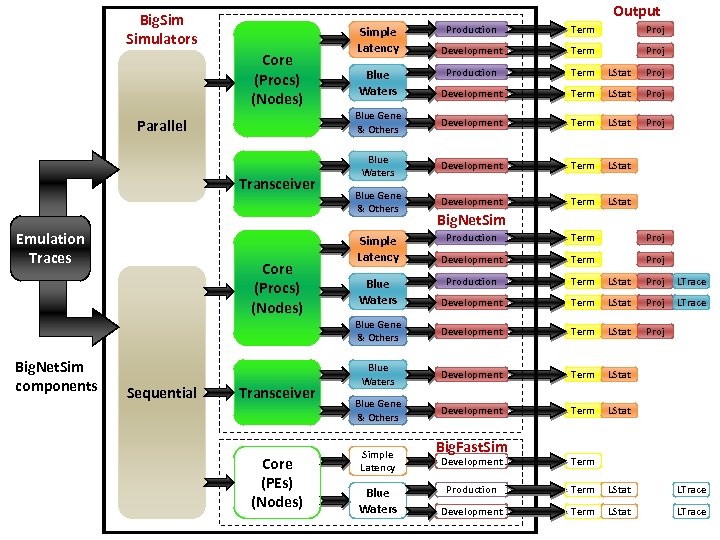
Output Big. Simulators Parallel Transceiver Emulation Traces Term Proj Development Term Proj Production Term LStat Proj Development Term LStat Proj Blue Gene & Others Core (Procs) (Nodes) Production Development Term LStat Proj Blue Waters Development Term LStat Blue Gene & Others Development Term LStat Simple Latency Blue Waters Big. Net. Sim components Sequential Transceiver Core (PEs) (Nodes) Term Proj Development Term Proj Production Term LStat Proj LTrace Development Term LStat Proj LTrace Blue Gene & Others Core (Procs) (Nodes) Production Development Term LStat Proj Blue Waters Development Term LStat Blue Gene & Others Development Term LStat Simple Latency Blue Waters Big. Fast. Sim Development Term Production Term LStat LTrace Development Term LStat LTrace
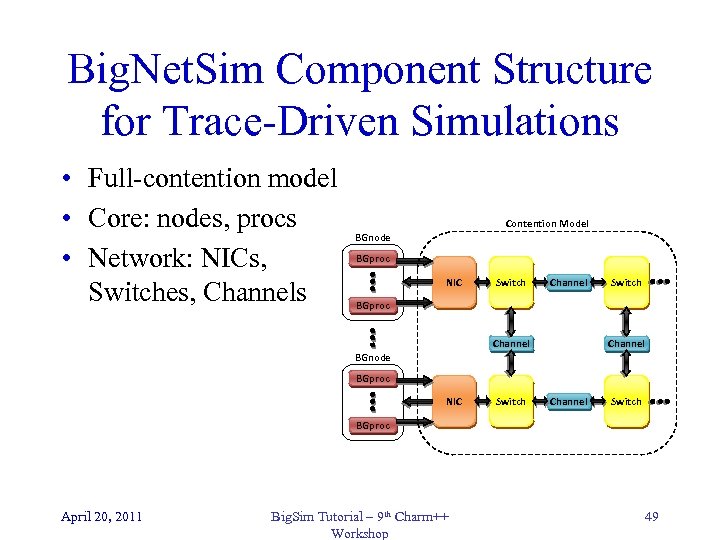
Big. Net. Sim Component Structure for Trace-Driven Simulations • Full-contention model • Core: nodes, procs • Network: NICs, Switches, Channels Contention Model BGnode BGproc NIC Switch Channel Switch BGproc Channel BGnode BGproc NIC Switch Channel Switch BGproc April 20, 2011 Big. Sim Tutorial – 9 th Charm++ Workshop 49
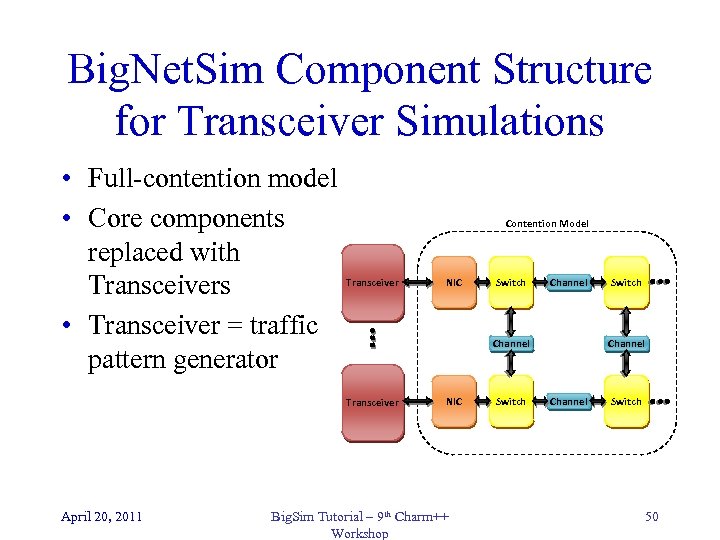
Big. Net. Sim Component Structure for Transceiver Simulations • Full-contention model • Core components replaced with Transceivers • Transceiver = traffic pattern generator Contention Model Transceiver Switch Channel Transceiver April 20, 2011 NIC Big. Sim Tutorial – 9 th Charm++ Workshop Switch Channel Switch 50
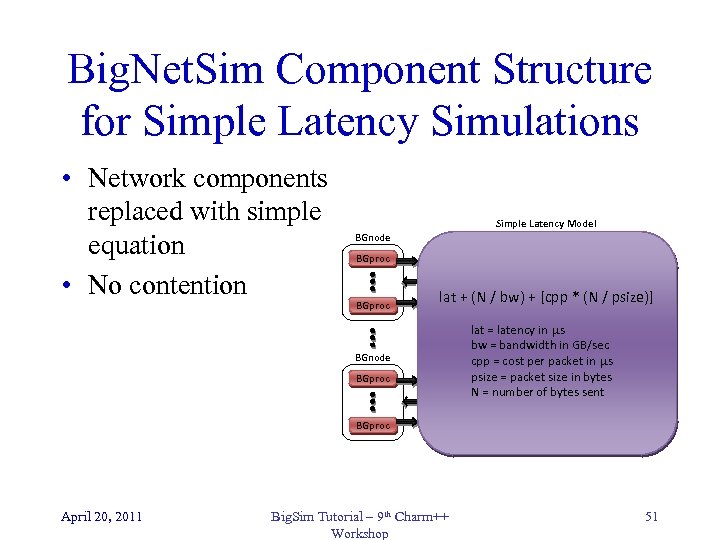
Big. Net. Sim Component Structure for Simple Latency Simulations • Network components replaced with simple equation • No contention Simple Latency Model BGnode BGproc lat + (N / bw) + [cpp * (N / psize)] lat = latency in s bw = bandwidth in GB/sec cpp = cost per packet in s psize = packet size in bytes N = number of bytes sent BGproc April 20, 2011 Big. Sim Tutorial – 9 th Charm++ Workshop 51
Big. Net. Sim – Development vs. Production • Development path – Standard way of building and running in the past – Many more options and parameters – Much more confusing • Production path – Recent addition – Many settings hidden from user – User only has to worry about a handful of command-line parameters February 28, 2007 Celso L. Mendes – PPL / CS - UIUC 52
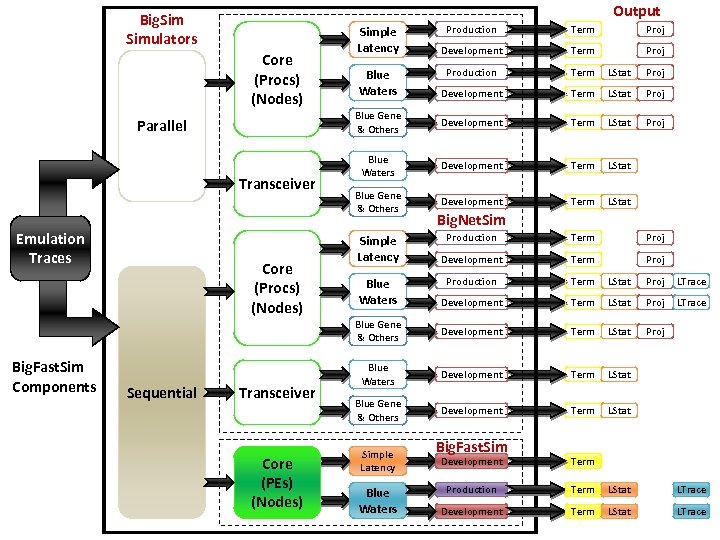
Output Big. Simulators Parallel Transceiver Emulation Traces Term Proj Development Term Proj Production Term LStat Proj Development Term LStat Proj Blue Gene & Others Core (Procs) (Nodes) Production Development Term LStat Proj Blue Waters Development Term LStat Blue Gene & Others Development Term LStat Simple Latency Blue Waters Big. Net. Sim Big. Fast. Sim Components Sequential Transceiver Core (PEs) (Nodes) Term Proj Development Term Proj Production Term LStat Proj LTrace Development Term LStat Proj LTrace Blue Gene & Others Core (Procs) (Nodes) Production Development Term LStat Proj Blue Waters Development Term LStat Blue Gene & Others Development Term LStat Simple Latency Blue Waters Big. Fast. Sim Development Term Production Term LStat LTrace Development Term LStat LTrace
Big. Fast. Sim Build Paths • Has PEs (procs) and nodes like Big. Net. Sim • Currently only has Simple Latency and Blue Waters models – Both production and development paths exist for Blue Waters • Projections output and other network models are planned as future additions April 20, 2011 Big. Sim Tutorial – 9 th Charm++ Workshop 54
Compile and Run Sequence • General procedure and options • Specific examples April 20, 2011 Big. Sim Tutorial – 9 th Charm++ Workshop 55
Basic Workflow (All Paths) • Download and compile Charm++ – Compile POSE – Compile bigsim • Download and compile simulator – Configure simulator – Compile simulator • Run simulator • Analyze output April 20, 2011 Big. Sim Tutorial – 9 th Charm++ Workshop 56
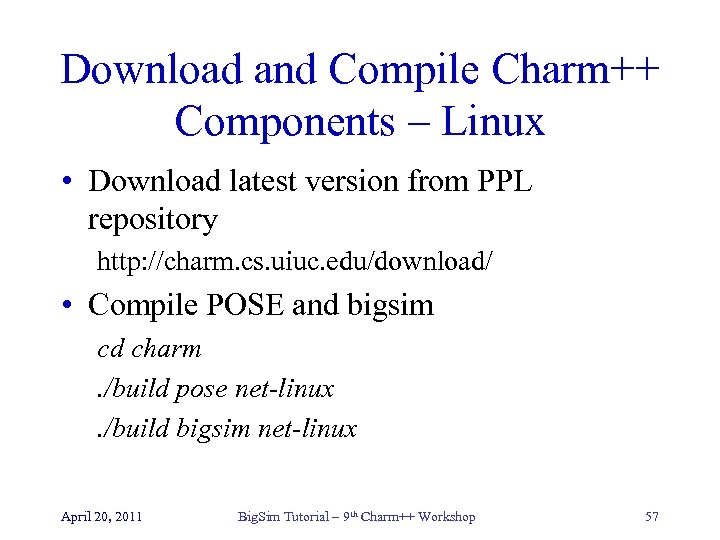
Download and Compile Charm++ Components – Linux • Download latest version from PPL repository http: //charm. cs. uiuc. edu/download/ • Compile POSE and bigsim cd charm. /build pose net-linux. /build bigsim net-linux April 20, 2011 Big. Sim Tutorial – 9 th Charm++ Workshop 57
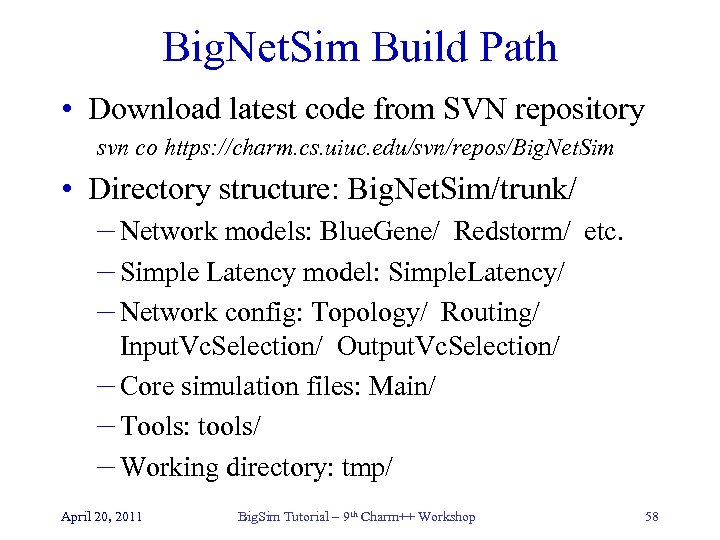
Big. Net. Sim Build Path • Download latest code from SVN repository svn co https: //charm. cs. uiuc. edu/svn/repos/Big. Net. Sim • Directory structure: Big. Net. Sim/trunk/ – Network models: Blue. Gene/ Redstorm/ – Simple Latency model: Simple. Latency/ – Network config: Topology/ Routing/ etc. Input. Vc. Selection/ Output. Vc. Selection/ – Core simulation files: Main/ – Tools: tools/ – Working directory: tmp/ April 20, 2011 Big. Sim Tutorial – 9 th Charm++ Workshop 58
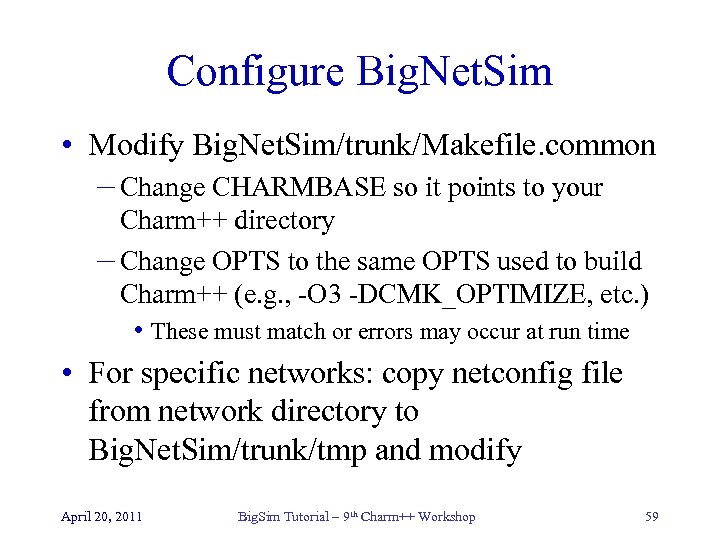
Configure Big. Net. Sim • Modify Big. Net. Sim/trunk/Makefile. common – Change CHARMBASE so it points to your Charm++ directory – Change OPTS to the same OPTS used to build Charm++ (e. g. , -O 3 -DCMK_OPTIMIZE, etc. ) • These must match or errors may occur at run time • For specific networks: copy netconfig file from network directory to Big. Net. Sim/trunk/tmp and modify April 20, 2011 Big. Sim Tutorial – 9 th Charm++ Workshop 59
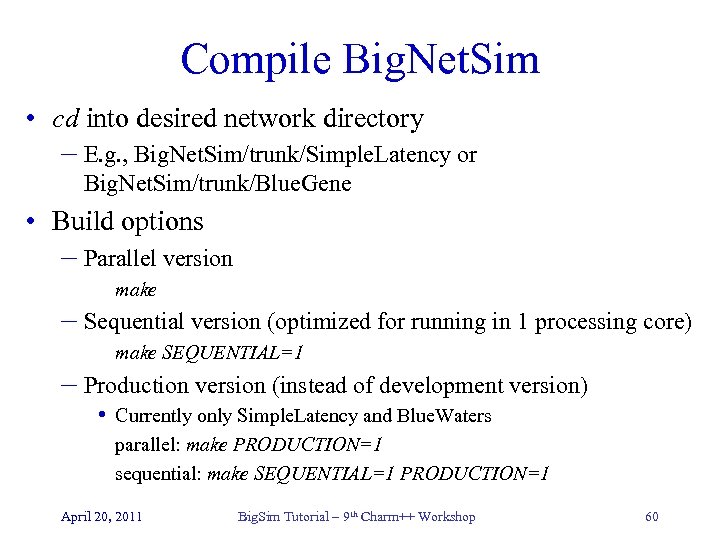
Compile Big. Net. Sim • cd into desired network directory – E. g. , Big. Net. Sim/trunk/Simple. Latency or Big. Net. Sim/trunk/Blue. Gene • Build options – Parallel version make – Sequential version (optimized for running in 1 processing core) make SEQUENTIAL=1 – Production version (instead of development version) • Currently only Simple. Latency and Blue. Waters parallel: make PRODUCTION=1 sequential: make SEQUENTIAL=1 PRODUCTION=1 April 20, 2011 Big. Sim Tutorial – 9 th Charm++ Workshop 60
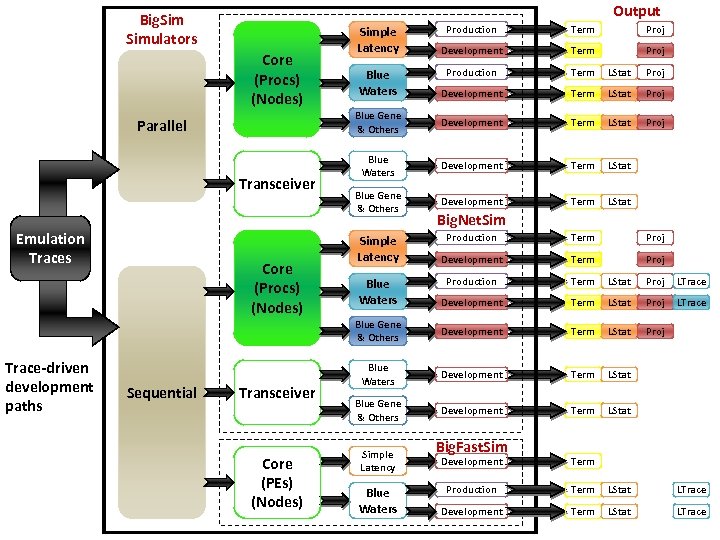
Output Big. Simulators Parallel Transceiver Emulation Traces Term Proj Development Term Proj Production Term LStat Proj Development Term LStat Proj Blue Gene & Others Core (Procs) (Nodes) Production Development Term LStat Proj Blue Waters Development Term LStat Blue Gene & Others Development Term LStat Simple Latency Blue Waters Big. Net. Sim Trace-driven development paths Sequential Transceiver Core (PEs) (Nodes) Term Proj Development Term Proj Production Term LStat Proj LTrace Development Term LStat Proj LTrace Blue Gene & Others Core (Procs) (Nodes) Production Development Term LStat Proj Blue Waters Development Term LStat Blue Gene & Others Development Term LStat Simple Latency Blue Waters Big. Fast. Sim Development Term Production Term LStat LTrace Development Term LStat LTrace
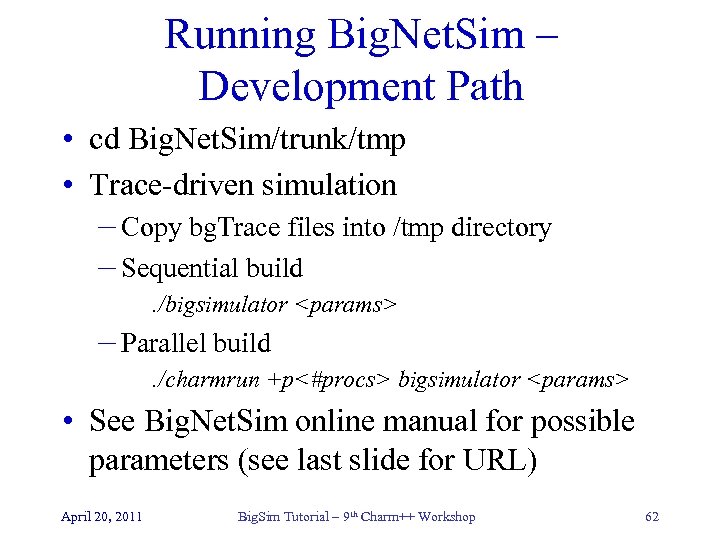
Running Big. Net. Sim – Development Path • cd Big. Net. Sim/trunk/tmp • Trace-driven simulation – Copy bg. Trace files into /tmp directory – Sequential build. /bigsimulator <params> – Parallel build. /charmrun +p<#procs> bigsimulator <params> • See Big. Net. Sim online manual for possible parameters (see last slide for URL) April 20, 2011 Big. Sim Tutorial – 9 th Charm++ Workshop 62
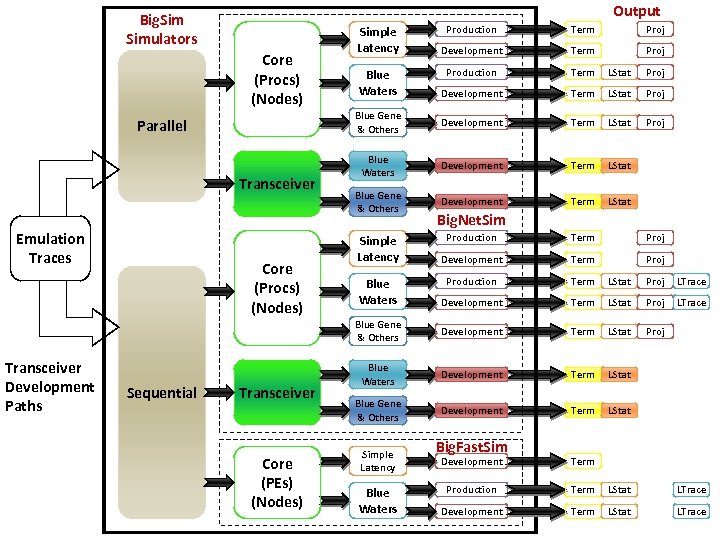
Output Big. Simulators Parallel Transceiver Emulation Traces Term Proj Development Term Proj Production Term LStat Proj Development Term LStat Proj Blue Gene & Others Core (Procs) (Nodes) Production Development Term LStat Proj Blue Waters Development Term LStat Blue Gene & Others Development Term LStat Simple Latency Blue Waters Big. Net. Sim Transceiver Development Paths Sequential Transceiver Core (PEs) (Nodes) Term Proj Development Term Proj Production Term LStat Proj LTrace Development Term LStat Proj LTrace Blue Gene & Others Core (Procs) (Nodes) Production Development Term LStat Proj Blue Waters Development Term LStat Blue Gene & Others Development Term LStat Simple Latency Blue Waters Big. Fast. Sim Development Term Production Term LStat LTrace Development Term LStat LTrace
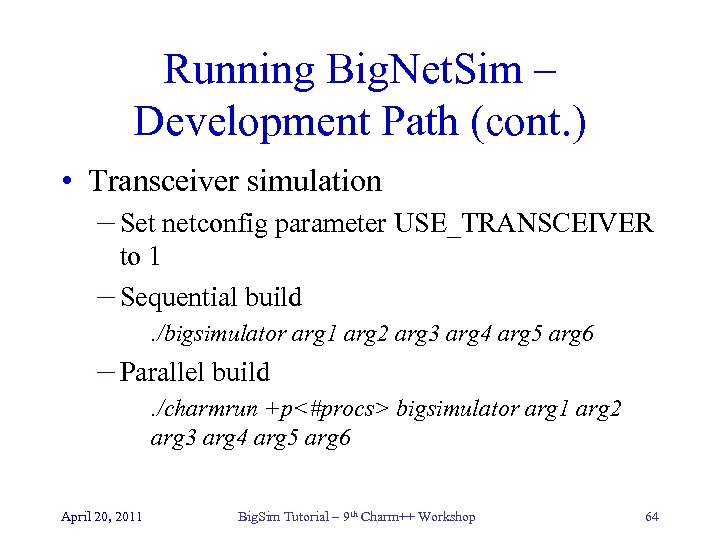
Running Big. Net. Sim – Development Path (cont. ) • Transceiver simulation – Set netconfig parameter USE_TRANSCEIVER to 1 – Sequential build. /bigsimulator arg 1 arg 2 arg 3 arg 4 arg 5 arg 6 – Parallel build. /charmrun +p<#procs> bigsimulator arg 1 arg 2 arg 3 arg 4 arg 5 arg 6 April 20, 2011 Big. Sim Tutorial – 9 th Charm++ Workshop 64
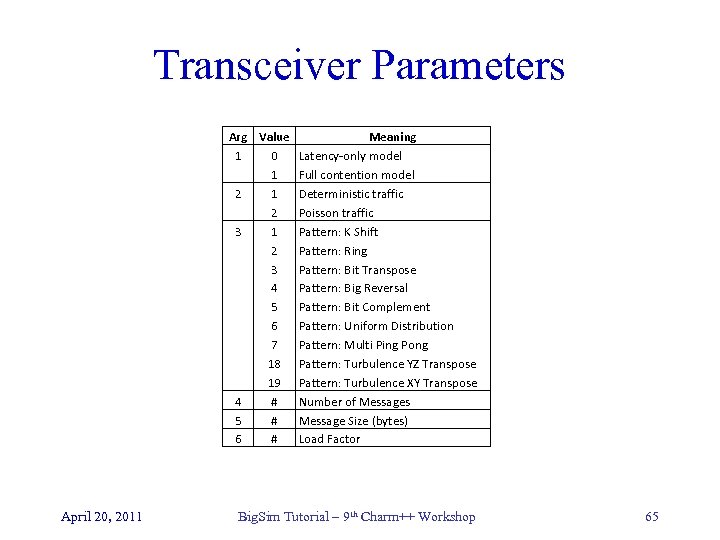
Transceiver Parameters Arg Value Meaning 1 0 Latency-only model 1 Full contention model 2 1 Deterministic traffic 2 Poisson traffic 3 1 Pattern: K Shift 2 Pattern: Ring 3 Pattern: Bit Transpose 4 Pattern: Big Reversal 5 Pattern: Bit Complement 6 Pattern: Uniform Distribution 7 Pattern: Multi Ping Pong 18 Pattern: Turbulence YZ Transpose 19 Pattern: Turbulence XY Transpose 4 # Number of Messages 5 # Message Size (bytes) 6 # Load Factor April 20, 2011 Big. Sim Tutorial – 9 th Charm++ Workshop 65
Output Big. Simulators Parallel Transceiver Emulation Traces Term Proj Development Term Proj Production Term LStat Proj Development Term LStat Proj Blue Gene & Others Core (Procs) (Nodes) Production Development Term LStat Proj Blue Waters Development Term LStat Blue Gene & Others Development Term LStat Simple Latency Blue Waters Big. Net. Sim Production paths Sequential Transceiver Core (PEs) (Nodes) Term Proj Development Term Proj Production Term LStat Proj LTrace Development Term LStat Proj LTrace Blue Gene & Others Core (Procs) (Nodes) Production Development Term LStat Proj Blue Waters Development Term LStat Blue Gene & Others Development Term LStat Simple Latency Blue Waters Big. Fast. Sim Development Term Production Term LStat LTrace Development Term LStat LTrace
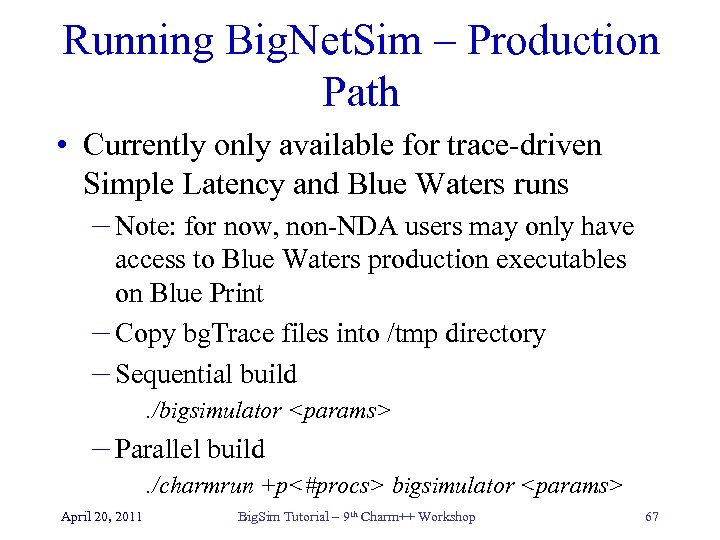
Running Big. Net. Sim – Production Path • Currently only available for trace-driven Simple Latency and Blue Waters runs – Note: for now, non-NDA users may only have access to Blue Waters production executables on Blue Print – Copy bg. Trace files into /tmp directory – Sequential build. /bigsimulator <params> – Parallel build. /charmrun +p<#procs> bigsimulator <params> April 20, 2011 Big. Sim Tutorial – 9 th Charm++ Workshop 67
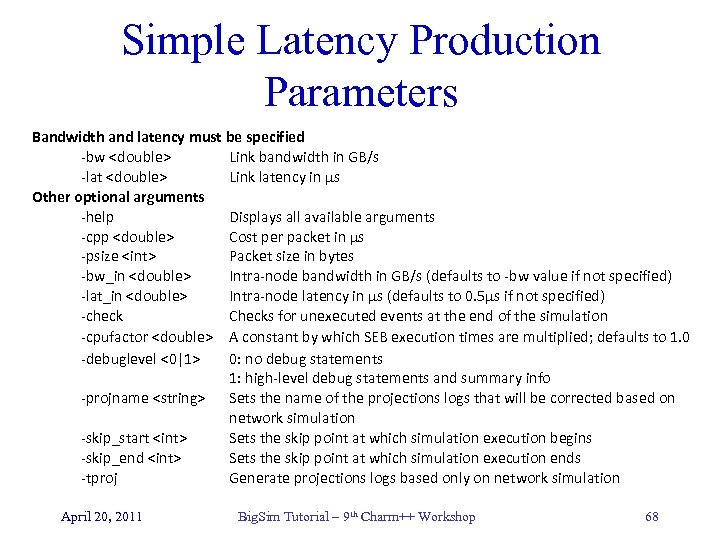
Simple Latency Production Parameters Bandwidth and latency must be specified -bw <double> Link bandwidth in GB/s -lat <double> Link latency in µs Other optional arguments -help Displays all available arguments -cpp <double> Cost per packet in µs -psize <int> Packet size in bytes -bw_in <double> Intra-node bandwidth in GB/s (defaults to -bw value if not specified) -lat_in <double> Intra-node latency in µs (defaults to 0. 5µs if not specified) -check Checks for unexecuted events at the end of the simulation -cpufactor <double> A constant by which SEB execution times are multiplied; defaults to 1. 0 -debuglevel <0|1> 0: no debug statements 1: high-level debug statements and summary info -projname <string> Sets the name of the projections logs that will be corrected based on network simulation -skip_start <int> Sets the skip point at which simulation execution begins -skip_end <int> Sets the skip point at which simulation execution ends -tproj Generate projections logs based only on network simulation April 20, 2011 Big. Sim Tutorial – 9 th Charm++ Workshop 68
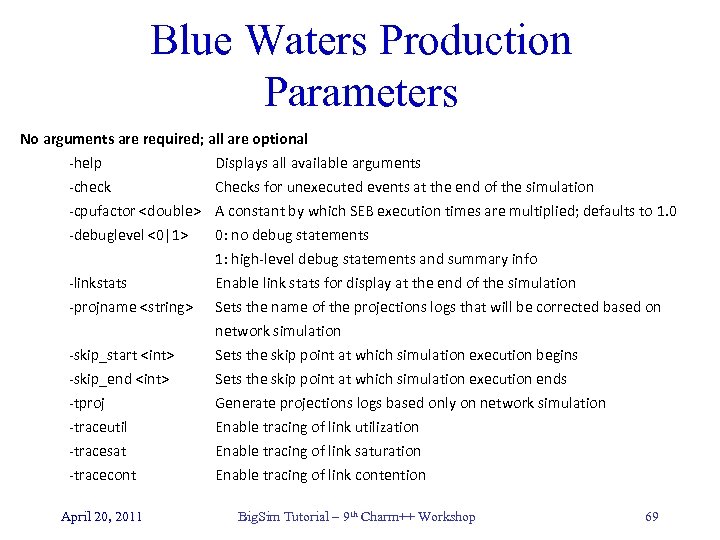
Blue Waters Production Parameters No arguments are required; all are optional -help Displays all available arguments -check Checks for unexecuted events at the end of the simulation -cpufactor <double> A constant by which SEB execution times are multiplied; defaults to 1. 0 -debuglevel <0|1> 0: no debug statements 1: high-level debug statements and summary info -linkstats -projname <string> -skip_start <int> -skip_end <int> -tproj -traceutil -tracesat -tracecont April 20, 2011 Enable link stats for display at the end of the simulation Sets the name of the projections logs that will be corrected based on network simulation Sets the skip point at which simulation execution begins Sets the skip point at which simulation execution ends Generate projections logs based only on network simulation Enable tracing of link utilization Enable tracing of link saturation Enable tracing of link contention Big. Sim Tutorial – 9 th Charm++ Workshop 69
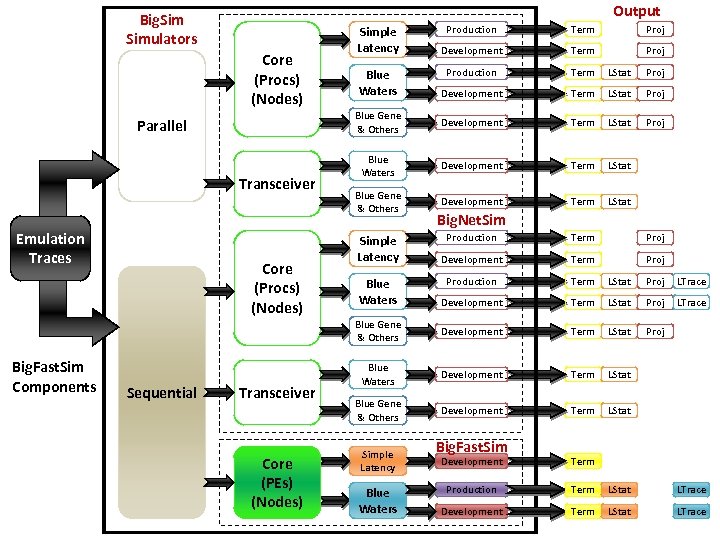
Output Big. Simulators Parallel Transceiver Emulation Traces Term Proj Development Term Proj Production Term LStat Proj Development Term LStat Proj Blue Gene & Others Core (Procs) (Nodes) Production Development Term LStat Proj Blue Waters Development Term LStat Blue Gene & Others Development Term LStat Simple Latency Blue Waters Big. Net. Sim Big. Fast. Sim Components Sequential Transceiver Core (PEs) (Nodes) Term Proj Development Term Proj Production Term LStat Proj LTrace Development Term LStat Proj LTrace Blue Gene & Others Core (Procs) (Nodes) Production Development Term LStat Proj Blue Waters Development Term LStat Blue Gene & Others Development Term LStat Simple Latency Blue Waters Big. Fast. Sim Development Term Production Term LStat LTrace Development Term LStat LTrace
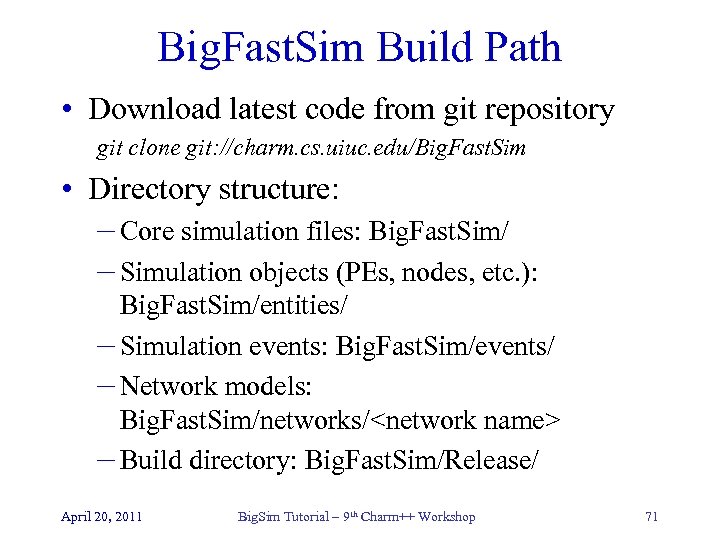
Big. Fast. Sim Build Path • Download latest code from git repository git clone git: //charm. cs. uiuc. edu/Big. Fast. Sim • Directory structure: – Core simulation files: Big. Fast. Sim/ – Simulation objects (PEs, nodes, etc. ): Big. Fast. Sim/entities/ – Simulation events: Big. Fast. Sim/events/ – Network models: Big. Fast. Sim/networks/<network name> – Build directory: Big. Fast. Sim/Release/ April 20, 2011 Big. Sim Tutorial – 9 th Charm++ Workshop 71
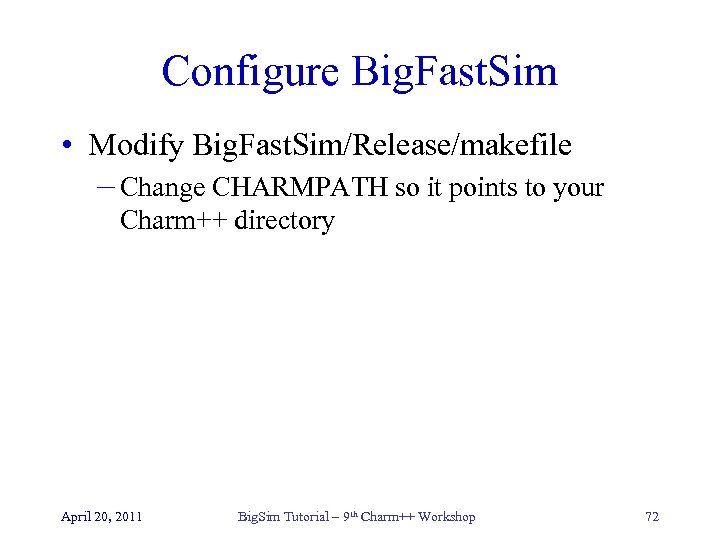
Configure Big. Fast. Sim • Modify Big. Fast. Sim/Release/makefile – Change CHARMPATH so it points to your Charm++ directory April 20, 2011 Big. Sim Tutorial – 9 th Charm++ Workshop 72
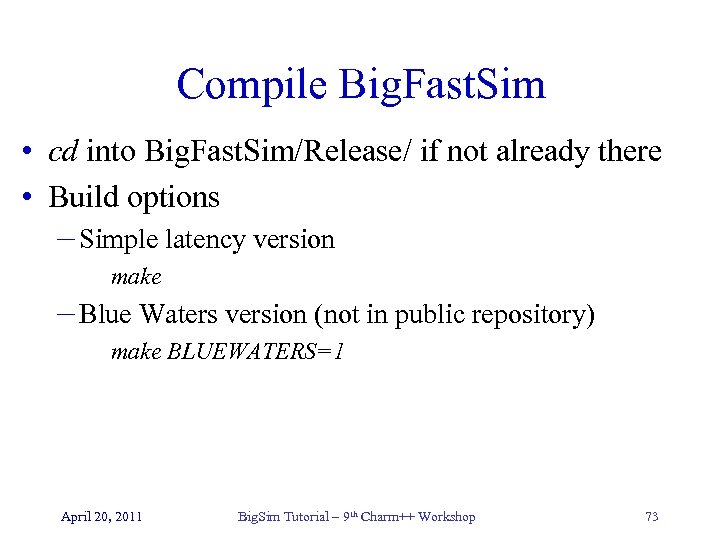
Compile Big. Fast. Sim • cd into Big. Fast. Sim/Release/ if not already there • Build options – Simple latency version make – Blue Waters version (not in public repository) make BLUEWATERS=1 April 20, 2011 Big. Sim Tutorial – 9 th Charm++ Workshop 73
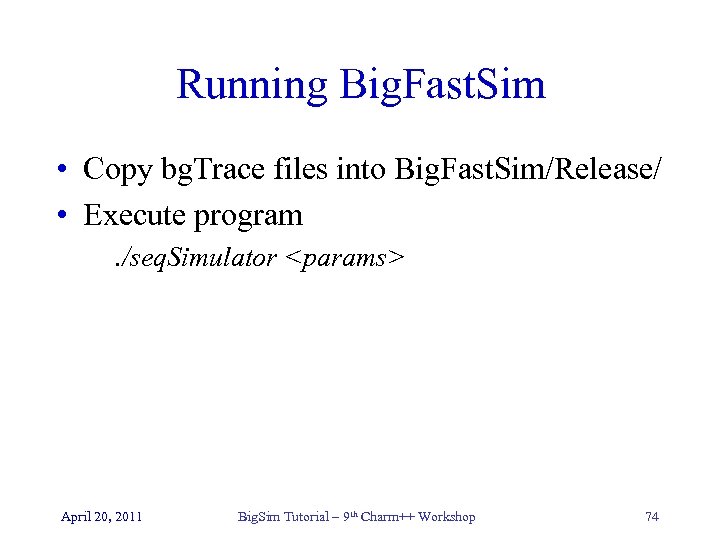
Running Big. Fast. Sim • Copy bg. Trace files into Big. Fast. Sim/Release/ • Execute program. /seq. Simulator <params> April 20, 2011 Big. Sim Tutorial – 9 th Charm++ Workshop 74
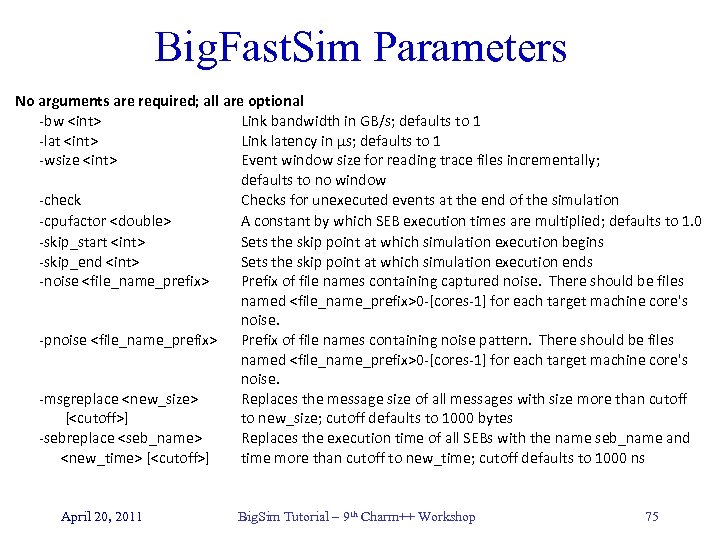
Big. Fast. Sim Parameters No arguments are required; all are optional -bw <int> Link bandwidth in GB/s; defaults to 1 -lat <int> Link latency in µs; defaults to 1 -wsize <int> Event window size for reading trace files incrementally; defaults to no window -check Checks for unexecuted events at the end of the simulation -cpufactor <double> A constant by which SEB execution times are multiplied; defaults to 1. 0 -skip_start <int> Sets the skip point at which simulation execution begins -skip_end <int> Sets the skip point at which simulation execution ends -noise <file_name_prefix> Prefix of file names containing captured noise. There should be files named <file_name_prefix>0 -[cores-1] for each target machine core's noise. -pnoise <file_name_prefix> Prefix of file names containing noise pattern. There should be files named <file_name_prefix>0 -[cores-1] for each target machine core's noise. -msgreplace <new_size> Replaces the message size of all messages with size more than cutoff [<cutoff>] to new_size; cutoff defaults to 1000 bytes -sebreplace <seb_name> Replaces the execution time of all SEBs with the name seb_name and <new_time> [<cutoff>] time more than cutoff to new_time; cutoff defaults to 1000 ns April 20, 2011 Big. Sim Tutorial – 9 th Charm++ Workshop 75
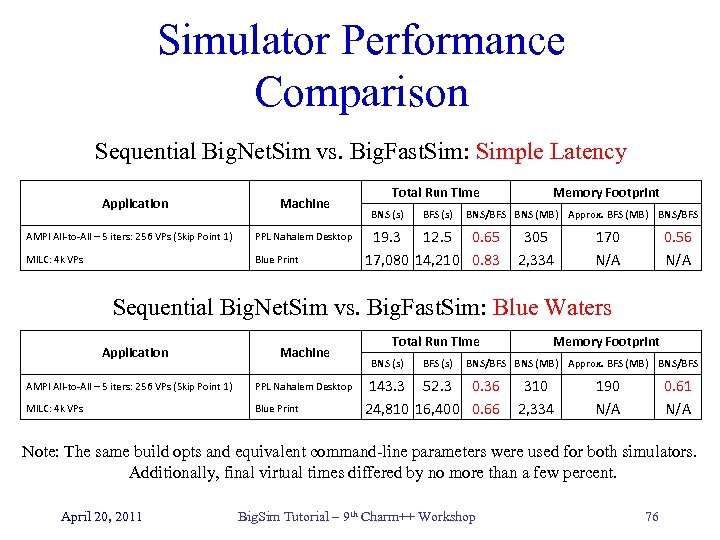
Simulator Performance Comparison Sequential Big. Net. Sim vs. Big. Fast. Sim: Simple Latency Application Machine AMPI All-to-All – 5 iters: 256 VPs (Skip Point 1) PPL Nahalem Desktop MILC: 4 k VPs Blue Print Total Run Time BNS (s) BFS (s) Memory Footprint BNS/BFS BNS (MB) Approx. BFS (MB) BNS/BFS 19. 3 12. 5 0. 65 17, 080 14, 210 0. 83 305 2, 334 170 N/A 0. 56 N/A Sequential Big. Net. Sim vs. Big. Fast. Sim: Blue Waters Application Machine AMPI All-to-All – 5 iters: 256 VPs (Skip Point 1) PPL Nahalem Desktop MILC: 4 k VPs Blue Print Total Run Time BNS (s) BFS (s) Memory Footprint BNS/BFS BNS (MB) Approx. BFS (MB) BNS/BFS 143. 3 52. 3 0. 36 24, 810 16, 400 0. 66 310 2, 334 190 N/A 0. 61 N/A Note: The same build opts and equivalent command-line parameters were used for both simulators. Additionally, final virtual times differed by no more than a few percent. April 20, 2011 Big. Sim Tutorial – 9 th Charm++ Workshop 76
Big. Simulators Parallel Transceiver Core (Procs) (Nodes) Proj Development Term Proj Production Term LStat Proj Development Term LStat Proj Blue Gene & Others Core (Procs) (Nodes) Emulation Traces Development Term LStat Proj Blue Waters Development Term LStat Blue Gene & Others Development Term LStat Blue Waters Simple Latency Blue Waters Big. Net. Sim Production Sequential Transceiver Core (PEs) (Nodes) 2 Term Proj Development Term Proj Production Term LStat Proj LTrace Development Term LStat Proj LTrace Term LStat Proj Term LStat 4 Term LStat 5 Term Blue Gene & Others Build path examples 1 Term Simple Latency Production Output Development Blue Waters Development Blue Gene & Others Development Simple Latency Blue Waters Big. Fast. Sim Development 3 Production Term LStat LTrace Development Term LStat LTrace
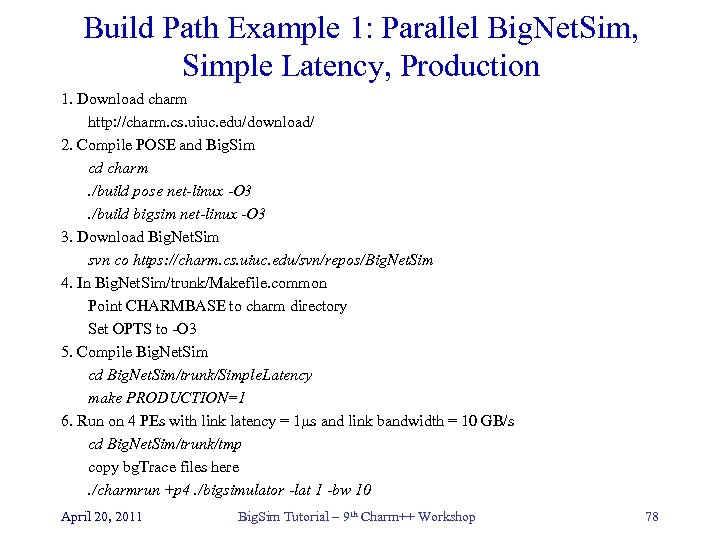
Build Path Example 1: Parallel Big. Net. Sim, Simple Latency, Production 1. Download charm http: //charm. cs. uiuc. edu/download/ 2. Compile POSE and Big. Sim cd charm. /build pose net-linux -O 3. /build bigsim net-linux -O 3 3. Download Big. Net. Sim svn co https: //charm. cs. uiuc. edu/svn/repos/Big. Net. Sim 4. In Big. Net. Sim/trunk/Makefile. common Point CHARMBASE to charm directory Set OPTS to -O 3 5. Compile Big. Net. Sim cd Big. Net. Sim/trunk/Simple. Latency make PRODUCTION=1 6. Run on 4 PEs with link latency = 1µs and link bandwidth = 10 GB/s cd Big. Net. Sim/trunk/tmp copy bg. Trace files here. /charmrun +p 4. /bigsimulator -lat 1 -bw 10 April 20, 2011 Big. Sim Tutorial – 9 th Charm++ Workshop 78
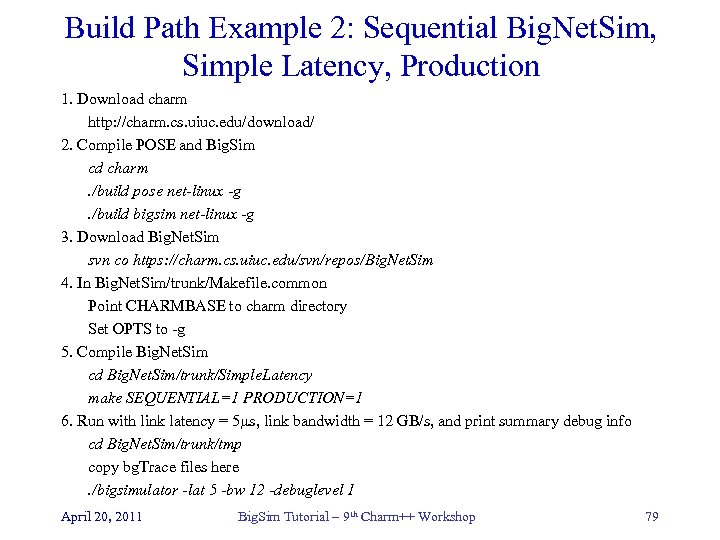
Build Path Example 2: Sequential Big. Net. Sim, Simple Latency, Production 1. Download charm http: //charm. cs. uiuc. edu/download/ 2. Compile POSE and Big. Sim cd charm. /build pose net-linux -g. /build bigsim net-linux -g 3. Download Big. Net. Sim svn co https: //charm. cs. uiuc. edu/svn/repos/Big. Net. Sim 4. In Big. Net. Sim/trunk/Makefile. common Point CHARMBASE to charm directory Set OPTS to -g 5. Compile Big. Net. Sim cd Big. Net. Sim/trunk/Simple. Latency make SEQUENTIAL=1 PRODUCTION=1 6. Run with link latency = 5µs, link bandwidth = 12 GB/s, and print summary debug info cd Big. Net. Sim/trunk/tmp copy bg. Trace files here. /bigsimulator -lat 5 -bw 12 -debuglevel 1 April 20, 2011 Big. Sim Tutorial – 9 th Charm++ Workshop 79
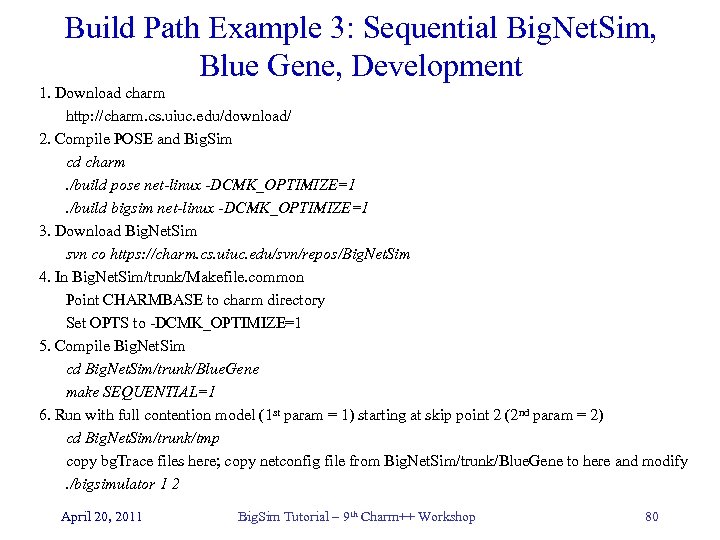
Build Path Example 3: Sequential Big. Net. Sim, Blue Gene, Development 1. Download charm http: //charm. cs. uiuc. edu/download/ 2. Compile POSE and Big. Sim cd charm. /build pose net-linux -DCMK_OPTIMIZE=1. /build bigsim net-linux -DCMK_OPTIMIZE=1 3. Download Big. Net. Sim svn co https: //charm. cs. uiuc. edu/svn/repos/Big. Net. Sim 4. In Big. Net. Sim/trunk/Makefile. common Point CHARMBASE to charm directory Set OPTS to -DCMK_OPTIMIZE=1 5. Compile Big. Net. Sim cd Big. Net. Sim/trunk/Blue. Gene make SEQUENTIAL=1 6. Run with full contention model (1 st param = 1) starting at skip point 2 (2 nd param = 2) cd Big. Net. Sim/trunk/tmp copy bg. Trace files here; copy netconfig file from Big. Net. Sim/trunk/Blue. Gene to here and modify. /bigsimulator 1 2 April 20, 2011 Big. Sim Tutorial – 9 th Charm++ Workshop 80
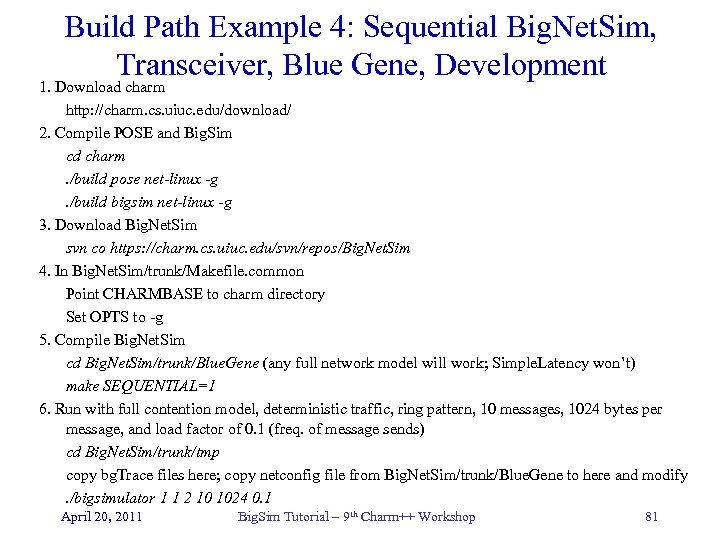
Build Path Example 4: Sequential Big. Net. Sim, Transceiver, Blue Gene, Development 1. Download charm http: //charm. cs. uiuc. edu/download/ 2. Compile POSE and Big. Sim cd charm. /build pose net-linux -g. /build bigsim net-linux -g 3. Download Big. Net. Sim svn co https: //charm. cs. uiuc. edu/svn/repos/Big. Net. Sim 4. In Big. Net. Sim/trunk/Makefile. common Point CHARMBASE to charm directory Set OPTS to -g 5. Compile Big. Net. Sim cd Big. Net. Sim/trunk/Blue. Gene (any full network model will work; Simple. Latency won’t) make SEQUENTIAL=1 6. Run with full contention model, deterministic traffic, ring pattern, 10 messages, 1024 bytes per message, and load factor of 0. 1 (freq. of message sends) cd Big. Net. Sim/trunk/tmp copy bg. Trace files here; copy netconfig file from Big. Net. Sim/trunk/Blue. Gene to here and modify. /bigsimulator 1 1 2 10 1024 0. 1 April 20, 2011 Big. Sim Tutorial – 9 th Charm++ Workshop 81
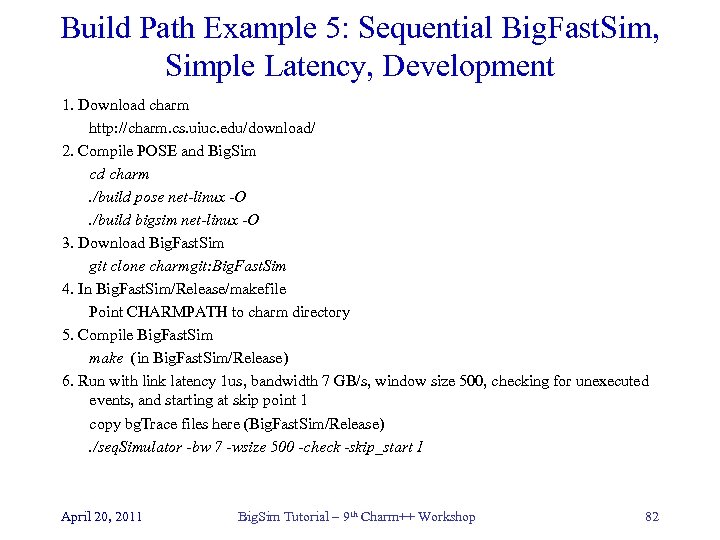
Build Path Example 5: Sequential Big. Fast. Sim, Simple Latency, Development 1. Download charm http: //charm. cs. uiuc. edu/download/ 2. Compile POSE and Big. Sim cd charm. /build pose net-linux -O. /build bigsim net-linux -O 3. Download Big. Fast. Sim git clone charmgit: Big. Fast. Sim 4. In Big. Fast. Sim/Release/makefile Point CHARMPATH to charm directory 5. Compile Big. Fast. Sim make (in Big. Fast. Sim/Release) 6. Run with link latency 1 us, bandwidth 7 GB/s, window size 500, checking for unexecuted events, and starting at skip point 1 copy bg. Trace files here (Big. Fast. Sim/Release). /seq. Simulator -bw 7 -wsize 500 -check -skip_start 1 April 20, 2011 Big. Sim Tutorial – 9 th Charm++ Workshop 82
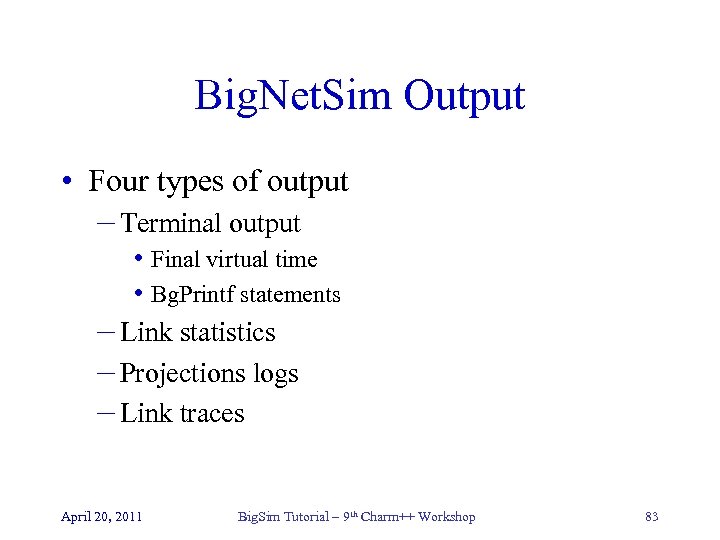
Big. Net. Sim Output • Four types of output – Terminal output • Final virtual time • Bg. Printf statements – Link statistics – Projections logs – Link traces April 20, 2011 Big. Sim Tutorial – 9 th Charm++ Workshop 83
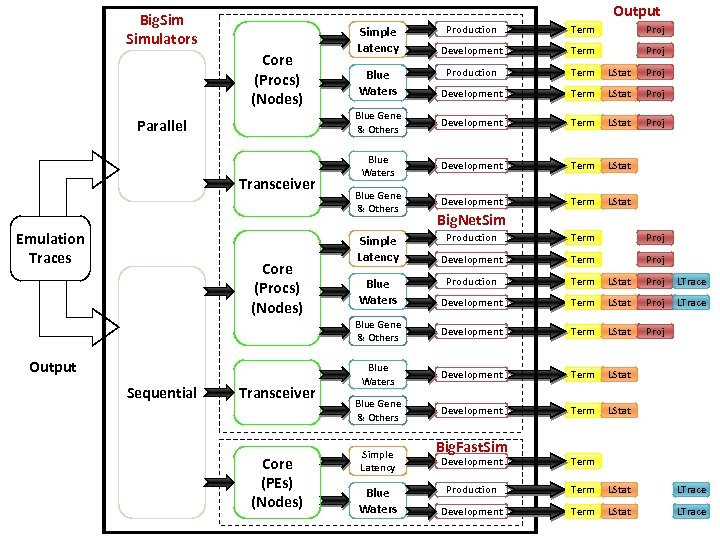
Output Big. Simulators Parallel Transceiver Emulation Traces Term Proj Development Term Proj Production Term LStat Proj Development Term LStat Proj Blue Gene & Others Core (Procs) (Nodes) Production Development Term LStat Proj Blue Waters Development Term LStat Blue Gene & Others Development Term LStat Simple Latency Blue Waters Big. Net. Sim Output Sequential Transceiver Core (PEs) (Nodes) Term Proj Development Term Proj Production Term LStat Proj LTrace Development Term LStat Proj LTrace Blue Gene & Others Core (Procs) (Nodes) Production Development Term LStat Proj Blue Waters Development Term LStat Blue Gene & Others Development Term LStat Simple Latency Blue Waters Big. Fast. Sim Development Term Production Term LStat LTrace Development Term LStat LTrace
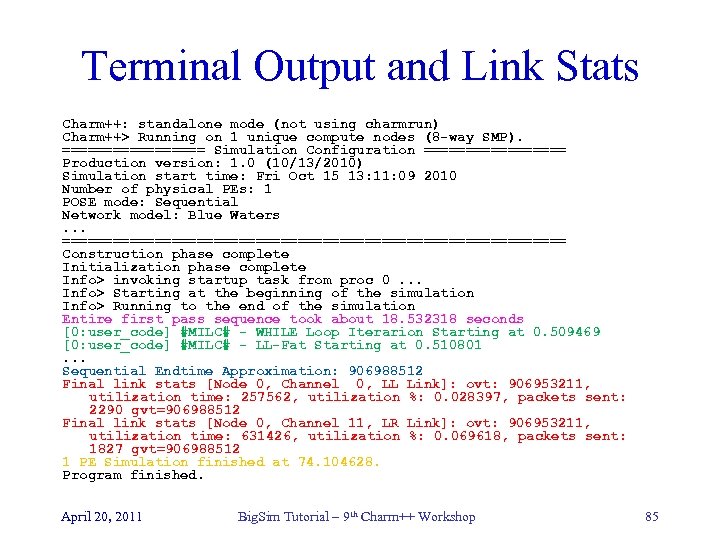
Terminal Output and Link Stats Charm++: standalone mode (not using charmrun) Charm++> Running on 1 unique compute nodes (8 -way SMP). ========= Simulation Configuration ========= Production version: 1. 0 (10/13/2010) Simulation start time: Fri Oct 15 13: 11: 09 2010 Number of physical PEs: 1 POSE mode: Sequential Network model: Blue Waters. . . ============================== Construction phase complete Initialization phase complete Info> invoking startup task from proc 0. . . Info> Starting at the beginning of the simulation Info> Running to the end of the simulation Entire first pass sequence took about 18. 532318 seconds [0: user_code] #MILC# - WHILE Loop Iterarion Starting at 0. 509469 [0: user_code] #MILC# - LL-Fat Starting at 0. 510801. . . Sequential Endtime Approximation: 906988512 Final link stats [Node 0, Channel 0, LL Link]: ovt: 906953211, utilization time: 257562, utilization %: 0. 028397, packets sent: 2290 gvt=906988512 Final link stats [Node 0, Channel 11, LR Link]: ovt: 906953211, utilization time: 631426, utilization %: 0. 069618, packets sent: 1827 gvt=906988512 1 PE Simulation finished at 74. 104628. Program finished. April 20, 2011 Big. Sim Tutorial – 9 th Charm++ Workshop 85
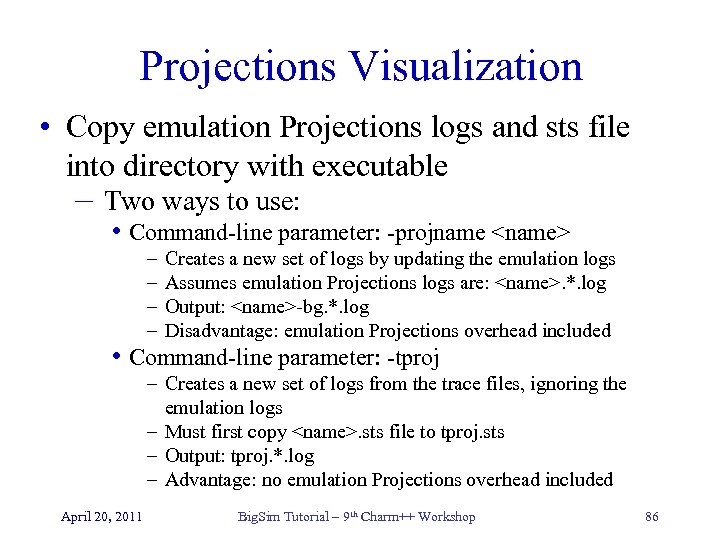
Projections Visualization • Copy emulation Projections logs and sts file into directory with executable – Two ways to use: • Command-line parameter: -projname <name> – – Creates a new set of logs by updating the emulation logs Assumes emulation Projections logs are: <name>. *. log Output: <name>-bg. *. log Disadvantage: emulation Projections overhead included • Command-line parameter: -tproj – Creates a new set of logs from the trace files, ignoring the emulation logs – Must first copy <name>. sts file to tproj. sts – Output: tproj. *. log – Advantage: no emulation Projections overhead included April 20, 2011 Big. Sim Tutorial – 9 th Charm++ Workshop 86
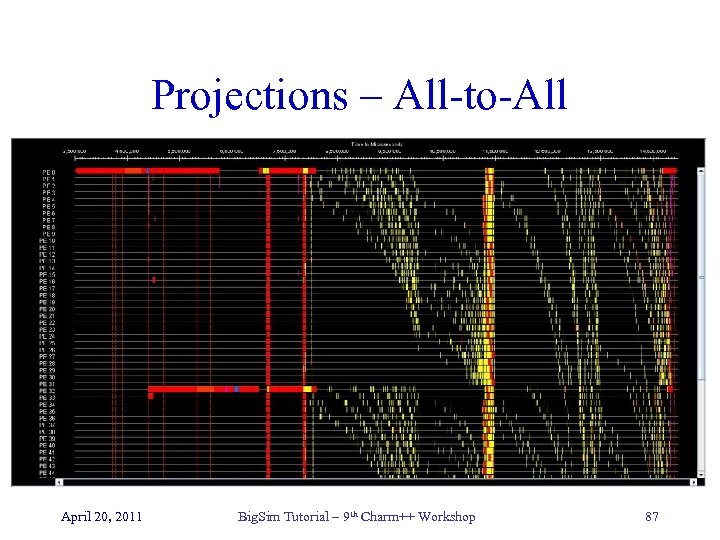
Projections – All-to-All April 20, 2011 Big. Sim Tutorial – 9 th Charm++ Workshop 87
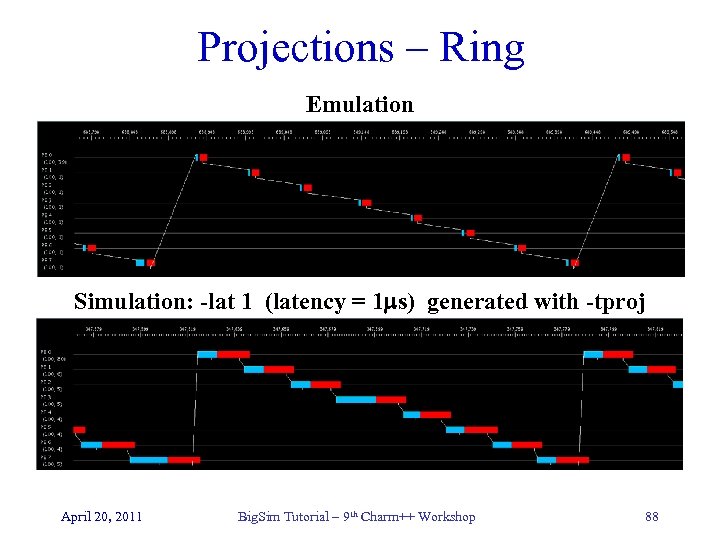
Projections – Ring Emulation Simulation: -lat 1 (latency = 1 s) generated with -tproj April 20, 2011 Big. Sim Tutorial – 9 th Charm++ Workshop 88
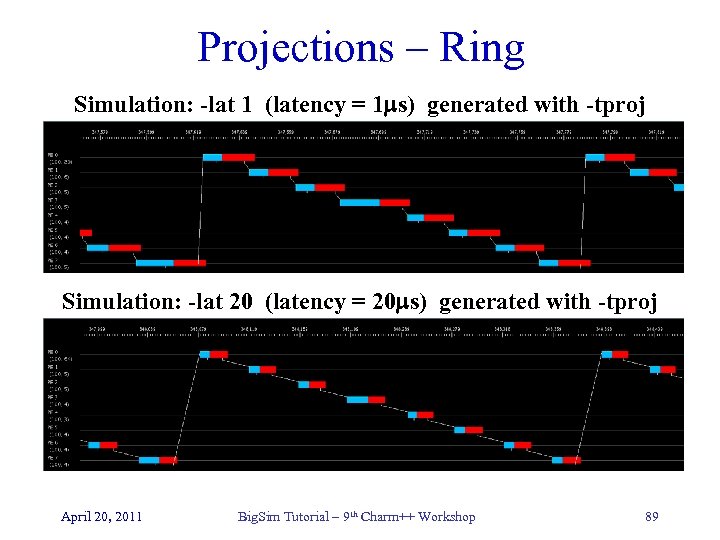
Projections – Ring Simulation: -lat 1 (latency = 1 s) generated with -tproj Simulation: -lat 20 (latency = 20 s) generated with -tproj April 20, 2011 Big. Sim Tutorial – 9 th Charm++ Workshop 89
Link Tracing • Printed link stats only give util % over entire run • Trace usage of each link – Utilization – Saturation – Contention • Only links with traffic are traced • Disadvantages – Slows simulation and increases memory usage • Only for Sequential Blue Waters model currently – Run with -traceutil, -tracesat, and -tracecont April 20, 2011 Big. Sim Tutorial – 9 th Charm++ Workshop 90
Link Tracing Definitions • Utilization – a link is in use whenever a packet is being transmitted over it • Saturation – a link is saturated when the next packet won’t fit in its output buffer • Contention – a link is in contention when the next packet won’t fit in its output buffer and it contains packets from more than one source node April 20, 2011 Big. Sim Tutorial – 9 th Charm++ Workshop 91
Link. Analyzer • Tool for analyzing the binary link traces generated by Big. Net. Sim • Not in the public repository right now April 20, 2011 Big. Sim Tutorial – 9 th Charm++ Workshop 92
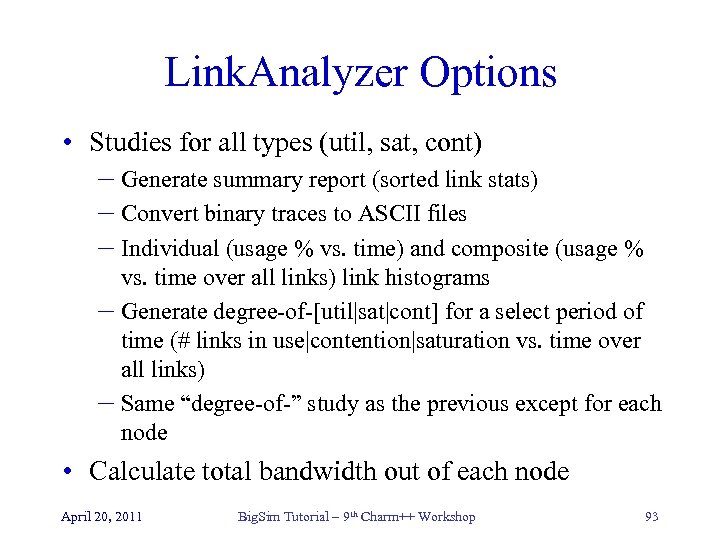
Link. Analyzer Options • Studies for all types (util, sat, cont) – Generate summary report (sorted link stats) – Convert binary traces to ASCII files – Individual (usage % vs. time) and composite (usage % – – vs. time over all links) link histograms Generate degree-of-[util|sat|cont] for a select period of time (# links in use|contention|saturation vs. time over all links) Same “degree-of-” study as the previous except for each node • Calculate total bandwidth out of each node April 20, 2011 Big. Sim Tutorial – 9 th Charm++ Workshop 93
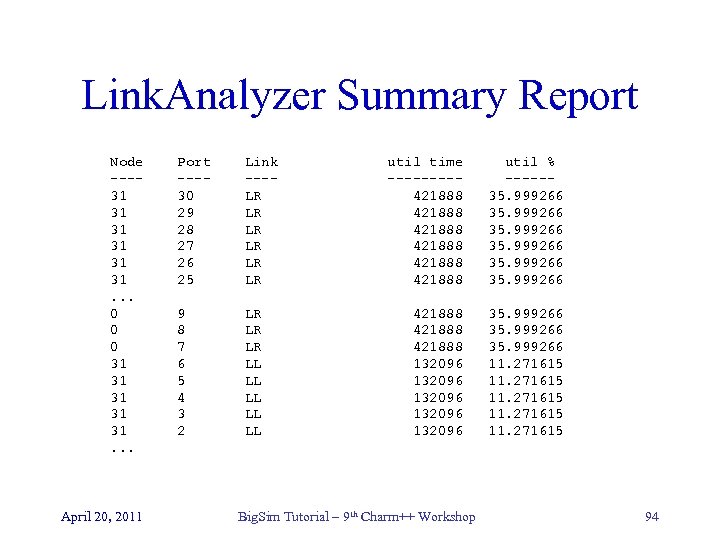
Link. Analyzer Summary Report Node ---31 31. . . 0 0 0 31 31 31. . . April 20, 2011 Port ---30 29 28 27 26 25 Link ---LR LR LR 9 8 7 6 5 4 3 2 LR LR LR LL LL LL util time ----421888 421888 util % -----35. 999266 421888 132096 132096 35. 999266 11. 271615 Big. Sim Tutorial – 9 th Charm++ Workshop 94
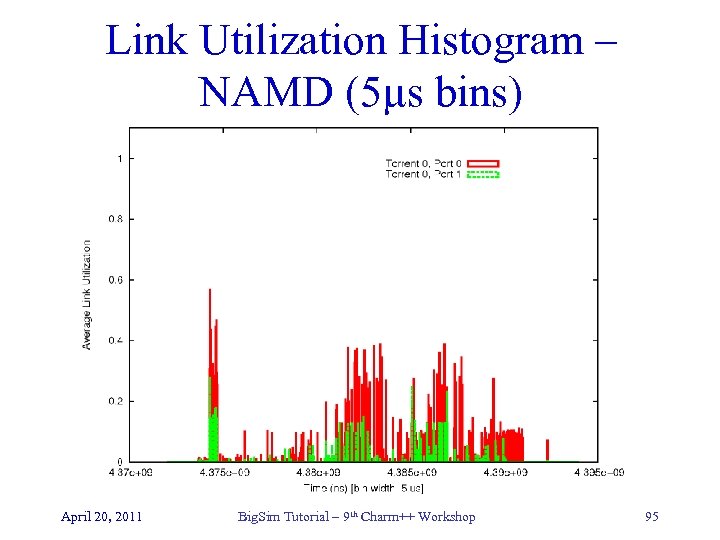
Link Utilization Histogram – NAMD (5µs bins) April 20, 2011 Big. Sim Tutorial – 9 th Charm++ Workshop 95
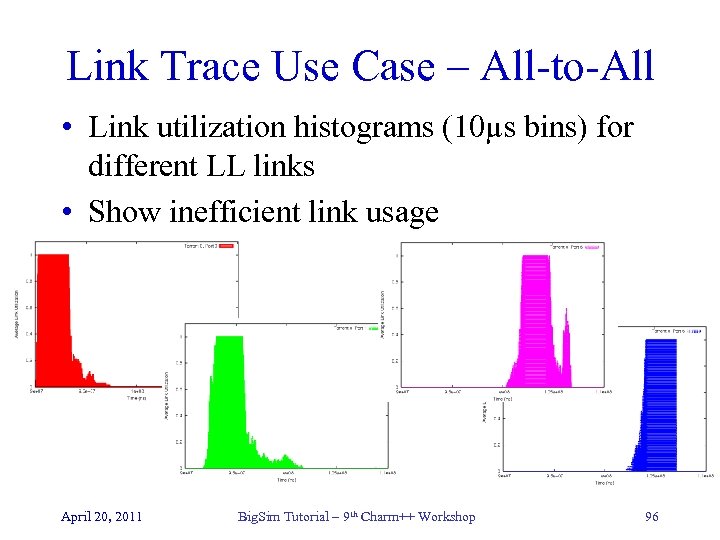
Link Trace Use Case – All-to-All • Link utilization histograms (10µs bins) for different LL links • Show inefficient link usage April 20, 2011 Big. Sim Tutorial – 9 th Charm++ Workshop 96
Extensibility • Other network models can be plugged into the main network framework in Big. Net. Sim – Routing algorithm – Topology – Input and output virtual channel selection strategies • See 2008 and 2009 Big. Sim tutorials for more info (see last slide for URLs) April 20, 2011 Big. Sim Tutorial – 9 th Charm++ Workshop 97
Additional Resources • Big. Sim Manuals: http: //charm. cs. uiuc. edu/manuals/ • Online Tutorial: at NCSA’s Web-based CI-Tutor • Recent Charm++ Workshop Tutorials and Talks – 2008 Big. Sim tutorial (bottom of page) • http: //charm. cs. illinois. edu/workshops/charm. Workshop 2008/slides. html – 2009 Big. Sim tutorial (bottom of page) • http: //charm. cs. uiuc. edu/workshops/charm. Workshop 2009/program. html – 2010 Big. Sim talk (near top of page) • http: //charm. cs. uiuc. edu/charm. Workshop/program. php – 2010 PRAC Workshop talk • http: //charm. cs. uiuc. edu/talks/Big. Sim. PRAC 10. ppt • E-mail PPL for help: ppl@cs. uiuc. edu April 20, 2011 Big. Sim Tutorial – 9 th Charm++ Workshop 98
Big. Sim Support • NSF Grants: – NGS 0103645 – CSR-SMA-0720827 • NSF/NCSA Blue Waters Grant: – OCI-0725070 • Machine Time: – Tera. Grid machines: allocation TG-ASC 050039 N – NCSA machines: Blue. Waters’ project allocation April 20, 2011 Big. Sim Tutorial – 9 th Charm++ Workshop 99
Скачать презентацию Big Sim Tutorial Celso L Mendes — Ryan
c0bf01238a9329ce703286fbfe1e69a5.ppt